Archive for the ‘along the shore’ Category
harvesting colour – Sea Lavender
~

Sea Lavender, picked long ago and woven into a wreath
~
~
Sea Lavender
Limonium Nashii Small.
1.
bunch of lavender, dry
picked at the edge
of the sea
2.
at high tide, overcome
by salt water, linear
leaves buffeted
as rags, tattered purple papers
echoed in oil-slick
mirrors of foam
3.
on-shore breeze, stiff
sprays of Sea Lavender
tremble
~
~
Published as ‘Sea Lavender’, Canadian Stories 17 (99),October/November 2014
Copyright 2014 Jane Tims

dry Sea Lavender
aromatic spring
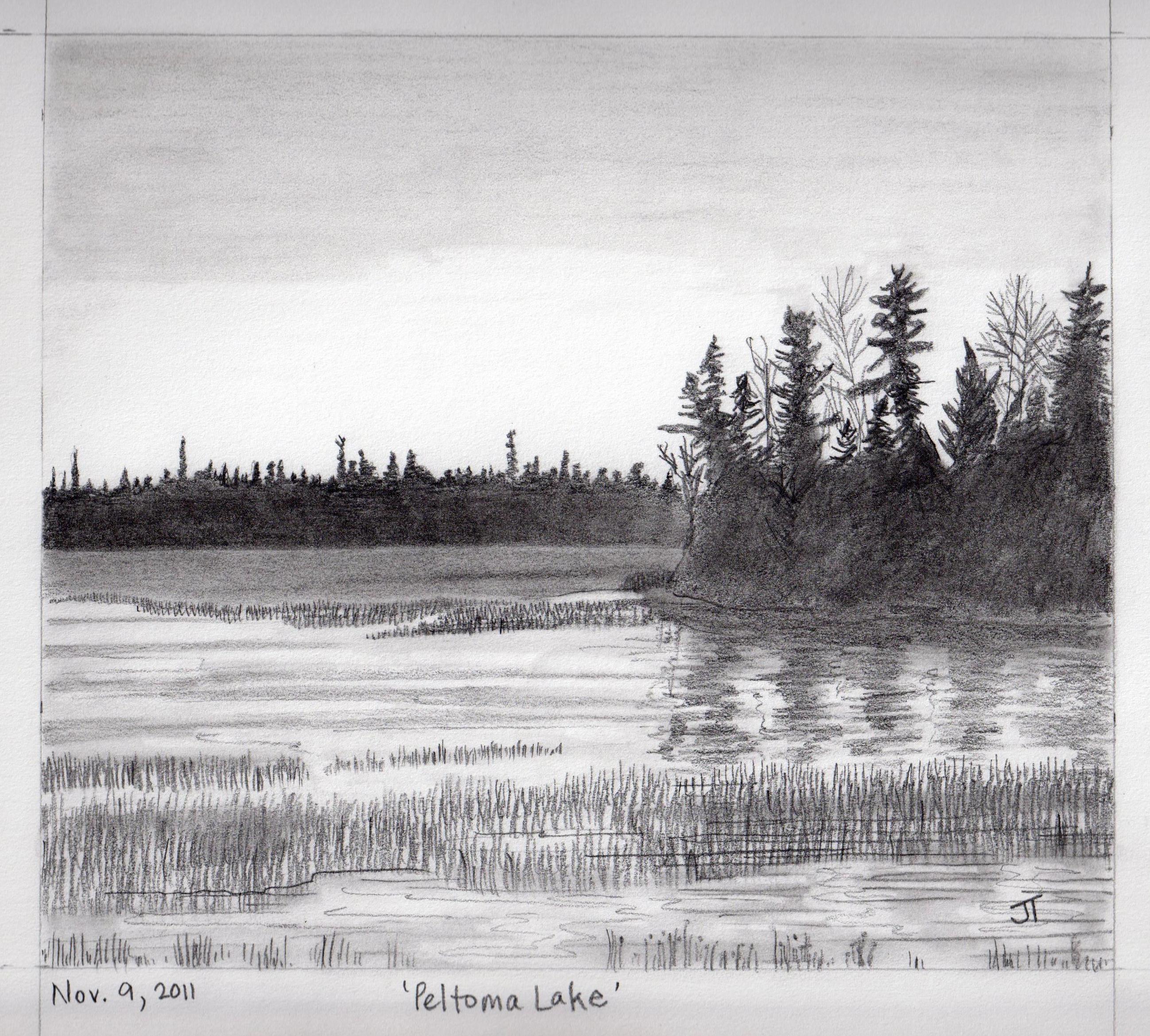
November 9, 2011 ‘Peltoma Lake’ Jane Tims
~
meadow aromatic
~
ozone lightning, late
waters cede, shoots
of cattail merge
end of day, end of June
fireflies, mosquito nights
~
lake-land meadow seeps
wetland meets nostril
marsh musk percolates
half sour, half sweet
methane ooze, decay
~
damp fiddleheads unfurl
bird beaks simmer
in duckweed soup
skin of salamander, frog
steeplebush, meadowsweet
~
angels crave human years, allow
their pores release, scent imitates
reek of sweat, of work
tears mingle with perfume
aftershave and powder
~
~
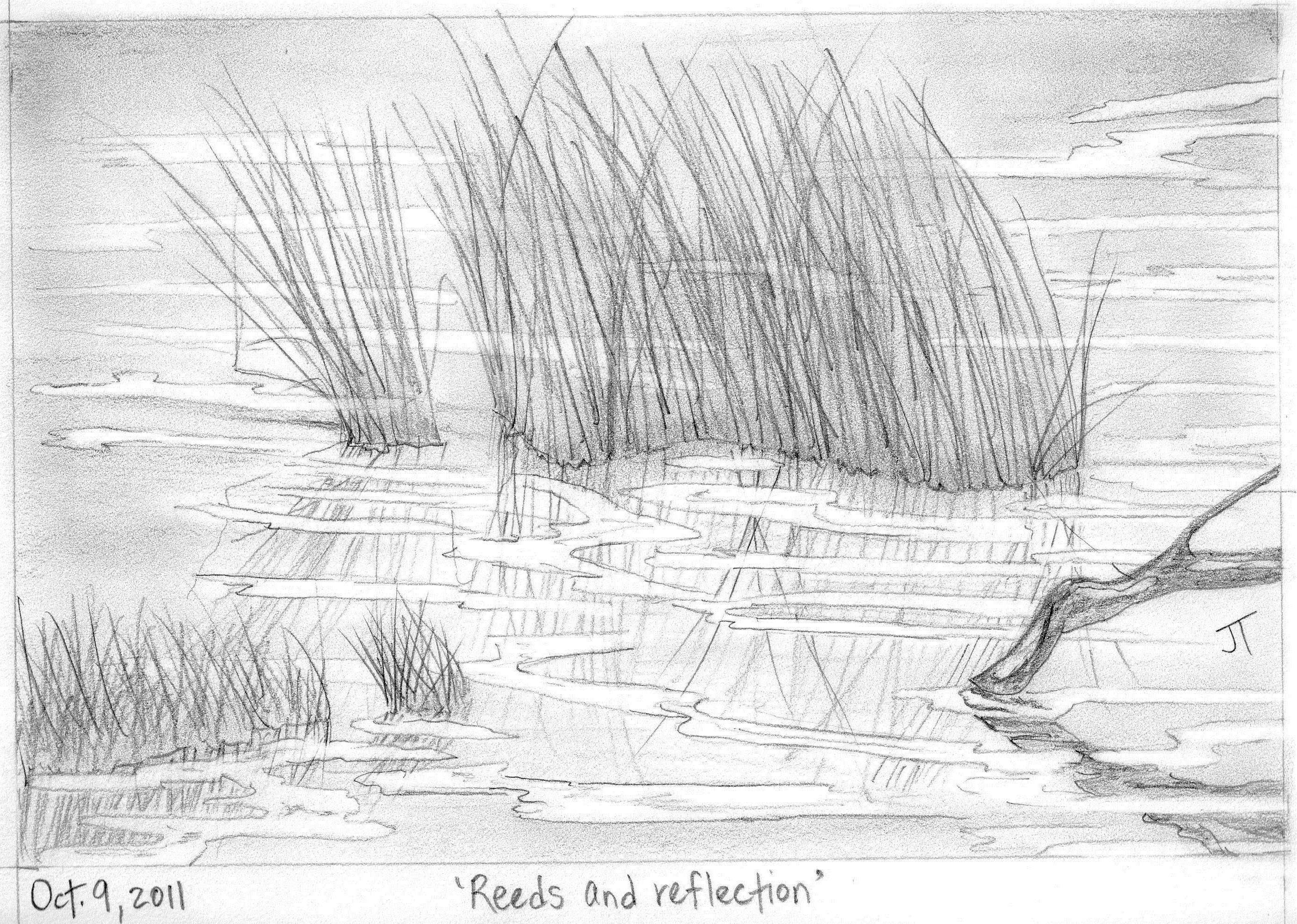
Oct. 9, 2011 ‘Reeds and reflection’ Jane Tims
~
Copyright 2014 Jane Tims
California #3 – the Pacific Ocean
When I went to California, I wanted to do four things: see my brother and my sister-in-law in their new home, drive over the Golden Gate Bridge, see Star Trek Academy (or its eventual location) and stick my toe in the Pacific Ocean. The first three were easy, but seeing the Pacific and touching it were two different things. We saw it almost immediately from the plane. Then we walked along Fishermen’s Wharf, watched the boats bobbing in the quay, walked among the Bay fish at the Aquarium and travelled on the Bay Cruise around Alcatraz and under the Golden Gate Bridge twice. Beyond the Golden Gate Bridge, I experienced some of the power of the Pacific Ocean. As you cross under the Bridge, the water turns very choppy and churns and twists and swells.
~
Once we got to Calistoga, my brother gave us his car for the day and my son and I headed across the winding roads of the Calistoga hills. Thanks to our GPS and my son’s piloting skills, we reached the coast with little problem. The waves were gorgeous – big white breakers on a blue ocean and a blue sky in the background. Surfers were riding the biggest of the waves. However, we couldn’t seem to find a way down to the beach that wouldn’t wreck my knees, so we contented ourselves with the view. Then we ate at the ‘Tides’ restaurant, at a seat near the window directly over the water. It was so close we both felt as though we were moving!
~
Our last stop was at Goat Rock. After a snail’s pace and a harrowing descent of very twisty roads, we reached the beach, but after reading the signs (they said it is the most dangerous beach in California for undertows), we decided to content ourselves with walking in the deep sand. As we turned from the ocean to return to Calistoga, I wondered why I was not disappointed at not getting my feet wet. The answer … I intend to return again and I’ll poke my toes in then!!!!
~
Since my son has all our photos, I will share some photos and my painting of the Atlantic Ocean (Lawrencetown Beach) from my visit this spring with my other brother.
~

~


~

~
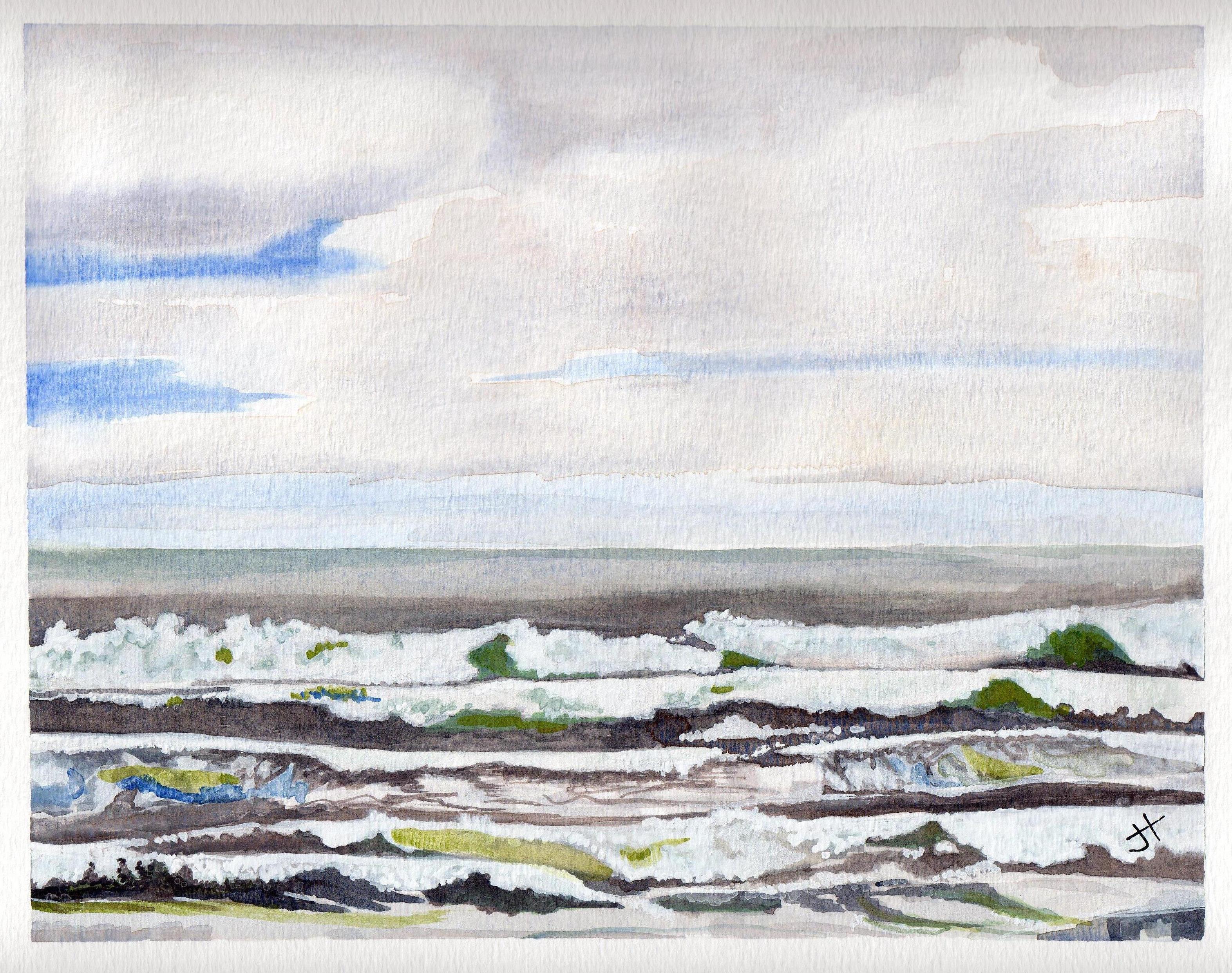
November 16, 2013 ‘Lawrencetown Beach, Nova Scotia’ Jane Tims
~
~
Copyright 2013 Jane Tims
by the frozen lake, next year
It’s mild here today and we are expecting lots of snow. I’m working on my novel, doing edits.
I want this post to include an excerpt from my work, so I have chosen a wintry bit.
In this excerpt, the protagonist, Sadie, and her husband are near the edge of the lake, on the property they have bought. They’re planning to bring the Landing Church to this location, to build a writer’s retreat.
Sadie’s husband, Tom, isn’t well. He’s dying. His way of coping is to be a stoic, to face his death as inevitable, and to plan his wife’s life out for her. Usually, he talks about what she’ll be doing this time next year. Until now, he’s refused to include himself in any talk of the future. But, as the novel progresses, his thinking is changing.
~

~
The lake, in the grip of November, had frozen to plates of glass, interrupted by pebbly bands where the wind mixed snow into the surface of the ice. The distant shore presented itself in silhouette, an indigo strip between the lake and the brighter sky. The dark images of trees were frozen into the surface of the ice. The air was crisp, but we sat, as we did in summer, on the bench by the lake’s edge.
‘Next year,’ said Tom, ‘we’ll clear the ice for skating. And we’ll build a bonfire, here by the shore. There’s certainly enough dead wood to fuel it.’
I sat still, watching the lake and thinking about Tom’s words – ‘next year’ and ‘we’. These words were so different from what he would have said, even three weeks ago. Ordinarily, he’d be making plans for me alone. Ordinarily, he’d have said ’Next year, you’ll clear the ice for skating.’
We sat in silence, as we always did, just watching the lake. Tom probably didn’t notice how thoughtful I’d become. I wondered how I’d missed it, this transition from ‘no future’ to ‘plans for tomorrow’. Plans to be shared by us both. My hands began to tremble.
To distract myself, I found a flat stone embedded in the frost at my feet. I stood, moving a little closer to the edge of the lake. I turned my arm and cradled the stone in my hand. I pulled my arm back and propelled the stone toward the ice. It hit with a clear ping and bounced across the surface, leaving a line of clear notes in its wake. I tried another one. It sang a semi-tone higher, and the ice vibrated between the crisp air and the ice-cold water below. Tom bent and loosened another flat stone from the ground. He stood beside me. In another minute, the ice was ringing with the song of skipping stones.
We’d soon depleted the shore of every loose flat rock. The lake was still and silent. No note remained in its repertoire. The ice in front of us was littered with flat grey stones.
‘No skating this year,’ said Tom. ‘We’ve planted enough trippers to last into next spring.’
We turned from the lake and followed the path back to the field. As we navigated the alders and rounded a corner, we came suddenly on a sturdy bush of bright red berries. ‘Look, Sadie. Winterberry holly,’ said Tom. ‘It usually grows by the lake, but here it is, in our field. Our very own burning bush.’
The bush glowed with orange-red berries, set off by bronze-colored leaves, not yet fallen. In the silver and grey of the thicket, it was a gift…
~
~

~
If you have any comments, good or bad, about this piece of writing, let me know. Is there anything you don’t understand? I there anything I could better explain? Have you ever skipped stones on the ice of a lake or pond?
~
Copyright Jane Tims 2012
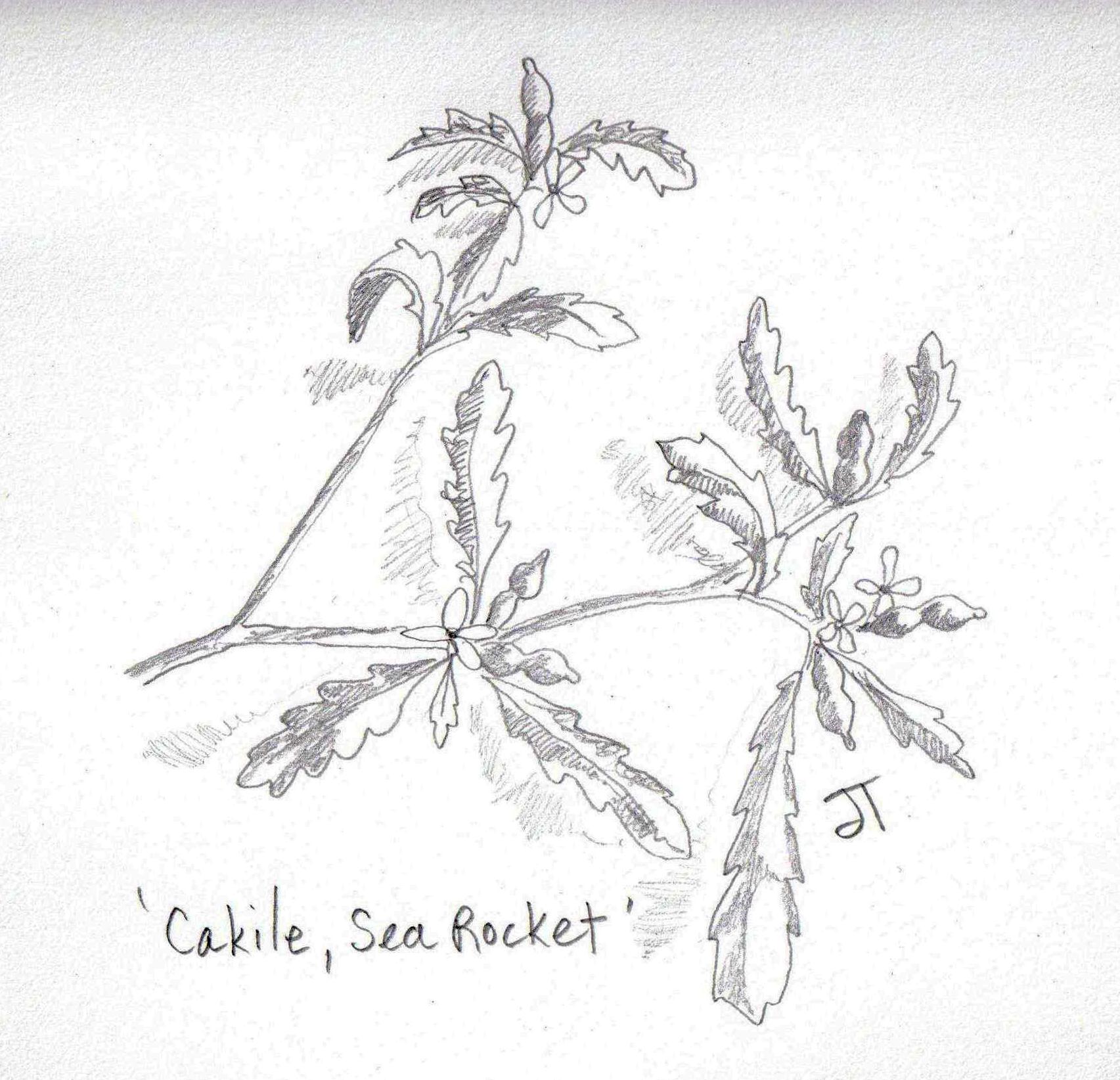
Sea-rocket (Cakile edentula Hook.)
Sea-rocket, also known as Seaside Mustard and caquillier in French, is found on sandy or gravelly beaches along the coast.
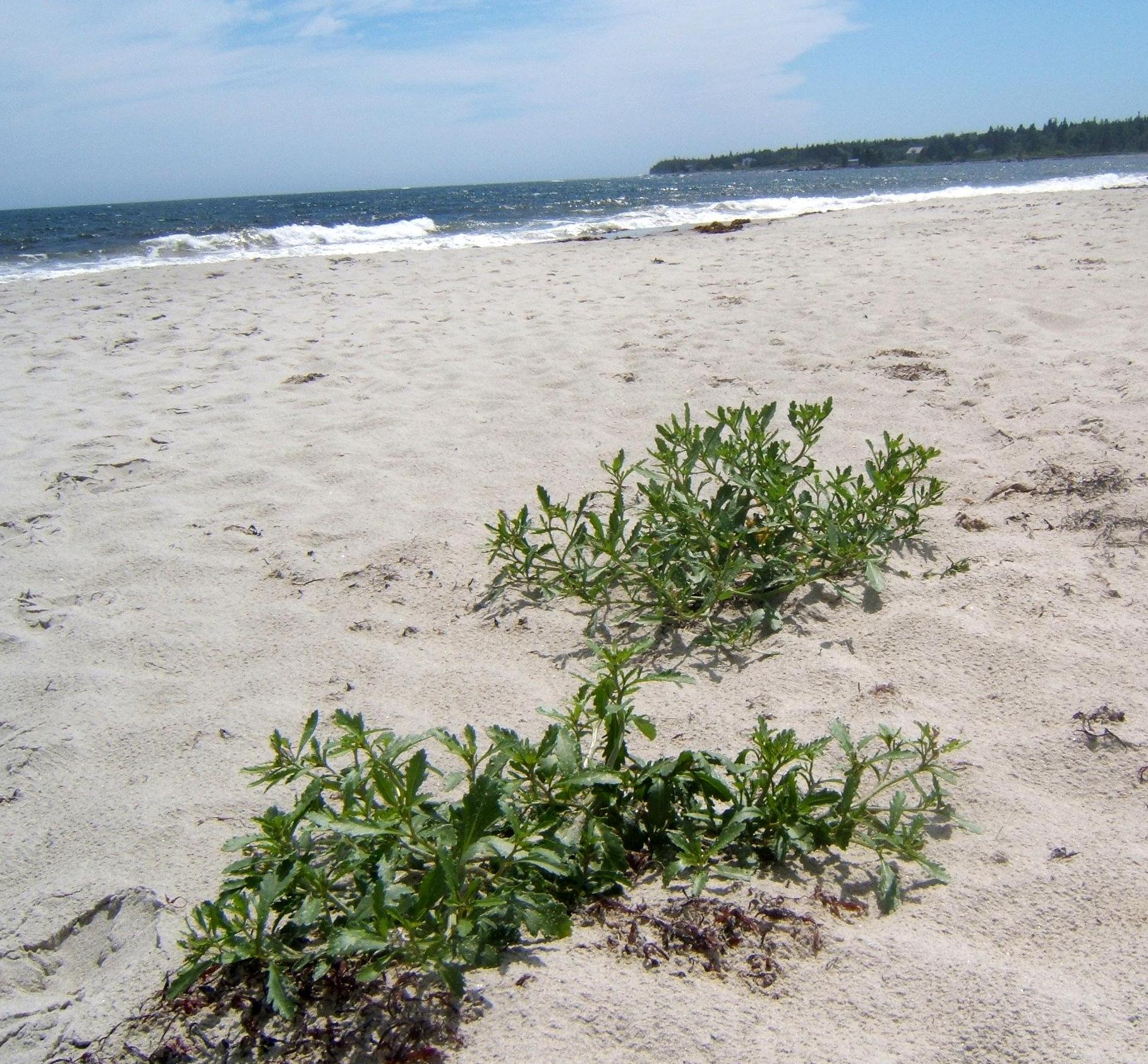
Cakile is a sprawling plant with succulent, branched stems. The leaves are thick and fleshy, with blunt-toothed margins. The four-petalled flowers are small, purple and located at the tip of the stem.
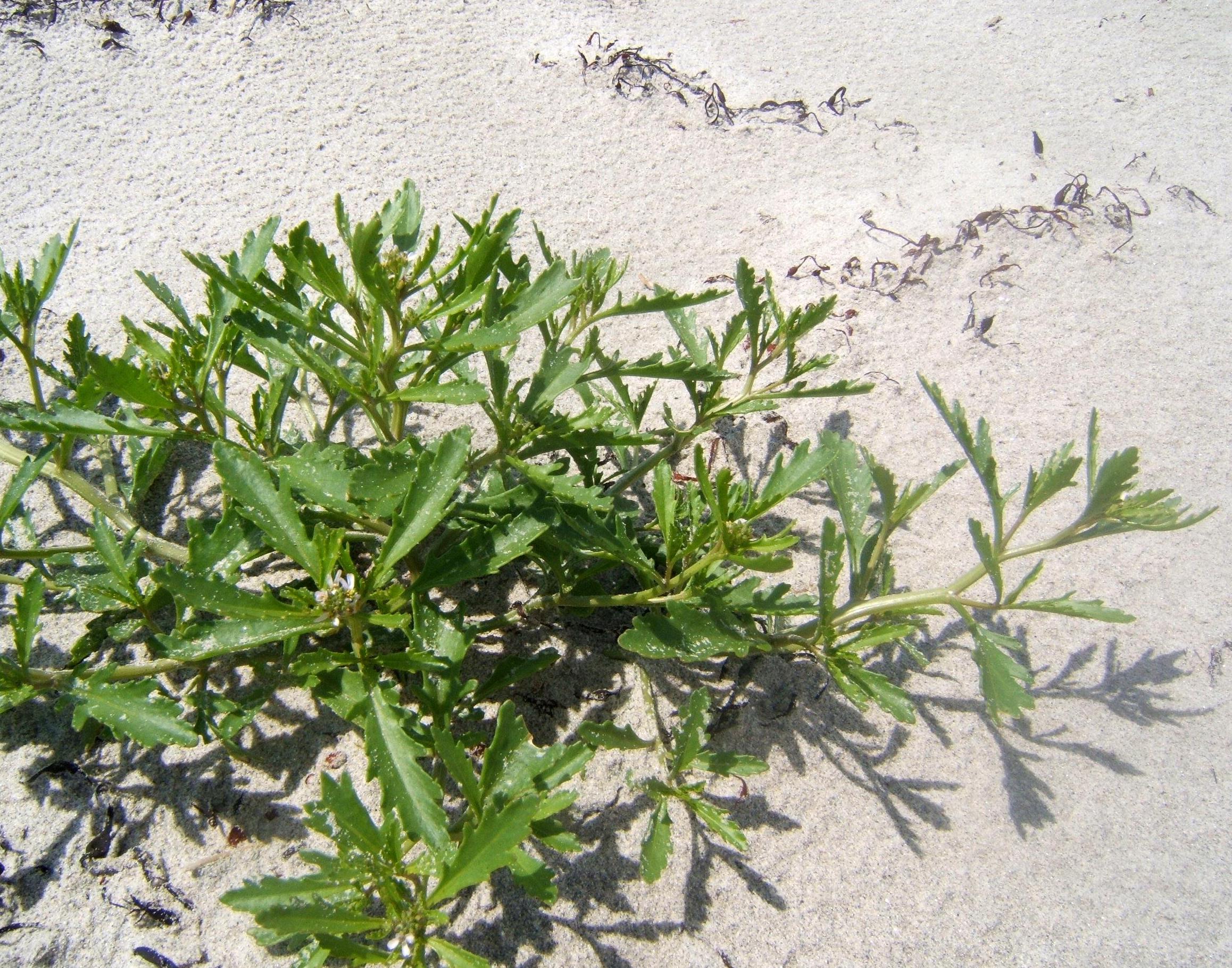
The name Sea-rocket comes from the distinctive shape of the seed pods. These have a narrow base and a pear-shaped tip, like a rocket. Cakile is an old Arabic name and edentula means ‘without teeth’.
Sea-rocket is edible. It has a hot, pungent taste, similar to radish. The stems, leaves and pods can be added to salads or boiled for 5 to 10 minutes to give a milder taste.
~
~
Cakile wind
~
the beach sizzles today
the breeze a peppered wind
the sand Cakile-hot
~
wind scours the shore-bands
of seaweed – rockweed, kelp
bleaches them, crisped and dry
~
sand dries, adheres to skin
brushes away, a rub
a sandpaper polish
~
the tongue too hot for words
the seas too salt for tears
tans ruined, scorched and red
~
~
© Jane Tims 2012
~
Warning:
1. never eat any plant if you are not absolutely certain of the identification; 2. never eat any plant if you have personal sensitivities, including allergies, to certain plants or their derivatives; 3. never eat any plant unless you have checked several sources to verify the edibility of the plant.poisonous Lathyrus – when ‘wild’ plants are not edible
Yesterday, August 1, 2012, I posted a description of the Beach Pea (Lathyrus japonicus Willd.) and said the peas could be collected, boiled and eaten. This is the advice of the Peterson Field Guide to Edible Wild Plants (1977). My further reading, from more up to date sources, says you should not eat the seeds of Beach Pea or other species of wild pea. Many Lathyrus species contain a neurotoxin that can lead to a condition called lathyrism, a type of paralysis. Although there are other guides saying that Beach Pea is edible in small quantities, I have revised the post to remain on the safe side.
When we choose to include wild plants in our diets, it is very important to know for certain they will not be harmful. In my posts, I have talked about avoiding berries that may look pretty to eat, but contain toxins (for example the bright blue berries of Clintonia (see my post for May 23, 2012, ‘Bluebead Lily’ https://nichepoetryandprose.wordpress.com/2012/05/23/bluebead-lily-clintonia-borealis-ait-raf/ ) or the tomato-like berries of the Common Nightshade (see my post for July 16, 2012, ‘growing and gathering – barriers to eating wild foods’ https://nichepoetryandprose.wordpress.com/2012/07/16/growing-and-gathering-barriers-to-eating-wild-foods/ ).
I have also talked about cases in history of people who risk eating poisonous plants when hunger or famine strike. An example is the making of Missen Bread in Scandinavia, using a long complicated process designed to remove the burning, poisonous crystals contained in the roots of the Wild Calla (see my post for June 4, 2012, ‘keeping watch for dragons #6 – Water Dragon’ https://nichepoetryandprose.wordpress.com/2012/06/04/keeping-watch-for-dragons-6-water-dragon/ ). Poisonous species of Lathyrus (for example Lathyrus sativus, the Grass Pea), in the same genus as the Beach Pea, have been used throughout history for food when people are desperate, in times of drought, famine or poverty.
So, please, take the following steps before you ingest any wild plant:
1. check out as many sources as you can find, to discover the current wisdom and science about ingesting a plant
2. be certain of your identification – many plants look very similar to one-another and can be confused
3. think about your own sensitivities, since you may react to foods that do not bother other people.
4. when in doubt, take the route of caution and safety and do not eat
~
© Jane Tims 2012
Beach Pea (Lathyrus japonicus Willd.)
During our vacation to Nova Scotia, we stopped at several places along St. Margaret’s Bay. All along the beaches, tucked just out of reach of the highest tides, were crowds of Beach Pea. Beach Pea (Lathyrus japonicus Willd.) is a common plant of the coast, growing on sandy and gravelly shorelines and beaches.

This plant resembles the garden pea. It has vine-like, trailing, compound leaves, each composed of 6-8 leaflets. At the base of each leaf is a clasping stipule; at the leaf’s tip is a curling tendril. The flowers are showy, pink and blueish-purple, blooming from June to August.

The seeds of the Beach Pea are podded peas, from 1 to 2 inches long. They are greyish-green and ripen in August.
Some sources, including Peterson’s Field Guide to Edible Wild Plants (1977), say that Beach Peas can be collected, boiled and eaten when they are young and tender. Other sources, more up to date, say they are not edible because they contain a toxic substance that effects the nervous system. In my next post, I’ll talk a bit about being cautious before eating wild plants.
~
~
Beach Pea
Lathyrus japonicus Willd.
~
she feints on the rocks
sighs on the sand
beckons with the tendrils
of her feathery hand
~
ruffles her skirts
in the salted breeze
and squanders her love
on indifferent seas
~
~
© Jane Tims 2012
Warning: 1. never eat any plant if you are not absolutely certain of the identification; 2. never eat any plant if you have personal sensitivities, including allergies, to certain plants or their derivatives; 3. never eat any plant unless you have checked several sources to verify the edibility of the plant.limits of the tide #5 – Samphire (Salicornia europaea L.)
A beach-comber this time of year may easily over-look plants of Samphire (Salicornia europaea L.), also called Glasswort, Pigeon-foot, and Chicken-claws. Unless it is plentiful, it becomes lost ‘in the green’ of other sea-shore plants. The genus name, Salicornia, comes from the words sal meaning salt and cornu meaning horn. These plants consist of a branched, succulent stem, apparently without leaves or flowers. The leaves and tiny flowers are embedded in the stem.

Although Salicornia is typically a plant of coastal areas, like Sea-blite, it is also found far from the coast, in the vicinity of inland salt springs.
Samphire greens are salty, delicious as a salad ingredient, a pickle, or a pot-herb.
~
~
salt of the sea
Samphire ( Salicornia europaea L.)
~
Salicornia smoulders
on a silica shore,
flute and fire
~
Glass pipes,
mainstem and branches,
pickle green
~
Light glimpsed
through crystalline,
transparent walls
~
Seawater, rarefied,
decanted
to a Samphire phial
~
Flask of salt-sap,
brine on the tongue
Always wanting more
~
~
© Jane Tims 2012
Warning: 1. never eat any plant if you are not absolutely certain of the identification; 2. never eat any plant if you have personal sensitivities, including allergies, to certain plants or their derivatives; 3. never eat any plant unless you have checked several sources to verify the edibility of the plant.coastal barren, coastal bog
On our vacation to Nova Scotia last month, we revisited the Peggy’s Cove area near Halifax. I spent a lot of time along this coast years ago, but I had forgotten the unique wildness and beauty of this landscape.

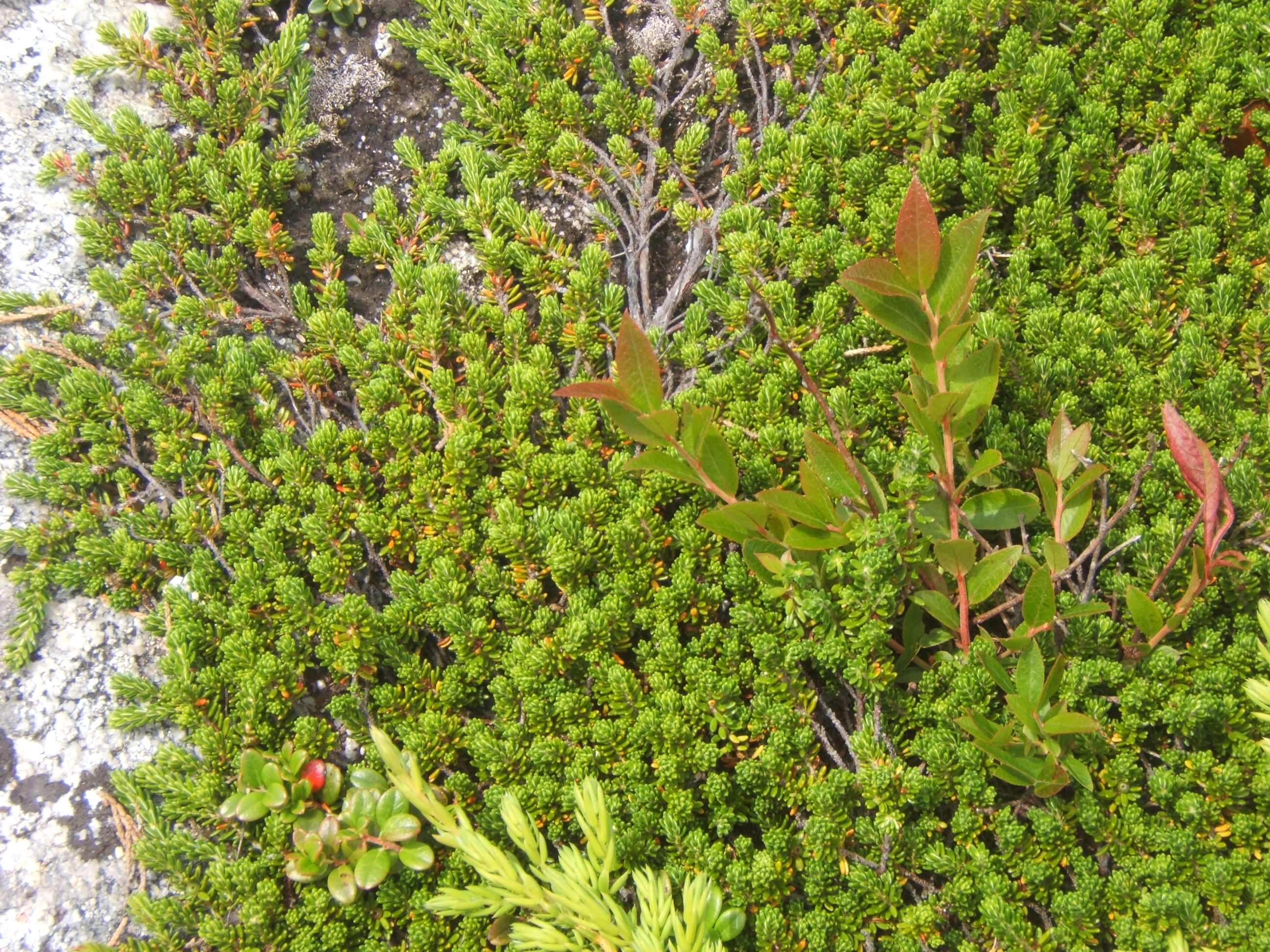
We explored two habitat types, the dry and rocky barrens, and the wet coastal bog. As we found each new plant, I felt like I was greeting old and well-loved friends.
On the higher areas, growing in the thin soil on the bedrock were several species. One of these included Crowberry (Empetrum nigrum L.), a small moss-like plant with spiky leaves and small pink flowers. Later in the season, these will bear edible back berries.
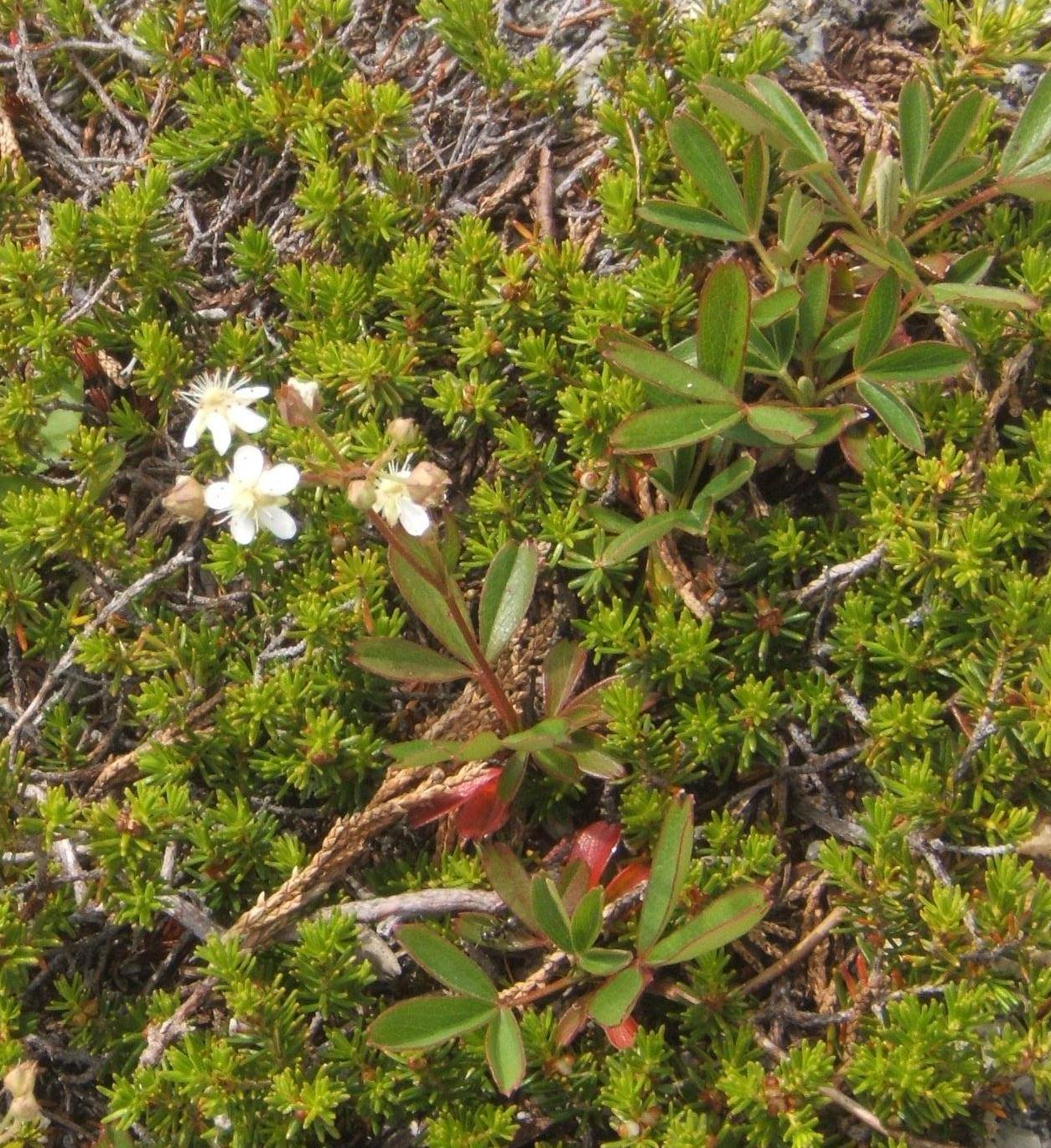
We also found Three-toothed Cinquefoil (Sibbaldia tridentata (Aiton) Paule & Soják) with its three leaflets and the characteristic three teeth at the tip of each leaf. The leaves are thick and outlined in red at this time of year. Later in the year the leaves turn bright red. The white flowers each have five petals, and are starry with stamens.
In the low-lying, boggy areas, we found a ‘merriment’ (my word) of Pitcher-plants (Sarracenia purpurea L.).

The leaves of these insectivorous plants are shaped like vessels. Insects climbing into the leaves encounter downward pointing hairs. They are trapped! Eventually they drown and are digested in the water at the base of the ‘pitcher’.
We also found another carnivorous plant, the Round-leaved Sundew (Drosera rotundifolia L.). The leaves of these plants are covered with tiny hairs… these exude a sticky liquid and trapped insects are slowly digested. For more information on the Sundew, please visit my post for October 31, 2011, ‘Round-leaved Sundew’. https://nichepoetryandprose.wordpress.com/2011/10/
All was not gruesome. We also found Arethusa (Arethusa bulbosa L.), a member of the orchid family. This beautiful pink orchid is also known as the Dragon’s Mouth.

Overall, our trip to Peggy’s Cove was a wonderful adventure. We plan to return in the early fall, when the Crowberry and the other edible plants we saw have set their berries.
Have you ever been to Peggy’s Cove and what did you think of the coastal landscape and the plants growing there?
~

© Jane Tims 2012
Warning: 1. never eat any plant if you are not absolutely certain of the identification; 2. never eat any plant if you have personal sensitivities, including allergies, to certain plants or their derivatives; 3. never eat any plant unless you have checked several sources to verify the edibility of the plant.a moment of beautiful – the sound of the sea
the space: a park bench by the edge of the sea
the beautiful: the sound of the breakers, sorting over cobbles on the shore
On a recent vacation to Nova Scotia, we had the time to sit and watch the breakers roll into a cove along St. Margaret’s Bay. The sight of the crashing waves was inspiring, but the sounds were unforgettable… first, the sweep and crash of the incoming waves…

then the clatter as the outgoing wave dragged at the cobbles along the shore…

My husband suffered through my recitation of a few lines of Matthew Arnold’s poignant ‘Dover Beach’, but mostly we were quiet, overwhelmed by the sound of the sea.
~
~
greed
~
jealous of its pretty
shaped and rounded stones,
the ocean mutters,
claws them back
clatters its dinner forks
over biscuits and gravy
hoards jellybeans
by the handful
~
~
© Jane Tims 2012




 nichepoetryandprose