Archive for September 2011
inside the covered bridge
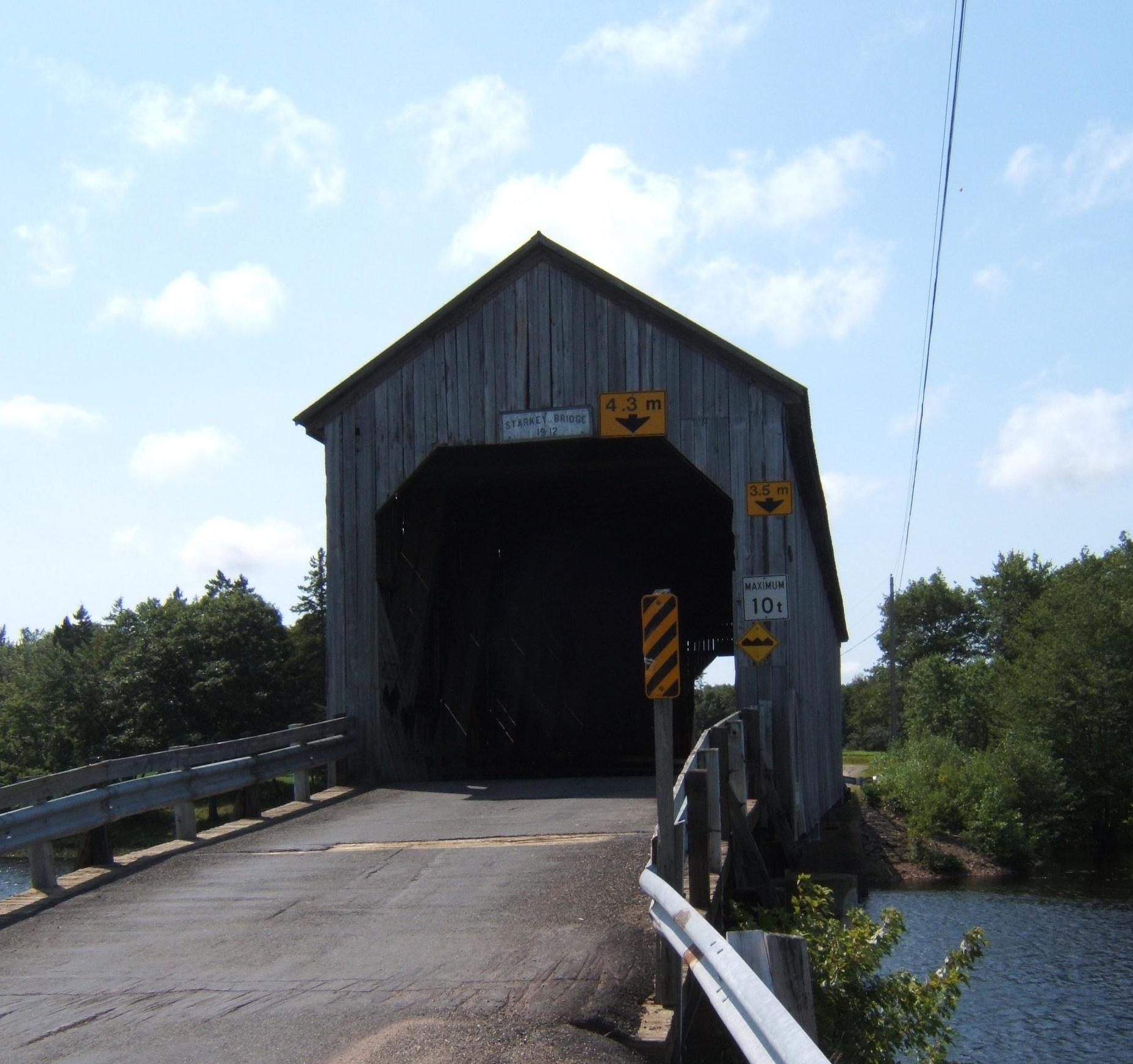
the Starkey Bridge over Long Creek
One of New Brunswick’s ‘claims to fame’ is its covered bridges. A covered bridge is a bridge constructed with high sides and a roof, made to cope with winter snow loads. The covered bridge was designed to be easier to cross in winter. Also, these bridges don’t have to be shovelled free of snow after storms.
There are 60 covered bridges in New Brunswick, one less after the Mangrum Bridge, crossing the Becaguimec River, was destroyed by vandals earlier this month. Communities really love their covered bridges and try to keep them safe by holding watches at Halloween and other times of the year. It is a huge disappointment to anticipate driving across a covered bridge you have visited in the past, only to find it has been burnt and replaced with a metal Bailey Bridge.
Visiting covered bridges is a favourite pastime for many New Brunswickers. On a hot day, the bridges are cool inside and there are usually open ‘windows’ to encourage breezes and allow a view of the river. When a car drives through the bridge, the whole structure vibrates and the car tires make a deep-toned rumble. The floor timbers in a covered bridge are pleasant to walk on and the rafters make interesting study for the carvings and writings people have left as mementos of their visits.
In 1992, my husband and son and I began a project to celebrate Canada’s 125thbirthday. We intended to visit all the covered bridges in the province and make a record of the carvings and graffiti inside each bridge.

we promised to include the ‘Canada 125’ logo whenever we reported on our project, so here it is!
We explored many of the bridges, and made pencil rubbings of some of the more memorable carvings. I particularly remember the girl’s name ‘Phoebe’ carved in elegant lettering in the Wheaton Bridge (bridge installed 1916) over the Tantramar River, and a carving of an old car and the date 1910 in the Maxwell Crossing Bridge over the Dennis Stream (bridge installed 1910).

some of the notations in our record for the Maxwell Crossing Bridge over the Dennis Stream
Other markings were also noteworthy. Inside the Falls Brook Bridge at Nortondale over the Nackawic River were the following words in India ink: ‘Ptarmigan Hunter Ray Brown May 12th 1896 Horse had bad leg”. An expert birder in the area told me Ptarmigan have never been recorded in New Brunswick and this could be a valid record.
Another bit of graffiti I particularly liked were the words I AM THE WIND, printed in yellow in at least three of the bridges in Charlotte County, including the covered bridge on Stillwater Road over the Digedeguash River. This bridge is now gone and a Bailey Bridge was in its place the last time we visited.
I am the wind
~
I am the wind
of the Digedeguash
shaped by valley walls
~
I race trout
lift ferns
blow quick kisses
under the wings of butterflies
~
I am the wind
spoken in the beams
of the covered bridge
slipped into space
between
boards
I rattle the roof, the reeds
vibrate with my breath
~
I am the wind
from the County line
to the Passamaquoddy Bay
I race
~
refreshed by the waterfall, salted
by the rising tide
~
carve my name
on the boards, block
my name in yellow
chalk
~
I am the wind
~
Published as: ‘I am the Wind’, Spring 1995, The Cormorant XI (2)
(revised)
© Jane Tims
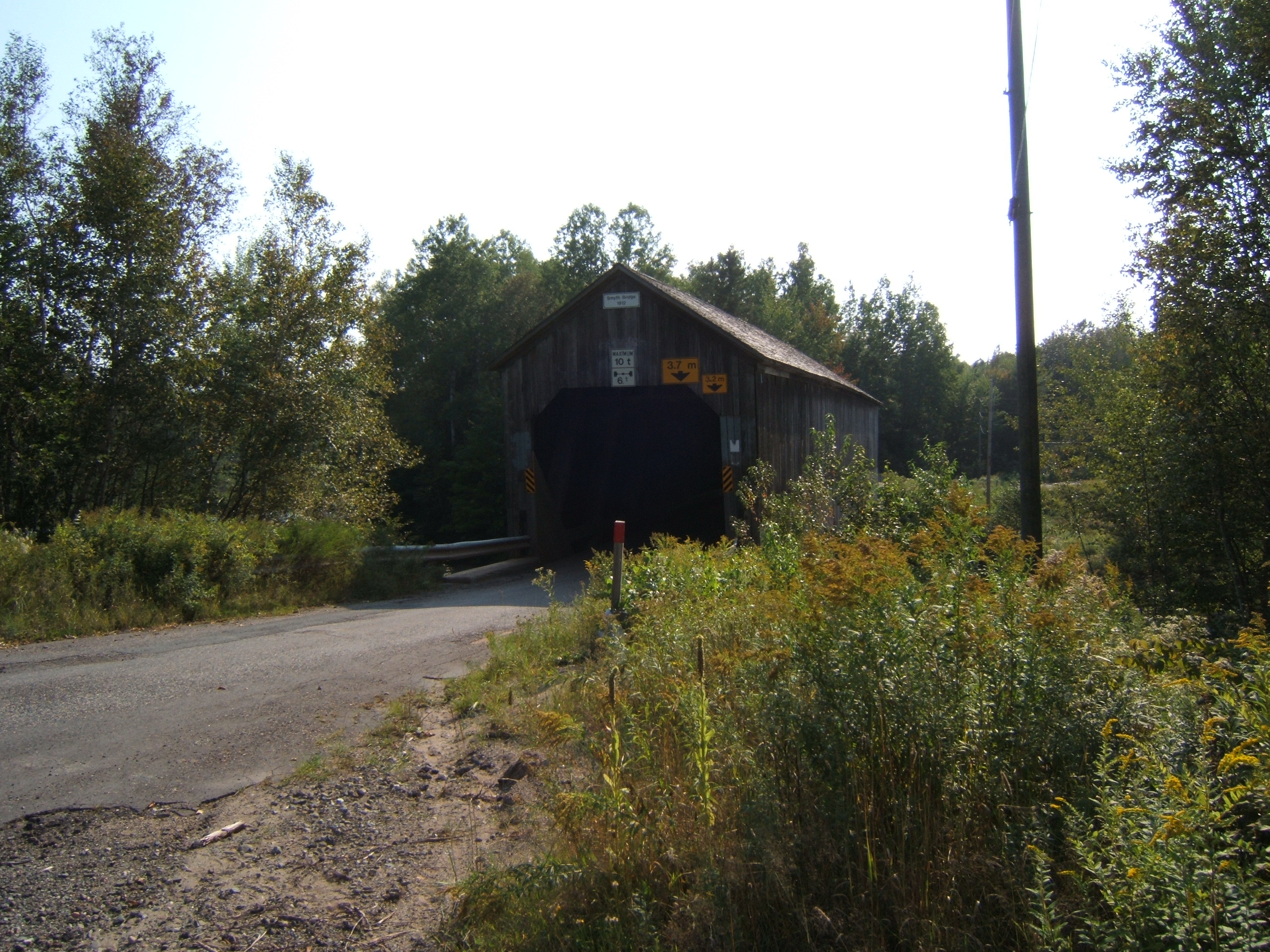
Smyth Bridge, crossing a small tributary of the South Oromocto River
holding on to our space
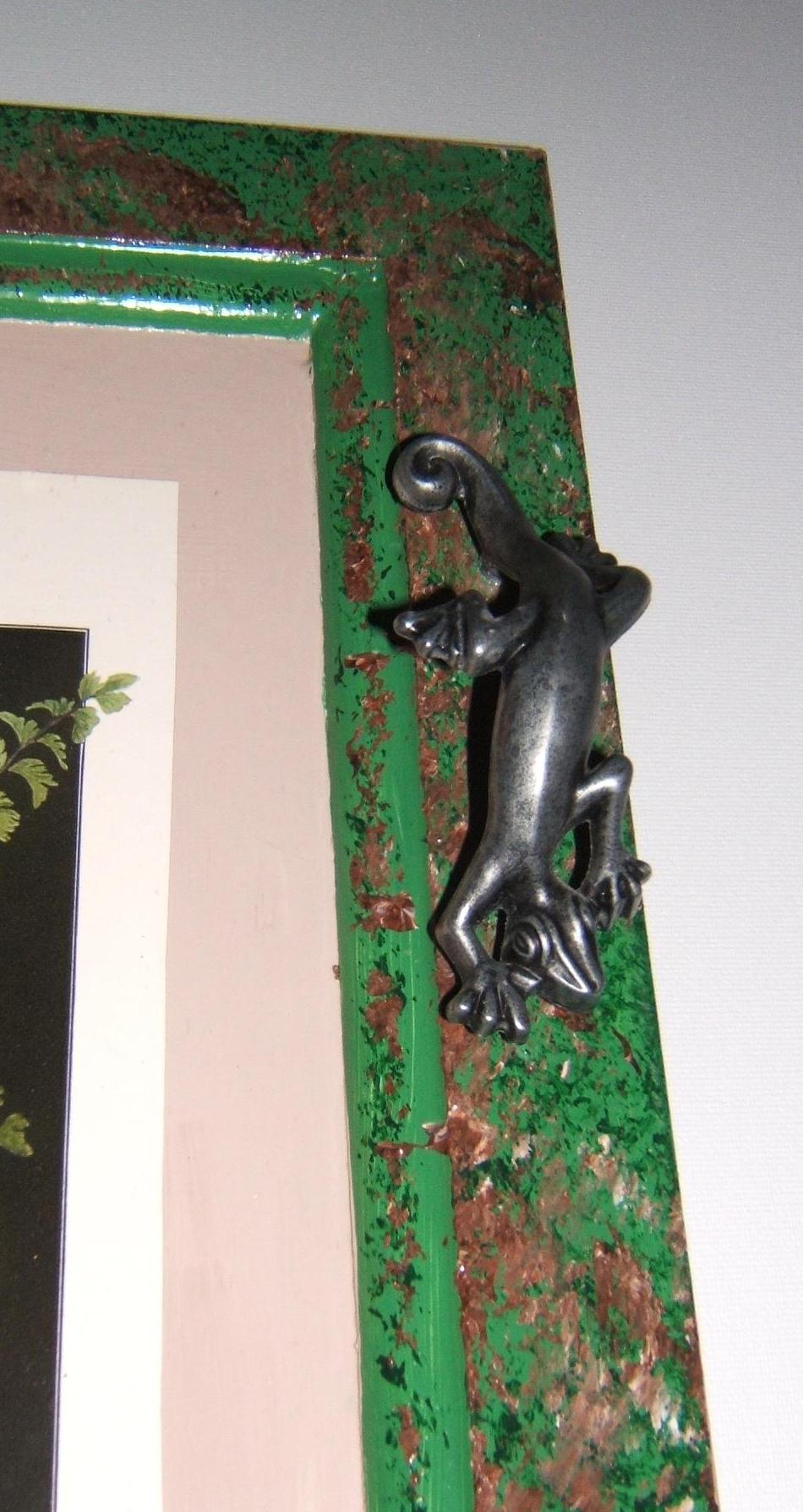
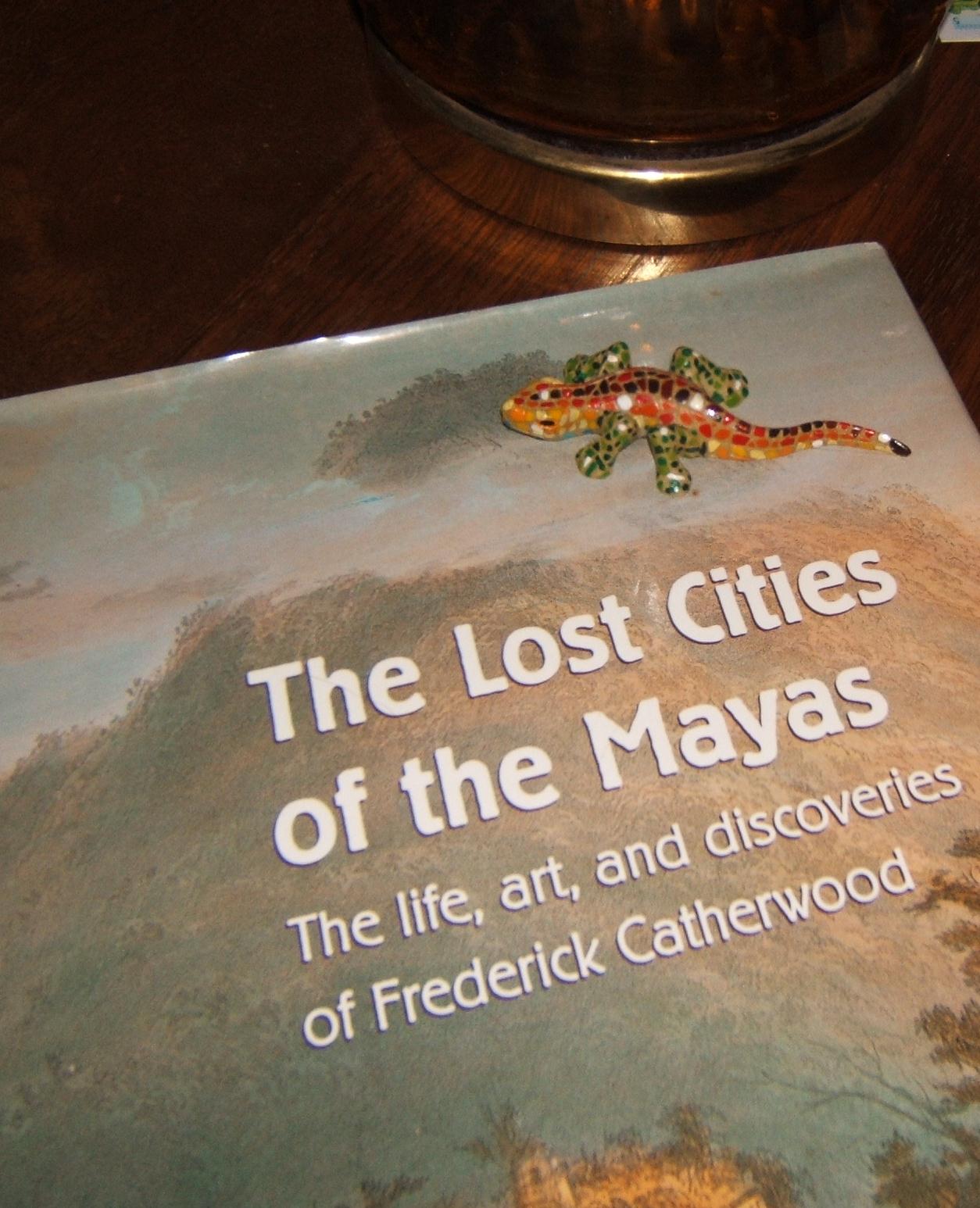
We are in a competition for space. A population of geckos has moved into our house. They are everywhere:
on the wall…
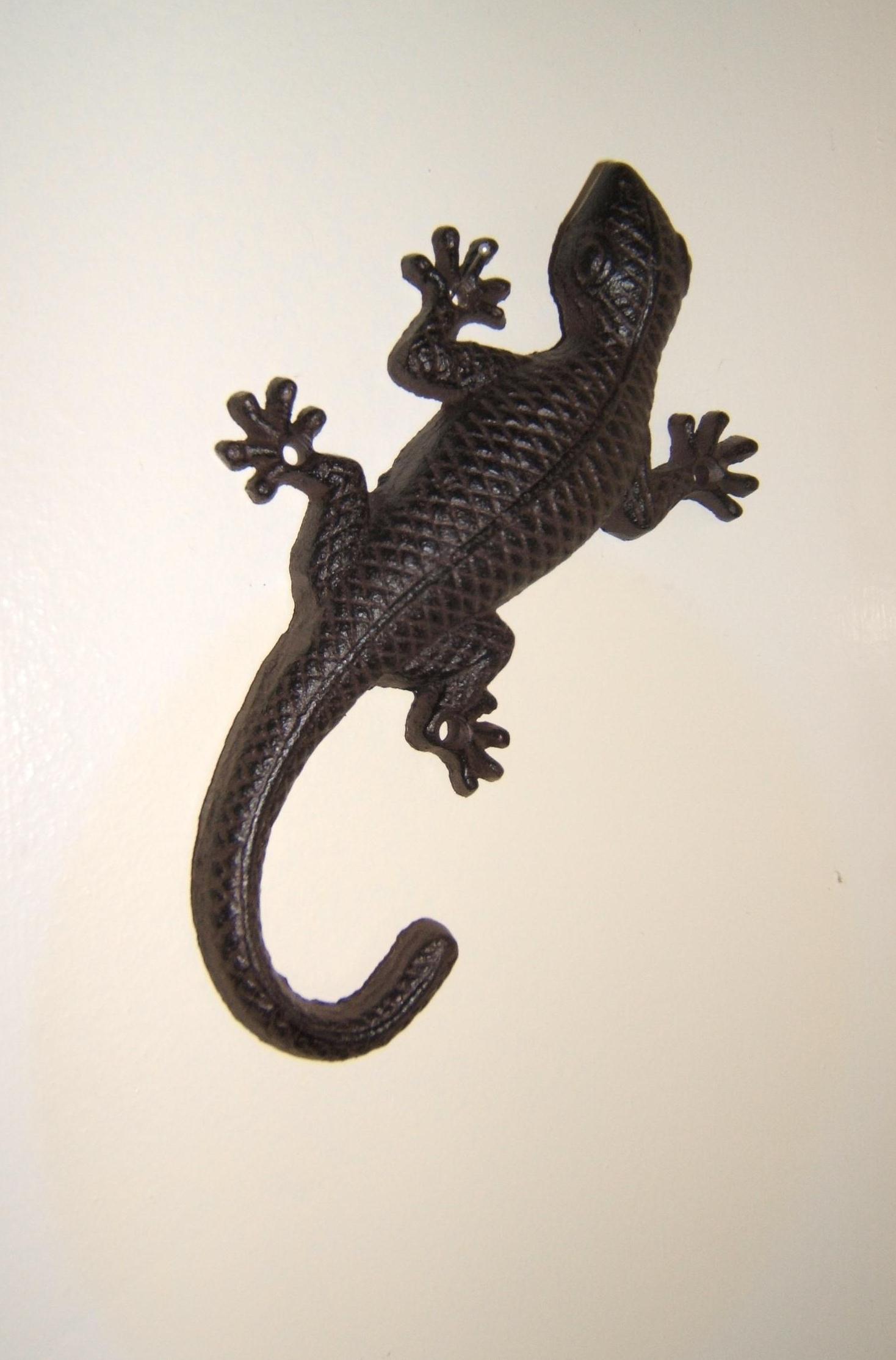
under the cupboard in the kitchen…

on the post in our stairway…
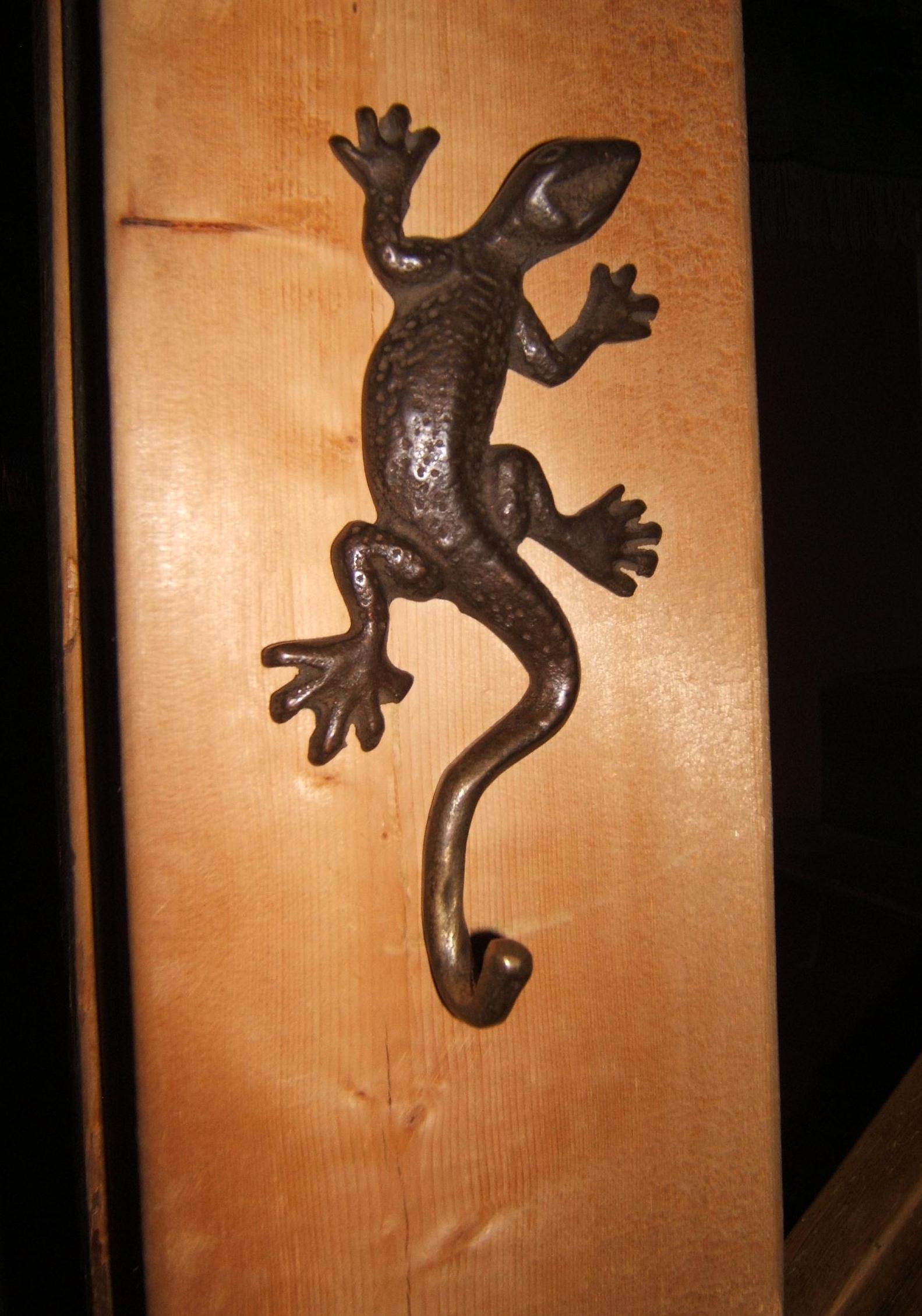
climbing down our picture frames…
on the books in my study…
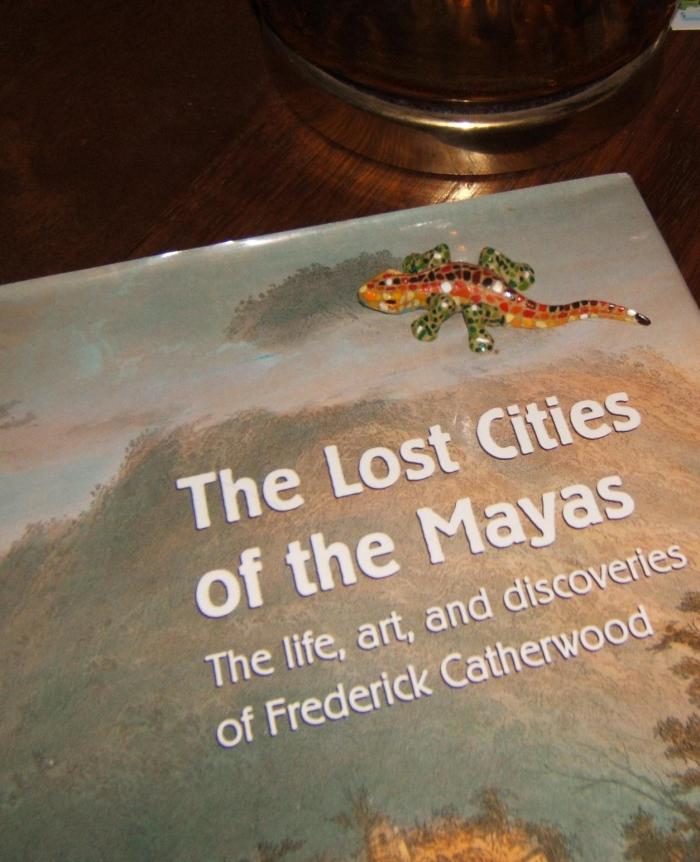
- this little fellow came all the way from Barcelona in Spain
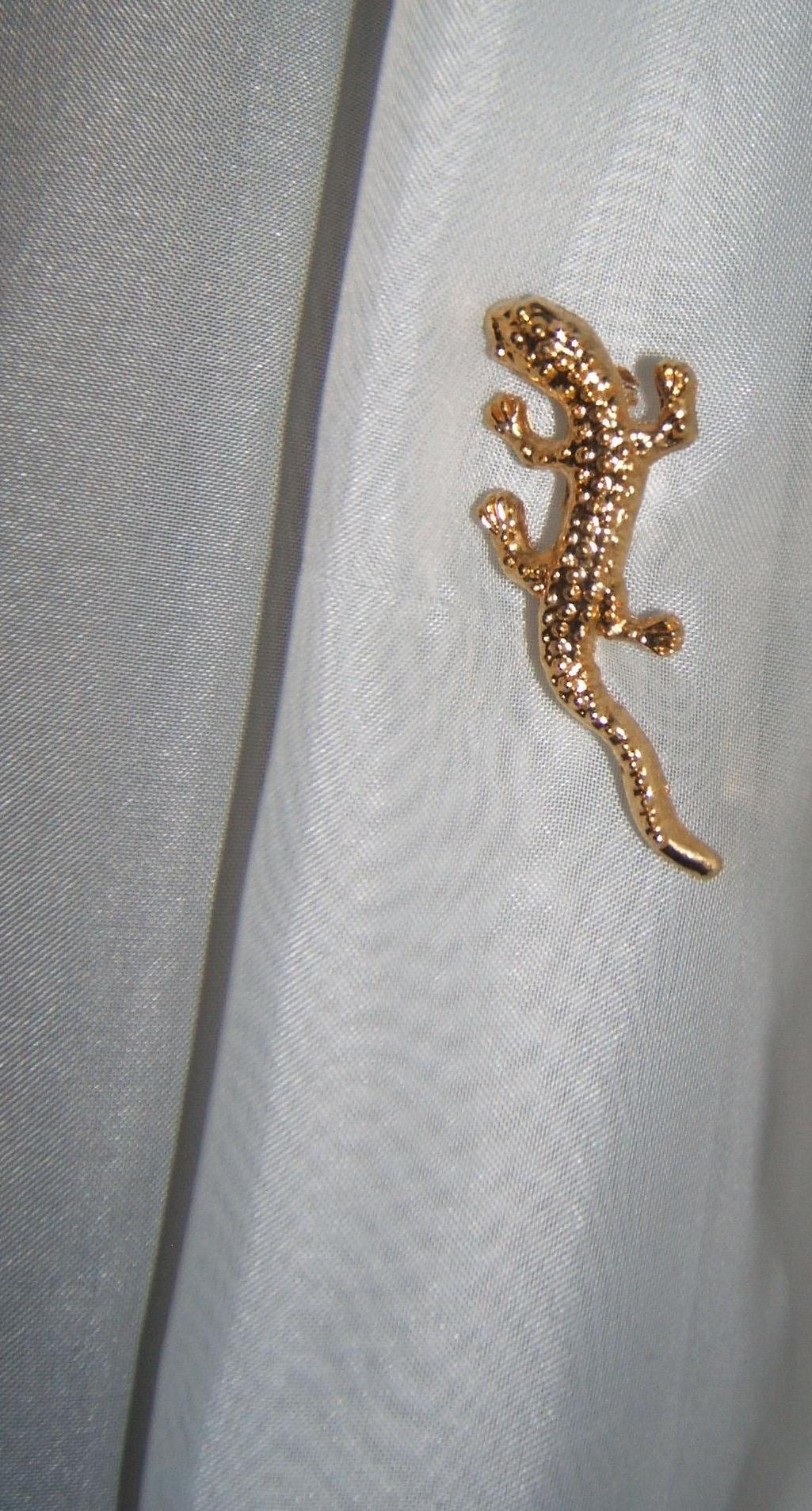
holding on
~
flex knee
reach
determined to stick
~
one foot on wall
will the molecular bond
to adhere
~
reluctant release
of rear foot
now dedicated to
surface past
~
flex knee
reach
~
© Jane Tims 2011
landscape
landscape: inland scenery (Oxford dictionary)
When I see the beaches and headlands of coastal New Brunswick…
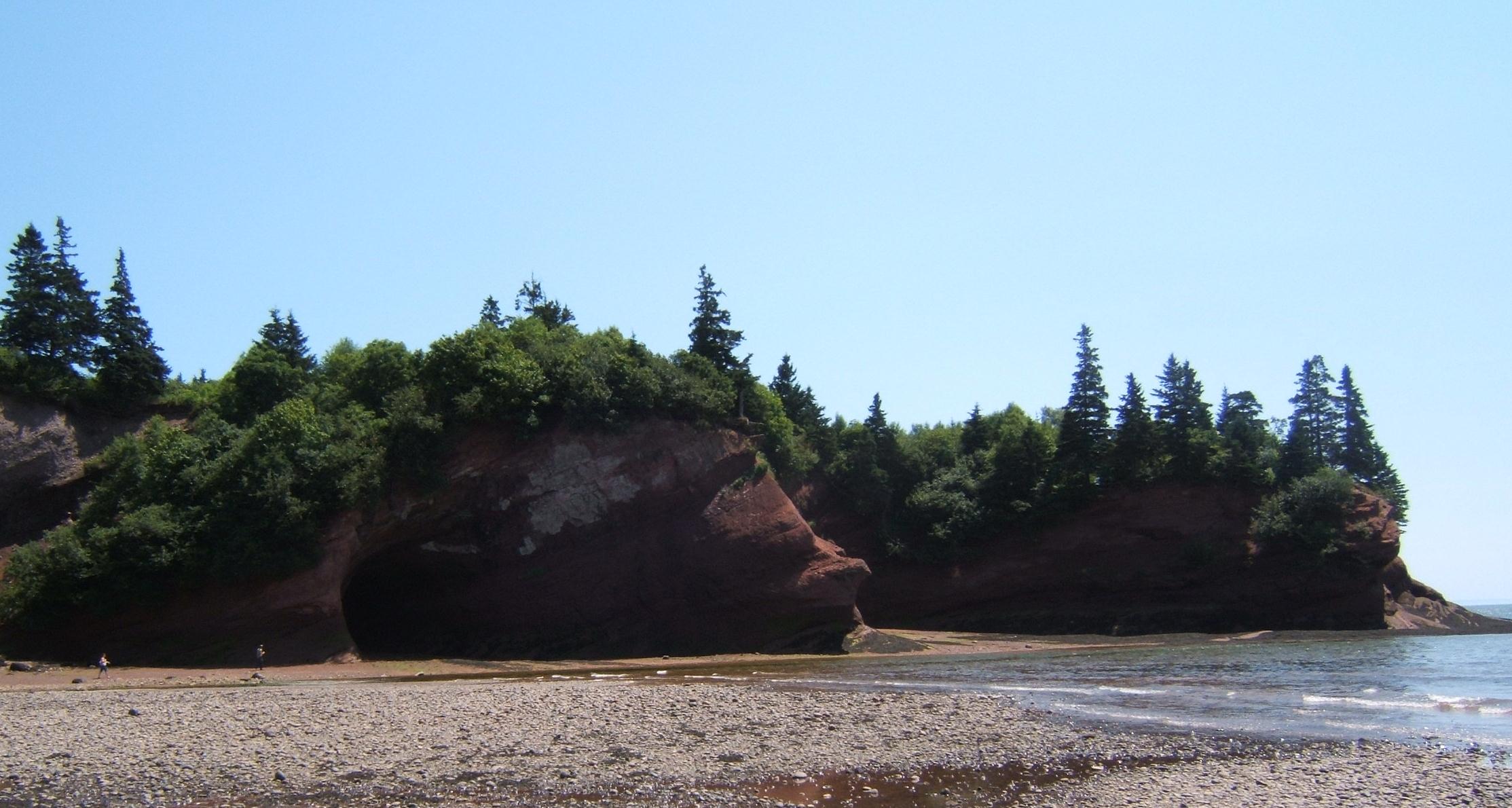
Saint Martins, New Brunswick
or the flatland and grasses of the western Canadian prairie…

prairie in southern Saskatchewan.. a dust storm on a salt lake bed
… I know landscape influences my life.
I also know my life has a landscape of its own, with hills and valleys, places to celebrate and places to hide, paths and roads moving ever forward. When I take the time to be aware of my landscape, to notice the detail and understand nature, I experience the best life has to offer.
landscape
~
a veil
draped across
bones of the earth
pointed tents
supported by forest
and the bent stems of grasses
soft settles in pockets
lichens and mosses
~
beneath the veil
texture
the ways I follow
quick or crawl
hollows elevations
clear eyes
or sorrow
~
the only way to understand
form follows function follows form
is repeated observation
lay myself on the landscape
allow my bones to conform
feel its nuance
~
see a field of grasses
see also awns and panicles and glumes
~
© Jane Tims, 2011

the parts of a grass plant (from Roland and Smith, 1969, page 68)
under the haystack
In our area, late summer is haymaking time. During the past two weeks, almost every field has been at some stage of mowing, bailing, or gathering. Farmers tried to bring their hay in before the August 28 tropical storm (Hurricane Irene), so most fields are now cut and cleared.
Haymaking is a picturesque activity. The cut hay is formed into parallel windrows in the fields, an artist’s lesson in perspective. The cutting and bailing and drying of hay are all fascinating to watch.
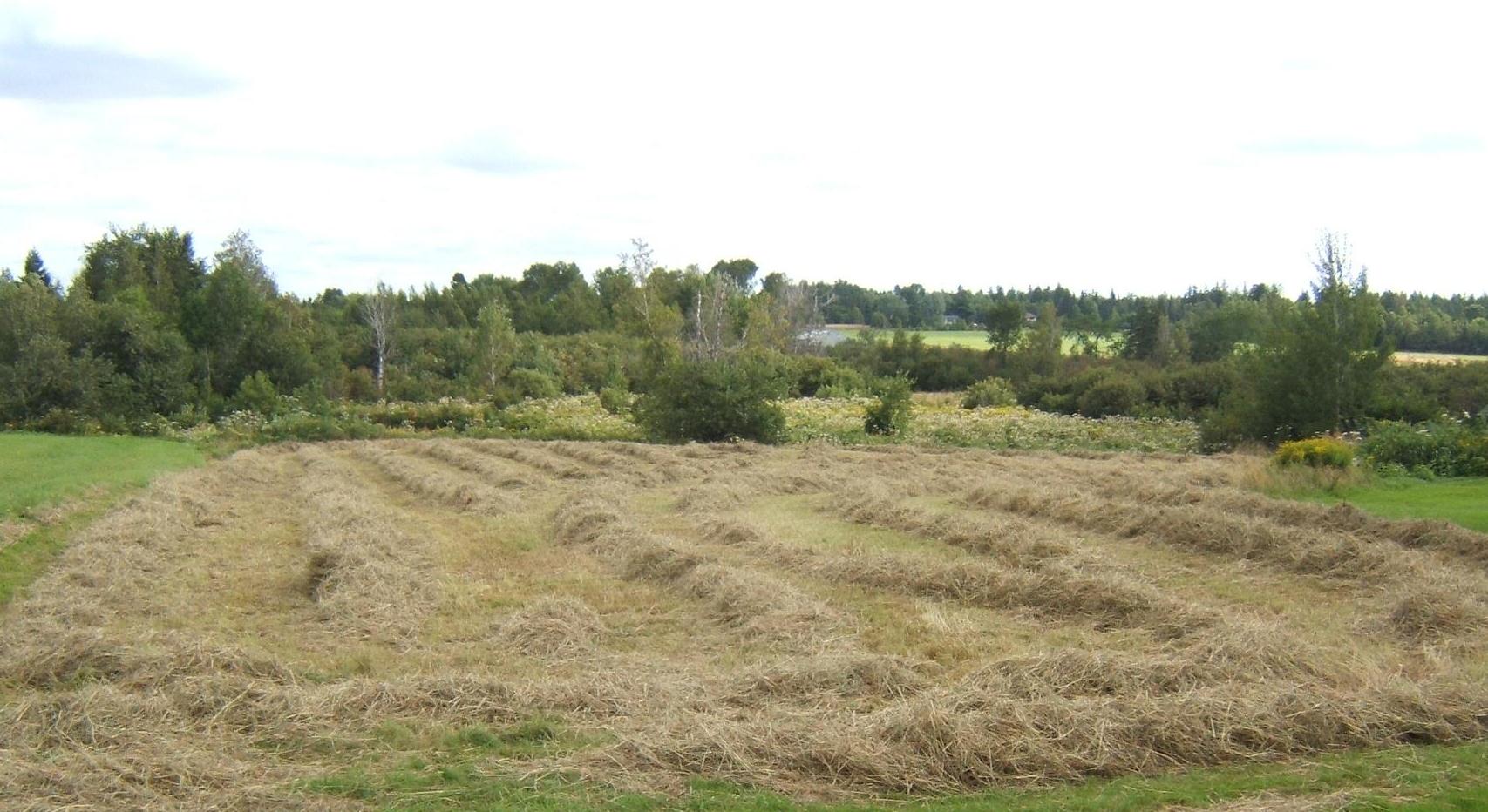
In the 1960s, at my grandfather’s farm, hay was gathered loose into a horse-drawn hay wagon and stored unbailed in the barn. One summer, I was thrilled to be asked to help ‘tramp hay’. As the fluffy hay was forked into the wagon, our work was to compress it by rolling and stomping and jumping.
Haying methods have changed, of course. Collecting loose hay is almost non-existent. Even the smaller square bails are hard to find. The most common are the cylindrical ‘round’ bails or the white plastic-wrapped silage bails.
The round bails look like plump shredded wheat…

and the silage bails are giant marshmallows.
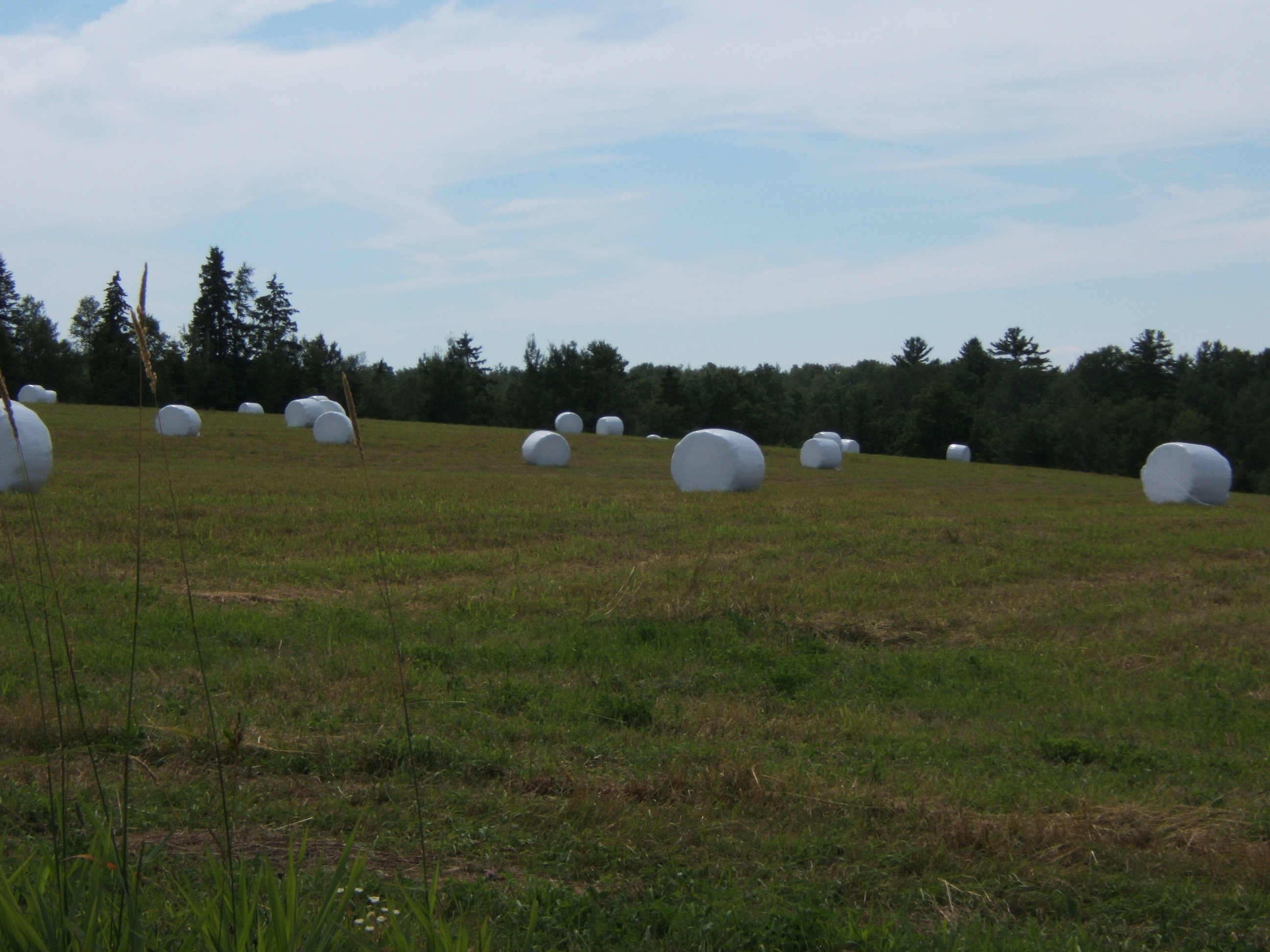
At sunset, the shadows of the round bails make musical half notes on the fields.

'half notes'
Summer Song
~
Sunbury County
sings in its sleep
purple vetch
hop clover
bluegrass
at the roadside
~
hay in rows
a staff
empty of song
awaiting
round bails and their shadows
half notes for an oboe
~
honey bee
ditty in the pink and red-hipped
old fashioned roses
bid country roads
enter the covered bridge
glimpses between planking
rock music on the water
tires drum on loose boards
~
deer look up
cattle low in the meadow
owl to whitethroat
counterpoint
goldenrod pollens the air
rushes by the Rusagonis River
north and south
~
over Sunpoke
big moon crescendo
~
trembles of aspen
diminish
~
Published as: Spring 1995, “Summer Song”, The Cormorant XI (2)
(revised)
© Jane Tims
along the country road #6
How are the giant statue of a Canada goose at WAWA, Ontario, and the roadside plant White Clover associated? Read on…
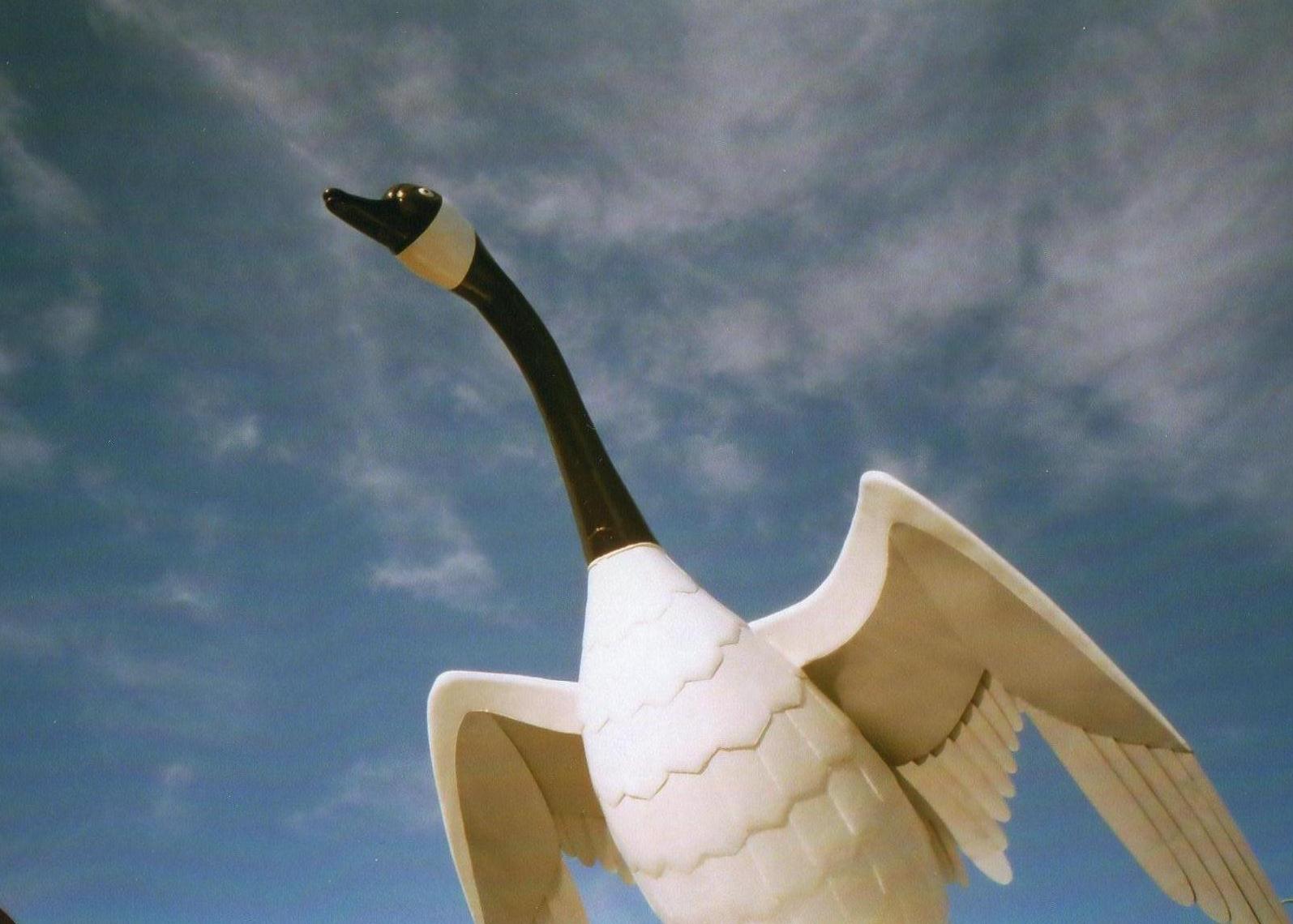
the giant statue of a Canada goose at Wawa, Ontario
White Clover is a common perennial herb of fields, lawns and roadsides. The plant is also called White Clover or, in French, trèfle blanc. Flowers are borne in globular heads, pure white or tinged with pink. The name Trifolium is from tres meaning three and folium meaning leaf. Repens means creeping, a reference to the long, prostrate stems.
The leaves of clover are in threes, palmately compound, and are occasionally found in fours. According to superstition, finding a four-leaved clover gives good luck to the finder. In the 1960’s, my Dad found a five-leaved clover in the grassy field in front of the giant statue of the Canada goose at WAWA, Ontario.
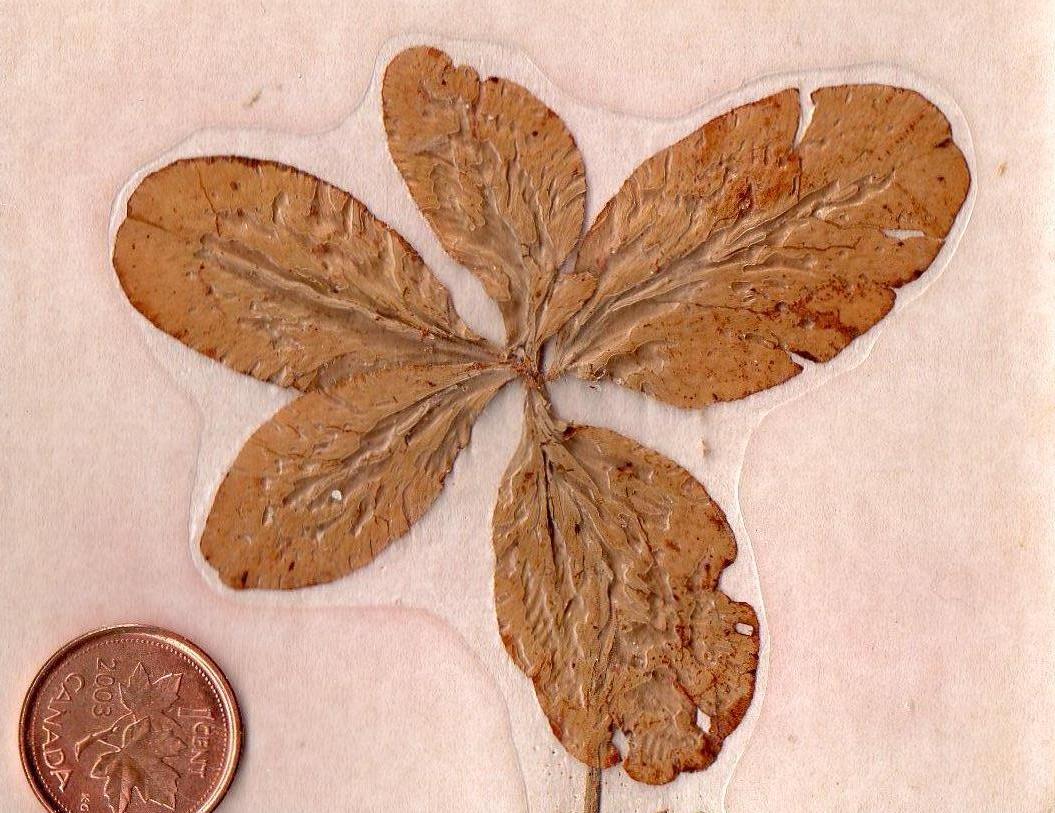
the five-leaved clover my Dad found on the lawn in front of the Canada goose at Wawa almost 45 years ago
Dad pressed the leaves and covered them in a laminating film. The pressed plant is still among my treasures.
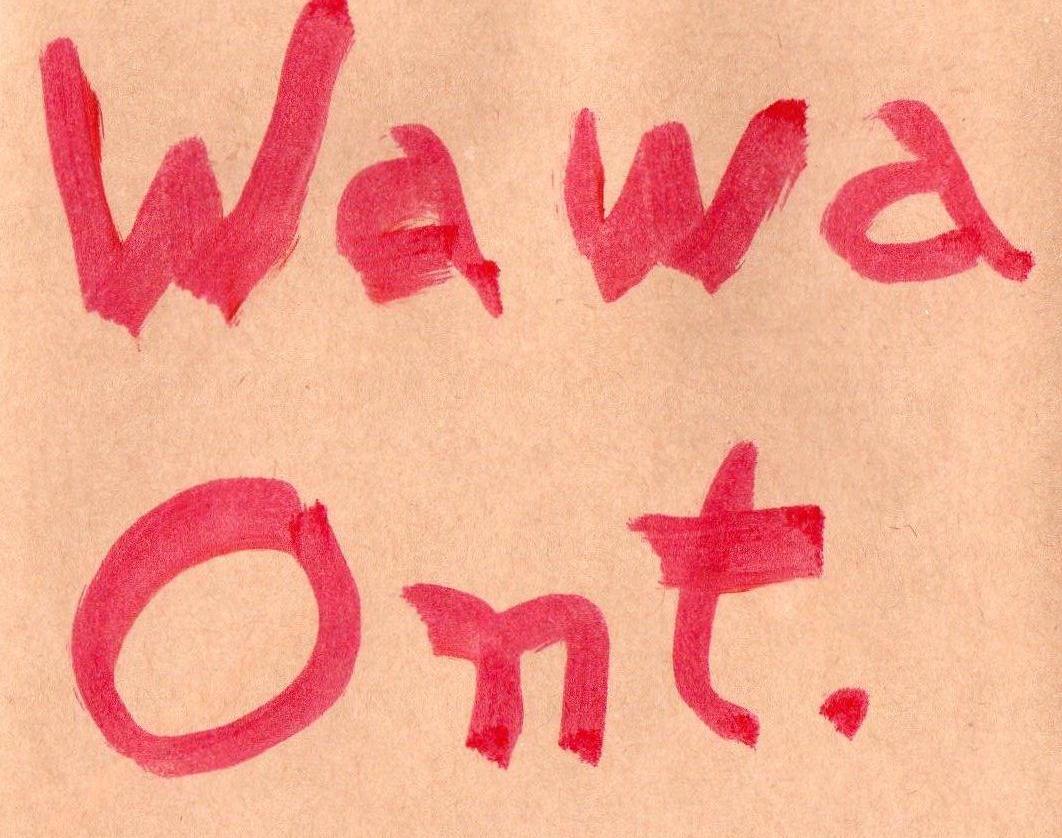
the reverse side of the specimen of five-leaved clover, with my Dad’s printing
We returned in 2002 and searched, but the three-leaved variety was all we found.
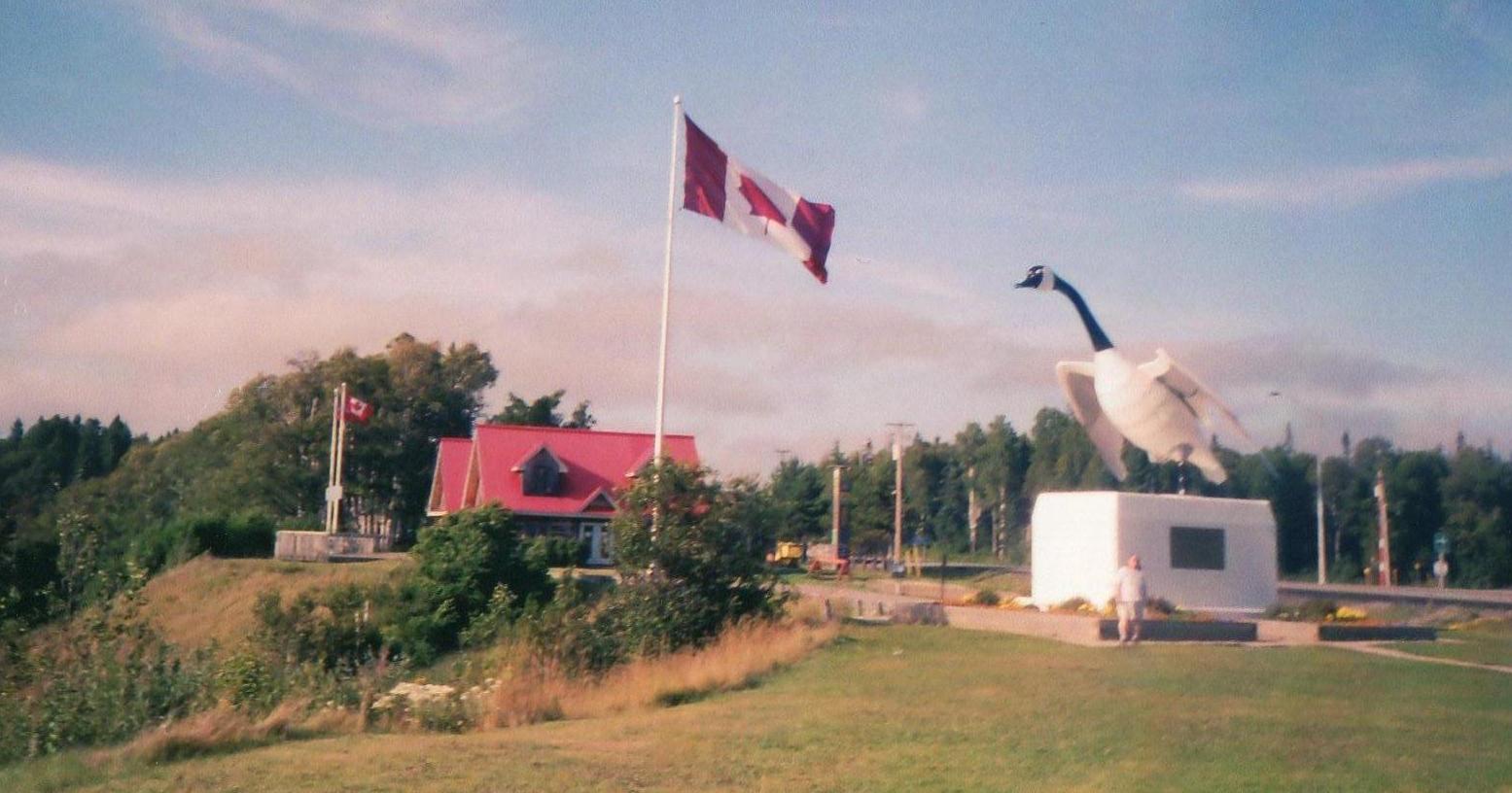
we searched in 2002, but I think the lawn had been replaced
Clover is a useful plant. It ‘fixes nitrogen’, meaning it takes nitrogen from the atmosphere and introduces it into the soil as it grows. The flowers are a source of honey for bees, and I’ve tasted honey made from an infusion of clover flowers. Dried leaves can be used for making tea.
Have you ever found a clover leaf with more than three leaflets? Did it bring you luck?
White Clover
Trifolium repens L.
(Three Leaves and Wishes)
~
only to lie
sweet dreaming in the clover
to pull blossoms
from long stems
toss soft snowballs
at blue-bottle flies
~
bees to visit me
florets for nectar
hair splashed on the clover
scented sweet honey
~
to search three leaves for four
creeping across the lawn
to the roadside
to roll in the fields
of white clover
trèfle blanc
blushing
~
Warning: 1. never eat any plant if you are not absolutely certain of the identification; 2. never eat any plant if you have personal sensitivities, including allergies, to certain plants or their derivatives; 3. never eat any plant unless you have checked several sources to verify the edibility of the plant.
© Jane Tims 2005





 nichepoetryandprose