Posts Tagged ‘writing’
illustrating poetry
I am in the process of creating several books of poetry from the many poems I have written over the years. I am now working on the third book, poems about life on my grandfather’s farm. The title will be ‘blueberries and mink’ since these were the main products of the farm.
~
There are about forty poems in this collection. I have decided how I will order the poems and done much of the formatting. Since I illustrate the books I write, the next task is to pair the poems with drawings I have done.
~
For some poems, as I wrote, I had an image in my head that my hands could draw. A good example is the poem ‘patience.’ One of the lines describes ‘staring down a cow.’ The drawing was fun to do.
~

~
In some cases, a drawing I did for another purpose will find a home in my ‘blueberries and mink’ manuscript. An example is the drawing of old pop bottles I did for a blog post a few years ago. These bottles look much like the ones that used to sit on a window ledge in a shed at my grandfather’s farm.
~

~
Once I have inserted the formatted drawings into the book, I have to make sure they are distributed evenly through the book. Sometimes a poem and its drawing can be relocated. Sometimes I have to do another drawing to fill a gap.
~
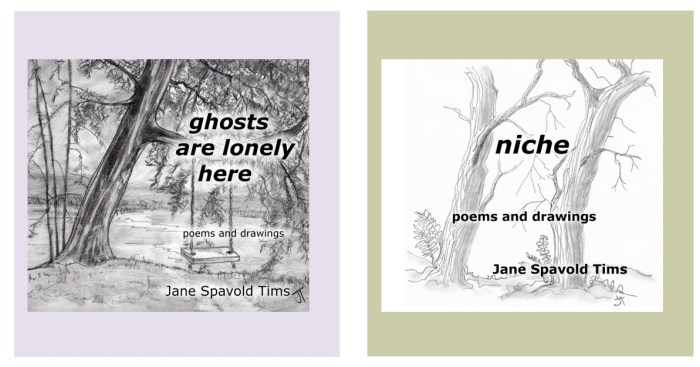
Next, from the drawings, I have to pick one for the cover of the book. I want the covers for these books to be similar in style with the book title and author name superimposed.
~
A couple of the possible covers I am working on are shown below.
~

~
all my best,
staying home,
Jane
organizing writing files – ordering a manuscript of poems
Last month I started a big project – to find and organize all the poems I have written during the last forty years. For a glimpse of my approach see here.
~
After four weeks of effort, I now have a file of poems I would like to assemble into a book. The title will be ‘niche’ and the book will include poems about the ecological spaces plants and animals (including humans) occupy.
~
niche \ ‘nich\ n (F, fr. MF, fr. nicher to nest, fr. (assumed) VL nidicare, from L nidus nest) 1 a : a recess in a wall, especially for a statue. b : something that resembles a niche. 2 a : a place, employment, or activity for which a person is best fitted. b : a habitat supplying the factors necessary for the existence of an organism or species. c : the ecological role of an organism in a community especially in regard to food consumption.
– Webster’s New Collegiate Dictionary, 1979
~
I have identified 66 poems for ‘niche,’ taking up about 110 pages. Although I could just toss the poems into the book in random order, I like to think about how I want the reader to encounter the poems. I organize the poems in the book following these steps.
~
1. List the ideas in the poems:
After I find all the poems to fit the ‘niche’ category, I arrange them roughly into a manuscript. Then I print the Table of Contents and write a list of ideas associated with each poem. Examples for ‘niche’ include: needs, predation, reproduction, invasion of other spaces, seasons, nutrition, competition, and so on. I also start to get a feel for poems that do not fit.
~

~
2. Develop a progression of ideas:
Once I have identified these ideas, I decide how I want to group them and how I want them to progress for the reader. In the case of ‘niche,’ I want the poems to first define niche, then consider the strategies plants and animals use to stay in their niche, then explore the discomfort or danger created when a niche is occupied, consider the spaces I have occupied in my own life, consider the problems you have to overcome to occupy your own niche, and conclude with an idea of the ideal space. Then, I reorder the poems so they fit the progression of ideas.
~
3. Sort the poems roughly into groups:
Once I have decided on a progression of ideas, I put poems into sections to portray those ideas. I choose the title for the section from a poem in the section. It is at this point that I decide which poems do not belong in the collection and remove them. For ‘niche’ the following are the sections (for now):
occupation of space – needs of an organism for food, water, air, physical space, and so on.
strategy – ways plants and animals protect their niche and solidify their position
praying for rain – dangers and discomforts of occupying a niche
mapping the labyrinth – places I have occupied, a bit of memoir
not touching the land – ways a niche is changed when it is occupied
forgetting to move – getting comfortable in your own niche
~
4. Order and fine tune:
Now the fine-tuning. To create a readable book of poetry, I think poems should not only be consistent in theme, but also segue from one to the other. This may be as simple as grouping poems of one season together, or grouping poems about plant species. It also means allowing the language and rhythm to flow from one poem to another.
The intensive way to do this is to print all the poems and lay them out on a surface, ordering and reordering until they feel ‘right.’
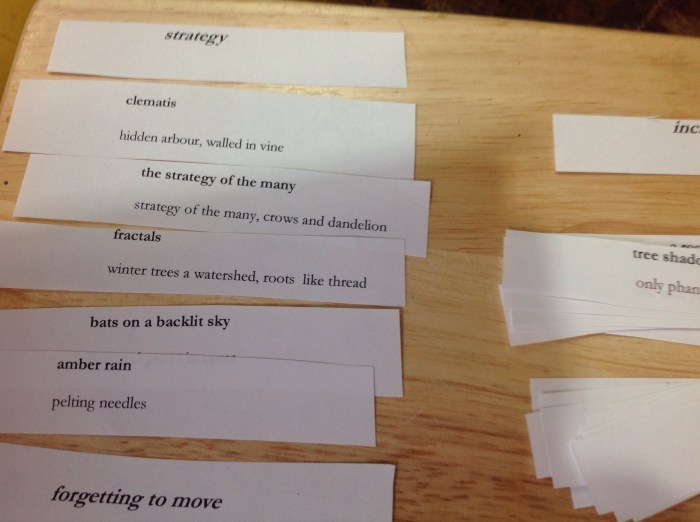
I hate to waste the paper, and I like to have all materials within one view, so I use an abbreviated method. I prepare pages showing just the section titles, the poem titles and a line about the poem. I cut these out so they can easily be moved around on a table. If I want to check detailed poem content structure, I have my i-pad near at hand.
~

~
The process is sometimes tedious. Taking a break helps since after a while the poems you know so well begin to blur in meaning and the relationships between poems become nebulous. However, like many editorial-type tasks, the end product is worth the effort.
~
All my best,
staying at home,
Jane
organizing writing files – what to do with scores of poems
Lately I have been doing a lot of thinking about the poetry I have written over the years. I have two traditionally published books of poetry and will publish, independently, a small volume later this month. But scattered in the memory of my computer are hundreds of other poems, written over the course of forty years. Quality varies, but they are all mine, an expression of what it is like to be ‘me.’ Someday, when I am dust on the wind, someone is going to scan my computer and push delete. My son would not do this, but if I leave them in this state, they will become part of the clutter of his life.
~
So, if I have had success at publishing my own work, and have the skills, why shouldn’t I ‘save’ the poems it took four decades to write.
~
My approach has been to find the poems and assign them to one of five files. Each of the files will be the contents of a book of poetry, independently published and produced in a few copies. I have no intention of marketing these books. I may give them to family or friends, perhaps submit them to a few contests and just enjoy them myself.
~
The five files will be:
1. ‘niche’ – poems about the spaces occupied by plants and animals
2. ‘myth and mystery’ – poems about strange occurrences in life
3. ‘lakes’ – poems about lakes and rivers in New Brunswick
4. ‘my grandfather’s farm’ – poems about my memories of the farm
5. ‘journal poems’ – poems about specific times in my life
~
This is a slow process. First, there are multiple copies of some poems. Second, I have not been consistent with the naming of files. One outcome of this project will be a tidier computer.
~
When I have the files in folders, then I will work to organize the poems, revise them, format the manuscript and produce a book. A huge task, but as with all things, I will see the project through in stages, working on one part at a time.
~

~
UPDATE: I now have the files organized! It has taken about a month of work, off and on. I am now working on the poems for ‘niche.’ There are 66 poems, taking about 110 pages. Next post, I will write about organizing the poems into a readable manuscript.
~
All my best,
and staying home,
Jane
writing the next mystery
Although I am working to assemble a new book of poetry this week, my mind is straying to my next novel, mostly unwritten. This book will be the third in the Kaye Eliot Mystery Series. The title, ‘No Stone Unturned.’ It may seem odd to already know the title but I usually start with a title in my head. I also know the general progress of the story.
~

~
Kaye Eliot, my main character, is on the track of another mystery, this time the whereabouts of a lost gemstone. She and her kids have found the ruins of an old stone house on their property, Daniel the stonemason is romancing Kaye’s friend Kelly, and a visitor from Ireland is asking a lot of questions about the community.
~
This is the point in a new book I most love to be as a writer: filling out the story, imagining the dialogue and building in a few twists and turns.
~
The story and its title began, for me, 40 years ago when a colleague and I were doing a study of hardwood growth in the Poplar Grove area of Nova Scotia. At that time there were the remains of an old stone house in the community and my love of story started the wheels turning. The stone house in Poplar Grove has since been restored by a well-known photographer and has been in the news. To read about the real stone house, check here: https://www.thechronicleherald.ca/news/provincial/the-mystery-of-the-hants-stone-house-255258/
~
If you haven’t read any of the Kaye Eliot Mysteries, there is still time to catch up!
~
 ~
~
How Her Garden Grew takes place on the north shore of Nova Scotia, and explores the mystery of a sea captain who once lived in Kaye’s old home place, keeping a garden and a lost collection of seashells. Kaye and her kids try to solve the mystery, thwarted at every turn by nosy neighbours and a local gang of thieves.
https://www.amazon.ca/dp/B07RTMN6WD
~
~
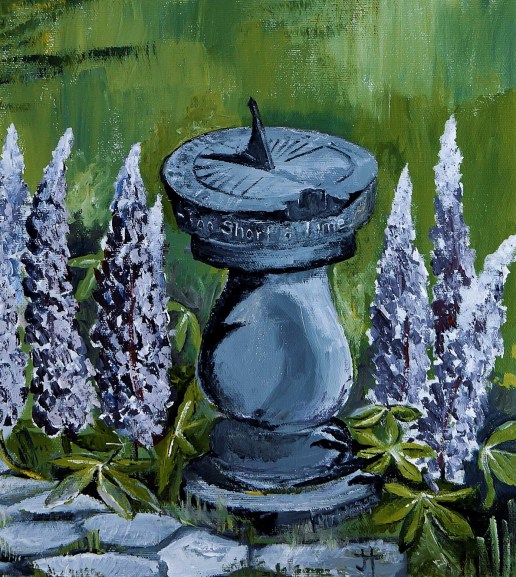
Something the Sundial Said takes place on Nova Scotia’s west coast. When Kaye’s family buys an old estate, they also gain a mystery. They find an old diary describing a century-old murder beside a missing sundial. When Kaye and her kids try to solve the mystery they encounter a local genealogist who will do anything to protect her great-uncle’s good name.
https://www.amazon.ca/dp/B085QQ3RGF
I’ll keep you up to date on the progress I make writing the new story!
~
All my best,
Jane
crystal ball
During these incredible days of isolation, our writing group has begun a series of prompts to help stimulate writing. One of our members suggested ‘weird phrases’ as the prompt category. So far we have had ‘ear hair,’ ‘under the fridge,’ ‘spider web’ and ‘crystal ball.’
~
I have two ‘crystal balls,’ both small and both more properly called ‘glass spheres.’ But they are as close to a crystal ball as I will ever have. I am certain neither sees the ‘future’ but both show an interesting ‘present’ and both remind me of the ‘past.’
~

~

~
clairvoyance
~
my crystal ball
is a glass sphere
from a claw-footed
piano stool I sat on
to practice my scales
~
chipped, it never
snags the sun
will not scry or clarify
occludes
forecasting fog
~
it has a past
Chopin’s Butterfly Étude
in half-time
and a furry
Für Elise
~
but gaze
though I may
it never resonates
with a note
about tomorrow
~
although it has
guessed, after
damaging percussion,
I will never play
Carnegie Hall
~

~
All my best,
Jane
Six requirements for an At-Home-Writing-Retreat
I planned to attend a writers’ retreat this week, in Saint Andrews, New Brunswick. In the end, it was cancelled – too few participants. My arthritis is having a flare-up, so perhaps it is just as well I am at home. But I refuse to miss my creative writing time. So, I will do what I have done before. I will have an at-home-writing-retreat.
~
I have done this twice before, so I know what works for me.
~
For this retreat I need:
1. A room in my house where I don’t usually work, with a desk and a place to relax. My guest room is clean and quiet, ready for a session each day. Actually, quiet is not necessary … years of working in a big office with lots of activity and other people have made me immune to ‘noise.’

2. Six days with no appointments or outside obligations. Since I had set aside six days for the Saint Andrews Retreat, my calendar is cooperating. I will also keep my emailing and social media time to a minimum.
3. Six days with few domestic obligations. I already have reduced expectations when it comes to domesticity! To help with the retreat I have planned easy meals and each day I will do one thing to help us keep ahead of the mess … for example, today I filled and ran the dishwasher.
4. A cooperative husband. No problem, he is always supportive!
5. Goals for the week. I am in the middle of revisions for my next book in the Kaye Eliot Mystery Series: ‘Something the Sundial Said.’ I also want to work on the map I include in all my mystery novels. By the end of the week, I want to be able to send for the Proof of the book, complete with map. I also want to create three blog posts, including two new poems.
6. Physical exercise. I do stretches and bike on my stationary cycle every day anyway. This week, I’ll spent some deliberate time walking outside, taking photos and feeding my need for nature, the basis of my creativity.
~
Today is the first day of my retreat. I took a walk in the rain and some photos for Wednesday’s blog. I did 70 pages of revisions (17,000 words); this sounds like a lot but this is the final revision before the Proof (will get editing and a beta-read). This afternoon I wrote the draft of a poem and started the map for ‘Something the Sundial Said’ (I use GIMP to draw my maps). The retreat is underway!
~
Here is the first draft of the map for my book. The book is set in a fictional community in Nova Scotia.

~
All my best,
Jane
How Her Garden Grew
Mid-summer and my little garden is doing well. The plants are growing in planters on my deck: three parsley plants, three climbing beans, three snow peas and one cucumber. I have to ‘weed’ every day as the maple keys keep sprouting!
~
With a small garden, I have lots of time to read. Right now I am reading the forth in the Lane Winslow Mysteries, set in Canada in British Columbia after WW II here. I love mysteries and now I have one of my own. ‘How Her Garden Grew’ tells the story of a mom and her kids who find a packet of old letters and follow a trail of mayhem and murder to summer’s end. This is the first in a series of three Kaye Eliot Mysteries, set in Nova Scotia in 1995.
~
‘How Her Garden Grew‘ is available on-line here. Or at Westminster Books in Fredericton (you should see their new store at 88 York Street!)
~

~
I am spending my summer (when I am not pulling maple sprouts) writing the sequel to ‘How Her Garden Grew’. It will be called ‘Something the Sundial Said’ and take readers on another cozy mystery adventure.
~
Enjoy your summer reading!
~
All my best,
Jane
nom de plume
When I decided to write and publish the science fiction Meniscus Series, I thought it might be a good idea to take on a pen name, just for the Series. I chose to use my first name Alexandra. A pretty name, but always my unused first name and therefore not familiar. But now that everything is electronic, Alexandra is the name I encounter more and more often in my daily life.
~

name of this boat is Alex
~
When I was a child, starting school, my parents warned me I might hear the name Alexandra when people addressed me. On the first day of school we all sat on the floor of the gymnasium and listened for our names to be read. I listened extra hard, terrified I would not recognize the unfamiliar name. At last the gymnasium was empty and my name, Jane or Alexandra, had not been called. As it turned out, my parents had sent me to the wrong school!
~
Using the pen name Alexandra has been a little strange. When registering for things like Access Copyright and Public Lending Rights I have to remember to register both names. I show up at launches and behave as Jane since that is the name most people know me by. I started a special blog www.offplanet.blog for posts about my science fiction series but recently I sign “All my best, Alexandra (a.k.a.Jane).” I sign books in the Meniscus series with Alexandra (a.k.a. Jane). I guess I am always going to be Jane.
~

~
Do you have a pen name and what has been your experience with using a nom de plume?
~
All my best,
Jane (a.k.a.Alexandra)
writing life,
This summer I have been taking a break from writing science fiction. I have my next science-fiction book Meniscus: Karst Topography ready to publish so I can take some time to think about other writing projects.
~
~
In 1997, I wrote a long mystery novel. I thought it would be interesting to read it through and see how much my writing style has changed. It has changed a lot, as you will see below. But the story was good and I had spent a decent amount of time on characters, story arcs, and point of view, so I decided to work on the draft.
~
The story is titled HHGG (big reveal later in the year) and was 162,500 words. Yikes.
~
This is my first draft of an eventual cover blurb …
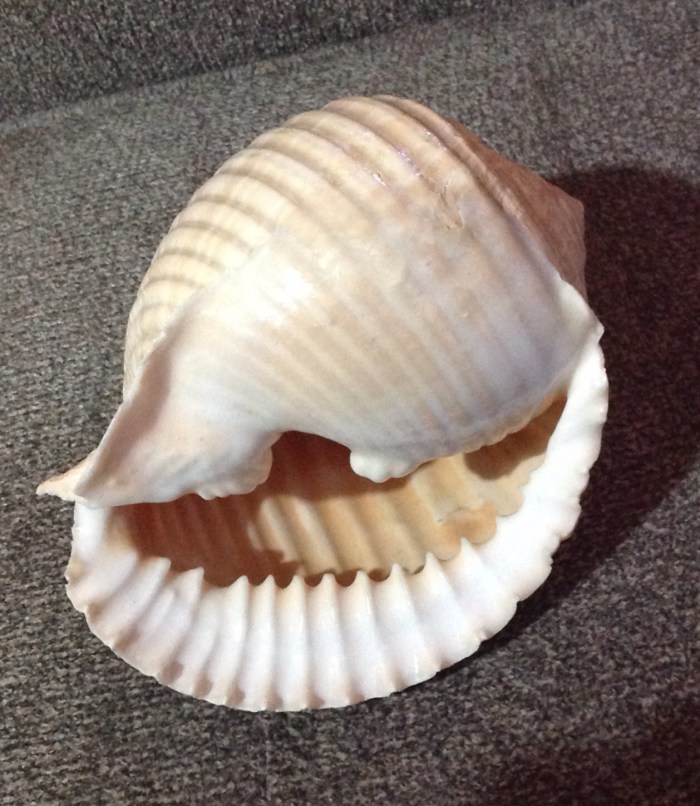
Kaye Eliot comes to Acadia Creek to spend a quiet summer with her two children. But instead of passing stress-free days of swimming and hiking, she finds herself embedded in mystery after mystery. A missing vagrant and a gang of thieves have the community worried. Neighbours seem determined to occupy all of Kaye’s time and energy in restoration of an old flower garden. Meanwhile, she and her kids have stumbled on a century-old legend of a treasure buried on the property, a packet of old letters and an old map of the garden. And they dig up a sinister sea shell. A sea shell who looks like a grinning skull and who will not stay where he is put. Can Kaye recover her calm or will she be victim of neighbors, vagrants, thieves and a shell called the Grinning Tun?
~


the Grinning Tun (about 25 cm or 10 inches across)
~
My work on the book has been on several fronts. I have ‘tweeted’ daily about my process since May 28, 2018 (@TimsJane):
- Reduce the number of words. I lost a lot of words through editing and style changes. I took out the dream sequences, all the ‘ly’ adverbs, a lot of thinking and feeling, and a raft of ‘that’s. I went from 162,561 words on April 13, 2018 to 148,999 words today on July 15, 2018. It is still a little long but a good read (in my opinion).
- I did a lot of thinking about whether to keep the setting in 1994 or modernize it to 2018. With some advice, I have decided to keep it in 1994. In fact, the story would not unfold as it does with cell phones and computers at hand. So my characters drive down to the community phone booth almost every day and look for clues in whirring reels of microfiche.
- Leaving the action in 1994 provided an opportunity to explore the culture of the 1990s. Besides the missing cell phones and computers, people collected Canadian Tire Money, waitresses smoked in restaurants and POGs were a fad among kids. In the summer of 1994, the song ‘I Swear‘ held the Canadian single charts for three weeks and the American charts for seven weeks. Six degrees of Kevin Bacon was a thing. The slang interjection ‘like’ punctuated speaking (still does).
- Part of the text is in Spanish so I asked my friend Roger Moore to help me proof-read the Spanish text.
- I spent a lot of time with my Grinning Tun … I bought him on line in 2010. The more you look at it, the more it looks like a skull.
- I spent a stupid amount of time designing a curlicue for announcing a change in sections. I am glad I did, because this new novel will include ‘Drop caps’ at the beginning of every chapter and said curlicue.
~

~
It will take me a few more weeks to proof the draft. To do this, I order a Proof from CreateSpace and do my edits as a way of passing the time effectively on my stationary cycle. Once I have the Proof, I’ll be able to concentrate on painting the cover for HHGG. This is the rough outlay for the cover, tacked together from various photos …
~

~
Now you know everything about HHGG except its title!
~
All my best,
Jane
tweeting about writing
Every day, I write. Today I worked on the story for Book Six in the Meniscus Series — Meniscus:Encounter with the Emenpod. I also did some editing of an upcoming mystery novel I refer to as HHGG. Tomorrow I will be writing poetry for a series about abandoned communities and what happens to plants in abandoned gardens.
~

~
Working back and forth like this between projects at various stages of completion is a great strategy for me. I never get bored, I never get writers’ block and I think shifting projects keeps my writing brain refreshed.
~

~
Besides blogging, I participate in Twitter, sending a tweet almost every day to #amwriting … if you’d like to find out what my writing life is like, follow me at @TimsJane … I report on what I am doing and share a bit of writing wisdom. I’d love it if you would follow along!
~
A little about the mystery novel since I tweet most often about it. HHGG is one I wrote in 1997. I have learned a lot since then, so editing makes me laugh. HHGG is about a woman and her two kids who seek summer solace at her old family home. She never dreams she is walking into a village rife with mysteries, some of them stretching back more than a century. I have a few human antagonists, but one who is anything but human!
~

~
Hope you are enjoying your summer and your own writing life!
~
All the best,
Jane.




 nichepoetryandprose