Posts Tagged ‘woodland’
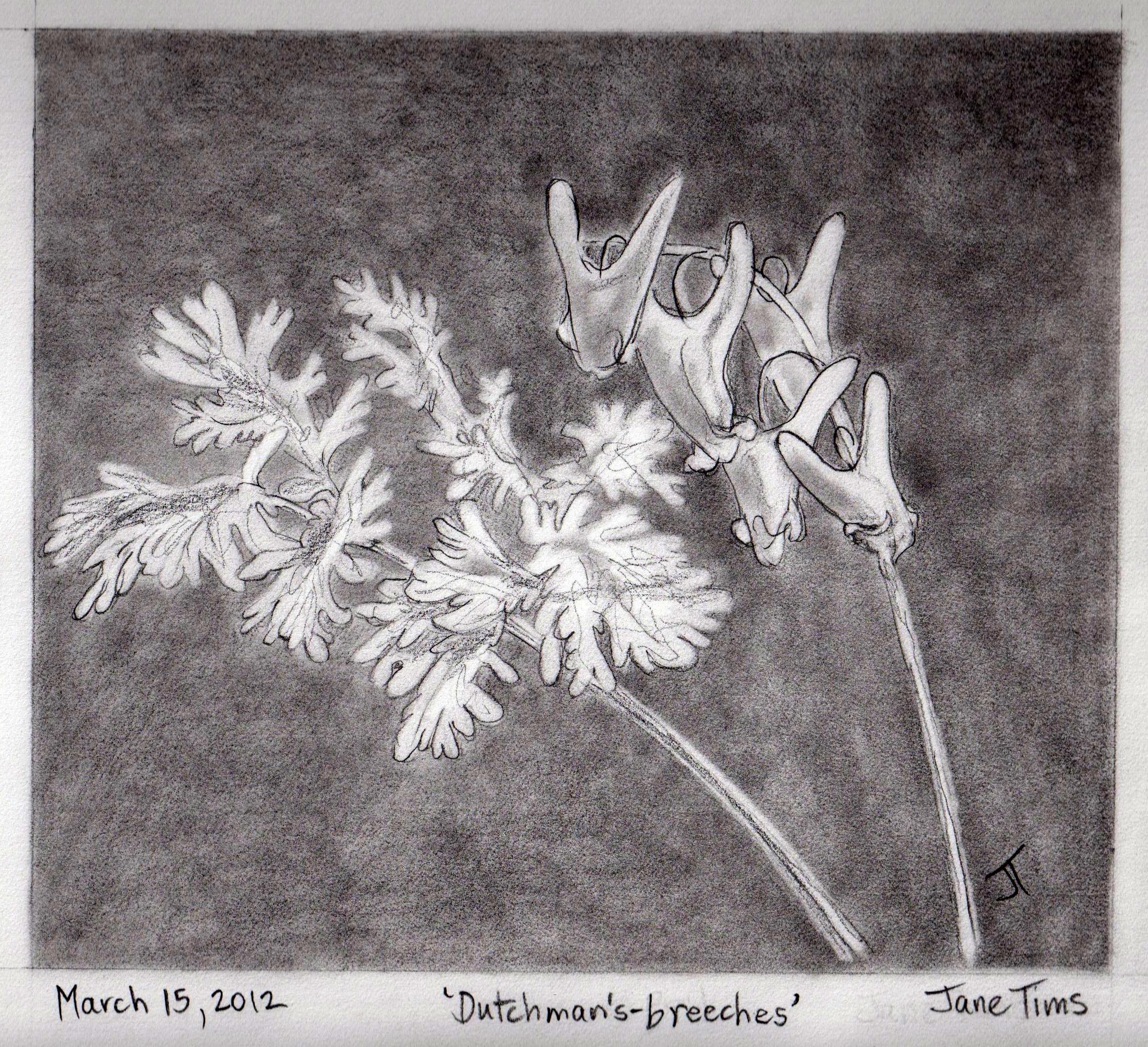
Dutchman’s-breeches (Dicentra Cucullaria (L.) Bernh.)
Our first summer home was located in a rich hardwood of Sugar-Maple (Acer saccharum Marsh.), Beech (Fagus grandifolia Ehrh.) and White Ash (Fraxinus Americana L. ). In these woods, in early spring, as the snow melted, wildflowers found ideal habitat. Many plants take advantage of the few days when the leaves of the overstory trees are still developing, and there is bright light in the understory of the woods.
One of these wildflowers is Dutchman’s-breeches (Dicentra Cucullaria (L.) Bernh.). This charming little plant blooms early in spring, in rich, rocky hardwoods. The white flowers are two-spurred, in groups of four to ten along a stem held just above finely divided, feathery leaves.
The plants is also known as breeches-flower, cullottes de Hollandais, and dicentre à capuchon. The generic name is from the Greek di meaning twice and centron meaning a spur. Cucullaria is the old generic name meaning hoodlike. The plant was named by Johann Jacob Bernhardi.
The flowers of Dutchman’s-breeches are an example of plant adaptation for pollination. The flower has a clever mechanism, in the form of fused flower parts, to ensure only certain insects (such as the bumblebee) can access the nectar and pollen.
In my copy of Roland and Smith (The Flora of Nova Scotia), I recorded my first encounter with this little plant – April 28, 1985, during one of our first visits to our property before we purchased it. We called our cabin Whisperwood, in part because of the subtle breezes in those wildflower-dotted spring woods.
~
~
Dutchman’s Breeches
Dicentra Cucullaria (L.) Bernh.
~
~
Dutchman’s breeches
brighten in sun
woodland washdays
have begun
~
spring-clean trousers
hung in rows
inflated with breath
the May wind blows
~
sprites are playing
tossing their hoods
above the damp
in the spring-fed woods
~
little fairy laundry
trembles on the line
before greening trees
block spring sunshine
~
~
© Jane Tims 1993
maple syrup ups and downs
It may be a short maple syrup season this year. The weather has not been cooperative. In order for the sap to run, warm days are great, but the nights need to be cold. When the temperatures fall below zero, the sap in the tree runs from the crown to the roots. When the day is warm and sunny, the sap runs back up to the canopy. If there is no cold night, no sap.
So far we have collected about 40 liters of sap from our 10 trees and I have 3 bottles (each 500 ml or two cups) of lovely dark syrup! This compares to 136 liters of sap last year on the same date, from 12 trees.
~
~
Cold night, warm day
~
Icicles build
from the spile
sweet sickles of sap
~
~
© Jane Tims 2012

keeping watch for dragons #1 – woodland dragon
Sometimes our grey woods are a mysterious place. Something about the slant of the light, the way the trees stand like pillars supporting the sky, or the way pale moths climb on the forest dust, conjures myth from reality.
Last year as I walked on one of the paths, my eye was drawn to the single scale of a seed cone, lying on the forest floor. Perhaps it had been dropped as a Grey Squirrel in the tree above nibbled on a pine cone.
Perhaps…
~
~
Woodland Dragon
~
~
in the blackened stand
of jack pine
~
a single
crimson
scale
~
~
© Jane Tims 1998
eight days – antler
During my trip to Ontario, we spent lots of time, on cold days, enjoying the wood stove.
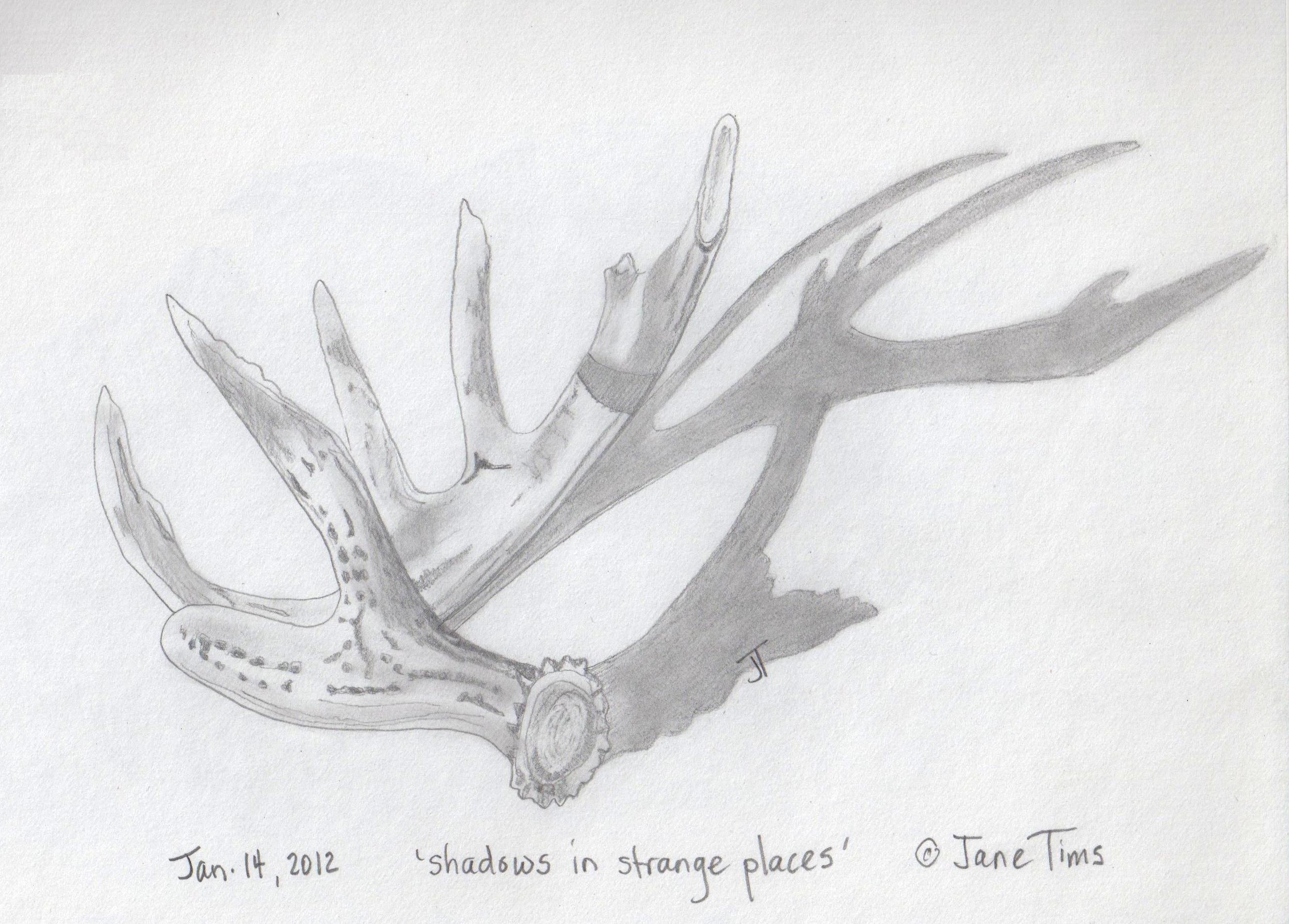
On the hearth was a deer antler, found on a walk in the woods. Usually they are hard to find since the mice chew them to nothing very quickly.
I was drawn to the antler because of its resemblance to a bony hand.

~
~
antler
~
ivory hand, posed
for incantation, shadows in unexpected places
relic of a woodland walk, artefact
enchanted, deer rub
cedar bark to summon
mist, acknowledge the passage
of days, manifest between
separation
and the gnawing of mice
~
~
© Jane Tims 2012
at the bird feeder #4 – Woodpeckers
The bird feeder had a new visitor last Thursday, a woodpecker. My husband saw it at the feeder, but by the time he had the camera ready, it was gone. Undaunted, he went outside and chased the little lady through the woods until he had several photos.
We identified the bird from the photos. There were two possibilities, a Downy Woodpecker (Picoides pubescens) and a Hairy Woodpecker (Picoides villosus). Both have a white stripe on the back. The males of both species have a red patch on the back of the head (the one at our feeder was a female). The differences between the two are body size (the Hairy Woodpecker is the larger of the two) and the size of the beak (the Hairy Woodpecker has a much longer beak, about 3/4 of the depth of the head).
We are reasonably certain our bird was a Hairy Woodpecker. Its beak is noticeably long. Also, the round cut branch on the tree in the photo (in front of the bird’s feet) is at least an inch in diameter, making the length of this bird about nine and a half inches.
~
~
hand-crafted
Downy Woodpecker (Picoides pubescens)
~
daft little bird
propped, pubescent, plump
bang your silly
head against the tree
eat a bug
~
your sculptor used
deft fingers
to point your beak
solidify your tail
paint feathers
foam on black water
snow on dark woods
night sky with planets
berry-stain
your downy crown
~
~
© Jane Tims 2012

on pond ice
The days are short, reminding me of days when my son was young and I resented the brief daylight. We left for work in the dark and arrived home after the sun set. To spend just a little time with my son in the snow, I would turn on the outside light and play with him for a few precious minutes at the end of every day.
On weekends, we would seek out the smallest patch of ice and skate together. Any patch of ice would do. Some years we tried to make a small rink. Usually, we made do with the strip of ice formed at the edge of our driveway…

Our favourite place to skate was a small hollow in the grey woods behind our house. We dubbed it “Hoot-and-Hollow Pond” (because it was just ‘a hoot and a holler’ out back, and because we hear owls so often in the grey woods). The pond was small, but just the right size for my son to wobble around on his first skates.
In the years since we skated there, the trees have grown thick and tall around the pond. I went looking for it this week and found the ruin of the little bridge we built across a narrow place in the pond…

ruined bridge over Hoot-and-Hollow Pond...you can see the broken boards and old nails
and ice on the little pond itself…
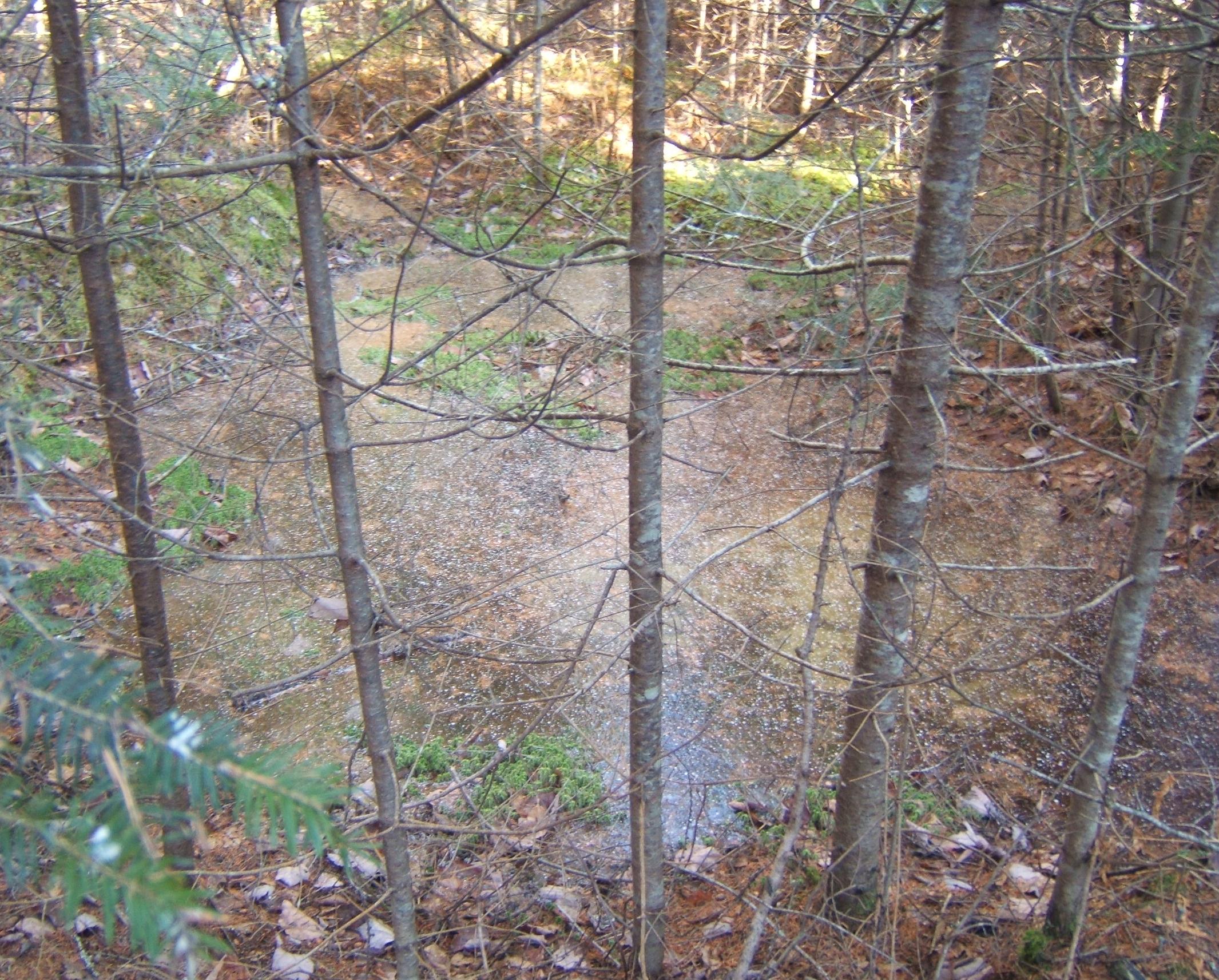
Hoot-and-Hollow Pond today, the water level a little lower than when we skated there
~
~
a skate on the woodland pond
~
~
etch
brittle cracks beneath the weight
of blades, we spread our bodies thin
twirl on the delicate lift
of snowflakes drift
above the pond, gather
firs around us, lean away, bend
beneath the weight of snow, find
room to glide, the edge where white birch
cage faint light
magnify the gleam
of paper bark, frail ice
white snow and stars
resist the dark
~
~
© Jane Tims 2011

witch’s broom
In the Balsalm Fir tree over our shed is a strange growth, like a dark mass of short deformed branches. This dark mass of branches is known as a ‘witch’s broom’.
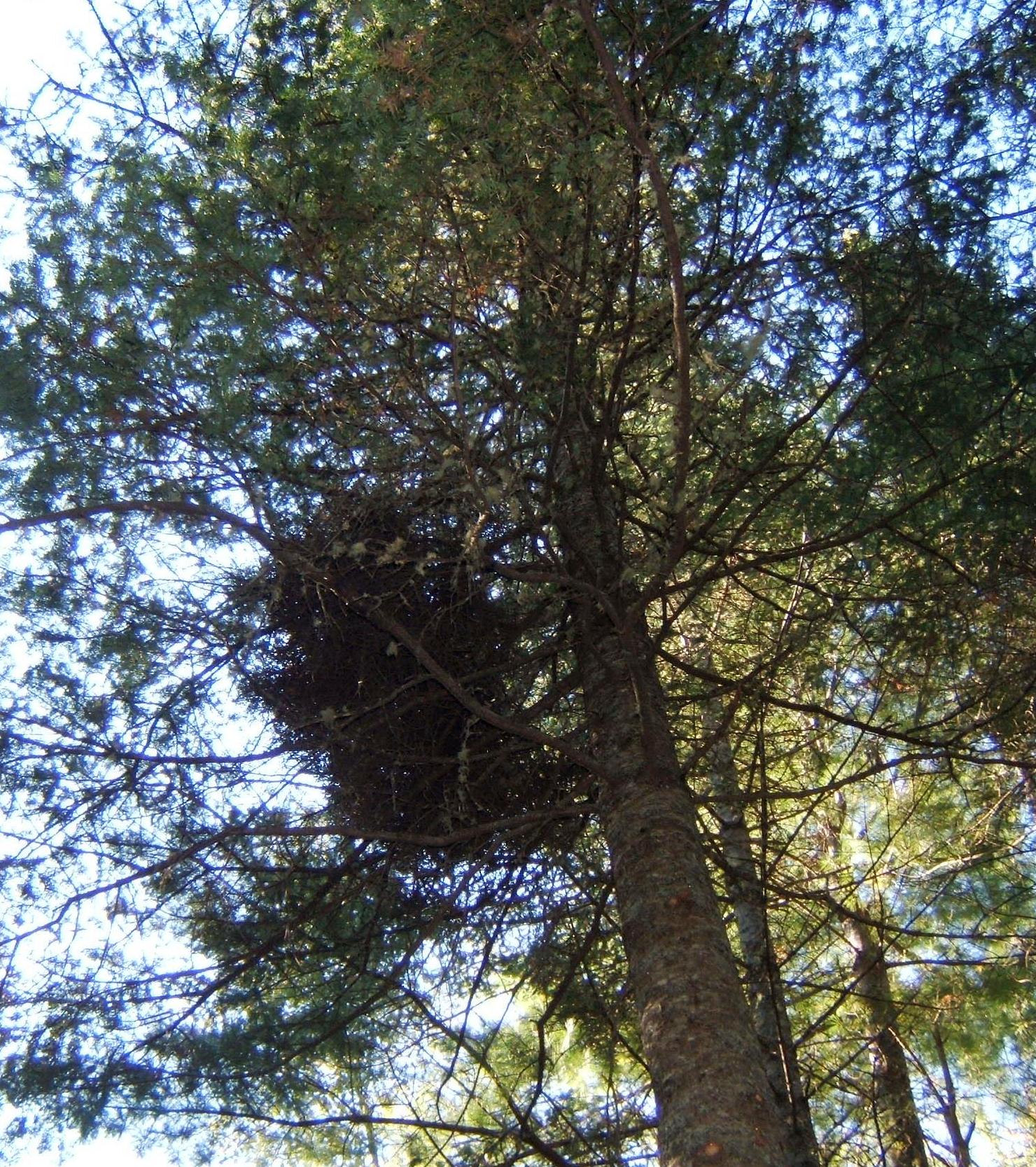
A witch’s broom is a common term for an abnormal growth caused by the action of an agent such as a mite, virus, insect, or fungus. The agent causes a branch of the tree to grow from a single point, resulting in a mass of twigs and branches resembling a nest or broom. Many kinds of plants can have a witch’s broom deformity, including many tree species.
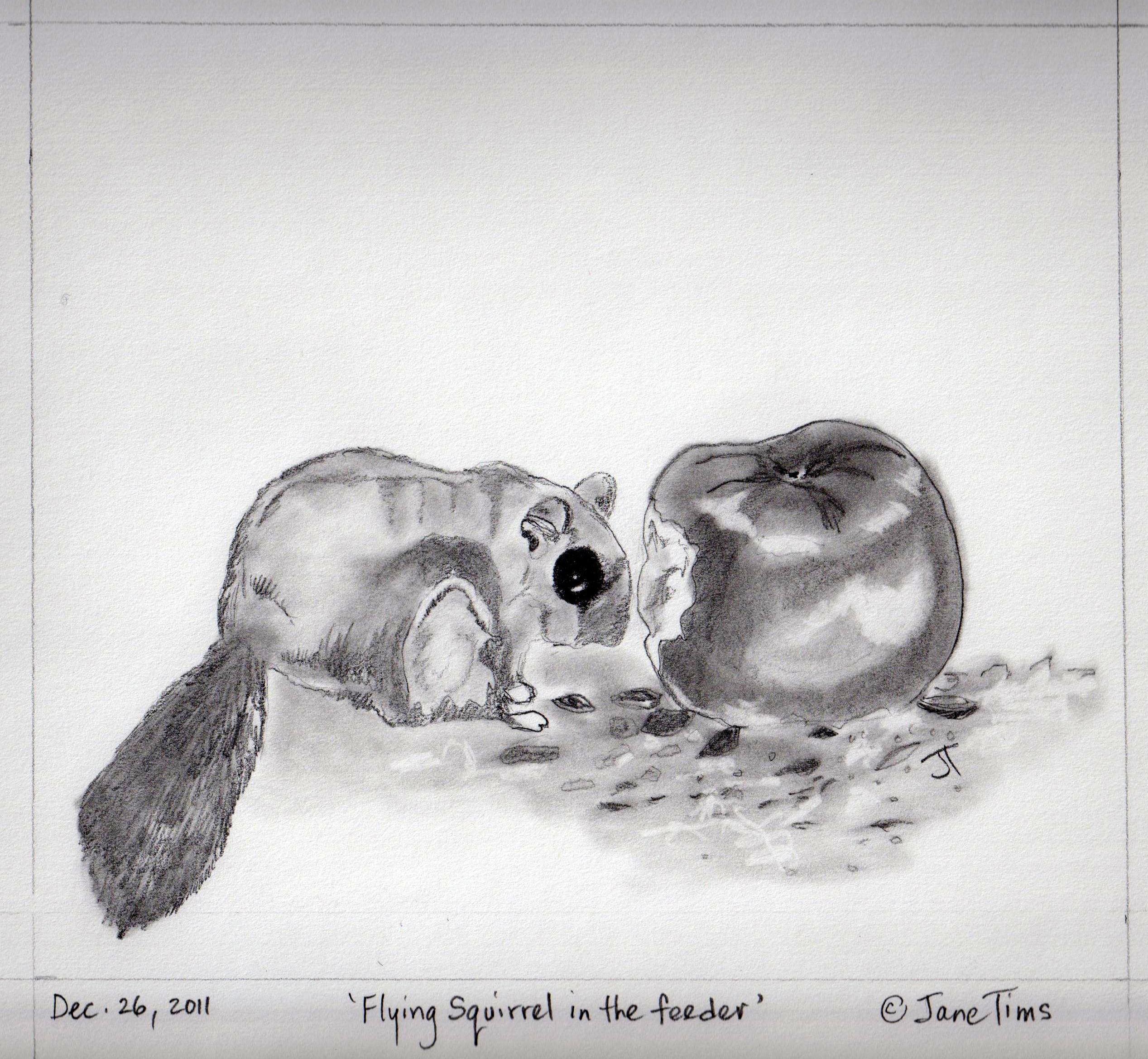
Animals, including the Northern Flying Squirrel, use the witch’s broom as a nesting place. The Northern Flying Squirrel is the big-eyed squirrel invading our feeders every night (see ‘spacemen in our feeder’ under the category ‘competing for niche space’ for December 23, 2011).
Witch’s brooms occur frequently … we have at least three in our grey woods. They lend an air of mystery to the woodland. People used to believe a witch had flown over the place where a witch’s broom grew.
If anyone knows of another name for the witch’s broom, please let me know. Years ago, we visited a small farm museum in northern Maine and an example of a huge witch’s broom was displayed in the shed, labelled ‘horrah’s nest’, but I have been unable to find this term used elsewhere.
~
~
wood witch
~
burdened by snow
a tree falls
tumbles a witch’s broom
the witch set free
~
a hex on the snowfall
slate where the dog walks
cuts her feet
soft rubies in every track
~
a hex on the room
cold as I left
now warm
~
too warm
~
~
© Jane Tims 2001
Evergreen Woodfern (Dryopteris intermedia Muhl.)
On Sunday, I looked for and found my first November fern! Since we had about 25 cm of snow yesterday, I may have found my only fern of the winter!
The fern I found is an evergreen fern, pressed close to the earth this time of year.

For me, identifying ferns is always a challenge. I use the Peterson Field Guide, ‘A Field Guide to the Ferns and their Related Families’ by Boughton Cobb, 1963. Then I turn to a very helpful website www.ontarioferns.com .
With patience and careful attention to some key features, I can usually figure them out.
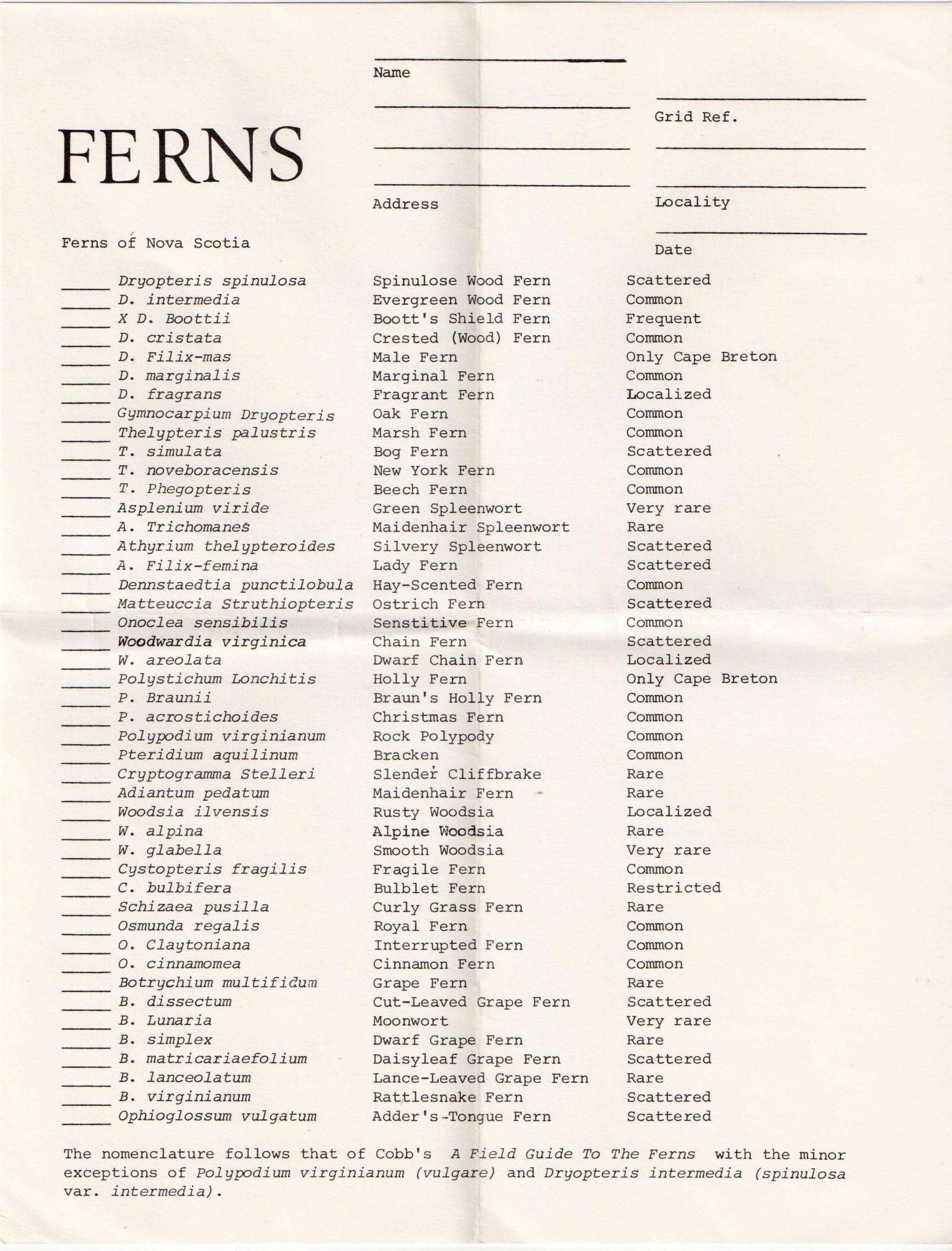
checklist issued by the Nova Scotia Museum for a fern project several years ago; a checklist like this is helpful to double-check your identification
The key features for the fern I found are:
- the roughly triangular shape
- the ‘thrice-cut’ nature of the leaves (cut once into leaflets or pinnae, a second time into subleaflets or pinnules, and a third time into lobes)
- the stalk is greenish and scaly, not hairy
- the lowest pair of inside subleaflets (next to the stem) of the lowest leaflet are slightly shorter than the second subleaflets next to the stem (if you look closely at the photo above, this feature is hard to see due to the camera’s perspective – the best example is the fern at the upper right).
This fern is the Evergreen Woodfern (Dryopteris intermedia), closely related to and difficult to distinguish from the Spinulose Woodfern.
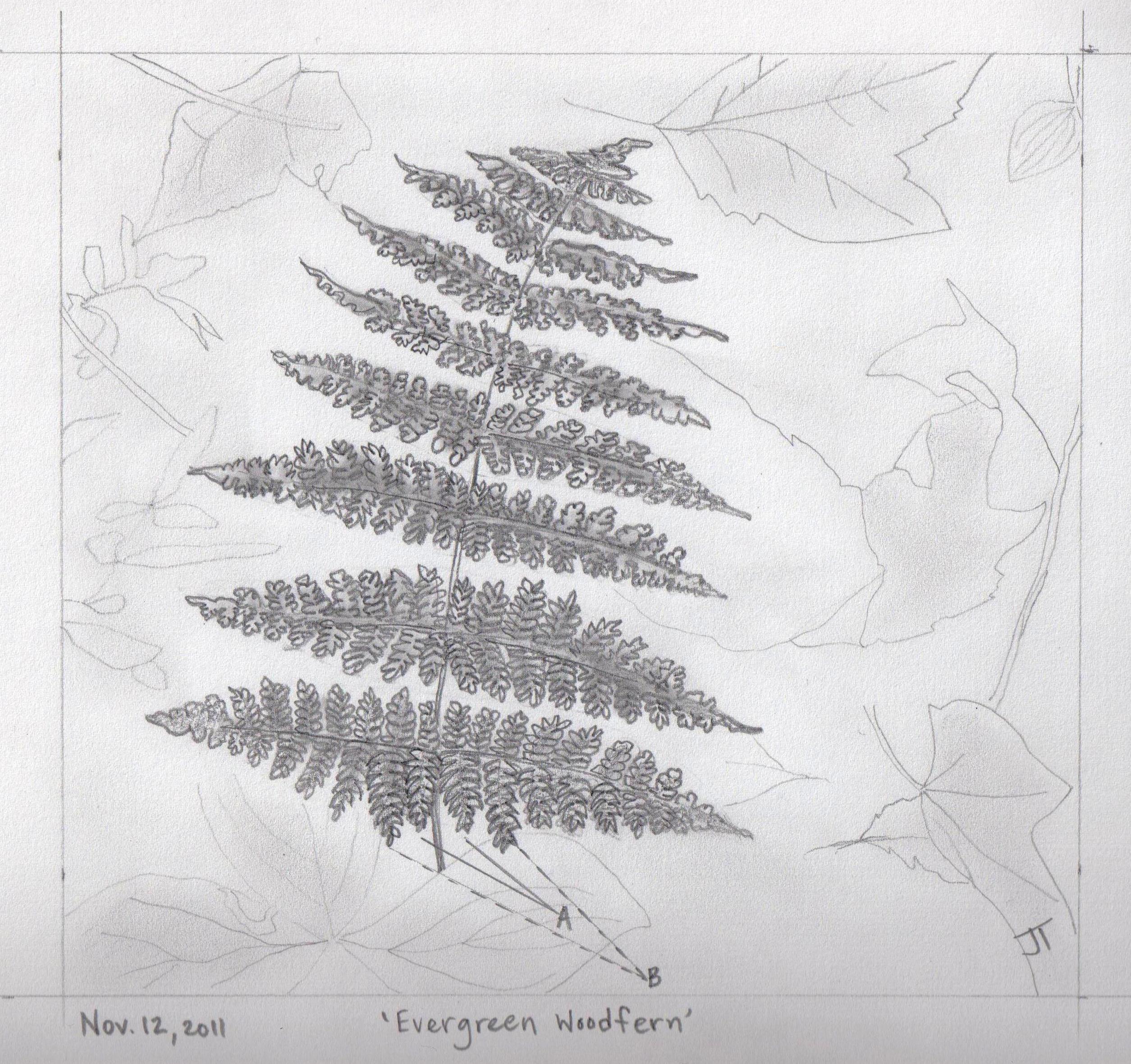
a leaf of the Evergreen Woodfern... the lowest pair of inside sub-leaflets at 'A' are shorter than the next pair at 'B'... this is the feature distinguishing the Evergreen Woodfern from other Woodferns
American Star-flower (Trientalis borealis Raf.)
Crisp November nights are a perfect time for a quick look up at the stars. I’ll be including some posts about our star-gazing, but for now, my thoughts are still turning back to summer. Stars in the sky? There are also stars in the dark summer woods.
The American Star-flower, Trientalis borealis Raf., is a plant with a delicate white, star-shaped flower, found in late spring in woodlands and on peaty slopes. Its scientific name comes from the Latin word for the third part of a foot, a reference to the height of the plant, and the Latin borealis, meaning northern. It is a common little plant, described by Fernald as a “forest pioneer”.
Some will wonder what the ‘Raf.’ refers to, at the end of the scientific name. This is an attribution to the botanist who first named the plant. In many cases, the attribution is ‘L.’, meaning the plant was first named by Carolus Linnaeus (the biologist who first introduced the ‘binomial’ naming system for plants).
‘Raf.’ stands for Constantine Samuel Rafinesque-Schmaltz who first assigned the genus and species names to the plant – Trientalis borealis. He was an eccentric polymath (knowledgeable in many fields and disciplines) who lived from 1783 to 1840. In his lifetime he published 6,700 binomial names for plants.
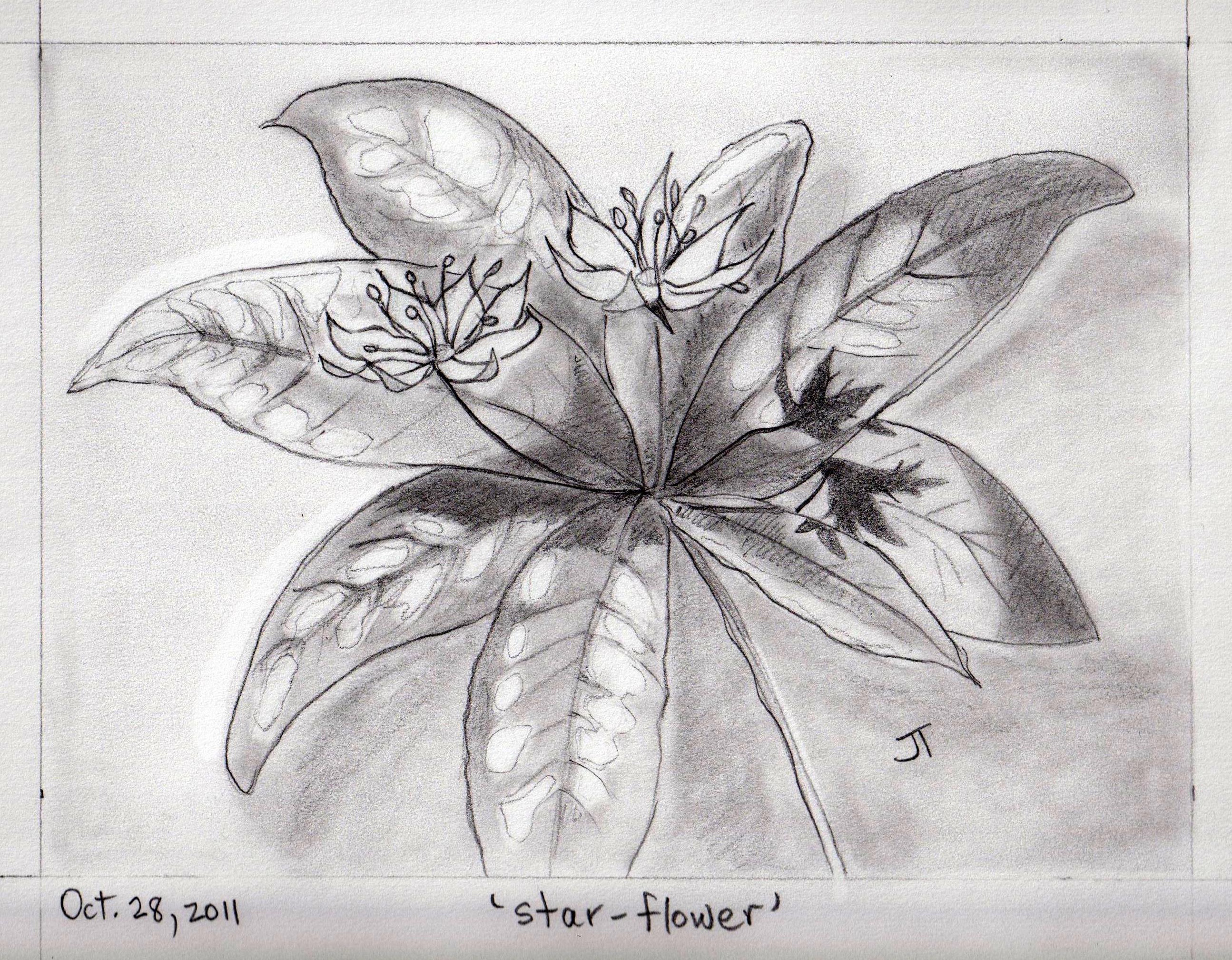
Star-flower
Trientalis borealis Raf.
~
Trientalis
borealis
star-flower
lost from the sky
four inches high
(the Latin name
makes claim)
petals white
boreal light
fallen down
first found
by Constantine
now often seen
it’s little lamp
above the damp
a forest pioneer
final frontier
up above
twinkling of
stamen and star
who you are
I wonder
and wander
down a trail blazed
by a frail flower
one candle power
~
Published as: ‘Star Flower’, Winter 1993, The Antigonish Review 92.
revised
© Jane Tims
Twinflower (Linnaea borealis L.)
As we enter the winter months, I like to remember the woodland plants now waiting under the layers of fallen leaves to flower again next spring.
Twin-flower (Linnaea borealis L. var. americana (Forbes) Rehd.) is a low-growing, creeping evergreen, found blooming in late June in wooded swamps, coniferous bogs and clearings.
Each slender stalk bears a set of two delicate, nodding, fragrant flowers, white in color and tinged with pink. Other names for the plant are pink bells and, in French, linnée boréale. The specific name is from the Latin borealis, meaning northern.
The European variety was a special favorite of Linnaeus, the founder of the present system of naming flowers.
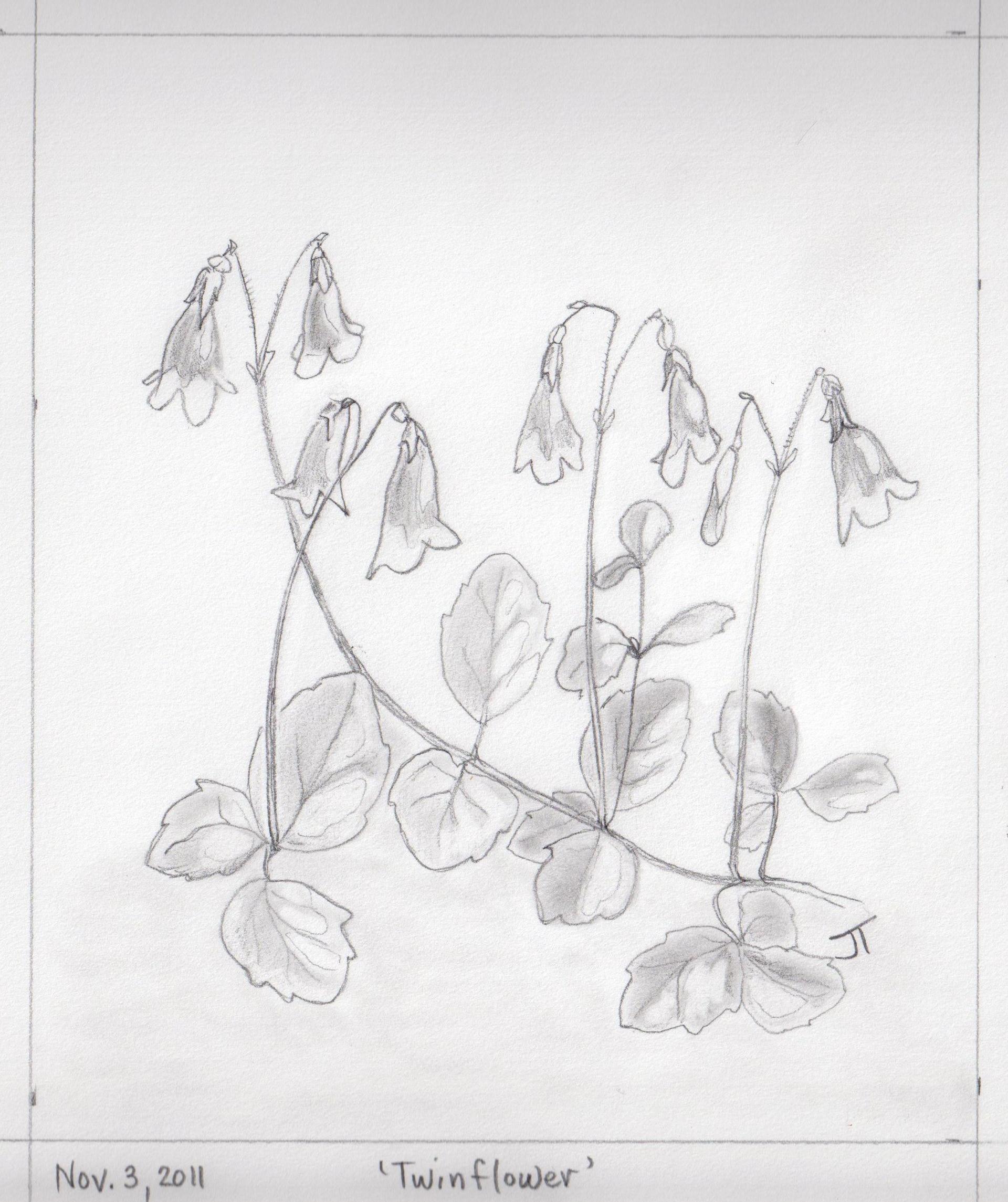
Twinflower
Linnaea borealis L.
~
conifer cathedral
slanting light
Linnaea carpets
stains the forest floor
to the edge
near the forest door
a woodland pool
~
on slender stem
mirrored
in the pool
and in the air
twinflower rings
pink boreal bells
at vespers
in whispers
a whisper
the rule
~
creeps under roots
and fallen leaves
Linnaea trails
over rude beams fallen
from fences built
when woods
were pasture
~
twin flowers
settle back to back
nodding heads
they cease to ring
and sleep
~
© Jane Tims 1992




 nichepoetryandprose