Posts Tagged ‘woodland’
in search of Thornton W. Burgess
Last weekend we took a drive to the western part of the province. Our goal was to see Bolton Lake.
~
I have heard that there was once a cabin on an island on Bolton Lake used by Thornton W. Burgess during his summer visits to New Brunswick. Thornton W. Burgess (1874 to 1965) was a conservationist and children’s author who wrote adventure stories featuring all the denizens of the wild wood – he wrote more than 170 books and many stories including The Adventures of Jerry Muskrat (1914), The Adventures of Sammy Jay (1915), The Adventures of Danny Meadow Mouse (1915), The Adventures of Grandfather Frog (1915) and so on. I particularly remember Mother West Wind’s Neighbors (1913) because it brought lots of the characters together.
~
Our drive took us along East Brook Road, off highway #630 in western New Brunswick, in the area of Palfrey and Spednic Lakes.
~

Bolton Lake is at 8 o’clock on the map … we followed the East Brook Road (upper road marked in red from right to left) and then the Parker Lake Ridge Road (marked in black along the left edge of the map)
~
The road is well-used but rough and I had a few ‘moments’ as my husband navigated the potholed and sometimes inundated road.
~

the road is the northern boundary of one of New Brunswick’s protected areas
~
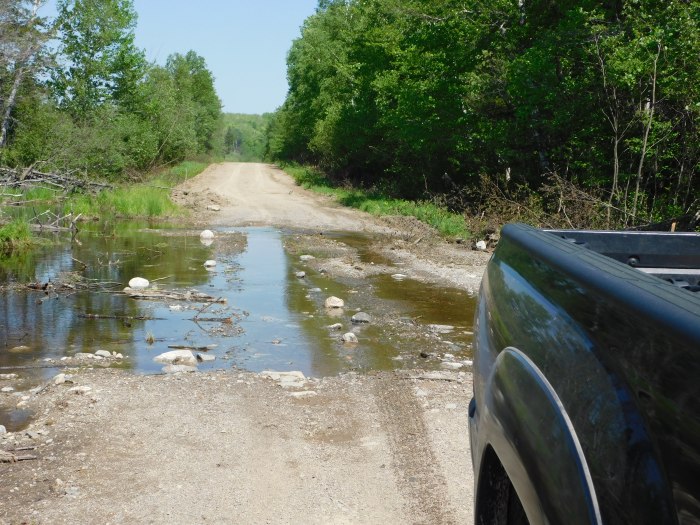
it always looks worse than it is …. a beaver dam blocking a culvert caused this flooding on the road
~
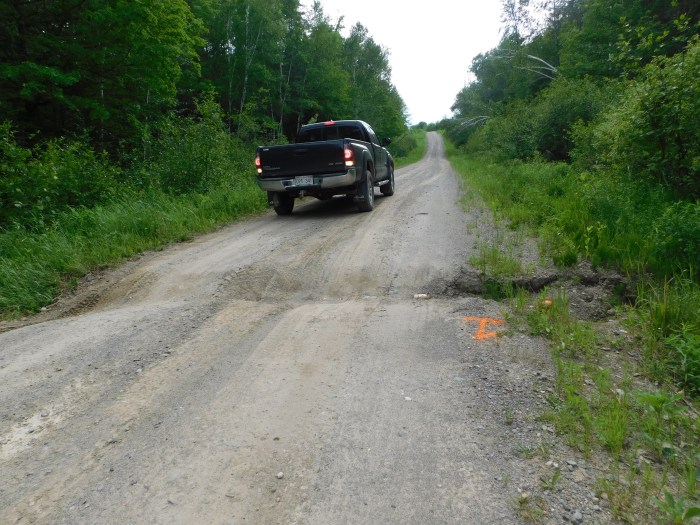
our conversation as we drive is augmented by my warnings … “bump!”, “big rock!”, “really big rock!” as if my husband couldn’t see these himself! … there was lots of road maintenance going on – culverts replaced and washouts resolved
~
We were surprised but wildlife sightings were scarce on our trek. We saw moose, deer and coyote tracks, bear and coyote droppings, and lots of beaver lodges but no one was out and about on such a hot and windy day.
~
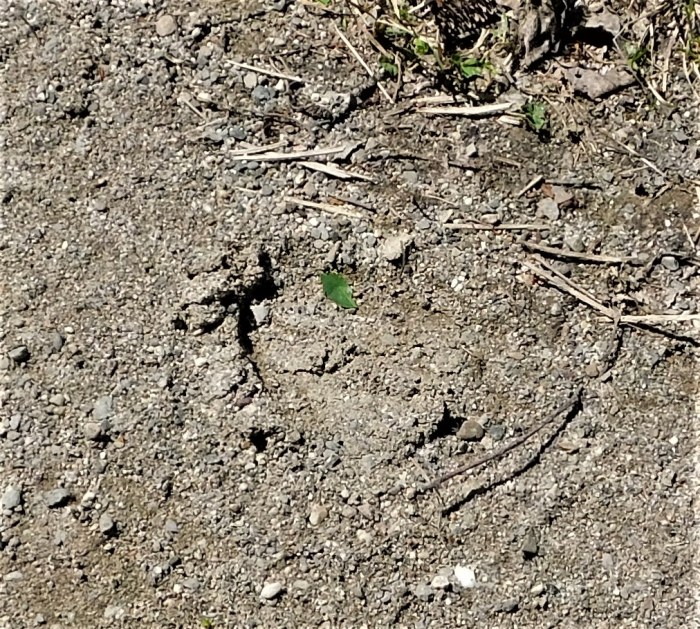
a moose track in the sand of the road
~
We had been to Bolton Lake in 1990 and were amazed to find that almost thirty years has made a huge change. The road from Parker Lake Ridge Road to Bolton Lake has completely grown over. So Bolton Lake will keep its secrets and its history for now. We will have to content ourselves with a vista from Pemberton Ridge along the Forest City Road … the lake in the distance is one of the many waters comprising the Spednic Lake – St. Croix River system along the US/Canada boarder. Bolton Lake is hidden in the trees and valleys on the right hand side of the photo.
~

~
Copyright Jane Tims 2017
song of the Hermit thrush
Every morning I listen at my window for the morning bird chorus. This morning, my first Hermit thrush of the year! It is my favorite of the bird songs, melodic and heavenly, phrases repeated in different keys. A year ago, I heard the song and wrote the following poem. For the process I followed in writing this poem, see this.
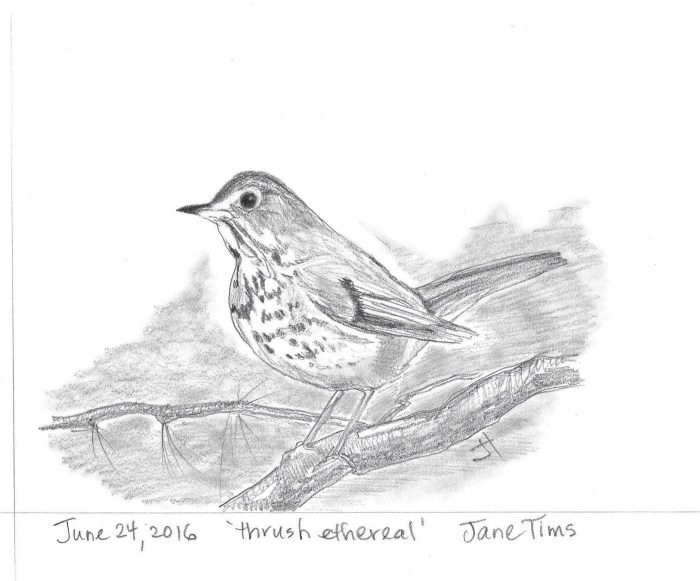
Hermit thrush
~
Catharus guttatus
~
neither visceral nor guttural, ethereal
tip-toe in tree tops
air pulled into taffy thread
a flute in the forest
froth on a wave
~
rain trembles on leaf tips
guttation drops on strawberry
a lifted curtain of mayflower
~
I saw you there
hidden in the thicket
and I followed
~
climb the ladder and sing
then step to the rung below
heads up, thoughts of the new day
parting of the beak
pulse at the throat
hairs lift
at the nape
of the neck, fingers
warble the keys
between middle and ring
catharsis
~
~
Published at http://www.janetims.com July 1, 2016
~
Copyright Jane Tims 2016
woodpeckers in the grey woods
If you are new to my site, you might not know that we call the woods behind our house ‘the grey woods’. The woods are mainly balsam fir and black spruce, with grey birch and red maple. Here is a map of our property (about 19 acres).
~

~
Woodpeckers are a common bird in the grey woods. We have Pileated Woodpeckers (Dryocopus pileatus), Hairy Woodpeckers (Leuconotopicus villosus), and Downy Woodpeckers (Picoides pubescens). The woodpeckers love the older trees in the woods. They also peck at our wood-shingled house!
~

~
Here is a Hairy Woodpecker hard at work in a balsam fir. He is hard to tell from the Downy Woodpecker (especially when you can’t see his beak) but the Hairy woodpecker is larger (about the size of a Robin) and sometimes his red cap is divided into two parts (seen clearly in this photo).
~

~
Copyright Jane Tims 2017
changing communities
Last week we went for a drive to the Cornhill Nursery in Kings County to buy a new cherry tree for our yard. Afterwards we took a drive to visit some of the old communities in the area. One of these communities, Whites Mountain, was a rural farming community with 17 families in 1866 (New Brunswick Provincial Archives). By 1898 the community had one post office, one church and 100 people. Today the community consists of a few farms and residences, perched on a steep hillside overlooking the hilly landscape of northern Kings County.
~
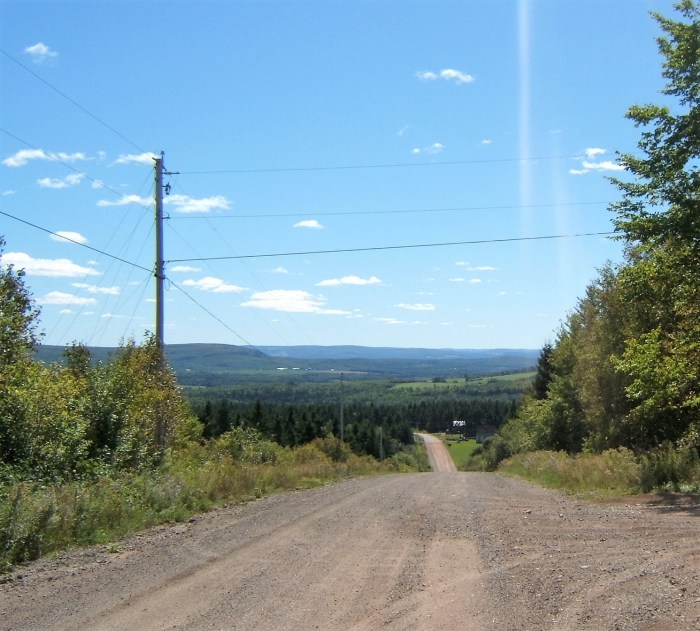
On the road descending Whites Mountain, Kings County, overlooking the broad Kennebecasis Valley (September 2016)
~
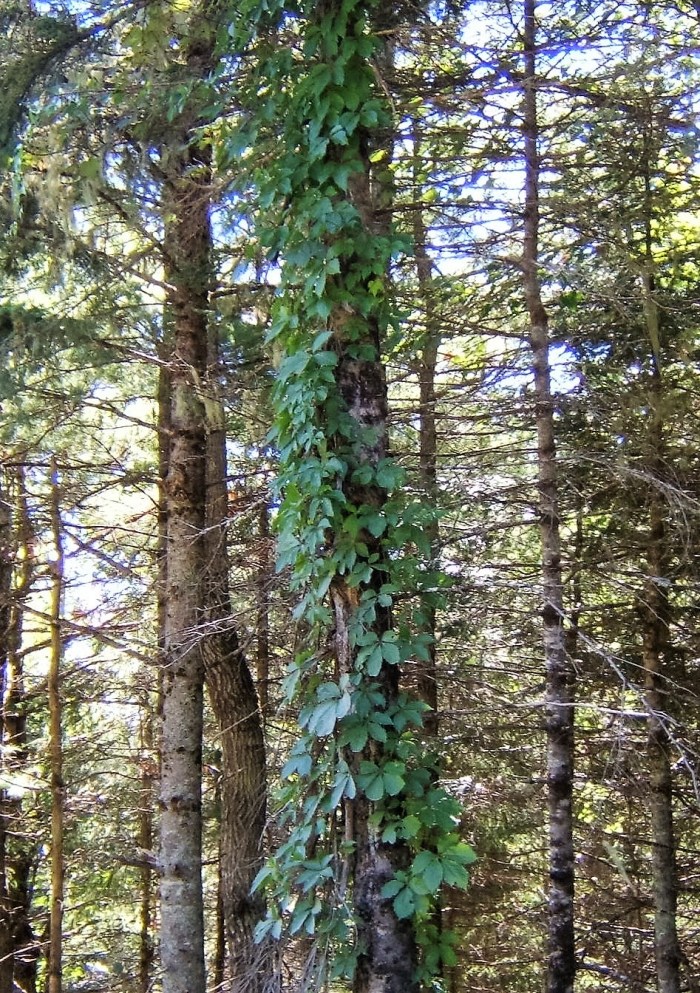
One of the most interesting sights on our drive may also be evidence of the farmsteads formerly in the area. Although Virginia creeper (Parthenocissus quinquefolia (L.) Planch.) is native to North America, in this area it is usually associated with human habitation. In the thick woods north of the community, we found Virginia Creeper in profusion, covering the surface of the trees.
~

~
~
Although there is only forest here now, perhaps the ancestors of these vines covered barns and other buildings in the area.
~
Copyright 2016 Jane Tims
Who ate the sunflower seeds???
First week of spring! Cold and snowy!
~
~
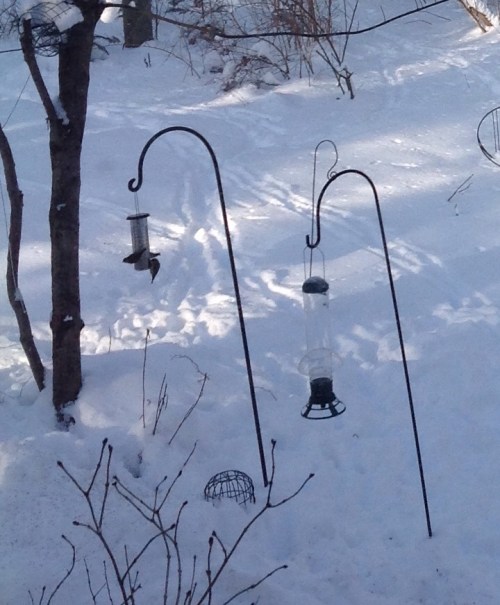
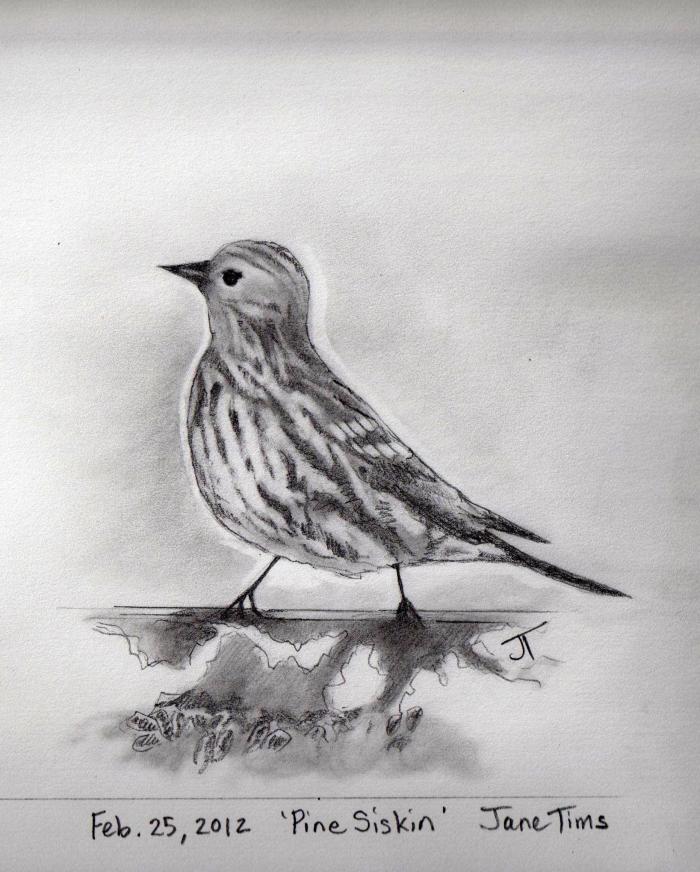
I woke this morning to find my newly-filled sunflower seed feeders all empty. Three pine siskins and a goldfinch were clinging to the finch seed feeder but the other birds are out of seed. A look at the yard will tell you who was slurping up the sunflower seeds in the night!
~

~

~
~
Copyright Jane Tims 2016
edible wild – spruce gum
In my part of North America, we have freezing temperatures and snow on the ground from December to March. With a few exceptions, most plants go into sleep mode during these months and foraging for edible plants is difficult. You can dig beneath the snow to find a few evergreens, but most of the edible wild is above ground.
~

~
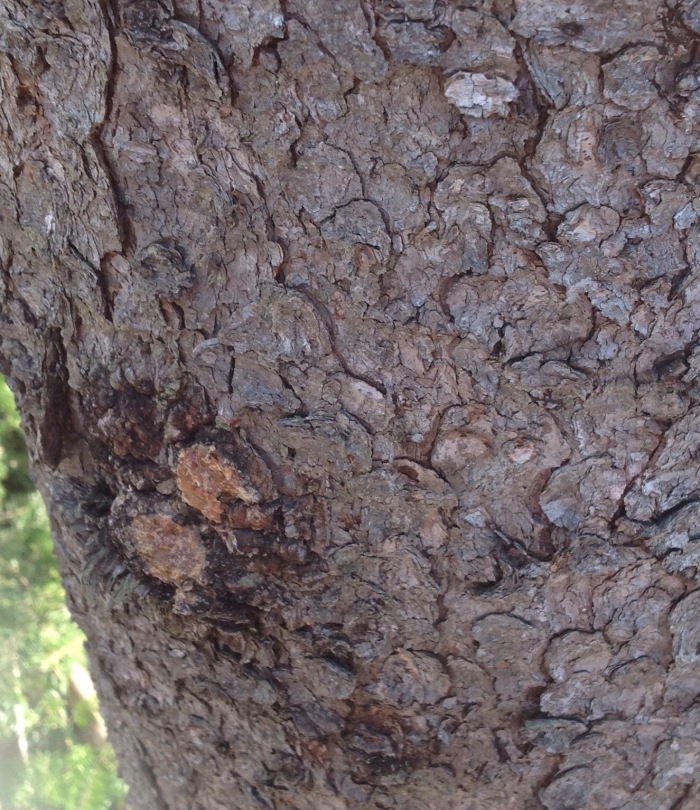
When I am in the woods, even in winter, I am always on the look-out for spruce gum, a natural sugar-free treat from the forest. Spruce gum is found, as the name suggests, on spruce tree bark. We have a large stand of spruce in our grey woods, but the tree below grows, conveniently, beside our driveway. For a map of our woods, see the right hand column ‘map of the grey woods’.
~

~
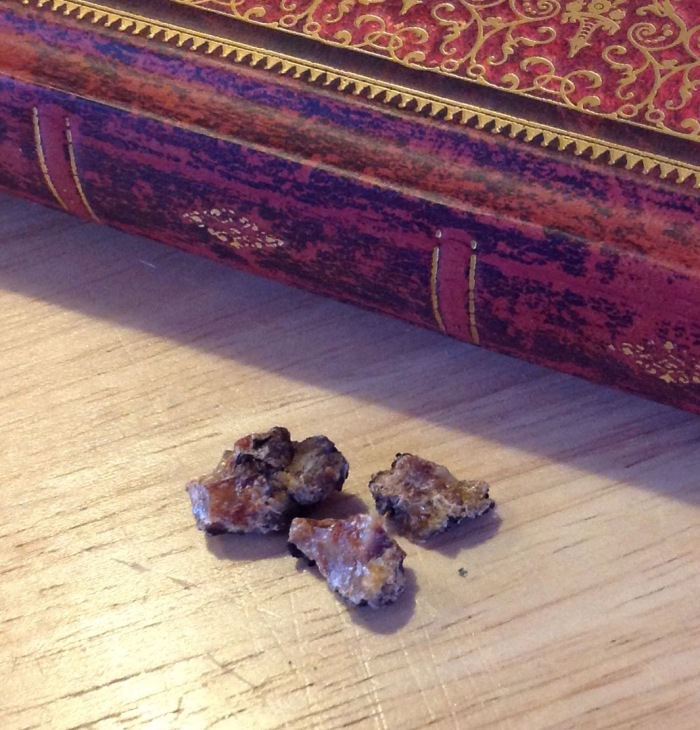
When a branch is broken or the bark is wounded in some way, the spruce oozes a sticky resin that eventually dries to a hard amber-coloured nodule. These nodules can be harvested and chewed like gum. My mom taught me about spruce gum, how to identify the spruce tree and to look for the sticky dark lumps where resin is hardening.
~

~
It is possible to collect a quantity of spruce resin, pulverize, melt and strain the substance, and solidify it, cracking it into bite-sized pieces. I chew the nodules right from the tree, with a little scraping to get rid of any rough bits. At first the gum is hard and crumbly, sticky and intensely aromatic, a little risky for dental work and made interesting by the accidental inclusion of bark bits. After a few minutes of chewing, the gum becomes pliable, woodsy-tasting and orange to pink in colour!
~
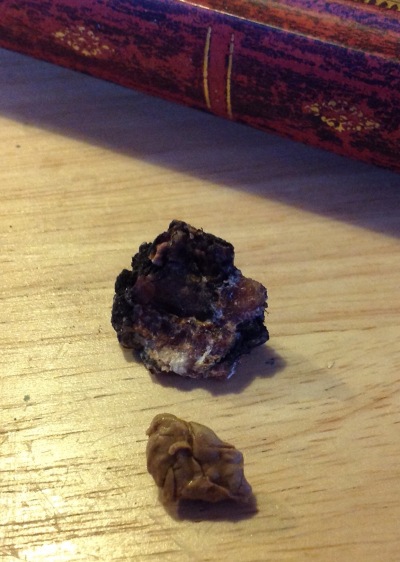
photos of chewed gum are a bit disgusting, but I want to show what normal-looking gum a two-minute chew produces. A rough nodule is shown above the chewed gum for comparison.
~
People of the First Nations have always known about this woodland edible and used it for medicinal purposes. In the nineteenth century, spruce gum was harvested with long handled spruce scrapers and sold commercially. Woods-workers made small carved boxes with sliding tops (gum books) to carry and store the resin nodules.
~
Robert Frost, wonderful poet of all things rural, wrote about spruce gum (‘The Gum Gatherer’. Mountain Interval. New York: Henry Holt and Company, 1916):
He showed me lumps of the scented stuff
Like uncut jewels, dull and rough …
~
You can find the rest of the poem at Project Gutenberg http://www.gutenberg.org/files/29345/29345-h/29345-h.htm
~
~
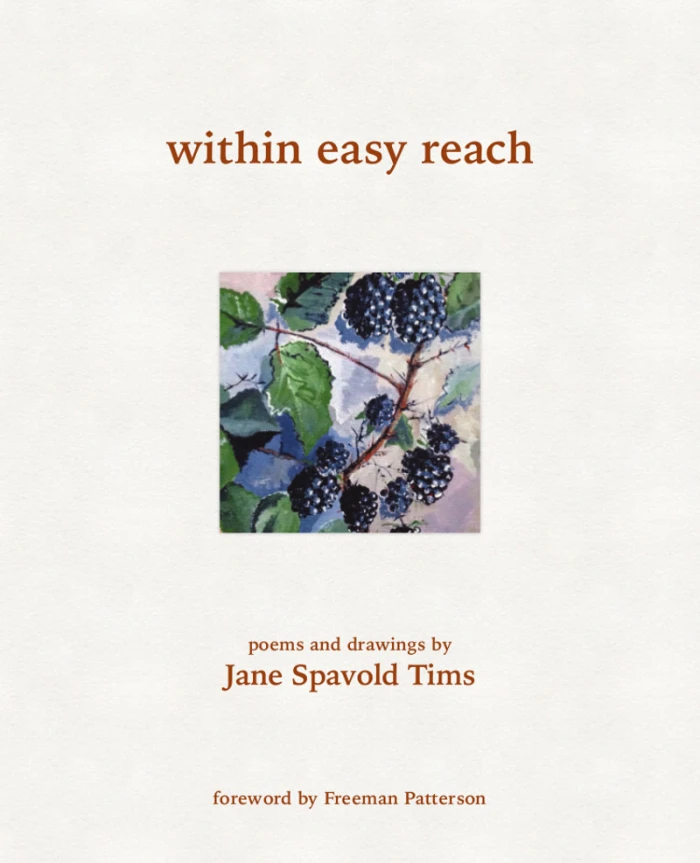
My upcoming book of poetry within easy reach includes a poem about spruce gum. The poem begins:
Black Spruce weeps if wounded
oozes to heal, embeds
pain in amber …
~
As I wait for spring, I intend to ration my small store of spruce gum and use it as a kind of countdown toward the end of our winter weather.
~

some very clean seeps of resin – these will harden eventually and make great spruce gum !
~
~
Copyright 2016 Jane Tims
something orange
I love the colour orange. It must be so – it is one of the most used ‘tag’ words in my blog postings.
~
This is a rather whimsical ‘side-view’ watercolour of an orange mushroom I saw recently in our cottage woods. I published the ‘top-view’ in an earlier post.
~

November 22, 2015 ‘side-view of an orange mushroom’ Jane Tims
~

November 5, 2015 ‘woodland floor’ Jane Tims
~
Copyright 2105 Jane Tims
colour on the woodland floor
Today, we went for a walk along the trails at our camp. My favorite path runs along the boundary, next to our zig-zag cedar fence and among young white pine, grey birch, red maple and balsam fir.
~
The weather has been very damp, so I expected to find fungi along the way. But I was surprised to see a beautiful patch of bright orange toadstools, each with a distinct orange-red center. They stood out among the red-brown leaves and green mosses.
~
I am not good at the identification of fungi, but I think this is Caesar’s mushroom (Amanita caesarea). It is easily confused with the poisonous Amanita muscaria, so no one should use my painting as an identification guide. Just a celebration of orange and red on a fall day.
~

November 5, 2015 ‘woodland floor’ Jane Tims
~
Copyright Jane Tims 2015
morning chorus
Each morning I have a short quiet time after rising. I spend this time in my guest bedroom. I do some stretching. I watch the sun rise among the trees. And I try to sort out the morning bird chorus.
~

~
The morning bird chorus is known to be a complex social interaction among birds of various species – a communication we humans can listen to with wonder, but little understanding.
~
We have lots of birds in our area and the woods are thick with birdsong. Although ours is a residential area, we have many hundred acres of woodland behind us and no houses between us and the river. Our back woods are mixed conifer and hardwood, mostly balsalm fir, spruce, red maple and white birch. We have nearby wetlands and, of course, the river.
~

~
I now regret not learning to identify the birds from their songs earlier in my life. Although I can name many birds by sight, I have a feeling I know many more by their sounds. This summer I have tuned up my ears and spent lots of hours trying to learn to recognise the birds by their songs. Perhaps because of their variety and complexity, learning the songs is more difficult than just listening and comparing. Once I have heard a few birds, my memory becomes jumbled trying to distinguish between them.
~
I use three main tools to help me identify and remember bird sounds.
- mnemonics – short phrases to describe and remember various bird songs. These phrases help narrow down the possibilities when I hear a bird sing. Many lists of bird song mnemonics exist, but I like the simple listing from the Fernbank Science Center in Georgia http://www.fernbank.edu/Birding/mnemonics.htm
- recorded songs – although there are many sites with bird song recordings, the one I like the best is Dendroica- NatureInstruct http://www.natureinstruct.org/dendroica/spec.php/Dendroica+Canada#sp_select . Once you select a bird, you can hear calls recorded by birders in various parts of the range.
- a list of the calls I know and new songs I hear, described in my own words and with a diagram of the way the song progresses, in a shorthand of my own. I use words like: trill, flute, scratch, liquid, repetitive, bored, delirious …
~
The Cornell Lab of Ornithology has some excellent tips for those who would like to learn the songs of local birds.
http://www.allaboutbirds.org/Page.aspx?pid=1189#_ga=1.202457239.768663648.1437046200
They suggest listening for rhythm, tone, pitch and repetition of a bird song. By listening for these qualities, one at a time, you can start to make sense of the variability and help your memory.
~
Here is a list of the participants in this morning’s bird chorus outside my window:
- odd high-pitched sound at the first grey light of morning, probably not a bird
- immediately, an American Robin – ‘chirrup, cheerup, cheery cheer-up’ – we have a nest of robins at the start of our woods road
- a Mourning Dove, intermittent – ‘oo-oo-hoooo’ – very sad sound – a pair perches on the wires along our main road
- a White-throated Sparrow – ‘I love dear Canada-Canada-Canada’
- a Hermit Thrush – an ethereal, flute-like phrase, repeated over and over, each time at a new pitch – close at first and then gradually moving further away
- an Eastern Phoebe – a nasal ‘fee-bee’, repeated – a nest in the eaves of our shed
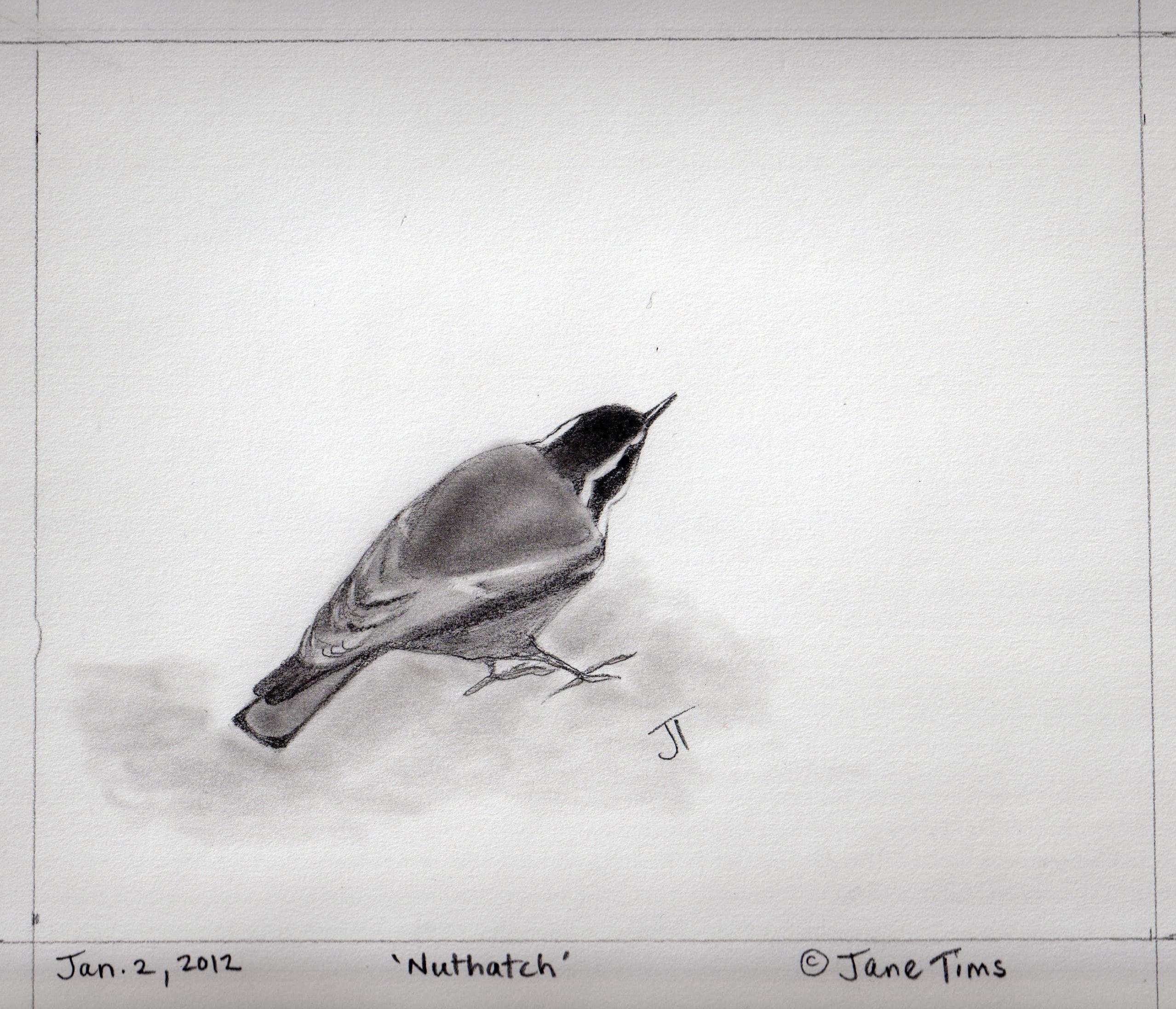
- a Red-breasted Nuthatch – a monotonous low-key ‘yank yank yank yank’, like a cross between a bored duck and a bullfrog
- the ‘caw caw caw’ of a Crow
~
I wonder if you ever listen to the morning bird chorus. What birds do you hear?
~
~
Copyright 2015 Jane Tims
spring orchestra – downy woodpecker

~
~
sticky tongue, tail prop, zygodactyl feet
~
beneath the key of chained song (chick-a-dee
whistle, robin melodic and whitethroat
mnemonic, wheezy phoebe, junco click) –
grubs mumble, coil in rotting wood
~
beneath low woodwind, blazing brass and string –
jagged percussion and drum roll, Downy
Woodpecker excavates sugar maple
stump, black jackhammer
~
beak throws wood chips, heaps sawdust and splinters
dapper shudders, black and white, a grey smudge
bright head-bars, a red blur, tap a stammer
steady stutter, busyspeak
~
~
Copyright 2015 Jane Tims




 nichepoetryandprose