Posts Tagged ‘wildflowers’
Bluebead Lily (Clintonia borealis (Ait.) Raf.)
When I hike through the woods, I am made uneasy by two unnatural-looking berries… the ‘doll’s eyes’ of White Baneberry (Actaea pachypoda Ell.) , and the metallic blue berries of the Bluebead Lily (Clintonia borealis (Ait.) Raf.). Both berries are poisonous and inedible. I’ll write more about White Baneberry in a later post, but first, I want to tell you about the Bluebead Lily.
The Bluebead Lily is also known by the names Snakeberry, Dogberry, Corn Lily, Cow Tongue, Straw Lily and even Wild Lily-of-the-Valley. It is called after De Witt Clinton, several-times Governor of New York. Its specific name, borealis, is Latin for ‘northern’.
Clintonia grows in rich, cool hardwoods, often on slopes. The plant consists of two or three large, shiny basal leaves, with parallel veins, wrapped around one-another and clasping the base of a flower-stalk. The stalk bears several yellow-green nodding lily-like flowers. In late May, these flowers are just beginning their blooming.
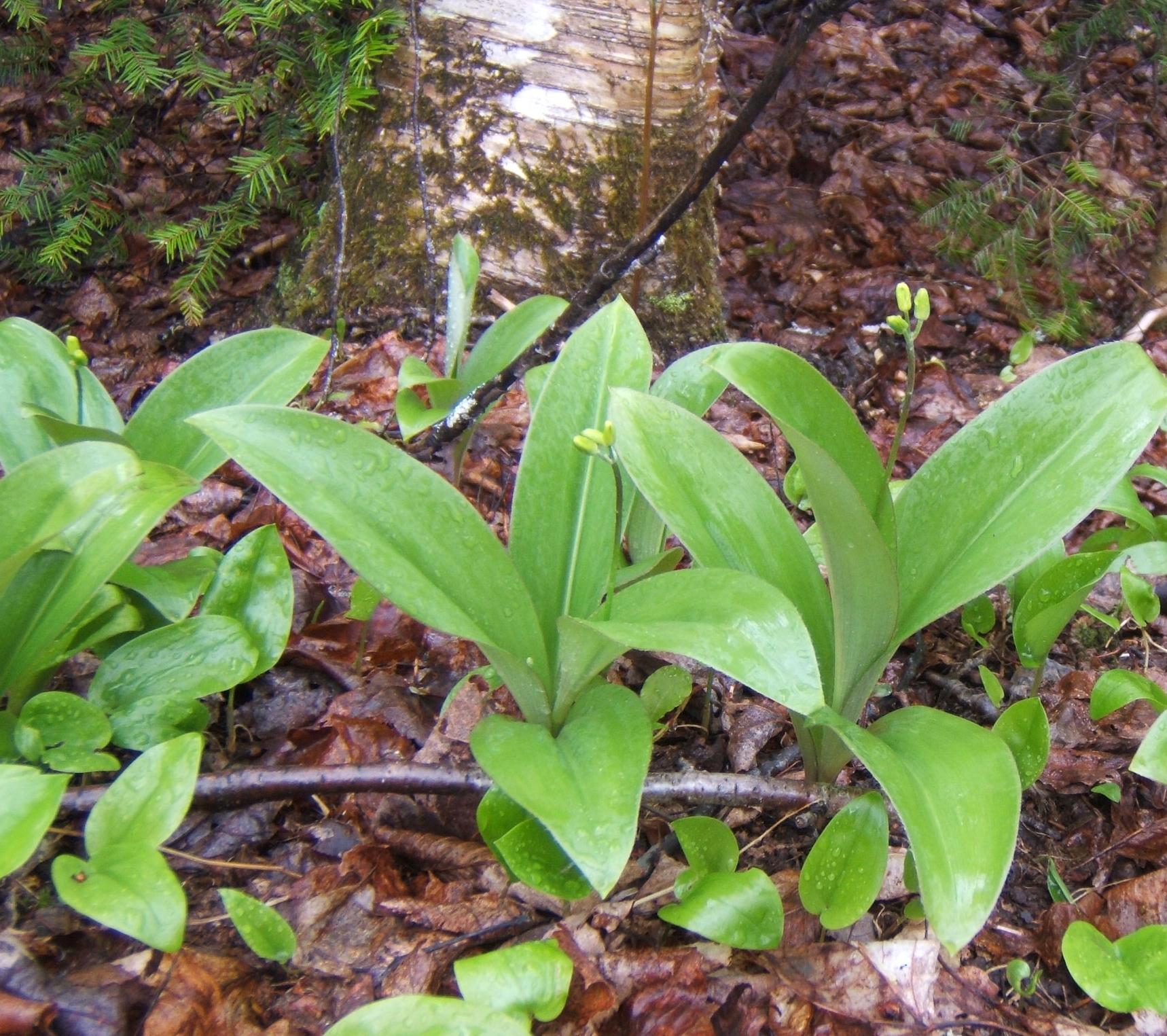

By July, the berries are ripening. These are considered inedible, perhaps toxic. They are oval, shiny, dark blue, and to me, menacing.
Although the berries are inedible, the young leaves, when they are just expanding, can be eaten cooked or raw, and taste like cucumber. To cook them, boil for 10 minutes and serve with butter. As the leaves mature, the cucumber taste becomes strong and unpleasant.
If you want to try the young leaves of Clintonia, make sure you are certain of identification since there are many leaves in the woods that may superficially resemble the leaves of Clintonia.
Have you ever seen a Bluebead Lily and its berries or flowers?
~
~
poisonous
~
White Baneberry
and Bluebead Lily –
vivid berries
peek between leaves,
part a path
in the understory, dolls
wink, use fern shadow
to blink or disguise
a gift, a bead
of metal, stained
glossy, alien
blueberry-blue
~
glossed by the Guidebook
with skull and crossbones
~
~
Warning: 1. never eat any plant if you are not absolutely certain of the identification; 2. never eat any plant if you have personal sensitivities, including allergies, to certain plants or their derivatives; 3. never eat any plant unless you have checked several sources to verify the edibility of the plant.© Jane Tims 2012
Purple Violet (Viola cucullata Ait.)
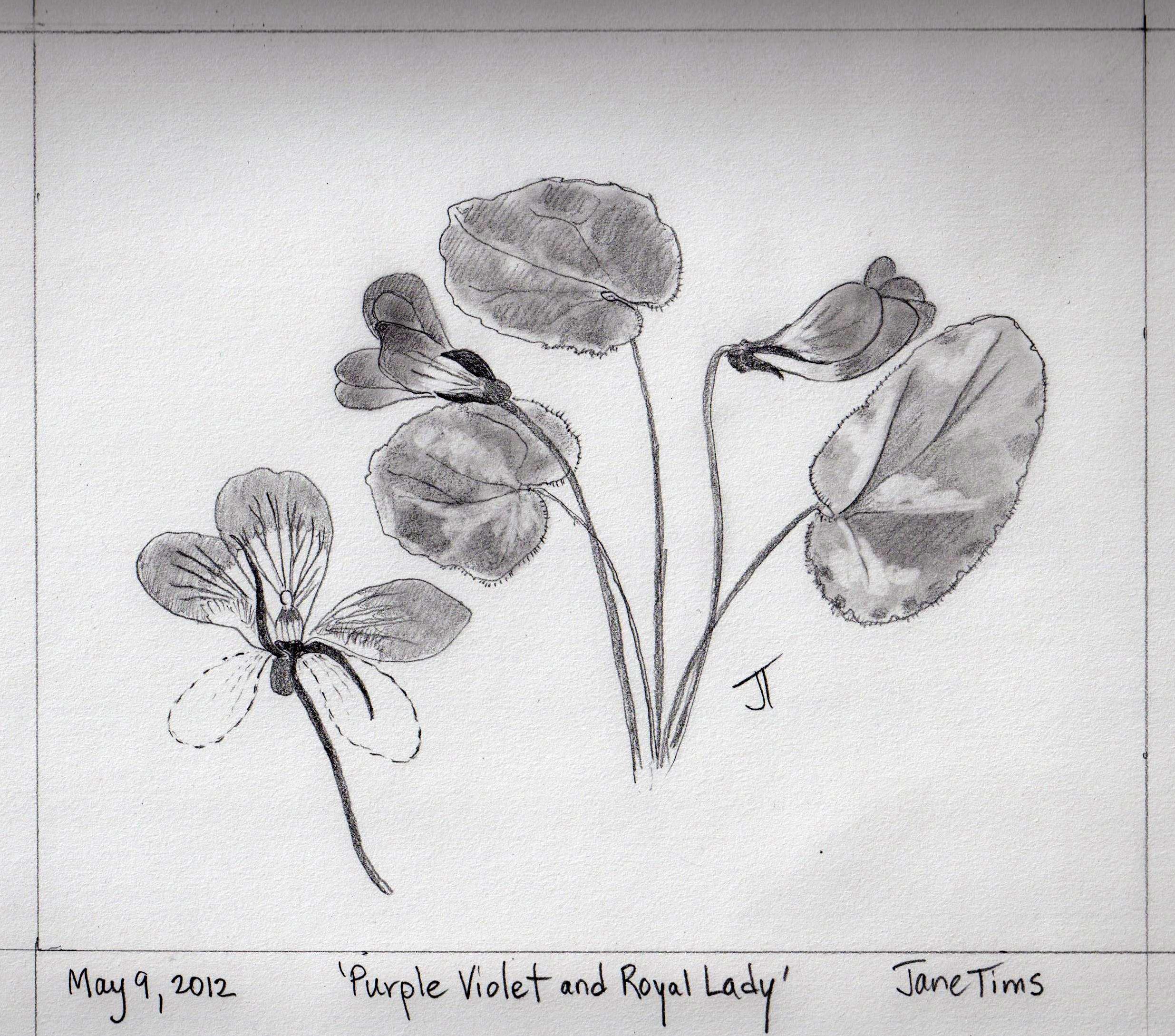
The Purple Violet is the floral symbol of my life. It is the official flower of the province where I live. It is one of the many species in my lawn, and the theme for my guest room. Every card my Mom and Dad ever sent to me has an image of violets.
Purple Violets are loved by many people. In New Brunswick, they were adopted as the Provincial Flower in 1936, at the request of the provincial Women’s Institute. The violet is also the State flower of Illinois, adopted in 1907 by schoolchildren in the State.
The Purple Violet ((Viola cucullata Ait.) is also known as the Hooded Blue Violet, the Marsh Blue Violet, the Long-stemmed Marsh Violet, and, in French, violette cucullée or violette dressée. The Latin species name means ‘hooded’ from the inrolled young leaves.

The Purple Violet is a low-growing perennial preferring wetlands, or low wet areas in mixed or coniferous woods.
The leaves are simple, with a long stalk. They are often heart-shaped, with rounded teeth.
The Purple Violet blooms in May. The flower is held on a long peduncle (stalk) above a basal rosette of leaves. The flower is dark blue, purple or occasionally white, with five petals darkly veined towards the center. The lower petal is short and spurred, and the two lateral petals are bearded. Bearded petals have clusters of tiny thick hairs, rounded at the tip.
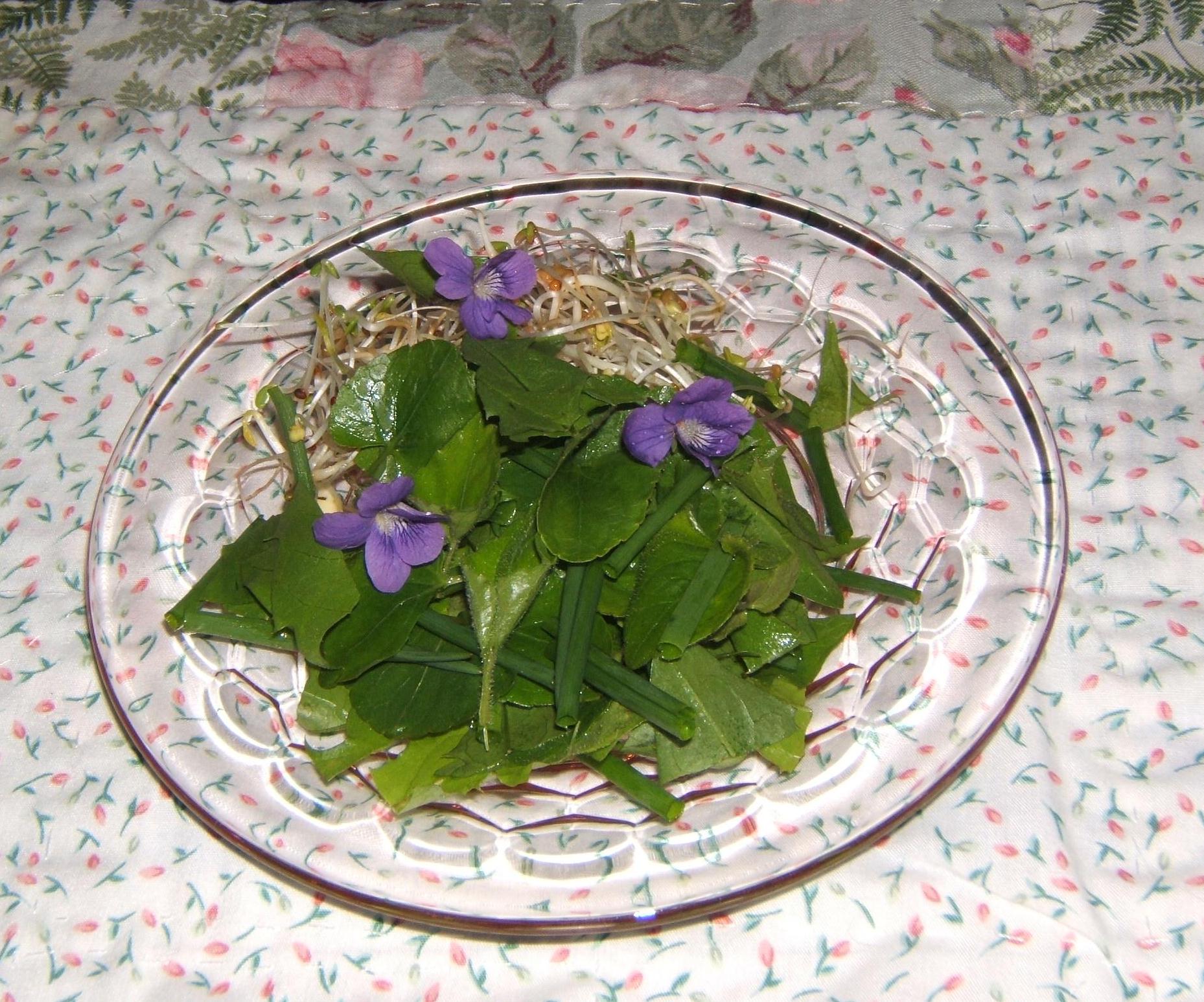
The leaves can be eaten raw or cooked, used as a thickener in soup, or to make a tea. The flowers can be added to a salad or used for edible decoration. My salad is made with Purple Violet leaves, Dandelion greens, chives from our garden and my own sprouts. I added three flowers for their delicate taste and decoration. Always be sure of your identification before you eat anything from the wild!
Although I do not advocate the wanton dismemberment of flowers, the violet holds a charming secret for children of all ages. If you gently pull down the ‘upper’ two petals from the flower, you can see a little lady with a white head and orange gown, sitting against the backdrop of her purple throne.
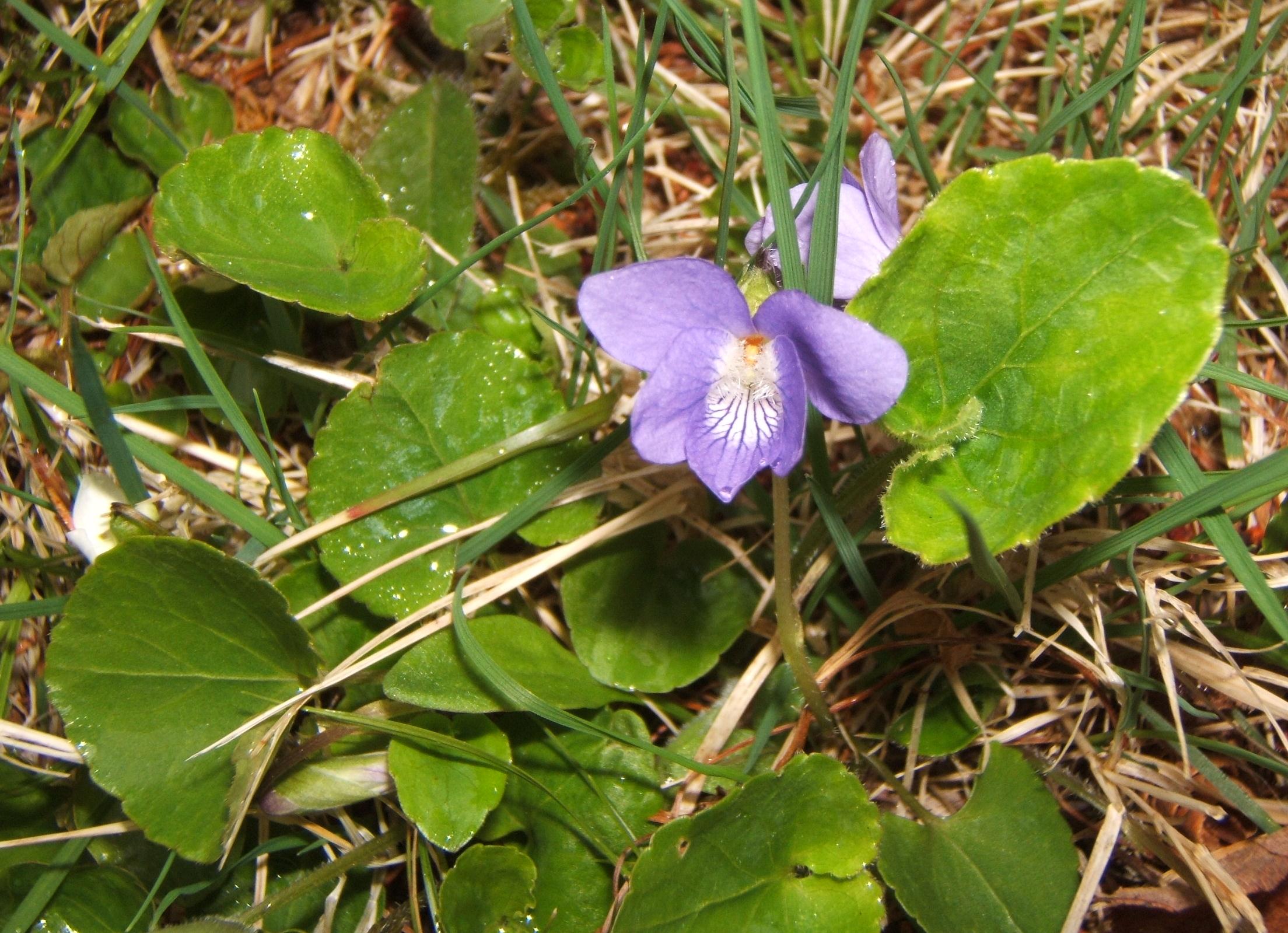
Purple Violet holds a royal lady… in this flower, you can barely glimpse the lady against her throne. She is upside down. You can see her white head and the top of the skirt of her orange gown.
~
~
Marshland Rule
Viola cucullata Ait.
~
within the perilous
limits of the rimless marsh,
disguised in woodland green,
spurred by deep viola speak
and crowds of envious hearts,
the hooded ranger guards
the tiny queen, long stemmed
tenderness, slenderness hid
by the folds of her orange gown,
seated against her purple throne,
flanked by wise men
bearded,
eager to advise
~
~
Trailing Arbutus (Epigaea repens L. var glabrifolia)
One of the common flowers of early spring is the Mayflower (Epigaea repens L. var. glabrifolia), or Trailing Arbutus, also called Epigee rampante in French. It belongs to the heath or heather family (Ericaceae). It grows in open woods, or pastures, and along hillsides, in acidic soil.

Mayflower in bloom, photo taken in 1978 in Nova Scotia
The Mayflower is part of what Roland and Smith (The Flora of Nova Scotia, The Nova Scotia Museum, 1969) called the ‘Canadian Element’, woodland plants native to Northeastern North America and including common plants of the coniferous woods: Maianthemum canadense Desf. (Wild Lily-of-the- Valley), Mitchella repens L. (Partridge-berry), Gaultheria procumbens L. (Wintergreen) and Trientalis borealis Raf. (Star-flower), among others. When I worked on my M. Sc. thesis project, years ago, these were in the community of plants I encountered in the woods I was studying, and they are still my favorite plants.

two members of the ‘Canadian Element’ community – leaves of Wild Lily-of-the-Valley (left) and Wintergreen (right)
The name epigaea means ‘on the earth’, and perfectly describes the way the Mayflower grows. The specific name is from the Latin repens meaning ‘creeping’. The plant spreads across the ground, its oval, leathery leaves lying flat and overlapping. The leaves persist all winter and sometimes look a little weather-worn. The variety we have is glabrous on the lower leaf surface, meaning without hairs. The leaves grow on hairy, woody twigs.

leaves of Mayflower in the Grey Woods, April 2012
The flowers grow in clusters tucked beneath the leaves. They are creamy white, and are in the form of a short tube ending in five flaring lobes. They bloom mid-April to mid-May. The flowers along our woods have just completed their blooming. For a nostalgic look at the tradition of picking Mayflowers in spring, have a look at http://ahundredyearsago.com/2012/04/28/gathering-arbutus/
A delight of spring is to manoeuvre close to the ground so you can smell the Epigaea flowers. The perfume is very sweet, gently stirring. The only edible part of the plant is the flower and it tastes as sweet and fragrant as it smells. It is a shame to eat such a delicate creature as a Mayflower, but once a year I allow myself the privilege, just one tiny bloom (always be absolutely certain of the identification before you eat any plant in the wild). The plant is protected in some areas since it rarely sets seed and is almost impossible to transplant.
The Mayflower is the floral emblem of Nova Scotia and Massachusetts.
~
~
Trailing Arbutus
(Epigaea repens L.)
~
on the slope, new leaves
Trientalis, Gaultheria
Star-flower, Wintergreen,
vines of Partridge-berry creep,
Maianthemum unfurls
~
beneath the din, a melody
weeps Epigaea, evergreen
pressed to the hillside
leather armour, thickened leaves
weather-beaten, worn
~
waxy bloom resists
subtle shadow
predator
unrelenting rain
~
~

Warning: 1. never eat any plant if you are not absolutely certain of the identification; 2. never eat any plant if you have personal sensitivities, including allergies, to certain plants or their derivatives; 3. never eat any plant unless you have checked several sources to verify the edibility of the plant.
© Jane Tims 2012
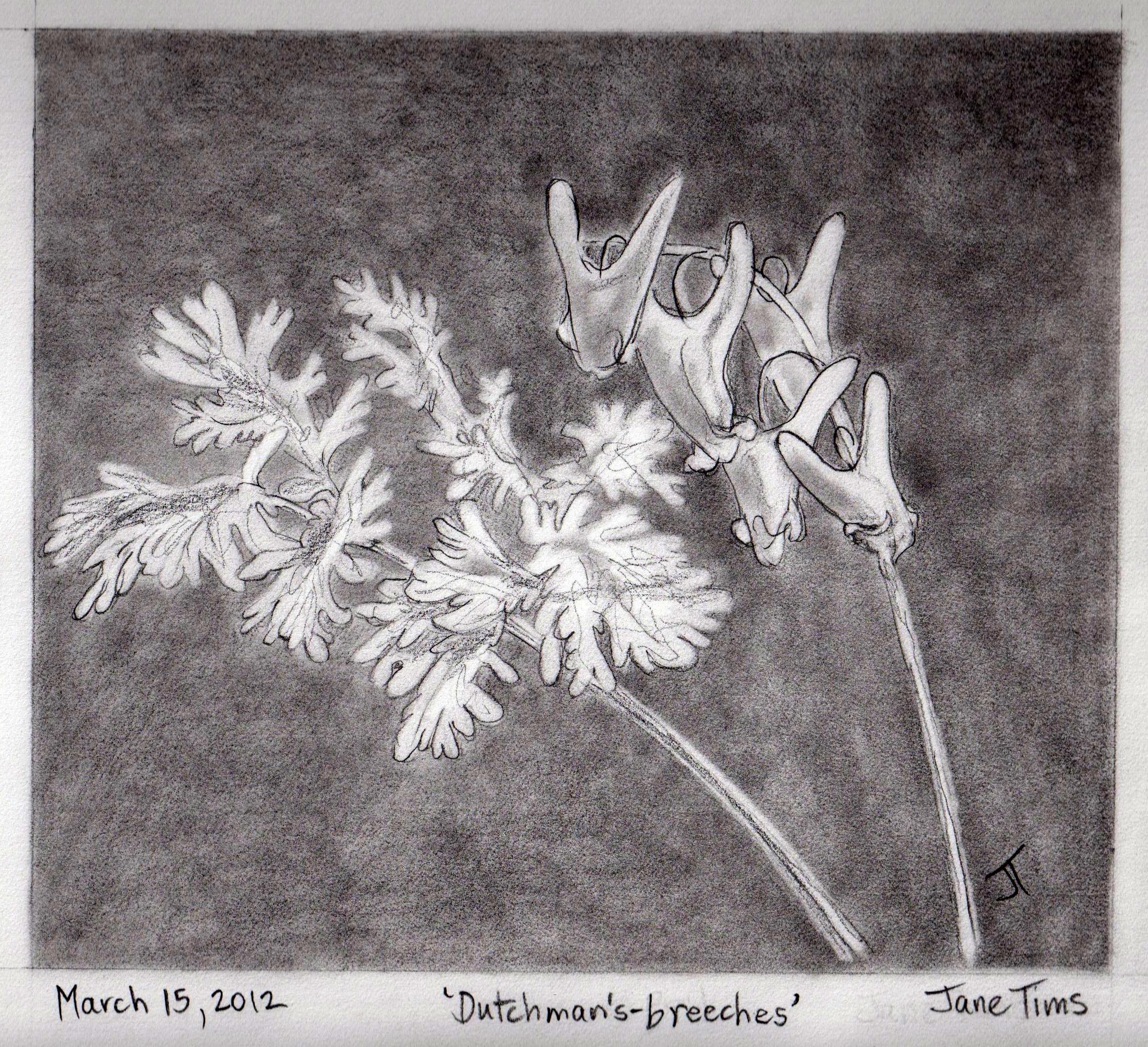
Dutchman’s-breeches (Dicentra Cucullaria (L.) Bernh.)
Our first summer home was located in a rich hardwood of Sugar-Maple (Acer saccharum Marsh.), Beech (Fagus grandifolia Ehrh.) and White Ash (Fraxinus Americana L. ). In these woods, in early spring, as the snow melted, wildflowers found ideal habitat. Many plants take advantage of the few days when the leaves of the overstory trees are still developing, and there is bright light in the understory of the woods.
One of these wildflowers is Dutchman’s-breeches (Dicentra Cucullaria (L.) Bernh.). This charming little plant blooms early in spring, in rich, rocky hardwoods. The white flowers are two-spurred, in groups of four to ten along a stem held just above finely divided, feathery leaves.
The plants is also known as breeches-flower, cullottes de Hollandais, and dicentre à capuchon. The generic name is from the Greek di meaning twice and centron meaning a spur. Cucullaria is the old generic name meaning hoodlike. The plant was named by Johann Jacob Bernhardi.
The flowers of Dutchman’s-breeches are an example of plant adaptation for pollination. The flower has a clever mechanism, in the form of fused flower parts, to ensure only certain insects (such as the bumblebee) can access the nectar and pollen.
In my copy of Roland and Smith (The Flora of Nova Scotia), I recorded my first encounter with this little plant – April 28, 1985, during one of our first visits to our property before we purchased it. We called our cabin Whisperwood, in part because of the subtle breezes in those wildflower-dotted spring woods.
~
~
Dutchman’s Breeches
Dicentra Cucullaria (L.) Bernh.
~
~
Dutchman’s breeches
brighten in sun
woodland washdays
have begun
~
spring-clean trousers
hung in rows
inflated with breath
the May wind blows
~
sprites are playing
tossing their hoods
above the damp
in the spring-fed woods
~
little fairy laundry
trembles on the line
before greening trees
block spring sunshine
~
~
© Jane Tims 1993
Coltsfoot (Tussilago Farfara L.)
Although it has been snowing sporadically this month, our recent days of very, very warm weather tell me spring has arrived. As a result, I am watching the roadsides for the first flowers of spring. Even before the snow is out of the woods, it begins to melt along the roadsides as they warm in the lengthening hours of sun. And the cycle of bloom begins again.
Coltsfoot (Tussilago Farfara L.) is one of the first plants seen in early spring. It forms large patches in waste areas, beside brooks and roads, and on damp hillsides. People often mistake Tussilago for Dandelion, but it is quite different. Its yellow flowers are borne on scaly, leafless stems. The large, woolly leaves don’t appear until later in the season. In spite of its early appearance in spring, Tussilago actually has late flowers. The flower buds are formed in autumn at the base of the plant, and pass winter underground, flowering in the first spring sunlight.
Other names for the plant are Son-before-the-Father, which refers to the appearance of flowers before the leaves, and pas-d’âne (literally donkey-steps). The scientific names are from the Latin tussis, meaning a cough, referring to the use of the plant as a remedy for such ailments, and the Latin word for coltsfoot, farfarus. The plant was named by Linnaeus, the Swedish botanist who established the present day system of naming plants.
Although the plant was used by pioneers for its medicinal effects, it is now known that Tussilago contains harmful alkaloids. Tea made from Coltsfoot has caused health problems in infants and pregnant women, so its use as a cough remedy is not recommended. In some States, Coltsfoot is considered a noxious weed.
~
~
Coltsfoot
Tussilago Farfara L.
~
Gold-
splashed beside the road
like prints
of a frisky colt’s feet
~
at first glance-
an early dandelion!
but-
too early
stem scaly
no leaves below the bloom
no perfume.
~
Coltsfoot,
Son-before-the-Father
(flowers before the leaves).
Introduced from
far, far away.
Old wives say
boiled greens
will ease
a cough.
~
Long ago
Tussilago
sprang from where
a burro trod
among the palms
(pas-d’ane)
~
~
Published as: ‘Coltsfoot’, Winter 1993, The Antigonish Review 92:76-77.
Revised
© Jane Tims 1993
~

Fringed Loosestrife (Lysimachia ciliata L.)
In any season, I think it is important to slow down and look closely at the ground to catch a glimpse of the natural diversity occurring there. This time of year, in our snowy climate, there are tracks to find, evergreens to notice, and seeds and berries to discover.
Since I am trained as a botanist, looking down is the norm for me. Often, I fail to look up and see the landscape and horizon. When we first bought our lake property, it was quite a while before I looked across the lake and realised there were farms and a church on the opposite shore!
As a result, I identify strongly with Fringed Loosestrife (Lysimachia ciliata L.), a yellow flower we find growing along the lakeshore in early summer. It has a downward-facing flower and can only ‘see’ the ground. Its shy demeanour encourages close inspection, but you have to get your own eyes quite low to see a view of its ‘face’.
Fringed Loosestrife has five yellowish-green petals and a reddish center and blooms from May to July. The petals are fringed and each is tipped with a ‘tooth’.
The genus is called after King Lysimachus of Thrace who, in legend, used the plant to calm a maddened bull. Ciliata comes from the Latin word cilium meaning eyelash, referring to the hairs on the stem of each leaf.
Fringed Loosestrife grows in thickets and along shorelines like ours.
~
Fringed Loosestrife
(Lysimachia ciliata L.)
~
at the edge of lake are two perspectives:
distant and near
horizon and shore
~
horizon
low hills and orchard
a farm, a steepled church
the flat of the lake
three waterfowl
~
the shore
yellow Loosestrife
Fringed petals
look down
~
red eye studies
flat rock and sticky bedstraw
a wood frog, a feather fern
winterberry petals new-fallen
shoe leather, shoe laces
~
© Jane Tims 2011

roses of summer
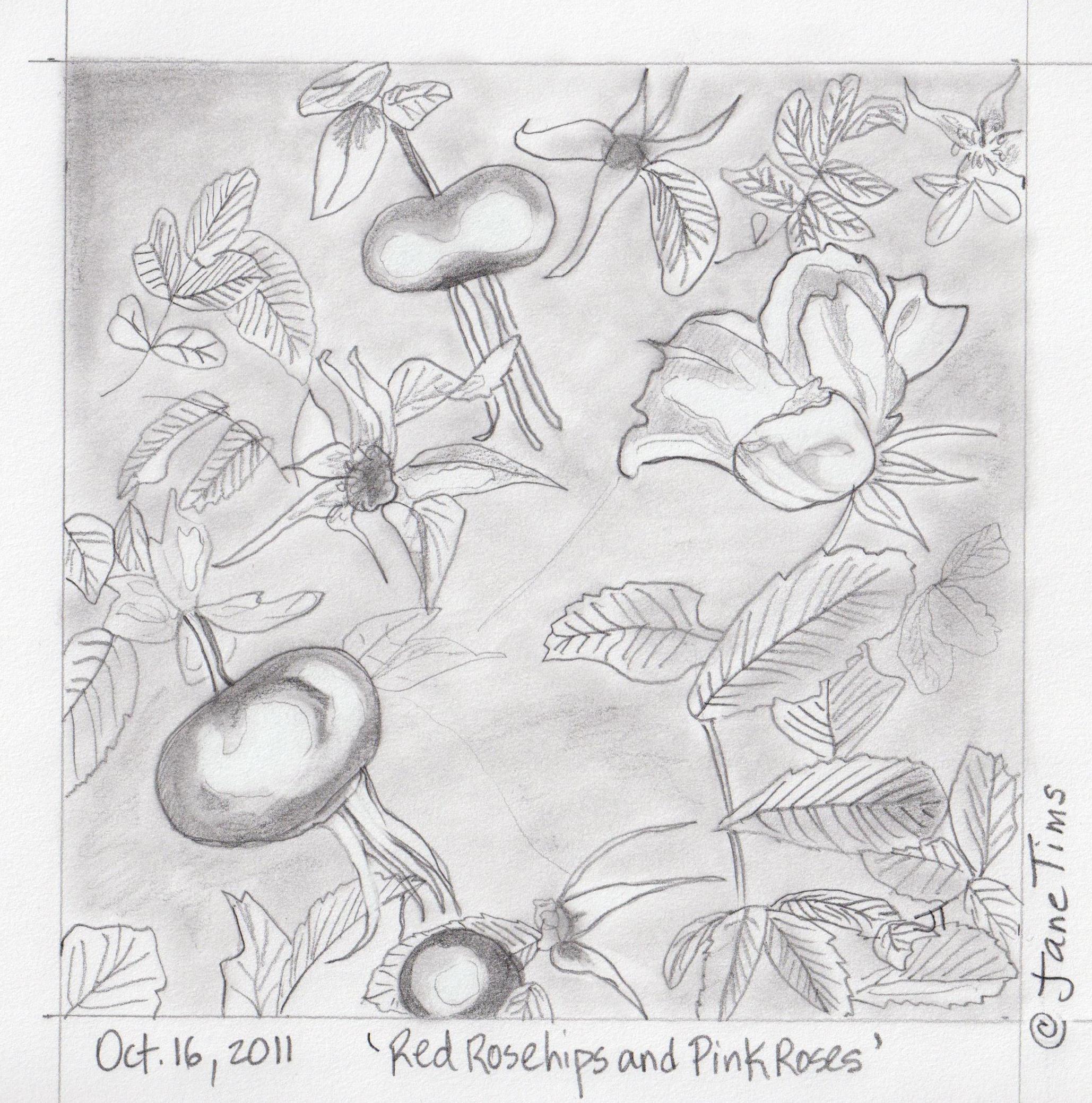
When I go for a walk this time of year, I visit our rosebush and I think of how rosebushes have been a part of my life:
- the little bush beside our road at the lake, delicate pink double roses and small rosehips… my husband loves this little bush and is always very careful not to cut it when he trims the lane…
- the huge rosehips on the rose bush (Rosa rugosa Thunb.) at Castalia Beach on Grand Manan Island, rigor in the harshest conditions; once I tried to bring a slip of the bush home in a banana peel (to keep the moisture) but, although it lived and grew, it only survived a few seasons…
- a tunnel of rosebushes and huge rosehips next to a parking lot where we stopped in Matane, Quebec on our trip to Gaspé a decade ago…
- a pair of long-gone rosebushes at my Mom’s old home place – when she and my Aunt were little girls, they called the rosebushes Mrs. Pears and Mrs. Rhodes and would visit them with their doll carriages to collect the red rosehips.
~
~
fragments from a walk
~
brambles and bedstraw
insect frass and dew
the petals of a wild rose
a rosehip
a red gall
swollen as a nose with crying
~
Nuphar and Nymphaea
lily leaves a plate
offering yellow to the sun
~
familiar trees
suddenly grown tall
~
© Jane Tims 2008
American Star-flower (Trientalis borealis Raf.)
Crisp November nights are a perfect time for a quick look up at the stars. I’ll be including some posts about our star-gazing, but for now, my thoughts are still turning back to summer. Stars in the sky? There are also stars in the dark summer woods.
The American Star-flower, Trientalis borealis Raf., is a plant with a delicate white, star-shaped flower, found in late spring in woodlands and on peaty slopes. Its scientific name comes from the Latin word for the third part of a foot, a reference to the height of the plant, and the Latin borealis, meaning northern. It is a common little plant, described by Fernald as a “forest pioneer”.
Some will wonder what the ‘Raf.’ refers to, at the end of the scientific name. This is an attribution to the botanist who first named the plant. In many cases, the attribution is ‘L.’, meaning the plant was first named by Carolus Linnaeus (the biologist who first introduced the ‘binomial’ naming system for plants).
‘Raf.’ stands for Constantine Samuel Rafinesque-Schmaltz who first assigned the genus and species names to the plant – Trientalis borealis. He was an eccentric polymath (knowledgeable in many fields and disciplines) who lived from 1783 to 1840. In his lifetime he published 6,700 binomial names for plants.
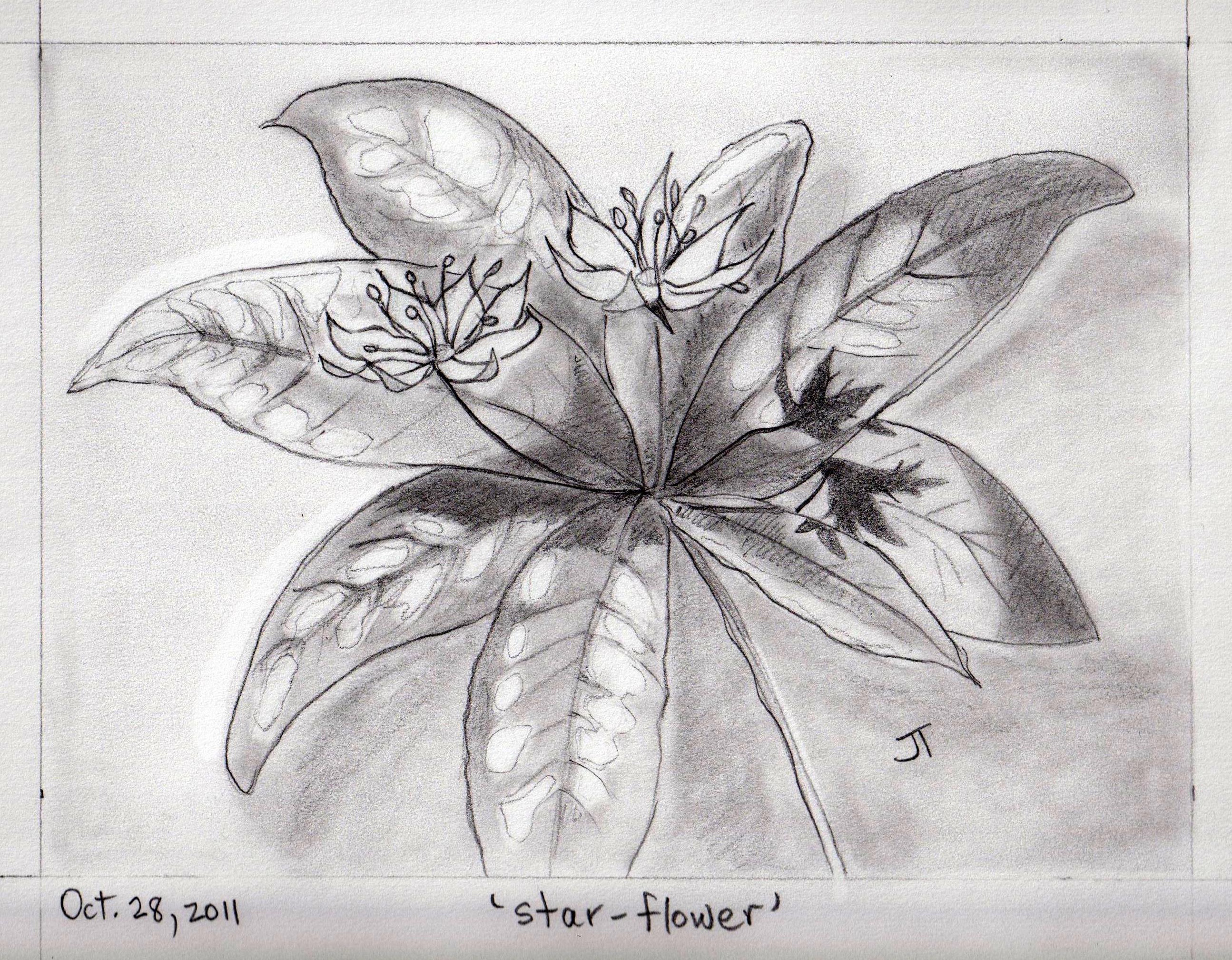
Star-flower
Trientalis borealis Raf.
~
Trientalis
borealis
star-flower
lost from the sky
four inches high
(the Latin name
makes claim)
petals white
boreal light
fallen down
first found
by Constantine
now often seen
it’s little lamp
above the damp
a forest pioneer
final frontier
up above
twinkling of
stamen and star
who you are
I wonder
and wander
down a trail blazed
by a frail flower
one candle power
~
Published as: ‘Star Flower’, Winter 1993, The Antigonish Review 92.
revised
© Jane Tims
Northern White Violet (Viola pallens (Banks) Brainerd.)
Yesterday, we had our first dusting of snow and it persisted on the grass until the evening. It reminded me of some of those low white summer flowers whose petals look like snow when they bloom in masses on the lawn or in a field. In any season, the sight of ‘snow’ can be a charming, welcome sight.
The northern white violet, or small white violet (Viola pallens (Banks) Brainerd.) inhabits the moist ground of meadows, bogs and thickets, and it blooms profusely on our front lawn. Pallens means pale, referring to the color of the flowers. The leaves are somewhat heart-shaped.
The violets are a difficult group, taxonomically. Viola pallens is also known as Viola macloskeyi Lloyd.
Northern White Violet
Viola pallens (Banks) Brainerd.
~
stars in the northern meadow
scattered at the feet
of cattle grazing hay
violet sweet
~
hearts among the grasses
where the ground is wet
flowers pale and nodding
small white violet
~
Published as: ‘Northern White Violet’, April 2005, Refuge 14 (1)
© Jane Tims 2005

Twinflower (Linnaea borealis L.)
As we enter the winter months, I like to remember the woodland plants now waiting under the layers of fallen leaves to flower again next spring.
Twin-flower (Linnaea borealis L. var. americana (Forbes) Rehd.) is a low-growing, creeping evergreen, found blooming in late June in wooded swamps, coniferous bogs and clearings.
Each slender stalk bears a set of two delicate, nodding, fragrant flowers, white in color and tinged with pink. Other names for the plant are pink bells and, in French, linnée boréale. The specific name is from the Latin borealis, meaning northern.
The European variety was a special favorite of Linnaeus, the founder of the present system of naming flowers.
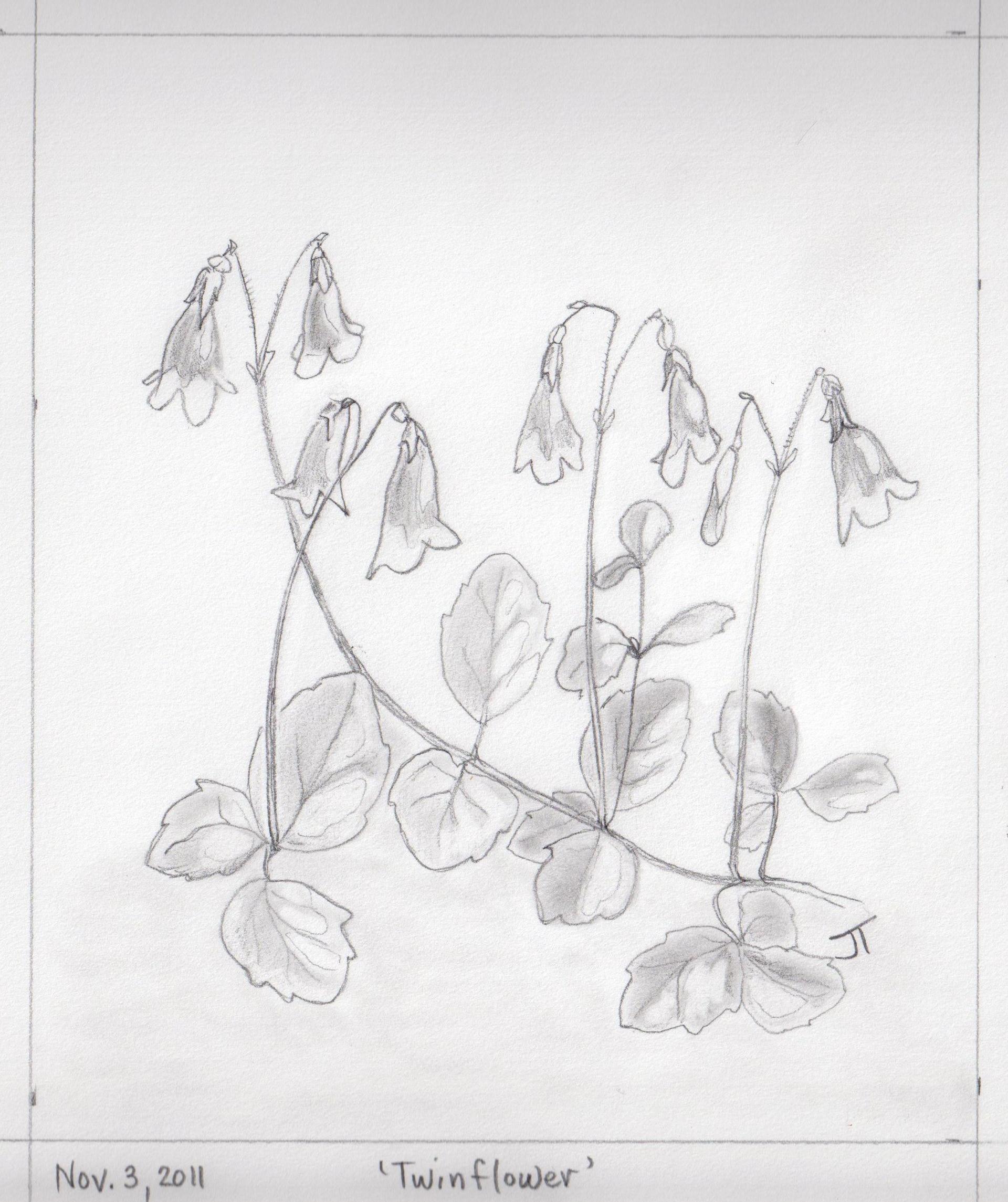
Twinflower
Linnaea borealis L.
~
conifer cathedral
slanting light
Linnaea carpets
stains the forest floor
to the edge
near the forest door
a woodland pool
~
on slender stem
mirrored
in the pool
and in the air
twinflower rings
pink boreal bells
at vespers
in whispers
a whisper
the rule
~
creeps under roots
and fallen leaves
Linnaea trails
over rude beams fallen
from fences built
when woods
were pasture
~
twin flowers
settle back to back
nodding heads
they cease to ring
and sleep
~
© Jane Tims 1992




 nichepoetryandprose