Posts Tagged ‘poetry’
fords across the river
During a week of vacation last month in south-eastern Ontario, I was able to get to know some of its rivers.
The water is low this time of year and the rivers run still and quiet. Pond lilies and duckweed cover the surface, joined by early falling leaves. The country roads cross and re-cross the rivers, giving a view of each river at several points along the way.
I was also reminded of another means of crossing a shallow river or stream – the ford. This is a place where the water is shallow enough to cross on foot or by vehicle, without a bridge. Sometimes the ford depends on the natural stones or solid bottom for its footing; sometimes the bottom is built up by adding stone.
The fords on the South Branch of the Raisin River in South Glengarry County were built to last, of stone. They make a charming pause in the run of the river, allowing passage of the water and a safe way to cross.

A local person familiar with the river told me this: in spring, when the river runs deep enough to allow canoes to paddle, the fords can still be seen, white stones shining up through the water.

~
crossing the South Branch Raisin River, South Glengarry County
~
weedy South Branch Raisin River water-dry
stream-bed wizened wild grapes purple-weighted
sun-dried field rock
fords and fences
rain and rising
leaf-spun river
surface winds reflected
elm, nymphaea
ash, nuphar
~
© Jane Tims 2011
sounds in the silence #1
If niche has colour, it also has sound. Some of those sounds are soothing, the sound of a babbling brook, or the wind in the Red Pine. Some sounds are alarming, the cry of a child, or the squeal of brakes. At my office, there are multiple sounds in the background – people talking, computers whirring, copiers copying, printers printing. When there is a power outage, I am amazed at the silence of the building, and wonder how I can possibly work with all the noise.
When I can’t sleep, I turn to a trick my Mom taught me – I count the sounds in the sleeping house. Last week, a welcome sound was added to the usual repertoire, the three part hoot of a Great Horned Owl. Hoo-Hoo-Hoo Hoo-o Hoo-o. It was a gentle but penetrating sound and it ruled the night. The owl hooted three times at about five minute intervals and then I fell asleep.
Not long ago I went for a walk in the grey woods and heard a sound I have heard so often before, the grating squeal of two trees rubbing together. These trees, a Balsam Fir and a Grey Birch, have tried to grow into the same space and now they reproach one another in an endless competition.
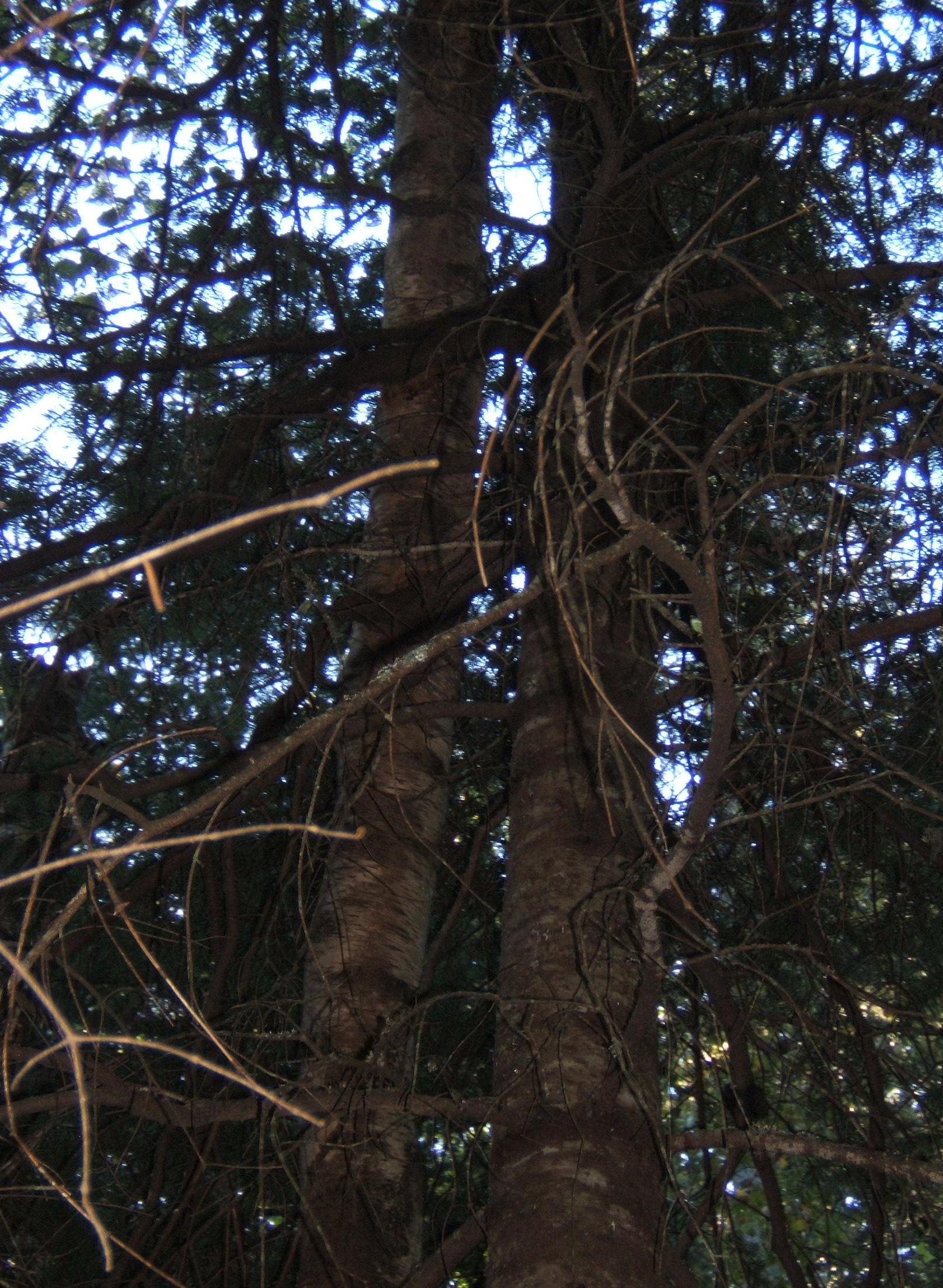
the branches of one tree grate against the bark of the other
fear of heights
~
as dizzying to look up
in the forest
as down
into the abyss
the trees taper so
~
they lean
birch
against fir
rubbed raw
where branches touch
and reach for one another
~
and sudden, wrenching sounds
a branch swings back or breaks
loosened by a squirrel
or burdened where crows complain
~
or where a warbler scolds
teacher teacher teacher
~
© Jane Tims 1996
butterfly spaces

Viceroy butterfly on the rail of a little-used track

- ‘Viceroy butterfly on a rail’

butterfly
~
scrap of paper
plucked from my hand
wind a tease
always one wing beat
beyond the finger tip
attempts to read
delicate code
of dots
and dashes
~
a yellow Post-it note
folded on the tower
of a blue sky flaxflower
a tatter
a musical note
set to the panic
of butterfly flight
~
a curtsy and away
across the field
~
pursued by a butterfly net
~
and a killing jar
~
© Jane Tims 2007
settling into unfamiliar
After three decades of work, I am retiring within the year. Another milestone. A new ‘way’ to settle into.
I remember when I made the transition into full-time employment. It was a huge change for me.
Previously, I had been a student, living at home. Suddenly, I was away from familiar places, in a new province, on my own.
Fortunately, I had solid back-up… my Mom and Dad were supportive and helped me whenever they could. I loved my apartment, my new friends, my responsibilities. Everything was new. I learned as I went, meeting each new experience as if it was a page being turned in a book.
This transition, my retirement, will be so different. I should be ahead of the change. I am settled. I know my home. I have my husband to steady me and my son to give me advice! I have a plan.
But the transition is still scary. For three decades, my work has structured my life, providing deadlines and places to be, people to see. I’ll have to establish a new daily routine. I’ll have to set goals and celebrate milestones. I’ll have to work a little harder to maintain my social contacts.
It will be like my first walks in the grey woods. In those days, I didn’t know the paths very well and worried about getting lost (even though I could hear the cars on the main road!). Sounds were strange, even frightening. I worried about wild animals.
But gradually I learned the ways of the grey woods. Every time I walked the paths, they became more familiar, and also more worn and easier to follow. I learned the sounds to expect and the animals and birds I would encounter. I learned the pitfalls. I learned to expect a gem on every walk… a fairy ring of mushrooms, a Pileated Woodpecker hammering at a tree trunk, a chorus of frogs from the ephemeral pools…

walk in the grey forest
~
I walk on unknown land
land I have not seen
but dreamed, the wary dream of intruder
where silence is fragile
snapped in two
by leaf fall
~
I step carefully
my disturbance less
than the exhalation of wind
or the mutter of moths
between moribund trees
~
this is ancient land
mossy logs, weary paths
where others may have walked
slanted cathedral light
lichened stones
~
the unknown watches me
crouched in a hollow
flattened to the bole of the oak
betrayed by a ripple on the vernal pool
by the rattle of beech leaf or birch bark paper
it will surely shake free of its leaf garment
rise from the forest floor
to chastise me
desecrator of place
~
even a careful step
is hard on hollow land
~
it will take time
to learn to walk here
to discover game trails in the half-light
to understand words unspoken
to know the dying trees
not as omen
but as part
of the forest
~
© Jane Tims 1998
pool at the base of the waterfall
Have you ever had trout nibble at your toes?
When I was a teenager, my family was fortunate to own a woods property with a brook and a substantial waterfall. We had a cabin there, built by my Dad.
The brook was wide and shallow, running through mixed woods. It was a torrent in the spring, but in summer it ran gently through the trees, bordered by mossy hummocks, accented with small pools and riffles.
I remember the first time I saw the waterfall. We were looking for a woods property and a farmer offered to show us some of his land. I was exploring a particular area, following the bank of the stream, when I first heard the roar of the falls and saw the bright froth of water through the trees. I couldn’t believe it when the owner said, without hesitation, we could have that lot for our cabin.
The falls were substantial, spilling about 15 feet over a dip in the shale substrate. They spread outward from the lip of the falls, creating a broad triangle of white, laid across the rock like a veil. The roar of the water falling was constant and intense.

'waterfall and pool'
At the base of the waterfall was a pool, waist deep. The water was headache cold, but once we became used to it, we could swim and cool off on a summer day. The pool was transparent as glass, and we could look down and watch the trout nibbling at our toes. In spite of the dramatic turn of my poem below, the trout were not voracious and their nibbles were butterfly kisses.
Meniscus
~
1.
~
mist and mosses
colour the air
where the waterfall leaps
green in the mumble of water
~
I stand waist deep
in the fall-fed pool
bubbles cling to my legs
to the hairs on the back of my knee
~
droplets of air above water are nothing
~
2.
~
the soles of my feet
slide on the slate
search for softer
pockets of sand
~
trout kiss my ankles
~
I try to see
but the surface is silver
a dome reflected
of maple and sky
~
3.
~
a green leaf settles
a pine needle spins
striders press dents on the water
~
4.
~
I need to see the trout
I bend my face to the water
press on the skin
push through the meniscus
~
my nose is severed from my face
~
5.
~
I am the pond
~
I cannot move
I cannot breathe
my hands are numb
my heart squeezes within me
~
I cannot believe
the trout have taken
great gashes of leg
my toes are slashed by the slate
~
I look up through the water
its surface a circle of silver
~
6.
~
fish gnaw at my toes
bubbles grate at the back of my knee
tears under water are nothing
~
© Jane Tims 1992
pitfalls
If the space you occupy, your niche, has benefits to nourish, lift and sustain you, it also has its pitfalls, its dangers. Animals know this and their adaptations to their habitat are as much about avoiding danger as they are about obtaining food or shelter.
Think about the Groundhog family in the grey woods behind our house (see post ‘the location of our picnic table‘ August 20,2011, category ‘wild life’). The Groundhog’s tunnels are designed to provide shelter and food storage, but they are also designed for checking out the enemy and for quick escape.
Like the Groundhog, I try to prepare for the pitfalls. I have an emergency kit, including water and a flashlight, ready for severe storms, unexpected floods, and power outages. In spite of this, when our basement was flooded last December, I found I was poorly prepared and all I could do was concentrate on the small steps toward return to normalcy.
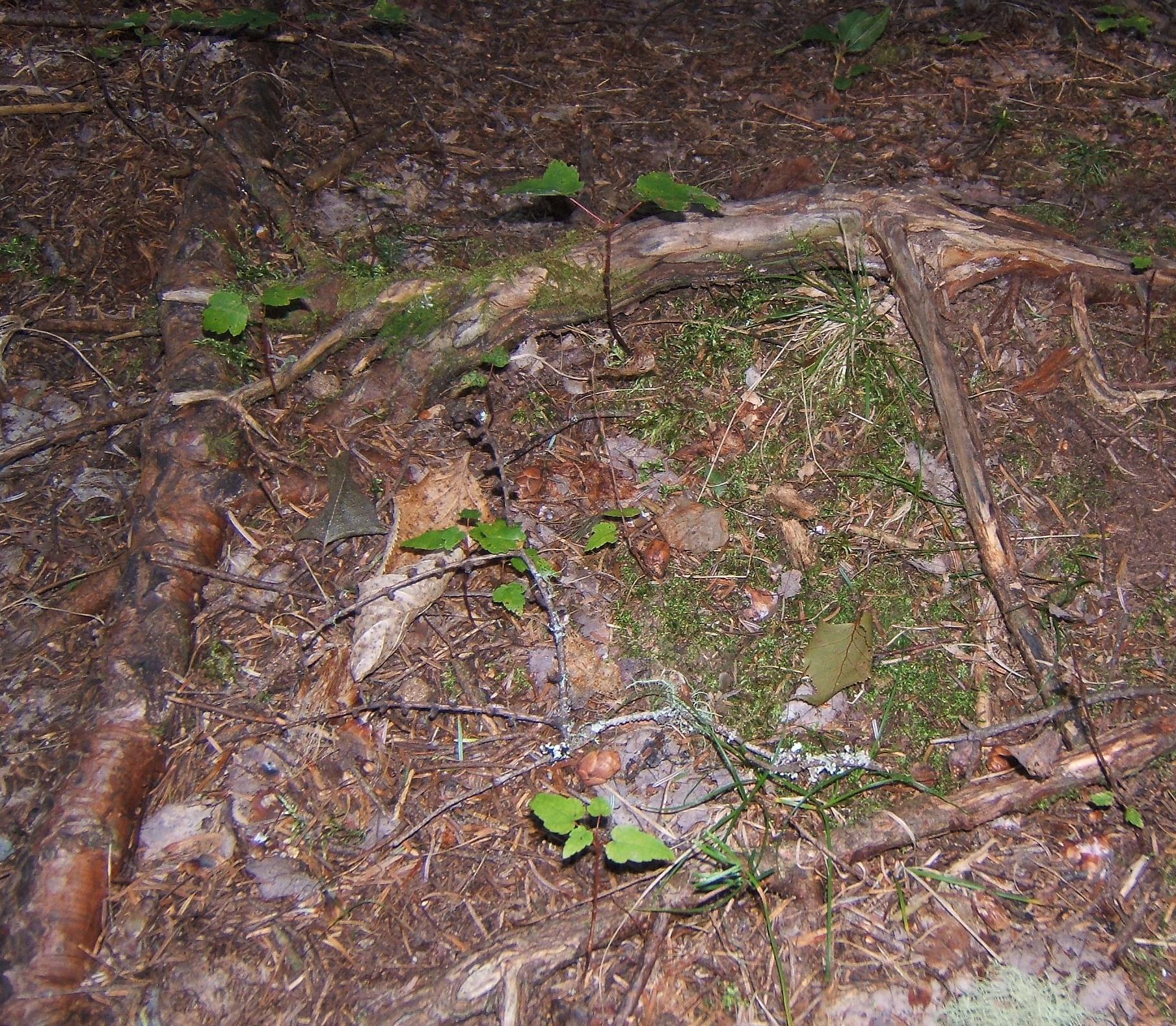
The path through the grey woods has its own pitfalls. When I go for walks I have to beware of fallen trees…

roots ready to grab an ankle…
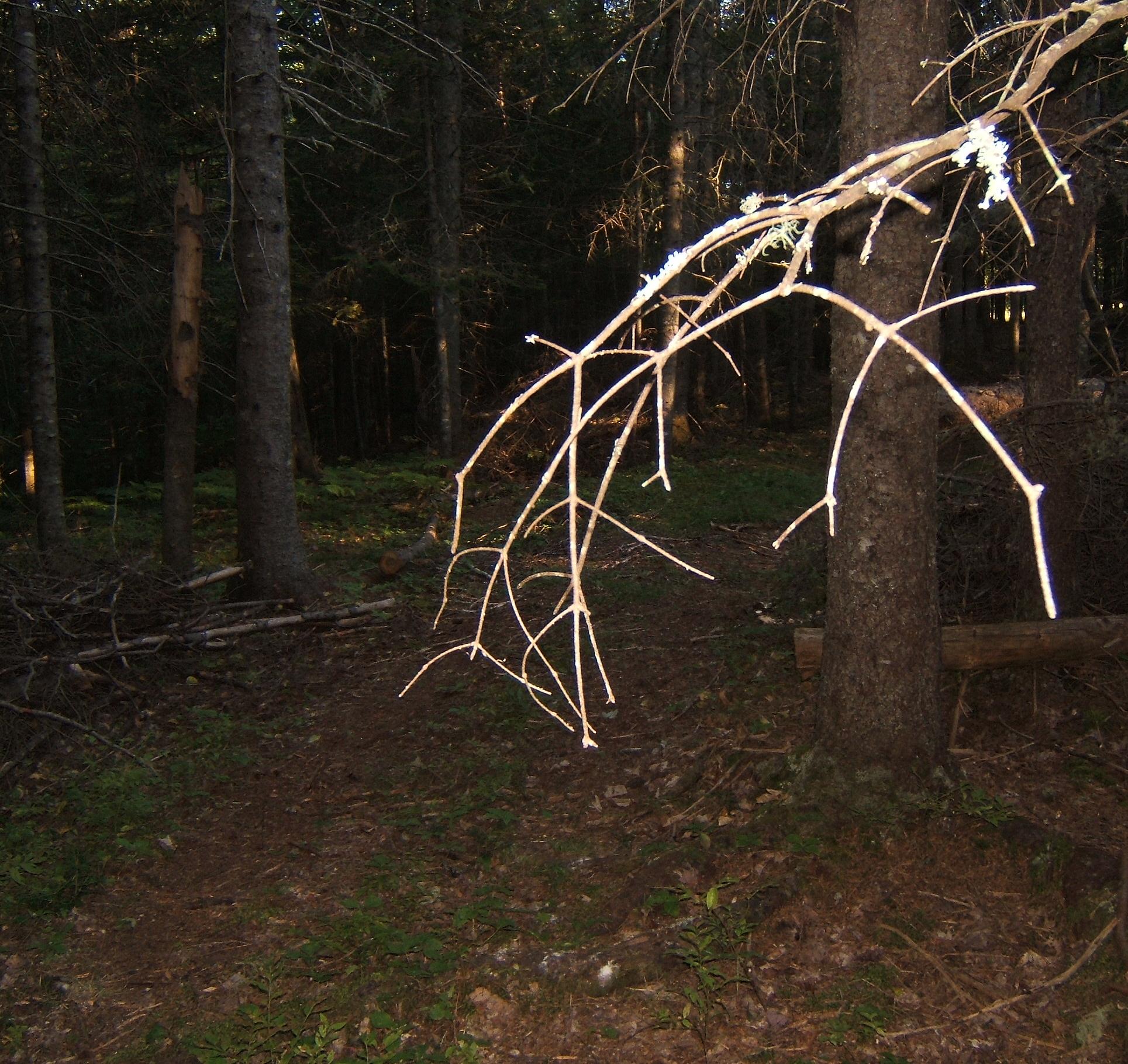
branches reaching to poke an eye…
and the risks of not looking around, and missing something special and ephemeral…
pitfalls
~
soft places in the earth
hollows in the leaf layer
deadfalls to snag the surest ankle
roots that reach for the body
and chasms to claim it
~
gaps in the greyness of pine
spaces to spill sunlight
admit the riot of leaves
and the keys of the maple
~
holes in the layer of cloud
snags in the curtain
knots in floorboards
eyes in the blackness of night
~
flaws in the fabric
seams to part and peer through
paths we have crossed before
in other ways
~
© Jane Tims 2005
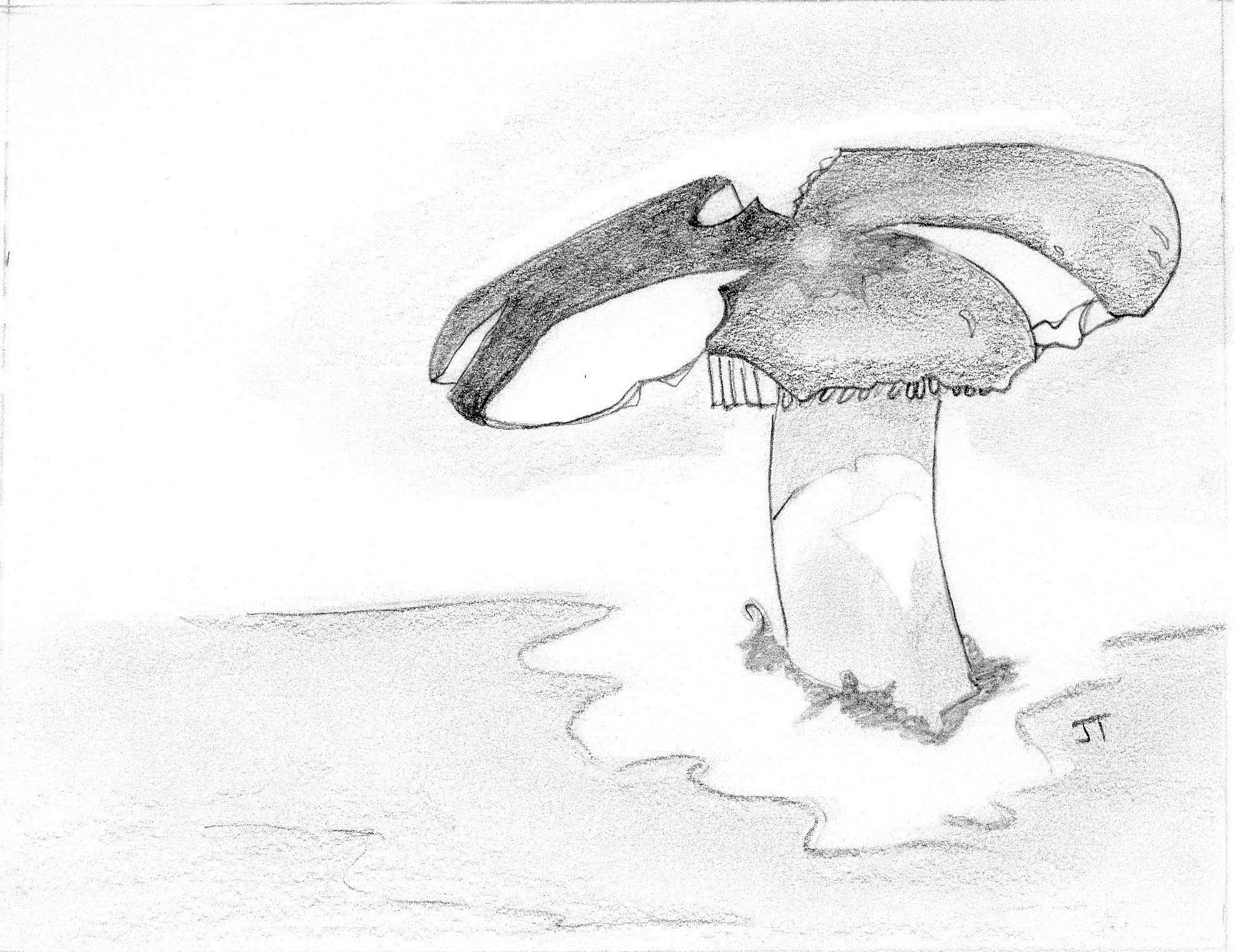
'red mushroom'
messages in stone
In my studies in history, no topic has engaged me like the use of stone to record our human endeavors. I have made a small study of the rune stones of Scandinavia, the stelae of Mesoamerica, and the petroglyphs of North America.
The majority of Scandinavian rune stones are found in Sweden (2,900 in Sweden, compared with 300 in Denmark, 50 in Norway and 33 on the Isle of Man).
These stones are upright or horizontal, frequently taller than two meters and marked by rune carvers with runes and various images. Rune stones are found scattered across the countryside and are mostly memorials, providing records of family relationships and history, community happenings and property ownership.
The majority of rune stones were made in the eleventh century, coinciding with the gradual conversion of the people of Scandinavia from pagan beliefs to Christianity. The transition took years, a merging of doctrine and practice from the two religions. The majority of rune stones show some religious symbolism, usually a blending of pagan and Christian ideas.
In the yard of an old church at Sigtuna, Uppland, is a rune stone once part of the Dominican cloister foundation.

rune stone U379 at Sigtuna churchyard (Source: Ojan, 2009, Wikimedia Commons)
The stone was raised by a guild of merchants to honor one of their members. The rune stone is carved with a ribbon of runes enclosing a simple pattée cross. The facimile (below) of the carvings on the rune stone is taken from:
http://www.ludd.luth.se/~frazze/history/mirror/viking_age/runes/nytt/rune_stone_index.shtml
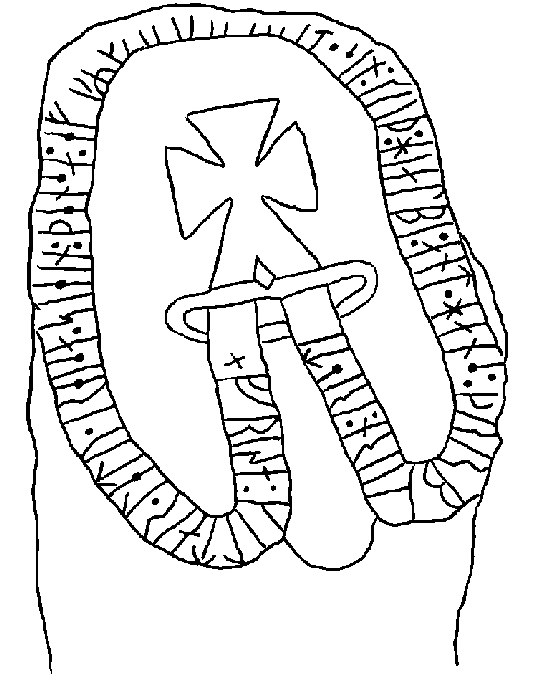
facimile of carvings on rune stone U379
The Dominicans are a Christian Order of mendicant monks founded in the early thirteenth century. The monks are also called “black friars” because of their black cloaks.
The chant in the poem below is based on the Order for Compline in the Anglican Book of Common Prayer.
they too were brothers
(rune stone at the Dominican cloister, Sigtuna)
~
Frisa gildaR letu ræisa stæin Þennsa æftiR Þor [kil, gild] a sinn.
The Frisian guild brothers let raise this stone after Torkel, their guild brother.
– inscription on the rune stone at the cloister
~
~
solemn
we, black friars, stride
stone to stone
the measured step
of Compline
~
lighten our darkness
protect us
from perils of night
~
beside the singular stone
our voices waver
pause on the syllable
explore the octave
and the chant moves on
~
relief of a quiet night
perfect end to imperfect day
fearless expectation
of the grave
~
they too were brothers
to him, Torkel
we, Frisa, raise
this stone
ribbon of runes
cut by Torbjörn
the cross by his blade
~
brighten our darkness
hide us beneath
the shadow of thy wings
~
God bless him and keep him
Guđ hialpi and hans
~
© Jane Tims 2005

not a rune stone, of course, but a grave marker in a New Brunswick cemetery
my ideal niche
I have a picture of the late Tasha Tudor, the children’s author and illustrator, standing in her hermit’s weeds, clutching an armload of branches for the woodstove. Her lined face and straightforward relationship with nature exactly describe my wished-for niche.
I imagine myself as living with the land, growing all my own vegetables, foraging for food I cannot grow, living off the ‘grid’ with solar panels and wood fires, pumping my water from a dug well, patching my roof with pitch from the spruce trees… you are getting the picture. I do few of these things. My garden is pitiful, no sensible fish would attach to my line, and I have to keep a few litres of water in containers in case my electricity-dependant water pump succumbs to a power outage.
The niche I actually occupy is satisfactory when measured by many standards. It falls short of my ideal, but I am not willing to sacrifice. Even in the simple matter of the woodstove, I have only achieved partial success. We have pleasant fires in the autumn when the days are getting cold. But in winter, I rely on electricity to keep me warm.

wood gathered for winter
If my ideal niche is not possible, I do find joy in the bits I have achieved. I think of my successful row of beans, my healthy crop of mint, my knitting of socks in winter, and my walks in the grey woods, as a ‘close approximation’ of my ideal. I admit that I would like to leave my cosy electricity-dependant niche, and acknowledgement frees me to stay.
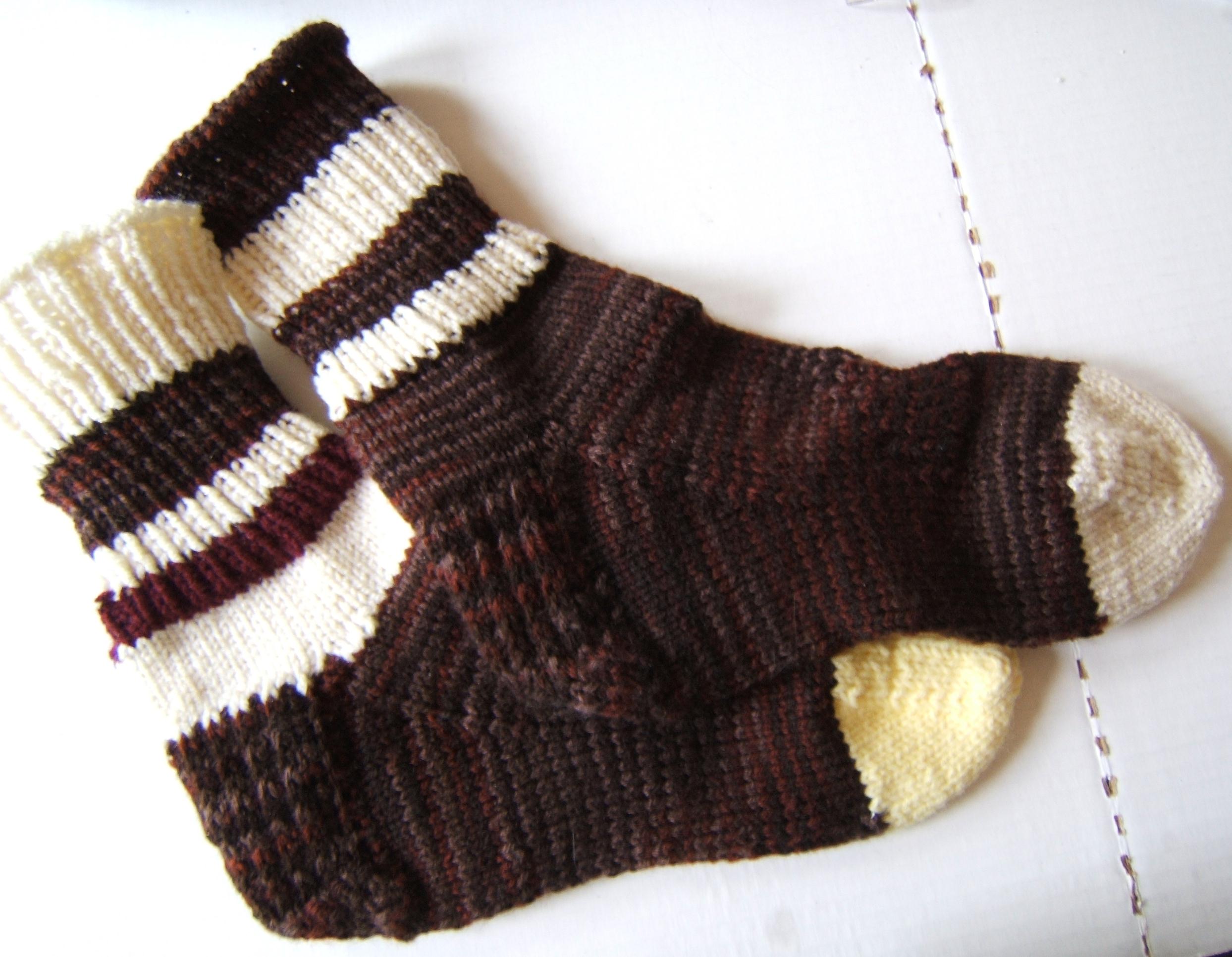
'Odd Socks' ... I knit them all winter...
I accept the truth … the ideal niche is a difficult goal. It takes determination and stamina to achieve.
a close approximation
~
Dolbear’s Law states: the number of chirps a cricket makes in fifteen seconds, plus forty, is a close approximation of the temperature on a summer night
~
warm September evening
I sit on the stoop consider
the timid wind chime the silent screen door
the unmetered patter of rain
~
soothing after a month of dry
~
the rain picks a song
over stones on the river
dolce vivace
dolce
vivace
~
where does my mantra take me?
~
away, to the songs of a summer night
at the back door on the concrete step
where crickets sing from cracks in the sidewalk
~
strung together patio lanterns
notes from a Spanish guitar
the insect refrain
~
behind me light from the kitchen
potatoes at boil the voice of my sister
the tap of her shoe
~
beside me the metal rail rings at my touch
cool on a night so hot and so dry
the pavement cracks
~
out in the yard the insect chorus
~
dolce
vivace
~
molto vivace
~
chirps
too quick
to count
~
Published as: ‘threshold’, Spring 1997, Pottersfield Portfolio 17 (3)
(revised)
© Jane Tims

'summer night at the back door'
returning to the shore
Each summer we try to include a visit to the seashore in our vacation plans. This year we explored the coast of Maine and discovered Acadia National Park. Last year, we followed the South Shore of Nova Scotia, stopping at its many public beaches and byways.
The seashore is a magical place. One of the beaches we visited in 2010 was Crescent Beach, near Lunenburg. At the far end of the two kilometre long beach was an outcrop of calcareous rock. This rock had been eroded and pitted by wave action over the millennia. At one spot, the erosion had worn a small hole in the rock, just big enough to put my finger through. For that moment, I was wearing the whole earth as a ring on my finger!!
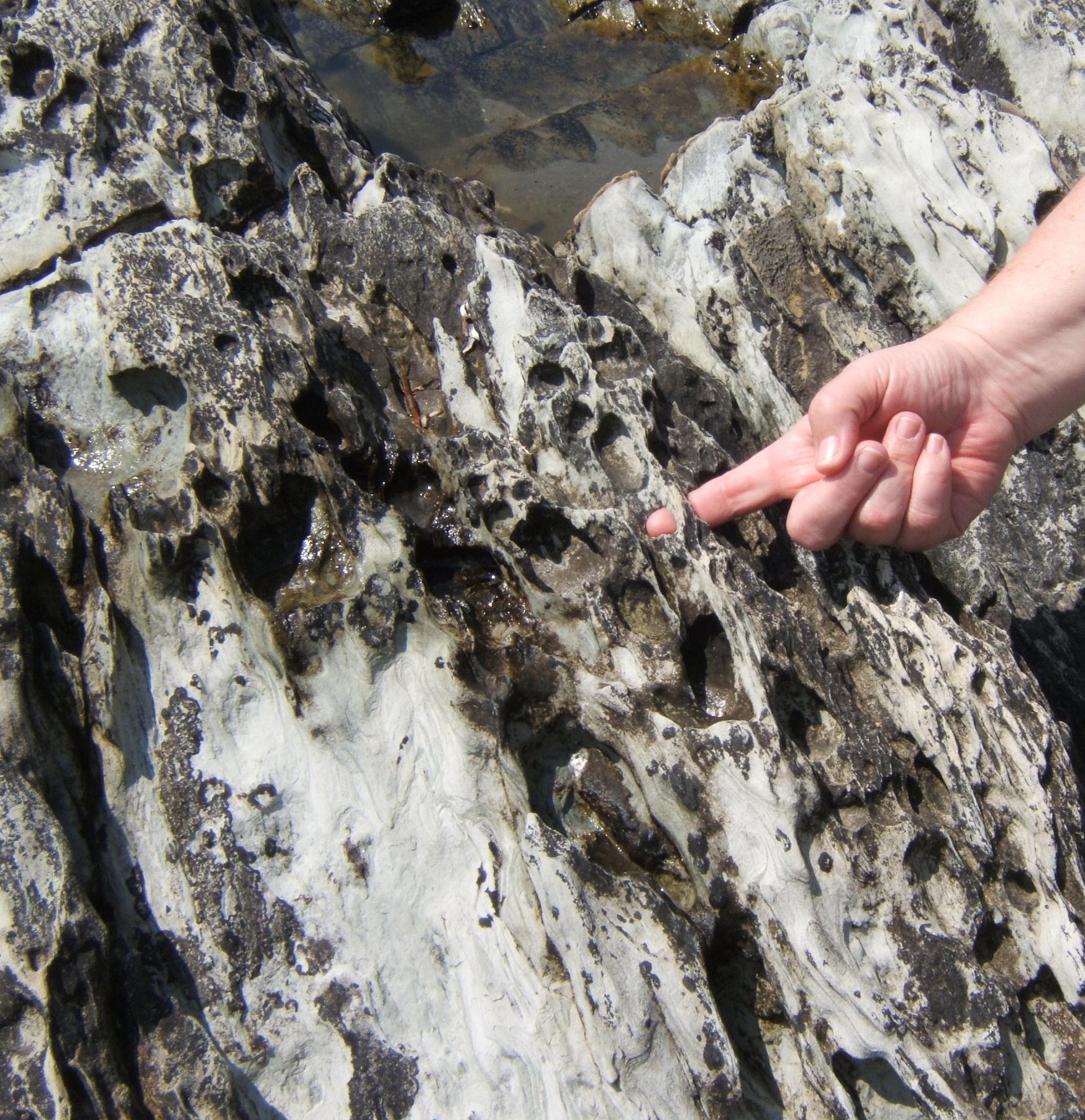
wearing the world on my finger!
The other magical aspect of the seashore is its changeability. In 2009, we followed the Eastern Shore of Nova Scotia and made our second visit to Tor Bay, near Larry’s River. When you stand on the beach at Tor Bay, the energy of the ocean and the drama of the wave action occupies all of your senses, all of ‘self’. The drama had also changed the beachscape significantly between our two visits, shortening its depth and exposing rocks I had not seen on our first visit.

It was as though we were not in the same place at all, but remembering a fable about a beach we had once known. No matter how hard we tried, we could never return to the same beach we had visited before.
fable
~
1.
~
stone
eroded
~
the fragments
layered by water
forged by fire
thrust and folded
into
stone
~
2.
~
this morning
the moon is real
sculpted in wavefoam
smooth as a pebble
random in the clatter
~
real
not a fable of moon
~
the rocks are folded
half-buried in sand
~
on the shore
an igneous man
in his lap a puddle of water
salt crystals
and stars
~
a quartz river
seams his forehead
~
real
not a fable of river
~
3.
~
I place quartz stones
too heavy for the gulls
to gather
~
these stones will shine
in darkness
a long line leading home
~
4.
~
I choose small stones
with smooth and shine
~
stones like eggshell
or potatoes pushed
into ground
~
pearl buttons
turned by a clumsy hand
rice pelting the window
lanterns shining in the dark
~
5.
~
at midnight
I run to the shore
the white pebbles
gather me to the moonlight
a dotted line
on the asphalt road
~
6.
~
the pebbles do not
wait for me
they fade
and scatter
roll over and over
lost
among so many
common stones
~
the wave edge
unravels behind me
~
7.
~
the path home is a fable
not real
~
in my lap is a pool
salt water
and stars
~
© Jane Tims 1998
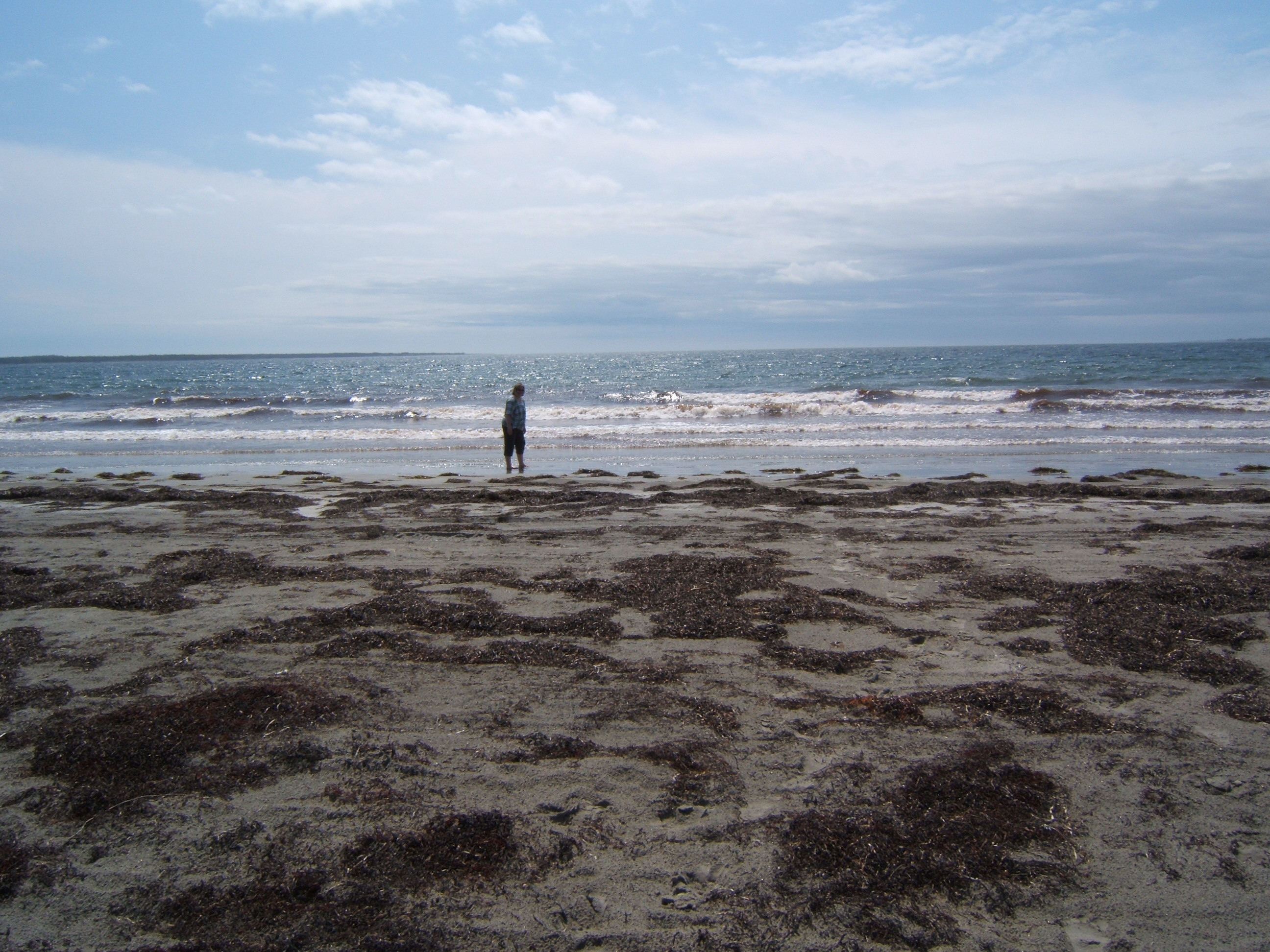
Crescent Beach near Lunenburg, Nova Scotia
autumn along the brook
Behind our house, in the grey woods, is a narrow little brook. It is not much to look at but I like its simplicity. This brook has steep sides (a cross-section like a ‘U’) and grassy banks, and it creates charming little riffles over fallen logs. Until this moment, I have never realised … we have not given this brook a name!

I walked to the brook last Monday evening, to see how high the water was and to look for signs of the changing season.
Autumn is showing its color everywhere. Some of the ferns have turned yellow with the first frost…
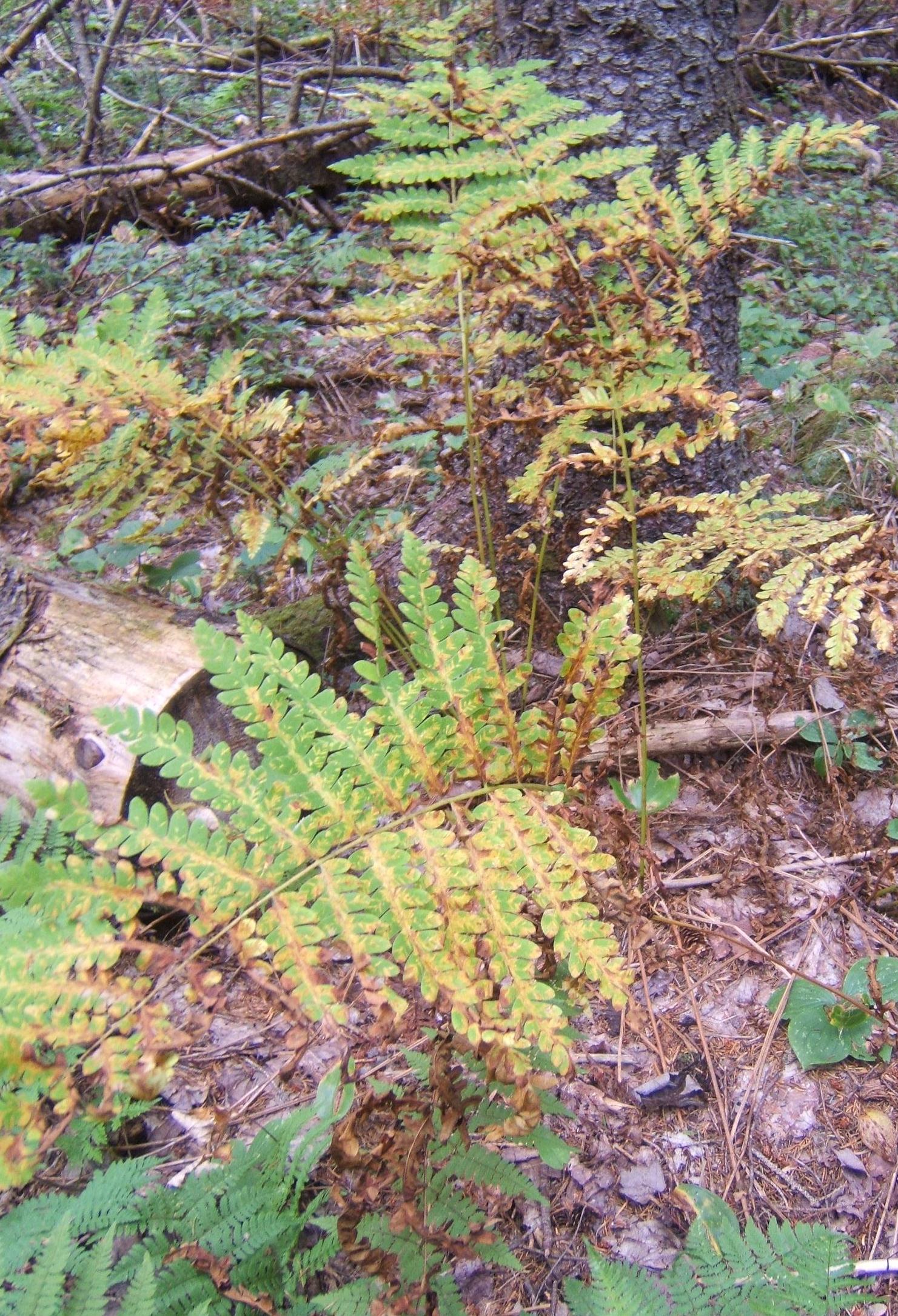
There are fallen red maple leaves on the trail and in the brook…

And the berries of Bunchberry (Cornus canadensis L.) are brilliant red…

- ‘red berries’

end of summer
~
on the path along the brook
one leaf bleeds into water
in town the walks are stony
chaff of linden, seeds
dry ditches overflow with flowers
~
I shrug
(no matter
summer is ended)
~
yellow rattle
pods and grasses
rehearse an incantation
wind sulks in corners of the shed
warmth and sun
paint the orange of pumpkins
knit winter mittens
~
I gather signs of autumn
asters, windfalls, flocks of red wings
frantic in the alders
acorns, hollow galls from oak
~
Orion peeks above the trees
time forgotten, found
and summer with rain never ends
~
I ask for rain
(arms loaded with everlasting)
~
© Jane Tims 2010

'oak leaves and acorns'




 nichepoetryandprose