Posts Tagged ‘poetry’
entering november
After the color explosion of October, I feel a little exhausted. Sensory overload. Trees and roadside plants have gone to sleep or seed for the winter. Most of the Canada Geese have left on their southward migration, and I am sure our Groundhogs have eaten themselves into a winter stupor. Not many of us left to settle in to our niche for the coming months.
My November ‘niche’ activities will include:
- daily filling of the bird feeder
- refurbishing our outside fire pit
- acquiring rock for our new project… a rock-embellished woods road (more about this later)
- sorting some of the books in my library
- return to making soups and stews for our meals

Mostly, I want to appreciate November. I am not very fond of the coming month, but I have resolved to find good in it.
November first frost
~
air brittle
a broken sliver of moon
caught among disrobed larches
silence ruptured
by craven’s cry
~
© Jane Tims 1995

Round-leaved Sundew (Drosera rotundifolia L.)
Carnivorous plants are a bit frightening. They seem more thoughtful than other plants. They are slightly macabre, possessing special adaptations for acquiring their food. They take on shapes not typical of flowering plants. On most days, you can find their prey, in various stages of digestion.
The Round-leaved Sundew, Drosera rotundifolia L., is also called Daily-dew or, in French, Rossolis à feuilles rondes. The Sundew is a carnivorous plant of acid bogs, barrens, moist roadside ditches and peaty soils. The leaves are in a tuft at the base of the plant and each leaf is covered with numerous gland-bearing bristles. These exude a clear fluid that glitters in sunlight, hence the name, from the Greek droseros meaning dewy. The delicate white flowers are borne on a slender, nodding stalk, and only open in the sun.

Round-leaved Sundew
Drosera rotundifolia L.
~
daily, dew is falling
sits on bristled leaves
of the sundew;
in innocence, believe
~
in our ditch is treasure,
glittering jewels, set
out in the sunshine,
a lure for insect fools
~
brilliance and beetles caught
in sticky dew, bristles tight
clutch creatures
they slew
~
tiny flowers cling
to the curve of a nodding stem,
opening when sunlight
shines on them
~
© Jane Tims 1984
trees on sky
This time of year, the lost leaves allow a new observation of sky. The bare branches remind me of pen and ink on paper.
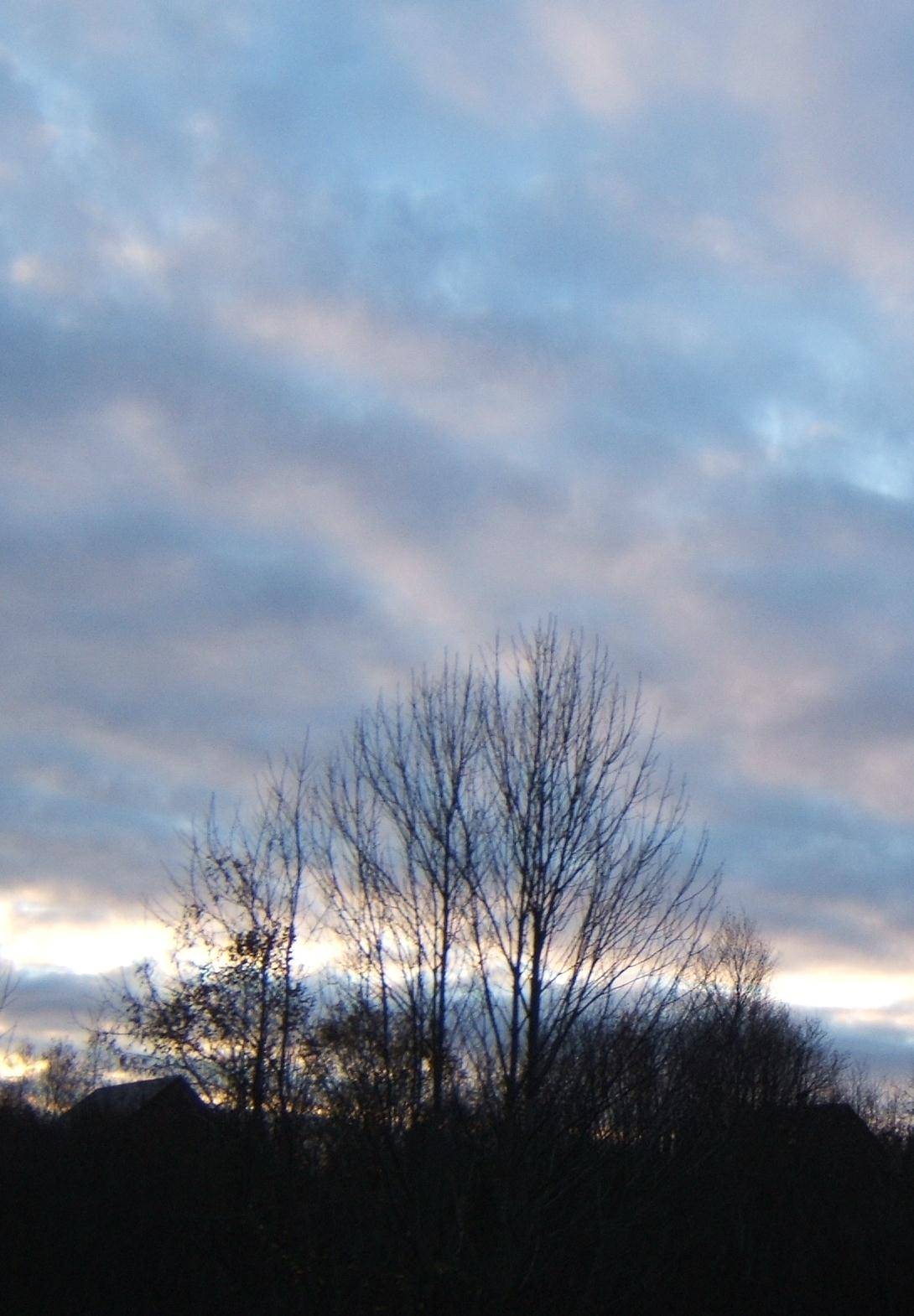
these leafless trees / brush against /a linen sky / ink strokes /on rice paper
(from ‘requesting the favor of a reply’ in the post ‘hidden in the hollow heart of an oak’ August 19, 2011, under shelter)
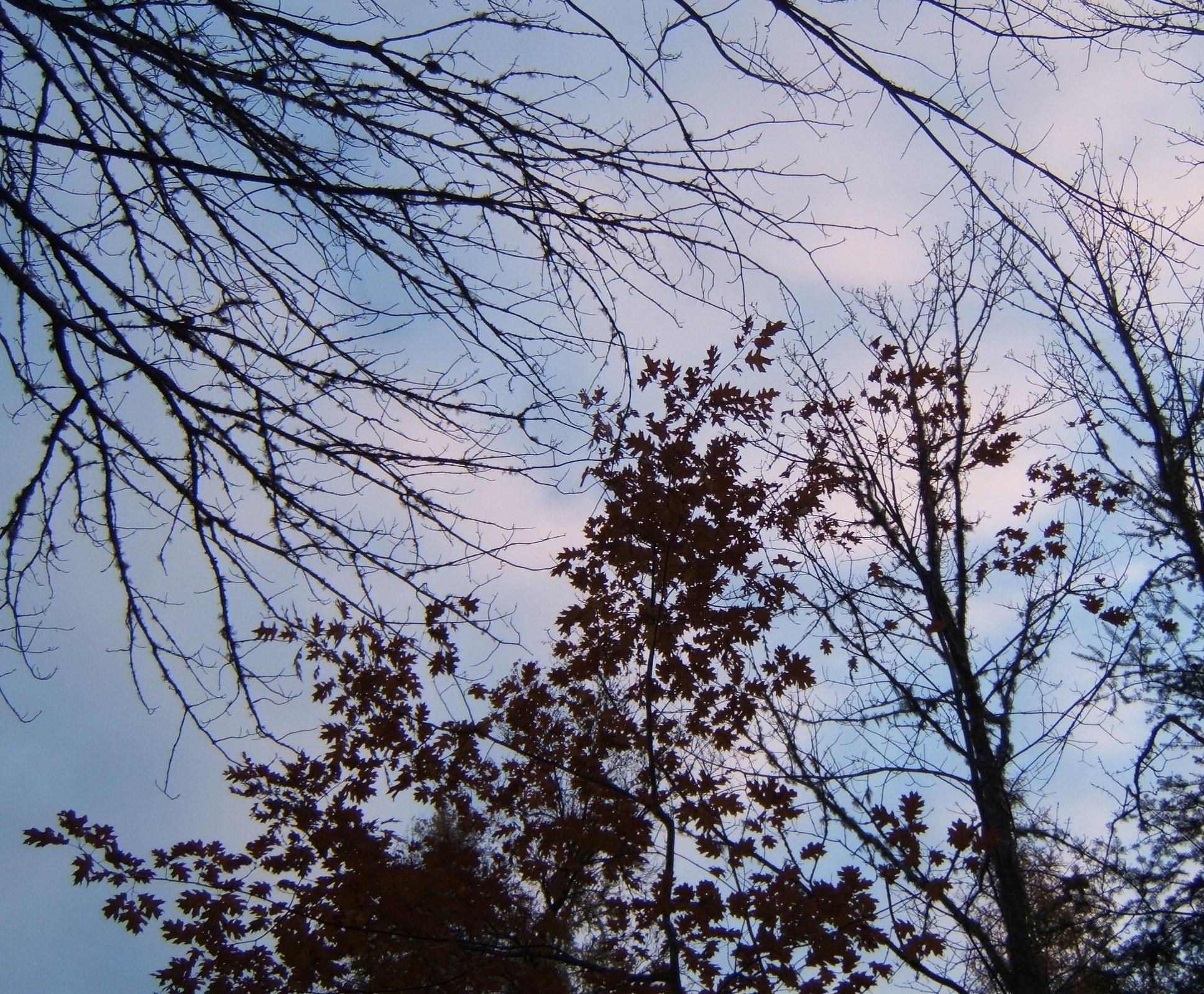
pale sunrise
~
perhaps this sparse oak
colored the pale sunrise
palette, faded autumn
~
even loaded, lean branches
lay only brief color
on canvas sky
~
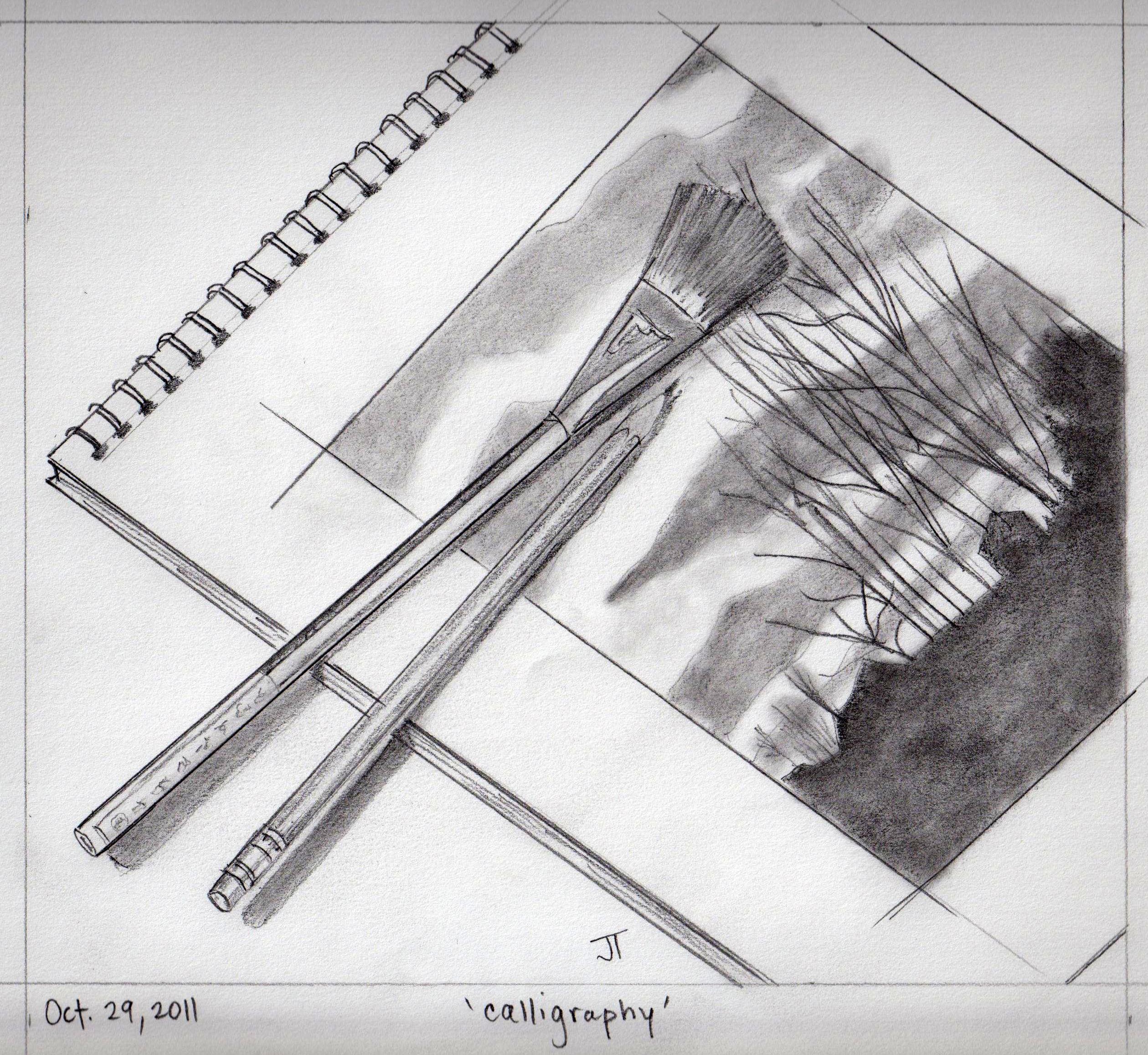
brush more suited to calligraphy
a few abbreviated strokes
a terse ‘good morning’
~
© Jane Tims 2007
air to breathe
As I approach retirement, I find I am thinking a lot about my past work. My first job was as a botanist in the field of air quality.
Some plants are very sensitive to air pollutants and develop ‘herring bone’ patterns on the leaves when the levels of pollutants like sulphur dioxide get too high. Other plants can be used as monitors since they absorb pollutants from the air.
I worked to diagnose air pollution injury to sensitive plants and designed ways of using plants to assess air quality problems. We grew tobacco to measure ozone pollution, set out ‘tea bags’ of sphagnum moss to monitor levels of trace metals in the air, and collected reindeer lichens to determine their pollutant exposure. I had wonderful days identifying plants, collecting lichens and being a botanist.
My favourite air pollution monitors were the reindeer lichens. These are like all lichens, a symbiotic organism consisting of an algae and a fungus. They have no roots, so they absorb all their nutrients from the air, making them an excellent monitoring system for air pollutants. They were a challenge to identify and the habitats where they grew took me to some very interesting places in New Brunswick. These included peat bogs where the lichens grew beside pitcher plants and sundews, mountain-tops dominated by ericaceous species like sheep laurel (Kalmia angustifolia L.) and blueberry, and high flung rock outcrops where I could see all the world below me as I picked my specimens.
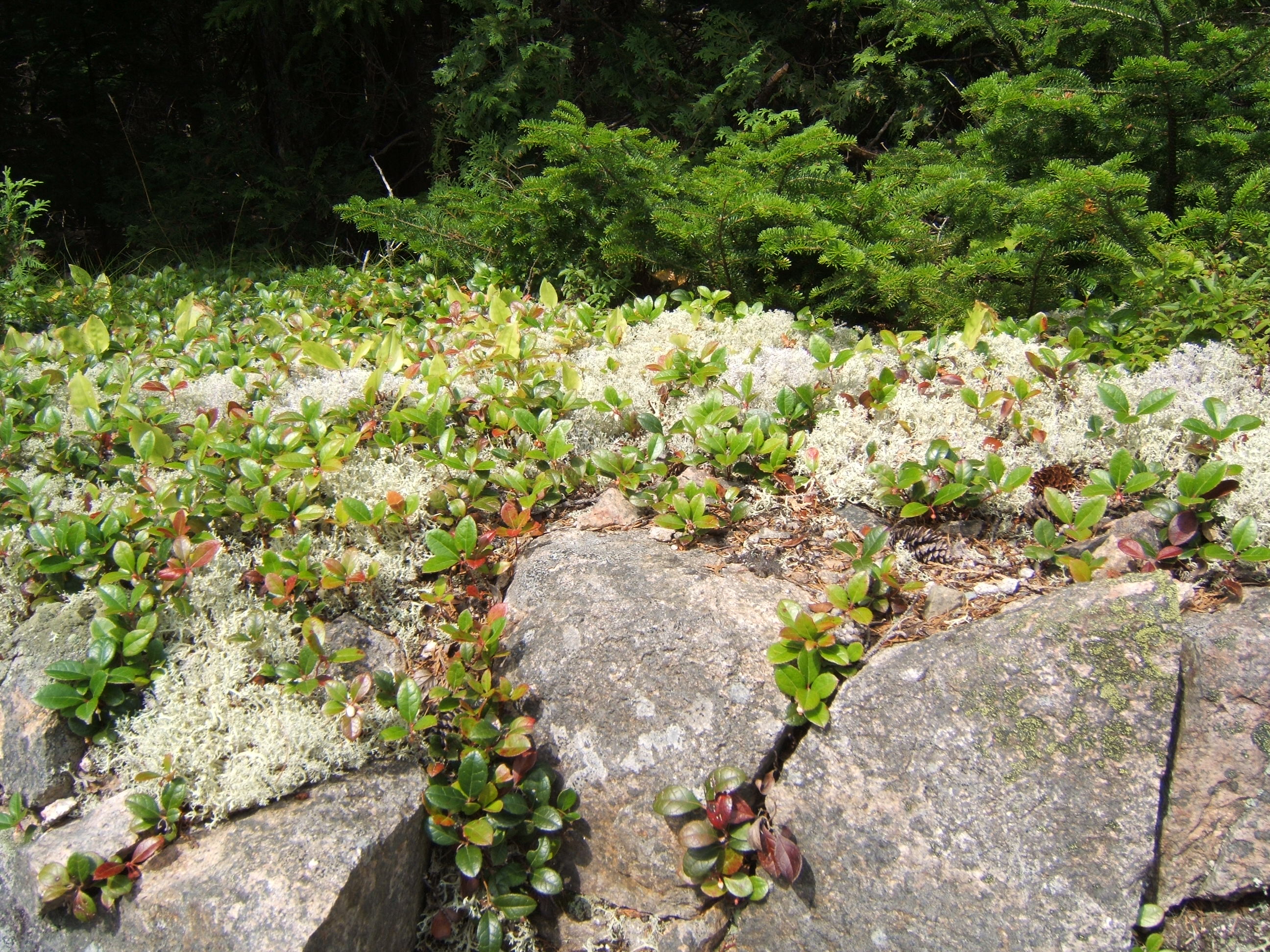
Although we collected many species, the three reindeer lichens most useful for our studies were Cladina arbuscula, Cladina rangiferina, and Cladina stellaris. These are all ‘fruticose’ lichens, species with a ‘shrubby’ appearance, consisting of a main branch with many side-branches. A single ‘plant’ fits nicely in your hand. The Cladinas all have hollow branches and could be (and are) used as little trees in HO scale train models.

- Cladina arbuscula (left) and Cladina rangiferina (right) growing on a rock by the roadside in Maine. You can tell the difference by the greenish color of the arbuscula and the bluish-grey color of the rangiferina.

Cladina arbuscula (Wallr.) Hale & Culb. grows in extensive colonies, and is yellowish-green. The tips of the branches all point in one direction, a distinguishing characteristic of the species. Cladina rangiferina (L.) Harm. is often found growing with Cladina arbuscula and can be distinguished from arbuscula by its very blue-grey appearance.
Cladina stellaris (Opiz) Brodo is yellowish-grey, and grows in distinct clumps which resemble small ‘poofy’ trees.

Cladina lichens and moss on the rock at Moss Glen Falls in New Brunswick. The clump of lichen towards the center, looking like the ice cream in a cone, is Cladina stellaris.
On our travels this summer, I reacquainted myself with the Cladinas. And I remembered all the remote places I have been as a result of my work. One of these was Turtle Mountain in southern New Brunswick, now protected as part of the Loch Alva Protected Natural Area (PNA). It is a very old mountain, worn to a granite hill. At the top of the hill, is an ericaceous meadow where Cladina lichens flourish.
Turtle Mountain, 1979
~
afternoon air at the base
of the food chain
rewards obligation to breathe
~
grazing tickles the nose
and grey-blue lichens know
laurel and balsam
~
flume of curtain billows
across the daybed
into the room
~
into the space between
Kalmia and wintergreen
meadow heat rising from stone
~
marbled weave of oxygen
hydrogen nitrogen
bilberry and salt ocean
~
© Jane Tims 2011

(brackets in the birch grove)
Last week we went for a walk (more like a struggle) through the birch grove at the base of the grey woods (see the ‘map of the grey woods’ under ‘about’). To get there, we crossed the fern gully, mostly dry this time of year, and entered a mixed wood of birch, maple, spruce and fir, much younger than the mature spruce in the grey woods.

These trees grow in very wet conditions, and the forest floor is a hummocky, spongy growth of Sphagnum moss and fern.

There is no path through this woodland, so the ‘walk’ was an up-and-down, over-and-under kind of trek. To stay dry, you must take giant steps from hummock to hummock. To stay upright, you must check your footing and hang on to the young trees. With all this concentration on moving forward, I tend to miss some of the interesting detail, so I try to use each ‘balancing moment’ as a time to look around and observe the wild life.
One occupant of the birch grove is the bracket fungus. This is a type of fungus that grows like shelves on both living and dead trees. The fungus forms thick flat pads on the tree, usually parallel to the ground. They remind me of steps, a spiral stair to ascend the tree.

The semi-circular body of the bracket fungus is called a conk. The conks of the bracket fungus growing in our woods are thick, often oddly shaped, and constructed of various cream, tan and brown coloured layers. The conks are the outwardly visible, reproductive part of the fungus. The vegetative portion of the fungus grows as an extensive network of threads within the tree.
bracket fungi
~
1.
in this forest
staid
practical
grey
could any form
construe to magic?
~
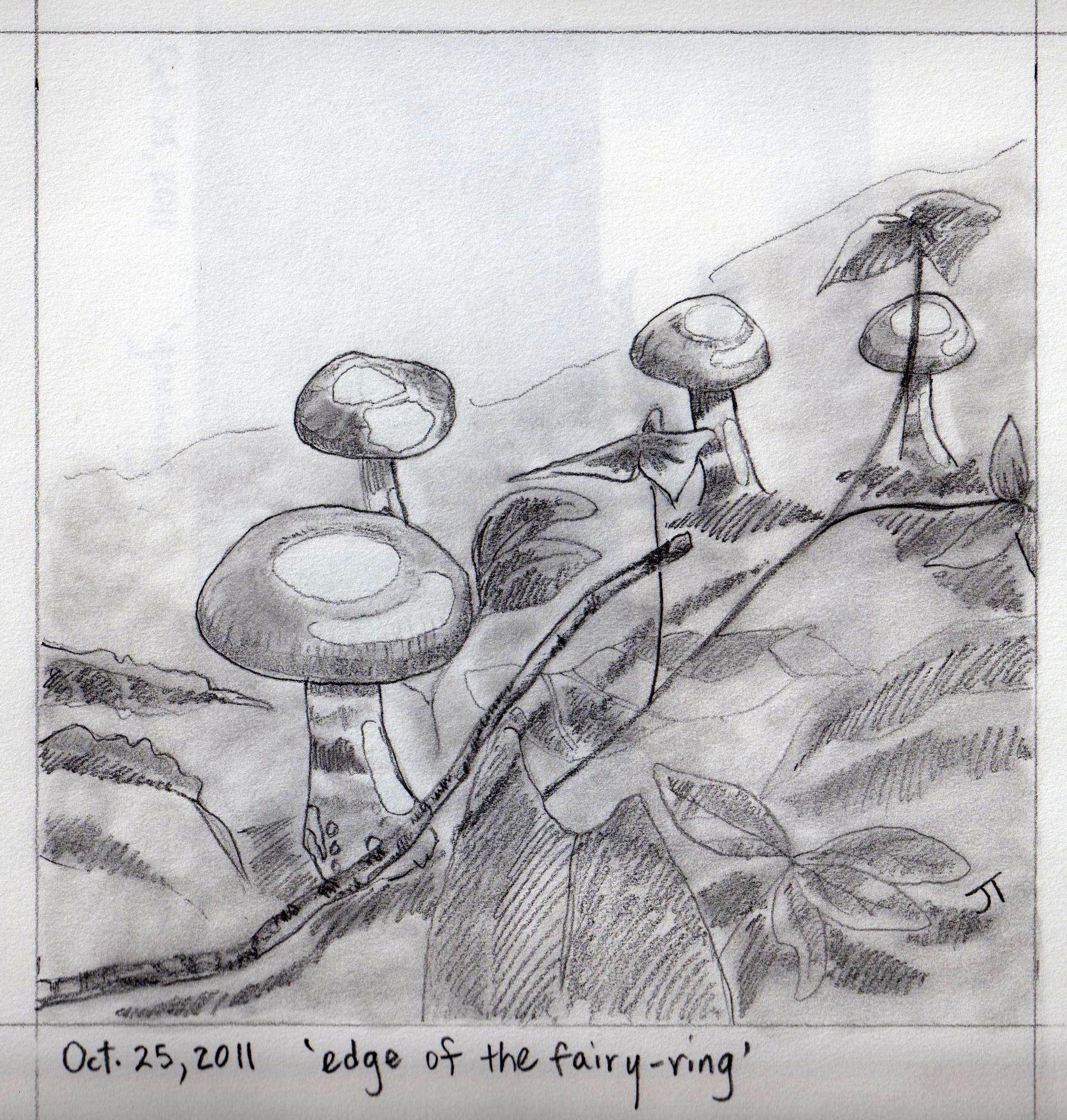
fairy rings
moths in spectral flight
spider webs, witches brooms
burrows and subterranean
rooms, hollows in wizened
logs, red toadstools
white-spotted, mottled
frogs
~
2.
bracket fungi
steps ascend
a branchless tree
~
© Jane Tims 2011
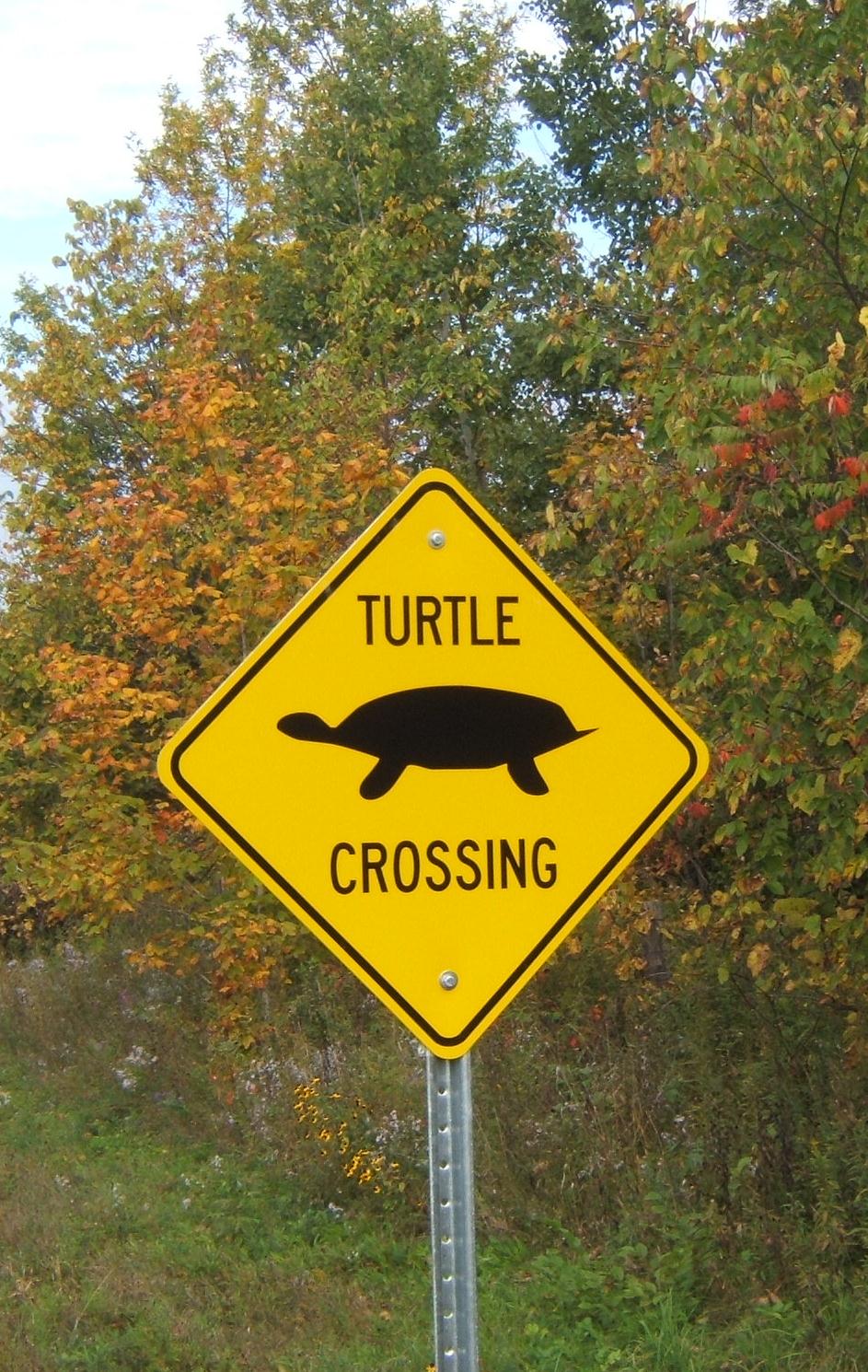
black and amber signs
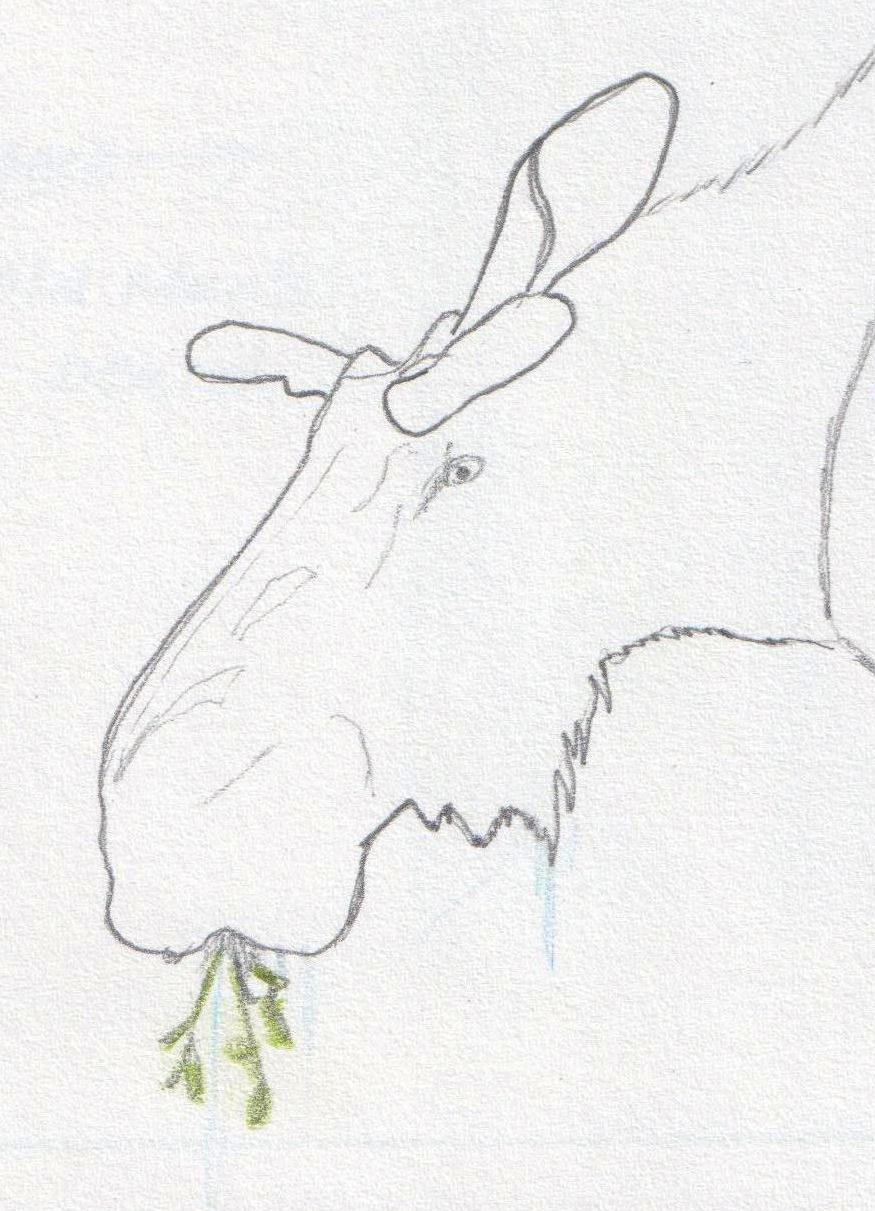
When people and animals try to occupy the same space, sometimes misfortune or even tragedy occurs. In New Brunswick, drivers constantly scan for deer and friends include a warning to ‘watch for moose’ in their goodbyes.
The tragedy works both ways. A moose is a big animal – a collision will mangle a car and destroy a young life in an instant. At the same time, a turtle killed on the highway is a loss for our ecology and our biodiversity.
The first step in preventing tragic encounters of vehicles with deer and moose and other wild life is the black and amber sign. It warns us when we travel through the spaces animals consider home.

In New Brunswick the fatalities involving moose have been so high, the Department of Transportation works constantly on a program of fencing and tunnels to keep cars and people separate and to provide safe passage for animals.
Often in our travels, my husband and I stop to rescue turtles from becoming road kill, carefully moving them off the road in the direction of their destination. In Ontario, we were delighted to encounter Turtle Crossing signs. These signs serve to warn and also to make people aware that the wetlands are home to many species.
black and amber
~
take these as warning
black on amber
time presses forward
no back-spin in the gyre
lost is lost
bubbles make no progress
against the river’s flow
~
five things to do
before evening
the least of these
to notice the shadow
climbs the wall
her hair tangles
on the pillow as she sleeps
immobile
~
remember the deer
how it fits itself to the hollow
of the hood of the car
and the moose matches pace
with the bike
prolonging collision
~
remember how the turtle withdraws its feet
refuses to move
just another
stone on the highway
~
© Jane Tims 2011
autumn black and white
Roaming around the countryside, the weekend before last, deluged by color from orange and yellow trees and crimson fields of blueberry, I was interested by the contrast in the ditches. A month ago, they were a riot of yellow or purple as the goldenrods, tansies and asters presented themselves, species by species. Now, they are done with blooming and are in the business of releasing their seeds.
To attract pollinators for setting their seeds, flowers put on a competitive display of color and form. But dispersing their seeds is a different process altogether. Many depend on the wind to carry their seeds to ideal sites for next year’s bloom and the wind is color-blind. Grey, white and even black are the dominant colors in the ditches.

Seeds dispersed by wind either flutter to the ground, or float in the air. Often, they are assisted by a special seed form. For example, maple keys are flattened and aerodynamic so they spin and travel some distance as they fall. Seeds of goldenrod and aster have feathery white bristles (called the pappus, a modified sepal) to help them float through the air. The term pappus comes from the Latin pappus meaning ‘old man’, an apt description of the white heads of the flowers, gone to seed.

Another species in the ditch, Common Tansy (Tanacetum vulgare L.), also known as Golden-buttons, ordinarily has bright yellow flowers in a flat head. Now, it has joined the black and white revue, showing black seed-heads against feathery leaves.

The seeds of Tansy, in a form called an achene, have no special adaptation for flight. This time of year, these seeds are dry and ready for dispersal by gravity.
autumn black
~
dry leaves
silent
colorless
wonder withdrawn, into the vortex of
no hue, no delight
cones suppressed, rods perceive
absence, black seed in heads of Tansy
absorb all light, feathered foliage
darkest green, approaching black
~
© Jane Tims 2011

in the shelter of the lane
Now, when the trees are shedding their foliage in yellow, red and orange, have you taken the time to stroll down a lane crackling with dry leaves?
1 lane n. 1: a narrow passageway between fences or hedges;
2: a relatively narrow way or track …
2 lane Scot var of LONE
Webster’s New Collegiate Dictionary, 1979
Words are so laden with connotative and denotative associations, those similar in meaning may not convey the same idea at all. For example, the word ‘lane’ is vastly different in meaning from ‘road’, yet a lane is a type of roadway.
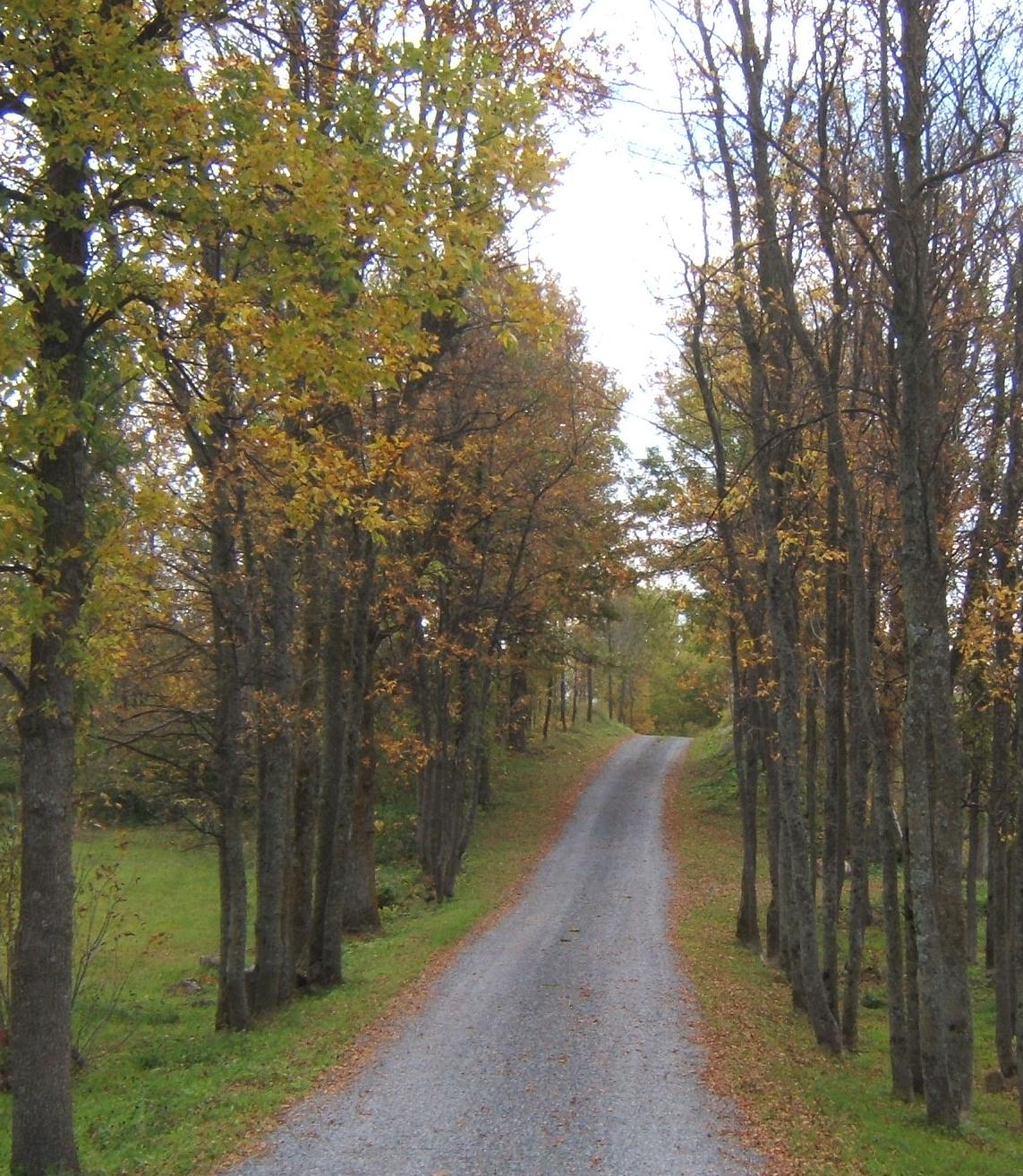
A lane, to me, is a narrow corridor, built to admit people from the ordinary world of community to the private world of home. A lane is bounded on each side by trees, hedges or fences. A proper lane must have ruts for the tires and a centerline of grass to challenge the clearance of any vehicle. Once you are in the lane, it is difficult to see anything outside.

When I was young, visiting my mother’s family took us to ‘the old home place’. It was sandwiched between the main road and the river, but because it was connected to the outside world by a long, bent, shady lane, it was truly a ‘world-apart’.

I spent many happy hours in the lane, wandering up and down its length, singing and dreaming, exploring and examining. I loved the small woodland habitat created on either side. I picked the wild blueberries growing there, watched squirrels busy at the workings of their pine-cone industry, and made friends with specific trees.
One young Silver-leaved Poplar (Populus alba L.) was a particular favourite. It stood just before the bend in the lane, its bark marked with black diamonds. When the wind blew, it turned its leaves over in a generous offering of silver.
I have other pleasant associations with the lane. I remember my Dad working there with a shovel and a pickaxe, trying to fill in the worst of the ruts to save the undercarriages of his car and trailer. I remember listening to my Mom’s stories of how she and my aunt pushed their doll carriages up the lane to visit imaginary neighbours. I remembered how excited we always were to see the gate at the end of the lane wide open, since that meant my aunt or uncles were at home.
lane
~
trees along the lane
sentinels
to guard its ways
cone scale mounds
acorn stashes
the silver undersides of poplar leaves
doll carriages with squeaky wheels
blueberries in slants of light
~
the lane a wooden shelter
its base the rutted track
its sides the trees, muscled arms
branches overhead with fingers locked
~
charmed paths
moss tablecloths
fairy rings and follows
~
protected by
the closing of eyes
~
© Jane Tims 2011

refections on the water
I have realised there is a sequence to the vanishing of the autumn colour.
First the maples lose their leaves in the early autumn winds. The next will be the poplars, now glowing with banana colours. The oak leaves, ruddy and slick with reds and oranges, will succumb by late October. Tamarack, a deciduous conifer, will lose its amber needles in early November. The beech trees will keep their ochre, papery leaves all through the winter, finally losing them in spring when the new leaves emerge.
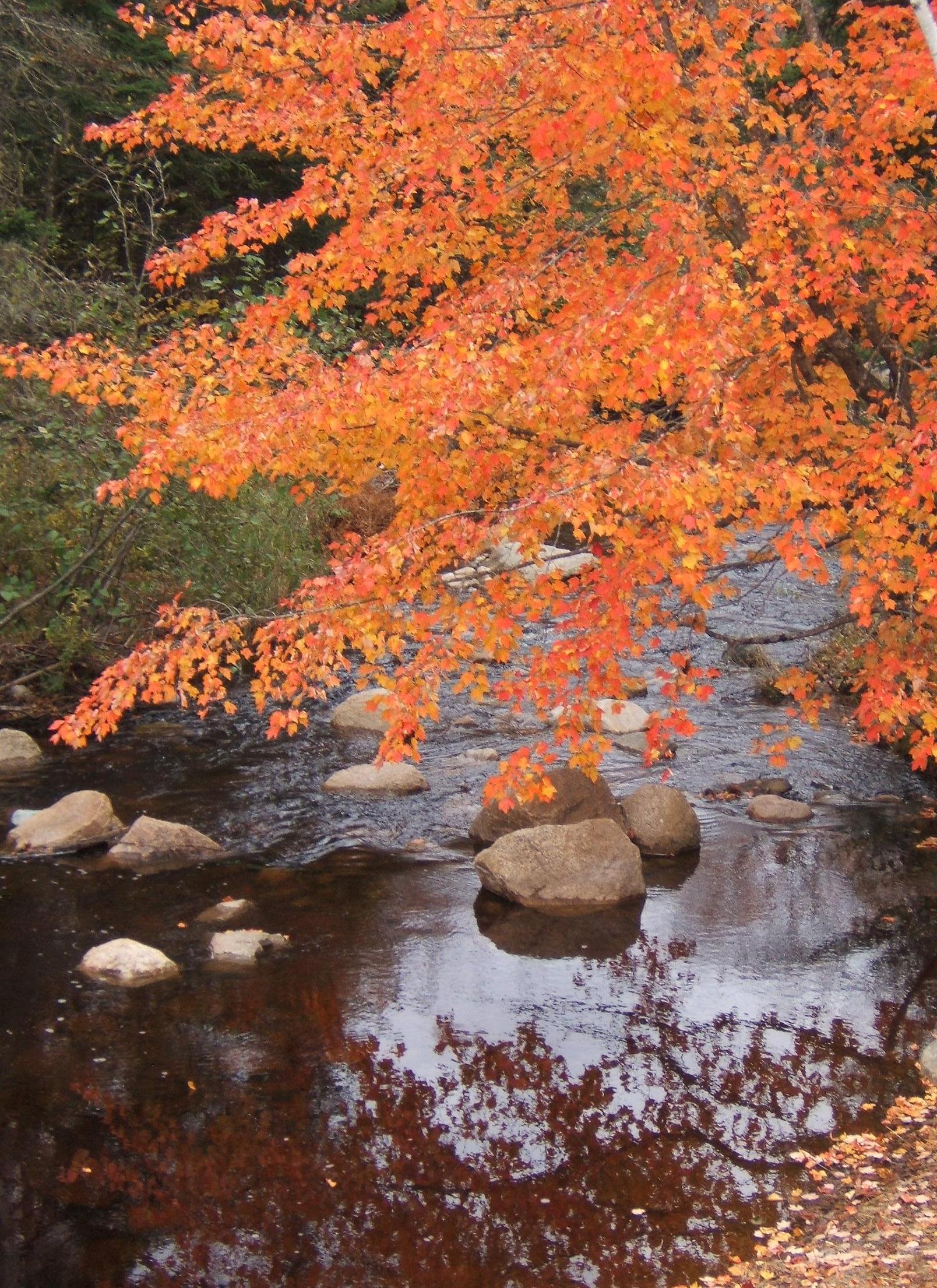
This past weekend, we found some maples still in autumn garb. At Watty Brook, flowing into McDougall Lake in south-west New Brunswick, at least one maple has taken longer than most to lose its leaves. At its sheltered location in the low valley of the brook, the tree has eluded the winds. It was reflected clearly in the brook, and its orange and gold were captured in the rocks showing through the tea-coloured water.

In spite of the movement of the water, the tree was reflected in all its splender.
in the millstream
~
upstream
deer are drinking
and the raindrops
swell the running
this I know
from bubbles
rising
~
I am a rock
in the millstream
seasons and freshets
have smoothed
my edges
~
once I met the water
a cleaver
divisive
now I ask the water
to flow
around me
~
© Jane Tims 2003

‘blue’berry fields in autumn
This time of the year, the only thing ‘blue’ about our blueberry fields is the blue sky above them. The fields themselves are a blanket of scarlet and orange.
These are a few scenes of the October blueberry fields in south-west New Brunswick…


legacy
~
remaining in the room
a well-used blanket
red with two black stripes
inexpensive facsimile of
~
a white
three-beaver blanket
stripes red, yellow, green
~
a blue sky
two vapor contrails
~
the yellow double line
on an asphalt road
~
a band of stars
across a light-starved sky
~
a red leather book
with black ribbons
mark passages for giving
thanks:
look down from heaven
upon the fields, now white
unto the harvest
~
a crimson blueberry field
in October, draped across bones
of the landscape
double tracks leading away
over the horizon
~
© Jane Tims 2011





 nichepoetryandprose