Posts Tagged ‘poetry’
a preface for a poetry manuscript
~
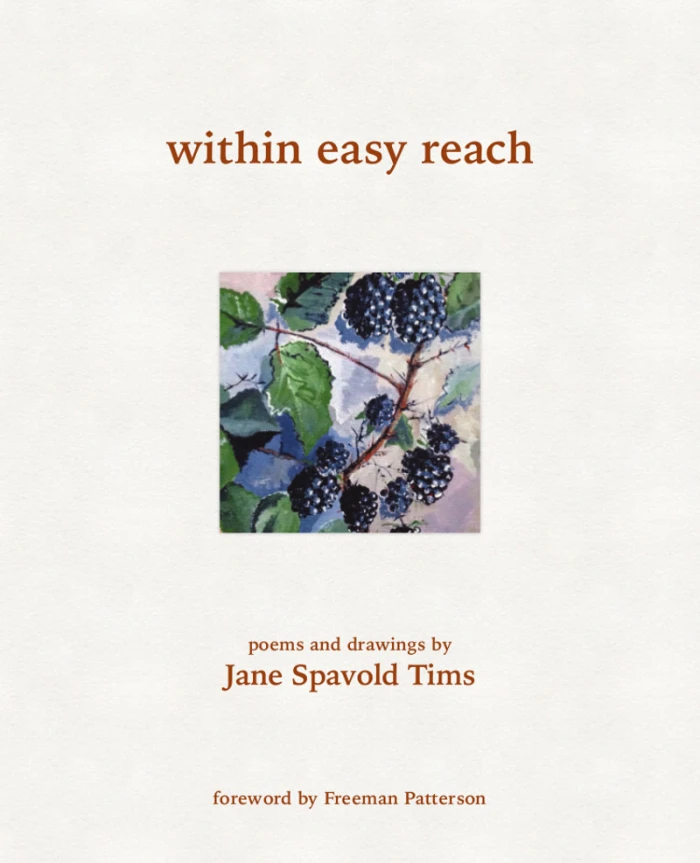
As followers of my Blog will know, I am working during these first months of 2015 to finalise, for eventual publication, a manuscript of the poetry I wrote for my ‘growing and gathering’ project (see the Category ‘growing and gathering’ for more information).
Now that the poetry is ordered within the manuscript, I have to pay attention to the ‘Front Matter’. This includes:
title: ‘within easy reach’
dedication: the manuscript is dedicated to my husband
table of contents: a listing of the poems
acknowledgements: all the people I want to thank and the support of artsnb and the Creations Grant
~
The above four items are straightforward. I needed some information about the next three:
~
foreword
preface
introduction
~
Foreword: written by someone other than the author of the book, usually an authority – celebrates the work and provides credibility.
Preface: written by the author of the book – includes the purpose and scope of the work, explains the origins of the central idea in the book, and may acknowledge those the author wants to thank.
Introduction: written by the author or an editor – includes information on the contents of the book, the author, and the audience.
Source: http://www.quickanddirtytips.com/education/grammar/foreword-versus-forward#sthash.No5DaWpu.dpuf
~
Many of the poetry books I have in my library do not include a Foreword or Preface, and Acknowledgements are often placed in the back of the book. I find this is true of collections where the theme of the poems is not immediately obvious. But collections about a particular subject, such as those about history, often have a Preface or Introduction.
~

~
For example, Jack’s Letters Home (Cynthia Fuller (2006) Stable Cottage, U.K., Flambard Press) includes an Introduction. The book is a collection of gritty poems based on real letters written by a British soldier in the First World War. The Introduction tells the soldier’s history, the story of how the letters were found and a little about the characters in the poems.
~

~
I have two poetry collections by Shari Andrews. Both focus on history. Crucible (Shari Andrews (2004) Canada, Oberon Press) is an insightful collection of poems depicting characters and events in the life of Saint Catherine of Sienna. It includes a Foreword by the poet. The Foreword includes background on Saint Catherine of Sienna, information about the inspiration for the book, and acknowledgements.
~
The Stone Cloak (Shari Andrews (1999) Canada, Oberon Press) is a collection of tactile, sometimes fierce, poems about the lives of settlers of New Denmark in New Brunswick. The Foreword includes information about the poet’s connection to the community and briefly describes the history of New Denmark. It includes acknowledgements.
~

~
Although it is not a book of poetry, in an 1843 edition of A Christmas Carol Charles Dickens includes a brief Preface, consistent with the spirit (!) of his story:
I have endeavoured, in this Ghostly little book, to raise the Ghost of an Idea, which shall not put my readers out of humour with themselves, with each
other, with the season, or with me. May it haunt their houses pleasantly, and no one wish to lay it!Their faithful friend and Servant,
CD.
December 1843.(Source: http://www.themorgan.org/collections/works/dickens/ChristmasCarol/3, accessed February 23, 2015)
~

a ‘grown and gathered’ salad – leaves and flowers of violet, leaves of mint and dandelion, bean sprouts and green onions
~
My poetry manuscript has a very specific theme – the ‘growing and gathering’ of local foods. Since all of the poems are about a particular topic, I think including a Preface is appropriate. I want the Preface for my manuscript to:
- be short (less than a page)
- inspire my audience
- include the purpose of my poems
- provide an overview of the contents
~
When I was young, I always skipped the Preface of any book I read. Now, I read the Preface first, eager to find information about the process the author followed in conceiving of or writing the book.
~
Copyright 2015 Jane Tims
a moment of beautiful – shadow forest

~
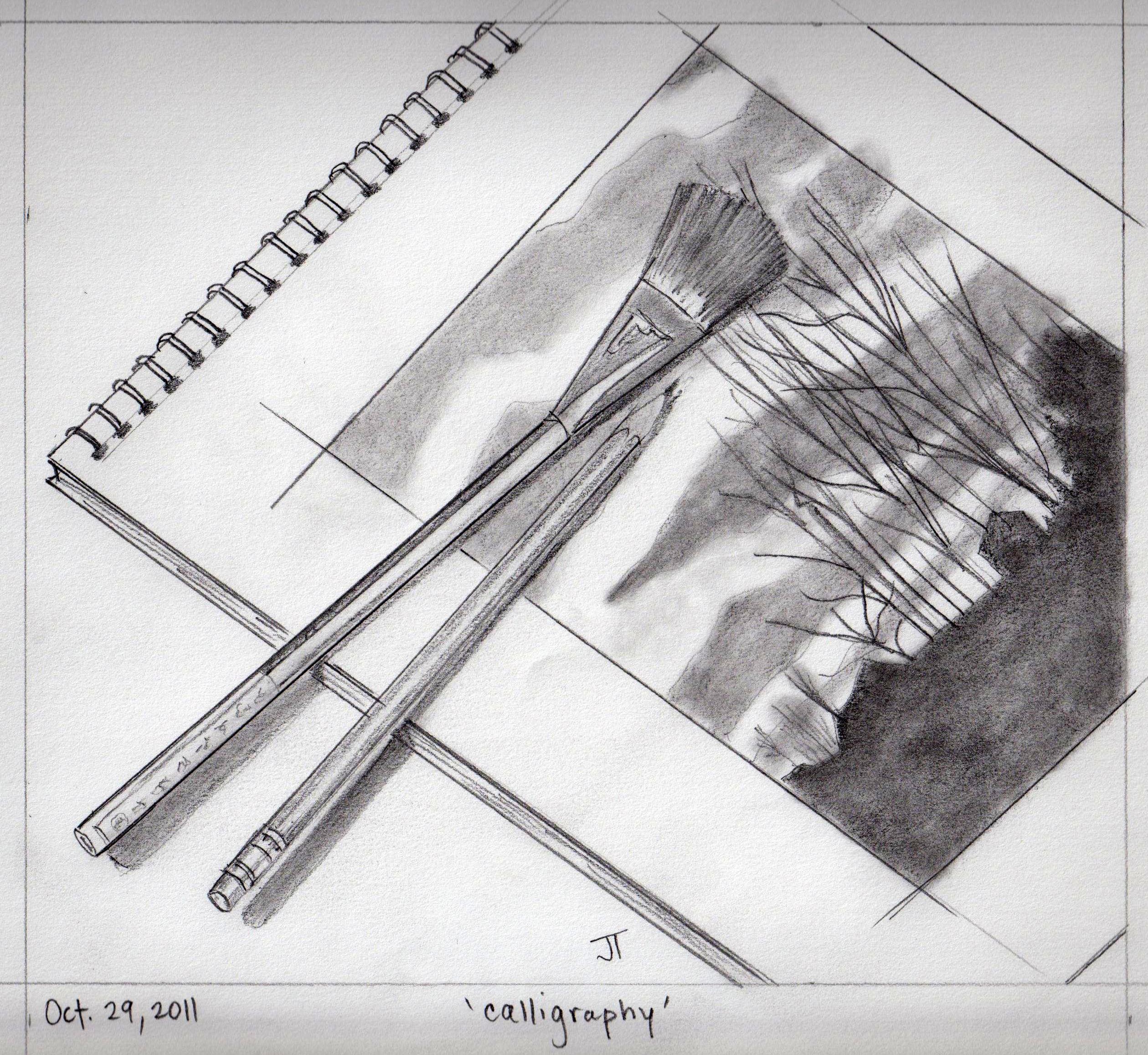
tree shadows, drawn on a sloped roof
~
tilted shadows on snow, graphite stems, crowded trees
~
pencil sketch of woodland, whim
of northern winter, slanted sun
~
from the trees, truth, but the artist lies
maligns tree shape, size and colour
wind direction
~
shadow trees without wild life
red squirrels and blue jays
seldom visit while light and pencil
sharpen their edge
~
only phantom light in space
between sender and receiver
message warped, passed
from molecule to molecule
through lead and air
~
~
Copyright 2015 Jane Tims
~
moment of beautiful – shadow on the snow

~
~
under the snow
~
the shadow is a blue portal, a hidden way
to crocus places, sheltered where no drifting
snow or bitter wind comes howling
~
frost-brittle maples creak
and chickadees crack seeds
of sunflower stashed
in tunnels shaped
by squirrels
~
~
Copyright 2015 Jane Tims
a moment of beautiful – shadow

a shadow on the kitchen cabinet of a pine cone hanging in my dining room window
shadow
~
frail interruption of light
ribbon without curl or selvage
pine cone without pitch
brief life from the ecliptic
~
Copyright 2015 Jane Tims
shaping a visual poem
Rather than being a mere mechanism for conveying ideas, words themselves can become a visual part of a poem’s theme or meaning. In a ‘shape’, ‘visual’ or ‘concrete’ poem, the words of the poem are arranged in a way to represent an idea or image from the poem.
The shape poem is a relatively old form and occurs many times in literature. For example, the Mouse’s ‘Long Tale’ in Chapter III of Alice’s Adventures in Wonderland is in the shape of a tail ( http://www.gutenberg.org/files/11/11-pdf.pdf ). Other visual poems include parts of ‘Easter Wings’ by George Herbert and ‘Vision and Prayer’ by Dylan Thomas (see Poetry through the Ages: http://www.webexhibits.org/poetry/explore_21_visual_examples.html ).
~
So, does a poet begin with the goal of creating a visual poem or does the shape of the poem evolve as part of the creative process? For me, the shape suggests itself well into the process, as part of my considerations of line length and punctuation.
~
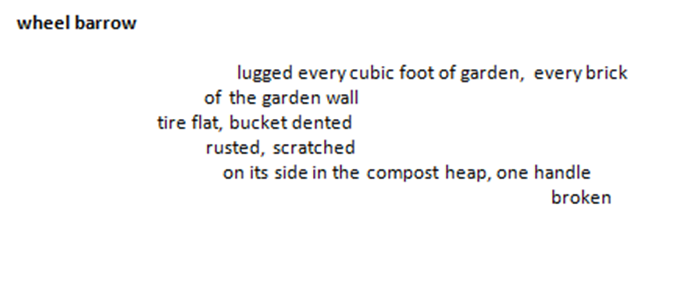
Here is a poem about an abandoned wheel barrow, part of my manuscript on derelict elements of our landscape. Like so many items, this wheel barrow has outlived its usefulness.
~
First, the basic poem:
~
wheel barrow
~
lugged every cubic foot of garden, every brick
of the garden wall
tire flat, bucket dented
rusted, scratched
on its side in the compost heap, one handle
broken
~
And now, as a shape poem:
~
~
Children are often asked to write shape poems as an introduction to writing poetry. Writing a shape poem can be a challenge for any writer and a way to explore ideas about line length, punctuation and word choice.
~
Copyright 2015 Jane Tims
words from the woodland – where branches touch

‘birch trees’ Jane Tims
~
fear of heights
~
as dizzying to look up
in the forest
as down
into the abyss
~
the trees taper so
~
they lean
water birch
against fir
rubbed raw
where branches touch
or reach for one another
~
and sudden, wrenching sounds
a branch swings back or breaks
loosed by a squirrel
burdened where crows complain
~
or where a warbler scolds
teacher teacher teacher
~
~
Copyright 2015 Jane Tims
words from the woodland – bird song
I have a lot of projects underway, mostly on the ‘administrative’ side of writing. I have been ordering and revising a manuscript of poems on abandoned aspects of our landscape ( see https://nichepoetryandprose.wordpress.com/2015/01/19/first-and-last-and-in-between/ ). Now, I have reached the point where I really need to set the manuscript aside so I can approach it with a fresh eye in a couple of weeks. So I will use the days between to order another manuscript of poems about sounds from the woodland. The poems mostly use animal and bird sounds and songs as metaphors for human communication.
~
Some of these poems have been around a while, packaged in another form. In the last weeks, I have been thinking about the bird song metaphor and now I am ready to consider the poems in relation to one-another. Perhaps I am responding to the Black-capped Chickadees, chattering in the Tamarack. Or the Hairy Woodpecker who comes every few days to beat his head against our telephone pole. Perhaps I am thinking more than usual about human communication (having just learned to ‘Twitter’).
~

January 8, 2012 ‘two Mourning Doves’ Jane Tims
~
drawing doves
~
‘… cease to mourn …’
Virgil, Eclogue I
~
grey sighs beneath graphite
or where eraser softens
troubled feathers
~
doves lament, disturb
fine detail, mourn
the fingers’ tremble
~
pencil strokes beak
and fingernails, kernels
of corn, husks of sunflower
~
~
Copyright 2015 Jane Tims
stitching a small quilt
These cold nights, I keep warm with a cup of hot chocolate and a sewing project. This winter I am making lap quilts, small quilts only 30 inches by 36 inches. A lap quilt is a cozy companion on a chill evening.
~
To make the quilts, I am using small scraps of material from my many sewing projects over the years. My quilts would not win any awards. The pattern is random and the stitches are long and a bit crooked, but the quilts are fun to make and use.
~

~
~
quilt
~
from the air
forests and snow-
covered cornfields
are light and dark patches
of a quilt pieced together, stitched
with fence posts and wire
~
~
Copyright 2015 Jane Tims
take flight, metal wings, take flight
A fellow blogger recently suggested a different way to present poetry in a post – to give a little background on the poem’s origins and perhaps show the evolution of the poem from draft to ‘final’ stage.
~
Sounds like fun!
~
The poem below began with a watchful eye. I am always on the lookout for an image to inspire a poem. Walking the path to the door of our house, my mind was on the rain, the warmish day and the forecast, an expected return to freezing temperatures.
~
I spotted the bird bath, full of leaves and melted water. And perched on the edge of the bird bath, a moulded metal bird. This bird is bolted to the edge of the bird bath’s copper rim. Presumably he is there to attract the real birds. But since no real birds use the bath, he is the only one ever there. My relationship with this metal bird is mixed. I like its quiet perching on the edge of the bath. I like its rusty patina. I don’t like its occasional disappearance when its metal bolt lets go. Then, I have a struggle to find its little metal body in the thick layer of leaves under the bird bath.
~
So this is the set-up for the poem – a day of January thaw, melt water everywhere and knowledge the metal bird will not stay put.
~
First, a photo of the metal bird. The words ‘take flight’ were bumping around in my brain and I knew I would have a poem from this. I want this poem to be about opportunity, about taking change and turning it into possibilities for an altered future.
~

I’m a poet, not a photographer …
~
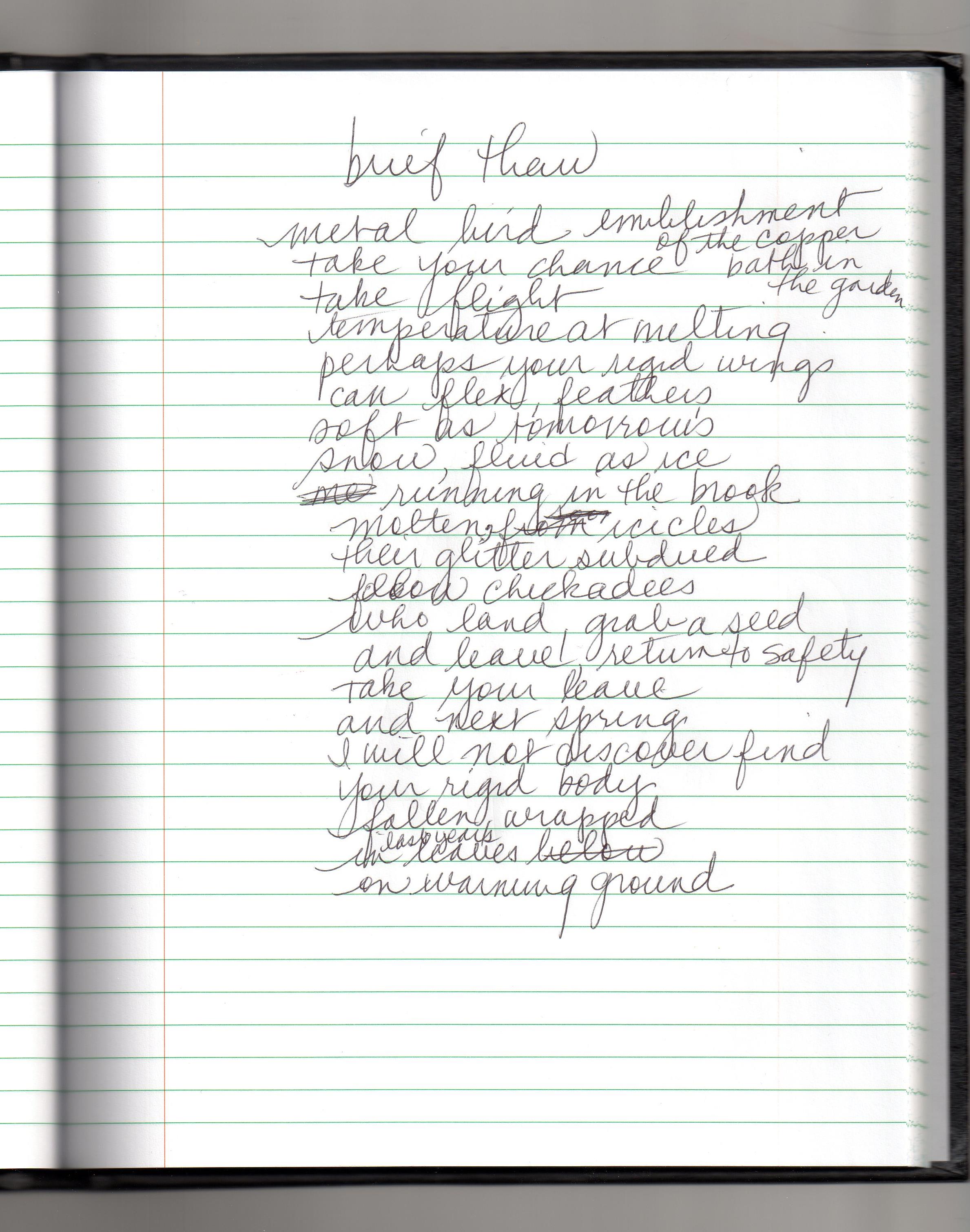
Then, I grabbed my ‘rough book’, the place where every poem I ever write begins. Sometimes, I hand-write several drafts, but in this instance, I felt like typing, so I copied the rough draft into the computer, almost word for word, but not quite.
~
~
brief thaw
2nd draft
~
metal bird, embellishment
of the copper bird bath in the garden
take your chance, your flight
temperature at melting
perhaps your rigid wings
can flex, find feathers soft
as tomorrow’s snow
fluid as ice now running
in the brook, molten icicles
their glitter subdued
follow chickadees who land
grab a seed and return to the
woods for safety, take your leave
and next spring I will not
find your rigid body fallen
wrapped in last year’s rotting
leaves on warming ground
~
So that is the rough poem. I like it. It flows, it contains some interesting metaphors, and it captures the possible flight and altered future of the metal bird. It needs editing.
~
For the next draft, I ‘press’ on words, getting rid of some, replacing others. I annotate the earlier draft, finding places where I like the flow, where I find internal rhyme or alliteration. In this poem, there are lots of words about metal, and I hope to include others. I change ‘ing’ words and the past tense to verbs in the present when possible.
~
brief thaw
3rd draft
~
metal (iron) bird, (silver-plated ?) embellishment
of the copper bird bath in the garden (doesn’t matter if it is in the garden)
take your chance, your (take ?) flight
temperature at melt (title says this)
perhaps your (rusted?) rigid wings
can flex, find feathers soft (fine?)
as tomorrow’s snow (when, last week ? next week ?)
fluid as ice, now running runs
in the brook, molten icicles
their glitter subdued
(take flight ?)
follow chickadees, who land
grab a seed (from the bird bath ????) and return fly to the
woods for (woods for ?) safety (of the trees ?) , take your leave (take flight ?)
and (and or/ore) next spring I will not (not ?)
find your rigid (rigid ?) body fallen (fallen ?), wrapped
in last year’s rotting muck rot of
leaves on warming (new-warmed?) ground
~
Well, I made a complete mess. Perhaps the fourth draft will be an improvement.
~
In the fourth draft, I incorporated the above ideas, and made a lot of changes. For example, I tried some different approaches to stanza … some of my poems are very irregular in their stanza breaks. I think this poem needs stanza breaks to help the reader. I also wanted to repeat ‘take flight‘ at intervals in the poem. Although I considered stanzas of three and five lines, my final decision, four stanzas of four lines, was based on the syllable counts of the lines and the sloping shape of each stanza. I am a rabid syllable-counter. I find it helps me decide what words are not needed at all and makes me consider alternatives.
~
brief thaw
4th and (for now) final draft
~
iron bird, embellishment
of the copper bird bath
take your chance
take flight
~
perhaps your rusted wings can
flex, find feathers, fine as
next week’s snow
take flight
~
molten as icicles from
the feeder where chickadees
seize a seed
take flight
~
or next spring find your metal
body rigid, wrapped in
last year’s rot
of leaves
~
take flight
~
~
Before I make further changes to the poem, I will read it aloud several times. The repetition of ‘take flight’ may have to go. Notice, I have not changed the title of the poem … that could change, although I like not mentioning the actual thaw in the poem. The title is a great place to add other information for the reader and I often forget this opportunity.
Do you have suggestions for other changes I could make to the poem? I welcome your comments!
~
Copyright 2015 Jane Tims
first and last and in between

~
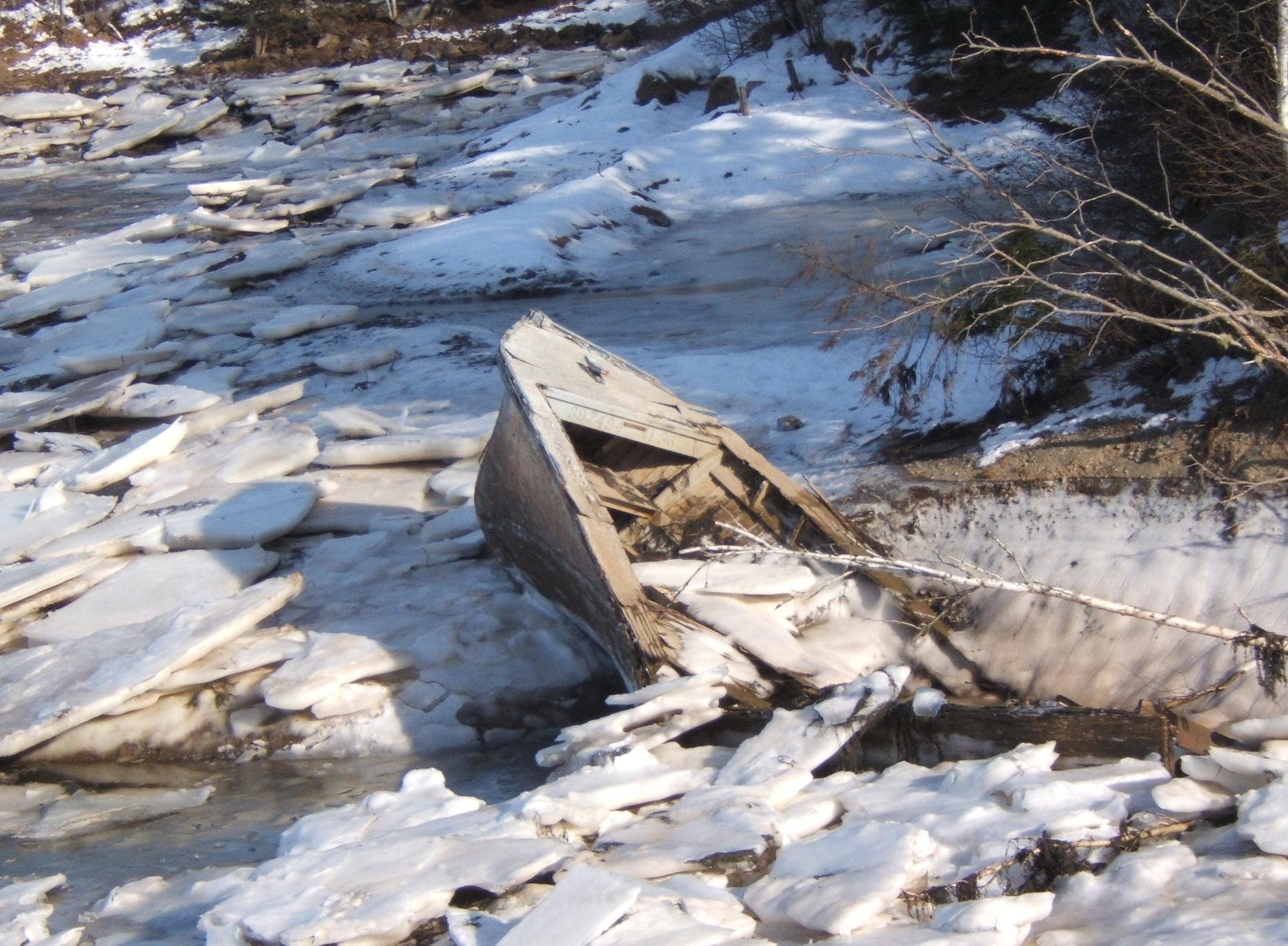
This past Saturday, I worked to create a manuscript of some poems I have written on the theme of discarded and abandoned elements of life and landscape.
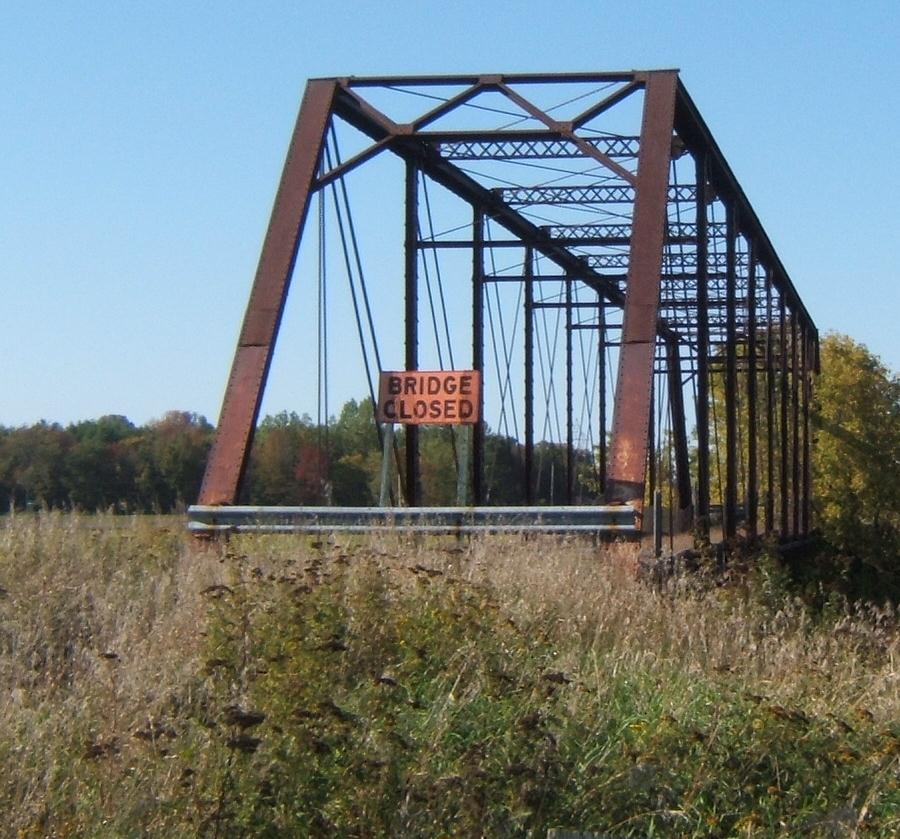
There are 38 poems in the rough manuscript, making up about 50 pages. The poems are a study of change. They include poems about abandoned boats, roads, churches, toolboxes, sheds, trucks, bridges and so on.
I have published a few of these on this blog … for an example, see ‘Foggy Molly’, a poem about an abandoned boat (https://nichepoetryandprose.wordpress.com/2013/01/30/abandoned-boat/ ).
~
~
Part of creating this manuscript is to put the poems in order. I find it hard to decide how to arrange 38 poems so they flow, one into the other, and so they tell a story.
~

~
1. My first step is to print a table of contents of the rough manuscript. I read each poem through and assign a couple of key words to describe it, jotting these into the table of contents. For my 38 poems on abandonment, I obtained 27 key words. Many of these are shared by various poems, but a few are unique to one or two poems. My key words are, in no particular order:
lost ways, regret, grown over, barriers, evidence, sadness, history, haunted, adaptation, voice, intention, anger, change, memory, denial, improvement, new life, lost function, buildings, items, understanding, cruel, resistance, life/death, shock, keeping past, lost/misplaced, broken
~
~
2. Next, I put everything into a table, with Xs to show which key words fit each poem. This does not take too long to do and helps me consider the meaning of each poem. Below is just a small section of my table:
| Poem Title | lost ways | regret | grown over | barriers | evidence | sadness | history | haunted | adaptation |
| Recovery | X | X | X | X | |||||
| Reason for Leaving | X | X | X | X | X | ||||
| South Nation Bridge | X | X | X | ||||||
| Outfield | X | X | |||||||
| Diverted road | X | X | |||||||
| Invitation to tea | X | X | X | X | X | ||||
| Lane | X | X | |||||||
| Abandoned church | X | X |
~
3. Once I have the table created, I tally the Xs in the columns and decide which key words are most common. Key words occurring in more than 10 poems are shown in bold:
lost ways, regret, Grown over, barriers, evidence, sadness, history, haunted, adaptation, decay, intention, anger, change, memory, denial, improvement, new life, lost function, buildings, items, understanding, cruel, resistance, life/death, shock, keeping past, lost/misplaced, broken
The words that apply to almost every poem usually speak to the theme of the poetry collection: in this case, the words ‘change’, ‘memory’ and ‘lost function’ were very common, no surprise in a collection about things abandoned. Other key words, common to a few poems, suggest possible themes for the sub-sections.
~

~
4. My next step is to look at the key words and see what themes ‘speak’ to me. I also want to have a progression of ideas through the manuscript. In this case, some of the poems are sad and rather hopeless, while some show how abandonment leads to understanding, and, in some cases, to new purpose and new life. From the key words, I selected six sub-sections: ‘lost ways’, ‘decay’, ‘haunted’, ‘broken’, ‘understanding’ and ‘new life’.
~
5. Now comes the long work of re-ordering the manuscript. I create a new document and, one at a time, transfer the poems into their new sections.
~
6. I like to name each section, taking the name from a line in one of the poems in the section. These may change later, but for now, they give me a reference within each group of poems:
lost ways – ‘overgrown …’
decay – ‘left to rust …’
haunted – ‘ghosts are lonely here …’
broken – ‘dry putty, broken glass …’
understanding – ‘the rock to stand on …’
new life – ‘a turn towards horizon …’
~

February 11. 2014 ‘old shed near Charlo’ Jane Tims
~
Today, I will begin a read of the manuscript to see how the poems flow within their sections. Many revisions are ahead, but this is my favorite part of the work!
~
Have you ever gathered poems into a manuscript and did you use any particular method to decide the order of the poems?
~
Copyright 2015 Jane Tims




 nichepoetryandprose