Posts Tagged ‘poetry’
edible wild – spruce gum
In my part of North America, we have freezing temperatures and snow on the ground from December to March. With a few exceptions, most plants go into sleep mode during these months and foraging for edible plants is difficult. You can dig beneath the snow to find a few evergreens, but most of the edible wild is above ground.
~

~
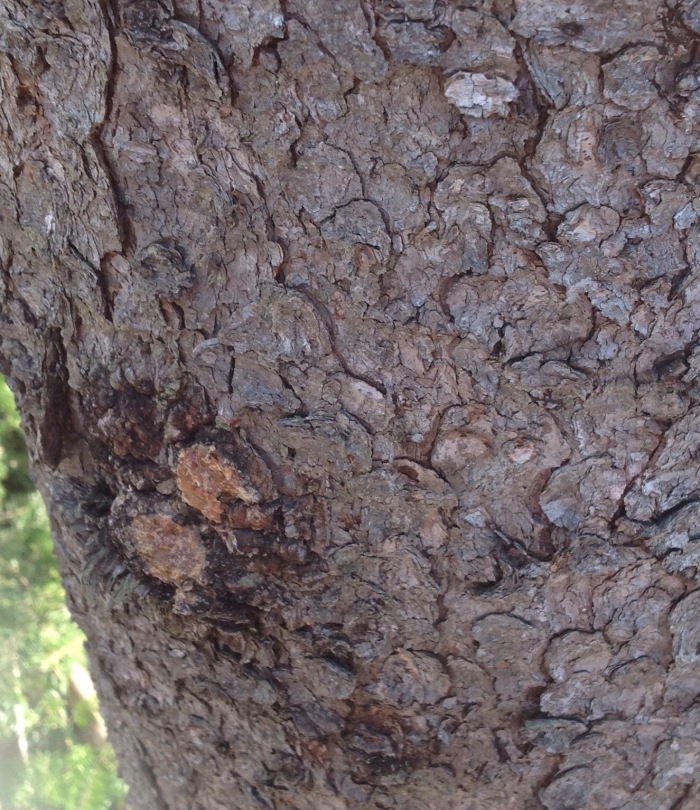
When I am in the woods, even in winter, I am always on the look-out for spruce gum, a natural sugar-free treat from the forest. Spruce gum is found, as the name suggests, on spruce tree bark. We have a large stand of spruce in our grey woods, but the tree below grows, conveniently, beside our driveway. For a map of our woods, see the right hand column ‘map of the grey woods’.
~

~
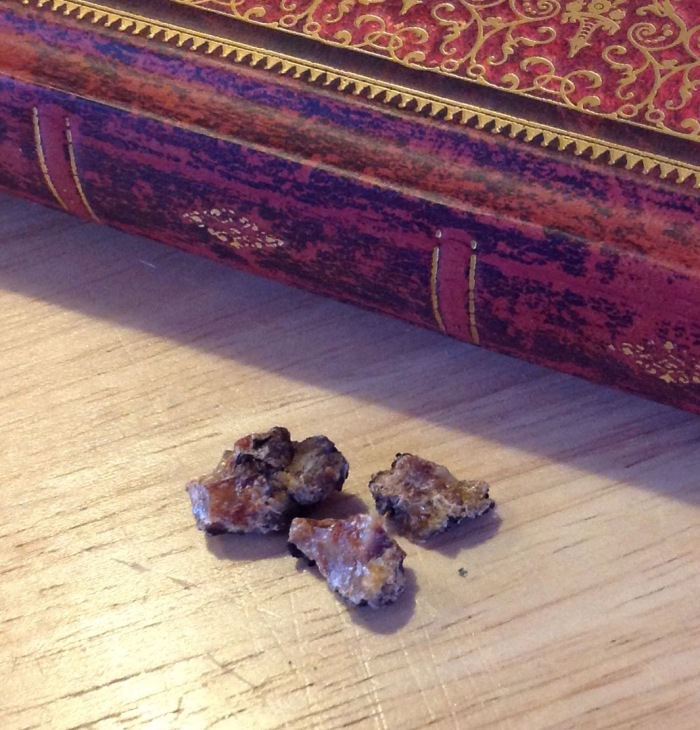
When a branch is broken or the bark is wounded in some way, the spruce oozes a sticky resin that eventually dries to a hard amber-coloured nodule. These nodules can be harvested and chewed like gum. My mom taught me about spruce gum, how to identify the spruce tree and to look for the sticky dark lumps where resin is hardening.
~

~
It is possible to collect a quantity of spruce resin, pulverize, melt and strain the substance, and solidify it, cracking it into bite-sized pieces. I chew the nodules right from the tree, with a little scraping to get rid of any rough bits. At first the gum is hard and crumbly, sticky and intensely aromatic, a little risky for dental work and made interesting by the accidental inclusion of bark bits. After a few minutes of chewing, the gum becomes pliable, woodsy-tasting and orange to pink in colour!
~
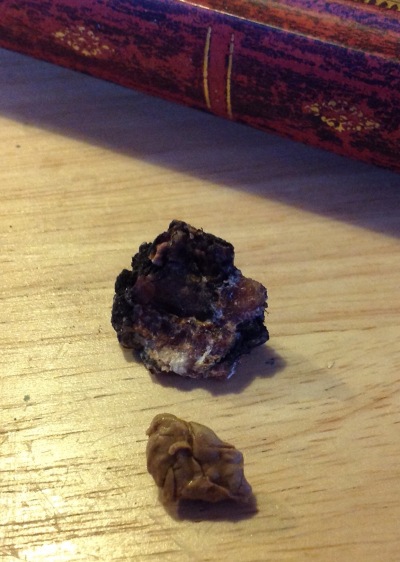
photos of chewed gum are a bit disgusting, but I want to show what normal-looking gum a two-minute chew produces. A rough nodule is shown above the chewed gum for comparison.
~
People of the First Nations have always known about this woodland edible and used it for medicinal purposes. In the nineteenth century, spruce gum was harvested with long handled spruce scrapers and sold commercially. Woods-workers made small carved boxes with sliding tops (gum books) to carry and store the resin nodules.
~
Robert Frost, wonderful poet of all things rural, wrote about spruce gum (‘The Gum Gatherer’. Mountain Interval. New York: Henry Holt and Company, 1916):
He showed me lumps of the scented stuff
Like uncut jewels, dull and rough …
~
You can find the rest of the poem at Project Gutenberg http://www.gutenberg.org/files/29345/29345-h/29345-h.htm
~
~
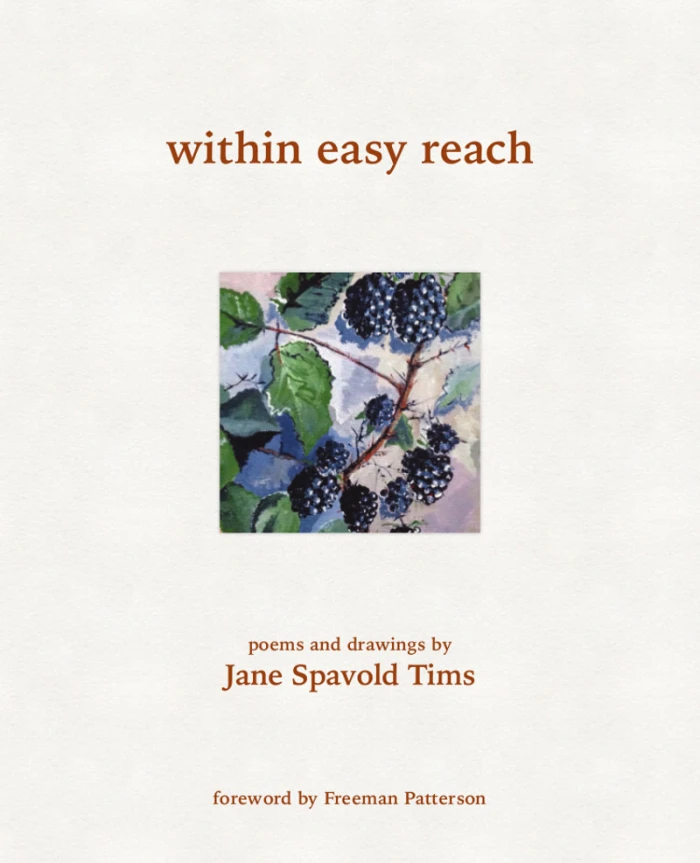
My upcoming book of poetry within easy reach includes a poem about spruce gum. The poem begins:
Black Spruce weeps if wounded
oozes to heal, embeds
pain in amber …
~
As I wait for spring, I intend to ration my small store of spruce gum and use it as a kind of countdown toward the end of our winter weather.
~

some very clean seeps of resin – these will harden eventually and make great spruce gum !
~
~
Copyright 2016 Jane Tims
‘within easy reach’ – why did I write these poems?
Later this spring I will have a book of poems and drawings in publication – ‘within easy reach’. The poems and art in the book are about gathering local, mostly wild, foods. I have been fortunate to work with a wonderful publisher, Chapel Street Editions, interested in books about the natural history, human history, and cultural life of the St. John River Region of New Brunswick, Canada. http://www.chapelstreeteditions.com/about_chapel_street_editions.html
~
As a botanist, I loved making this book. Identifying plants is a skill learned in university and during years of enjoying the out-of-doors. Many of the plants are found on my own property, but my husband and I travelled throughout the region to find some species. We found edible trout lily along the banks of the Dunbar Stream, salty orach on the beaches of Saint Andrews, and dangerous-to-eat water dragon in a wetland on the Renous highway. On our own property we tried to out-smart the squirrels for hazelnuts, tapped twelve trees for maple syrup and discovered partridge berries growing in the woods behind our house. As you can see, part of my enthusiasm for the subject is about spending time with my husband!
~

~
I also did a little time-travelling to write these poems. Although most of the plants I write about are found in the St. John River Region, I looked into my own past to remember some edible plants in other parts of Canada. This included eating cactus berries on the Alberta prairie, buying cloud berries from children along the Trans-Canada in Newfoundland, and picking blueberries with my Mom and Dad in Nova Scotia. I also looked to the diaries of my Great-Aunt to get a glimpse of the growing and gathering habits of an earlier generation.
~
I am sure many of my poems will echo memories of your own experiences with local foods.
~
Eating near to home has so many benefits – these foods are often free and have not travelled far to your table. Many wild foods go unharvested although they are ‘within easy reach’. Just think of those apples in the abandoned orchard at the edge of town, the dandelion greens on your brother’s lawn, or the choke-cherries growing along the fence down the road. Although you should use care when eating wild foods, many are easy to harvest and can add variety and taste to your meals.
~

~
In my next post, I’ll say more about why you might enjoy reading my book. And very soon, I’ll be starting a count-down on my blog to let you know how many days you have to wait until publication. I’ll have a contest and a give-away. Shameless self-promotion!
~
Copyright Jane Tims 2016
‘within easy reach’
This spring, I will celebrate the publication of my first book of poetry!
~
‘within easy reach’ is a result of my 2012 project ‘growing and gathering’ supported by artsnb (the New Brunswick Arts Board). The poems focus on harvesting and eating local foods, especially wild foods. My book will be published by Chapel Street Editions, Woodstock, New Brunswick.
~
The book will include about sixty poems as well as some of my black and white pencil drawings. These are poems about picking blackberries and blueberries, eating coastal favorites like goose tongue greens and samphire, buying smelts from a truck at the roadside and fishing for landlocked salmon. Every poem is based on a personal experience of harvesting and using local foods.
~
During the next few posts, I will tell you more about my book and its poems and drawings. I can’t wait to show it to you!
~

‘fiddleheads’ – a wild food eaten every spring in New Brunswick
~
Copyright 2016 Jane Tims
in the shelter of the covered bridge – a line of pigeons
~

~
keeping watch
~
Florenceville Bridge
~
~
pigeons swim through air
fill gaps on the ridge line
~
perch on the shingled roof
scrutinize the traffic
the squeeze of half-tons
on the bridge
the kissing of mirrors
~
pigeons quit the ridge, glide
to the shingled shore
~
river winds shiver
hawkweed and sumac, displace
blankets of wild cucumber, billow
the skirts and Tilley
hats of tourists
~
~
published previously in a post on September 11, 2015
~
Copyright Jane Tims 2016
in the shelter of the covered bridge – vantage point for planets
If there are clear pre-sunrise morning skies this week, we will be able to see a rare view of several planets in the morning sky – Mercury, Venus, Saturn, Mars and Jupiter. For a description of the event, see http://earthsky.org/astronomy-essentials/visible-planets-tonight-mars-jupiter-venus-saturn-mercury
~
Last year, on February 21st, we saw the conjunction of Mars, Venus and the Moon. On that evening, as my husband and I drove through our local covered bridge, we startled a hare. I will never forget its long-eared shadow as it fled the bridge. The conjunction of planets and moon, and snowshoe hare and truck, were inspiration for a drawing and poem …
~
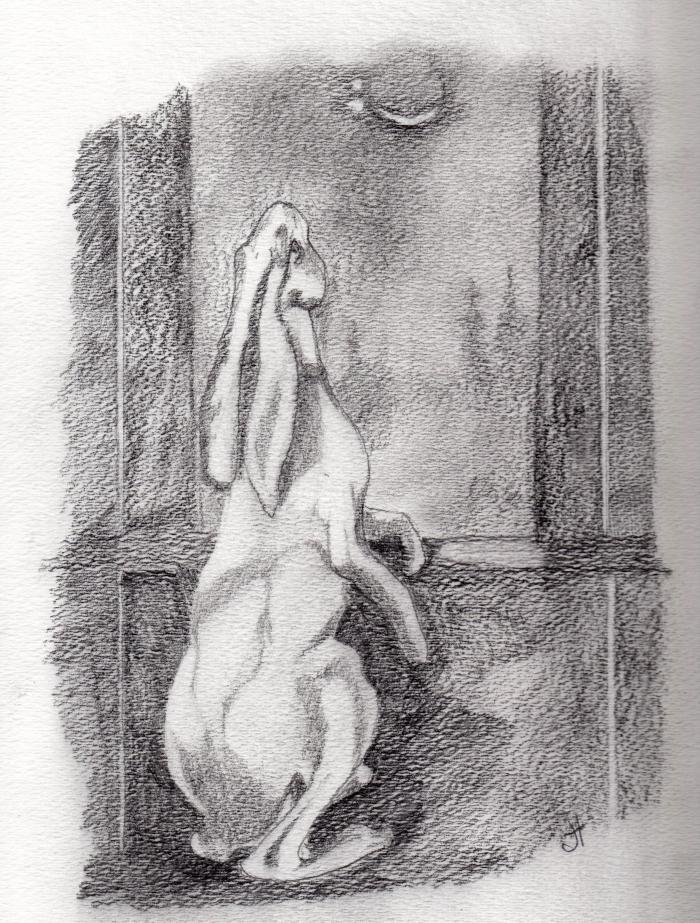
March 1, 2015 ‘conjunction’ Jane Tims
~
~
conjunction – February 21, 2015
~
Patrick Owens Covered Bridge
Rusagonis River #2
~
~
planet and moon light scamper
into crevasses in the covered bridge
Venus and Mars, chin velvet
and sickle of mid-winter moon
~
headlights of the half-ton enter
overwhelm planet shadow
startle a winter hare
erect on haunches, paw lifted
~
frosted by sky-gaze, worshiping
the sliver of moon, dismayed
at desecration, round glare
of the truck’s predatory eyes
~
fright to stop a heart
or flight to mobilize
hind- legs straighten
before fore-legs turn
~
and long ear shadows
quit the length of the bridge
ahead of whiskers, nose
and rabbit wisdom
~
~
previously published in a post March 2, 2015
~
Copyright Jane Tims 2016
in the shelter of the covered bridge – drawings
As I complete my manuscript of poems ‘in the shelter of the covered bridge’, I am also working on the drawings to accompany the text. I have made a list of the visuals presented in the poems, so I have a specific idea of what drawings I need. Many are completed since I have a large portfolio of bird drawings, for example …
~

~
Others are still to be done. This morning I completed a rather delicate drawing of the two kinds of roses growing beside the Darlings Island Covered Bridge and captured in my poem ‘tangle’.
~

~
I love to draw. For me, it is like watching a movie as I see my hand lay pencil marks on paper. It is not a calm activity. Perhaps because my hand and arm are moving, I get quite agitated when I draw and I imagine my blood pressure rising as the work progresses.
~
In order to have a body of work to choose from for the final manuscript, I aim to have more than forty drawings. I have completed nineteen. Lots to do !
~
Copyright Jane Tims 2016
local eating … sprout sandwich
Winter in New Brunswick – snow, frozen ground, temperatures far below zero. Not a time to be thinking about growing your own food? Not quite true!
~
Anyone can grow sprouts. I have a great sprouter, the 8 X 10 Sproutmaster from Sprout People.
https://sproutpeople.org/sproutmaster-8×10-tray-sprouter/
~
I have also used a one pint mason jar for growing sprouts. For me, a twice daily water rinse and careful draining is key to growing the best sprouts.
~
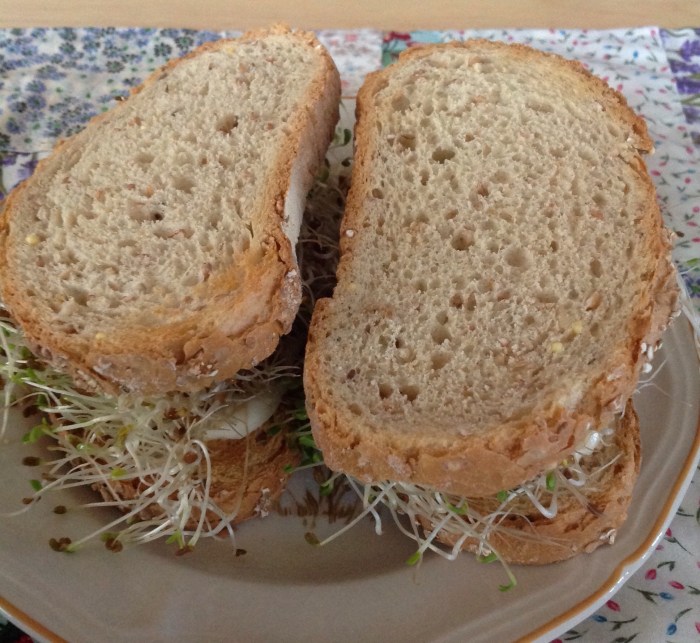
Today, I had a couple of sprout sandwiches for breakfast. Sprouted alfalfa, multi-grain bread from Real Food Connections in Fredericton, and mayo. Yum!
~
~
sprout sandwich
~
sprouts peek
between sheets
of whole wheat
green baby beaks
~
stems tickle lips
as though I kissed
a man with a mobile
mustache
~
satisfying crunch
crisp bunch
of alfalfa
delight
~
green and white
and mayo
daub of mustard
sprig of thyme
~
a sprinkle
from my stash of seed
a little time
sprouts did all the work
~
swell, burst seed coat, grow
rinse, dry , fluff
pluck and toss
and wow! what a kiss!
~
~
Copyright 2016 Jane Tims
in the shelter of the covered bridge – shelter?
‘shelter’
– n.
1. protection from danger, bad weather, etc.
2. place giving shelter or refuge.
-v.
1. act or serve as a shelter to; protect; conceal; defend.
2. find refuge, take cover.
(Oxford English Dictionary)
~
As I refine the results of my poetry project, ‘in the shelter of the covered bridge’, I am thinking about the idea of ‘shelter’ and how important it is to all living things.
~

~
A covered bridge changes the landscape, alters the environment and encourages habitat diversity. It changes the availability of light, water and air. It provides cover from harsh environments.
~
Some examples of finding shelter in a covered bridge:
Plants:
- seeds on the wind, waylaid, find a place to germinate
- grasses growing beneath the bridge get less light as shadows thicken – sometimes there is too little light to grow at all
- a crack between boards in the floor of the bridge provides a space to grow away from competition from other plants
- mosses and lichens find a place to thrive in the rotted hollows of posts and timbers
Animals:
- birds use rafters and beams as nesting sites
- spiders find places to attach their webs
- mice store seeds in nooks and crannies
- birds hunt insects on the sun-warmed boards of the bridge
Humans:
- travellers find brief respite from wind and snow and rain
- friends and lovers find meeting places, out of the view of curious eyes
- visitors find surfaces for expression – graffiti, vulgarity, art, a space to say ‘I was here’
- children of all ages find a place to shout, hear echoes, remember
~
~
shelter
~
the engine dies – after midnight
not far from home
~
snow builds on track
eyelash and mitten
~
wind conceals the road
sweeps the bridge
~
enter, a lull and chill subsides
bright of snow subdued
~
no solitude – a mouse ticked
off, her hibernation interrupted
~
and ghosts carve names, spray
broad epithets in purple
~
inspire defiance, kick me
out, into the storm
~
~

~
Copyright Jane Tims 2016
loving hockey
I think that I will never be as proud of a magazine publication as I am of my two poems and two drawings in a hockey magazine!
Between the Lines – A Journal of Hockey Literature is a publication of the University of Saskatchewan, now in its third volume. The editors are Dwayne Brenna and Sara-Jane Gloutnez.
~
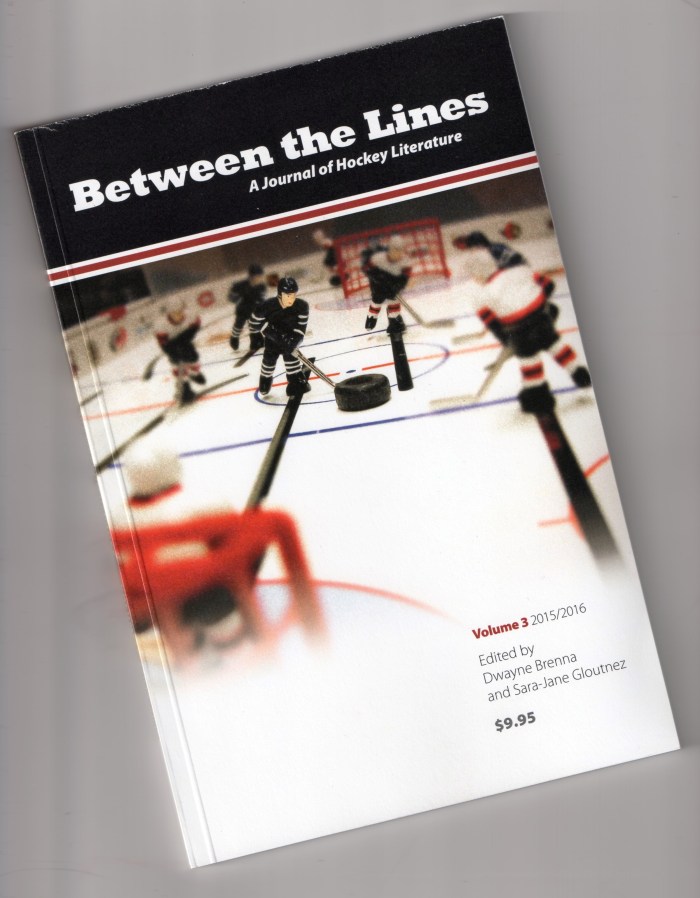
Between the Lines: A Journal of Hockey Literature
~
So, why am I so proud of this accomplishment? Is it because I am a lover of hockey? Just the opposite. I never pay it any attention! I have been known to ask if the Blue Jays won the Stanley Cup last year! However, one of my brothers is a devoted hockey fan. His love for the sport when he was young has always impressed me … I think people need should be passionate about their interests!
~
Hockey is a great theme for poetry. The game itself is naturally rhythmic (the movement of the skater, the varying pace of the game). The names of players and announcers, the terms for various plays, the enthusiasm of the fans … interesting words to work with! And metaphors abound.
~
I like to learn new things, to discover new themes for my writing and art. I also consider the game of hockey to be quintessentially Canadian. I can’t name a single hockey player after Mickey Mantle, but I love having my poems and art in a hockey magazine.
~
Between the Lines is a well-presented publication that includes stories about hockey and hockey players in both poetry and prose. The writing inside captures the scratch of blades on ice, the excitement of the announcer’s voice, the clouds of breath above the outside hockey rink, and the scurry of kids to move the net from the way of subdivision traffic.
~
~
loving hockey
~
at eight, my brother
was tall for his age
narrow-boned, jointed
as a skater bug
on the big farm pond
but compact, center
of gravity low
~
he learned to skate
on a strip of ice
by the driveway
practiced on the pond
a family myth
that he was pale
and our dad saw no value
in rising early
for ice time
~
my brother’s rink
a screen, rabbit-eared
Hockey Night in Canada
a pad of blue-lined
paper, hockey stick
a yellow pencil, skate
marks neat columns
of statistics, goals
and assists, Howe hat tricks
Mahovlich, Rocket
Richard, numbers
from the breathless
crescendo, Foster Hewitt –
‘He shoots, he scores.’
~
today my brother
is a fit man
an accountant, skates
on the boardroom table
on the frozen pond
a water strider
on the meniscus
attends games
at the coliseum
can still do a pivot
from standing
~
~

~
poem published as ‘loving hockey’ in Between the Lines, Volume 3, 2015/2016
drawing published in Between the Lines, Volume 1, 2014
~
Copyright 2015 Jane Tims
in the shelter of the covered bridge – update
Although my blog has been a bit silent this fall, I have been working! Among other projects, I am making great progress on my poetry manuscript ‘in the shelter of the covered bridge’.
~

~
To provide experiences and inventory the plants and animals living in and around covered bridges in the province, my husband and I have visited 28 covered bridges in the drainage basin of the Saint John River and 5 covered bridges in Charlotte and Westmorland Counties. I have a few more bridges to visit, but to give a little seasonal diversity to my project, I’ll travel to these in early winter.
~

Reading at WordsFall 2015, an annual event of the New Brunswick Writers’ Federation (photo by WFNB)
~
As a result of these bridge visits, I’ve written 60 poems. I read five of these last weekend at two writers’ events: WordsFall (Writers’ Federation of New Brunswick http://wfnb.ca/ ) and Odd Sundays (a monthly Fredericton reading event). The poems include the results of my work on different poetic forms – in the manuscript I have examples of the sonnet, ghazal, haiku, tanka and villanelle.
~
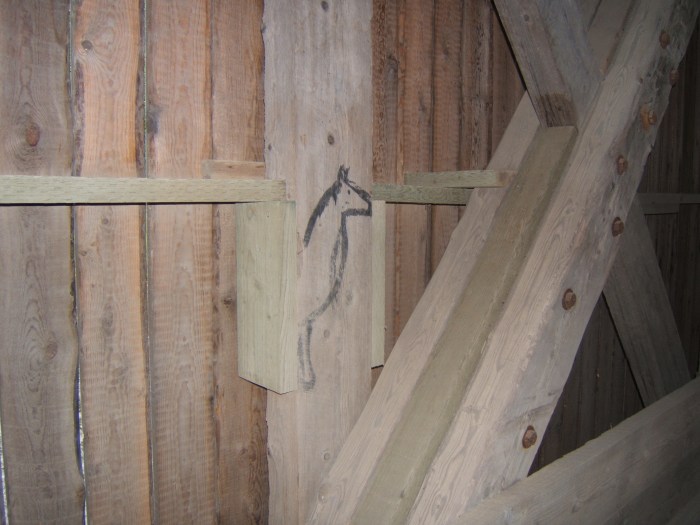
black horse painted in the Quisibis River Covered Bridge (Pont Lavoie)
~
As I develop the manuscript, and to help organize the poems, I have sorted them into categories:
- gaps between boards (deterioration and loss)
- liminal, shore to shore (transitions)
- grit of a blade (carvings and history)
- notch of a lily pad (habitat)
- a blade of grass between thumbs (mystery)
- heads of timothy (miscellaneous)
- a loose board rattles (sounds)
~
Writing these poems has given me a glimpse into the living world of the covered bridge. We may cross a bridge daily but it takes a little time to know a bridge and discover the life there. Most of the animals living in or around a covered bridge are timid or hidden, and avoid human contact. The plants provide the setting for the bridge but there is a pattern to the places they grow and some will only be seen if visitors to the bridge slow down. And carved in the beams are the stories of the humans who have been part of the history of the covered bridge.
~

Baker Brook #2 Covered Bridge – a deer and a crow are watching us from the hay field
~
Copyright 2015 Jane Tims




 nichepoetryandprose