Posts Tagged ‘New Brunswick’
a botanical alphabet
In the last couple of years, I have had the happy task of helping Jennifer Houle, award-winning author, produce her new book, A Child’s Botanical Alphabet. The book takes the reader through the alphabet with examples from the world of botany, plants local to New Brunswick and the Maritime provinces.
~

~
My specific work was to produce the drawings for the book and undertake its formatting on the way to it becoming a published book. I also wrote ‘Notes for the Curious,’ to enable caregivers to give a little more information to children abut the plants they encounter in the book.
~
~
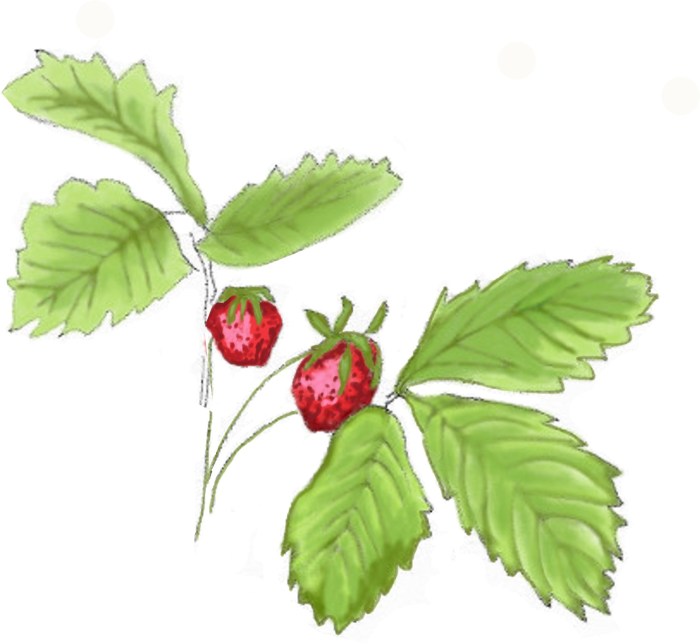
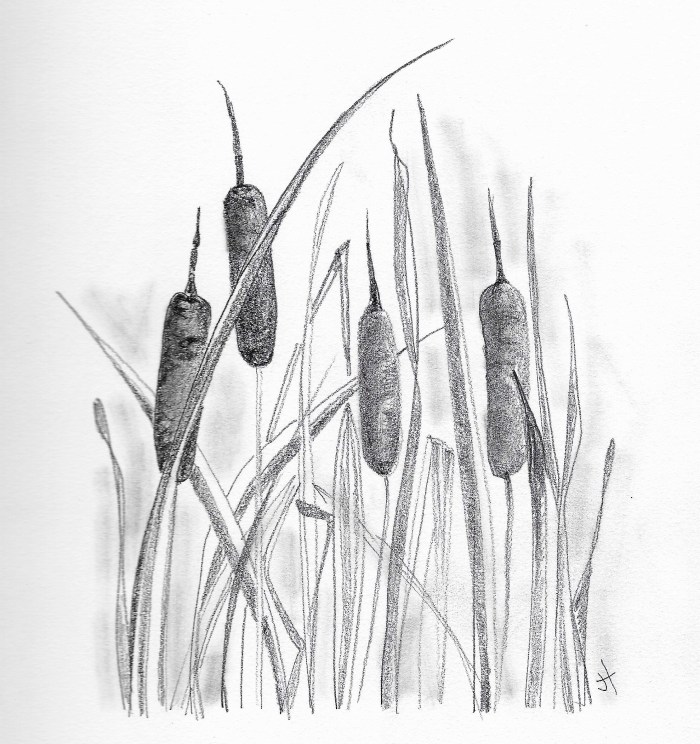
The images in the book began as black and white pencil drawings. Before this, I had never done digital illustrations, so I began by colourizing each drawing. After this, I leaned to do grades of colour and shading. In the end, I did the 26 illustrations, one for each letter of the alphabet, and other images to illustrate the life cycle of the luna moth and fill in the story we wanted to tell.
~

~
I also experimented with background colour and learned to present the images in the proportions of the final book. For the first time, I attempted images that would bleed to the very edge of the page.
~


~
The book is an old-fashioned approach to learning the alphabet, but also a way of encouraging children to look closely at their surroundings and interact with them. To help with this, we have shown that plants are part of a larger community of plants and animals. The book shows the life cycle of the luna moth–we have hidden the luna at various stages of its life throughout the images in the book. We also encourage children to collect, with respect, examples of the plants they find and to learn about the other plants they see. Where I have left parts of the images without colour, the children are invited to add their own colour to the book.
~

~
At last, A Child’s Botanical Alphabet is ready to present to the world! Both paperback and hardcover versions of the book are now available at Amazon.ca by clicking here. On May 11, Saturday, we will launch the book at the Kennebecasis Public Library in Quispamsis, with a special presentation and art activity for the children. After that, the book will be available in both paperback and hardcover at various events, including 2024 Book Fairs in Moncton-Riverview (July 27), Saint John (September 14), and Fredericton (October 19).
~
We hope you enjoy this wonderful book! We are looking forward to showing it to you and introducing children to the world of local plants.
~

~
All my best!!!
Jane
summer drive
We are so lucky to live in New Brunswick. Driving down any road is a kaleidoscope of flowers, especially in June. We have green hills, streams and rivers gushing after our recent rains and lots of wild life to see. And we have river ferries!!!!
~
Today we drove home from our camp by way of the Gagetown ferry. It’s only been operating a few days but we have ridden the ferry so many times it feels like a cruise on the river.
~


~
In the Gagetown area, there are lots of osprey nests to see. This time of year there is usually at least one adult, sometimes two, feeding young chicks.
~


~
We do not have road runners, but we have road crossers. Last week we watched as an American bittern ran across the road, its neck stretched forward parallel to the ground as it ran. Today we saw a woodcock walking slowly across the road, not concerned in the least about the truck or the photographer. Unfortunately, the photographer lacks skill but you can see the woodcock’s short legs and his long beak over his right shoulder …
~

~
And, this week, there are the roses (Rosa spp.), pink and fragrant. Some with a single whorl of five petals. Some doubled and redoubled.
~


~
And other flowers:
bladder campion or maidenstears (Silene vulgaris), with deeply-notched petals and red-veined inflated calyx …
~

~
bedstraw (Galium sp.) grows in mounds in the ditches, with leaves in whorls and white flowers …
~

~
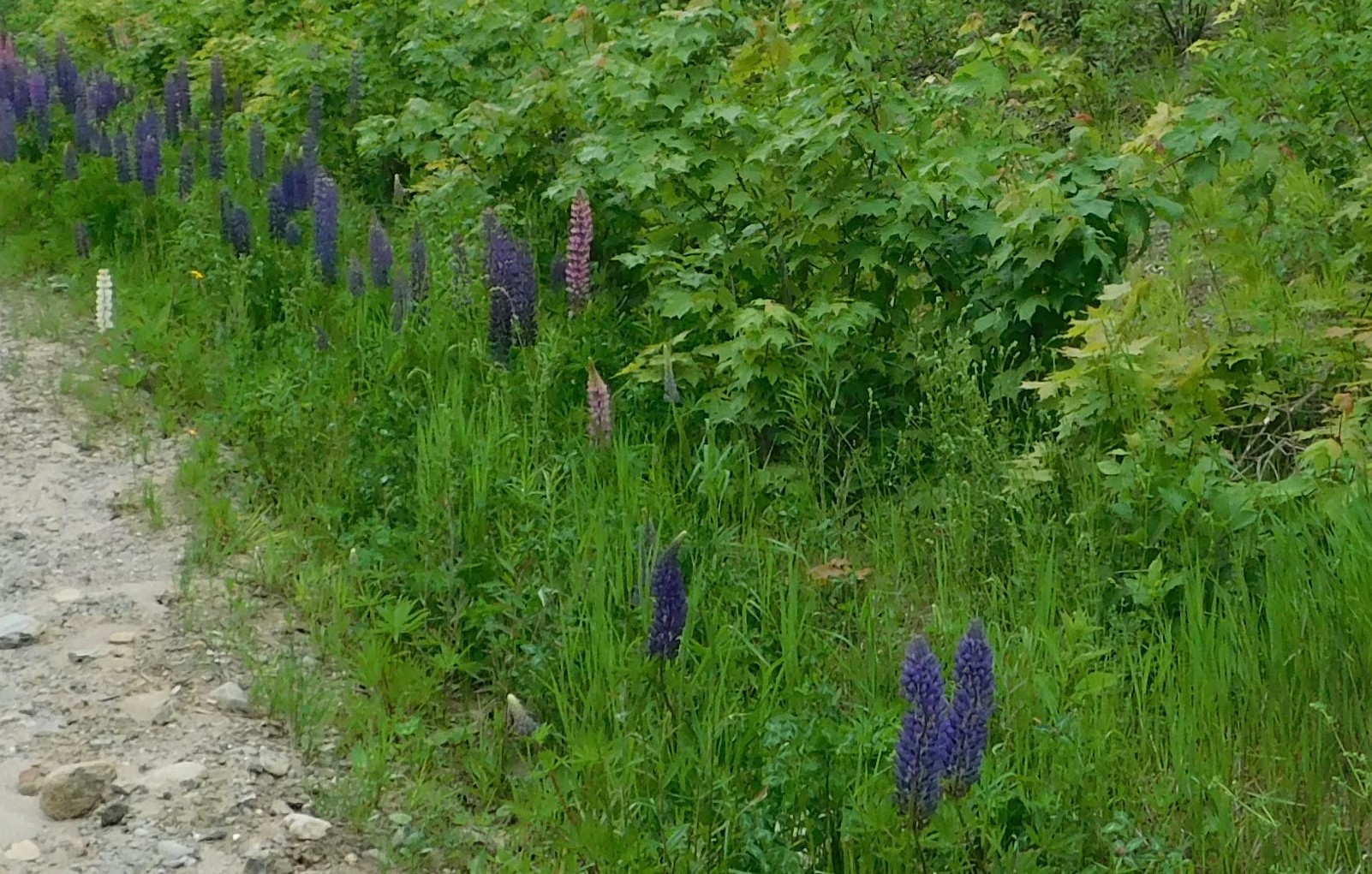
and lupins (Lupinus sp.), crowding the ditches in pink, blue and purple and occasionally white, already setting seed …
~
~
Looking forward to many drives this summer. I know that gasoline is expensive, but this is my entertainment of choice.
~
All my best,
Jane
drawings of waterfalls
For me, a waterfall is the most beautiful expression of water on the landscape. The feeling of water droplets on your face, the sound of splashing water, the sight of sunlight on fast-moving water. I have tried to capture these in my collection of waterfall poems a glimpse of water fall. The book includes forty-four poems and twenty-three pencil drawings of waterfalls and other water scenes.
~

~
We have many beautiful waterfalls here in New Brunswick. Over the years I have visited quite a few. In New Brunswick, we are lucky to have two great resources for lovers of waterfalls: a great guide by Nicholas Guitard (Waterfalls of New Brunswick: A Guide, now in its Second Edition, Goose Lane Publications), and a very active Facebook Group – Waterfalls of New Brunswick.
~

~
My poetry book about waterfalls, ‘a glimpse of water fall,’ is now available from Westminster Books in Fredericton and from Amazon (click here). Enjoy!
~

~
All my best,
Jane
hiding in the leaves!
On our return from our cabin last week, I saw something dark among the leaves of an old birch tree. I put the truck in reverse, in time to see two turkey vultures take off. Their red featherless heads and white beaks were in full view. A third vulture was in the tree and we managed one camera shot before he spread his wings and flew after his companions. The photo shows his glossy feathers, his red head and his huge nostril. But his white beak is hidden behind a leaf!
~

~
Thirty years ago, turkey vultures were a rarity in New Brunswick, but today they are common and even overwinter here. They are exclusively carrion-eaters and play a role in our food chain and nutrient cycle.
~
All my best
Jane
garden escapes: learning something new
The poems I am writing have two dimensions:
- consideration of the plant, its names and characteristics, and its tendency to die, persist or escape when a garden is abandoned
- consideration of the community or area where the plant occurs
~
For the botany, I have my floras: Hal Hinds ‘Flora of New Brunswick‘ (2002), Roland and Smith’s ‘Flora of Nova Scotia’ (1969) and others. During the project so far, I have learned about three new-to-me flowers: golden alexander (Zizia aurea), dropwort (Filipendula vulgaris) and narrow-leaved everlasting pea (Lathyrus sylvestris).
~


For the history, I have the New Brunswick Archives site ‘Where is Home?’ which tells when the community was first settled, what the population of the community was in certain years and so on. I also have the Canada Census for various decades and some excellent local histories lent to me by a very good friend.
~
For example, one of the abandoned communities we visited was Mavis Mills, north of Stanley. The community of Mavis Mills included a lumber mill and camp, post office and train stop. The community was named by a lumberman for his daughter, Mavis Mobbs. The community had a post office from 1922 to 1928. The 1921 Census shows a boarder and miller, John Mobbs, in Stanley Parish and below his name a mill camp with 31 men.
~
Something that puzzled me was the entry of ‘last lumberman’ under occupation, beside each of the 31 names. At first I thought it was a mis-spelling of ‘lath.’ Then I read more about the mill, in Velma Kelly’s book ‘The Village in the Valley: A History of Stanley and Vicinity‘ (1983). After World War I, metal was in short supply. So in 1919, the Mavis Timber Company was contracted to make ‘last blocks’ from rock maple.
~

a screen capture of part of the Canada Census for 1921 … under ‘Occupation’, the Census lists ‘Last lumber for each worker in the mill …
~
I had no idea what ‘last blocks’ were, so went on a Google hunt. ‘Last blocks’ were used to make the wooden shoe forms used by shoe makers. From 1919 to 1924, the Mavis Lumbering Company made five million ‘last blocks,’ to be shipped to England.
~

an empty lot in a place in the community where Mavis Mills once stood … the lot is filled with golden alexanders
~
Such is the learning from a project such as mine. The phrase ‘never stop learning’ comes to mind.
~
Have you ever heard of a ‘last block?’ My great-grandfather, Josiah Hawk, who was a shoemaker in Pennsylvania, would be puzzled about the lack of knowledge of his great-granddaughter!
~

shoemaker’s lasts (Source: Wikipedia)
~
Note that this project ‘garden escapes’ is funded under a Creations Grant from artsnb (the New Brunswick Arts Board).
~
All my best,
staying in as much as possible and staying safe,
Jane
wild gardens
As I look for ornamental plants that have escaped to other places in the landscape, I often find plants so lovely, it is hard to believe they have not been cultivated at one time.
~
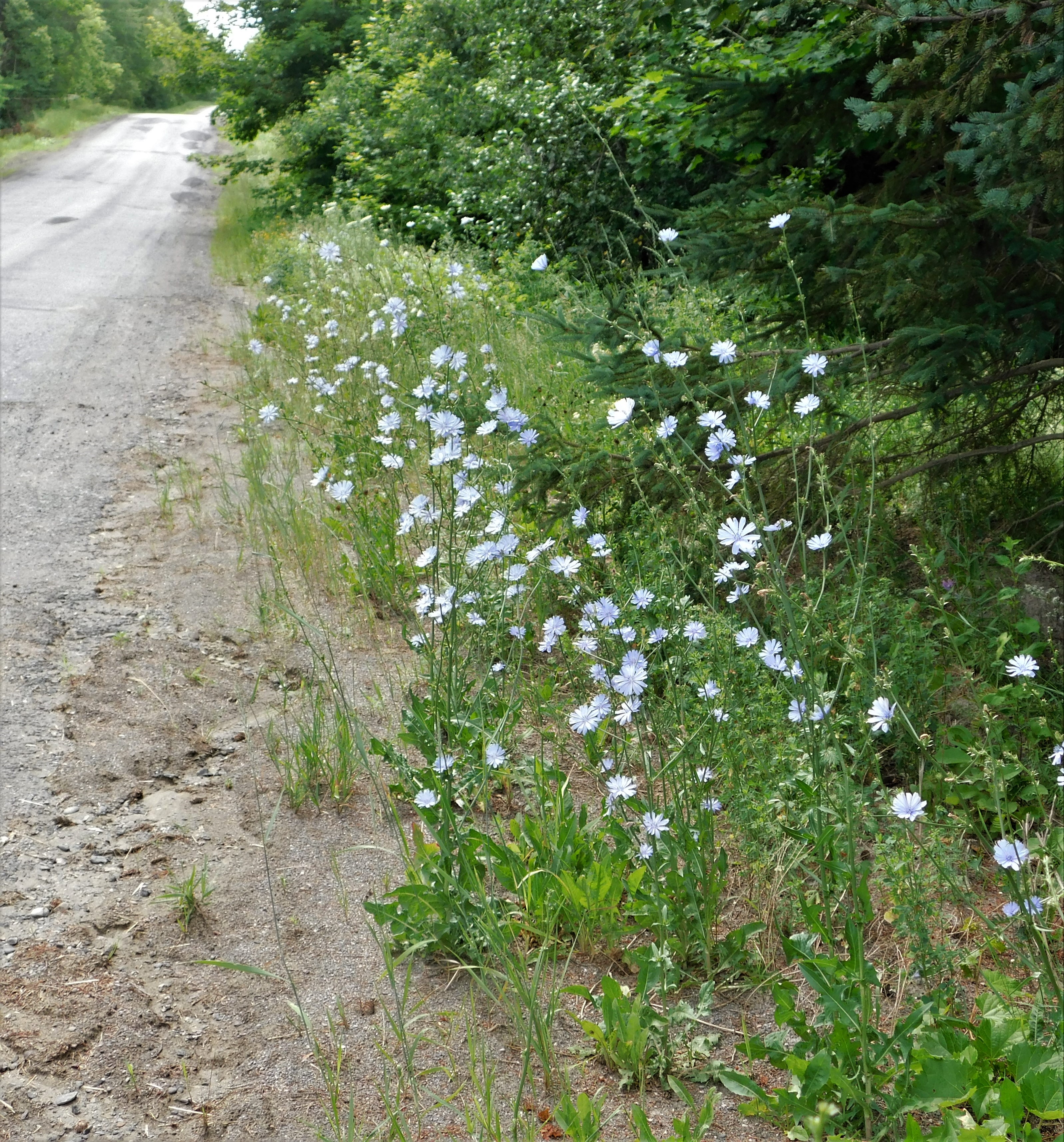
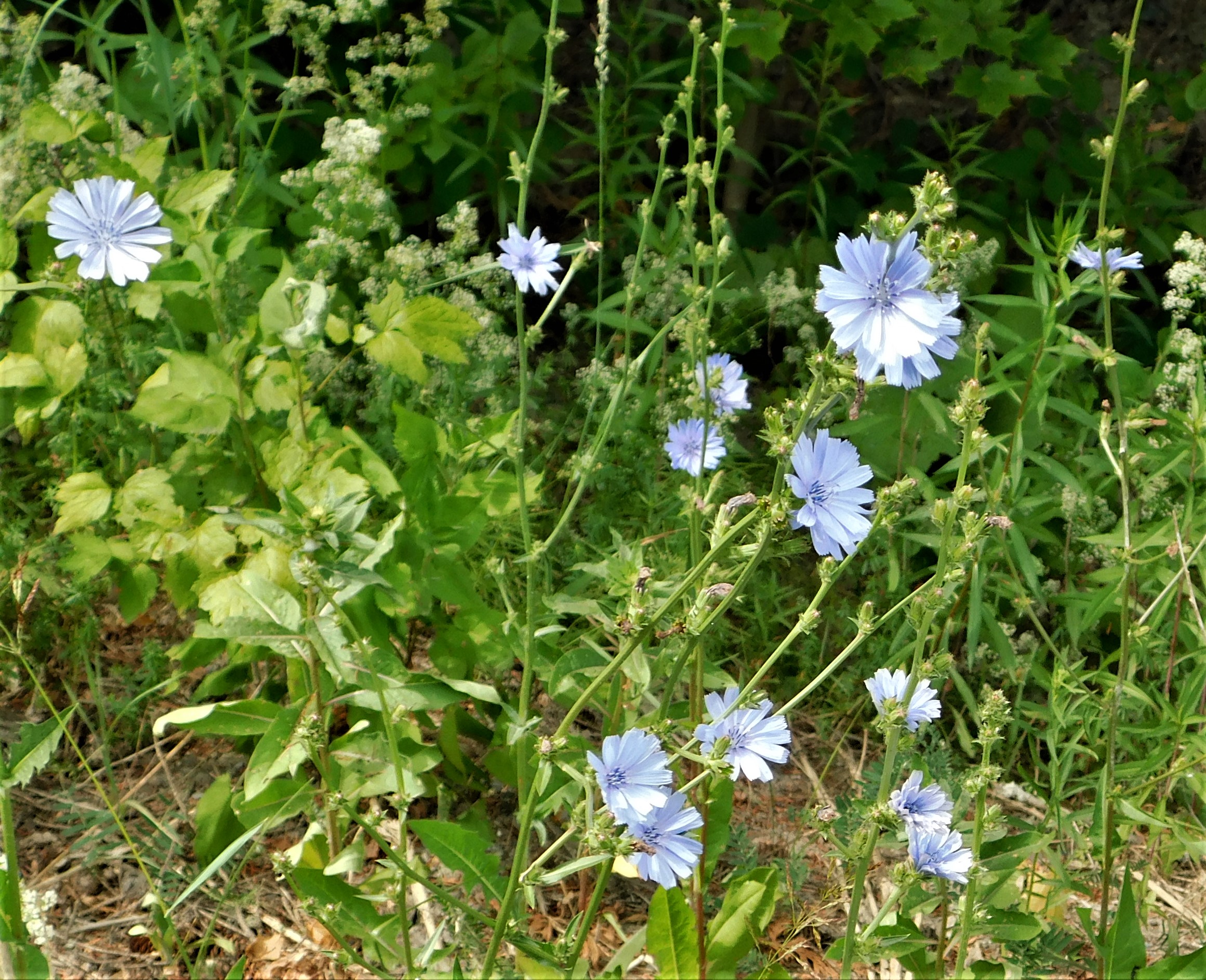
One of these is chicory (Cichorium intybus), a lovely blue flower. We found chicory growing on the Dugan Road west of Woodstock.
~

~
Also known as blue sailors and, in French, chicoreé, chicory is a tall plant, seen along roadsides and in other waste places. Sometimes chicory is brought in loads of gravel (used for road maintenance) to locations where it is not usually found.
~
~
Chicory has basal leaves resembling those of the dandelion. When broken, the stem exudes a white milky fluid.
The bright blue flowers of chicory occur along the length of the almost leafless and somewhat zig-zag stem. Each flower is formed of a central involucre of tiny blue flowers and a disc of larger ray flowers. The rays are square-cut and fringed. The flowers follow the sun, closing by noon, or on overcast days.
~
~
At least one gardener I know has successfully transplanted chicory to his garden. I think I will keep a list of garden-worthy wildflowers during my treks this summer and perhaps write a poem to capture my virtual wildflower garden.
~
This work was made possible by a Creations Grant from artsnb!
~
All my best.
Jane
wild turkeys in New Brunswick
As we came back from our drive in Charlotte County last weekend, we were on the lookout for wild life. And we were not disappointed.
~
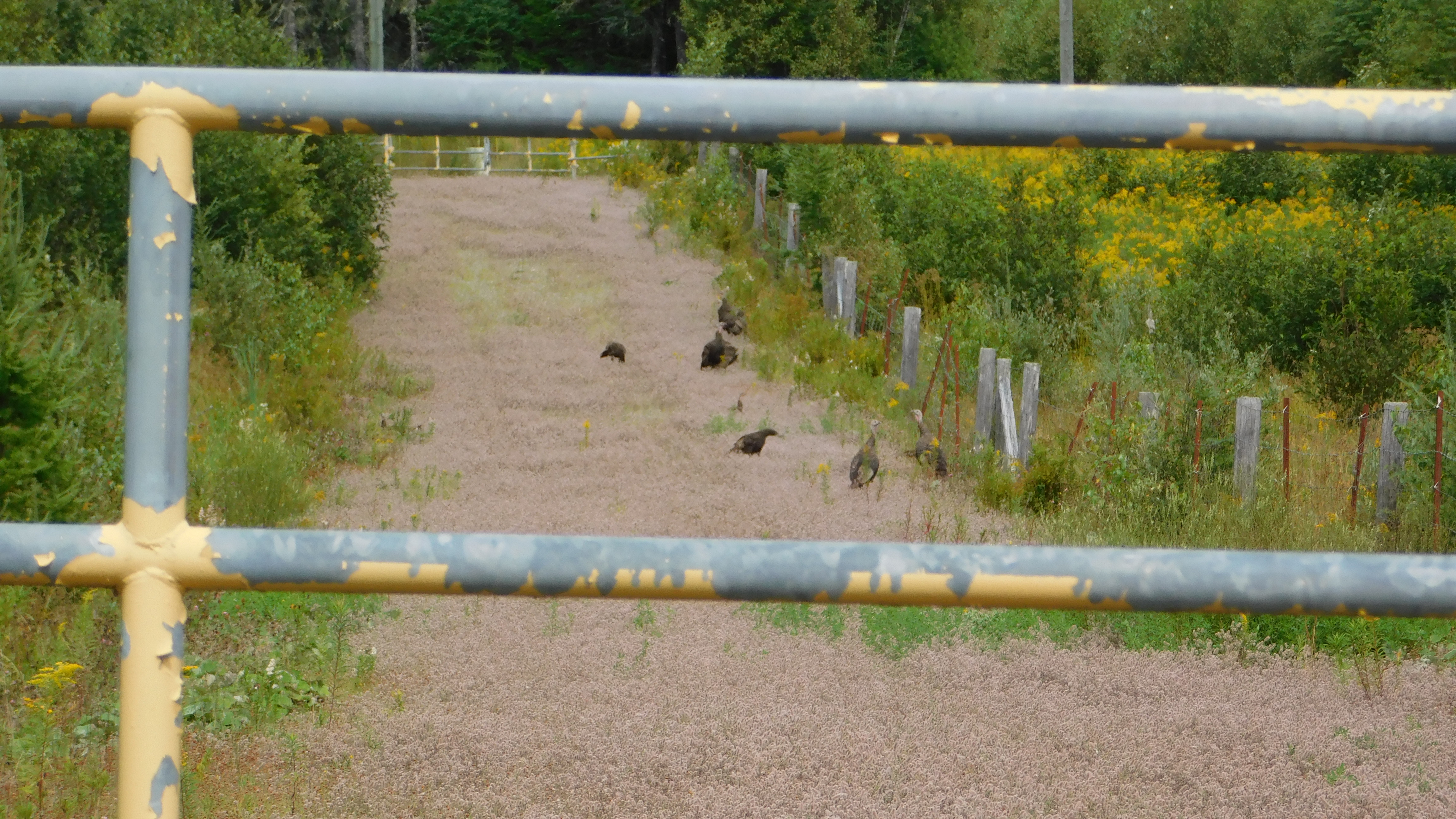
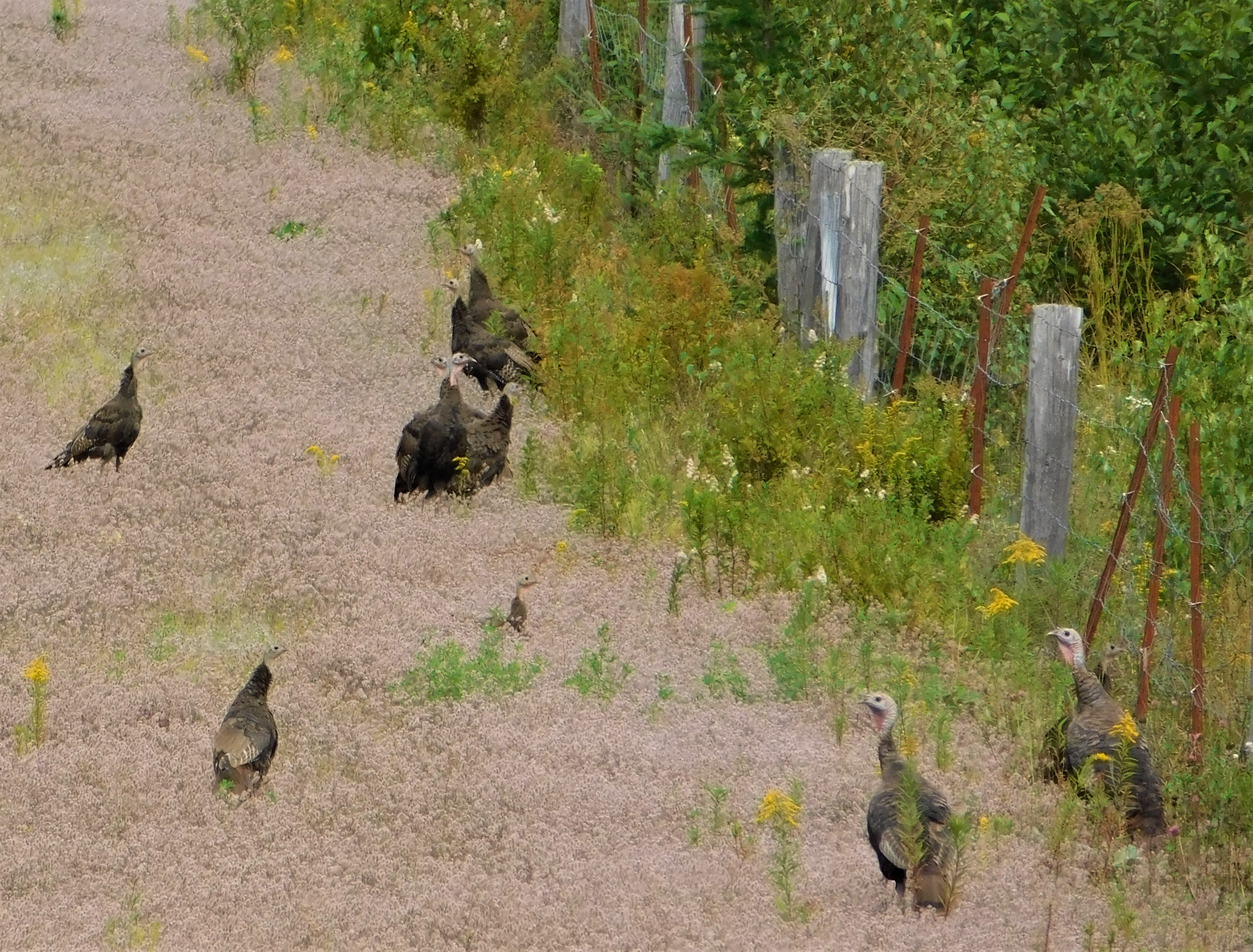
Down an unused road we saw twelve wild turkeys. Most, perhaps all, were females. In recent years we have seen wild turkeys more often on our various drives.
~
They are fun to watch. They are quite social. Some were foraging, probably eating seeds, berries or insects; others were resting among the pink rabbit-foot clover.
~
~
~
The University of New Brunswick is asking people to report the wild turkeys they see. The study will help determine the status of populations in New Brunswick. Report sightings to the Facebook Page NB Wild Turkey Research
~
All my best,
Jane
covered bridges
If you follow this blog, you know how much I love covered bridges. We are so lucky in New Brunswick to have 58 remaining covered bridges, but we lose some almost every year, to vandalism, neglect, fire or flood.
~
I have included covered bridges in my art for years. My first covered bridge painting was of an anonymous bridge. My dad asked me to paint a large mural (8′ x 4′) in our rec room at home and this was the result …
~
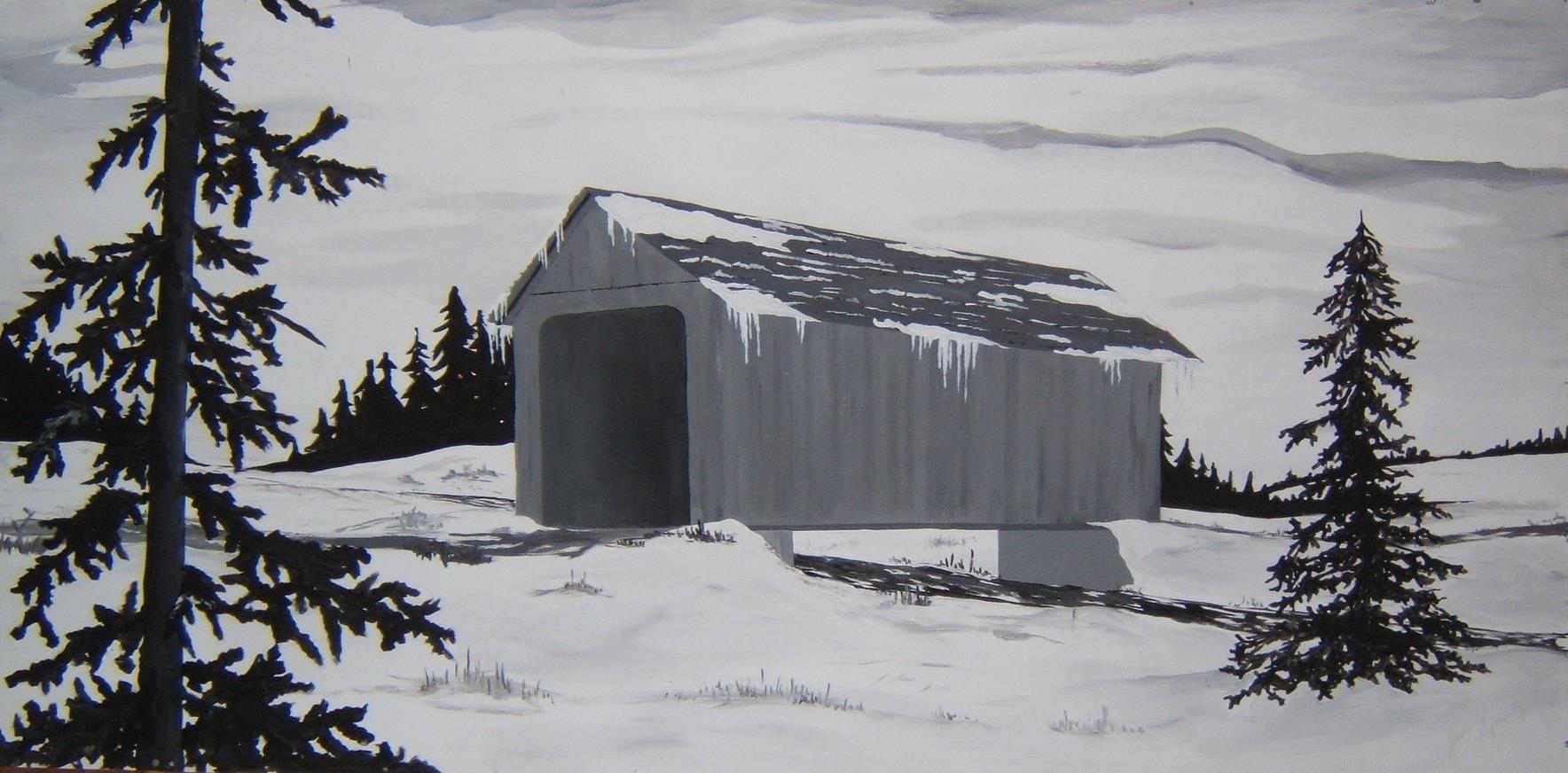
‘a covered bridge in winter’ Jane Spavold (Tims)
~
When I first arrived in New Brunswick, many of our local trips involved visits to covered bridges. In 1992, as a project to celebrate Canada’s 125th anniversary, my son, husband and I visited many bridges in southern New Brunswick. Last year, my husband and I found this notation on one of those bridges — our initials!
~

~
During those days, I was busy with work and painting covered bridges was not a priority, but in 2013, I painted one rather uninspired watercolour of the Marven Covered Bridge near Sussex.
~

‘Marven Covered Bridge, Kings County’ Jane Tims
~
In 2015, as part of a project under artsnb (the New Brunswick’s Arts Board) and a Creations Grant, my husband and I visited 35 covered bridges, mostly in the Saint John River watershed. The results of the project are the poems and art contained in my book ‘in the shelter of the covered bridge‘ (Chapel Street editions, 2017). The cover of the book shows one of the paintings I did of the Malone Covered Bridge.
~

‘apple tree, Malone Bridge’ Jane Tims
~
One of the drawings for the book captured a covered bridge now lost due to carelessness, the French Village Bridge over the Hammond River.
~

~
In the next months, based on other black and white drawings in the book, I did two more covered bridge paintings for the on-going art auction at Isaac’s Way Restaurant in Fredericton.
~

‘thistles at the Malone Bridge’ Jane Tims
~
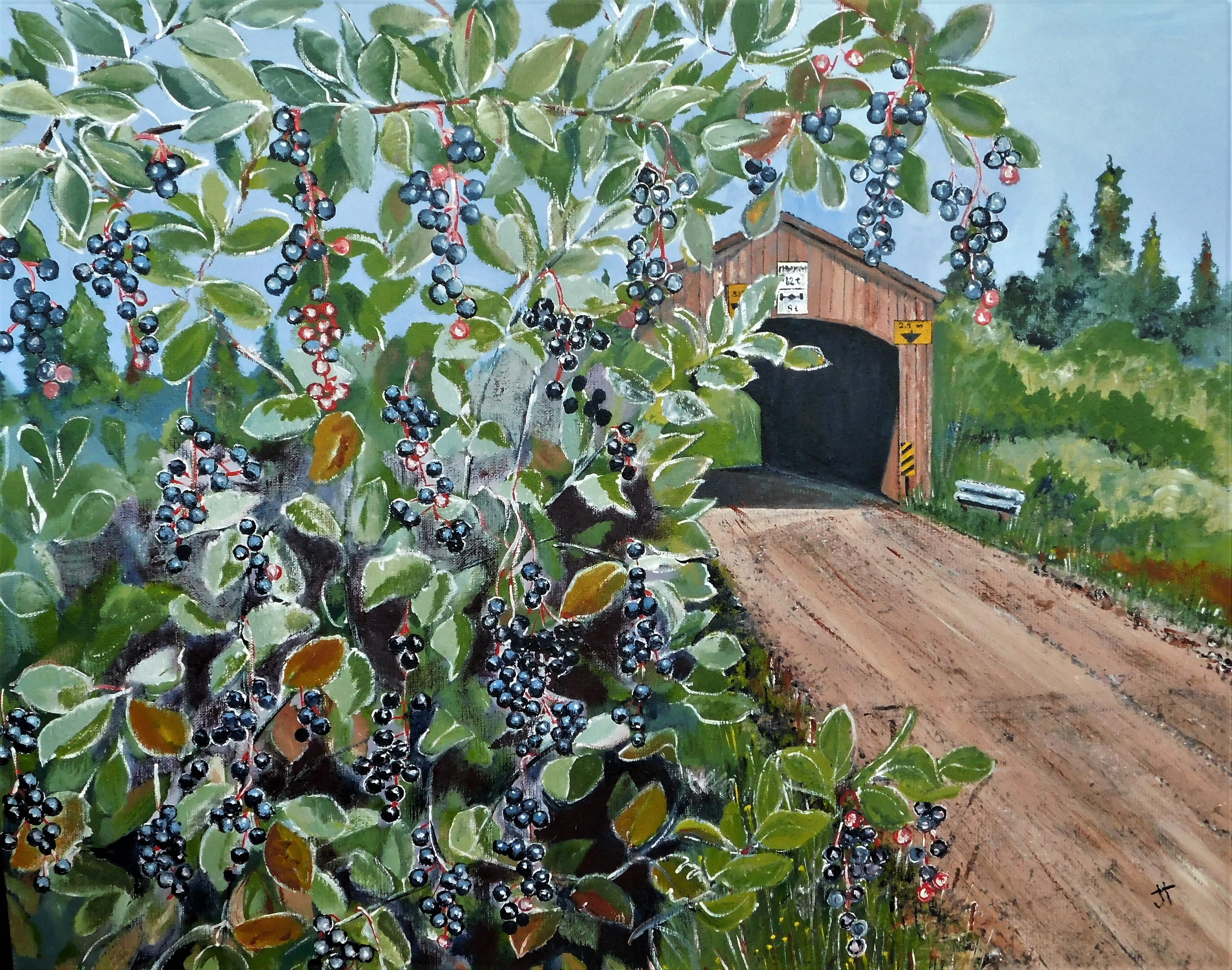
‘chokecherries at the Ellis Bridge’ Jane Tims
~
A neighbour of mine saw the Ellis Bridge painting and commissioned me to paint our local Patrick Owens Covered Bridge.
~
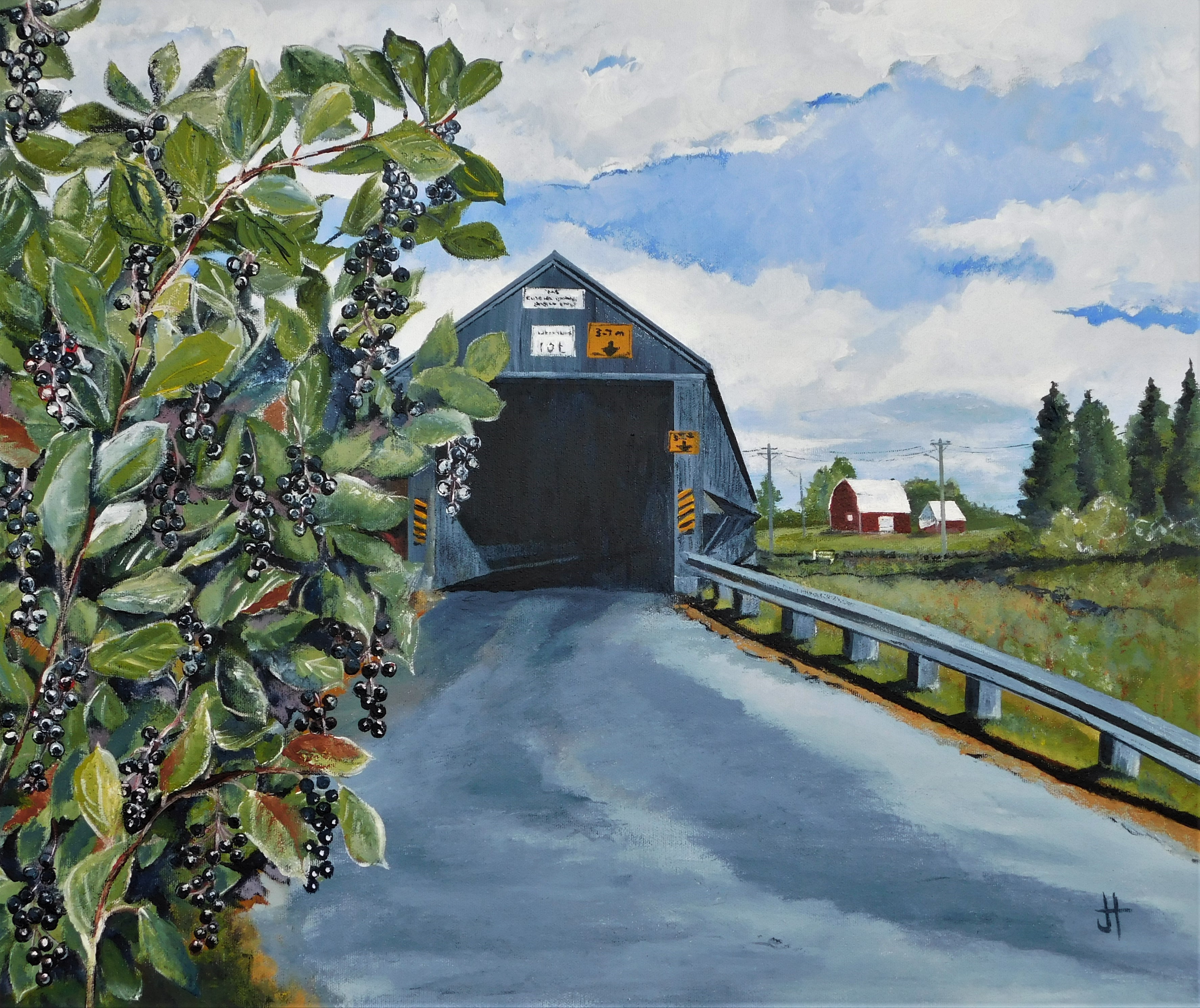
‘chokecherries at the Patrick Owens Bridge’ Jane Tims
~
As time goes on, I will paint other covered bridges. They are so beautiful, each a work of art and engineering. The artist’s challenge is to bring out the individuality of each bridge and illustrate its place in our history and landscape.
~
All my best,
Jane Tims
celebration of a covered bridge
Do you love covered bridges?
Have you done any writing about the Patrick Owens Bridge or any other covered bridge?
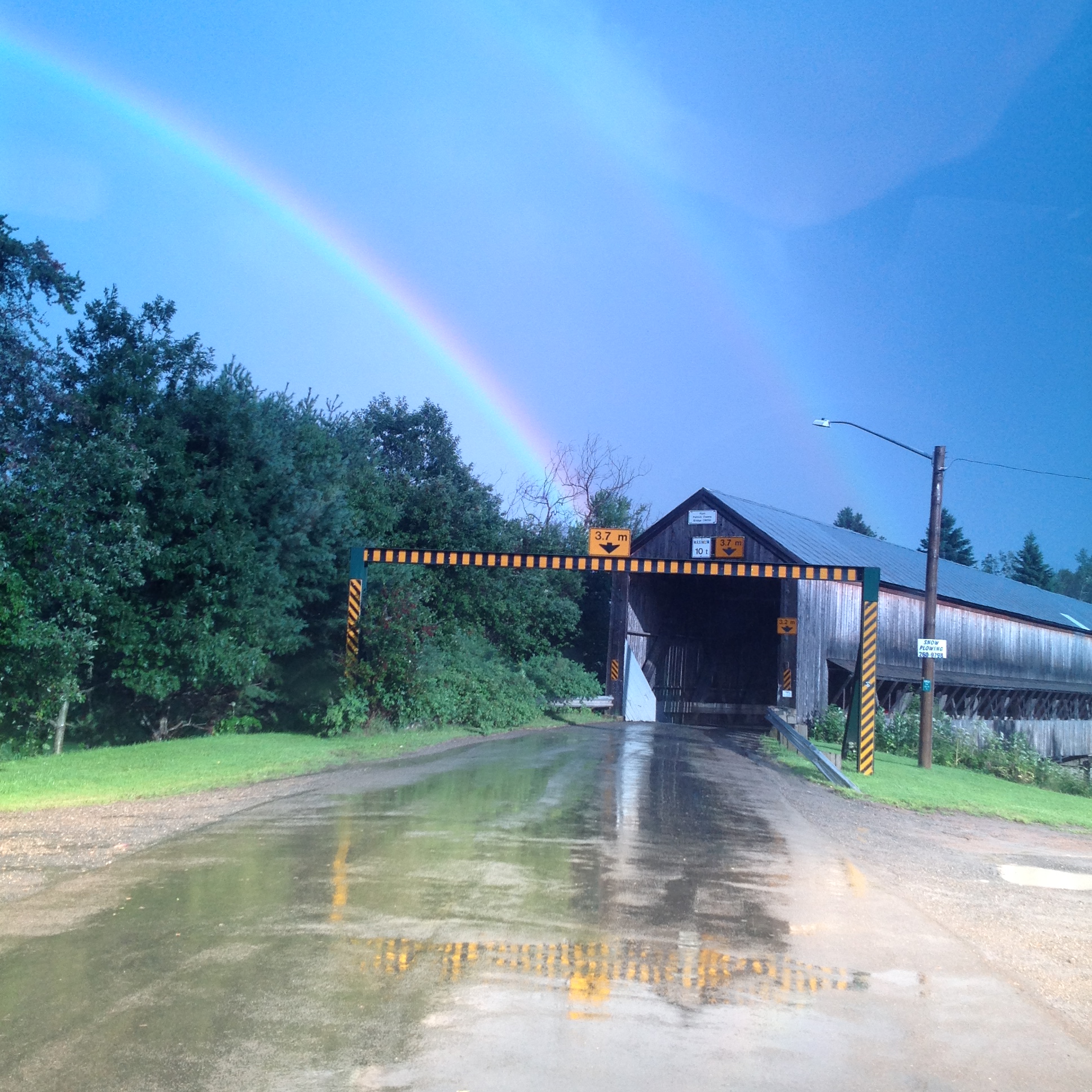
On Saturday August 25, 2018 at 2:00 pm join us at the Rusagonis Covered Bridge Park to celebrate our Bridge.
- We will hear from Jeff Carr, MLA.
- Linda Cogswell will tell us a bit about the history of the bridge.
- I will be reading from my book ‘in the shelter of the covered bridge’ (Chapel Street Editions, 2017) and $10 from every sale of my book will be donated for the upkeep of the Park.
- Rose Burke will read a piece about the Upper Mills Bridge and cross-border travel in former years.
- Ian LeTourneau, Fredericton’s Cultural Laureate, will read his poem about the loss of the Bell Covered Bridge.
- We will also have an ‘open mic’ where you can join others in reading from your own work (about bridges or any other related theme).
We will have cake and lemonade as part of the afternoon. There will also be a BBQ, courtesy of MLA Jeff Carr! Everyone is welcome!
Let me know if you would like to read (in the comments or at timstims@nbnet.nb.ca).
All my best,
Jane
abandoned spaces: day-lilies
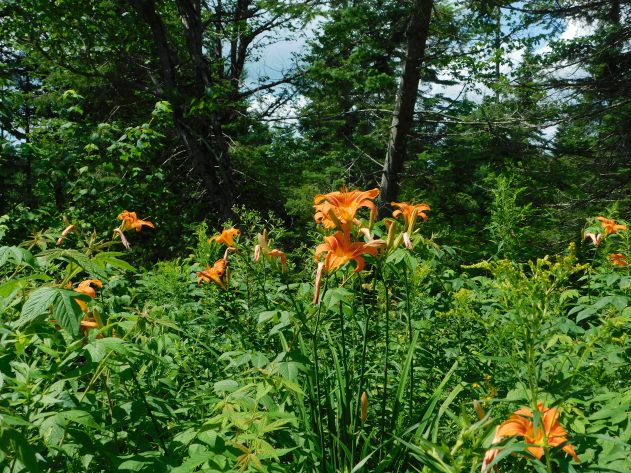
The orange day-lily (Hemerocallis fulva) is also called roadside day-lily, outhouse day-lily, wash-house day-lily, ditch day-lily, and railroad day-lily, giving a hint of the spaces where it is found. When gardens containing the orange day-lily are abandoned, the flowers persist and spread on the site, and also escape to live in nearby ditches and fields.
~

~
The day-lily is an herbaceous perennial with an extensive tuberous root. The flowers are borne on a long scape and each flower blooms and lasts only a day. It spreads via stolons and seeds. Although pretty, the orange day-lily is considered an invasive species. Its colonies can out-compete other native species.
~
~
This time of year, orange day-lilies are everywhere in New Brunswick. In the abandoned community of Beaufort, Carleton County, orange day-lilies line the roadside on the way to the former community.
~

the road to Beaufort … the long isolated road gives a hint as to why a community in the area was abandoned … a long way to other communities, hard winters with deep snow and few opportunities for young people
~
The New Brunswick Archives says:
… settled in 1879 following the adoption of the Free Grants Act: named for William Beaufort Mills who persuaded the government to give aid to Anglicans burned out in the Saint John Fire of 1877 and encouraged settlement in this area: PO [post office] 1881-1946: in 1898 Beaufort was a community with 1 post office and a population of 100.
Source: https://archives.gnb.ca/Exhibits/Communities/Details.aspx?culture=en-CA&community=232
~
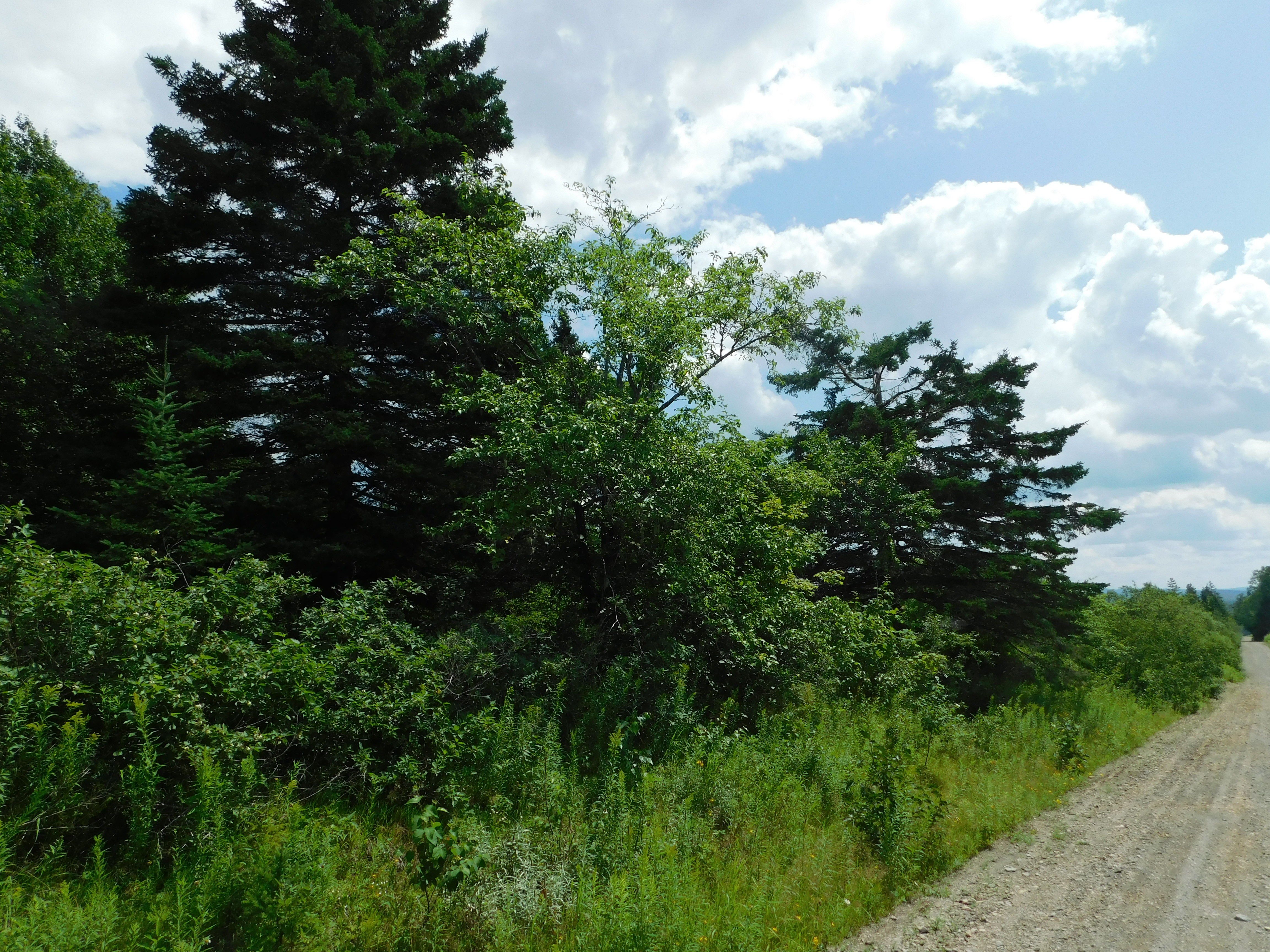
Today, there is only one, modern house in the community. But remnants of old gardens in the community still remain. we saw:
many apple trees at the roadside and in overgrown orchards …
~
~

~
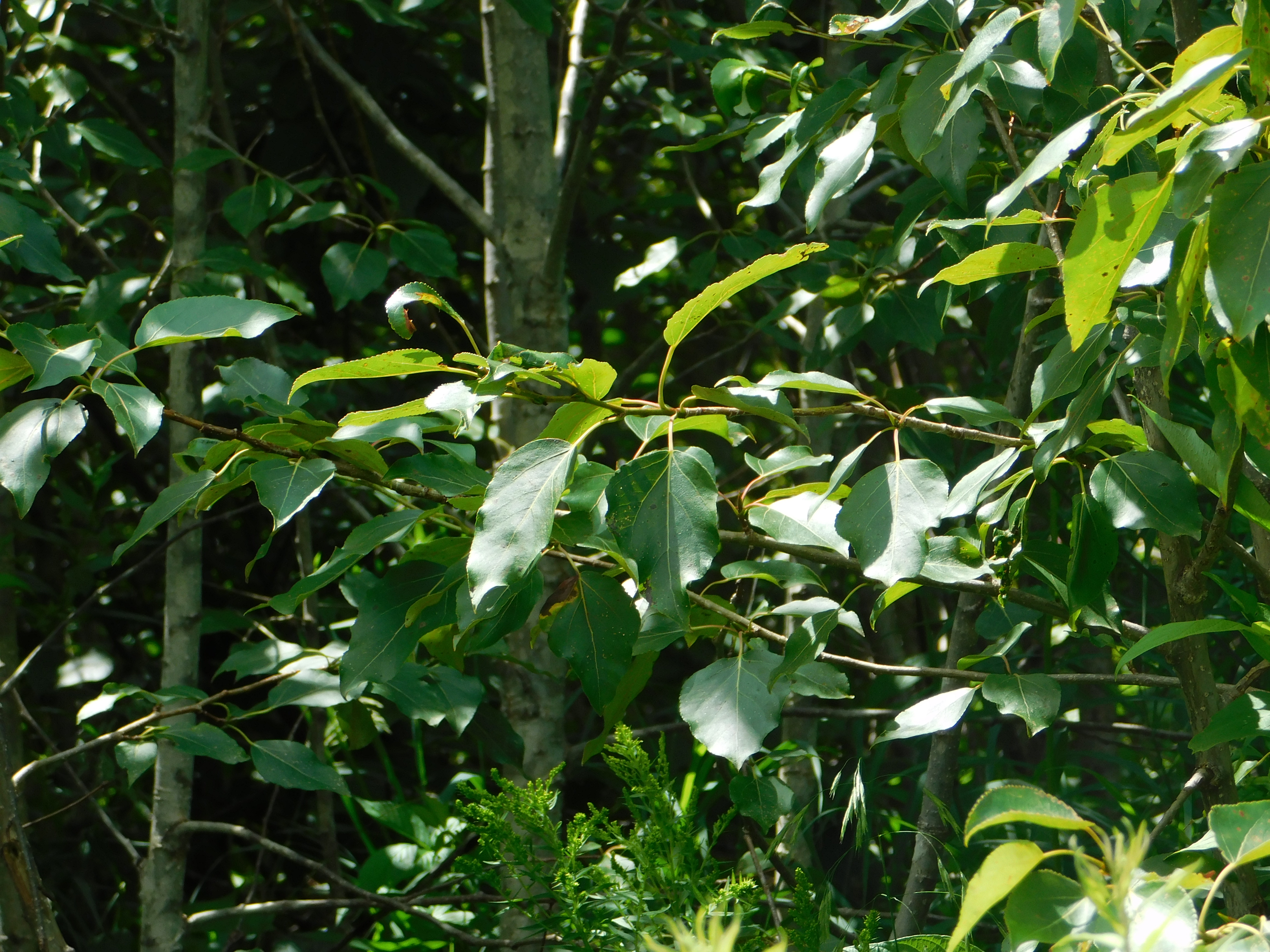
a young crowded stand of Balsam poplar, perhaps the hybrid Balm of Gilead …
~

~
~
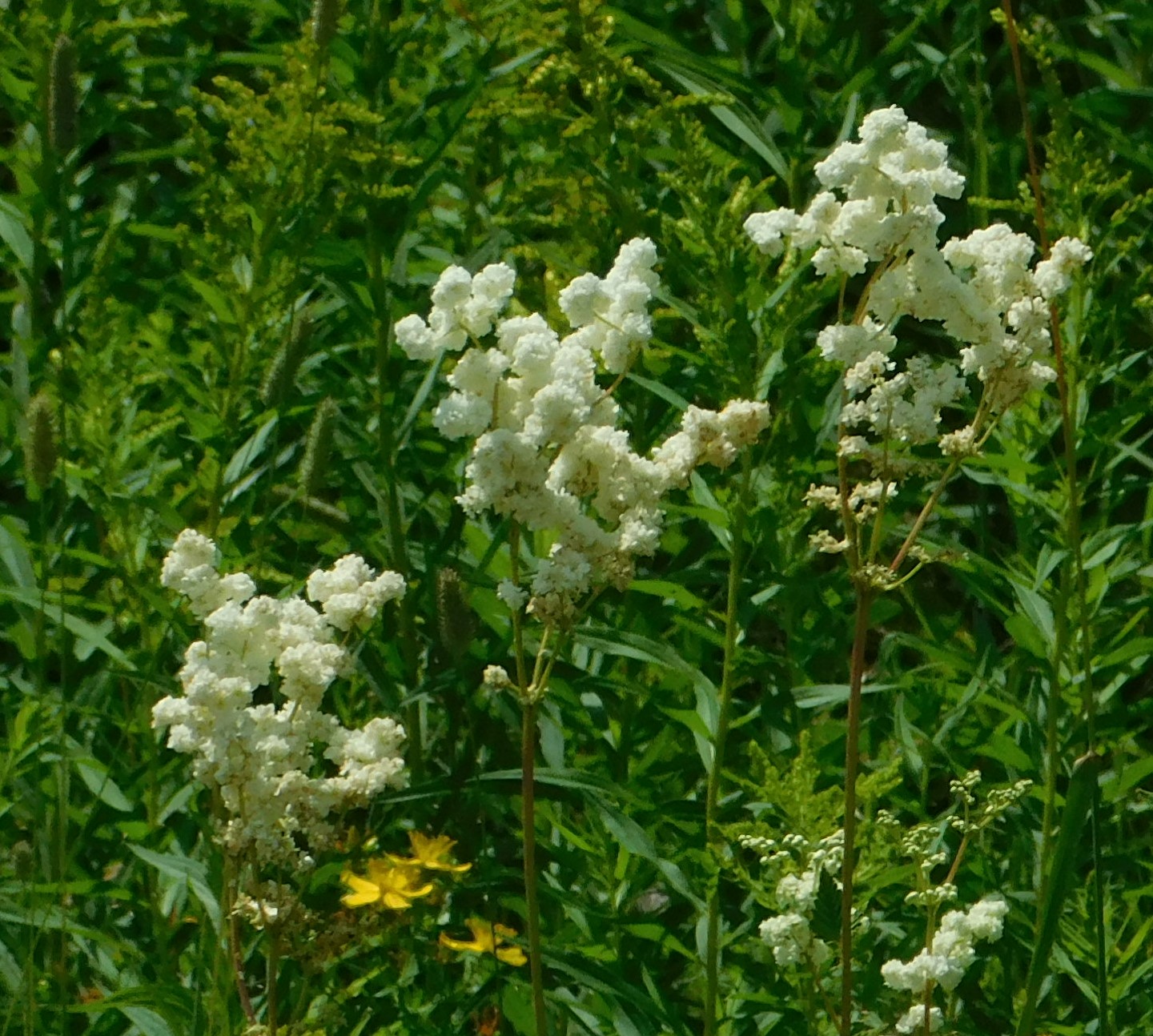
and a flower I have not yet identified … does anyone know what it is?
~
~

~
Sad to think of the people who lived in Beaufort, planted their gardens and struggled to make their lives there. But they left their mark, on the communities they moved to and in the plants they left behind, now beautifying the former community.
~
All my best,
Jane




 nichepoetryandprose