Posts Tagged ‘nature’
snippets of landscape – evidence of old roads
This week, we drove to the south-west corner of the province and spent a little time at the Ganong Nature and Marine Park, at Todd’s Point near St. Stephen. The area is managed by the Quoddy Futures Foundation and is the former property of Eleanor and Whidden Ganong (Whidden Ganong was President of the Ganong Bros. candy factory in St. Stephen). The property is beautiful and good for the soul. We walked through the fields, identified wildflowers, listened to the birdsong, and were returned to a simpler time.
The fields along the path were yellow with Buttercup (Ranunculus sp.) and the largest population of Yellow Rattle (Rhinanthus Crista-galli L.) I have ever seen. The flowers of the Yellow Rattle were bright yellow, but the inflated calyx was tinged with red, giving the field a stippled glow (for more information on Yellow Rattle, see my post for August 3, 2011, ‘along the country road #1’ ).

Yellow Rattle among the field flowers… the fused sepals are tinged and veined with red
The Buttercups were everywhere, but concentrated in certain areas of the field. One area in particular seemed to mark the path of an abandoned road. The Buttercups have found some aspect of the old road to their liking. Perhaps the soil is compacted and they have a competitive ‘edge’ on the other plants. Perhaps the hidden track provides some alteration in the water regime or a place where certain types of seeds concentrate as they are dispersed. Perhaps there are subtle differences in the soil chemistry.
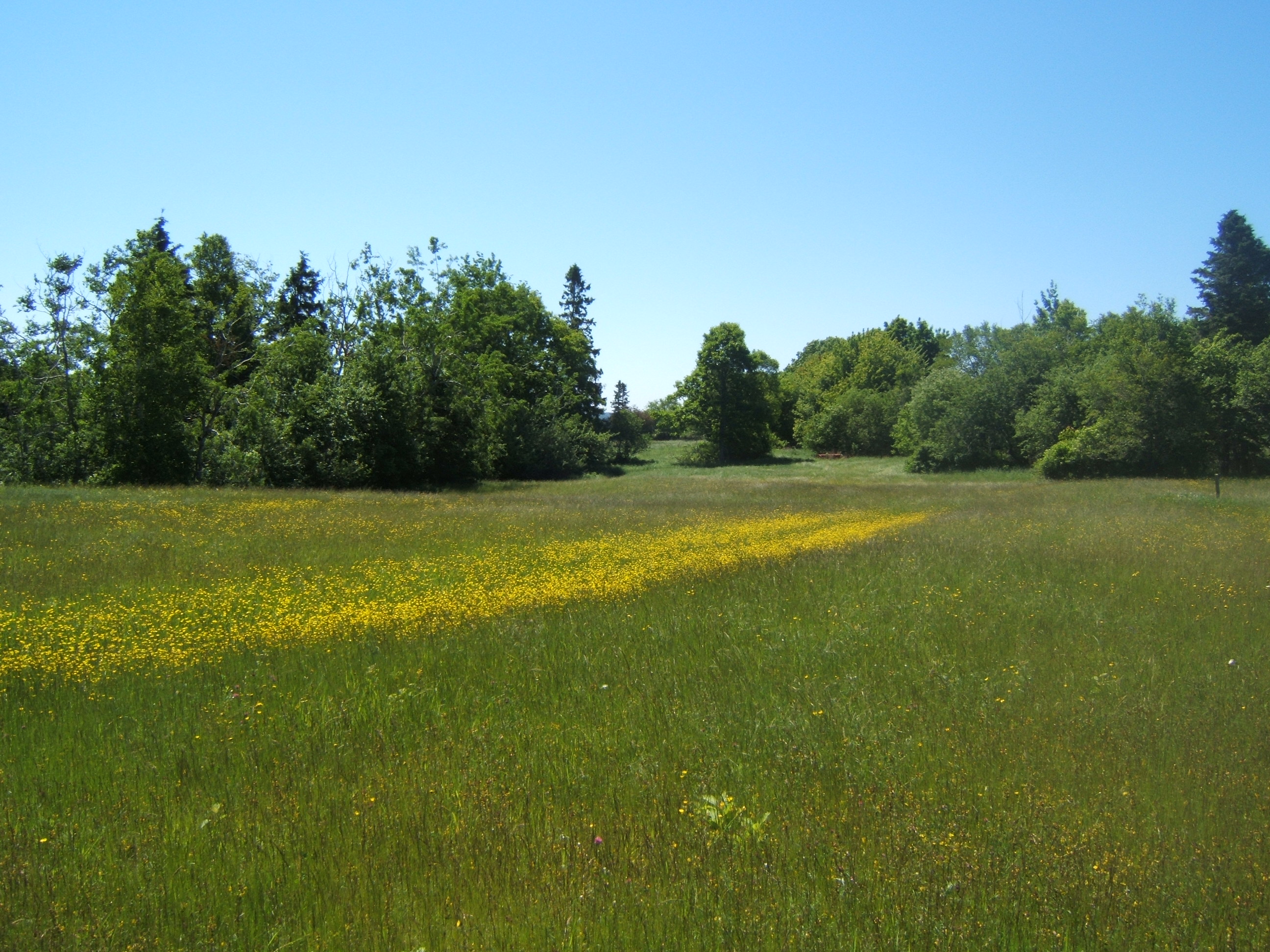
an abandoned track marked in Buttercups… the red tint in the foreground is from the reddish coloration of the Yellow Rattle
Years ago, I visited a property where the roadway to a back field was clearly marked with Bluets (Houstonia caerulea L.). The owner of the property said he thought they grew there because he always took his lime in an open cart back to his fields, and enough had spilled to make the way especially attractive to the Bluets.
Perhaps you will have a look in your landscape for wildflower clues to past activities.
~
~
Invitation to Tea
~
in the afternoon,
I huddle over tea
and watch
the road
~
an old road,
rarely used –
walks scarcely part
the tangle of fern
~
I scan the woods,
I love the look
of ancient trunk
and horizontal green
~
and always,
in the corner of my eye,
the road
~
overgrown –
a narrow course of saplings
intercepts
the sameness
of maturity
~
I watch
expectantly
~
but the road is abandoned –
cart-tracks worn
to rivulets,
culverts buried
by fallen leaves,
rusted oil tins,
depressions in the mould
~
~
© Jane Tims 2012
Common Plantain (Plantago major L.)
When we were children, we often pretended to be storekeepers and picked various wild plants as the ‘food’ for sale. We collected weed seeds for our ‘wheat’, clover-heads as ‘ice-cream’, vetch seed pods as ‘peas’, and (gasp) Common Nightshade berries as ‘tomatoes’.
This is probably a good place to urge you to teach your children – everything that looks like a vegetable or fruit may not be good for them to eat! I don’t remember ever trying any of our pretend ‘groceries’, but some of them, such as the Common Nightshade berries, were poisonous and harmful.

berries of Common Nightshade are poisonous… later in the season, they are red and quite beautiful… children should be warned that all red berries are NOT good to eat
We also ‘sold’ the leaves of Common Plantain at our ‘store’. They looked like spinach, and the Plantain leaves would have actually been fine for us to eat.
Common Plantain (Plantago major L.) is a very easily found weed since it grows almost everywhere, especially along roadsides, in dooryards and in other waste places. Plantain is also known as Ribwort, Broad-leaved Plantain, Whiteman’s Foot, or, in French, queue de rat. The generic name comes from the Latin word planta meaning ‘foot’. Major means ‘larger’.
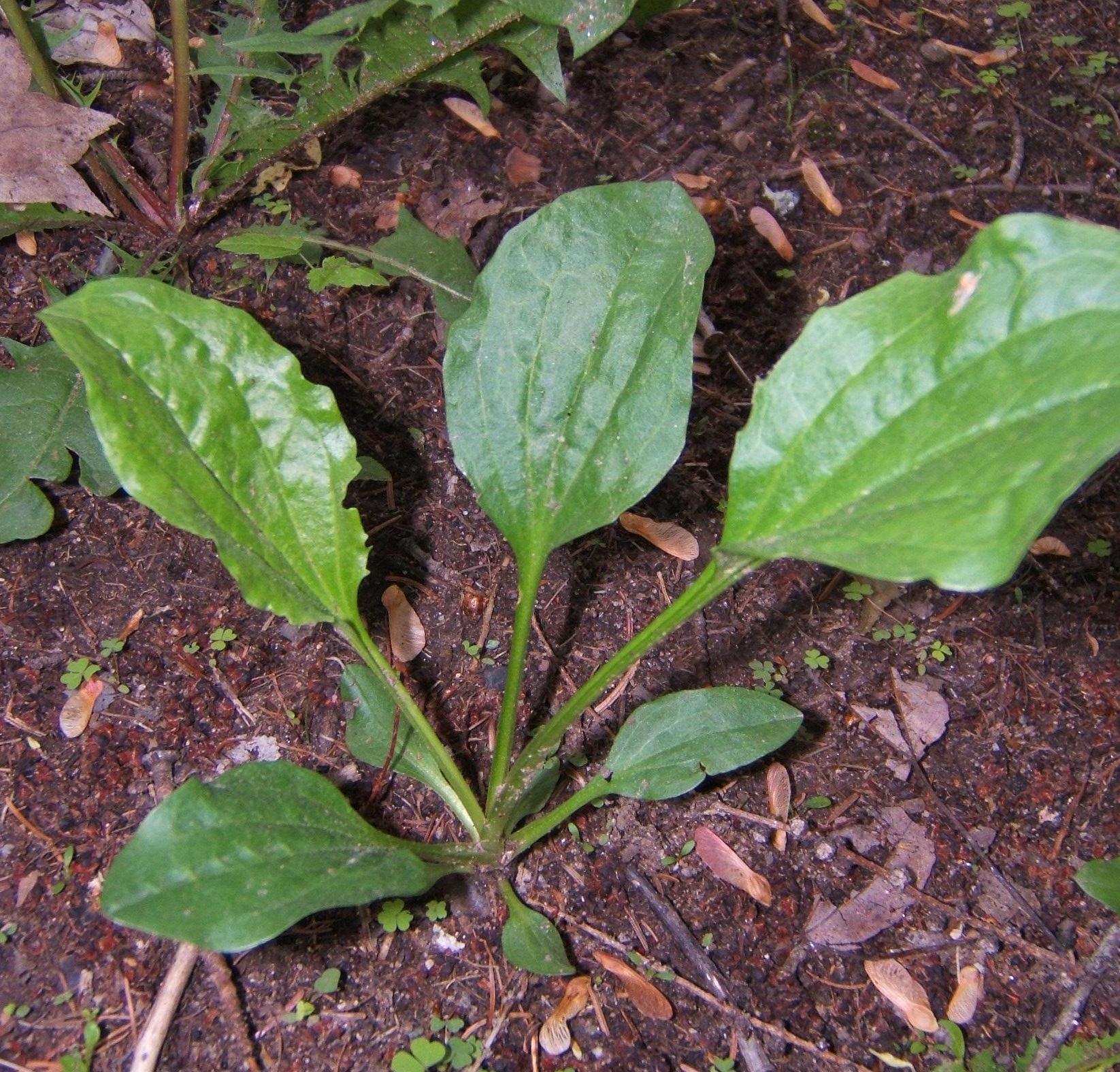
Plantain has thick, dark green, oval leaves. These grow near the ground in a basal rosette. The stems of the leaves are long and trough-like. The leaves themselves are variously hairy and feel rough to the touch. The leaf has large, prominent veins, and, as the plant grows older, these veins become very stringy. The veins resist the breakage of the leaf and stick out from the stem end of a harvested leaf like the strings of celery.
Flowers of Plantain grow in a dense spike on a long, slender stalk rising from the leaves. The flowers are small and greenish-white, appearing from June to August.
The young leaves of Common Plantain can be used in a salad or cooked and seasoned with salt and butter. The older leaves become tough and stringy.
Warning: 1. never eat any plant if you are not absolutely certain of the identification; 2. never eat any plant if you have personal sensitivities, including allergies, to certain plants or their derivatives; 3. never eat any plant unless you have checked several sources to verify the edibility of the plant.
leaves of Common Plantain and Dandelion, picked from our dooryard, not yet washed or looked over for insects… note the strings protruding from the stem ends
Yesterday, I gathered the youngest leaves of plantain I could find and cooked them for my lunch. They might be fine in times of need, but I found the cooked product to be just like eating soggy cardboard.

I should say, since I have begun my almost daily tests of edible wild plants, my husband asks me almost hourly how I am feeling.
~
~
wisdom
~
plantain, past the picking –
a pulled leaf resists,
tethered to a thread
~
~
© Jane Tims 2012
Warning: 1. never eat any plant if you are not absolutely certain of the identification; 2. never eat any plant if you have personal sensitivities, including allergies, to certain plants or their derivatives; 3. never eat any plant unless you have checked several sources to verify the edibility of the plant.Wild Strawberry (Fragaria virginiana Duchesne)
Soon, the fields at our summer place will be jeweled with Wild Strawberries.
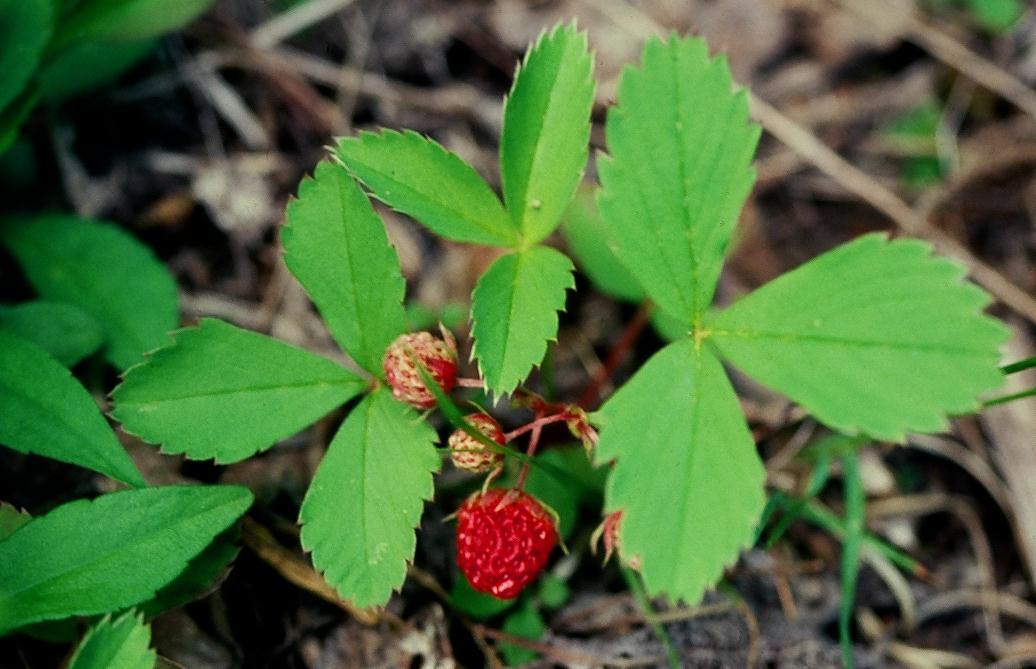
Wild Strawberry (Fragaria virginiana Duchesne) grows in open woodlands, fields and barrens. It is also known as Virginia Strawberry, Common Strawberry and, in French, fraisier. The name Fragaria comes from the Latin word for strawberry, fraga meaning fragrance.
The leaves of Wild Strawberry grow on slender stalks, and occur in threes. They are hairy and coarsely toothed. Plants are stoloniferous, meaning they produce ‘stolons’ or runners, freely-rooting basal branches.
The flower of the Wild Strawberry is white, with five petals and numerous stamens and pistils. Right now, our fields are spangled with them. The flowers occur in an open cluster of two or more flowers. In this species, the flower stalk is not longer than the leaf stalk.
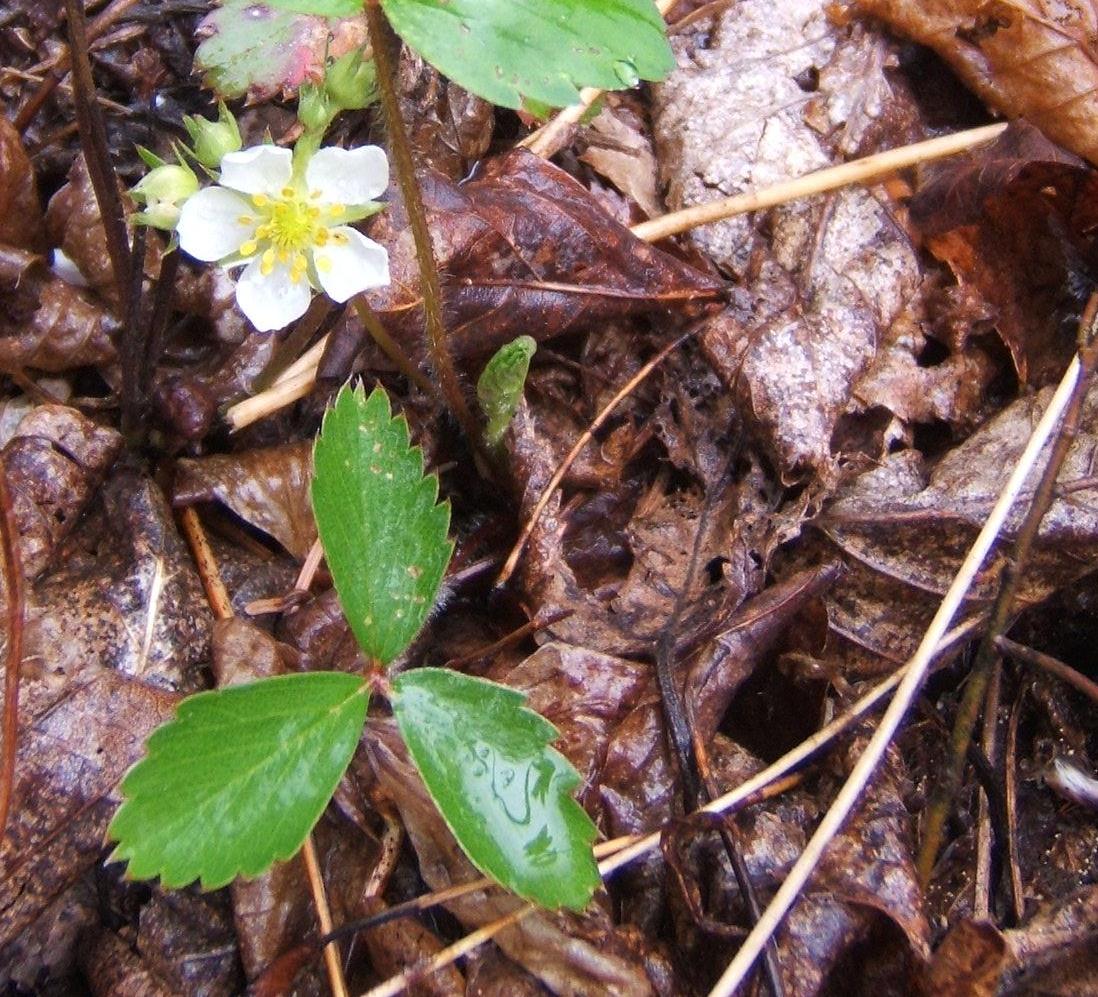
The berries are red and ovoid, covered with small pits and seeds. They are more delicate and sweeter than the domestic strawberry. They appear in late June and may last until August, but the best berry-picking is at the first of summer.
In the book ‘The Blue Castle’ by Lucy Maude Montgomery, the heroine says one of her greatest pleasures is to eat berries directly from the stem:
Here they found berries … hanging like rubies to long, rosy stalks. They lifted them by the stalk and ate them from it, uncrushed and virgin, tasting each berry by itself with all its wild fragrance ensphered therein. When Valancy carried any of these berries home that elusive essence escaped and they became nothing more than the common berries of the market-place–very kitchenly good indeed, but not as they would have been, eaten in their birch dell …
(from L.M. Montgomery, The Blue Castle, Chapter 30, McClelland and Stewart Limited, 1972)
~
The berries of the Wild Strawberry are delicious in jam. The leaves also make a fragrant tea, high in Vitamin C. To make the tea, put a handful of green leaves into two cups of boiling water, steep, strain and enjoy!
~
~
too early to pick
~
last week of June
roadside red with leaves
and ripening wild
strawberries hang
still green except
where sepal contrast
shows sweet berry
~
patience, wait
a few days and every berry
ripe and a thimble pot
of berry jam
~
can’t wait?
sour green flesh
grit of tiny seed
~
~
Copyright Jane Tims 2012

a moment of beautiful – a button of moss
the space: at ground level, in the grey woods
the beautiful: a little button of moss, emerald green
~
Mosses are a beautiful, enigmatic group of plants. Except for a few well-known species, they simply grow unnamed and unnoticed by most people. The beauty of the mosses, especially under the stereo-microscope, where you can see so much detail, was what attracted me to the study of botany in the first place.
We have many species of moss in our Grey Woods. I long to be able to take the time to identify every one. For now, though, I content myself with a few common names and some of my own ‘made-up’ names.
I call this little moss ‘The Button’. Wherever I find it, it seems to grow in a little cushion. Its surface is like velvet and its color is a lovely shade of lime green.
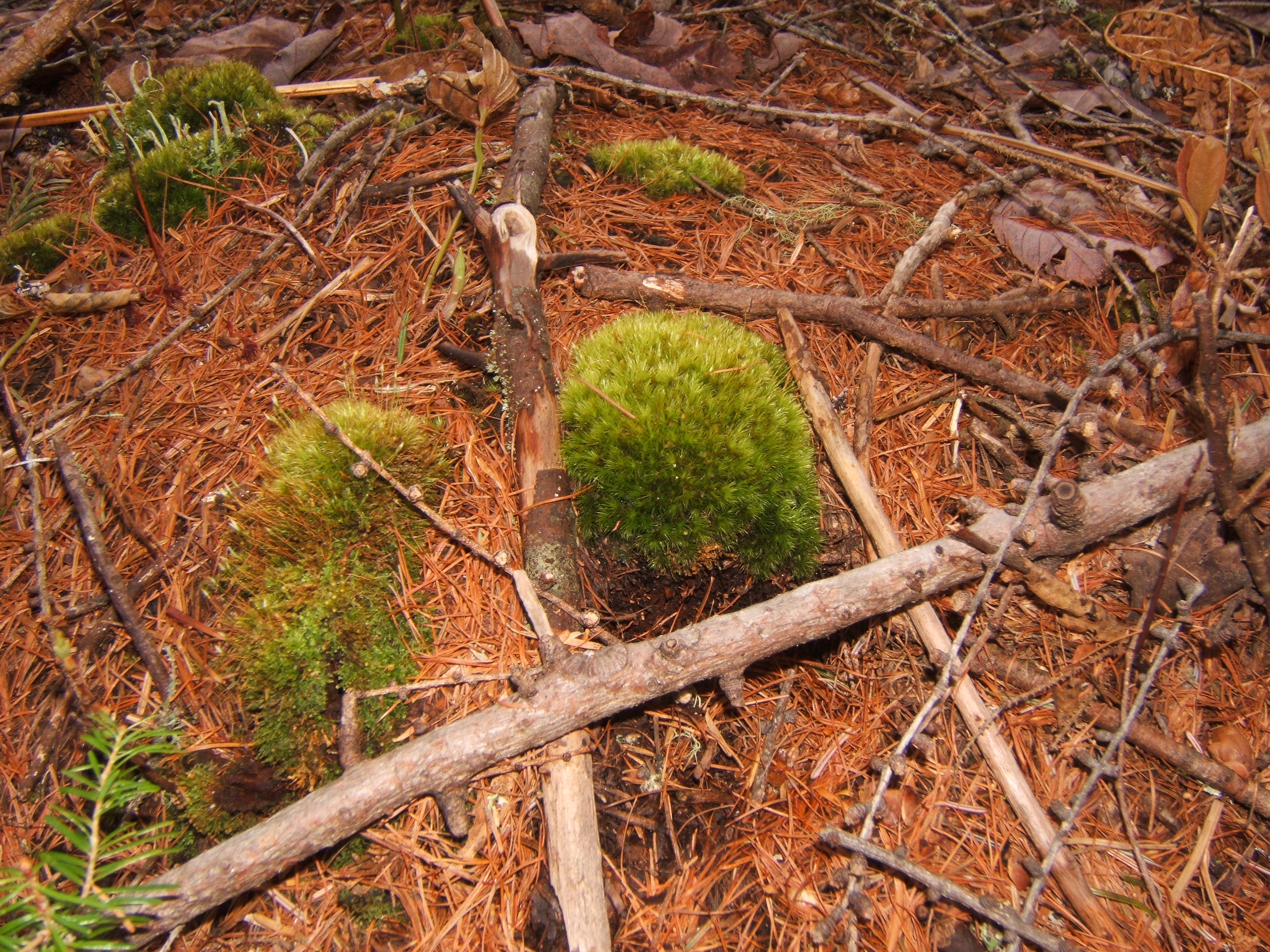
~
~
a button to press
~
resist the urge
to depress this plump of moss
firmly with a finger
~
will take you up
to the first floor
where the bunchberry blooms
or the second where bracken
planks an ephemeral floor
or the 67th where leaves align
precisely with sun
~
or down
to where the roots criss-cross
in confused abandon
~
~
© Jane Tims 2012
a view of a Black Bear
One of the experiences of the past two weeks was the sighting of a young Black Bear (Ursus americanus) along the Plaster Rock – Renous Highway. The Black Bear was only a youngster, probably a two-year-old born last January or February (2011). He watched us a long time from the woods, appearing a little confused. Eventually, he wandered away. He was probably rejoining his mama – Black Bears stay with their mothers until they are 16 or 17 months old.

I have seen/smelled a few bears in my life:
§ Once, on a fishing trip with my Uncle, he told me to stop and sniff the air. The smell was fetid, unforgettable. He told me you often smell a bear but almost never see one.
§ When we first built our house, our young neighbor was riding his bike up our gravel heap and encountered a bear coming up the other side of the pile!

§ When we first lived in our community, we had a garbage dump. We used to go to the dump on the weekend and join the other cars, watching the bears work their way through the garbage. I remember one was inside an old refrigerator, opening and closing the door!

§ On a work excursion to Mount Carleton, we saw a bear running up the road ahead of us, but it disappeared before we could get close.
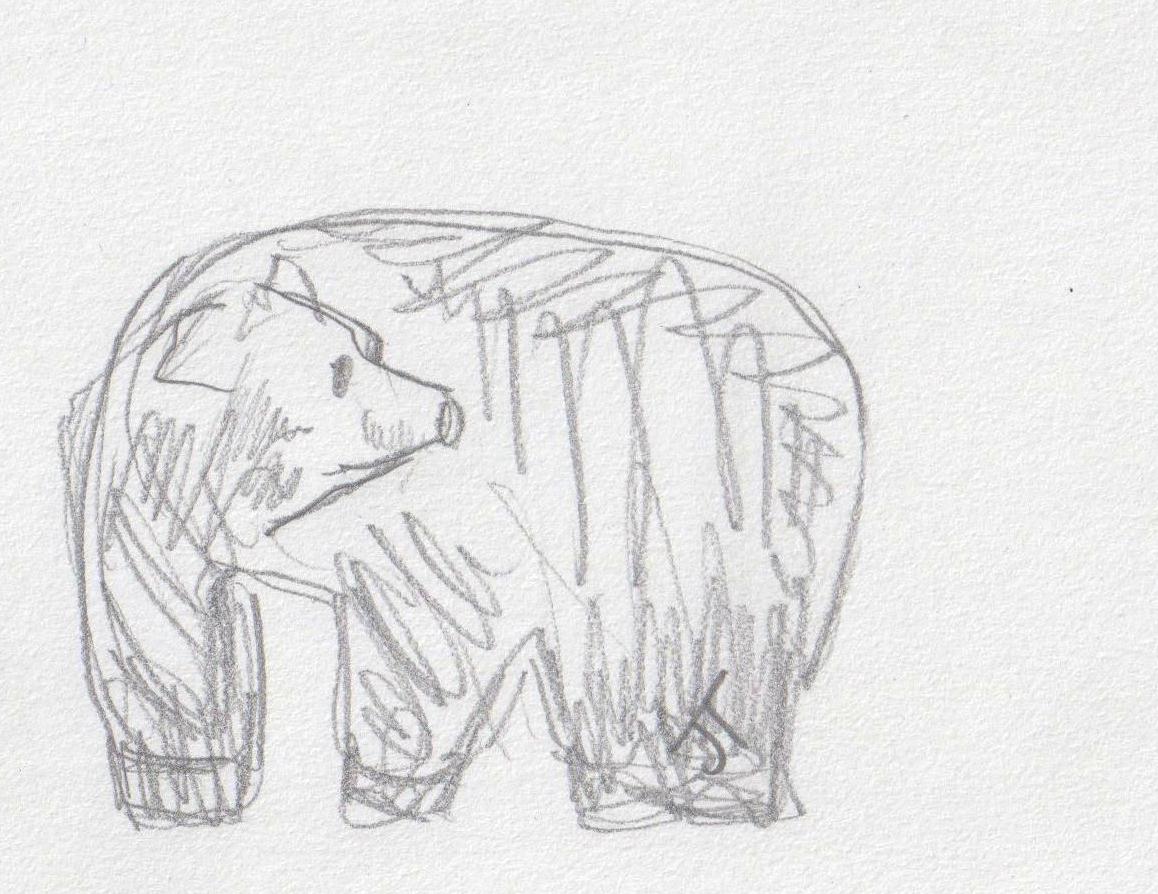
§ Once, on the Salmon River Road, on a drive to Bouctouche with my sister-in-law and niece and nephew, we saw a full-grown bear, on a run from one side of the road to the other. He had very long legs and ran by stretching his front legs out and bringing his rear legs up between them. He only hit the pavement twice, once with each set of feet!
§ On our trip through the Rocky Mountains, I saw a bear, species unknown, in a steep ditch beside the roadway.
Have you ever seen a bear???
~
© Jane Tims 2012
wildflowers in the rich spring hardwoods
On our drive and hike along the South Branch Dunbar Stream, north of Fredericton, we encountered many spring wildflowers. The Trout Lily (Erythronium americana Ker) was everywhere, in extensive carpets, especially in hummocky areas (see my post for June 1, 2012). The delicate Wood Anemone was just beginning its bloom, also in dense carpets of feathery foliage. Other plants in these woods included the Purple Trillium and Green Hellebore.
The Wood Anemone (Anemone quinquefolia L.) is one of our less common plants. Its leaves are deeply toothed with 3 to 5 parts. The ‘flower’ is white and five-petalled, not really a flower at all, but the white sepals of the plant.
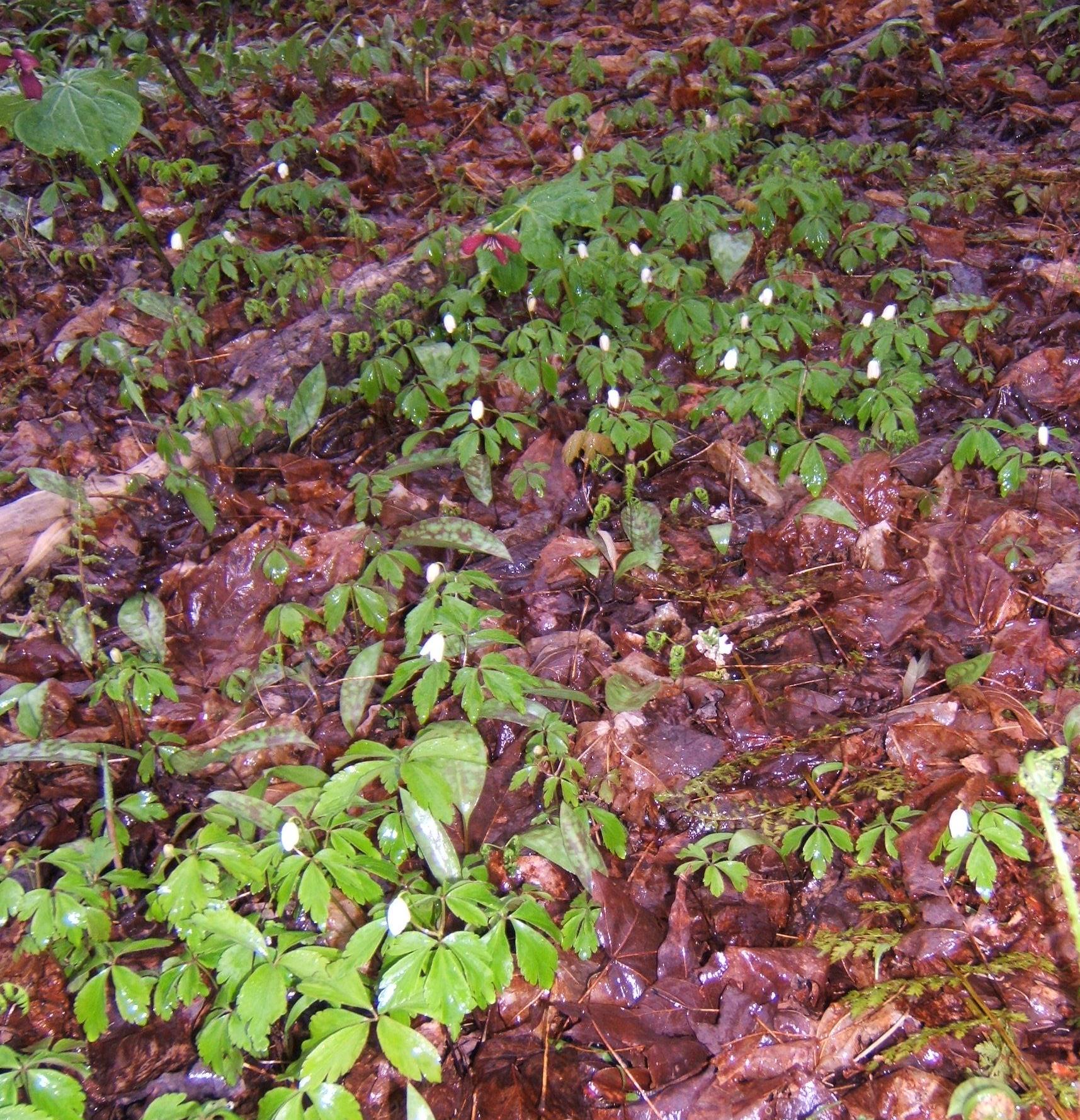
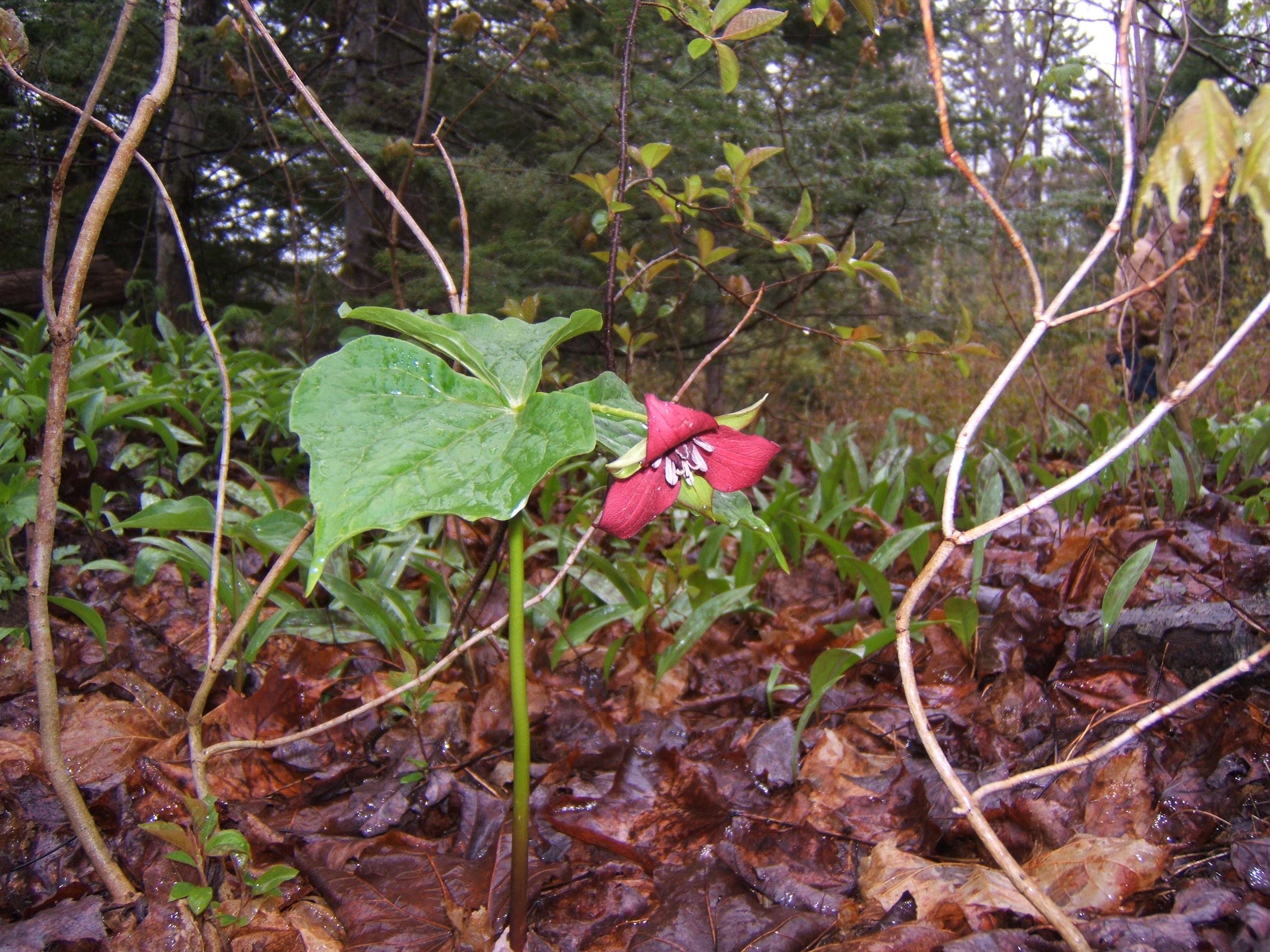
The Purple Trillium (Trillium erectum L.), also known as the Wakerobin, is a showy plant with the parts in three’s. The flower is maroon or purple, and, as in our case, may be nodding, in spite of the name (erectum meaning erect). The flower is known by its purple ovary (female part of the flower) and its nasty odor. You can eat the very young leaves of the Purple Trillium, but they are not usually in large abundance, so to protect the plants, I recommend just enjoying their bloom.
The light green leaves of Green or False Hellebore (Veratrum viride Ait.) were also conspicuous in the woods, I see them in woods along rivers all over our area. They are large plants, made up of heavily ribbed, pleated, clasping leaves. The leaves are parallel veined and do not smell like skunk, unlike the Skunk-Cabbage which has netted veins in the leaves and a skunky odor. Later, the Green Hellbore will have large clusters of yellow-green star-shaped flowers. This plant is poisonous.

We enjoyed our hike, and saw a beaver tending his dam and a narrow, raging waterfall pouring into the South Branch of the Dunbar, probably only a trickle in summer after the heavy spring rains are gone.

~

© Jane Tims 2012
making friends with the ferns #3
Although the fiddleheads of the Ostrich Fern are edible and a delicacy in New Brunswick, all fiddleheads are not edible. The fiddlehead is the tightly-rolled, earliest emergence of the immature fern leaf. This coil of the leaf resembles the head of a fiddle, hence the name. As time passes, the fiddleheads uncoil and become the mature leaves of the fern.
In the Grey Woods, we have two species of fern with very distinctive fiddleheads.
The fiddleheads of the Sensitive Fern (Onoclea sensibilis L.) are slim and red. They are not edible and are poisonous to horses.

red fiddleheads of the Sensitive Fern are hard to see against the dried leaf layer
The Sensitive Fern grows at the edges of the Grey Woods, along our house foundation and in a large patch on our ‘lawn’.
The common name ‘sensitive’ refers to the fern’s characteristic dying at the first frost. The Sensitive Fern is also called the Bead Fern, a reference to the hard brown spore cases on the fertile spikes. Once the green leaves have died, only the tall brown fertile spikes remain, and these persist until spring. The Sensitive Fern is a once-cut fern (the leaves are cut once into simple leaflets) with wavy margins and sometimes deep indentations in the leaflets. The upper leaflets are ‘winged’ or ‘webbed’ where they join the main axis of the plant.
The fiddleheads of the Cinnamon Fern occur in clumps and are densely covered with coarse white hairs. The fiddleheads can be eaten but are not used as commonly as those of the Ostrich fern.
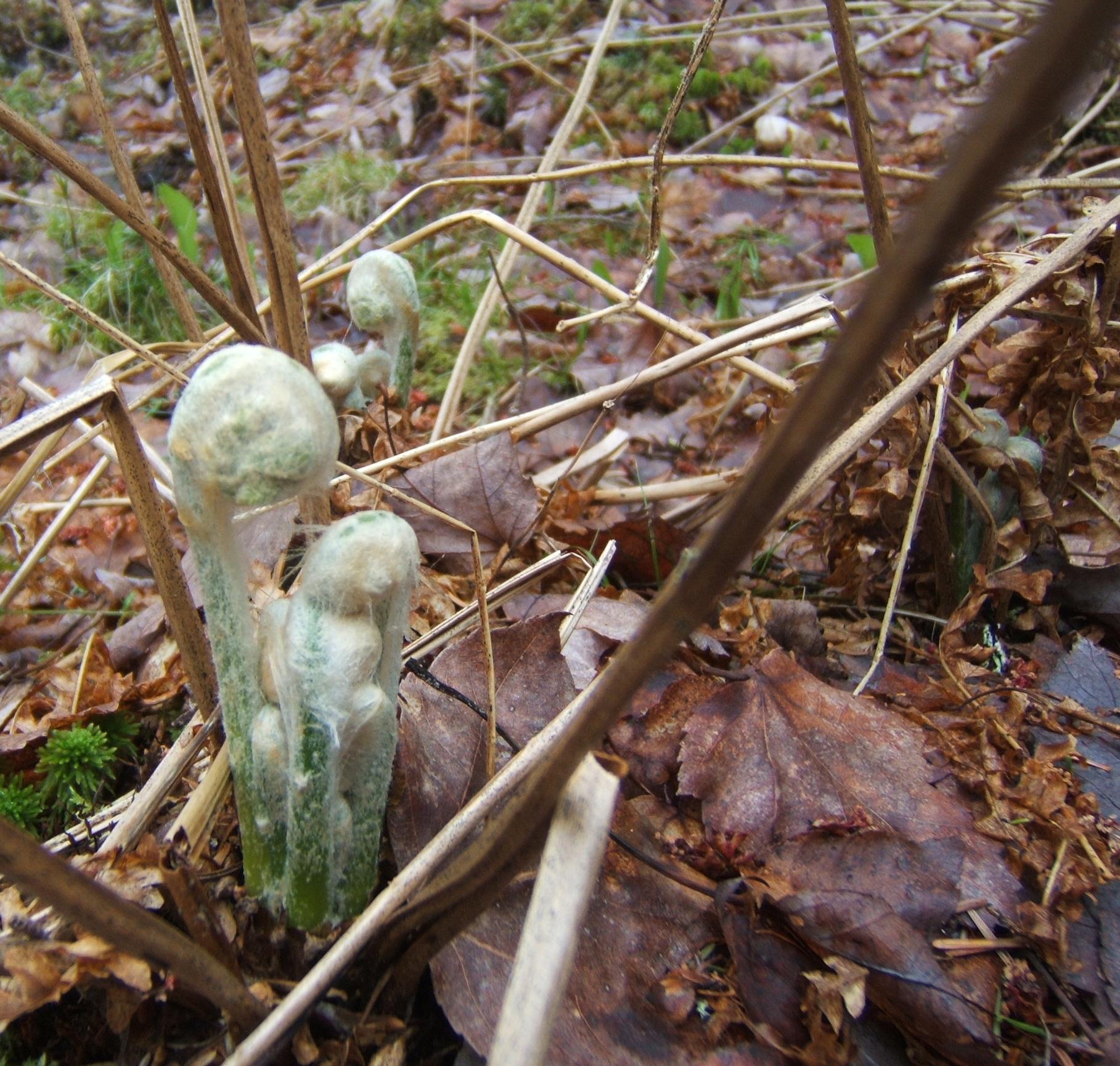
the wooly fiddleheads of the Cinnamon Fern are common in wet woods in New Brunswick
The Cinnamon Fern (Osmunda cinnamomea L.) grows in wet woods and other water-logged areas. In our Grey Woods, it grows in the fern gully (see the ‘map of the grey woods’ under ‘about‘).
Cinnamon Fern is a twice-cut fern (the leaves are cut into leaflets and these, in turn, are cut into sub-leaflets). As the sterile leaves expand, you can see fine cinnamon-colored wooly hair along the stalk, and tufts of cinnamon-colored hairs on the underside and at the base of each leaflet. The plant produces separate fertile spikes that turn cinnamon-brown in color.
~
~
fiddleheads
~
thin music in the May-woods,
trowie tunes from the peerie folk,
a bridge between spring
peepers and the wind,
fiddleheads carved in
Sensitive red and Ostrich green,
the bow strung by spiders,
the riff in the violin trembles
as potential uncoils,
music befuddled in a web
of Cinnamon wool
~
~
© Jane Tims 2012
Warning: 1. never eat any plant if you are not absolutely certain of the identification; 2. never eat any plant if you have personal sensitivities, including allergies, to certain plants or their derivatives; 3. never eat any plant unless you have checked several sources to verify the edibility of the plant.places off-planet #6 – the ‘Coathanger’ asterism
Most people have never seen my favourite star grouping, but if you use binoculars and can locate two key stars, I think you could see it too. It is the ‘Coathanger’ asterism (or group of stars), also known as Collinder 366, Al Sufi’s Cluster, or Brocchi’s Cluster. It looks like a little upside-down coathanger. It was first described by the Persian astronomer Al Sufi in 964 AD!
The ‘Coathanger’ is in the constellation Vulpecula in the ‘Summer Triangle’. To find the ‘Coathanger’, use the binoculars to sweep the Milky Way from the star ‘Altair’ towards the bright star ‘Vega’. The ‘Coathanger’ is found about one-third of the way from Altair to Vega.

photo is from Wikimedia Commons
original contributor DannyZ
~
~
coat hangers, closets and stars
~
1.
metal hangers
aggravate
refuse to cooperate
jangled
tangled twisted
~
2.
her closet
built for grace
satin hangers
muffled plumped and padded
kind to arthritic hands
~
pearl buttons to catch
her dresses
before they slip
to the floor
~
3.
between Altair and Vega
Brocchis’ Coathanger Cluster
also known as Collinder 399
suspends the fabric of sky
~
with binoculars
this fuzzy patch of light
resolves
to ten splendid stars
~
strong little hanger
oversized hook
upside-down
~
~
© Jane Tims 2011
Wild Lily-of-the-Valley (Maianthemum canadense Desf.)
This time of year, the floor of our Grey Woods is carpeted in the leaves and blooms of Wild Lily-of-the-Valley (Maianthemum canadense Desf.). The leaves first poke through the dry leaves in mid-April and literally unfurl …

By May the forming flowers are visible…

… by late-May they are in full bloom.

I cannot get a good photo of a white flower, but this shows their star-like quality
The Wild Lily-of-the-Valley, also known as False Lily-of-the-Valley and Canada Mayflower, grows in woods and clearings, and is one of the first plants to appear in the coniferous woods understory. The leaves are heart-shaped, cleft to fit around the floral stem. Flowers are white, contained in a compact elliptical raceme. Each little flower is four-pointed.
The berries of Maianthemum canadense are edible, first appearing as whitish-green with small spots and gradually turning to red.
~
This post is dedicated to Barbara Rodger’s mother, who loved Lily-of-the-Valley, the flower the Wild Lily-of-the-Valley gently resembles!
~
~
Wild Lily-of-the-Valley
– Maianthemum canadense Desf.
~
slim emerald flames
burn through dry leaves,
ignite sparklers
of stamen stars,
puffs of smoke,
white berries heat to red
embers in forest
~
~

Bluebead Lily (Clintonia borealis (Ait.) Raf.)
When I hike through the woods, I am made uneasy by two unnatural-looking berries… the ‘doll’s eyes’ of White Baneberry (Actaea pachypoda Ell.) , and the metallic blue berries of the Bluebead Lily (Clintonia borealis (Ait.) Raf.). Both berries are poisonous and inedible. I’ll write more about White Baneberry in a later post, but first, I want to tell you about the Bluebead Lily.
The Bluebead Lily is also known by the names Snakeberry, Dogberry, Corn Lily, Cow Tongue, Straw Lily and even Wild Lily-of-the-Valley. It is called after De Witt Clinton, several-times Governor of New York. Its specific name, borealis, is Latin for ‘northern’.
Clintonia grows in rich, cool hardwoods, often on slopes. The plant consists of two or three large, shiny basal leaves, with parallel veins, wrapped around one-another and clasping the base of a flower-stalk. The stalk bears several yellow-green nodding lily-like flowers. In late May, these flowers are just beginning their blooming.
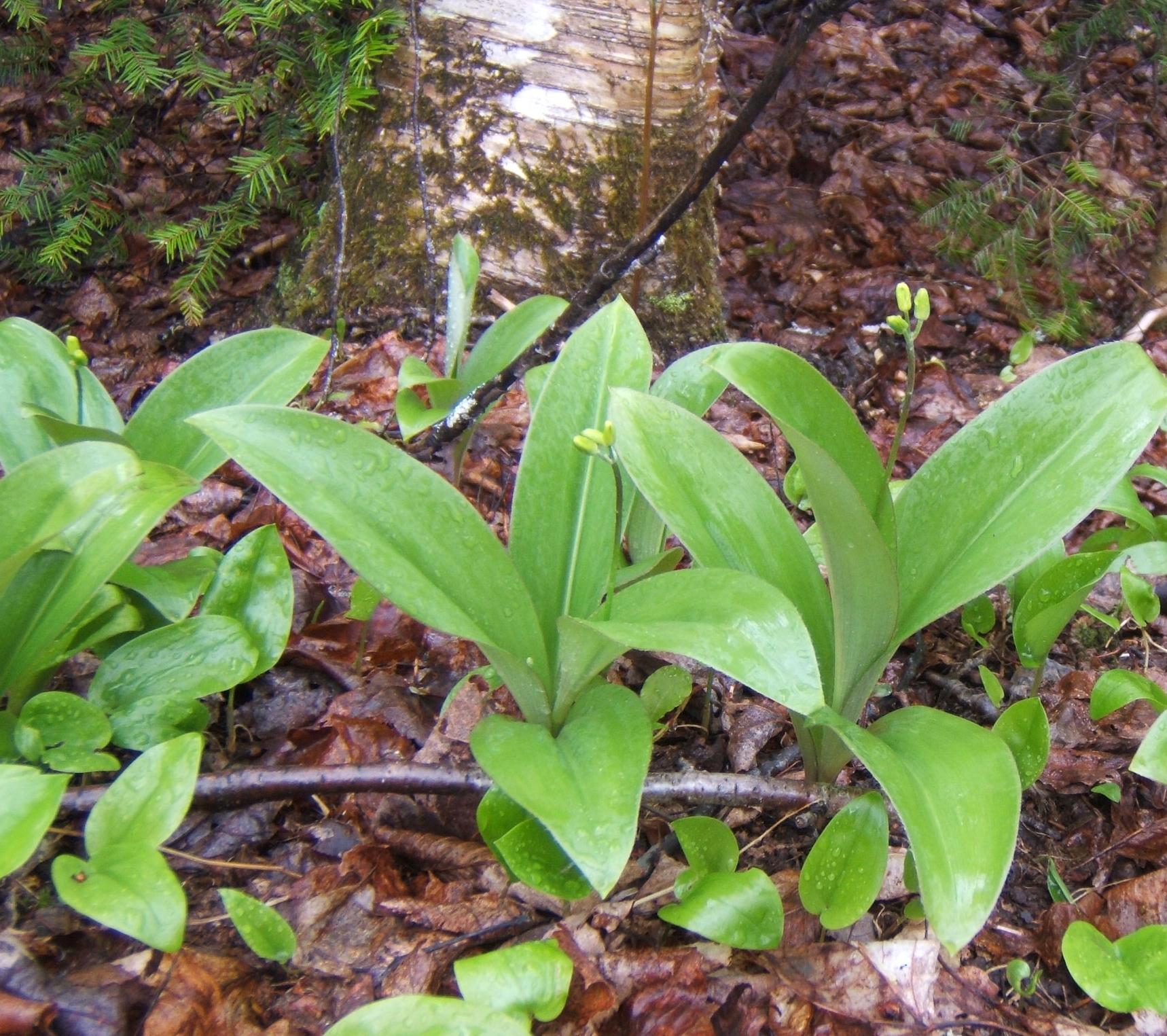

By July, the berries are ripening. These are considered inedible, perhaps toxic. They are oval, shiny, dark blue, and to me, menacing.
Although the berries are inedible, the young leaves, when they are just expanding, can be eaten cooked or raw, and taste like cucumber. To cook them, boil for 10 minutes and serve with butter. As the leaves mature, the cucumber taste becomes strong and unpleasant.
If you want to try the young leaves of Clintonia, make sure you are certain of identification since there are many leaves in the woods that may superficially resemble the leaves of Clintonia.
Have you ever seen a Bluebead Lily and its berries or flowers?
~
~
poisonous
~
White Baneberry
and Bluebead Lily –
vivid berries
peek between leaves,
part a path
in the understory, dolls
wink, use fern shadow
to blink or disguise
a gift, a bead
of metal, stained
glossy, alien
blueberry-blue
~
glossed by the Guidebook
with skull and crossbones
~
~
Warning: 1. never eat any plant if you are not absolutely certain of the identification; 2. never eat any plant if you have personal sensitivities, including allergies, to certain plants or their derivatives; 3. never eat any plant unless you have checked several sources to verify the edibility of the plant.© Jane Tims 2012






 nichepoetryandprose