Posts Tagged ‘art’
in the branches of the White Pine

- the White Pine is the larger tree to the left of the road

The most frequent denizens of the pine are a pair of Bohemian Waxwings (Bombycilla garrulus). They prefer berries for food and so are in their ideal habitat. Our property must look like a big dinner plate to them, with its orderly presentation of wild strawberries, blueberries, blackberries, hawthorn and winterberry.
Another bird who stops to rest in the pine is the American Goldfinch (Carduelis tristis), also known as the Thistle bird. These are seed-eating birds who fly across the fields in a distinctive pattern of loops. They are also one of the most common birds at our winter bird feeder.

~
~
building homes
~
we fly kites
to learn the field and sky
set copper whirligigs to spin
~
yellow flirt crosses blue
per-chick-or-ree
potato-chip potato-chip potato-chip
~
we build our cabin
with 2 by 4s, boards and trusses
woodscrews and spiral nails
~
firm framework
woven grass and birch
bark rim and spider silk
~
you fill walls with fiberglass
I quilt curtains for windows
~
goldfinch waits while his female tucks
her nest with thistledown
tufts of cattail, puffs of dandelion
~
© Jane Tims 2011

Briar Island Rock #4

~
~
jointed ruler
(Wreck of the Trafalgar, 1817)
~
the ship is broken on rocks
and we leave in fog
I hold my brother’s hand
we stumble up the shore
in a yellow room of fog
it stumbles with us
they set the baggage down
together, folded
we wait
~
my step-father
pats my mother’s hand
leaves to talk with the Captain
the ship is lost
I look up at my mother
she watches him go, her lips move
she says we will lie in green pastures
~
I look for grass but only see
black rock and grinning fog
lanterns and men calling
my brother sniffs a little
in my pocket I clutch my father’s jointed ruler
he was a carpenter, would have fixed the hole
the mate says
there’s no going back to her now
we stay where we are
folded in a yellow room
luggage at our feet
~
the walls move
the ruler opens
I see the ship
black hull held high
on dark and pointed rock
against the early morning sky
white waves beyond
the ruler closes
~
pink and yellow mix, and the room
is the color of pumpkin
the ruler opens and I know
the black shore has bristles
I heard the mate call it
Briar Island
~
the rock I stand on tips a bit
I step down
the rock is wet and grey
five sides
a funny-looking stone
fits with other stones
strange puzzle
~
I take my ruler
help it to unfold
I measure the rock
I make it jiggle and my brother smiles
a little smile
the ruler folds, unfolds, the room expands
I see my step-father’s uneven walk
across uneven stones
~
~
Copyright 2011, Jane Tims
a nest in November
On Saturday, we drove to the lake to gather boughs of fir and pine for our Christmas decorations. While we were there, we poked around in the thicket. We found a few bird nests, still intact, easily seen now the trees and alders are free of leaves.
The first nest was cup-shaped, made of tightly woven grasses and weeds. Nests of songbirds are not easy to identify since they are similar in size and construction materials. If this little nest survives the winter, perhaps I can watch who uses it next spring.
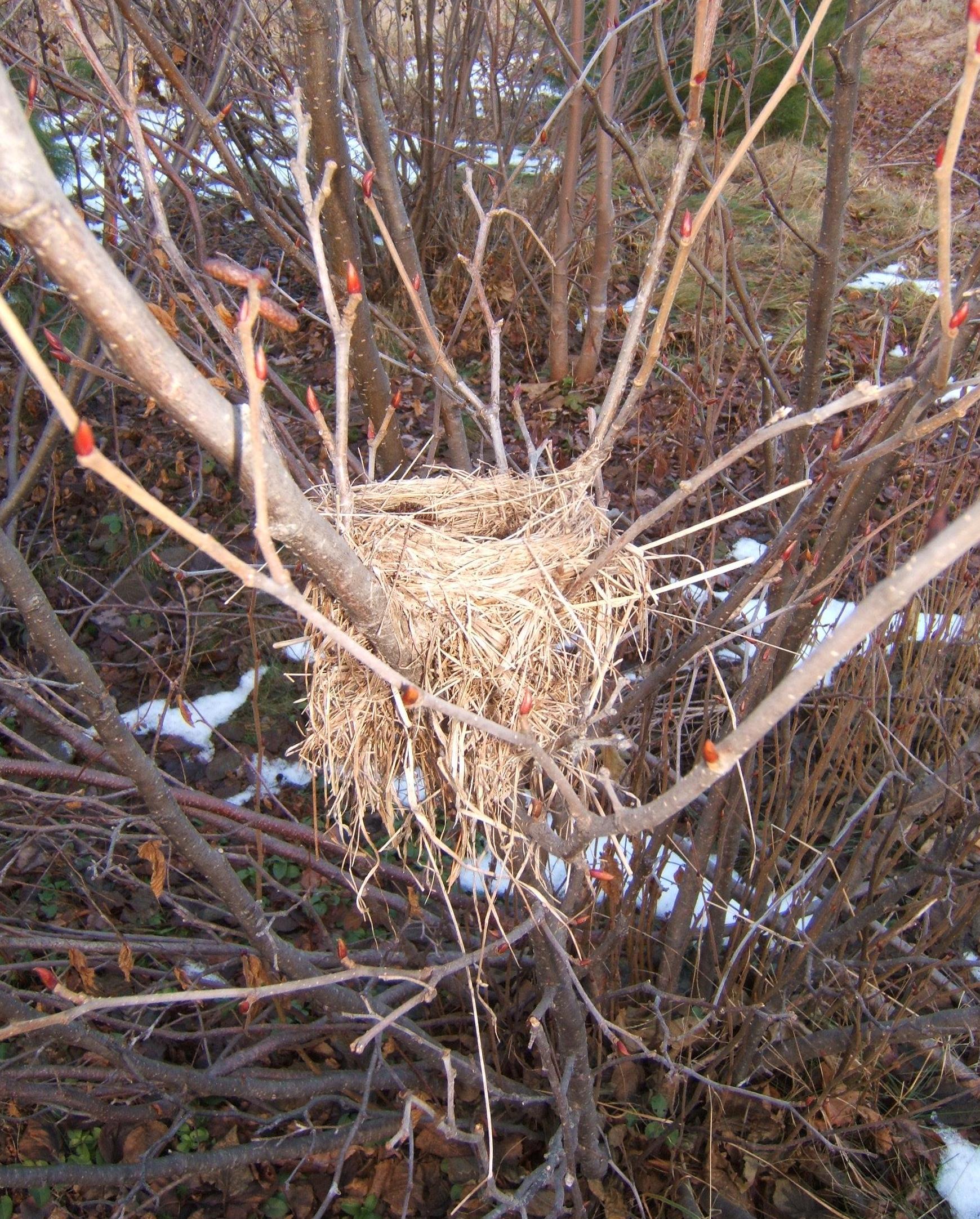
The second nest probably belonged to a Robin. It was high in a tamarack tree, welded firmly to the branches. Robins often return to the same area and sometimes use the nest of the previous summer, so I’ll be watching this nest too.

The last nest we saw was a beautiful little hanging basket covered with birch bark and woven with grasses. It appeared to be frail but it was very sturdy and stubbornly clung to the bough in spite of its exposure in the November wind. I think it is the most delightful sight I have ever seen.
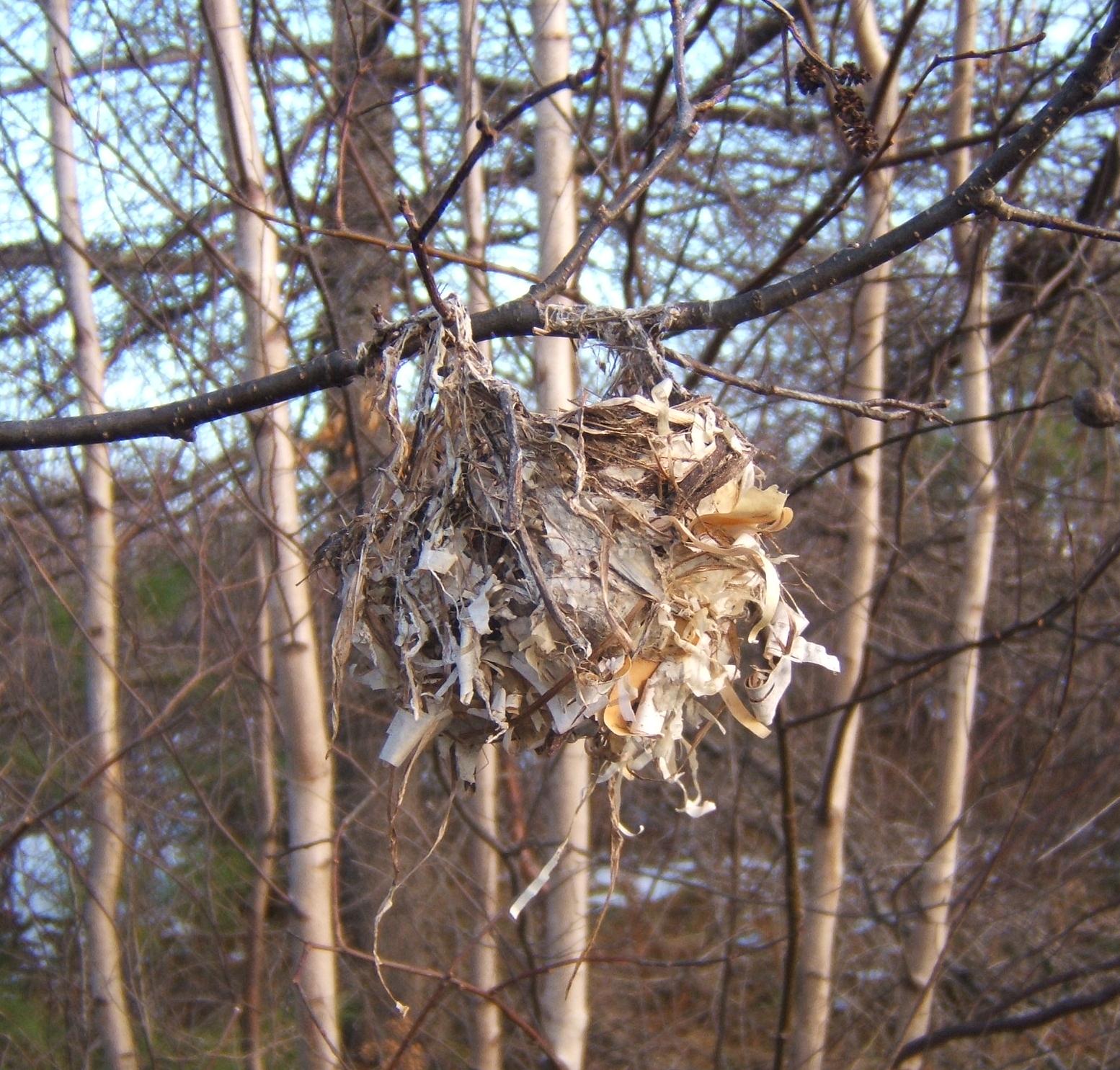
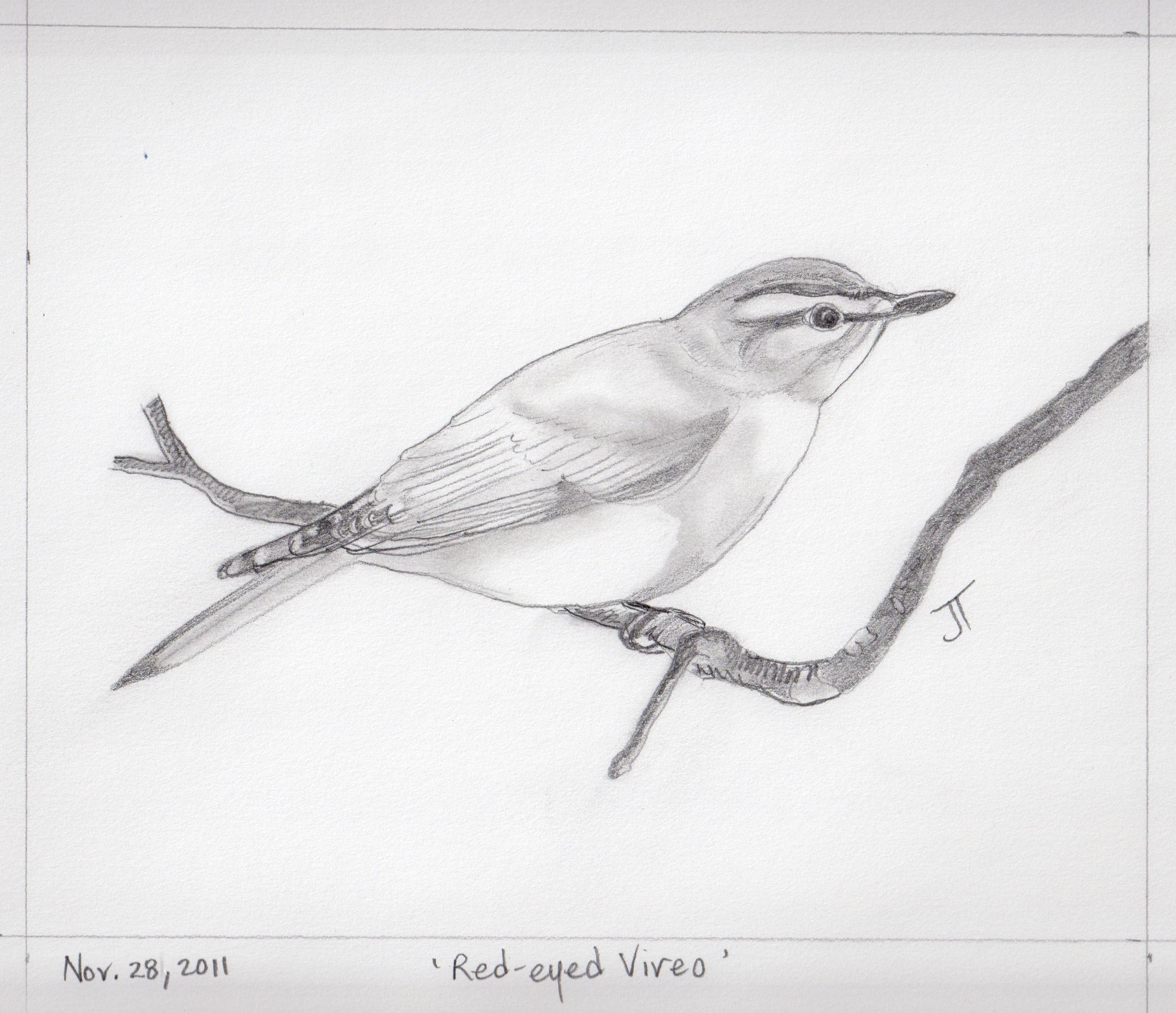
A biologist with the New Brunswick Department of Natural Resources was able to identify this nest from my photo. The nest probably belonged to a red-eyed vireo, one of our common songbirds. I have never seen this bird at our lake property, but we hear it all summer, endlessly asking its question and giving an answer.
~
~
Red-eyed Vireo
(Vireo olivaceous)
~
drab little
olivaceous outlaw
black masked
red eye
~
can’t see you
can’t find you
can hear you
where’re you?
over there
where’re you?
nowhere
~
in November
ghost-self flutters
in birch bark tatters
a basket in the alder
remnant of summer
~
gone now
what’d ya do?
did an answer finally
come to you?
~
© Jane Tims 2011
cave beneath the waterfall
In the cold weather, I think about the waterfalls we saw this summer. As the temperature gets lower, they succumb. First the water freezes at the edges, building up on the rocks and ledges. Then, gradually icicles build and the surface water freezes. By mid-winter, the waterfall will be a frozen cataract, a glass house of ice. Within the frozen falls are ice caverns and icicles, places where water runs and where water stands still, and places where the ice traps sunlight to shimmer and sparkle.
One of the waterfalls we visited this summer was Smith Falls (see ‘niche beneath waterfall’ under the category ‘waterways’, published October 21, 2011). At the base of the waterfall was a small cave. In winter, the entrance to this cave must be a crystalline curtain of icicles and glass.
Below, in my poem and drawing, I remember the cave and waterfall in summer.
~
shelter
‘a small cave is hidden beneath the falls’
– trail guide
~
sip of tea
candles lit in evening
a lap quilt tucked
relief from freshet
~
cave, respite
beneath two newly reconciled
slabs of bedrock
or where vulnerable sediments finally fail
succumb to the reach of water
~
spurt and shard
the brawl subsides
and damp recedes
pollen settles
~
concentric rings
and space is made
to occupy
~
© Jane Tims 2011

© Jane Tims 2011
jane 9 squirrels 1
Again, I am in competition with the squirrels (see ‘competing with the squirrels #1 and #2’, in the Category ‘competing for niche space’).
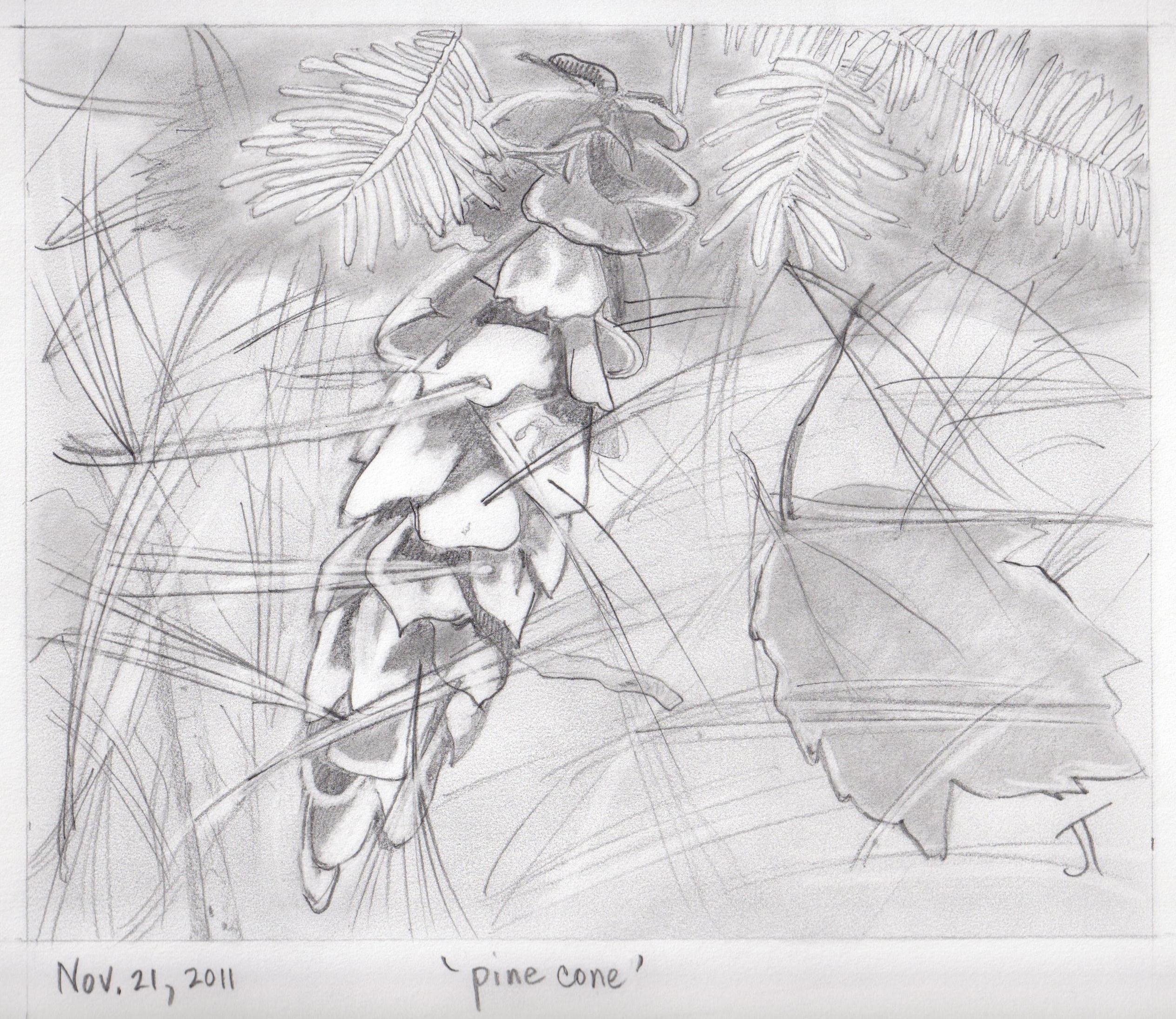
Christmas is coming and this year, I am decorating with natural elements. One of these is a ceramic bowl of large pine cones.
We have several large White Pine (Pinus Strobus L.) on our property and from time to time, they produce masses of beautiful pine cones, perfect for my decorations. White Pine are easy to remember in this area, since they have their needles in bundles of five. The cones are between 10 and 15 cm long and are a favourite food for squirrels.
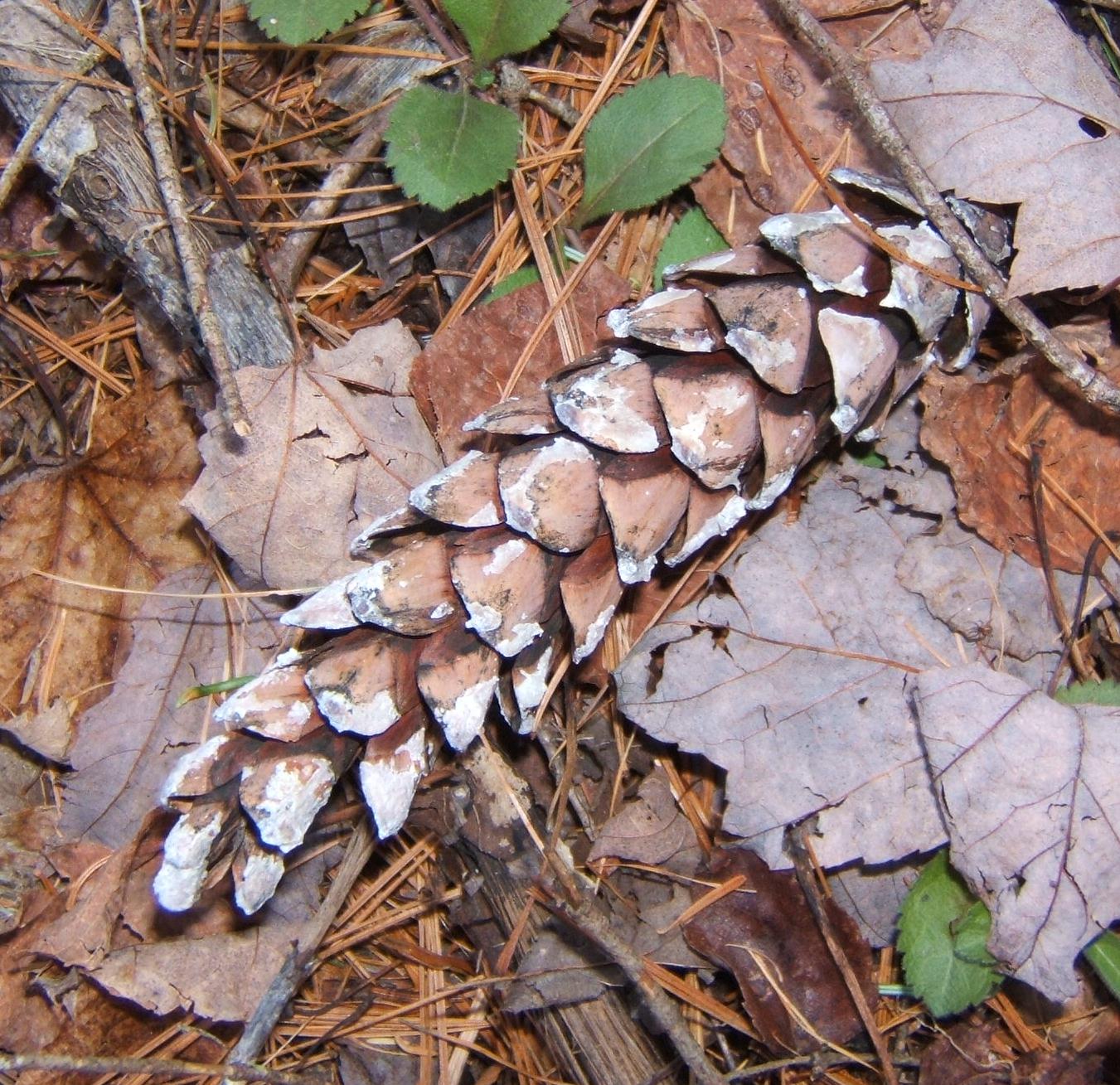
My husband came in last weekend and announced there were lots of the big cones in the pine tree next to our lawn. “Watch for them to fall, and then you should hurry to collect them,” said my savvy husband (he remembers the sad tale of the ripening hazelnuts).
I waited a couple of days and then went scavenging. And now, I am supreme. I have gathered enough cones for our Christmas. I saw a few cones with the lower scales and seeds nibbled away, but I found plenty for me. My hands were sticky, true, but I was so happy. All I can say is, with an emphasis approaching smug, “CH-CH-Ch-chchchchch-ch.”

- just to show that the squirrels do have lots of pine nuts… these cones are about half eaten

in November
~
we gather pine cones
snakes of lion’s paw
hawthorn
cedar boughs
and holly
~
we walk the wild ways
pruners and scissors
baskets and stout cord
bind bunches
of branches
~
balsam and cedar
blood berries
and evergreen
garlands of fir
rosehips and acorns, gilded
needles
and prickles
and thorns
~
© Jane Tims 2011
crows in trees

Of all the birds, I like the American crow (Corvus brachyrynchos) the best.
For one thing, they seem to me to be full of personality. I also know that crows are intelligent – research shows they can distinguish humans from one another by facial features. Crows also stay in family groups (parents and fledged offspring) for a few seasons. I feel sorry for crows; they seem to have a bad reputation and are treated poorly as a result.
If you want to learn more about crows and their habits, have a look at Michael Westerfield’s new book “The Language of Crows: The crows.net Book of the American Crow,” available at www.crows.net/crowbook.html .
A group of crows is known as a ‘murder’ of crows. The term ‘murder’ refers to the ‘observation’ that a group of crows will kill a dying cow. Some people are advocating for an alternative, since the term ‘murder’ perpetuates the notion of crows being malicious. Alternative names for a group of crows are presented in http://www.crows.net/mjw.html Michael Westerfield’s Crow Log: The Crows.net Project. I think this is an opportunity for a Poll!
~
~
Morning Song
~
in the morning
dew soaks the grass
and Canada
belongs to the crows
~
the croaking of ravens
the cawing of crows
familiar, unheard
backdrop to Canadian dawn
~
(theme music
in Canadian film)
~
in a conversational rattle
discussing gold and letters
~
a two syllable scream
haunting the fields
~
solitary sorrow
throned at the top
of a tamarack
~
black wings bruise the air
he calls an alarm
screams to his mate
the love of his life
with only the fall of the dew
for an answer
~
silent is the shroud of black feathers
strung by the feet from a pole
beside a garden
where she braved the flapping man
and dared to pull new corn
~
in the morning
Canada belongs to the crows
~
Published as: ‘Morning Song’, Spring 1995, The Cormorant XI (2)
© Jane Tims 1995
American Star-flower (Trientalis borealis Raf.)
Crisp November nights are a perfect time for a quick look up at the stars. I’ll be including some posts about our star-gazing, but for now, my thoughts are still turning back to summer. Stars in the sky? There are also stars in the dark summer woods.
The American Star-flower, Trientalis borealis Raf., is a plant with a delicate white, star-shaped flower, found in late spring in woodlands and on peaty slopes. Its scientific name comes from the Latin word for the third part of a foot, a reference to the height of the plant, and the Latin borealis, meaning northern. It is a common little plant, described by Fernald as a “forest pioneer”.
Some will wonder what the ‘Raf.’ refers to, at the end of the scientific name. This is an attribution to the botanist who first named the plant. In many cases, the attribution is ‘L.’, meaning the plant was first named by Carolus Linnaeus (the biologist who first introduced the ‘binomial’ naming system for plants).
‘Raf.’ stands for Constantine Samuel Rafinesque-Schmaltz who first assigned the genus and species names to the plant – Trientalis borealis. He was an eccentric polymath (knowledgeable in many fields and disciplines) who lived from 1783 to 1840. In his lifetime he published 6,700 binomial names for plants.
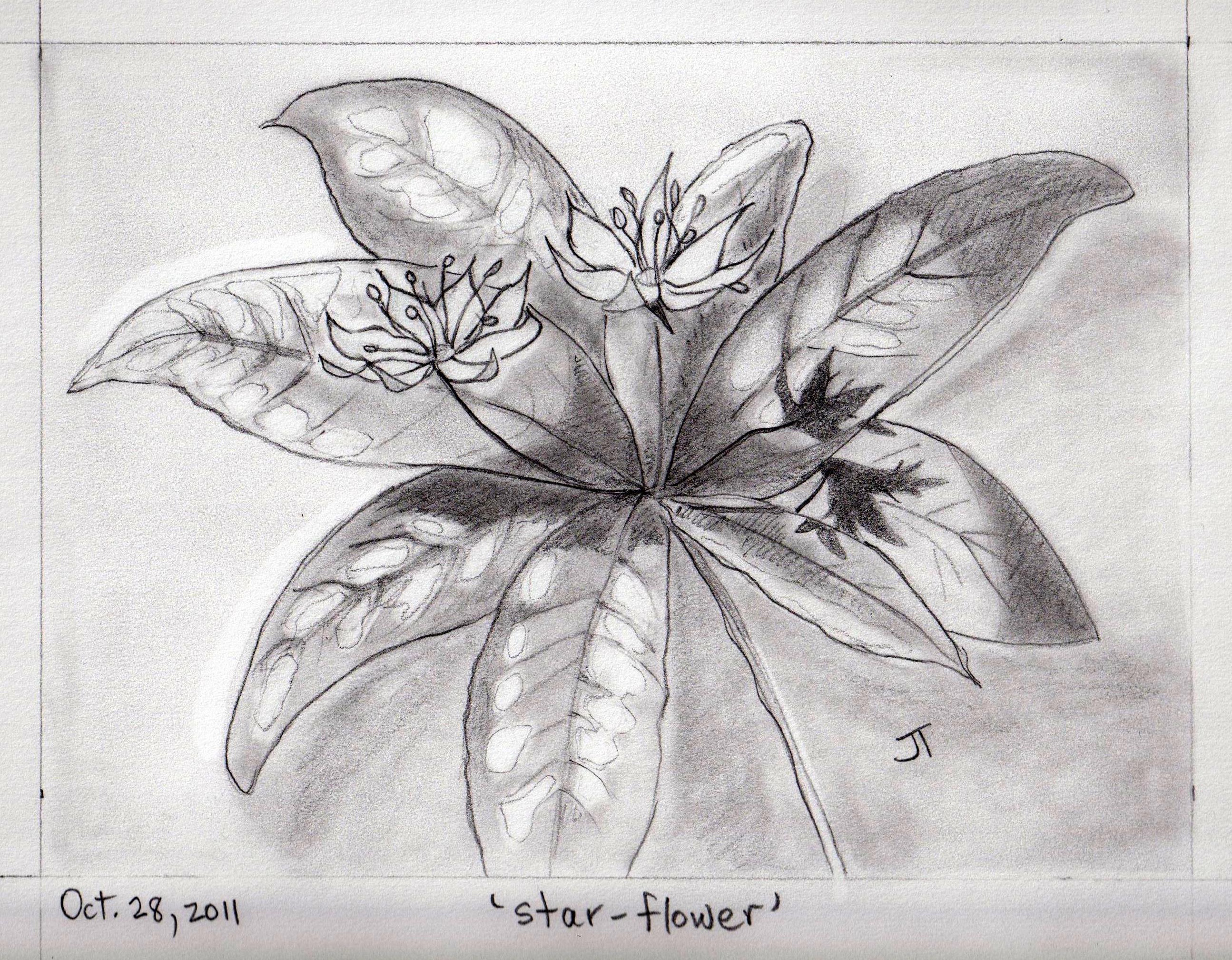
Star-flower
Trientalis borealis Raf.
~
Trientalis
borealis
star-flower
lost from the sky
four inches high
(the Latin name
makes claim)
petals white
boreal light
fallen down
first found
by Constantine
now often seen
it’s little lamp
above the damp
a forest pioneer
final frontier
up above
twinkling of
stamen and star
who you are
I wonder
and wander
down a trail blazed
by a frail flower
one candle power
~
Published as: ‘Star Flower’, Winter 1993, The Antigonish Review 92.
revised
© Jane Tims
a bridge for the soul
In eleventh century Sweden, rune stones were often raised by landowners as a memorial of their accomplishments.
Jarlebanke was a landowner and a local magnate who lived in Uppland, Sweden during the second half of the eleventh century. He took pains to ensure he would be remembered, and six stones survive of the many he ordered to be carved.
Four of the surviving stones stand at the ends of the Täby bru. The Täby bru is a ‘bridge’ or causeway marked with two rune stones at each end.
One of these stones (U127) was used in the 17th century as the threshold of the church in Täby; it now stands to the side of the church door. The inscription (in runes) says: Iarlabanki let ræisa stæina Þessa at sik kvikvan, ok bro Þessa gærđi fyr and sina ok æinn atti Tæby allan. This has been translated as: “Jarlebanke let raise these stones after himself, while he was living, and he made this bridge for his soul, and he himself owned the whole Täby.”
The stone depicts two serpent creatures enclosing a Latin cross. Symbols of the old religion and Christianity are often found together on rune stones, evidence of transition in belief systems. Jarlebanke was not taking any chances when he recognized both religions on his rune stones. The facimile (below) of the runes on the stone is from:
http://www.ludd.luth.se/~frazze/history/mirror/viking_age/runes/nytt/images/u127.gif

facimile of carvings on rune stone U127
a bridge for the soul
Danderyds church, Täby, Uppland
~
ok bro Þessa gærđi fyr and sina…
and he made this bridge for his soul…
– inscription on a Täby bridge runestone
~
Jarlabanke made this bridge
for his soul
a causeway crossing marshy ground
~
uncertain
for though he owned all Täby
he was afraid
~
he raised these four while living
a rare deed
the stones, of course, never care
~
first at the ends of the Täby bru
then at the threshold
of the south church door
~
the Cross tethered to old faith
dragon-kind
best wager for passage into heaven
~
© Jane Tims 2003

Northern White Violet (Viola pallens (Banks) Brainerd.)
Yesterday, we had our first dusting of snow and it persisted on the grass until the evening. It reminded me of some of those low white summer flowers whose petals look like snow when they bloom in masses on the lawn or in a field. In any season, the sight of ‘snow’ can be a charming, welcome sight.
The northern white violet, or small white violet (Viola pallens (Banks) Brainerd.) inhabits the moist ground of meadows, bogs and thickets, and it blooms profusely on our front lawn. Pallens means pale, referring to the color of the flowers. The leaves are somewhat heart-shaped.
The violets are a difficult group, taxonomically. Viola pallens is also known as Viola macloskeyi Lloyd.
Northern White Violet
Viola pallens (Banks) Brainerd.
~
stars in the northern meadow
scattered at the feet
of cattle grazing hay
violet sweet
~
hearts among the grasses
where the ground is wet
flowers pale and nodding
small white violet
~
Published as: ‘Northern White Violet’, April 2005, Refuge 14 (1)
© Jane Tims 2005

monuments in stone
inuksuk n. (plural inuksuit) a stone landmark or cairn used by Arctic and northern peoples to mark a point of reference or a place of significance; an Inuit cultural symbol.
inunnguaq n. (plural inunnguat) a stone cairn in the shape of a human figure, meant to represent a human figure, and distinguished from an inuksuk.
Wikipedia.org
Our rock project is progressing slowly. We are collecting rocks for a stone monument. Since I want this to be a sculptural piece, I am sure the rocks we select will play a role in the final look of the monument.
One possibiity is to build an inuksuk. These stone landmarks are a part of the culture of the north, but they have caught the general imagination and are now encountered throughout Canada. On our trip out west, the inuksuk built along the Trans-Canada highway in Manitoba were particularly memorable.
For a few years, the inuksuk (plural inuksuit) and inunnguaq were common along the New Maryland highway in New Brunswick. On the stretch of road between New Maryland and Fredericton, the highway is carved through rock and outcrops are part of the roadscape. A women who walked along the road every morning for a few years was responsible for building many of the inuksuit. The local newspaper did a story on her, explaining that she walked and built the monuments as exercise following by-pass surgery. She wore a white jogging outfit with black splotches and was fondly referred to as the ‘Cow Lady’.
The ‘Cow Lady’ no longer walks the road and her inuksuit and inunnguat have fallen into disrepair. I remember her fondly and dedicate the poem below to her.
Inunnguaq 101
~
these are the hill people
sometimes without arms and legs
sometimes with other, alien parts
but proud
honor the woman who walks here
~
sometimes toppled
often reassembled
constructed one day at a time
optimism of increment
a community on the hillside
~
© Jane Tims 2004




 nichepoetryandprose
