harvesting colour – the yellow of tansy
Since last September, a small bunch of Tansy (Tanacetum vulgare L.) has hung on the line in my kitchen. Now, with a small batch of alum-treated wool, I am able to see what colour will come from the dried and lifeless flowers.
~

dried Tansy, collected in 2013
~
To extract the dye, I crumbled the flowers and leaves and soaked them in water overnight. Then I added more water and brought them slowly to a boil in my big, well-marked dyepot (marked so I will not use it for food by mistake). After an hour’s boil, I let the dye cool and strained the liquid. The result was a clear, amber-yellow dye.
~

dye from Tansy and water, simmered
~
To dye the wool, I added water, immersed a shank of alum-treated wool and slowly brought the dye to a simmer – one hour and then the long process of cooling (I am realising that dyeing is more about waiting than doing!!!!!!!!!!!). The result is a green-yellow, almost exactly the colour shown for Tansy-dyed fibre in Jenny Dean’s book (Wild Color) !!! My photo is not clear because the drying line insists on vibrating but you can clearly see the colours – left to right – the brown of the lichen-dyed wool from a few days ago), the green-yellow of the Tansy-dyed wool and the tan of the undyed wool.
~

three shanks of wool, dyed with the lichen Usnea (left), dyed with Tansy (center) and raw wool (treated with alum)
~
I wrote my poem to the heady yet sleepy smells of the Tansy boiling in its dye pot. I remembered the living Tansy, growing in the ditch last summer, each flower cluster hiding a sleepy bumblebee that had to be shaken from its resting. I was also reminded in my reading that Tansy was used so often at funerals in New England in the 19th century that people associated its smell with death.
~
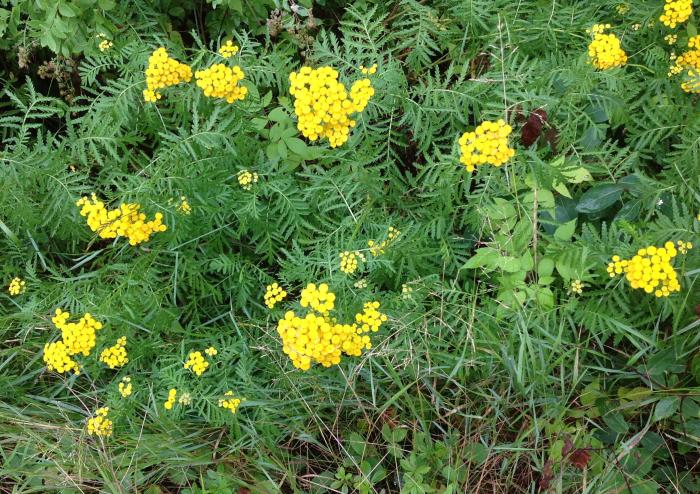
Tansy in the ditch
~
sleep before dyeing
~
Tanacetum vulgare L. – Common Tansy, Mugwort, Bitter Buttons
~
Bitter Buttons hover in the dye pot
simmering on the kitchen stove
drowsy scent of camomile
camphor and rosemary
liquid amber, saffron sallow
jaundiced pale of Tansy
reclines in the roadside ditch
each flat-topped cluster
hibernaculum
for a furred and yellow
unconcerned
and mellow
bumblebee
~
~
Copyright 2014 Jane Tims
harvesting colour – beautiful brown!
I will never see brown with the same eyes again!
~
Today I finished a batch of alum-treated raw wool and I was ready to try my first experiment with dyeing animal fibre. The alum, you will remember, is a mordant, added to the fibre to increase its colour-fast and light-fast qualities. In some cases, it also makes the colours brighter.
~
Remember my gathering of Old Man’s Beard lichen? (https://nichepoetryandprose.wordpress.com/2014/03/26/colour-on-the-snow/)
~

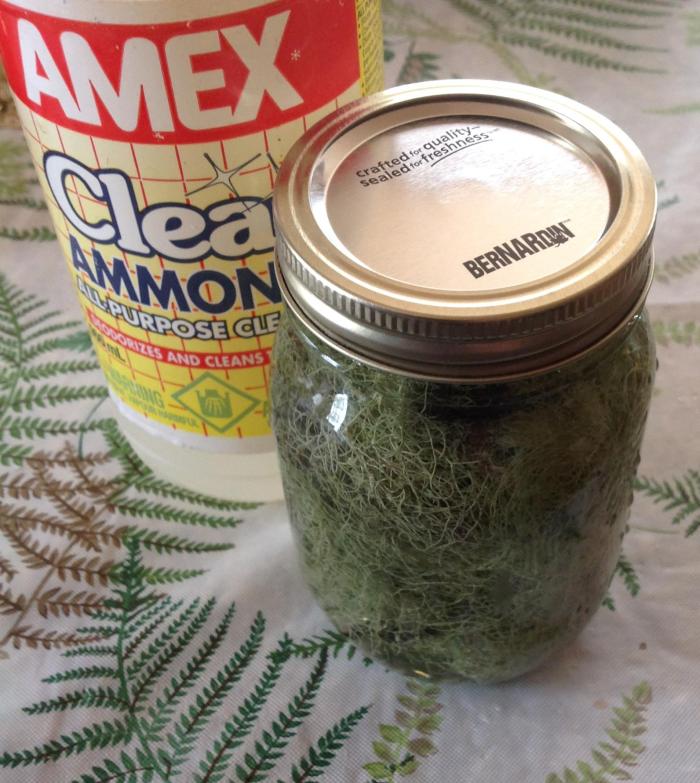
jar with Old Man’s Beard lichen, water and ammonia
~
The lichen has been ‘fermenting’ in ammonia about a week and developed a lovely brown colour with tones of orange, reminiscent of root beer.
~
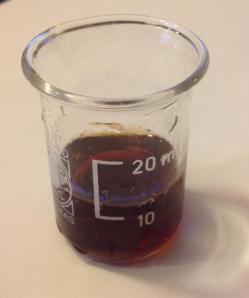
a sample of the dye obtained from the Old Man’s Beard lichen
~
I sieved out the lichen and added the dye to my dye pot. I added a little vinegar to neutralize the alkalinity since basic solutions can harm the wool. I put about one once of the alum-treated wool into the dye pot and added water, to cover the wool. Then I increased the temperature very, very slowly since sudden changes in temperature can damage the texture and weaken the fibres. I left the dye pot on simmer for about an hour and then left it to cool slowly. Now the wool is drying on the line in my dining room.
~
The result may seem like an unimpressive brown, but to me it is the most wonderful brown in the world. Reminds me of the ice cream in a root beer float! My first effort at dyeing wool, and obtained from a lichen of the palest green. I feel a poem stirring!
~
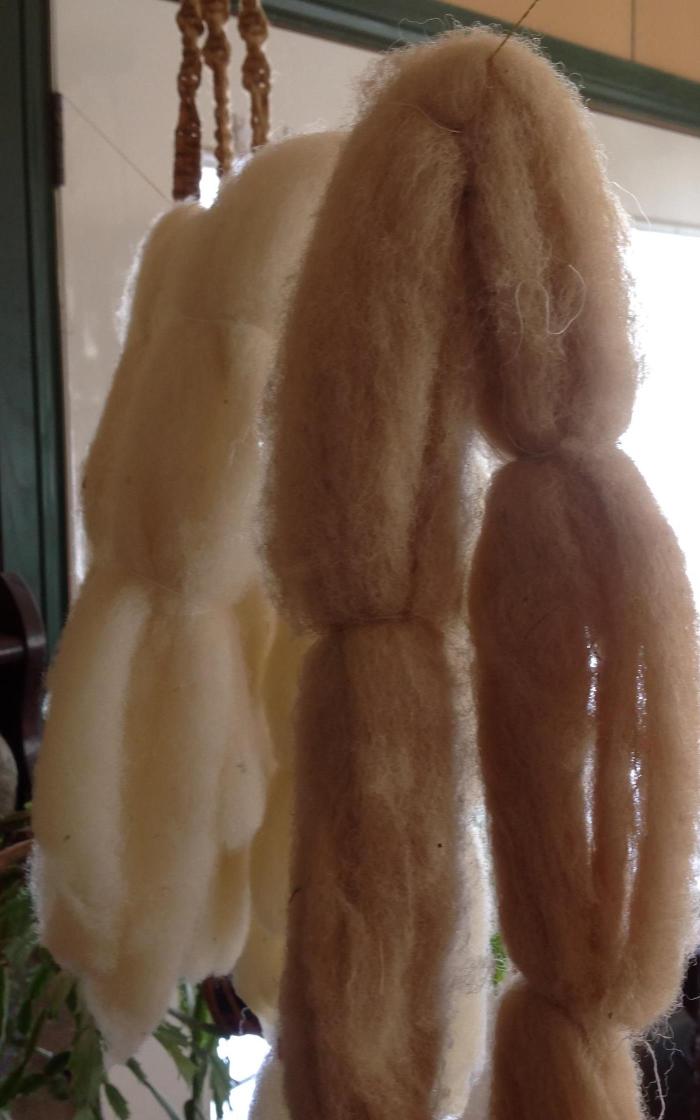
to the right, my lichen-dyed wool, and to the left, my un-dyed alum-treated wool
~
Copyright 2014 Jane Tims
harvesting colour – onion skin yellow
About a month ago, I stuffed an old white cotton shirt into a pickle jar with onion skins and cider vinegar (https://nichepoetryandprose.wordpress.com/2014/02/21/harvesting-colour-onion-skins-in-a-pickle-jar/). It was all I could do not to open the jar early to see how everything was progressing, but I was patient. On Friday, I opened the jar to see the results!
~

the pickle jar containing cider vinegar, my old shirt, and a few handfuls of onion skins
~

cotton shirt and onion skins released to the sink
~

onion skins picked away to reveal yellow and maroon
~

a rinse with water
~

and my ‘new’ shirt hanging on the line to dry!
~
I am so pleased with the results. The yellows are bright and an old shirt is wearable again. The dried cloth is soft and smells clean and fresh. And, most important, I have another poem to add to my growing collection.
~
~
transformation
~
cotton shirt
soft and comfortable
but stained, unwearable
~
stuffed into
a pickle jar
onion skin and vinegar
~
thirty days –
yellow cheer,
saffron and sienna
~
stains concealed
tears dried
~
~
Copyright 2014 Jane Tims
preserving coastal marsh (day 24 and 25)
The last few days of my virtual biking have reminded me of the need to preserve coastal areas, including barrier beaches and coastal salt marsh. Day 24 and 25 of my virtual travels took me along Youghall Beach near Bathurst. This barrier beach has been almost entirely developed with seasonal and year-round residences.
~

map showing distance travelled (map from Google Maps)
~
8-24 March 24, 2014 35 minutes (south of Youghall Beach to Youghall)
8-25 March 25, 2014 30 minutes ( Youghall to south of Youghall)
~

aerial view of Peters River salt marsh (right) and Youghall Beach (left) (image from Street View)
~

Peters River salt marsh (image from Street View)
~
One of the reasons to protect barrier beaches from development is the close association with coastal marshes and their sensitive wild life. For example, the coastal marshes in the Bathurst area, including the coastal salt marshes of the Peters River near Youghall Beach, are home to the Maritime Ringlet Butterfly. The Maritime Ringlet (Coenonympha nipisiquit McDunnough) is a small butterfly with a wing-span of four centimeters. It is buff-and-rusty-coloured, with a dark eyespot.
~
This butterfly is endangered, because it faces extinction. It is ‘endemic’ to the salt marshes of the Baie-des-Chaleurs – this is the only place in the world where this butterfly lives. The butterfly can only live in the salt marsh – the Maritime Ringlet caterpillar lives on salt marsh grasses (Spartina patens) and the adult uses Sea Lavender (Limonium nashii) as its nectar source.
~
Government and conservation groups in New Brunswick have worked together to educate homeowners about protecting the Maritime Ringlet Butterfly. They list practical steps people can take to ensure the habitat of this endangered butterfly is protected. These include: not filling in the marsh, not burning marsh grasses, not using vehicles in the marsh, not picking marsh wildflowers such as Sea Lavender, and not going into the marsh. For more information on the Maritime Ringlet Butterfly and its protection, see http://www.bathurstsustainabledevelopment.com/userfiles/file/HSP%20Final%20MR%20ENGLISH%20brochure.pdf
~

March 27, 2014 ‘Maritime Ringlet Butterfly’ Jane Tims
~
Copyright 2014 Jane Tims
between the salt marsh and the sea (day 21, 22 and 23)
My virtual biking in early March took me along the last length of coast before Bathurst. This is an area of coastal salt marsh and barrier beach. It is also an area where a lot of coastal development has occurred. My bike ride revived many memories of days when I worked on the provincial coastal policy.
~
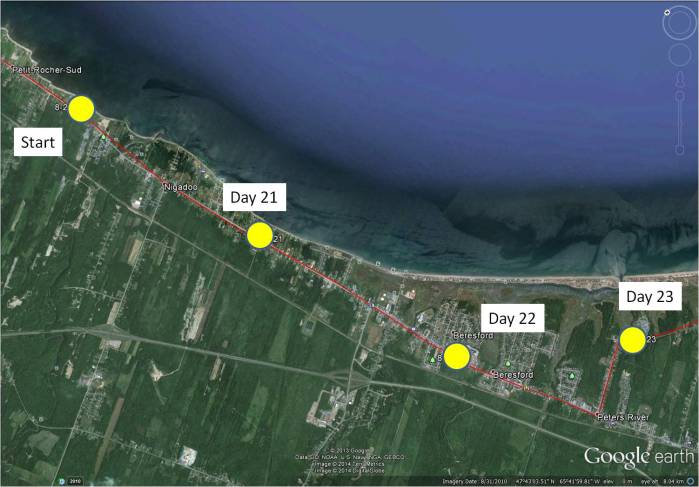
distance travelled (map from Google Earth)
~
8-21 March 1, 2014 40 minutes (Petit-Rocher-Sud to east of Nigadoo)
8-22 March 4, 2014 30 minutes (east of Nigadoo to Beresford)
8-23 March 8, 2014 30 minutes (Beresford to south of Yougall Beach)
~
The prominent landscape feature in the area is a huge coastal salt marsh and a barrier beach. I certainly understand why people would want to live near to the sea. However, the development of the barrier beach can harm the beach environment, puts the health of the ecologically important salt marsh at risk, and sometimes creates a safety issue for the homes and cottages along the beach (people who live along the beach are at risk of coastal erosion, storm surge and walls of ice that build up along this coast).
~

aerial view showing Beresford barrier beach, the coastal salt marsh behind it and the waters of the Baie-des-Chaleurs (map from Google Earth)
~
The community of Beresford has preserved a portion of the beach and marsh, creating the Passerelle, a long boardwalk to enable people to appreciate the marsh and the bird life there. The Passerelle can also be seen in the upper left corner of the aerial view above (a white, curved structure crossing a corner of the marsh pond).
~

a view of the Passerelle boardwalk on the Beresford Marsh (image from Street View)
~
Once private land is developed, either for seasonal or year-round residential use, the only way to protect the beach and salt marsh is to encourage homeowners along the barrier beach to live as gently as possible.
~
Copyright 2014 Jane Tims
lichens on the snow
As you may know, we are still under a blanket of snow here in New Brunswick. And later today a Nor’easter is predicted to bring another 30 cm. Not the best place for collecting plants as dyestuff. But, as I always find – nature provides!
Our windy weather this past week has dropped lots of Old Man’s Beard lichen (Usnea subfloridana) along our driveway. These lichens grow in the maple and spruce trees on our property but usually they grow too high to reach. I was able to collect quite a handful.
And now my experiment begins.
~

~
Lichens have been used for centuries as a source of dye. The Roccella species, for example, makes a purple dye called orchil. I may not get purple from my Usnea lichens, but I am ‘dyeing’ to try!
~

~
The typical extraction process for lichens is called ‘ammonia fermentation’ – soaking the lichens in ammonia for two or three weeks. Lichens also yield dye with boiling. I have decided to try the ammonia method first, although I will not use urine as was traditionally done!
~
~
So I stuffed the Usnea lichens into a canning jar, added water and a tablespoon of ammonia, labelled the jar and put it on the shelf.
~

~
And now we wait. I’ll let you know what, if any, colour develops. I feel like a housewife of old, wanting some dyestuff to add colour to my life, willing to make do with what is available.
~
Copyright 2014 Jane Tims
small scale economy – picking berries
~

~
small-scale economy
~
my box of berries spilled
on the footpath,
between leaves
of Kalmia and wintergreen
hawkweed and cow pies
~
the cousins, their boxes brimming,
stood gawking, dismayed,
I was certain they were thinking
dumb city girl, spilled her berries
box only half full anyway
~
instead, they gathered around me
sympathy in every hand
scooped most of the berries
into the box
added a few from nearby bushes
~
seventeen cents he paid me
half the value of a box at full
the cousins had picked a crate or more,
remembered the wasted berries, left on the trail
and wept at the loss
~
~
Published as: ‘small scale economy’, Canadian Stories 16 (94), December 2013/ January 2014
Copyright 2014 Jane Tims
harvesting colour – memorable colour
I am starting to think about some of the colours I hope to capture in my dyeing projects. In my reading I have discovered that plant colours come from three groups of plant pigments:
- the porphyrins – includes chlorophyll, the green pigment in plants that enables photosynthesis to occur
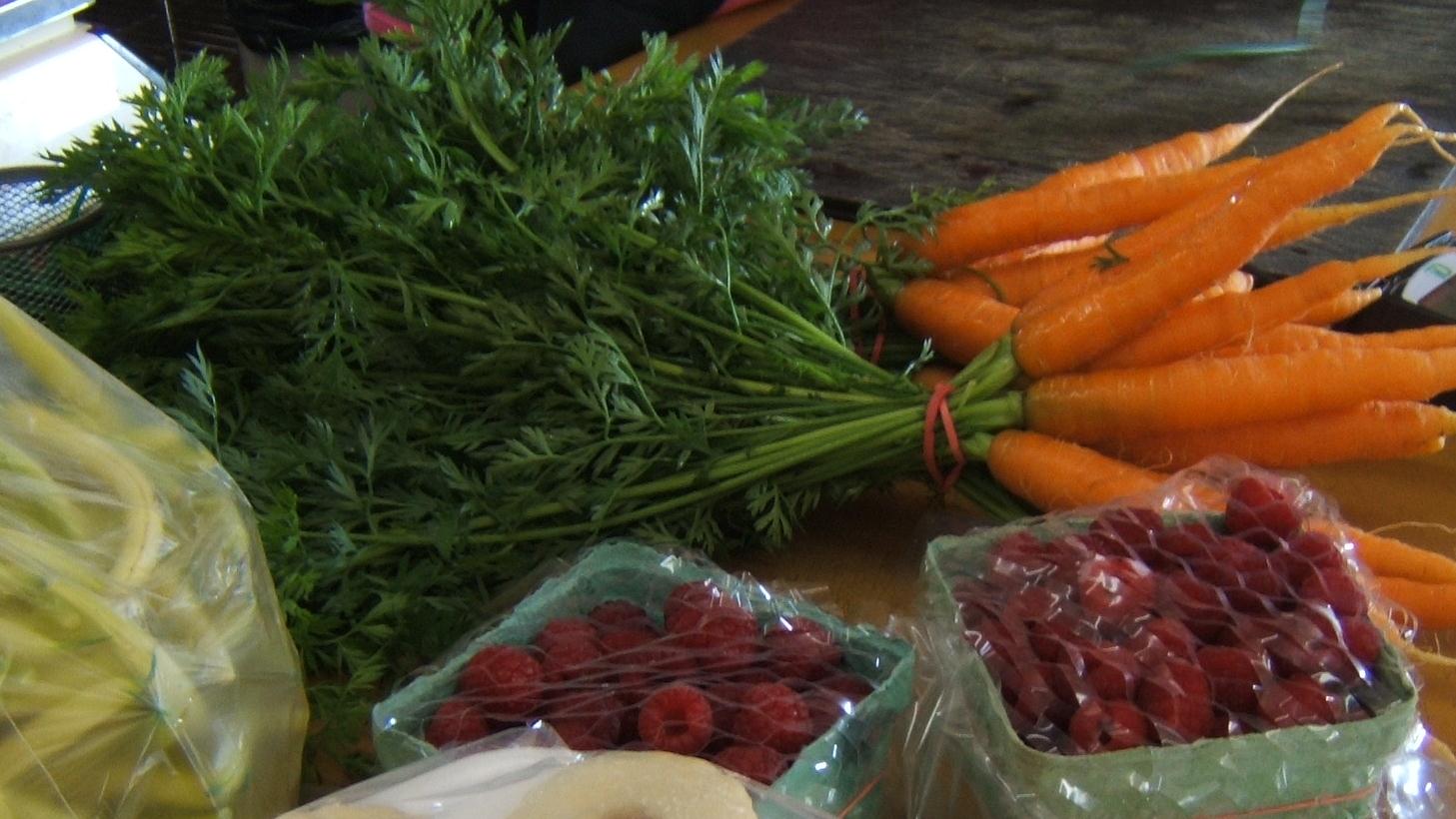
- the carotenoids – includes the yellows of carrots and the red lycopene of tomatoes
- the flavonoids – the yellows of flower petals and the red, blue and purple anthocyanins of strawberries and blueberries
~
~
In my poems, I want to portray these colours with words. A quick look in the thesaurus shows how many words we have for the various colours:
- green: emerald, sage, verdigris, malachite, beryl, aquamarine, chartreuse, lime, olive …
- yellow: ivory, lemon, saffron, gold, sallow, buff …
- red: scarlet, carmine, vermillion, crimson, ruby, garnet, maroon, brick, rust …
- blue: azure, phthalo, cerulean, indigo, sapphire, turquoise, watchet, navy, teal …
- purple: lilac, violet, mauve, magenta, heliotrope, plum, lavender …
~
~
~
~
Copyright 2014 Jane Tims
beekeeper

~
beekeeper
~
1.
~
bees smoke-drowsy rag smoulders swung slowly protected thick
in net and cotton wicking folds into beeswax candle flame
pours golden through panes in the honeycomb
streamers sweet circles sink into bread
~
hollows
yeast-filled
and honey
~
2.
~
bee sting
unexpected
~
beekeeper
never flinches
~
flicks the bee
from his fingers
~
spit and mud
for a poultice
~
~
Published as: ‘beekeeper’, Canadian Stories 17 (95), February/March 2014
Copyright 2014 Jane Tims
beech leaves and berries
One more poem about winterberry holly …
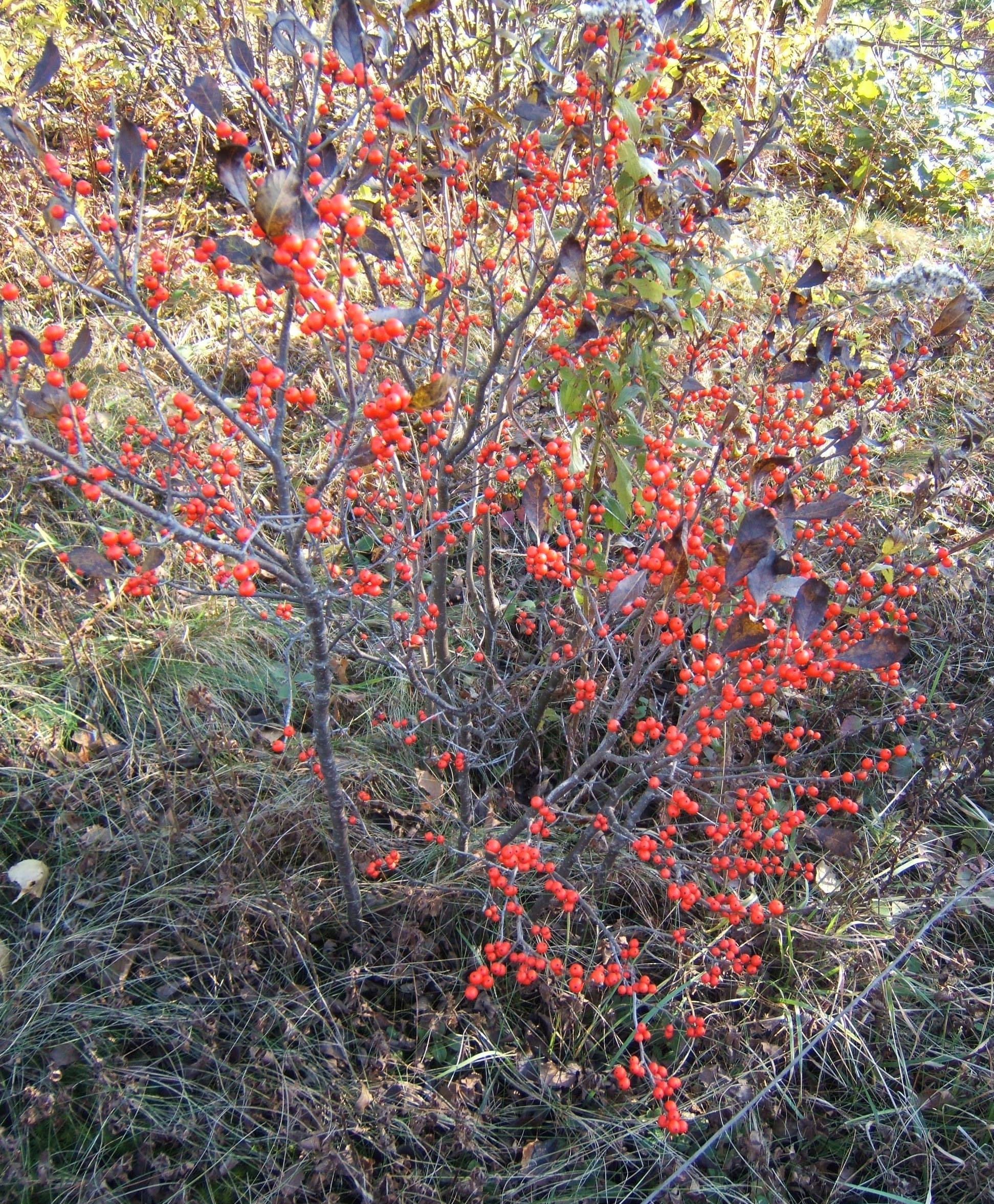
winterberry holly in early winter
~
~
beech leaves and berries
~
watch the wretched shudder
of the second hand, clutch
at the day, a beech leaf, intent
or winterberries persistent
through December
~
peeling paint on the door
of the shed, insistent –
resist new color
parchment leaves and paint chips rattle
~
on a day in January
a grey-green flake of paint
is tumbled by wind
and vermillion berries surrender
drop
by
drop
~
indifferent snow
~
~
Copyright 2014 Jane Tims




 nichepoetryandprose