where we read
I am a reader. There are stacks of read and unread books wherever you go in my house. There is a Kindle by my living-room chair and a Kobo by my bedside. Since I read multiple books at once, most are marked ‘last-page-read’. I read the books a bit at a time, choosing whatever I think will suit me on a particular day.
~

~
So where do I read? Anywhere!
~
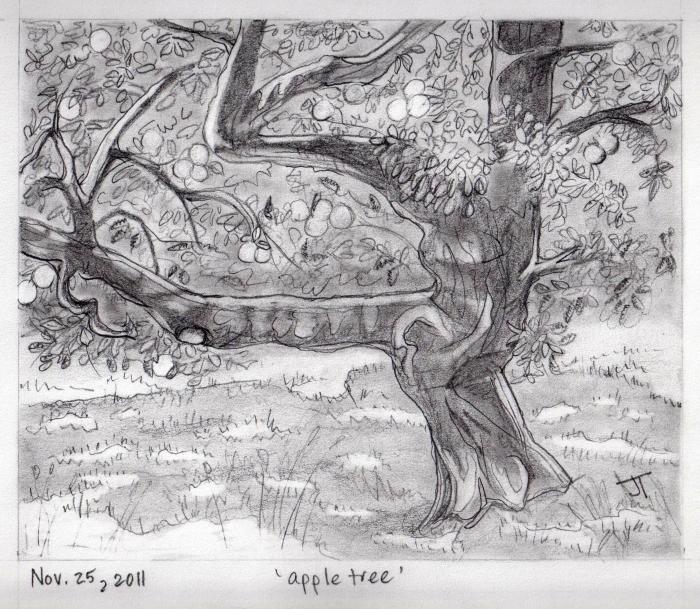
When I was young, I read in my bedroom. I’d take a flashlight to bed and hide under the covers to read. Mom was not fooled! When we went to Nova Scotia for summer vacation, I read in my grandfather’s orchard. There was a tree-limb perfect for sitting!
~
 ~
~
During my university days, I read like a mad-woman, as much mystery/romance as I could absorb. I think I wanted solace from my steady diet of science texts and journal articles! My preferred reading place was my car – also a rest from the lab where I did most of my university studies.
~
I still favour mysteries, especially detective series. Science fiction too. And poetry, always poetry!
A few series I’d recommend:
Chuck Bowie -“Donovan: Thief for Hire”
Ann Cleeves – “Sheltland Island Mysteries”
Ann Granger – I like her older “Fran Varady Crime Novels”
~
Through the years, I have been constant in my reading spaces:
- the car … for years I drove to a park on my lunch hour and cheerfully read the time away. When my son was in his early university days, I never minded waiting for him because I could read while I waited.
- in bed … as the years go by, reading puts me to sleep faster and faster. It sometimes takes me months to read a particular book!
- in my accustomed chair in the living room … experience with decades of public service work means I can read with any distraction.
- in our camp at our table. No distractions, just good company.
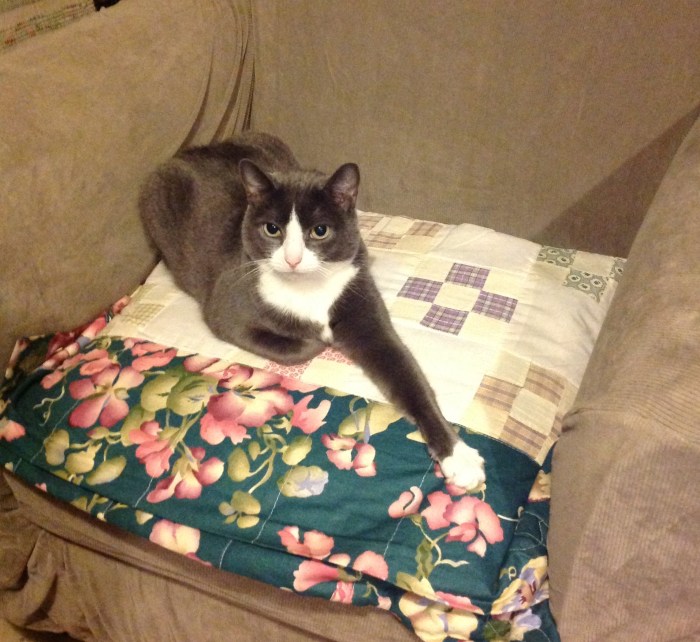
- but never in my planned reading space … when I retired I bought a comfy chair and designed a perfect reading corner. It is a great space to store stuff – books for my next signing, the shower head we haven’t yet installed, two throw pillows no-one wants to sit with and recent purchases not put away. When the chair is empty of stuff, it is filled with Zoë. I never read there …. never, ever.
~
~
Where do you read? If you had a special reading spot, do you think you would use it?
~
Copyright 2018 Jane Tims
segue
segue
(verb) move without interruption from one song, melody or scene to another.
(noun) an uninterrupted transition from one piece of music or film scene to another.
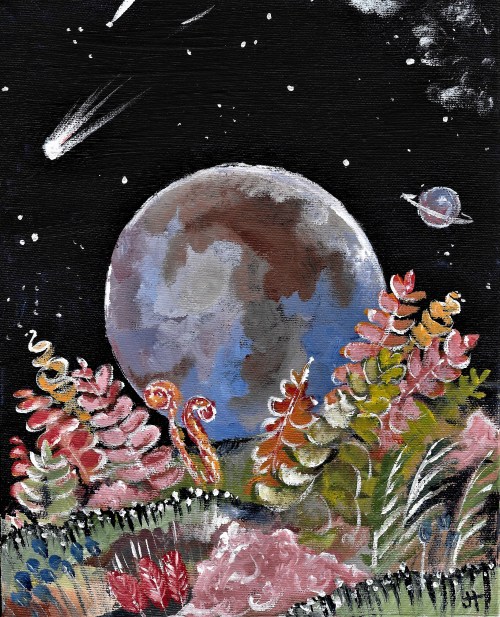
Ways of creating smooth transitions, from chapter to chapter, action to action, or scene to scene:
~
- make sure the tone and rhythm of the writing are similar or appropriate in the transition. This may be particularly important since I am writing poetry. Sometimes, a smooth transition will occur because lines are of a similar length or number of beats, or because the tonal qualities of the poetry are similar. On the other hand, there may be places where an abrupt change is necessary to introduce an element of anxiety or surprize. I compare this to the background music in a movie, carrying the watcher from scene to scene, or changing abruptly to signal a crisis. In the following passage, the terse, rather short lines of Chapter 13 are focused on action verbs and are picked up by terse statements in Chapter 14:
~
Madoline locks the door as she leaves.
Ignores the way to her cell
in the honeycomb.
Turns
towards the centre
of the city.
14.
Belnar throws down his pack.
“Not there,” he says.
“Big scandal afoot.
The cook gone.
Eighteen
unconscious
Gel-heads.
Nine dead
Dock-winders.”
~
~
- use a repeated idea or word to help transition the reader. An example might be the use of colour. Sometimes in movies characters are shown walking down a hallway, for example, and characters in the next scene are also walking down a hallway. In the following passage, the idea of swirling at the end of Chapter 1 is picked up by the word ‘confusion’ at the beginning of Chapter 2:
~
Chill wind kisses cold rock.
Sweeps out, across the Darn’el.
Stirs desert and dust.
2.
Confusion in the village.
The women gone.
~
- have a character in the first scene think about a character in the second. In Chapter 9, the Dock-winder child Don’est remembers Kathryn and Chapter 10 takes us immediately to Kathryn in the Gel-head’s clutches:
~
“And Kathryn
was a bedwarmer,”
says the Dock-winder child,
nodding, the wisp of a smile
on her thin lips.
Her knowledge
not appropriate
for her years.
12.
Kathryn waits in the cell
of the honeycomb.
Fiddles with a ring above her eye.
Tries to ignore confining walls,
paltry inflow of air.
~
~

- signal to the reader that something new is coming. If the location changes, name the new location to make sure the reader knows where the action is situated. In Chapter 7, Don’est, the Dock-winder child, reminds the others that she and the wolf-like Kotildi are also part of the community of Themble Hill. In Chapter 8, the action is taken far from the Themble Wood, in the city of Prell:
~
“Len, len.
And me,”
says Don’est.
“And tame Kotildi.
“Elan’drath
in the Themble Wood.”
8.
Tal and Daniel in a room
as unlike the Themble Wood
as it is possible to be.
Del-sang ma’hath,
Acquisitions Tracking,
Prell.
~
~

- report on an event happening in the previous chapter. In the following passage, Odymn rocks the new baby in Chapter 22 and Vicki refers to the birth of the baby in Chapter 23:
~
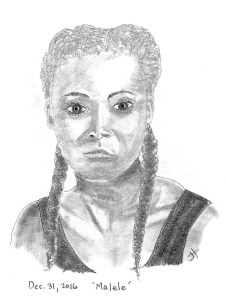
Odymn weeps when she sits with Malele
and rocks the tiny baby.
23.
“Fourteen days,”
says Vicki.
“Fourteen days
and we’ve made
no progress at all.
“Back in the Themble
Malele’s baby will have been born.
They will be wondering
if we will ever return.”
~
~
So my first task in creativity is to look at each shift from one chapter to another and write in some segues. Sounds a little like editing to me!
~
What do you think of the transitions I have written above? What devices do you use to make certain there is a smooth transition from one chapter to the next?
~
~
Copyright 2018 Jane Tims
Meniscus: One Point Five – Forty Missing Days
Know first, then judge … understanding one another may be the most dangerous part of any shared journey …
My new book in the Meniscus Series is available!!!!
~
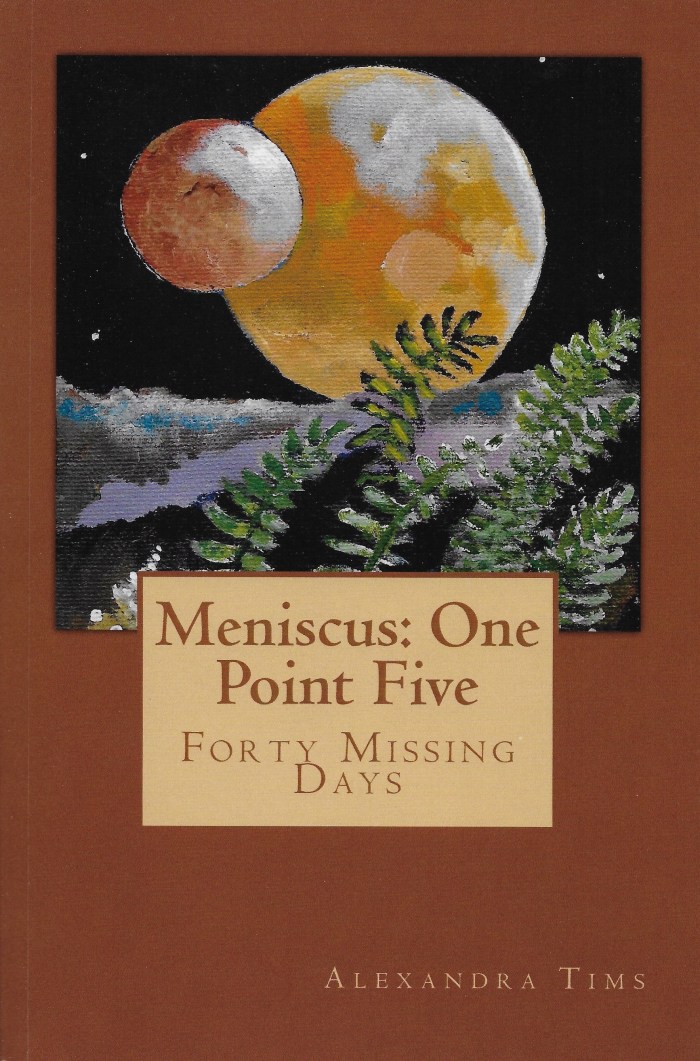
To get a paperback copy, visit https://www.amazon.com/dp/1978407564
~
As I write my science fiction Meniscus Series, I realize there are questions my readers may have about circumstances in the books. In fact, I have a few questions. Why are there no knives on the planet Meniscus? What is beelwort (revealed in Meniscus Five)? Why do people on a planet with interstellar travel walk wherever they go?
~
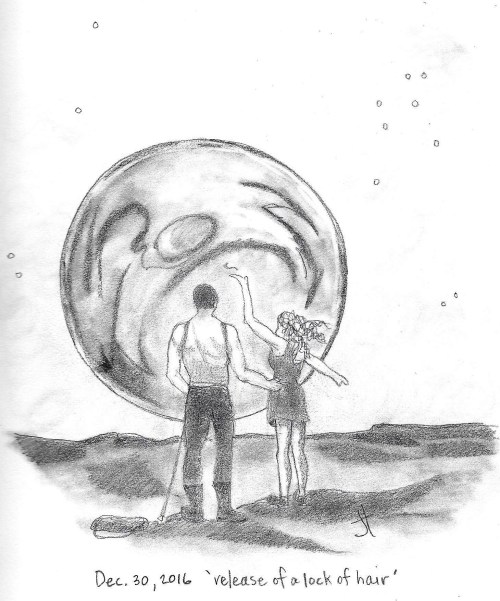
The biggest question in my own mind — what happens during the forty missing days in Meniscus: Crossing The Churn (between the time when the Slain is shot and the time when he and Odymn release her lock of hair to the wind)? As I thought about this, I began to write Meniscus: One Point Five.
~
~
Meniscus: One Point Five
Forty Missing Days
by Alexandra (a.k.a. Jane) Tims
~
When the Slain bails on his contract to sell Odymn to the Dock-winders, he is shot trying to escape. Odymn, who loves the Slain, cannot abandon him. She recruits Wen-le-gone, an Argenop elder and healer, to help her nurse the Slain back to good health. As they make their way toward the relative safety of the Themble, the trio must forage for food, save Odymn when she encounters a poisonous foe, and get to know and trust one-another. When Wen-le-gone leaves for his home, Odymn decides to stay with the Slain. As they continue on their journey, they work together to survive the dangers of the Themble Wood but in the end, memories of the past may be their biggest obstacle to building a life together.
~
Meniscus: One Point Five takes place near the end of the first book in the Meniscus Series, and tells the story of the forty missing days after the shooting of the Slain. Helping the Slain heal from his wounds and protecting him from the dangers of Meniscus may be the least of Odymn’s problems.
~

~
Copyright Jane Tims 2018
feeding the birds
I am late this year with putting out bird feeders. Two reasons: the reported difficulty with disease in bird feeders last year and my general lack of time.
~
This morning I made a bird feeder from a coke bottle (my son and I used to do this when he was little) and filled three of our feeders. The old sunflower seed feeders, difficult to clean and too expensive to toss out every few days, are in the trash.
~
Presenting my new home-made feeder for sunflower seeds! I may add a simple roof to keep the snow out. I can replace it at intervals to keep it clean.
~

~
The finch-feeder with nyjer (thistle) seed:
~

~
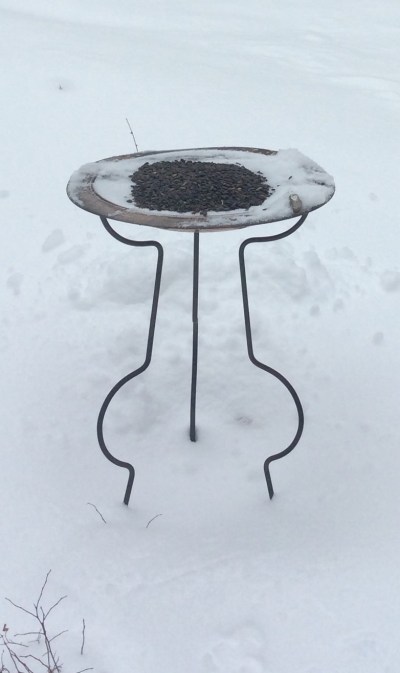
A pile of seeds in our frozen bird-bath, for the squirrels and deer:
~
~
As I came in from outside, I heard a chickadee in the larch tree, so I am hoping they will find the feeders soon.
~

one of the illustrations in my book ‘in the shelter of the covered bridge’ (Chapel Street Editions 2017)
~
Copyright Jane Tims 2018
ordinary magic
~
Although I am a biologist and understand that even the magical can usually be described in concrete terms, I prefer to not try to ‘puzzle out’ at least some of the ‘magic’ in my life. After all, what is more delightful and truly mysterious than a six-sided snowflake, the pattern of veins in a basil leaf, the smell of lavender at bedtime, the pungent, cold-busting taste of turmeric, or a line in a movie that brings tears to your eyes.
~
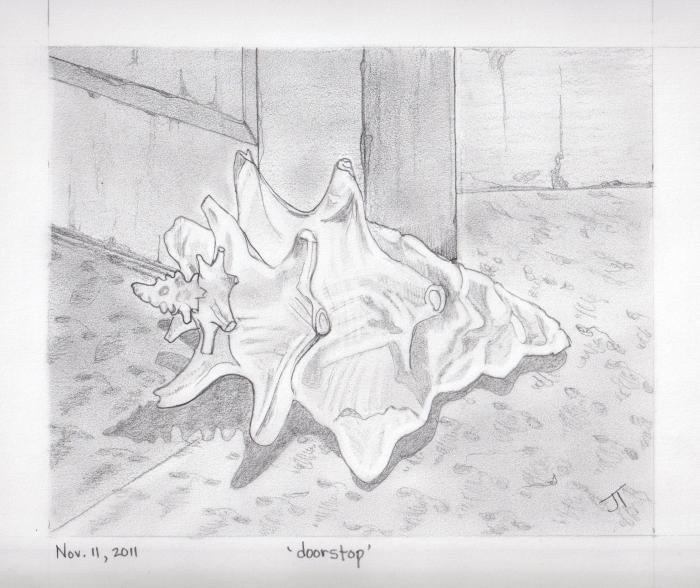
When I wrote the poem below, I was playing Dungeons and Dragons regularly and keeping watch for the magical in life. I still have the small blue jar with the magical false bottom.
~
 |
~
ordinary magic
~
small blue jar
emptied of face cream
has a false bottom when held to the light
a bright inverted inner shell
hovers untouchable
~
the peel of an orange
spurts flammable oil
cantrips of fire
~
press a shell to your ear
murmur of ocean
~
~
~
Copyright Jane Tims 2018
Pokiok Falls

Pokiok Stream, about 2011
~
On one of our family summer excursions across Canada, my parents stopped along the highway in New Brunswick to see the Pokiok Falls near Nackawick. I remember the white churn of water below me, so steep it looked like the water was falling into a pipe. In 1967 the Mactaquac Dam submerged the falls and now they are only a memory, visible on old post cards and in photo albums.
~
For a fictionalized account of the changes resulting from the building of the Mactaquac Dam, read Riel Nason’s excellent coming-of-age book ‘The Town That Drowned‘ (Goose Land Editions, 2011).
~
Pokiok Falls
~
my mother held me at the railing
to see the Pokiok
plunge
from highway
to river
granite pipe
roiling water
~
later, when the dam went in
they moved the churches
to higher ground
so the church bells
wouldn’t gurgle
when they rang
~
now the river slips sideways a notch
to fill the round drowning of the falls
~
water cannot fall within water
~
I cried when I left
I hadn’t seen the pokioks
I said
~
~
Copyright Jane Tims 2018
free book – Meniscus: Crossing the Churn
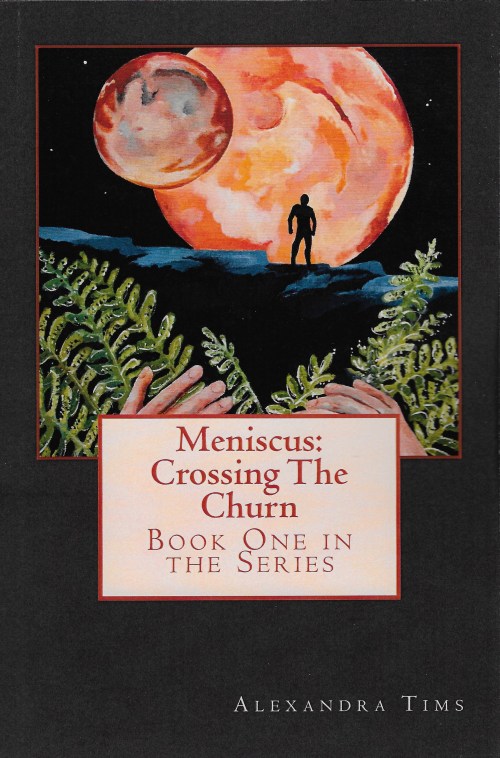
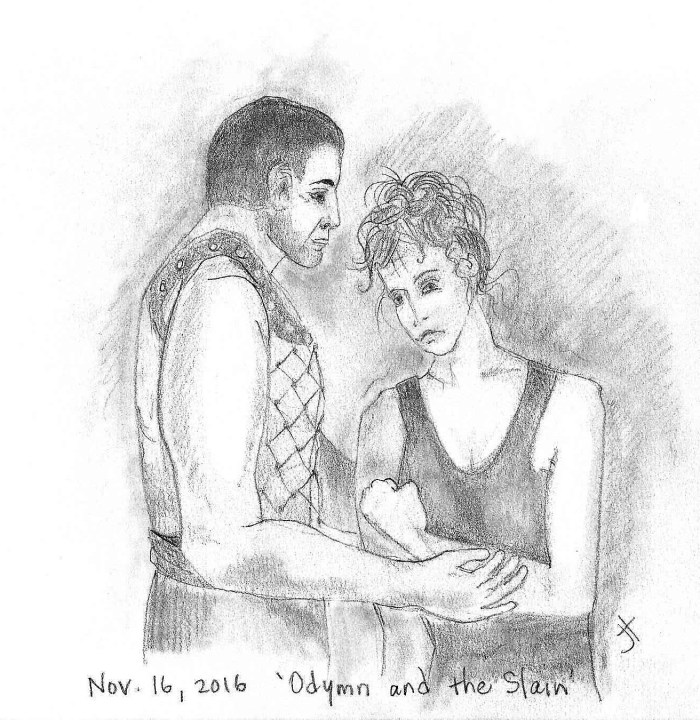
Want a quick read? A chance to explore a distant planet with two spirited characters? The first book in my science-fiction adventure series Meniscus: Crossing the Churn (Kindle version) is available for free for the next five days on Kindle. From January 27 to January 31, you can meet Odymn and the Slain, and learn about their meeting and their first travels together across the landscapes of planet Meniscus.
~
~
From the dangerous streets of Prell-nan to the dark woods of the Themble, this is a dystopian adventure, set on a planet where Humans are slaves to an alien race. Their only hope for freedom is to work together, foraging for their food, running from the nasty Dock-winders and battling the wild life. The only way to survive will be in their growing love for one another.
~
~
A sample from the story …
~
She watches the fire,
the space where flames
feign glowing eyes.
The creature speaks and she startles,
then knows the words are the endless friction
of two close-growing limbs of banyan.
High pitched squeal, low grown.
She peers at the Slain.
“I’m Odymn,” she says,
points to the place
between her breasts,
the now-charred microchip.
Points at him.
“Who are you?”
Emphasis on ‘who’ and ‘you’.
Unwavering stare.
His eyes not black, but amethyst,
dark rings around the iris.
At the edges a pale film,
nictitating membrane.
Long lashes.
“Odymn,” she says.
“Named by my father.
“Rare earth metal, Neodymium.
Atomic number 60. Silvery,
soft, tarnishes in air.
“Common as copper.
Makes a reddish dye,
colour of my hair.
“Now you,” and points at his chest.
Blue sparks snap to the tip of her finger.
Faint vibration through hand, along arm,
deep into torso.
Penetrating stare.
Lazy double blink.
Membrane and lashes close and open.
“OK. I’ll choose a name for you.
Daniel. Or James.
Not quite right, too common.
“You need an alien name.
Something deep from Dock-winder mythology.
Amblyn, god of fire. Or De-al, water-weld.”
Steady stare. Double blink.
One hand lifts. One finger raised to lips.
Be silent.
~
To get a free Kindle version of Meniscus: Crossing the Churn (from January 27 to January 31), just click on the book icon in the margin. This will take you to the Amazon website where you can get a free copy downloaded to your Kindle device.
~
If you like Meniscus: Crossing the Churn, you will love the continuing adventures of Odymn and the silent Slain – Meniscus: South from Sintha, Meniscus: Winter by the Water-climb and the newest book Meniscus: One Point Five – Forty Missing Days, available January 31, 2018.
~

~
Copyright Jane Tims 2018
ghost stories
Although I hesitate to write this post, I am trying to go through my older poems and think about them a little. The next one on the list (I am working backwards through the alphabet) is called ‘visitations’. The subject matter is a bit ghostly.
~
I do not generally believe in ghosts although I do believe in phenomena if that makes sense. A phenomenon is defined as a fact or situation that is observed to exist or happen, especially one whose cause or explanation is in question.
~
I have experienced many phenomena in my life. Odd things that seem to have some particular significance at the time. My mother, who also had such experiences, called them “comforts from heaven.”
~
Here are a couple of examples from my own life:
- After my mom died, a little yellow bird came almost every day to peck at our windows (not a goldfinch, in spite of the drawing below). After that year, I never saw it again.
- Once I bought a handmade quilt at an auction and laid it over our upper loft railing. One night I came out to the hall in the dark, touched the quilt and heard the following words, quite distinctly: “Henry, come in to supper!” I don’t know anyone named Henry.
- When she was alive, my aunt and I had a contest to see who could lose the most weight. My aunt told me to pick an item from her home as the ‘prize’. I know she was disappointed when I chose a little framed picture of a waterfall she had won as a prize in Sunday School in 1937. Neither of us lost any weight so the prize was never claimed. After her death, we retrieved some boxes from her estate. I couldn’t believe my eyes when I opened the box in the trunk of my car and the little picture of the waterfall was the top item.
- Once when I was staying away from home, I heard the front door open and footsteps, crossing the tile floor. I expected to see someone else and instead a little girl with ringlets came into my view, reached up for the doorknob of the adjacent bedroom and went inside. There were no children in the house at the time and I was terrified.
- My husband had his own weird experience on our local covered bridge. He was crossing the narrow bridge one day in our truck and was alarmed to see another car enter the bridge. He was certain there would be a crash but the other car, an older V-8 model, squeezed right by. My husband, knowing there was no way two vehicles could pass in the bridge, had to stop the truck at the other side of the bridge, he was shaking so hard.
~
Now every one of these experiences could be explained. Probably a vivid imagination is part of that explanation. But I do believe in the phenomenon. Have you had any experiences of your own?
~
~
visitations
~
moonlight on birch
stark shadows
words precise on the page
~
her tread heavy
she reaches for the door
opens, ringlets close as a spring
~
lengthen, what else is possible?
hand touches a quilt, a voice asks
a practical question, distilled in velvet
~
a small yellow bird
at the window
every morning for a year
~
~

~
Copyright Jane Tims 2018
herb growing in winter
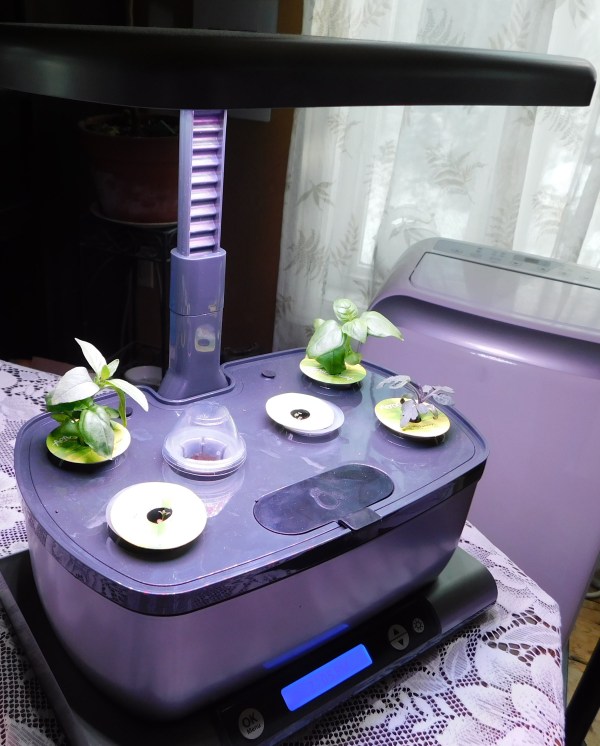
For Christmas, my husband bought me an Aerogarden – a way to grow herbs and other plants hydroponically. My garden has been set up for 19 days and has five plant pods underway – two basil, one parsley, one mint and one thyme. The sixth pod is having some troubles but is now replanted with more basil. I will keep you up to date on my garden’s progress!
~
~
Copyright Jane Tims 2018
spirit guide
As a biologist, I believe that human beings are fundamentally connected to the natural world. We are part of that world. To live, we need to eat and drink and breathe. We respond to the cycles of climate and weather.
~
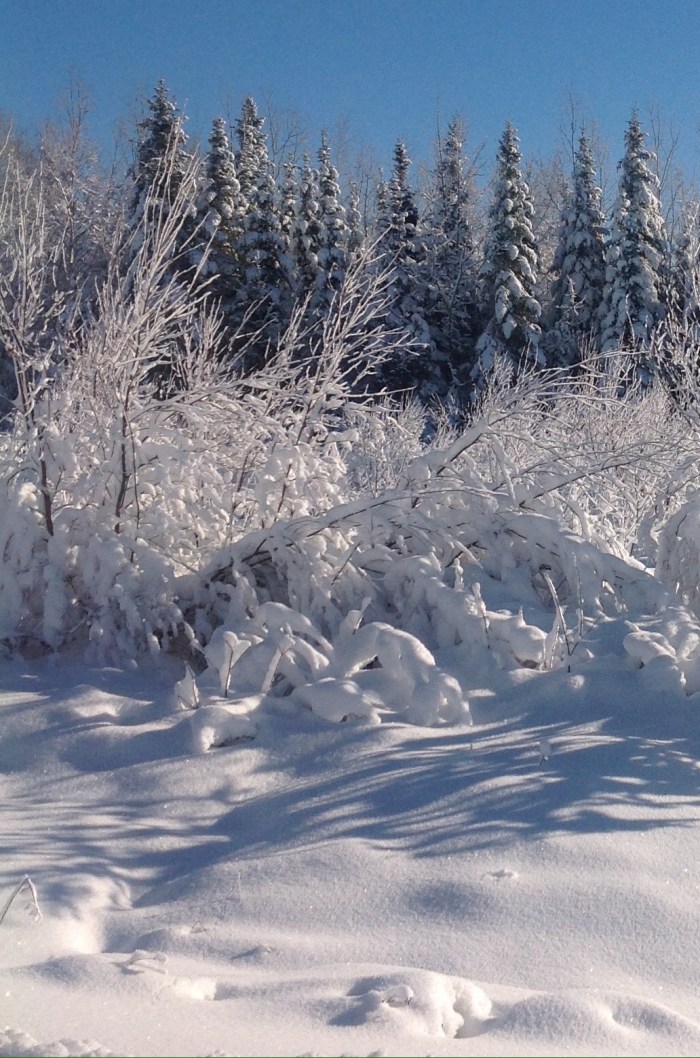
I believe, to be whole, we need to experience nature on a daily basis. In winter it is so easy to hide within our warm houses and pretend we are immune. But when I have hibernated for a few days, I start to long for a snowflake on my tongue, the glimpse of a bird, the sound of ice cracking on the lake. I need fresh air, a moment spent counting the sides on a flake of snow, the dripping of maple sap into a metal pail, the chortle of a black crow, flying overhead.
~
 ~
~
Call me crazy, but sometimes I am certain our connection with nature is one of communication. I am stopped by the knowing look of my cat staring at me as if she cannot understand my lack of understanding. I ask for a prayer to be answered and hear the low tremolo of a loon from the lake. I am startled by the constant return of a yellow bird to the window in the months after my mother dies. I watch my hand painting detail in a landscape and am amazed at how a white line can capture the essence of a leaf.
~
~
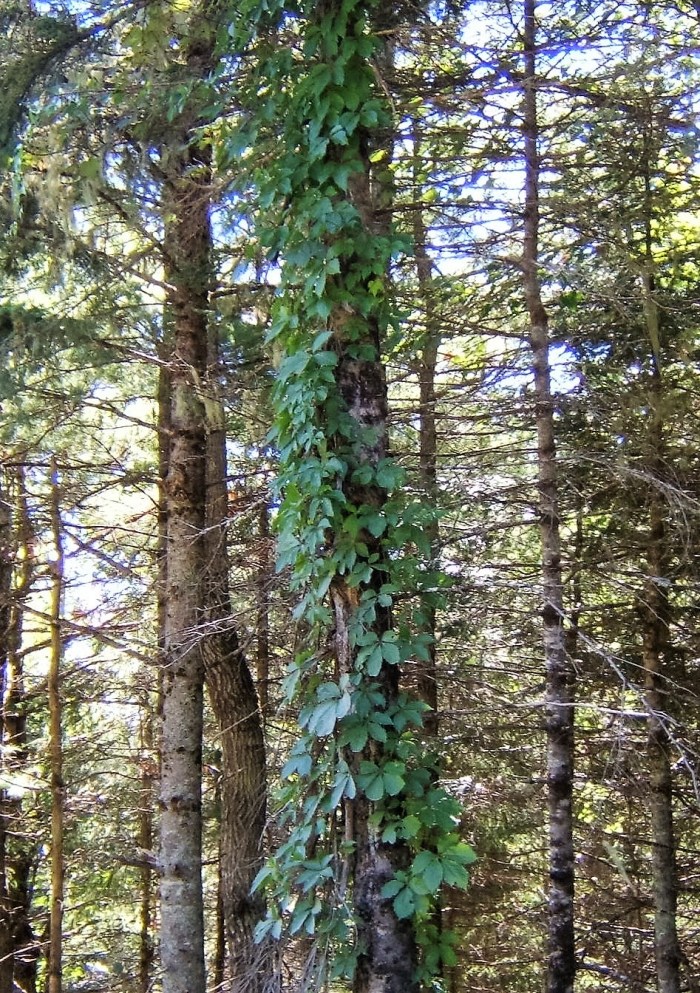
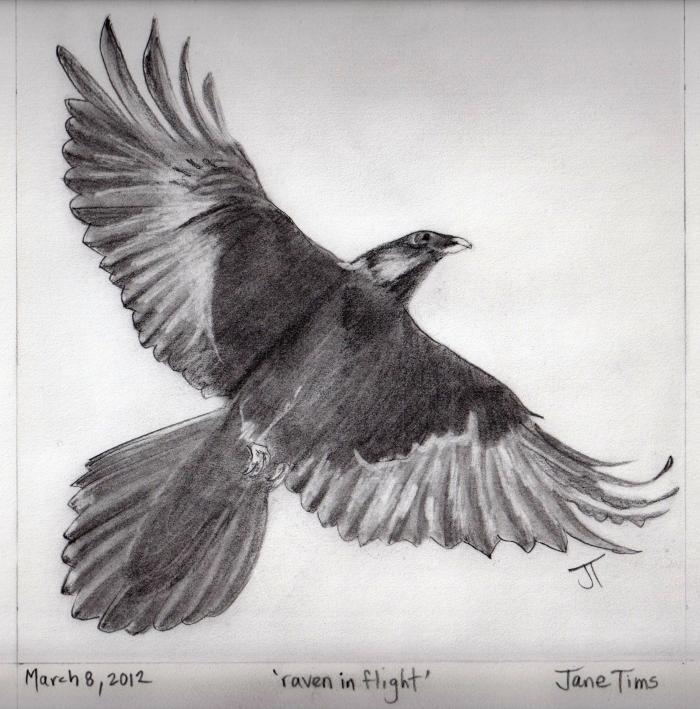
I also feel kinship with a particular animal. Some days it seems to express my disgruntlement with life. Other days, my joy. When I think of sound, the first sound I remember is the beat of wings on overhead air.
~
~
spirit guide
~
after the proper length of fast
after the proper exposure to fire
I open my eyes
but I see no animal spirit
only black
~
I listen
silence
unless you count the compression
of a single beat of wing
~
I stretch and feel the atmosphere
detached
partitioned by sharpened feather fingers
and the zigzag trail
of some multi-legged crawler
~
my mouth is filled
with the down
of fallen angels
(also feathered black)
~
the stink of burning quills
~
where is a crow
when you need to experience
more than the characteristics of crow?
~
~
~
Copyright Jane Tims 2018




 nichepoetryandprose