Archive for the ‘wild life’ Category
a snippet of landscape – moose habitat
Not far from Gagetown, on Route 102 in New Brunswick, is an interesting bit of wetland. Sometimes there is water in this small area but more often it is just wet mud. During periods of little rain, the mud becomes cracked and dry. The area never seems to grow any of the grasses or other wetland plants typical of wet areas.

The reason can be discovered through two pieces of evidence. The first thing you notice about the area is… the mud is carved with the tracks of a large animal. The second thing you notice is the Moose Crossing sign not far away, along the highway.
I have seen a moose in this muddy place. It is a dangerous place for a moose to be hanging out, because it is so near the road.
Moose visit these muddy areas for several reasons. They need water, of course. Also, salts from the road accumulate and moose use the wet areas as ‘licks’ to replenish their body salts. Sometimes these waters are naturally high in salt content.
We have seen moose quite often this summer. We watched a moose and her calf for about a half an hour during our trip to the Cranberry Lake area in July.

a moose and her calf
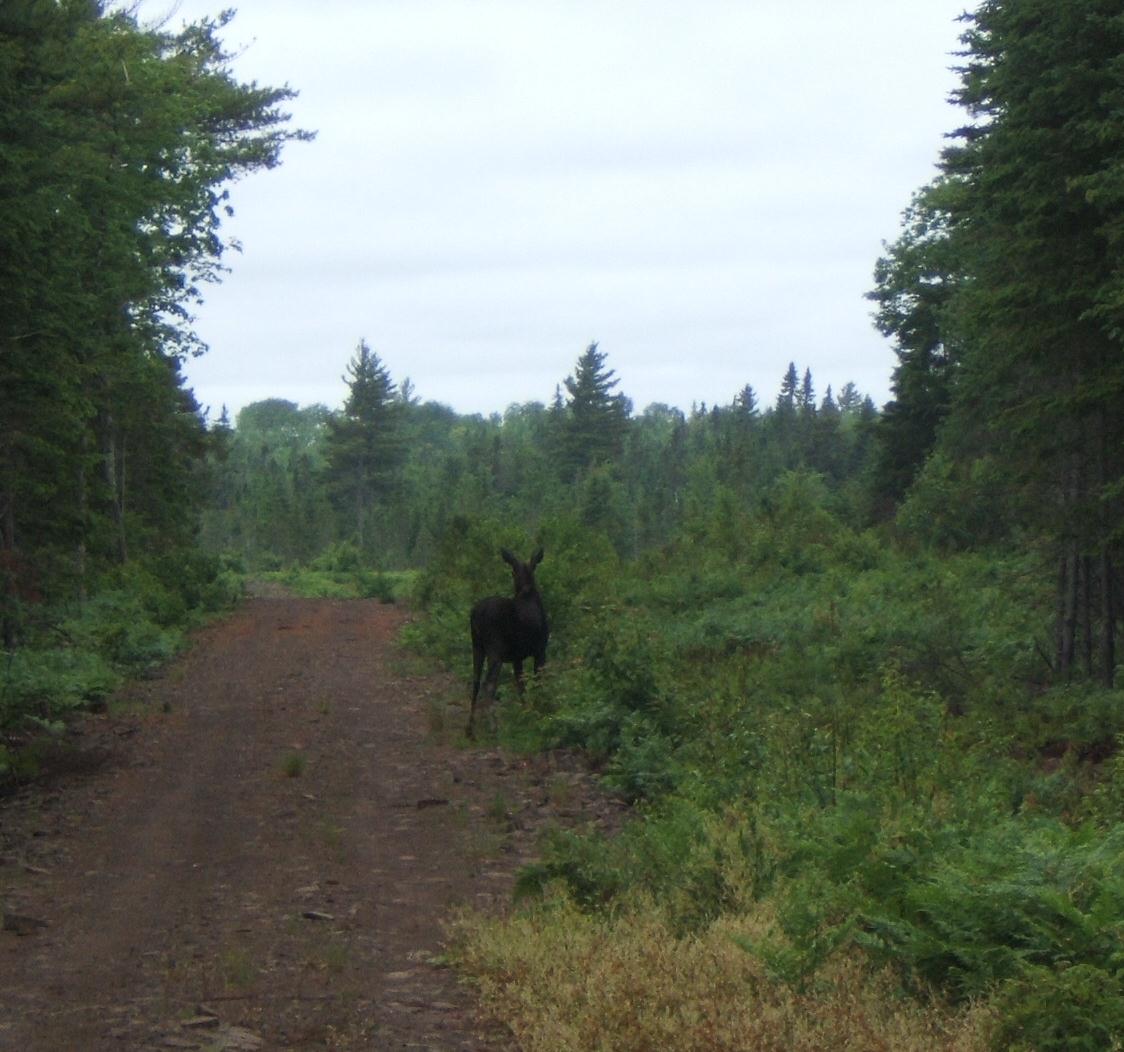
the moose sent her calf into the woods to hide and grazed quite a while, only a little concerned by us
Do you see moose where you are?
© Jane Tims 2012
rescuing a turtle
On a recent drive to St. Stephen, we took the cross-country Route 785, a haul-road, recently upgraded and chip-sealed (this creates a hard, smooth pavement-like surface). For us, it is the perfect short-cut to the Bay of Fundy coast.

Since it is so far from ‘civilization’, cars travel a little fast on this road. Sometimes this is a peril for wild life.
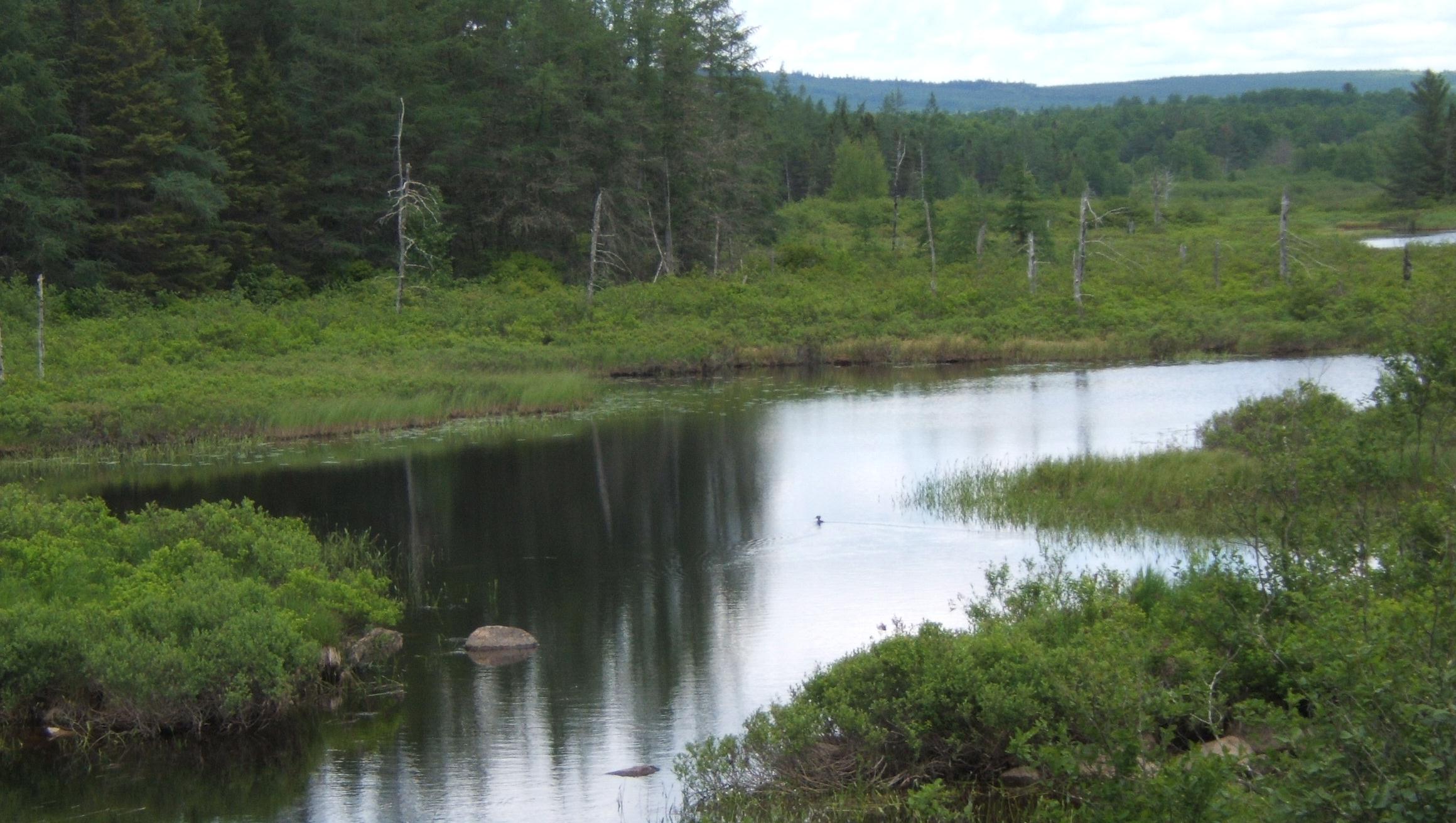
Along the way, we helped a Painted Turtle (Chrysemys picta) in its desperate attempt to cross the road.

He was certainly suspicious of my help and my camera angle, and retreated into his shell rather than be properly photographed.

In the end, I helped him over a steep bank of gravel left by a grader, and he was on his way to the pond on his preferred side of the road.
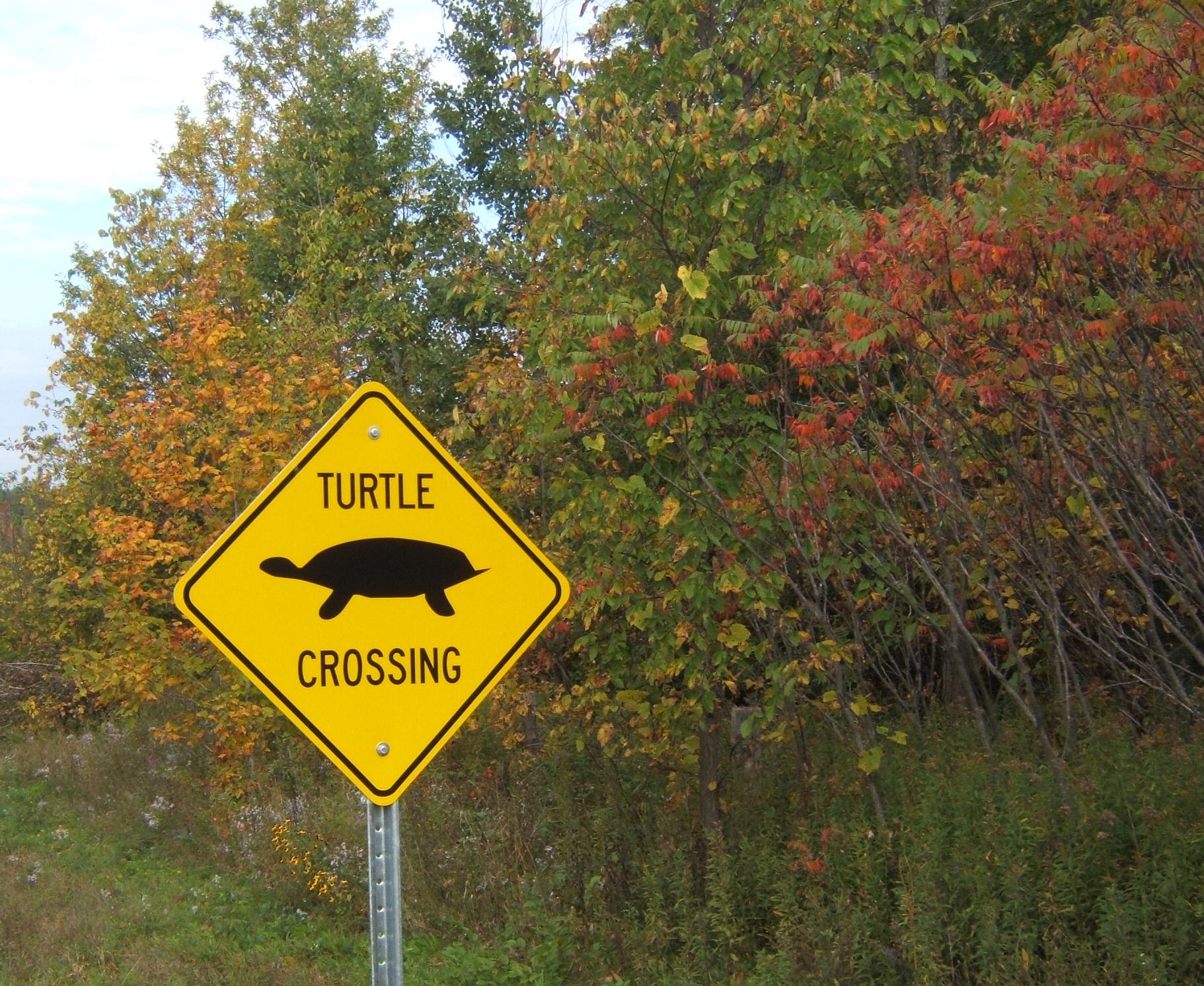
‘Turtle-Crossing’ sign in southern Ontario
© Jane Tims 2012
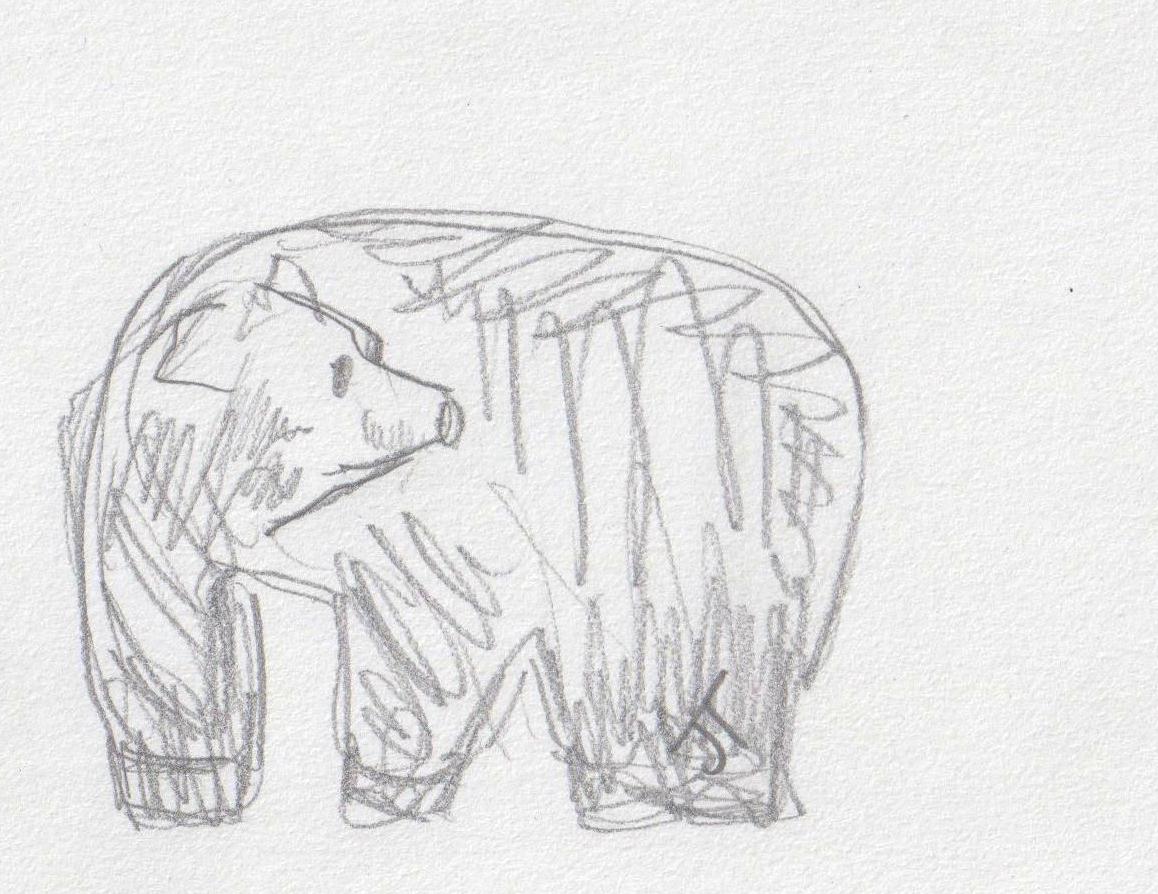
a view of a Black Bear
One of the experiences of the past two weeks was the sighting of a young Black Bear (Ursus americanus) along the Plaster Rock – Renous Highway. The Black Bear was only a youngster, probably a two-year-old born last January or February (2011). He watched us a long time from the woods, appearing a little confused. Eventually, he wandered away. He was probably rejoining his mama – Black Bears stay with their mothers until they are 16 or 17 months old.

I have seen/smelled a few bears in my life:
§ Once, on a fishing trip with my Uncle, he told me to stop and sniff the air. The smell was fetid, unforgettable. He told me you often smell a bear but almost never see one.
§ When we first built our house, our young neighbor was riding his bike up our gravel heap and encountered a bear coming up the other side of the pile!

§ When we first lived in our community, we had a garbage dump. We used to go to the dump on the weekend and join the other cars, watching the bears work their way through the garbage. I remember one was inside an old refrigerator, opening and closing the door!

§ On a work excursion to Mount Carleton, we saw a bear running up the road ahead of us, but it disappeared before we could get close.
§ Once, on the Salmon River Road, on a drive to Bouctouche with my sister-in-law and niece and nephew, we saw a full-grown bear, on a run from one side of the road to the other. He had very long legs and ran by stretching his front legs out and bringing his rear legs up between them. He only hit the pavement twice, once with each set of feet!
§ On our trip through the Rocky Mountains, I saw a bear, species unknown, in a steep ditch beside the roadway.
Have you ever seen a bear???
~
© Jane Tims 2012
American Black Duck
On our drives along the St. John River this month, we have tried to identify as many ducks as possible. There are actually not a lot of species to sort through, but we are just learning. Among the ducks we have seen this May are the American Wigeon (Anas americana), the Mallard (Anas platyrhynchos), the Green-winged Teal (Anas crecca), and the American Black Duck (Anas rubripes). These are all Marsh Ducks, surface feeders of ponds and marshes. The species in this Subfamily feed by ‘dabbling’ and ‘upending’… delightful words!
One weekend, we watched a male American Black Duck for quite a while. He flew around a bit, flashing his white wing linings, and then floated slowly along a back passageway through the marsh. He was very dark brown, with a tan head, a yellow beak, and a bluish wing patch. The best part of the experience was his deep croaking, each croak about a second long, and sounding like a little like an unimaginative bullfrog or two pieces of smooth wood being rubbed slowly together.

~
The poem below requires a short explanation. Two months ago, I attended a workshop on climate change at the offices of the North Shore Micmac District Council in Eel Ground, New Brunswick. I was given a gift afterward, a calendar showing the names of the months in the Mi’qmak language. The names are beautiful and describe well characteristics of the natural world during various times of the year. For those of you who do not live in this part of the world, the Mi’kmaq are a First Nations people, indigenous to this region.
~
~
Frog-Croaking Moon – Etquljuikús
(Mi’qmak name for the May moon)
~
under the May moon,
bullfrogs glub-grunk,
underscore spring peeper trill
~
rasp of a Black Duck
rowing in the reeds
~
friction
of fir and maple
grown to lean on one-another
~
~
© Jane Tims 2012
juvenile Bald Eagle
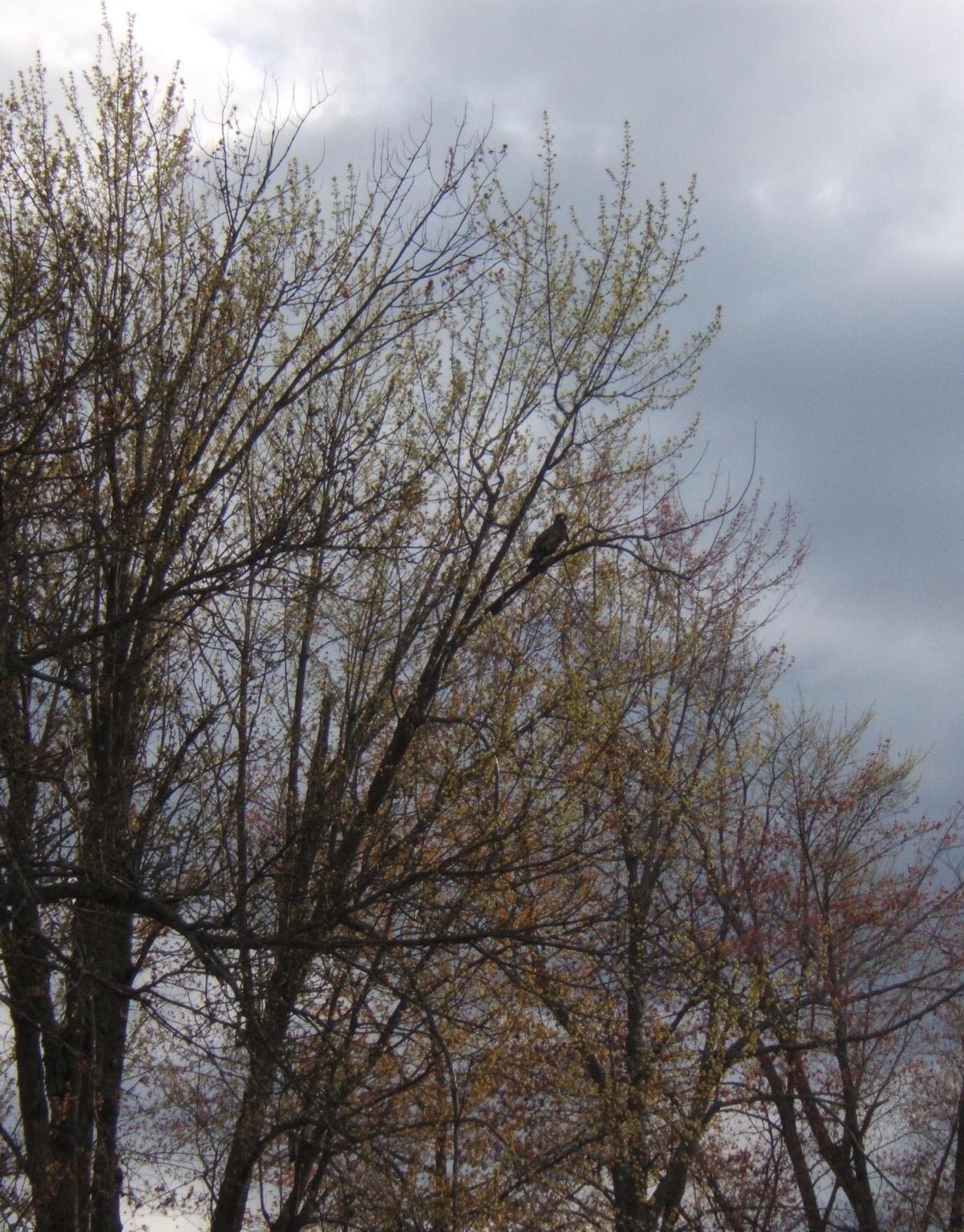
Last evening, we drove along the St. John River looking for fiddleheads and were delighted to see a juvenile Bald Eagle (Haliaeetus leucocephalus).
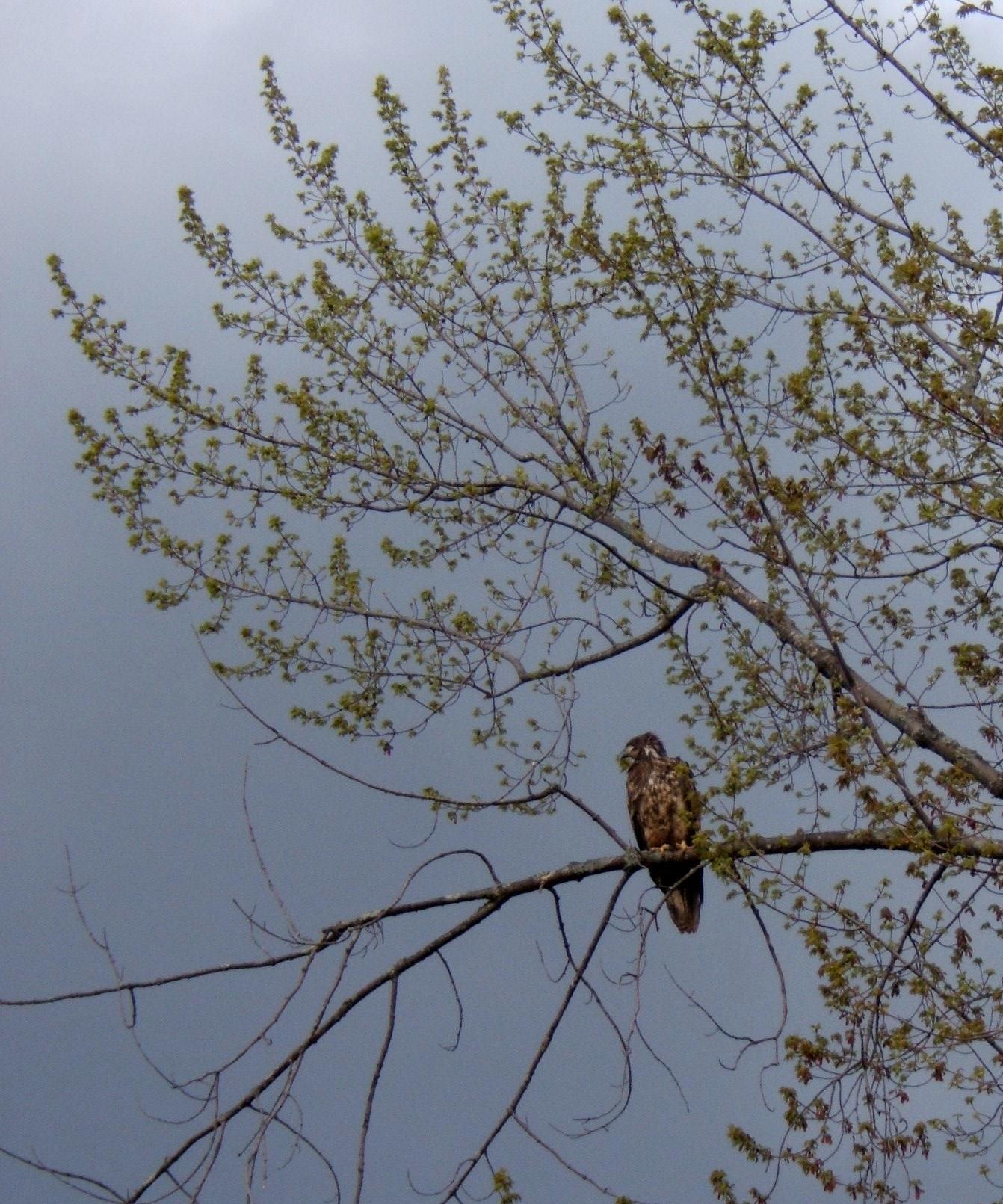
He was sitting on the dead branch of a Silver Maple, just above the highway. He stayed quite still as I took a few photos. He was huge compared to the hawks and osprey we usually see in the trees along the raodway. His plumage was tawny and brown, and his talons were a beautiful orange. Occasionally, he would twist his head and his eye would gleam, reflecting the light of the setting sun.
~
~
young eagle
~
his golden eye
glints as he twists his head
reinterprets the sinking sun
as soul
scrutinizes the river lands
for peril or prey
~
~
© Jane Tims 2012
excavation underway!
On Tuesday morning last week, I began my morning work to the beat of an intermittent rapping. It was so loud and so near, I thought it must be someone hammering on the house.
I looked outside and saw, across the lawn, a large bird with a flaming red crest. A Pileated Woodpecker (Dryocopus pileatus)!
We have seen this species of woodpecker several times before in our Grey Woods. These birds leave their oval cavities in many of our older trees, evidence of their search for insects or the preparation of cavities for nesting. The use of dead or dying trees as cavity nesting sites is an example of how important these trees are to the woodland ecosystem.

I watched as the bird did her circuit of the tree and hopped down to the ground for a while. Then she fluttered up to our cedar rail fence and into the trees.
The Pileated Woodpecker’s bright red crest and long skinny neck give it a comical air – not a beautiful bird, but very exciting to see and watch.
~
~
© Jane Tims 2012

a pair of Painted Turtles
We did our usual bird-watching run along the St. John River on Sunday afternoon. We ordinarily follow the same circuit, from Oromocto, along the north side of the River, to Jemseg, crossing the River via the Gagetown Ferry, and returning on the south side of the St. John River. This area is in central New Brunswick, east of Fredericton.
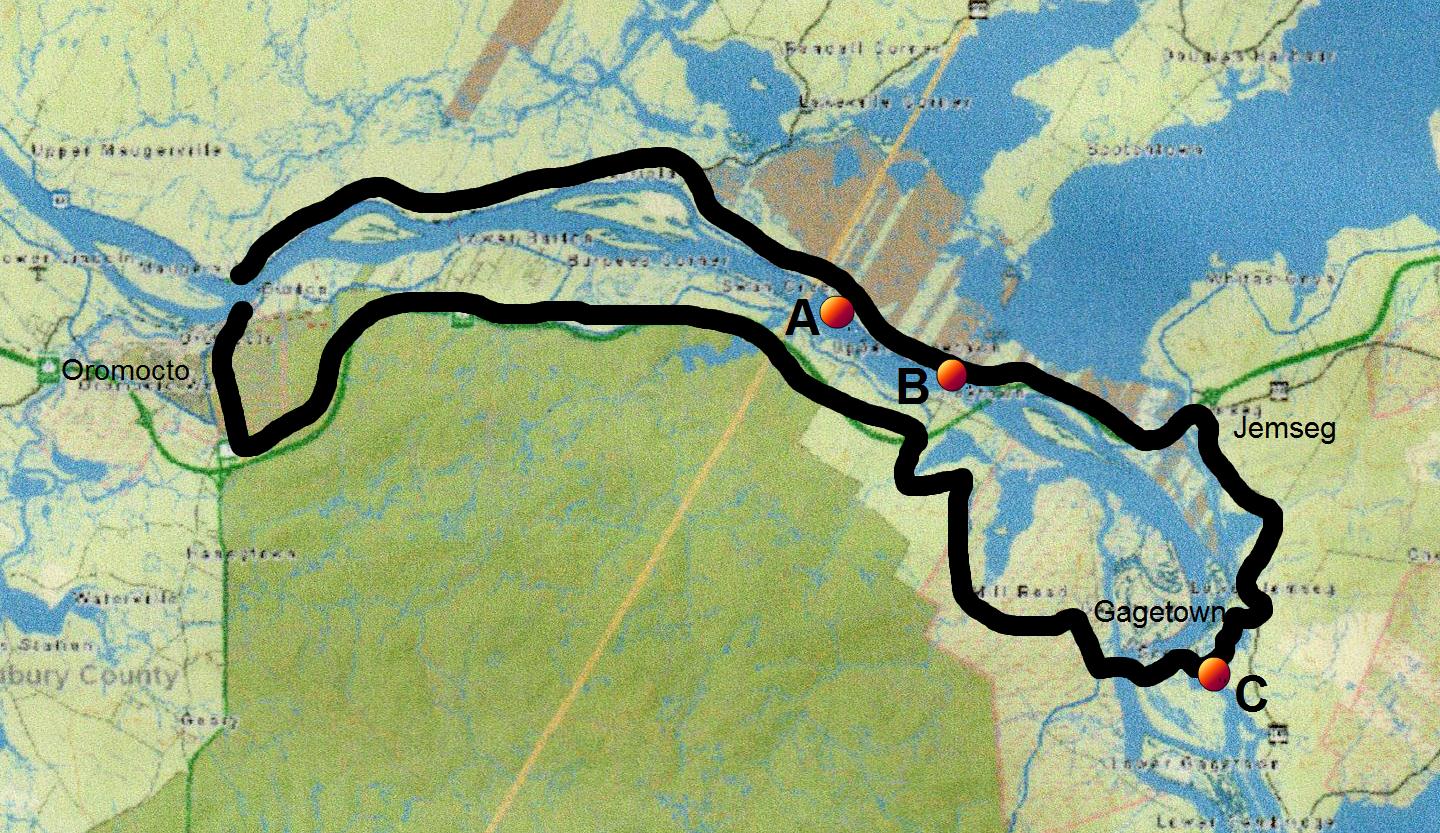
The first part of this circuit is along the old Trans Canada Highway, now Route 105. This section follows the St. John River, through the Grand Lake Meadows, an important wetland area for New Brunswick. Near the spot marked ‘A’, we saw lots of ducks, an Osprey eating a fish, and three other raptors (a group including hawks or eagles) too distant to identify. Near ‘B’ is the place we often see various owls, Bald Eagles, and Moose.

From Jemseg, we take Route 715 to Lower Jemseg. This part of the route travels above the River, through farmland. We rarely see wildlife along this section, but the area has a rich history and has several interesting buildings, including the old church featured in my post of September 14, 2011.

From Lower Jemseg, we turn towards the Gagetown Ferry and Scovil. This is a very interesting part of the route, snaking between wetlands and ponds. Along this section, it is usual to spot other cars of eager birdwatchers.
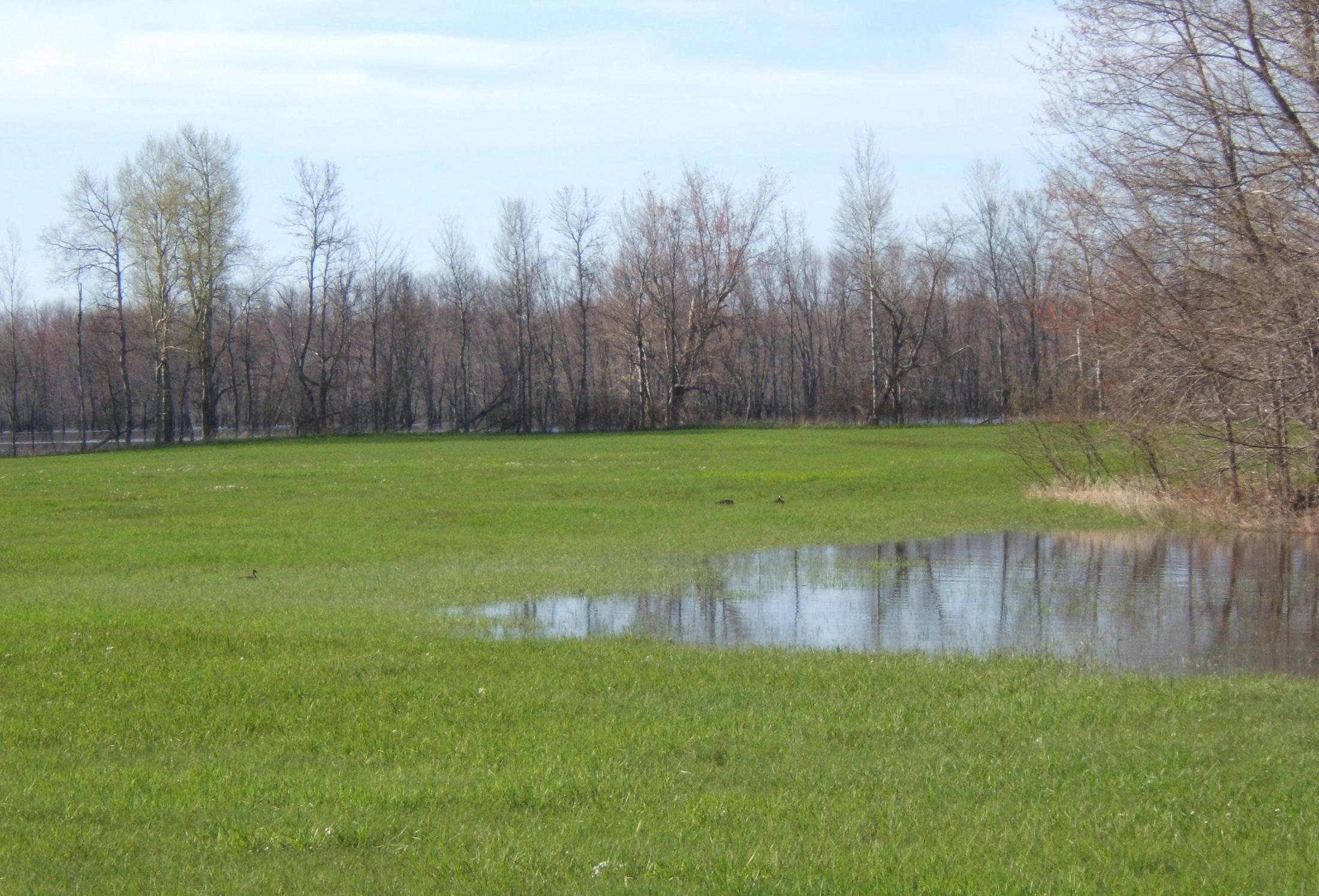
a wet field near Scovil … there are two American Black Ducks in the grass to the left and two Canada Geese beyond the pond … this is the same pond where we saw a Glossy Ibis on April 23, 1988
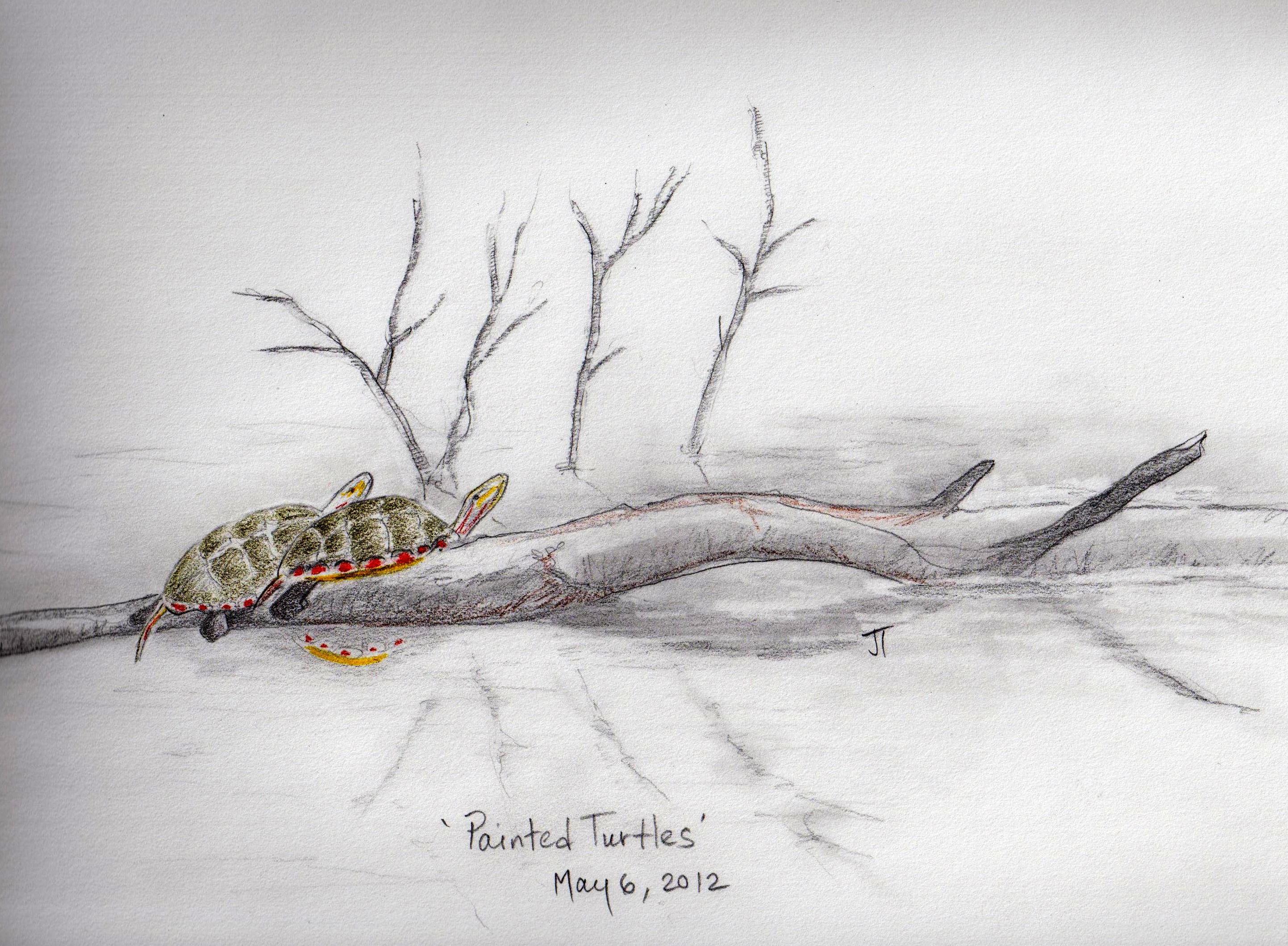
The highlight of our trip on Sunday was a group of three Painted Turtles (Chrysemys picta) on a log along this last section of our route, near the spot marked ‘C’.

The turtles were sunning themselves on a log in the middle of a pond. They have dark green, smooth shells, with bright orange markings along the edge of the shell. The inside of the lower shell is bright yellow. Their heads and tails are also marked with short streaks of orange and yellow. All winter these turtles have been hibernating at the bottom of the pond. Now awake, they will live in the pond all summer, laying eggs and feeding on aquatic insects and vegetation.
These Painted Turtles were stretching their necks out of their shells as far as possible. They made a beautiful sight, their colorful shells mirrored in the pond water.
~
~
Painted Turtles
~
I study the colors
through binoculars
remember these
with my hand, my fingers
rock the fine focus
rotate the brush
pick paint from the palette
~
the shell, flat olive tiles, grouted
Payne’s Grey
the wrinkled foot and leg, relaxed along the log
Burnt Umber
on the tail, the neck, the head
deft strokes of Cadmium
Yellow and Orange
~
the head stretches, to soak in sun
and dazzles on the pond
the lower shell
Yellow
refection on water
~
and, at the edge of the carapace
bright dabs of Orange
one part Cadmium
two parts Quinacridone
and a touch of some unknown
translucence
elusive
~
© Jane Tims 2012
‘Ducks’ Ditty’
On Saturday we took a drive along the St. John River, to see if any waterfowl were braving the cold windy day. The water is slowly receeding but still above summer levels. On a miserable day, the ducks retreat to the shallows, away from the exposure of the open water.
There were a few birds on the water. We stopped for a while to watch five male Mallards (Anas platyrhynchos) paddling about. They stuck together as a group, feeding in the shallows and occasionally ‘standing’ on the water to flap their wings. This time of year, the female Mallards are on the nest, hatching their young, and the males typically hang out in groups with other males until moulting begins.
I am not good at duck identification, but the Mallard is easy to spot, with its bright green head and the white ring around its neck. I enjoyed watching them through the binoculars, especially their orange legs and feet maneouvering in the muddy water.
The Mallard is a member of the marsh duck family and a ‘dabbler’. Dabblers obtain their food by skimming it from the surface or tipping up to submerge their heads so they can feed underwater.
I can never watch dabblers on the water without thinking of Kenneth Grahame’s famous poem ‘Ducks’ Ditty’, from the book The Wind in the Willows. If you don’t have a copy of the book, have a look at the poem at http://www.literaturepage.com/read/windinthewillows-14.html

© Jane Tims 2012
snippets of landscape – vernal pools and the spring migration
At the edges of our Grey Woods are several places where ‘vernal pools’ form. As a result, these spring evenings are alive with the peeping and croaking of various frogs and toads.
‘Vernal pools’ are temporary accumulations of water in depressions. This water may originate from snow accumulations or from rising water tables. The word ‘vernal’ comes from the Latin ver meaning spring.
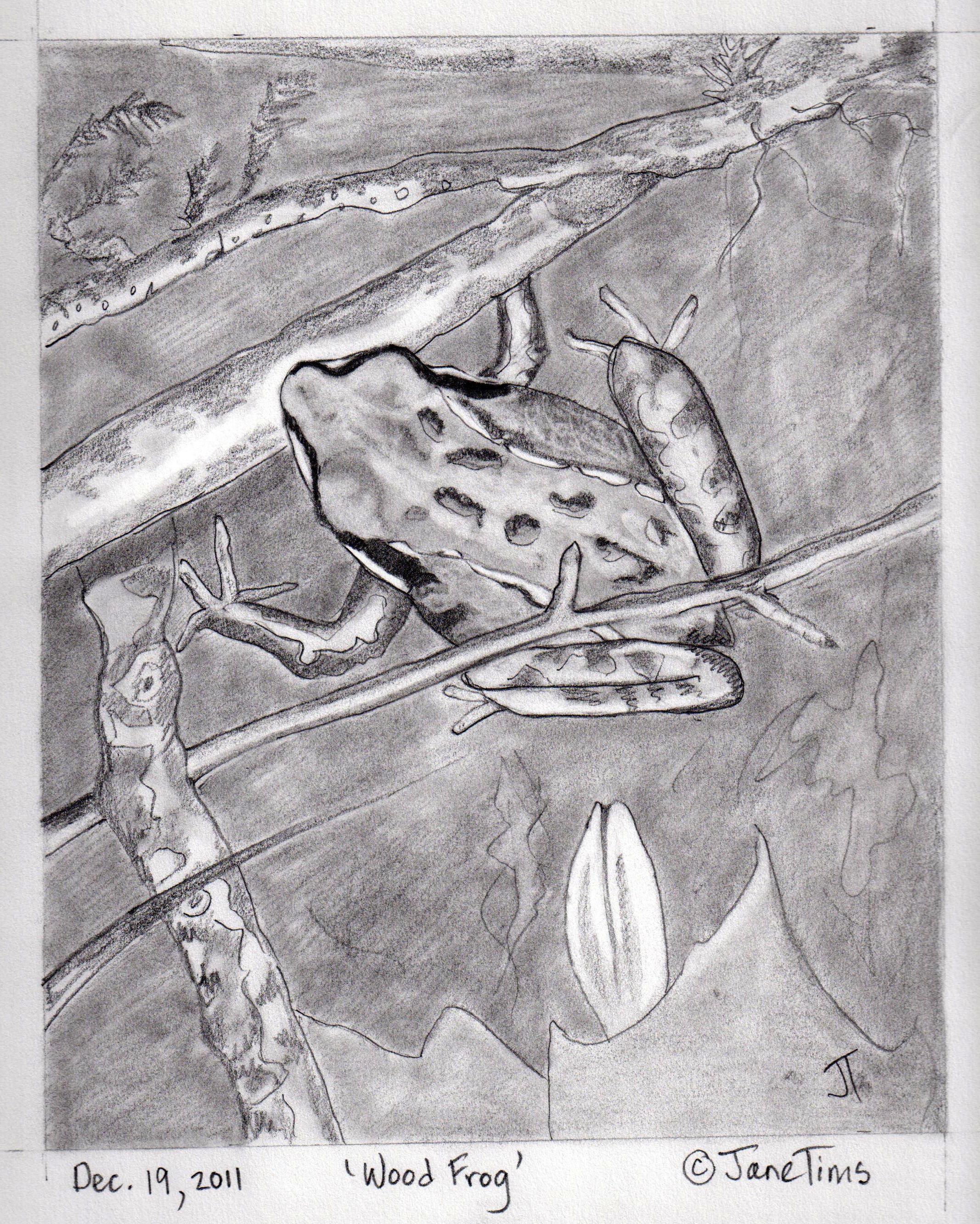
Although vernal pools are ephemeral, they create habitat for many animals, including insects and amphibians, often at critical life stages. Amphibians such as Wood Frogs (Rana sylvatica), Spotted Salamanders (Ambystoma maculatum), and Blue Spotted Salamanders (Ambystoma laterale) depend on vernal pools for laying their eggs and development of tadpoles. Other amphibians you may encounter in a vernal pool include Spring Peepers, Grey Tree Frogs and Bull Frogs.
During a rainy night in late April or early May, you may be fortunate enough to observe the early spring migration of Wood Frogs and other species as they make their way to breeding locations. These frogs have remained all winter in hibernation and have unthawed in the early spring rains. Unfortunately, many must cross roads to get to the ponds and vernal pools where they will lay their eggs, and many become casualties of their attempts to cross the road.

~
~
an uncertain spring migration
~
if it rains
the night road
leads home
to lowlands
and hollows
vernal pools
north of the highway
swollen with rain
~
mists crawl
towards me
vignettes
sweep the windshield
frogs cross the roadway
follow ancestral memory
blurred by rain
~
some nights
the tail-lights ahead
are my only family
red streamers on wet pavement
tadpoles from the eggmass
grow legs
absorb their tails
follow the road
~
I watch
the phone poles
the potholes
the hidden driveways
the headlight echo on trees
frog legs
crushed on the pavement
mailboxes with uncertain names
~
the centre line is a zipper
seals the left side
to the right
the coming home
with the leaving
frogs plead
from the wetlands
never saying goodbye
~
Published as: ‘an uncertain spring migration’, Spring 1997, Green’s Magazine XXV (3).
revised
© Jane Tims 2011
~
snippets of landscape – beaver lodges and beaver dams
Everywhere along streams in New Brunswick there are dams and lodges the beaver have built. The North American Beaver (Castor canadensis) is a clever engineer, building dams to create ponds as habitat. The still, deep water provides safety from predators and enables the beaver to float branches and logs to be used as building materials and food.
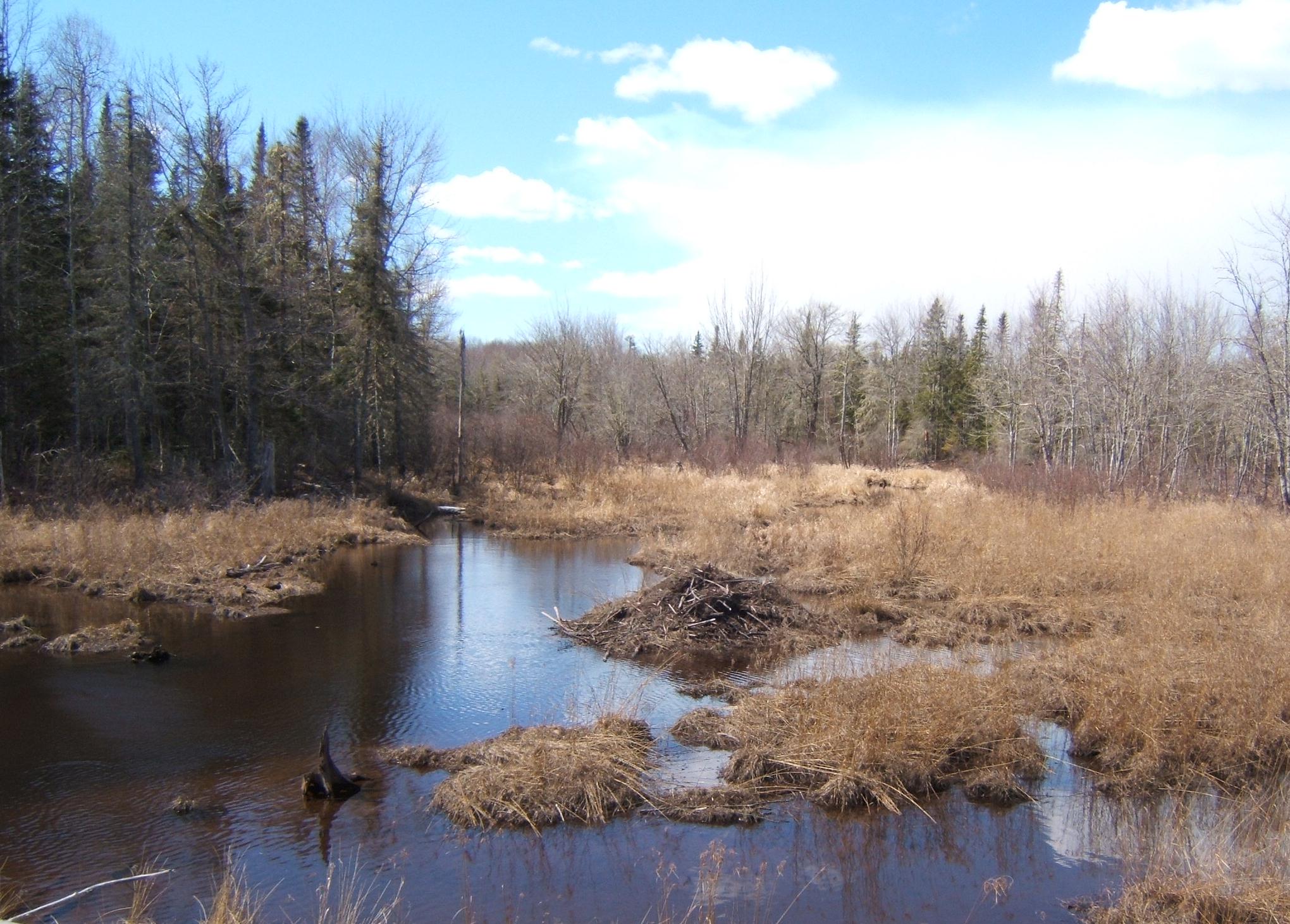
a beaver pond near our cabin ... notice the two ducks on the shore to the left...
Unfortunately, the subsequent flooding of roads and other land means the beaver’s talents are not always appreciated. However, beaver dams help create and maintain wetlands, important for providing habitat for other animals and storage areas for water.
~
~
Bear Creek Meadow by Canoe
~
from the river
we portage
across the beaverdam
over poles and patted mud
up
to the quiet pond
~
and the bow
scoured by rocks
parts green
~
and our paddles
pitted by snags
spoon soup
~
dignity quiets our paddles
hushed voices heed
the diminishing echo
~
pliant as stems of pickerel weed
we honour the whisper
of wild rice
the edgewise touching
of nymphaea and nuphar
amphibian eyes
in the harbour-notch of lily pads
~
we are threaded by dragonflies
drawn by water striders
gathered in a cloak of water shield
~
oval pads a puzzle
part in silence
return to their places
~
no trace of our passing
~
~
Published as ‘Bear Creek Meadow by Canoe’, Canadian Stories 14 (79), 2011.
© Jane Tims 2011




 nichepoetryandprose