Archive for the ‘waterways’ Category
ponds and pond lilies
Water is a favorite feature of the landscape for many people. On our drives we encounter streams and rivers, lakes and ponds. Thoreau, writing about his Walden Pond, said that water features are the eyes of the landscape. Reflected in those eyes are sky and clouds and the dazzle of the sunlight.
‘A lake is the landscape’s most beautiful and expressive feature. It is earth’s eye; looking into which the beholder measures the depth of his own nature. The fluviatile trees next the shore are the slender eyelashes which fringe it, and the wooded hills and cliffs around are its overhanging brows.’ Henry David Thoreau, Walden, 1854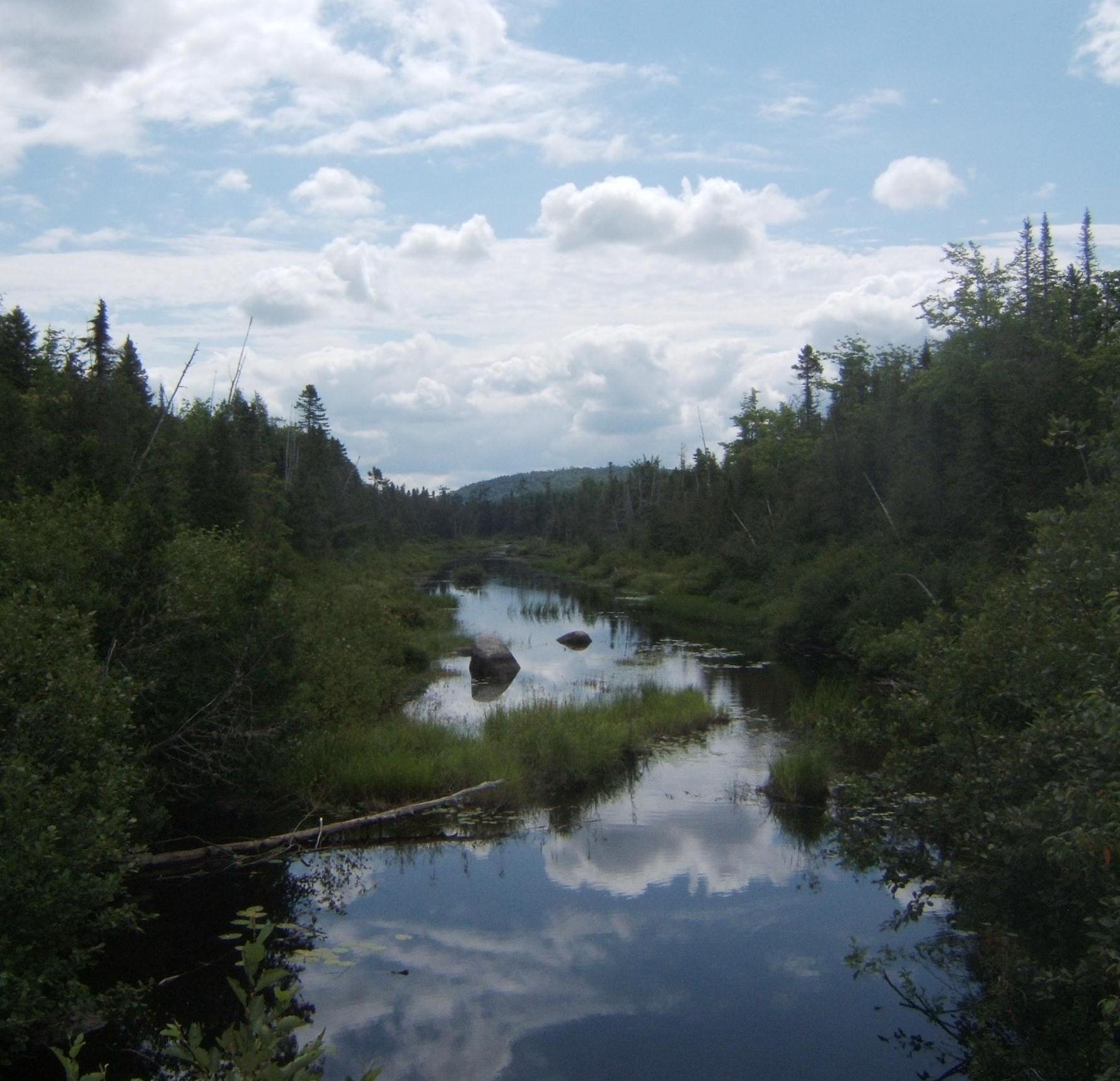
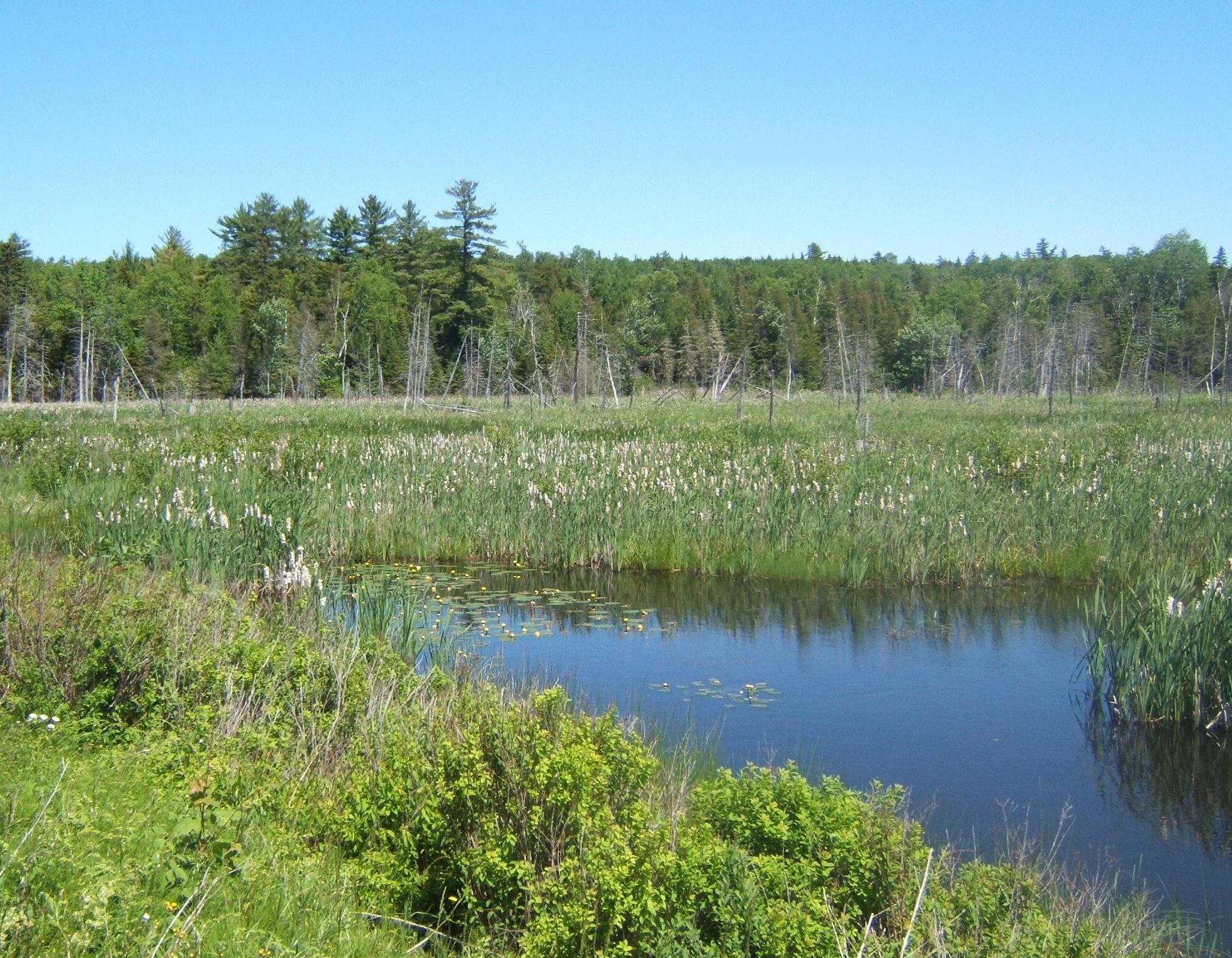
This time of year, pond vegetation is lush and in bloom. Some ponds and wetland waters are alwost covered by Duckweed (Lemna minor L.), Pickerel-weed (Pontederia cordata L.) and Pond-lilies.

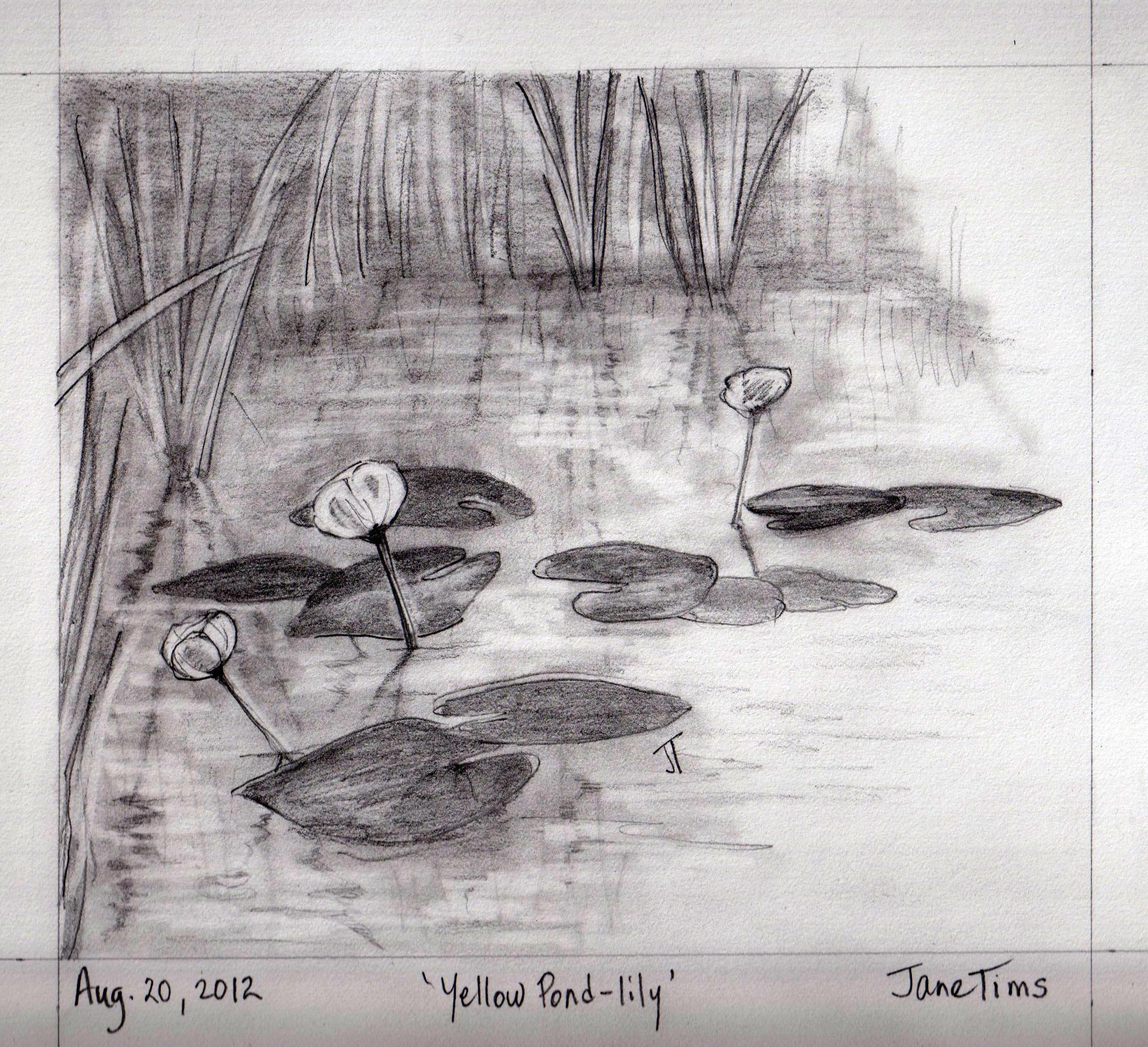
Pond lilies are in bloom and their flat pad-like leaves cover the water like pieces of a puzzle. White Water-lilies, Nymphaea odorata Ait., speckle the edge of almost every pond…


and the yellow cup-like blooms of Cow-lily (Nuphar variegatum Engelm.) brighten the sluggish waters of meandering brooks and wetland ponds…
Last week we drove to South Oromocto Lake in Charlotte County and stopped beside the lake outlet where there is a dam, including a water control structure and a fish ladder. The long, red stems of up-rooted Water-shield (Brasenia Schreberi Gmel.) were gathered in tangles at the control structure.
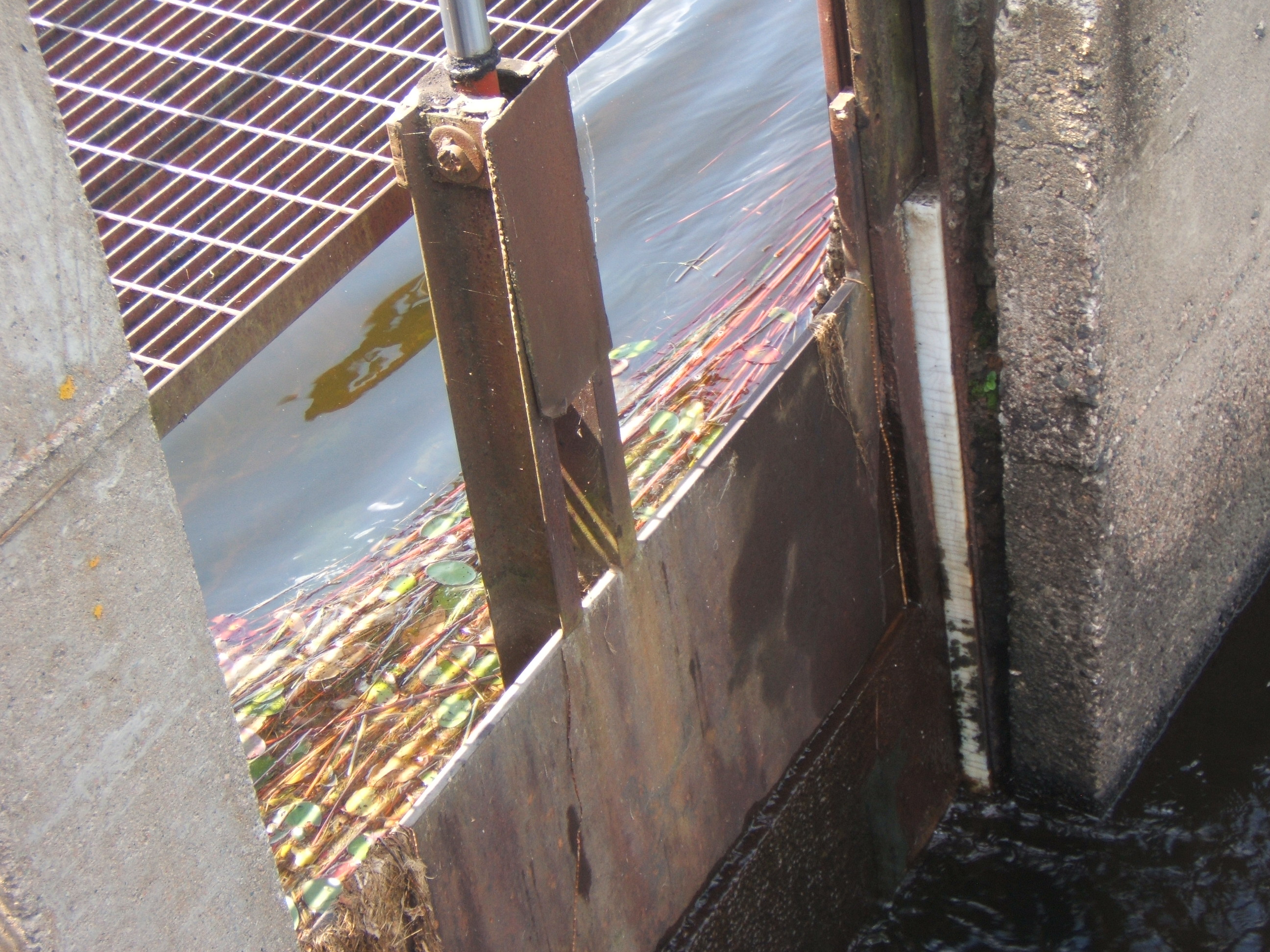
the red stems and green leaves of up-rooted Water-shield, gathered in the dam at the outlet of South Oromocto Lake

Do you have Pond-lilies and Water-shield where you are?
~
Copyright Jane Tims 2012
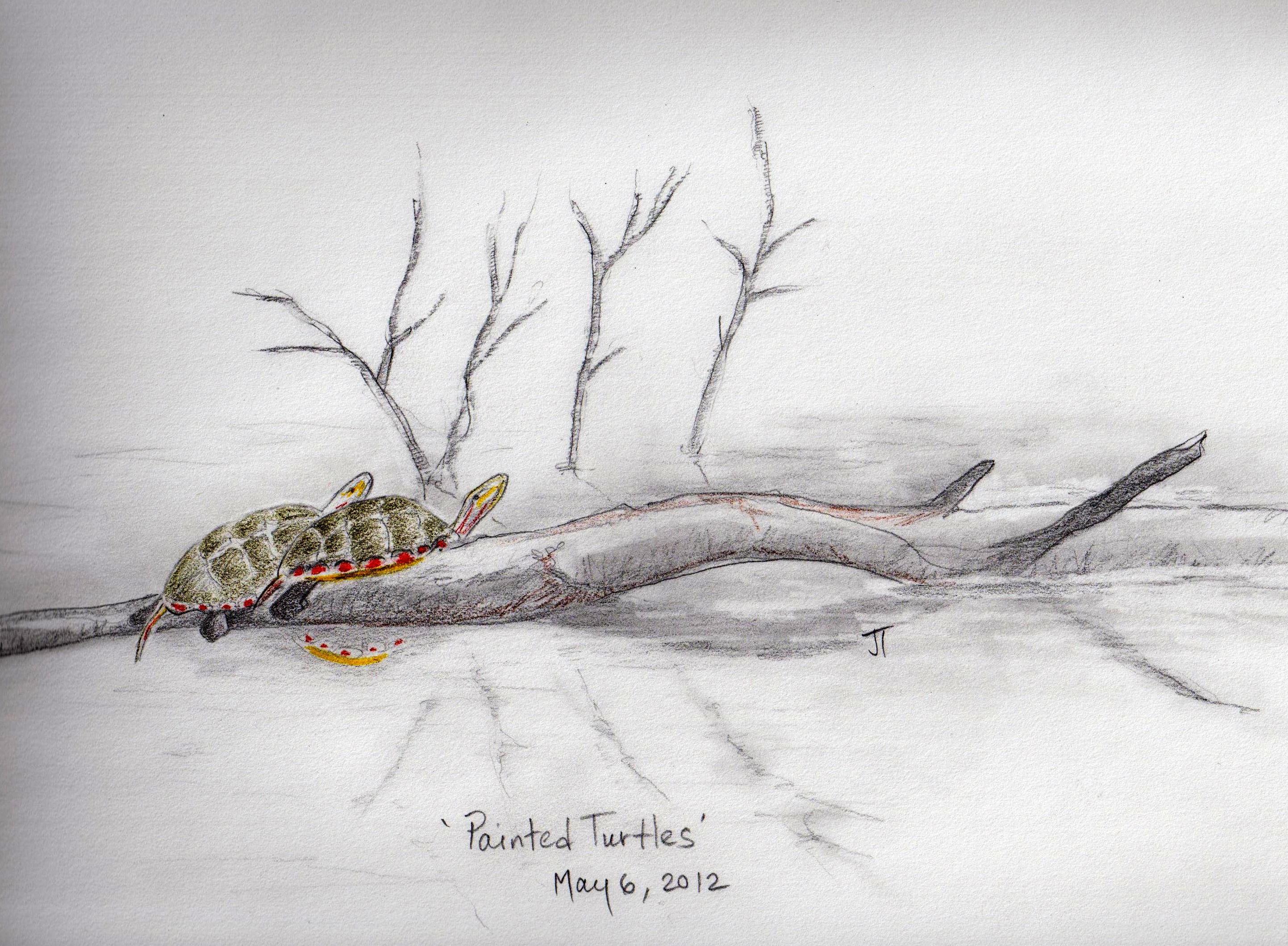
a pair of Painted Turtles
We did our usual bird-watching run along the St. John River on Sunday afternoon. We ordinarily follow the same circuit, from Oromocto, along the north side of the River, to Jemseg, crossing the River via the Gagetown Ferry, and returning on the south side of the St. John River. This area is in central New Brunswick, east of Fredericton.
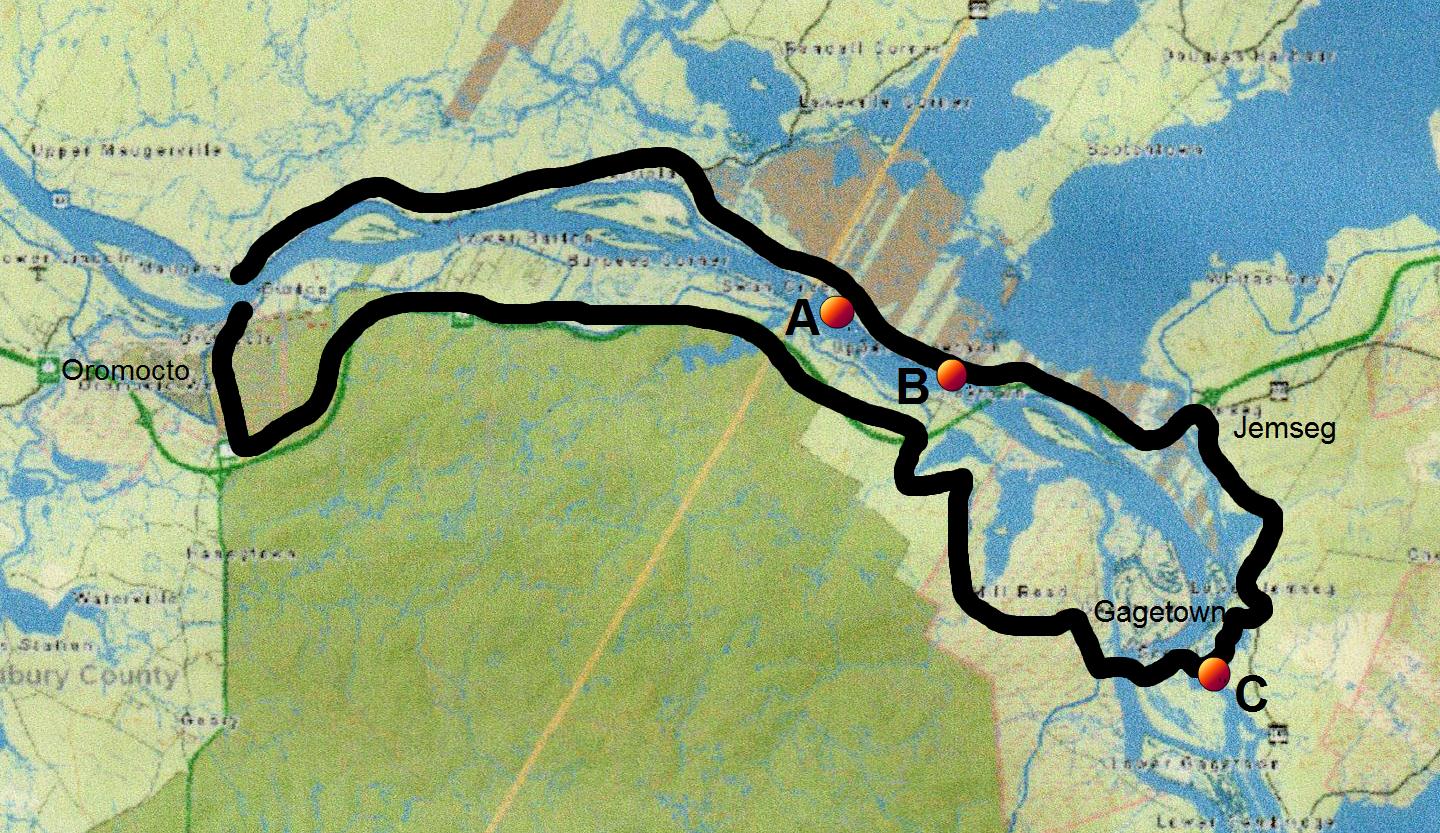
The first part of this circuit is along the old Trans Canada Highway, now Route 105. This section follows the St. John River, through the Grand Lake Meadows, an important wetland area for New Brunswick. Near the spot marked ‘A’, we saw lots of ducks, an Osprey eating a fish, and three other raptors (a group including hawks or eagles) too distant to identify. Near ‘B’ is the place we often see various owls, Bald Eagles, and Moose.

From Jemseg, we take Route 715 to Lower Jemseg. This part of the route travels above the River, through farmland. We rarely see wildlife along this section, but the area has a rich history and has several interesting buildings, including the old church featured in my post of September 14, 2011.

From Lower Jemseg, we turn towards the Gagetown Ferry and Scovil. This is a very interesting part of the route, snaking between wetlands and ponds. Along this section, it is usual to spot other cars of eager birdwatchers.
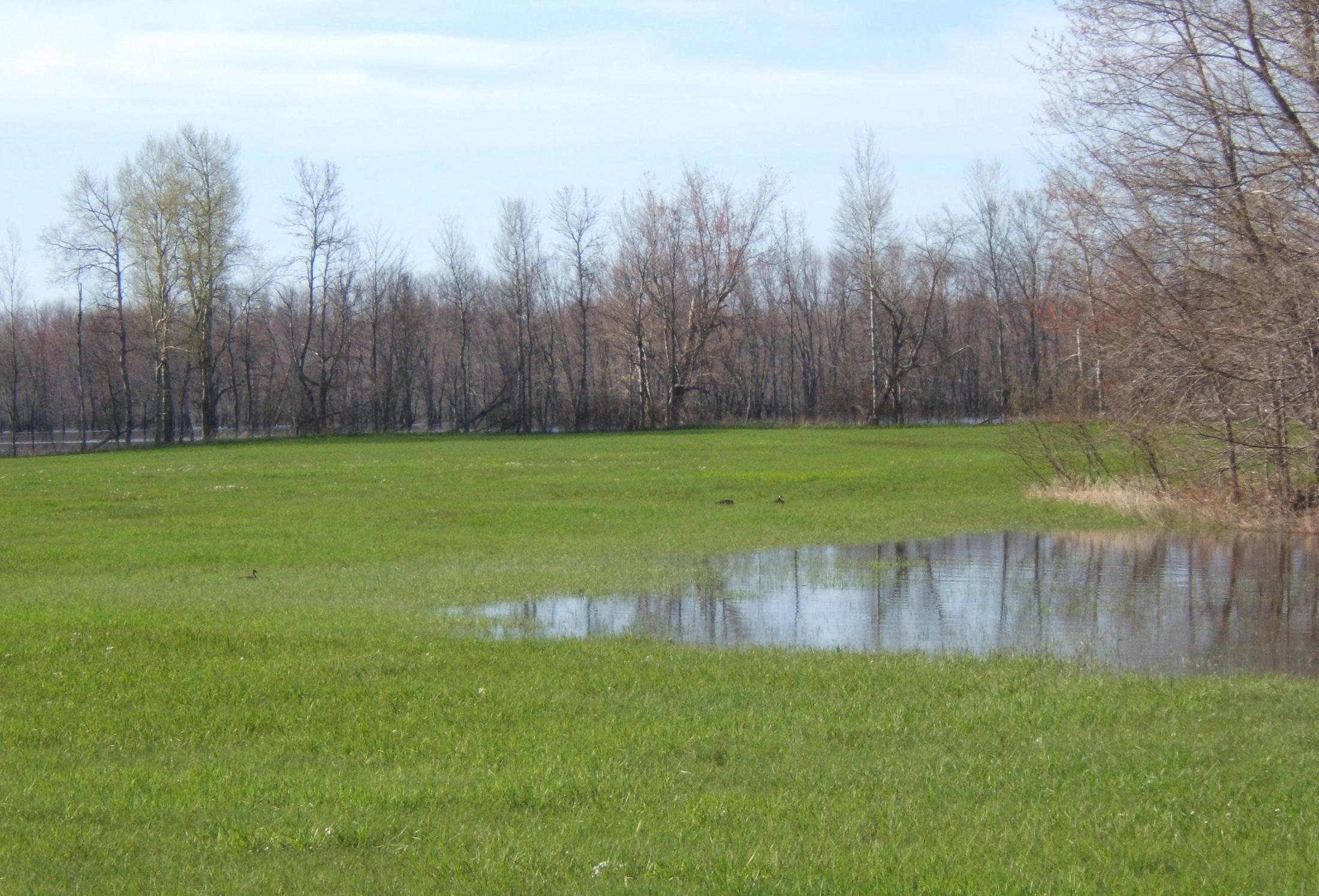
a wet field near Scovil … there are two American Black Ducks in the grass to the left and two Canada Geese beyond the pond … this is the same pond where we saw a Glossy Ibis on April 23, 1988
The highlight of our trip on Sunday was a group of three Painted Turtles (Chrysemys picta) on a log along this last section of our route, near the spot marked ‘C’.

The turtles were sunning themselves on a log in the middle of a pond. They have dark green, smooth shells, with bright orange markings along the edge of the shell. The inside of the lower shell is bright yellow. Their heads and tails are also marked with short streaks of orange and yellow. All winter these turtles have been hibernating at the bottom of the pond. Now awake, they will live in the pond all summer, laying eggs and feeding on aquatic insects and vegetation.
These Painted Turtles were stretching their necks out of their shells as far as possible. They made a beautiful sight, their colorful shells mirrored in the pond water.
~
~
Painted Turtles
~
I study the colors
through binoculars
remember these
with my hand, my fingers
rock the fine focus
rotate the brush
pick paint from the palette
~
the shell, flat olive tiles, grouted
Payne’s Grey
the wrinkled foot and leg, relaxed along the log
Burnt Umber
on the tail, the neck, the head
deft strokes of Cadmium
Yellow and Orange
~
the head stretches, to soak in sun
and dazzles on the pond
the lower shell
Yellow
refection on water
~
and, at the edge of the carapace
bright dabs of Orange
one part Cadmium
two parts Quinacridone
and a touch of some unknown
translucence
elusive
~
© Jane Tims 2012
snippets of landscape – vernal pools and the spring migration
At the edges of our Grey Woods are several places where ‘vernal pools’ form. As a result, these spring evenings are alive with the peeping and croaking of various frogs and toads.
‘Vernal pools’ are temporary accumulations of water in depressions. This water may originate from snow accumulations or from rising water tables. The word ‘vernal’ comes from the Latin ver meaning spring.
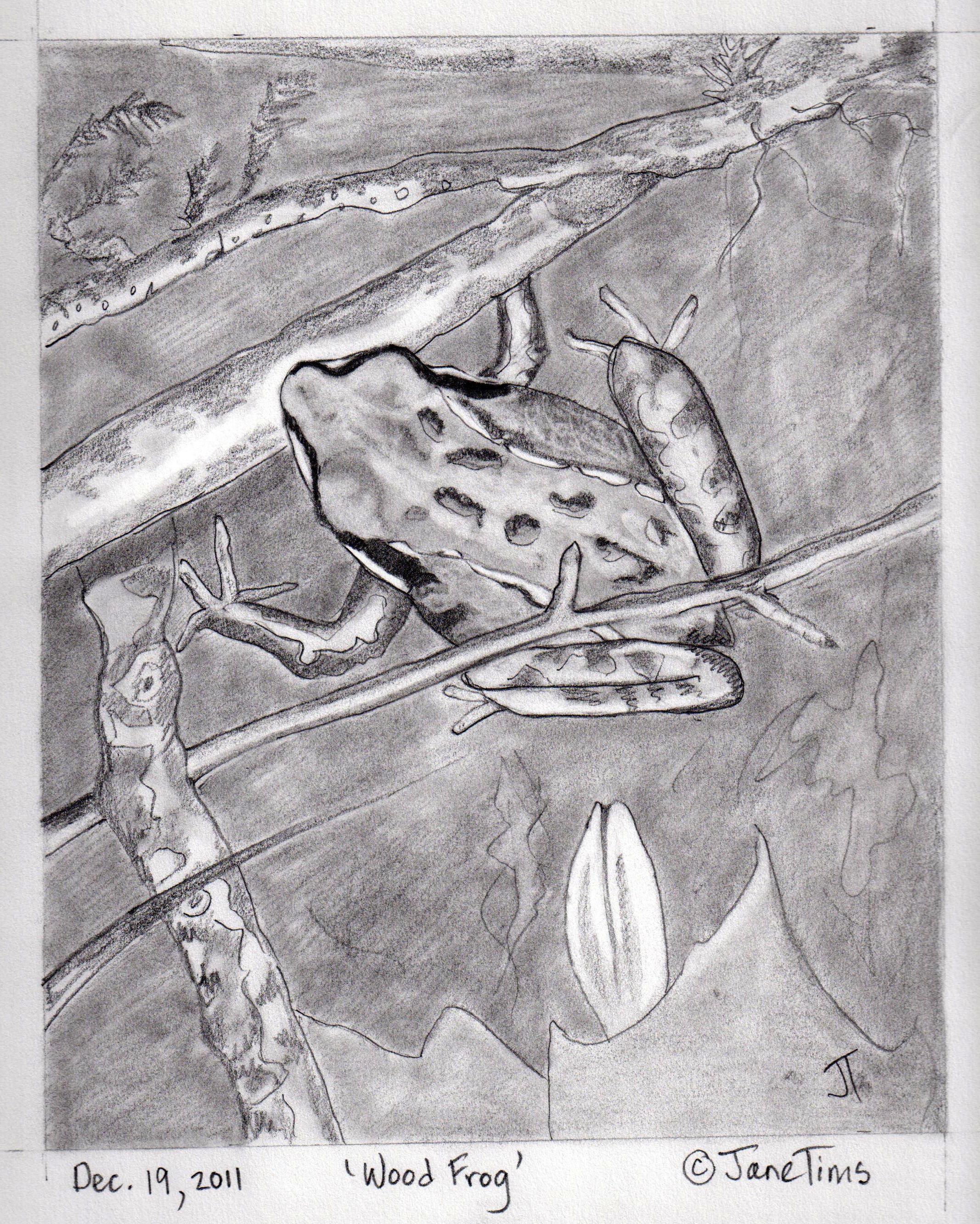
Although vernal pools are ephemeral, they create habitat for many animals, including insects and amphibians, often at critical life stages. Amphibians such as Wood Frogs (Rana sylvatica), Spotted Salamanders (Ambystoma maculatum), and Blue Spotted Salamanders (Ambystoma laterale) depend on vernal pools for laying their eggs and development of tadpoles. Other amphibians you may encounter in a vernal pool include Spring Peepers, Grey Tree Frogs and Bull Frogs.
During a rainy night in late April or early May, you may be fortunate enough to observe the early spring migration of Wood Frogs and other species as they make their way to breeding locations. These frogs have remained all winter in hibernation and have unthawed in the early spring rains. Unfortunately, many must cross roads to get to the ponds and vernal pools where they will lay their eggs, and many become casualties of their attempts to cross the road.

~
~
an uncertain spring migration
~
if it rains
the night road
leads home
to lowlands
and hollows
vernal pools
north of the highway
swollen with rain
~
mists crawl
towards me
vignettes
sweep the windshield
frogs cross the roadway
follow ancestral memory
blurred by rain
~
some nights
the tail-lights ahead
are my only family
red streamers on wet pavement
tadpoles from the eggmass
grow legs
absorb their tails
follow the road
~
I watch
the phone poles
the potholes
the hidden driveways
the headlight echo on trees
frog legs
crushed on the pavement
mailboxes with uncertain names
~
the centre line is a zipper
seals the left side
to the right
the coming home
with the leaving
frogs plead
from the wetlands
never saying goodbye
~
Published as: ‘an uncertain spring migration’, Spring 1997, Green’s Magazine XXV (3).
revised
© Jane Tims 2011
~
snippets of landscape – beaver lodges and beaver dams
Everywhere along streams in New Brunswick there are dams and lodges the beaver have built. The North American Beaver (Castor canadensis) is a clever engineer, building dams to create ponds as habitat. The still, deep water provides safety from predators and enables the beaver to float branches and logs to be used as building materials and food.
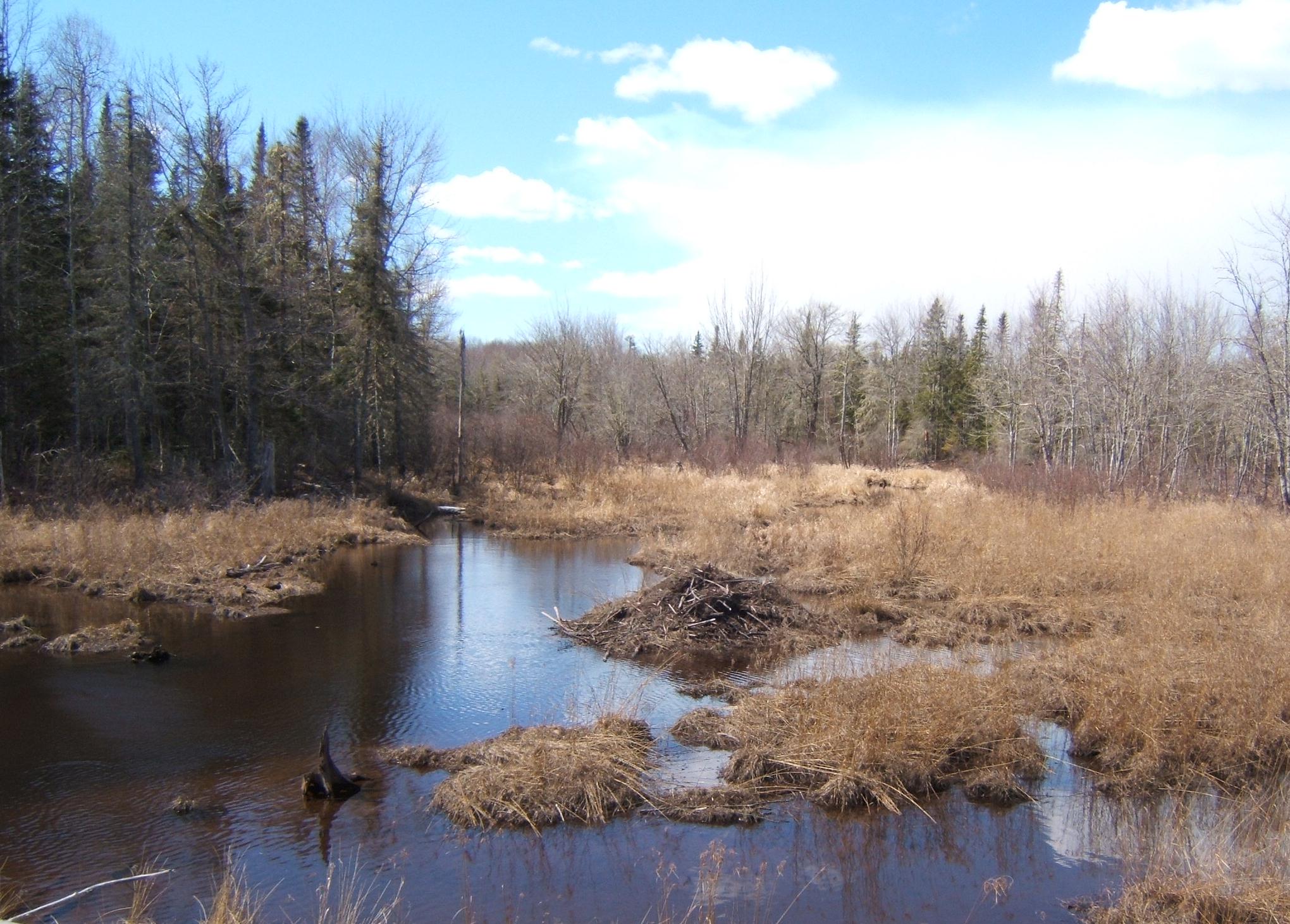
a beaver pond near our cabin ... notice the two ducks on the shore to the left...
Unfortunately, the subsequent flooding of roads and other land means the beaver’s talents are not always appreciated. However, beaver dams help create and maintain wetlands, important for providing habitat for other animals and storage areas for water.
~
~
Bear Creek Meadow by Canoe
~
from the river
we portage
across the beaverdam
over poles and patted mud
up
to the quiet pond
~
and the bow
scoured by rocks
parts green
~
and our paddles
pitted by snags
spoon soup
~
dignity quiets our paddles
hushed voices heed
the diminishing echo
~
pliant as stems of pickerel weed
we honour the whisper
of wild rice
the edgewise touching
of nymphaea and nuphar
amphibian eyes
in the harbour-notch of lily pads
~
we are threaded by dragonflies
drawn by water striders
gathered in a cloak of water shield
~
oval pads a puzzle
part in silence
return to their places
~
no trace of our passing
~
~
Published as ‘Bear Creek Meadow by Canoe’, Canadian Stories 14 (79), 2011.
© Jane Tims 2011
burrballs, weedballs and manganese concretions
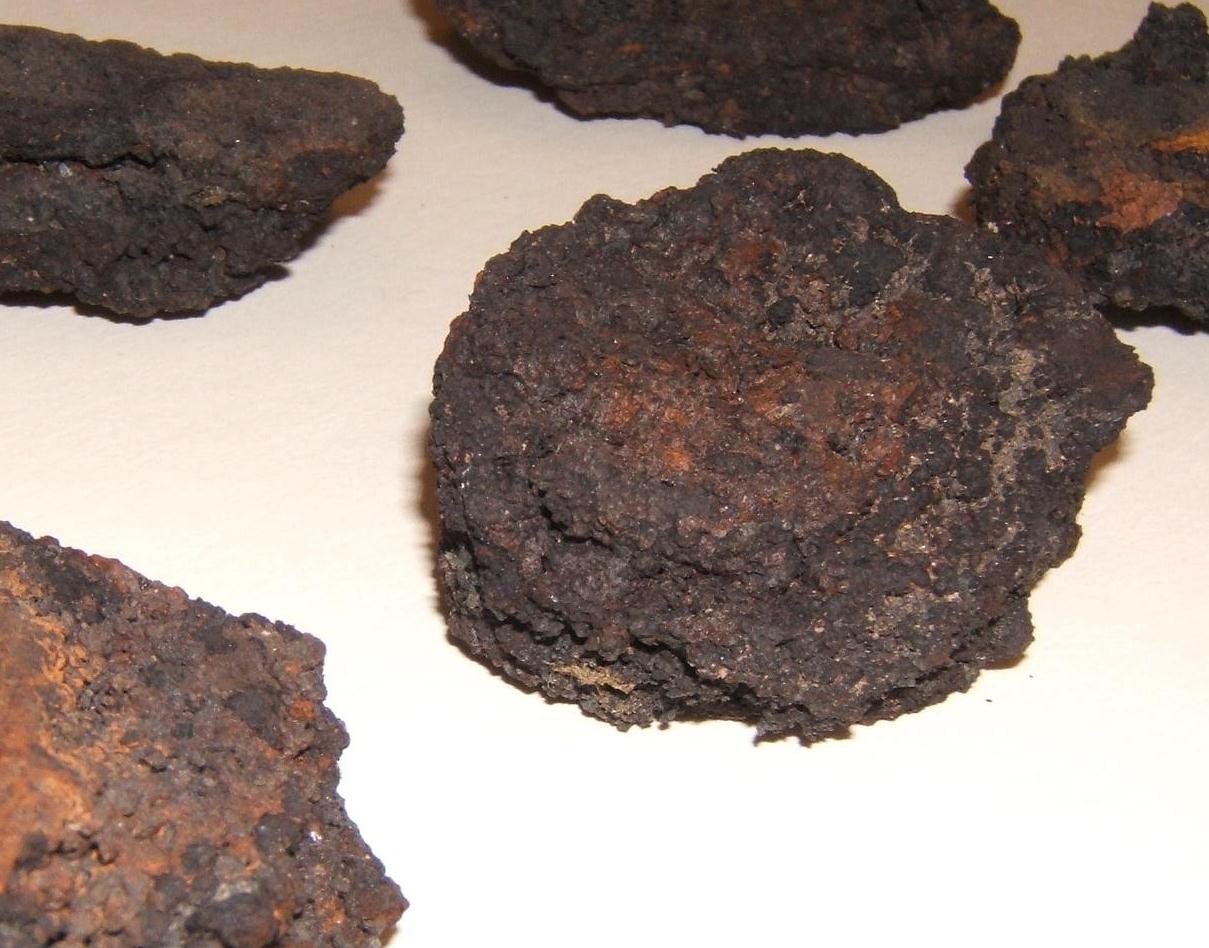
As I slowly clean out my office in preparation for my retirement, I am encountering the collected mementoes of 33 years of work. One of the oddest items I kept through the years is a plastic case filled with six hard black gobs, about 4 to 6 centimetres in diameter. They look like burnt chocolate chip cookies, but I assure you, even my baking is not that bad!
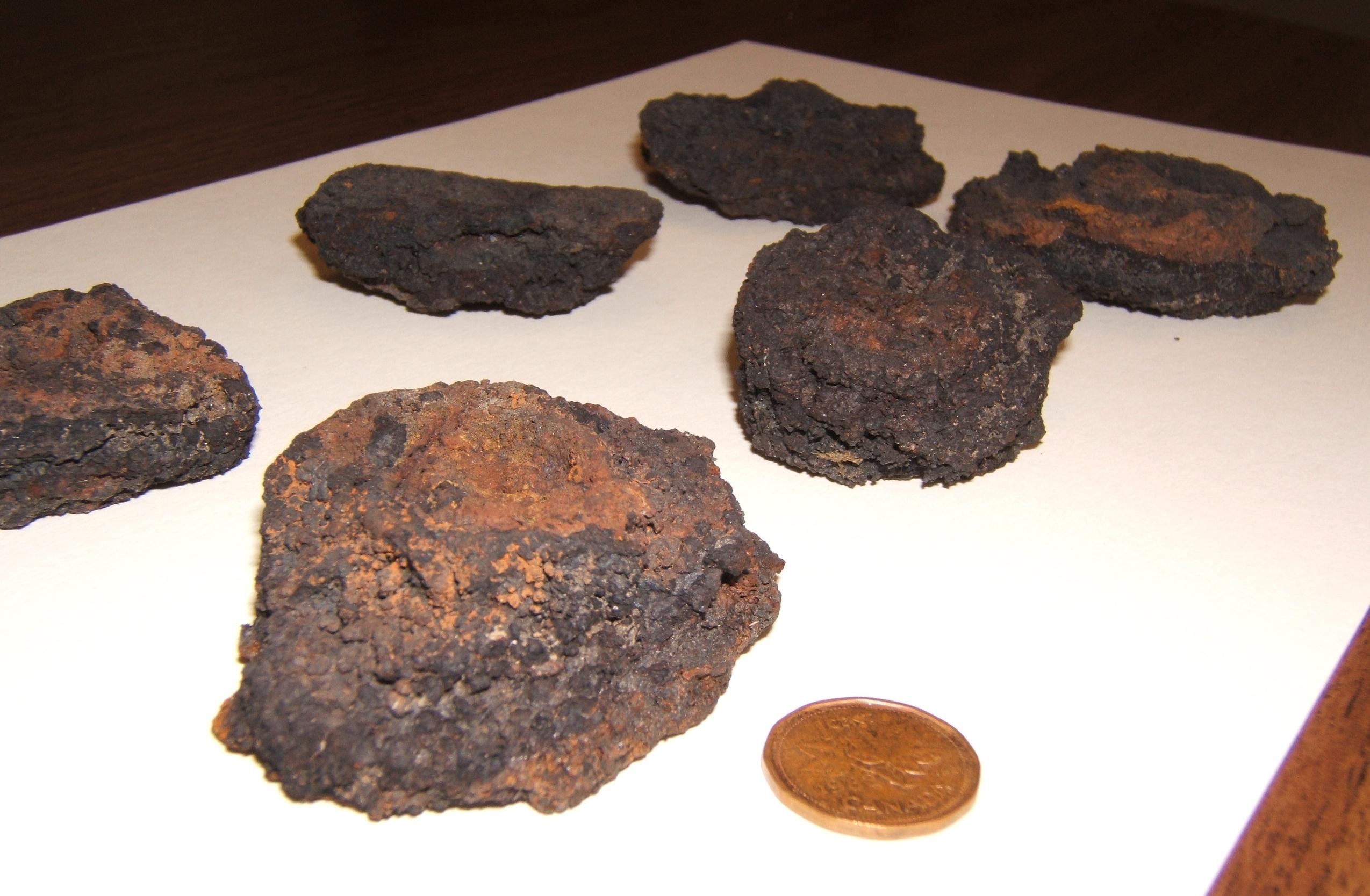
These are called iron-manganese concretions. They were found in the late 1990’s on the bottom of a lake in New Brunswick.
The occurrence of ‘balls’ in lakes and other bodies of water has been an interest of mine. In my experience, and in the reading I have done, I have encountered three different natural spherical formations in the Maritime Provinces. One of these is found along the ocean shore. The other two are found on the bottoms of lakes.
These are:
Water-rolled Weed Balls:
This was A.H. MacKay’s suggested name for ‘sea-balls’, compact balls of seaweeds and other materials found on a beach near Lunenburg, Nova Scotia. MacKay wrote a paper about these balls for the Transactions of the Nova Scotia Institute of Science in 1906. These strange formations were first reported by a teacher, Mary Bowers, who wrote to MacKay about their occurrence on a beach at Upper Kingsburg, along the mouth of the LaHave River. She wrote: “I have seen up to 200 balls on a short strip of beach…” MacKay described them as 1 ½ to 5 inches in diameter, composed of rolled-up remains of brown algae. The balls also incorporated red seaweeds, sea sponges, and small sea shells. MacKay wrote: “…Their structure in the different forms examined suggest their formation from light ridges of algae left by the retreating tide on flat sandy shallows. Under the sun, the weeds curl and lock into masses which, when moved over the sand by alternate tides and winds, occasionally produce very round balls.”
Kedron Balls:
These spherical balls of organic matter, a natural formation on the bottom of Little Kedron Lake, near Oromocto Lake in York County, New Brunswick, were described in 1904 by the naturalist William Ganong. Needles of fir and spruce from the forest surrounding the lake roll together with twigs, sandy silt and other vegetable matter on the lake bottom, gradually forming these soft compact spheres.
In his book Walden, Thoreau describes similar balls of organic matter from Sandy Pond in Lincoln, Massachusetts: “… I have found, in considerable quantities, curious balls, composed apparently of fine grass or roots, of pipewort, perhaps, from half an inch to four inches in diameter, and perfectly spherical. These wash back and forth in shallow water on a sandy bottom, and are sometimes cast on the shore.”
Iron-Manganese Concretions:
The examples I have were given to me by a friend who collected them at Balls Lake, a small lake near Cape Spencer in Saint John County, New Brunswick. These are natural formations, known as polymetallic or manganese nodules, built in successive layers of iron and manganese hydroxides around a core. The result is a spherical formation, rough and knobby on the surface. The concretions range in size, but most, like the specimens I have, are the size of a small potato. Manganese concretions form in both lakes and salt-water.
~
~
~
water-rolled weeds
~
begin with
a pinch of sand
a thread
a gesture, word
a fir leans
over the lake edge
drops a single leaf
~
layers spool
from chemistry of water
sediment
or a fluff of needles
quilting, quilting
soft balls wind
forward and back
~
gather, gather
while sunreels
ravel scene by scene
a bobbin
accepts the thread
and first line
builds to story
~
~
© Jane Tims 2012
~
~
Some reading about burrballs and weedballs:
W.F. Ganong. 1904. ‘On Vegetable-, or Burr-, Balls from Little Kedron Lake, New Brunswick’. Bulletin of the Natural History Society of New Brunswick v: 304.
A.H. MacKay. 1906. ‘Water-Rolled Weed Balls’. Transactions of the Nova Scotia Institute of Science XI: 667-670. Available on-line at: http://dalspace.library.dal.ca/bitstream/handle/10222/12593/v11_p4_a8_MacKay_water-rolled_weed-balls.pdf?sequence=1 Accessed February 28, 2012.
Henry David Thoreau. 1954. ‘Ponds’, Walden or Life in the Woods. Pennsylvania State University, 154.
floodwaters
This time of year, along the St. John River, we watch for floodwaters. For some, whose homes may be threatened by the flood, this means worry. For others, it means a road along the river may be closed until the waters recede. For me, it is a time to watch for the return of the Canada Geese. It is also a time to see what interesting cargo the floodwaters carry.
All along the river, there will be huge wheels of root… the remains of trees ripped from the river’s banks and carried along with the floodwaters. These ‘root wheels’ come to rest on the river’s edges, stranded by the falling waters. Washed clean of the soil, the roots show us the underpinnings of the trees and reveal what goes on beneath the ground, where we ordinarily cannot see.


~
~
Windthrow
~
another scar
in the clearcut
~
one crooked pine
left sentinel
to watch shoots and brambles
scramble for sun
~
wind thrown in silence
(no ears to hear)
seedlings
patted in by Boy Scouts
crushed
~
roots and fibre, exposed
clots of clay
dripping rock, wounded
rootlets, oozing sap
~
overturned war wagon
mighty axle, broken
wheel of matted roots, still
spinning, earth upended
~
a crater dug in regolith
~
a new shelter
from the wind, rain
sprouting seeds
in mineral
and fallen leaves
~
~
Published as: ‘Windthrow’, The Cormorant XI (1): 100 (Fall 94)
© Jane Tims 1994
snippets of landscape – the bogan
Along the St. John River are sluggish side-streams, flooded in spring to form full tributaries of the river, but isolated and stagnant in low-water conditions, sometimes completely cut off from the main river. These are known as bogans, a word of Algonquian origin. The words logan and pokelogan have a similar origin and meaning.
My favorite bogan is a strip of water next to the Trans-Canada Highway near Jemseg. The bogan creates an island, Thatch Island, in the St. John River. Old Silver Maple trees lean over the still water, creating reflections and shadows.

bogan along Thatch Island
On maps of the St. John River, a bogan on Sugar Island, just north of Fredericton, is called the Sugar Island Padou.

bogan (padou) on Sugar Island
~
~
bogan
~
appendage of river
footnote on water
predictable as the day we walked
the dead-end backroad
and retraced our steps to return
~
in spring, by canoe, at high water
or on ice skates in winter
in summer sluggish
stagnant, secluded
~
we lurk, eavesdrop on whispered
conversation
we are river folk
unwelcome
~
~
© Jane Tims 2012
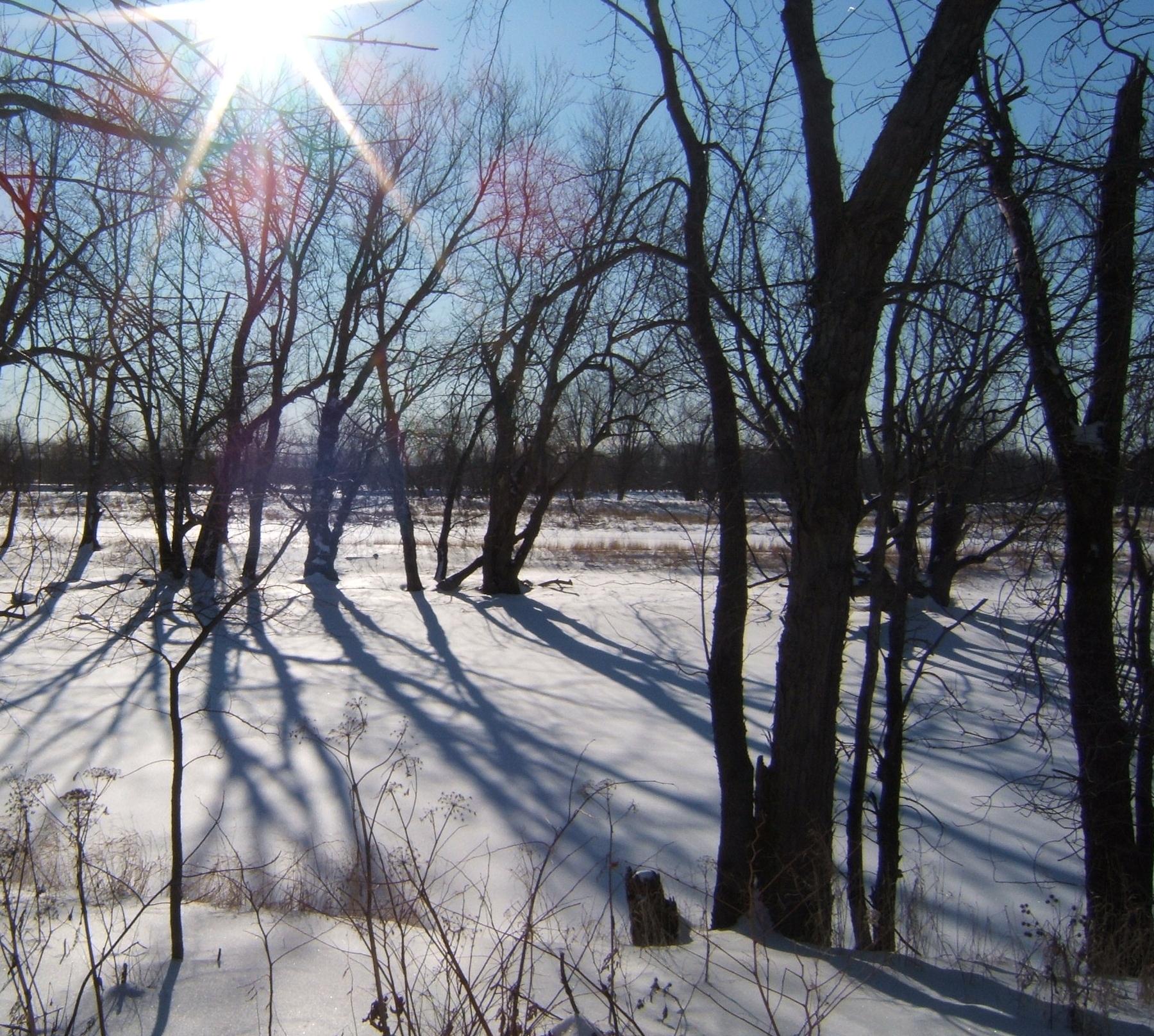
snow-bound bogan to the north of Thatch Island on the St. John River
a moment of beautiful – trees and shadows
space: edge of the St. John River in winter
beautiful: mature silver maple trees and their shadows on the snow
~
We went for a drive last weekend, along the St. John River. Above the ice, the river is covered in snow, a broad white plain edged by very old and very rugged silver maple trees.
In spite of a harsh environment, these trees endure. Each spring and fall, they are flooded. They are scoured by ice and subject to the eroding forces of the river. They are always at risk from people searching for a supply of firewood. A friend tells me these huge trees are usually suckers, grown from the base after the original tree was harvested.
And yet they grow old, a part of the hardwood floodplain forest. On a sunny day, they lean over the snow-covered river and spread their shadows across its surface. They have the beauty of their symmetry, solidity, grace, and fortitude.
~
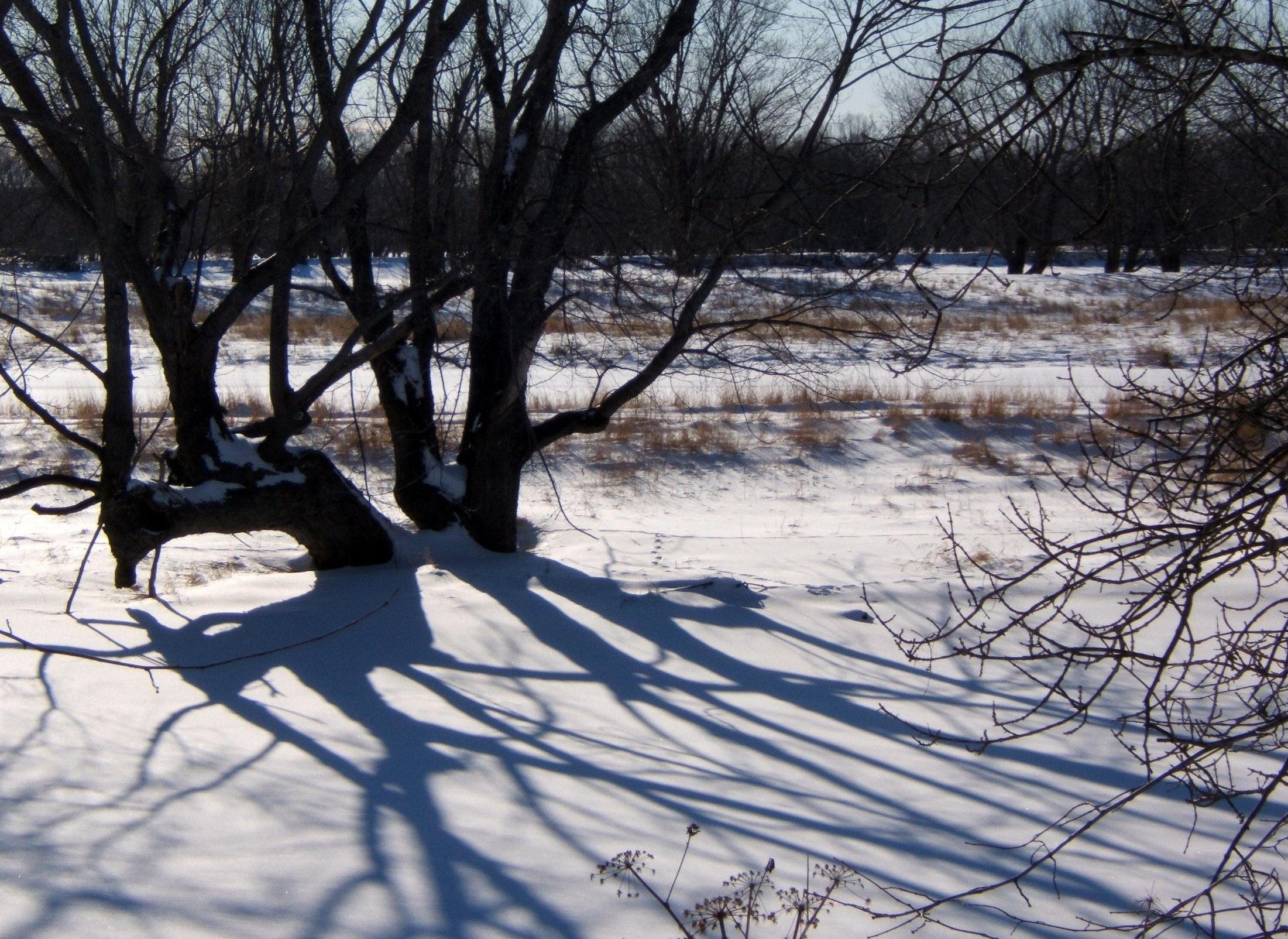

the line of animal tracks crossing the snow are probably from a Red Fox
Copyright Jane Tims 2012
on the rink
Ice rinks are a part of all our lives in New Brunswick. My son did not play hockey, but I know from friends how demanding the pursuit of ice-time and practice can be.
My ice skating experiences have been a little tamer, but definitely part of the fun side of life.
When my son was young, we had a backyard ‘rink’ for a couple of years. Although we had fun pouring water and trying not to fall, my best memories are of skating with him on ‘Hoot-and-Hollow Pond’, the postage-stamp pond in our back woods.
In my teenaged years, my family had a big pond where the ice was only smooth enough for skating during a few winters. I called it ‘Singing Glass Pond’ because of the sound made when stones were skipped across the ice. I remember skating there with my Mom who always sang as she skated and the oldest of my brothers who could jump up and do a spin from a position of standing still!
When I was in grade school, our teachers took us to the public rink where I skated in endless circles next to the boards and learned to do a ‘toes-out circle’, my single figure-skating ‘move’ to this day. When they were young, I used to watch my two nieces figure skate and was amazed at their fluidity and skill.
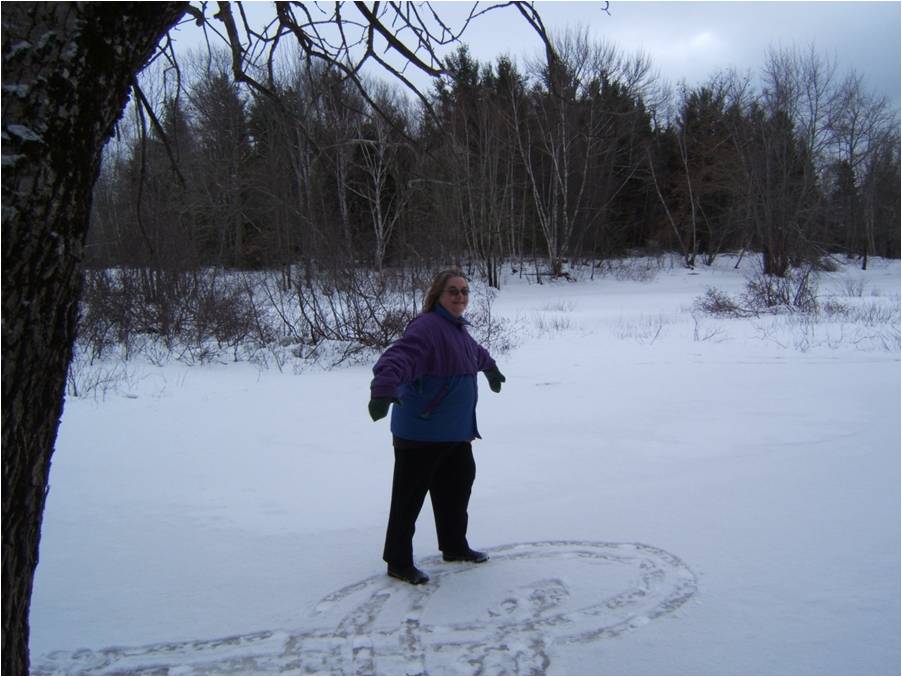
Today my knees are arthritic and my balance is pitiful, so my skates are put away. But on the frozen marsh at the lake, I can still ‘skate’ with my boots and do a parody of a ‘toes-out circle’!
~
~
a string of light bulbs
~
a string
of fifty
100 watt
bulbs
casts shadows
along plywood walls
exposes gouges and splinters
collisions of small bodies
~
Charlie, caretaker, solidifies
light and water
lays down rainbows
and new ice
~
~
© Jane Tims 2001

ice is nice
Our snow is slow in coming this year. We have had three snowfalls, but each, in its turn, has been rained or warmed away. If our ups and downs of temperature continue, the scant layer of snow on the ground this morning will be gone by Saturday.
However, winter is manifesting itself in other ways. I am wearing another sweater-layer this week. Our grey woods are muttering with chill cracking sounds. And ice is forming on the river and along the lake edge, gradually covering the surfaces with white and grey.
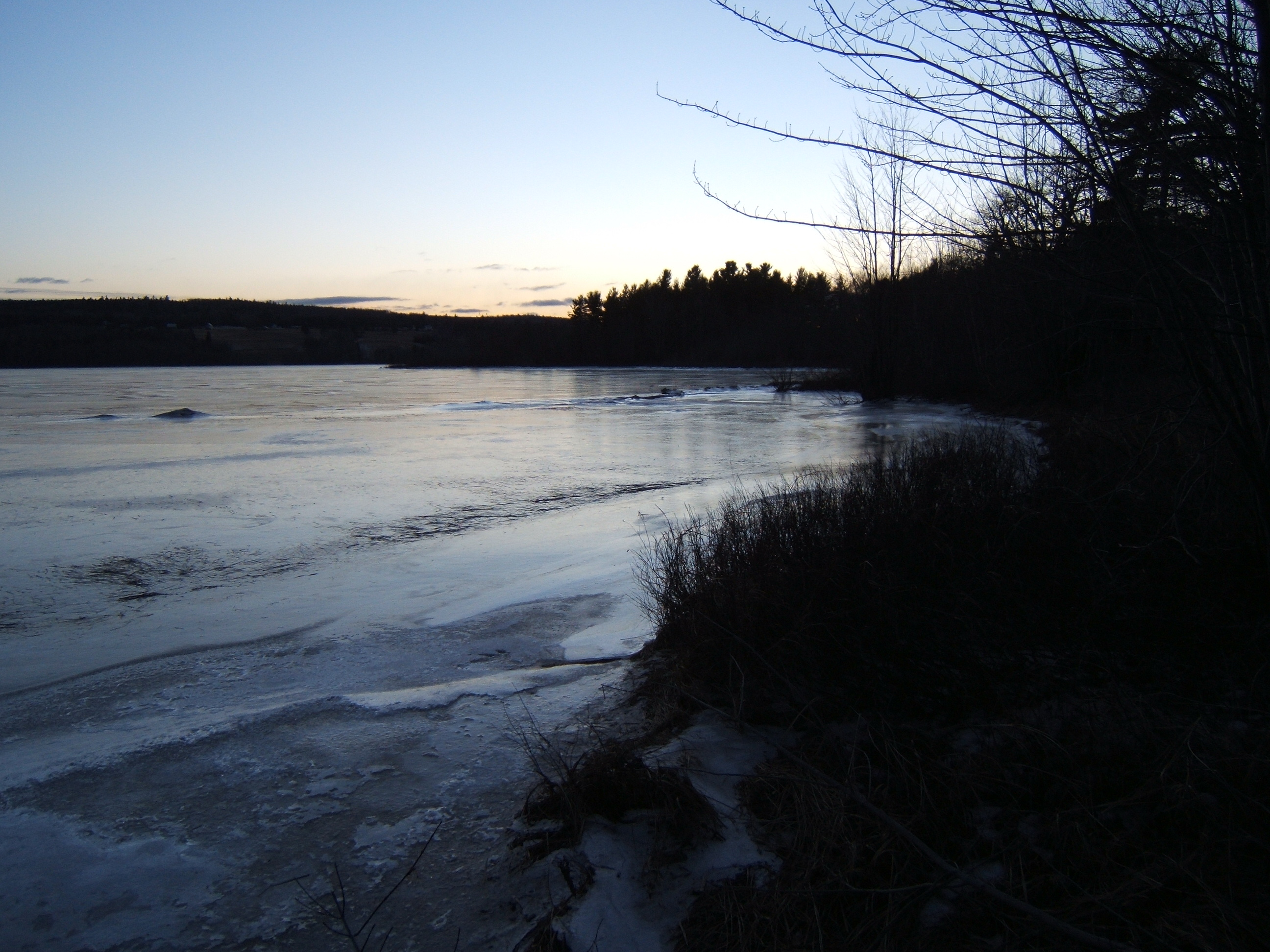
Ice – the frozen state of water… water is critical because it is a key component of our ecosystem and we need water to drink. Also, an unusual property of ice is responsible for keeping our ecosystem healthy.
Frozen water is about 8% less dense than liquid water. This means ice floats. As a result, bodies of water such as rivers, ponds and lakes, do not freeze from the bottom up. Instead, when water freezes at the surface, critical habitat is left under the ice for living things to survive and thrive. This is especially important for the bacterial and algal colonies at the base of the food chain.
Ice, therefore, is nice.
~
~
river ice
~
ice builds in shallows
at the rim of river, incremental
embellishment to glass, surrounds
willow stem and reed, thickness
increased as frost penetrates, sharp
edges cauterized by cold
~
© Jane Tims 2011




 nichepoetryandprose