Archive for the ‘the landscape of home’ Category
monuments in stone
inuksuk n. (plural inuksuit) a stone landmark or cairn used by Arctic and northern peoples to mark a point of reference or a place of significance; an Inuit cultural symbol.
inunnguaq n. (plural inunnguat) a stone cairn in the shape of a human figure, meant to represent a human figure, and distinguished from an inuksuk.
Wikipedia.org
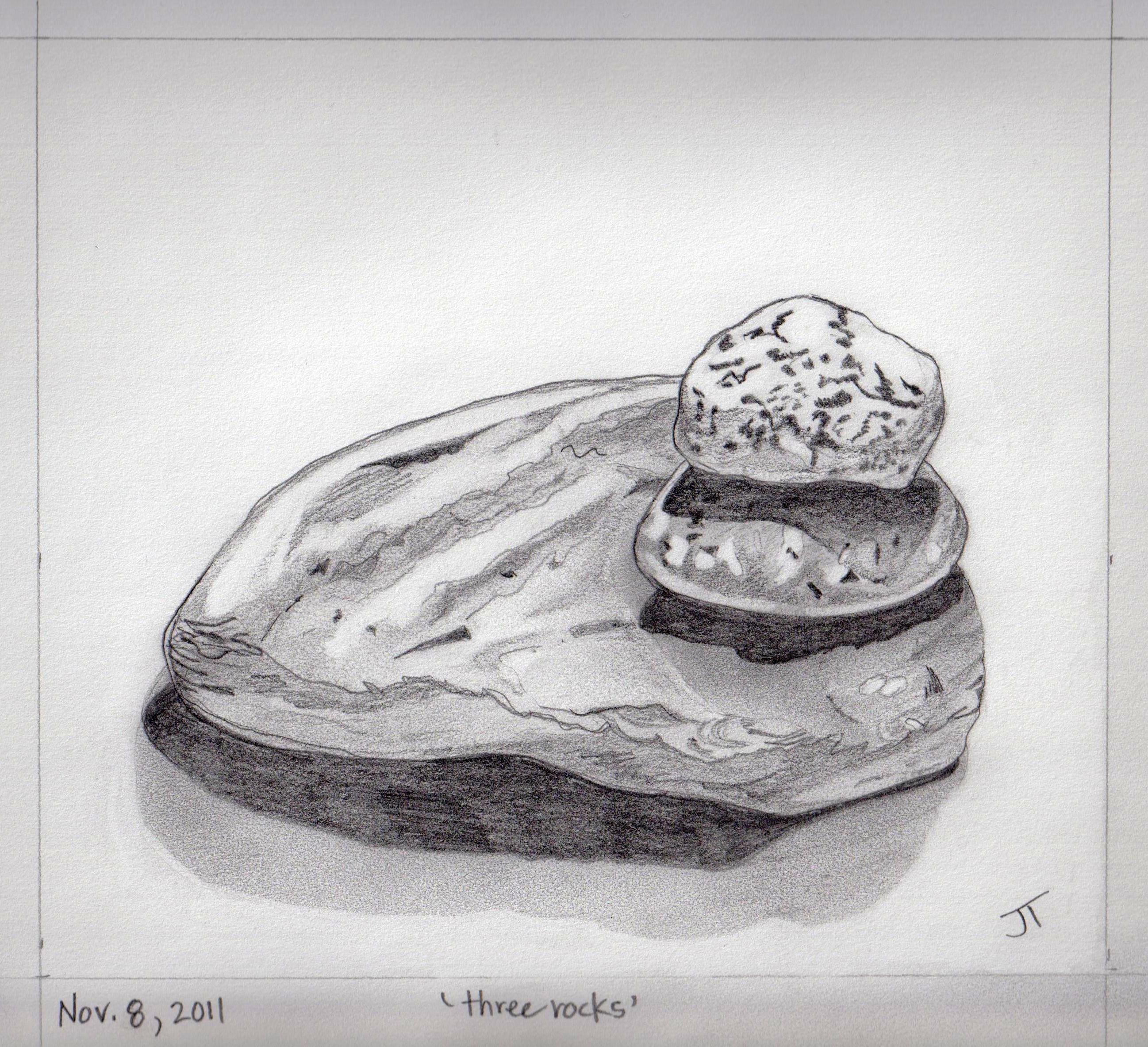
Our rock project is progressing slowly. We are collecting rocks for a stone monument. Since I want this to be a sculptural piece, I am sure the rocks we select will play a role in the final look of the monument.
One possibiity is to build an inuksuk. These stone landmarks are a part of the culture of the north, but they have caught the general imagination and are now encountered throughout Canada. On our trip out west, the inuksuk built along the Trans-Canada highway in Manitoba were particularly memorable.
For a few years, the inuksuk (plural inuksuit) and inunnguaq were common along the New Maryland highway in New Brunswick. On the stretch of road between New Maryland and Fredericton, the highway is carved through rock and outcrops are part of the roadscape. A women who walked along the road every morning for a few years was responsible for building many of the inuksuit. The local newspaper did a story on her, explaining that she walked and built the monuments as exercise following by-pass surgery. She wore a white jogging outfit with black splotches and was fondly referred to as the ‘Cow Lady’.
The ‘Cow Lady’ no longer walks the road and her inuksuit and inunnguat have fallen into disrepair. I remember her fondly and dedicate the poem below to her.
Inunnguaq 101
~
these are the hill people
sometimes without arms and legs
sometimes with other, alien parts
but proud
honor the woman who walks here
~
sometimes toppled
often reassembled
constructed one day at a time
optimism of increment
a community on the hillside
~
© Jane Tims 2004

plans for a rocky road
This fall, we have begun a new landscaping project, using rocks to embellish a length of road on our property.
On our travels this summer, we were impressed by the many ways home landscapers use stone as a signature element. Some of these ventures were as simple as a stone wall snaking through the woods. Some had elaborate stone benches, stone sculptures, or carefully-built piles of stones.
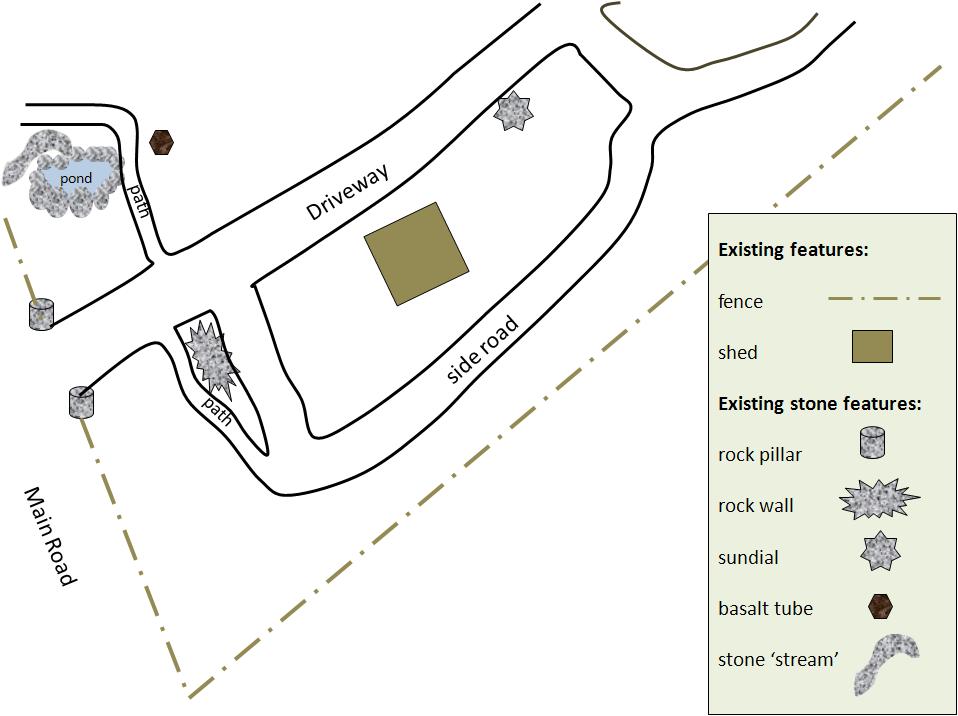
We have an offshoot to our driveway, intended some day to form half of a circular road. Over the years, we have added some stone embellishments to this road and its associated path, so it seems to me to be the perfect place to develop our own rock project.

To date, we have the following features in place, some in an advanced state of disrepair:
- two stone pillars, about three feet in diameter – each is a page-wire cage filled with rock
- an ‘old-fashioned’ rock wall constructed of granite stones, each about the size of a large honeydew melon
- a lopsided (fallen-down) sundial built of small angular rocks in the shape of a cone
- a chunk of black basalt, a five-sided, columnar volcanic feature, harvested from the shore where my ancestors came to Canada via shipwreck
- a stone ‘stream’ built years ago before we purchased more property and Fern Gully Brook entered our lives – this stream is a one foot wide course of small stones screened from a pile of pit-run gravel. It ‘runs’ from a small artificial pond and is now completely overflowing with dry leaves.

- existing rock and stone features on the road and path
Over the next months, we want to add some features to the road:
- rebuild our formerly wonderful granite fire pit in a new location along the road
- create two new lengths of stone wall to match the existing wall
- build a stone statue or monument
- lay out a circle of stones to mark the one area where we can see the Milky Way from our property (star-gazing is difficult since we have so many trees)
- build a stone embankment-with-moss feature to emulate a lovely roadway we saw at my brother’s wedding last year.

- rock and stone features we plan to add

Over the next year, it is my intention to report back on the progress made on our Rock Project. If you never hear another word about this project, remember – I like to plan.
Copyright Jane Tims 2011
yellow rain
In October, we still have at least one more autumn display, the shedding of the tamarack needles. Tamarack is a deciduous tree and loses most of its needles this time of year. We have a number of tamaracks on our property, so the golden needles fall as a constant ‘rain’ during late October and early November.
Tamarack (Larix laracina (DuRoi) K. Koch) is also known as Hackmatack, American or Black Larch and, in French, épinette rouge. Tamarack is a large tree, with a narrow pyramidal canopy and pendulous branches.

In my head, I can still hear the voice of my undergraduate botany professor, who was interested in the origin of growth forms of plants, saying, “the tamarack has, here, both short shoots and long shoots”. The short shoots emerge from the sides of branches and resemble small bunches or tufts of needles, and the long shoots grow at the ends of each branch and are elongated, with single needles along the length. The needles are small and generally very soft to the touch compared to other conifers.
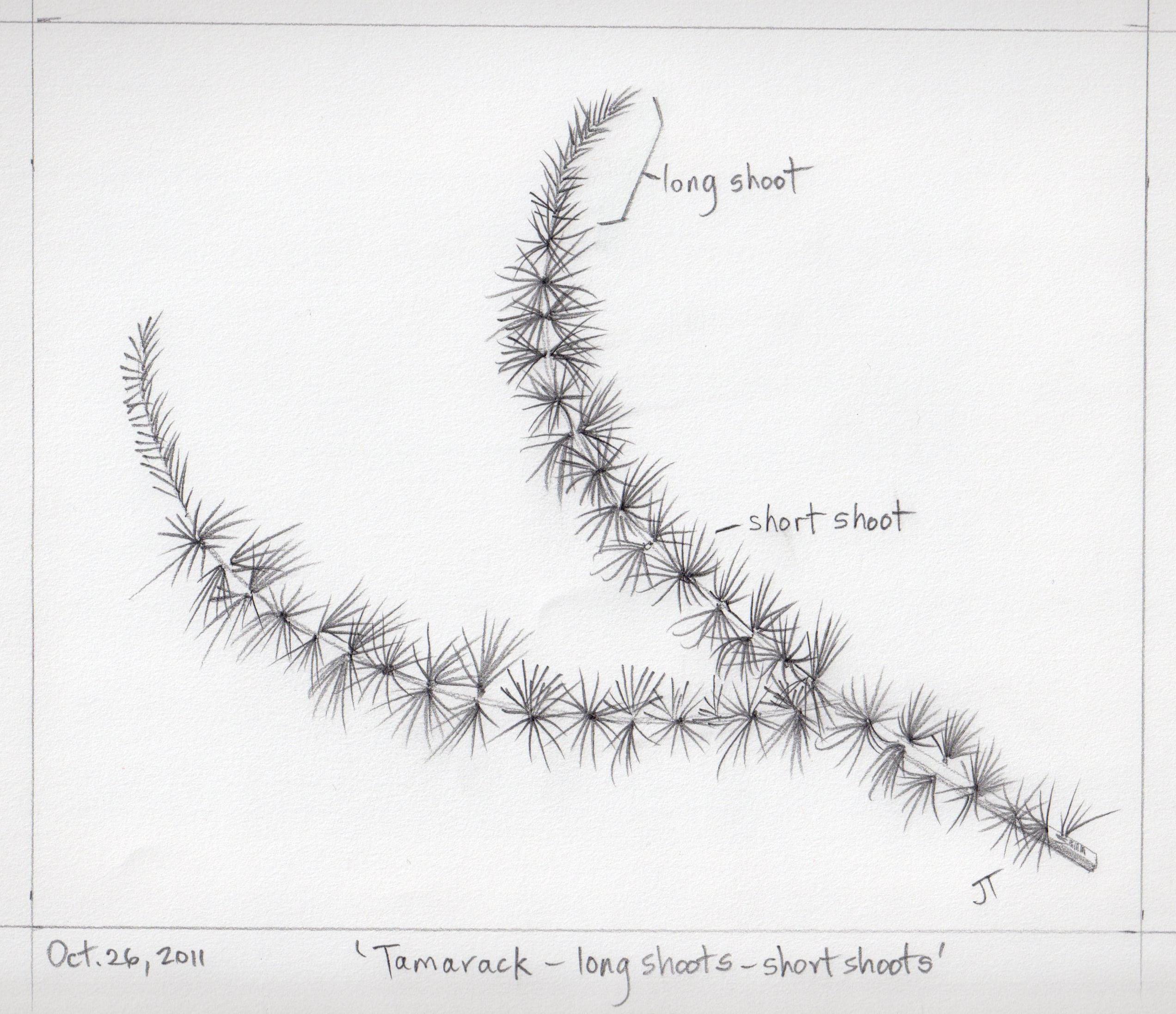
Today, there is evidence that the ‘amber rain’ has begun, just a few needles on every outside surface. By the end of next week, the windshield of the car will need a swipe of the wipers to clear the yellow needles.
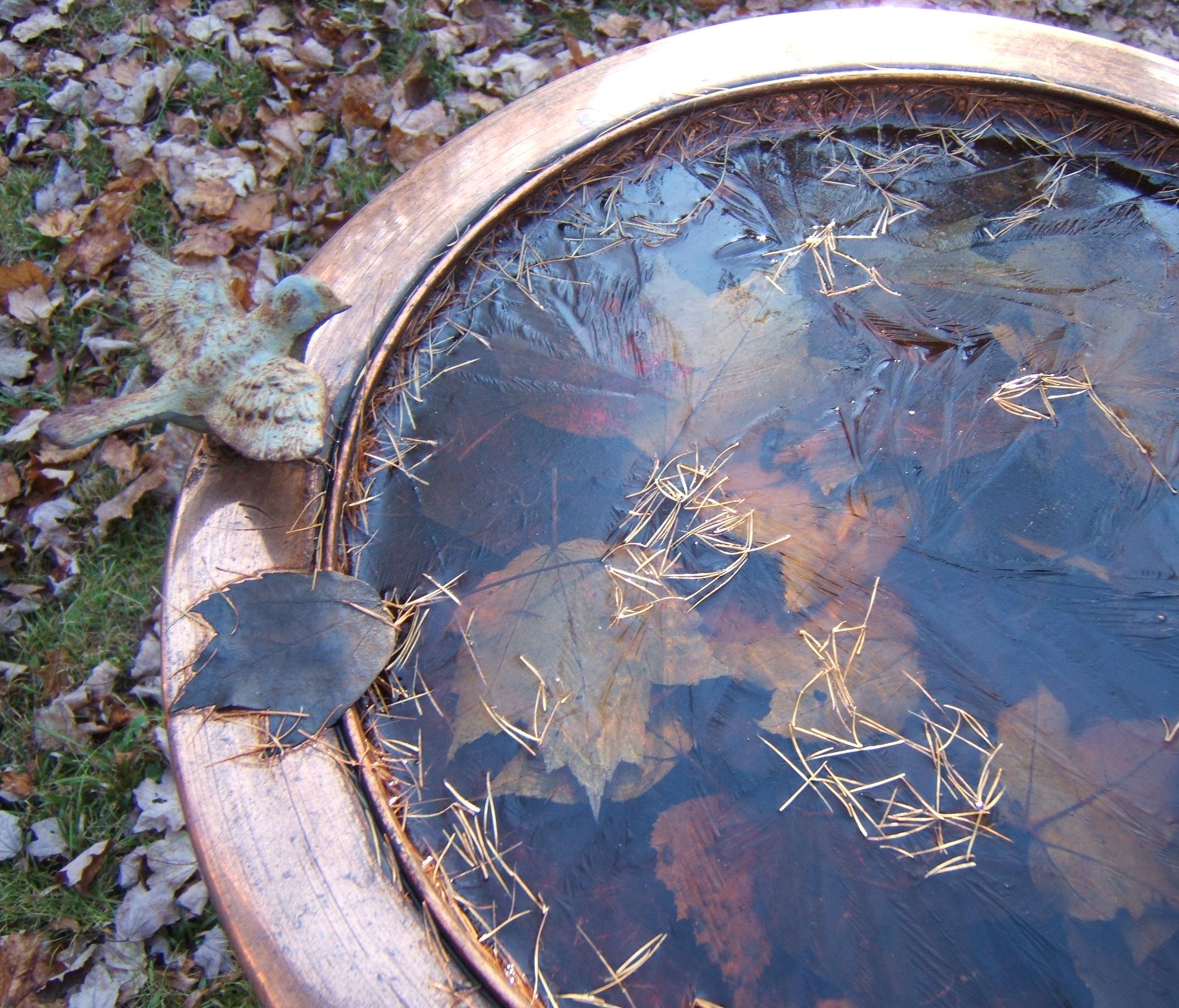
Tamarack needles on the frozen water of the birdbath
Amber Rain
~
autumn fades
bright carpets
swept away
pale ghosts rattle
from beech and oak
limp rags hang
on frosted pumpkin vines
~
but still
a touch of autumn
stands of larch
yellow in the afternoon
~
and now
a gust of wind
begins
the amber rain
~
pelting needles
fill the air
soaking ground
strewing gold
everywhere
~
fairy straw
washed to the edge
of puddle shores
flooding borders
of roads, driven
by wind, a storm
of gold
~
needles patter
gentle chatter
~
where begins
the amber rain?
is it larch
or hackmatack,
juniper
or tamarack?
who sends the amber rain?
~
© Jane Tims 1992
more black and amber signs
In most Canadian provinces, there are areas where the highway has been built by blasting through bedrock. Often these sections of highway have warnings… Danger, Falling Rock! I have never actually seen a rock falling, but there is always evidence, at the base of the outcrop, of the wisdom of the sign.
danger, falling rock
~
outcrop
massive, at its base
a delta of rubble
~
© Jane Tims 2011

‘blue’berry fields in autumn
This time of the year, the only thing ‘blue’ about our blueberry fields is the blue sky above them. The fields themselves are a blanket of scarlet and orange.
These are a few scenes of the October blueberry fields in south-west New Brunswick…


legacy
~
remaining in the room
a well-used blanket
red with two black stripes
inexpensive facsimile of
~
a white
three-beaver blanket
stripes red, yellow, green
~
a blue sky
two vapor contrails
~
the yellow double line
on an asphalt road
~
a band of stars
across a light-starved sky
~
a red leather book
with black ribbons
mark passages for giving
thanks:
look down from heaven
upon the fields, now white
unto the harvest
~
a crimson blueberry field
in October, draped across bones
of the landscape
double tracks leading away
over the horizon
~
© Jane Tims 2011

comparing landscapes
When you are visiting an area away from home, what do you notice about the landscape?
As we were driving the roads of south-east Ontario, I was always comparing the scenes I was seeing with the landscapes of home in south-central New Brunswick.
Both areas are hilly and rural, with a strong agricultural base. Both are forested wherever farmland is not the main land use. The trees in south-eastern Ontario are predominantly hardwood with some cedar, fir and pine, whereas ours are mostly mixed wood with a stronger component of conifers (spruce, fir and pine).
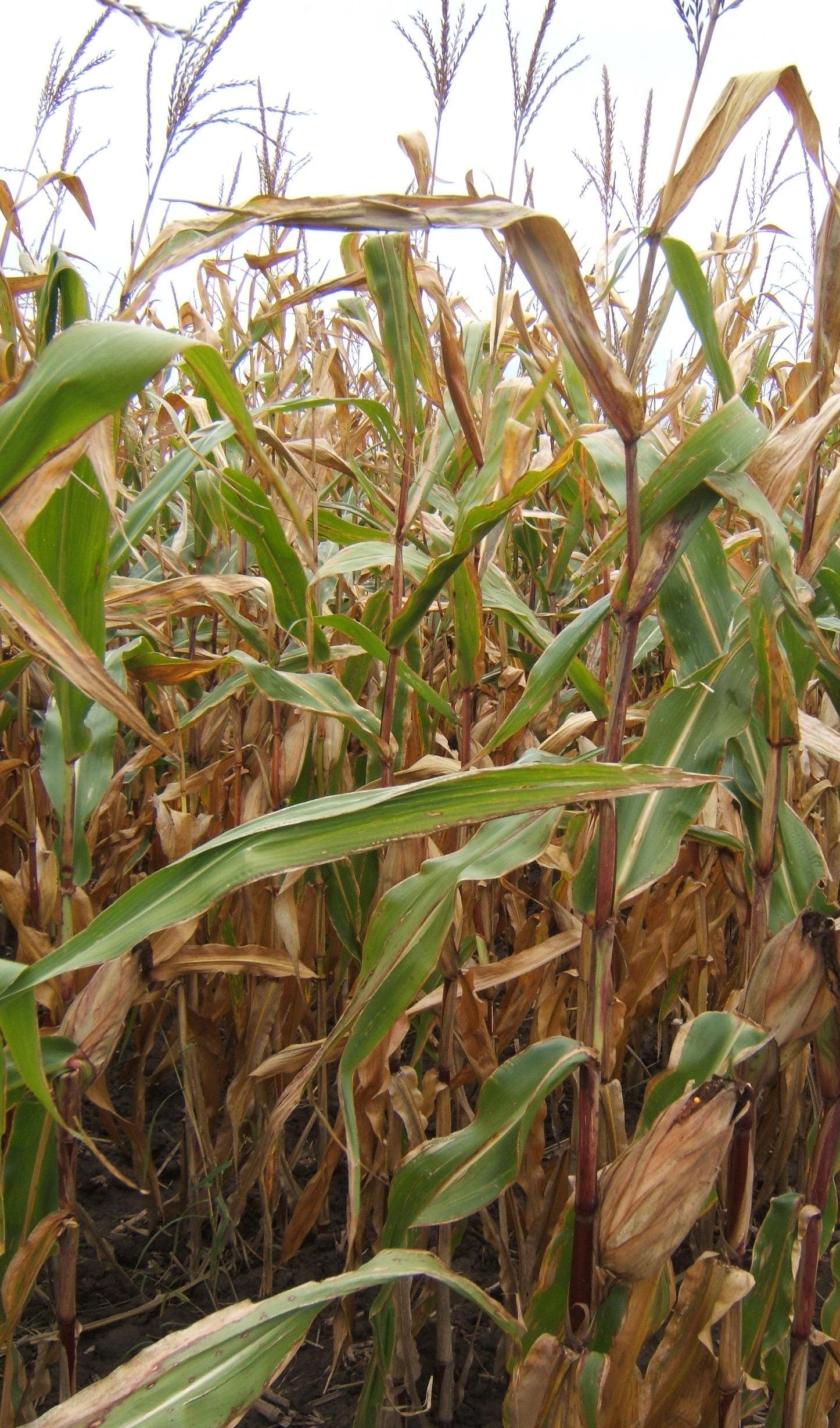
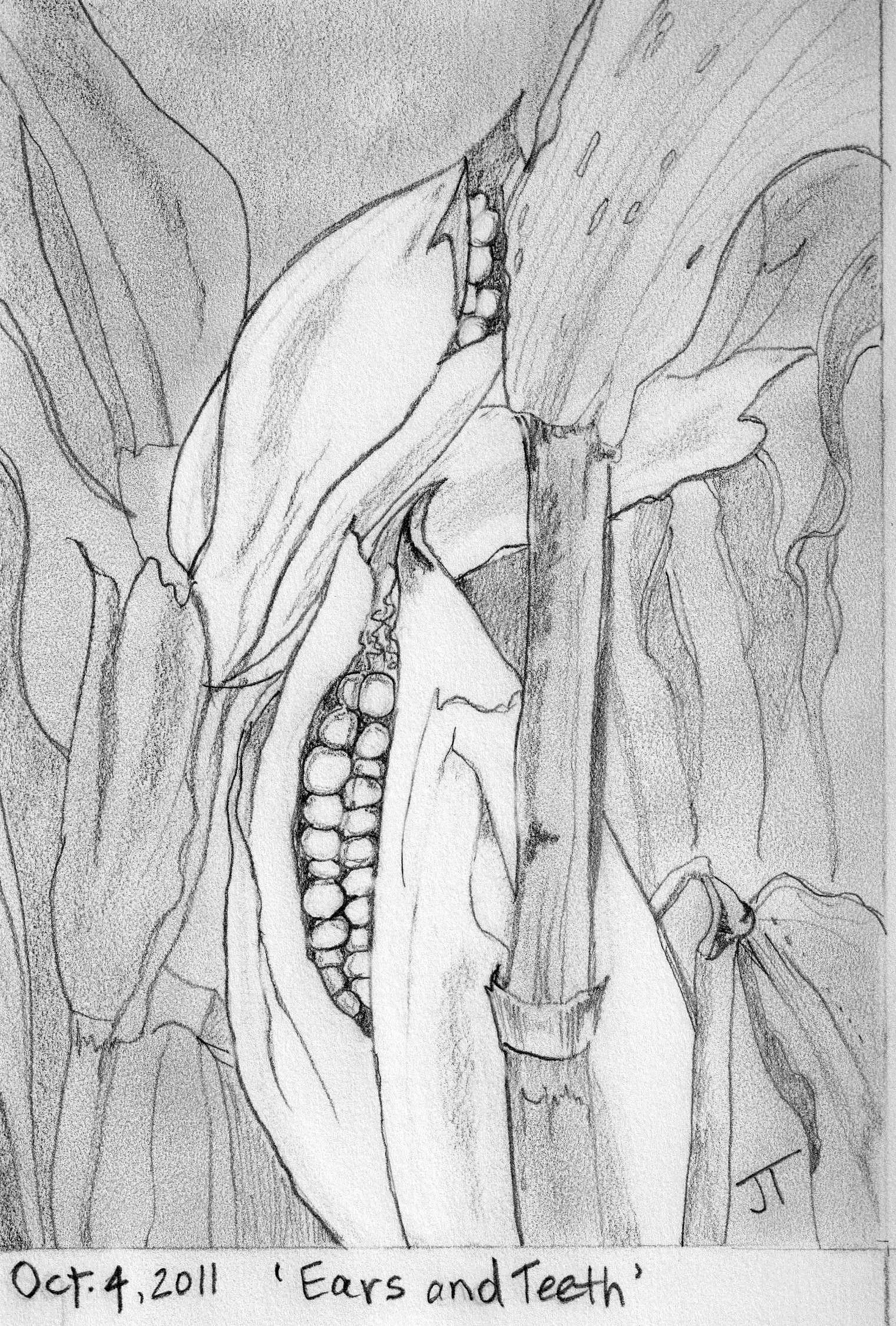
Probably the thing I noticed most about the Ontario farming landscape was the predominance of corn as a crop. When we were there, the ‘eating’ corn had already been harvested, but corn for silage (mostly used for cattle) was growing everywhere. It stood tall in golden fields, mostly broadcast, without corn-rows.
The corn was ready for harvest, the corn kernels held in stout, starchy ears. I think ‘ears’ is such an apt word for corn since the sense of hearing is shaken awake when you stand in a cornfield. This time of year, the long leaves are dry and rustle in the slightest breeze, carrying on a whispering conversation in an unknowable language.
gossip
~
cattle-corn rustles
silage close-standing
whispers and secrets
wind-syllables
murmurs and sighs
rumours
no single
discernable
voice
~
© Jane Tims 2011
more horizons
horizon: line at which earth and sky appear to meet (Oxford dictionary)
After thinking more about horizons, I looked through our photos for some horizons we have captured in New Brunswick. Once you start to look for them, they are everywhere!

overlooking the hilly area of Sussex... Poley Mountain (a local ski hill) is in the background

a blueberry field and the distant hills of Queens County
- Horizons are made more interesting by the passing seasons…
- in autumn…
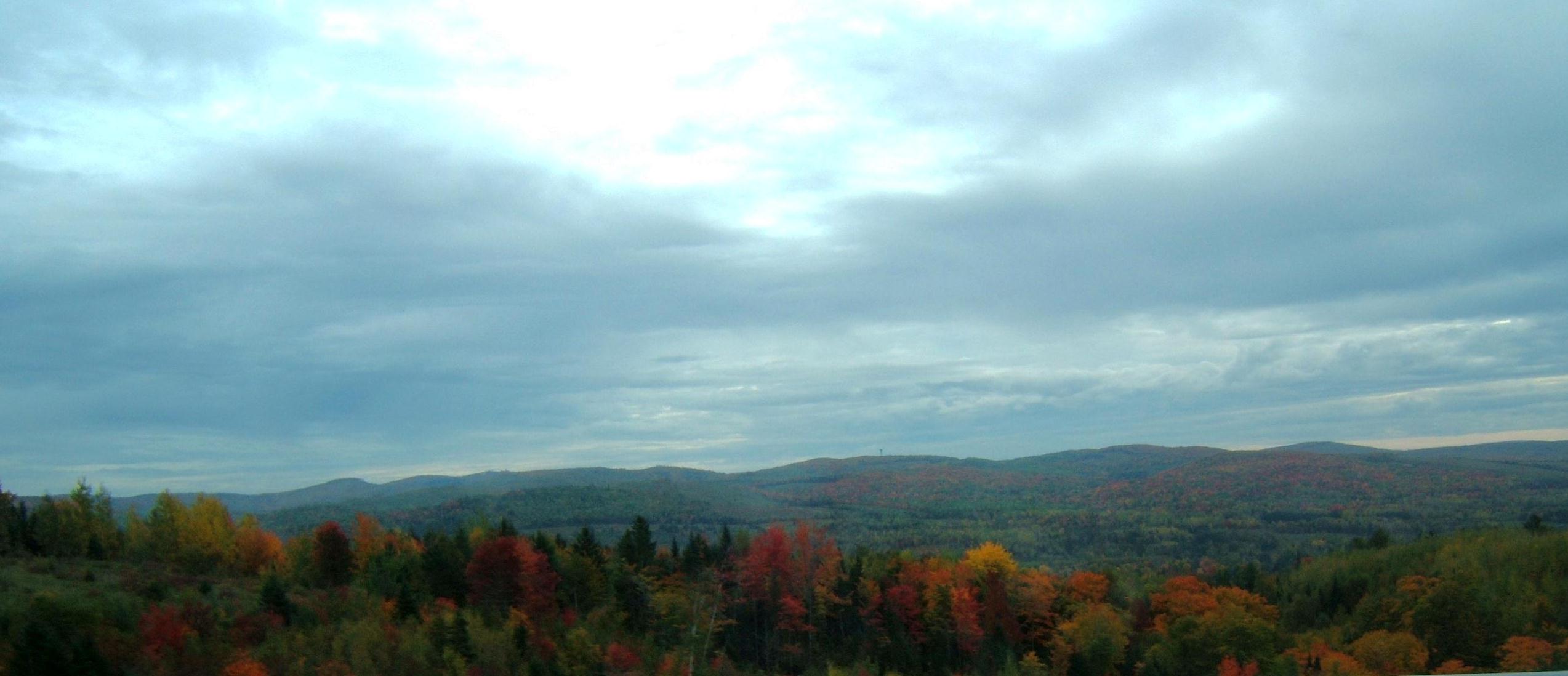
maple trees in autumn costume along the Trans-Canada Highway in Victoria County
…and in winter.

bare trees in the Grand Lake Meadows area in winter... a hawk in the tree and a treed horizon if you look carefully
Of course, I can’t forget the horizon of the Bay of Fundy…

Bay of Fundy at Saint Martins
…the horizon viewed from the ocean…

Charlotte County viewed from the waters of the Bay of Fundy
…and the horizon created by islands.

'The Wolves', special islands in the Bay of Fundy
Look to the hoizon, and see where land and sky, and sometimes water, meet.
horizontal haiku
~
horizon distant intersection land water sky
~
© Jane Tims 2011
horizons
Landscape is a fundamental driver in our lives. The spaces around us shape our experiences, our thoughts and our perspectives.
I was born and raised on the Alberta prairie. Although I love the woods and hills where I now live, I think my eyes are never satisfied when they seek the horizon.
When we drove across Canada in 2002, my husband, who was born in New Brunswick, was appreciative of the prairie landscape, but when we finally turned toward home, he was glad, so glad, to see the trees.
In southern Alberta, on the Trans-Canada Highway, we tried to measure the distance to the horizon. We took note of the oncoming lights and timed how long it took them to reach us on the road. One car, we estimated, was 17 kilometers away when we first saw it on the prairie horizon! On the Trans-Canada in New Brunswick, we rarely see cars more than 2 or 3 kilometers distant.
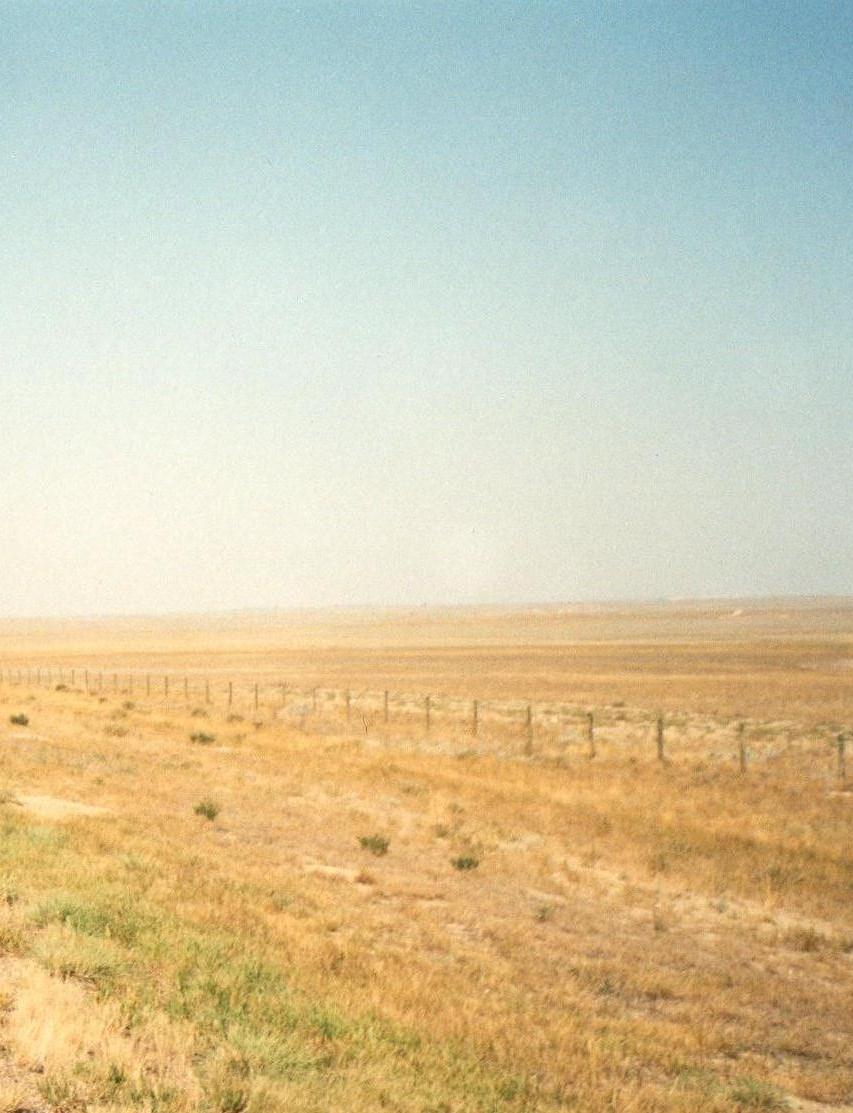
the prairie horizon of southern Alberta (2002)
What was the landscape of your childhood? Do you live in a different landscape now? How are these landscapes different and how are you different in each?
a longing for prairie
~
1.
what subtle psychoses
plague women
who grow on the prairie
and leave
to die in the forest
2.
memories a few words long
the chinook coulees at sunset the odd red of prairie mallow grasshoppers without aim
spears of foxgrass gophers beside their burrows willows by the slough
the rattle of the Texan Gate the tarnished dry of August
I want to run on the prairie
3.
I narrow my eyes at the ditches
imagine the weeds tumbling
to cover the forest with shortgrass
and sedges
the clearcut
and the barrens of blueberry
have the lie
but not the essence of prairie
4.
piled by the roadside
nine bales of hay
burst from the baler twine
left to the rain
piled three high into landscape
mountains, foothills, flatland
this last has sprouted me prairie
5.
trees form a tunnel
shut out the spaces around me
some days I can’t summon the words
the hay and the corn fields are all I have
and the hayfield shows the tines of the tiller
deep into summer
~
Published as: ‘a longing for prairie’, Whetstone Spring 1997
(revised)
© Jane Tims

a glimpse of prairie landscape in New Brunswick ... just a glimpse
defining our spaces
Fences have always been my favourite type of human architecture. I like them because they are a place to sit and observe the landscape.
The reasons for building fences are varied. They mark the boundaries between properties, keep domestic and other animals in or out, create a visual edge to property, prevent uncontrolled movement of vehicles, provide privacy, and so on. Did I mention they are also fine places to sit?
Types of fences are as varied as the reasons for building them.
On our vacation to Maine, we encountered some unfamiliar types, although I have seen examples of these in New Brunswick. The fences I liked the best were made of stone, sometimes so much a part of the local landscape they could have been natural, not human-made…

poles and sturdy metal cable…

wood with mortise and tenon…
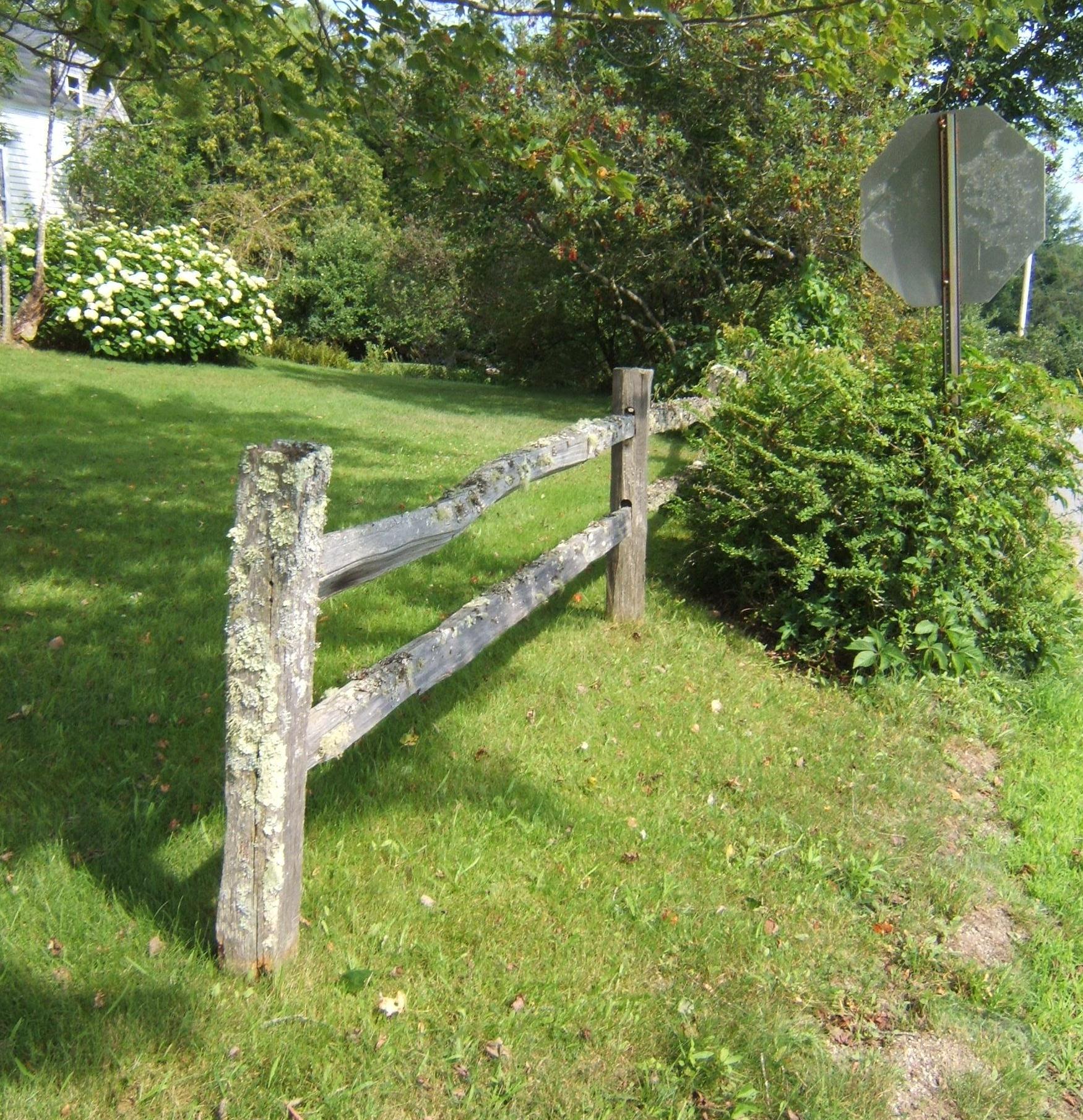
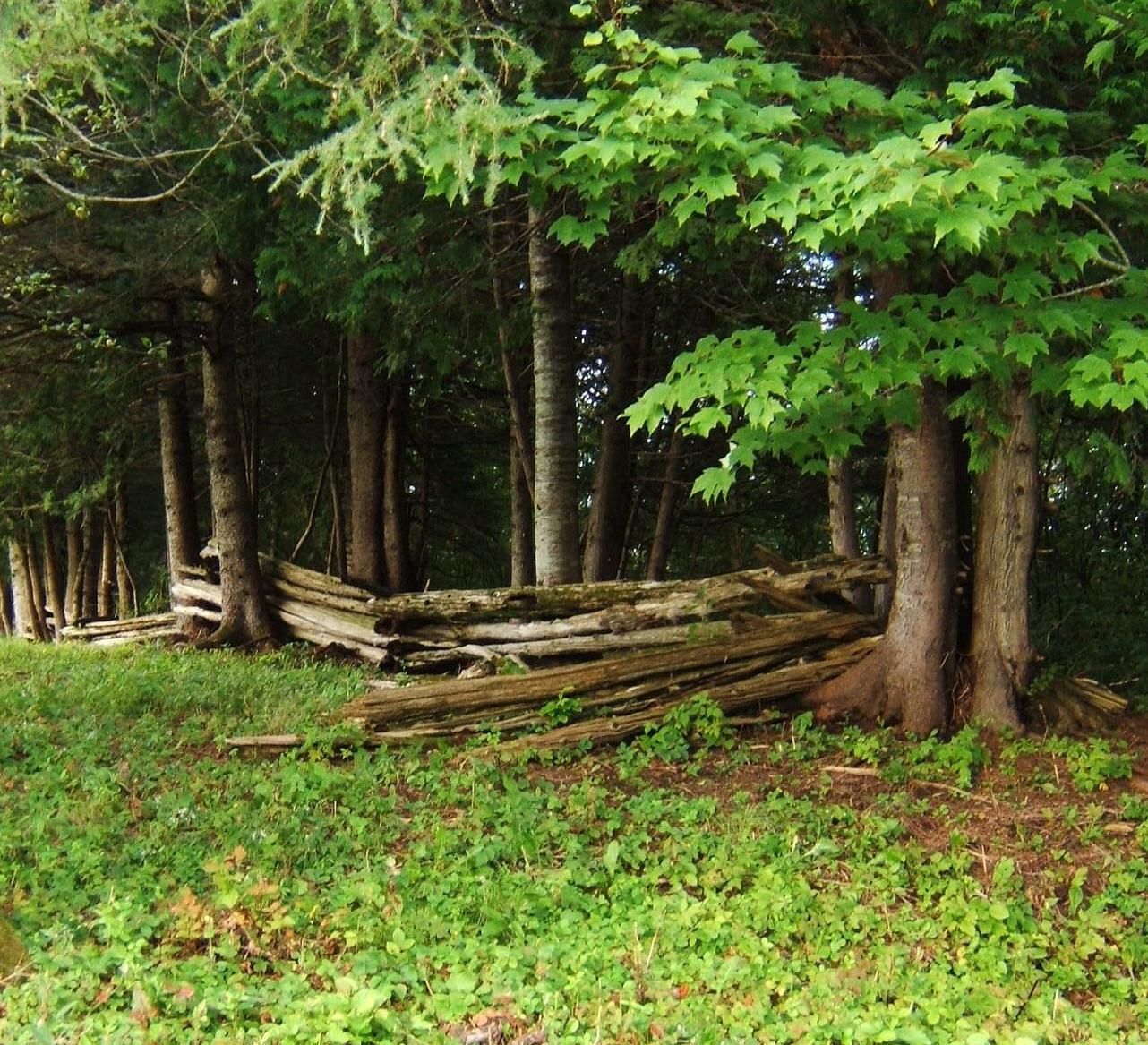
In New Brunswick, a familiar traditional fence is made with cedar, the rails fitted together in a zigzag…
Stone fences, put together with mortar, are common around churchyards…

Farm fences are usually of the post and wire type…

My favourite fence is the type my husband builds, a modern version of the traditional cedar rail fence, held together by gravity and no nails…

lethargy
~
on the breathing side
of the window
beyond the curtain
limply lifted
is a pleasant day
a dandelioned field
a sloe-eyed cow
sumac leaning on the fence
a weary hitch-hiker beside
a carless road
~
reminds me
of a basket of patches
a quilt to assemble
hems to stitch
perennials to weed
letters to crumple
and stars to count
in a cinnamon
and saccharine
apple-crumble
sky
~
more to do
than prop one arm
on the window sill
and lift the muslin
barely higher
than the hitch-hiker’s
wilted shoulders
unslung pack
or knee-supported head
~
© Jane Tims 2010
landscape
landscape: inland scenery (Oxford dictionary)
When I see the beaches and headlands of coastal New Brunswick…
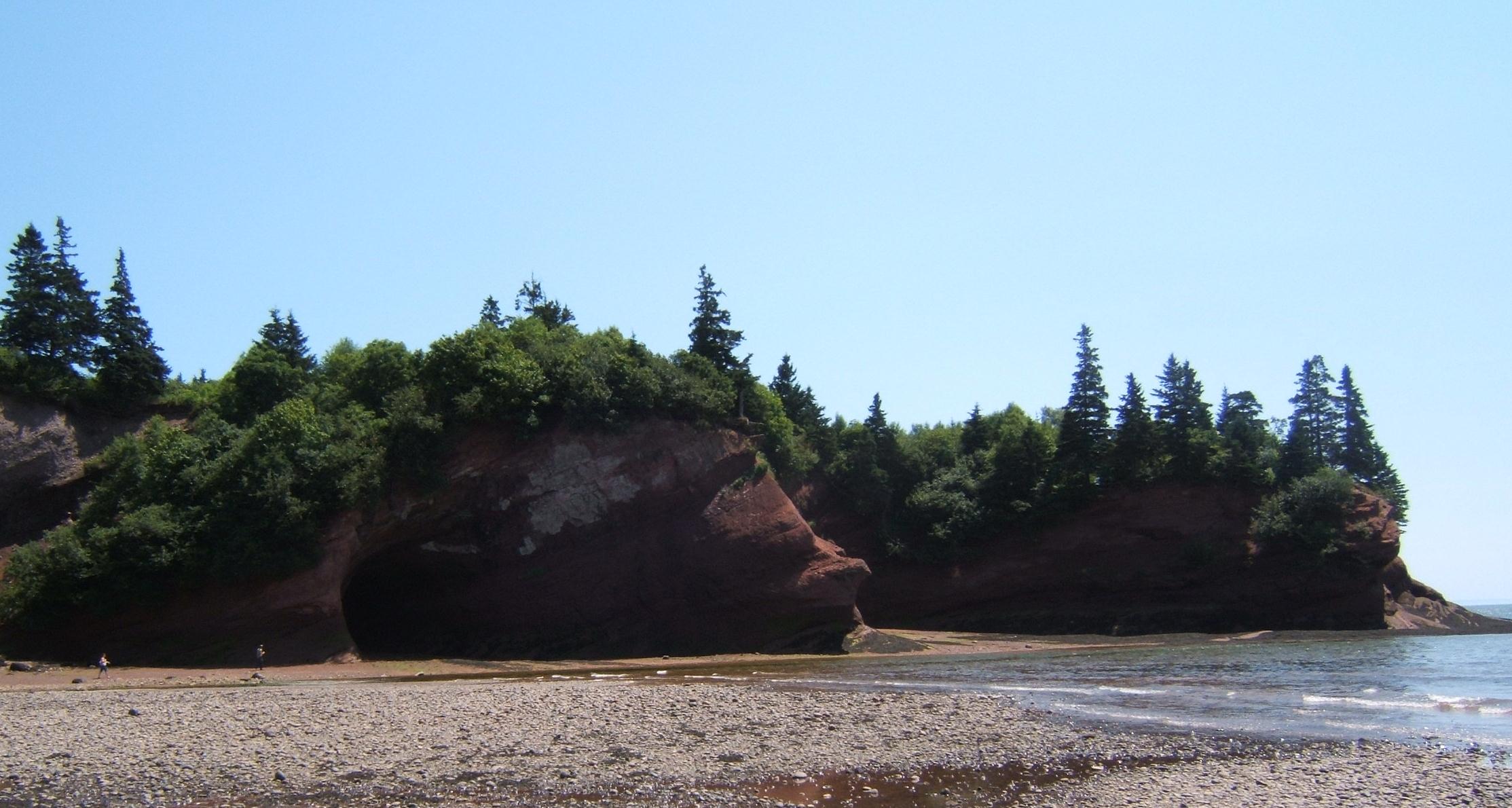
Saint Martins, New Brunswick
or the flatland and grasses of the western Canadian prairie…

prairie in southern Saskatchewan.. a dust storm on a salt lake bed
… I know landscape influences my life.
I also know my life has a landscape of its own, with hills and valleys, places to celebrate and places to hide, paths and roads moving ever forward. When I take the time to be aware of my landscape, to notice the detail and understand nature, I experience the best life has to offer.
landscape
~
a veil
draped across
bones of the earth
pointed tents
supported by forest
and the bent stems of grasses
soft settles in pockets
lichens and mosses
~
beneath the veil
texture
the ways I follow
quick or crawl
hollows elevations
clear eyes
or sorrow
~
the only way to understand
form follows function follows form
is repeated observation
lay myself on the landscape
allow my bones to conform
feel its nuance
~
see a field of grasses
see also awns and panicles and glumes
~
© Jane Tims, 2011

the parts of a grass plant (from Roland and Smith, 1969, page 68)