Archive for the ‘strategies for winter’ Category
making a quilt
One of the things I love to do as winter approaches is to make a quilt. My quilts are not the beautiful, hand-stitched, carefully patterned quilts I admire. My quilts are usually patchwork and often machine sewed, although some I quilt by hand, with long, uneven stitches.

a few of the quilts I’ve made, mostly lap-sized quilts for winter evenings
This fall, I am working on a quilt for our bed, in the theme of ferns and poppies. I have used an old blanket covered in blue roses as the batting, given to me years ago by my uncle. It has a large tea stain in one corner and is not as warm as our modern bedding, but I would like to keep it for sentimental reasons, so I am using it as the base for my new quilt.
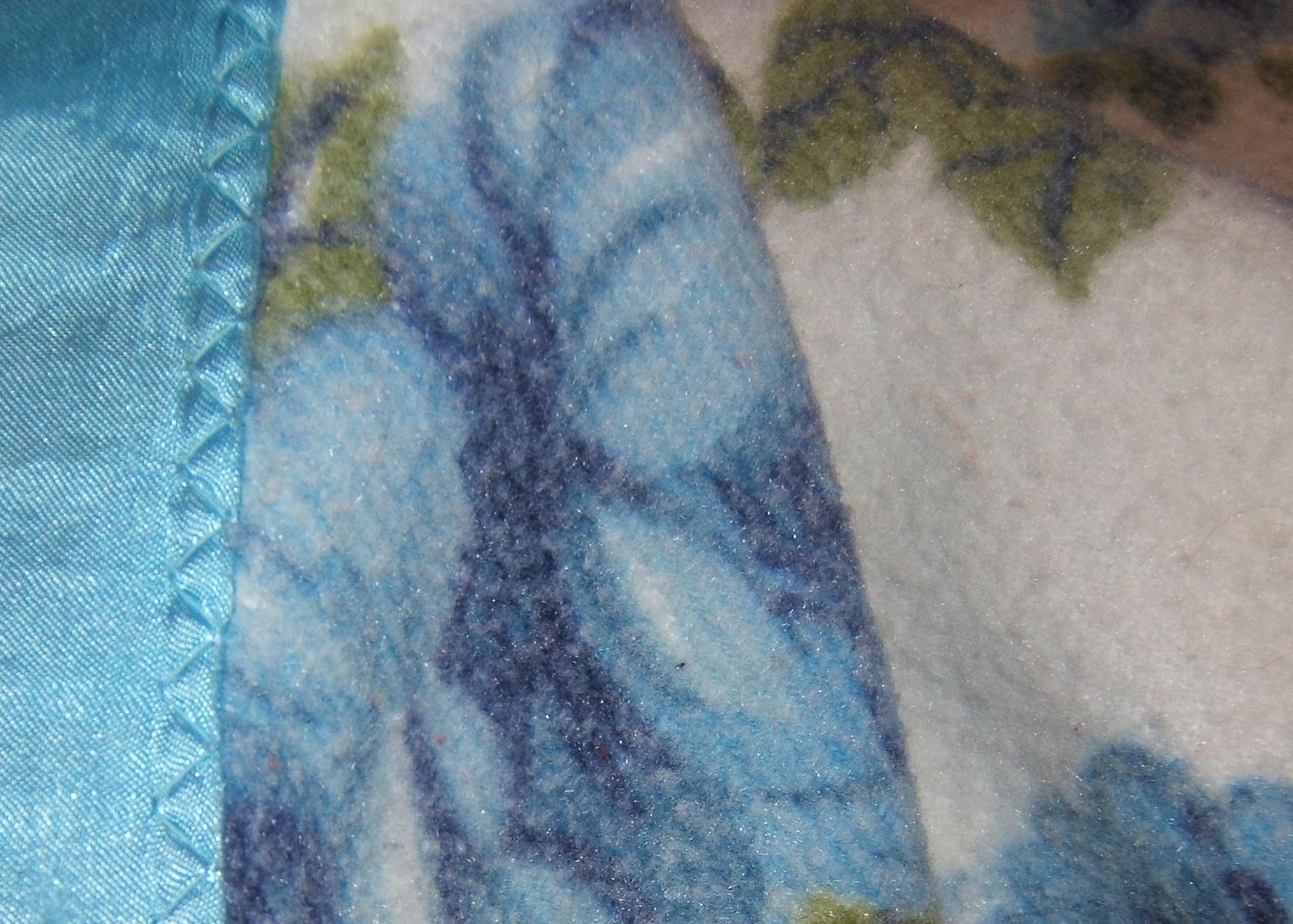
For the fabric, I am using various bits and pieces I have collected over the years. I can’t resist fabrics and when I visit the store, I often leave with a half meter of a fabric I love, even if I have no planned project.
I am planning to make the quilt entirely by machine, following a method my Dad told me his mother used. She would take an old blanket and sew the patches on by hand, one at a time, covering the adjacent seams as she went.
First, I chose a width for the patches and cut a piece of sturdy cardboard for the template. I marked the fabric with bands in the width of the template, to use as an inked guideline to keep my fabrics straight…

Then I cut my fabrics the width of the template and arrange them, right sides together and pin them to the blanket, making sure the edges of my fabric follow the inked guidelines…

Then I sew a seam…

When each piece is sewn, I open it to the right side to reveal a neatly attached patch…

Once I have worked my way around the blanket, attaching one row of patches, I will add another row, leaving one inked guideline row empty.

After I have finished the rows of patches, I will add long strips of fabric to fill in the empty rows and to cover the rough edges left by the first rows of patches.

I will have to pin and top-sew the other edge of this strip of fabric, to cover all the raw edges.
Then, when all the edges are hidden or turned in, I will top-quilt all of the patches with the machine.
The last step will be to select a fabric to cover the other side of the blanket. I think I will attach this layer with ties, another old-fashioned method of making a quilt.
I’ll show you the quilt when it is completed, probably next year!!!
Do you make quilts and what is your method???
~
~
Copyright Jane Tims 2012
at the bird feeder #7 – Pine Siskin
After our heavy snow last week, the birds were all looking for perches and easy feeding. A few Chickadees and Pine Siskins were at the feeders early. Pine Siskins (Carduelis pinus) are fidgety little birds, staying at the feeder to get their fill, but ever vigilant and looking over their shoulders. They are heavily striped, sometimes with yellow bars on their wing feathers. They also have sharp beaks.
Because the Pine Siskins are striped, I confused them at first with female Purple Finches. The female Purple Finch is also striped, but is a slightly bigger, chunkier bird. Its beak is large and wedge-shaped, and it has no yellow coloration.
~

Pine Siskin at the feeder
~

female Purple Finch - wedge-shaped beak and stripes around eye (a male Purple Finch at left)
~
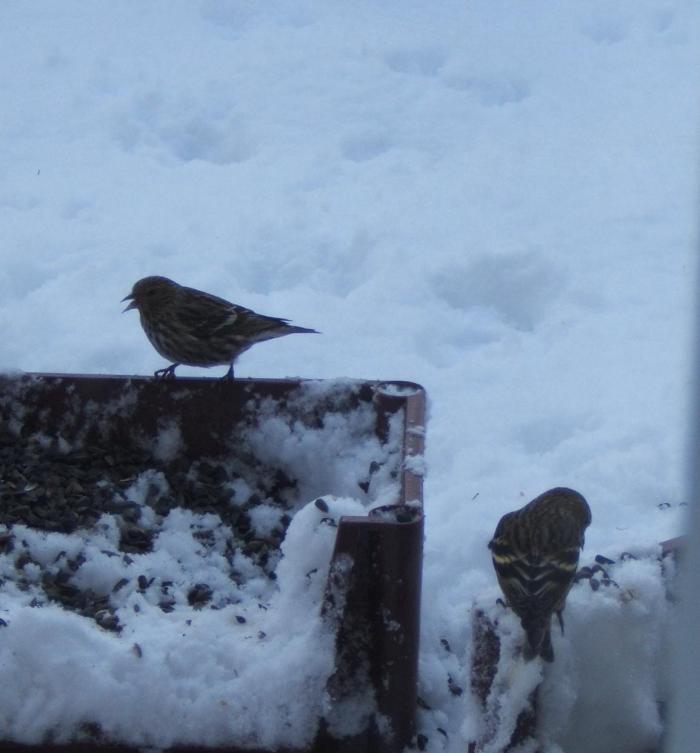
two Pine Siskins at feeder - sharp beaks and yellow wing bars

© Jane Tims 2012
a moment of beautiful – tracks in the snow
the space: new fallen snow
the beautiful: a Red Squirrel’s tracks
~
An expanse of new fallen snow is like an unwritten page. When you find something written there, it is a message of beauty.
In our driveway, after the last snow, a Red Squirrel was the first to write on the ‘page’. The prints were delicate, traced in blue shadows.
~

Our Red Squirrels are certainly not afraid of the snow.

digging for sunflower seeds

red squirrel with snow accumulating on his head
~
~
a love letter, unsigned
~
the meadow in winter
a sheet of paper
folded
where the stream
flows under the ice
~
the sky
an envelope
lined in blue
~
tracks on the snow
cautious
afraid
words
pressed to the page
~
erased
(erased)
by melting
or a dusting
of new snow
~
~
Published as: ‘a love letter, unsigned’, 1999, Green’s Magazine XXVII (2): 44.
Copyright Jane Tims 1999
warm room
We had another snow storm last night. In our winter climate, can anything compare with being settled in a warm room with a cup of tea, perhaps reading a good book, and listening to the storm throw handfuls of ice-pellets at the window glass?
As I write this, I know everyone is not so fortunate.

~
~
within
~
~
winter lays a cheek against the glass pecks at the window
rattles the door
~
the room is a yellow lattice on the snow a frail package
of warmth firelight a quilt the pages of a novel
kneading paws
~
field mice and ermine etch fleet trails in the thicket breathe
in the velvet space beneath the fir
~
kettle and cat are purring
~
~
© Jane Tims 2000
at the bird feeder #6 – Purple Finch
On Thursday, we had a Hairy Woodpecker and a large flock of male and female Purple Finches at the bird feeder. The Peterson Field Guide describes the Purple Finch (Carpodacus purpureus) as ‘… a Sparrow dipped in raspberry juice.’ I can’t improve on that description! The other particularly noticeable feature is its large sturdy beak. My husband took a few photos since I was not home, just enough to give me one to draw.
I miss most of the feeder birds since I leave in the early light and come home after dark. Nevertheless, the Chickadees and Goldfinches are usually there to see me off. We have one Chickadee who always has his ‘hair’ ruffed up, like a rock star with a ‘do’.

~
~
Purple Finch
(Carpodacus purpureus)
~
sunflower seed and millet
purple finch posed in the maple
sullen brow
blunt beak
metallic tick
~
he knows my eye
at the edge of the glass
my struggle for stamina
~
he is immobile as a post
a vermillion bird stuffed
with husks of sunflower seed
~
he sees me sidle to the chair
watches me settle
~
he is still
as a post card
~
seedless husks of sunflower
~
~
© Jane Tims 2012

© Jane Tims 2012
a moment of beautiful – trees and shadows
space: edge of the St. John River in winter
beautiful: mature silver maple trees and their shadows on the snow
~
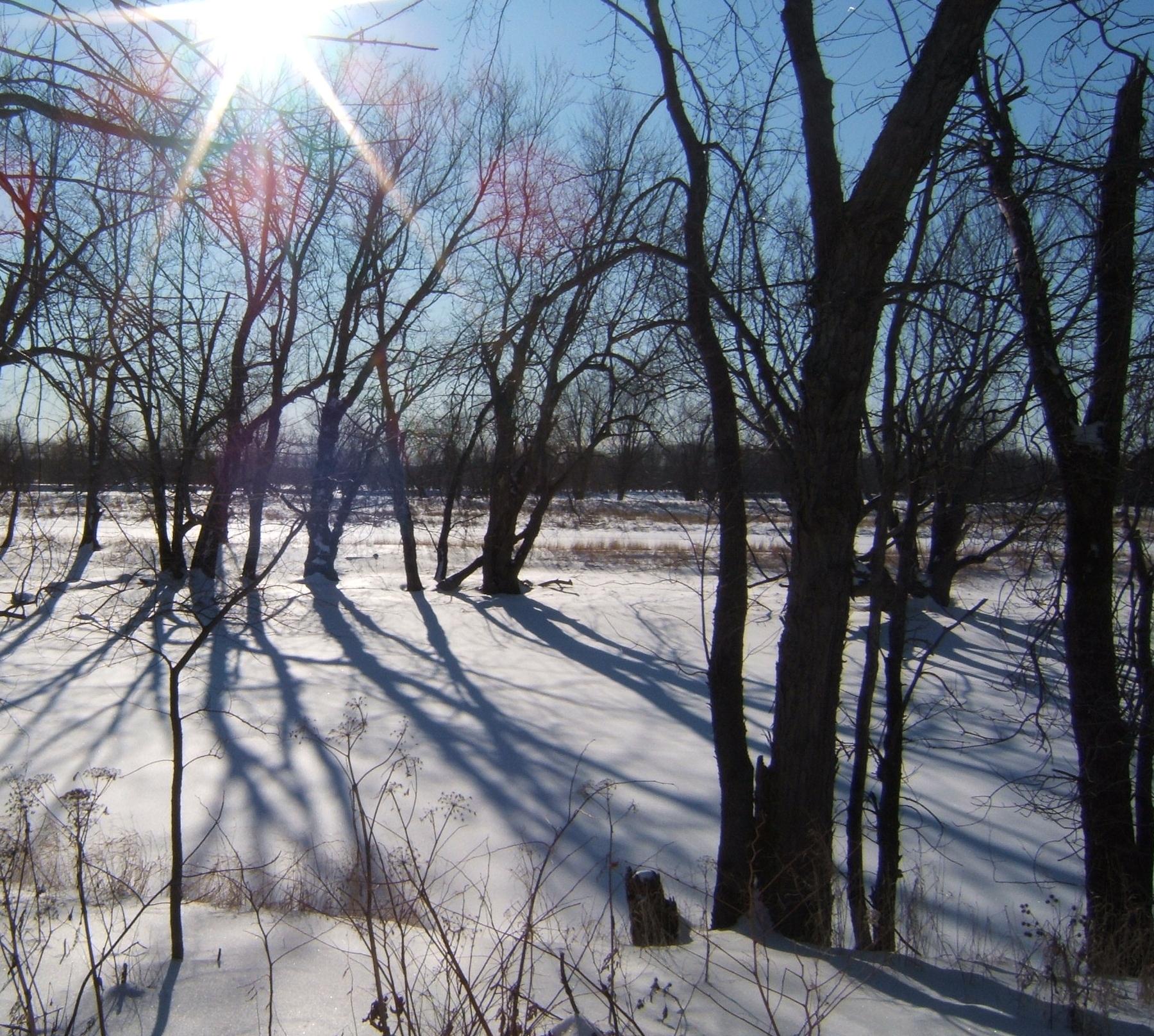
We went for a drive last weekend, along the St. John River. Above the ice, the river is covered in snow, a broad white plain edged by very old and very rugged silver maple trees.
In spite of a harsh environment, these trees endure. Each spring and fall, they are flooded. They are scoured by ice and subject to the eroding forces of the river. They are always at risk from people searching for a supply of firewood. A friend tells me these huge trees are usually suckers, grown from the base after the original tree was harvested.
And yet they grow old, a part of the hardwood floodplain forest. On a sunny day, they lean over the snow-covered river and spread their shadows across its surface. They have the beauty of their symmetry, solidity, grace, and fortitude.
~
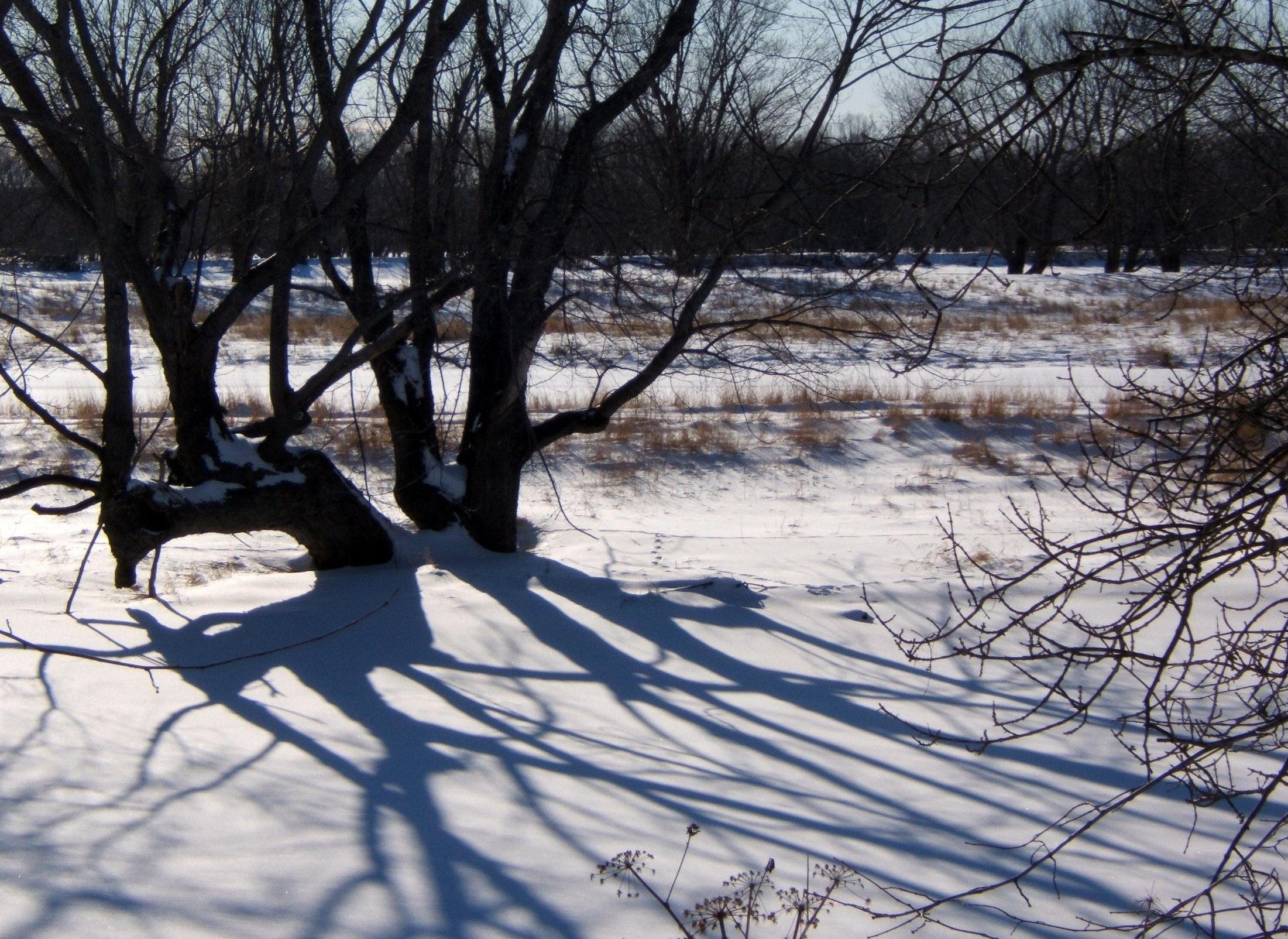

the line of animal tracks crossing the snow are probably from a Red Fox
Copyright Jane Tims 2012
on the rink
Ice rinks are a part of all our lives in New Brunswick. My son did not play hockey, but I know from friends how demanding the pursuit of ice-time and practice can be.
My ice skating experiences have been a little tamer, but definitely part of the fun side of life.
When my son was young, we had a backyard ‘rink’ for a couple of years. Although we had fun pouring water and trying not to fall, my best memories are of skating with him on ‘Hoot-and-Hollow Pond’, the postage-stamp pond in our back woods.
In my teenaged years, my family had a big pond where the ice was only smooth enough for skating during a few winters. I called it ‘Singing Glass Pond’ because of the sound made when stones were skipped across the ice. I remember skating there with my Mom who always sang as she skated and the oldest of my brothers who could jump up and do a spin from a position of standing still!
When I was in grade school, our teachers took us to the public rink where I skated in endless circles next to the boards and learned to do a ‘toes-out circle’, my single figure-skating ‘move’ to this day. When they were young, I used to watch my two nieces figure skate and was amazed at their fluidity and skill.
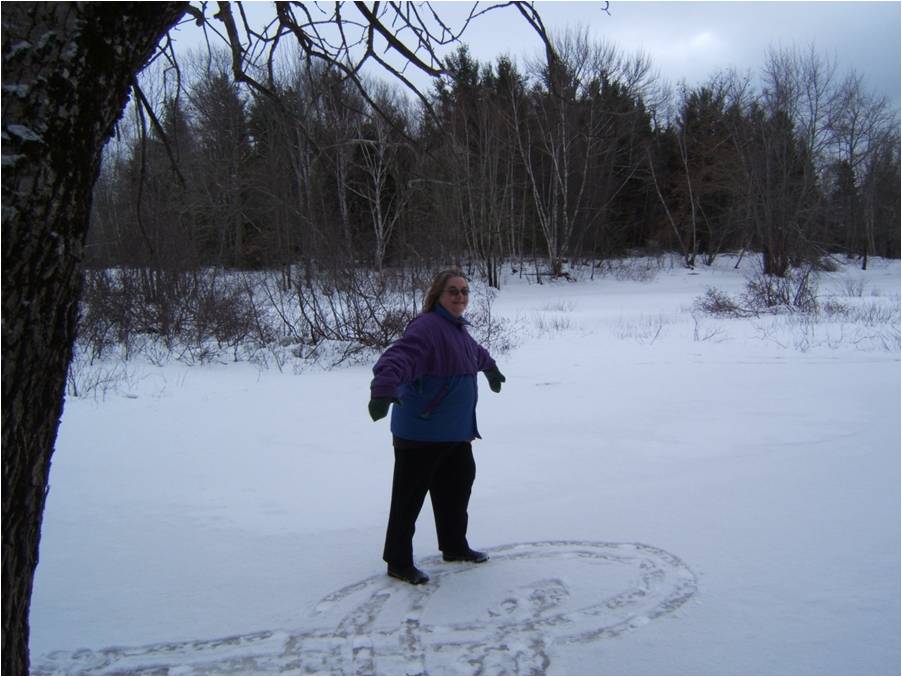
Today my knees are arthritic and my balance is pitiful, so my skates are put away. But on the frozen marsh at the lake, I can still ‘skate’ with my boots and do a parody of a ‘toes-out circle’!
~
~
a string of light bulbs
~
a string
of fifty
100 watt
bulbs
casts shadows
along plywood walls
exposes gouges and splinters
collisions of small bodies
~
Charlie, caretaker, solidifies
light and water
lays down rainbows
and new ice
~
~
© Jane Tims 2001

a moment of beautiful – slices of orange
the space – a window with curtains
the beautiful – dried slices of orange
~
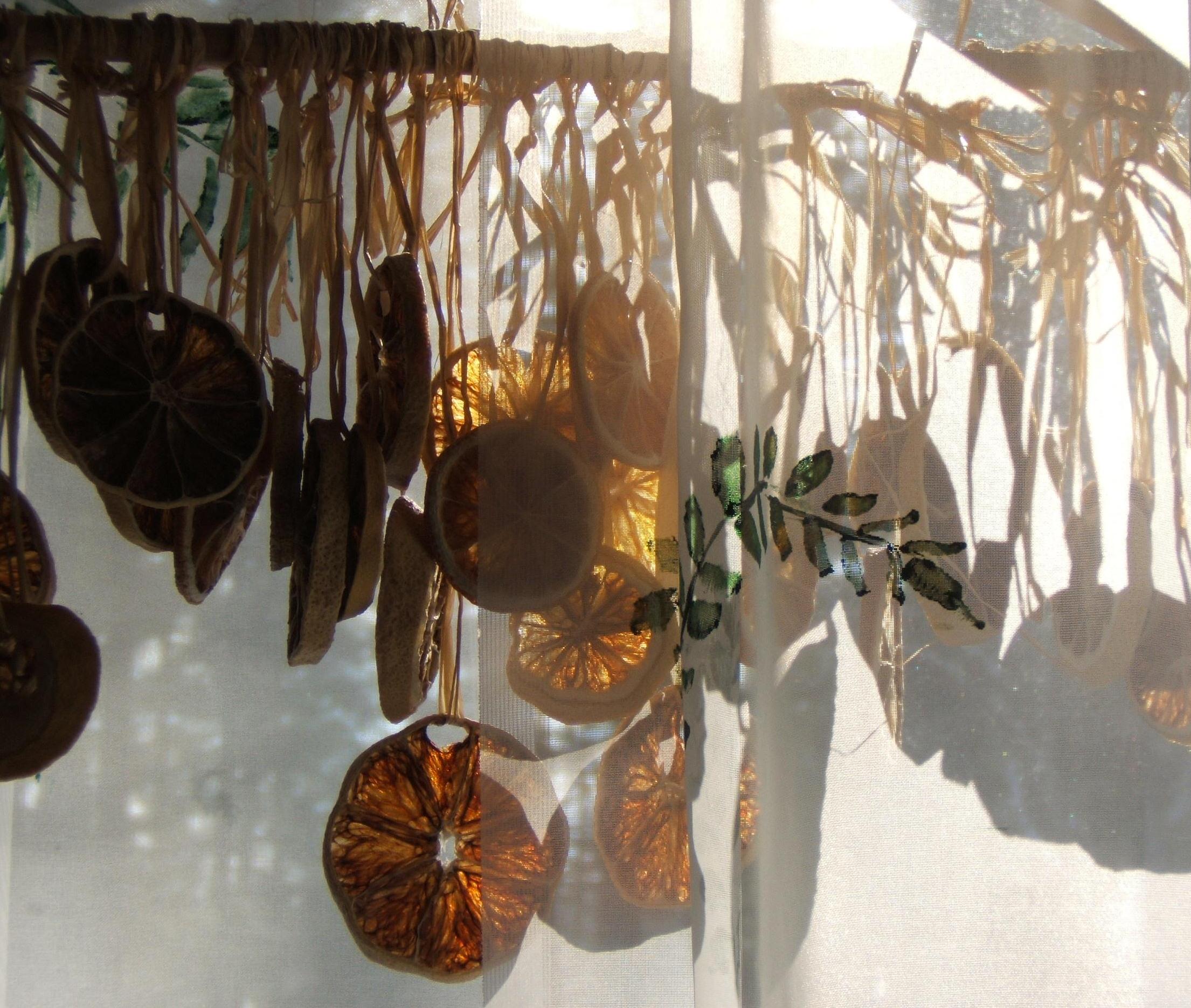
Yesterday I came into the house just as the sunlight was beaming through the window and experienced a moment so beautiful – a dazzling display of light and shadow.
Last Christmas, I sliced oranges and lemons and dried them as decorations for our tree at work. When Christmas was over, they were too pretty to throw away, so I strung them on raffia and hung them on a wooden coat hanger in the front window.
The sunlight shining through those dried orange slices, in combination with the shadows on the sheer curtains, was magical.
~

~
~
sunlight shines
through a slice of orange
~
sliced sunlight
rays transparent
membrane cellophane orange
juice fossilized
rose window
lustrous
citrus
~
~
© Jane Tims 2012

© Jane Tims 2012
eight days – snow storm
During my eight days in Ontario, we had a snow storm whose memorable characteristic was the size of its snowflakes. They were the biggest I’ve ever seen, as big as large marshmallows. Every fluffy snowball must have been the composite of a dozen individual snowflakes. After the storm, the trees were coated with white. The cedar were particularly beautiful, with their evergreen leaves each hanging beneath a personal burden of snow.
~
~
deep snow
~
snowed all day, sealed us in
knee-deep, snowflakes
the size of mittens, wrists
of cedar hang
weight of snow, on backs of hands
boughs of fir, three-thumbed
and frosted, fists on fence posts
impressions of boot
in the hollow of leg-prints, fingernails play
the wind chime, brief
reminder of summer, signals
in-coming cold
~
~
© Jane Tims 2012

at the bird feeder #5 – Hairy Woodpecker
Our Hairy Woodpecker was back today. She was determined to get to the feeder, so we got a very good look at her in all her black and white splendor.
This time the identification was not a problem. This woodpecker is a noticably large bird, compared to the smaller Downy Woodpeckers we have seen at the feeder before. Also, the outer tail feathers are white, not marked in black as they are with the Downy Woodpecker.
I like to compare illustrations in the various bird books. Have a look at these two sets of Downy and Hairy Woodpeckers, both drawn by Roger Tory Peterson, first in his ‘A Field Guide to the Birds East of the Rockies’ (1980)…

Roger Tory Peterson, 1980, 'A Field Guide to the Birds East of the Rockies', Houghton Mifflin Company, Boston.
… and second, from his illustration in ‘The Birds of Nova Scotia’ by Robie W. Tufts (1973). In the ‘Field Guide’ , the markings on the white tail feathers of the Downy Woodpecker are clearer.
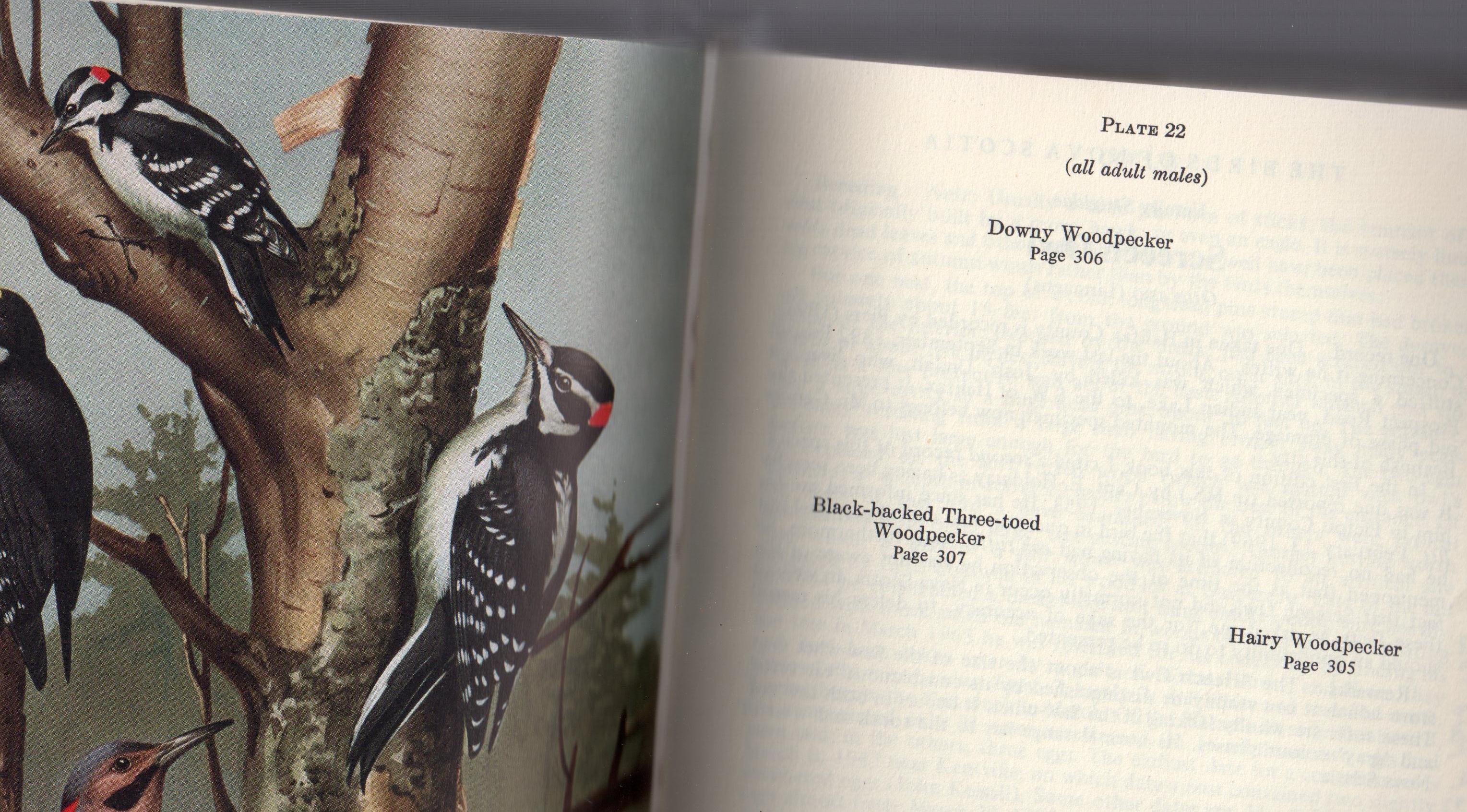
Robie W. Tufts, 'The Birds of Nova Scotia', 1973, Nova Scotia Museum, Halifax. Color illustrations in this book are by Roger Tory Peterson.
Both Downy and Hairy Woodpeckers are cavity nesters. They stay through the winter and are frequent visitors at feeding stations… they love suet and black sunflower seeds.





 nichepoetryandprose