Archive for the ‘in the grey woods’ Category
Wild Lily-of-the-Valley (Maianthemum canadense Desf.)
This time of year, the floor of our Grey Woods is carpeted in the leaves and blooms of Wild Lily-of-the-Valley (Maianthemum canadense Desf.). The leaves first poke through the dry leaves in mid-April and literally unfurl …

By May the forming flowers are visible…

… by late-May they are in full bloom.

I cannot get a good photo of a white flower, but this shows their star-like quality
The Wild Lily-of-the-Valley, also known as False Lily-of-the-Valley and Canada Mayflower, grows in woods and clearings, and is one of the first plants to appear in the coniferous woods understory. The leaves are heart-shaped, cleft to fit around the floral stem. Flowers are white, contained in a compact elliptical raceme. Each little flower is four-pointed.
The berries of Maianthemum canadense are edible, first appearing as whitish-green with small spots and gradually turning to red.
~
This post is dedicated to Barbara Rodger’s mother, who loved Lily-of-the-Valley, the flower the Wild Lily-of-the-Valley gently resembles!
~
~
Wild Lily-of-the-Valley
– Maianthemum canadense Desf.
~
slim emerald flames
burn through dry leaves,
ignite sparklers
of stamen stars,
puffs of smoke,
white berries heat to red
embers in forest
~
~

excavation underway!
On Tuesday morning last week, I began my morning work to the beat of an intermittent rapping. It was so loud and so near, I thought it must be someone hammering on the house.
I looked outside and saw, across the lawn, a large bird with a flaming red crest. A Pileated Woodpecker (Dryocopus pileatus)!
We have seen this species of woodpecker several times before in our Grey Woods. These birds leave their oval cavities in many of our older trees, evidence of their search for insects or the preparation of cavities for nesting. The use of dead or dying trees as cavity nesting sites is an example of how important these trees are to the woodland ecosystem.

I watched as the bird did her circuit of the tree and hopped down to the ground for a while. Then she fluttered up to our cedar rail fence and into the trees.
The Pileated Woodpecker’s bright red crest and long skinny neck give it a comical air – not a beautiful bird, but very exciting to see and watch.
~
~
© Jane Tims 2012

snippets of landscape – vernal pools and the spring migration
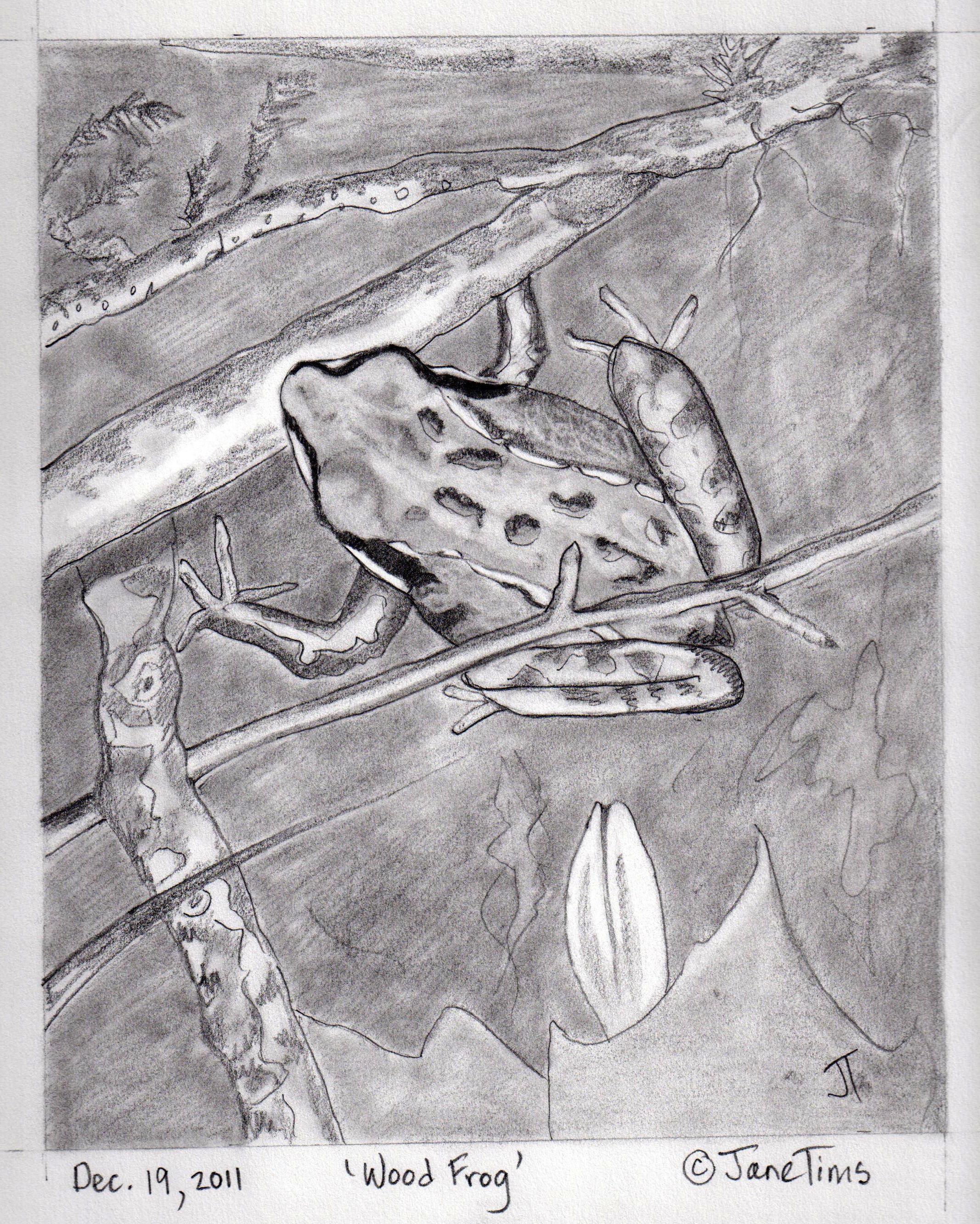
At the edges of our Grey Woods are several places where ‘vernal pools’ form. As a result, these spring evenings are alive with the peeping and croaking of various frogs and toads.
‘Vernal pools’ are temporary accumulations of water in depressions. This water may originate from snow accumulations or from rising water tables. The word ‘vernal’ comes from the Latin ver meaning spring.
Although vernal pools are ephemeral, they create habitat for many animals, including insects and amphibians, often at critical life stages. Amphibians such as Wood Frogs (Rana sylvatica), Spotted Salamanders (Ambystoma maculatum), and Blue Spotted Salamanders (Ambystoma laterale) depend on vernal pools for laying their eggs and development of tadpoles. Other amphibians you may encounter in a vernal pool include Spring Peepers, Grey Tree Frogs and Bull Frogs.
During a rainy night in late April or early May, you may be fortunate enough to observe the early spring migration of Wood Frogs and other species as they make their way to breeding locations. These frogs have remained all winter in hibernation and have unthawed in the early spring rains. Unfortunately, many must cross roads to get to the ponds and vernal pools where they will lay their eggs, and many become casualties of their attempts to cross the road.

~
~
an uncertain spring migration
~
if it rains
the night road
leads home
to lowlands
and hollows
vernal pools
north of the highway
swollen with rain
~
mists crawl
towards me
vignettes
sweep the windshield
frogs cross the roadway
follow ancestral memory
blurred by rain
~
some nights
the tail-lights ahead
are my only family
red streamers on wet pavement
tadpoles from the eggmass
grow legs
absorb their tails
follow the road
~
I watch
the phone poles
the potholes
the hidden driveways
the headlight echo on trees
frog legs
crushed on the pavement
mailboxes with uncertain names
~
the centre line is a zipper
seals the left side
to the right
the coming home
with the leaving
frogs plead
from the wetlands
never saying goodbye
~
Published as: ‘an uncertain spring migration’, Spring 1997, Green’s Magazine XXV (3).
revised
© Jane Tims 2011
~
maple syrup ups and downs
It may be a short maple syrup season this year. The weather has not been cooperative. In order for the sap to run, warm days are great, but the nights need to be cold. When the temperatures fall below zero, the sap in the tree runs from the crown to the roots. When the day is warm and sunny, the sap runs back up to the canopy. If there is no cold night, no sap.
So far we have collected about 40 liters of sap from our 10 trees and I have 3 bottles (each 500 ml or two cups) of lovely dark syrup! This compares to 136 liters of sap last year on the same date, from 12 trees.
~
~
Cold night, warm day
~
Icicles build
from the spile
sweet sickles of sap
~
~
© Jane Tims 2012

keeping watch for dragons #1 – woodland dragon
Sometimes our grey woods are a mysterious place. Something about the slant of the light, the way the trees stand like pillars supporting the sky, or the way pale moths climb on the forest dust, conjures myth from reality.
Last year as I walked on one of the paths, my eye was drawn to the single scale of a seed cone, lying on the forest floor. Perhaps it had been dropped as a Grey Squirrel in the tree above nibbled on a pine cone.
Perhaps…
~
~
Woodland Dragon
~
~
in the blackened stand
of jack pine
~
a single
crimson
scale
~
~
© Jane Tims 1998
on pond ice
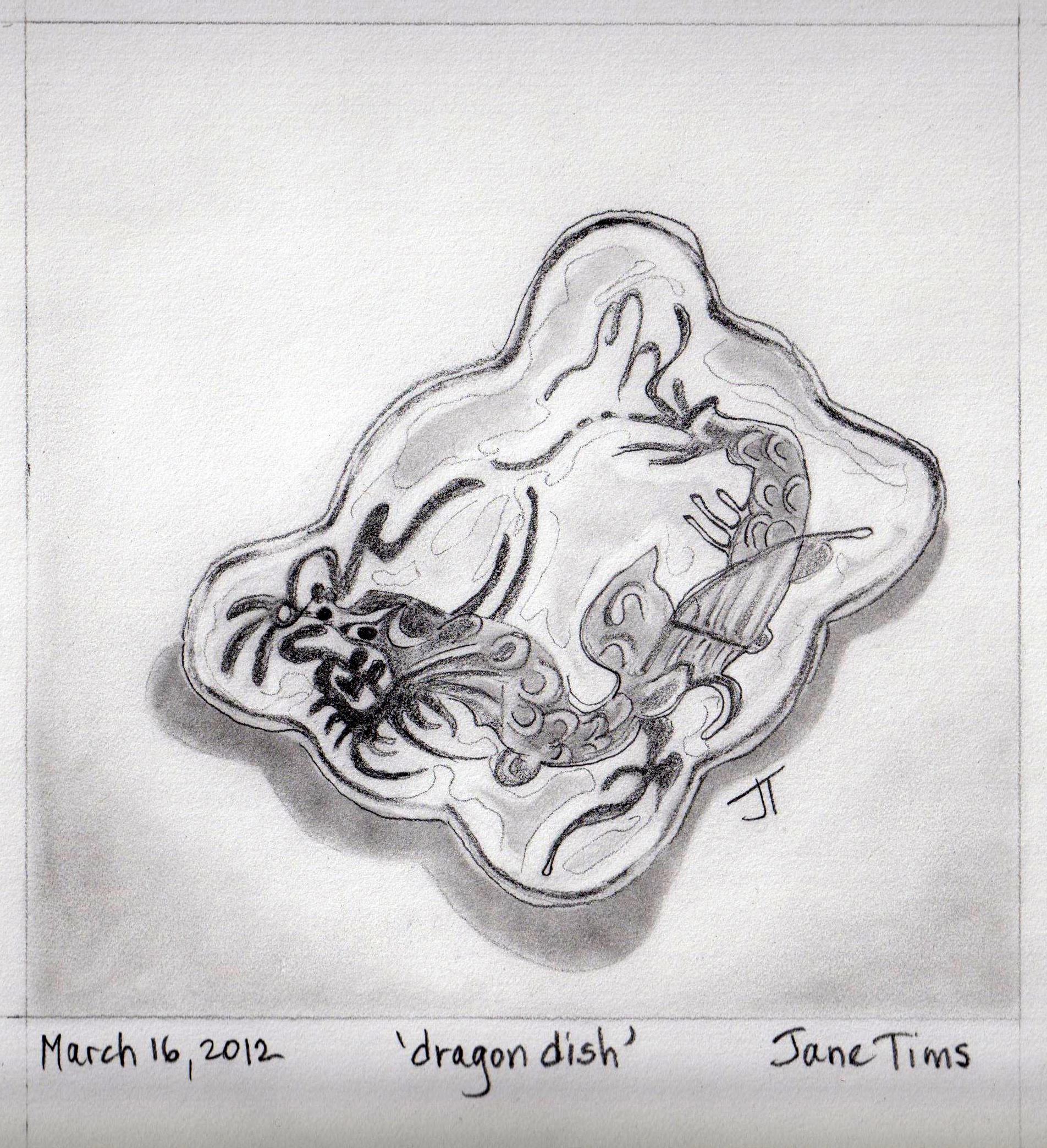
The days are short, reminding me of days when my son was young and I resented the brief daylight. We left for work in the dark and arrived home after the sun set. To spend just a little time with my son in the snow, I would turn on the outside light and play with him for a few precious minutes at the end of every day.
On weekends, we would seek out the smallest patch of ice and skate together. Any patch of ice would do. Some years we tried to make a small rink. Usually, we made do with the strip of ice formed at the edge of our driveway…

Our favourite place to skate was a small hollow in the grey woods behind our house. We dubbed it “Hoot-and-Hollow Pond” (because it was just ‘a hoot and a holler’ out back, and because we hear owls so often in the grey woods). The pond was small, but just the right size for my son to wobble around on his first skates.
In the years since we skated there, the trees have grown thick and tall around the pond. I went looking for it this week and found the ruin of the little bridge we built across a narrow place in the pond…

ruined bridge over Hoot-and-Hollow Pond...you can see the broken boards and old nails
and ice on the little pond itself…
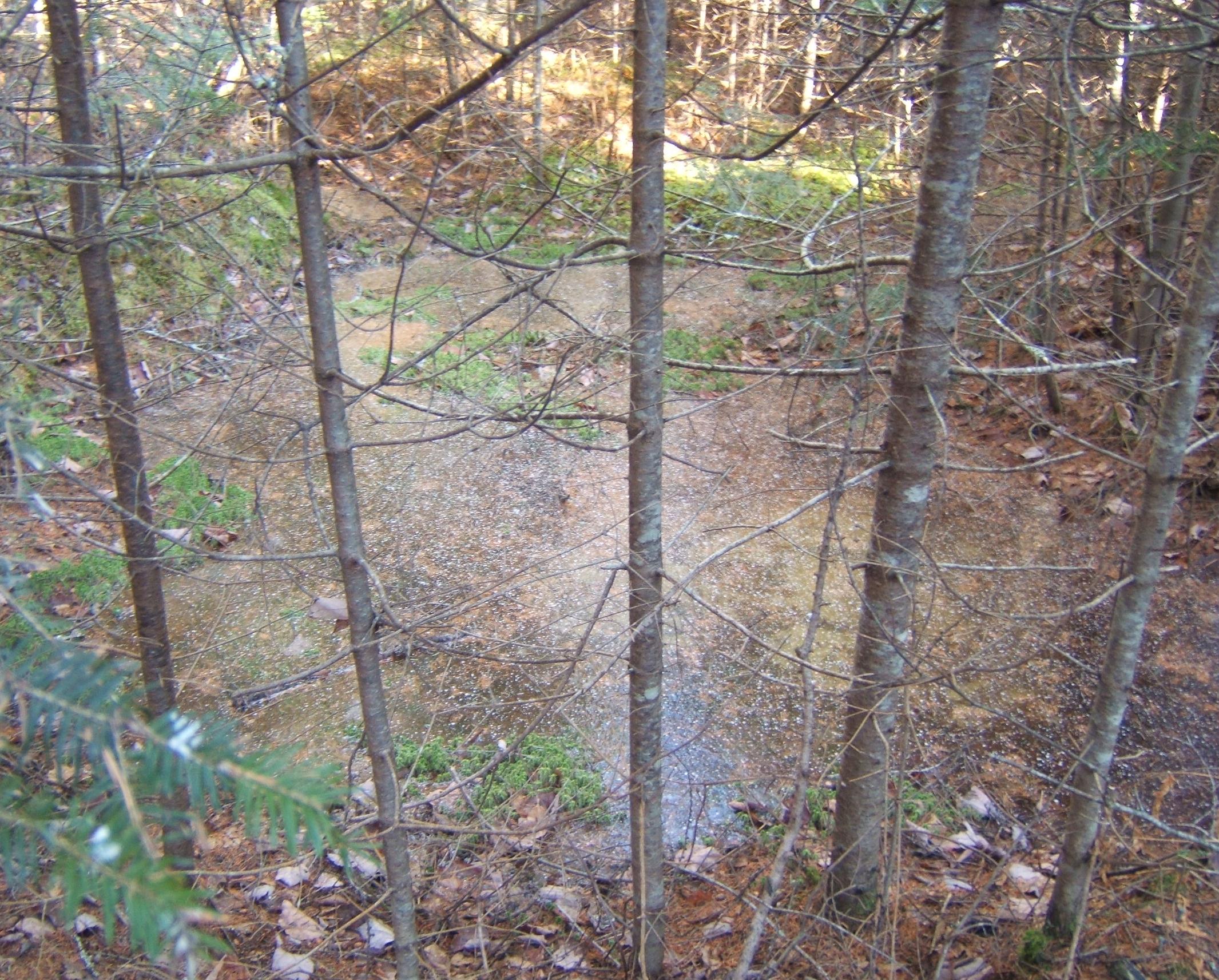
Hoot-and-Hollow Pond today, the water level a little lower than when we skated there
~
~
a skate on the woodland pond
~
~
etch
brittle cracks beneath the weight
of blades, we spread our bodies thin
twirl on the delicate lift
of snowflakes drift
above the pond, gather
firs around us, lean away, bend
beneath the weight of snow, find
room to glide, the edge where white birch
cage faint light
magnify the gleam
of paper bark, frail ice
white snow and stars
resist the dark
~
~
© Jane Tims 2011

witch’s broom
In the Balsalm Fir tree over our shed is a strange growth, like a dark mass of short deformed branches. This dark mass of branches is known as a ‘witch’s broom’.
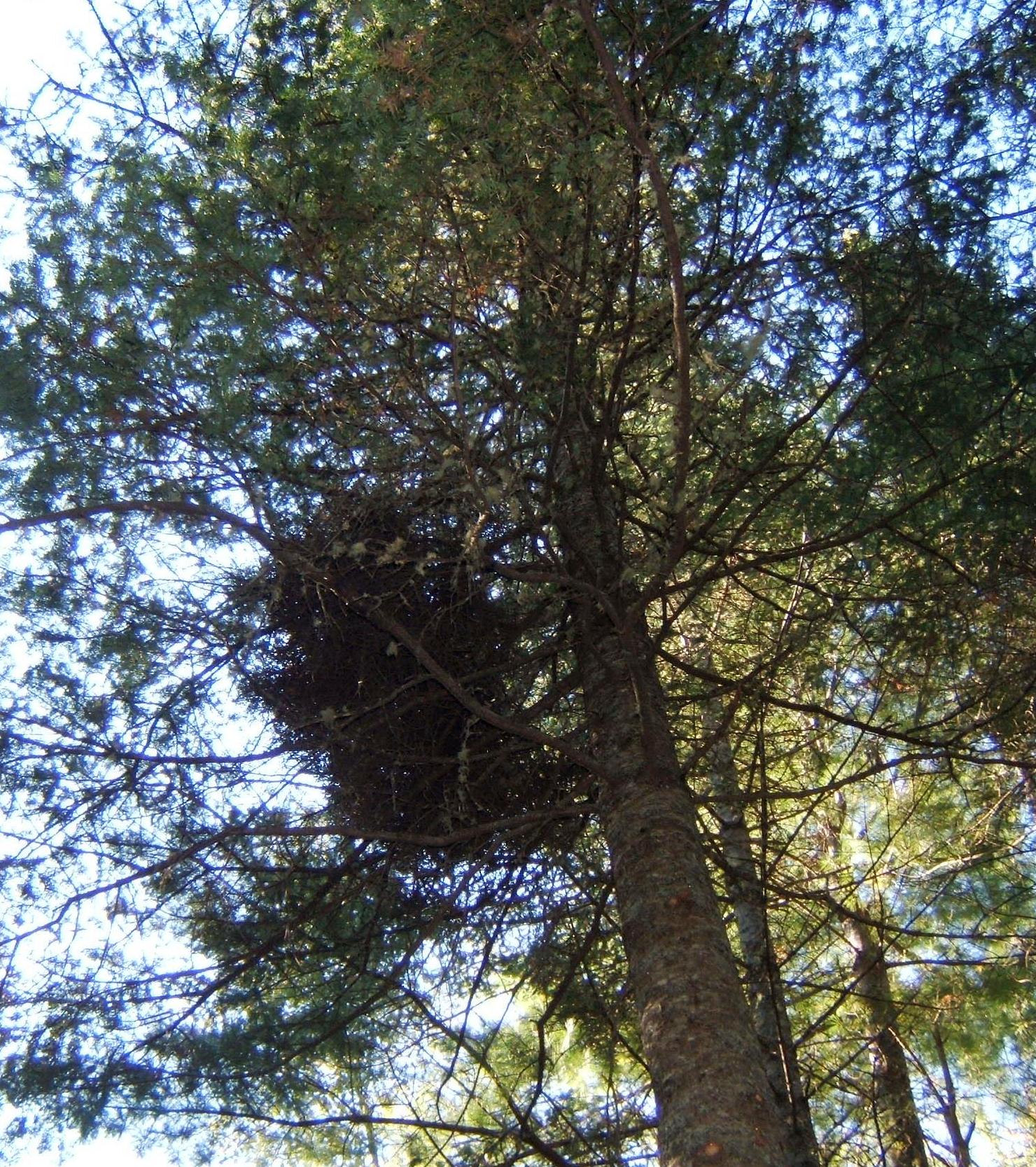
A witch’s broom is a common term for an abnormal growth caused by the action of an agent such as a mite, virus, insect, or fungus. The agent causes a branch of the tree to grow from a single point, resulting in a mass of twigs and branches resembling a nest or broom. Many kinds of plants can have a witch’s broom deformity, including many tree species.
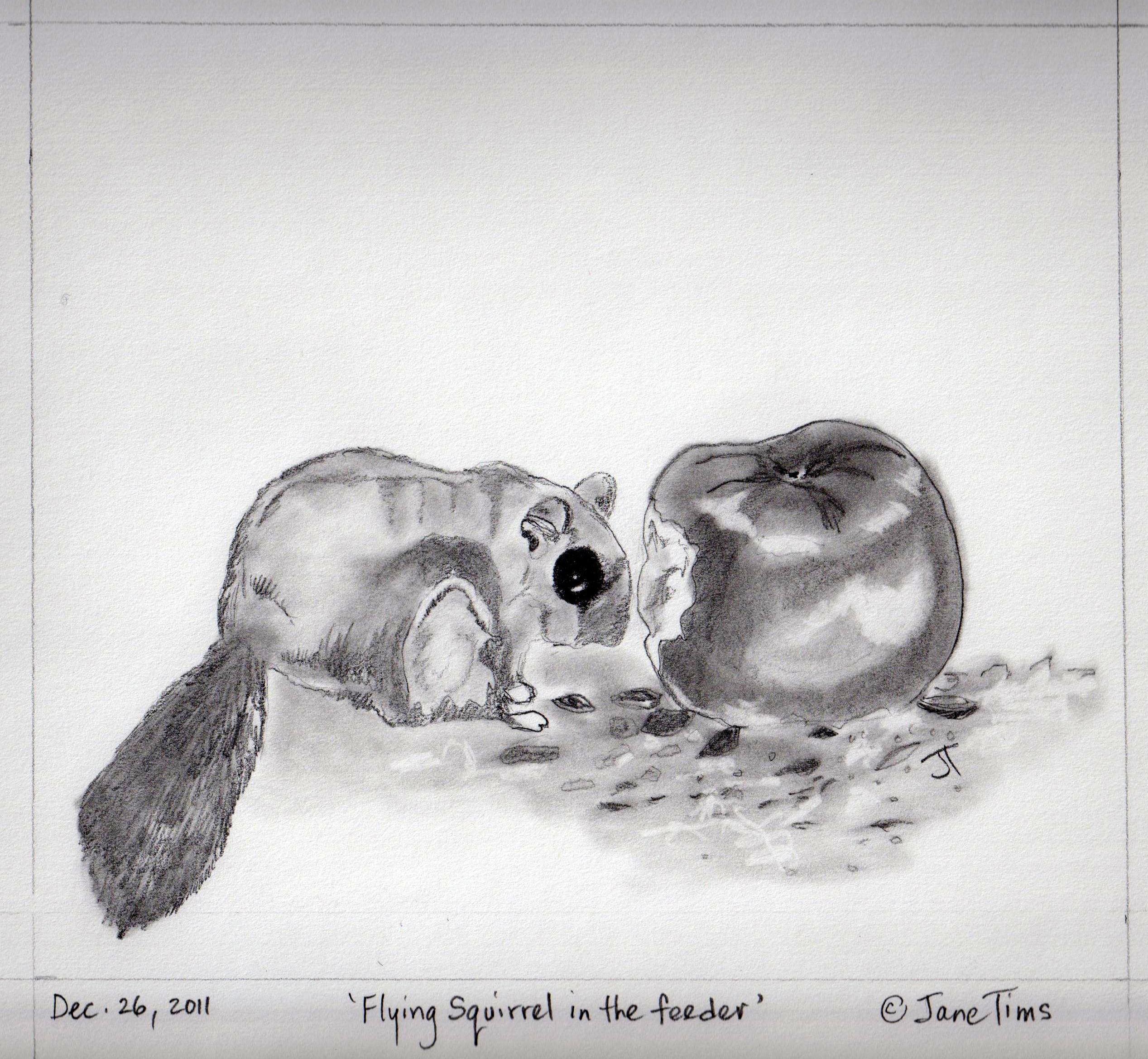
Animals, including the Northern Flying Squirrel, use the witch’s broom as a nesting place. The Northern Flying Squirrel is the big-eyed squirrel invading our feeders every night (see ‘spacemen in our feeder’ under the category ‘competing for niche space’ for December 23, 2011).
Witch’s brooms occur frequently … we have at least three in our grey woods. They lend an air of mystery to the woodland. People used to believe a witch had flown over the place where a witch’s broom grew.
If anyone knows of another name for the witch’s broom, please let me know. Years ago, we visited a small farm museum in northern Maine and an example of a huge witch’s broom was displayed in the shed, labelled ‘horrah’s nest’, but I have been unable to find this term used elsewhere.
~
~
wood witch
~
burdened by snow
a tree falls
tumbles a witch’s broom
the witch set free
~
a hex on the snowfall
slate where the dog walks
cuts her feet
soft rubies in every track
~
a hex on the room
cold as I left
now warm
~
too warm
~
~
© Jane Tims 2001
groundhog burrow
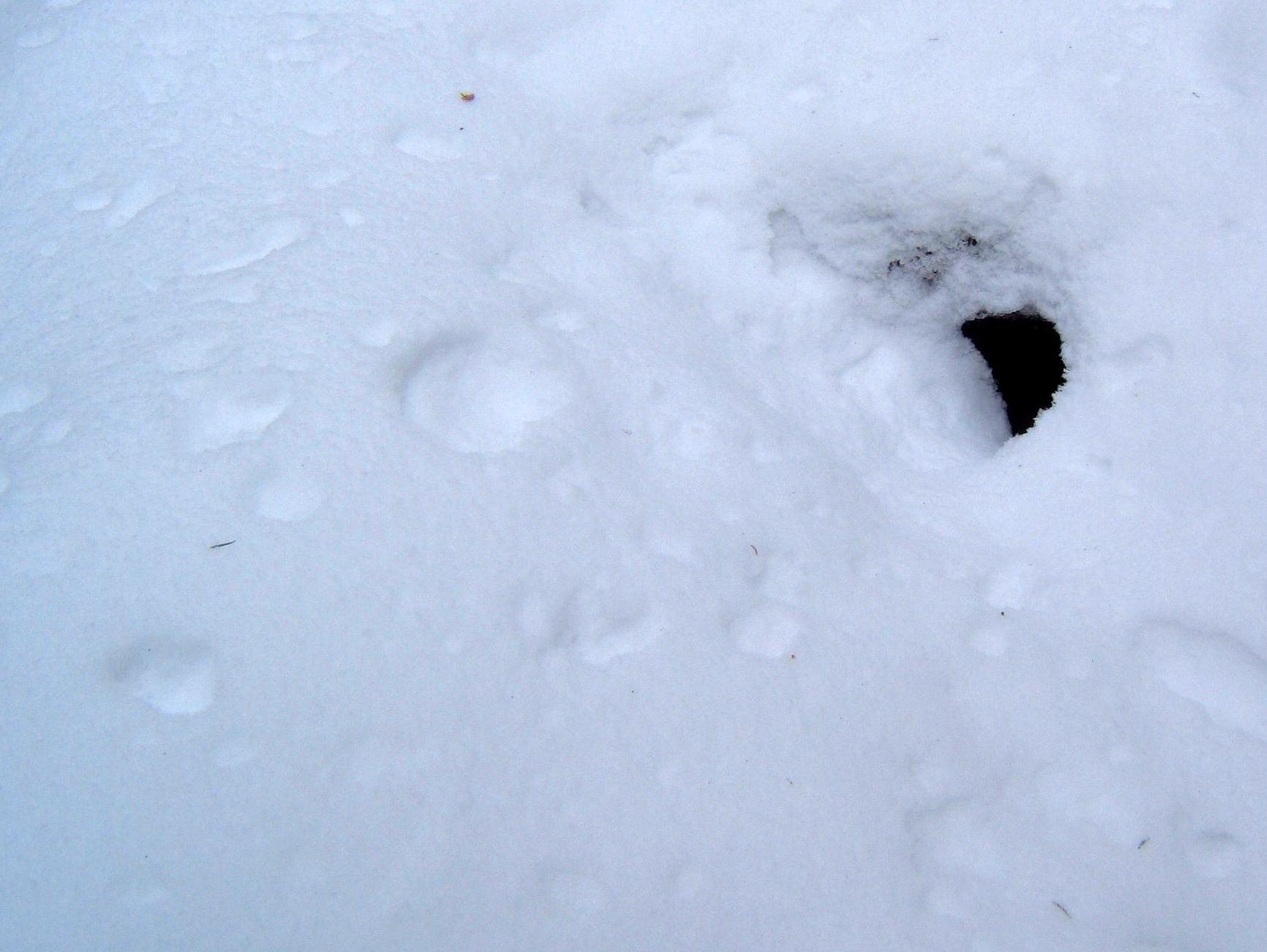
On my walk in the snowy grey woods, I checked on the burrows of the Groundhog (Marmota monax) near our picnic table. I have read about the winter habits of the Groundhog and I know he enters true hibernation this time of year. He does not wake through the winter to feed. For this reason, I was not surprised to find the snow around the main entrance untouched by any tracks leading to or from the burrow. The snow has buried the other burrow entrances. Sleep well, Groundhog family!
~
~
hibernation
~
groundhog excavates
beneath the fir, a meter cubed of dug
and snug and sifted dirt, disturbed
observes from veiled backdoor
under fibred curtain, dangled root
twisted tunnel, tilted floor
~
eats well and sleeps but
wakes, stumbles down his bleary halls
for green but white still sifts between
the burrow walls, tells his mate shove over
settles back to hibernate
~
~
© Jane Tims 2011

tracks in the snow
On Tuesday I went for a walk in the grey woods. Snow fell just before Christmas, so my walk turned into a quest to see who else had been walking (or running) in the woods.
I found many tracks, large and small. Mice had made their cylindrical tunnels, and occasionally had run across the surface. At some places, you can see where their tunnels suddenly go subterranean…
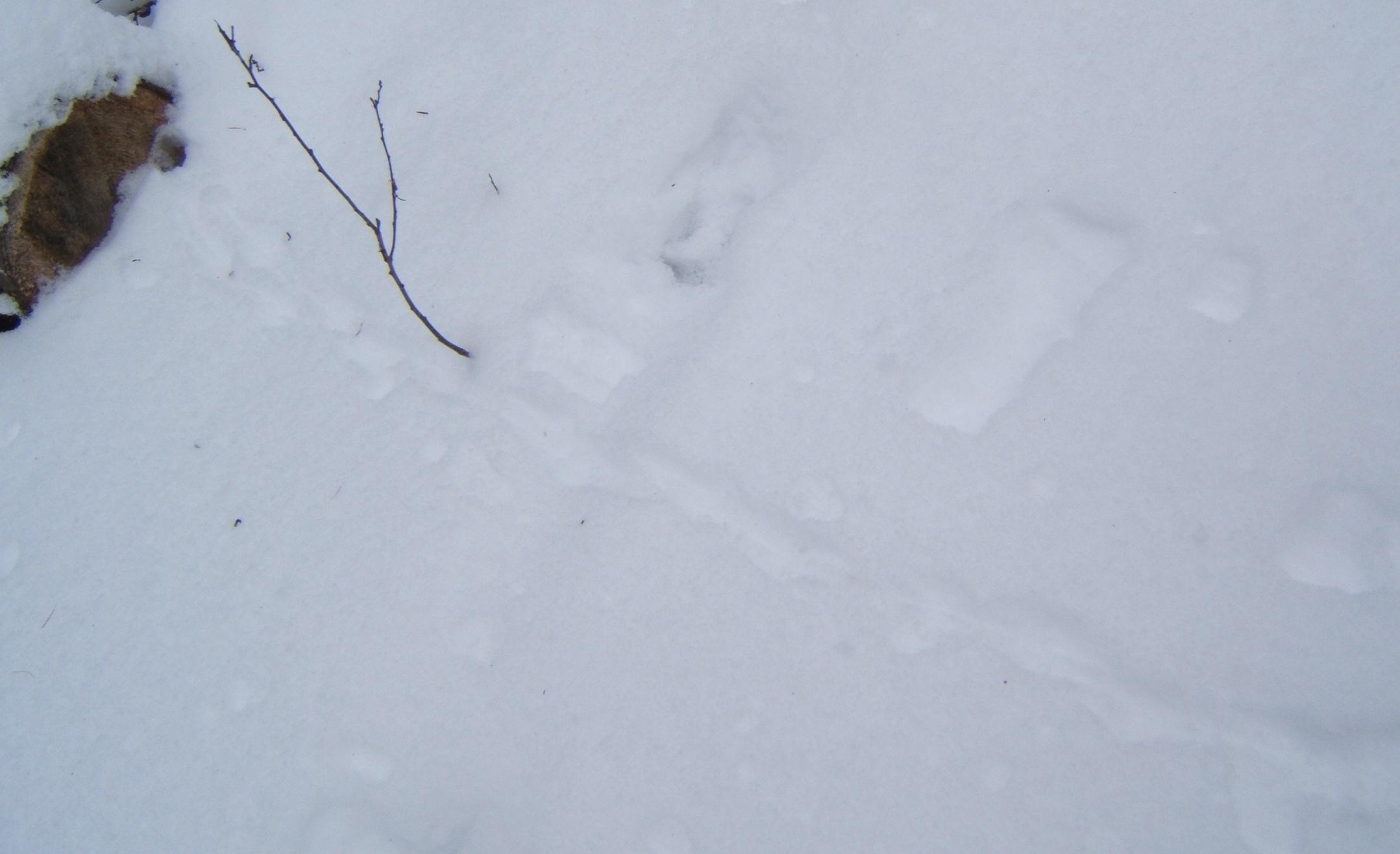
Sometimes several paths converge at a sheltered area beneath a fallen log, like a woodland bus terminal…

There were lots of squirrel tracks, often ending at the base of a tree where their paths move into the treetops…
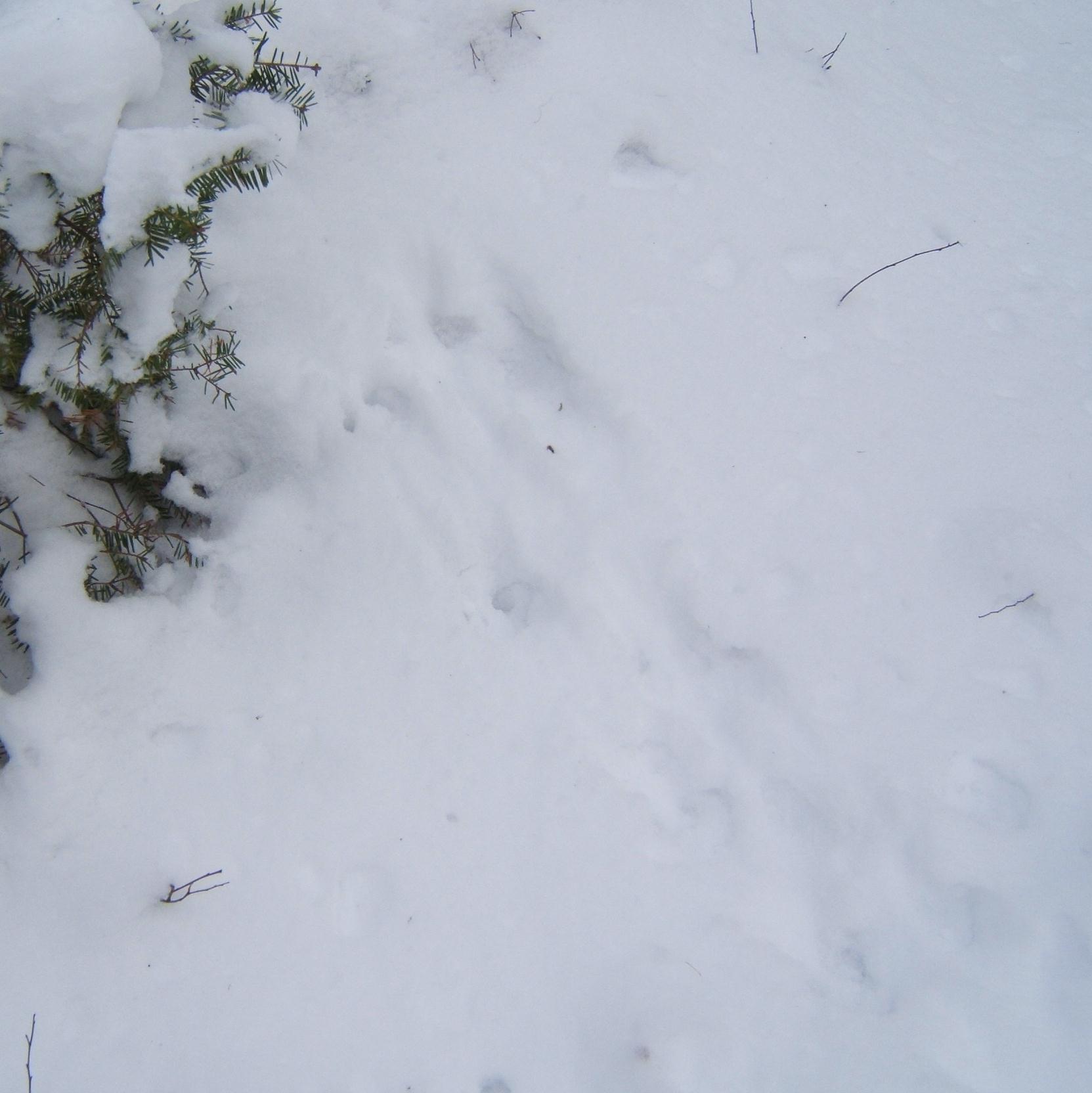
Squirrel tracks crisscrossed with those of deer…
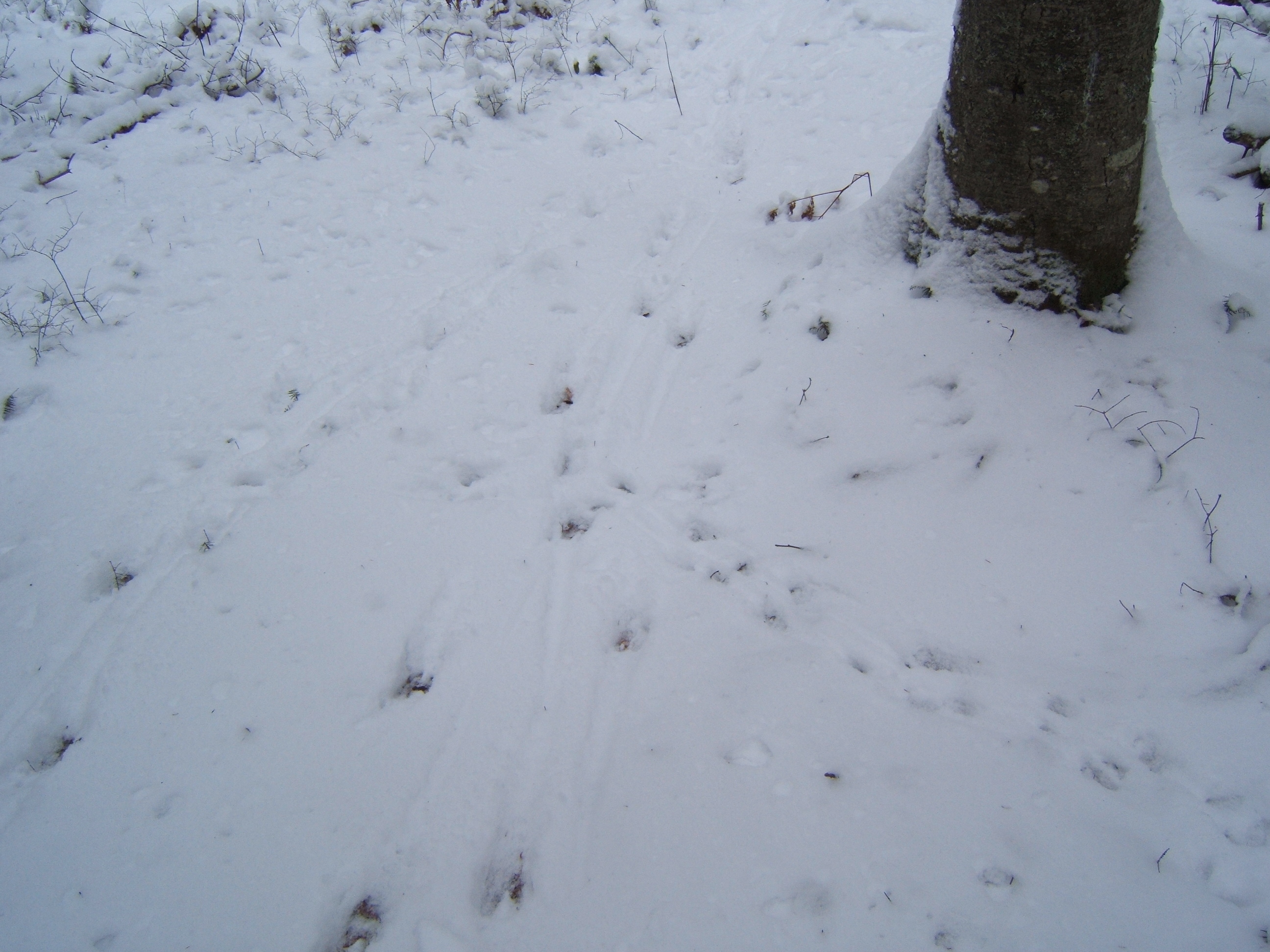
I followed the trail of two deer deep into the woods, thinking they were long gone since the tracks were filled with a slight dusting of snow…

This made me a little careless, and the next thing I heard was a high-pitched snort and squeal of warning and the bounding of hooves through the woods. I got a good look at two beautiful deer, but the camera was not ready. I did capture the very fresh track of one of the retreating deer.
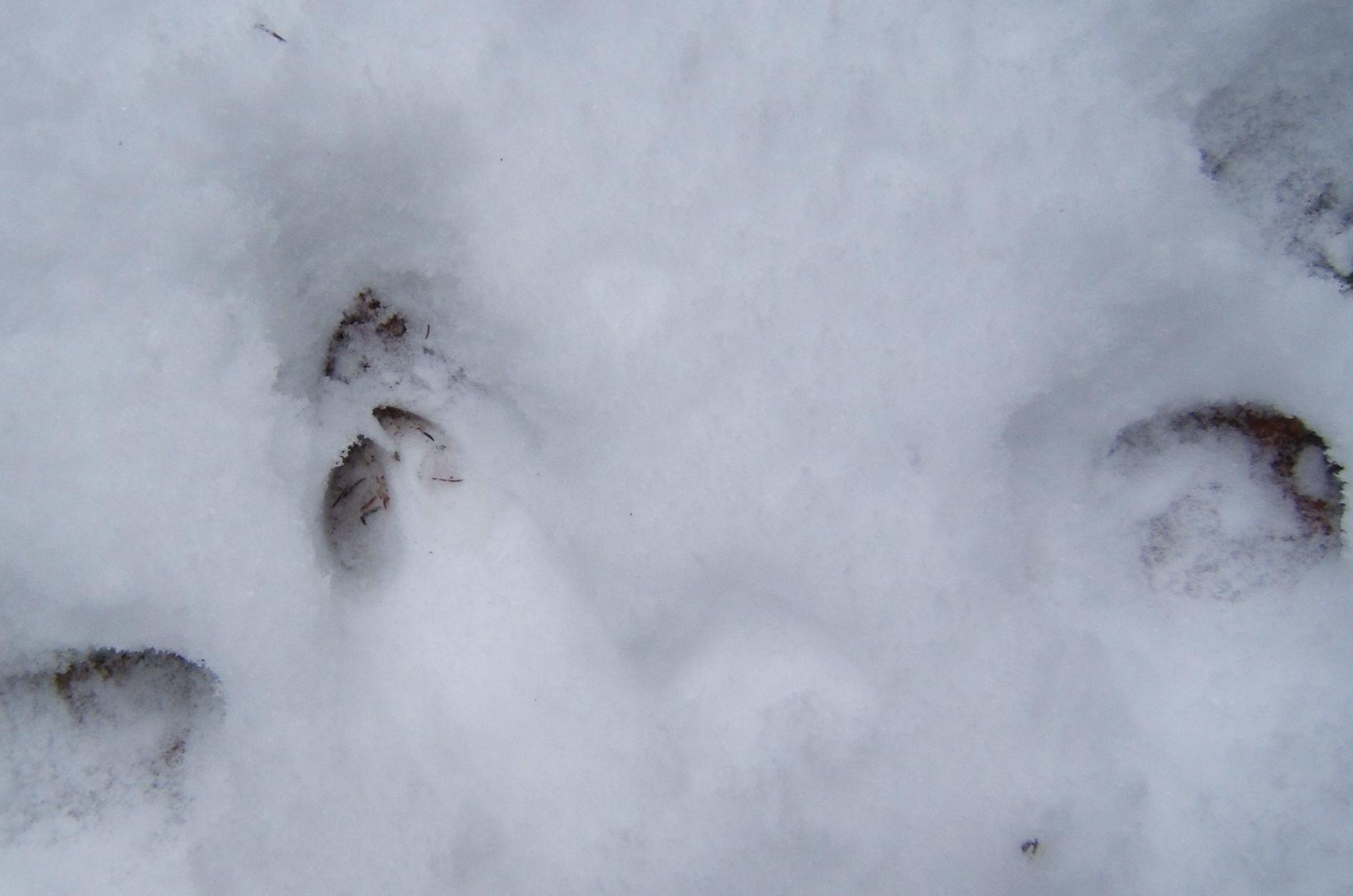
~
~
tracks in the snow
~
ephemeral proof
I follow the beacon
of a stash of spruce cones
stock-piled at the base
of a crooked tree
careen from a foe
slip beneath a log
dive into a hole
secret hollow
a pause to still
thud thud of my heart
~
~
© Jane Tims 2011
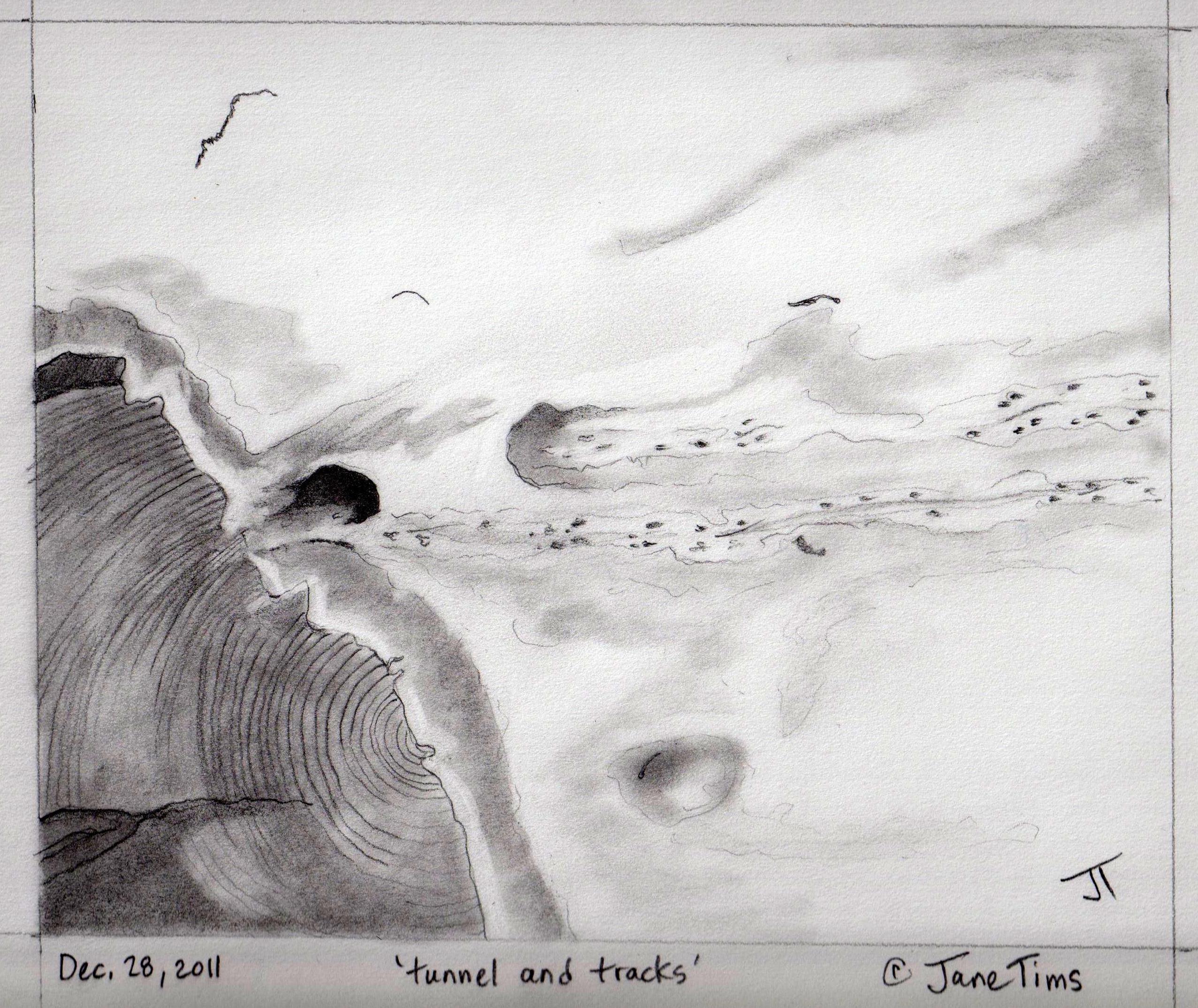
snow hollow at the base of a tree
Words are the tools of a writer’s craft. I literally wallow in words when I write a poem. Sometimes the right word comes immediately to mind. Sometimes I have to search for it, sometimes for days or weeks. When I do the final edits for a poem, I ‘press’ on every word, to make sure it is absolutely right.
Sometimes, I encounter an idea or image that seems to have no word. For example, I have searched for a word referring to the charming hollow that builds next to the base of a tree when the snow falls. Sometimes small animals use this hollow for a temporary den. Sometimes it’s a place where debris gathers, as it does in the corners of alleyways. Sometimes it is a calm, beckoning place where snow shadows rest in shades of olive green and blue.

I wonder if there is a name for these elusive places, perhaps in another language.
~
~
snow hollow
~
snow shuns the tree
manifest in the hollow
the empty gather of wind
at the base of the fir
~
where snow-shoe hares find
shelter or dry leaves skipping
across a crust of snow
assemble and rest
~
inside curve to fit
the spine of an animal
the heart of a man
curled against the cold
~
a place where shadows meet
select blue from the prism of all
indigo to illustrate the space
of no snow, no warmth, no light
~
~
© Jane Tims 2011





 nichepoetryandprose