Archive for the ‘books with a strong sense of ‘place’’ Category
on my bookshelf – Covered Bridges of Central and Eastern Canada by Lyn and Richard Harrington
Thanks to a friend, I have added a gem to my small collection of covered bridge books! Covered Bridges of Central and Eastern Canada, published in 1976, gives a glimpse of days when there were over a hundred covered bridges still standing in New Brunswick.
~

~
Harrington, Lyn and Richard Harrington. Covered Bridges of Central and Eastern Canada. Toronto: McGraw-Hill Ryerson Limited, 1976.
~
Covered Bridges of Central and Eastern Canada includes black and white photos (and two in colour) of many of the covered bridges of the time, including one of the Southwest Otnabog Covered Bridge on Base Gagetown.
~
These photos provide a glimpse into history: the types of signage used, the vintage cars, and the land uses in the vicinity of the bridge. Photos show the stacking of wooden lobster traps and log drives on the river. From the days when the bridges were used for private notices, there are photos of a circus poster and a painted eye glass advertisement.
~
The book also includes written information on the history of covered bridges, bridge construction, enemies of the covered bridge and hopes for the future. The text covers topics such as traditions and superstitions, sources of bridge names, and anecdotes. I like the detailed story of the creation of the picnic park beside the Patrick Owens Bridge in Rusagonis.
~
The Chapter ‘Hope for the Future’ is informative and somewhat sad. In the 1970s The League for Rural Renewal was seen by the author as the cornerstone for covered bridge protection and appreciation.
~
Since the book was published, we have lost over forty covered bridges. On the positive side, appreciation for rural landscape is still alive in New Brunswick, evidenced by the many efforts of the Department of Transportation and Infrastructure. On our visits to covered bridges we have seen new roofs, mended walls and upgrades to abutments. Some of the photos in the book show deteriorated bridges now renovated and mended.
~
The book provides a list of covered bridges in New Brunswick and Quebec in 1970. Although the list includes the names of 101 covered bridges in New Brunswick, the authors say 113 bridges existed in 1974/75 when they made their visits. The book also says there were 307 covered bridges in New Brunswick in 1950. Many of the names in the list are no longer familiar in today’s covered bridge lexicon: two bridges over the Shikatehawk River in Carleton County; Windgap Brook #1 in Kings County; Southwest Long Creek in Queens County; and Chemical Creek #1 in Albert County. As a point of interest, in the 1960s, there were still three covered bridges in Nova Scotia.
~
The Foreword to the book is by Milton Gregg, born in Kings County, New Brunswick – cabinet minister, recipient of the Victoria Cross for bravery in World War II and Officer of the Order of Canada. He was also the founder and head of the League for Rural Renewal mentioned above.
~
I was very fortunate to receive my copy of this book from a friend and I thank him again for the gift. Amazon lists the book as available through one of their associated sellers.
~
Copyright 2016 Jane Tims
on my bookshelf – A Photo Tour of the Covered Bridges of New Brunswick by Ray Boucher
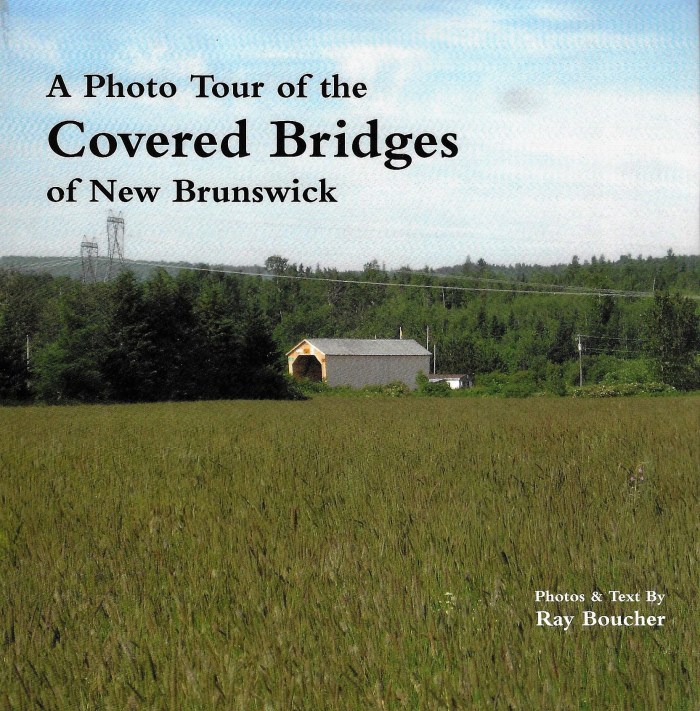
As I make revisions to my poetry manuscript ‘in the shelter of the covered bridge’, my collection of books about covered bridges in New Brunswick provides needed reference material. Ray Boucher’s book A Photo Tour of the Covered Bridges of New Brunswick looks at the 64 covered bridges present in the province in 2008. Today only 60 of these remain.
~
~
Ray Boucher. A Photo Tour of the Covered Bridges of New Brunswick. Kissing Bridge Publications, 2009.
A Photo Tour takes the reader county-by-county to discover New Brunswick’s covered bridges. Many of the bridges are shown in more than one photo and photos were taken in every season. I particularly like the photos showing a bridge from up or downstream.
~
Now gone from this record of 64 are the Adair Bridge (North Becaguimec River #1) (lost to fire in 2009), the Aaron Clark Bridge (Canaan River #1) (lost to flooding in 2014), the Stone Ridge Bridge (Keswick River #6) (lost to fire in 2008), and the Mangrum Bridge (Becaguimec River #3) (lost to fire in 2011). My version of the book has notes added in red to indicate the 2014 and 2008 losses. The historical value of this book is the photographic record of these four bridges as well as those still standing.
~
Each photo is accompanied by facts on bridge length and date of construction, and interesting notes and anecdotes on the bridge and the photographer’s visit. Since my husband accompanied me on my visits to the covered bridges I am writing about, I liked reading that this book was also a husband and wife effort!
~
I was able to buy a copy of this book on Amazon.ca … my collection of books about covered bridges is growing!
~
Copyright 2016 Jane Tims
on my book shelf: ‘Crow Impressions & Other Poems’
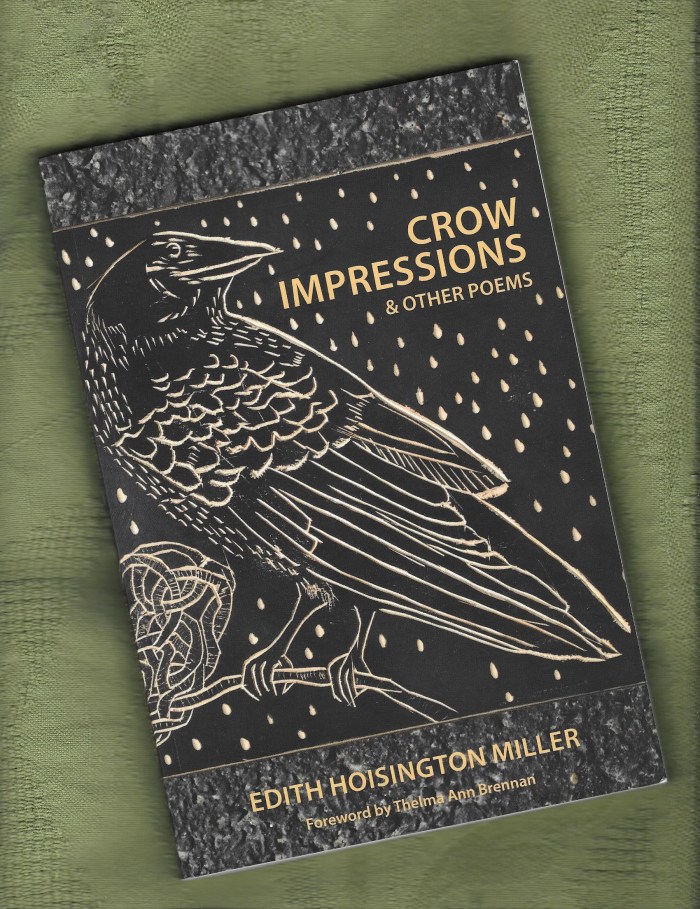
I am now reading Crow Impressions & Other Poems’ by Edith Miller. Crow Impressions is another book from my publisher, Chapel Street Editions in Woodstock, New Brunswick. Edith and I both launched our books at Westminster Books in Fredericton on June 9. Although I gave her book a quick read before the launch, I have now been able to sit down and enjoy a thoughtful read, as this insightful book deserves!
~
~
Edith Hoisington Miller, Crow Impressions and other poems. Chapel Street Editions: Woodstock, 2016.
~
The other evening at a local writing event I sat next to a fellow book-lover who asked me if I’d read Edith’s book. ‘I love poetry about nature,’ she said. ‘The poems in Crow Impressions make you feel like you are there!’
–
Throughout her book, Edith’s first-hand knowledge of her subject matter shines through. Edith has watched not only crows, but herons on the shore, song sparrows in the rose bush, and eaglets in the nest. It has been said that crows recognize individual humans and I am certain they know Edith! I know she reveres this kindred ‘spirit sign’, understanding the crow’s sharing of this world, the intricacies of their language. I love her inclusion of her first poem, written when she was seven – it will be a mystery for you to solve in your own reading, what part of nature she addresses in her poem.
~
As I read, I am able to follow a journey to places Edith has lived and visited — from Long Island Sound to Arizona, from Penobscot Bay to New York City, here to Fredericton in New Brunswick. As I read, I am taken to places I have been but stopped short of fully knowing. I read ‘Tidal Bore’ and experience the wild ride on the Shubenacadie River. The sounds and smells in ‘Air Shaft’ recall my own few days in New York City in the 1970s and show me what it might have been like to live in the Village (truly ‘the dream of a 1950s suburban girl’!). Edith’s poems show she shares my interest in American Hopi culture and her poems show the respect she has for other cultures through her experience in issues of social justice.
~
Crow Impressions is a lovely book, from the feel in a reader’s hands, to the easy-on-the-eyes layout. From the etching on the cover (a woodcut of a crow from a skate board created as a tribute to the memory of her grandson Isaac William Miller) to the final poems of the book. These return to the image of the crow, acknowledging the true nature of the ‘spirit sign’.
–
I recommend a close read of Crow Impressions – it will recall your own journey, make you ponder the symbols in your life for their particular meanings, and give you the joy of a walk on the beach even if you are far from the shore. Edith’s book is available at http://www.chapelstreeteditions.com and at our planned joint reading at Tidewater Books in Sackville this fall.
~
~
Copyright 2016 Jane Tims
on my bookshelf: New Brunswick’s Covered Bridges by Helen Coldrick
~
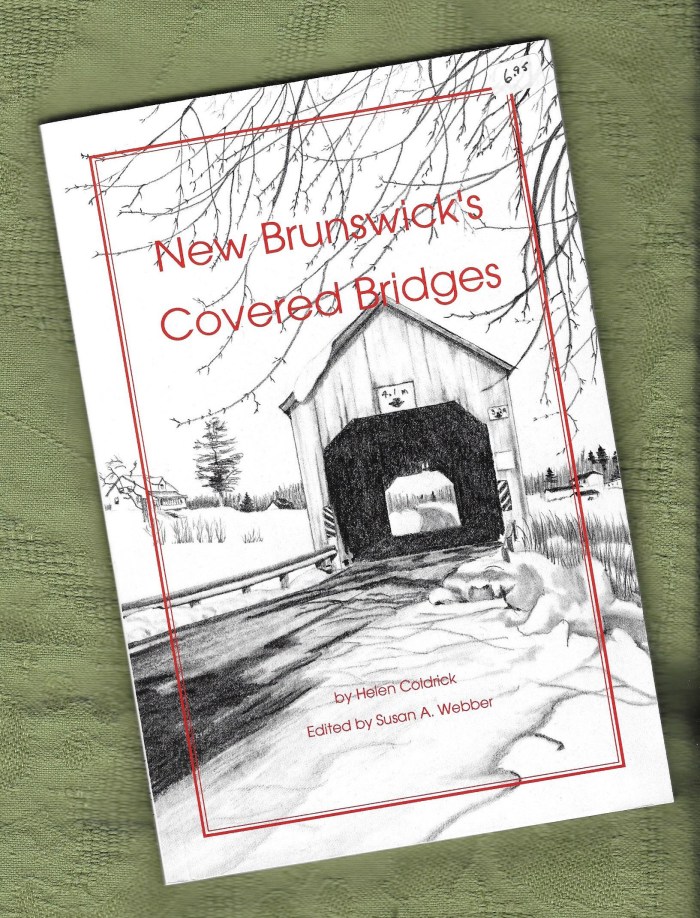
One of the ‘must haves’ in a collection of books about covered bridges in New Brunswick is Helen Coldrick’s soft cover book New Brunswick’s Covered Bridges. It includes drawings and information on the 70 bridges that existed in 1992. Today there are only 60 covered bridges in New Brunswick and Helen’s book is one way of seeing some of what we are missing.
~
Helen Coldrick. New Brunswick’s Covered Bridges. Neptune Publishing Company Limited: Saint John, 1992.
~
~
In her book, Helen includes 30 of her black and white drawings of various covered bridges and construction features. I love these drawings because I can see the artist’s process in the lines: her way of using shadow and white space, and her approach to portraying the reflections in water. The drawings also show the setting of each bridge and in some cases, the dramatic landscape of the river beneath.
~
Drawings in the book include bridges now lost: the Aaron Clarke Bridge (lost to flooding in 2014) and Iroquois River #4 (no longer standing). The book also includes a listing of the covered bridges in New Brunswick in 1992. I think one of the values of the book is its snapshot of the situation in years past. The New Brunswick government keeps a list of today’s covered bridges but finding information on those no longer existing is more challenging. Helen’s book shows us what some of these lost bridges looked like and tells some of their stories.
~
New Brunswick’s Covered Bridges includes a general history of covered bridges in New Brunswick, and a description of covered bridges by county. The book also includes lots of information on bridge construction, including pages on trusses, abutments, bases, sidings, entrances, windows and walkways, and roofs.
~
New Brunswick’s Covered Bridges is available for $7.95 from Nimbus Publishing (www.nimbus.ca). If you are interested in New Brunswick, covered bridges, history or architecture, or if you just like books with lovely drawings, this would be a great addition to your library!
~
~
Copyright Jane Tims 2016
.
on my book shelf: ‘Three Wrongs’
As part of my summer reading program I am including books by some of our New Brunswick authors.
~
Chuck Bowie. Three Wrongs – Donovan: Theif for Hire. MuseItUp Publishing: Montreal, 2014.
–
I love mysteries and plots with adventure. Smooth, unflappable, Donovan is a dangerous yet likeable protagonist. His approach to acquiring his ‘souvenirs’ is always original, well planned and flawless. Donovan never leaves his fingerprints behind.
~

~
The characters Donovan encounters in his profession are usually ruthless, willing to pay anything to acquire what they covet. The most interesting of Donovan’s clients is Katie Storm, the spoiled young actor who meets her match in Donovan. Katie hires him to steal a necklace from her rival. Donovan manages to meet his obligations, turn the tables on his immature client and fall in love, but not with Katie! Just how it all unfolds is worth the read.
~
Females characters always interest me and the women in Three Wrongs have strong personalities and very distinct voices. I especially like Madeleine, Donovan’s funky, out-spoken sister. I like his adventure with her during an evening at a ‘take away concert’ – educational if you didn’t know about these before! Their interactions also let readers see Donovan’s background and his believable yet broken family.
~
Three Wrongs takes us through the action of Donovan’s three capers and their consequences. But Three Wrongs is also a story about change and how Donovan realizes change may be the only path to take.
~
I recommend this as a great read and would say I am looking forward to the next in the series, AMACAT, but I must confess: I read that book first!!! Now I am eager to read #3 in the series, Steal It All.
~
~
Copyright Jane Tims 2016
Little Free Library
I have heard about these little free libraries, appearing in cities all over North America. And now we have at least two in Fredericton.
~

‘little free library’ on University Avenue in Fredericton
~
Charming and whimsical …
~

‘little free library’ in Sunshine Gardens in Fredericton
~
A delightful expression of community! I love the stump or stone step so a child can borrow from the little library!
~
The idea is simple … take a book, leave a book. It’s a way to find some great new reading, visit a part of the community you may not know well and promote literacy.
~
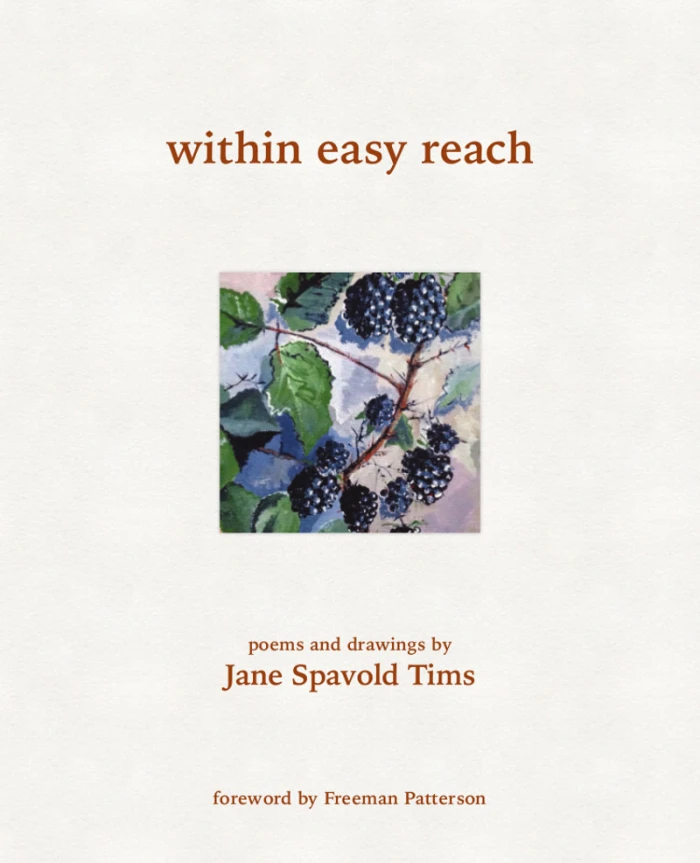
As of this morning, I have left a copy of my poetry book ‘within easy reach’ at two of these tiny libraries, one in Sunshine Gardens and one on University Avenue. If you want to go on a treasure hunt and borrow a book, make sure to take a book with you to trade! Happy reading!
~
~
Copyright 2016 Jane Tims
on my book shelf – New Brunswick’s Covered Bridges
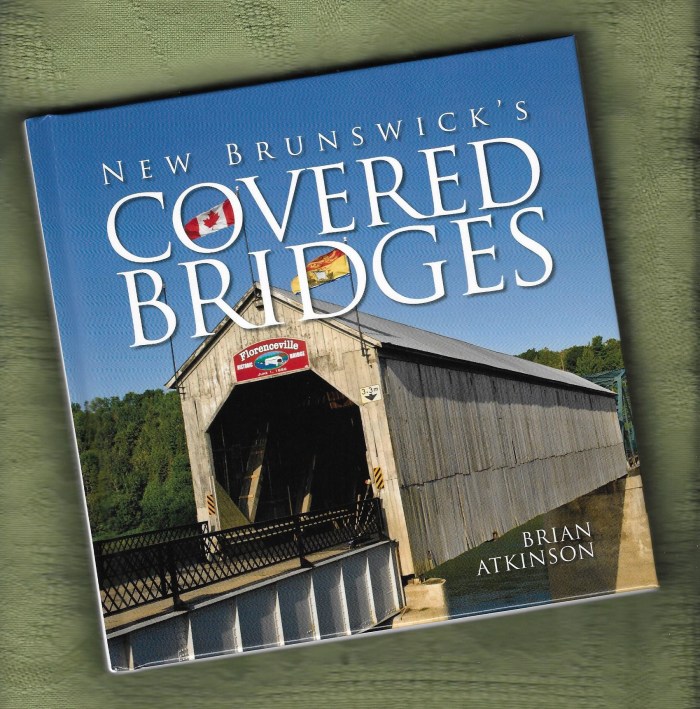
As part of my project ‘in the shelter of the covered bridge’ I have collected books about covered bridges in New Brunswick. One of my favourites is a small book of photos of the 62 covered bridges existing in 2010: Brian Atkinson. New Brunswick’s Covered Bridges. Nimbus Publishing: Halifax. 2010.
~
~
New Brunswick’s Covered Bridges is a compact hardcover, small enough to take along on an adventure spent visiting our covered bridges. The bridges are arranged by County and easily found in an index. Directions to each bridge are provided. Some of the entries include anecdotes about the bridge and all list the year the bridge was built.
–
The best elements of the book are Brian’s photographs. They are clear and set each bridge in its surroundings. Some are taken from unusual angles, either from an upstream or downstream vantage point. One is taken beneath the bridge! Although some offer enticing glimpses through the bridge’s entrance, none show the inside of the bridge.
~
Brian’s book includes an introduction outlining the history of New Brunswick’s covered bridges. He includes information on the construction of the bridges and the origin of the signage advising folks to ‘Walk Your Horse and Save A Fine’!
~
Included in the book is a preface which points out how many of our bridges are in out-of-the-way places … many New Brunswickers have never seen the most quaint and lovely of our bridges. As Brian says of one of the bridges: ‘… as pretty a spot as you can find for letting an afternoon slip by …’.
–
As the book tells us, in 1900 there were 4000 covered bridges in New Brunswick, in 1944, 320 and in 2010, only 62. Today, as a result of flood and fire, only 60 remain. My advice – take Brian’s book and head out for an expedition to make your own discoveries about this wonderful part of our built history.
~
New Brunswick’s Covered Bridges is available through Westminster Books in Fredericton, your own local bookstore, or Nimbus Publishing
https://www.nimbus.ca/?s=New+Brunswick%27s+covered+bridges
~
Copyright Jane Tims 2016
on my book shelf – Triggerfish, a crime novel
‘… he had fifty feet under the hull. The carcass of a rowboat against the shore, cedar, pine and rock rimming the cove, no cottages out here … Switching to the trolling motor, Beck eased around the bend in the cove …’ (Triggerfish).
Around that bend in the cove, Beck meets his share of trouble. I usually think of crime novels as an easy read. Triggerfish challenges that notion. The characters are many and, to me, a bit hard to follow – there doesn’t seem to be a good guy among them. The action is non-stop giving the reader few chances to relax! And what, oh what is going to happen to Eddie???
~

~
Dietrich Kalteis, Triggerfish – a crime novel. ECW Press, Toronto: 2016. Published June 1, 2016.
~
This review is done as a result of my role as Shelf Monkey for ECW Press http://ecwpress.com/pages/shelf-monkey.
~
Not usually in the genre I read, Triggerfish was nevertheless entertaining. The main character, Rene Beckman, ‘Beck’, is an ex-cop, hard-hitting and resourceful. He is trying to stay out of trouble but accidentally views a murder and some ruthless drug runners in action. And the bad guys won’t look the other way.
The action takes place in the Vancouver area and so scenes feel, to me, Canadian, familiar. Description is gritty, but evocative: ‘Crunching on dead leaves, wet ferns slapping against him, he ducked under pine boughs … a dry creek bed. A crest beyond it. Moss, ferns and rock … ‘. Some of the action occurs on Beck’s boat, the thirty-two foot Triggerfish.
The book is the classic example of shortening sentences to move the action along. This, and the frequent inclusion of gerunds to provide an odd combination of past and present tense, mean the book is sometimes hard to read. I’m not certain I ever got used to phrases like: ‘ … Ramon and Eddie walked in from the dining room side, both stopping at the fireplace, Eddie looking like he wanted to turn and run, Ramon nudging him forward…’ Or ‘… He told her, and she said, ”Nice meeting you, Marty Schmidt.” The second shot spoiling his looks.’
The characters are diverse and multi-dimensional: Vicki, environmentalist and play girl; Ashika, skilled and patient terrorist with a sense of humour; and Hattie, mature girl next door. I liked one of the bad guys the best – poor Eddie, trying to outsmart the cruel bosses by stealing their dope, cooperating with Beck.
Ironic humour abounds – from the description of the vegan protest, with protesters wearing body paint diagramming cuts of meat, to Beck’s attempt to rescue a drowning Ashika. Ashika, hearing a rooster crow for the first time, almost blows it off the fence.
It took me a long time to finish this book, partly because of the sentence structure, but mostly because of my lack of familiarity with the genre. In the end the plot was satisfying and no loose ends were left dangling. I just may read it again.
~
~
Copyright 2015 Jane Tims
‘within easy reach’
This spring, I will celebrate the publication of my first book of poetry!
~
‘within easy reach’ is a result of my 2012 project ‘growing and gathering’ supported by artsnb (the New Brunswick Arts Board). The poems focus on harvesting and eating local foods, especially wild foods. My book will be published by Chapel Street Editions, Woodstock, New Brunswick.
~
The book will include about sixty poems as well as some of my black and white pencil drawings. These are poems about picking blackberries and blueberries, eating coastal favorites like goose tongue greens and samphire, buying smelts from a truck at the roadside and fishing for landlocked salmon. Every poem is based on a personal experience of harvesting and using local foods.
~
During the next few posts, I will tell you more about my book and its poems and drawings. I can’t wait to show it to you!
~

‘fiddleheads’ – a wild food eaten every spring in New Brunswick
~
Copyright 2016 Jane Tims
Born to Walk – a book review
‘… Marooned at my desk, I swiveled round and round, drowning in digital static …‘ (page XIII).
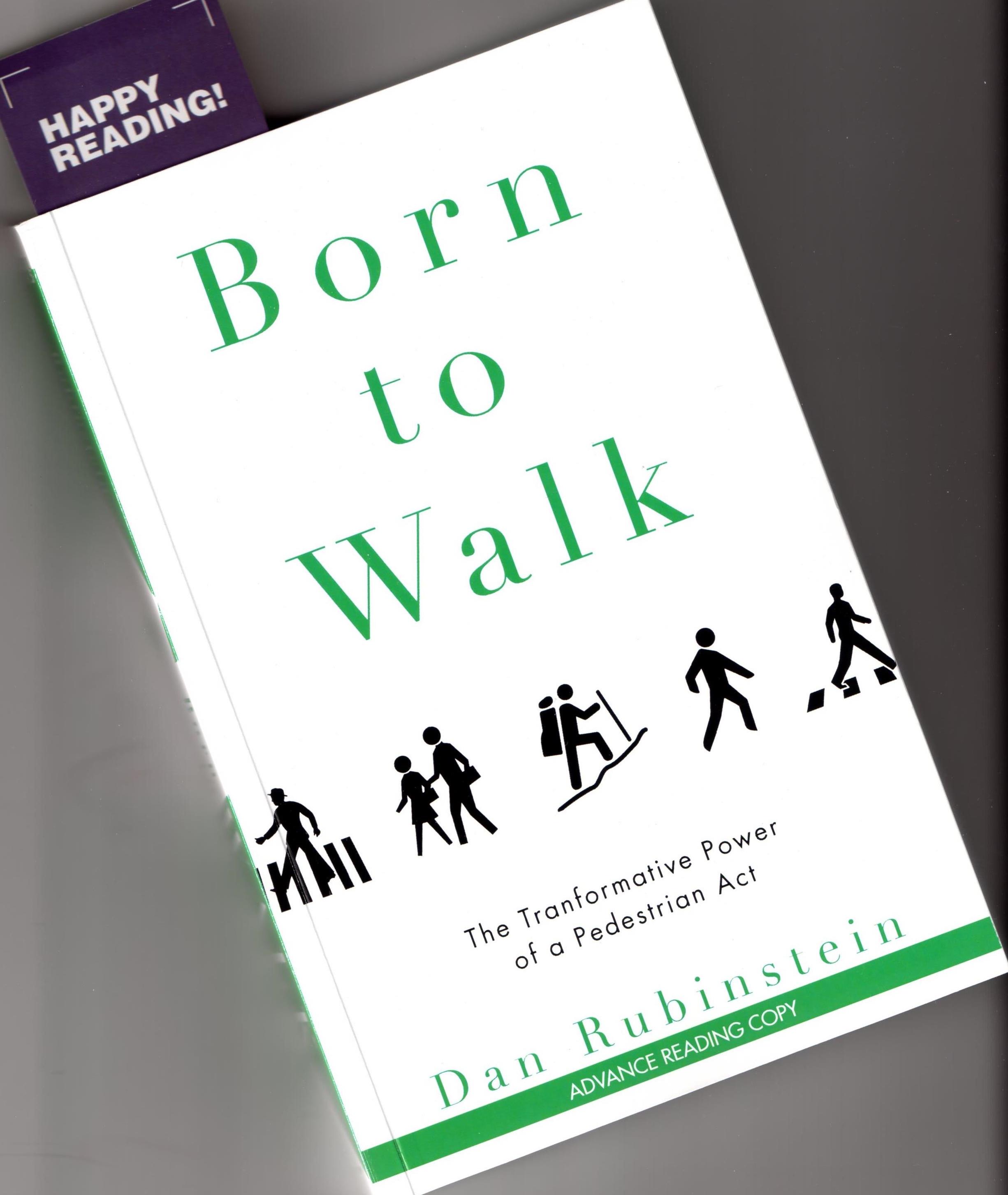
So many of us can relate in a personal way to Dan Rubenstein’s description of his work life in the field of journalism. When he talks about managing his stress by checking emails every few minutes, I can say, I’ve been there! Dan’s book, Born to Walk, shows us a way to change our lives in a very simple way … just walk!
~
~
Born to Walk – The Transformative Power of a Pedestrian Act (Dan Rubinstein, 2015, ecw press, Toronto) is a book of non-fiction with a strong narrative component. It could be described as a self-help book of the environmental kind. Born to Walk describes the health benefits of walking, fitting this into the context of what it is to be human in the natural world. This book would be interesting for those who walk already and those who are thinking about taking up or accelerating a walking program. As I was reading, I often wanted to quit reading and start (you guessed it) walking.
~
In a discussion of the benefits and pleasures of walking, Dan considers walking a key life strategy. He tells the tales of people who feel compelled to walk or who walk for a living. Dan’s credentials for writing this book become more obvious as we read – the writer has learned through doing. Over the course of the book, we learn about his interviews with some of the most outstanding walkers in the world – interviews conducted while on foot and on the trail! The walkers he tells us about include a postal ‘delivery agent’ in Ottawa, a police officer walking the beat in Philadelphia, a photographer in New York City, and a medical doctor walking between Native communities in eastern Canada.
~
The book considers, chapter by chapter, specific topics about walking: the effects of walking on the body and mind; how society can benefit from pedestrian ways; the economic and political connections of walking; and the influences of walking on creativity, spirituality and family life.
~
My interest in the book sparked when I read the sub-title – ‘The Transformative Power of a Pedestrian Act’. My struggle with arthritis and the inactivity that accompanies mobility problems, has convinced me that activity and walking should have been a focus of my life, especially in my thirties and forties when I started sitting more than walking. The book points out that isolation and sitting are the new smoking.
~
In opposition to the ‘sitting disease’, Born to Walk explores the benefits walking can deliver. Dan describes the positive effects of being in nature. Sneakers, he says, are as important as medications in dealing with our many health issues. With careful consideration of the sage advice of the walkers of our time, backed up by health statistics and epidemiological studies, Dan explains how walking can improve our sense of ‘personal mastery’ and ‘self-regard’. I was intrigued by his descriptions of the experiences of those who are serious walkers – for example, the ‘green blur’ overtaking those who have been on a difficult trail for days.
~
As a planner, I was most interested in Dan’s insightful ideas about planning for a ‘walkable city’. He describes new approaches to creating urban areas where cars and people can coexist in safety. Some of the ideas he explores include development of road-skinny cities, the benefits of ‘walking meetings’, and the possibility of finding tranquil urban spaces to make up for our lack of being in more natural locations.
~
Reading this book was a pleasure. The narrative lines are engaging, the stories are often funny and Dan’s style is sensitive and not at all condescending. He writes with the conviction and knowledge of one who practices what he advocates. My favourite chapter of the book was definitely ‘Creativity’. As a writer, I have often noticed that the rhythms of walking inspire both the metre and cadence of poetry. Born to Walk describes ‘participatory art walks’ in Brooklyn and the ephemeral art of an ‘X’ walked into a field of daisies. ‘People get ideas when they are out walking’ (page 190).
~
My only problem with the book is related to the way I personally prefer to read. I found the chapters long (eight chapters plus prologue and epilogue for a book of 251 pages with about 300 words per page). I tend to read in chunks and consider it a smooth read if I can take in a full chapter at a sitting.
~
As a person with mobility problems, I applied much of what Dan said to my preferred mode of exercise (the stationary bike). While the stationary bike gives me some of the physical benefits of walking out-of-doors, I realise I am missing out on other benefits. For this reason, I am motivated to walk to the extent of my ability. One truth I read in the book is the idea of embracing and putting up with some pain as long as I am not doing damage to my joints.
~
Born to Walk – The Transformative Power of a Pedestrian Act is a thought-provoking, walk-inspiring book. I am eager to read other books by Dan Rubenstein!
Dan has an interesting blog describing some of his adventures leading to the writing of Born to Walk ( http://borntowalk.org/ ).
~
~
Copyright 2015 Jane Tims




 nichepoetryandprose