Archive for June 2012
Common Plantain (Plantago major L.)
When we were children, we often pretended to be storekeepers and picked various wild plants as the ‘food’ for sale. We collected weed seeds for our ‘wheat’, clover-heads as ‘ice-cream’, vetch seed pods as ‘peas’, and (gasp) Common Nightshade berries as ‘tomatoes’.
This is probably a good place to urge you to teach your children – everything that looks like a vegetable or fruit may not be good for them to eat! I don’t remember ever trying any of our pretend ‘groceries’, but some of them, such as the Common Nightshade berries, were poisonous and harmful.

berries of Common Nightshade are poisonous… later in the season, they are red and quite beautiful… children should be warned that all red berries are NOT good to eat
We also ‘sold’ the leaves of Common Plantain at our ‘store’. They looked like spinach, and the Plantain leaves would have actually been fine for us to eat.
Common Plantain (Plantago major L.) is a very easily found weed since it grows almost everywhere, especially along roadsides, in dooryards and in other waste places. Plantain is also known as Ribwort, Broad-leaved Plantain, Whiteman’s Foot, or, in French, queue de rat. The generic name comes from the Latin word planta meaning ‘foot’. Major means ‘larger’.
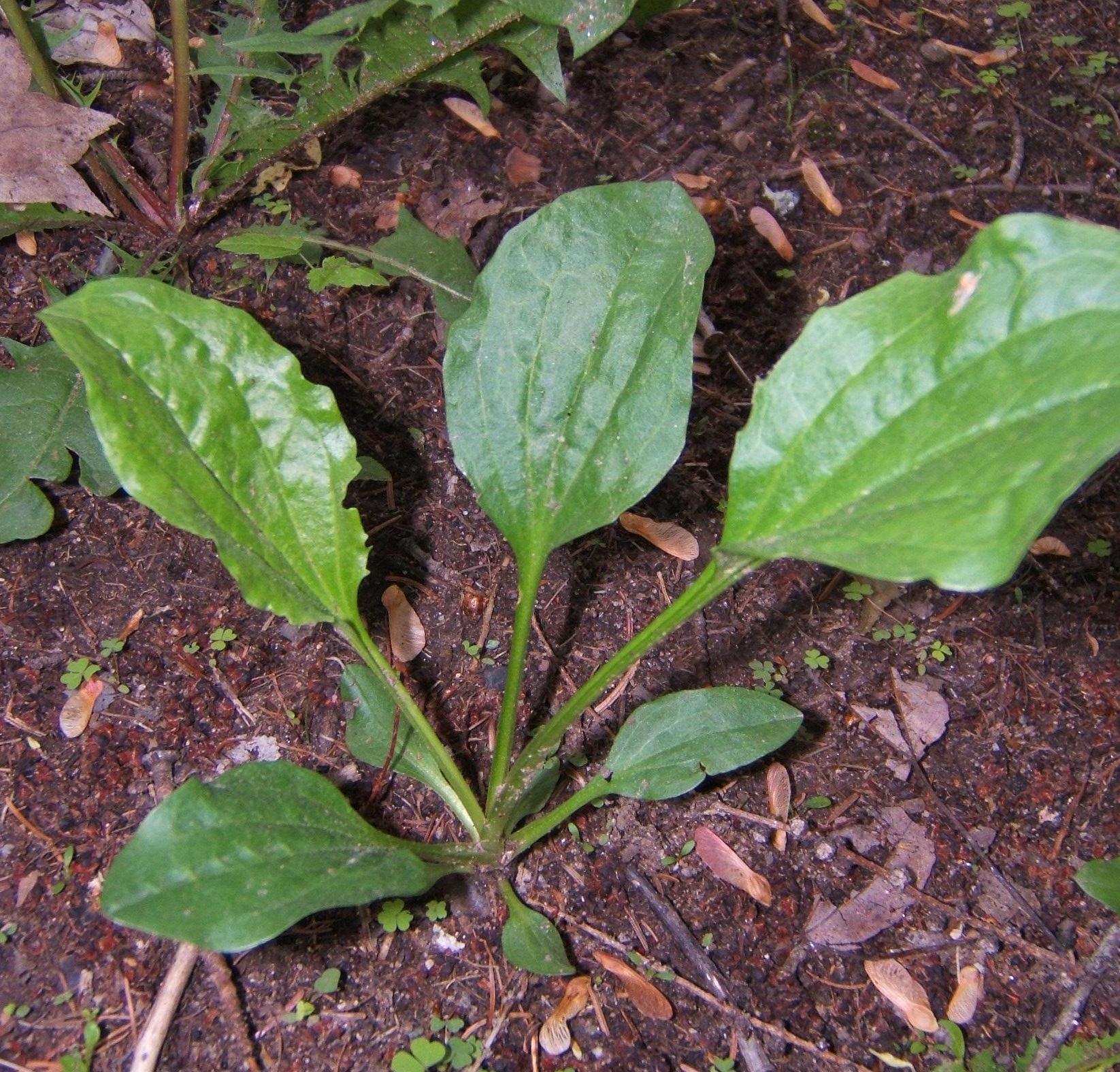
Plantain has thick, dark green, oval leaves. These grow near the ground in a basal rosette. The stems of the leaves are long and trough-like. The leaves themselves are variously hairy and feel rough to the touch. The leaf has large, prominent veins, and, as the plant grows older, these veins become very stringy. The veins resist the breakage of the leaf and stick out from the stem end of a harvested leaf like the strings of celery.
Flowers of Plantain grow in a dense spike on a long, slender stalk rising from the leaves. The flowers are small and greenish-white, appearing from June to August.
The young leaves of Common Plantain can be used in a salad or cooked and seasoned with salt and butter. The older leaves become tough and stringy.
Warning: 1. never eat any plant if you are not absolutely certain of the identification; 2. never eat any plant if you have personal sensitivities, including allergies, to certain plants or their derivatives; 3. never eat any plant unless you have checked several sources to verify the edibility of the plant.
leaves of Common Plantain and Dandelion, picked from our dooryard, not yet washed or looked over for insects… note the strings protruding from the stem ends
Yesterday, I gathered the youngest leaves of plantain I could find and cooked them for my lunch. They might be fine in times of need, but I found the cooked product to be just like eating soggy cardboard.

I should say, since I have begun my almost daily tests of edible wild plants, my husband asks me almost hourly how I am feeling.
~
~
wisdom
~
plantain, past the picking –
a pulled leaf resists,
tethered to a thread
~
~
© Jane Tims 2012
Warning: 1. never eat any plant if you are not absolutely certain of the identification; 2. never eat any plant if you have personal sensitivities, including allergies, to certain plants or their derivatives; 3. never eat any plant unless you have checked several sources to verify the edibility of the plant.Wild Strawberry (Fragaria virginiana Duchesne)
Soon, the fields at our summer place will be jeweled with Wild Strawberries.
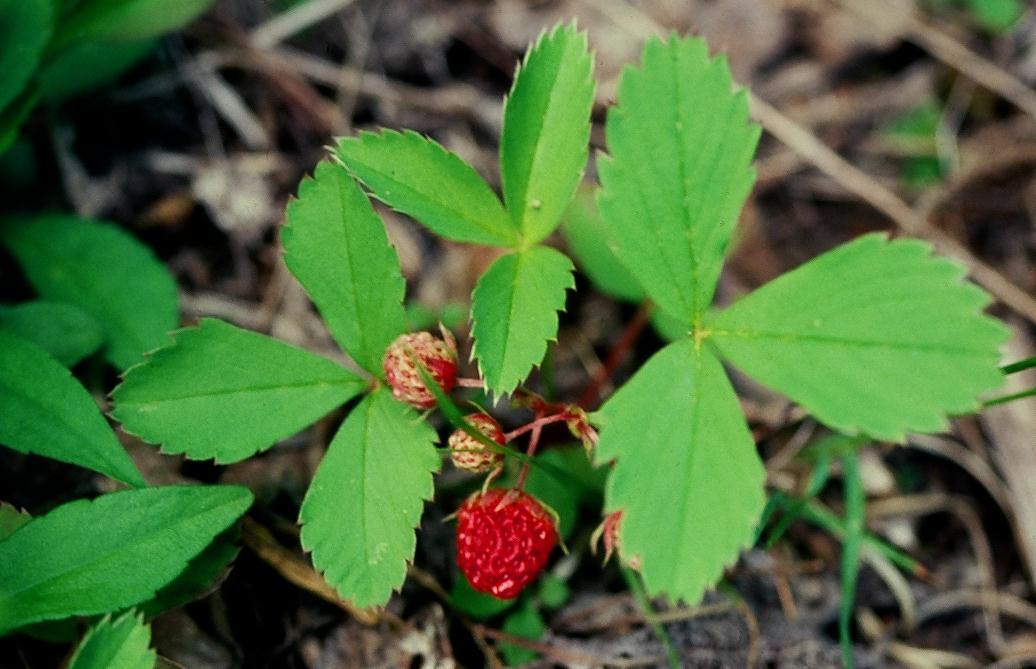
Wild Strawberry (Fragaria virginiana Duchesne) grows in open woodlands, fields and barrens. It is also known as Virginia Strawberry, Common Strawberry and, in French, fraisier. The name Fragaria comes from the Latin word for strawberry, fraga meaning fragrance.
The leaves of Wild Strawberry grow on slender stalks, and occur in threes. They are hairy and coarsely toothed. Plants are stoloniferous, meaning they produce ‘stolons’ or runners, freely-rooting basal branches.
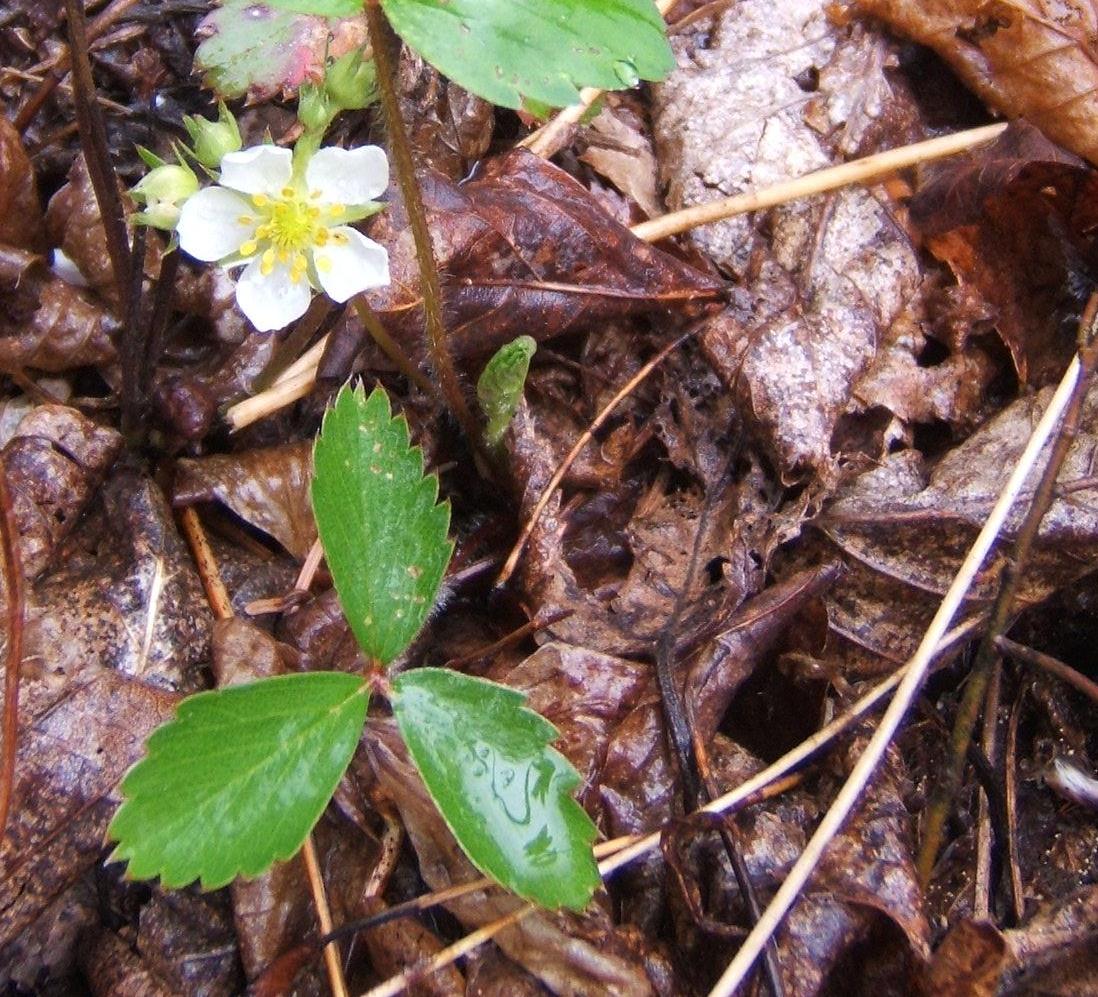
The flower of the Wild Strawberry is white, with five petals and numerous stamens and pistils. Right now, our fields are spangled with them. The flowers occur in an open cluster of two or more flowers. In this species, the flower stalk is not longer than the leaf stalk.
The berries are red and ovoid, covered with small pits and seeds. They are more delicate and sweeter than the domestic strawberry. They appear in late June and may last until August, but the best berry-picking is at the first of summer.
In the book ‘The Blue Castle’ by Lucy Maude Montgomery, the heroine says one of her greatest pleasures is to eat berries directly from the stem:
Here they found berries … hanging like rubies to long, rosy stalks. They lifted them by the stalk and ate them from it, uncrushed and virgin, tasting each berry by itself with all its wild fragrance ensphered therein. When Valancy carried any of these berries home that elusive essence escaped and they became nothing more than the common berries of the market-place–very kitchenly good indeed, but not as they would have been, eaten in their birch dell …
(from L.M. Montgomery, The Blue Castle, Chapter 30, McClelland and Stewart Limited, 1972)
~
The berries of the Wild Strawberry are delicious in jam. The leaves also make a fragrant tea, high in Vitamin C. To make the tea, put a handful of green leaves into two cups of boiling water, steep, strain and enjoy!
~
~
too early to pick
~
last week of June
roadside red with leaves
and ripening wild
strawberries hang
still green except
where sepal contrast
shows sweet berry
~
patience, wait
a few days and every berry
ripe and a thimble pot
of berry jam
~
can’t wait?
sour green flesh
grit of tiny seed
~
~
Copyright Jane Tims 2012

a moment of beautiful – a button of moss
the space: at ground level, in the grey woods
the beautiful: a little button of moss, emerald green
~
Mosses are a beautiful, enigmatic group of plants. Except for a few well-known species, they simply grow unnamed and unnoticed by most people. The beauty of the mosses, especially under the stereo-microscope, where you can see so much detail, was what attracted me to the study of botany in the first place.
We have many species of moss in our Grey Woods. I long to be able to take the time to identify every one. For now, though, I content myself with a few common names and some of my own ‘made-up’ names.
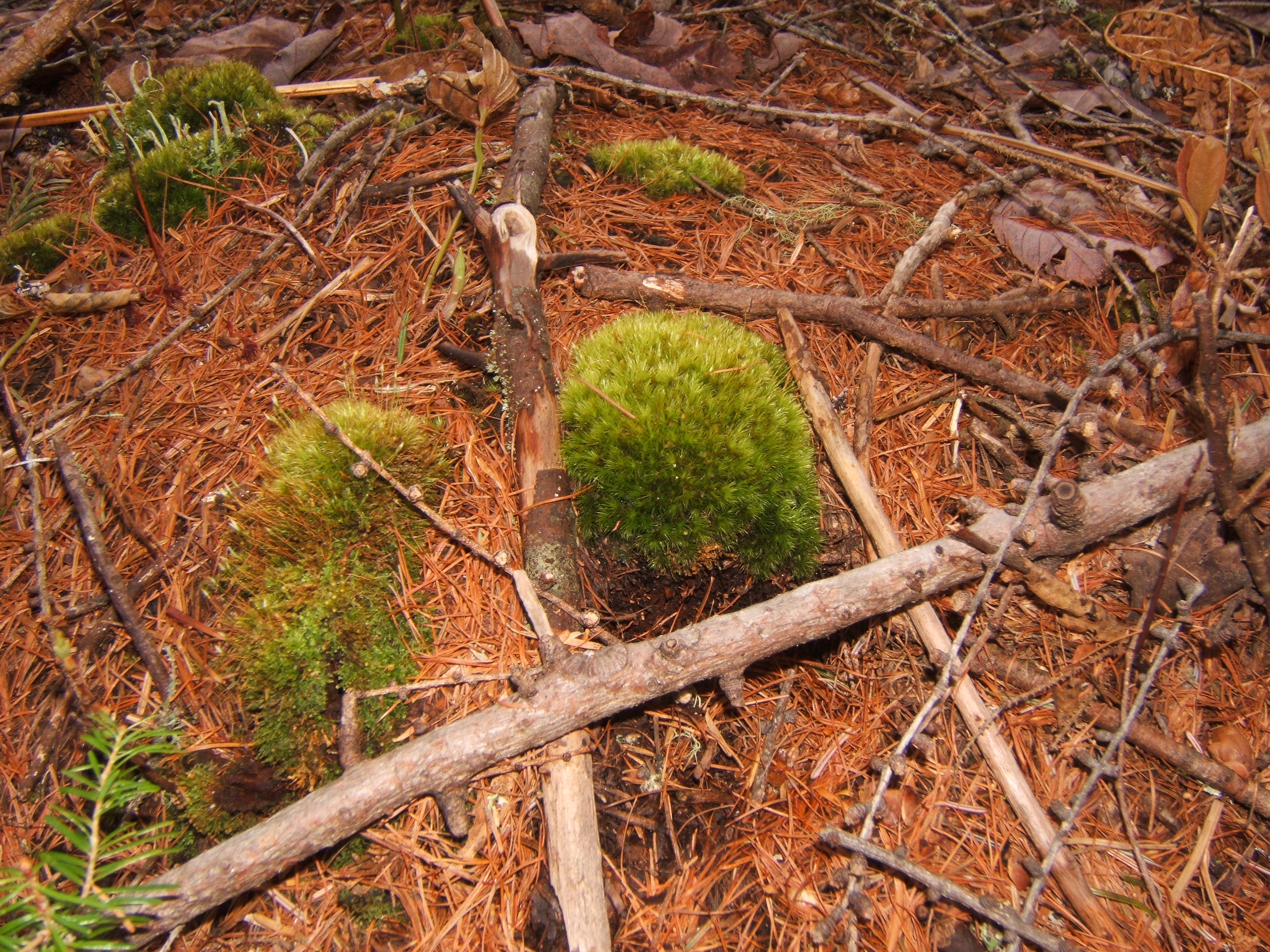
I call this little moss ‘The Button’. Wherever I find it, it seems to grow in a little cushion. Its surface is like velvet and its color is a lovely shade of lime green.
~
~
a button to press
~
resist the urge
to depress this plump of moss
firmly with a finger
~
will take you up
to the first floor
where the bunchberry blooms
or the second where bracken
planks an ephemeral floor
or the 67th where leaves align
precisely with sun
~
or down
to where the roots criss-cross
in confused abandon
~
~
© Jane Tims 2012
Sheep Sorrel (Rumex Acetosella L.)
At this time of year, some of the fallow fields adjacent to our Federal-Provincial Agricultural ‘Farm’ in Fredericton are shadowed with bright red. Closer inspection shows these fields are filled with Sheep Sorrel, in scarlet bloom.

The common Sheep Sorrel (Rumex Acetocella L.) is a small, slender plant, less than a foot high, with distinctive leaves shaped a little like an arrowhead or halberd. The lobes at the base of each ‘arrowhead’ leaf point backwards, a shape described in botany as ‘hastate’.
Sheep Sorrel is considered a weed, growing along roadways and in fields. It prefers acidic, ‘sour’ soils and is considered an indicator of these soils.
Sheep Sorrel (Rumex Acetosella ) is also known as Common Sorrel, Field Sorrel, Red Sorrel, and Sour Weed. In French it is called surette or oseille. The old generic name Acetosella means ‘little sorrel’. Sheep Sorrel is from the Buckweat Family of plants.

The flowers of Sheep Sorrel are small, distributed in an open cluster along the stem. The female flowers are maroon and the male flowers are brownish-green.
The leaves of Sheep Sorrel are well-known as an edible plant. They have a pleasantly tart, sour flavour and make a good nibble, an iced tea, or an addition to a salad. They can also be used as a pot-herb – when cooked they reduce in size like spinach, and they lose the acid taste. The Sheep Sorrel plant has a chemical called oxalate so cannot be consumed in large quantities. Long-term consumption can affect calcium absorption in the body. As always, please be sure of your identification before you consume any wild plant.
Warning: 1. never eat any plant if you are not absolutely certain of the identification; 2. never eat any plant if you have personal sensitivities, including allergies, to certain plants or their derivatives; 3. never eat any plant unless you have checked several sources to verify the edibility of the plant.~
~
red field
~
walk in the field with the scarlet flowers
arrowheads and halberds surely leave
a sour taste on the tongue
titration with alkaline needed
to sweeten the ground, dilute the red
return the soil
to more productive ways
~
~
© Jane Tims 2012

a view of a Black Bear
One of the experiences of the past two weeks was the sighting of a young Black Bear (Ursus americanus) along the Plaster Rock – Renous Highway. The Black Bear was only a youngster, probably a two-year-old born last January or February (2011). He watched us a long time from the woods, appearing a little confused. Eventually, he wandered away. He was probably rejoining his mama – Black Bears stay with their mothers until they are 16 or 17 months old.

I have seen/smelled a few bears in my life:
§ Once, on a fishing trip with my Uncle, he told me to stop and sniff the air. The smell was fetid, unforgettable. He told me you often smell a bear but almost never see one.
§ When we first built our house, our young neighbor was riding his bike up our gravel heap and encountered a bear coming up the other side of the pile!

§ When we first lived in our community, we had a garbage dump. We used to go to the dump on the weekend and join the other cars, watching the bears work their way through the garbage. I remember one was inside an old refrigerator, opening and closing the door!

§ On a work excursion to Mount Carleton, we saw a bear running up the road ahead of us, but it disappeared before we could get close.
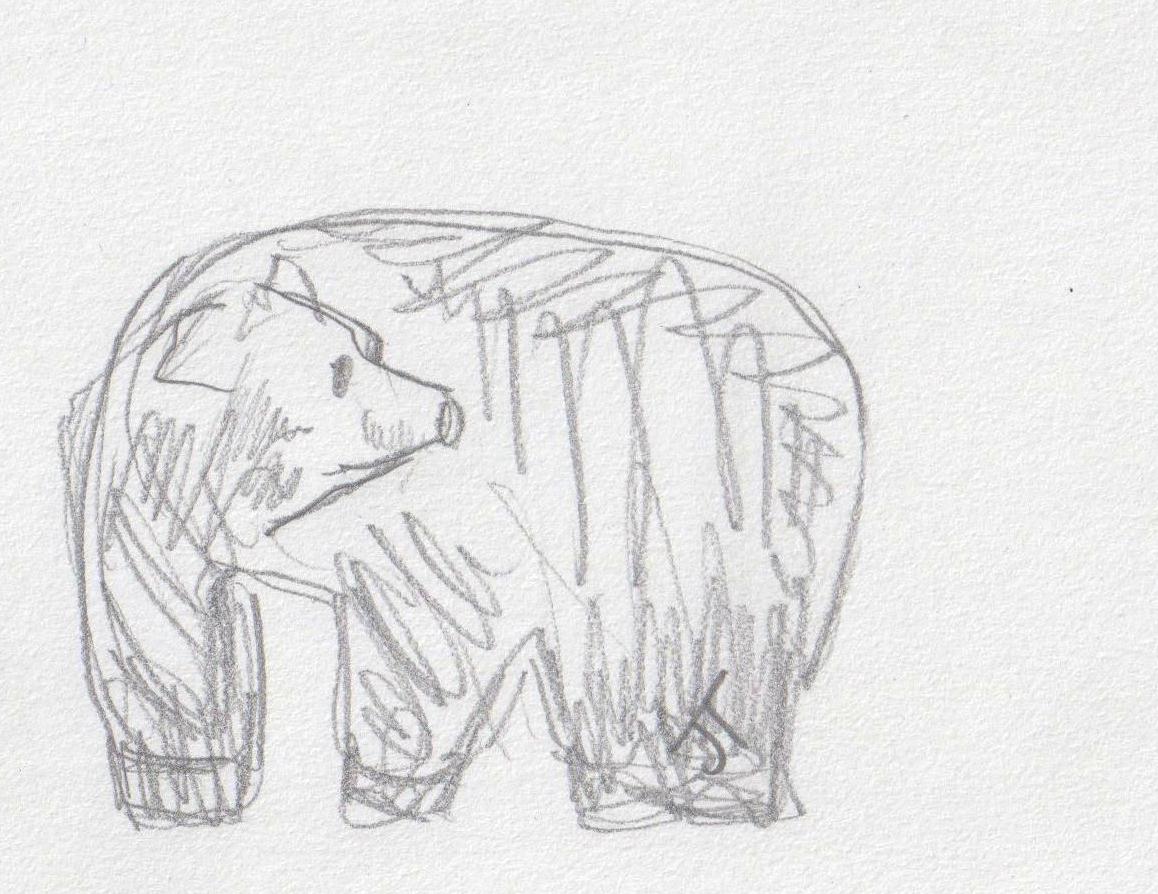
§ Once, on the Salmon River Road, on a drive to Bouctouche with my sister-in-law and niece and nephew, we saw a full-grown bear, on a run from one side of the road to the other. He had very long legs and ran by stretching his front legs out and bringing his rear legs up between them. He only hit the pavement twice, once with each set of feet!
§ On our trip through the Rocky Mountains, I saw a bear, species unknown, in a steep ditch beside the roadway.
Have you ever seen a bear???
~
© Jane Tims 2012
keeping watch for dragons #6 – Water Dragon
The last full week in May, we took a day to drive the Plaster Rock-Renous Highway. This is an isolated, but paved, stretch of road, called Highway 108, connecting the sides of the province through a large, unpopulated area. The highway runs from Plaster Rock in the west, to Renous in the east and traverses three counties, Victoria, York and Northumberland. It takes you across more than 200 km of wetland, hardwood, and mixed coniferous forest, some privately owned, and some Crown Land. A large part of the area has been clearcut, but the road also passes through some wilderness of the Plaster Rock-Renous Wildlife Management Area and the headwaters of some of our most beautiful rivers.
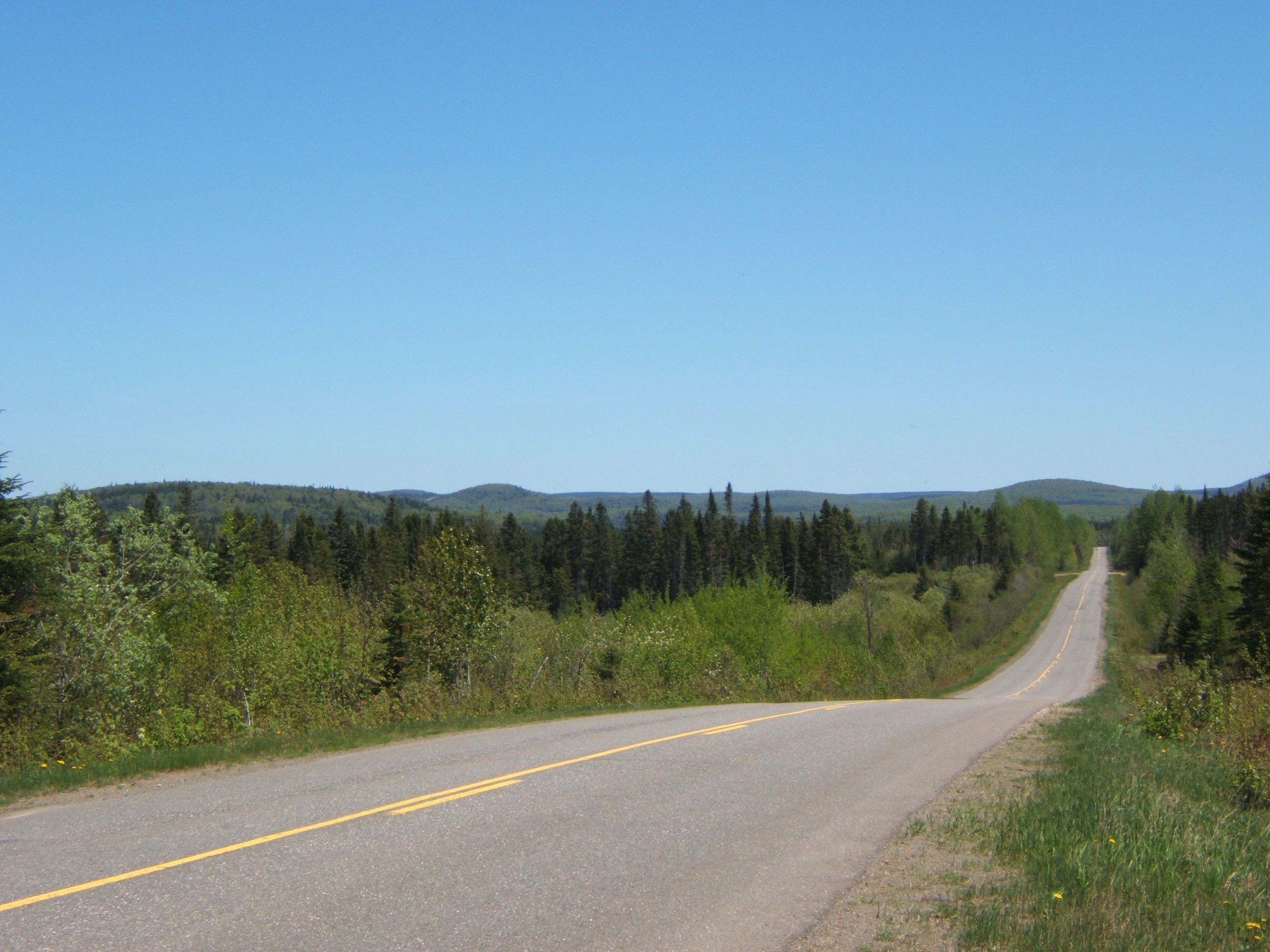
From the east, the highway first runs along the waters of the Tobique River, across the Divide Mountains, and into the drainage of the Miramichi River, crossing the Clearwater Brook, and running along the South Branch of the Dungarvon River and the South Branch Renous River.
Along the way, we stopped at a boggy pond next to the road between Clearwater Brook and the Dungarvon, to listen to the bull frogs croaking. There among the ericaceous vegetation filling most of the pond was a dragon for my collection.


look closely near the center of the photo… the single white spot is the spathe of a Wild Calla or Water Dragon
Water Dragon, more commonly known as Wild Calla or Water Arum, was present in the shallow, more open waters of the pond, appearing as startling white spots on an otherwise uniform backdrop of green and brown.
Wild Calla (Calla palustis L.) is also known as Female Dragons, Frog-cups, Swamp-Robin and, in French, calla des marais, arum d’eau, or aroïde d’eau. It lives in wet, cold bogs, or along the margins of ponds, lakes and streams.
The Wild Calla belongs to the Arum family, along with Jack-in-the-Pulpit (Arisaema Stewardsonii Britt.) and Skunk Cabbage (Symplocarpus foetidus (L.) Nutt.). These plants have tiny flowers along a thick spike known as a ‘spadix’. The spadix is enclosed by a leafy bract called the ‘spathe’. The spathe of Wild Calla is bright white, ovoid and abruptly narrow at the tip. The leaves are glossy green and heart-shaped. The flowers growing among them are often overlooked. On the pond, there were about ten visible spathes, and likely many more hidden among the plentiful leaves.
The various parts of the Wild Calla are considered poisonous since they contain crystals of calcium oxalate. These cause severe irritation of the mouth and throat if eaten. However, there is a twist to this story of a poisonous plant. Scandanavian people, in times of severe hardship, prepared flour for ‘Missen bread’ from the dried, ground, bruised, leached, and boiled seeds and roots of Wild Calla. Do I have to warn you not to try this at home!!!!????
Warning: 1. never eat any plant if you are not absolutely certain of the identification; 2. never eat any plant if you have personal sensitivities, including allergies, to certain plants or their derivatives; 3. never eat any plant unless you have checked several sources to verify the edibility of the plant.Linnaeus, the botanist who invented the binomial (Genus + Species) method of naming plants, described the laborious process the Swedish people used to remove the poisonous crystals from the Water Dragon in order to make flour. To read Linnaeus’ account, see Mrs. Campbell Overend, 1872, The Besieged City, and The Heroes of Sweden (William Oliphant and Co., Edinburgh), page 132 and notes (http://books.google.ca/books?id=IAsCAAAAQAAJ&pg=PA222&lpg=PA222&dq=missen+bread&source=bl&ots=ZO8cl_2nBl&sig=Gtr5Lq6PvG3DXV_l-kfECNuhWfo&hl=en&sa=X&ei=gGLFT-79B4OH6QG1m-nOCg&ved=0CC8Q6AEwAA#v=onepage&q=missen%20bread&f=false Accessed May 29, 2012).
~
~
~
desperate harvest
‘… they can be satisfied with bark-bread, or cakes made of the roots of water-dragon, which grows wild on the banks of the river…’
– Mrs Campbell Overend, 1872
~the pond beside the road
simmers, a kettle
of frog-croak and leather-leaf
~
spathes of Water Dragon
hug their lamposts, glow white
lure the desperate to the pond
~
bull-frog song deepens the shallows
the way voices lower when they speak
of trouble, of famine
~
people so hungry, harvest so poor
they wade in the mire
grind roots of Wild Calla for flour
~
needles to the tongue
burns to the throat
crystals of calcium oxalate, poison
~
worth the risk –
the drying,
the bruising,
the leaching,
the boil,
the painful test to know
if poison has been neutralized
~
the toughness of
the Missen bread
~
~
© Jane Tims 2012

wildflowers in the rich spring hardwoods
On our drive and hike along the South Branch Dunbar Stream, north of Fredericton, we encountered many spring wildflowers. The Trout Lily (Erythronium americana Ker) was everywhere, in extensive carpets, especially in hummocky areas (see my post for June 1, 2012). The delicate Wood Anemone was just beginning its bloom, also in dense carpets of feathery foliage. Other plants in these woods included the Purple Trillium and Green Hellebore.
The Wood Anemone (Anemone quinquefolia L.) is one of our less common plants. Its leaves are deeply toothed with 3 to 5 parts. The ‘flower’ is white and five-petalled, not really a flower at all, but the white sepals of the plant.
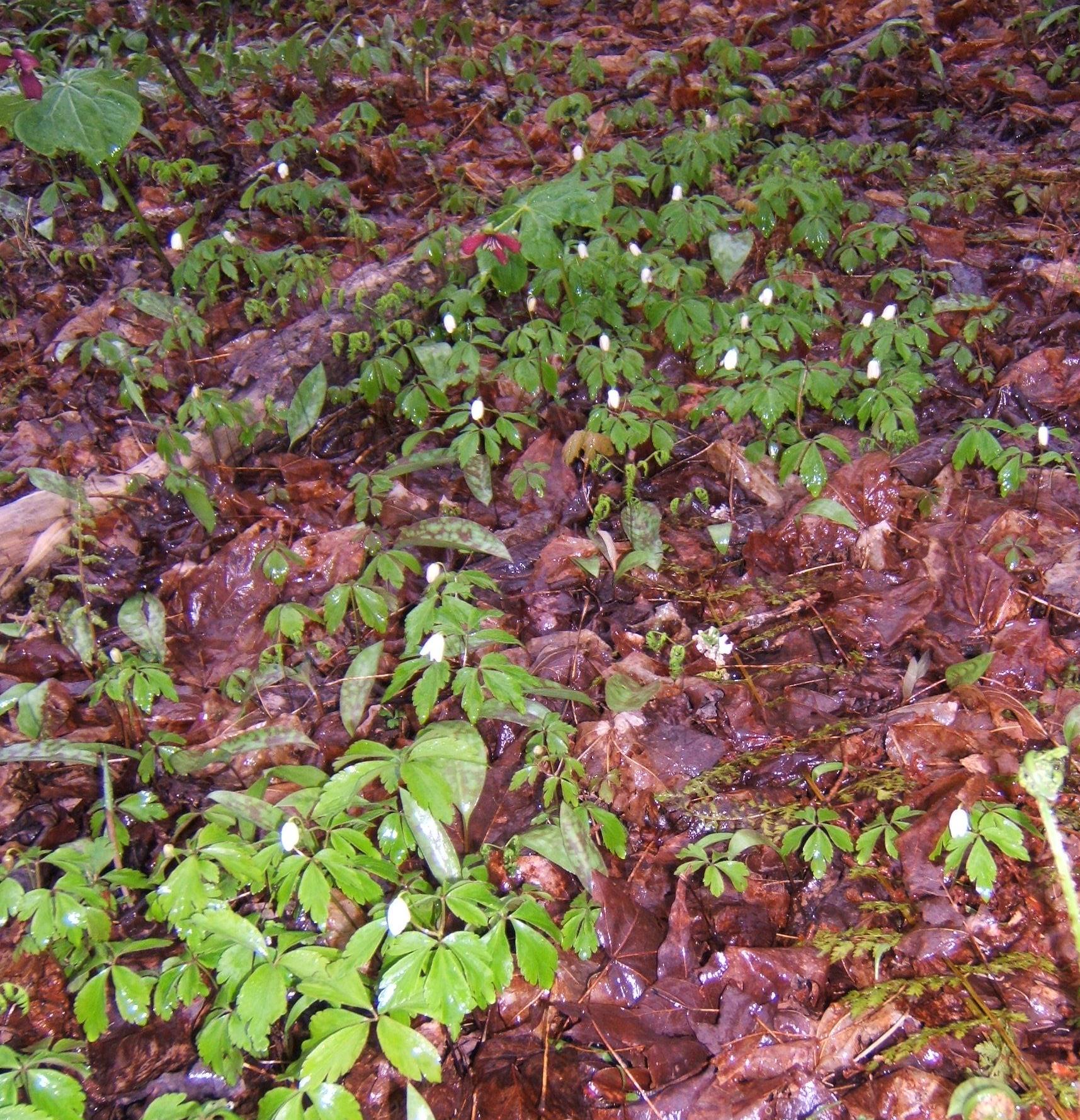
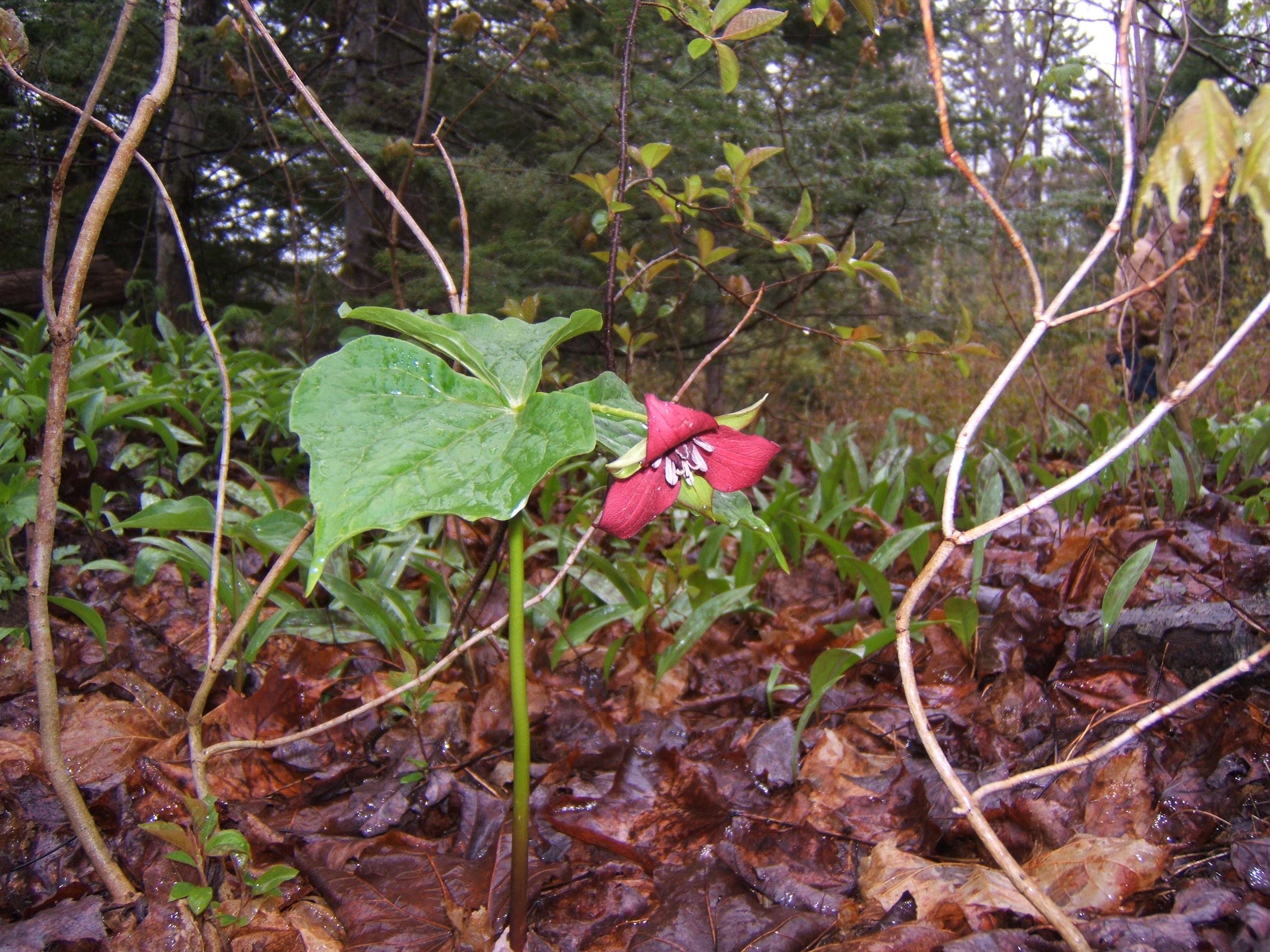
The Purple Trillium (Trillium erectum L.), also known as the Wakerobin, is a showy plant with the parts in three’s. The flower is maroon or purple, and, as in our case, may be nodding, in spite of the name (erectum meaning erect). The flower is known by its purple ovary (female part of the flower) and its nasty odor. You can eat the very young leaves of the Purple Trillium, but they are not usually in large abundance, so to protect the plants, I recommend just enjoying their bloom.
The light green leaves of Green or False Hellebore (Veratrum viride Ait.) were also conspicuous in the woods, I see them in woods along rivers all over our area. They are large plants, made up of heavily ribbed, pleated, clasping leaves. The leaves are parallel veined and do not smell like skunk, unlike the Skunk-Cabbage which has netted veins in the leaves and a skunky odor. Later, the Green Hellbore will have large clusters of yellow-green star-shaped flowers. This plant is poisonous.

We enjoyed our hike, and saw a beaver tending his dam and a narrow, raging waterfall pouring into the South Branch of the Dunbar, probably only a trickle in summer after the heavy spring rains are gone.

~

© Jane Tims 2012
Trout-lily (Erythronium americanum Ker)
Two weeks ago, we had a memorable drive and hike along the South Branch Dunbar Stream, north of Fredericton. The wet hardwoods along the intervale areas of the stream were green with understory plants and dotted with spring wildflowers. One of the plants growing there in profusion is the Trout Lily. The Trout Lily is colonial, covering slopes in rich, moist hardwoods. Its red and green mottled leaves grow thick on the hummocks, beside the Wood Anemone and Purple Trillium. The area where we were hiking was not far from the stream and there was evidence it had been flooded earlier in the year.
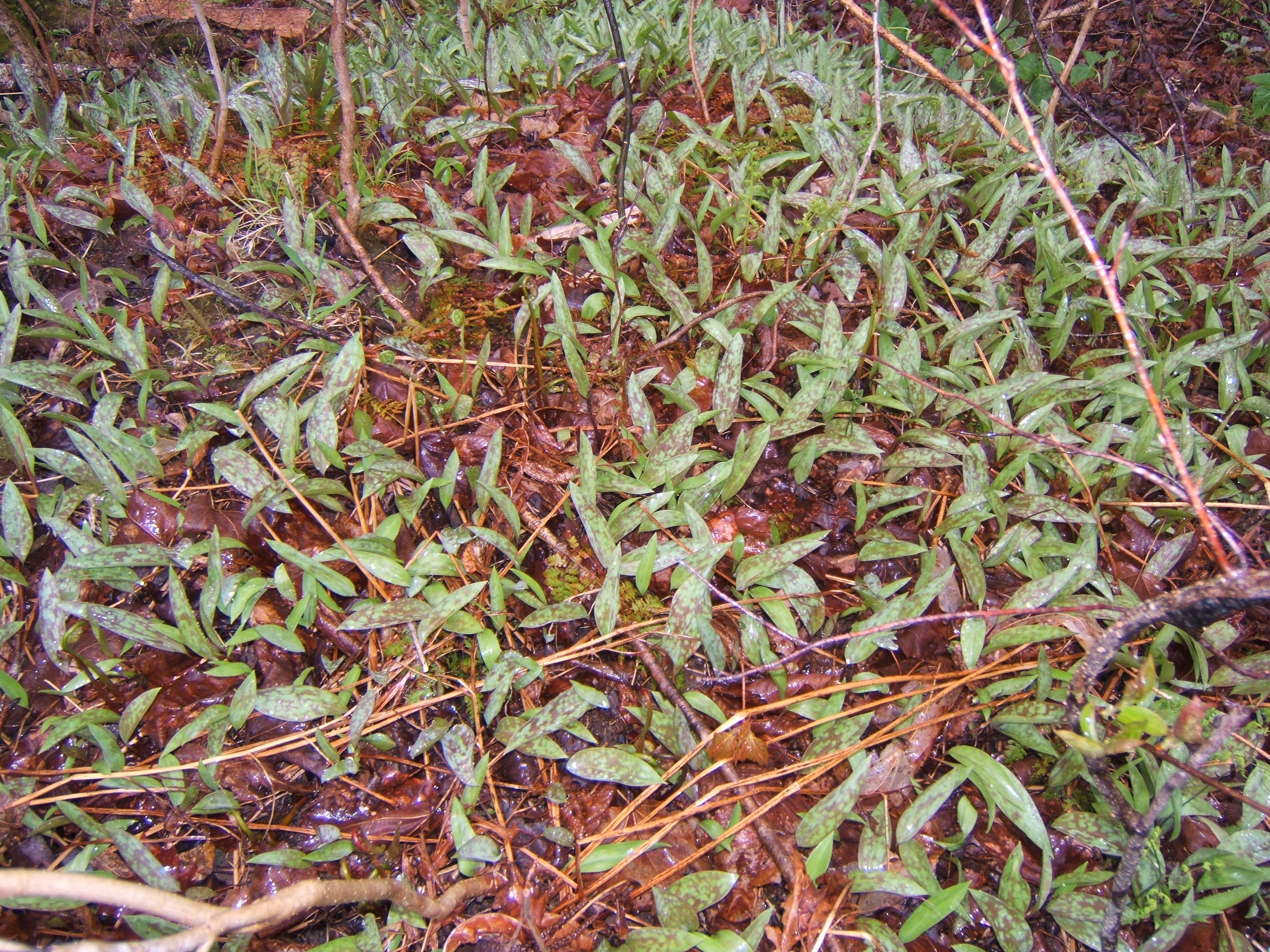
Trout Lily (Erythronium americanum Ker) is also known as the Dog’s Tooth Violet, Yellow Adder’s-tongue, Fawn-lily, and, in French, ail doux. Its generic name is from the Greek erythros meaning ‘red’, a reference to the purple-flowered European species.
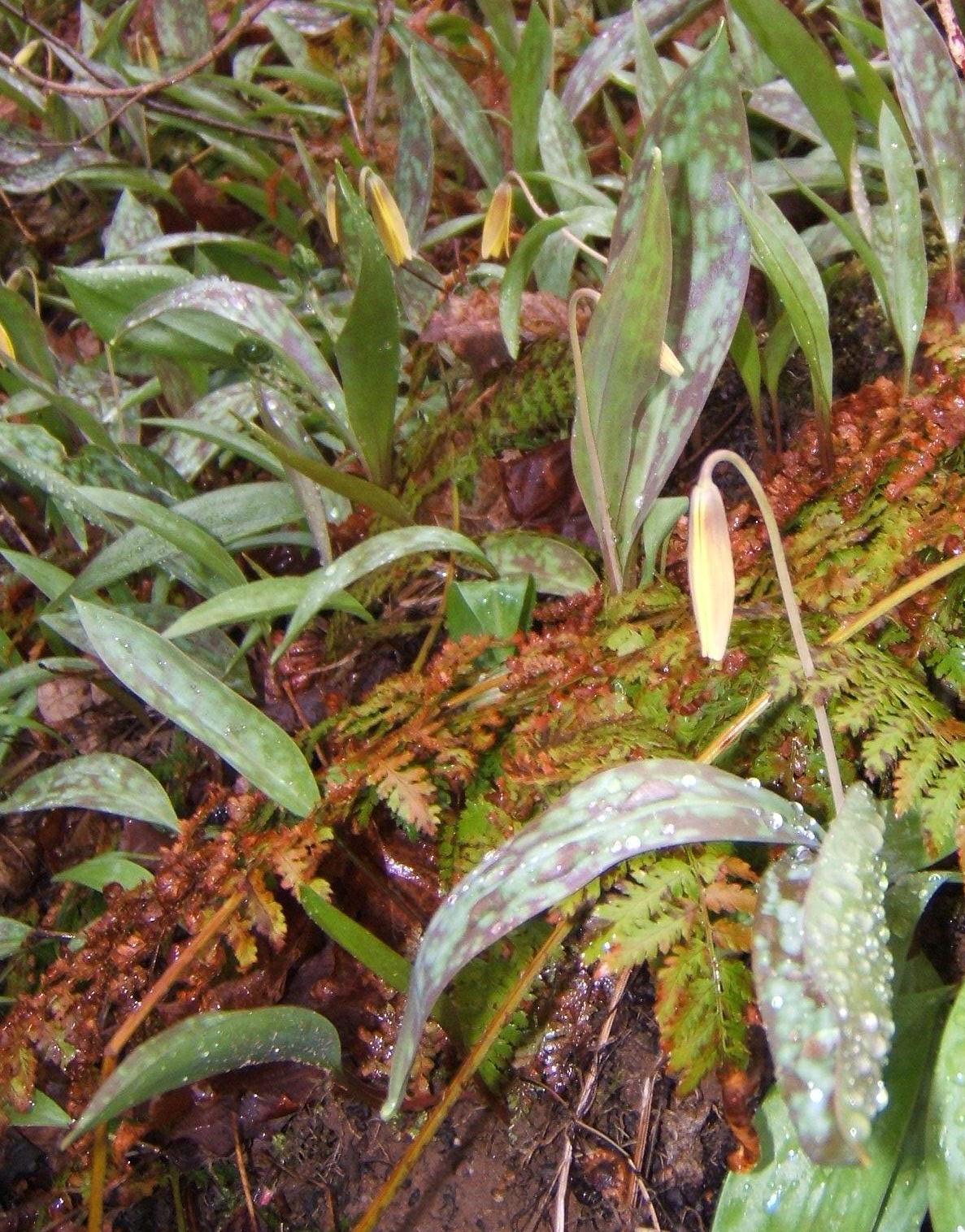
The Trout Lily was barely beginning its blooming when we were there, but it will be almost over by now. The flowers usually bloom from March to May. They are yellow and lily-like, with six divisions. The petals curve backward as they mature.

The young leaves are edible but should only be gathered if they are very abundant in order to conserve the species. To prepare the leaves for eating, clean them, boil them for 10 to 15 minutes and serve with vinegar. The bulb-like ‘corm’ is also edible; it should be cooked about 25 minutes and served with butter. Again, the bulbs should only be gathered if the plant is very plentiful, and only a small percentage of the plants should be harvested to enable the plant to thrive. Also, the usual warning applies, only harvest if you are absolutely certain of the identification.
~
~
Trout Lily
(Erythronium americanum Ker)
~
on a hike in the hardwood
north of the Dunbar Stream
you discover Trout Lily in profusion
mottled purple, overlapping
as the scales of adder, dinosaur or dragon
~
you know these plants as edible
the leaves a salad, or pot-herb
and, deep underground, the corm
flavoured like garlic
~
you fall to your knees
to dig, to gather
and hesitate,
examine your motives –
you, with two granola bars in your knapsack
and a bottle of water from Ontario
~
~
© Jane Tims 2012




 nichepoetryandprose