Posts Tagged ‘writing process’
the joy of writing
I have been absent from my blog for a week. Tied up in the sheer enjoyment of writing my fantasy tale.
~

an illustration of the interaction between the main character of my story and a Dock-winder alien
~
I have discovered that there are two main parts to writing: the writing itself and the ‘administration’. The administration includes the editing, the creation of other materials associated with the writing (for me, drawings, maps and covers), the search for publication, the preparatory work toward publication, and the marketing (readings, selling books, making sure the cat doesn’t destroy your boxes of books).
~
Although some of the administration is fun, it is the writing I love to do. This includes the research and the joy of creating the characters, the story, the plot, the various drafts.
~
This project has been particularly involving. Perhaps it is the creation of an entirely new world. Perhaps the freedom of building characters I have not known before. Perhaps the thrill of writing in a genre I have always enjoyed reading but felt hesitant to write.
~

the main character in the book – a practitioner of parkour and a woman who has hung on to hope in spite of adversity
~
My story is simple. It is about a young woman who wants freedom and sets out on a search for that freedom. The plot is a little more complicated. In her search she encounters a man who seems to share her purpose. Adventures and romance ensue.
~
So far I have
- the first in what I hope will be a series of three stories
- most of the first draft of the second story because it informs the first … in the writing of the second story I discover needed elements of the world I’ve created
- a cover design … one of the tasks ahead is to create a painting from my design
- a description of the planet Meniscus
- a map of the part of Meniscus in my story
- a glossary since some of the words in the story are unique to the created world – units of measurement, plants and animals, and so on
- a condensed guide to the main language used on the planet (everything in the text is translated but having a dictionary is just fun)
- drawings to illustrate some of the action in the story
~

a map to go with the story
~
My plans are to pull this all together and venture into the world of self-publishing. I have a friend who has lots of experience with Amazon publishing and is willing to share his ability.
~
I have also hired an editor to work with me on the project so my book will be the best it can be.
~

~
I will be looking for some beta-readers, so if you are a regular reader, like sci-fi, fantasy, romance, and adventure, and enjoy reading accessible poetry, let me know by leaving a request in the comments, including a little about your reading life and genre preferences, and whether you have been a beta-reader before.
From this I will choose a few beta-readers and I will exchange what I hope is a great read for some feedback.
A beta-reader provides general comments on readability, identifies parts of the story not easily understood, points out any ‘bugs’, and lets me know what they enjoyed/disliked about the book.
The book will be short (9,500 words) and about 100 pages (stretched out since it is written in poetic lines and includes illustrations and a map). There is some violent content, sexual content and alien profanity, so beware.
~
Back to writing. And ‘administrative’ duties!
~
~
Copyright 2016 Jane Tims
choosing book covers and titles
I was recently at a writing workshop about independent (or self) publishing. The instructor took us through an interesting exercise … creation of a book title and book cover for a story. Each of us was asked to provide the potential name of a book and a verbal description of the book’s cover. The audience tried to guess the book genre, general plot and story.
~
This exercise illustrated how important it is for writers considering independent publication of their work to chose titles and book covers carefully. This would be a great exercise for anyone trying to see if their ideas get a good initial reader response.
~
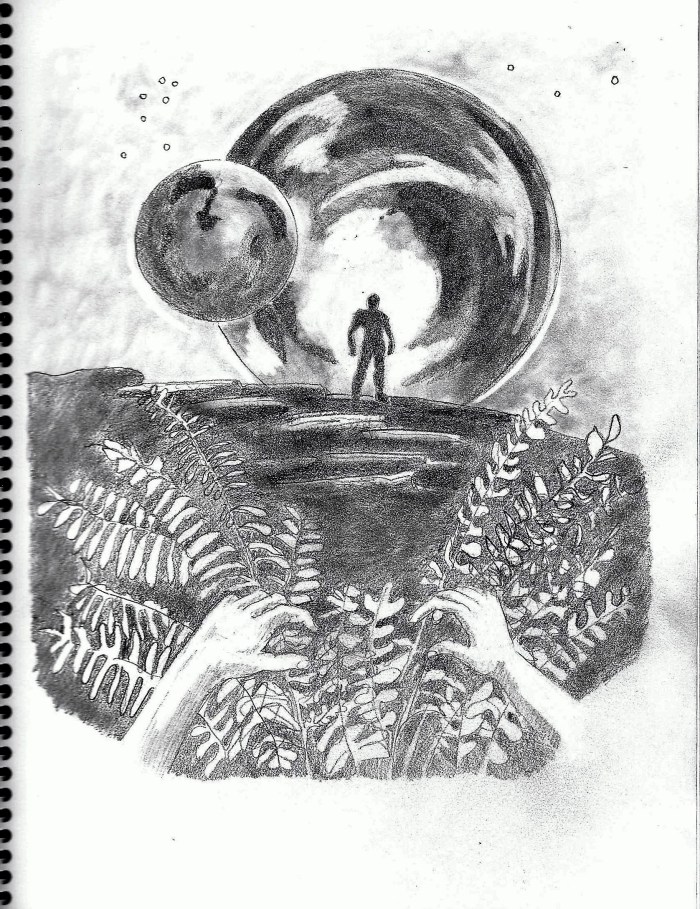
I provided the title for my new fantasy tale: Meniscus
and a verbal description of the following cover sketch:
~
~
Most people guessed correctly that this will be a Science-fiction/Fantasy (I think the alien sky helped). They also thought the book might be about an encounter between alien species.
~
Only two people in the audience knew what ‘meniscus’ meant.
Google provides the following definition:
me·nis·cus
noun
Physics– the curved upper surface of a liquid in a tube.Optics– a lens that is convex on one side and concave on the otherAnatomy– a thin, fibrous cartilage between the surfaces of some joints

three fantasy characters
On Friday, I introduced my current writing and drawing project – creation of a short fantasy tale. The story is about a young woman who tries to trade an old life for a new. The setting is an alien planet named Meniscus. I have three main characters:
- The young woman is a Human named Odymn. Odymn is in her thirties, living a life of servitude on Meniscus. Every night she escapes confinement to practice her passion of parkour. Parkour is the discipline of moving through the landscape in the most efficient way possible, running, jumping, vaulting, climbing and rolling. The discipline involves strength, endurance and flexibility and has allowed Odymn to reclaim and have control over at least one part of her life. Odymn has bright red hair which is about to get her into a lot of trouble.
- The man she meets during one of her parkour adventures is a genetically enhanced human, a Eu-hominid. He is a rover, moving from place to place to earn his living. He wears a special kind of armour and weaponry which taps into the electrical forces in his body. He has strength and endurance but almost no flexibility. He does not engage in idle chatter, to say the least. So far he has no name, so I just refer to him as Eu-hom. It’s OK if you are thinking names are not my strong point!
- After some encounters with other hominids and creatures on the planet, Odymn and Eu-hom set off on some adventures. At one point they encounter Wen-le-gone, a sentient, passive, furry creature known as an Argenop. Wen-le-gone adopts Odymn as his friend but does not warm to the Eu-hom, not at all.
~
Now that you have met my characters, I’ll show you what they look like.
~
Odymn has a peculiar scar on her forehead. How she got the scar and what it means to her is part of the story.
~

The Eu-hom is a rather serious character, not much of a conversationalist and not easy to befriend.
~

The Argenop, Wen-le-gone, is the village healer and sage. Looks a little like my cat.
~
Next time, I’ll show you drawings of some of the other humanoids and creatures of Planet Meniscus.
~
~
Copyright Jane Tims 2016
learning curves
In the last two weeks, I’ve taken a detour. Instead of working on my poetry or novels, I’ve had some fun creating a fantasy tale. The story is about a young woman who tries to escape servitude only to find herself back in a similar situation. The story takes place in the future, on a planet far from earth.
~

~
Writing the tale was fun. Creating a simple language to use in the dialogue was interesting. Finding some names for the characters and places was a challenge but very satisfying.
~
Making a map to describe the setting was no fun at all. I liked creating the spaces, thinking about where to put the landscape features and towns. But, I had to make a decision:
- draw the map by hand and risk wanting to change names or details in the future, or
- create the map in a layered digital format where I could make changes anytime I want
~
I decided to do the map in GIMP (GNU Image Manipulation Program), a free on-line app similar to Photoshop Pro. I have never worked with GIMP before, so I have had some frustrating hours coming up the learning curve. But, I have prevailed and I now have a map to suit my story.
~
a map to go with the story
~
The story is told in poetry and is based on a world where water doesn’t behave as it does here on Earth. Instead it effervesces and tries to flow upward. Hence a water-climb rather than a water-fall. This is just a taste of the story. The main characters are fleeing, pursued by an alien species, the Gel-heads (Gel-heads have transparent skin, like green gelatin). Windfleers are flocking birds, like large white starlings.
Terrain changes. A climb, the way rocky, tangled.
Glimpses of a water-climb.
Shouts in the valley behind them, Gel-heads
sensing the prey is near. Need for stealth and speed.
Burst from the forest to a plateau. The En’ast Water-climb
above them. Startle a flock of windfleers. Cacophony
and dithering panic. Two hundred pairs of wings swirl upward,
a tornado of feathers. The Gel-heads alerted.
Nowhere to run. The water-climb a bracket at the head of the valley.
A colossal outcrop, sheer walls of stone. Jagged cliffs where water ascends.
Shallow pool at the base, fed by artesian groundwater. The water bubbles
and leaps, each droplet climbs, then falls, net flow upward.
Rocks slick.
~
Copyright Jane Tims 2016
in the shelter of the covered bridge – final manuscript
In the last weeks, I have been working towards completion of the book-length manuscript for ‘in the shelter of the covered bridge’. It includes poems and drawings about the plants and animals living in and around some of the covered bridges in New Brunswick.
~
Earlier this summer I was lucky enough to win a mentoring package from the Writers’ Federation of New Brunswick. I chose a talented, award-winning local poet to work with me on the manuscript and during the early part of the summer, with her expert guidance, I made revisions to the poems. She focused my attention on word choice, clarity and ‘showing not telling’. She also helped me with a handful of poems I thought were not salvageable and now some of these will make it into the manuscript!
~
In the last few weeks, I have worked on revisions, ordering of the poems, and, hardest of all, my footnotes. Since the poems are about the remaining covered bridges in the St. John River watershed, I want to include some basic information in the footnotes as well as notes I made during my visits to each bridge. I have also worked on the drawings I will include in the manuscript.
~

~
The process of preparing a manuscript is long and certainly goes beyond the fist few lines written on the page way back when this manuscript was just an idea. But if the way is about the journey, this has been such a memorable experience. Best of all, I have been lucky to make the acquaintance of many of New Brunswick’s covered bridges. Last Thursday, as we returned home from a visit, we saw a double rainbow in the sky and I was able to snap a shot as we waited to take our turn crossing the covered bridge across the Rusagonis River (the Patrick Owens Bridge):
~
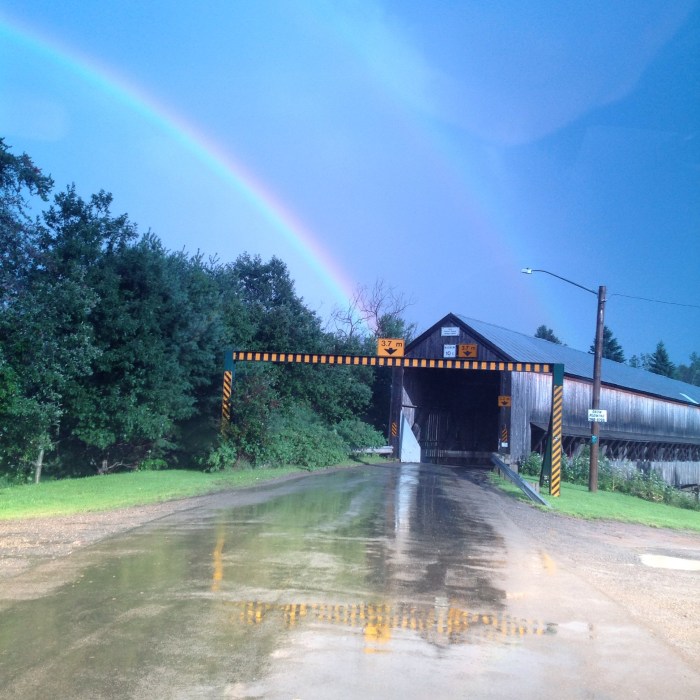
double rainbow over the Rusagonis #2 Covered Bridge in Rusagonis, New Brunswick – August 19, 2016
~
Copyright Jane Tims 2016
on my bookshelf – A Photo Tour of the Covered Bridges of New Brunswick by Ray Boucher
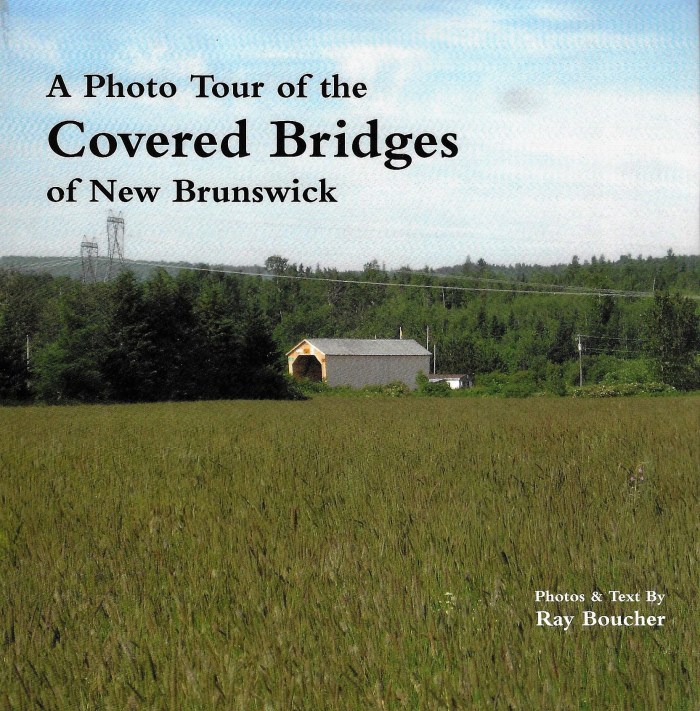
As I make revisions to my poetry manuscript ‘in the shelter of the covered bridge’, my collection of books about covered bridges in New Brunswick provides needed reference material. Ray Boucher’s book A Photo Tour of the Covered Bridges of New Brunswick looks at the 64 covered bridges present in the province in 2008. Today only 60 of these remain.
~
~
Ray Boucher. A Photo Tour of the Covered Bridges of New Brunswick. Kissing Bridge Publications, 2009.
A Photo Tour takes the reader county-by-county to discover New Brunswick’s covered bridges. Many of the bridges are shown in more than one photo and photos were taken in every season. I particularly like the photos showing a bridge from up or downstream.
~
Now gone from this record of 64 are the Adair Bridge (North Becaguimec River #1) (lost to fire in 2009), the Aaron Clark Bridge (Canaan River #1) (lost to flooding in 2014), the Stone Ridge Bridge (Keswick River #6) (lost to fire in 2008), and the Mangrum Bridge (Becaguimec River #3) (lost to fire in 2011). My version of the book has notes added in red to indicate the 2014 and 2008 losses. The historical value of this book is the photographic record of these four bridges as well as those still standing.
~
Each photo is accompanied by facts on bridge length and date of construction, and interesting notes and anecdotes on the bridge and the photographer’s visit. Since my husband accompanied me on my visits to the covered bridges I am writing about, I liked reading that this book was also a husband and wife effort!
~
I was able to buy a copy of this book on Amazon.ca … my collection of books about covered bridges is growing!
~
Copyright 2016 Jane Tims
Hermit thrush
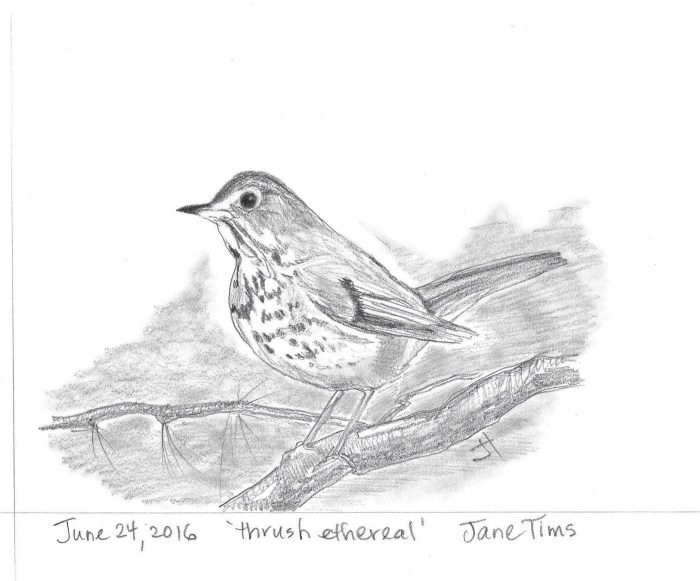
Another surprise in the morning bird chorus — a Hermit thrush. I have been listening for it all spring and at last, this morning, the ethereal notes.
~
~
How to describe the song of the Hermit thrush? T.S. Eliot described it in The Waste Land, in V: What the Thunder Said :
… sound of water over a rock
Where the hermit-thrush sings in the pine trees
Drip drop drip drop drop drop drop …
and
… who is the third who walks always beside you …
and
… In the faint moonlight, the grass is singing
Over the tumbled graves …
~
A technical description of the Hermit thrush song is ‘a beginning note, then several descending musical phrases in a minor key, repeated at different pitches.’
~
The song is clear, flute-like. To me the essential characteristics are the change in pitch at the beginning of the new phrase and the hint of water within. If you watch the Hermit thrush while she is singing, she stands tall, tilts her head back, looks into the distance with her bright black eye, lifts her feathers ever so slightly and opens her beak. Her throat swells a little but otherwise you are left to wonder, where do those notes begin?
~
If her song was another sound, it would be a flute in the forest.
If it was a smell, it would be the sweet scent of mayflowers, as you part the leaves with the back of your hand.
If it was a touch, it would be lifted hairs at the back of your neck.
If it was a taste, it would be syrup drizzled over iced milk.
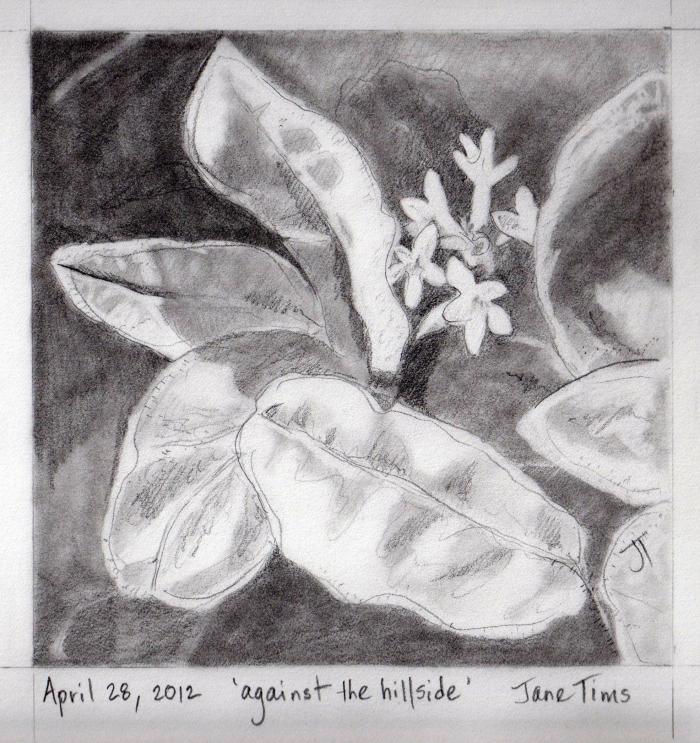
If it was an image, it would be guttation drops on strawberries.
~
~
What other words describe the song of the Hermit thrush?
clear
precise
covert
alone
sweet
tremolo
pure
hidden
pensive
thoughtful
thicket
froth on a dancing wave
raindrops trembling on the tips of leaves
the step from rung to rung on a ladder
~
If it was a vowel, it would be every vowel
If it was a consonant, it would be ‘c’, ‘l’, ‘r’, or ‘v’
~
~
Hermit thrush
~
Catharus guttatus
~
neither visceral nor guttural, ethereal
tip-toe in tree tops
air pulled into taffy thread
a flute in the forest
froth on a wave
~
rain trembles on leaf tips
guttation drops on strawberry
a lifted curtain of mayflower
~
I saw you there
hidden in the thicket
and I followed
~
climb the ladder and sing
then step to the rung below
heads up, thoughts of the new day
parting of the beak
pulse at the throat
hairs lift
at the nape
of the neck, fingers
warble the keys
between middle and ring
catharsis
~
~
Copyright 2016 Jane Tims
Mourning dove
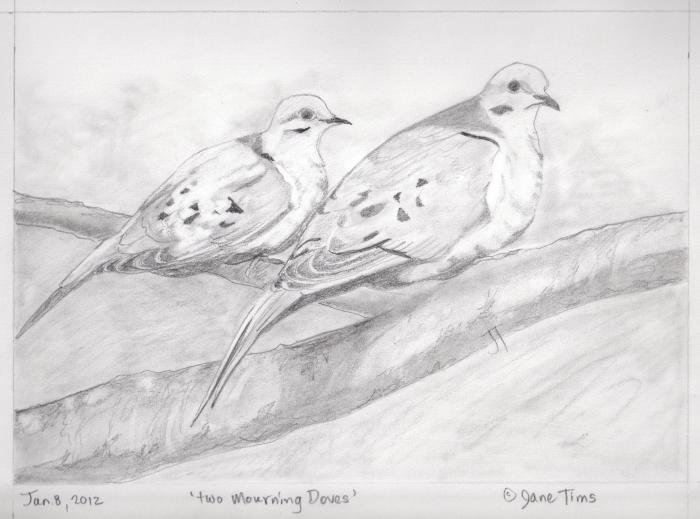
I woke this morning to another new bird in the mix of the morning bird chorus — a Mourning dove. In this area, the Mourning dove is a common bird, seen pecking at seeds beneath feeders or hanging out on the telephone lines. But I haven’t heard one in our grey woods for a while.
~
~
The call of the Mourning dove gives it its name. It begins with a low question and continues in a descending series of coos.
Oh no, no, no, no, no
Dear me, me, me, me, me, me
I decided to try and capture this sound in words.
~
Mourning
Melancholy
Monotonous
Sad
Solemn
Hollow, mellow
A reed, the inside walls of a bottle
An emerald bottle, buried to its neck in the sand
Breath across the mouth of a bottle
A child’s feeble attempt at a whistle
Light and shadow inside a vessel of glass
~
If the call of a mourning dove were a colour it would be amethyst
If the call of a mourning dove were a sound it would be wind blowing down the stairway of a tower
If the call of a mourning dove were a taste it would be chowder, thick and left too long on the fire
If the call of a mourning dove were a touch it would be a wooden shawl, wrapped round and round until it was no longer warm but strangling
If the call of a mourning dove were a song it would be hesitant, riff-driven, repeated over and over
If the call of a mourning dove were a smell it would be the cloying perfume of lilac
~
If it was a vowel, it would be ‘o’ or ‘u’ and sometimes ‘y’
If it was a consonant, it would be ‘m’, ‘n’, ‘r’, or ‘w’
~
Heavy or light
Loud or soft
Tall or short
Sad or happy
Bright or dull
Sharp or dull
Nearby or distant
Solemn or joyous
Spacious or confined
~
So, from all this, a poem. This is the second draft of a poem about the mourning dove which never mentions the bird except in the title.
~
Mourning dove
~
Zenaida macroura
~
wind wakens, descends the stair
notices shadow, gaps in cladding
the hollow of the tower, breath
across the mouth of a bottle
amethyst, buried in sand
~
the reed widened, a solemn song
the riff, the echo, a distant train
expands across the valley
and a child hollows her hand
shapes her lips for a kiss
~
tries to whistle, her breath
a sigh, a puff to cool
the chowder, still simmers
on the fire, thick
and needing stirring
~
potatoes, corn and onions
curdled cream, a woollen shawl wrapped
round and round, warmth tightened
to struggle, viscous as lilac
unable to breathe
~
~
For other posts and poems about the Mourning dove, see https://janetims.com/2012/01/16/keeping-warm/ and https://janetims.com/2015/01/30/for-the-birds/
~
Copyright 2016 Jane Tims
songs in the grey woods – ovenbird, over and over
This week we had a meeting of our writing group Fictional Friends. We are trying something new – dedicating our whole meeting to one person’s writing. The writer ‘in the spotlight’ talks about writing goals and the problems they encounter. Then they describe their current project, giving a synopsis. They read and the group provides constructive comments. We found this first session helpful for everyone present and we plan another session, with a focus on another writer’s work. I think each member of the group learned something applicable to his or her own writing.
~
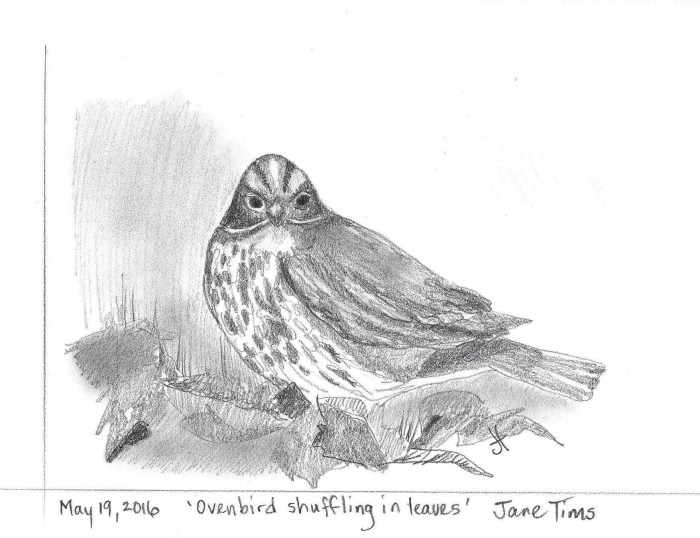
This session was held at my house. I left the back screen open, to let in some air. More than air comes in – at a meeting last month, the sound of our next door neighbour’s rooster crowing provided a backdrop to some reading about rural themes. At this week’s meeting, an Ovenbird decided to start singing in the woods behind our house. ‘Teacher, teacher, teacher’ he said, over and over. Perhaps he was making a commentary on our particular way of learning.
~
The Ovenbird is a large warbler, olive-brown. He reminds me of a thrust because of his streaked white breast. He has an orange crest, a white ring around each eye, a white throat and a dark line below his cheek. My drawing is from a photo by Ann Gardner, used with permission. http://www.anngardnerphotography.com/
~
~
Do you belong to a writing group? What methods does your group use to help one another?
~
Copyright 2016 Jane Tims
songs in the grey woods – ovenbird
He can be a bit monotonous. A bit of a scold. He reminds me of a rusty hinge. He says teacher-teacher-teacher, repeating his song through the woodland. He is the Ovenbird.
~
His scientific name is Seiurus aurocapilla. Seiurus (which I remember as ‘serious’) is from the Greek meaning ‘tail shake’, a reference to the characteristic upward flip of his tail. The name aurocapilla means golden-haired referring to his crest of orangy feathers. The Ovenbird is olive-brown, with a streaked white breast. He has a white ring around his eye, a white throat and a dark line below his cheek. He looks a bit like a thrush, but is a large warbler.
~
His serious nature and his call of ‘teacher, teacher, teacher’ make me think I’ll include a poem about his ways in my project about one room school houses in New Brunswick. This is how my poems usually begin, with a whisper from nature.
~

~
Copyright 2016 Jane Tims




 nichepoetryandprose