Posts Tagged ‘writing’
Bookmarks and Dog Ears-A Mystery
A few posts ago, I introduced you to my new poetry project: ‘Bookmarks and Dog Ears.‘ One of the subjects I want to include (briefly) in my manuscript is the ‘gloss.’ According to Merriam-Webster, a ‘gloss’ is a brief explanation (as in the margin or between the lines of a text) of a difficult or obscure word or expression.
~
A gloss marks a book using pencil or pen marks in the margins and counts in the scope of my writing about ‘bookmarks.’ Some think writing in a book is not a good idea and defaces the book. However, I have found during this project that glosses reveal a lot about the history of a book.
~
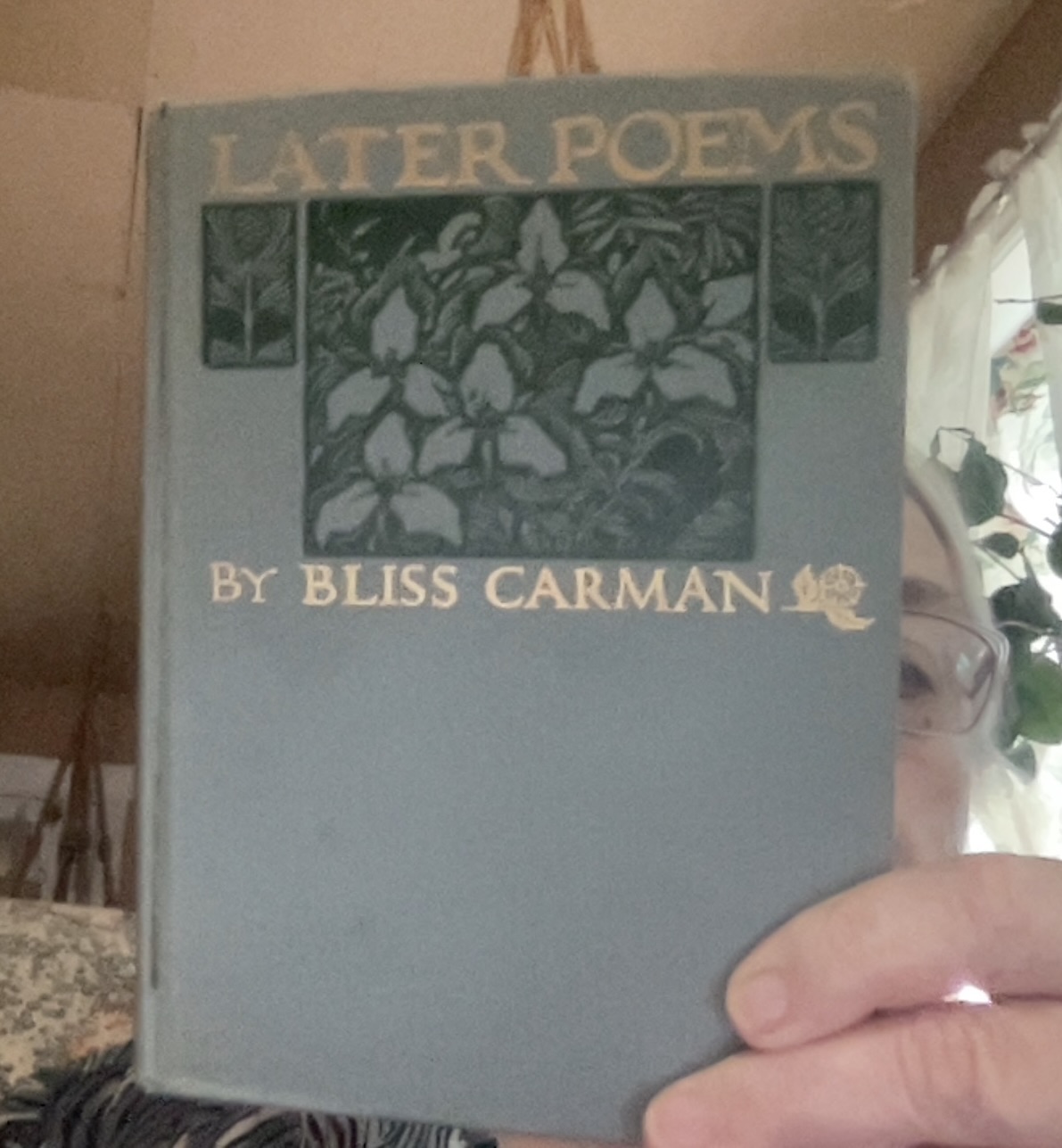
I will use one of my prized possessions to illustrate the power of glosses. This item is a book, a first edition, signed copy of Bliss Carman’s Later Poems, published in Toronto by McLelland & Stewart, 1921. Bliss Carman was a famous poet, born in Fredericton. The book Later Poems includes many poems I love, including ‘Vestigia’ which begins … ‘I searched for God and found him not…’ and goes on to say the poet finds God in many aspects of nature. I bought the book on-line for $80 some years ago. It is a ‘presentation copy’ and includes an inscription by Carman to friend, publisher and author, Irving Way.
~

~
Even better, my copy of Later Poems is glossed with pencil and points out some differences in this 1921 Edition from the 1922 American Edition (Small, Maynard and Company, Boston) and the 1926 Canadian Edition (McLelland & Stewart, Toronto). For example, my 1921 Edition is missing four lines from the end of the poem ‘Easter Eve.’ The lines are present in both 1922 and 1926 Editions. In another example, the glosses point out a duplication of two stanzas in the book: identical stanzas occur in ‘A Christmas Eve Choral’ and ‘The Sending of the Magi.’ The stanzas are entirely missing in the 1922 Edition and are included only in the poem ‘The Sending of the Magi’ in the 1926 Edition.
~

~
At first, I thought perhaps the book was a sort of ‘proof’ copy, and the glosses were Bliss Carman’s. But recently, I found a date in pencil in the same handwriting – 24 July 1932. The glosses were added by another person, not Bliss Carman who died in 1929, or Irving Way who died in 1931. The glosses were also added after the 1926 edition and so could not have been the impetus for changes in either of the other Editions.
~
So, who was the person who wrote in pencil in the book? An heir of Irving Way? An editor considering yet another Edition? Or simply a lover of poetry who did some research between Editions.
~
This is a first draft of part of my poem about the glosses in this book – this part of the poem explains why I love Bliss Carman’s work. One of the reasons – the writing group I meet each month (Wolf Tree Writers) has a member who is a distant cousin of Bliss Carman: Virginia Bliss Bjerkelund, author of Meadowlands- A Chronicle of the Scovil Family (Chapel Street Editions, 2020) and A Nurse for All Seasons (Chapel Street Editions, 2023); for a review of the book Meadowlands, click here.
~
My poem includes quotes from Bliss Carman’s Later Poems.
~
First Edition Glosses
~
1.
as she walked the forest edge
my mother quoted poets
William Cullen Bryant
‘Whither, ‘midst falling dew’
Bliss Carman
‘I took a day to search for God …’
~
at her funeral, knowing
she still ‘dwelt within my heart’
I read ‘Vestigia,’ by Carman
my poet of choice
~
I hear his voice
when purple lilacs ‘stir’
when I hear the wind
‘conversing with the leaves’
~
when I wander
in the meadow
chasing ‘stealthy shadows
of the summer clouds’
~
distant cousin brings his
charm and talent
to our writing group
when it meets each month
~
~
The poem goes on to talk about the other Editions, the glosses and how many hands have held the book before mine.
~
I am loving this Bookmark project. I am learning so many new things and I find the writing of ‘fact-filled’ poetry a bit of a challenge.
~
Enjoy your own reading and discoveries!
~
All my best,
Jane
bookmarks and dog ears: new poetry
Hi everyone. I have been working on a new project, honouring bookmarks, such an important part of our reading life. I will be exploring the humble bookmark in poetry and drawings.
~
In Oromocto in New Brunswick, we have a wonderful second-hand bookstore, Dog Eared Books. When used books are brought to the store, staff save the bookmarks they find. My project is to capture some of these in a book-length manuscript. To learn more about this project, click here.
~

~
I am about five weeks into the project and I am having a very rewarding time. The bookmarks are diverse in character and I have had to learn a lot about subjects quite new to me. Just an idea of the variety I have encountered:
- class notes on ways of presenting arguments in the field of logic;
- a hockey card of one of the Soviet players in the 1970’s;
- a chart showing the Queens and Kings of England;
- a local teacher’s permit from 1959;
- a bookmark from Owl’s Nest Bookstore in Fredericton (now closed);
- a stack of small cards made for a game of charades;
- a card with the number ‘150’ — from an Irish dance feis competition.
~
These are only a few of the collection.
~
Because I love bookstores, the bookmark from the Owl’s Nest Bookstore was of interest. The word ‘bibliosma’ refers to the smell or aroma of books. The books I mention in the poem were in the bookshelves of the store in the weeks before it closed, evidenced by their Facebook posts and photos.
~

~
bibliosma
‘… went all the way to Fredericton to buy this old book’
-saying on a bookmark
~
Owl’s Nest Bookstore
grey cat purrs in the window
prowls between stacks
while I search for wildflowers
careful steps between hardwoods
lifting of leaves, counting of petals
rummage for botany among
overflowing shelves of books
~
first find, hardcover, dark green, old
1919 Botany of the Living Plant
Frederick Orphen Bower, botanist,
lover of ferns
~
and here, The Wildflowers of Canada—1895
a reprint classic, on the cover, scant
specimen of golden chain tree ‘Laburnum,’
scentless but inside—heady smell
of mayflower, lily of the valley, lilac—
colour plates of wildflowers
~
and a hardcover, The Blossom on the Bough: A Book of Trees
Diane Ophelia Dowden, 1826
delicate apple blossom overcomes
almond and vanilla smell of books
three bees buzz, overpower
rumble of traffic on Queen Street
~
copies of The Fiddlehead
my poems in some of them
‘Old Man’s Beard’ The Fiddlehead 180, 1994‘
‘The Gazing Ball’ The Fiddlehead 196, 1998
~
find the book
you didn’t know you wanted
at the bottom of a pile
glimpse of indigo shimmer of water
No Faster Than a Walk
Gillis and Gillis
love covered bridges
~
book on the top shelf
always
a
stretch
Gavin Maxwell
Ring of Bright Water
‘it is no will-o’-the-wisp
that I have followed here’
~
book store closed in 2018
blue and white bookmark
left between pages
sketch of an owl
memory of a grey cat
a forest of books
bibliosma
~

~
I hope if you are from the Fredericton area, you remember the Owl’s Nest Bookstore. And I hope you enjoy my poem.
All my best!
Jane
Cover Painting for ‘Meniscus: Reckoning’
In preparation for the release of ‘Meniscus: Reckoning,’ the next book in the Meniscus Science Fiction Series, I have finished the painting for the cover.
~
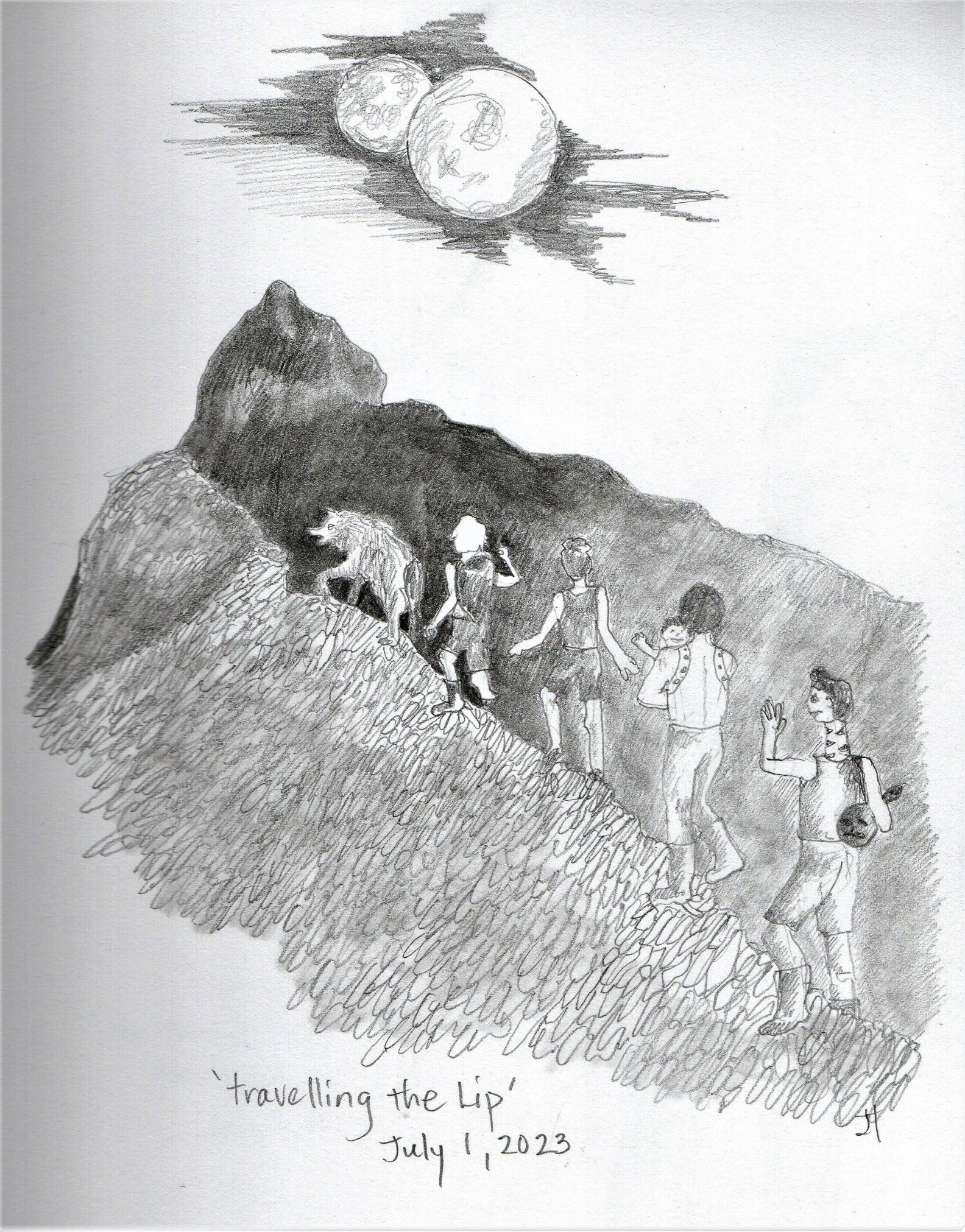
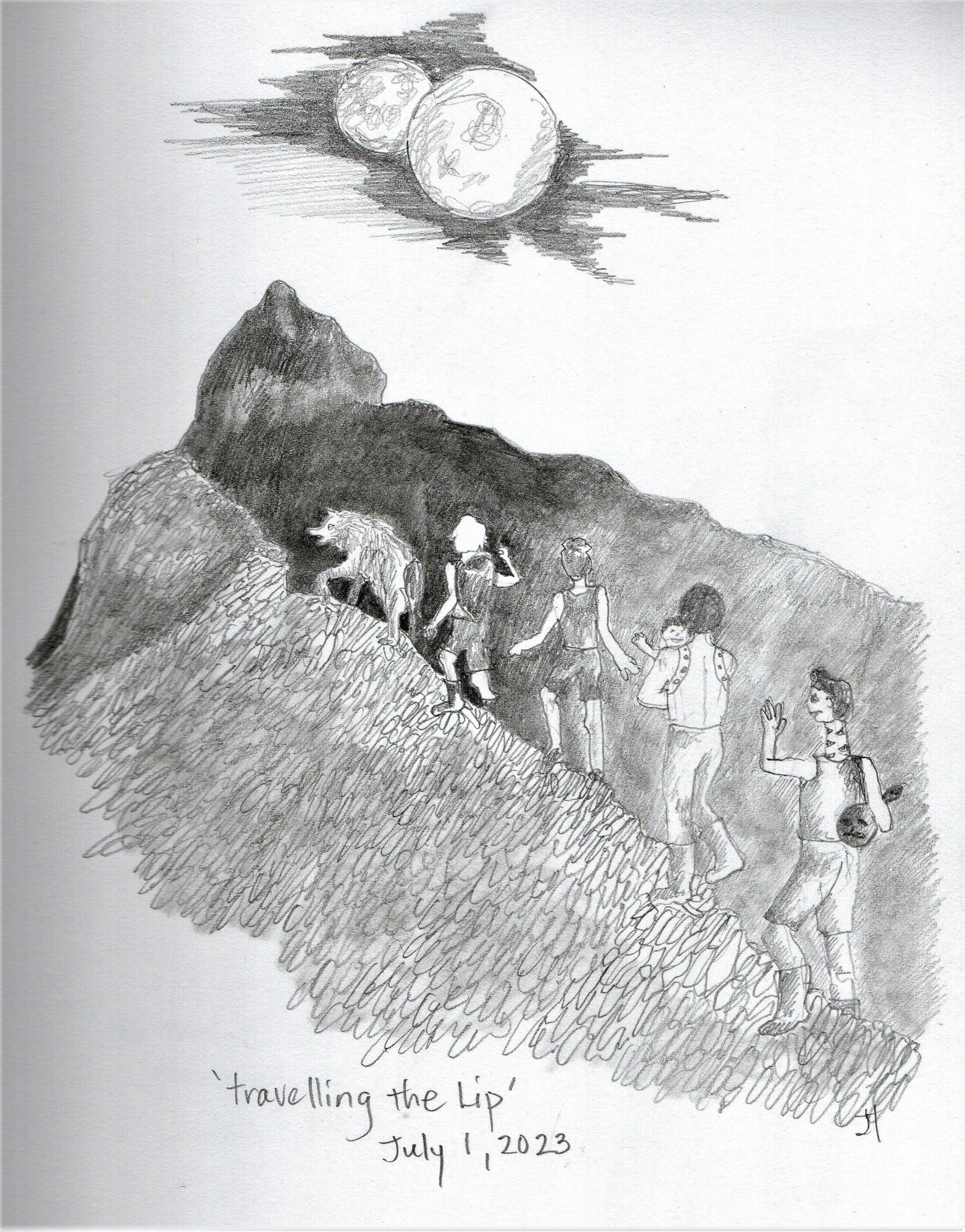
The painting is based on the pencil drawing ‘Travelling the Lip.’ It shows six travellers as they cross the treacherous El’ban Elevations, on their way to rescue James, imprisoned in El’ban. The group, in order, are Kotildi (the wild alien ‘wolf’), Belnar (one of the Slain), Odymn (heroine of many of the stories), Daniel (also a Slain), carrying Danny (Odymn and Daniel’s baby), and Don’est (the Dock-winder child, with her long neck).
~
~
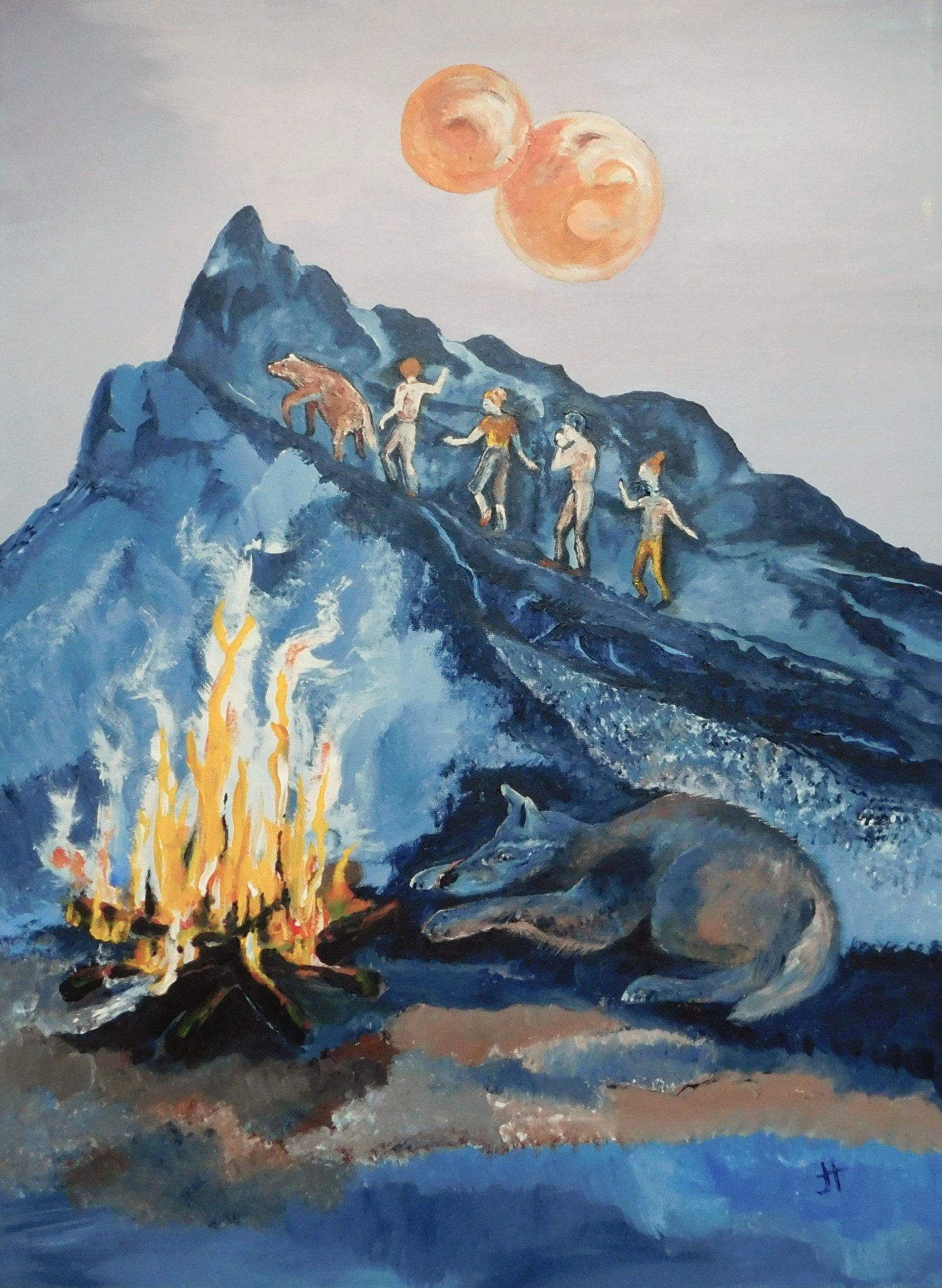
To be consistent with other covers, I need a distant view of the Meniscus moons (Cardoth roe and Cardoth grill’en), a mid-range view of the travellers, and a nearer scene from the book. Campfires are a common theme in the story and who better to sleep by the fire than wolf-like Kotildi?
~
~
I was pleased with the painting. For a couple of days, I showed the travellers as black silhouettes against the Elevations. In the end, I gave them some colour, to suggest clothing and hair. I love the browns, blues and yellows in the painting.
~
To make the painting fit the space on the book cover, I made some alterations in GIMP (GNU Image Manipulation Program). I brought the moons closer to the mountain silhouette and moved the fire and sleeping Kotildi closer to the travellers. In the end, the image fit well with the cover design. Here is a sneak peek at the final cover.
~

~
I am now re-reading Meniscus: Reckoning for the last time, making a few revisions as I go. I have also sent the proof to my beta-reader for her reactions.
~
I plan to release Meniscus: Reckoning in early May. I am looking forward to my reader response!
~
All my best!
Alexandra (a.k.a. Jane)
soon! a new children’s alphabet book
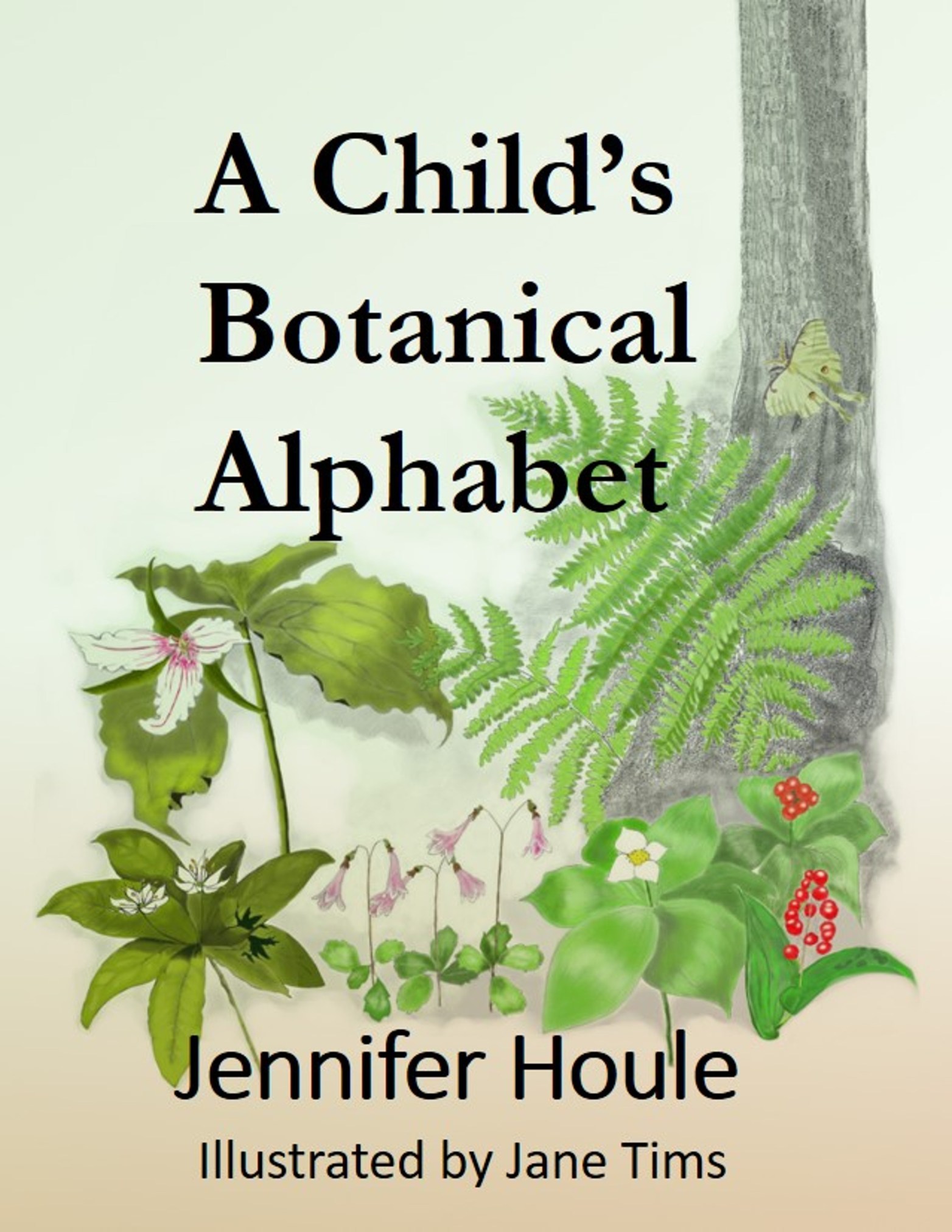
On my list of goals for the year is a project I haven’t talked about before. A friend and I have been working on her new book, A Child’s Botanical Alphabet.
~
I have known Jenn for years, since we both worked on Fredericton’s WordFeast in 2017. Jennifer Houle is a seasoned author, with two award-winning poetry collections, The Back Channels and Virga (Signature Editions). Her first children’s book, Un logis pour Molly/A Home for Molly, was published by Éditions Bouton d’Or Acadie in summer of 2022 in both French and English.
~
Here is what Jenn is saying about A Child’s Botanical Alphabet:
~
This book started out as a little rhyme I made up for my boys when they were toddlers. I loved teaching them to name common flowers & trees around the yard & neighbourhood. Having a vocabulary for things helps deepen imagination, sense of relatedness. I imagined it as a book that caregivers could read with children as they explored … the pages are meant to be coloured on & leaves & flowers pressed between pages. So it’s a book meant to be used. Oh! And there are Luna Moths fluttering throughout. . .presiding spirits.
Jennifer Houle, Facebook, March 20, 2024
~
When Jenn asked me to do the illustrations for her book, I said yes because I loved the concept and I had some suitable pencil drawings already done. I knew from the start I wanted the illustrations to be in colour, so I did my first work of this sort in the digital world. I used GIMP (GNU Image Manipulation Program) to colourize each pencil drawing. I have learned so much about colour and its presentation. Jennifer was easy to work with, so in spite of some learning curves, we are very happy with the result.
~
~
As we work on the last small edits, we are excited to see A Child’s Botanical Alphabet in its final form and show it to you. Stayed tuned for more information!
~
All my best,
Jane
setting goals for writing in 2024
As usual, I have lots of writing plans for this year. I find it helpful to set goals at the first of the year (well, at least by March!) and keep track of my progress.
~
In setting your own goals, make certain they are realistic. As a rule, goals should be SMART – Specific, Measurable, Attainable, Realistic and Timely. For a lesson on setting SMART goals, see the Participaction website here.
~
My writing goals this year are 9 in number. This number of goals is realistic for me since I am quite productive. I will plan to report on how well I did at achieving these goals in December.
~
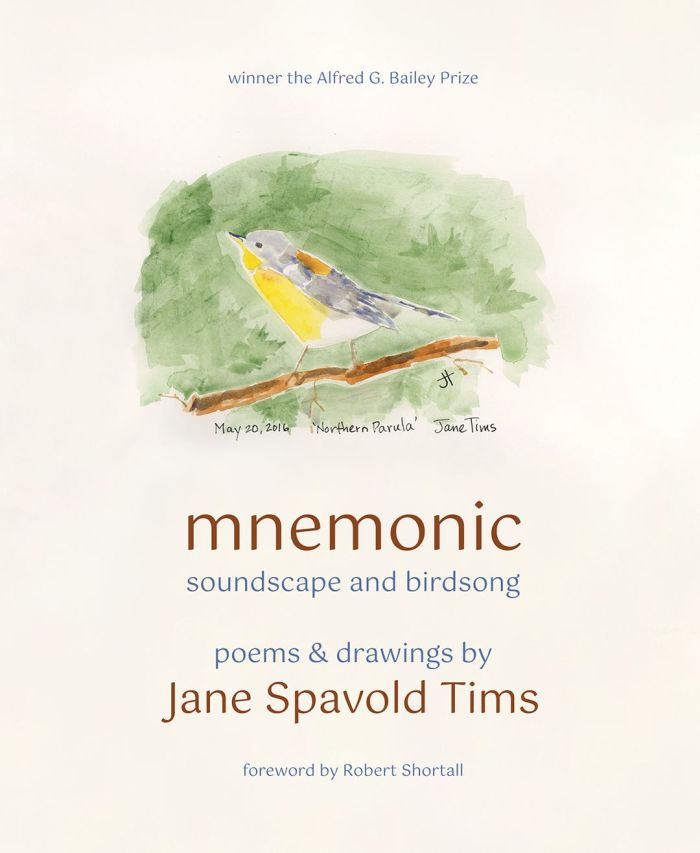
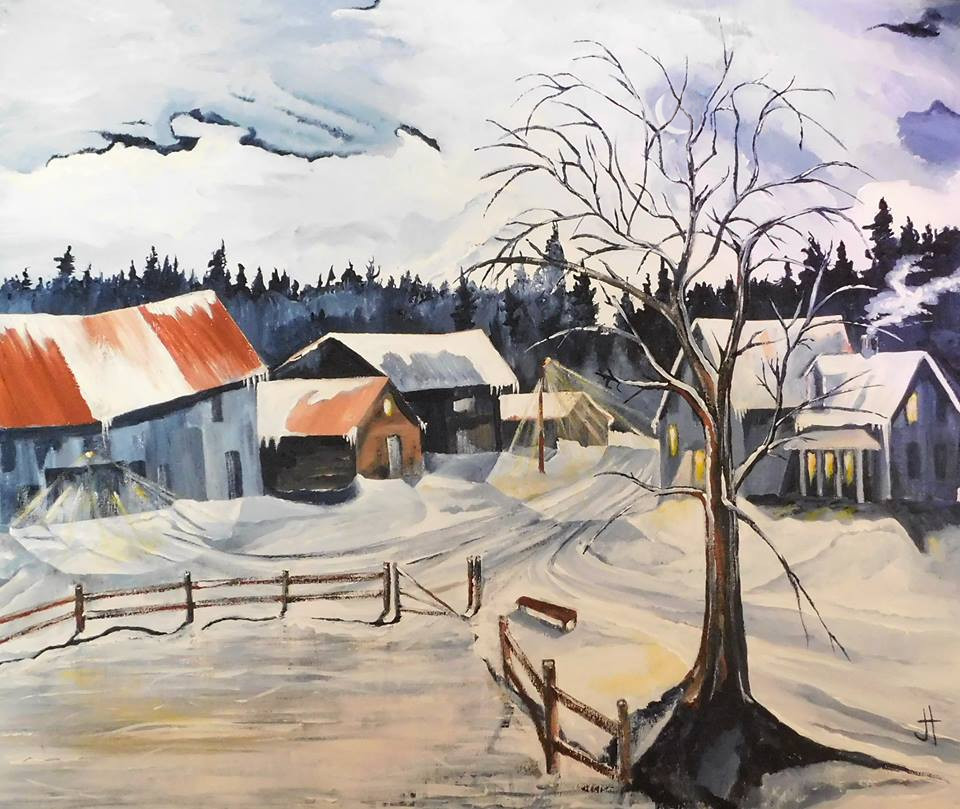
1. Continue to introduce my new poetry book ‘meniscus – soundscape and birdsong’ to the world. By mid-summer, I will attend at least six reading and signing events and feature my book in 5 blog posts. The manuscript for this book won the WFNB Alfred G. Bailey Prize for Poetry in 2016 and I have been enjoying the readings and book signings I have done so far. To purchase a copy of this book, go to the Chapel Street Editions webpage here.
~
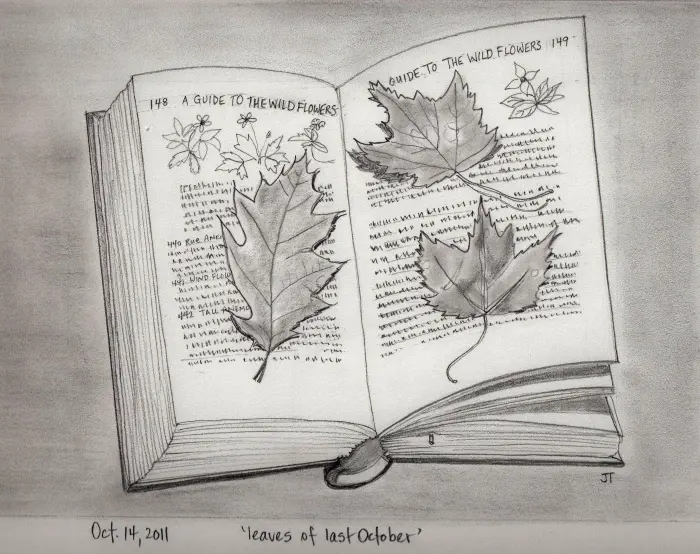
2. A new poetry project – details soon!
~
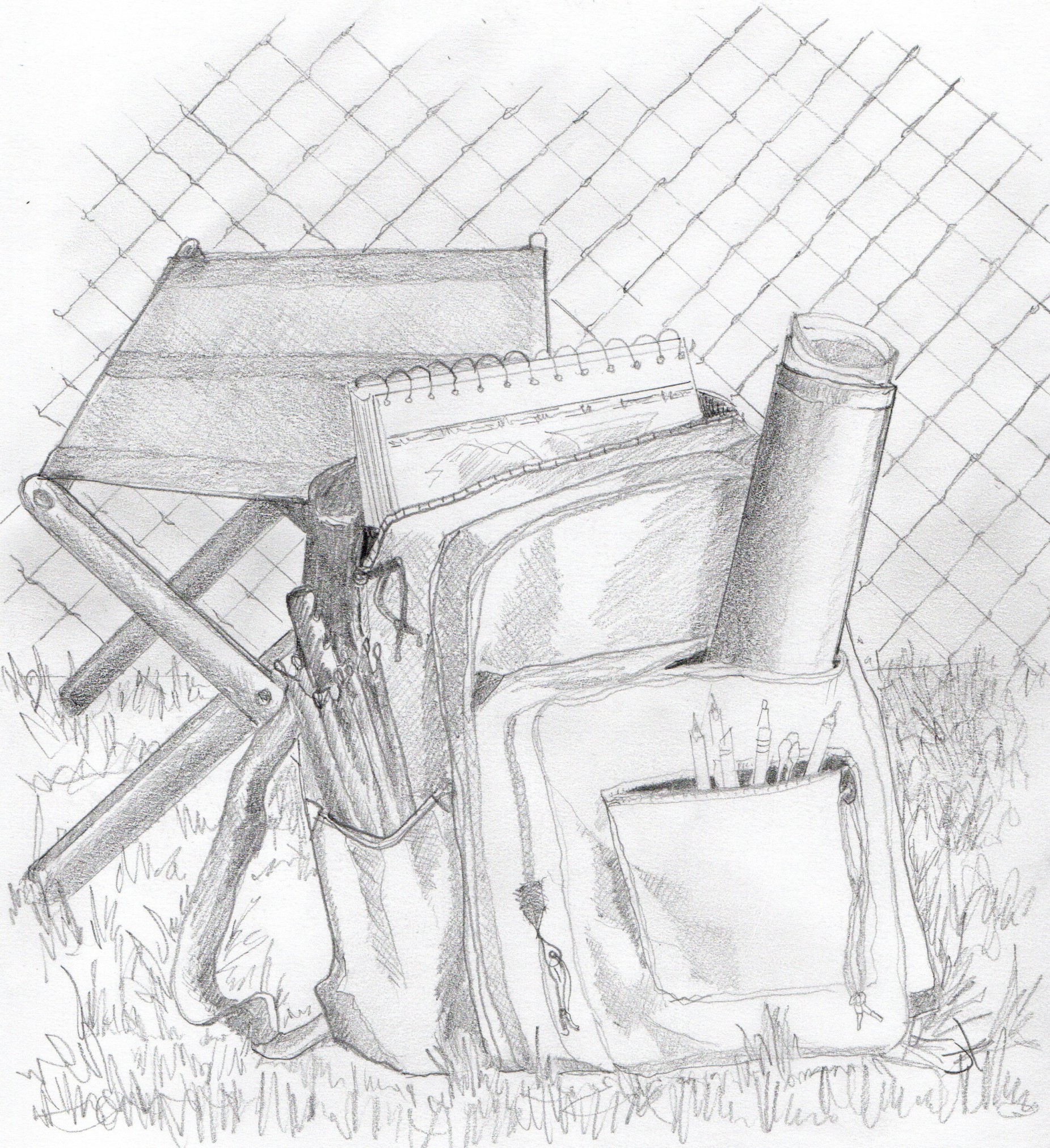
3. Continue to work on my suite of five Urban Mysteries. By the end of the year, I intend to complete the draft of all five books, edit the five, and format them in KDP (Kindle Direct Publishing). These adventures are set in cities where I have lived or worked: Halifax, Fredericton and Saint John. They are short books, about 20,000 words each, entitled ‘Urban Green,’ ‘Roundabout,’ ‘Stately Elms,’ ‘City Grotesque,’ and ‘Hollow Hotel.’ Eventually they will be released as a set of novellas.
~
4. Meniscus: The Reckoning – By the end of May, I will have completed the editing and formatting for this book and published it on KDP. This book is in final format with all the illustrations complete. I have to incorporate my editor’s comments and paint the cover art before it is published. This will be the last novel of thirteen in the Meniscus Science Fiction Series. In this book, several of the characters introduced in the previous novels take a perilous journey to rescue the leader of the Human Resistance.
~
5. A Glimpse of Sickle Moon – By early December, I will review the final proof of this book and publish it with KDP. This poetry manuscript won Third Prize in the WFNB competition for the Alfred G. Bailey Prize for Poetry in 2020. It works through the imagery of each of our four seasons, cycling through 15 years of my life.
~
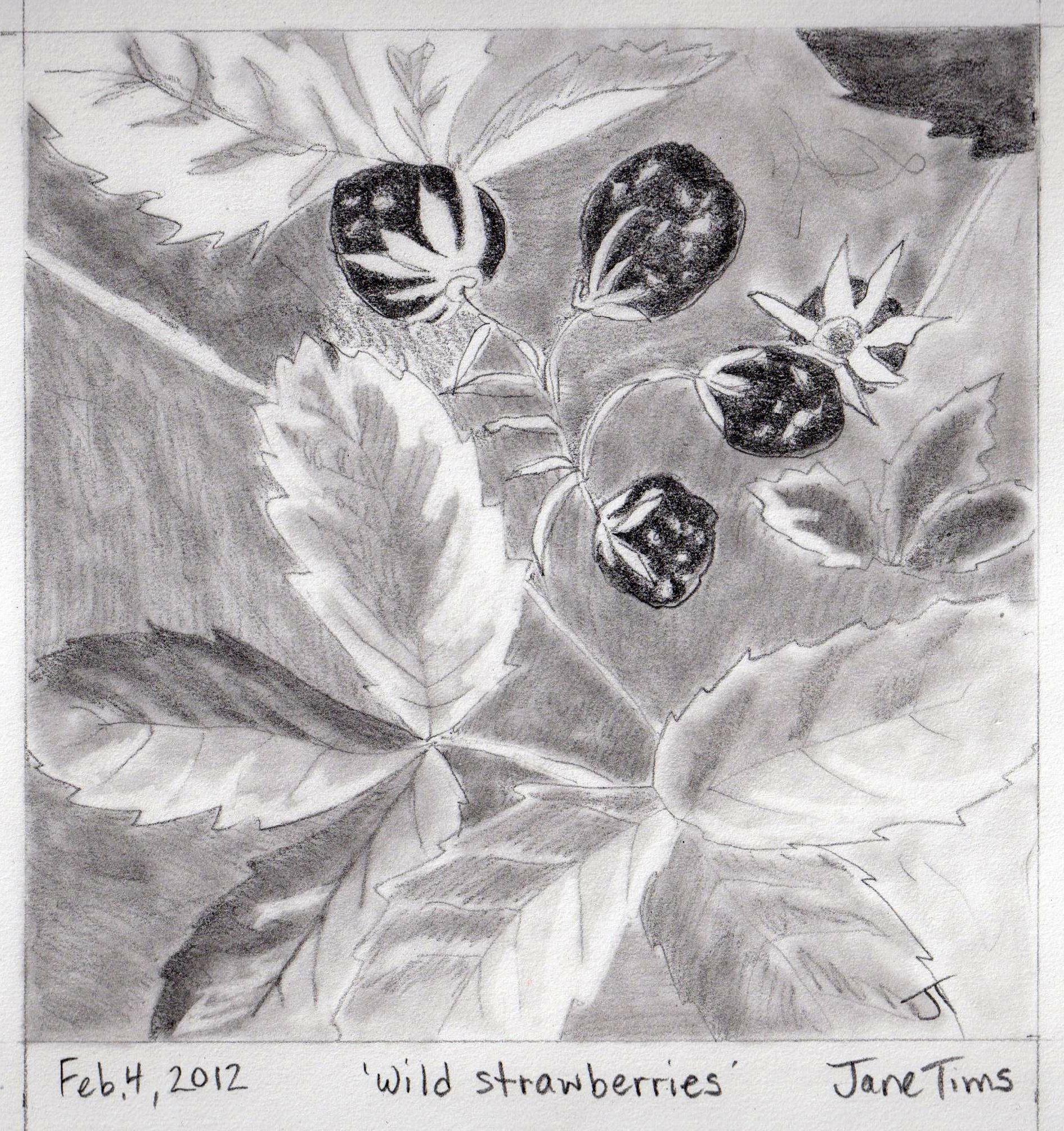
6. A new children’s book (as artist) with a writing friend – details soon!
~
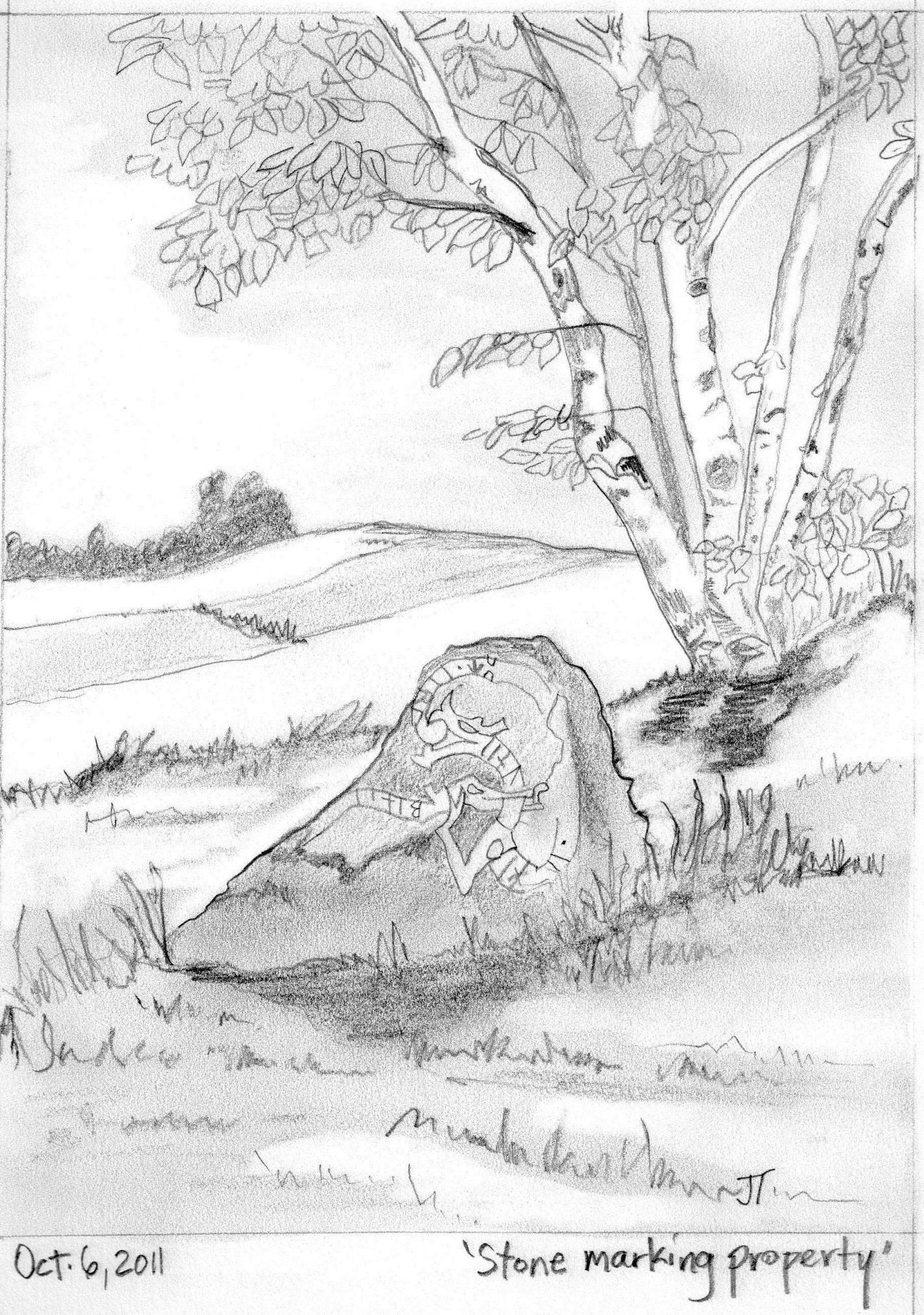
7. writing in the dark‘ manuscript : Each month this year, I will workshop 2 poems in my ‘writing in the dark’ manuscript with my two writing groups. The poems are about my encounters with writings on stone in three cultures. Included are poems of my reactions to the stelae of the Maya, the runestones of the Vikings and the pictographs of the First Nations peoples of North America. My editor has commented on the manuscript, and I am in the process of reading and discussing the poems with my two writing groups, Wolf Tree Writers and Fictional Friends.
~
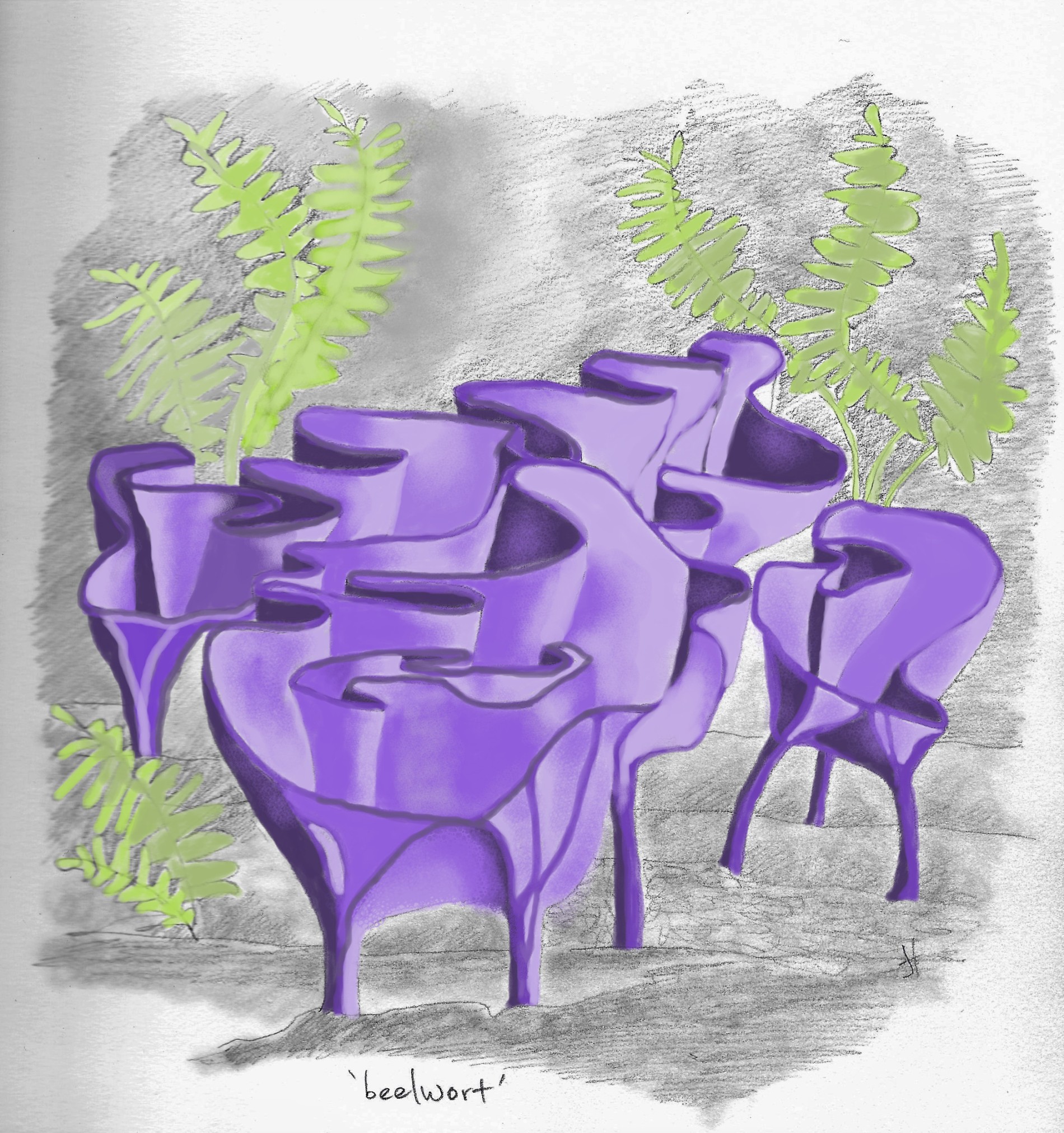
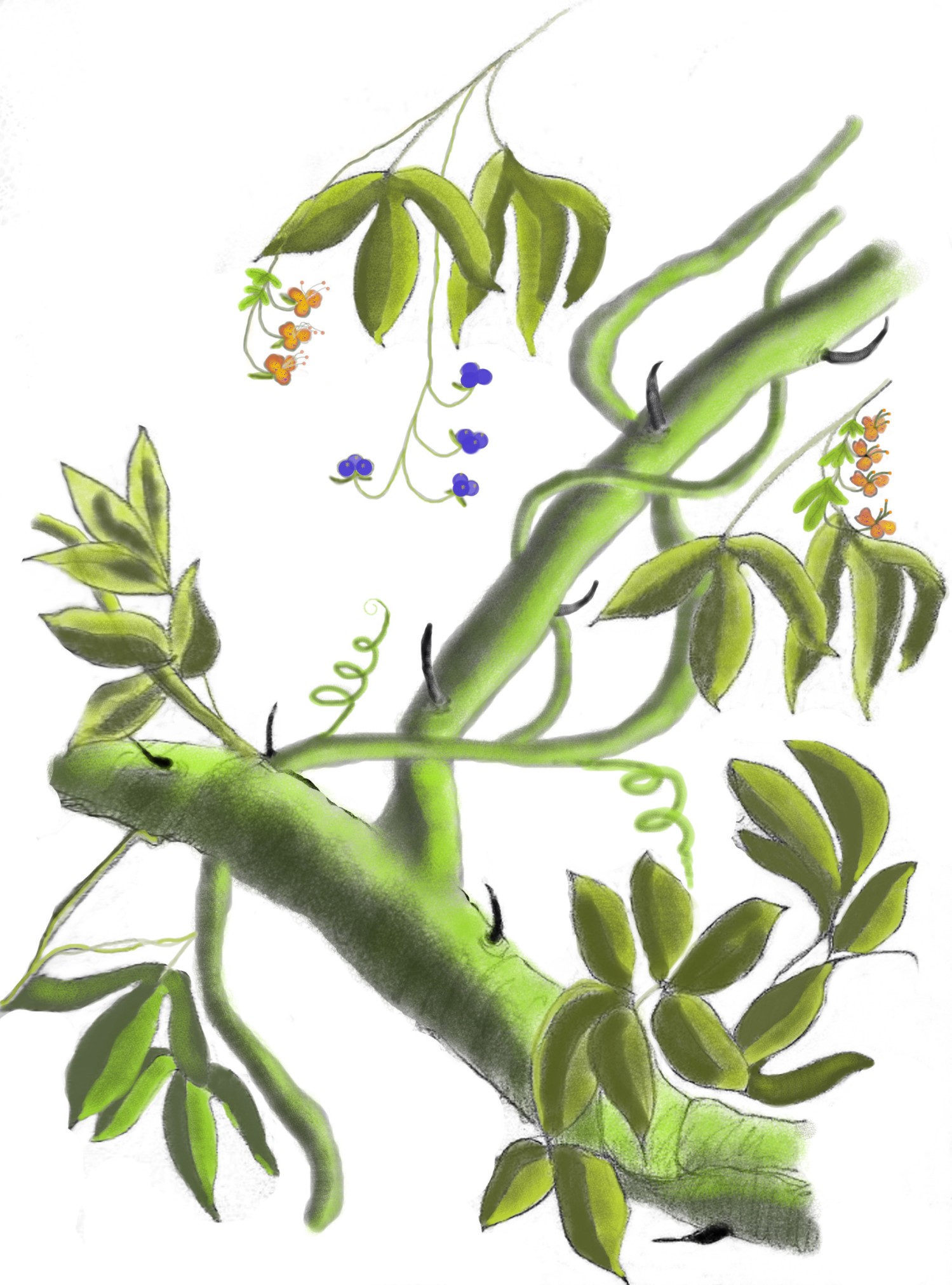
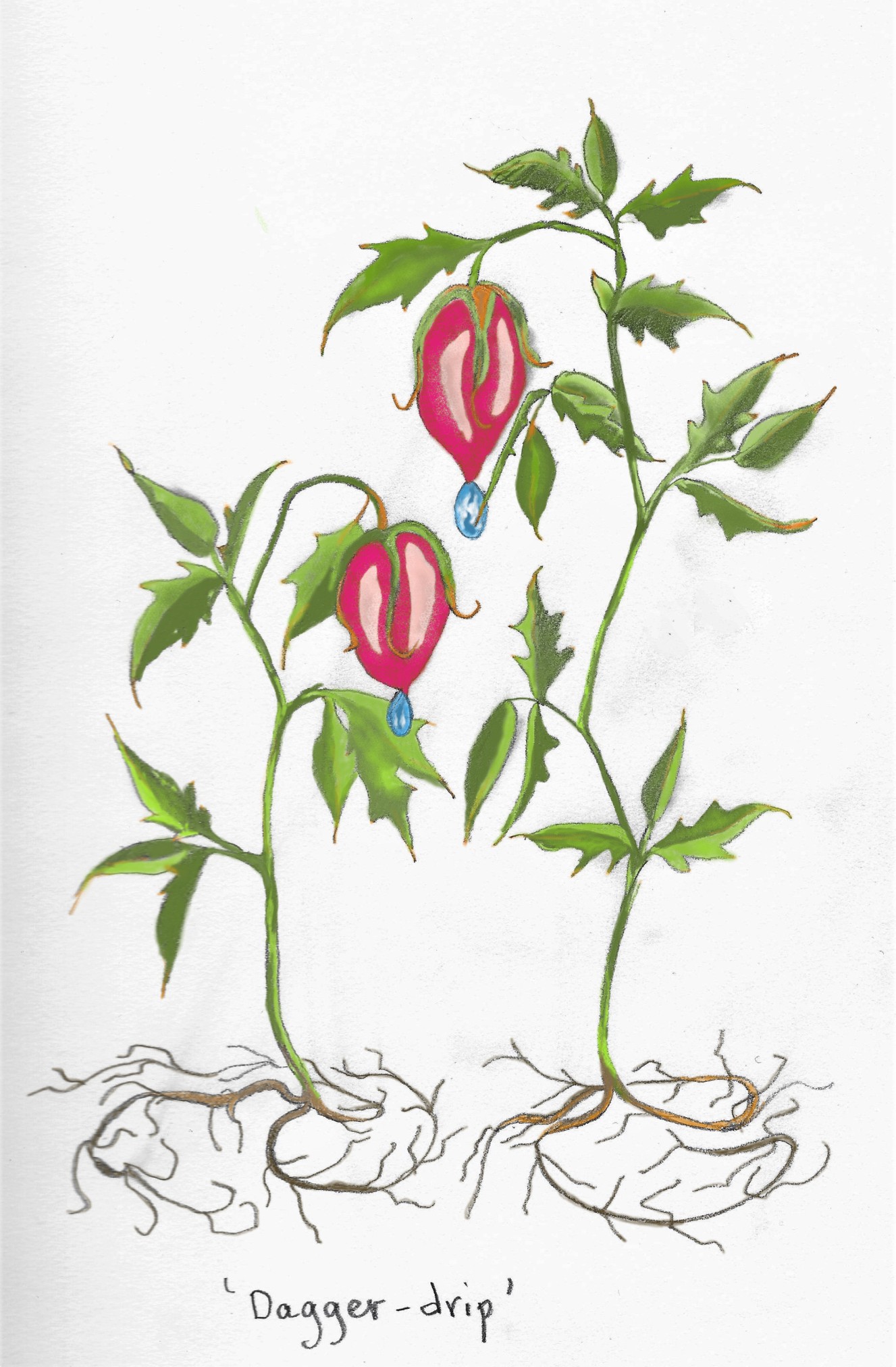
8. ‘Meniscus: A Flora‘ – Complete a list of the alien plants featured in my Meniscus Science Fiction Series and check this against the drawings I have done to see if more drawings are needed. This will push forward my work on a manuscript featuring coloured drawings of plants encountered on the planet featured in my science fiction series.
~
9. More frequent blog posts! This year I will do four blog posts per month featuring elements of my writing goals. This allows a lot of scope since it will explore my interests in writing, drawing and painting, botany, bird watching and history.
~
I am energized and looking forward to my writing life this year. In my next post, I will look a little closer at ‘mnemonic’ and the inclusion of sounds in poetry.
All my best!
Jane (a.k.a. Alexandra)
still writing
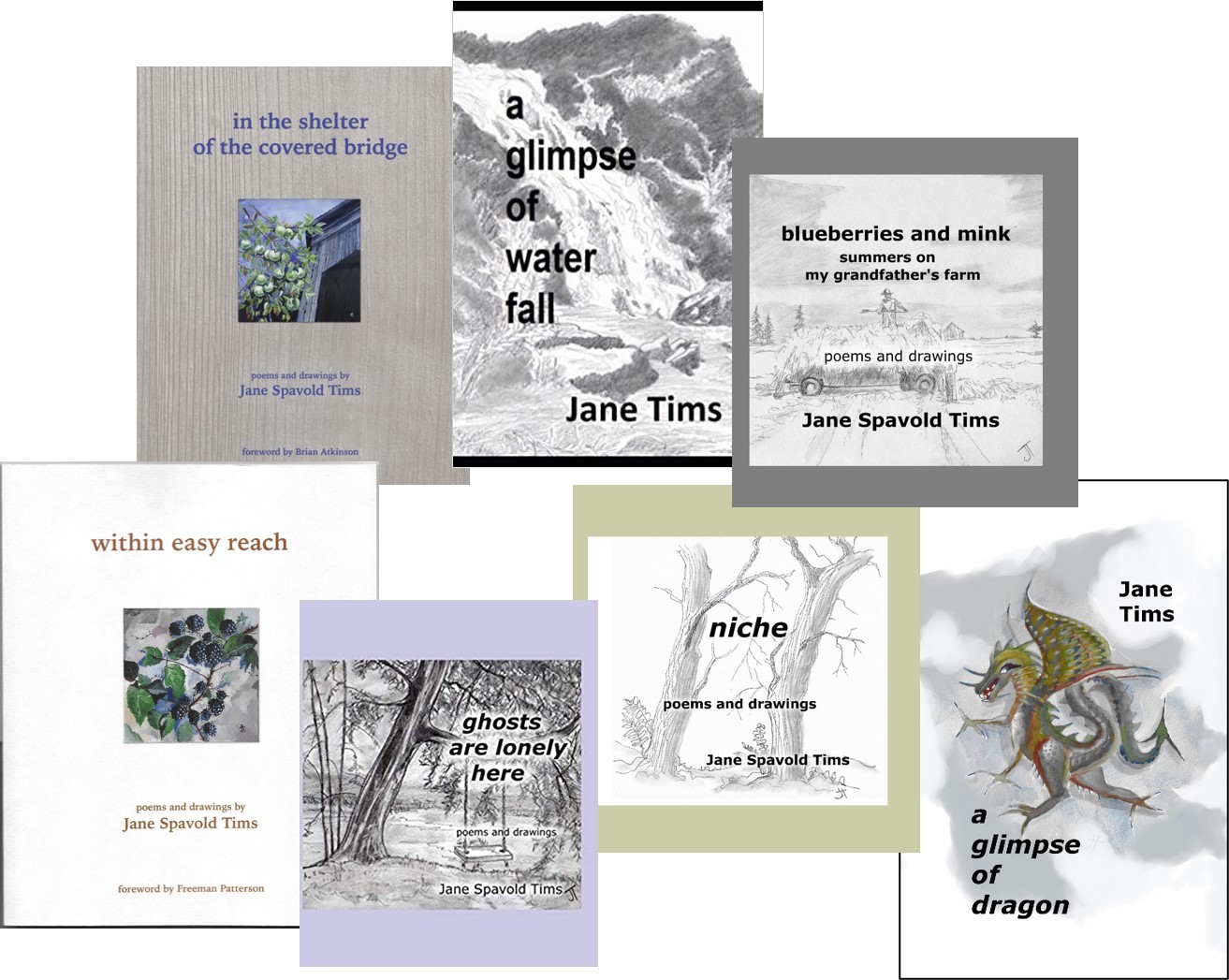
When I retired in 2012, I had my next phase of life well-planned. I had applied for a Creations grant and so stepped right into writing my first book. Since then, in ten years, I have published seven poetry books, twelve science fiction books and four Kaye Eliot Mysteries. Two of the poetry books were published with Chapel Street Editions; the rest, I have published myself with Kindle Direct, learning the formatting process as I go.
~
~
I still have a few books waiting in the wings, including three books in my upcoming Writers Retreat Mysteries and five novellas in an Urban Adventure Series. I also have the poems for at least three more poetry collections, including one about ‘sounds in nature’ to be published by Chapel Street Editions next year. And I have new ideas all the time.
~
At present, I am completing my first non-fiction book, a history of my great-grandmother Ella (Hawk) Norman (Ella:1859-1933). Ella began her life as one of the Pennsylvania Deutch, the community of German immigrants to Pennsylvania established in the 1700s. As an adult, Ella traveled to the west and spent years in Laramie, Wyoming, where she married, and Denver, Colorado where she built a life for herself and her young son.
~
~
The book includes the research done by me and by my aunt, Dr. Jane Margaret Norman. Genealogy is a unique type of writing because the work can never be truly completed. There is so much still to learn about Ella and new tools, such as DNA analysis, are helping to add to her story. However, I have enough information to publish the book. Only a few more edits to go.
~
The audience for this book will include Ella’s descendants and relatives in her Family Tree, as well as other genealogists who are interested in my methods. I have also included a creative element, a series of poems written as a tribute to Ella and her family.
~
I think the book will also be of interest to those curious about ‘women’s history.’ Ella was one of those brave folks who traveled west in the 1880s at a time when the railroad made travel to the west more accessible than ever before. Her sister, Sadie Hawk, who was a big part of her life, was an example of a single woman who supported herself in a day when women had few rights and were at a disadvantage in a world where women were expected to marry.
~
I have completed the painting for the cover of the book. The lower part of the image, a garden of columbines and poppies, represents the security of home in Pennsylvania. Ella stands at the edge of the garden path in silhouette, looking toward the west and the mountains near Laramie, Wyoming. My Uncle Francis who knew Ella, his grandmother, told me Ella never forgot the west after she returned to Pennsylvania and always planned to return some day.
~

~
I wish you well with your own endeavors. If you are a writer, what projects are you working on and what stage in the process most intrigues you? If you are interested in your own family history, what ancestor interests you the most and why? If you are a reader, perhaps you will try one of my books, or look forward to the release of Ella-1859 to 1933.
~
All my best!
Jane
stained glass
Of all the media I have tried, working with glass has been the most satisfying, the most dangerous, the most fun, and the most dangerous. Did I say I think this medium is dangerous?
~
In 1995, I took a course in making stained glass. I had visions of completing a box light for above our bar. Something with parrots fluttering among broad Monstera leaves. In those days I was in full decorating mode and the home bar was to be called ‘le parroquet.’ It had a large artificial tree, vines from the ceiling, a three-panel diorama of African plain, a life-long collection of Tarzan books, and dozens of parrot bric-a-brac: parrot-shaped mugs, stir sticks and cushions. Some of this still exists, but the only part of the bar light completed was a lone parrot, unfettered by vines and leaves.
~

~
As I worked with the glass, I dreaded my sessions more and more. First I worried about being cut by the glass. Part of the process means scoring and breaking the glass into needed shapes. I actually never cut myself, but I worried that I would.
~
For ten years of my professional career, I worked in the field of air quality, so I was sensitive to issues of inhalation of particulates and gasses. As I honed the edges of the pieces of glass, I was aware that the process sent a fine glass powder into the air. I wore a mask, but felt lingering glass particles might be a result of the process. Next, the process involved laying down of lead solder between the bits of glass: use of flux and solder added to my air quality concerns.
~
In the end, I worked with stained glass less and less, and today, I have only a few pieces to represent my foray into making of stained glass. I know there are many stained glass artisans who work safely with beautiful results. But the medium was not for me.
~
Nevertheless, I can continue to ‘work’ with stained glass in my writing life. The next Kaye Eliot Mystery will be titled Stained Glass and will feature a stained glass artist who uses his medium to tell the story of a mystery four decades old. Working with stained glass may be dangerous, but hanging around with this particular stained glass artist might be dangerous too!
~
Stained Glass is now in the proof and beta-reading stage, so it will be published by March, 2022. For those who have enjoyed the previous Kaye Eliot Mysteries, this will be an enjoyable read. If you haven’t followed the mystery-loving family before, have a look at How Her Garden Grew here.
~
All my best,
and no cut fingers!
Jane
Book Launch
If you live in the Fredericton area, I will be at Westminster Books tomorrow, Saturday, from 1 to 4 to launch the next in the Kaye Eliot Mystery Series, Land Between the Furrows. I will be there with friend Chuck Bowie who is launching two books: Her Irish Boyfriend (in the Donovan, Thief for Hire Series) and, writing as Alexa Bowie, Death Between the Tables (in the Old Manse Mystery Series).
~
In these worrisome times, we will be wearing masks and keeping our distance. And no cake will be served.
~
Looking forward to talking about mystery writing and local books!
~
My best to you!
Jane
Starting a new book 3
So the first draft of my new Meniscus book is written. I have completed a Table to help me through revisions. Now I will do a series of scans to make certain the book is the best it can be.
~

~
Revision 1: Refinements. I read through the draft, making edits and adjustments. This includes alterations to punctuation, alternative word selections, re-phrasing to refine the cadence, spelling, suiting of dialogue to character and so on. Of all the revision stages, this step takes the most time and effort.
~
~
Revision 2. Continuity. Because my book is part of a series, I have to consider the action that occurs in previous books and in books-yet-to-come. I have thought through and written drafts for each future story in the series, so I can ‘see into the future’ and include small set-ups for future actions. I also have to make certain settings, characters and actions are consistent with respect to previous books. For example, today I found a place where a character with three brothers has only two in a past story. I also like repetition in series I read, so I have certain things I mention in every book: the scar on Odymn’s forehead, the moons, the tattoos on the Dock-winder’s necks, and so on. I keep a checklist of these in a writing compendium for the series.
~
~
Revision 3. Conflict. Using my Table, I make sure each chapter includes a conflict. This could be an internal conflict, played out in the thoughts and actions of a single character, a conflict between two or more characters, or a conflict between character and setting (for example, a character wakes in a dangerous setting where breathing is difficult). I summarize each conflict in my Table.
~

~
Revision 4. Change. I want each of my characters, major and minor, to have a want and a need, and show change during the book. For example, Odymn wants to return to her home on Earth, but to be happy, she needs to make a home for herself, even on an alien planet. By the end of the book, she will realize she will never return to Earth, but that home is where you find those you love.
~

~
Revisions take time. The re-reading can make a writer bored with his/her own ideas. But every revision pays its own way in terms of improving the story for both the writer and reader.
After revisions, editing remains to be done. This includes conceptual, structural, substantive and line edits.
~
Hoping you are making progress with your own writing,
and staying safe,
Jane (a.k.a. Alexandra)
Starting a new book 2
Today, I finished the rough draft of my new book in the Meniscus Series. This book will deal with discovery of a secret that will bring down the nasty Dock-winders.
The working title of the book is Meniscus: Resistance.
Before you become amazed at my productivity, remember that my Meniscus stories are in narrative poetry and are a quick read. At this early stage, this book has 11,600 words.
~
The next step in my process is tedious, but very helpful.
~
I create a Table of Chapters. Each ‘Chapter’ in the table is described by ‘What happens,’ ‘Setting.’ ‘Point of view,’ ‘Characters,’ and ‘Theme Progress.’ I can work through my entire document:
- change all the place holders to actual Chapter numbers;
- make certain the setting is described in detail;
- ensure point of view in each chapter is clear and does not waver;
- list the characters in the chapter and ensure everyone has a role to play; and,
- check on progress made towards resolution of the story.
Table of Chapters for Meniscus: of Resistance
| Chapter | What happens | Setting | Point of View | Characters | Theme Progress |
| Prologue | James escapes | Space dock | James | James, D, DW, GH, Drag’on | Introduce antagonists |
| 1. | Trath crawls from mine | base of Flame Mtn | Trath | Trath | Trath escapes |
| 2. | Abra finds six glyphs | obelisk at The Tip | Abra | Abra | Abra finds glyphs |
| 3. | Evening meal at Hath’men | Village of Hath’men | Omniscient | James, Drag’on villagers | Drag-on set apart |
| etc. |
~
If the story is missing an ending, or has continuity issues, this building of the table helps me to focus on the story progress and, by the time the table is completed, the story is more complete.
~
Once these tasks have been done, the Table of Chapters can be set aside and used later for any stage of the revision process. For example, I can check each chapter for phases of the moon, so the full moon doesn’t occur two days before the crescent moon! I also use the table to make certain the illustrations are evenly distributed throughout the text.
~
~
Off I go, to fill out the Table of Chapters and to find an ending for my book.
~
All my best!
Stay safe.
Jane




 nichepoetryandprose