Posts Tagged ‘poetry’
ice falls
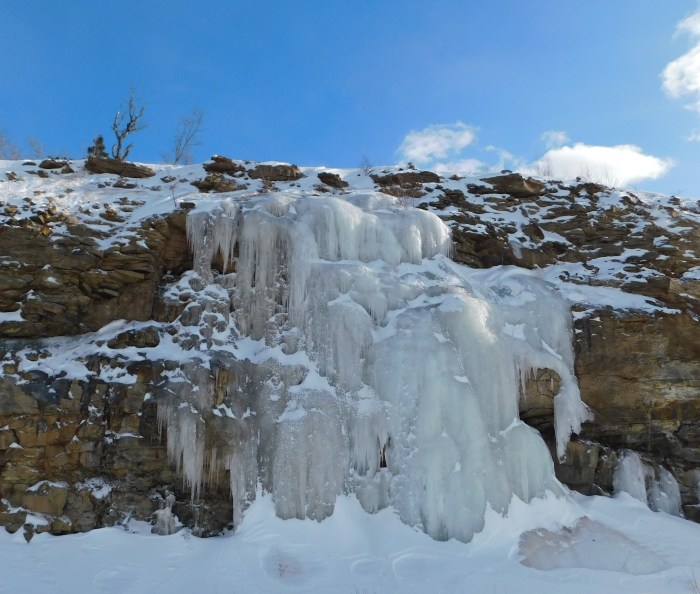
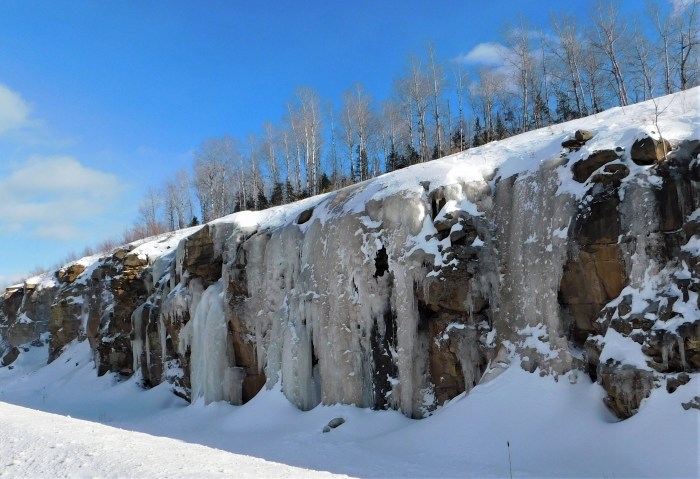
Last weekend we took a drive along Highway 8 from Fredericton to Boisetown, a relatively new road to bypass Marysville and the older winding road along the Nashwaak River. For some of its length, the highway has been carved through bedrock and includes several impressive road cuts. I find these interesting because they show the geological formations in the bedrock. In winter, they are beautiful, a result of the frozen curtains of runoff and overland flow.
~

~
Some of these cuts show thick ice flows, frozen waterfalls and dripping icicles.
~
~

~
Most are browning in colour, probably from inclusion of sediments, but some are clear and blue.
~
~
In a few places, it’s possible to look through gaps in the flow, and get a glimpse of the still, cold spaces lurking just out of sight.
~
 ~
~
~
curtain of ice
~
frozen land drools, and water
follows contours of rock
encounters cold, sculpts
cataracts and waterfalls, builds
frozen walls, solidifies
panes of glass, stitches
curtains of frost and filigree
icicle knives
~
behind the curtain are caves
spaces where light glimmers,
diffuse where whispers shiver,
muted, protected from wind
glimpse inward layers
through flaws in rigid curtains
frosted shards of rock
icicle knives
~
~
For more on ice falls, including another poem, see
https://janetims.com/2012/03/10/snippets-of-landscape-ice-falls-on-rock-walls-2/
~
My best always,
Jane
Ice dance
In southern New Brunswick, we are recovering from a snow and ice storm. My husband has been in the tractor, removing snow and ice, for two days. Between runs with lunch and diesel, I am reading Ann Cleeves, one of my favourite UK detective authors. The phone rings and I am wrenched from a very different kind of storm in the Shetlands to a neighbour who wants the services of an ice-gobbling tractor.
~
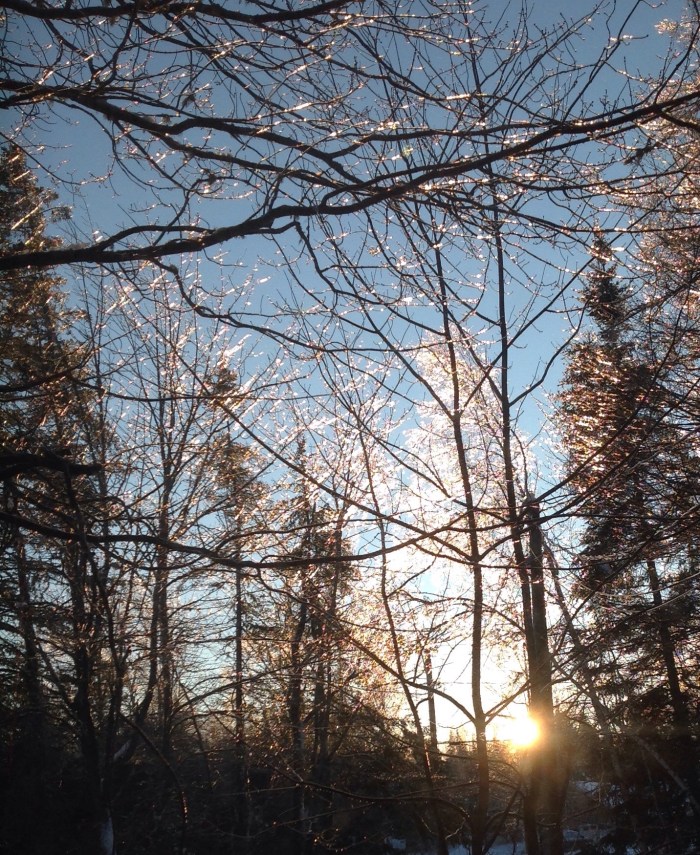
As the sun goes down, I re-live the beauty of the day. Chickadees, a downy woodpecker and a red squirrel spent the afternoon competing for the sunflower seeds in our feeder. Every tree is laden with ice and the wind stirs up powdery snow-devils across open places. The evening begins with memories of glassy trees and the faint tinkling of their twigs and branches.
~
Every twig wears
A diamond bracelet.
A wrist turned,
Just so,
To join in the dance.
~
~
All my best,
Jane
pantoum on morning
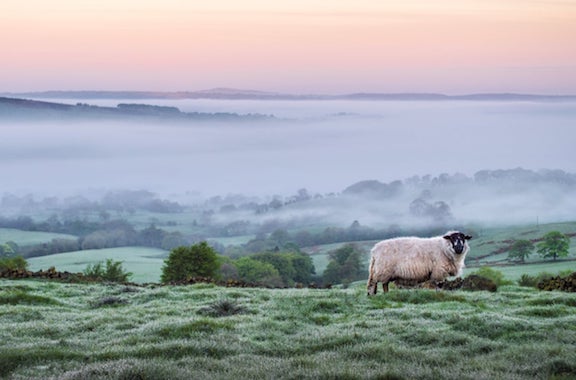
A couple of months ago, a friend from my Fictional Friends writing group suggested the image below as a writing prompt. The image reminded me of my once-daily morning commute where I would often see the settling of the morning mists in the low valley of the Saint John River.
~
~
morning mist
~
wake in morning, wool-headed
reluctant to start the day
fog settles as droplets of dew
webs woven over pasture
~
reluctant to start the day
fleece teased over hollows of hill
webs woven over pasture
hesitation of a solitary ewe
~
fleece teased over hollows of hill
disperse as sun stretches arms
hesitation of a solitary ewe
drowsy as dreams feather into deed
~
disperse as sun stretches arms
push back pillows and duvet
drowsy as dreams feather into deed
woolen blanket of valley mist
~
push back pillows and duvet
wake in morning wool-headed
woolen blanket of valley mist
fog settles as droplets of dew
~
~
I have been thinking about prompts for writing: images, collage, words, phrases, sentences, and so on. Just google ‘writing prompts’ for a barrage of ideas. Writing prompts can be used to combat ‘writer’s block’, to suggest new pathways for writing or to find new metaphors.
~
For a poet, I think another type of prompt is ‘form’. Form suggests new patterns of expressing an idea. For the poem ‘morning mist‘, I used a photo as a visual writing prompt and the pantoum form (with modifications) to explore new ways to pattern ideas about morning.
pantoum – a poetic form written in any number of quatrains with an abab rhyme scheme and repeating lines: the first and third lines of any stanza are the same as the second and fourth lines of the preceding stanza; the first and third lines of the opening stanza are used as the second or fourth lines of the last stanza. The last line of the poem may be the same as its first line.
I like the interweaving of ideas and emerging images as the pantoum proceeds. The repetition slows the poem and establishes echoes within.
~
All my best,
Jane Tims
rural to urban
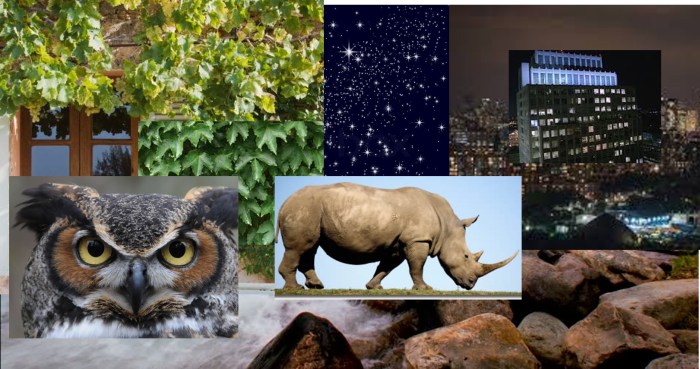
In one of my recent posts, here, I wrote about a course I took using collage-making as a writing prompt. To help us visualize the method, the teacher (Lynn Davies) gave us examples of collages she had built and asked us to do some response writing. Here is a facsimile of Lynn’s collage and the poem I wrote in response.
~
~
Relocating the Rhino
~
We move,
rural to urban.
Exchange night song
for traffic noise.
Swap canopied trees
for storied buildings,
~
night stars and Jupiter
for wall switches
and tic-tac-toe
of energy leak
from offices
in skyscrapers.
~
Beneath our feet,
rocks become fluid,
magma, electric blue.
Footing uncertain
on rocks
that wobble.
~
We armor ourselves,
chose tenement addresses.
Turn off lights
to save our silver,
wish for stars
in the night sky.
~
See only
tired workers,
keeping
the lights on
way past
quitting time.
~
~
Since I am a community planner and environmentalist, the interpretation of the collage comes as no surprise. The surprises (for me) are the rhino as metaphor for humans moving into the urban setting and the comparison of the twinkle of office buildings to the twinkle of rural stars. Implied is the irony of rural workers, seeking a better life, working even longer hours when they migrate to an urban life.
~
All my best,
Jane Tims
black ice
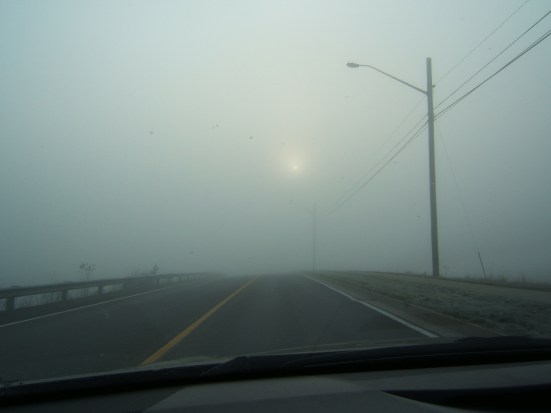
black ice – a transparent coating of ice on a road, usually asphalt
~
Winter comes with its driving challenges. Heavy snow, slippery roads, poor visibility … a good driver is aware of them all. Black ice is particularly challenging … it’s hard to see, often unnoticeable until you are trying to navigate across it. It may look like bare pavement, smooth sailing all the way! Black ice can be a metaphor for any dangerous encounter in our lives.
~
~
charisma
~
your eyes glitter
crystals of salt
I think you are
untrustworthy
your charm a veneer
~
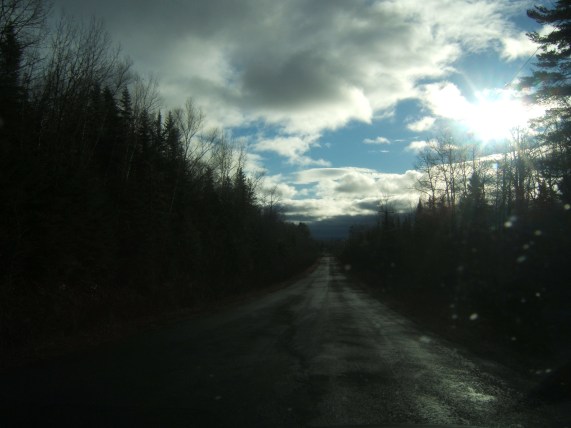
black ice only shows
in a stray beam
of moonlight
or when headlights are switched
to high
~
~

Drive with care in every incident of life!!!
Jane
out of place
One of the advantages of belonging to a regional writing group — regular opportunities to refresh the writing mind and put new tools in the writer’s kit.
~
This past month at WordsFall, an annual event of the New Brunswick Writers’ Federation, I took a course from well-known poet Lynn Davies (author of how the gods pour tea, 2013, Goose Lane Editions, The Bridge That Carries the Road, 1999, Brick Books, and others). Lynn’s course Paper Moon, Paper Shoe: Writing and Collage introduced me to an new idea, using paper collage to inspire and renew.
~
In a couple of very enjoyable hours, Lynn showed us how to build a collage from magazine images and other paper scraps. She showed us examples of collages she had made and set us to work on our own collage. Her instructions were to select images that appealed to us at the moment and not overthink the choice of images. After the images were glued to a card, we took some time to write about the collage and the ideas it suggested.
~
Here is the collage I produced and the resulting poem.
~

~
out of place
~
An orange tree
in temperate soil,
among caraway
and dill.
One red tile
in a zigzag
of black and white.
~
Shoes take me
for a walk
in barley grass
and caraway.
Melon rinds
on size five feet.
Too slippery, too wide.
~
Garlic and dill
by lantern-light.
Ten after ten
on the hall clock.
Pickles and port
and a splash
of blackberry wine.
~
Floor-plan,
when the lights go out,
makes no sense at all.
Dormer rooms
too tight
and me too tall.
Caraway among the dill.
~
Salt on wounds.
Seeds in pickle jars.
Willow trees scratch
at window glass.
Garlic to banish
grinning skulls,
creep beneath tiles.
~
~
Next time you struggle for inspiration, consider generating some new ideas with collage.
~
All my best,
Jane Tims
first ephemeral snow
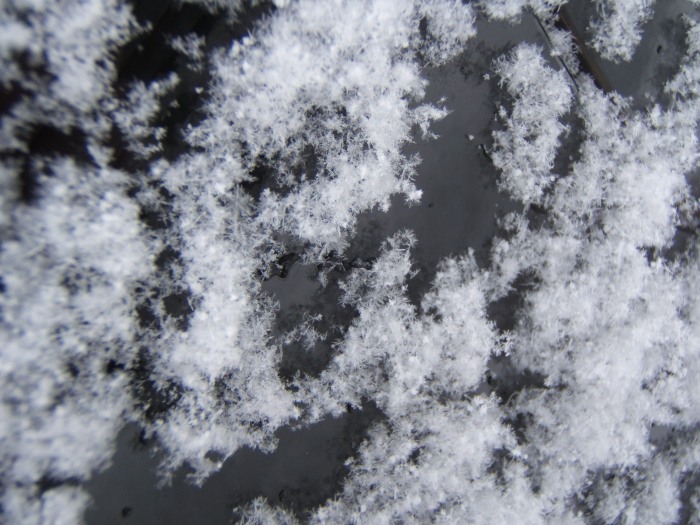
snowflakes
absorbed by wet pavement
as though
they never existed at all
~
~
all my best,
Jane
Jack-o-lanterns

~
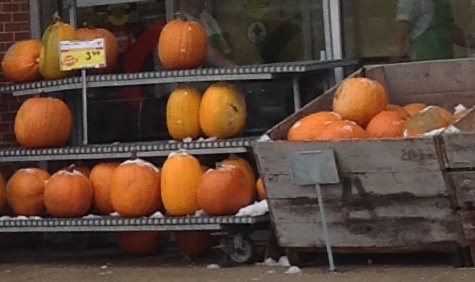
pumpkins, anonymous Jack-o-lanterns
huddle in snow, flakes melt
and tears slide down
undifferentiated
cheeks
~
people pass by and fail
to recognize
featureless
family
~
Happy Hallowe’en
Jane
sampling a story
This week, my new book Meniscus: Karst Topography is out. Follow the continuing adventures of the Humans at Themble Hill … aliens have taken Kathryn, Meghan, Vicki and Madoline from the Village and the Slain go on a dangerous rescue mission to Prell. But at least two of the women don’t need to be rescued … they have found their own ways to get the better of the Dock-winders.
~
Did you know you do not have to purchase the book if you are part of KU (Kindle Unlimited) and KOLL (Kindle Owners’ Lending Library). Just go to Amazon and read a sample of the book before you decide to buy or not. This is a support for authors since authors are paid by KDP for pages read. https://www.amazon.ca/dp/1548434396

Thank you so much for trying out my new book or any of the series.
All my best,
Jane (a.k.a. Alexandra)
after a poetry reading
Why do you go to poetry readings? Is it because you are supporting a writing friend? Because you love poetry? Or because you search for the perfect poetic experience — the memorable reading of an unforgettable poem, expressive words you know you will always be able to summon. Have you ever left a poetry reading feeling renewed, animated, believing in the impossible?
~
I attend a lot of readings. I go to support my writing friends. I go because I love words and poetry. I also go because I long for the memorable. Occasionally, I will hear words, phrases, poems to thrill me for the rest of my life.
~
I have had many such experiences. I have been privileged to hear Roo Borson read her poem Grey Glove. I have heard Roger Moore read poems from his book Monkey Temple with his stirring Welsh accent. Years ago I heard a young Irish poet read her poem about a kettle boiling on the stove, and I have never forgotten her words even though I have forgotten her name.
~

~
after the poetry reading
~
Bailey Drive is a steep incline
for an out-of-shape heart
a pause returns the thud in ears
to chest where it needs to be, a moment
to see maples on the Aitken House lawn
animated by wind, as metaphor for adrenaline rush
of words
~
as trees send Tesla coil sparks into blue sky
from trunks constrained by building
and sidewalks, to branches and twigs
unfettered, plasma filaments bloom
on fractal paths
~
another pulse, trunk to bud-tips
and another, signals up and outward
heart slows and holds in place
lightning throb in continuum of space
~
~
All my best,
Jane




 nichepoetryandprose