Posts Tagged ‘poetry’
American Black Duck
On our drives along the St. John River this month, we have tried to identify as many ducks as possible. There are actually not a lot of species to sort through, but we are just learning. Among the ducks we have seen this May are the American Wigeon (Anas americana), the Mallard (Anas platyrhynchos), the Green-winged Teal (Anas crecca), and the American Black Duck (Anas rubripes). These are all Marsh Ducks, surface feeders of ponds and marshes. The species in this Subfamily feed by ‘dabbling’ and ‘upending’… delightful words!
One weekend, we watched a male American Black Duck for quite a while. He flew around a bit, flashing his white wing linings, and then floated slowly along a back passageway through the marsh. He was very dark brown, with a tan head, a yellow beak, and a bluish wing patch. The best part of the experience was his deep croaking, each croak about a second long, and sounding like a little like an unimaginative bullfrog or two pieces of smooth wood being rubbed slowly together.

~
The poem below requires a short explanation. Two months ago, I attended a workshop on climate change at the offices of the North Shore Micmac District Council in Eel Ground, New Brunswick. I was given a gift afterward, a calendar showing the names of the months in the Mi’qmak language. The names are beautiful and describe well characteristics of the natural world during various times of the year. For those of you who do not live in this part of the world, the Mi’kmaq are a First Nations people, indigenous to this region.
~
~
Frog-Croaking Moon – Etquljuikús
(Mi’qmak name for the May moon)
~
under the May moon,
bullfrogs glub-grunk,
underscore spring peeper trill
~
rasp of a Black Duck
rowing in the reeds
~
friction
of fir and maple
grown to lean on one-another
~
~
© Jane Tims 2012
making friends with the ferns #2
The onset of plants in spring is overwhelming. This year, I seem to see ferns everywhere, probably because the fiddlehead of the Ostrich Fern is a delicacy in New Brunswick. The Ostrich Fern (Matteuccia Struthiopteris (L.) Todaro) grows in riparian (shoreland) areas all along the St. John River and its tributaries.
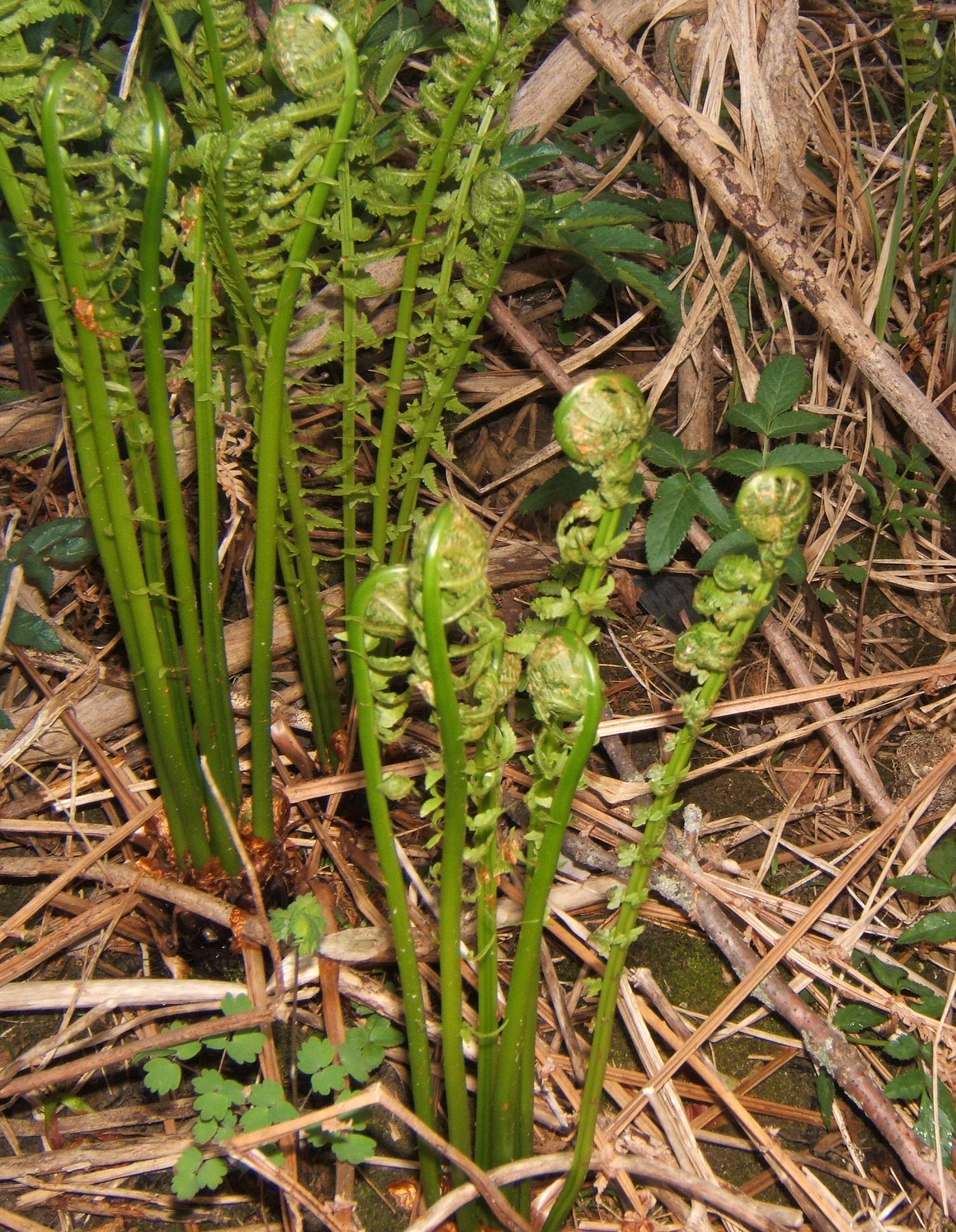
This time of year, car and trucks park in small roads off the old Trans-Canada, and you can glimpse people picking fiddleheads in lowlying places along the river. They concentrate on what they are doing, their backs bent, hardly looking up from their picking. People have favorite fiddleheading spots and usually follow a code, leaving a percentage of the fiddleheads to grow and sustain the ferns for future years.

I only picked a few fiddelheads this year. They were a little older than they are ordinarily picked, but they were delicious. The best fiddleheads are picked when they are just above the surface. After picking they are cleaned, a very easy undertaking, and boiled or steamed until very well cooked.

The cooking liquor is discarded – its dark amber-red color is due to high concentrations of shikimik acid. Once cooked, the fiddleheads are a flavorful green, served with butter or margarine. When my husband was young, his family ate a meal of fiddleheads, new potatoes and shad at fiddleheading time.
Warning: 1. never eat any plant if you are not absolutely certain of the identification; 2. never eat any plant if you have personal sensitivities, including allergies, to certain plants or their derivatives; 3. never eat any plant unless you have checked several sources to verify the edibility of the plant.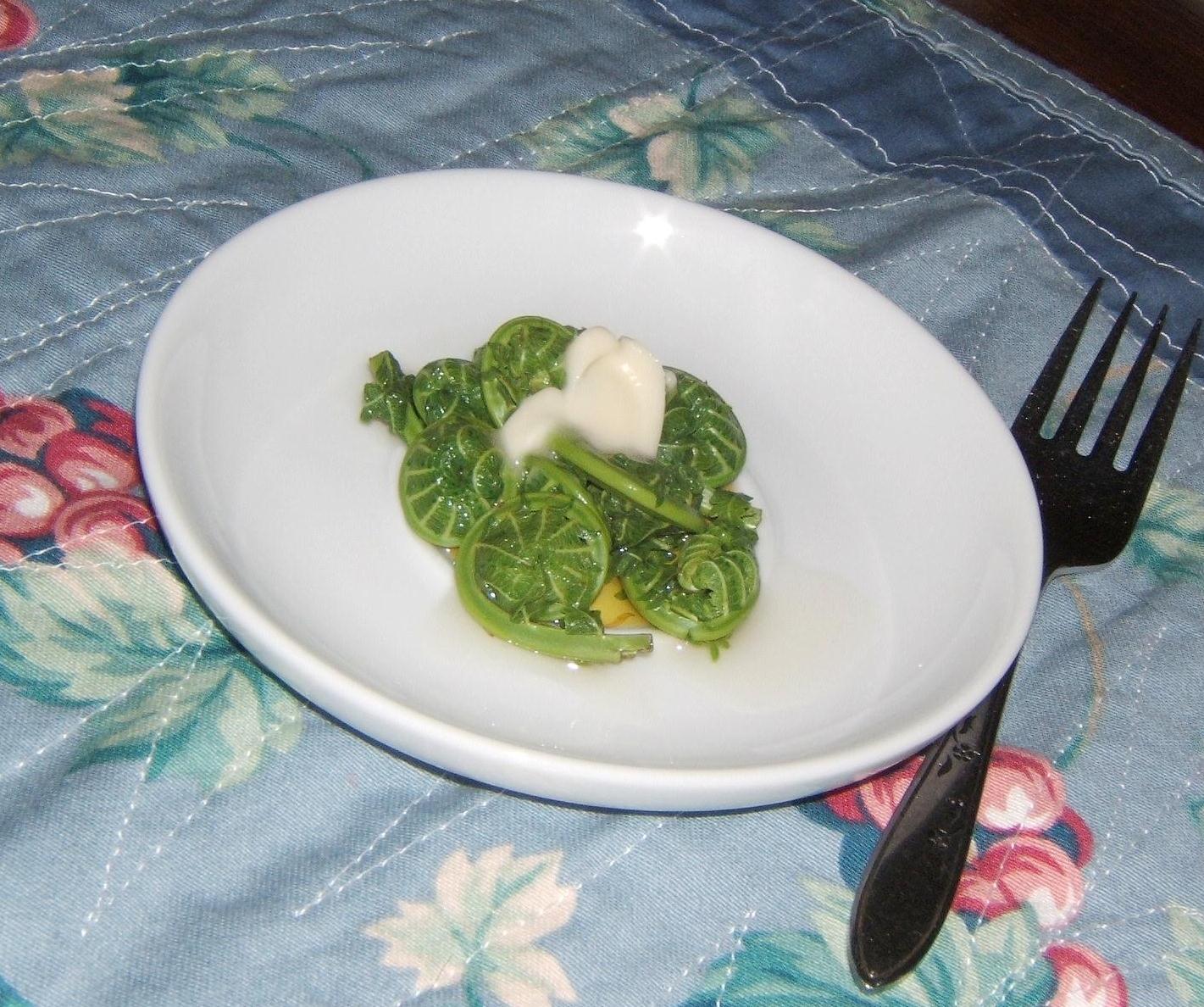
In town, people are selling fiddleheads from trucks and at small stands, and there will certainly be Fiddleheads at the Farmer’s Market today in Fredericton. Usually, the sellers do a brisk business, keeping the fiddleheads fresh in portable coolers and in buckets. I watched a vendor bagging the green fiddleheads, giving the clear plastic bag a deft twirl to seal it before he handed it to the buyer.
Have you ever eaten fiddleheads?
~
~
waking from a dream
Ostrich Fern (Matteuccia Struthiopteris (L.) Todaro)
~
bottom-land thicket
naked in spring
a rumpled bed
the throws of hibernation
~
new growth cocooned
in dry leaves, bent skeletons
last summer’s fern
~
sun surge
insult
between curtains
~
green fiddlehead
uncoils
head down
hesitant fist thrust
between pillows and down
stretches fingers
filigreed shadow
new blocking of sun
~
brown coverlet
kicked
~
new green bedspread
new green canopy
green shade
~
~
Published www.nichepoetryandprose.wordpress.com Nov. 9, 2011
© Jane Tims 2011
Warning: 1. never eat any plant if you are not absolutely certain of the identification; 2. never eat any plant if you have personal sensitivities, including allergies, to certain plants or their derivatives; 3. never eat any plant unless you have checked several sources to verify the edibility of the plant.Purple Violet (Viola cucullata Ait.)
The Purple Violet is the floral symbol of my life. It is the official flower of the province where I live. It is one of the many species in my lawn, and the theme for my guest room. Every card my Mom and Dad ever sent to me has an image of violets.
Purple Violets are loved by many people. In New Brunswick, they were adopted as the Provincial Flower in 1936, at the request of the provincial Women’s Institute. The violet is also the State flower of Illinois, adopted in 1907 by schoolchildren in the State.
The Purple Violet ((Viola cucullata Ait.) is also known as the Hooded Blue Violet, the Marsh Blue Violet, the Long-stemmed Marsh Violet, and, in French, violette cucullée or violette dressée. The Latin species name means ‘hooded’ from the inrolled young leaves.

The Purple Violet is a low-growing perennial preferring wetlands, or low wet areas in mixed or coniferous woods.
The leaves are simple, with a long stalk. They are often heart-shaped, with rounded teeth.
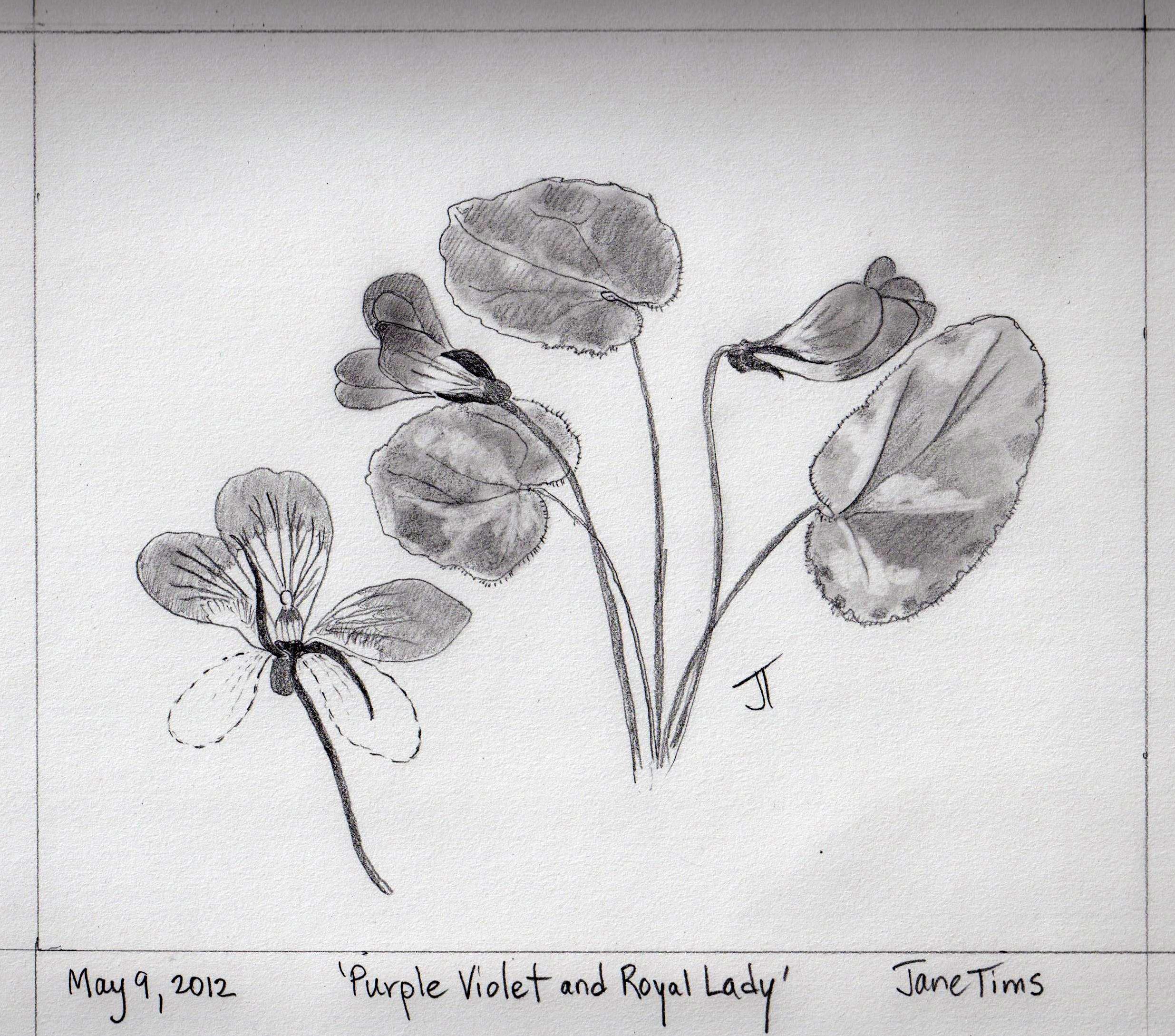
The Purple Violet blooms in May. The flower is held on a long peduncle (stalk) above a basal rosette of leaves. The flower is dark blue, purple or occasionally white, with five petals darkly veined towards the center. The lower petal is short and spurred, and the two lateral petals are bearded. Bearded petals have clusters of tiny thick hairs, rounded at the tip.
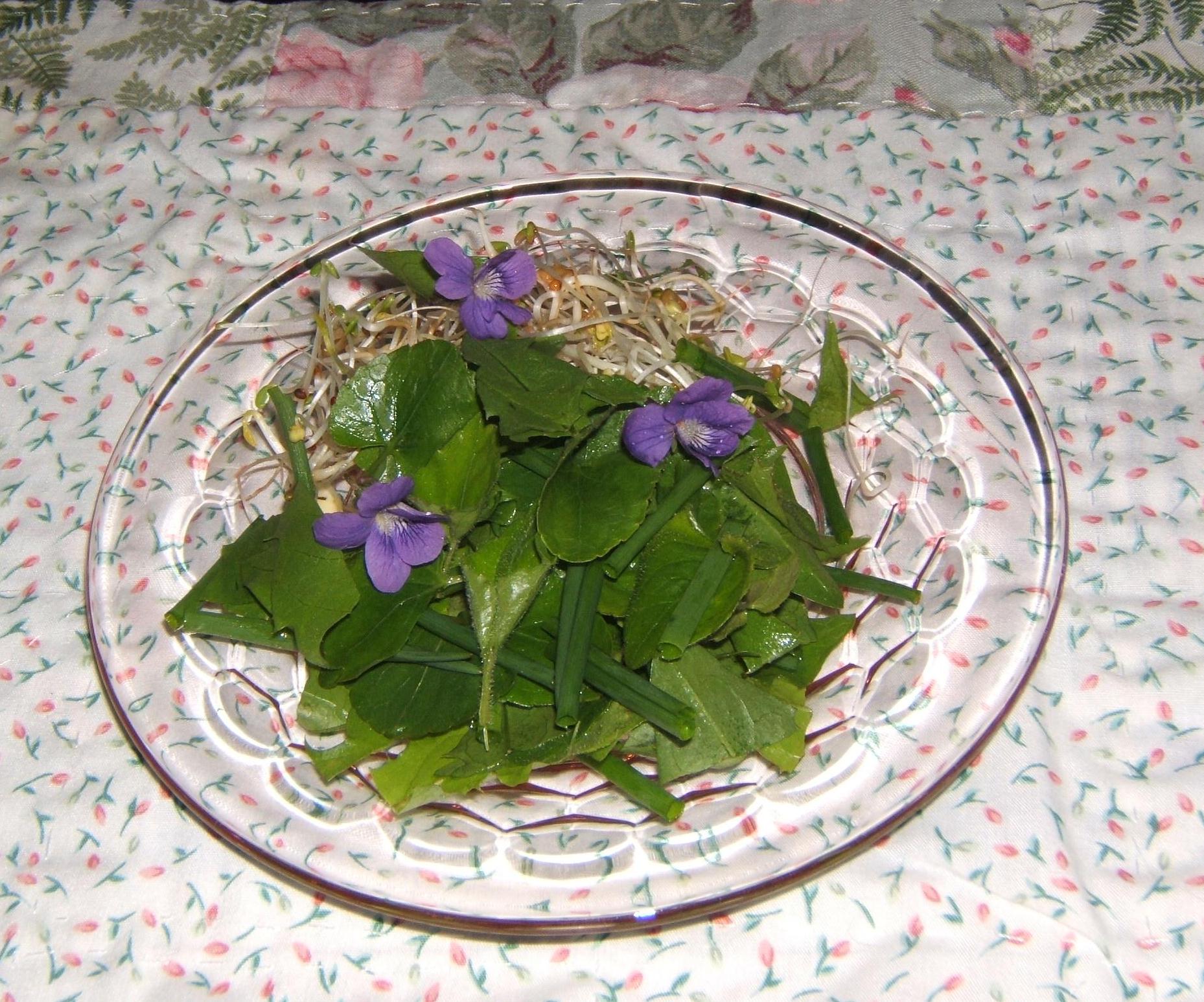
The leaves can be eaten raw or cooked, used as a thickener in soup, or to make a tea. The flowers can be added to a salad or used for edible decoration. My salad is made with Purple Violet leaves, Dandelion greens, chives from our garden and my own sprouts. I added three flowers for their delicate taste and decoration. Always be sure of your identification before you eat anything from the wild!
Although I do not advocate the wanton dismemberment of flowers, the violet holds a charming secret for children of all ages. If you gently pull down the ‘upper’ two petals from the flower, you can see a little lady with a white head and orange gown, sitting against the backdrop of her purple throne.
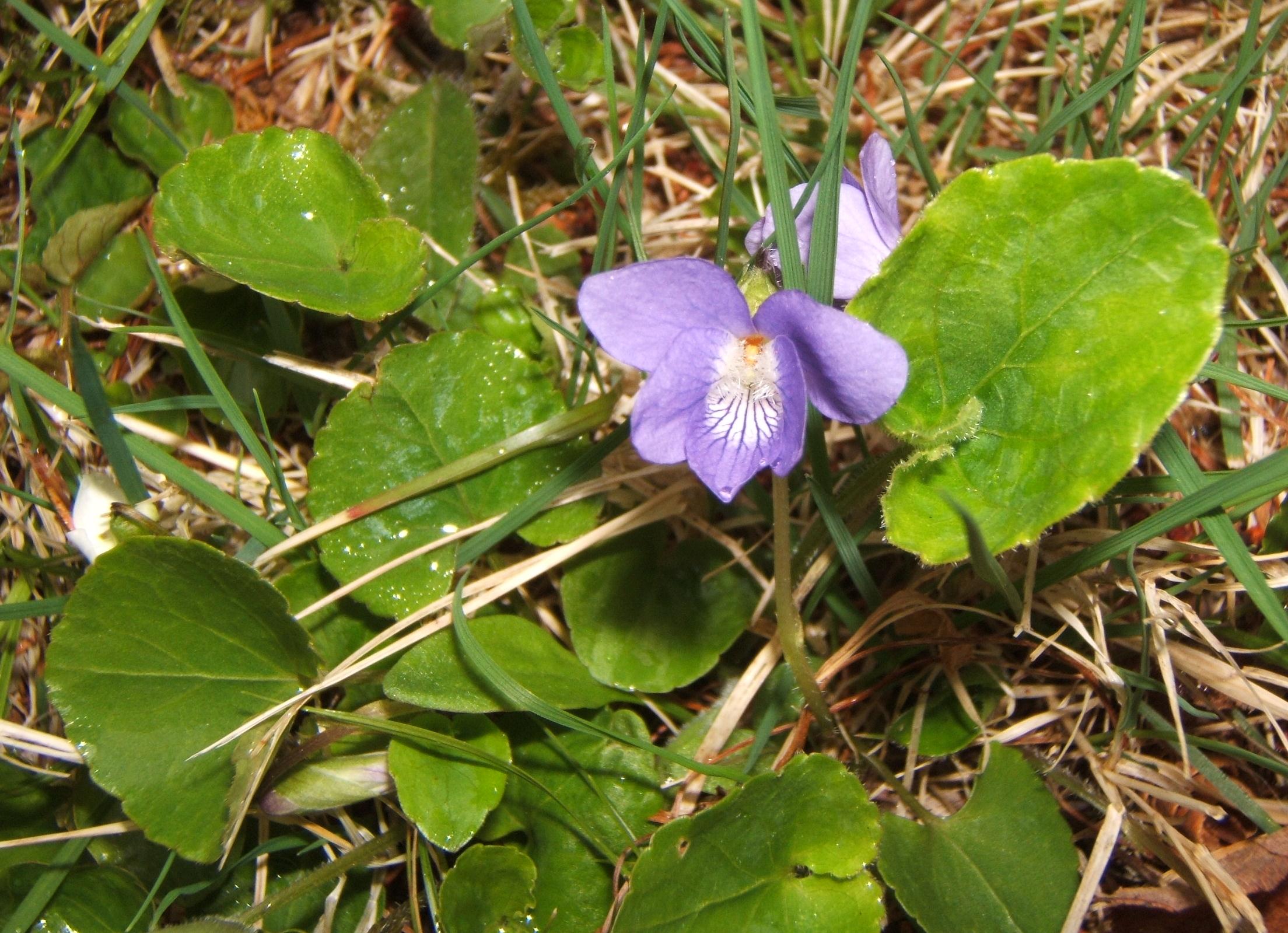
Purple Violet holds a royal lady… in this flower, you can barely glimpse the lady against her throne. She is upside down. You can see her white head and the top of the skirt of her orange gown.
~
~
Marshland Rule
Viola cucullata Ait.
~
within the perilous
limits of the rimless marsh,
disguised in woodland green,
spurred by deep viola speak
and crowds of envious hearts,
the hooded ranger guards
the tiny queen, long stemmed
tenderness, slenderness hid
by the folds of her orange gown,
seated against her purple throne,
flanked by wise men
bearded,
eager to advise
~
~
Serviceberry (Amelanchier sp.)
In the corner of our property is a usually-inconspicuous bush struggling to become a tree. This time of year it comes out of anonymity in full bloom. Today it is covered in white flowers – in a week it will be a scattering of confetti on the ground.
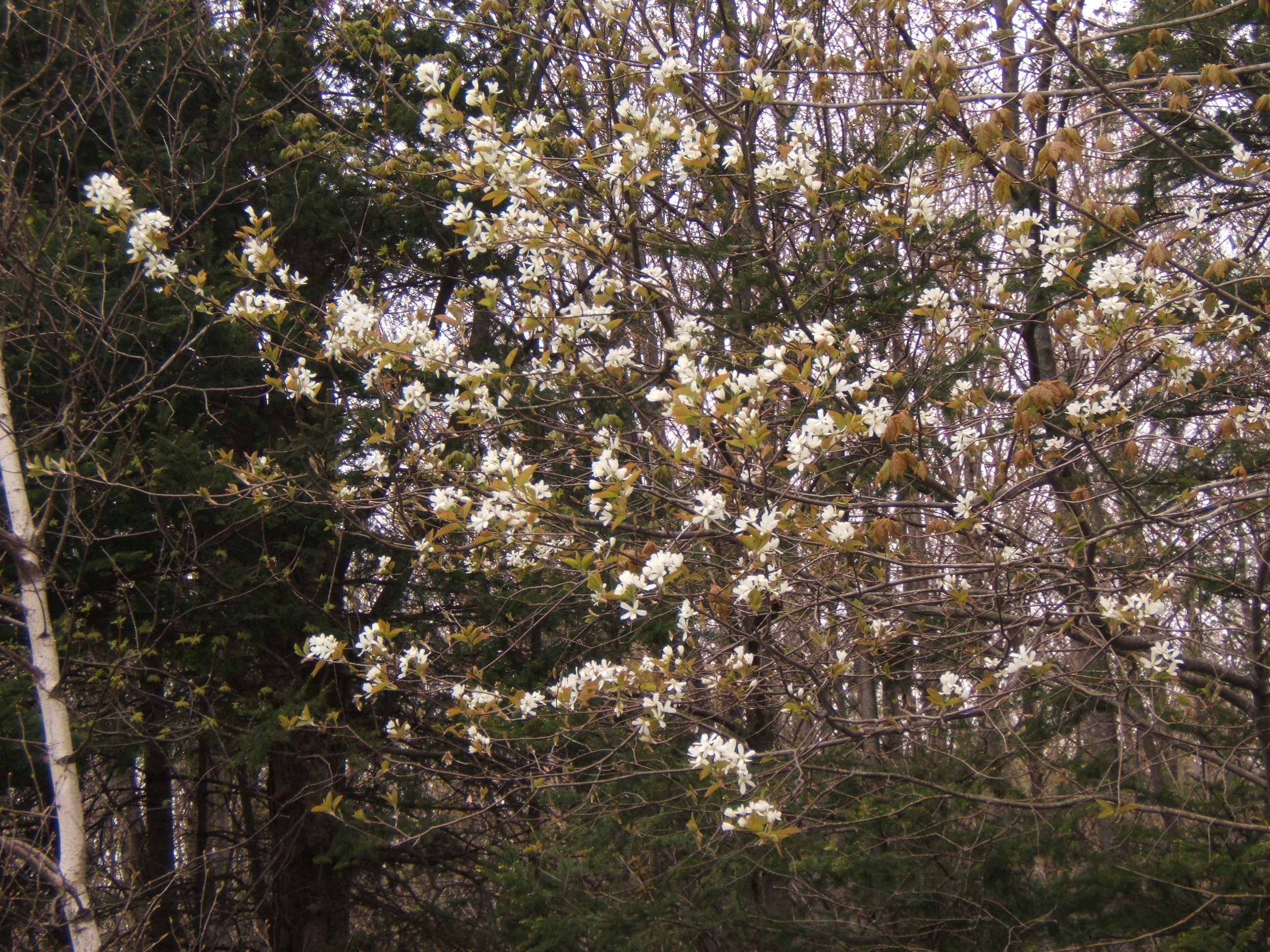
This bush is one of the Amelanchier species, probably Amelanchier sanguinea var. alnifolia (Nutt.) P. Landry. Amelanchier is perplexing to identify to species because of hybridization and other complex genetics. It has many common names, including Serviceberry, Wild Pear, Juneberry, Shadbush, Wild Plum, Sugar Pear, Saskatoon, and Chuckley Pear. In French it is called poiriers or petites poires. It is called Shadbush because it blooms at the same time the shad are running. The American Shad is an anadromous fish caught as it makes its way up the rivers for spawning.
Amelanchier is often found on disturbed sites, along roadways and fields. It also likes the edges of thickets and wet areas. This time of year, it beautifies the landscape with frail white bloom.
The fruit of Amelanchier is a berry-like pome, dark purple in color. Each berry contains 10 seeds and the sepal is persistent on the blossom end of the berry. The berries are edible and sweet, and can be eaten raw or used to make jam.
~
~
the shad are running
~
after the hard rain
and the wind between cold front and warm
the river runs brown
and for dinner we have fiddleheads
new potatoes and shad,
and last-July’s Serviceberry jam
~
Serviceberry bushes are torn fish nets
holes poked through with fingers
petals scattered on mossy stones
along the river shore
~
~

Warning: 1. never eat any plant if you are not absolutely certain of the identification; 2. never eat any plant if you have personal sensitivities, including allergies, to certain plants or their derivatives; 3. never eat any plant unless you have checked several sources to verify the edibility of the plant. © Jane Tims 2012
places off-planet #5 – Comet Hale-Bopp 1996
Comet Hale-Bopp could be seen from Earth in late 1996 and early 1997. Its strange name is from the independent co-discoverers, Alan Hale and Thomas Bopp. Hale-Bopp was a large comet, with a nucleus of about 60 miles in diameter. It had two visible tails, one of gas and one of dust, and had a third tail of sodium. It has been called the most-observed comet in history. Hale-Bopp won’t be back until 4385!
I have no specific memory of Hale-Bopp itself, although I do remember a common saying in our household in 1997 was to greet almost every out-of-place object with “Hail! Bopp!”. The poem I wrote after seeing the comet is all I have to know how it appeared to me.
Do you remember seeing Hale-Bopp?
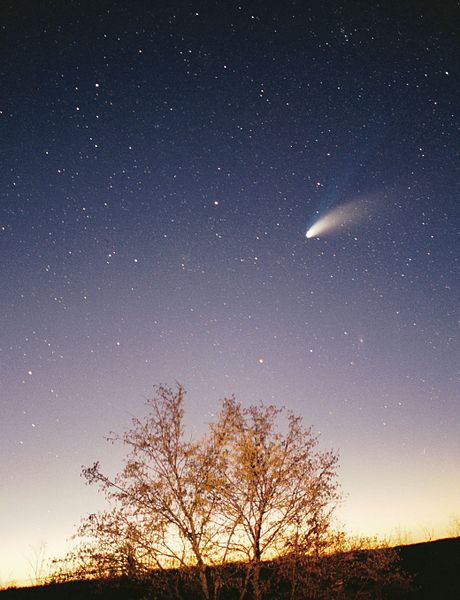
photo from Wikimedia Commons, taken by Philipp Salzgeber
~
~
Hale-Bopp
also a comet
~
Hail! bright star
~
a flare in the western sky
a diamond
~
a sparkler
embedded in smoke
~
~
© Jane Tims 1997
juvenile Bald Eagle
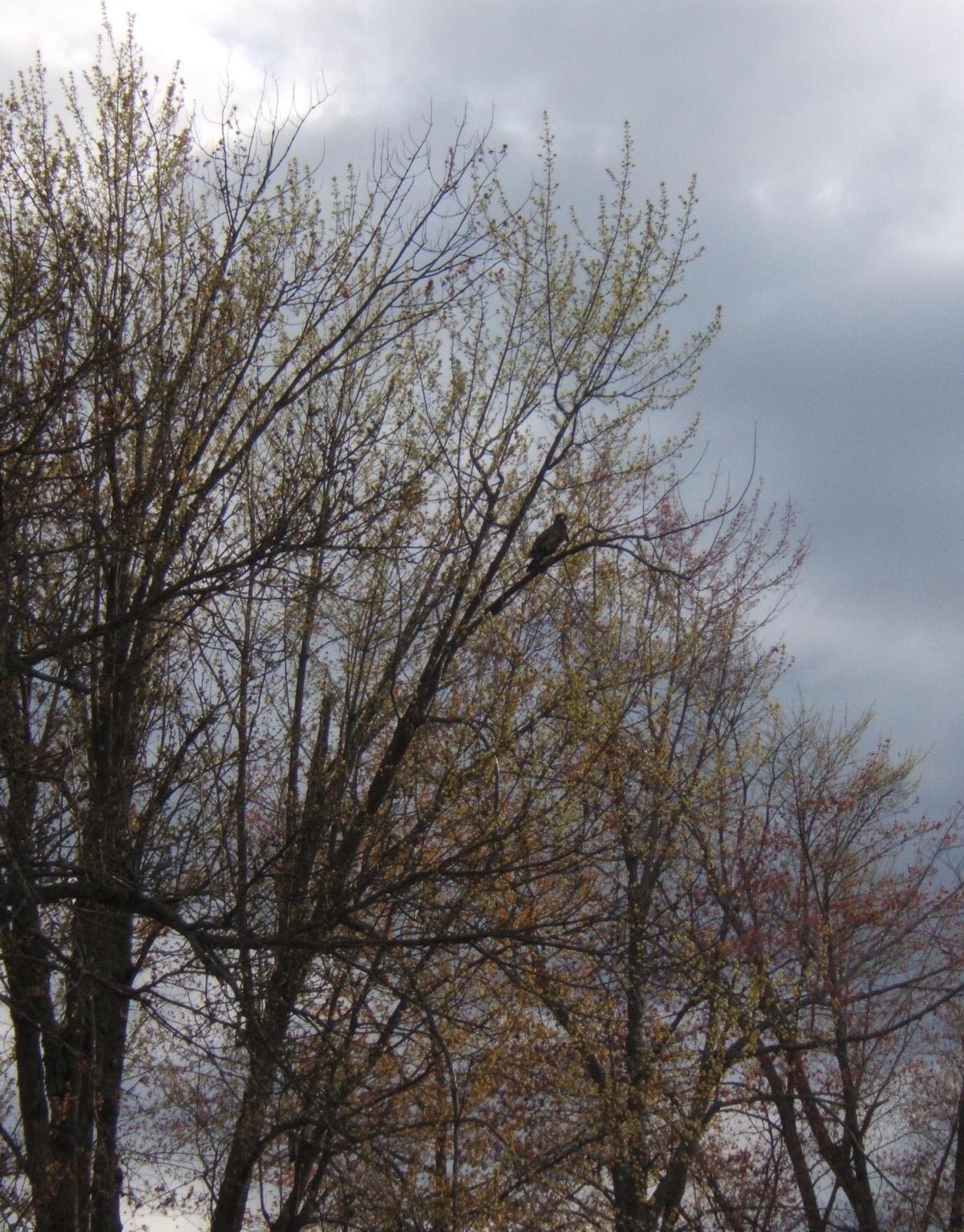
Last evening, we drove along the St. John River looking for fiddleheads and were delighted to see a juvenile Bald Eagle (Haliaeetus leucocephalus).
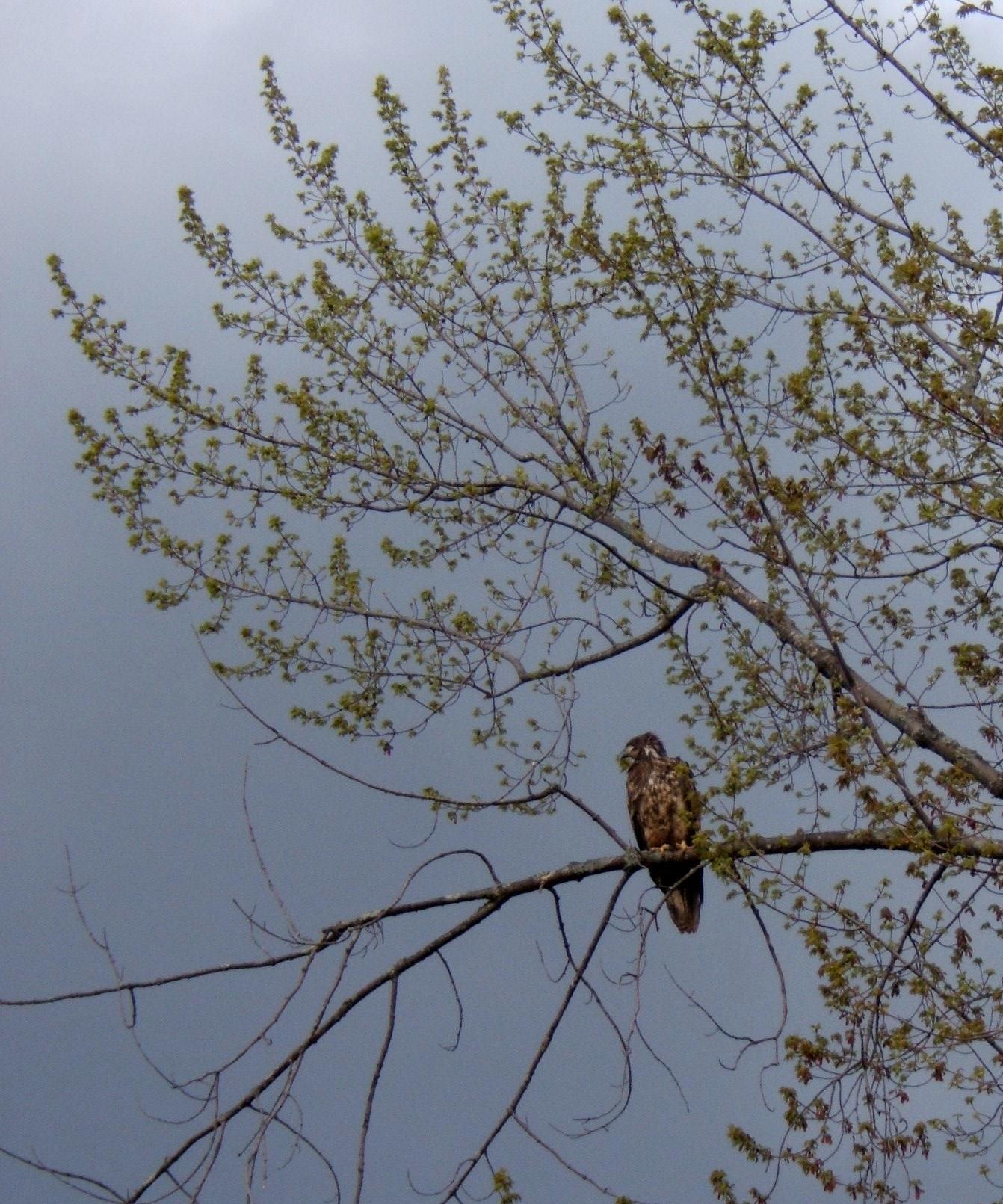
He was sitting on the dead branch of a Silver Maple, just above the highway. He stayed quite still as I took a few photos. He was huge compared to the hawks and osprey we usually see in the trees along the raodway. His plumage was tawny and brown, and his talons were a beautiful orange. Occasionally, he would twist his head and his eye would gleam, reflecting the light of the setting sun.
~
~
young eagle
~
his golden eye
glints as he twists his head
reinterprets the sinking sun
as soul
scrutinizes the river lands
for peril or prey
~
~
© Jane Tims 2012
places off-planet #4 – Comet Hyakutake 1996
Comet Hyakutake had a nucleus of about 2 km in diameter and a tail-length of 570 million km. The Ulysses spacecraft is known to have flown through Haykutake’s tail. One of the comet’s notable characteristics was its blue-green color. It was bright to the naked eye for only a few days.
I remember Hyakutake as a ‘knock-you-off-your-feet’ surprise. I knew it could be seen, but I hadn’t made any effort to look for it. One night as I arrived home, I saw it shining through the trees at the end of the driveway, and climbed the snowbank at the end of the drive to investigate. I saw the comet and literally stumbled backward in amazement!
Did you see Comet Hyakutake in 1996?
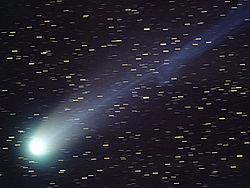
photo is from Wikimedia Commons
taken by E. Kolmhofer and H. Raab of the Johannes-Kepler-Observatory
~
~
Hyakutake
a comet
~
she runs in the solar wind
pale night woman
her face to the sun
hair and petals streaming
~
ephemeral, strewn in whispers
soft fistfuls of light
tresses tangled
in the fingers of the forest
~
~
© Jane Tims 1997
a pair of Painted Turtles
We did our usual bird-watching run along the St. John River on Sunday afternoon. We ordinarily follow the same circuit, from Oromocto, along the north side of the River, to Jemseg, crossing the River via the Gagetown Ferry, and returning on the south side of the St. John River. This area is in central New Brunswick, east of Fredericton.
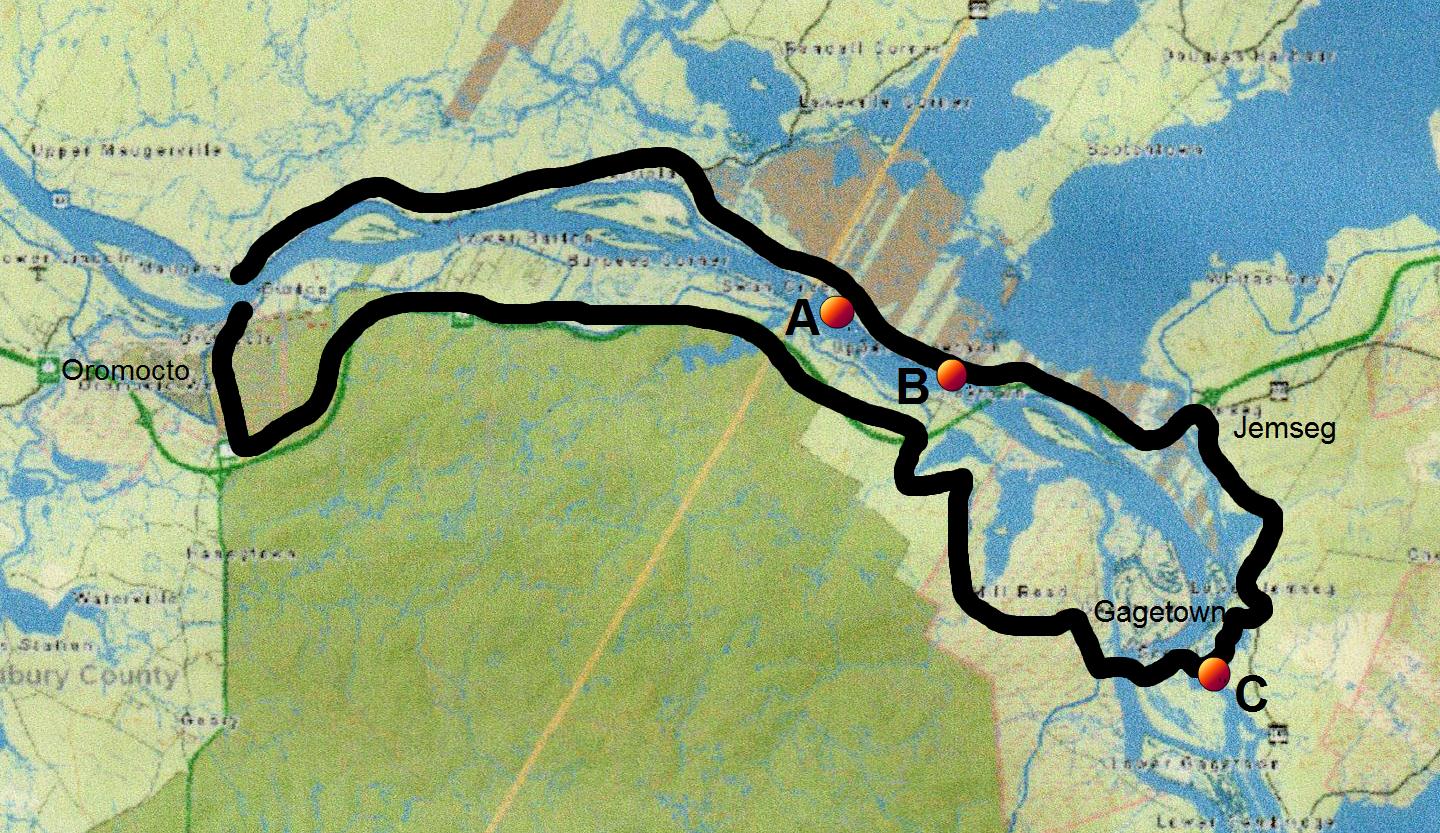
The first part of this circuit is along the old Trans Canada Highway, now Route 105. This section follows the St. John River, through the Grand Lake Meadows, an important wetland area for New Brunswick. Near the spot marked ‘A’, we saw lots of ducks, an Osprey eating a fish, and three other raptors (a group including hawks or eagles) too distant to identify. Near ‘B’ is the place we often see various owls, Bald Eagles, and Moose.

From Jemseg, we take Route 715 to Lower Jemseg. This part of the route travels above the River, through farmland. We rarely see wildlife along this section, but the area has a rich history and has several interesting buildings, including the old church featured in my post of September 14, 2011.

From Lower Jemseg, we turn towards the Gagetown Ferry and Scovil. This is a very interesting part of the route, snaking between wetlands and ponds. Along this section, it is usual to spot other cars of eager birdwatchers.
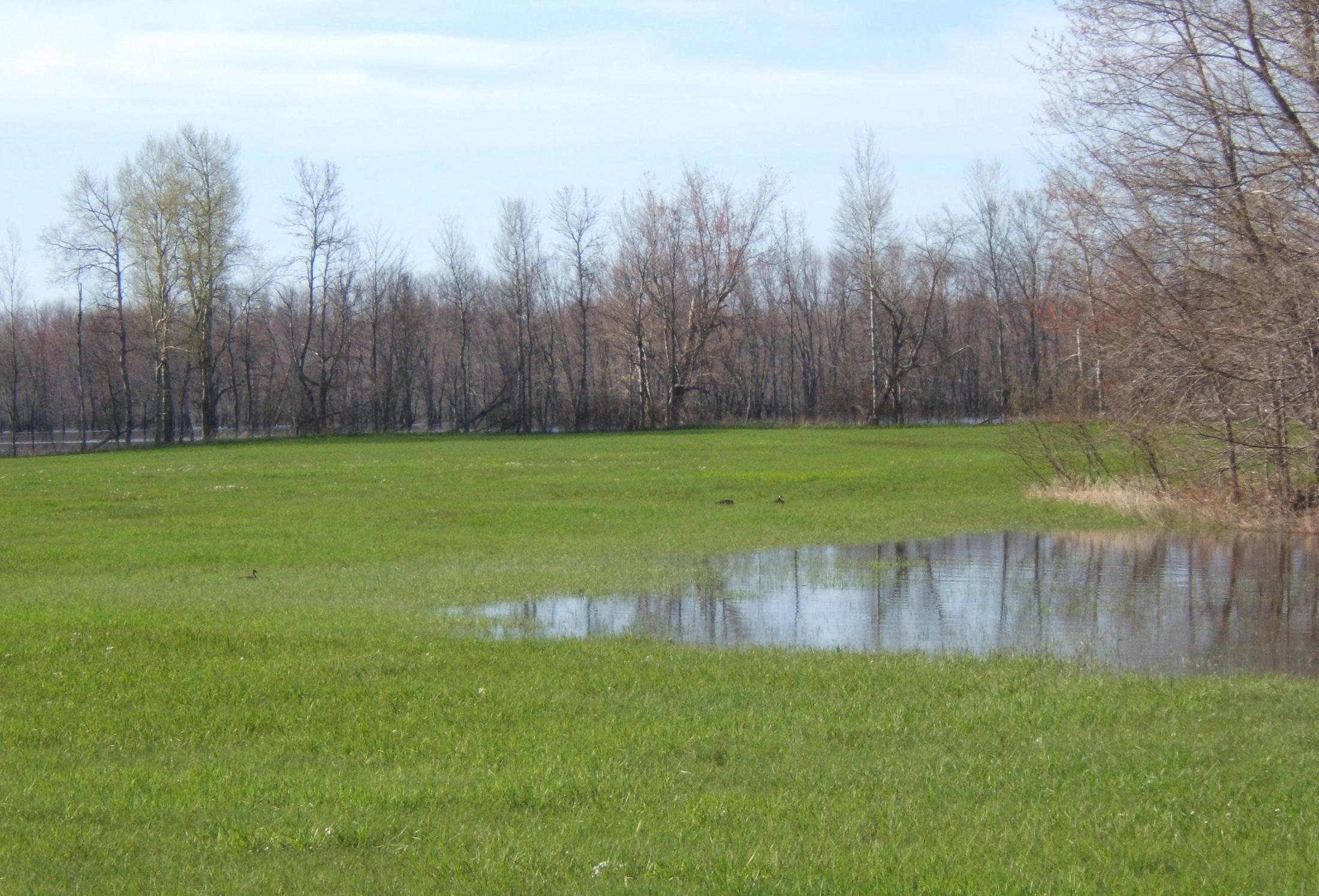
a wet field near Scovil … there are two American Black Ducks in the grass to the left and two Canada Geese beyond the pond … this is the same pond where we saw a Glossy Ibis on April 23, 1988
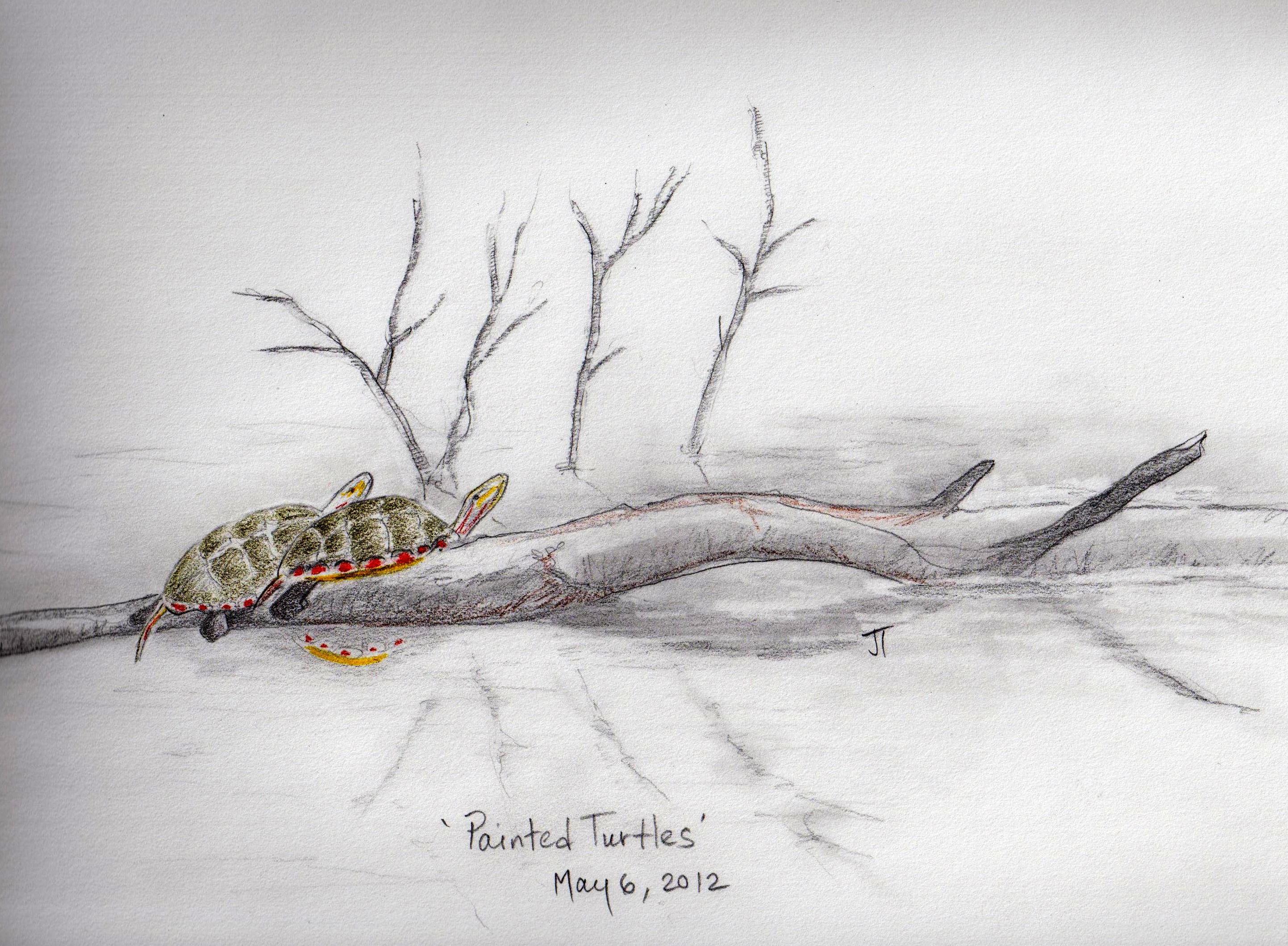
The highlight of our trip on Sunday was a group of three Painted Turtles (Chrysemys picta) on a log along this last section of our route, near the spot marked ‘C’.

The turtles were sunning themselves on a log in the middle of a pond. They have dark green, smooth shells, with bright orange markings along the edge of the shell. The inside of the lower shell is bright yellow. Their heads and tails are also marked with short streaks of orange and yellow. All winter these turtles have been hibernating at the bottom of the pond. Now awake, they will live in the pond all summer, laying eggs and feeding on aquatic insects and vegetation.
These Painted Turtles were stretching their necks out of their shells as far as possible. They made a beautiful sight, their colorful shells mirrored in the pond water.
~
~
Painted Turtles
~
I study the colors
through binoculars
remember these
with my hand, my fingers
rock the fine focus
rotate the brush
pick paint from the palette
~
the shell, flat olive tiles, grouted
Payne’s Grey
the wrinkled foot and leg, relaxed along the log
Burnt Umber
on the tail, the neck, the head
deft strokes of Cadmium
Yellow and Orange
~
the head stretches, to soak in sun
and dazzles on the pond
the lower shell
Yellow
refection on water
~
and, at the edge of the carapace
bright dabs of Orange
one part Cadmium
two parts Quinacridone
and a touch of some unknown
translucence
elusive
~
© Jane Tims 2012
places off-planet #3 – Halley’s Comet 1986
Halley’s Comet, first recorded by astronomers in 240 BCE, has been a regular visitor through the ages, although people did not realise they were seeing the same comet until astronomer Edmund Halley determined this in 1705. Halley’s Comet makes an elliptical orbit of the sun and returns to view approximately every 75 years. It was last seen in 1986. Halley’s Comet is composed of dust, ice water and other frozen gasses, and was described by astronomer Fred Whipple as a ‘dirty snowball’. Its nucleus is 15 km long, 8 km wide and 8 km thick; its tail is as much as 100 million km long!
We saw Halley’s Comet as a family, waking in the middle of the night, and driving to a nearby hill overlooking a big field with French Lake and its treeless wetlands in the distance. The night sky was overcast with a thin high-elevation cloud, so our view was not the best. However, to me, it was marvellous… a huge (relative to the size of the stars) ball of fuzzy light. My son can barely remember our watch on the hillside, all swathed in blankets. However, when it returns in 2061 and he is 78 years old, he will be able to say he saw it twice!

Photo from Wikimedia Commons, taken by Kuiper Airborne Observatory
~
~
Halley’s 1987
~
we choose a roadside watching place
beside a farmer’s field
across from the cemetery
few trees
few lights
~
we set the alarm for three
coax one another
into the icy car
in awe for an hour
at the comet fuzzy indistinct
four fingers above the horizon
~
too undefined, too faint
for the dirty snowball
they predicted
I scrape our breath from the window
I see it, says my son, only three
I think
~
he sleeps between us until ten o’clock
his blanket a soft ball
pressed to his nose
~
almost eighty
he waits for the return
~
I saw it when I was only young
I think
~
~
© Jane Tims 1997
places off-planet #2 – three comets
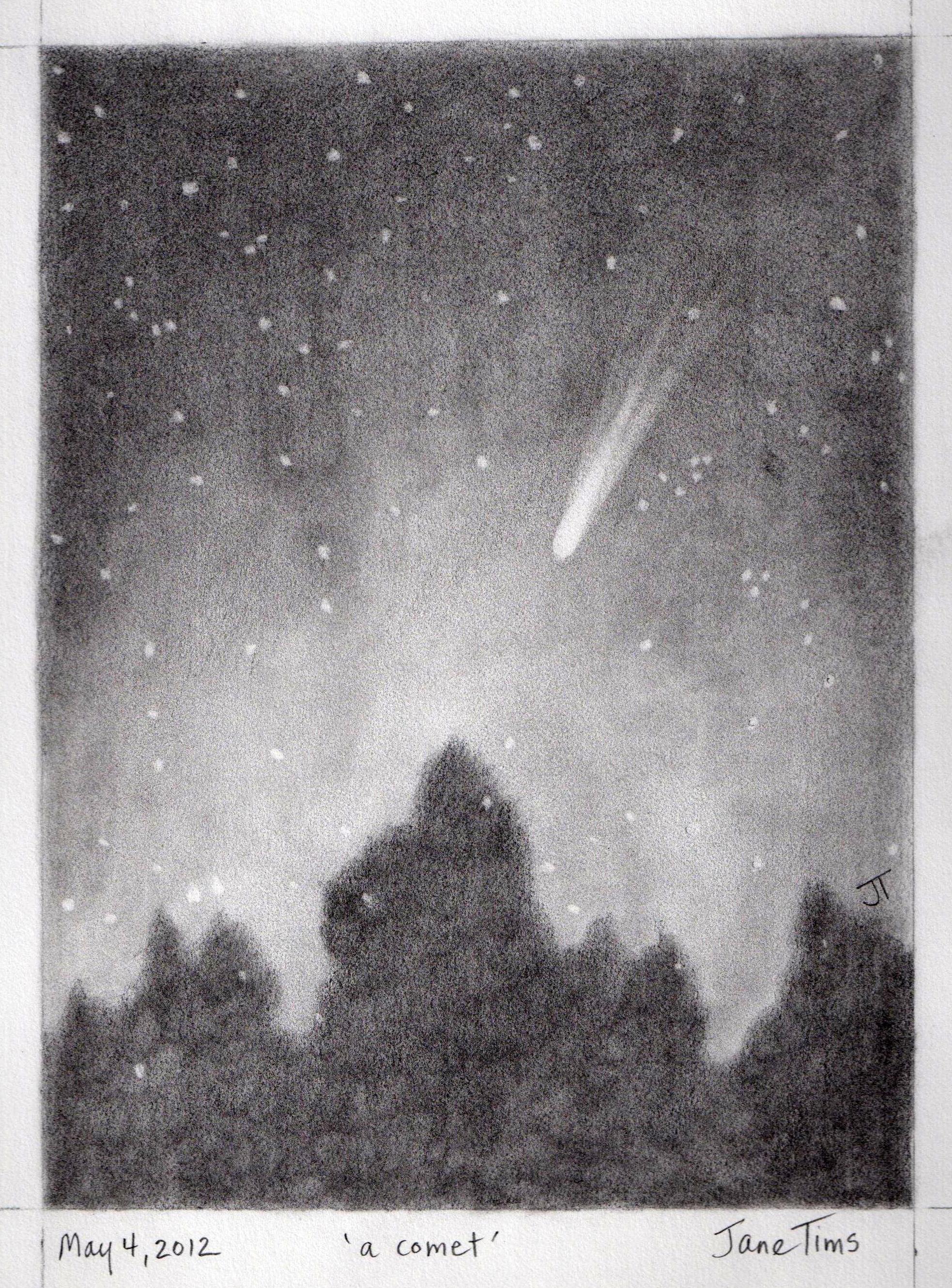
In my life so far, I have seen three major comets – Halley’s Comet in 1986, Hyakutake in 1996, and Hale-Bopp in 1997. There have been comets since then, I know, but I have always been asleep!
A comet is composed of a ‘nucleus’ of rock, dust and frozen gas, and a tail. The tail is formed when the gasses in the nucleus are heated by the sun and create an atmosphere or ‘coma’. The sun’s radiation and the solar wind cause the coma to flow away from the sun as a tail. Since the comet can be moving away from the sun, sometimes this means the comet moves in the direction of its tail!
How many comets have you seen?
~
~
Comet
~
from the Greek
koman
~
to wear long hair
~
© Jane Tims 1997




 nichepoetryandprose