Posts Tagged ‘plants’
getting ready for fall – high bush cranberry
Another painting to accompany my fall book and painting sale. These are high bush cranberries growing along the St. John River. The painting is done in acrylics, gallery edges, 12″ X 10″, Chromium Oxide Green, Paynes Grey, Titanium White, Cadmium Yellow Medium, Cadmium Red Medium and a touch of Burnt Sienna. The subject matter of high bush cranberries was a suggestion of one of my blogging friends!
~

~
Copyright Jane Tims 2016
plants along the roadside – wild hops
When we go for drives to find covered bridges or one room school houses, I always watch the roadside for plants familiar and unfamiliar. This habit comes from years of work as a botanist. As we drive, I name the plants I know. Sometimes there is a huge surprise!
~
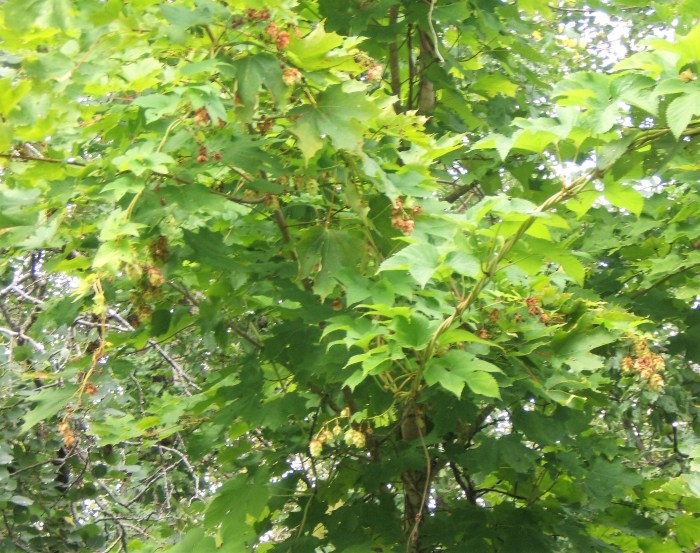
While driving in Victoria County last year, looking for a covered bridge, we travelled a short way on a side road. The road became quite rough and narrow and soon we were searching for a good place to turn. There, away from any habitation, among the vegetation on the side of the road, was something different: large 3 to 5-lobed leaves, climbing tendrils and golden cone-like flowers. A vigorous ‘wild’ hop vine. I was thrilled!
~
~
Hops (Humulus sp.) is well known as a stabilizing and flavouring agent in beer. The hops contain various flavonoids, acids and oils which impart smell and taste to beer.
~

~
When I got home, I went hunting on the Internet and discovered a CBC article describing an Agriculture Canada study about native hops. http://www.cbc.ca/news/canada/prince-edward-island/hops-research-could-aid-beer-industry-1.3136764
The researchers, Jason McCallum and Aaron Mills, were (and still are) asking for the public’s help in locating wild hops in the Maritimes. Needless to say, I contacted them.
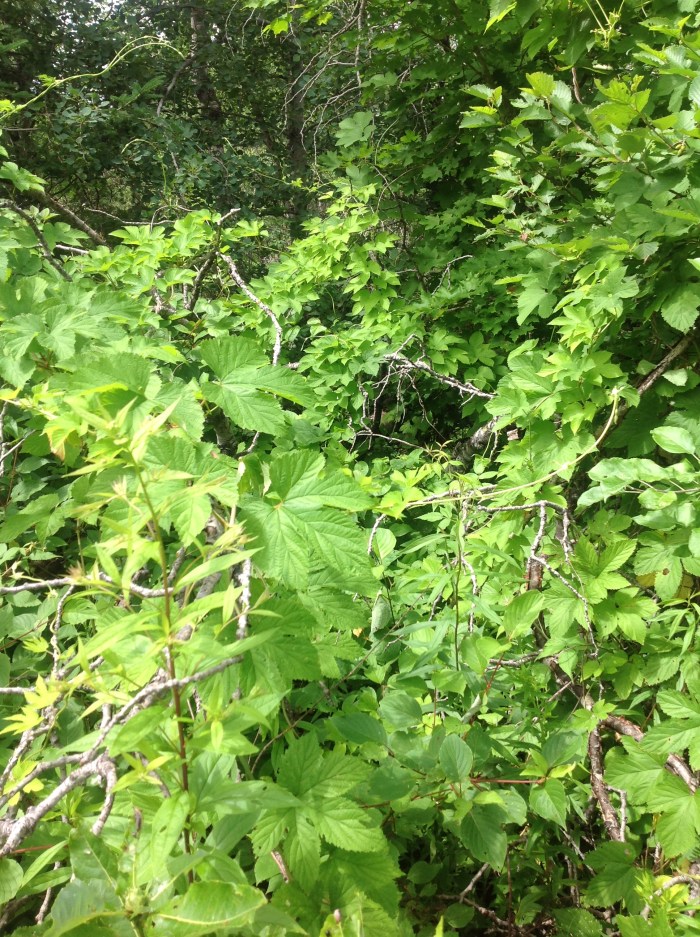
A couple of weeks ago, I learned they were coming to New Brunswick to find my hops plant. To make sure we could give them good directions, my husband and I drove to Victoria County to see if the plant was still there. It was growing more vigorously than ever, climbing among the top branches of a downed tree.
~
~
With our improved directions in hand, the Agriculture Canada team found the hops plant, a couple of hours after a road crew went through with bush saws to widen the road!!! However, the team was able to take the samples they needed and assured me that the plant was so vigorous, it would be able to recover and continue to thrive!
~

~
The researchers at Agriculture Canada will do genetic analyses to determine if the plant is native to North America (var. lupuloides), an escaped European hops (Humulus lupulus) or a hybrid between the two. The purpose of their study is to examine hops native to New Brunswick to see if they have resistance to disease and pests. Discovery of a native hops variety, perhaps with unique properties, flavours and aromas, would be valuable to a local brewing industry.
~
Hops are cultivated around the world. The Agriculture Canada researchers think ‘my’ hops plant may have been grown on a now-abandoned homestead. These folks may have grown the hops as a way of making starter cultures of yeast for bread-making. The elements in hops are toxic to bacteria but tolerated by yeast. Starter cultures resulted when yeasts colonized standing mixtures of hops and a sugar like molasses.
~
This experience has reinforced my passion for ‘ditch-combing’ … I am so lucky to have my husband as driver so I can spend my time scanning the road side. If you live in the Maritimes, keep your eyes open and if you see a wild hops plant, let the researchers at Agriculture Canada know!
~
Copyright Jane Tims 2016
within easy reach – winner of ‘berries and brambles’ painting
I am so pleased to announce the winner of my painting ‘berries and brambles’. The winning raffle entry was drawn at a dinner I attended this week in Fredericton.
~
The winner is Margo Sheppard, Fredericton!
~
Congratulations Margo!!! The painting ‘berries and brambles’ is yours. Thanks to all those who entered!
~

April 24, 2016 ‘berries and brambles’ Jane Tims
~
Holding the raffles for my paintings has been a very enjoyable part of the process of marketing my book! I’ll be offering another painting to win at my reading at Tidewater Books in Sackville in the fall!
~
Copyright 2016 Jane Tims
winner of cover art for ‘within easy reach’
I am so pleased to announce the winner of the painting ‘brambles’, the cover art for my book within easy reach! The winning raffle entry was drawn at my book launch at Westminster Books on June 9, 2016.
~
The winner is Carol Steel, a long-term follower of my blog and a blogger at http://carolsteel5050.blogspot.ca/ . Carol posts her beautiful photographs, her published poems and her insights into the wildlife she sees. Carol also won First and Second Place in the 2016 Writers’ Federation of New Brunswick Writing Competition — Dawn Watson Memorial Prize.
~
Congratulations Carol!!! The painting ‘brambles’ is yours. Thanks to all those who entered!
~

February 29, 2016 ‘brambles’ Jane Tims
~
The names of the other entrants, and the names of all those who purchase a book from my publisher or at any of my reading events, will now go into a draw for another painting ‘berries and brambles’ (18″ X 14″, acrylic, unframed, gallery edges). Names will be entered until June 30, 2016 and the winner will be announced in July.
~
April 02, 2016 ‘berries and brambles’ Jane Tims
~
Holding the raffles for my paintings has been a very enjoyable part of the process of marketing my book!
~

June 9, 2016 book launch at Westminster Books – almost 50 people attended! (photo courtesy Chapel Street Editions)
~
Copyright 2016 Jane Tims
Growing and gathering – Spring salad
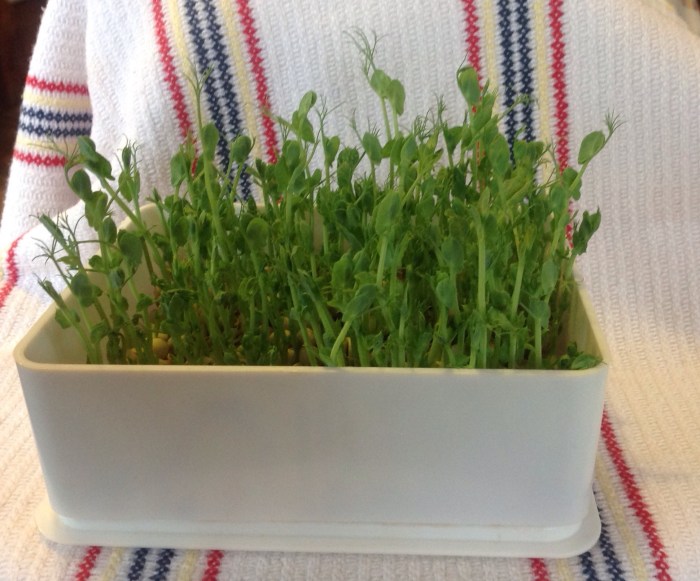
I make a new batch of sprouts weekly. This week’s crop was something I haven’t tried to grow before … pea shoots. I sprouted the peas in my 8 X 10 Sproutmaster from Sprout People.
https://sproutpeople.org/sproutmaster-8×10-tray-sprouter/
~
Pea shoots sprout sooner if they are soaked in water first. I let mine sprout with just the rinse water.
~
For me, a twice daily water rinse and careful draining is key to growing the best sprouts. I know pea shoots can grow quite tall with a vermiculite base and some propping at the sides but I was content to just let them peak above the sides of my sprouter.
~
~
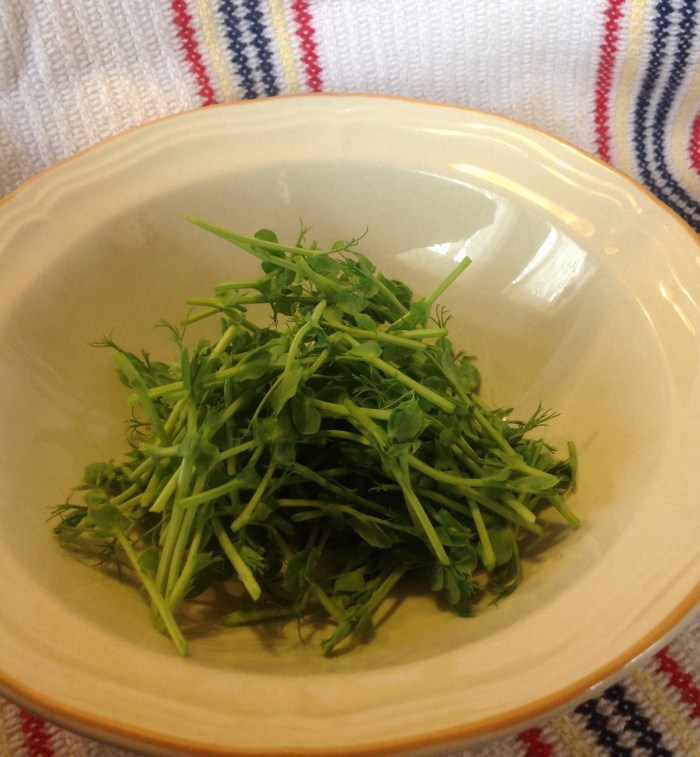
To prepare the pea shoots, I washed them well and harvested them with scissors.
~
~
Then I added a chopped onion, chopped celery, chives from the garden and a sprig of mint. Just plain mayonnaise for a dressing. Yum!
~

~
My husband shook his head and said (as a joke) I would have to survive the Apocalypse all by myself.
~
Copyright 2016 Jane Tims
‘within easy reach’ … a poetry book about wild edibles and local foods
all about my new book:
within easy reach by Jane Spavold Tims
(with a foreword by Freeman Patterson)
Chapel Street Editions, Woodstock
May 2016
~

~
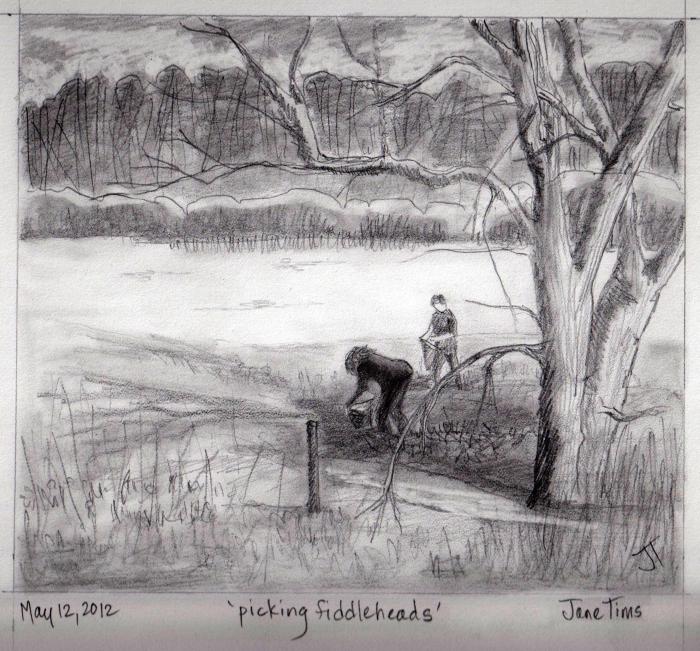
includes poems and pencil drawings about
eating local foods and gathering wild edible plants
~
~
poetry about picking berries, gathering herbs and roots, gardening, fishing
local markets, beekeeping and salad greens
explores how easy it is to bring local foods into your diet
and
considers the barriers to eating local and gathering wild foods
explores abandoned gardens
poisonous berries and berries in bottles
includes poems about our history of eating wild foods
and about New Brunswick’s special local foods:
maple syrup and fiddleheads
coastal plants like goosetongue greens and samphire
land-locked salmon
notes on each plant – characteristics and uses
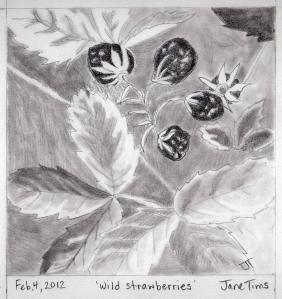
seventeen pencil drawings
~
~
this book will remind you of your own experiences picking berries
a tribute to every age of our lives – dancing in the school gym and picking berries with arthritic hands
it will recall the habits of your ancestors
a beautiful book – rests open in your hands as you read
a font so easy on the eyes
I hope you will love within easy reach
~
Jane Tims
2016
~
a drawing of a covered bridge
Another drawing for my manuscript ‘in the shelter of the covered bridge’: Hammond River #2 French Village Covered Bridge

~
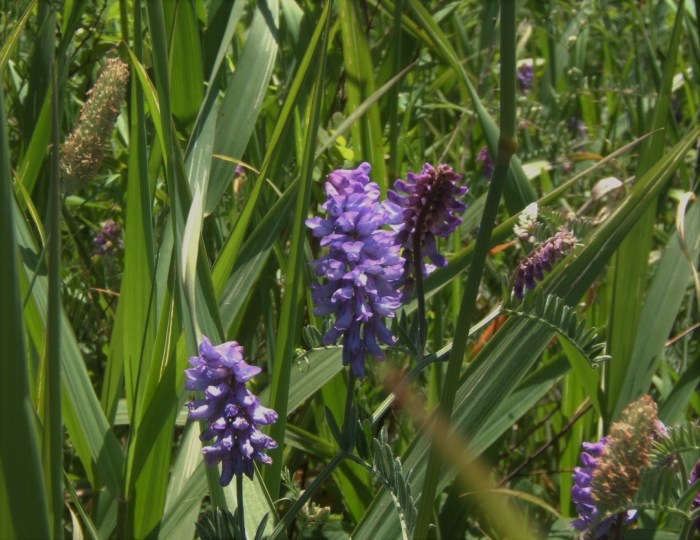
Cow vetch and Timothy at the entry to the covered bridge:
~
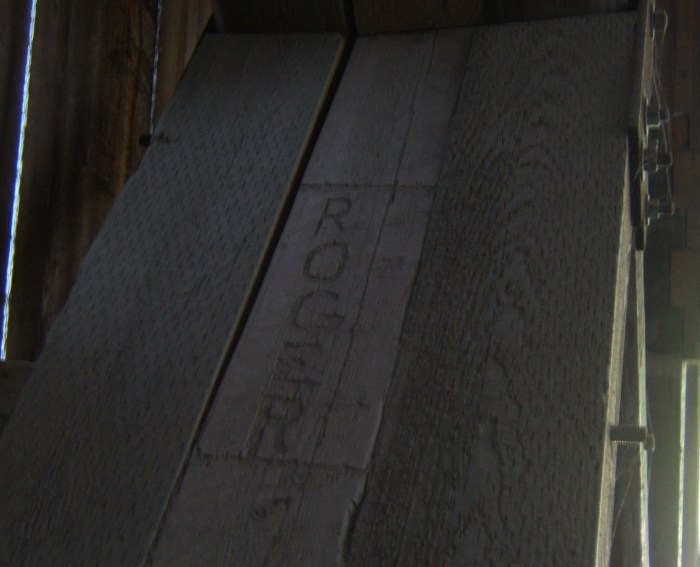
Who were ‘B’ and ‘E’? Who was ‘Roger’?

~
~

Hammond River #2 – packed in green
~
Copyright 2016 Jane Tims
‘within easy reach’ – a painting for the front cover
As the release date for my book of poetry ‘within easy reach’ draws near, I have been doing some painting.
~
I began my project ‘growing and gathering’ and the poems for my book ‘within easy reach’ after my husband and I discovered blackberries on our new property at the lake. For this reason, blackberries seem a fitting subject for a cover painting.
~
I think blackberries are fun to paint:
- a basic berry-shape of Payne’s Grey
- a highlighting of each seed in the drupe with Payne’s Grey mixed with Titanium White
- a spot of white to highlight berries on one side of the drupe
- a background of blues and purples to simulate the shadow in the thicket
- leaves and a stem
~
This is my ‘practice painting’, in acrylics, 5″ by 10″.
~

~
I’ll be showing you the final cover painting soon – 10″ by 10″, a perfect shape for the cover of my book.
~
On a windy, wintery day, it is hard to be patient, waiting for blackberry season!!
~
Copyright Jane Tims 2016
edible wild – spruce gum
In my part of North America, we have freezing temperatures and snow on the ground from December to March. With a few exceptions, most plants go into sleep mode during these months and foraging for edible plants is difficult. You can dig beneath the snow to find a few evergreens, but most of the edible wild is above ground.
~

~
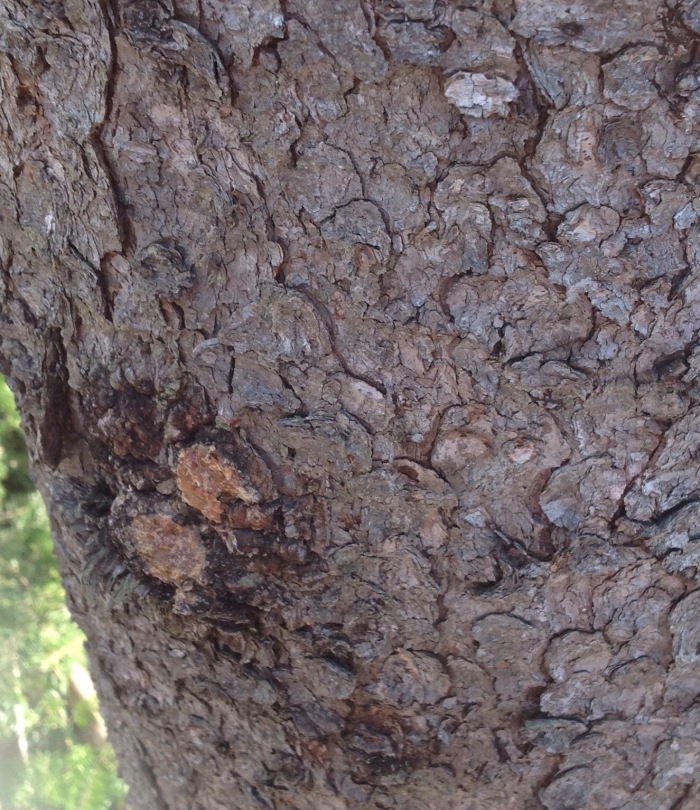
When I am in the woods, even in winter, I am always on the look-out for spruce gum, a natural sugar-free treat from the forest. Spruce gum is found, as the name suggests, on spruce tree bark. We have a large stand of spruce in our grey woods, but the tree below grows, conveniently, beside our driveway. For a map of our woods, see the right hand column ‘map of the grey woods’.
~

~
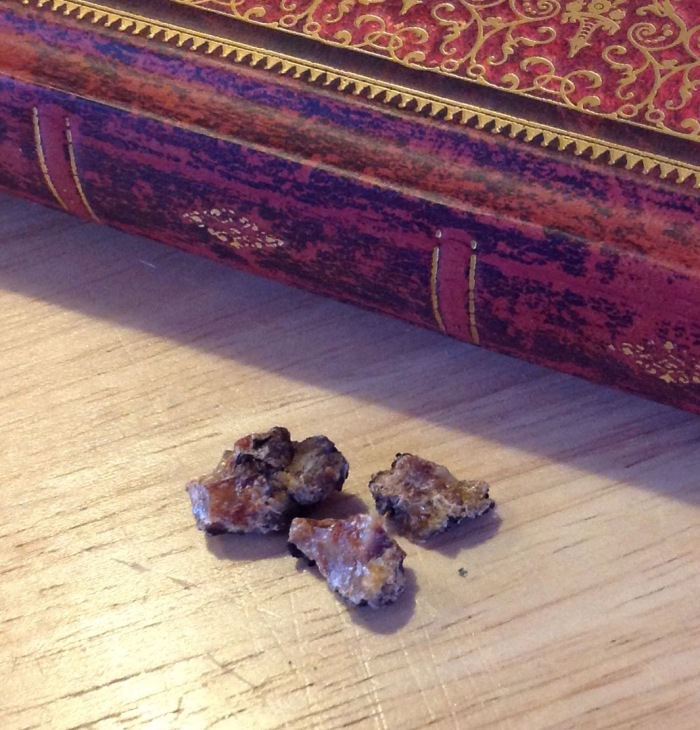
When a branch is broken or the bark is wounded in some way, the spruce oozes a sticky resin that eventually dries to a hard amber-coloured nodule. These nodules can be harvested and chewed like gum. My mom taught me about spruce gum, how to identify the spruce tree and to look for the sticky dark lumps where resin is hardening.
~

~
It is possible to collect a quantity of spruce resin, pulverize, melt and strain the substance, and solidify it, cracking it into bite-sized pieces. I chew the nodules right from the tree, with a little scraping to get rid of any rough bits. At first the gum is hard and crumbly, sticky and intensely aromatic, a little risky for dental work and made interesting by the accidental inclusion of bark bits. After a few minutes of chewing, the gum becomes pliable, woodsy-tasting and orange to pink in colour!
~
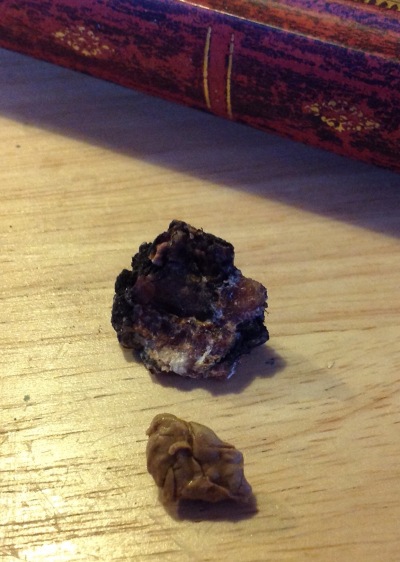
photos of chewed gum are a bit disgusting, but I want to show what normal-looking gum a two-minute chew produces. A rough nodule is shown above the chewed gum for comparison.
~
People of the First Nations have always known about this woodland edible and used it for medicinal purposes. In the nineteenth century, spruce gum was harvested with long handled spruce scrapers and sold commercially. Woods-workers made small carved boxes with sliding tops (gum books) to carry and store the resin nodules.
~
Robert Frost, wonderful poet of all things rural, wrote about spruce gum (‘The Gum Gatherer’. Mountain Interval. New York: Henry Holt and Company, 1916):
He showed me lumps of the scented stuff
Like uncut jewels, dull and rough …
~
You can find the rest of the poem at Project Gutenberg http://www.gutenberg.org/files/29345/29345-h/29345-h.htm
~
~
My upcoming book of poetry within easy reach includes a poem about spruce gum. The poem begins:
Black Spruce weeps if wounded
oozes to heal, embeds
pain in amber …
~
As I wait for spring, I intend to ration my small store of spruce gum and use it as a kind of countdown toward the end of our winter weather.
~

some very clean seeps of resin – these will harden eventually and make great spruce gum !
~
~
Copyright 2016 Jane Tims
‘within easy reach’ – why did I write these poems?
Later this spring I will have a book of poems and drawings in publication – ‘within easy reach’. The poems and art in the book are about gathering local, mostly wild, foods. I have been fortunate to work with a wonderful publisher, Chapel Street Editions, interested in books about the natural history, human history, and cultural life of the St. John River Region of New Brunswick, Canada. http://www.chapelstreeteditions.com/about_chapel_street_editions.html
~
As a botanist, I loved making this book. Identifying plants is a skill learned in university and during years of enjoying the out-of-doors. Many of the plants are found on my own property, but my husband and I travelled throughout the region to find some species. We found edible trout lily along the banks of the Dunbar Stream, salty orach on the beaches of Saint Andrews, and dangerous-to-eat water dragon in a wetland on the Renous highway. On our own property we tried to out-smart the squirrels for hazelnuts, tapped twelve trees for maple syrup and discovered partridge berries growing in the woods behind our house. As you can see, part of my enthusiasm for the subject is about spending time with my husband!
~

~
I also did a little time-travelling to write these poems. Although most of the plants I write about are found in the St. John River Region, I looked into my own past to remember some edible plants in other parts of Canada. This included eating cactus berries on the Alberta prairie, buying cloud berries from children along the Trans-Canada in Newfoundland, and picking blueberries with my Mom and Dad in Nova Scotia. I also looked to the diaries of my Great-Aunt to get a glimpse of the growing and gathering habits of an earlier generation.
~
I am sure many of my poems will echo memories of your own experiences with local foods.
~
Eating near to home has so many benefits – these foods are often free and have not travelled far to your table. Many wild foods go unharvested although they are ‘within easy reach’. Just think of those apples in the abandoned orchard at the edge of town, the dandelion greens on your brother’s lawn, or the choke-cherries growing along the fence down the road. Although you should use care when eating wild foods, many are easy to harvest and can add variety and taste to your meals.
~

~
In my next post, I’ll say more about why you might enjoy reading my book. And very soon, I’ll be starting a count-down on my blog to let you know how many days you have to wait until publication. I’ll have a contest and a give-away. Shameless self-promotion!
~
Copyright Jane Tims 2016





 nichepoetryandprose