Posts Tagged ‘plants’
a muse takes over – creating alien plant species
When I was in university, we spent lots of time in botany courses discovering the concept of ‘form follows function’. This means that plants have adapted to their surroundings so almost every physical feature reflects the requirements of landscape and habitat. Good examples:
- thorns discourage predators
- tubular flowers to enable pollination by insects with long mouth parts
- hairs on leaves help conserve moisture by blocking air flow
~
This concept is foremost in my mind as I try to populate my fictional planet Meniscus with plants. Plants are important to my story because my characters have to forage for their food (the main character, Odymn, is particularly good at finding food in the forest). My alien plants have to serve the purposes of the story. They also have to be credible and follow biological logic. Form must follow function.
~

This drawing of Odymn practicing her parkour in the woods shows two plant species on Meniscus — a banyan-like tree and ‘slag-fern’. This banyan is great for climbing and jumping!!!
~
Some sci-fi readers prefer authors not to invent new species, but to use our familiar species. I decided to create new species because my story is about what humans have lost when they were brought to an alien planet. I plan to help my readers by including a glossary of alien plants in the back of each book.
~
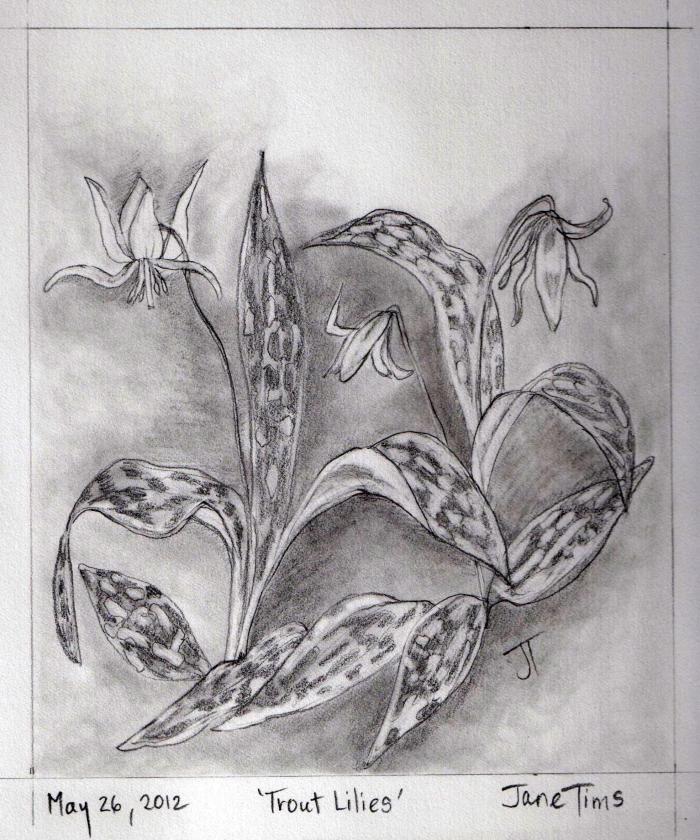
Although they are alien, most of my plants are reminiscent of our species here on Earth. A good example would be ‘arbel’ a small woodland plant used to treat ailments on planet Meniscus. One of the chemical components of ‘arbel’ is ASA (acetylsalicylic acid or aspirin), making it similar to tea berry (Gaultheria procumbens), a plant common in our woods. I imagine ‘arbel’ to look like our woodland species trout lily (Erythronium americanum). Like trout lily, ‘arbel’ has edible corms. Also like trout lily, ‘arbel’ has thick leaves to conserve water on a planet where surface water is rare.
~
~
Another of my alien plant species is a carnivorous club-moss, a dangerous inhabitant of the Themble Woods. Sheets of this moss crawl across the woodland floor, engulfing their prey. I want to include carnivorous plants on Meniscus because our own carnivorous plants, such as the sundew (Drosera sp.), are so intriguing. My carnivorous ‘club-moss’ has glands to absorb nutrients from its prey and touch-responsive tendrils to help it crawl through the forest. For a while I thought I would use carnivorous vines but I have seen too many movies where vines take over the earth!
~
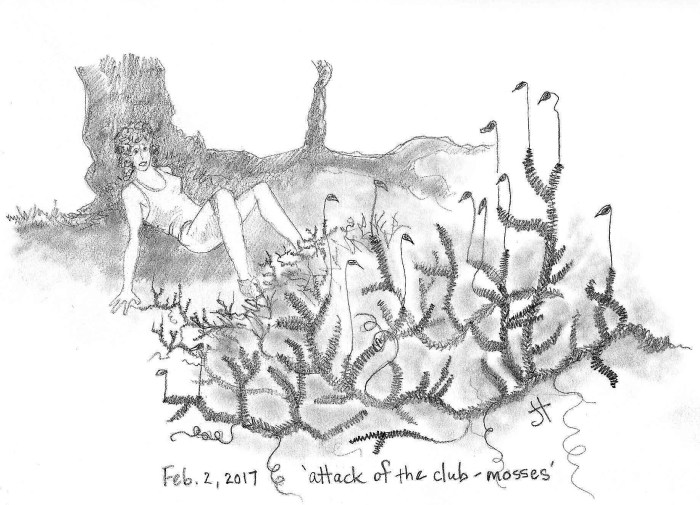
Odymn falls asleep in the woods and is overtaken by a carpet of carnivorous club-mosses.
~

An earlier drawing showing vines attacking Odymn.
~
Following is a list of the plants I have planted on Meniscus. Beverages to keep the folks on Meniscus awake are brewed from the leaves and berries of ‘thief-bush’!
~
| plant | description |
| arbel | nodding woodland flower; corms edible |
| glasswort | transparent, low-growing plant, adapted to the edges of the Churn |
| grammid | tree with orange leaves and edible seed pods; smells like cinnamon |
| ransindyne | plant grown for its edible root |
| slag-fern | fern-like plant with leathery leaves |
| spenel | small plant with edible berries |
| thief-bush | bush with thick leaves and blue berries; used to make beverages |
| tussilago | plant similar to colts-foot, used to sooth a cough |
| walking-vine | vigorous vine native to the edges of the Darn’el desert |
| yarnel | tree with edible fruit like pomegranate |
~
This writing has given me new appreciation for the interesting and complex plants we have on our own planet!
Next post I will show you some of the animals on Meniscus!
~

~
Copyright 2017 Jane Tims
raspberries in winter
On December 11, 2016 (from 10 AM to 4 PM), I will be at the Delta Hotel (Fredericton, New Brunswick) at Sandra’s Christmas Market Fredericton to sell my paintings and books. If you are in the Fredericton area, please pay me a visit!
~
I have a new painting for sale at the event. December 8, 2016 ‘raspberries’ is painted in acrylics, 7″ x 5″, gallery edges, unframed. It reminds me of picking raspberries on a summer day.
~
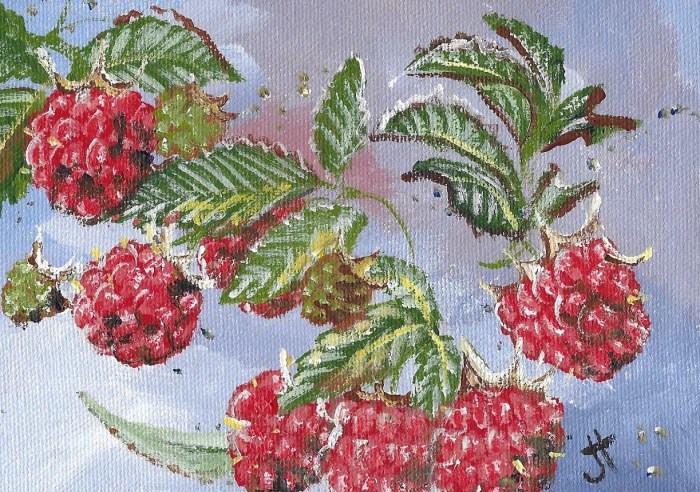
December 8, 2016 ‘raspberries’ Jane Tims (acrylic) 7″ x 5″ $25
~
~
mended by raspberries
for Mary
~
drove all the way to Flume Ridge
to pick those berries, large as thimbles
~
red as blood after we’d pricked
our fingers on needled vines
~
crossed the covered bridge to nowhere
the through road blocked, the way broken
~
the covered bridge at our backs
the roar of the flume in our ears
~
the tipple of honey bees
lightheaded in the berry canes
~
~
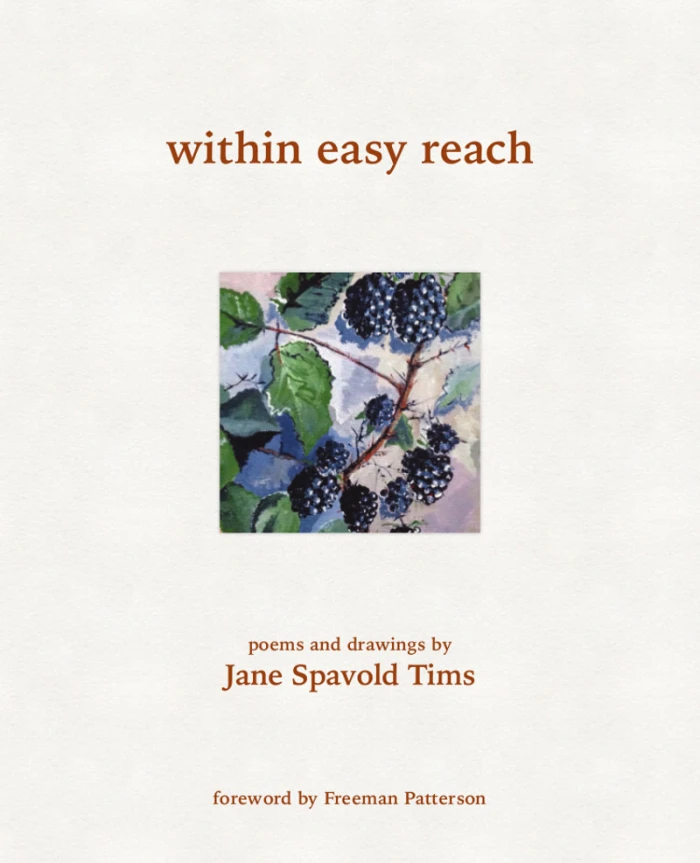
This poem appears in my book, within easy reach, Chapel Street Editions, 2016.
Copyright Jane Tims 2016
pick faster

October 21, 2016 ‘blueberries’, Jane Tims
~
pick faster
for Dad
~
blue ripens as morning, deft fingers
noisy pails, hail on metal gutters
this bush spent, unsatisfactory
berries over there fatter
bluer
~
I am certain I see, beside mine
my father’s hands, callused
and quick
~
berries roll between
thumb and fingers
~
I try to meet
his expectation
~
pick faster
~
~
Published in: ‘within easy reach’, Chapel Street Editions, 2016
Copyright Jane Tims 2016
~

October 21, 2016 ‘sweet hurts’ Jane Tims
so many kinds of apples

October 24, 2016 ‘yellow transparent’ Jane Tims
~
orchard outing
~
wooden bushel baskets
of laughter, delirious tumble down
the avenue of trees, shadows ripple
among the dapples, Cortlands tied
with scarlet ribbons
burdened
boughs
~
my son grown tall
on his father’s shoulders
stretches to pick the McIntosh
with the reddest shine
small hand
barely able
to grip the apple
~
~
Published: ‘within easy reach’, Chapel Street Editions, 2016
Copyright Jane Tims 2016
next reading of ‘within easy reach’
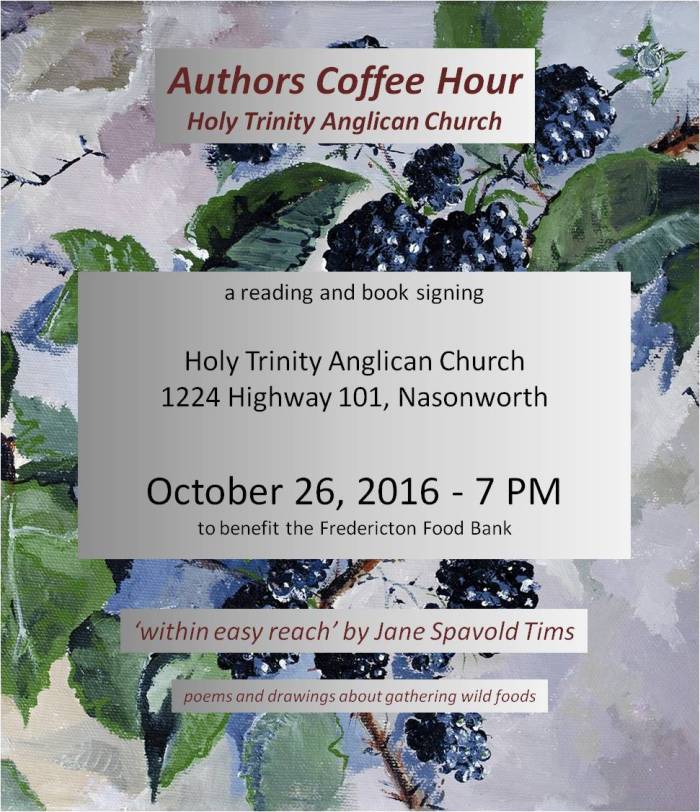
My fifth reading this month of my book ‘within easy reach’ will take place at 7PM on Wednesday evening (October 26, 2016) at the Holy Trinity Anglican Church, 1224 Highway 101 in Nasonworth, New Brunswick. This will be the first of the Authors Coffee Hour series being held by our church in the coming months.
~
There will be refreshments including apple squares prepared from local ingredients by Real Food Connections in Fredericton. A local musician will be providing music. And $10 from every book sold will be donated to the Fredericton Food Bank.
~
If you are in the Fredericton area, please join me at this event! I will be reading poems to help sustain us through the long months ahead – about picking berries, making jelly and spending time in the apple orchard. My poems will also take you to the woodlands and coastal areas of New Brunswick, to sample foods you may never have tasted! And my poems will encourage you to ‘eat local’!
~
 ~
~
Hope to see you there!!!!!
~
Copyright 2016 Jane Tims
more blueberries!
Tomorrow, Saturday October 22, 2016, I am giving a reading of my book ‘within easy reach’ and a short talk about eating local foods, especially wild plants. The reading will be for a regional meeting of local chapters of the New Brunswick Women’s Institute. Their theme this year is ‘pulses’ and the nutritional benefits of eating beans, lentils, chickpeas and split peas – foods harvested dry – affordable, protein-packed and delicious!
~
I will be reading poems from my book, taking the Institute members on a tour of local foods – from the forest floor to the field, to the garden and the farmers market, as well as foods grown inside the home kitchen.
~
I will also have a door prize for my reading, a painting of wild blueberries. ‘Sweet Hurts’ is 5″ X 7″ with gallery edges, done in acrylics using Ultramarine Blue, Cadmium Yellow, Cadmium Red, Titanium White, Paynes Grey and Burnt Sienna. The name ‘Sweet Hurts’ comes from an alternative name for the Low Sweet Blueberry.
~
~
Looking forward to this reading, my fourth this month!
~
Copyright Jane Tims 2016
yard work – the grape harvest
We had a frost on October 4 and today, I harvested my grapes. You will imagine tubs of ripe fruit, hands stained purple and a row of grape jelly jars on the counter.
~
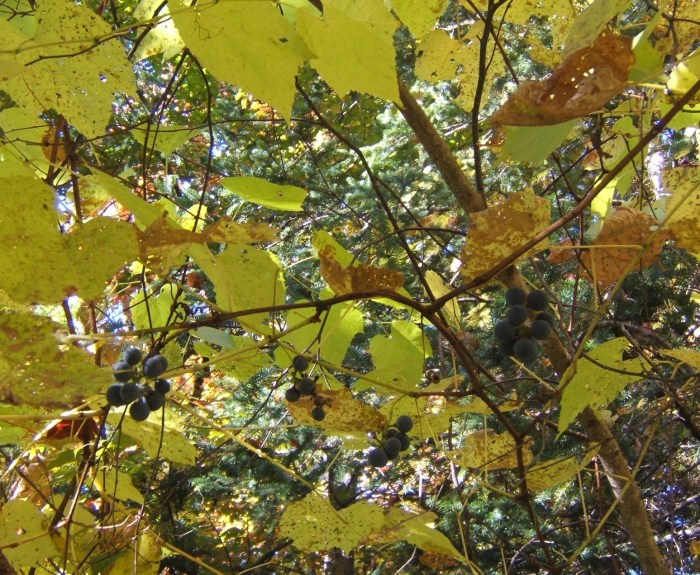
my grapes, wandering about in the birch tree
~
But my grape harvest is a bit small. However after ten years, this is the first ‘harvest’ from this vine so I am quite proud! No jelly though. I ate the lot of them, sitting in the yard, admiring the autumn leaves. They were juicy, sweet and delicious.
~
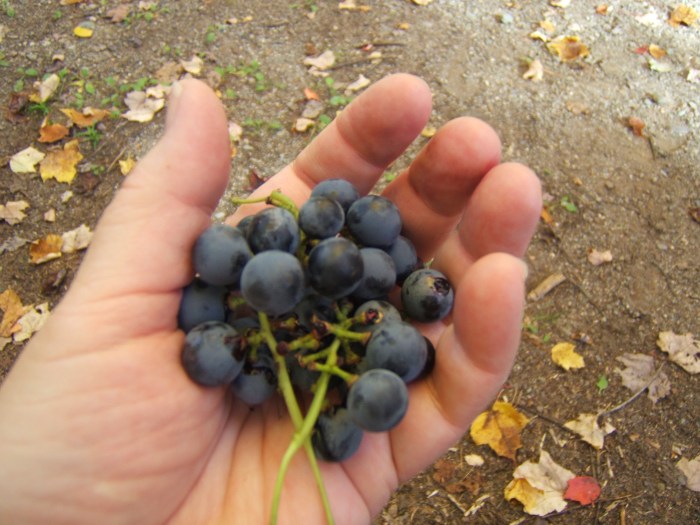
the entire harvest!
~
~
Copyright 2016 Jane Tims
changing communities
Last week we went for a drive to the Cornhill Nursery in Kings County to buy a new cherry tree for our yard. Afterwards we took a drive to visit some of the old communities in the area. One of these communities, Whites Mountain, was a rural farming community with 17 families in 1866 (New Brunswick Provincial Archives). By 1898 the community had one post office, one church and 100 people. Today the community consists of a few farms and residences, perched on a steep hillside overlooking the hilly landscape of northern Kings County.
~
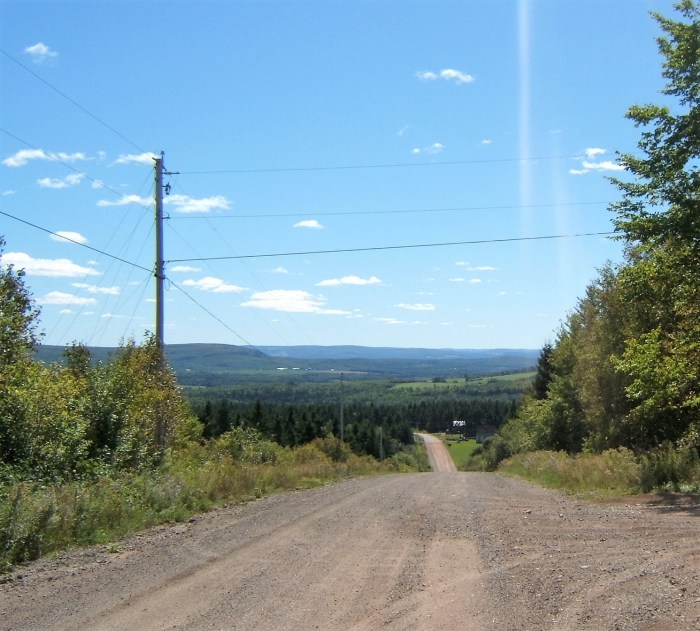
On the road descending Whites Mountain, Kings County, overlooking the broad Kennebecasis Valley (September 2016)
~
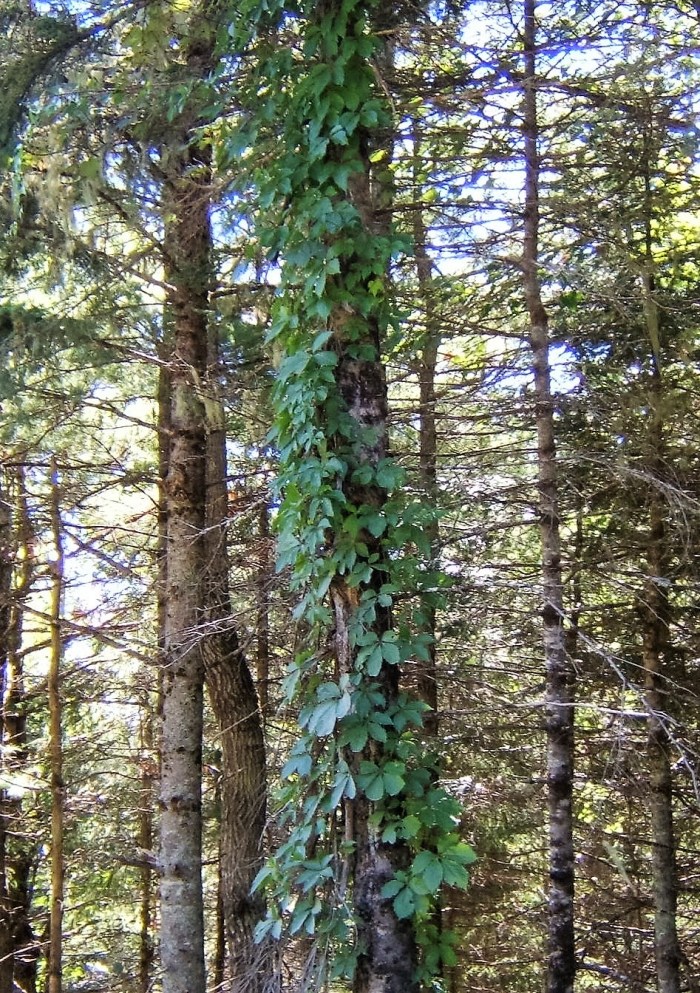
One of the most interesting sights on our drive may also be evidence of the farmsteads formerly in the area. Although Virginia creeper (Parthenocissus quinquefolia (L.) Planch.) is native to North America, in this area it is usually associated with human habitation. In the thick woods north of the community, we found Virginia Creeper in profusion, covering the surface of the trees.
~

~
~
Although there is only forest here now, perhaps the ancestors of these vines covered barns and other buildings in the area.
~
Copyright 2016 Jane Tims
getting ready for fall – choke-cherries
I have finished the final painting in the group for my sale in November. The last one is titled ‘within easy reach’, the title of my book and the first poem in the book! The painting is done in acrylics, 8″ X 16″, gallery edges, with Ultramarine blue, Cadmium red, Cadmium yellow, Burnt sienna and Titanium white.
~
Choke-cherry is a large weedy shrub, found along roadways, at the edge of fields and woods, and in barrens and lakeside thickets. The dark red berries occur in drooping clusters. They are very sour but are used to make jelly and wine. When the choke-cherries are ripe, all you have to do is reach up and your pail will fill to overflowing!
~
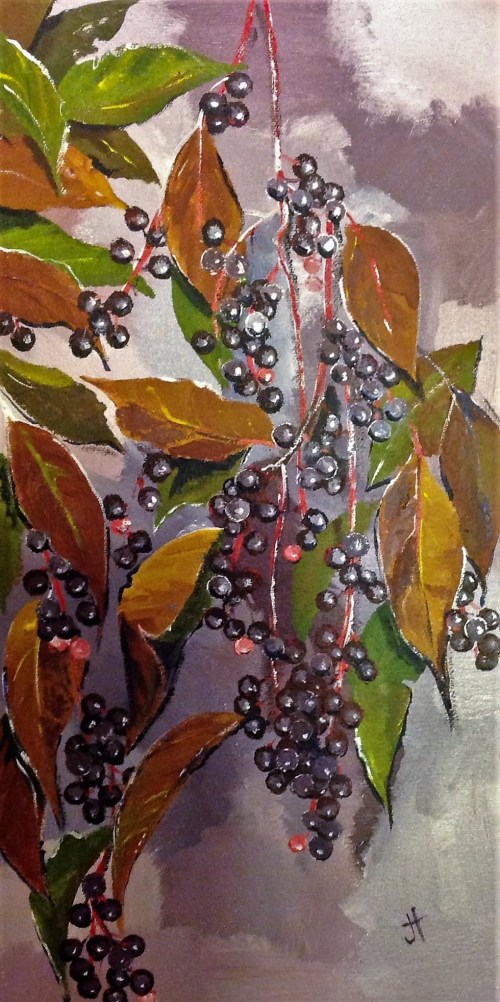
August 30, 2016 ‘within easy reach’ Jane Tims
~
within easy reach
~
Choke-cherry (Prunus virginiana L.)
~
Choke-cherries flow
into pail, sunlight
into winter, glint
of ripening by fireside
and flame, a taste
of dry wine, cherry-laden
and summer within
easy reach, berries
by the handful, ice-pellets
against the glass
~
~
within easy reach, Chapel Street Editions, 2016
Copyright Jane Tims 2016
getting ready for fall – rose hips
~
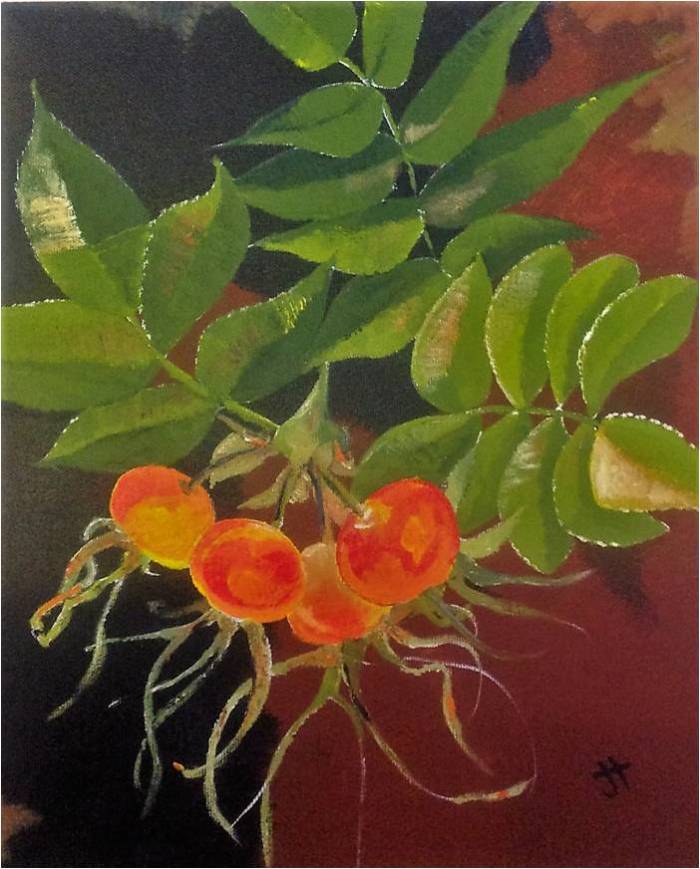
Rose hips ripening … another painting towards my fall sale of books and paintings.
Along the road at our cabin is a small bush. Pink flowers in spring and plump rose hips in fall. Anyone who does cutting or roadwork at our cabin gets strict instructions not to disturb the rose bush!
~
Copyright 2016 Jane Tims




 nichepoetryandprose