Posts Tagged ‘pencil drawing’
A muse takes over – final edits
This week I am working towards final publication of my first sci-fi novel on CreateSpace – Meniscus: Crossing The Churn.
I have incorporated the comments of my editor ( Lee Thompson Editing + https://leethompsonediting.com/ ) into my final draft.
I have sent my beta-version to my six beta-readers and will make a few edits based on their comments.
~
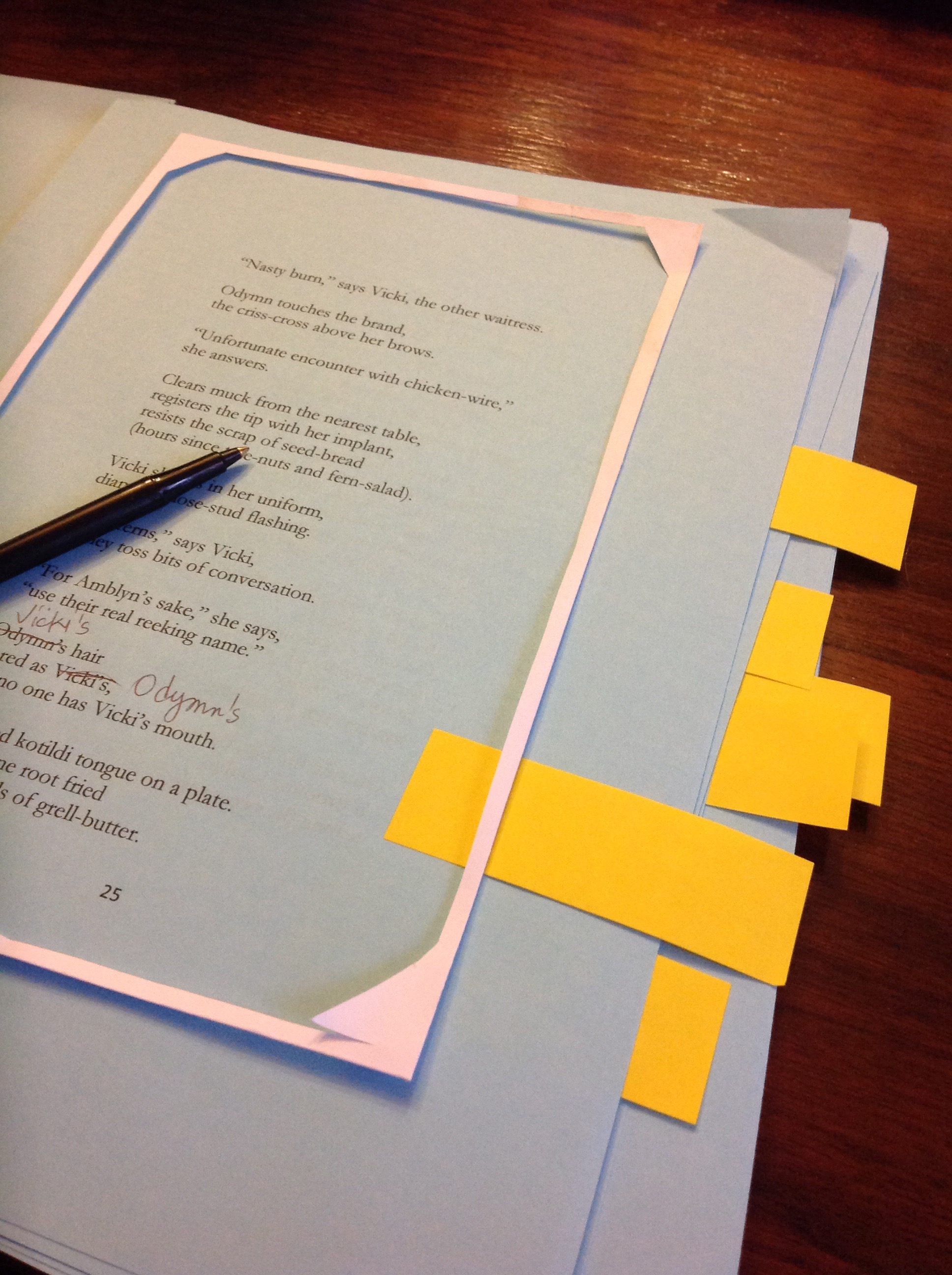
A glimpse of the book in final editing. The blue paper was a gift from my husband who thought he was buying white paper! The yellow tabs are just a few last minute changes. The white frame is my way of seeing how the book will look on the final page size!
~
At the last minute I decided my font was too small and switched from Garamond 12 to Garamond 14. It took a while to get all those drawings back to the left hand page!
Now, I have printed out a final version to have one last view before I load the cover, text and other information into CreateSpace.
A comment about independent versus traditional publishing:
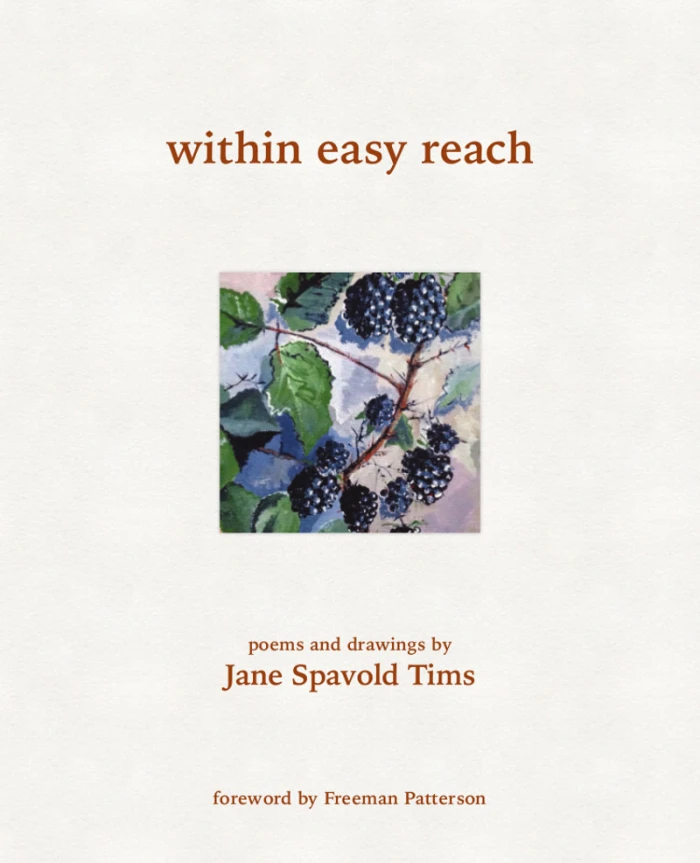
I realize how patient the publisher was with all the edits for my poetry book within easy reach (Chapel Street Editions, 2017).
I also realize that my publisher made the final call and ‘pushed the button ‘ regarding the final, final, final draft. Left to my own, I realize I am a bit nervous about this last step and find myself procrastinating, just a little.
To that end, I spent all morning, not working on Meniscus:Crossing The Churn, but on the early draft of the fifth book in the series!
~
Copyright 2017 Jane Tims
a muse takes over – character arcs
Every character in a novel needs a background and a story arc of their own, in order to make them interesting and realistic. This creates challenges as I proceed through the drafts of the five books of my sci-fi series ‘Meniscus’.
~
In Book One (Crossing the Churn), I have only two main characters, Odymn and the Slain.
In Book Two (South from Sintha), they rescue three new characters from servitude under the Dock-winder aliens and a simple community begins to take shape.
In Book Three (Winter by the Water-climb), a transport crash brings six more humans to the settlement.
By Book Four (The Town at Themble Hill), the settlers are actively seeking new recruits to the community and there are sixteen characters for the writer (me) to manage.
At the end of Book Five, even I don’t know how many characters will survive/be added!
~
Character arcs assist with the forward motion of the entire story. Each character’s story arc contributes to the whole and is usually connected in some way to the main story arc.
~
I express my character story arcs in a three-part sentence — what the character wants, the obstacles he or she encounters, and the resolution.
~
~
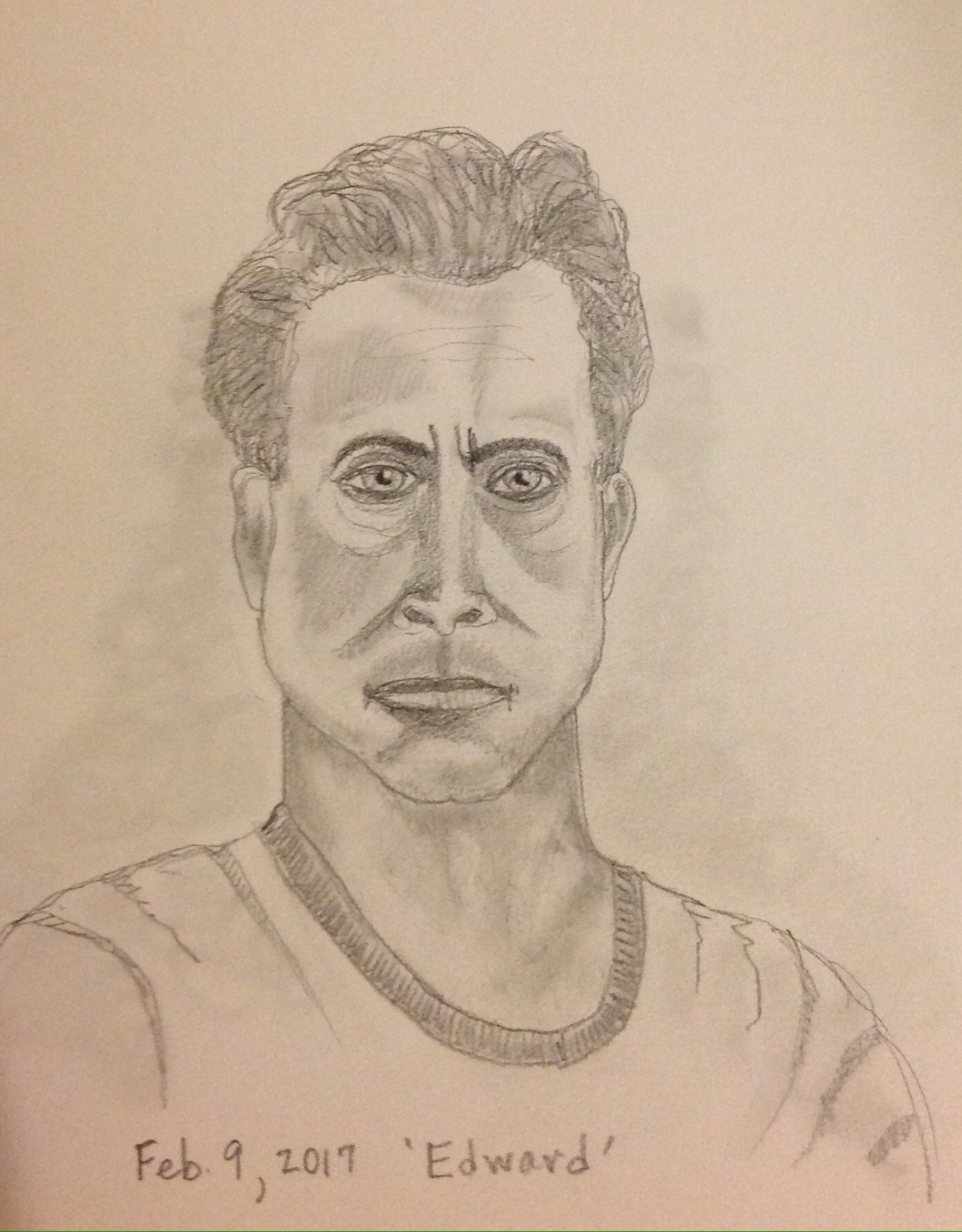
For example, one of the new recruits in Book Four (The Town at Themble Hill) is Edward, a medical doctor. Although the settlers can get the help of an alien elder, a doctor who has actually treated human illness will be a great asset to the community. When he enters the story, he has been a Dock-winder slave, used to treat the ailments of other human slaves.
~
In the Dock-winder city of Prell, Edward has been able to work with complex technologies. But in the new human settlement, deep in the Themble Woods, even simple tools like stethoscopes or standard pharmaceuticals don’t exist. Edward has to reinvent his approach to medicine, developing his own methods with available tools and embracing alien natural medicines and techniques he previously belittled.
~
So, Edward’s story arc is expressed as follows:
Edward wants to help his patients but when technology is no longer available, he has to learn to embrace alien methods and natural herbal medicines.
~
This sentence, once written, can help determine the mood of the character, his attitude towards other characters, his response in various situations and the risks he is willing to take. Now I can revise my draft to make it consistent with Edward’s story arc.
~
There are often three ‘bumps’ to move the character’s story arc along. Edward’s three ‘bumps’ are consistent with his story arc:
- Edward is skeptical of the Argenop methods (the Argenops are primitive aliens, cute and furry)
- He encounters a medical challenge that, with technology, could be easily resolved
- He tries an alien, herbal treatment and learns to trust new methods
~
Back to work!
~
~
Copyright 2017 Jane Tims
a muse takes over – creating alien animal species
In this post, I’ll show you some of the animals I have invented for my science fiction tale of life on the alien planet Meniscus. If you think I have gone crazy, keep reading anyway!
~
Hiking through the woods on planet Meniscus is dangerous. At any moment my characters can be attacked by carnivorous club-mosses, voracious bird-like reptiles seeking hair for their nests, packs of wolf-like ‘kotildi’, or three-eyed ‘slear-snakes’. Writing the scenes with these creatures has been so much fun.
~

… the wolf-like kotildi are denizens of the Meniscus woodlands – wild, they are voracious, but tame, they are endearing!
~

… Odymn and the Slain spend a bit of their time fending off trolling ‘slear-snakes’ …
~
Probably because I love birds, I have included lots of birds in my list of species on Meniscus. These include large flightless and burrowing ‘grell’, the wheeling ‘wind-fleers’, and woodland song-birds.
~

… Odymn sees a bird that looks like a ‘scarlet minivet’ on one of her adventures … not afraid of her at all …
~
Here is a list of some of the animals on planet Meniscus.
| animal | description |
| elginard | wingless insect; moves by floating on air currents |
| evernell | feral cat-like scavenger, with whiskers; slinks, sprays saliva |
| grell-swallows | large burrowing birds; used for a food and fat source |
| kemet | striped horse-like animal with hooves and a long tail |
| kotildi | woodland carnivore, like a large wolf with a hump and mane; source of meat |
| midlar | territorial, tree-living rodent; hoots |
| nelip | small external parasite, infesting fur and hair |
| slear-snake | snake-like reptile with poison teeth, claws, and pincers |
| warbel | song bird living in the woodland |
| windfleer | heron-like bird; moves in flocks |
~
My favorite species on Meniscus is a small insect, the ‘elginard’. Wingless and fluffy, it follows currents of air, at the whim of the universe. Dandelion fluff and wooly aphids were my inspiration for the ‘elginard’.
~

~
~
Copyright 2017 Jane Tims
a muse takes over – creating alien plant species
When I was in university, we spent lots of time in botany courses discovering the concept of ‘form follows function’. This means that plants have adapted to their surroundings so almost every physical feature reflects the requirements of landscape and habitat. Good examples:
- thorns discourage predators
- tubular flowers to enable pollination by insects with long mouth parts
- hairs on leaves help conserve moisture by blocking air flow
~
This concept is foremost in my mind as I try to populate my fictional planet Meniscus with plants. Plants are important to my story because my characters have to forage for their food (the main character, Odymn, is particularly good at finding food in the forest). My alien plants have to serve the purposes of the story. They also have to be credible and follow biological logic. Form must follow function.
~

This drawing of Odymn practicing her parkour in the woods shows two plant species on Meniscus — a banyan-like tree and ‘slag-fern’. This banyan is great for climbing and jumping!!!
~
Some sci-fi readers prefer authors not to invent new species, but to use our familiar species. I decided to create new species because my story is about what humans have lost when they were brought to an alien planet. I plan to help my readers by including a glossary of alien plants in the back of each book.
~
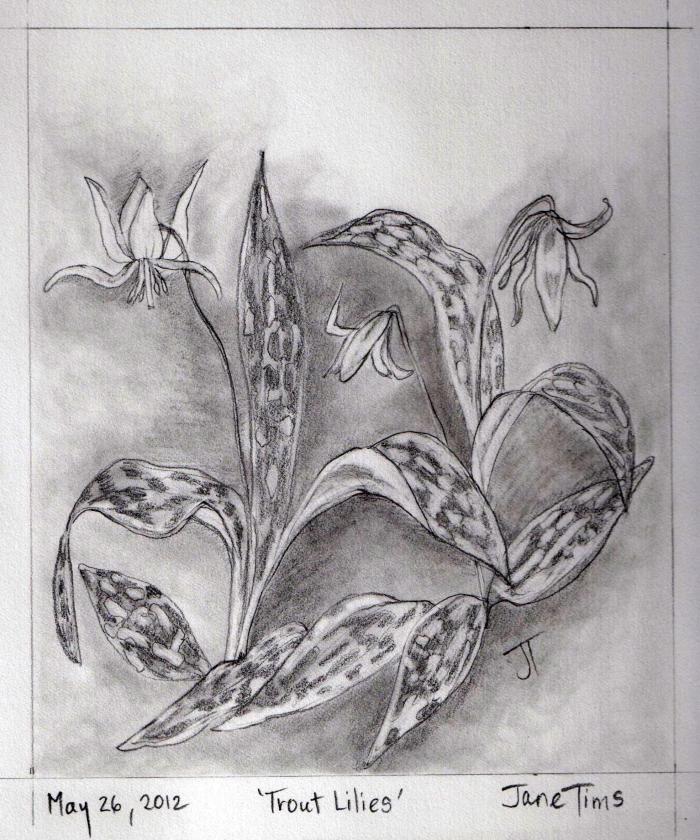
Although they are alien, most of my plants are reminiscent of our species here on Earth. A good example would be ‘arbel’ a small woodland plant used to treat ailments on planet Meniscus. One of the chemical components of ‘arbel’ is ASA (acetylsalicylic acid or aspirin), making it similar to tea berry (Gaultheria procumbens), a plant common in our woods. I imagine ‘arbel’ to look like our woodland species trout lily (Erythronium americanum). Like trout lily, ‘arbel’ has edible corms. Also like trout lily, ‘arbel’ has thick leaves to conserve water on a planet where surface water is rare.
~
~
Another of my alien plant species is a carnivorous club-moss, a dangerous inhabitant of the Themble Woods. Sheets of this moss crawl across the woodland floor, engulfing their prey. I want to include carnivorous plants on Meniscus because our own carnivorous plants, such as the sundew (Drosera sp.), are so intriguing. My carnivorous ‘club-moss’ has glands to absorb nutrients from its prey and touch-responsive tendrils to help it crawl through the forest. For a while I thought I would use carnivorous vines but I have seen too many movies where vines take over the earth!
~
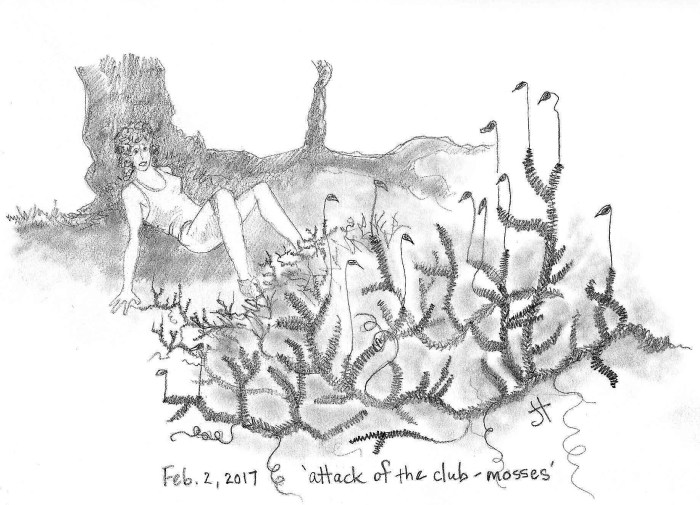
Odymn falls asleep in the woods and is overtaken by a carpet of carnivorous club-mosses.
~

An earlier drawing showing vines attacking Odymn.
~
Following is a list of the plants I have planted on Meniscus. Beverages to keep the folks on Meniscus awake are brewed from the leaves and berries of ‘thief-bush’!
~
| plant | description |
| arbel | nodding woodland flower; corms edible |
| glasswort | transparent, low-growing plant, adapted to the edges of the Churn |
| grammid | tree with orange leaves and edible seed pods; smells like cinnamon |
| ransindyne | plant grown for its edible root |
| slag-fern | fern-like plant with leathery leaves |
| spenel | small plant with edible berries |
| thief-bush | bush with thick leaves and blue berries; used to make beverages |
| tussilago | plant similar to colts-foot, used to sooth a cough |
| walking-vine | vigorous vine native to the edges of the Darn’el desert |
| yarnel | tree with edible fruit like pomegranate |
~
This writing has given me new appreciation for the interesting and complex plants we have on our own planet!
Next post I will show you some of the animals on Meniscus!
~

~
Copyright 2017 Jane Tims
the joy of writing
I have been absent from my blog for a week. Tied up in the sheer enjoyment of writing my fantasy tale.
~

an illustration of the interaction between the main character of my story and a Dock-winder alien
~
I have discovered that there are two main parts to writing: the writing itself and the ‘administration’. The administration includes the editing, the creation of other materials associated with the writing (for me, drawings, maps and covers), the search for publication, the preparatory work toward publication, and the marketing (readings, selling books, making sure the cat doesn’t destroy your boxes of books).
~
Although some of the administration is fun, it is the writing I love to do. This includes the research and the joy of creating the characters, the story, the plot, the various drafts.
~
This project has been particularly involving. Perhaps it is the creation of an entirely new world. Perhaps the freedom of building characters I have not known before. Perhaps the thrill of writing in a genre I have always enjoyed reading but felt hesitant to write.
~

the main character in the book – a practitioner of parkour and a woman who has hung on to hope in spite of adversity
~
My story is simple. It is about a young woman who wants freedom and sets out on a search for that freedom. The plot is a little more complicated. In her search she encounters a man who seems to share her purpose. Adventures and romance ensue.
~
So far I have
- the first in what I hope will be a series of three stories
- most of the first draft of the second story because it informs the first … in the writing of the second story I discover needed elements of the world I’ve created
- a cover design … one of the tasks ahead is to create a painting from my design
- a description of the planet Meniscus
- a map of the part of Meniscus in my story
- a glossary since some of the words in the story are unique to the created world – units of measurement, plants and animals, and so on
- a condensed guide to the main language used on the planet (everything in the text is translated but having a dictionary is just fun)
- drawings to illustrate some of the action in the story
~

a map to go with the story
~
My plans are to pull this all together and venture into the world of self-publishing. I have a friend who has lots of experience with Amazon publishing and is willing to share his ability.
~
I have also hired an editor to work with me on the project so my book will be the best it can be.
~

~
I will be looking for some beta-readers, so if you are a regular reader, like sci-fi, fantasy, romance, and adventure, and enjoy reading accessible poetry, let me know by leaving a request in the comments, including a little about your reading life and genre preferences, and whether you have been a beta-reader before.
From this I will choose a few beta-readers and I will exchange what I hope is a great read for some feedback.
A beta-reader provides general comments on readability, identifies parts of the story not easily understood, points out any ‘bugs’, and lets me know what they enjoyed/disliked about the book.
The book will be short (9,500 words) and about 100 pages (stretched out since it is written in poetic lines and includes illustrations and a map). There is some violent content, sexual content and alien profanity, so beware.
~
Back to writing. And ‘administrative’ duties!
~
~
Copyright 2016 Jane Tims
two alien characters
In my fantasy tale I have included several alien species. Two of these are in the category of ‘bad guys’. Neither species is sympathetic to human ideals and concerns.
- The Dock-winders are intelligent aliens, natives of the planet Meniscus and primarily interested in the economics of buying and selling other sentient beings. They are called Dock-winders because, when they invaded Earth, their long necks reminded people of the big tie-ups at ships’ wharves.
- The Gel-heads are also aliens of the planet Meniscus. No one would call them intelligent. They are mostly interested in enjoying themselves and letting others do their work for them. Through the eons they have settled into a trading relationship with the Dock-winders. They are called Gel-heads because their skin is green, transparent and gelatinous, allowing their skulls and musculature to show through.
~
Drawing these aliens was fun, but I realise I am in the trap of copying humanoid characteristics such as bi-symmetry, bi-pedalism and head-near-the-top. Two eyes, a nose and a mouth. Oh well, all in fun.
~
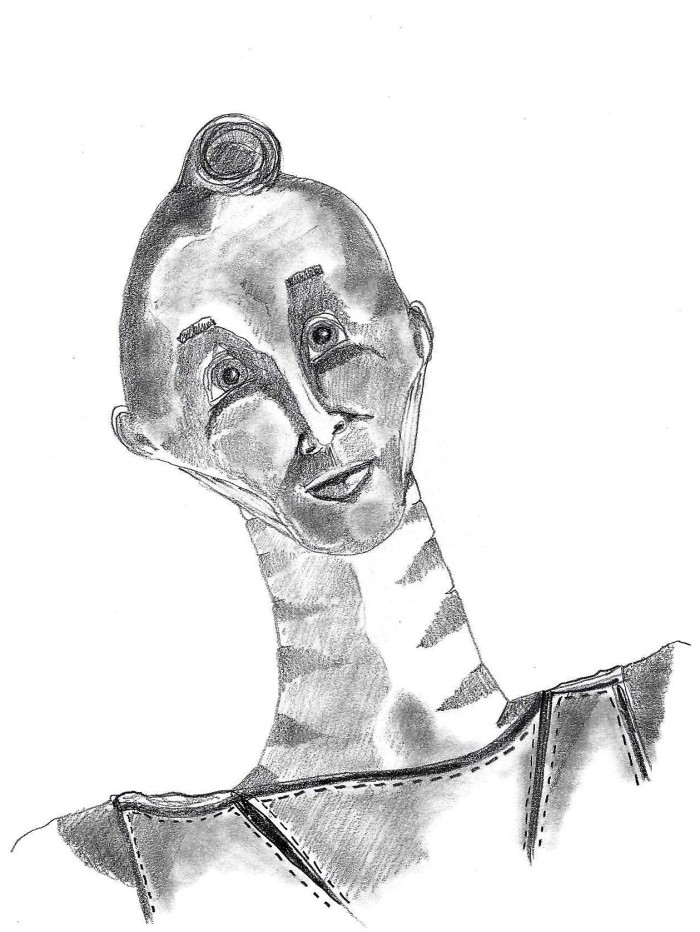
Dock-winders try to look benign and naïve. They blink a lot.
~
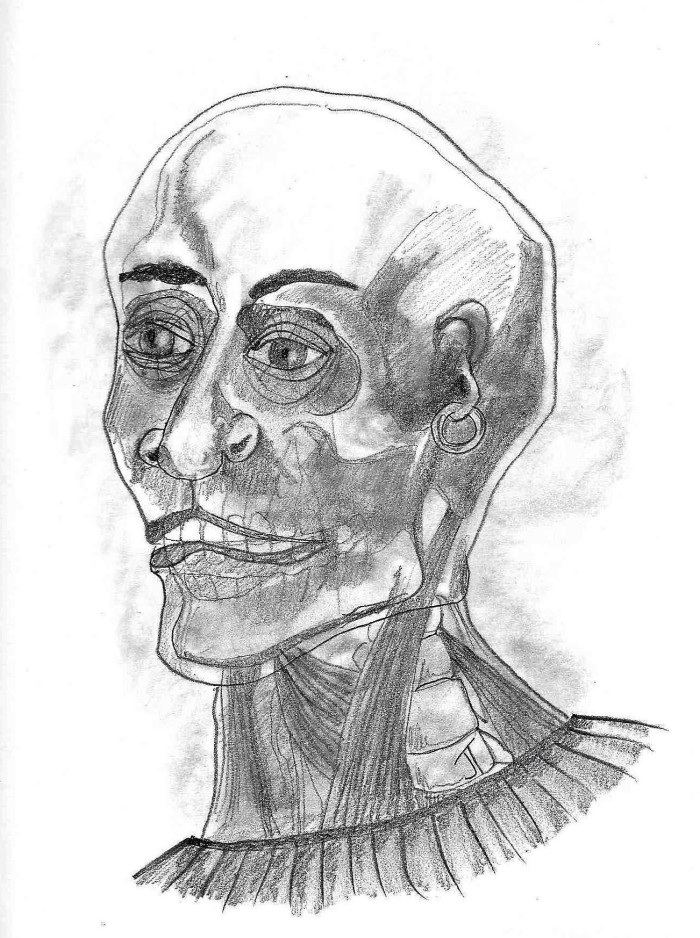
Gel-heads cannot hide the cavities in their teeth.
~
I am glad I will never have to meet up with either species.
~
Copyright 2016 Jane Tims
choosing book covers and titles
I was recently at a writing workshop about independent (or self) publishing. The instructor took us through an interesting exercise … creation of a book title and book cover for a story. Each of us was asked to provide the potential name of a book and a verbal description of the book’s cover. The audience tried to guess the book genre, general plot and story.
~
This exercise illustrated how important it is for writers considering independent publication of their work to chose titles and book covers carefully. This would be a great exercise for anyone trying to see if their ideas get a good initial reader response.
~
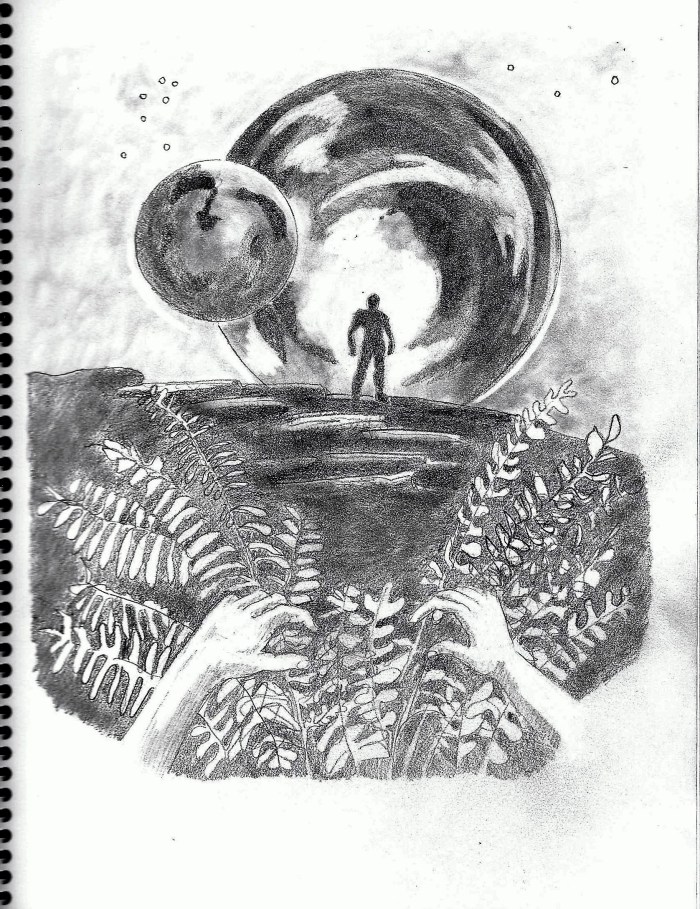
I provided the title for my new fantasy tale: Meniscus
and a verbal description of the following cover sketch:
~
~
Most people guessed correctly that this will be a Science-fiction/Fantasy (I think the alien sky helped). They also thought the book might be about an encounter between alien species.
~
Only two people in the audience knew what ‘meniscus’ meant.
Google provides the following definition:
me·nis·cus
noun
Physics– the curved upper surface of a liquid in a tube.Optics– a lens that is convex on one side and concave on the otherAnatomy– a thin, fibrous cartilage between the surfaces of some joints

three fantasy characters
On Friday, I introduced my current writing and drawing project – creation of a short fantasy tale. The story is about a young woman who tries to trade an old life for a new. The setting is an alien planet named Meniscus. I have three main characters:
- The young woman is a Human named Odymn. Odymn is in her thirties, living a life of servitude on Meniscus. Every night she escapes confinement to practice her passion of parkour. Parkour is the discipline of moving through the landscape in the most efficient way possible, running, jumping, vaulting, climbing and rolling. The discipline involves strength, endurance and flexibility and has allowed Odymn to reclaim and have control over at least one part of her life. Odymn has bright red hair which is about to get her into a lot of trouble.
- The man she meets during one of her parkour adventures is a genetically enhanced human, a Eu-hominid. He is a rover, moving from place to place to earn his living. He wears a special kind of armour and weaponry which taps into the electrical forces in his body. He has strength and endurance but almost no flexibility. He does not engage in idle chatter, to say the least. So far he has no name, so I just refer to him as Eu-hom. It’s OK if you are thinking names are not my strong point!
- After some encounters with other hominids and creatures on the planet, Odymn and Eu-hom set off on some adventures. At one point they encounter Wen-le-gone, a sentient, passive, furry creature known as an Argenop. Wen-le-gone adopts Odymn as his friend but does not warm to the Eu-hom, not at all.
~
Now that you have met my characters, I’ll show you what they look like.
~
Odymn has a peculiar scar on her forehead. How she got the scar and what it means to her is part of the story.
~

The Eu-hom is a rather serious character, not much of a conversationalist and not easy to befriend.
~

The Argenop, Wen-le-gone, is the village healer and sage. Looks a little like my cat.
~
Next time, I’ll show you drawings of some of the other humanoids and creatures of Planet Meniscus.
~
~
Copyright Jane Tims 2016
in the shelter of the covered bridge – Malone Bridge
As I prepare for my fall book and art sale, I have tried to bring some of my pencil drawings into acrylic-world.
~
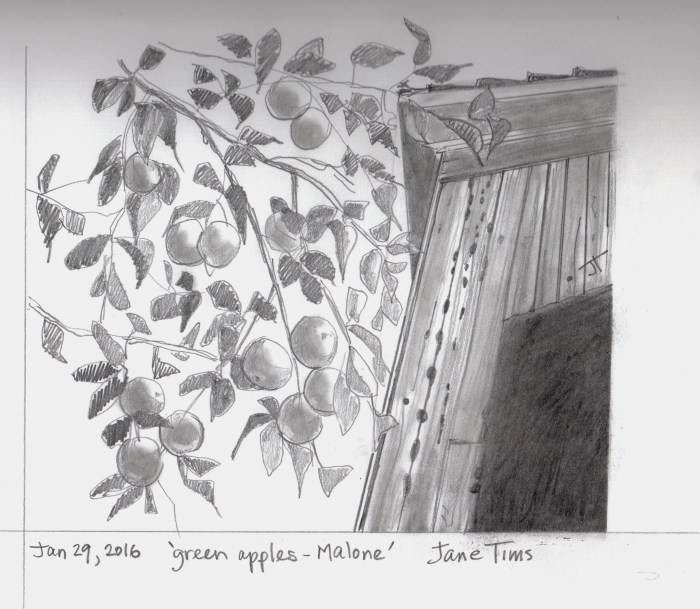
One of my favorite covered bridge drawings depicts a tree of green apples against the backdrop of the Malone Covered Bridge near Goshen in Kings County, New Brunswick. The Malone Bridge crosses the Kennebecasis River where it is hardly more than a stream.
~
~
From this drawing, I have done ‘apple tree, Malone Bridge’. I think this is my personal favorite of all the paintings I have done. The painting is acrylic, 18″ X 18″, gallery edges, using Paynes Grey, Ultramarine Blue, Cadmium Yellow, Titanium White and Burnt Sienna.
~

September 24, 2016 ‘apple tree, Malone Bridge’ Jane Tims
~
~
Copyright 2016 Jane Tims
in the shelter of the covered bridge – final manuscript
In the last weeks, I have been working towards completion of the book-length manuscript for ‘in the shelter of the covered bridge’. It includes poems and drawings about the plants and animals living in and around some of the covered bridges in New Brunswick.
~
Earlier this summer I was lucky enough to win a mentoring package from the Writers’ Federation of New Brunswick. I chose a talented, award-winning local poet to work with me on the manuscript and during the early part of the summer, with her expert guidance, I made revisions to the poems. She focused my attention on word choice, clarity and ‘showing not telling’. She also helped me with a handful of poems I thought were not salvageable and now some of these will make it into the manuscript!
~
In the last few weeks, I have worked on revisions, ordering of the poems, and, hardest of all, my footnotes. Since the poems are about the remaining covered bridges in the St. John River watershed, I want to include some basic information in the footnotes as well as notes I made during my visits to each bridge. I have also worked on the drawings I will include in the manuscript.
~

~
The process of preparing a manuscript is long and certainly goes beyond the fist few lines written on the page way back when this manuscript was just an idea. But if the way is about the journey, this has been such a memorable experience. Best of all, I have been lucky to make the acquaintance of many of New Brunswick’s covered bridges. Last Thursday, as we returned home from a visit, we saw a double rainbow in the sky and I was able to snap a shot as we waited to take our turn crossing the covered bridge across the Rusagonis River (the Patrick Owens Bridge):
~
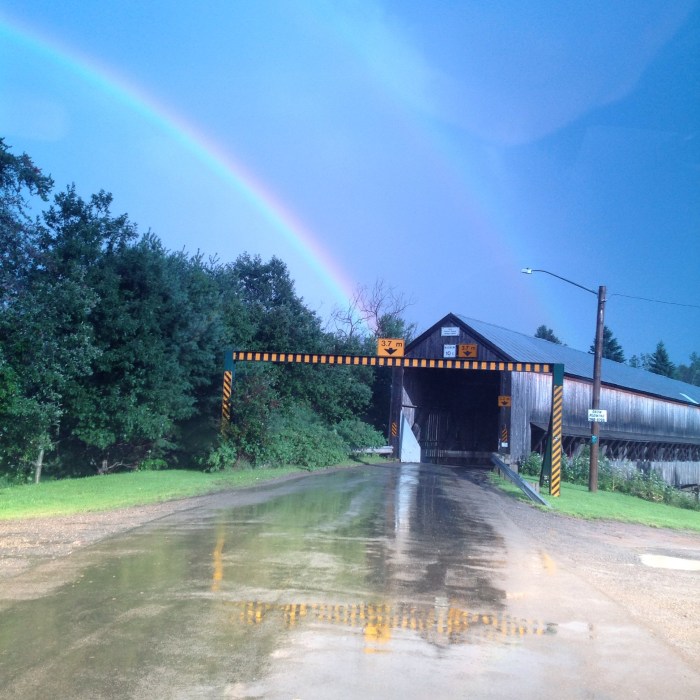
double rainbow over the Rusagonis #2 Covered Bridge in Rusagonis, New Brunswick – August 19, 2016
~
Copyright Jane Tims 2016




 nichepoetryandprose