Posts Tagged ‘pencil drawing’
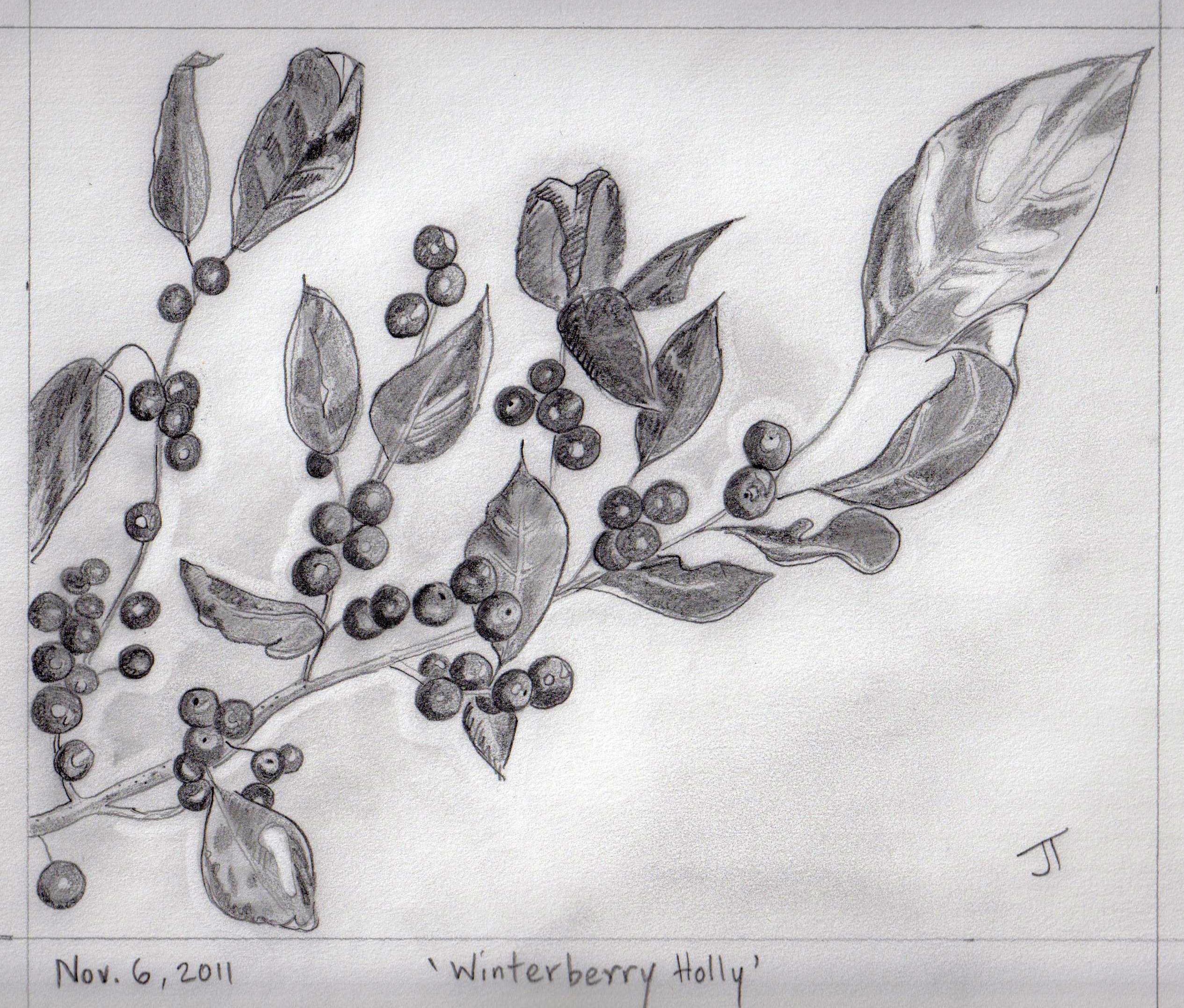
Winterberry Holly (Ilex verticillata (L.) Gray)
In contrast to October, November is a colorless month. The exception – November’s red berries.
They punctuate the roads and ditches – Highbush-cranberry, Staghorn Sumach, American Mountain-ash, Hawthhorn and Rose. Eventually the birds claim every one for food, but through most of early winter, the berries remain to cheer us.

Highbush Cranberry in November
Last November, my husband and I took a walk in the thicket of saplings above the lake. As we came around the edge of a clump of alder, we were surprised to see a sturdy bush of Winterberry Holly. It glowed with orange-red berries, set off by sprays of bronze-coloured leaves, not yet fallen. We are used to seeing Winterberry along the lake, but in the grey and white thicket, the little bush was a gift. We went there again this past Saturday, and there it was, glowing in the morning sun.

our bush of Winterberry Holly
Winterberry Holly (Ilex verticillata (L.) Gray) is also known as Canadian Holly, Swamp Holly, Inkberry, Black Alder and Feverbush. The shrub is usually found in wet areas, including wetlands, damp thickets, moist woods and along waterways. The leaves turn a brassy purple-brown before they fall. The fruit is a small, hard orange-red berry, remaining on the bush until January.

In my poem, the words ‘lexicon’ and ‘exile’ are included as imperfect anagrams for Ilex (ilex).
Canadian Holly
(Ilex verticillata (L.) Gray)
~
drab November
and lexicon
expires
umber leaves
grey verticals
dull stubble
~
winterberries
astound the wetland
red ink on page
and words explode
from exile
~
fever flush and holly
above December snow
icicles vermillion
~
© Jane Tims 2011
yellow rain
In October, we still have at least one more autumn display, the shedding of the tamarack needles. Tamarack is a deciduous tree and loses most of its needles this time of year. We have a number of tamaracks on our property, so the golden needles fall as a constant ‘rain’ during late October and early November.
Tamarack (Larix laracina (DuRoi) K. Koch) is also known as Hackmatack, American or Black Larch and, in French, épinette rouge. Tamarack is a large tree, with a narrow pyramidal canopy and pendulous branches.

In my head, I can still hear the voice of my undergraduate botany professor, who was interested in the origin of growth forms of plants, saying, “the tamarack has, here, both short shoots and long shoots”. The short shoots emerge from the sides of branches and resemble small bunches or tufts of needles, and the long shoots grow at the ends of each branch and are elongated, with single needles along the length. The needles are small and generally very soft to the touch compared to other conifers.
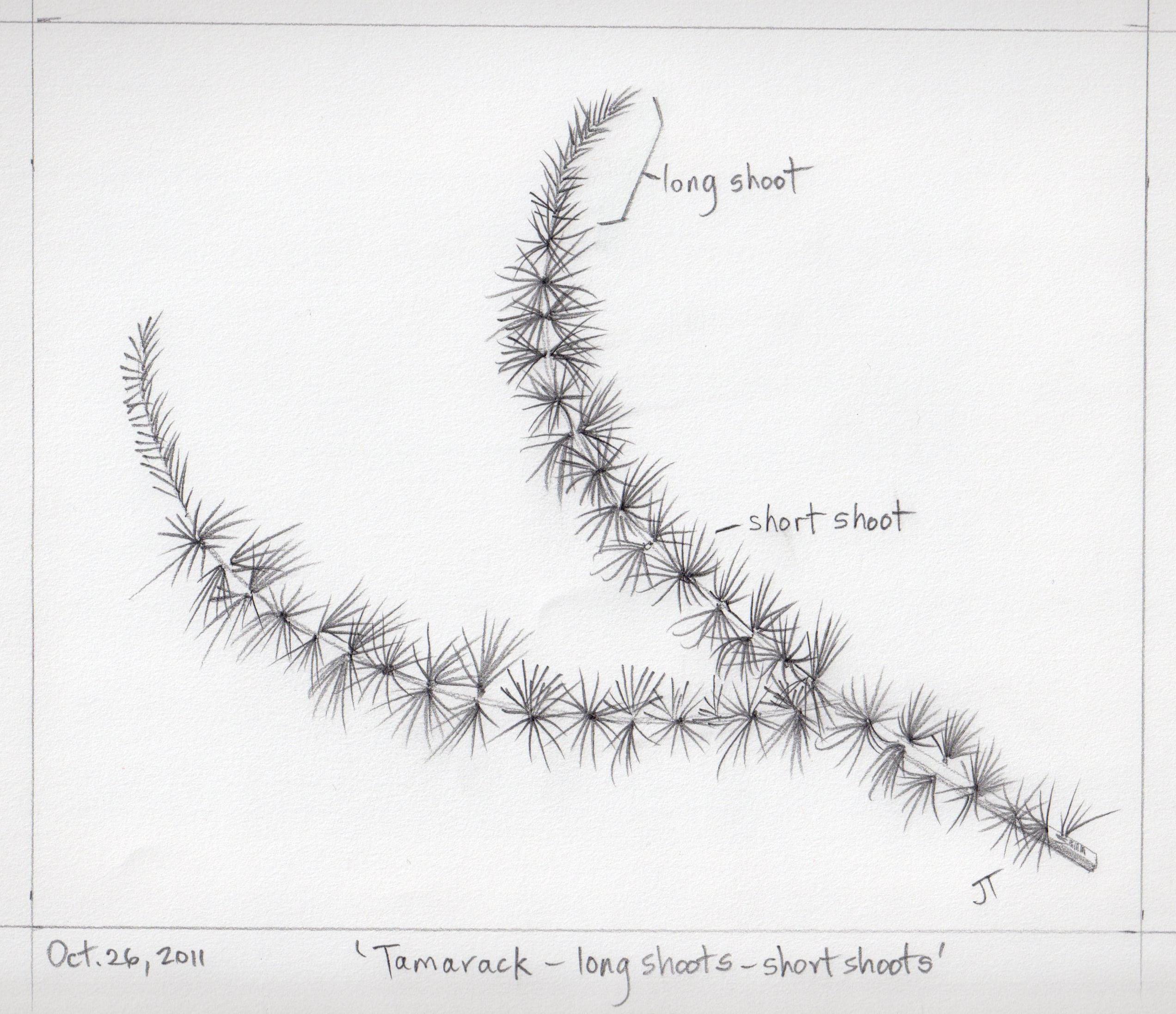
Today, there is evidence that the ‘amber rain’ has begun, just a few needles on every outside surface. By the end of next week, the windshield of the car will need a swipe of the wipers to clear the yellow needles.
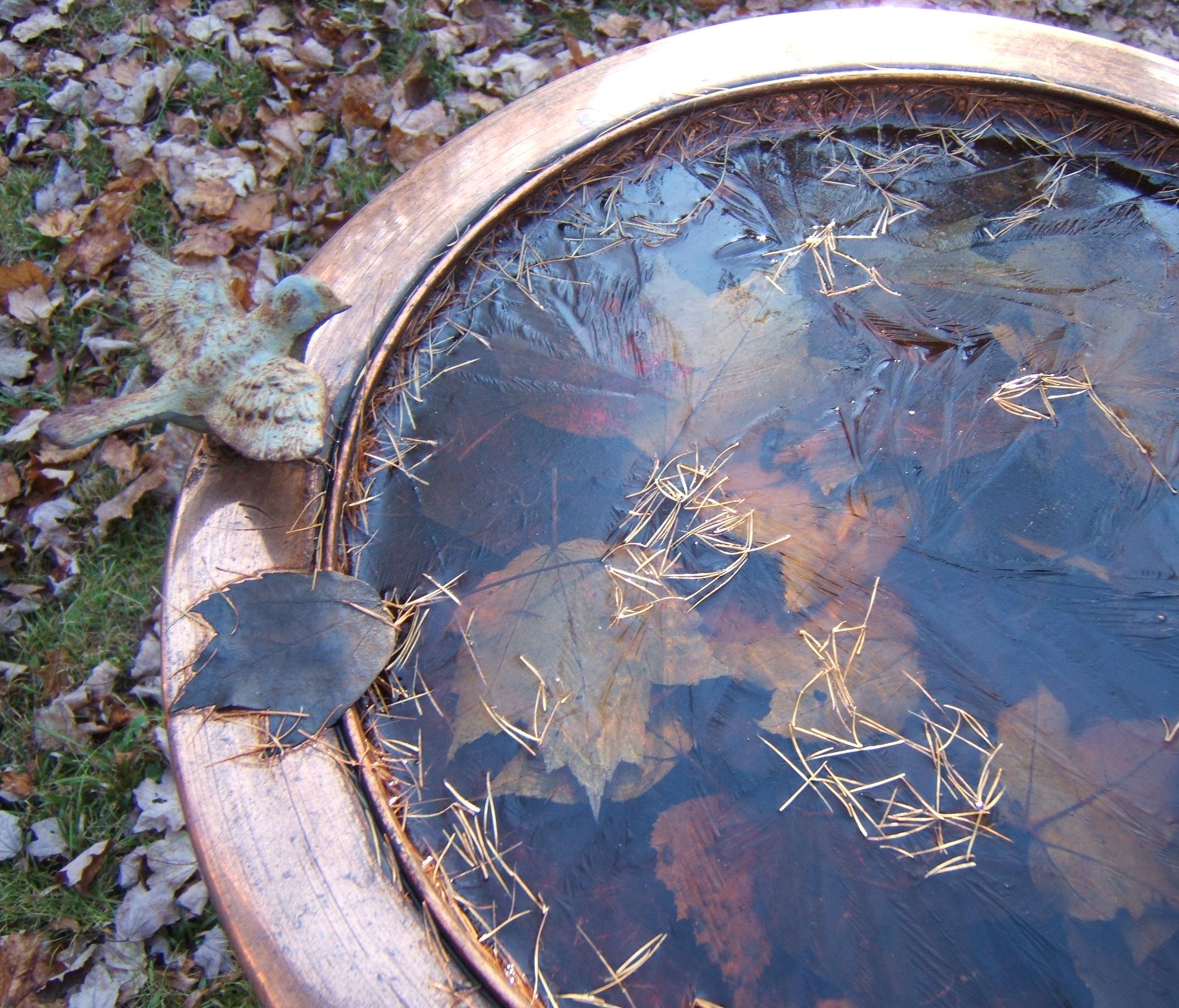
Tamarack needles on the frozen water of the birdbath
Amber Rain
~
autumn fades
bright carpets
swept away
pale ghosts rattle
from beech and oak
limp rags hang
on frosted pumpkin vines
~
but still
a touch of autumn
stands of larch
yellow in the afternoon
~
and now
a gust of wind
begins
the amber rain
~
pelting needles
fill the air
soaking ground
strewing gold
everywhere
~
fairy straw
washed to the edge
of puddle shores
flooding borders
of roads, driven
by wind, a storm
of gold
~
needles patter
gentle chatter
~
where begins
the amber rain?
is it larch
or hackmatack,
juniper
or tamarack?
who sends the amber rain?
~
© Jane Tims 1992
preface to fire
I always associate November with bonfires and the smell of smoke and burning leaves. I love sitting in front of a fire, with friends and family, sharing stories and talking about days ahead. But even in the midst of having fun, I am reminded – fire is not always a friendly force.
In 2002, we encountered the negative side of fire when we took an extended car trip to the west. In Quebec, Ontario and Alberta, we saw evidence of the destruction of recent forest fires.
One of the places we visited on our trip was Portal Lake, near Mount Robson, in British Columbia. We were at Portal Lake for about an hour. We hiked along the east side of the lake, and sat on the mountain rocks to dangle our feet along the rock face. The berries were brilliant, glowing like embers. Although there was no burnt land at Portal Lake, the paths were like tinder, the lichens dry and brittle. The lakeside had the thickened scent of drying vegetation.
The smell of smoke was in the air, as well as the faint smell of sulphur. We had just visited the hot spring at Miette. I had dangled my hands in the warm water and the sulphurous odor still lingered.
It was a kind of foreshadowing. Later in the week, the Rockies would be hazy with smoke as we made our way south of Banff. Two weeks later, we were back home, watching the reports on the Weather Channel. The Parks, Jasper, Banff and Kootenay, were all closed due to forest fire.
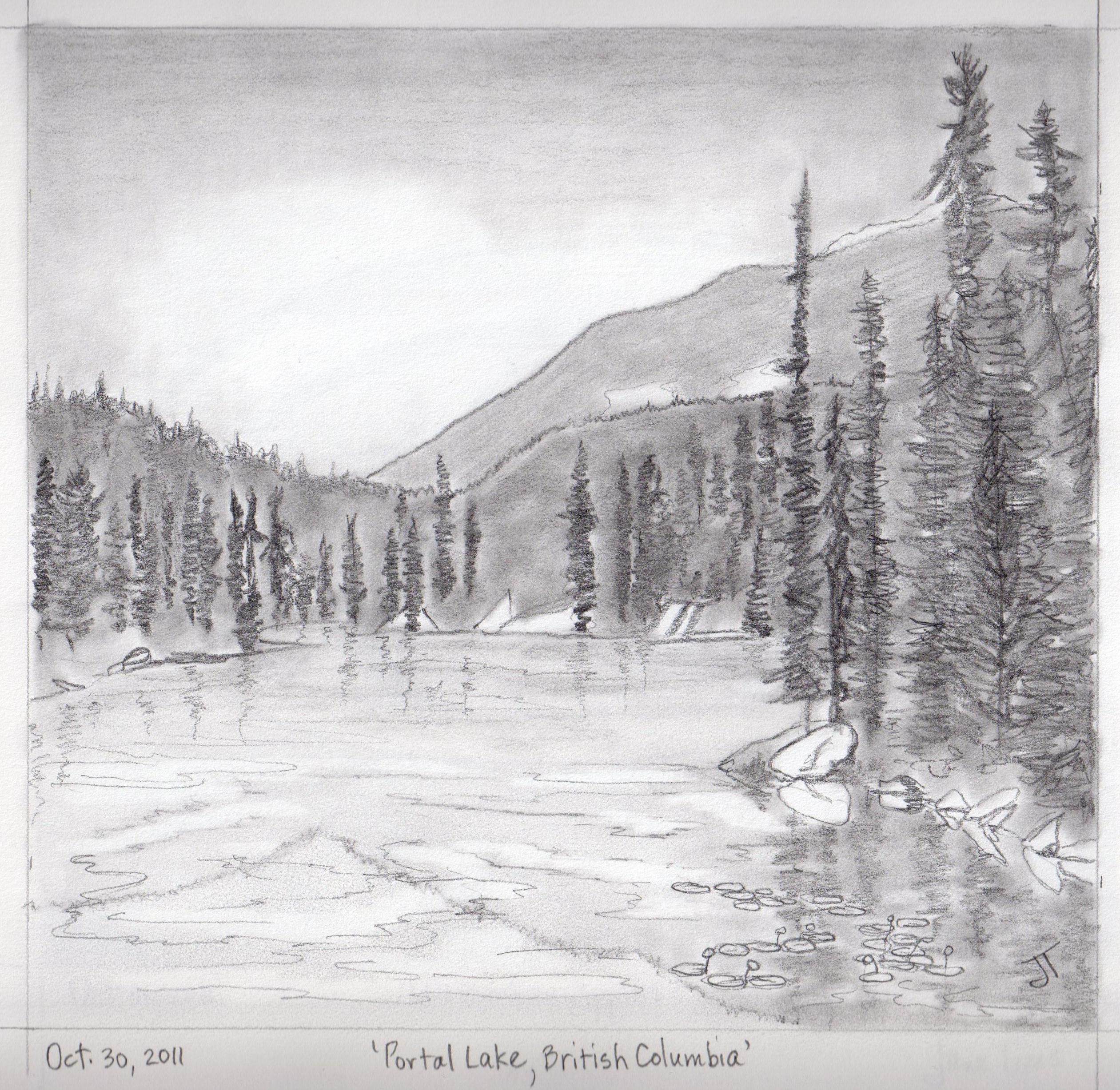
Portal Lake – British Columbia
~
1.
gateway to wildfire
preface to cinder
smoke and ember
~
2.
Xanthoria ochre, pale juniper
mountain titanium and grey
rose hip and raspberry
smilacina and cranberry
~
3.
granite transfers the burn
to the calves of my legs
hot as the sulphur spring
the air pine scale
and mosses
~
winds arrange the shallow lake
the surface in lines
on the bottom, sun shadows cast
sun shadow sun shadow sun
lily pads are lifted and settle
are lifted and settle
~
succession of fire, ashes and green
~
© Jane Tims 2002
more black and amber signs
In most Canadian provinces, there are areas where the highway has been built by blasting through bedrock. Often these sections of highway have warnings… Danger, Falling Rock! I have never actually seen a rock falling, but there is always evidence, at the base of the outcrop, of the wisdom of the sign.
danger, falling rock
~
outcrop
massive, at its base
a delta of rubble
~
© Jane Tims 2011

Heal-all (Prunella vulgaris L.)
Heal-all, self-heal, carpenter weed, and, in French, herbe au charpentier are all names for this little weed. Prunella vulgaris L. inhabits waste areas and lawns, becoming small and compact if mowed. The flowers are purple, lobed and lipped and held in a dense head or spike. This is one of many plants belonging to the mint family, easily identified because they have a square stem. The name is of uncertain origin; at one time the plant was called Brunella. Vulgaris means ‘common’.
Drawing this little plant is fun… no matter what you do, the individual flowers resemble small hooded sprites.

Heal-all
Prunella vulgaris L.
~
Prunella vugaris neat little weed
prim and proper gone to seed
~
called Brunella: gatherers found
Prunella purple fades to brown
~
weed, a carpenter busy and strong
mends bare patches on the lawn
~
heal-all, self-heal – your name suggests
herbal secret you possess
~
© Jane Tims 1994
entering november
After the color explosion of October, I feel a little exhausted. Sensory overload. Trees and roadside plants have gone to sleep or seed for the winter. Most of the Canada Geese have left on their southward migration, and I am sure our Groundhogs have eaten themselves into a winter stupor. Not many of us left to settle in to our niche for the coming months.
My November ‘niche’ activities will include:
- daily filling of the bird feeder
- refurbishing our outside fire pit
- acquiring rock for our new project… a rock-embellished woods road (more about this later)
- sorting some of the books in my library
- return to making soups and stews for our meals

Mostly, I want to appreciate November. I am not very fond of the coming month, but I have resolved to find good in it.
November first frost
~
air brittle
a broken sliver of moon
caught among disrobed larches
silence ruptured
by craven’s cry
~
© Jane Tims 1995

Round-leaved Sundew (Drosera rotundifolia L.)
Carnivorous plants are a bit frightening. They seem more thoughtful than other plants. They are slightly macabre, possessing special adaptations for acquiring their food. They take on shapes not typical of flowering plants. On most days, you can find their prey, in various stages of digestion.
The Round-leaved Sundew, Drosera rotundifolia L., is also called Daily-dew or, in French, Rossolis à feuilles rondes. The Sundew is a carnivorous plant of acid bogs, barrens, moist roadside ditches and peaty soils. The leaves are in a tuft at the base of the plant and each leaf is covered with numerous gland-bearing bristles. These exude a clear fluid that glitters in sunlight, hence the name, from the Greek droseros meaning dewy. The delicate white flowers are borne on a slender, nodding stalk, and only open in the sun.

Round-leaved Sundew
Drosera rotundifolia L.
~
daily, dew is falling
sits on bristled leaves
of the sundew;
in innocence, believe
~
in our ditch is treasure,
glittering jewels, set
out in the sunshine,
a lure for insect fools
~
brilliance and beetles caught
in sticky dew, bristles tight
clutch creatures
they slew
~
tiny flowers cling
to the curve of a nodding stem,
opening when sunlight
shines on them
~
© Jane Tims 1984
trees on sky
This time of year, the lost leaves allow a new observation of sky. The bare branches remind me of pen and ink on paper.
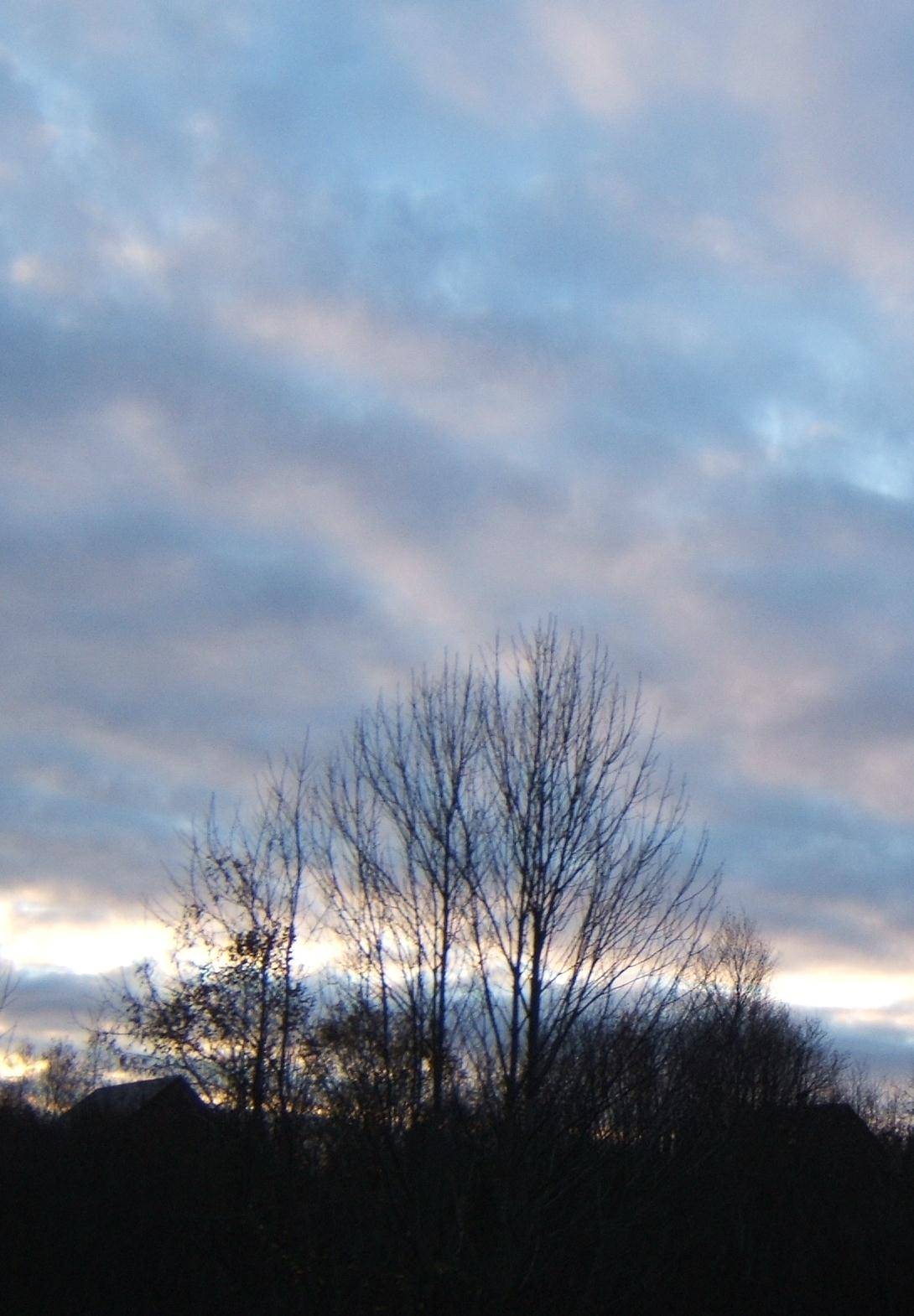
these leafless trees / brush against /a linen sky / ink strokes /on rice paper
(from ‘requesting the favor of a reply’ in the post ‘hidden in the hollow heart of an oak’ August 19, 2011, under shelter)
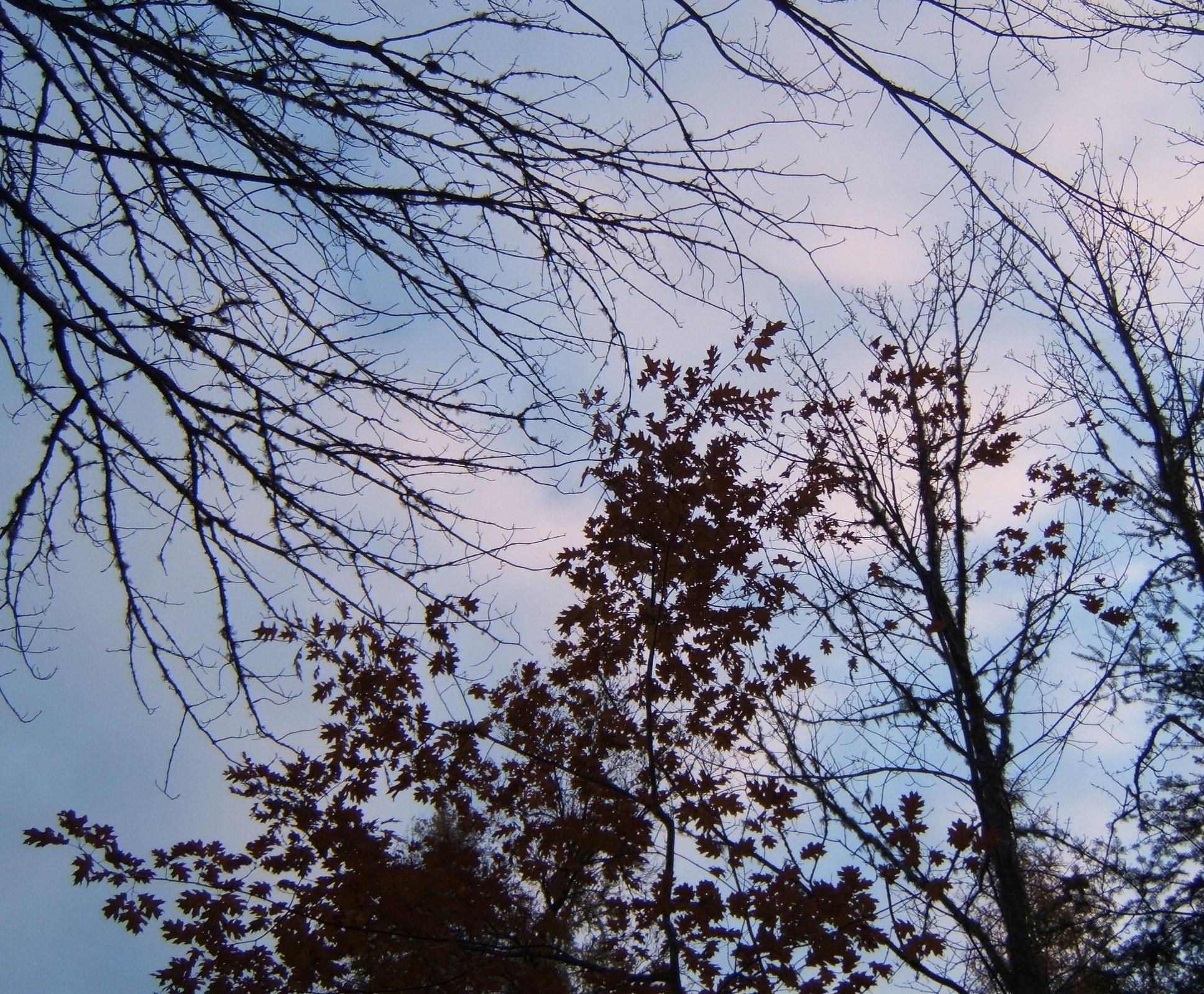
pale sunrise
~
perhaps this sparse oak
colored the pale sunrise
palette, faded autumn
~
even loaded, lean branches
lay only brief color
on canvas sky
~
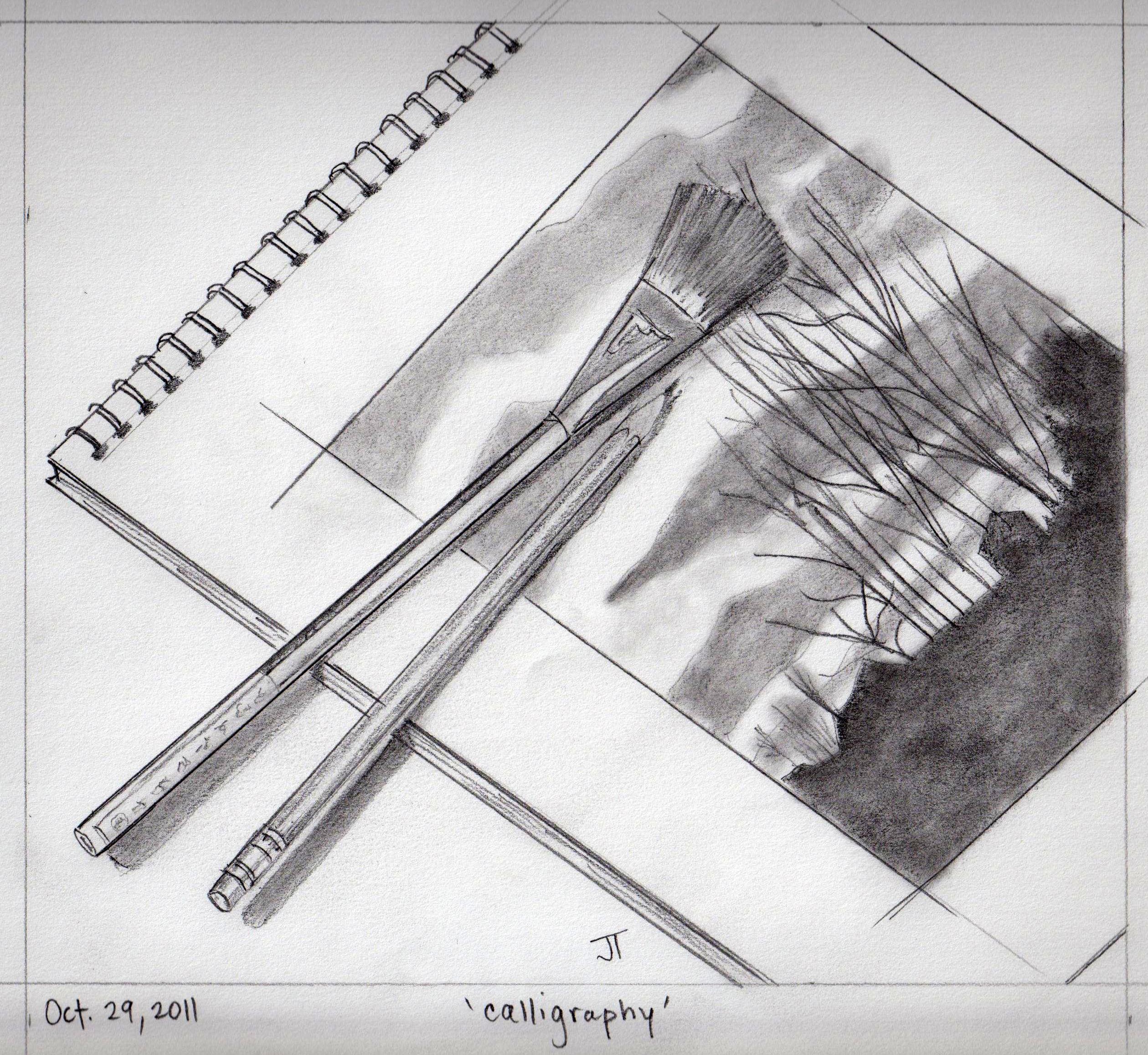
brush more suited to calligraphy
a few abbreviated strokes
a terse ‘good morning’
~
© Jane Tims 2007
air to breathe
As I approach retirement, I find I am thinking a lot about my past work. My first job was as a botanist in the field of air quality.
Some plants are very sensitive to air pollutants and develop ‘herring bone’ patterns on the leaves when the levels of pollutants like sulphur dioxide get too high. Other plants can be used as monitors since they absorb pollutants from the air.
I worked to diagnose air pollution injury to sensitive plants and designed ways of using plants to assess air quality problems. We grew tobacco to measure ozone pollution, set out ‘tea bags’ of sphagnum moss to monitor levels of trace metals in the air, and collected reindeer lichens to determine their pollutant exposure. I had wonderful days identifying plants, collecting lichens and being a botanist.
My favourite air pollution monitors were the reindeer lichens. These are like all lichens, a symbiotic organism consisting of an algae and a fungus. They have no roots, so they absorb all their nutrients from the air, making them an excellent monitoring system for air pollutants. They were a challenge to identify and the habitats where they grew took me to some very interesting places in New Brunswick. These included peat bogs where the lichens grew beside pitcher plants and sundews, mountain-tops dominated by ericaceous species like sheep laurel (Kalmia angustifolia L.) and blueberry, and high flung rock outcrops where I could see all the world below me as I picked my specimens.
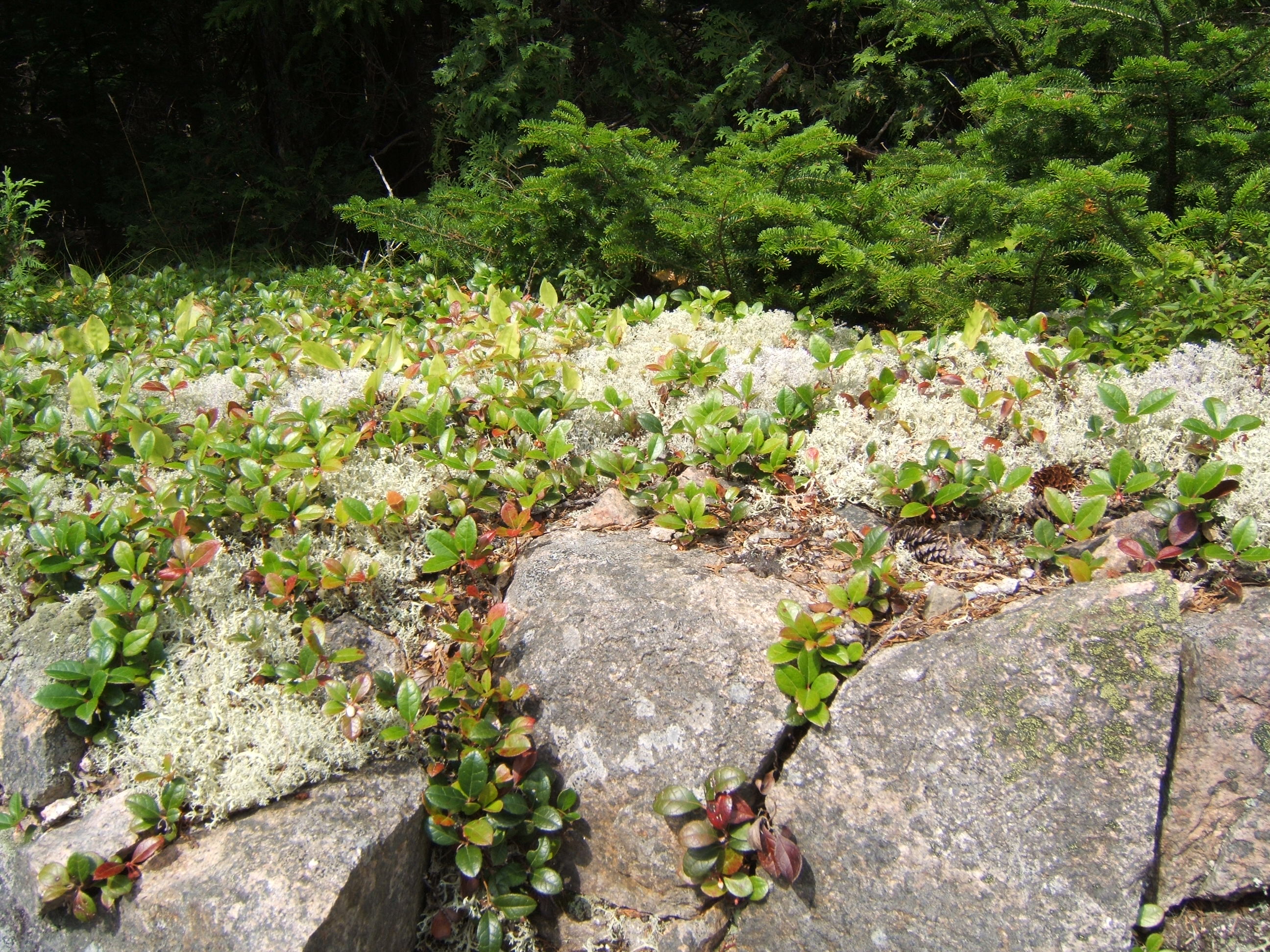
Although we collected many species, the three reindeer lichens most useful for our studies were Cladina arbuscula, Cladina rangiferina, and Cladina stellaris. These are all ‘fruticose’ lichens, species with a ‘shrubby’ appearance, consisting of a main branch with many side-branches. A single ‘plant’ fits nicely in your hand. The Cladinas all have hollow branches and could be (and are) used as little trees in HO scale train models.

- Cladina arbuscula (left) and Cladina rangiferina (right) growing on a rock by the roadside in Maine. You can tell the difference by the greenish color of the arbuscula and the bluish-grey color of the rangiferina.

Cladina arbuscula (Wallr.) Hale & Culb. grows in extensive colonies, and is yellowish-green. The tips of the branches all point in one direction, a distinguishing characteristic of the species. Cladina rangiferina (L.) Harm. is often found growing with Cladina arbuscula and can be distinguished from arbuscula by its very blue-grey appearance.
Cladina stellaris (Opiz) Brodo is yellowish-grey, and grows in distinct clumps which resemble small ‘poofy’ trees.

Cladina lichens and moss on the rock at Moss Glen Falls in New Brunswick. The clump of lichen towards the center, looking like the ice cream in a cone, is Cladina stellaris.
On our travels this summer, I reacquainted myself with the Cladinas. And I remembered all the remote places I have been as a result of my work. One of these was Turtle Mountain in southern New Brunswick, now protected as part of the Loch Alva Protected Natural Area (PNA). It is a very old mountain, worn to a granite hill. At the top of the hill, is an ericaceous meadow where Cladina lichens flourish.
Turtle Mountain, 1979
~
afternoon air at the base
of the food chain
rewards obligation to breathe
~
grazing tickles the nose
and grey-blue lichens know
laurel and balsam
~
flume of curtain billows
across the daybed
into the room
~
into the space between
Kalmia and wintergreen
meadow heat rising from stone
~
marbled weave of oxygen
hydrogen nitrogen
bilberry and salt ocean
~
© Jane Tims 2011

(brackets in the birch grove)
Last week we went for a walk (more like a struggle) through the birch grove at the base of the grey woods (see the ‘map of the grey woods’ under ‘about’). To get there, we crossed the fern gully, mostly dry this time of year, and entered a mixed wood of birch, maple, spruce and fir, much younger than the mature spruce in the grey woods.

These trees grow in very wet conditions, and the forest floor is a hummocky, spongy growth of Sphagnum moss and fern.

There is no path through this woodland, so the ‘walk’ was an up-and-down, over-and-under kind of trek. To stay dry, you must take giant steps from hummock to hummock. To stay upright, you must check your footing and hang on to the young trees. With all this concentration on moving forward, I tend to miss some of the interesting detail, so I try to use each ‘balancing moment’ as a time to look around and observe the wild life.
One occupant of the birch grove is the bracket fungus. This is a type of fungus that grows like shelves on both living and dead trees. The fungus forms thick flat pads on the tree, usually parallel to the ground. They remind me of steps, a spiral stair to ascend the tree.

The semi-circular body of the bracket fungus is called a conk. The conks of the bracket fungus growing in our woods are thick, often oddly shaped, and constructed of various cream, tan and brown coloured layers. The conks are the outwardly visible, reproductive part of the fungus. The vegetative portion of the fungus grows as an extensive network of threads within the tree.
bracket fungi
~
1.
in this forest
staid
practical
grey
could any form
construe to magic?
~
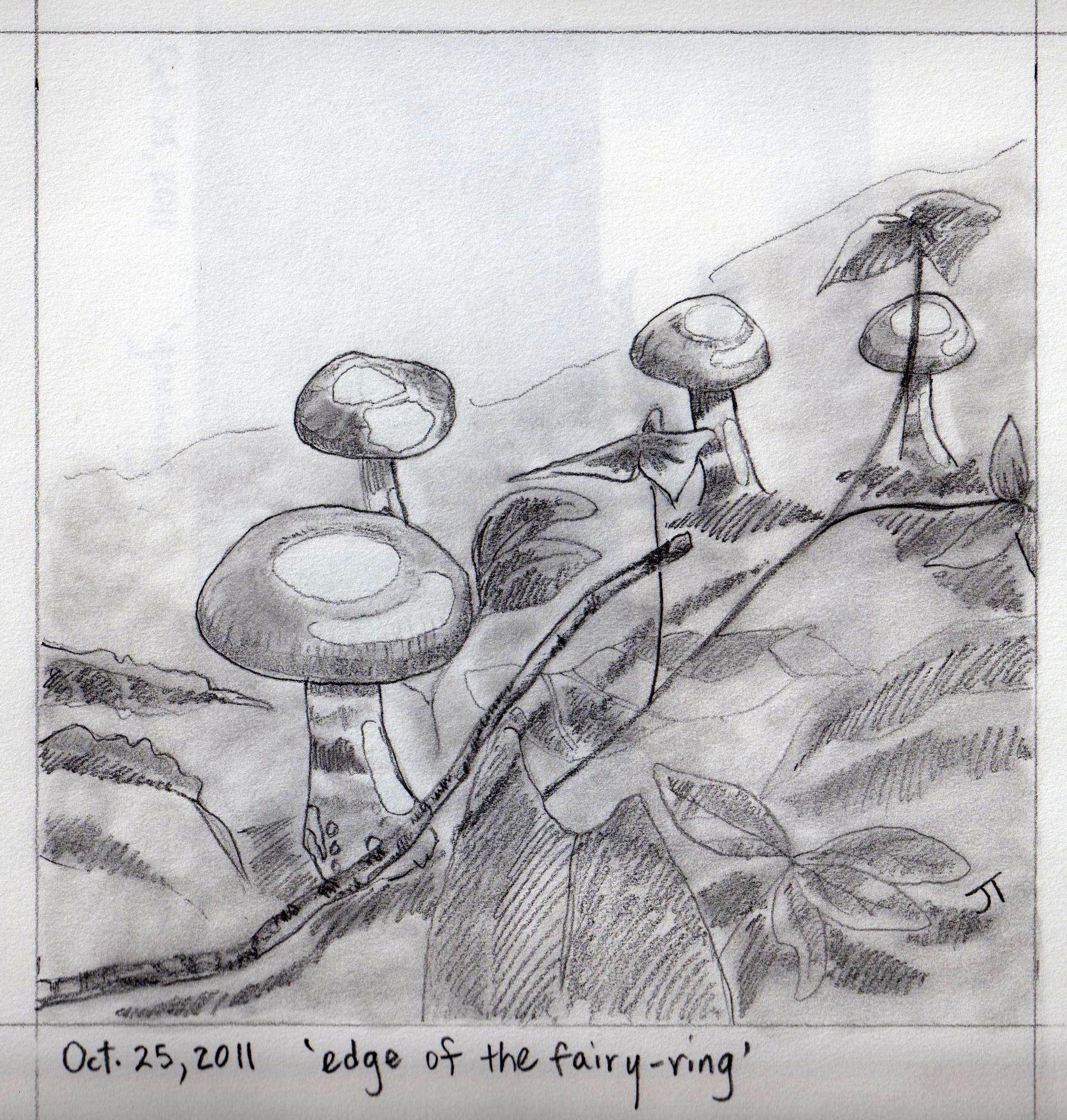
fairy rings
moths in spectral flight
spider webs, witches brooms
burrows and subterranean
rooms, hollows in wizened
logs, red toadstools
white-spotted, mottled
frogs
~
2.
bracket fungi
steps ascend
a branchless tree
~
© Jane Tims 2011





 nichepoetryandprose