Posts Tagged ‘pencil drawing’
at the bird feeder #1
Today our bird feeders are a mess. Racoons and grey squirrels don’t keep neat houses. However, the seeds scattered across the deck are attracting a delightful array of birds. The last few mornings we have had:
a few chickadees (Black-capped Chickadee, Parus atricapillus)… they grab a seed and swoop to the nearest low branch to break the seed open… they seem to travel in small groups, but bicker with one another at the feeder…
a few nuthatches (Red-breasted Nuthatch, Sitta canadensis)… they are acrobats, grabbing to the feeder and then flipping inside to get the seed… they are solitary, sometimes in small groups of two or three… they leave one another alone, each taking their turn…
a flock of goldfinches (American Goldfinch, Carduelis tristis)… gregarious, they are all a-flutter and feed together side by side… they hang around to break open the seed and tolerate other species beside them…
~
~
goldfinches
~
bright feathers distil
yellow from atmosphere
essence of sunflower
tipple and sip champagne
make small talk at parties
gesture with hands
paint scallops on air, animated discussion
~
the gregarious obtain information
best feeder in the neighbourhood
best seed
least squirrel
~
~
© Jane Tims 2011

snowdrift
Wind is not visible, yet we can describe the shape of the wind. Along the shores of our lakes, White Pines are wind-blown into irregular forms to show the direction of the prevailing wind. In my poem ‘Clear Lake’ (see the post for August 26, 2011, ‘deep waters – Clear Lake’ under the category ‘waterways’), I describe these as “group of seven trees/ flung southward”. Artists from the Group of Seven were famous for their depiction of this symbol of the Canadian wilderness. A good example is the painting ‘White Pine’ by A.J. Casson.
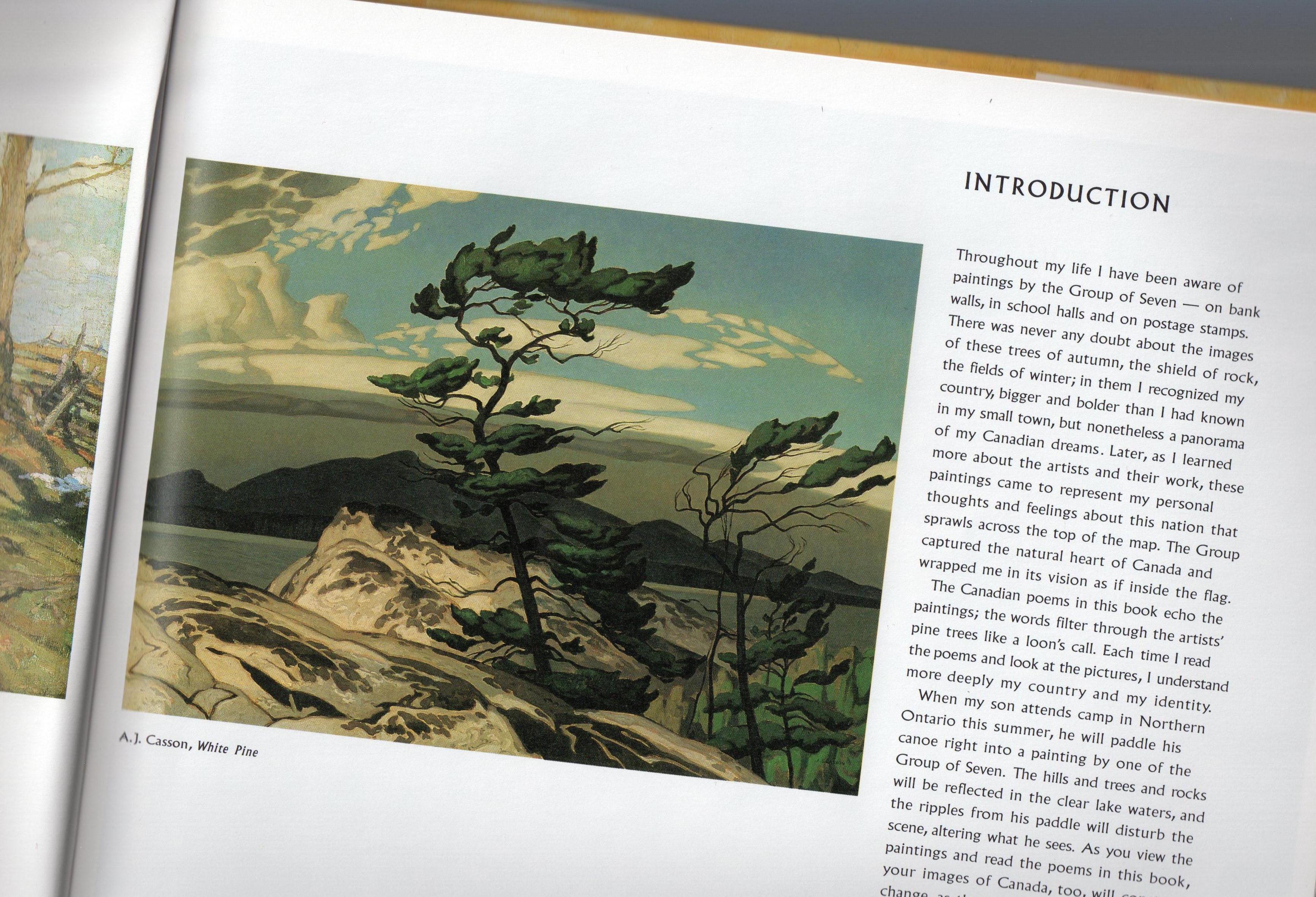
'White Pine' by A.J. Casson, from the book 'Images of Nature: Canadian Poets and the Group of Seven' compiled by David Booth, Kids Can Press, Toronto, 1995.
In winter, the shape of the snow also captures the three dimensional form of the wind. The easiest manifestation of this is the way horizontal surfaces record the direction of blowing snow.

Snowdrifts form as the wind blows quantities of snow into shapes resembling dunes of sand. As kids on the prairie, we loved these snowdrifts since we could tunnel in them and build fantastic snow shelters. Today, I can watch the drifts build across our lawn and transform its flat surface into the artistry of the wind.
~
~
Drift
~
after the storm
snow heaps
high against the wall
fingers of the wind sculpt
etch shadows
into vacant white
~
sunshine flashes
summons prisms
from hollows of snow
warmth shivers through the drift
crystal
into cataract
~
a tendril of snow
clings
damply to the wall
a lingering winter ivy
~
~
Published as: ‘Drift’, 1994, The Cormorant (Fall 1994) XI (1)
revised
© Jane Tims 2011

witch’s broom
In the Balsalm Fir tree over our shed is a strange growth, like a dark mass of short deformed branches. This dark mass of branches is known as a ‘witch’s broom’.
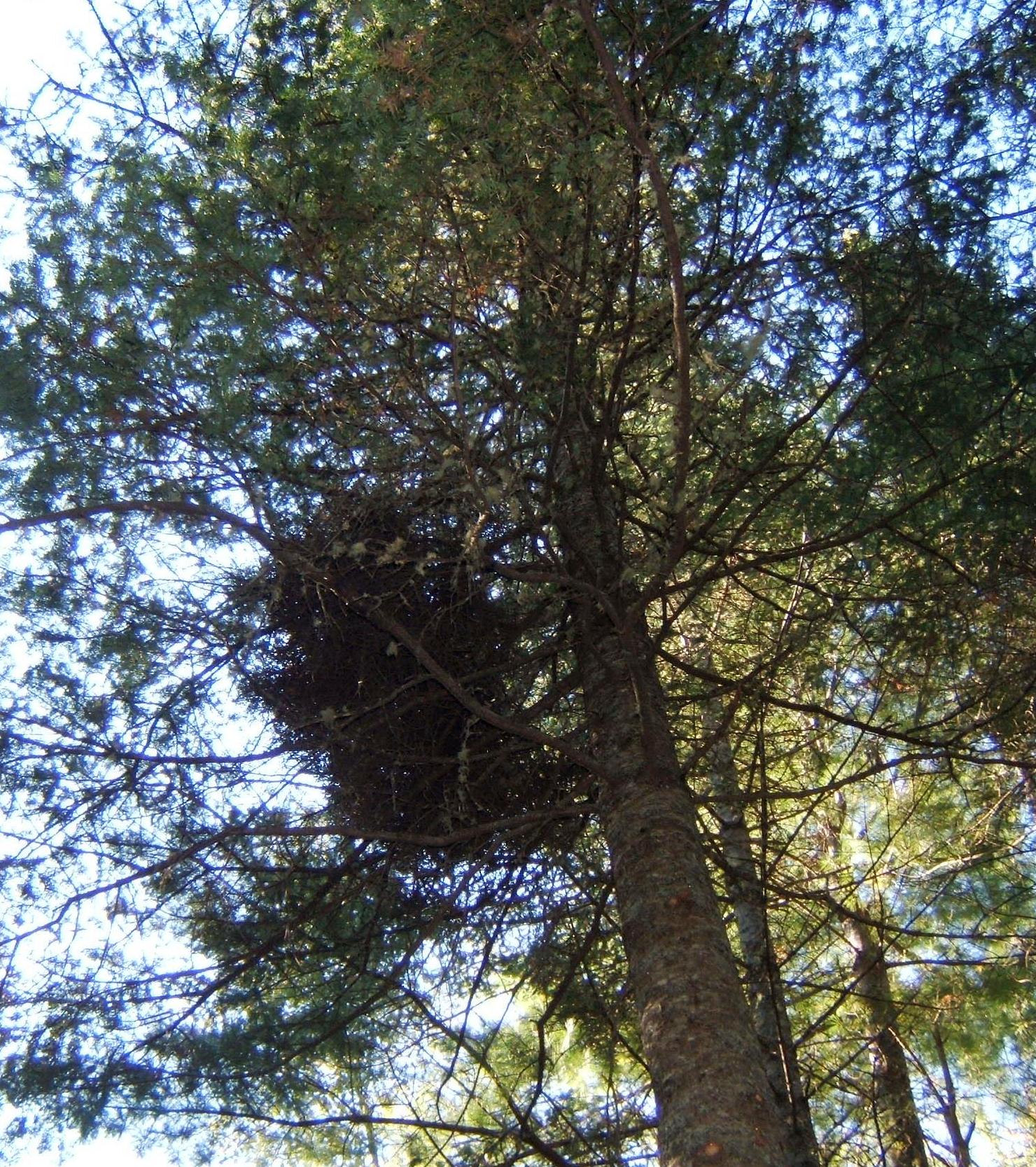
A witch’s broom is a common term for an abnormal growth caused by the action of an agent such as a mite, virus, insect, or fungus. The agent causes a branch of the tree to grow from a single point, resulting in a mass of twigs and branches resembling a nest or broom. Many kinds of plants can have a witch’s broom deformity, including many tree species.
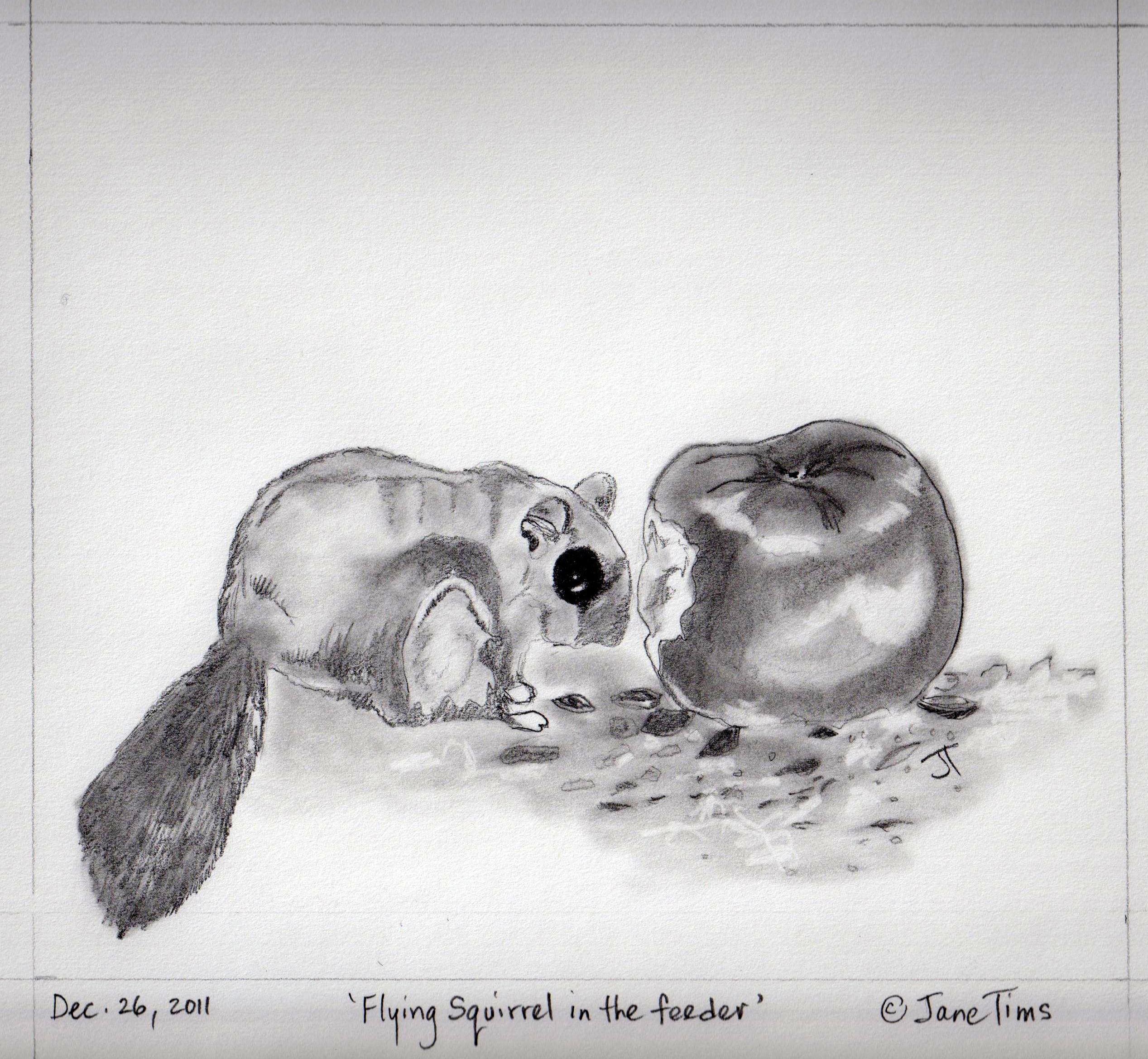
Animals, including the Northern Flying Squirrel, use the witch’s broom as a nesting place. The Northern Flying Squirrel is the big-eyed squirrel invading our feeders every night (see ‘spacemen in our feeder’ under the category ‘competing for niche space’ for December 23, 2011).
Witch’s brooms occur frequently … we have at least three in our grey woods. They lend an air of mystery to the woodland. People used to believe a witch had flown over the place where a witch’s broom grew.
If anyone knows of another name for the witch’s broom, please let me know. Years ago, we visited a small farm museum in northern Maine and an example of a huge witch’s broom was displayed in the shed, labelled ‘horrah’s nest’, but I have been unable to find this term used elsewhere.
~
~
wood witch
~
burdened by snow
a tree falls
tumbles a witch’s broom
the witch set free
~
a hex on the snowfall
slate where the dog walks
cuts her feet
soft rubies in every track
~
a hex on the room
cold as I left
now warm
~
too warm
~
~
© Jane Tims 2001
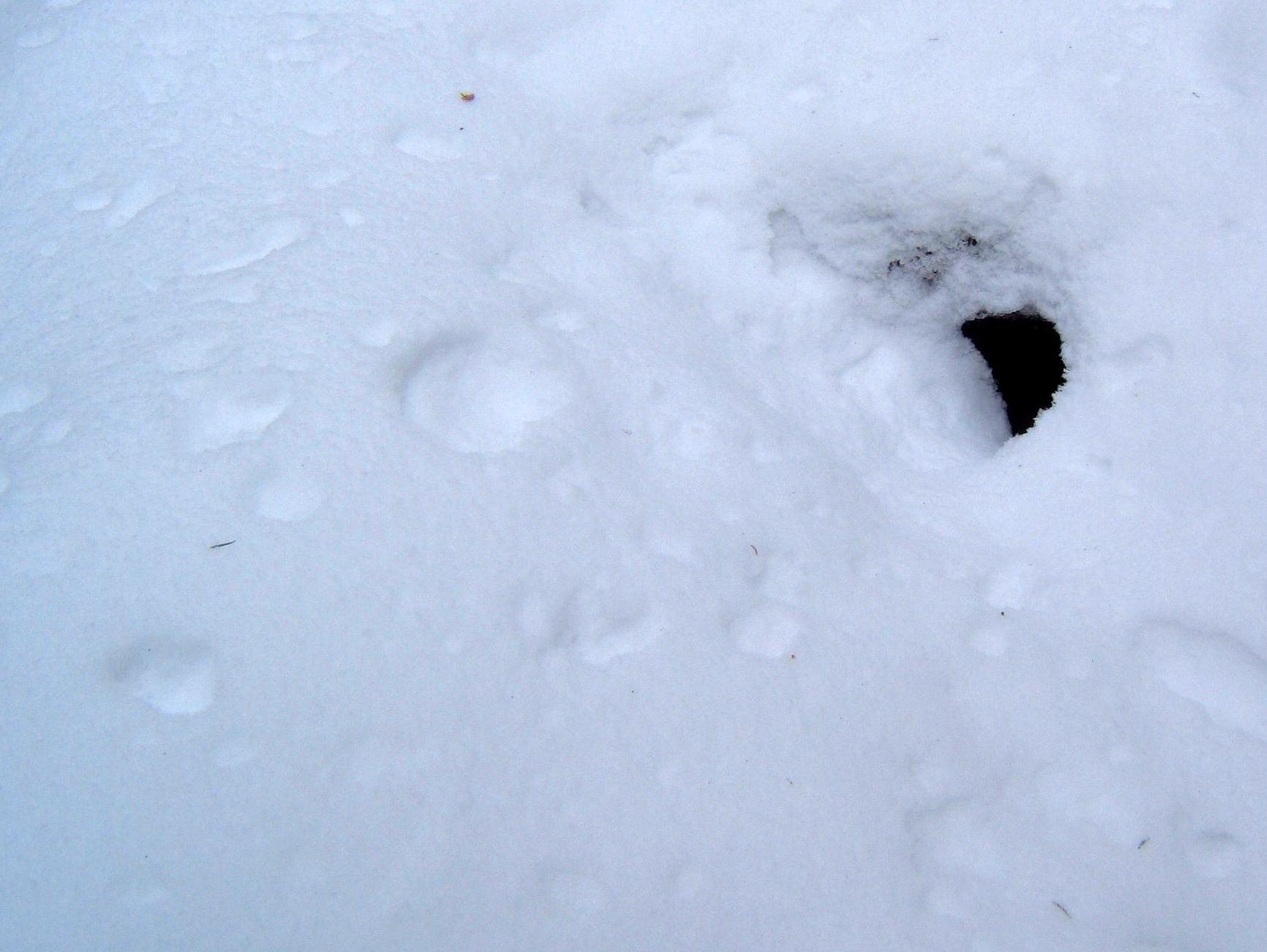
groundhog burrow
On my walk in the snowy grey woods, I checked on the burrows of the Groundhog (Marmota monax) near our picnic table. I have read about the winter habits of the Groundhog and I know he enters true hibernation this time of year. He does not wake through the winter to feed. For this reason, I was not surprised to find the snow around the main entrance untouched by any tracks leading to or from the burrow. The snow has buried the other burrow entrances. Sleep well, Groundhog family!
~
~
hibernation
~
groundhog excavates
beneath the fir, a meter cubed of dug
and snug and sifted dirt, disturbed
observes from veiled backdoor
under fibred curtain, dangled root
twisted tunnel, tilted floor
~
eats well and sleeps but
wakes, stumbles down his bleary halls
for green but white still sifts between
the burrow walls, tells his mate shove over
settles back to hibernate
~
~
© Jane Tims 2011

tracks in the snow
On Tuesday I went for a walk in the grey woods. Snow fell just before Christmas, so my walk turned into a quest to see who else had been walking (or running) in the woods.
I found many tracks, large and small. Mice had made their cylindrical tunnels, and occasionally had run across the surface. At some places, you can see where their tunnels suddenly go subterranean…
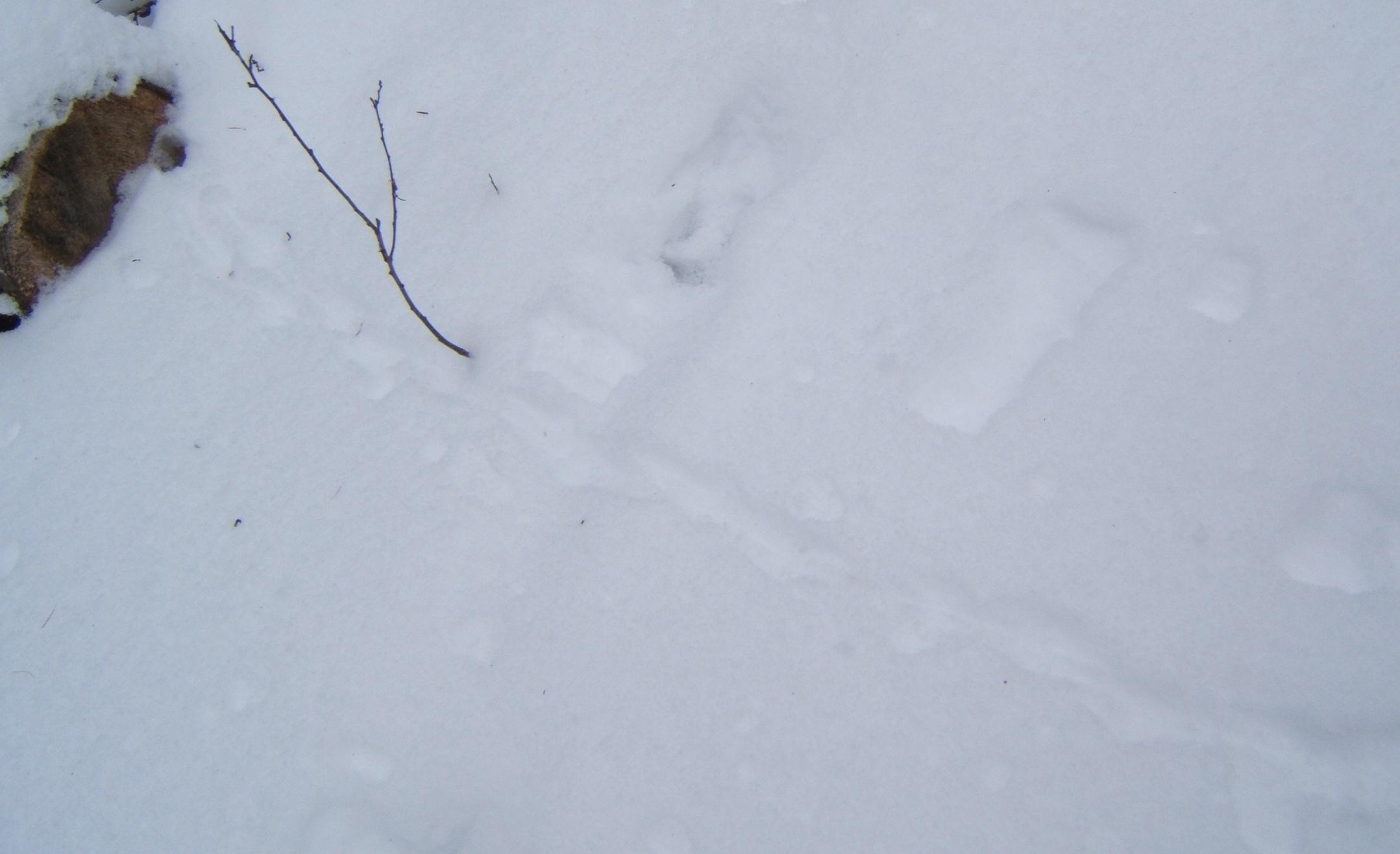
Sometimes several paths converge at a sheltered area beneath a fallen log, like a woodland bus terminal…

There were lots of squirrel tracks, often ending at the base of a tree where their paths move into the treetops…
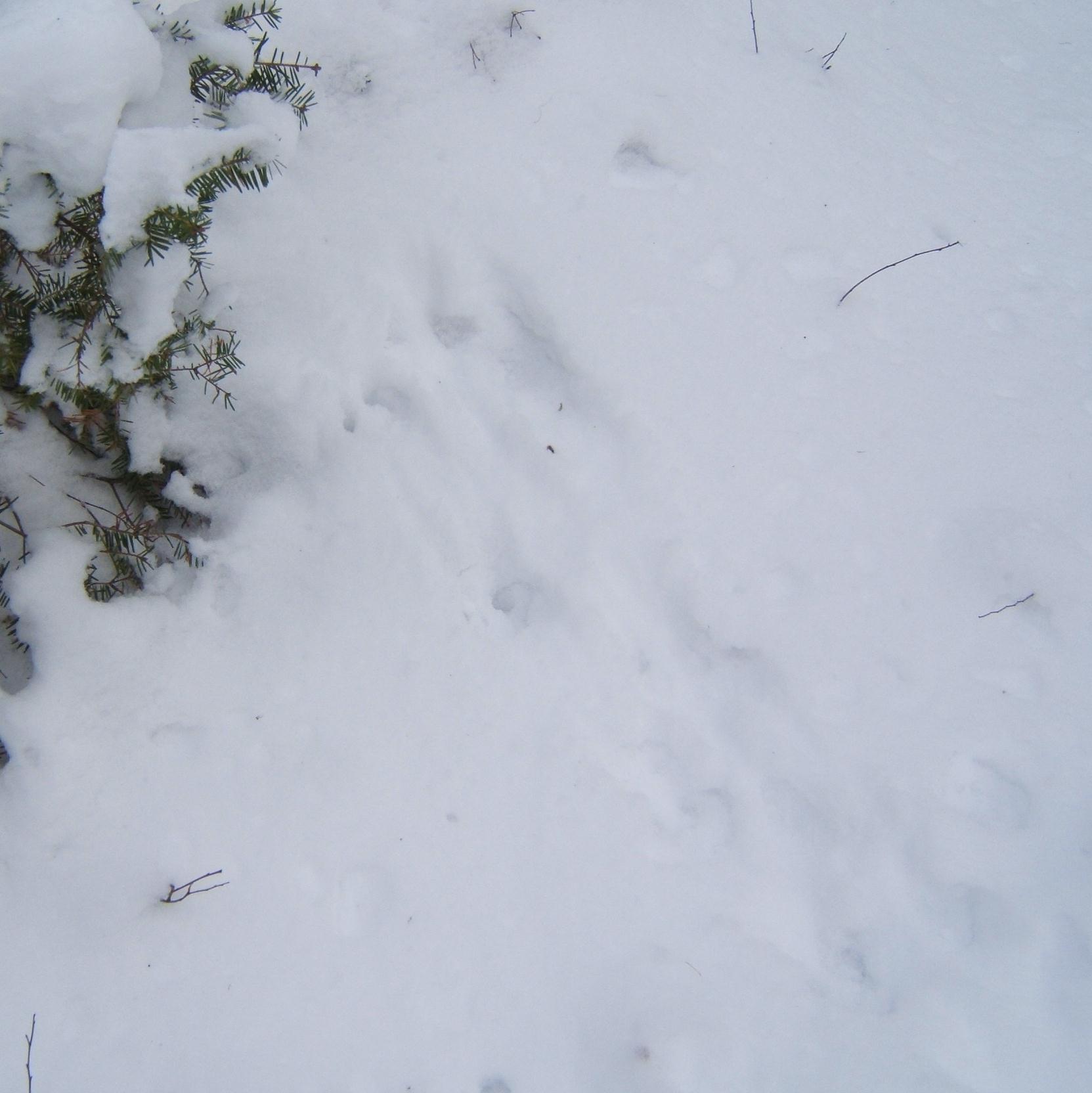
Squirrel tracks crisscrossed with those of deer…
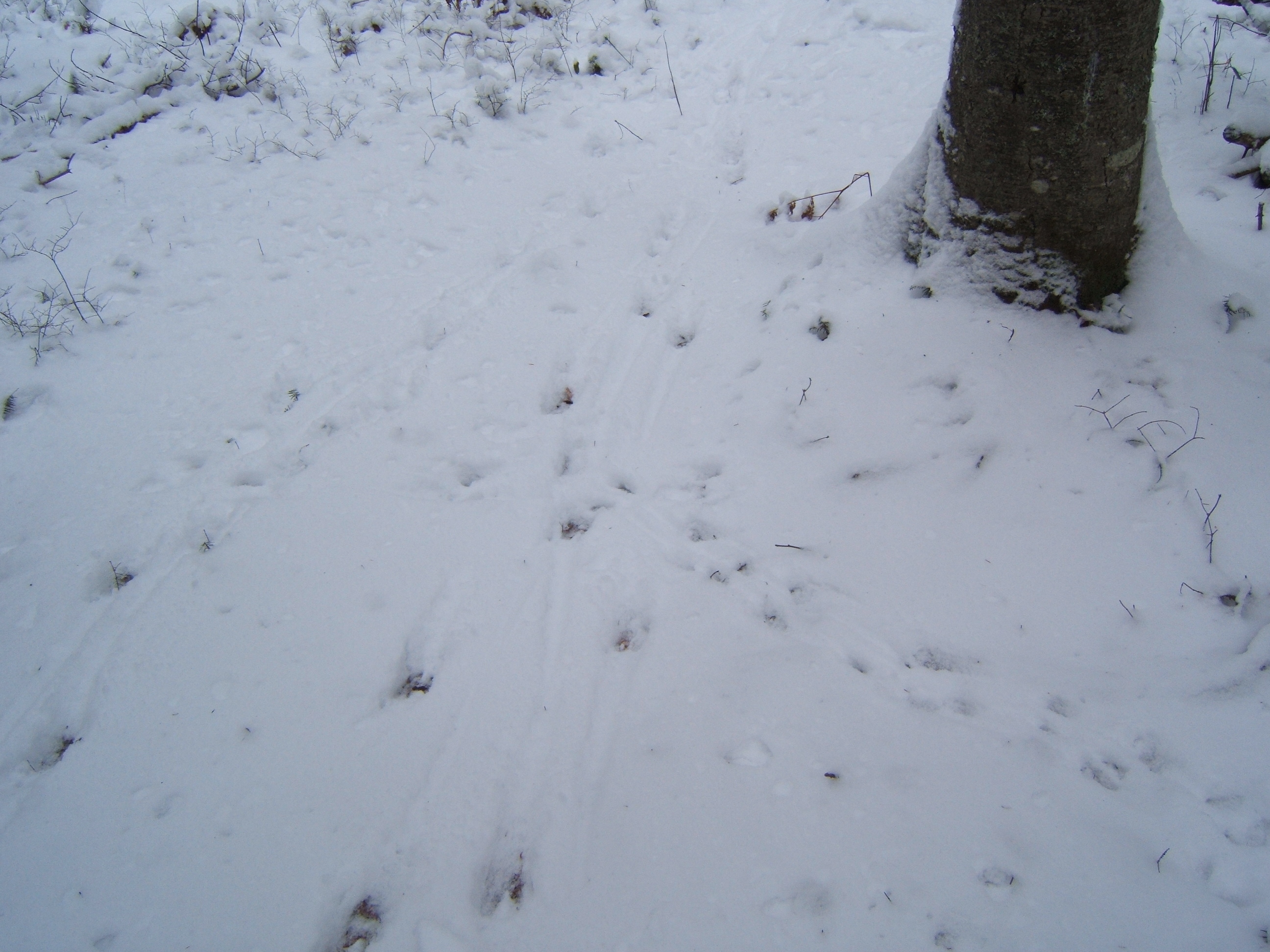
I followed the trail of two deer deep into the woods, thinking they were long gone since the tracks were filled with a slight dusting of snow…

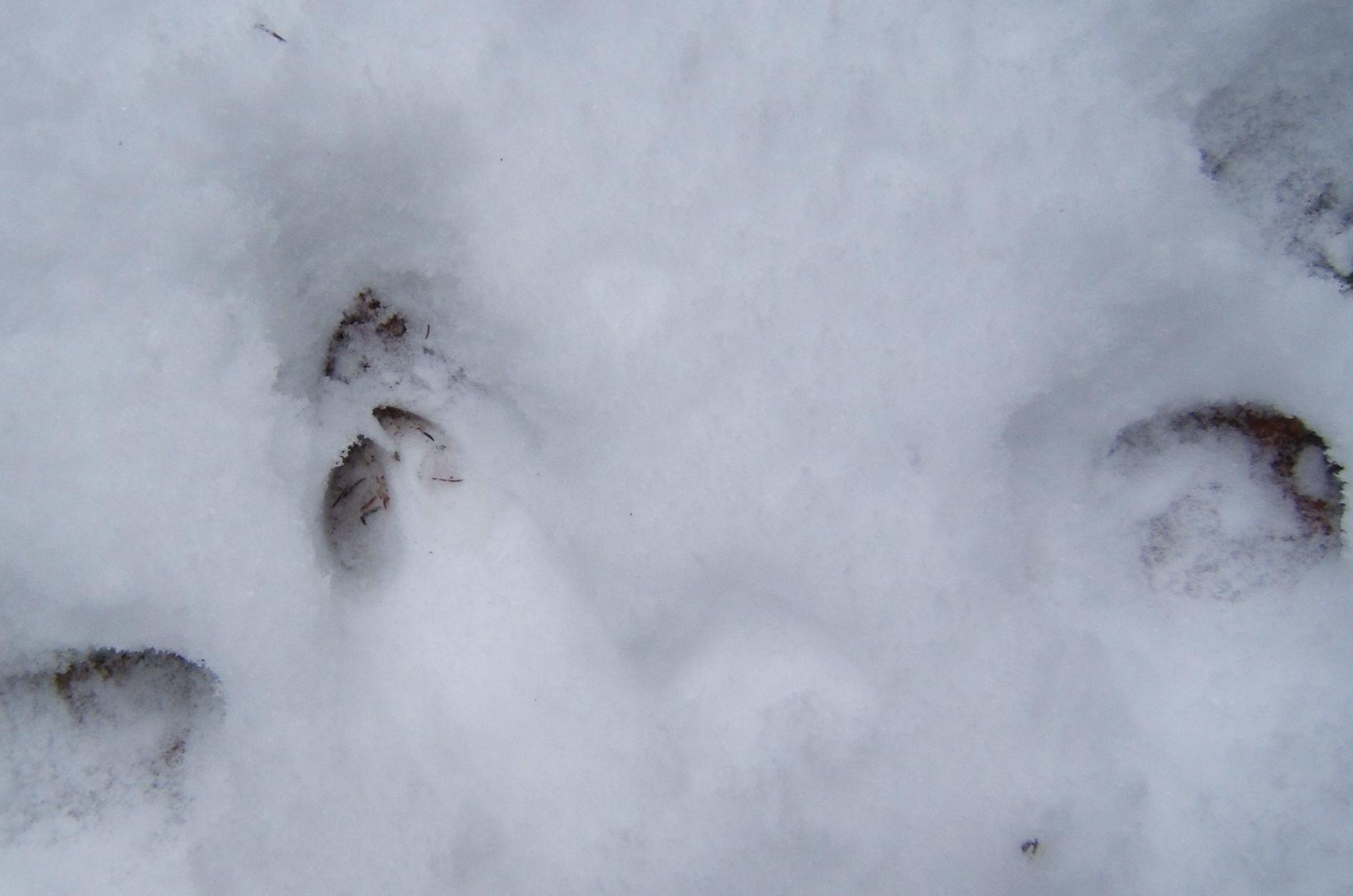
This made me a little careless, and the next thing I heard was a high-pitched snort and squeal of warning and the bounding of hooves through the woods. I got a good look at two beautiful deer, but the camera was not ready. I did capture the very fresh track of one of the retreating deer.
~
~
tracks in the snow
~
ephemeral proof
I follow the beacon
of a stash of spruce cones
stock-piled at the base
of a crooked tree
careen from a foe
slip beneath a log
dive into a hole
secret hollow
a pause to still
thud thud of my heart
~
~
© Jane Tims 2011
firepit
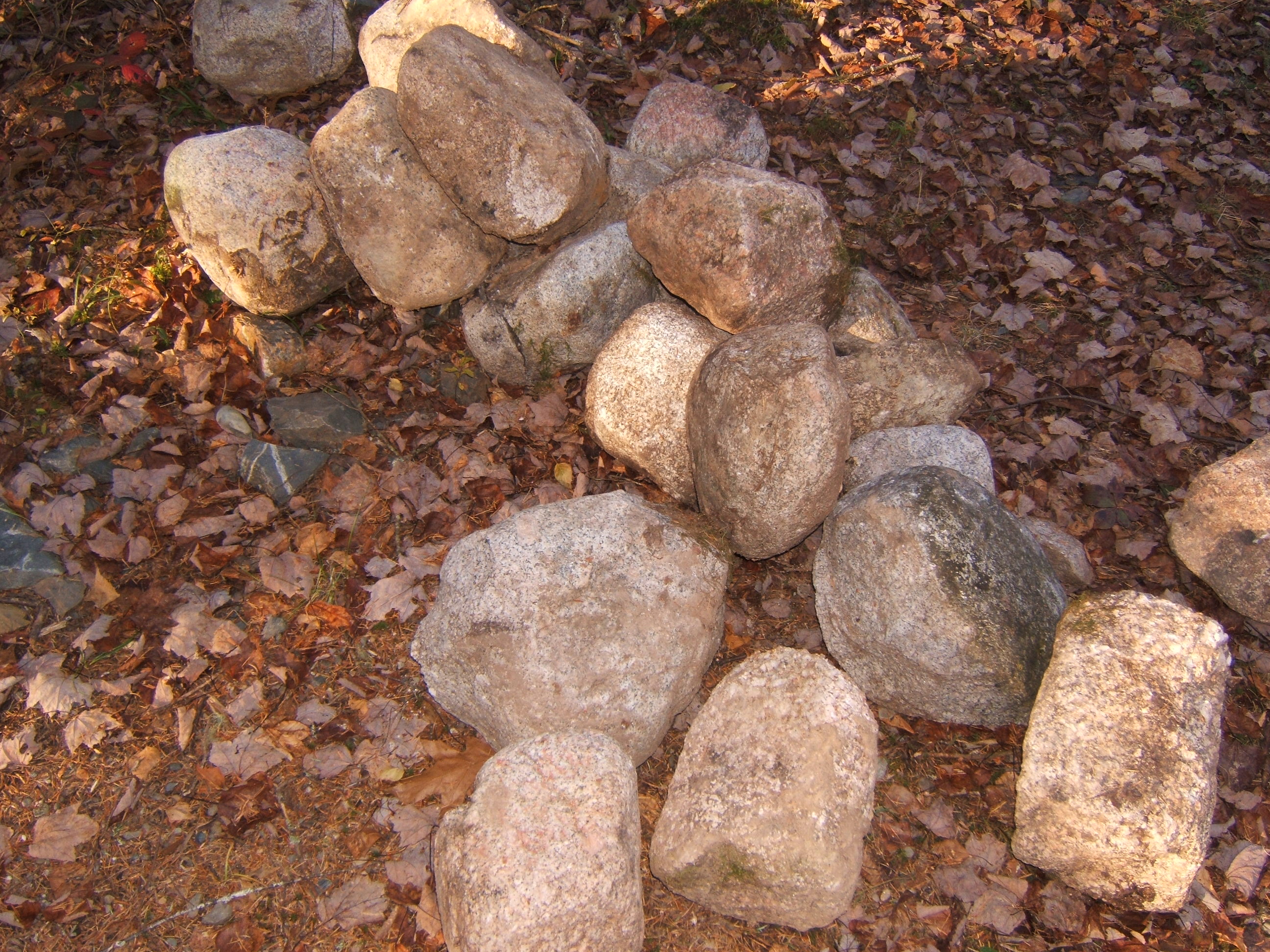
Our firepit has a roaming spirit. It began its days in front of the house and we had many wonderful evening fires. Then, as the years passed, the maple tree overhead grew until it was dangerous to have a fire under such a thick canopy.
To improve the safety of the firepit, I moved it, stone by stone to the back of the house, reassembling it exactly as it was. We had a few fires and then, one day, our lives became busy. We kept taking wood for the next fire and the next fire never happened. Gradually the pile became so large, you could not see the firepit!
Last month, my husband put our tractor to use to move the firepit one more time. I clawed my way into the pile of scrap wood and uncovered the stones. Then we pushed them into the bucket of the tractor and away they went, to their new home across the yard.

Now they are in the driveway, waiting for their new home (see the plan in ‘plans for a rocky road’ November 13, 2011 under the category ‘the rock project’).
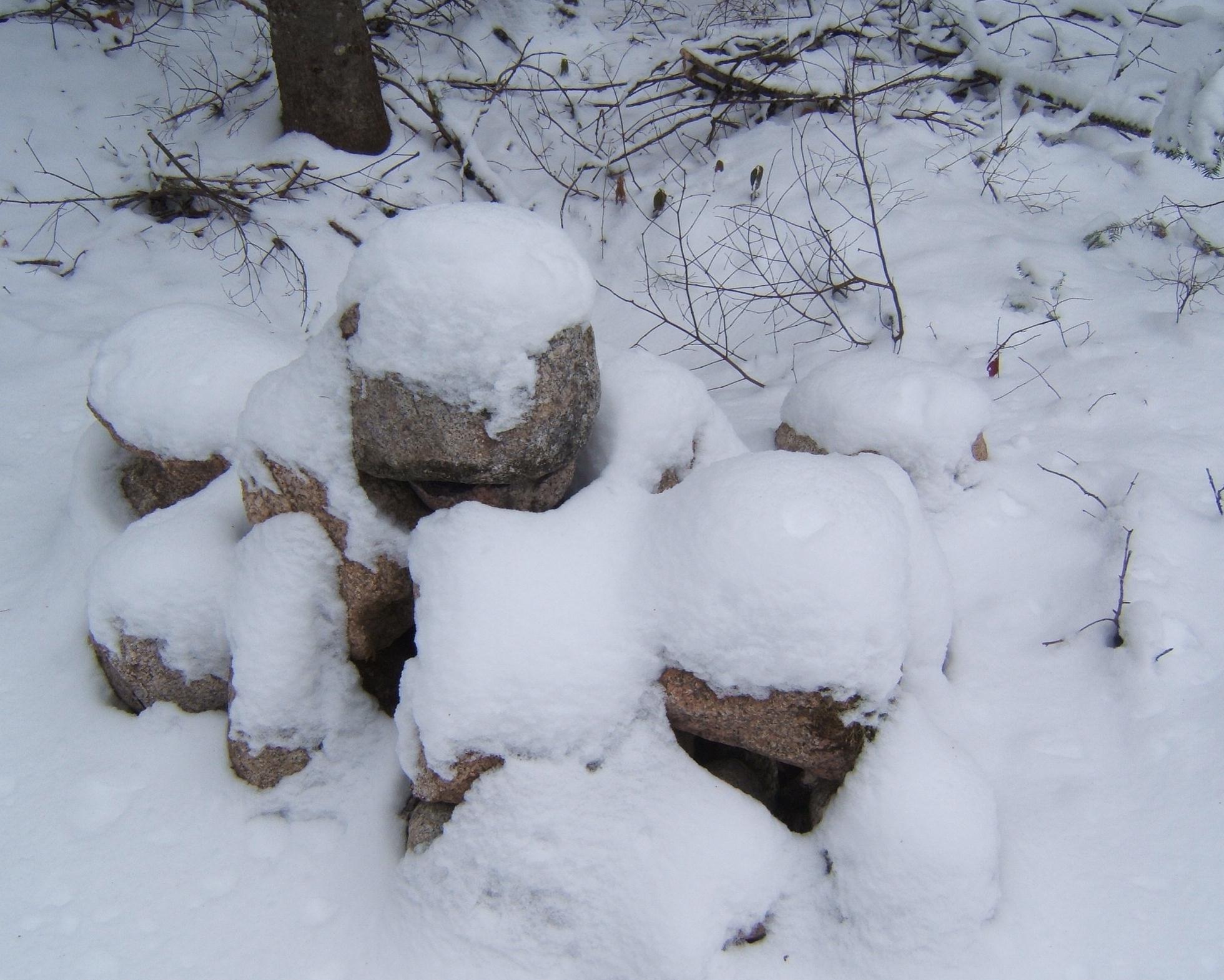
The next step will be to fell four spruce trees in the area of the firepit, to make sure we can have our fires safely. This next step may have to wait until spring since the stones are now in the frozen throes of winter!
fire
~
rattle of leaves
bark, twigs
and paper
as the air warms
finds its chimney
surges red life
into the tunnel of maple
the moment when breath
turned cloudy on cold air
becomes smoke
and lungs draw ash and fire
~
the summer night
when lightning strikes
when thunder
bold in its dreaming
turns beneath the earth
ions leap
and pine sap explodes
in a fistful of sparks
~
the warming by smiles
and clasping of hands
striking of sparks in the tinder
the flame leaps
from candle to candle
~
the sharp ache
at the corner of an eye
where cinders and smoke
have gathered
lungs drawing fire and ash
an effort to breathe
and fingers
warm with tremble
~
© Jane Tims 1995

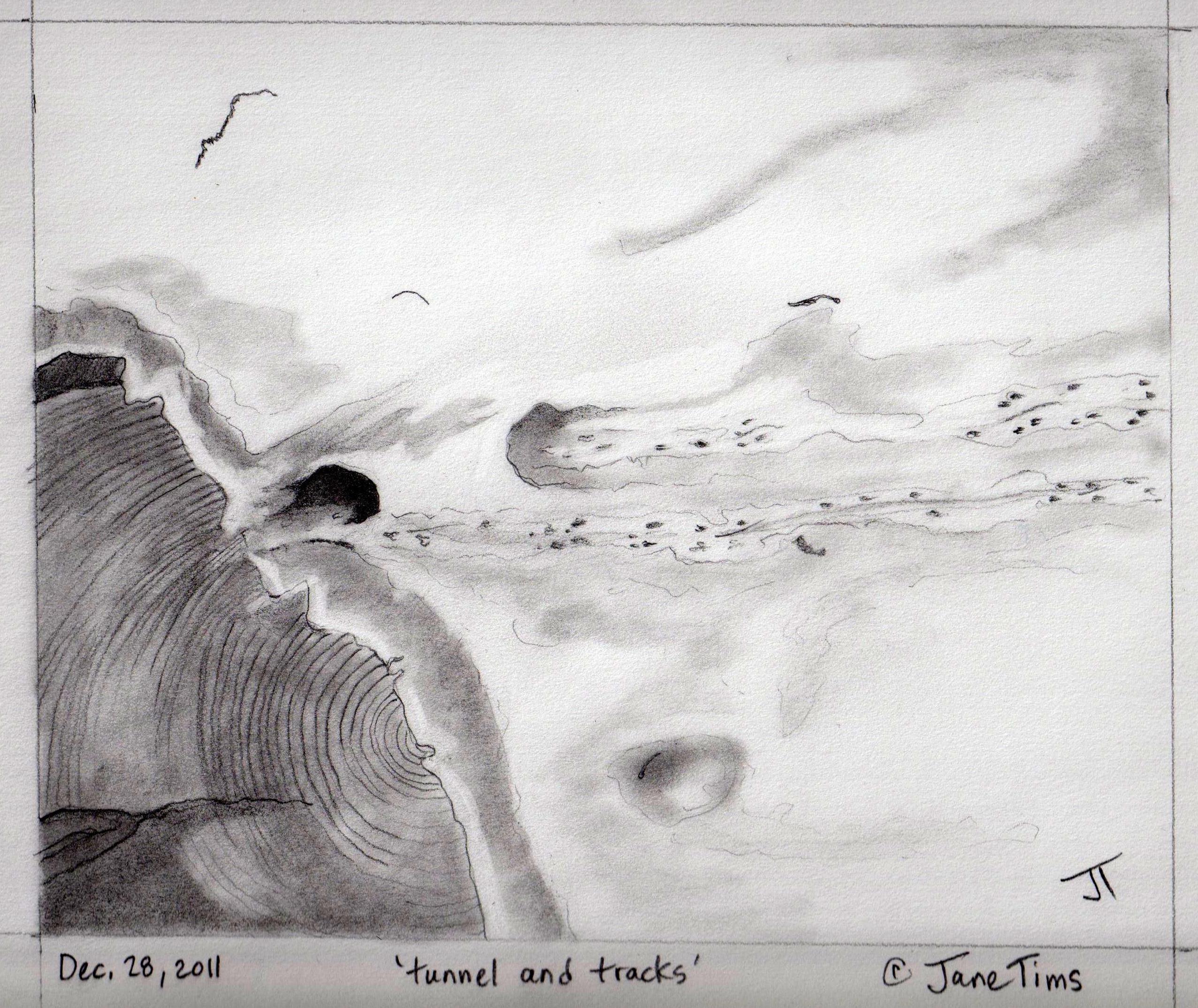
snow hollow at the base of a tree
Words are the tools of a writer’s craft. I literally wallow in words when I write a poem. Sometimes the right word comes immediately to mind. Sometimes I have to search for it, sometimes for days or weeks. When I do the final edits for a poem, I ‘press’ on every word, to make sure it is absolutely right.
Sometimes, I encounter an idea or image that seems to have no word. For example, I have searched for a word referring to the charming hollow that builds next to the base of a tree when the snow falls. Sometimes small animals use this hollow for a temporary den. Sometimes it’s a place where debris gathers, as it does in the corners of alleyways. Sometimes it is a calm, beckoning place where snow shadows rest in shades of olive green and blue.

I wonder if there is a name for these elusive places, perhaps in another language.
~
~
snow hollow
~
snow shuns the tree
manifest in the hollow
the empty gather of wind
at the base of the fir
~
where snow-shoe hares find
shelter or dry leaves skipping
across a crust of snow
assemble and rest
~
inside curve to fit
the spine of an animal
the heart of a man
curled against the cold
~
a place where shadows meet
select blue from the prism of all
indigo to illustrate the space
of no snow, no warmth, no light
~
~
© Jane Tims 2011

red berries red
Red Berries Red
Jane Tims
2011
~~
~~
Hawthorn
(Crataegus)
~
between ruby glass
and hard wood floor
a slide of light and three
~
extinguished candles
smoke lifts from smoulder
each mote a particle
~
of spectral light, mosaic
shard, image
reassembled in three
~
dimensions
shepherd, hawthorn
pitiful lamb
~~
~~
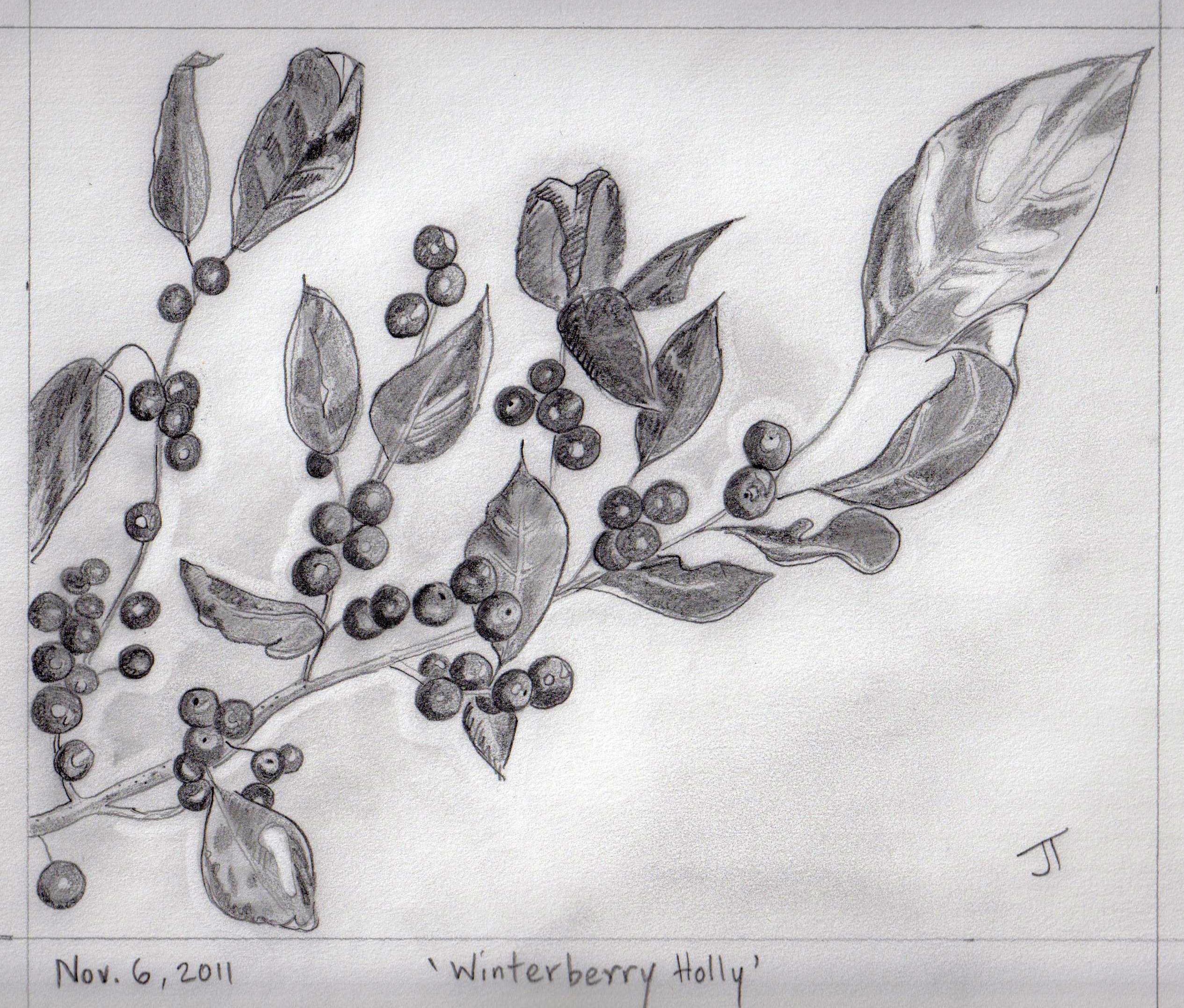
Canadian Holly
(Ilex verticillata (L.) Gray)
~
drab November
and lexicon
expires
umber leaves
grey verticals
dull stubble
~
winterberries
astound the wetland
red ink on page
words explode
from exile
~
fever flush and holly
above December snow
icicles vermillion
~~
~~
© Jane Tims, 2011

'red berries' Bunchberry (Cornus canadensis L.)
villages and vignettes
I love to view bits of the world in miniature. Especially at Christmas, small replicas of human space make me feel comfortable. Perhaps seeing a world fit neatly into a small space is a version of the safety and calm an animal feels in its den. Perhaps looking over a diorama gives me powerful feelings of omniscience and omnipresence. Perhaps I like the impression of a story being told, from beginning to end, confined in space and time.
Our Christmas decorations are predominantly miniaturized vignettes:
our nativity scene, complete with a stable and its donkey, and a star-spangled hillside of angels and sheep…

my collection of Buyers Choice skaters, including a fellow roasting a marshmallow at a fire beside the frozen pond…

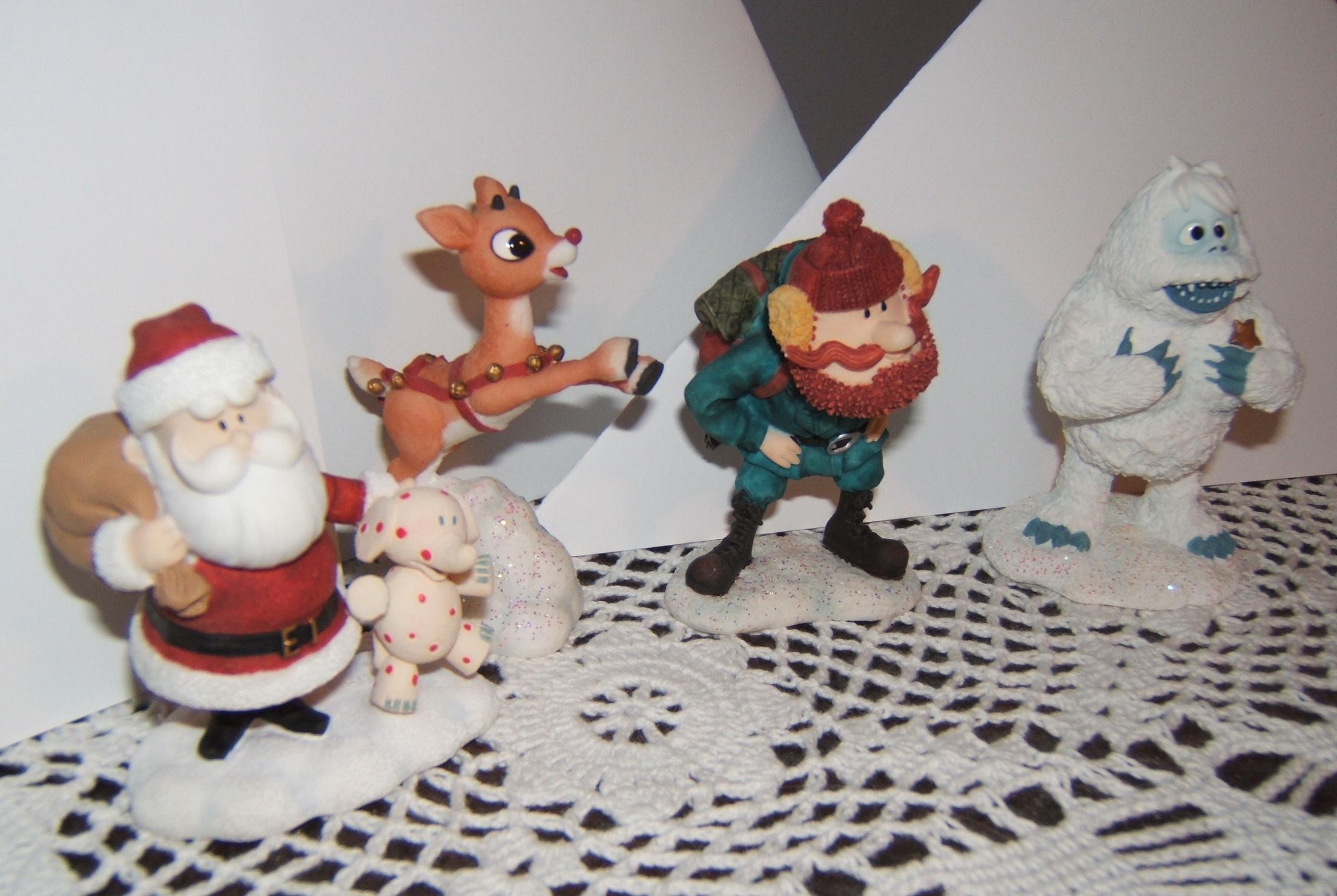
Rudolf and Bumbles from the Island of Misfit Toys…
children gathering around a pitiful Charlie Brown Christmas tree…

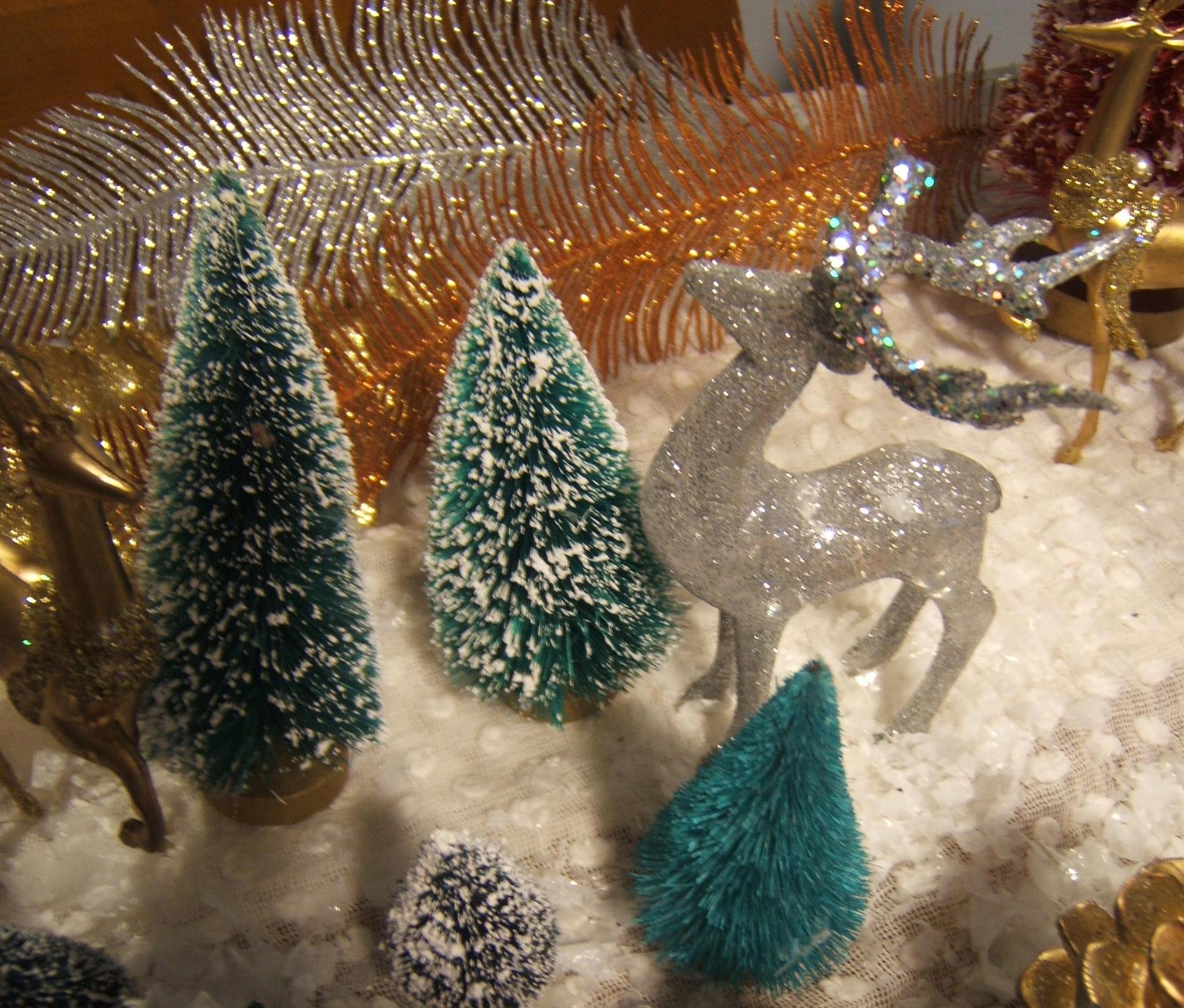
a frosty forest of bottle-brush trees and silver reindeer …
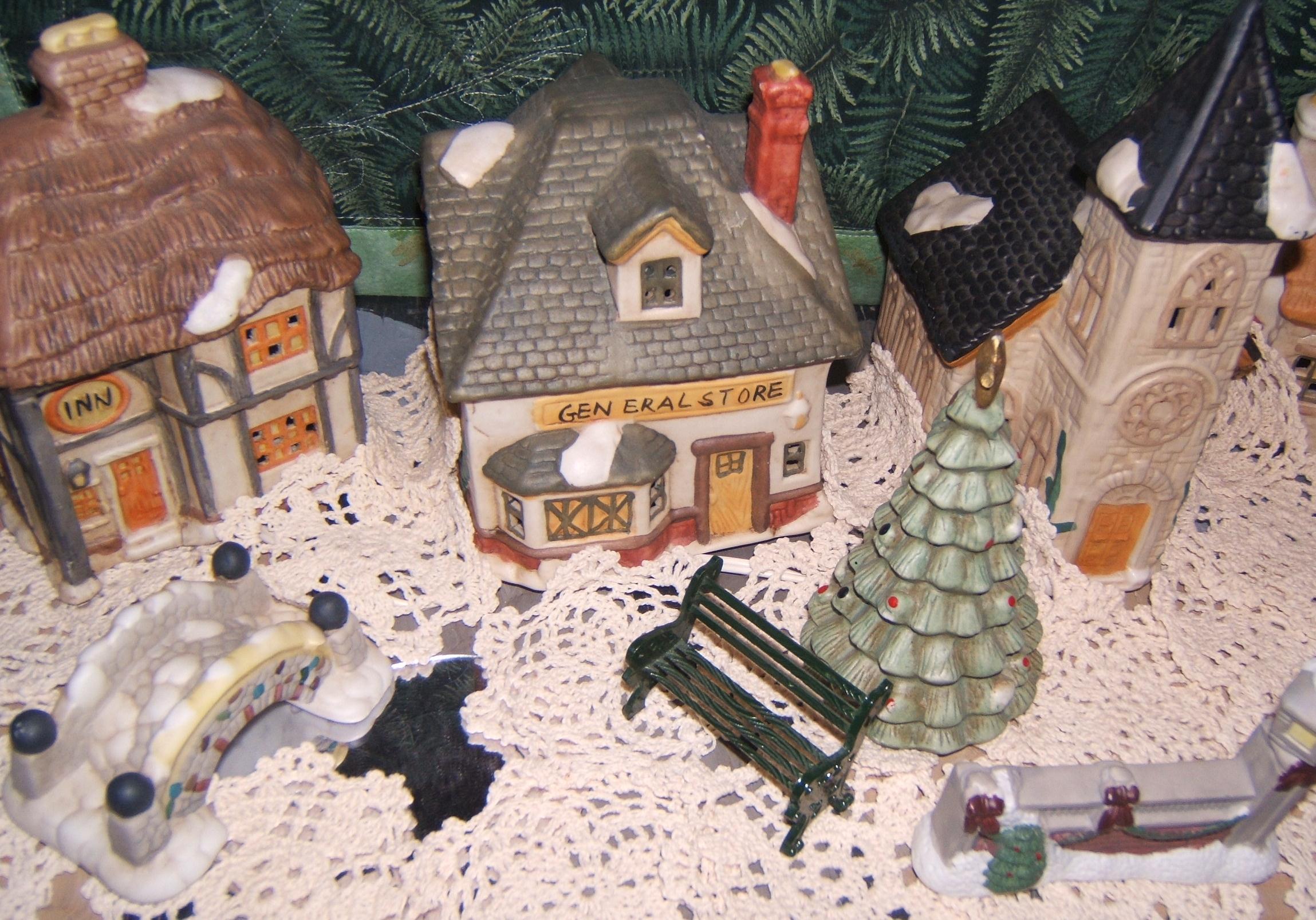
and a village with an inn, a church, and a park with a pond, a stone bridge and a park bench…
All very cute, but there is something missing.
The best scenes are those with real people. A scene of us sitting by our Christmas tree, talking and laughing. A scene of people in the bookstore, looking for a special book to give someone they love. The scene of a colleague at work, leaving a Christmas card on each desk. A scene of friends walking along a downtown street while the snow falls and the church bells mark the hour.
Merry Christmas everyone!
~
~
still street
~
the stillness of this street
its gentle curve
the steady glow of lamps
lighted windows, sturdy gates
a frozen pond, stone bridge reflected
soft snow, unmarked
and a park bench
where no one ever sits
~
~
© Jane Tims 2011

spacemen in our feeder
Our feeder has attracted some little space aliens!
In one of my recent posts, I talked about the Grey Squirrel and its marauding ways. Now I have two more mammals to add to my list of bird-feeder pirates.
During the weekend, we went to the Co-Op and puchased a new squirrel-proof feeder. It consists of a slim tube enclosed within a cage with the squares too small for the squirrels to squeeze through. Raccoons can’t fit through those small holes either, but they can take the new feeder off its hook and just toss it off the deck! Once they had cleaned out the spilled food, they began an assault on the older wooden feeder with its hoard of black sunflower seeds.

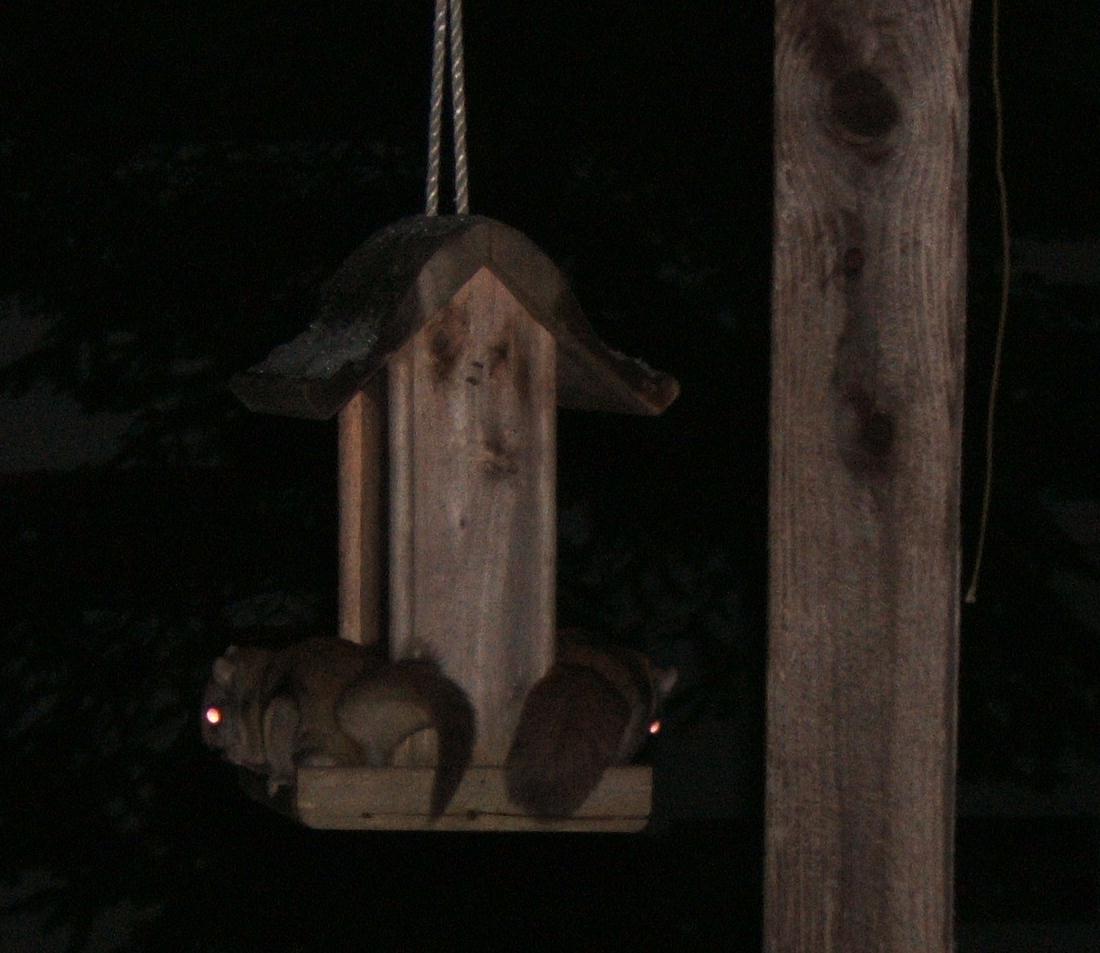
Just before I went to bed, I switched on the outer lights to see if the raccoons had returned and got a wild surprise. Two little spacemen were cleaning the rest of the sunflower seeds from the feeder! They looked like Red Squirrels, but were golden-brown in color, and had white undersides, a lot of extra folds of skin and big black ‘wombat’ eyes.
Flying Squirrels!!
We know the Northern Flying Squirrel (Glaucomys sabrinus) lives in our grey woods, but we haven’t seen them for a while. They not only look different, but move very differently from the Red Squirrels. They are very, very fast and sort of flow and fold themselves across the surfaces they are on, a little like those ‘parkour’ urban acrobats who move fluidly over obstacles.
The two Flying Squirrels argued and bickered with one another and paid no attention to me as I opened the door to snap their photo.
~
~
spacemen in the bird feeder
~
I missed the flash
the revolving light show
and high-pitched whine
just before the spacemen
(the Flying Squirrel Squadron)
set their coordinates on the feeder
~
bickered and folded over landscape
fired lasers from their eyes
took a moment for a black stare
at the earthling watching
and turned to complete the harvest
the sunflower seeds
craved by their planet
~
~
© Jane Tims 2011

one of the usual visitors to our feeder ... the Black-capped Chickadee (Parus atricapillus)




 nichepoetryandprose