Posts Tagged ‘pencil drawing’
making friends with the ferns #2
The onset of plants in spring is overwhelming. This year, I seem to see ferns everywhere, probably because the fiddlehead of the Ostrich Fern is a delicacy in New Brunswick. The Ostrich Fern (Matteuccia Struthiopteris (L.) Todaro) grows in riparian (shoreland) areas all along the St. John River and its tributaries.
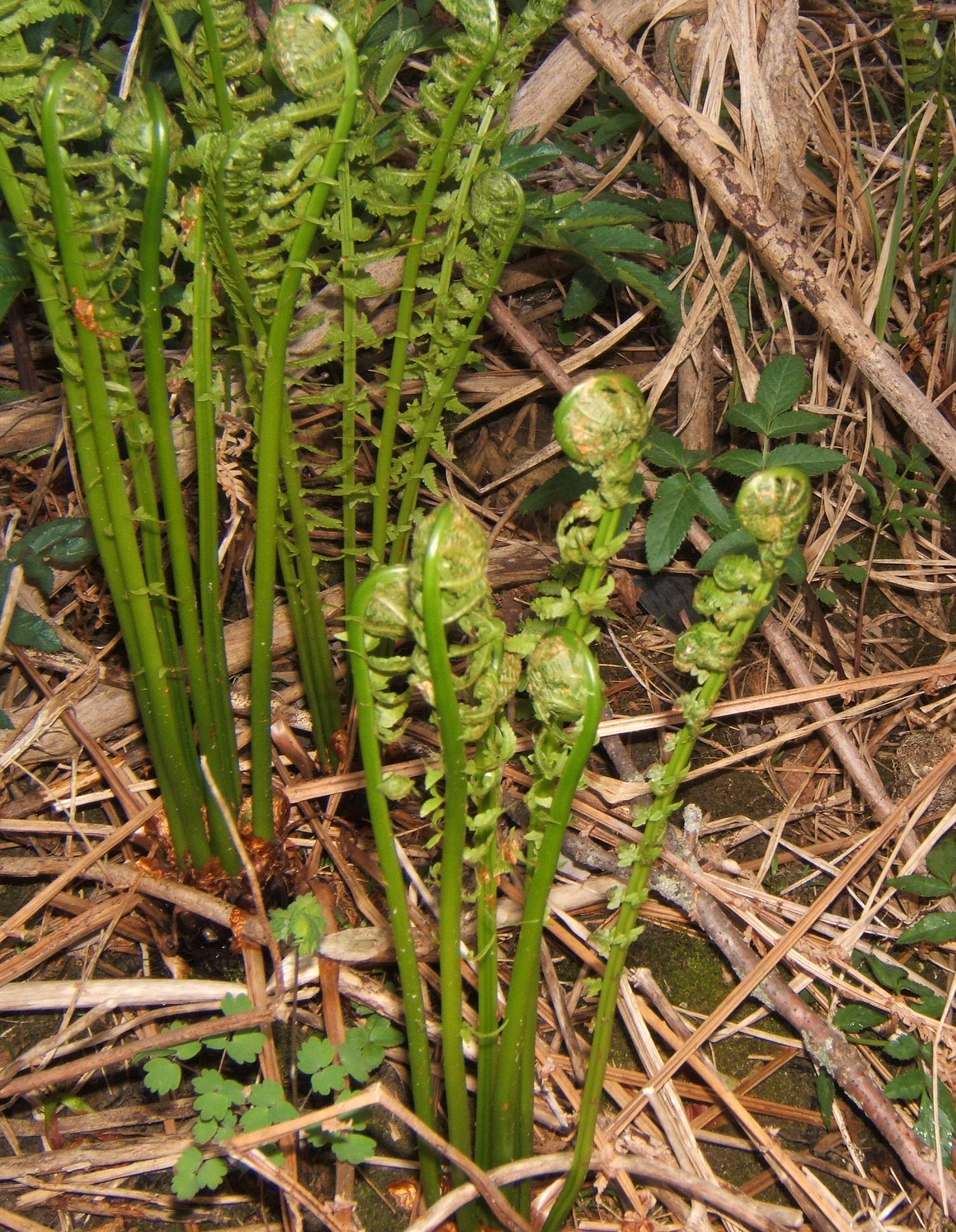
This time of year, car and trucks park in small roads off the old Trans-Canada, and you can glimpse people picking fiddleheads in lowlying places along the river. They concentrate on what they are doing, their backs bent, hardly looking up from their picking. People have favorite fiddleheading spots and usually follow a code, leaving a percentage of the fiddleheads to grow and sustain the ferns for future years.

I only picked a few fiddelheads this year. They were a little older than they are ordinarily picked, but they were delicious. The best fiddleheads are picked when they are just above the surface. After picking they are cleaned, a very easy undertaking, and boiled or steamed until very well cooked.

The cooking liquor is discarded – its dark amber-red color is due to high concentrations of shikimik acid. Once cooked, the fiddleheads are a flavorful green, served with butter or margarine. When my husband was young, his family ate a meal of fiddleheads, new potatoes and shad at fiddleheading time.
Warning: 1. never eat any plant if you are not absolutely certain of the identification; 2. never eat any plant if you have personal sensitivities, including allergies, to certain plants or their derivatives; 3. never eat any plant unless you have checked several sources to verify the edibility of the plant.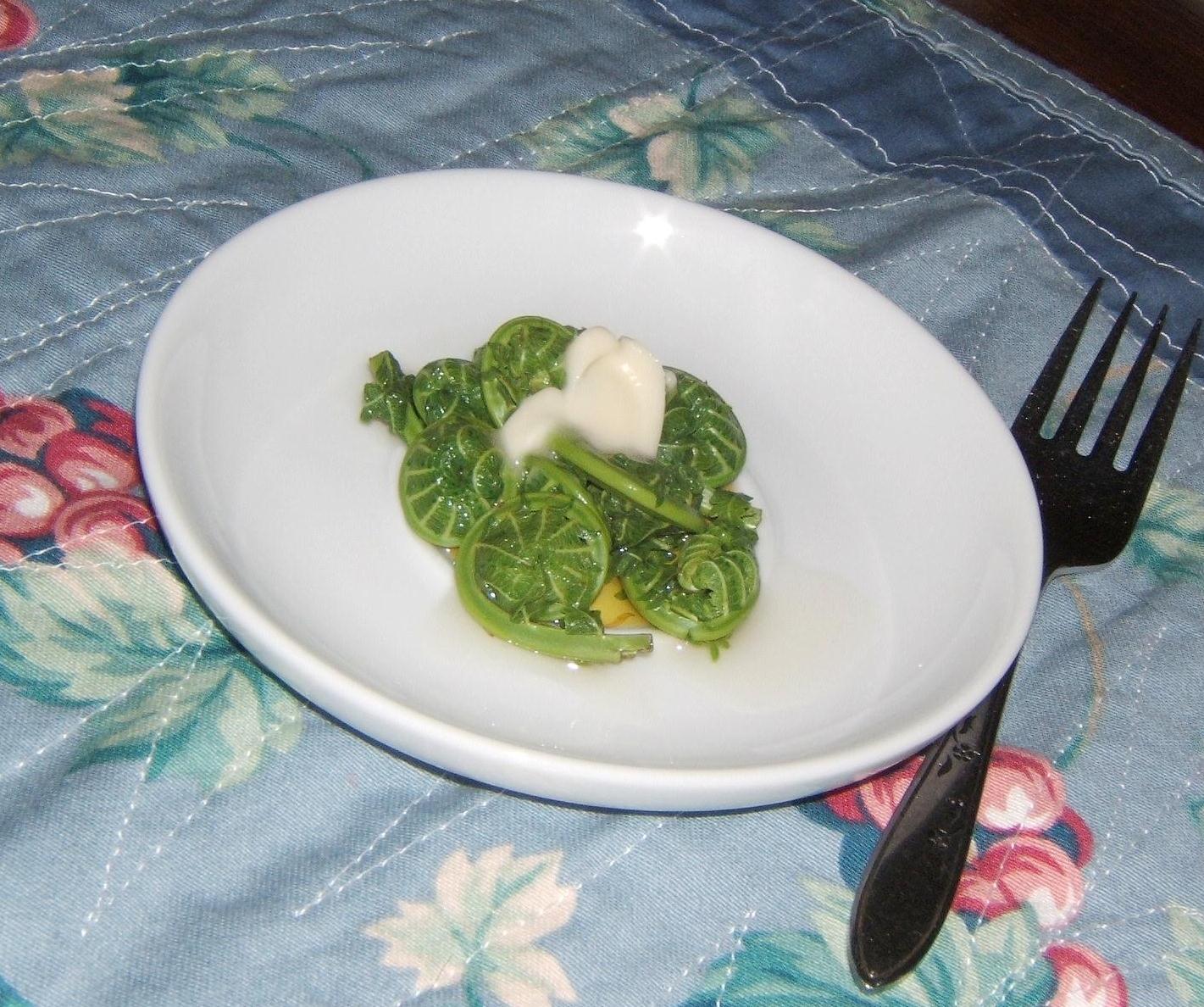
In town, people are selling fiddleheads from trucks and at small stands, and there will certainly be Fiddleheads at the Farmer’s Market today in Fredericton. Usually, the sellers do a brisk business, keeping the fiddleheads fresh in portable coolers and in buckets. I watched a vendor bagging the green fiddleheads, giving the clear plastic bag a deft twirl to seal it before he handed it to the buyer.
Have you ever eaten fiddleheads?
~
~
waking from a dream
Ostrich Fern (Matteuccia Struthiopteris (L.) Todaro)
~
bottom-land thicket
naked in spring
a rumpled bed
the throws of hibernation
~
new growth cocooned
in dry leaves, bent skeletons
last summer’s fern
~
sun surge
insult
between curtains
~
green fiddlehead
uncoils
head down
hesitant fist thrust
between pillows and down
stretches fingers
filigreed shadow
new blocking of sun
~
brown coverlet
kicked
~
new green bedspread
new green canopy
green shade
~
~
Published www.nichepoetryandprose.wordpress.com Nov. 9, 2011
© Jane Tims 2011
Warning: 1. never eat any plant if you are not absolutely certain of the identification; 2. never eat any plant if you have personal sensitivities, including allergies, to certain plants or their derivatives; 3. never eat any plant unless you have checked several sources to verify the edibility of the plant.Purple Violet (Viola cucullata Ait.)
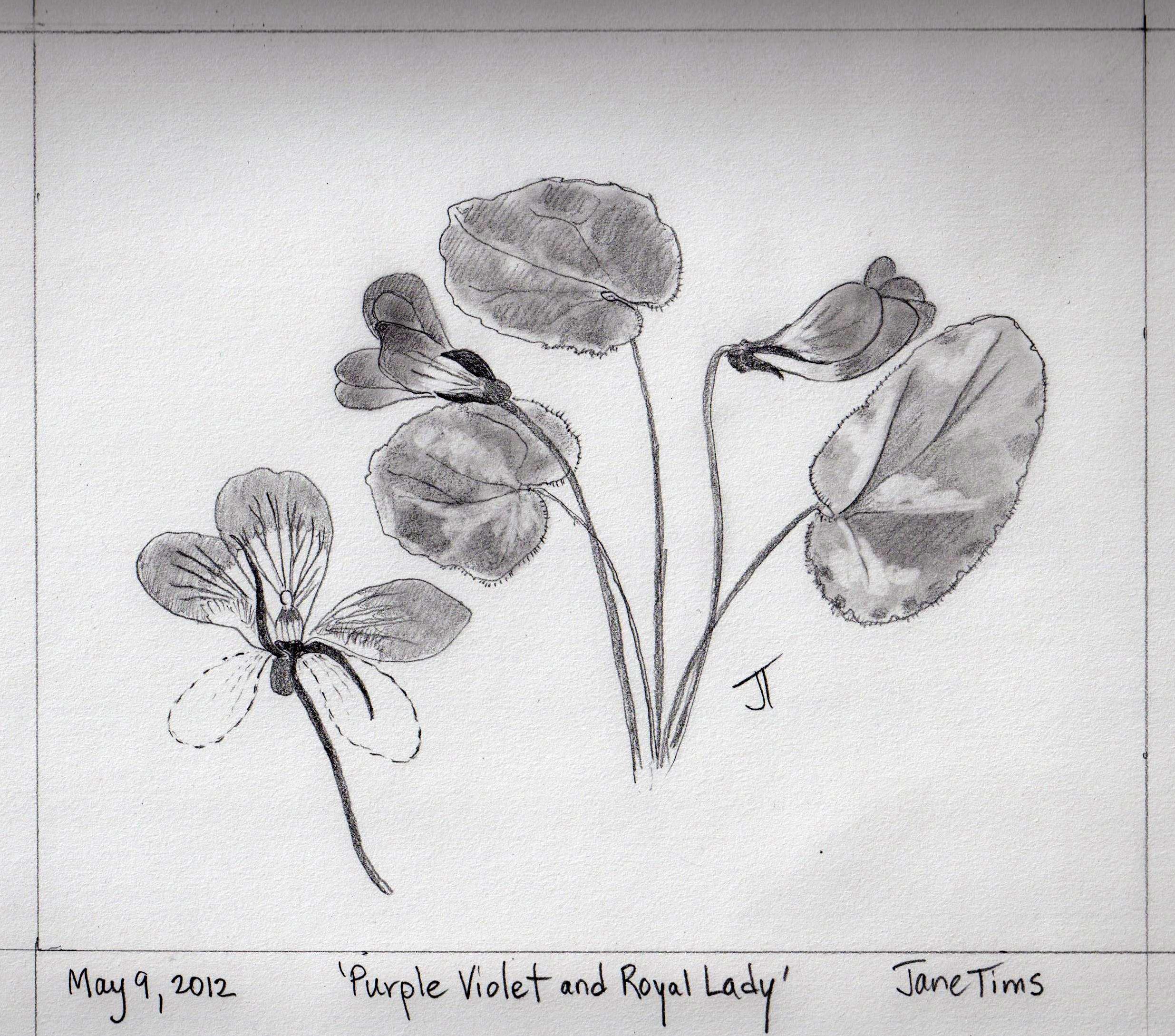
The Purple Violet is the floral symbol of my life. It is the official flower of the province where I live. It is one of the many species in my lawn, and the theme for my guest room. Every card my Mom and Dad ever sent to me has an image of violets.
Purple Violets are loved by many people. In New Brunswick, they were adopted as the Provincial Flower in 1936, at the request of the provincial Women’s Institute. The violet is also the State flower of Illinois, adopted in 1907 by schoolchildren in the State.
The Purple Violet ((Viola cucullata Ait.) is also known as the Hooded Blue Violet, the Marsh Blue Violet, the Long-stemmed Marsh Violet, and, in French, violette cucullée or violette dressée. The Latin species name means ‘hooded’ from the inrolled young leaves.

The Purple Violet is a low-growing perennial preferring wetlands, or low wet areas in mixed or coniferous woods.
The leaves are simple, with a long stalk. They are often heart-shaped, with rounded teeth.
The Purple Violet blooms in May. The flower is held on a long peduncle (stalk) above a basal rosette of leaves. The flower is dark blue, purple or occasionally white, with five petals darkly veined towards the center. The lower petal is short and spurred, and the two lateral petals are bearded. Bearded petals have clusters of tiny thick hairs, rounded at the tip.
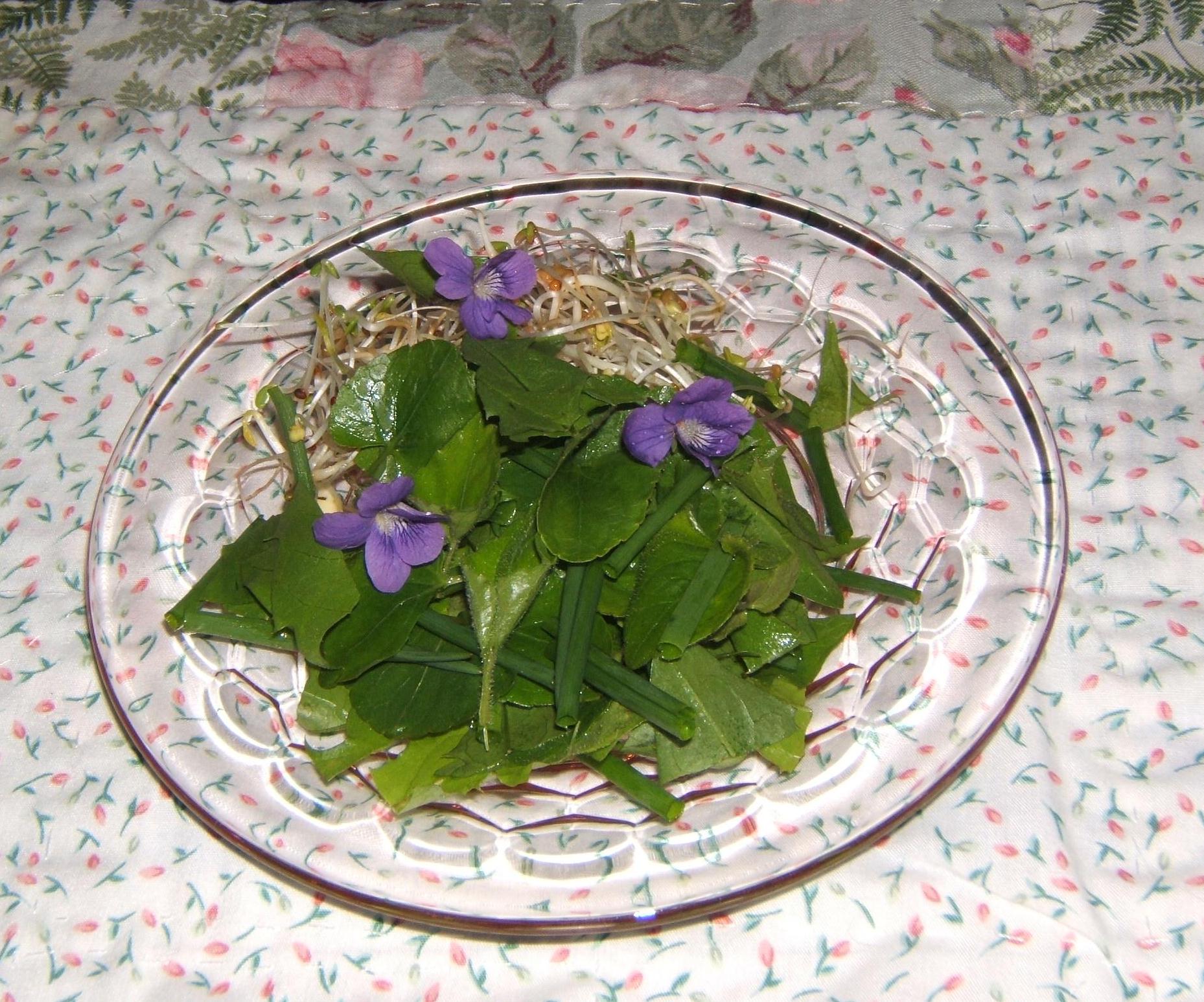
The leaves can be eaten raw or cooked, used as a thickener in soup, or to make a tea. The flowers can be added to a salad or used for edible decoration. My salad is made with Purple Violet leaves, Dandelion greens, chives from our garden and my own sprouts. I added three flowers for their delicate taste and decoration. Always be sure of your identification before you eat anything from the wild!
Although I do not advocate the wanton dismemberment of flowers, the violet holds a charming secret for children of all ages. If you gently pull down the ‘upper’ two petals from the flower, you can see a little lady with a white head and orange gown, sitting against the backdrop of her purple throne.
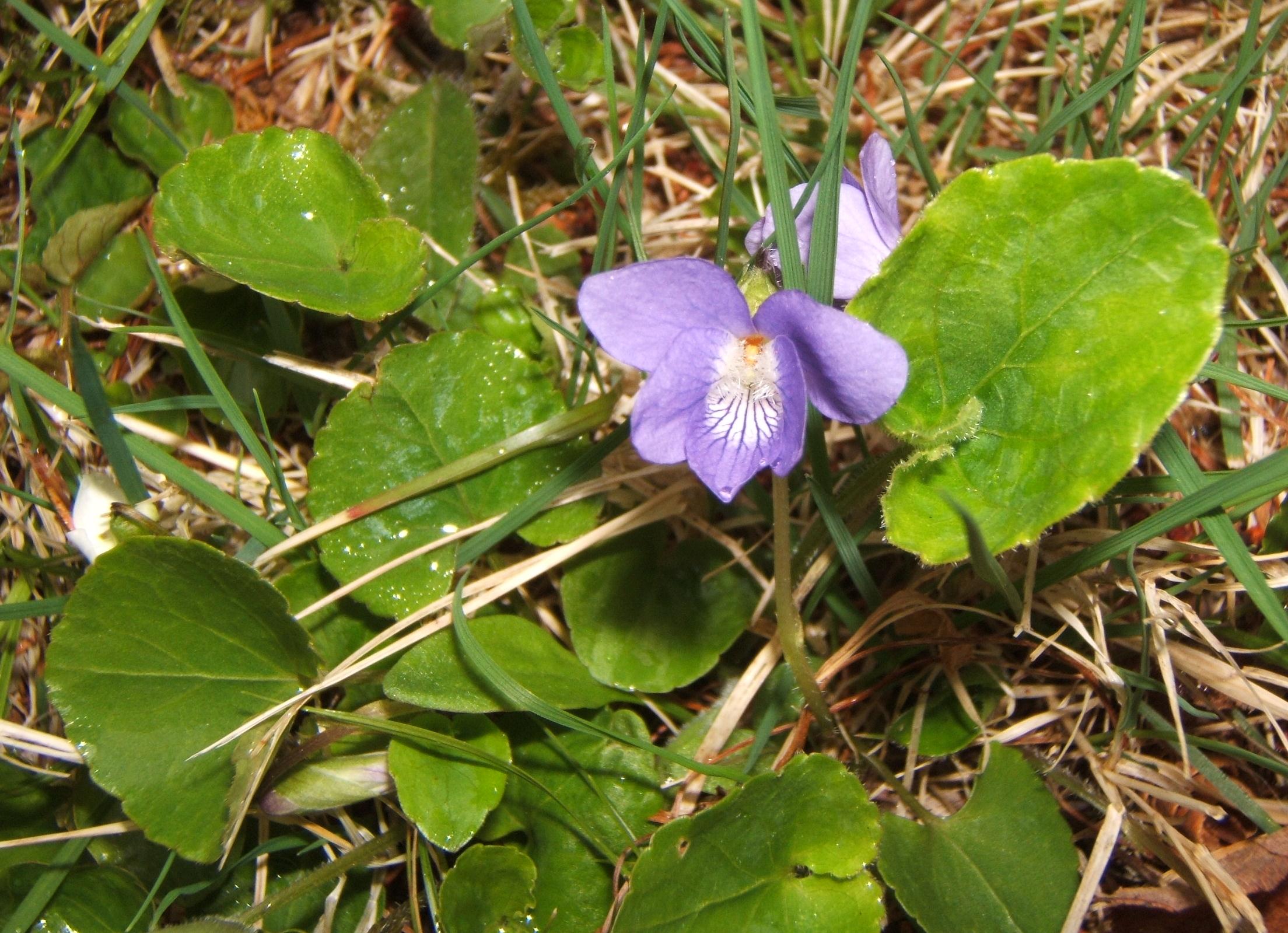
Purple Violet holds a royal lady… in this flower, you can barely glimpse the lady against her throne. She is upside down. You can see her white head and the top of the skirt of her orange gown.
~
~
Marshland Rule
Viola cucullata Ait.
~
within the perilous
limits of the rimless marsh,
disguised in woodland green,
spurred by deep viola speak
and crowds of envious hearts,
the hooded ranger guards
the tiny queen, long stemmed
tenderness, slenderness hid
by the folds of her orange gown,
seated against her purple throne,
flanked by wise men
bearded,
eager to advise
~
~
Serviceberry (Amelanchier sp.)
In the corner of our property is a usually-inconspicuous bush struggling to become a tree. This time of year it comes out of anonymity in full bloom. Today it is covered in white flowers – in a week it will be a scattering of confetti on the ground.
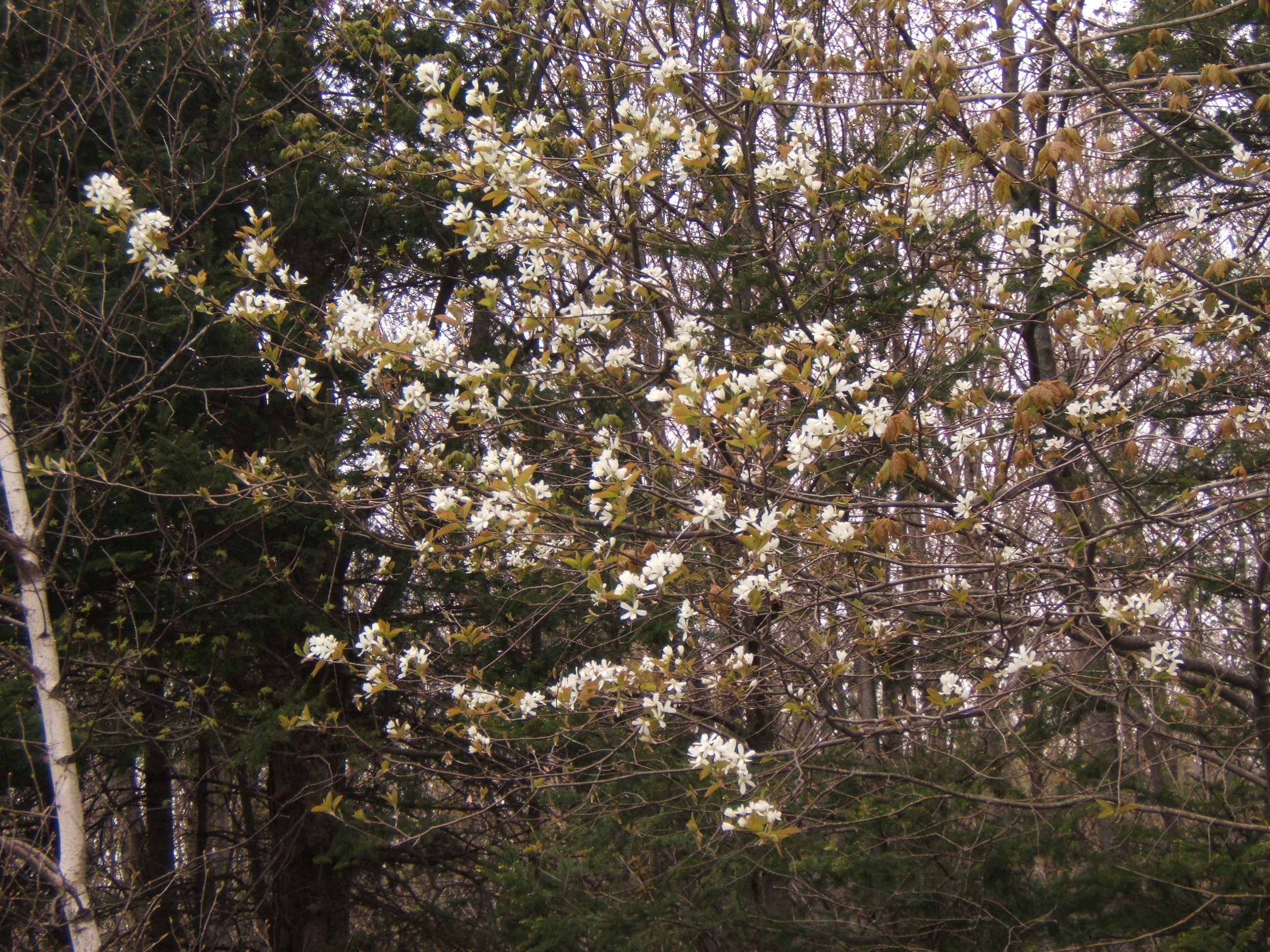
This bush is one of the Amelanchier species, probably Amelanchier sanguinea var. alnifolia (Nutt.) P. Landry. Amelanchier is perplexing to identify to species because of hybridization and other complex genetics. It has many common names, including Serviceberry, Wild Pear, Juneberry, Shadbush, Wild Plum, Sugar Pear, Saskatoon, and Chuckley Pear. In French it is called poiriers or petites poires. It is called Shadbush because it blooms at the same time the shad are running. The American Shad is an anadromous fish caught as it makes its way up the rivers for spawning.
Amelanchier is often found on disturbed sites, along roadways and fields. It also likes the edges of thickets and wet areas. This time of year, it beautifies the landscape with frail white bloom.
The fruit of Amelanchier is a berry-like pome, dark purple in color. Each berry contains 10 seeds and the sepal is persistent on the blossom end of the berry. The berries are edible and sweet, and can be eaten raw or used to make jam.
~
~
the shad are running
~
after the hard rain
and the wind between cold front and warm
the river runs brown
and for dinner we have fiddleheads
new potatoes and shad,
and last-July’s Serviceberry jam
~
Serviceberry bushes are torn fish nets
holes poked through with fingers
petals scattered on mossy stones
along the river shore
~
~

Warning: 1. never eat any plant if you are not absolutely certain of the identification; 2. never eat any plant if you have personal sensitivities, including allergies, to certain plants or their derivatives; 3. never eat any plant unless you have checked several sources to verify the edibility of the plant. © Jane Tims 2012
excavation underway!
On Tuesday morning last week, I began my morning work to the beat of an intermittent rapping. It was so loud and so near, I thought it must be someone hammering on the house.
I looked outside and saw, across the lawn, a large bird with a flaming red crest. A Pileated Woodpecker (Dryocopus pileatus)!
We have seen this species of woodpecker several times before in our Grey Woods. These birds leave their oval cavities in many of our older trees, evidence of their search for insects or the preparation of cavities for nesting. The use of dead or dying trees as cavity nesting sites is an example of how important these trees are to the woodland ecosystem.

I watched as the bird did her circuit of the tree and hopped down to the ground for a while. Then she fluttered up to our cedar rail fence and into the trees.
The Pileated Woodpecker’s bright red crest and long skinny neck give it a comical air – not a beautiful bird, but very exciting to see and watch.
~
~
© Jane Tims 2012

a pair of Painted Turtles
We did our usual bird-watching run along the St. John River on Sunday afternoon. We ordinarily follow the same circuit, from Oromocto, along the north side of the River, to Jemseg, crossing the River via the Gagetown Ferry, and returning on the south side of the St. John River. This area is in central New Brunswick, east of Fredericton.
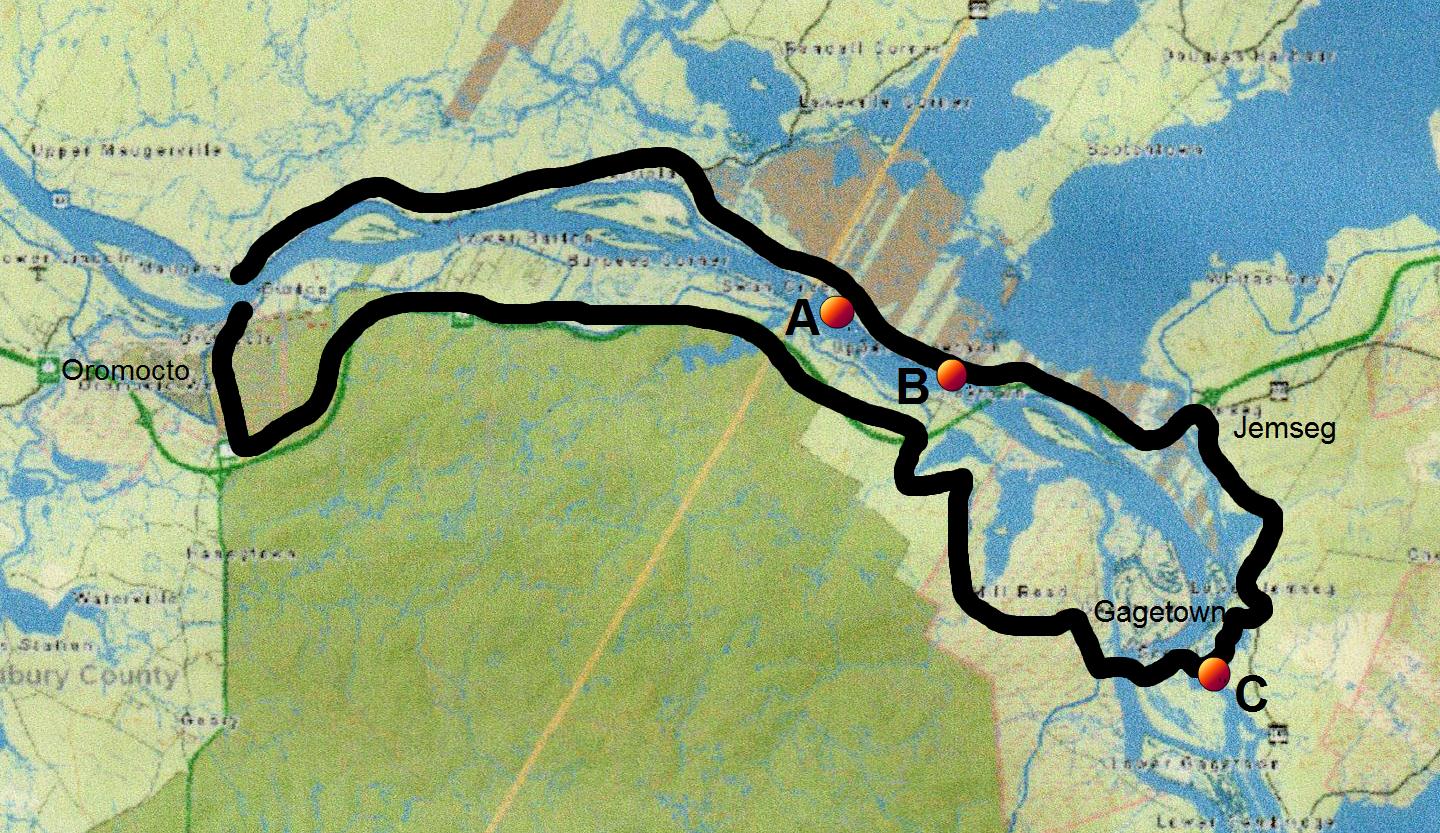
The first part of this circuit is along the old Trans Canada Highway, now Route 105. This section follows the St. John River, through the Grand Lake Meadows, an important wetland area for New Brunswick. Near the spot marked ‘A’, we saw lots of ducks, an Osprey eating a fish, and three other raptors (a group including hawks or eagles) too distant to identify. Near ‘B’ is the place we often see various owls, Bald Eagles, and Moose.

From Jemseg, we take Route 715 to Lower Jemseg. This part of the route travels above the River, through farmland. We rarely see wildlife along this section, but the area has a rich history and has several interesting buildings, including the old church featured in my post of September 14, 2011.

From Lower Jemseg, we turn towards the Gagetown Ferry and Scovil. This is a very interesting part of the route, snaking between wetlands and ponds. Along this section, it is usual to spot other cars of eager birdwatchers.
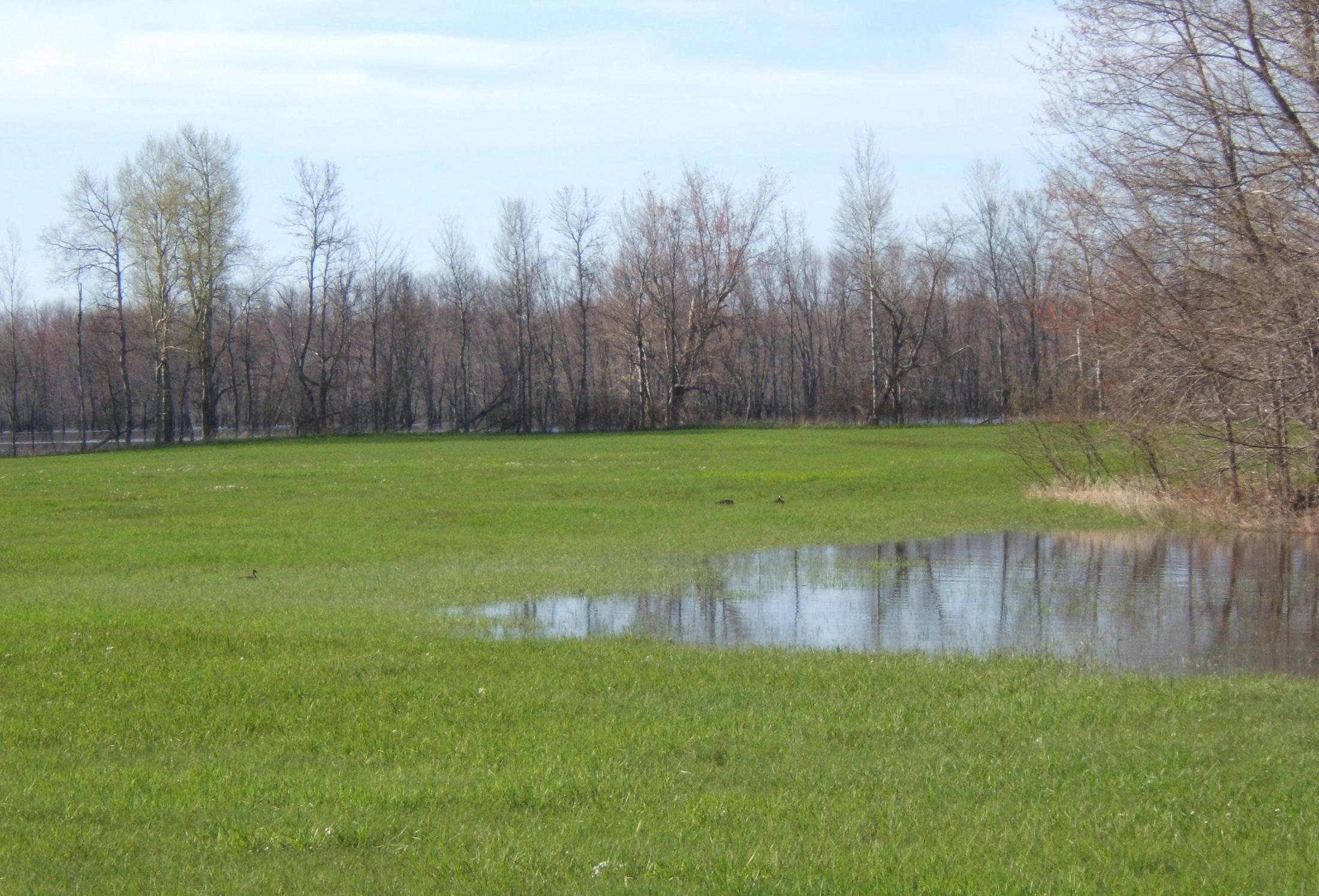
a wet field near Scovil … there are two American Black Ducks in the grass to the left and two Canada Geese beyond the pond … this is the same pond where we saw a Glossy Ibis on April 23, 1988
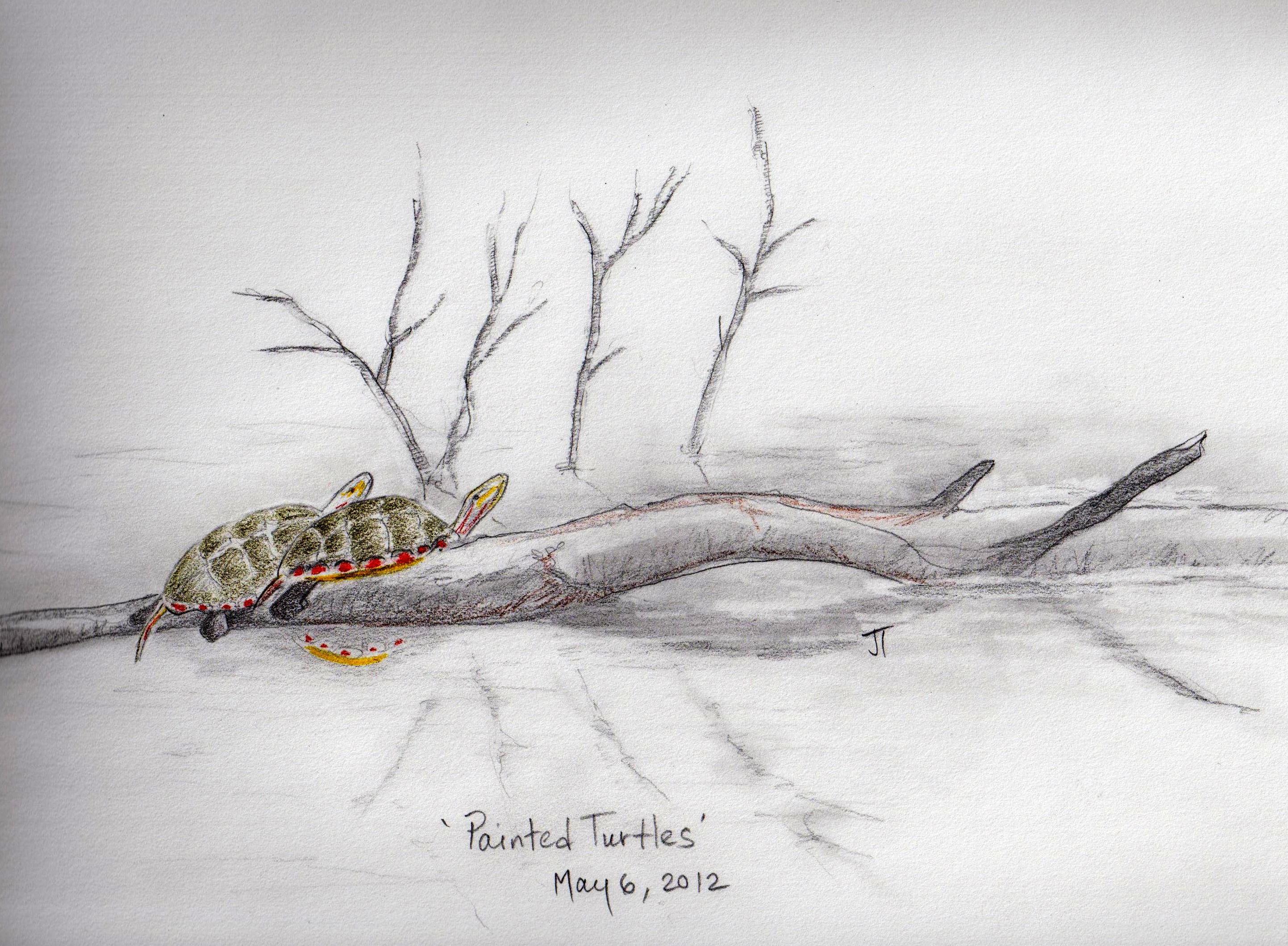
The highlight of our trip on Sunday was a group of three Painted Turtles (Chrysemys picta) on a log along this last section of our route, near the spot marked ‘C’.

The turtles were sunning themselves on a log in the middle of a pond. They have dark green, smooth shells, with bright orange markings along the edge of the shell. The inside of the lower shell is bright yellow. Their heads and tails are also marked with short streaks of orange and yellow. All winter these turtles have been hibernating at the bottom of the pond. Now awake, they will live in the pond all summer, laying eggs and feeding on aquatic insects and vegetation.
These Painted Turtles were stretching their necks out of their shells as far as possible. They made a beautiful sight, their colorful shells mirrored in the pond water.
~
~
Painted Turtles
~
I study the colors
through binoculars
remember these
with my hand, my fingers
rock the fine focus
rotate the brush
pick paint from the palette
~
the shell, flat olive tiles, grouted
Payne’s Grey
the wrinkled foot and leg, relaxed along the log
Burnt Umber
on the tail, the neck, the head
deft strokes of Cadmium
Yellow and Orange
~
the head stretches, to soak in sun
and dazzles on the pond
the lower shell
Yellow
refection on water
~
and, at the edge of the carapace
bright dabs of Orange
one part Cadmium
two parts Quinacridone
and a touch of some unknown
translucence
elusive
~
© Jane Tims 2012
places off-planet #2 – three comets
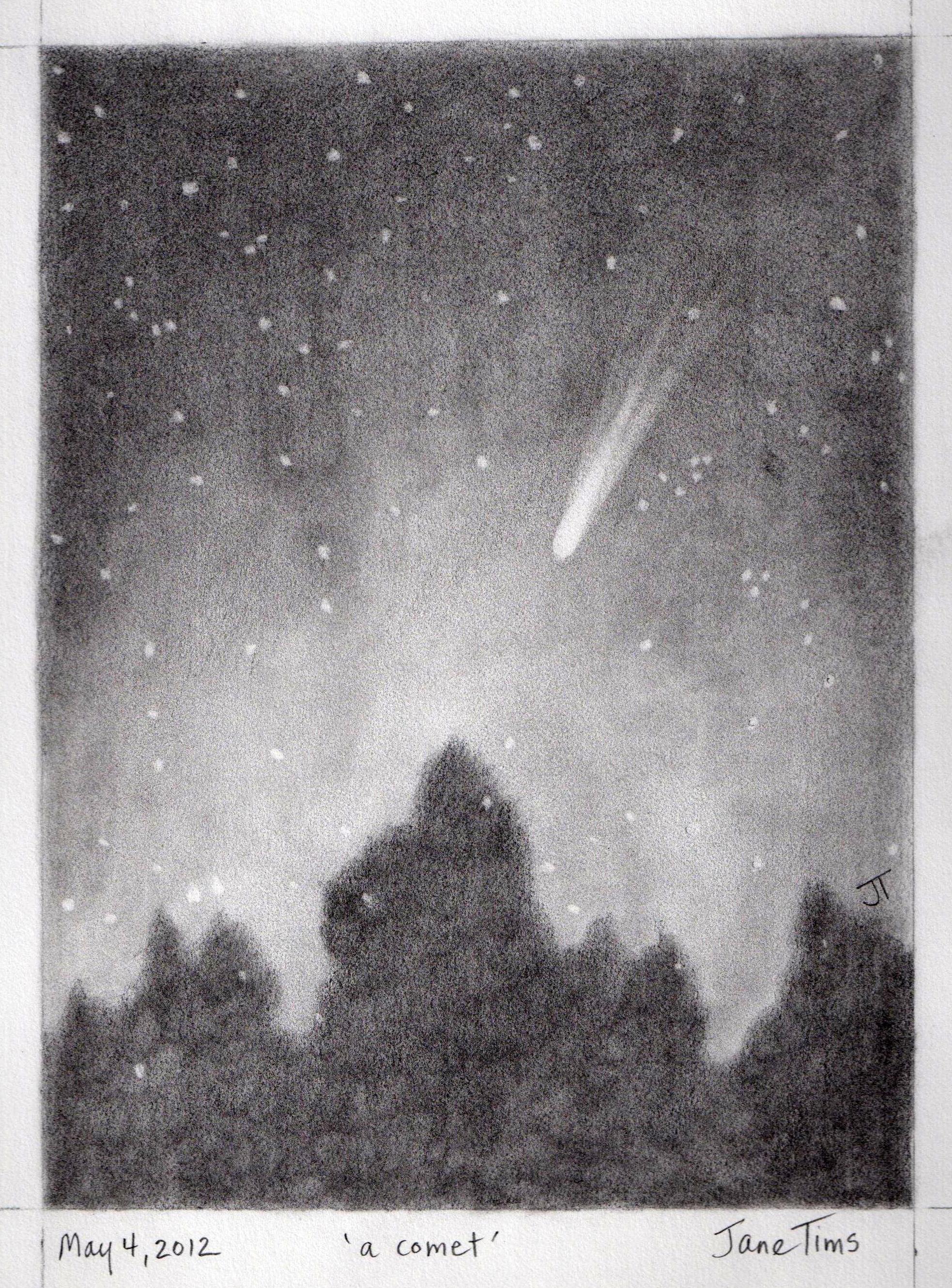
In my life so far, I have seen three major comets – Halley’s Comet in 1986, Hyakutake in 1996, and Hale-Bopp in 1997. There have been comets since then, I know, but I have always been asleep!
A comet is composed of a ‘nucleus’ of rock, dust and frozen gas, and a tail. The tail is formed when the gasses in the nucleus are heated by the sun and create an atmosphere or ‘coma’. The sun’s radiation and the solar wind cause the coma to flow away from the sun as a tail. Since the comet can be moving away from the sun, sometimes this means the comet moves in the direction of its tail!
How many comets have you seen?
~
~
Comet
~
from the Greek
koman
~
to wear long hair
~
© Jane Tims 1997
Trailing Arbutus (Epigaea repens L. var glabrifolia)
One of the common flowers of early spring is the Mayflower (Epigaea repens L. var. glabrifolia), or Trailing Arbutus, also called Epigee rampante in French. It belongs to the heath or heather family (Ericaceae). It grows in open woods, or pastures, and along hillsides, in acidic soil.

Mayflower in bloom, photo taken in 1978 in Nova Scotia
The Mayflower is part of what Roland and Smith (The Flora of Nova Scotia, The Nova Scotia Museum, 1969) called the ‘Canadian Element’, woodland plants native to Northeastern North America and including common plants of the coniferous woods: Maianthemum canadense Desf. (Wild Lily-of-the- Valley), Mitchella repens L. (Partridge-berry), Gaultheria procumbens L. (Wintergreen) and Trientalis borealis Raf. (Star-flower), among others. When I worked on my M. Sc. thesis project, years ago, these were in the community of plants I encountered in the woods I was studying, and they are still my favorite plants.

two members of the ‘Canadian Element’ community – leaves of Wild Lily-of-the-Valley (left) and Wintergreen (right)
The name epigaea means ‘on the earth’, and perfectly describes the way the Mayflower grows. The specific name is from the Latin repens meaning ‘creeping’. The plant spreads across the ground, its oval, leathery leaves lying flat and overlapping. The leaves persist all winter and sometimes look a little weather-worn. The variety we have is glabrous on the lower leaf surface, meaning without hairs. The leaves grow on hairy, woody twigs.

leaves of Mayflower in the Grey Woods, April 2012
The flowers grow in clusters tucked beneath the leaves. They are creamy white, and are in the form of a short tube ending in five flaring lobes. They bloom mid-April to mid-May. The flowers along our woods have just completed their blooming. For a nostalgic look at the tradition of picking Mayflowers in spring, have a look at http://ahundredyearsago.com/2012/04/28/gathering-arbutus/
A delight of spring is to manoeuvre close to the ground so you can smell the Epigaea flowers. The perfume is very sweet, gently stirring. The only edible part of the plant is the flower and it tastes as sweet and fragrant as it smells. It is a shame to eat such a delicate creature as a Mayflower, but once a year I allow myself the privilege, just one tiny bloom (always be absolutely certain of the identification before you eat any plant in the wild). The plant is protected in some areas since it rarely sets seed and is almost impossible to transplant.
The Mayflower is the floral emblem of Nova Scotia and Massachusetts.
~
~
Trailing Arbutus
(Epigaea repens L.)
~
on the slope, new leaves
Trientalis, Gaultheria
Star-flower, Wintergreen,
vines of Partridge-berry creep,
Maianthemum unfurls
~
beneath the din, a melody
weeps Epigaea, evergreen
pressed to the hillside
leather armour, thickened leaves
weather-beaten, worn
~
waxy bloom resists
subtle shadow
predator
unrelenting rain
~
~

Warning: 1. never eat any plant if you are not absolutely certain of the identification; 2. never eat any plant if you have personal sensitivities, including allergies, to certain plants or their derivatives; 3. never eat any plant unless you have checked several sources to verify the edibility of the plant.
© Jane Tims 2012
places off-planet #1 – watching the stars
For me, star-gazing is a warm-weather activity. The winter, although dazzling in its displays of stars, is too cold for my arthritic joints and the immobility of prolonged star study.
So, as May approaches, I am looking forward to spending some time outside, to locate some old friends in the sky and to meet some new sky-folk!
I am lucky to live in an area not overly polluted with night light. At our home, although trees make viewing sporadic, stray light from street and yard lights is not a problem. At our lake property, the surroundings are utterly dark and the sky is stunning, studded with stars.
If you want to do some stargazing, you need three things to get a good start:
- a star chart or a planisphere (a combination of a star chart and a viewer). My favourite planisphere is downloadable and printable, from the National Research Council at
http://www.nrc-cnrc.gc.ca/eng/education/astronomy/constellations/html.html
- a reclining lawn chair (so you can relax and your neck will not ache)
- a flashlight with a clear red cover (this is to prevent your eyes from becoming light-adapted as you check the star-chart).
Another helpful item, to see groupings of stars more clearly, or to see details of the moon:
- a pair of binoculars
Are you a stargazer? What are your favorite ‘tools-of-the-trade’?
~
~
the search for wind
and stars
`
these are not the winds I sought to stand in
I wanted a zephyr to ruffle the bluets in spring
a breeze to whip the silver wind chime to frenzy
~
instead I cower from night moans
the rattle at the window
the street where a dust daemon lurks
near every wall, lifts the leaves
grinds them to powder
~
I gaze at the skies
watch for Altair and Orion
the never- random pulse to signal man
~
but all the lights in the night sky
are not stars
the moon who solemn watches
as his face is peeled away
the comet drawing scant thoughts across darkness
its tears a storm of falling stars
~
I walk with sorrow
it rests behind the eyes
and cannot swell to tears
~
the truth so simple
yet impossible to know-
you need only stand
and the hill will form beneath your feet
and the roaring shrink
to the breath of love across your face
~
© Jane Tims 2012

‘Ducks’ Ditty’
On Saturday we took a drive along the St. John River, to see if any waterfowl were braving the cold windy day. The water is slowly receeding but still above summer levels. On a miserable day, the ducks retreat to the shallows, away from the exposure of the open water.
There were a few birds on the water. We stopped for a while to watch five male Mallards (Anas platyrhynchos) paddling about. They stuck together as a group, feeding in the shallows and occasionally ‘standing’ on the water to flap their wings. This time of year, the female Mallards are on the nest, hatching their young, and the males typically hang out in groups with other males until moulting begins.
I am not good at duck identification, but the Mallard is easy to spot, with its bright green head and the white ring around its neck. I enjoyed watching them through the binoculars, especially their orange legs and feet maneouvering in the muddy water.
The Mallard is a member of the marsh duck family and a ‘dabbler’. Dabblers obtain their food by skimming it from the surface or tipping up to submerge their heads so they can feed underwater.
I can never watch dabblers on the water without thinking of Kenneth Grahame’s famous poem ‘Ducks’ Ditty’, from the book The Wind in the Willows. If you don’t have a copy of the book, have a look at the poem at http://www.literaturepage.com/read/windinthewillows-14.html

© Jane Tims 2012
maple blossoms
This week, as Red Maple (Acer rubrum) flowers bloom, the woodland blushes scarlet. In the driveway, a tree-shadow of blossoms has begun to form, as the flower clusters reach their peak and then drop to the ground.
Each flower is a puff of reddish-pink bracts surrounding the male and female flower parts. The stamens (the male part of the flower) consist of a thin filament topped by a dark anther where the pollen is formed. The pistil (the female part) is made of a style topped by a stigma; once fertilised by pollen, the maple seeds will form here. Red maple flowers may have both stamens and pistils, or may be only male or only female. The flower looks like a tiny fireworks, the burst-effect created by a bundle of stamens or stigmas.
When I went to Dalhousie University in Halifax, I always loved the flowering of the Norway Maples (Acer platanoides) in spring. Their flowers are green and most people mistake them for new leaves. I used to wonder what the ecosystem consequences might be if the flowers were bright orange or purple instead of green.
~
~
red maple blossoms
~
across brown sky
strontium bursts of bright
sparks bloom
against dark
~
~
© Jane Tims 2012




 nichepoetryandprose