Posts Tagged ‘history’
a walk through the covered bridge – disappearing covered bridges
Last week we took a drive to re-visit some of the covered bridges we saw in 1992 as part of a special project to celebrate Canada’s 125th birthday. One of these was the Stone Ridge Covered Bridge (formally known as Keswick River #6), crossing the Keswick River at Upper Stone Ridge in York County. I was looking forward to seeing the bridge because we had recorded some interesting carvings in 1992. Among the usual initials, someone had craved the images of three houses, one with steps and two chimneys, and one, a cottage, on the sill of the bridge window.
A short drive on a pretty country road along the Keswick River brought us to the bridge… a metal Bailey bridge, constructed to cross the river at the point where the covered bridge had once stood. The new bridge was sturdy and had its own charm, but it was so disappointing to know the old covered bridge was gone forever. The Stone Ridge Covered Bridge was lost to fire on October 10, 2008.
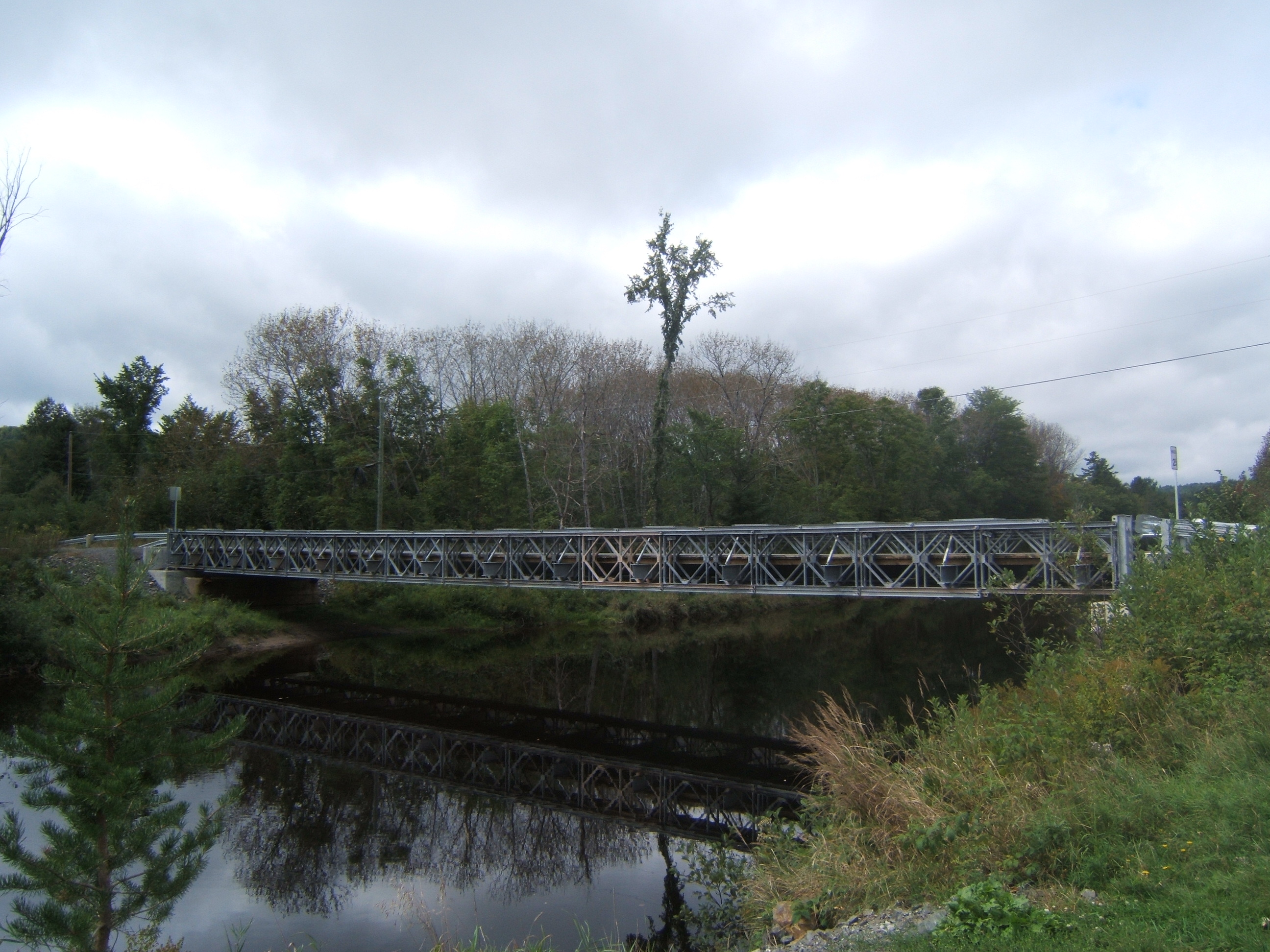
The Stone Ridge Covered Bridge was built in 1914 and had a span of 123′ 4″ and a total length of 126′ 4″. It had a roadway width of 14′ 10″ and a capacity of 10 T.
I wrote in our journal, on May 1, 1992: “most carvings were on the flat of the horizontal plate that formed the window sill and ran the length of the bridge”.’ I also wrote: “lots of hacking and hewing done on the window part of the sill”. The oldest date we recorded was ‘May 9, 1951 VHA’.
Some of the other carvings on the bridge in 1992 were: ‘LA + LB’, ‘WLR 54’, ‘VHA MARCH 7, 1952’, ‘1951 [or 1957] MAY 7 WLB [and a small heart]’, ‘KM 1952’, ‘KMB 9/55’, and ‘BB 1951’. There was also a separate carving of an upward arrow beside a ‘B’ and on the next line, ‘KM A4 54’.
I wonder who was VHA and how often did he or she return to the bridge over the years? Who was KM in 1952, and did she return, married, in 1955 with her new last name beginning with ‘B’? Was she married on April 4, 1954 to ‘B’? A mystery, perhaps solvable by looking into some local marriage records?!
It is sad to see the covered bridges in New Brunswick disappear, one at a time. Some are lost due to the dramatic power of the spring freshet. Others are lost to vandalism (fire) – every Hallowe’en residents keep a careful watch on the covered bridge in our community. In 1992 when we did the covered bridge project, our list had 71 covered bridges. The New Brunswick Department of Transportation website http://www.gnb.ca/0113/coveredbridges/coveredbridges-e.asp says there are presently 61 covered bridges in New Brunswick.
~
Copyright Jane Tims 2012
a walk through the covered bridge – Falls Brook Covered Bridge, Falls Brook on the Nackawic River
On May 16, 1992, we visited the Falls Brook Covered Bridge in York County as part of our project on covered bridges for Canada’s 125th anniversary. The Falls Brook Covered Bridge, on the Nackawic Siding Road at Nortondale, is also known as the Nackawic Siding Covered Bride, and is formally known as Nackawic River #5. This means that there used to be at least four other covered bridges crossing the Nackawic River or its tributaries, but they have been lost for various reasons.
This past weekend, we visited the Falls Brook bridge again, to see if it is still there. The sign at the end of the road was hopeful, indicating a covered bridge could be found on the road. Most of New Brunswick’s covered bridges are marked by these signs. 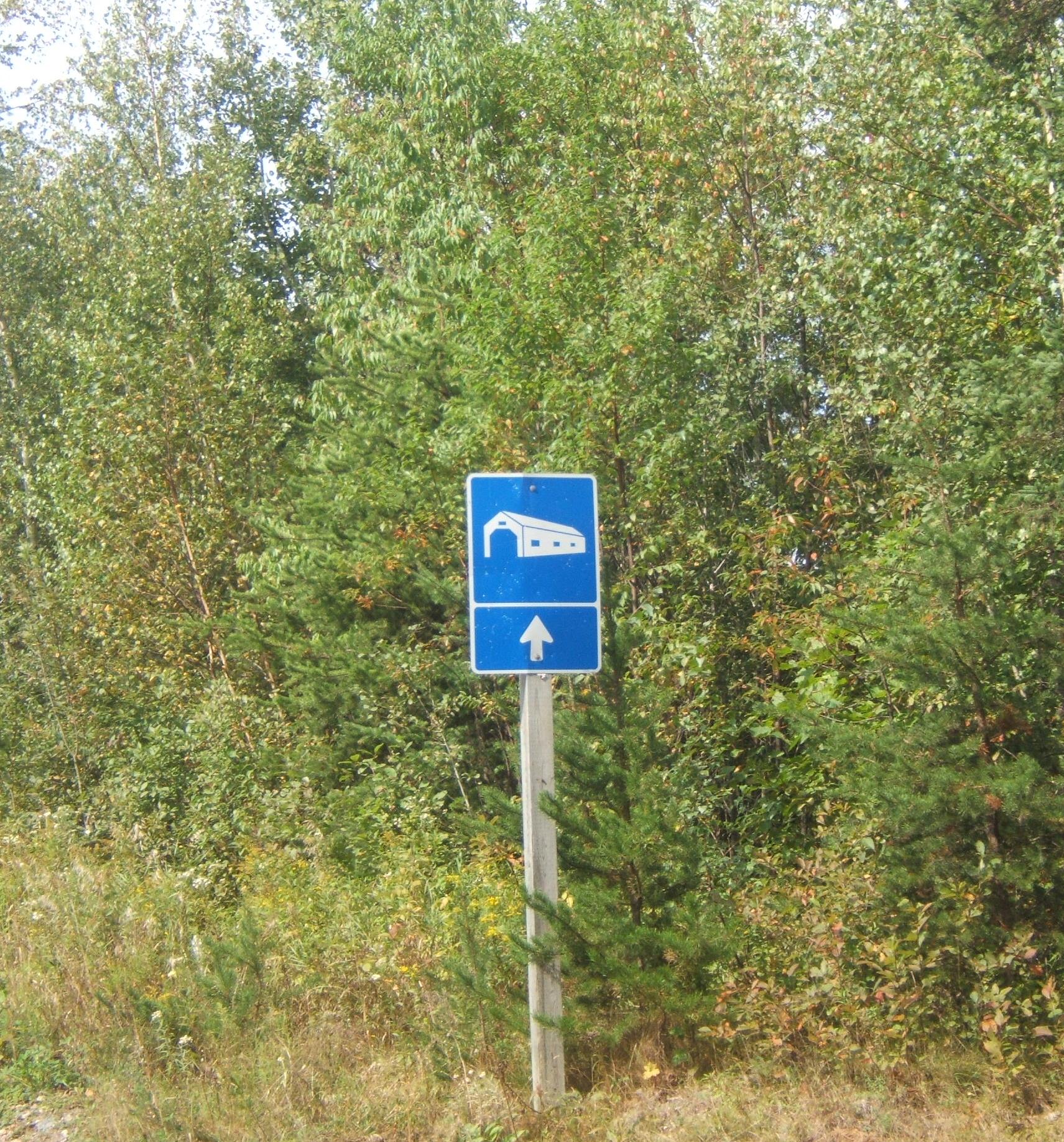
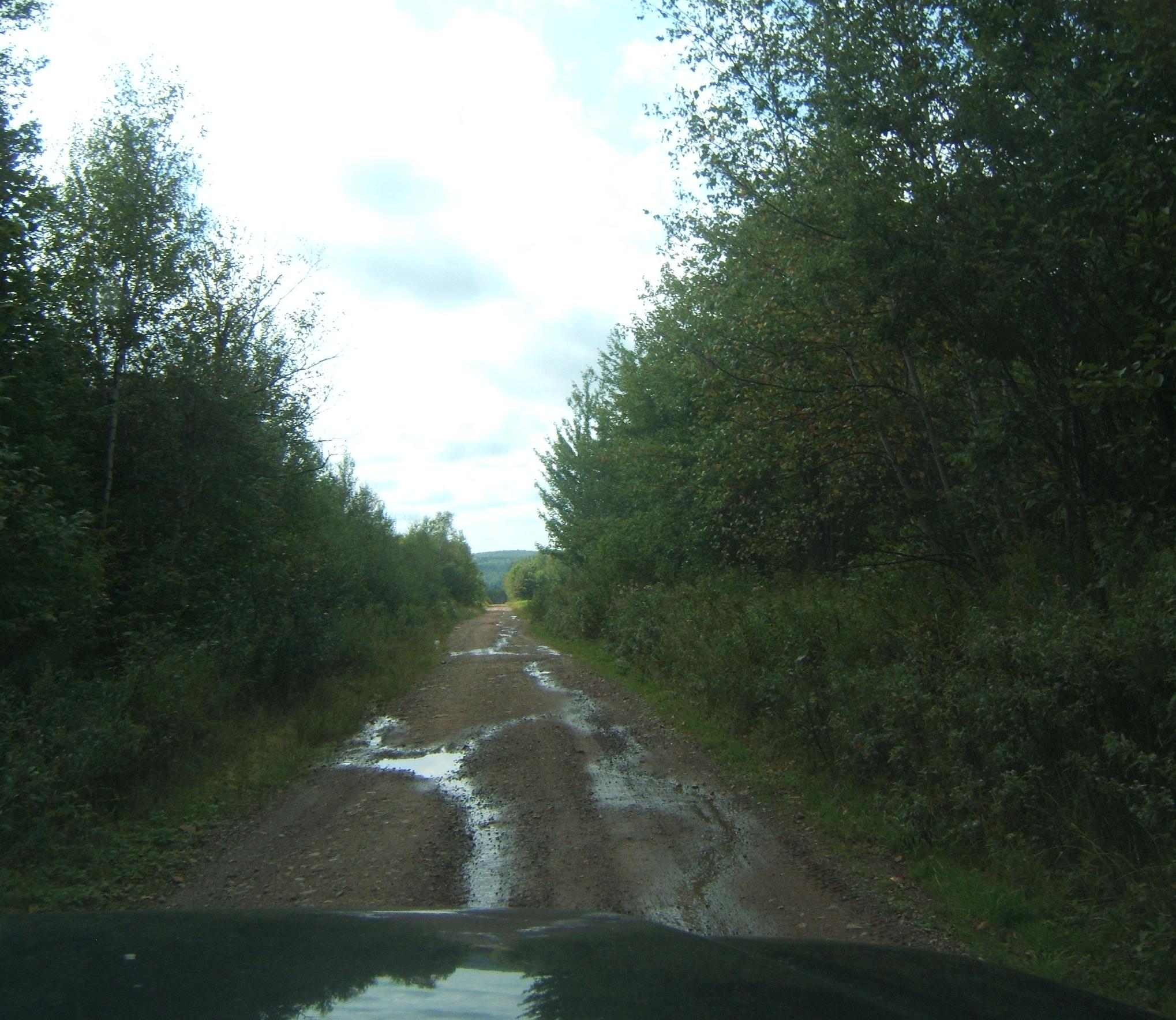
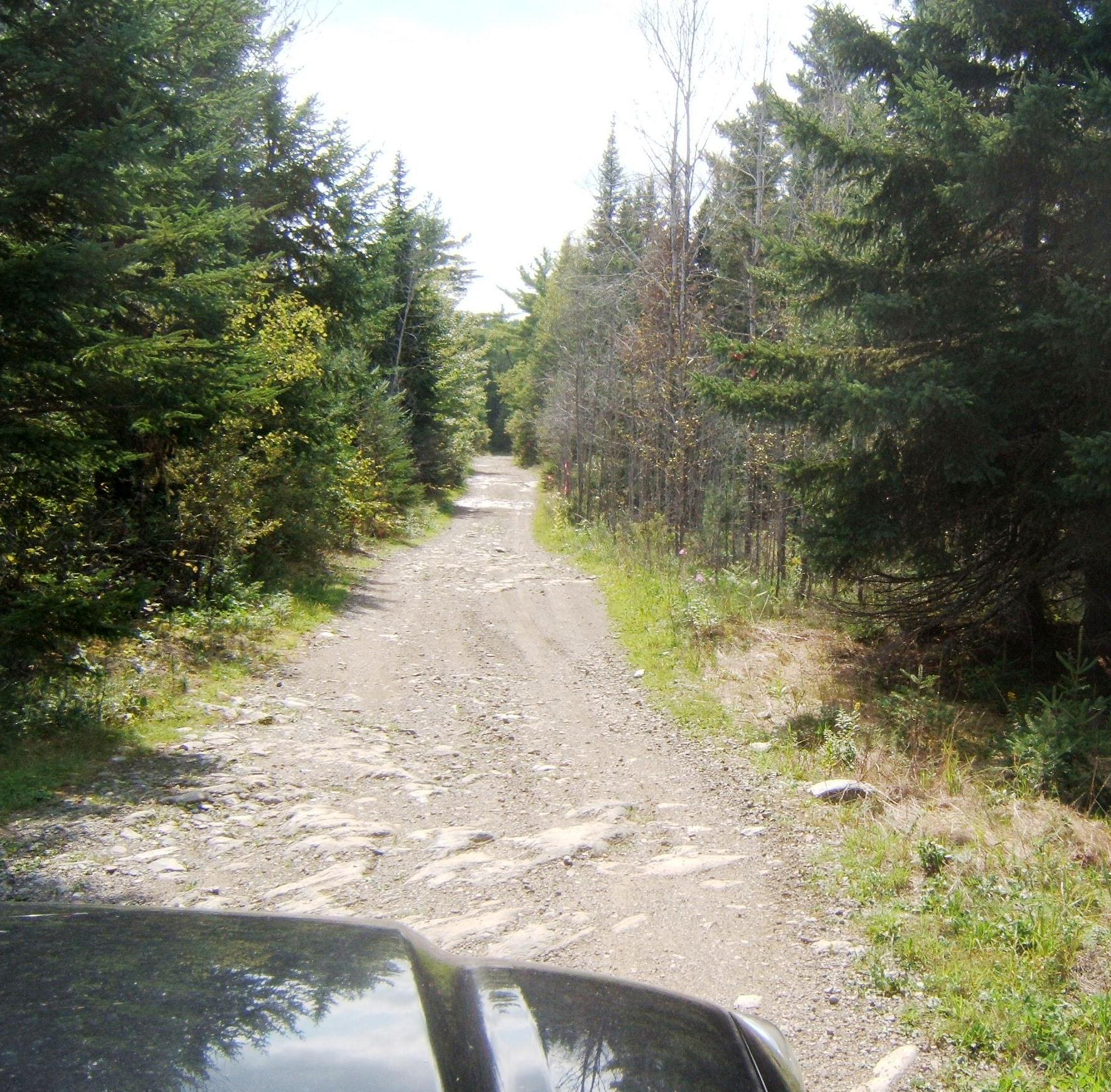
My notes from 1992 said the road to the bridge was in poor shape – ‘spooky but very pretty and other-worldly’ was what I wrote. The road has deteriorated over the years to become a narrow track with deep potholes and large outcroppings of rock.
The bridge was still there, tucked in among fir and maple woods. It had been renovated within the last couple of years, based on the presence of some new large timbers and completely new wood siding.

The Falls Brook Covered Bridge was built in 1927. It is 63′ long, with a span of 60′. It is 14′ 10″ wide and has a maximum load of 8 T. The height clearance is 4.0 m. The architecture of the bridge is amazing, showing brace and beam construction with various hardwood joinery.

Unfortunately, the renovations have removed many of the markings we noted in 1992. At that time, the oldest dates were a carved ‘1885’ and, in black ink, ‘Ptarmigan hunter Ray Brown May 12th 1896 Horse had bad leg’. I have asked a well-informed birder about this and he told me there are no other records of ptarmigan in New Brunswick. Other carvings we noted in 1992 included: ‘M.A.K.’, ‘WDH’, ‘Colin + BrenDa’, ‘Could be fishin’ ‘ , ‘D C ‘ and ‘TOGETHER AGANE Betty and Johnathan’.
The markings from the 1800s were gone, but ‘D.C.’ was still there, as well as some interesting new markings.


Some show that height is no barrier to leaving your name!

If you have covered bridges in your area, take note of the markings people have left behind! Your record may be all that survives!

~
Copyright Jane Tims 2012
a walk through the covered bridge – Bell Bridge, South Branch of the Oromocto River
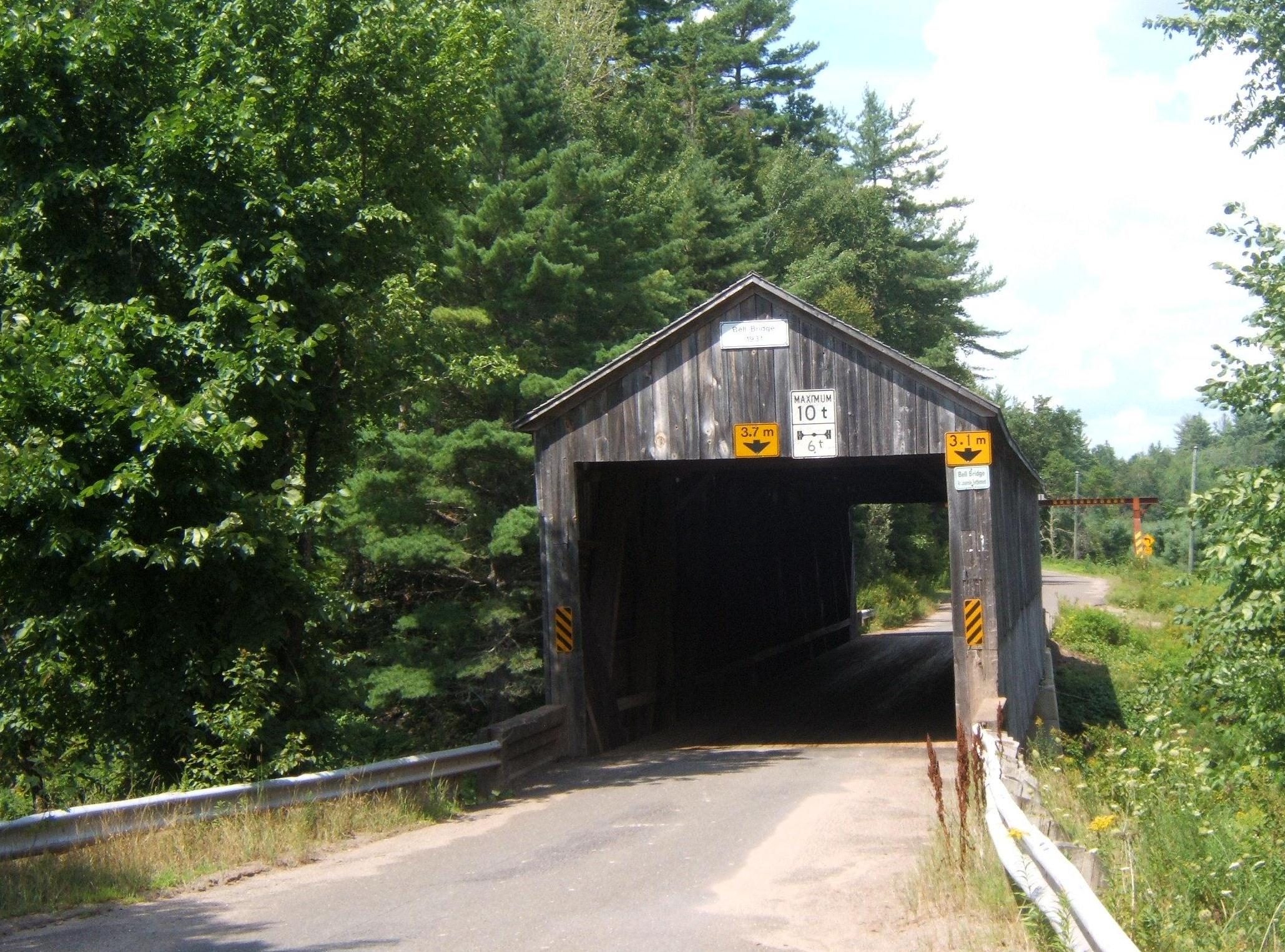
Another covered bridge crossing the South Branch of the Oromocto River is the Bell Bridge near Juvenile Settlement, Sunbury County (listed as South Oromocto Rover #3 in the April 1992 pamphlet ‘Covered Bridges in New Brunswick’, no author indicated). This bridge was built in 1931. It is 126′ 4″ long with a span of 123′ 4″. The roadway width is 15′ 5″, and the load limit is 10 t (6 t for double axle vehicles). The maximum clearance is 3.7 meters and a metal height barrier has been installed to ensure trucks exceeding the clearance cannot proceed through the bridge since this can do significant damage to the bridge structure.
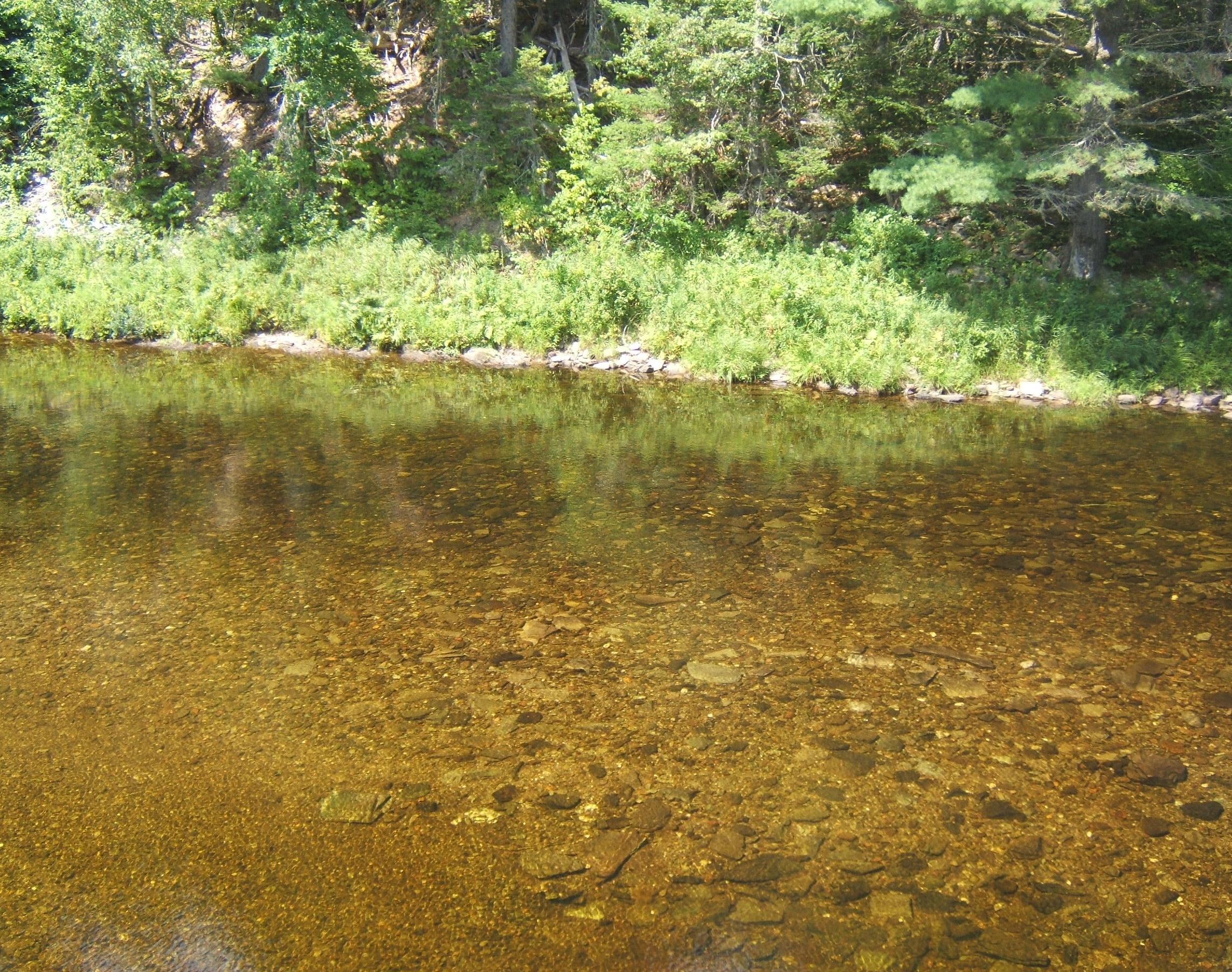
The water at this point in the river is shallow and clear. I watched for a long time to see a fish, but they will be hiding in the cooler waters of the deeper pools.
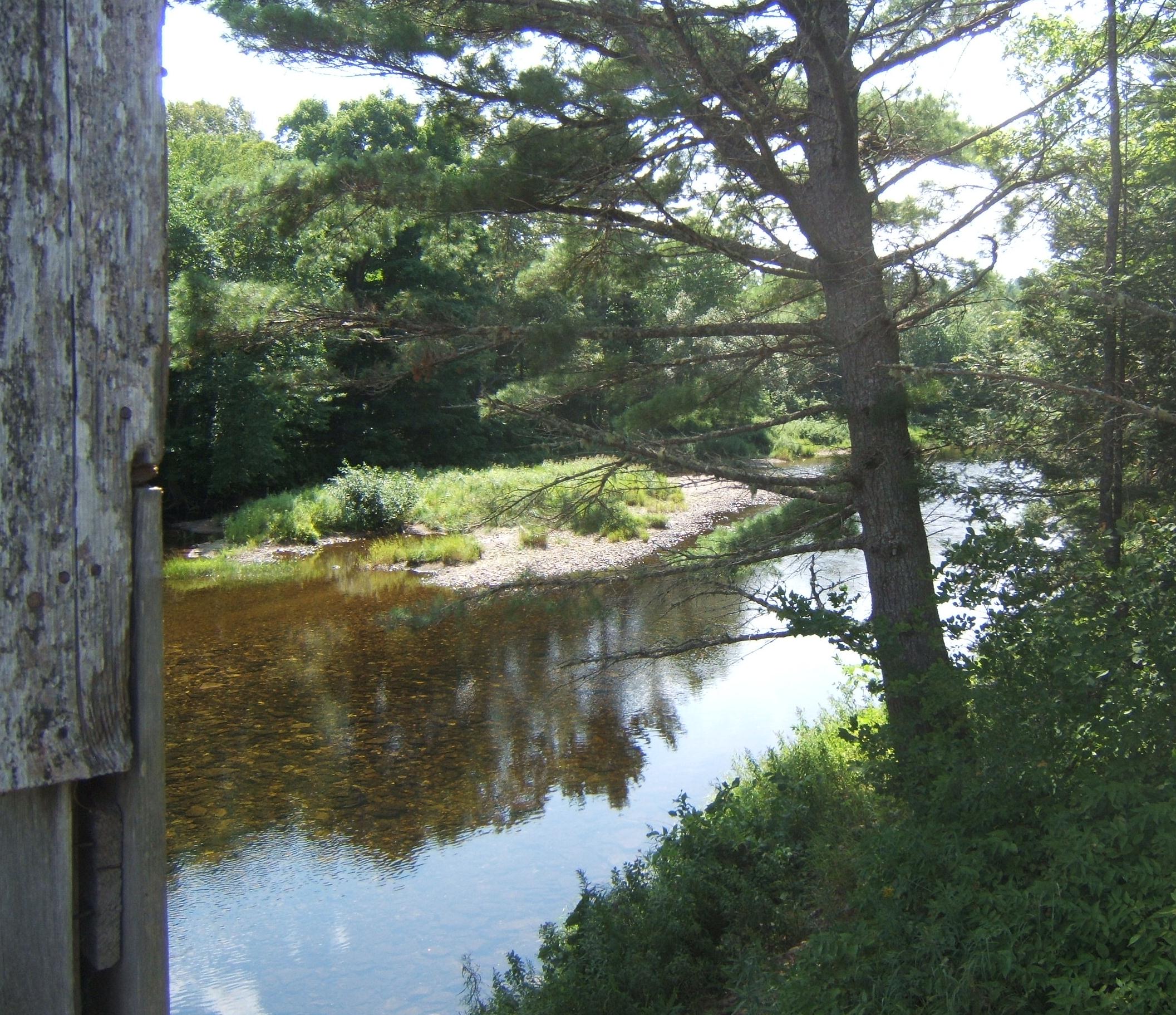
We visited this bridge on April 26, 1992 as part of our Covered Bridge Project for Canada’s 125th anniversary.
In 1992, we found many carved initials inside the bridge, on the various timbers. The oldest date we found was ‘April 3, 1932’. Some of the other initials included ‘LYL May 1, 1932′, RPC [perhaps PRC] June 6 /32’, ‘RS ’77 ‘, ‘ RT MAY 49’, ‘RM AUG 38’, ‘EK’, and ‘AE Mc APR 3/32’. We also found the initials ‘A.K.O.G. APPI 35.’ with the ‘O’ written as a diamond.
On our August drive, I noticed two unrecorded inscriptions: ‘ALIE 69’ and ‘M.O. L R.A.’
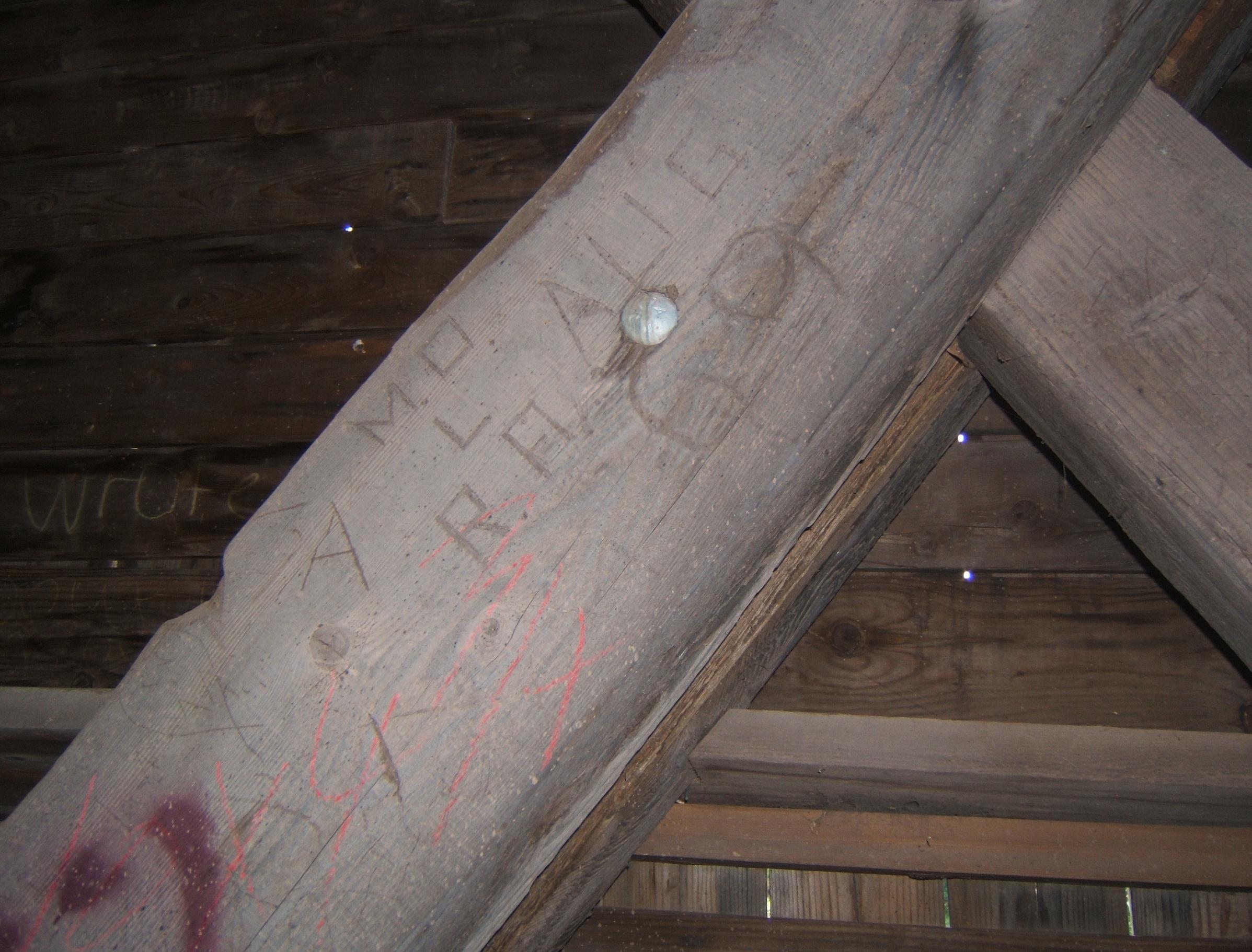
I also found a large carved ‘S’, very hard to see…

the ‘S’ is hard to see, just above the knot and about three times the length
Do you suppose ‘M.O.’ still loves ‘R.A.’ ?
~
~
forever
~
we carve our initials
in the beams of the covered bridge
pledge our love to endure
~
but these words may
outlast the love
even the people
~
~
Copyright Jane Tims 2012
a walk through the covered bridge – Smyth Bridge, South Branch of the Oromocto River
On our August drive along the South Branch of the Oromocto River, we crossed two covered bridges. I love these bridges… they are picturesque and so pleasant to walk through. They are also part of the local history of many communities in New Brunswick. I’ve talked a little about covered bridges before in my Blog – please have a look at https://nichepoetryandprose.wordpress.com/2011/09/05/inside-the-covered-bridge/
One of the bridges we saw on this drive was the Smyth Bridge. It crosses the South Branch of the Oromocto River, near Mill Settlement in Sunbury County (listed as South Oromocto Rover #2 in the April 1992 pamphlet ‘Covered Bridges in New Brunswick’, no author indicated).

Inside the bridge, it is cool and dark. When a car drives through, you hug the side, hoping the driver will see you and slow down. I love the sound of the tires on the timbers making up the floor of the bridge.

Down-river, the shallow water of the river glows in the sun. Most of our local rivers are the color of tea, a consequence of their origins in wetland areas.
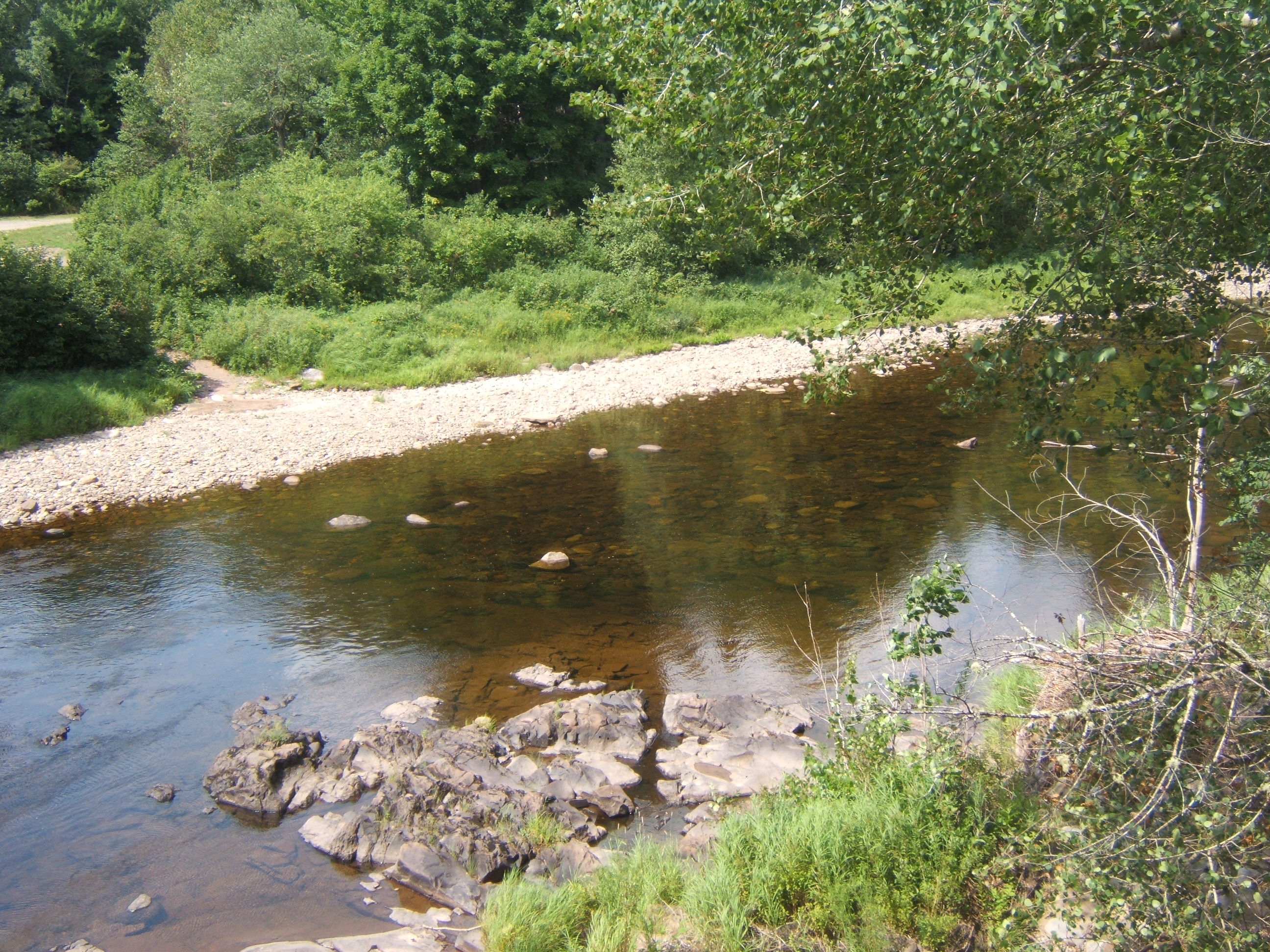
Up-river of the Smyth Bridge is a gravel beach and water for wading and swimming.
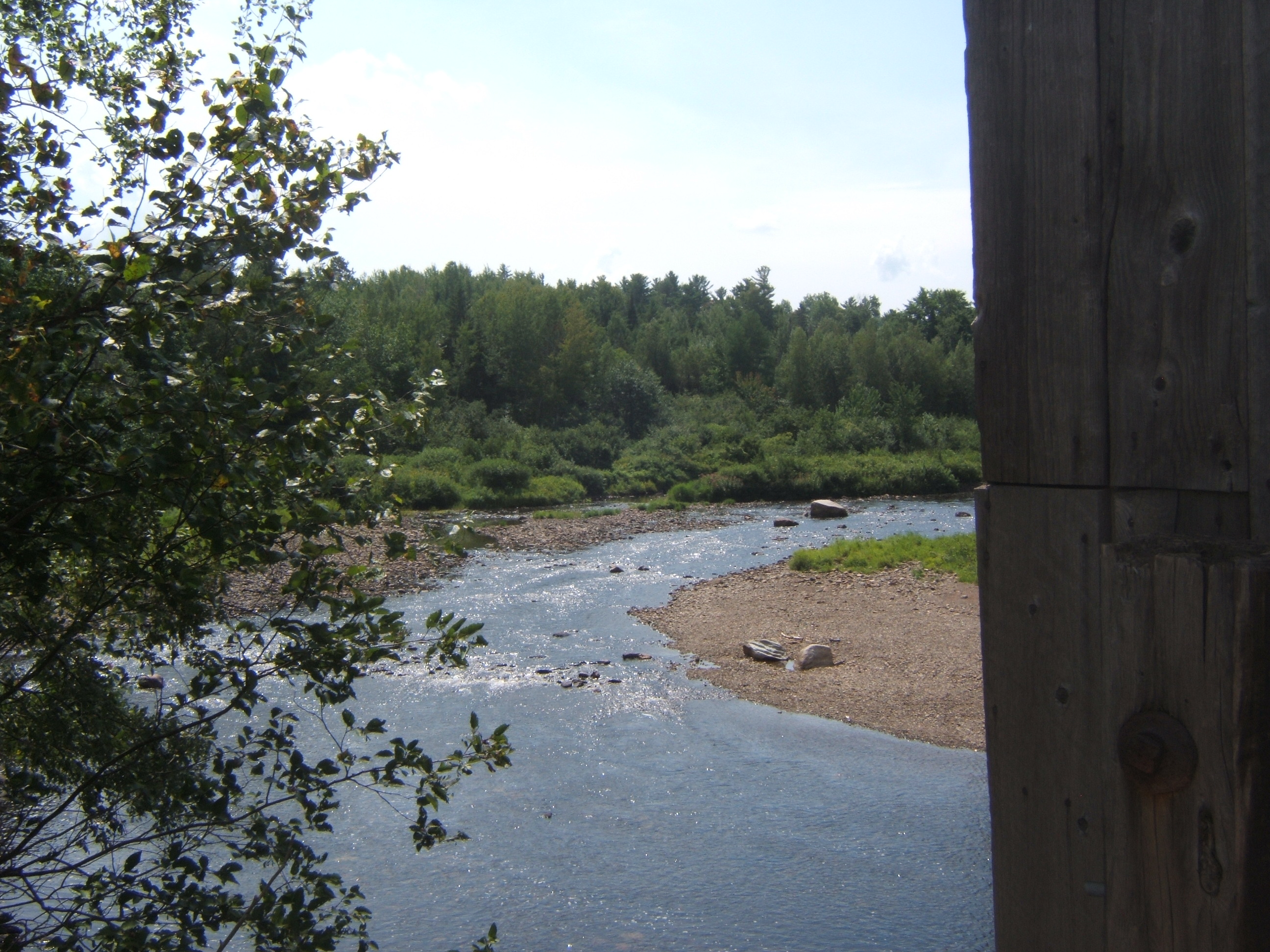
The Smyth Bridge was built in 1912 and has a total length of 139′ 1/2 “, and a span of 136′ 1/2 “. Its roadway width is 14′ 9”. Its Maximum Load is 10 t (6 t for double axle vehicles) and its center clearance height is 3.7 m.
During our Covered Bridge Project for Canada’s 125th anniversary, we visited the Smyth Bridge on April 16, 1992.
In 1992, the oldest dates we could find carved into the bridge were ‘Oct 3, 1915 Sunday’ under the initials ‘R K’ (in pen or pencil) and ‘Feb 1931’ beside the initials ‘LTF’ and ‘LEIK’ to the right of three simple crosses. There was also the totem of a face carved into the south side of the bridge, on the outside corner post. We also found a few other initials, deeply carved: ‘M B’, ‘R H’, ‘C B’, and ‘CED ER May 63’.
Finding these carvings requires patience, a good flashlight and about an hour per bridge, so I didn’t check to see if any of the carvings were still there on our recent visit. Sometimes they are lost when boards are replaced in the bridge during renovations.
I wonder if these people remember leaving their initials in the bridge so long ago?
~
~
‘LEIK’
– initials carved on the boards of the Smyth Covered Bridge, 1931
~
dark
silent
sequestered
~
light leaks between gable
boards, window squares cut high
river water below
sparkles in August sun
~
carved initials announce
the focused presence of
ghosts with knives
~
the clatter of tires
on timbers, as a car
rattles across the bridge
~
~
Copyright Jane Tims 2012
growing and gathering – years and seasons
As I work on my collection of poems about growing and gathering, I am aware of the passage of time. I am in the revision stage. This means my manuscript will soon be ‘complete’. I will worry over it and list the last things to be done. I will prepare my final report to artsnb (the New Brunswick Arts Board), the source of my Creations Grant, and send it away to them for approval.
The project will be over, but there will still be work to do. I will have to decide what poems should go in the final manuscript, re-order them a few times, do some more revisions and them send them away, to a publisher, hoping I will be able to get a book from all this work.
Then I will be at the end and facing a new beginning, a new project. I have a few to choose from, so I won’t be relaxing for long.
In all this is the dimension of time, with its deadlines and unforgiving rush forward. Even in a project about growing and gathering local foods, there are poems about time.
A number of my poems are about the ephemeral nature of local foods. Another way to think of this is ‘eating local foods in season’. In spring, everything is plentiful – new plants arrive in a rush, so fast, you can hardly keep up. Then there is the patient waiting for berries to ripen and, again, a rush… blueberries are quickly followed by blackberries and raspberries and so on. But everything has its season, so leaves become too old to harvest, and berries shrivel and fall to the ground.

This seasonal aspect of local foods can be thought of as as a metaphor for aging, and some of my poems work with this comparison. I have poems about resisting aging, and about the ailments of age including arthritis, lethargy, forgetfulness, and aging memory.
Many of my poems on the theme of ‘time’ overlap with other themes, about ‘companionship’, or changes to ‘place’. For this reason, I find myself shifting poems around in my manuscript. I ask myself if the poems flow well, one to another.
I also find I don’t seem to have many poems about the differences between our historical use of local foods and our present day use. I have lots of source material, particularly among my great-aunt’s diaries… she loved to pick berries. So away I go, to write a few more poems about time!
~
~
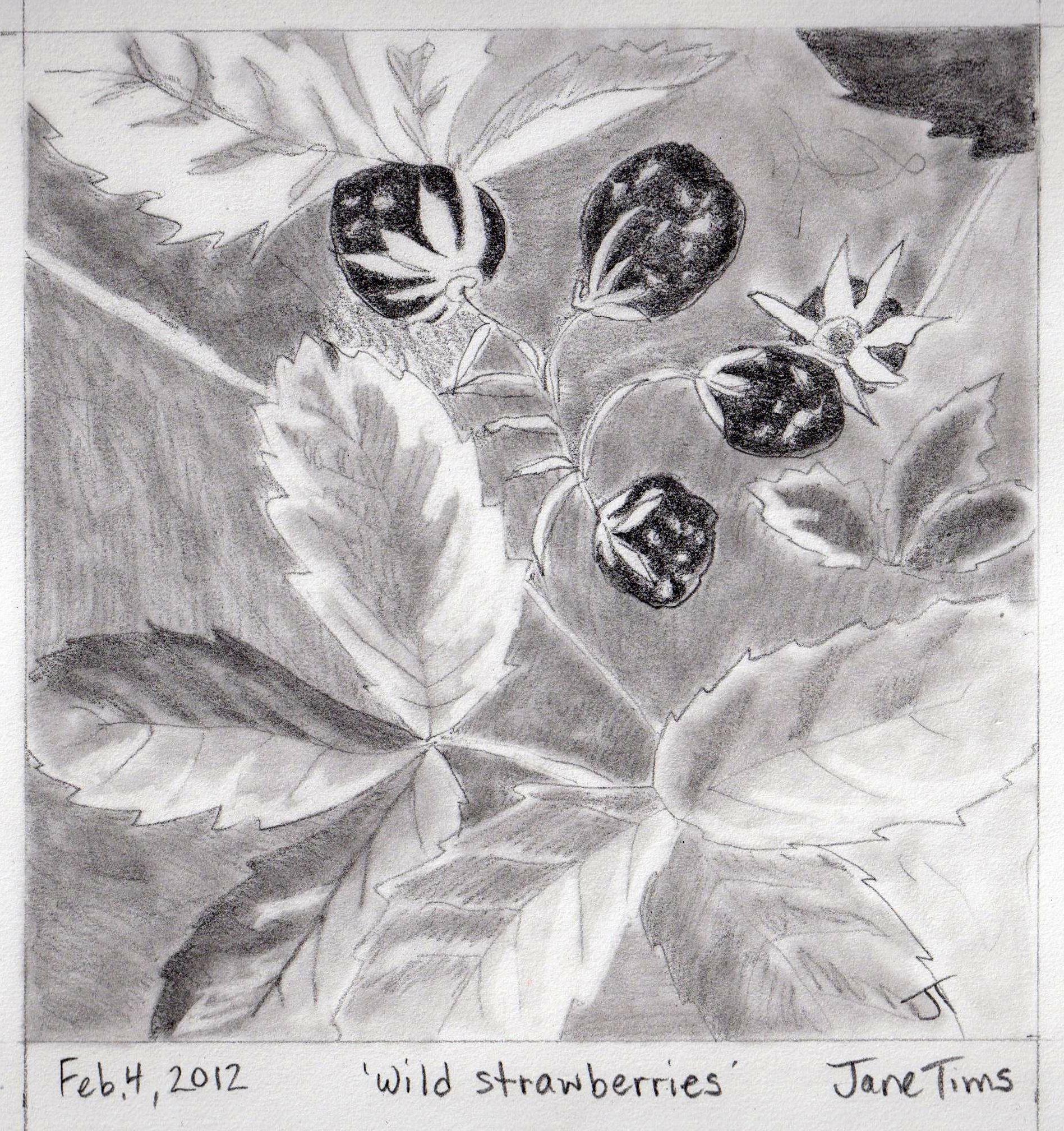
Old Man’s Beard
~
Usnea subfloridana Stirt.
~
you and I
years ago
forced our ways
bent through the thicket
of lichen and spruce
~
Usnea
caught in your beard
and we laughed
absurd!
us with stooped backs
and grey hair?
~
found a game trail
a strawberry marsh
wild berries
crushed into sedge
stained shirts
lips
and fingers
strawberries
dusted with sugar
washed down with cold tea
warmed by rum
~
today
an old woman
alone
lost her way in the spruce
found beard
caught in the branches
and cried
~
~
Published as ‘Old Man’s Beard’, The Fiddlehead 180, Summer, 1994
© Jane Tims 2012

growing and gathering
Many of my recent posts are associated with my writing project, ‘growing and gathering’. My aim is to write a poetry manuscript about collecting and producing local foods. So far, I have concentrated on ‘edible wild plants’ in my blog, but the full scope of the project will include poems on gardening and other aspects of aquiring local foods.
My process so far has included research into a particular wild plant, a trip to see it in the wild and perhaps gather it for eating, a piece of prose on the characteristics of the plant, a pencil drawing (becoming more and more a part of my thought process), and a poem or poems about the edible plant.
As my project progresses, I am generating many poems. I am also starting to think about how I will assemble this information into a manuscript.
One of the first steps toward assembling the manuscript is to decide what themes are emerging. This will help me decide how the poems relate to one another, as well as identify the gaps.
Major themes so far are:
~ companionship (for example, picking berries with a friend)
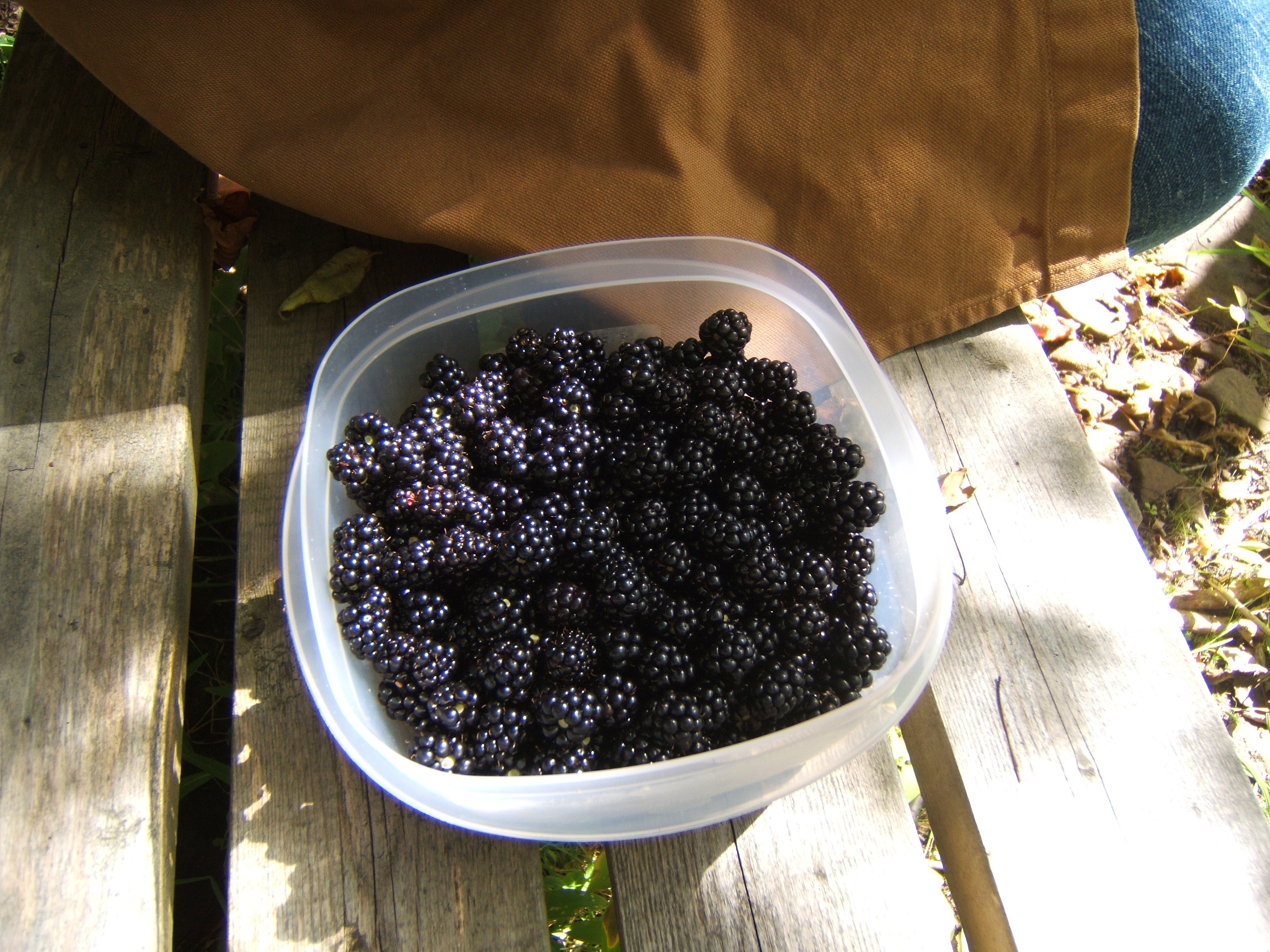
the results of an hour of blackberry picking with my husband
~ competition (for example, trying to get those hazelnuts before the squirrels)
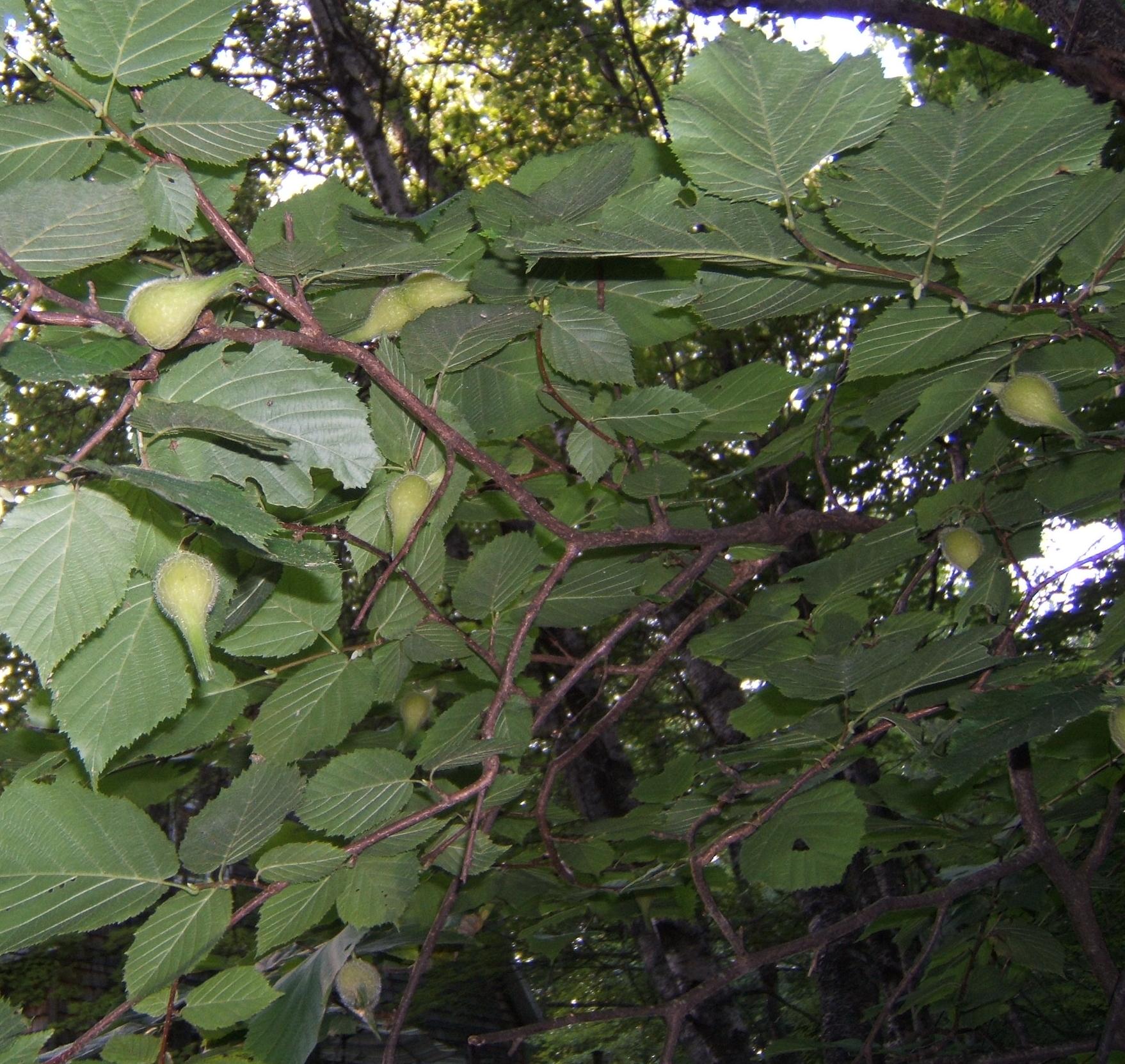
hazelnuts on the tree…almost ripe…who will get them, the squirrels or me?
~ time (this includes historical uses of wild edibles, as well as seasonal and lifetime components of eating local)

a ‘graveyard’ of old apple trees
~ ethics (this includes ecosystem concerns about eating wild plants when they are struggling to survive in reduced habitat)

a patch of Trout Lily in the hardwoods… edible… but should I harvest when this type of habitat is disappearing?
~ barriers to gathering local foods (for example, why do I buy bags of salad greens when Dandelion greens, Violet leaves and Wood-sorrel grow right outside my door?)

a salad of Dandelion greens and Purple Violets
In my upcoming posts, I want to explore each of these themes.
~
~
berry picking
~
fingers stain indigo
berry juice as blood
withdrawn by eager
thorns
~
berry picking sticks
to me, burrs
and brambles
hooks and eyes
inseparable as
contentment and picking berries
~
even as I struggle
berries ripen
shake free
fall to ground
~
~
© Jane Tims 2012
Warning: 1. never eat any plant if you are not absolutely certain of the identification; 2. never eat any plant if you have personal sensitivities, including allergies, to certain plants or their derivatives; 3. never eat any plant unless you have checked several sources to verify the edibility of the plant.places off-planet #5 – Comet Hale-Bopp 1996
Comet Hale-Bopp could be seen from Earth in late 1996 and early 1997. Its strange name is from the independent co-discoverers, Alan Hale and Thomas Bopp. Hale-Bopp was a large comet, with a nucleus of about 60 miles in diameter. It had two visible tails, one of gas and one of dust, and had a third tail of sodium. It has been called the most-observed comet in history. Hale-Bopp won’t be back until 4385!
I have no specific memory of Hale-Bopp itself, although I do remember a common saying in our household in 1997 was to greet almost every out-of-place object with “Hail! Bopp!”. The poem I wrote after seeing the comet is all I have to know how it appeared to me.
Do you remember seeing Hale-Bopp?
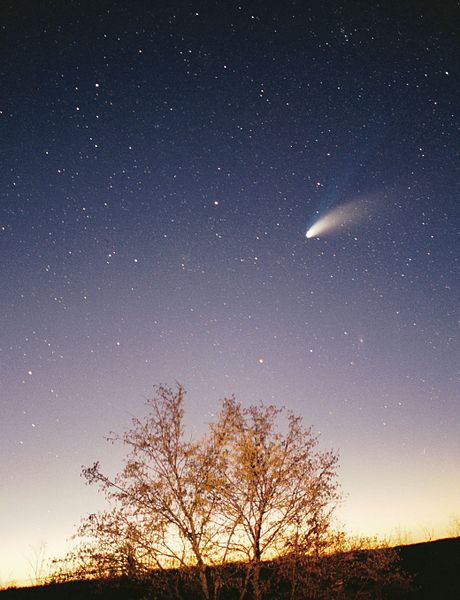
photo from Wikimedia Commons, taken by Philipp Salzgeber
~
~
Hale-Bopp
also a comet
~
Hail! bright star
~
a flare in the western sky
a diamond
~
a sparkler
embedded in smoke
~
~
© Jane Tims 1997
places off-planet #4 – Comet Hyakutake 1996
Comet Hyakutake had a nucleus of about 2 km in diameter and a tail-length of 570 million km. The Ulysses spacecraft is known to have flown through Haykutake’s tail. One of the comet’s notable characteristics was its blue-green color. It was bright to the naked eye for only a few days.
I remember Hyakutake as a ‘knock-you-off-your-feet’ surprise. I knew it could be seen, but I hadn’t made any effort to look for it. One night as I arrived home, I saw it shining through the trees at the end of the driveway, and climbed the snowbank at the end of the drive to investigate. I saw the comet and literally stumbled backward in amazement!
Did you see Comet Hyakutake in 1996?

photo is from Wikimedia Commons
taken by E. Kolmhofer and H. Raab of the Johannes-Kepler-Observatory
~
~
Hyakutake
a comet
~
she runs in the solar wind
pale night woman
her face to the sun
hair and petals streaming
~
ephemeral, strewn in whispers
soft fistfuls of light
tresses tangled
in the fingers of the forest
~
~
© Jane Tims 1997
places off-planet #3 – Halley’s Comet 1986
Halley’s Comet, first recorded by astronomers in 240 BCE, has been a regular visitor through the ages, although people did not realise they were seeing the same comet until astronomer Edmund Halley determined this in 1705. Halley’s Comet makes an elliptical orbit of the sun and returns to view approximately every 75 years. It was last seen in 1986. Halley’s Comet is composed of dust, ice water and other frozen gasses, and was described by astronomer Fred Whipple as a ‘dirty snowball’. Its nucleus is 15 km long, 8 km wide and 8 km thick; its tail is as much as 100 million km long!
We saw Halley’s Comet as a family, waking in the middle of the night, and driving to a nearby hill overlooking a big field with French Lake and its treeless wetlands in the distance. The night sky was overcast with a thin high-elevation cloud, so our view was not the best. However, to me, it was marvellous… a huge (relative to the size of the stars) ball of fuzzy light. My son can barely remember our watch on the hillside, all swathed in blankets. However, when it returns in 2061 and he is 78 years old, he will be able to say he saw it twice!

Photo from Wikimedia Commons, taken by Kuiper Airborne Observatory
~
~
Halley’s 1987
~
we choose a roadside watching place
beside a farmer’s field
across from the cemetery
few trees
few lights
~
we set the alarm for three
coax one another
into the icy car
in awe for an hour
at the comet fuzzy indistinct
four fingers above the horizon
~
too undefined, too faint
for the dirty snowball
they predicted
I scrape our breath from the window
I see it, says my son, only three
I think
~
he sleeps between us until ten o’clock
his blanket a soft ball
pressed to his nose
~
almost eighty
he waits for the return
~
I saw it when I was only young
I think
~
~
© Jane Tims 1997
places off-planet #2 – three comets
In my life so far, I have seen three major comets – Halley’s Comet in 1986, Hyakutake in 1996, and Hale-Bopp in 1997. There have been comets since then, I know, but I have always been asleep!
A comet is composed of a ‘nucleus’ of rock, dust and frozen gas, and a tail. The tail is formed when the gasses in the nucleus are heated by the sun and create an atmosphere or ‘coma’. The sun’s radiation and the solar wind cause the coma to flow away from the sun as a tail. Since the comet can be moving away from the sun, sometimes this means the comet moves in the direction of its tail!
How many comets have you seen?
~
~
Comet
~
from the Greek
koman
~
to wear long hair
~
© Jane Tims 1997




 nichepoetryandprose