Posts Tagged ‘bird song’
songs in the grey woods – ovenbird
He can be a bit monotonous. A bit of a scold. He reminds me of a rusty hinge. He says teacher-teacher-teacher, repeating his song through the woodland. He is the Ovenbird.
~
His scientific name is Seiurus aurocapilla. Seiurus (which I remember as ‘serious’) is from the Greek meaning ‘tail shake’, a reference to the characteristic upward flip of his tail. The name aurocapilla means golden-haired referring to his crest of orangy feathers. The Ovenbird is olive-brown, with a streaked white breast. He has a white ring around his eye, a white throat and a dark line below his cheek. He looks a bit like a thrush, but is a large warbler.
~
His serious nature and his call of ‘teacher, teacher, teacher’ make me think I’ll include a poem about his ways in my project about one room school houses in New Brunswick. This is how my poems usually begin, with a whisper from nature.
~

~
Copyright 2016 Jane Tims
songs in the grey woods – black-throated green
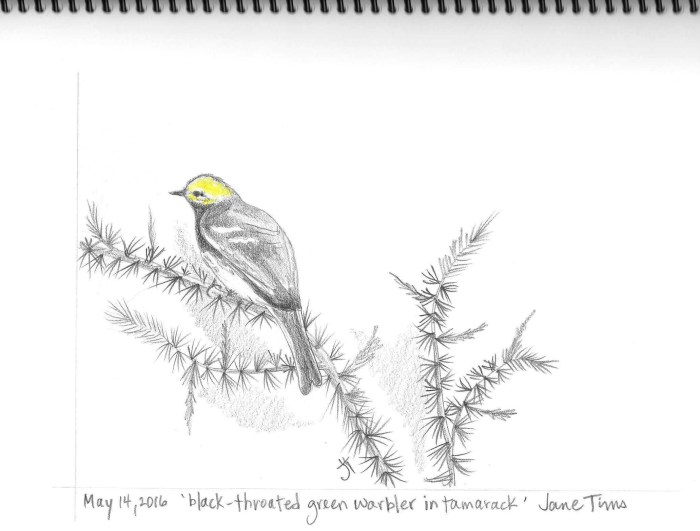
Our grey woods are noisy this week. White-throated sparrows, nuthatches, ovenbirds and chickadees. Loudest of all is a black-throated green warbler. He says, in his raspy voice, at intervals of about ten seconds: zee-zee-zee-zee- whee-zee, also a more musical dee-dee, dee-dee, doo-dee (the doo a note lower than the dee). He perches near the tops of the tamarack and red maple trees.
~
~
I sat on our deck a long while, and finally caught him as he paused in a red maple. He had a bright yellow head and looked back at me over his white wing stripe before he flew away. I also get an occasional glimpse of him as he flies from tree to tree. His best features are his yellow head, the two white stripes on each wing, and his black throat.
~

~
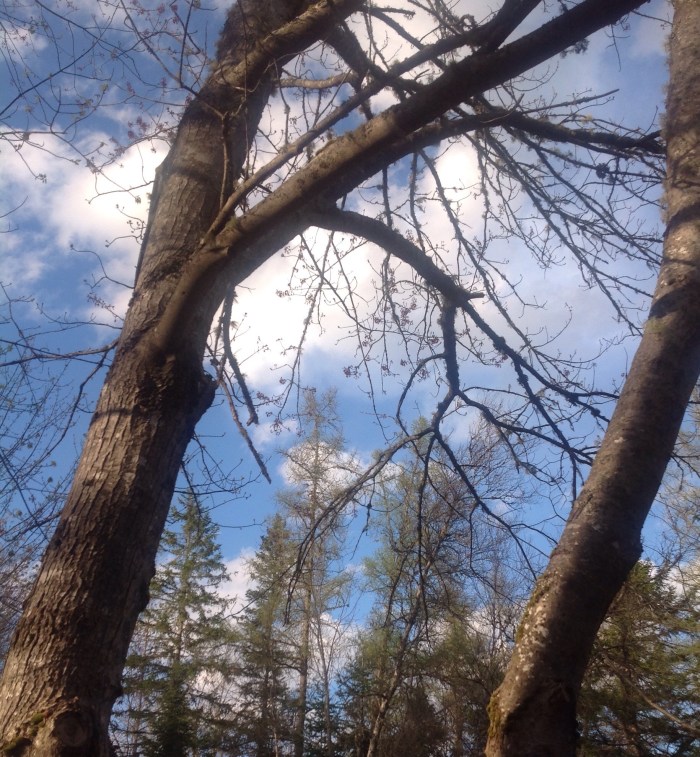
a view of the tamarack trees and spruce where the black-throated green warbler is singing – the red maple is just starting to leaf-out
~
Copyright Jane Tims 2016
morning chorus
Each morning I have a short quiet time after rising. I spend this time in my guest bedroom. I do some stretching. I watch the sun rise among the trees. And I try to sort out the morning bird chorus.
~

~
The morning bird chorus is known to be a complex social interaction among birds of various species – a communication we humans can listen to with wonder, but little understanding.
~
We have lots of birds in our area and the woods are thick with birdsong. Although ours is a residential area, we have many hundred acres of woodland behind us and no houses between us and the river. Our back woods are mixed conifer and hardwood, mostly balsalm fir, spruce, red maple and white birch. We have nearby wetlands and, of course, the river.
~

~
I now regret not learning to identify the birds from their songs earlier in my life. Although I can name many birds by sight, I have a feeling I know many more by their sounds. This summer I have tuned up my ears and spent lots of hours trying to learn to recognise the birds by their songs. Perhaps because of their variety and complexity, learning the songs is more difficult than just listening and comparing. Once I have heard a few birds, my memory becomes jumbled trying to distinguish between them.
~
I use three main tools to help me identify and remember bird sounds.
- mnemonics – short phrases to describe and remember various bird songs. These phrases help narrow down the possibilities when I hear a bird sing. Many lists of bird song mnemonics exist, but I like the simple listing from the Fernbank Science Center in Georgia http://www.fernbank.edu/Birding/mnemonics.htm
- recorded songs – although there are many sites with bird song recordings, the one I like the best is Dendroica- NatureInstruct http://www.natureinstruct.org/dendroica/spec.php/Dendroica+Canada#sp_select . Once you select a bird, you can hear calls recorded by birders in various parts of the range.
- a list of the calls I know and new songs I hear, described in my own words and with a diagram of the way the song progresses, in a shorthand of my own. I use words like: trill, flute, scratch, liquid, repetitive, bored, delirious …
~
The Cornell Lab of Ornithology has some excellent tips for those who would like to learn the songs of local birds.
http://www.allaboutbirds.org/Page.aspx?pid=1189#_ga=1.202457239.768663648.1437046200
They suggest listening for rhythm, tone, pitch and repetition of a bird song. By listening for these qualities, one at a time, you can start to make sense of the variability and help your memory.
~
Here is a list of the participants in this morning’s bird chorus outside my window:
- odd high-pitched sound at the first grey light of morning, probably not a bird
- immediately, an American Robin – ‘chirrup, cheerup, cheery cheer-up’ – we have a nest of robins at the start of our woods road
- a Mourning Dove, intermittent – ‘oo-oo-hoooo’ – very sad sound – a pair perches on the wires along our main road
- a White-throated Sparrow – ‘I love dear Canada-Canada-Canada’
- a Hermit Thrush – an ethereal, flute-like phrase, repeated over and over, each time at a new pitch – close at first and then gradually moving further away
- an Eastern Phoebe – a nasal ‘fee-bee’, repeated – a nest in the eaves of our shed
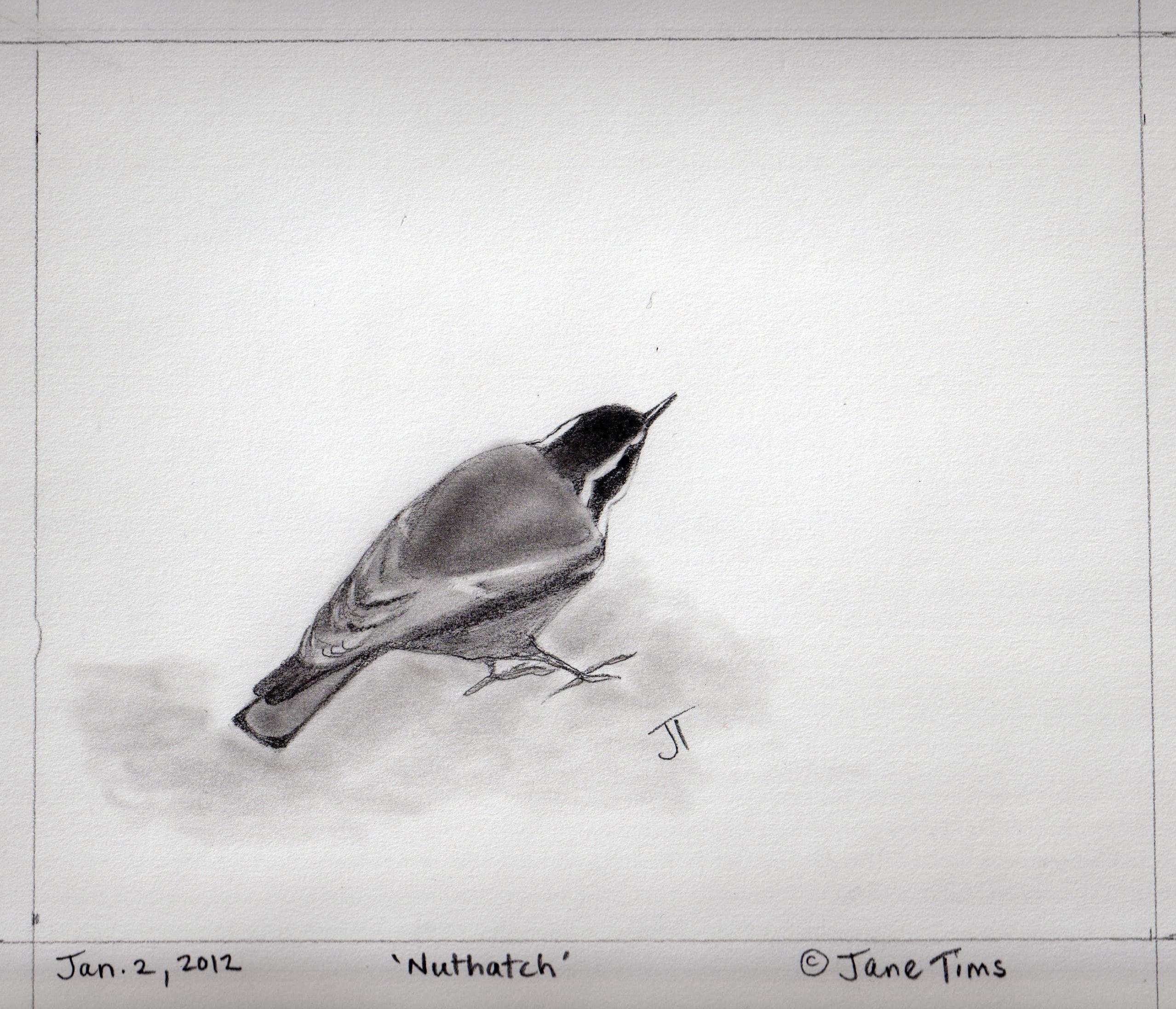
- a Red-breasted Nuthatch – a monotonous low-key ‘yank yank yank yank’, like a cross between a bored duck and a bullfrog
- the ‘caw caw caw’ of a Crow
~
I wonder if you ever listen to the morning bird chorus. What birds do you hear?
~
~
Copyright 2015 Jane Tims
spring orchestra – fee-bee

Carving of the name ‘Phoebe’ on a beam of the Tantramar #2 Covered Bridge near Sackville, New Brunswick
~
~
Phoebe
~
unknown, she nudges
her way into Monday –
carved name in the covered bridge
~
Black-capped Chickadee pipes
fee -bee, hey-sweetie
(bored with chick-a-dee-dee-dee)
~
and Eastern Phoebe, rasps fee-bee
whee-zy, Phoe-bee
black bed-head, smuggie throat
~
unknown, Phoebe nudges
her way into Monday
~
~
Copyright 2015 Jane Tims
~

one of the usual visitors to our feeder … the Black-capped Chickadee
words from the woodland – bird song
I have a lot of projects underway, mostly on the ‘administrative’ side of writing. I have been ordering and revising a manuscript of poems on abandoned aspects of our landscape ( see https://nichepoetryandprose.wordpress.com/2015/01/19/first-and-last-and-in-between/ ). Now, I have reached the point where I really need to set the manuscript aside so I can approach it with a fresh eye in a couple of weeks. So I will use the days between to order another manuscript of poems about sounds from the woodland. The poems mostly use animal and bird sounds and songs as metaphors for human communication.
~
Some of these poems have been around a while, packaged in another form. In the last weeks, I have been thinking about the bird song metaphor and now I am ready to consider the poems in relation to one-another. Perhaps I am responding to the Black-capped Chickadees, chattering in the Tamarack. Or the Hairy Woodpecker who comes every few days to beat his head against our telephone pole. Perhaps I am thinking more than usual about human communication (having just learned to ‘Twitter’).
~

January 8, 2012 ‘two Mourning Doves’ Jane Tims
~
drawing doves
~
‘… cease to mourn …’
Virgil, Eclogue I
~
grey sighs beneath graphite
or where eraser softens
troubled feathers
~
doves lament, disturb
fine detail, mourn
the fingers’ tremble
~
pencil strokes beak
and fingernails, kernels
of corn, husks of sunflower
~
~
Copyright 2015 Jane Tims




 nichepoetryandprose