Posts Tagged ‘birch’
harvesting colour – soaking the bark
Birch bark is on my top ten list of natural phenomena. Just the outer covering of a tree, but for me it has so many associations.
~

~
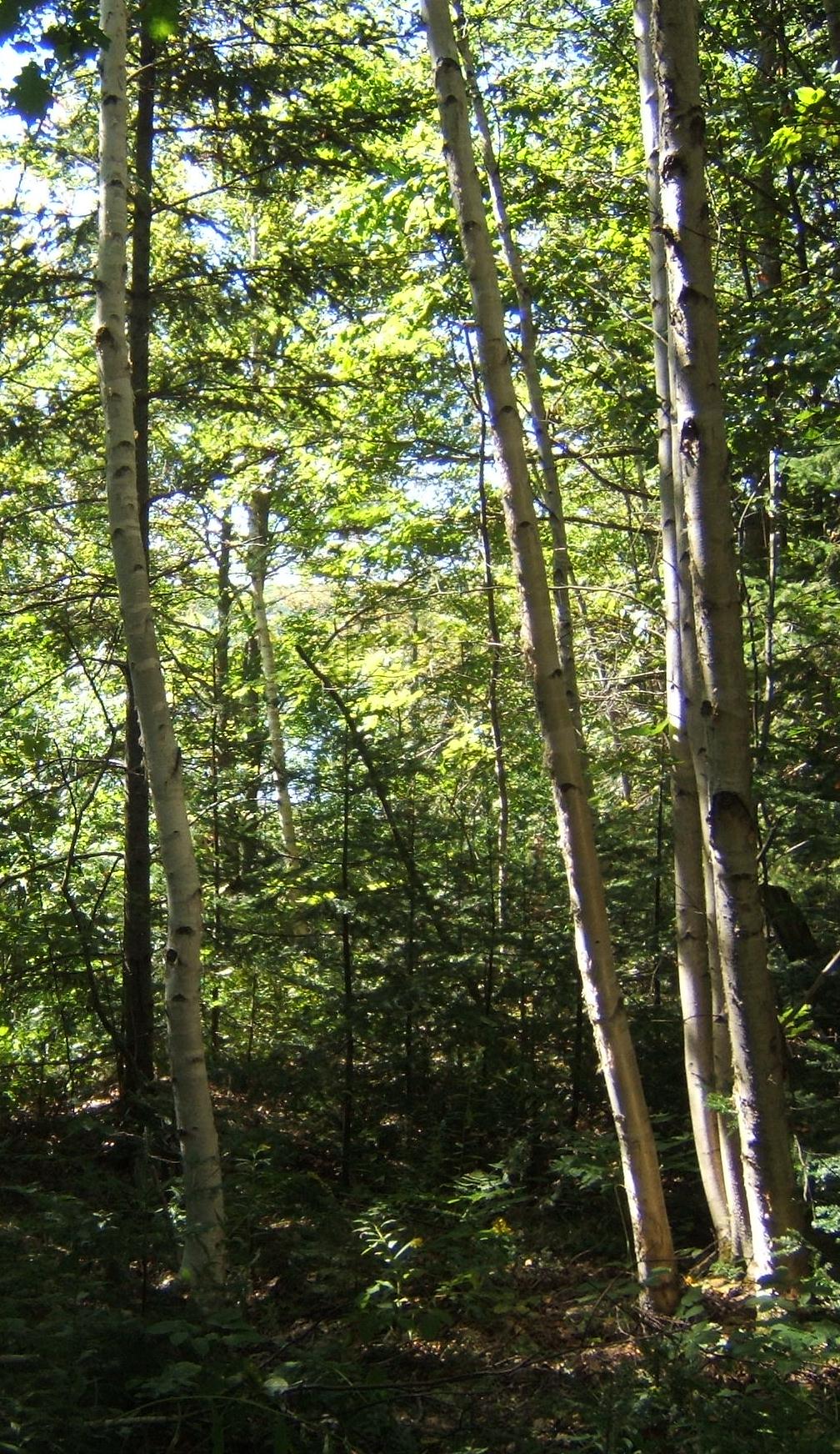
Walking in a stand of birch is an experience like no other. The trees are ghosts, wavering and pale, unable to speak but capable of subtle quiet communication. In the slightest breeze, they whisper in short syllables, dry murmurings I cannot quite understand.
~
Birch bark is magical. Unravelled from its tree by a little tugging of the wind. Like paper, in thin dry sheets. Covered in unreadable script. You know removing the bark could be dangerous for the tree but it lures you, encourages you to reach out and strip it away in unbroken, unblemished reels.
~
Such a useful tree: birch bark canoes, tinder for a campfire, sweet sap from yellow birch, the wintergreen scent of crushed yellow birch twigs. And now, the promise of colour.
~
Using bark as dyestuff requires time rather than heat. Jenny Dean (Wild Colour, New York, 2010) suggests soaking the bark for days, even weeks to extract the first colour. She says never to boil bark since heat may release tannins and dull any resulting colour. From her book, I expect birch bark to yield colours ranging from purple to pinkish-red.
~
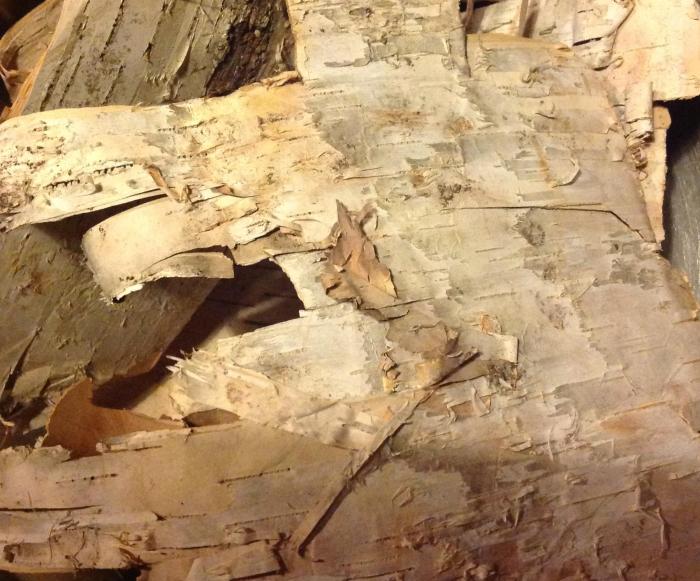
birch bark, donated by my brother-in-law
~
I am so grateful to my brother-in-law for allowing me to use the birch bark he has collected as he works on next winter’s stove-wood supply. I am sure he was saving it for a project of his own.
~

strips of birch bark layered in the dyepot
~
To start, I stripped the sheets of bark into narrow pieces and set it to soak in cool water in my big dye pot.
~

strips of birch bark, set to soak in water
~
I intend to leave it for a month before I take the next step of simmering the bark and dying my wool.
~
~
requesting the favour of a reply
~
these leafless trees
brush against
a linen sky
ink strokes
on rice paper
letters penned
at midnight
~
hidden in the hollow
heart of an oak
afraid to reach in
to feel only
curls of birch bark
desiccated leaves
~
these trees
all seem the same
empty envelopes
parchment ghosts
~
branches tangled
messages
lost
~
black spruce scribbled on sky
~
~
Poem previously posted 19/08/2011
Copyright 2014 Jane Tims
(brackets in the birch grove)
Last week we went for a walk (more like a struggle) through the birch grove at the base of the grey woods (see the ‘map of the grey woods’ under ‘about’). To get there, we crossed the fern gully, mostly dry this time of year, and entered a mixed wood of birch, maple, spruce and fir, much younger than the mature spruce in the grey woods.

These trees grow in very wet conditions, and the forest floor is a hummocky, spongy growth of Sphagnum moss and fern.

There is no path through this woodland, so the ‘walk’ was an up-and-down, over-and-under kind of trek. To stay dry, you must take giant steps from hummock to hummock. To stay upright, you must check your footing and hang on to the young trees. With all this concentration on moving forward, I tend to miss some of the interesting detail, so I try to use each ‘balancing moment’ as a time to look around and observe the wild life.
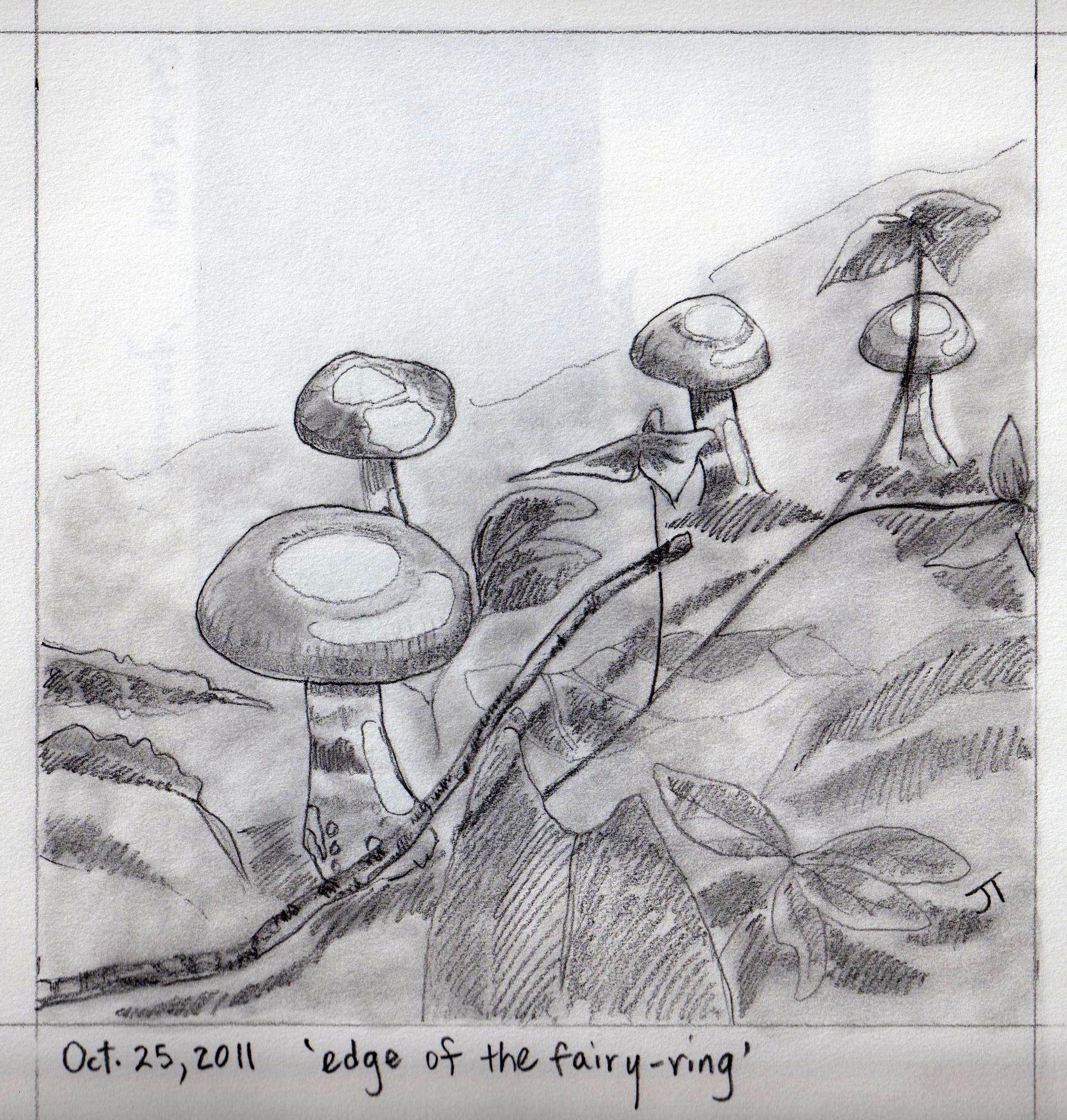
One occupant of the birch grove is the bracket fungus. This is a type of fungus that grows like shelves on both living and dead trees. The fungus forms thick flat pads on the tree, usually parallel to the ground. They remind me of steps, a spiral stair to ascend the tree.

The semi-circular body of the bracket fungus is called a conk. The conks of the bracket fungus growing in our woods are thick, often oddly shaped, and constructed of various cream, tan and brown coloured layers. The conks are the outwardly visible, reproductive part of the fungus. The vegetative portion of the fungus grows as an extensive network of threads within the tree.
bracket fungi
~
1.
in this forest
staid
practical
grey
could any form
construe to magic?
~
fairy rings
moths in spectral flight
spider webs, witches brooms
burrows and subterranean
rooms, hollows in wizened
logs, red toadstools
white-spotted, mottled
frogs
~
2.
bracket fungi
steps ascend
a branchless tree
~
© Jane Tims 2011
the stone between farms
How do you show the boundary line between you and your neighbor?
At Ågersta Village in Uppland, Sweden, is a rune stone positioned to mark a boundary between two properties. The stone is carved with two serpent creatures entwined, their heads in profile. Each has two sets of legs, the forelegs strong, and the rear legs weak and helpless.
The stone was carved by Balle, a frequent carver of rune stones in Sweden, and raised by Vidhugse, in memory of his father. The boundry, established in the twelfth century, showed the boudary until 1856 when the property lines were finally changed!
The inscription reads, in part: Hiær mun standa stæinn miđli byia – “Here shall stand the stone between farms.”
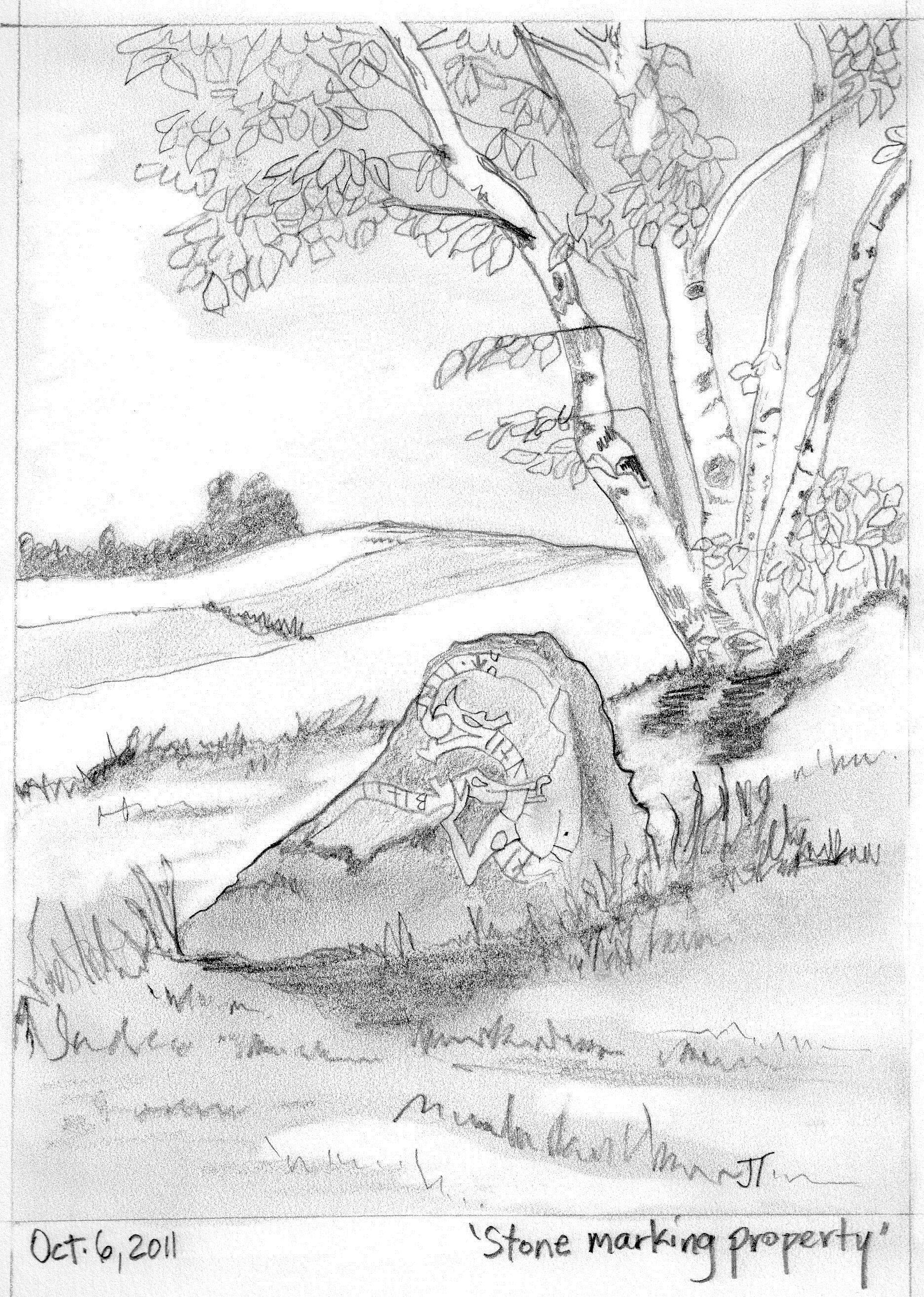
from my imagination and not the rune stone at Ågersta Village
stone between farms
(rune stone in Ågersta Village, Uppland)
Do not move your neighbor’s boundary stone…
– Deuteronomy 19:14
~
ninth morning already
irate I rise
gather my tools
trudge to the hillside
~
stone waits for me, Balle
(master carver of runes)
shadows pulled into dragon
compete with guidelines
‘what is not’ more complete than ‘what is’
~
another fair day
Vidhugse to the west and south
Austmadr to the east
surely their bickering over boundaries
will cease
~
by noon the sun
embroils the rock
streaks my brow with sweat
floods the serpent creature’s clever eye
lip lappets drip
~
mosquitoes dither about
the creature’s profile acquires
the look of an insect head
reckless slip of the rune tool
could end its smirk
~
hill of rock dust
settles on my shoe
birches stir the air
odor of leaf layer
memory smell of Birka
~
© Jane Tims 2005




 nichepoetryandprose