in a yellow caravan
The Wind in the Willows by Kenneth Grahame was published in 1908 and has defined the relationship of people to place for four generations. The story of animal friends and their lives along the river is a magical yet down-to-earth tale. It solidifies ideas of home, adventure and longing. It captures (or doesn’t) the insubstantial voice of nature:
… it passes into words and out of them again – I catch them at intervals – then it is dance-music once more, and then nothing but the reeds’ soft thin whispering.
One of the memorable characters of the book is Toad. He is reckless and arrogant, and constantly gets into trouble, but I think his appeal is the adventurer in all of us. Some of his adventures are in a bright yellow caravan …
~

2003 ‘Toad’s yellow cart, Wind in the Willows’ Jane Tims
~
… there, drawn out of the coach house into the open, they saw a gipsy caravan, shining with newness, painted a canary-yellow picked out with green, and red wheels.
‘There you are!’ cried the Toad … ‘There’s real life for you, embodied in that little cart. The open road, the dusty highway, the heath, the common, the hedgerows … The whole road before you, and a horizon that’s always changing …
~
My copy of Wind in the Willows (Kenneth Grahame, 2007, Vancouver: Blue Heron Books) was illustrated by Robert Ingpen (what a name for an artist!). I will leave you with his illustrations of Toad’s yellow caravan …
~

~

~
Copyright 2015 Jane Tims
Daisy’s light
The Great Gatsby by F. Scott Fitzgerald (1925) is a book of excesses and haunting results. It is a cautionary story about the consequences of pursuing wealth without responsibility.
~
My painting is of Jay Gatsby as he looks across the bay to Daisy’s green light on the far shore.
~

Jane Tims ‘Daisy’s light from The Great Gatsby’ 2003 (acrylic)
~
Something in his leisurely movements and the secure position of his feet upon the lawn suggested that it was Mr. Gatsby himself, come out to determine what share was his of our local heavens.
I decided to call to him. Miss Baker had mentioned him at dinner, and that would do for an introduction. But I didn’t call to him, for he gave a sudden intimation that he was content to be alone — he stretched out his arms toward the dark water in a curious way, and, far as I was from him, I could have sworn he was trembling. Involuntarily I glanced seaward — and distinguished nothing except a single green light, minute and far away, that might have been the end of a dock.
from F. Scott Fitzgerald (1925) The Great Gatsby
~
The disposable wealth and carelessness of Gatsby are things most of us will never know. But we can feel for Gatsby who is willing to accept blame in the name of love and loses his life in consequence.
~
~
Copyright 2015 Jane Tims
silence
How many stories written by Edgar Allan Poe can you name? Certainly ‘The Pit and The Pendulum’. Perhaps ‘The Fall of the House of Usher’ and ‘The Purloined Letter’. Perhaps ‘The Murders in the Rue Morgue’.
~
My favorite story by Poe is ‘Silence – A Fable’, published in 1837. As many of Poe’s tales of the macabre, after numerous readings it still has the power to send shivers along the spine. The setting of the story is vividly portrayed with words. These were the inspiration for my painting.
~

Jane Tims (2002) ‘Silence by Edgar Allan Poe’ (acrylic on canvas, 20″ X 26″)
~
The waters of the river have a saffron and sickly hue; and they flow not onwards to the sea, but palpitate forever and forever beneath the red eye of the sun with a tumultuous and convulsive motion. For many miles on either side of the river’s oozy bed is a pale desert of gigantic water-lilies. They sigh one unto the other in that solitude, and stretch towards the heaven their long and ghastly necks, and nod to and fro their everlasting heads. And there is an indistinct murmur which cometh out from among them like the rushing of subterrene water. And they sigh one unto the other.
From Edgar Allan Poe, ‘Silence – A Fable’, 1837
‘Silence – A Fable’ describes the waters of the Zaire River and a strange man who sits on a rock along the river. A Demon in the water, wants the man to get down from the rock. So the Demaon sends all manner of horrors: the hippopotamus and the behemoth, and the tempest with torrential rains, thunder and lightening. But the man will not get off the rock. So what does the Demon do to get the man down from the rock. You need to read the story.
~
For a full text of this wonderful fable, see http://classiclit.about.com/library/bl-etexts/eapoe/bl-eapoe-silence.htm
~
I have a book of stories by Edgar Allan Poe that belonged to my Uncle Alec. The stories are illustrated with wood engravings by Fritz Eichenberg. These engravings are, in themselves, a study in horror. I thought you might like to see a couple of my favorites.
~

Illustration by Fritz Eichenberg of the Edgar Allan Poe story ‘The Fall of the House of Usher’ (Poe, 1944, Tales of Edgar Allan Poe, New York: Random House)
~

Illustration by Fritz Eichenberg of the Edgar Allan Poe story ‘The Black Cat’ (Poe, 1944, Tales of Edgar Allan Poe, New York: Random House)
~
I wonder how Fritz Eichenberg would have illustrated ‘Silence – A Fable’. Perhaps illustrations can never be as frightening as ‘… and the lilies sighed one unto the other in the solemnity of their desolation’. Just try reading the story aloud!
~
Copyright 2015 Jane Tims
heart of darkness
I love to read. Certain scenes in the books I read stick in my head. Sometimes they inspire me to try to capture the author’s words on canvas.
~
I thought I would share a few of my paintings over my next few posts. If you have read these books, perhaps my paintings will remind you of the words and scenes they try to portray. If you have not read them, perhaps the paintings will inspire you to add them to your reading list.
~

Jane Tims 2002 ‘Joseph Conrad’s Heart of Darkness’ acrylic on canvas, 20 X 16
~
‘ … Only the barbarous and superb woman did not so much as flinch, and stretched tragically her bare arms after us over the somber and glittering river …’ – Joseph Conrad, 1902, Heart of Darkness
~
I first read Joseph Conrad’s ‘Heart of Darkness’ in school. First published in 1902, the book is set against a background of British colonialism and the ivory trade. The novella takes us on a dark journey along the Congo River as the narrator travels to meet Kurtz, the chief of the Inner Station of a Belgian Trade Company. The book is a study of what happens to humans when corruption and greed become the drivers for life, and when they are left to operate outside the norms of society.
~
The painting tries to capture the moment in the story when the steamboat is about to leave the Inner Station with the gravely ill Kurtz. The natives he has been living with come to the shore. Kurtz’ ‘mistress’, a ‘superb woman’, reaches her arms towards the leaving steamer. A moment later the men on the boat use the people on the shore for target practice.
~

My battered and dog-eared copy of Heart of Darkness. Leonard F. Dead (ed.) (1960) ‘Joseph Conrad’s Heart of Darkness – Backgrounds and Criticisms’, Englewood Cliffs: Prentice-Hall, Inc.
~
Copyright 2015 Jane Tims
please affix a 1 cent stamp
Among my many genealogy projects is the study of a stack of 174 post cards sent to my Grandmother (Katie Clark) from 1906 to 1910. The post cards are a record of her travels to the United States where she was studying to become a nurse. To see more about this project, see https://nichepoetryandprose.wordpress.com/2015/02/09/a-stack-of-post-cards/
~

~
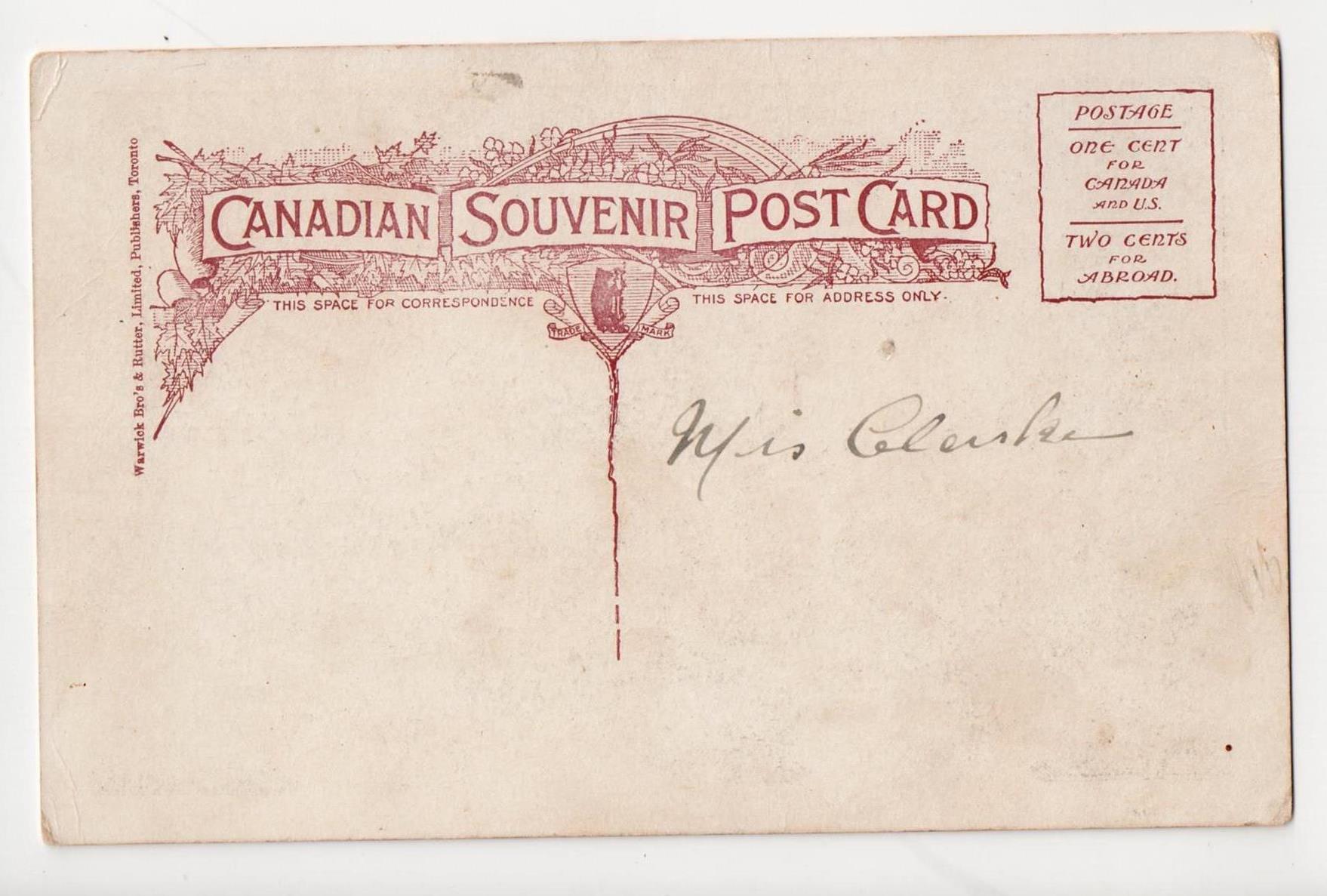
The stamps used to post the cards make an interesting study. In the early 1900s, it cost 1 cent to send a post card in both the United States and Canada. The postage requirements are printed in the upper right hand corner of this undated post card.
~
~
Since the post cards were mailed in both Canada and the United States, I have examples of stamps from both countries. The numbers in brackets (below) indicate the number of stamps I have of the type for a given year.
~
Canada
Green, Edward VII, perforated, 1 cent, 1906 (2), 1907 (7), 1908 (9), 1909 (8), 1910 (41), unknown date (10) (Note: King George V came to the throne in May 10, 1910, but stamps with his image were not issued until 1911)
Green, Cartier and Champlain, perforated, 1 cent, 1908 (1), unknown date (1)
~

~
Very occasionally, people used a 2 cent stamp to mail a post card.
Red, Edward VII, perforated, 2 cent, unknown date (2)
~

~
USA
Green, Franklin front-facing, perforated, 1 cent, 1906 (4), 1907 (5), 1908 (9), 1910 (3), unknown date (4)
Green, Franklin left-facing, perforated, 1908 (1), 1909 (9), 1910 (4)
~

~
In the collection is one USA example of a 2 cent stamp.
Red, Washington, perforated, 2 cents, 1907 (1), 1909 (1)
~

~
One card of the collection was mailed in 1913 to my Great-Grandmother, Mary Jane, Katie’s mother.
Green, Washington, perforated, 1 cent, 1913 (1)
~

~
Since Katie also received two post cards from Mexico, two of the stamps are from that country. They depict the scene on the Mexican coat of arms, an eagle holding a snake in its mouth.
Mexico
Green, Eagle Eating Snake, perforated, 2 cents, 1908 (2)
~

~
When I was young, I collected stamps for a short time, sorting through cloth pouches of bulk stamps from all over the world. Philately, the study of stamps, is not really one of my interests, but I did enjoy making a study of the stamps on my Grandmother’s post cards, mailed over one hundred years ago to help people keep in touch – the modern equivalent of a text message or e-mail.
~
Copyright 2015 Jane Tims
in the shelter of the covered bridge – conjunction

March 1, 2015 ‘conjunction’ Jane Tims
~
~
conjunction
~
~
planets and moonlight whisper, scamper
into crevasses in the covered bridge
half-ton’s headlights enter
overwhelm the shadows
~
chin velvet of Venus and Mars
sickle of mid-winter moon
truck lights startle a winter hare
erect on haunches, paw lifted
~
frosted by sky-gaze, worshipping
the sliver of moon, dismayed
at desecration, round glare
of predator eyes
~
fright to stop a heart
or flight to mobilize
hind-legs, straighten before
fore-legs turn
~
and long ear shadows
quit the length of the bridge
ahead of whiskers, nose
and rabbit wisdom
~
~
Copyright 2015 Jane Tims
a preface for a poetry manuscript
~
As followers of my Blog will know, I am working during these first months of 2015 to finalise, for eventual publication, a manuscript of the poetry I wrote for my ‘growing and gathering’ project (see the Category ‘growing and gathering’ for more information).
Now that the poetry is ordered within the manuscript, I have to pay attention to the ‘Front Matter’. This includes:
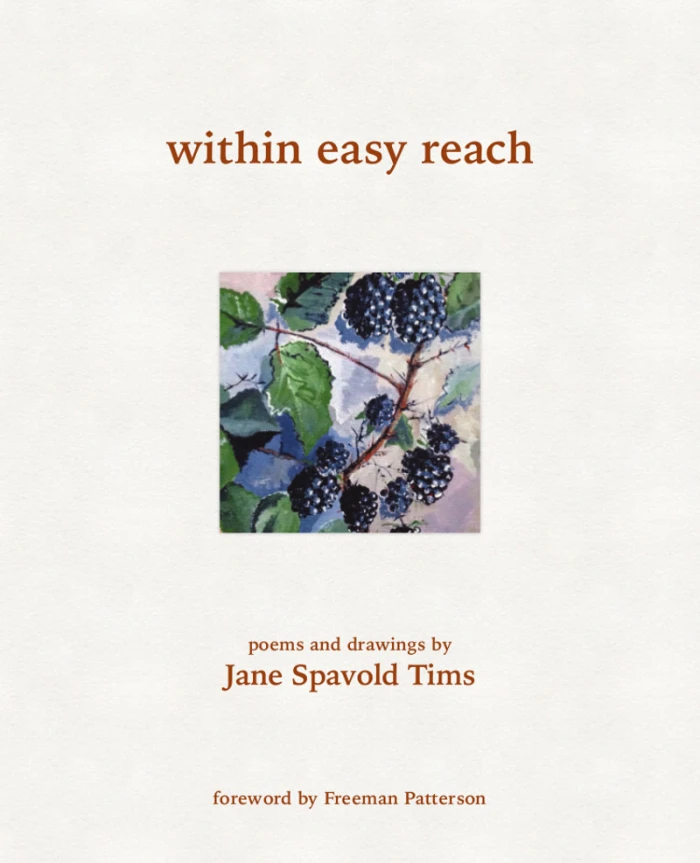
title: ‘within easy reach’
dedication: the manuscript is dedicated to my husband
table of contents: a listing of the poems
acknowledgements: all the people I want to thank and the support of artsnb and the Creations Grant
~
The above four items are straightforward. I needed some information about the next three:
~
foreword
preface
introduction
~
Foreword: written by someone other than the author of the book, usually an authority – celebrates the work and provides credibility.
Preface: written by the author of the book – includes the purpose and scope of the work, explains the origins of the central idea in the book, and may acknowledge those the author wants to thank.
Introduction: written by the author or an editor – includes information on the contents of the book, the author, and the audience.
Source: http://www.quickanddirtytips.com/education/grammar/foreword-versus-forward#sthash.No5DaWpu.dpuf
~
Many of the poetry books I have in my library do not include a Foreword or Preface, and Acknowledgements are often placed in the back of the book. I find this is true of collections where the theme of the poems is not immediately obvious. But collections about a particular subject, such as those about history, often have a Preface or Introduction.
~

~
For example, Jack’s Letters Home (Cynthia Fuller (2006) Stable Cottage, U.K., Flambard Press) includes an Introduction. The book is a collection of gritty poems based on real letters written by a British soldier in the First World War. The Introduction tells the soldier’s history, the story of how the letters were found and a little about the characters in the poems.
~

~
I have two poetry collections by Shari Andrews. Both focus on history. Crucible (Shari Andrews (2004) Canada, Oberon Press) is an insightful collection of poems depicting characters and events in the life of Saint Catherine of Sienna. It includes a Foreword by the poet. The Foreword includes background on Saint Catherine of Sienna, information about the inspiration for the book, and acknowledgements.
~
The Stone Cloak (Shari Andrews (1999) Canada, Oberon Press) is a collection of tactile, sometimes fierce, poems about the lives of settlers of New Denmark in New Brunswick. The Foreword includes information about the poet’s connection to the community and briefly describes the history of New Denmark. It includes acknowledgements.
~

~
Although it is not a book of poetry, in an 1843 edition of A Christmas Carol Charles Dickens includes a brief Preface, consistent with the spirit (!) of his story:
I have endeavoured, in this Ghostly little book, to raise the Ghost of an Idea, which shall not put my readers out of humour with themselves, with each
other, with the season, or with me. May it haunt their houses pleasantly, and no one wish to lay it!Their faithful friend and Servant,
CD.
December 1843.(Source: http://www.themorgan.org/collections/works/dickens/ChristmasCarol/3, accessed February 23, 2015)
~

a ‘grown and gathered’ salad – leaves and flowers of violet, leaves of mint and dandelion, bean sprouts and green onions
~
My poetry manuscript has a very specific theme – the ‘growing and gathering’ of local foods. Since all of the poems are about a particular topic, I think including a Preface is appropriate. I want the Preface for my manuscript to:
- be short (less than a page)
- inspire my audience
- include the purpose of my poems
- provide an overview of the contents
~
When I was young, I always skipped the Preface of any book I read. Now, I read the Preface first, eager to find information about the process the author followed in conceiving of or writing the book.
~
Copyright 2015 Jane Tims
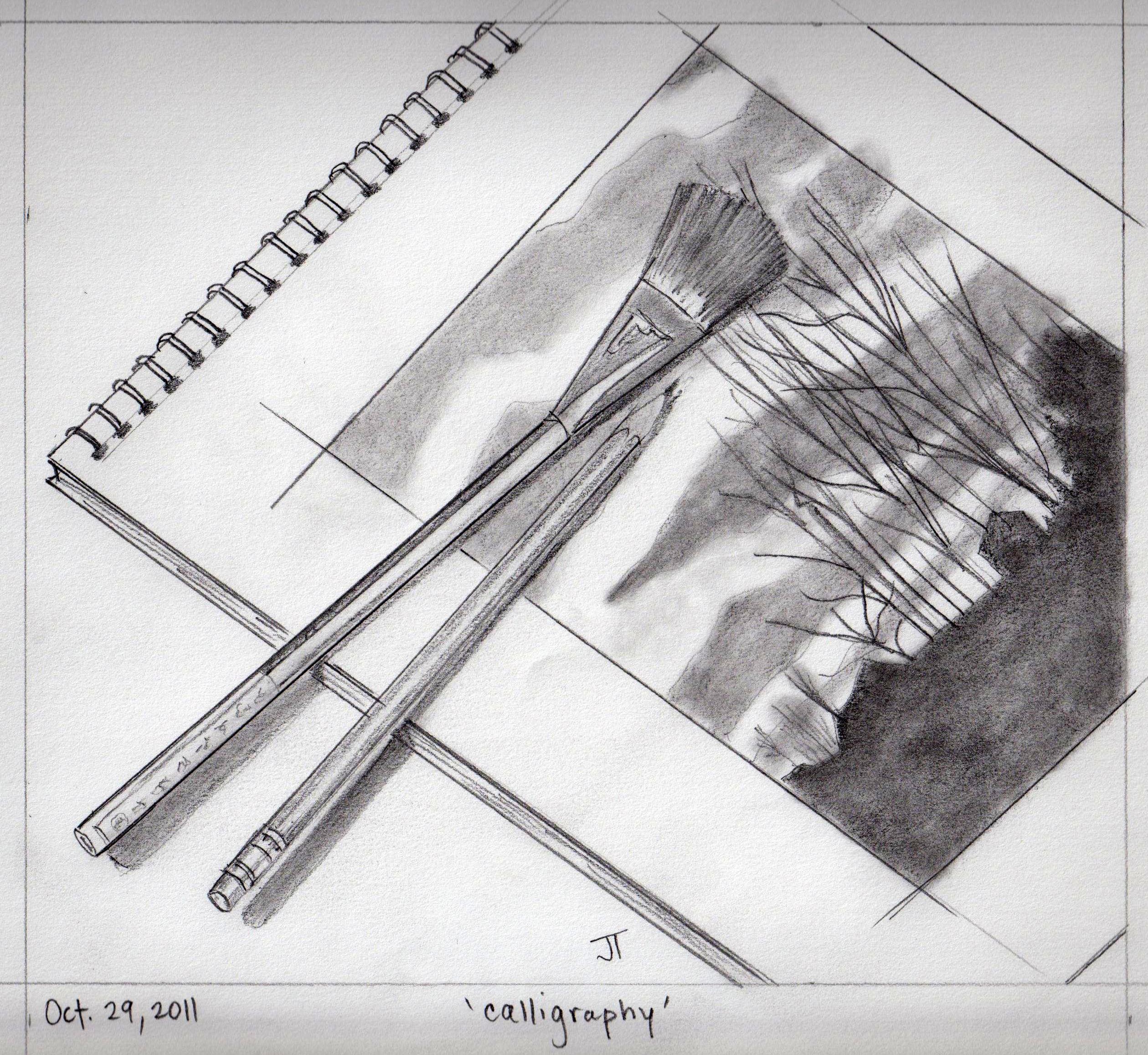
a moment of beautiful – shadow forest

~
tree shadows, drawn on a sloped roof
~
tilted shadows on snow, graphite stems, crowded trees
~
pencil sketch of woodland, whim
of northern winter, slanted sun
~
from the trees, truth, but the artist lies
maligns tree shape, size and colour
wind direction
~
shadow trees without wild life
red squirrels and blue jays
seldom visit while light and pencil
sharpen their edge
~
only phantom light in space
between sender and receiver
message warped, passed
from molecule to molecule
through lead and air
~
~
Copyright 2015 Jane Tims
~
moment of beautiful – shadow on the snow

~
~
under the snow
~
the shadow is a blue portal, a hidden way
to crocus places, sheltered where no drifting
snow or bitter wind comes howling
~
frost-brittle maples creak
and chickadees crack seeds
of sunflower stashed
in tunnels shaped
by squirrels
~
~
Copyright 2015 Jane Tims
art auction – update
At the end of January, 2015, I published a post about the 23rd Art Auction now being held at Isaac’s Way Restaurant in Fredericton, New Brunswick ( https://nichepoetryandprose.wordpress.com/2015/01/26/art-auction/ ).
~
Isaac’s Way organizes three auctions each year, each raising funds for children’s charities in one of four artistic areas: dance, art, music, and theatre. The art is sold by silent auction to raise funds for kids-in-need. Since 2007, the auction has raised more than $92,200 !
~
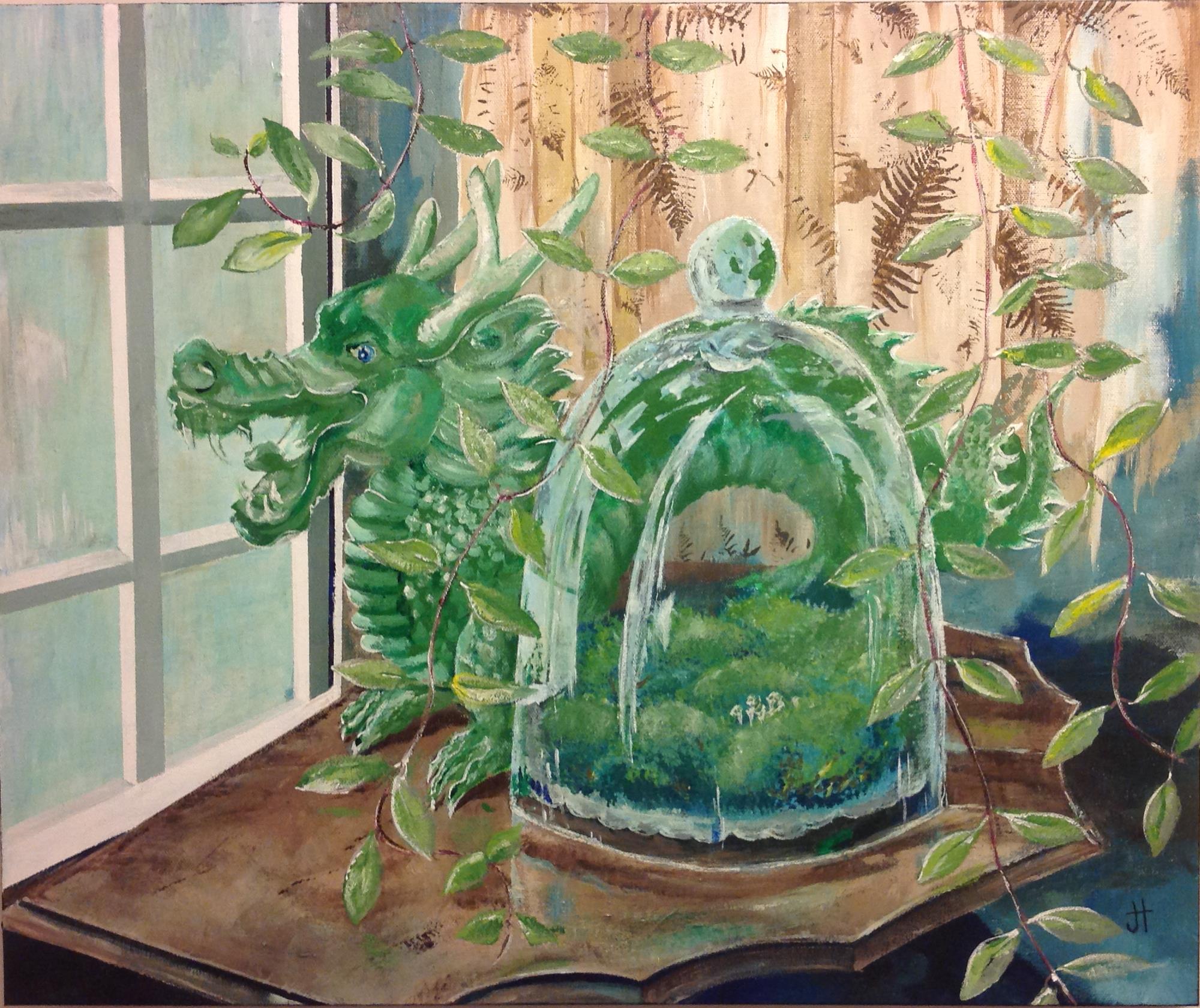
The new painting is an acrylic entitled ‘outside-in’ (24″ x 20″, unframed, gallery edges). It is a painting of a dragon guarding a terrarium, based on a photo posted here ( https://nichepoetryandprose.wordpress.com/2015/01/05/one-small-green-world/ )
~
~
The painting ‘outside-in’ was fun to do. The outside has been brought inside in many ways – the mosses in the terrarium, the wood of the table, the vines, the fern pattern on the curtains. And yet, the dragon turns to gaze out the window (sometimes his eye looks at ‘you’). I used four main colours – Chromium Oxide Green, Burnt Umber, Titanium White and Phthalo Blue – and touches of Phthalo Green, Cadmium Yellow and Quinacridone Magenta. To give shine to all the glass and wood in the painting, I used several layers of a tinted glaze.
~
The more than 60 art pieces on display at Isaac’s Way will be for sale until May 24, 2015 ( http://isaacsway.ca/art/ ). This auction will sponsor MUSIC lessons for kids.
~
Issac’s Way also has, for auction and sale, paintings created live during Fredericton’s recent winter festival, Winterfesthiver ( if you are on Facebook, just look for Winterfest Art Auction 2015 ).
~
I am so proud to take part in this worthwhile project.
~
Copyright 2015 Jane Tims




 nichepoetryandprose