getting ready for fall – blueberries
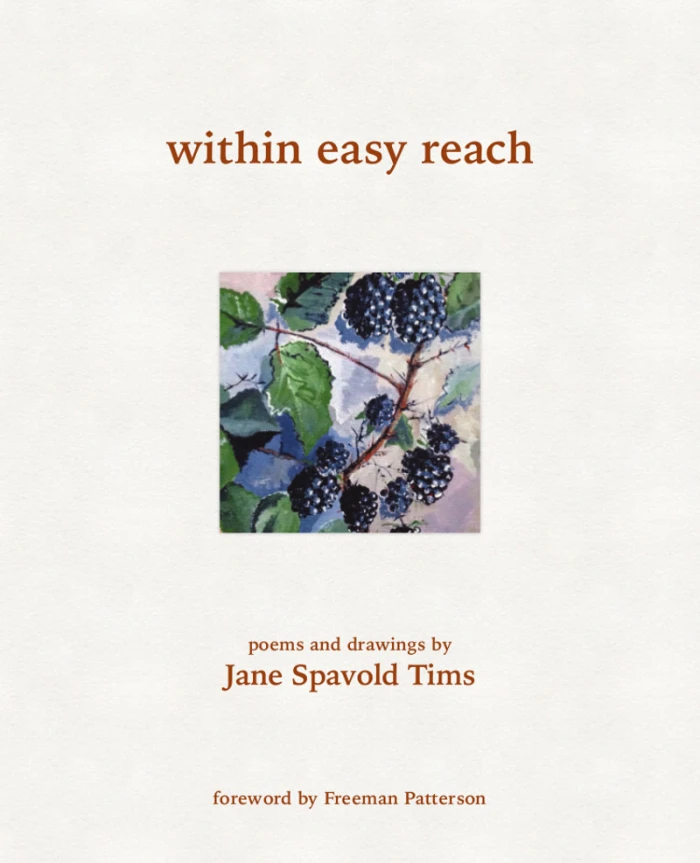
Another painting in my series! I could call the collection paintings to illustrate ‘within easy reach’ since each one was inspired by a poem in my book.
~
Blueberries are probably my favorite berry to pick. This could be because every summer, when my family visited Nova Scotia, we spent a week at my Grandfather’s blueberry farm. I picked blueberries with cousins, siblings and parents. I was never very good at the task but my idea of picking is one for the bucket, two for the mouth, so I guess you now know why I love picking blueberries!
~
This little painting was fun to do. I was inspired because I had just finished putting together freezer bags of blueberries from a big box we bought at McKay’s Wild Blueberry Farm Stand in Pennfield, New Brunswick (https://janetims.com/2012/08/04/blueberries/).
~
The painting is 10″ X 10″, gallery edges, acrylics, painted with Ultramarine blue, Cadmium yellow, Cadmium red, Burnt sienna and Titanium white.
~

August 20, 2016 ‘pick faster’ Jane Tims
~
And, to accompany the painting, another sampling from the poems in my book ‘within easy reach’. My book of poems and drawings is available from my publisher http://www.chapelstreeteditions.com
~
~
pick faster
for Dad
~
blue ripens as morning, deft fingers
noisy pails, hail on metal gutters
this bush spent, unsatisfactory
berries over there fatter
bluer
~
I am certain I see, beside mine
my father’s hands, callused
and quick
~
berries roll between
thumb and fingers
~
I try to meet
his expectation
~
pick faster
~
~
~
within easy reach, Chapel Street Editions, 2016
Copyright 2016 Jane Tims
getting ready for fall – choke-cherries
I have finished the final painting in the group for my sale in November. The last one is titled ‘within easy reach’, the title of my book and the first poem in the book! The painting is done in acrylics, 8″ X 16″, gallery edges, with Ultramarine blue, Cadmium red, Cadmium yellow, Burnt sienna and Titanium white.
~
Choke-cherry is a large weedy shrub, found along roadways, at the edge of fields and woods, and in barrens and lakeside thickets. The dark red berries occur in drooping clusters. They are very sour but are used to make jelly and wine. When the choke-cherries are ripe, all you have to do is reach up and your pail will fill to overflowing!
~
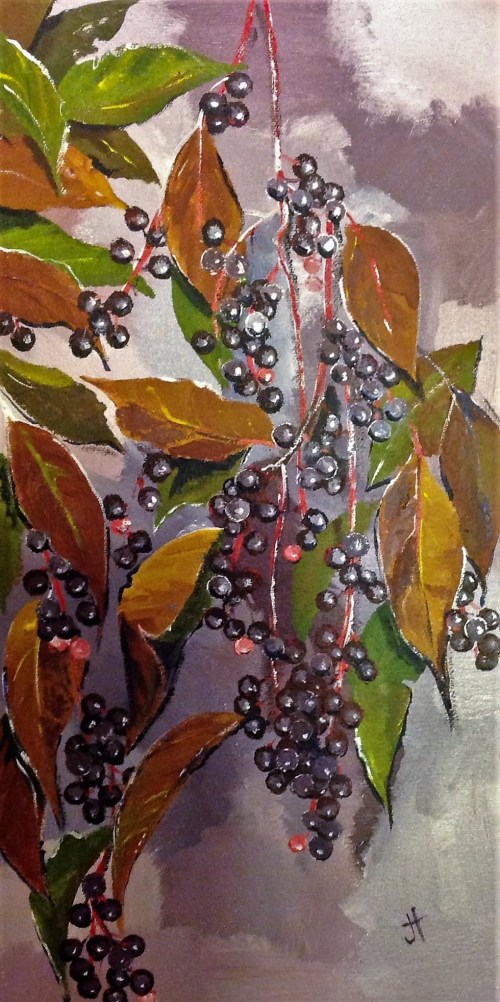
August 30, 2016 ‘within easy reach’ Jane Tims
~
within easy reach
~
Choke-cherry (Prunus virginiana L.)
~
Choke-cherries flow
into pail, sunlight
into winter, glint
of ripening by fireside
and flame, a taste
of dry wine, cherry-laden
and summer within
easy reach, berries
by the handful, ice-pellets
against the glass
~
~
within easy reach, Chapel Street Editions, 2016
Copyright Jane Tims 2016
getting ready for fall – orchard green
Thirty years ago, we planted a young Wolf River apple tree in our side yard. I wanted to create an orchard where I could walk in the shade and gather fruit in fall.
~
For years we took good care of the orchard – three apple trees and a cherry. In spring I have inhaled the sweet fragrance of apple and cherry blossoms. In spring I watch the blossoms burst open like popped corn. I listen to the bees gathering their nectar. Watch the apples ripen and grow. Some years I make apple jelly, some years applesauce. In the fall I watch deer under the trees, eating their fill of apples. One year a deer challenged me for ownership of the Wolf River tree, pounding his hoof into the ground with a loud, reverberating stomp.
~
A few years ago, our interests turned to other things and the orchard was left to go its own way. The cherry tree continued to bloom but produced no cherries because it is ‘self-unfruitful’ and needs another cherry tree. Two of the apple trees succumbed to the shade and died. The Wolf River tree survived, but grew tall and gangly, trying to reach the sun that peaks over the roof of the house.
~
Now, priorities have shifted. We are interested again in the ‘orchard’ and have plans for its future. In the next weeks we intend to cut down the dead trees. A friend has agreed to prune the Wolf River tree when the season is right, to bring its branches within reach. I will buy another cherry tree so we can finally have cherries.
~
To seal the plan for the orchard, I have done a portrait of the apples as they grow plump in late summer. Painted in acrylics, 11″ x 14′, gallery edges, with Ultramarine Blue, Cadmium Yellow, Titanium White, Paynes Grey and Burnt Sienna.
~

August 26, 2016 ‘orchard green’ Jane Tims
~
Copyright 2016 Jane Tims
getting ready for fall – rose hips
~
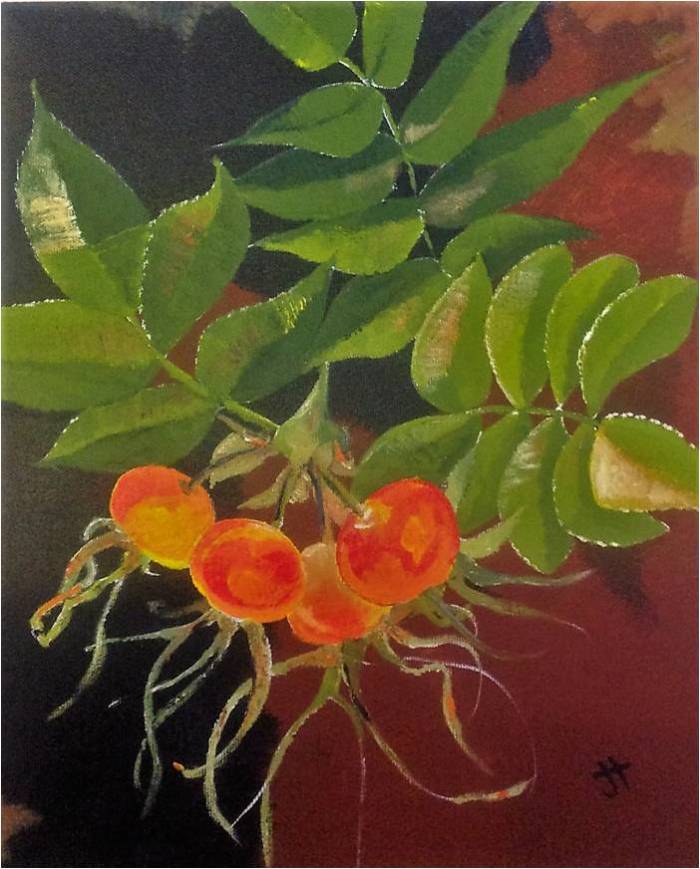
Rose hips ripening … another painting towards my fall sale of books and paintings.
Along the road at our cabin is a small bush. Pink flowers in spring and plump rose hips in fall. Anyone who does cutting or roadwork at our cabin gets strict instructions not to disturb the rose bush!
~
Copyright 2016 Jane Tims
lost communities – an old flower garden
Do you ever see an old flower garden, no house in sight, growing alone, expanding and reseeding where it can?
~
On our drives to find old one room school houses in the landscape, we often find bits of domesticated flowers, indicating a home once flourished there. Sometimes these old gardens are all that is left of a rural community.
I have seen first hand, how many small rural communities in New Brunswick are little more than memories.
~
A good example of this is Fredericksburg near Stanley in York County. Today it is a pleasant rural landscape with three or four homes. In 1866 Fredericksburg was a farming settlement with approximately 12 families. This information comes from an information-packed website from the Provincial Archives of New Brunswick: ‘Place Names of New Brunswick: Where is Home? New Brunswick Communities Past and Present’. By typing the name of a community, you can discover information about original land grants, the size of a community in the eighteen hundreds, how many families lived there, the population and whether there was a post office, store, or church. http://archives.gnb.ca/exhibits/communities/Home.aspx?culture=en-CA
~
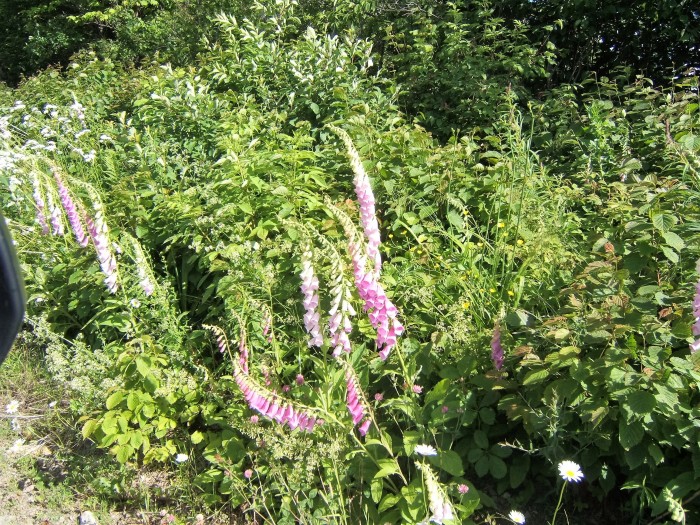
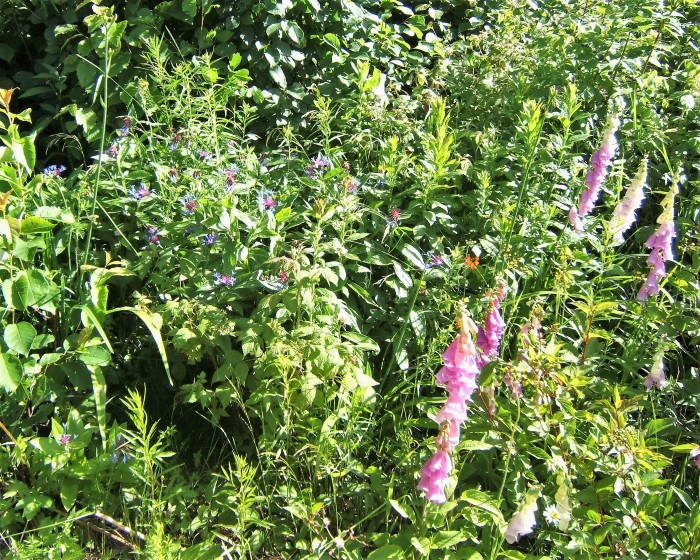
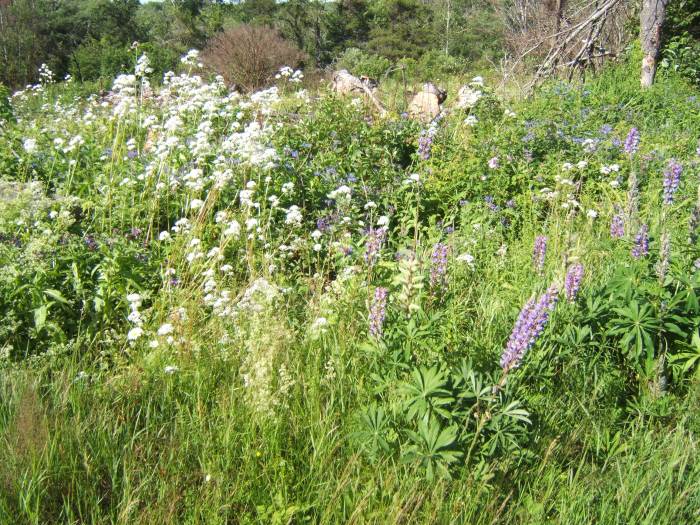
I am sorry these are not better photos, but the colour among all the green shows the remnants of a flower garden that someone once loved.
~

~
Musk Mallow (Malva moschata) …
~
~
Common Foxglove (Digitalis purpurea) …
~
 ~
~
Some more Foxglove and blue Bachelors Button (Centaurea cyanus) …
~
~
Lupin (Lupinus perennis). I don’t know the identity of the white flowers, but they make a lovely overall ‘bouquet’!
~
Have you seen any abandoned flower gardens? Do you wonder what stories they would tell?
~
~
Copyright 2016 Jane Tims
in the shelter of the covered bridge – final manuscript
In the last weeks, I have been working towards completion of the book-length manuscript for ‘in the shelter of the covered bridge’. It includes poems and drawings about the plants and animals living in and around some of the covered bridges in New Brunswick.
~
Earlier this summer I was lucky enough to win a mentoring package from the Writers’ Federation of New Brunswick. I chose a talented, award-winning local poet to work with me on the manuscript and during the early part of the summer, with her expert guidance, I made revisions to the poems. She focused my attention on word choice, clarity and ‘showing not telling’. She also helped me with a handful of poems I thought were not salvageable and now some of these will make it into the manuscript!
~
In the last few weeks, I have worked on revisions, ordering of the poems, and, hardest of all, my footnotes. Since the poems are about the remaining covered bridges in the St. John River watershed, I want to include some basic information in the footnotes as well as notes I made during my visits to each bridge. I have also worked on the drawings I will include in the manuscript.
~

~
The process of preparing a manuscript is long and certainly goes beyond the fist few lines written on the page way back when this manuscript was just an idea. But if the way is about the journey, this has been such a memorable experience. Best of all, I have been lucky to make the acquaintance of many of New Brunswick’s covered bridges. Last Thursday, as we returned home from a visit, we saw a double rainbow in the sky and I was able to snap a shot as we waited to take our turn crossing the covered bridge across the Rusagonis River (the Patrick Owens Bridge):
~
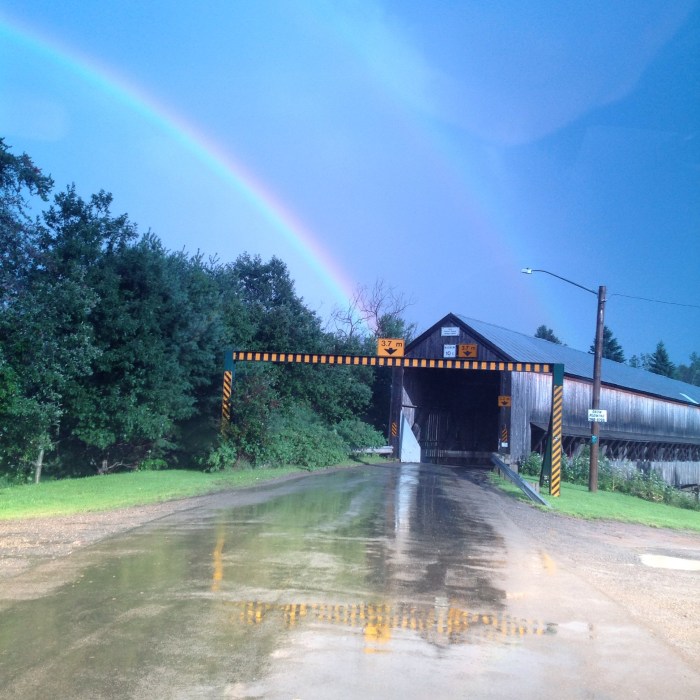
double rainbow over the Rusagonis #2 Covered Bridge in Rusagonis, New Brunswick – August 19, 2016
~
Copyright Jane Tims 2016
within easy reach – next reading!
Hi Everyone.
I am happy to let you know about an upcoming reading event!
The reading will take place on August 25 (Thursday) at the Attic Owl Reading Series in Moncton (Café C’est la Vie) at 7 PM. I will be reading from my book within easy reach. Novelist Elaine McCluskey (http://www.elainemccluskey.ca/) and musicians Travis Furlong & Dave Smith will also be there!
~

~
This is my second reading at the Attic Owl. On January 28, 2016 Carol Steel, Lee Thompson and I shared the stage. I know the crowd is attentive and the food is so good!
~
Hope you can drop by to listen and say hello!
~
Jane
Copyright Jane Tims 2016
getting ready for fall – high bush cranberry
Another painting to accompany my fall book and painting sale. These are high bush cranberries growing along the St. John River. The painting is done in acrylics, gallery edges, 12″ X 10″, Chromium Oxide Green, Paynes Grey, Titanium White, Cadmium Yellow Medium, Cadmium Red Medium and a touch of Burnt Sienna. The subject matter of high bush cranberries was a suggestion of one of my blogging friends!
~

~
Copyright Jane Tims 2016
getting ready for fall – hops vine
I have completed a few more paintings in the group I’ll take to my fall sale. This one is of the wild hops vine we found in Victoria County. It is acrylic, gallery edges, 12″ X 10″, painted with Titanium White, Paynes Grey, Chromium Oxide Green, Burnt Sienna, Cadmium Yellow Light and a touch of Iridescent Copper.
~

~
Copyright Jane Tims 2016
in the shelter of the covered bridge – lichens on the Benton Bridge
Some of the species found growing ‘in the shelter of the covered bridge’ are unexpected. The Benton Bridge (Eel River #2) in west-central New Brunswick offered a few surprises.
~

~
The Benton Bridge, built in 1927, crosses the Eel River at Benton, York County. The bridge is in an open area of houses, hay fields and a picnic park. A huge lilac at the end of the bridge was busy with hawk mothshttps ( https://janetims.com/2015/06/10/in-the-shelter-of-the-covered-bridge-hummingbird-moths/) . And Stonefly nymphs, an indicator of excellent water quality, covered the boards on the side and end of the bridge ( https://janetims.com/2015/06/08/in-the-shelter-of-the-covered-bridge-stonefly-nymphs/ ). But, to me, the most interesting discovery was on the upstream side of the bridge.
~

~
On the north-east facing outside wall, two species of lichen grew:
Boreal oakmoss (Evernia mesomorpha) and burred horsehair (Bryoria furcellata). These are common lichens, usually found on trees in open coniferous woods or on scraggy trees in bogs. Perhaps they like the coolness and humidity offered by this side of the bridge! I am so grateful to Stephen Clayden of the New Brunswick Museum for identifying and commenting on these lichens.
~
~
on the north-east wall
~
Benton Bridge
Eel River #3
~
on the shaded side of the covered bridge
the walls are clothed, furred
in lichen
boreal oakmoss
yellow-grey and goose-fleshed
(Evernia mesomorpha)
burred horsehair
bristled, toasted and tangled
(Bryoria furcellata)
~
they thrive on the weathered boards
from eaves to river they follow
the runnel ways of damp
cool on the dark side of the bridge
bark and branches their usual home
~
~
Copyright Jane Tims 2016




 nichepoetryandprose