along the country road #5
Not far from where I live is a new road, built a few years ago along the edge of a field. When it was first built, it was a scar on the land, its ditches unlovely smears of muck.
This year, the weeds of the roadside have moved in to fill the empty spaces with green. At one place, where the new road joins the old, it is particularly wet and the ditches have been overwhelmed with a green and orange explosion of Jewel Weed.
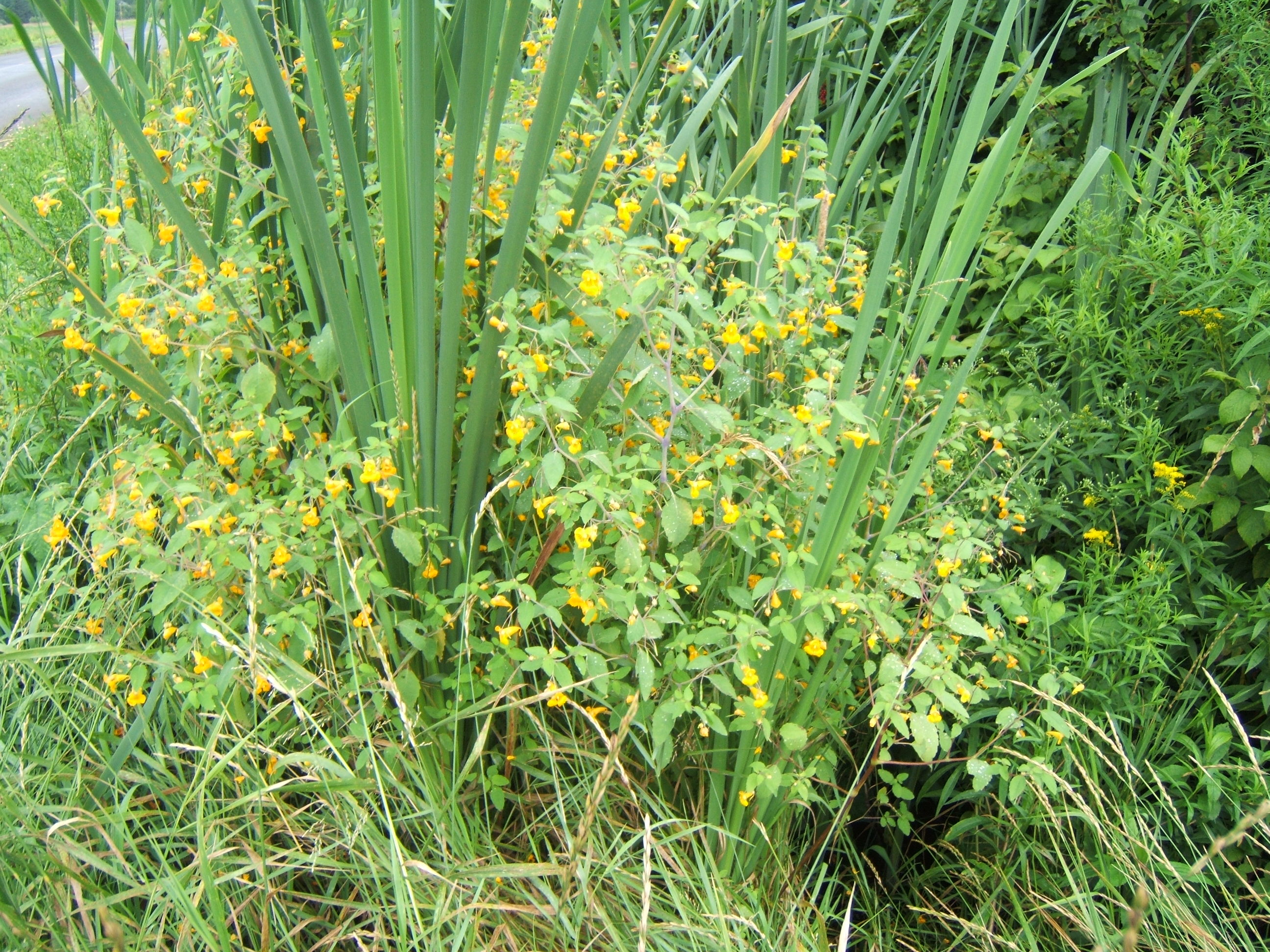
Jewel Weed growing with cattails in a wet ditch

a profusion of Jewel Weed
The botanist, Nicolaas Meerburgh, who first named the plant, called it capensis, meaning “of the cape” since he wrongly thought it had been introduced from the Cape of Good Hope into European gardens.

Jewel Weed (Impatiens capensis Meerb.)
Jewel Weed
Impatiens capensis Meerb.
~
Jewel Weed
orange and green
tangled in the gully
spotted spurred
impatiente
for a visit
from a hummingbird
~
Jewel Weed
not used as gems
for lady’s ears
not (after all)
from the Cape
of Good Hope-
Celandine tends
to mope
~
Jewel Weed
pendulant
petulant
“Touch-me-not!
or I fling
seeds from my pods
into the spring”
~
© Jane Tims
along the country road #4
My Mom was a great gardener. She could grow vegetables on the smallest corner of land and coax flowers where I was certain none would grow. When I was a little girl, and we lived in Alberta, she kept vibrant flower gardens. I remember the hollyhocks towered above my head, nasturtiums made pools of fire beside our door, and alyssum spilled over the edge of the cement walkway. One year, Mom planted sweet peas and I helped her put up a little string, unbelieving when the shoots pushed up through the soil and the papery leaves used curly tendrils to climb the string.
Another flower I remember fondly is the snapdragon, with its inflated lower lip. Its mouth yawned and looked like it could spurt dragon-fire if you pressed the petals between your thumb and forefinger.
I was never able to grow snapdragons, although I’ve tried. But one of the plants growing wild along our road has the charm of the garden snapdragon and is in the same family of plants. This little plant is called Toadflax. Its other common name is Butter-and-eggs.
Butter-and-eggs (Linaria vulgaris Hill.) is a weed of roadsides and waste places, blooming in large patches, late in summer. The flowers are spurred and bright yellow, with a lower orange lip. The inflated lower lip acts as a landing platform for insects and is hinged, to allow the right pollinators access to the nectar and pollen.
Butter-and-eggs is not a very big dragon, but it does have a mouth that yawns if you press the petals between your thumb and forefinger. Perhaps this is the reason Butter-and-eggs is known in French as guele de lion. Its other French name is linaire. This name, and the scientific name Linaria, are derived from the Latin linum meaning ‘flax’.

Butter-and-eggs (Linaria vulgaris Hill.)
abandoned spaces
When I drive through the countryside, I am drawn to the sight of abandoned farms or houses. I wonder why they have gone from being loved and used, to being alone.

abandoned farm buildings
Sometimes, the leaving is from economic necessity. Sometimes the last one who lived or worked there has died or moved on. Sometimes the government decides it can’t provide services anymore to out-of-the-way places. Occasionally, we are just seeing a moment in time, and new tenants and new life may be just around the corner.

an abandoned house
During the Depression, in the 1930s, many farms out west were abandoned because the combination of eroded land and poor economic conditions made staying impossible.
The poem below was written to remember one such place in southern Alberta. In the 1960’s, we went there once with my Dad, on a drive to explore the prairie roads.
Why do we abandon the spaces we know best?
The Reason for Leaving
~
1964
~
I remember the place
without texture
a line drawing
plainly coloured
~
two tracks on the prairie
one to come
and one to go on
~
a grey house
on a rise of green
(not grass, just green)
the door fallen away
~
a brown canal
still, without depth
sluice gears and flood gates
making the most
of insufficient water
~
and a bridge, also brown
boards laid without nails
~
~
1933
~
the truck
heavy on the driver’s side
steps down from the bridge
(the bridge ironic)
(three years, the Creek’s been dry)
~
in the rear-view mirror
a wooden house
on a low hill
a thin brown wind
and thirsty grasses
~
only the young ones
turn to stare
~
home
now hollow
stripped of voice and windows
the door left open
for tumbleweeds
~
Published as: ‘The Reason for Leaving’, 2010/2011, Canadian Stories 13 (76).
© Jane Tims
along the country road #3
A few years ago, I became interested in pressing flowers as a craft. I discovered a secret – one of the best flowers to press is Queen Anne’s Lace. Laid out on the page, it has the look of intricate crochet.
Queen Anne’s Lace, also called wild carrot, devil’s-plague, and carotte sauvage, is a tall weed with an umbrella-like cluster of lacy white flowers. The flowers are an umbel, meaning that the individual flowers all radiate from the same point on the stem to form a head. The flower is commonly seen in hayfields and waste places, and along roadsides.

Queen Anne's Lace (Daucus carota L.)
Daucus is the ancient Greek name for carrot; carota is the old generic name for carrot.
Don’t let the name ‘carrot’ fool you, as the roots are said to be somewhat poisonous. Also, beware of look-alikes. There are many flowers that can be described as a ‘white umbel’, some of them poisonous to the touch. Use an identification guide before you investigate too closely!
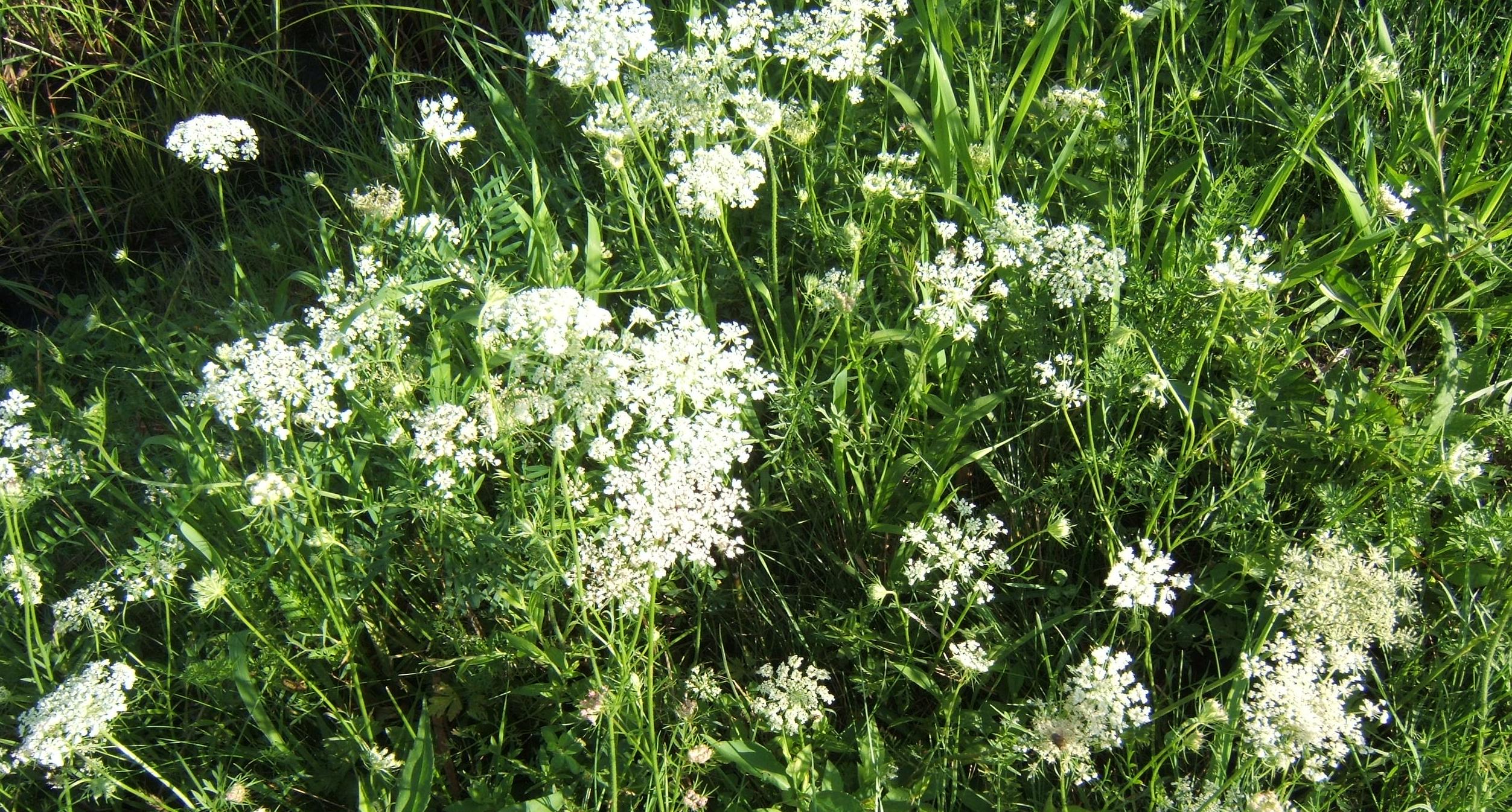
like snowflakes in summer
Queen Anne’s Lace
Daucus carota L.
wild carrot
inedible
no colour
unsuitable
as a vegetable
(poison probable)
white lace
three dimensional
tatted for Anne
‘Not Suitable’
for a Queen
(too usual)
umbrella
non-functional
(leaky)
unsuitable
for the rain
(or even drizzle)
in moonlight
unforgettable
common words
unsuitable
devil’s-plague?
ethereal!
Published as: ‘Queen Anne’s Lace’, Winter 1993, The Antigonish Review 92:80-81.
(revised)
© Jane Tims
in the apple orchard
One of the spaces I loved the best on my grandfather’s farm was the apple orchard. It was a small orchard, perhaps twenty trees. I have never seen it in spring when the apple blossoms are in bloom, in fall when the trees are laden with fruit, or in winter when the stark bones of the trees are visible. But I knew the orchard in summer, when the green canopies of the trees shed thick shade over the meadow grasses beneath.

an apple orchard in August
In summer, the orchard was usually a private space. The farm yard could be bustling with people and animals, but the orchard was set apart. It was a still room of dark and dapple.
When I wasn’t pushing the swing to its limits, I was climbing apple trees, one in particular. Its main side branch was as thick as its trunk and jutted out parallel to the ground. A little jump and you could sit on it like a chair. Swing a leg across and you had a horse. Stand on it and you were in the crow’s nest of a sailing ship. Sit down again, lean against the trunk and you had the ideal perch for reading the afternoon away.

an apple orchard in spring (photo by G. Tims)
The orchard was usually a private space. But on Family Reunion Day, it was the focus of the festivities. Big tables covered with white cloths were assembled in a line. Enough chairs were unfolded for every person in our very large family. Cars turned in at the driveway and claimed a spot in the farm yard. Cousins rolled from the cars and were soon climbing and swinging in the orchard. The table gradually filled with a conundrum of casseroles, bean pots, roasters and platters.
After the eating was done, wire hoops went up for a game of croquet. My Dad loved croquet and would show me all the tricks – how to get through the starting hoops in a single turn and how to ricochet off the goal post. He also showed me how to bump up against the ball of another player and send their ball flying out of bounds on the next turn. Armed with my learning, I gripped my croquet mallet, certain to win. And realised my brothers and sister and some of the cousins had some strategies of their own!
After the Reunion was over and the last car was waved from the driveway, I was left alone in the orchard and it seemed more empty and silent than before.
I would love to return to the apple orchard on my grandfather’s farm and read a book in my tree one more time. Are you ever too old to climb an apple tree?
dapple
the worn blanket flung
over the bough
of the apple tree
is an old woman
she hugs the limb
reaches for a branch
or an apple
barely beyond
the crook
of her fingers
she would dare
to set her foot
on the branch
and the next
step up
put the orchard
below her
rise above
the canopy
the valley
the meander of the river
feeble
she waits
in the dapple
clings to the branch
endures the tremble
delays the fall
Published as: ‘dapple’, 1998, Green’s magazine (Autumn 1998) XXXVII (1)
(revised)
© Jane Tims
along the country road #2
Here in New Brunswick, although it is only August, the flowers along the roadside are changing. The daisies and buttercups of summer are giving way to the flowers we associate with autumn – the goldenrods, the asters, and Pearly Everlasting.
Pearly everlasting (Anaphalis margaritacea (L.) C.B. Clarke), called immortelle in French, is a weed of roadsides, fields, open woods, and clearings. Its flowers are borne in clusters on an upright, leafy stem. They are easy to dry in bouquets since most of the so-called flower consists of a small yellow floral head surrounded by pearly-white dry bracts.
The generic name is an anagram of Gnaphalium, the name of another genus of everlasting flowers. This, in turn, is an ancient Greek name for a downy plant, derived from the word gnaphallon, lock of wool. Margaritacea means pearly.
What flowers mark the change of seasons in your area?
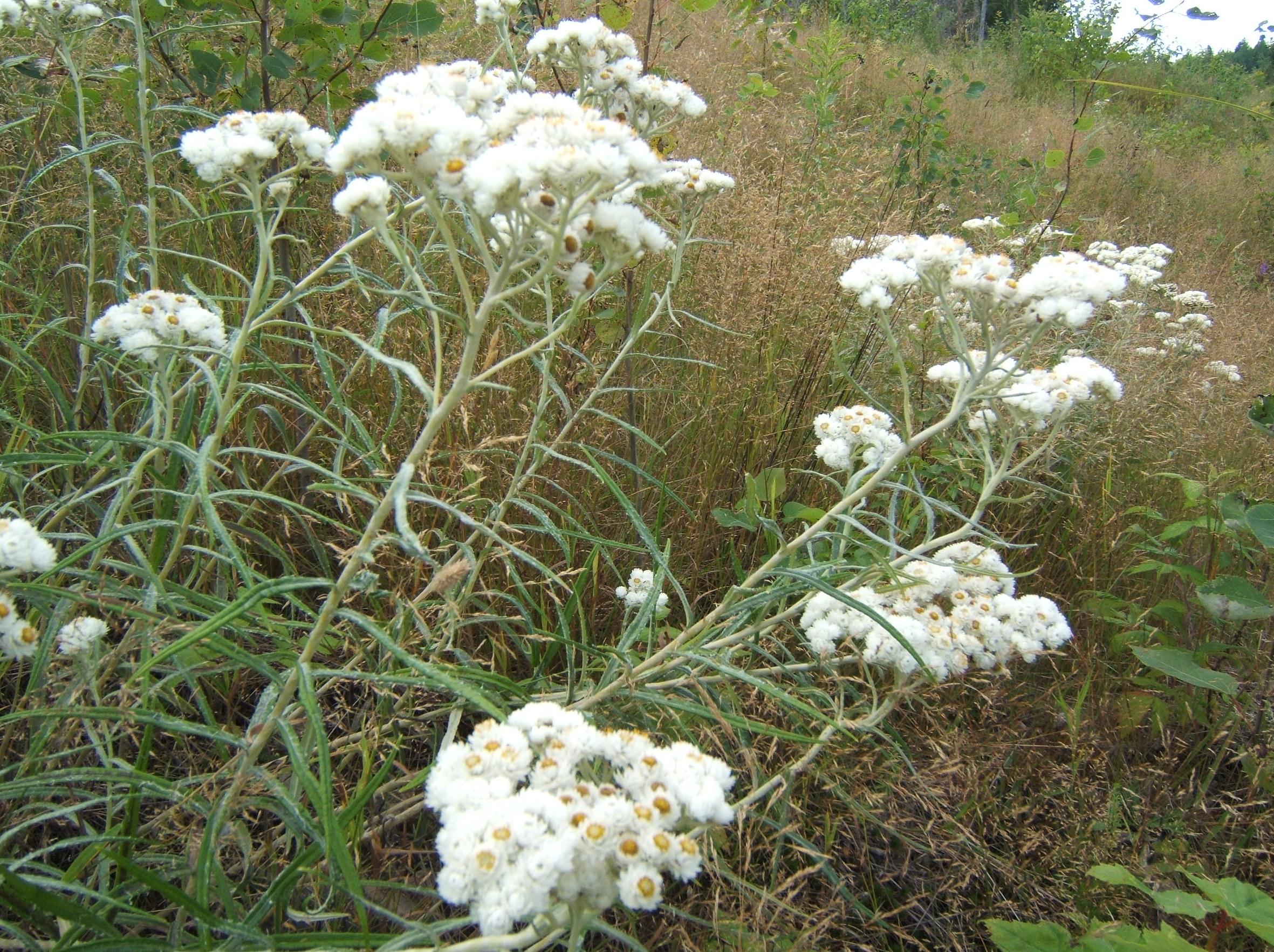
Pearly Everlasting (Anaphalis margaritacea (L.) C.B. Clarke)
Pearly Everlasting
Anaphalis margaritacea L.
Pearly Everlasting
sign of summer’s passing
yet- immortelle
picked by the road
by the armload
hung from rafters
children’s laughter
runs beneath
downy leaf, woolly stem
white diadem
perfectly matched flowers
thatched in gold
dry and old
Linnaeus-named
for Marguarite
memory sweet
paper petals keep
pale perfume
summer
grace
in a winter room
Published as: ‘Pearly Everlasting’, Winter 1993, The Antigonish Review 92.
(revised)
© Jane Tims
competing with the squirrels #1
The squirrels and I have issues. I say squirrels, because we have at least two species of squirrel (Sciurus sp.) on our property, reds and greys.
The red squirrels were here before we arrived, about 31 years ago. The red squirrels I see here today must be the great-great-great… grandchildren of the little fellow who used to shimmy down a copper wire to get to our feeder. The grey squirrel arrived only a couple of years ago and is as big as a small cat. Both reds and greys compete with the birds for the sunflower seeds and other food we put in the feeder. The two species of squirrels compete with one another for roughly the same ‘niche’ and my reading tells me that the grey squirrels will eventually displace the red.

grey squirrel cleans out feeder
I overlap with the squirrels’ ‘niche’ in one repect: we all love hazelnuts. I have two large shrubs of Beaked Hazelnut (Corylus cornuta Marsh.) in our woods. Beaked Hazelnut is a wiry shrub with large serrated leaves. Its fruit is contained in bristly beaked husks and the nut is edible, to both me and the squirrels.

Beaked Hazelnut shrub with hazelnuts in beaked husks
The question is, when do I pick my hazelnuts? It has to be the day before the squirrels pick their hazelnuts. I ask my husband every day and he says he doesn’t know…..
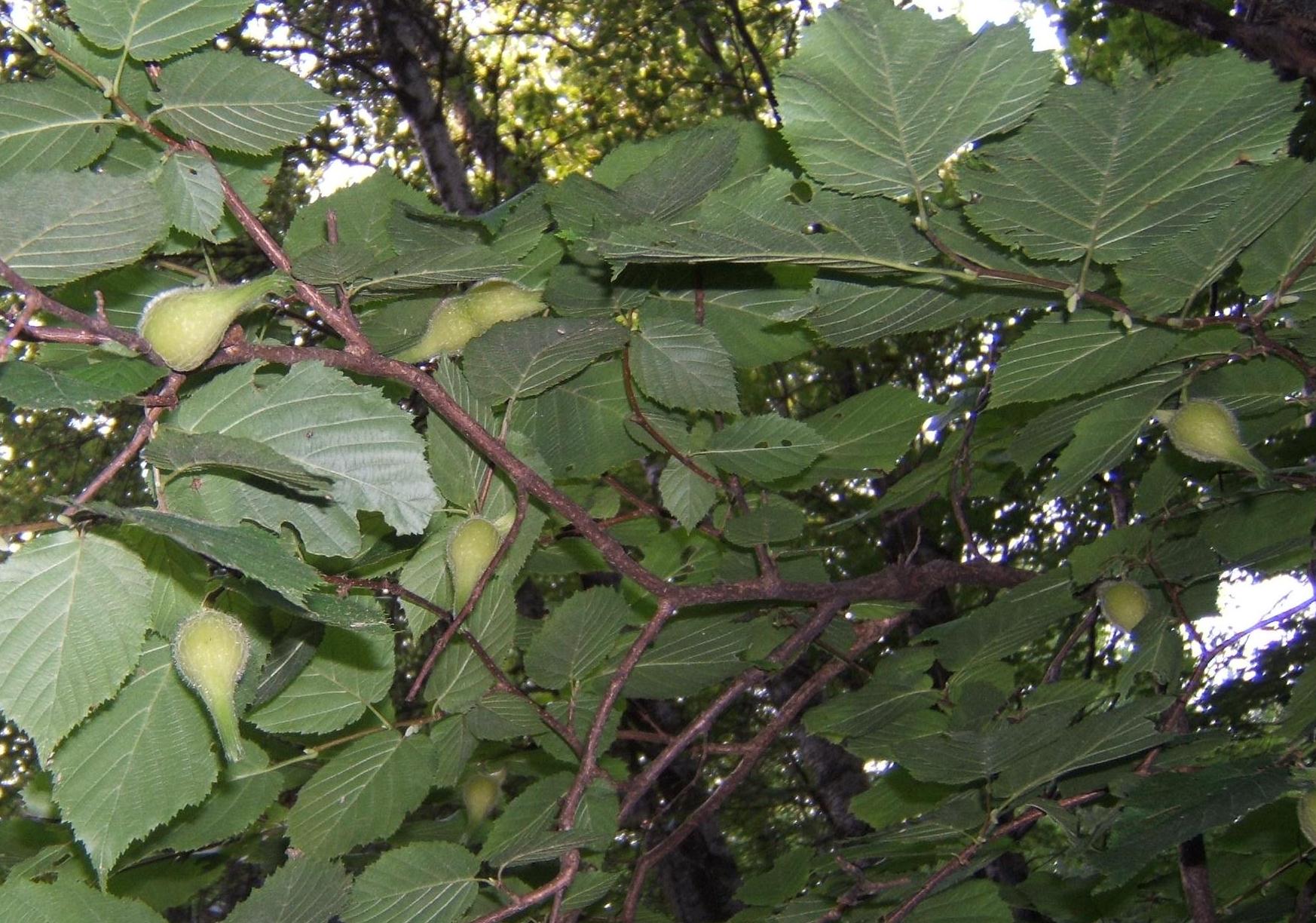
hazelnuts viewed from the underside of the shrub canopy
© Jane Tims
thriving on the roof
Our wood shed is almost thirty years old and its roof has never been re-shingled. This summer, perhaps it is trying to communicate with us.
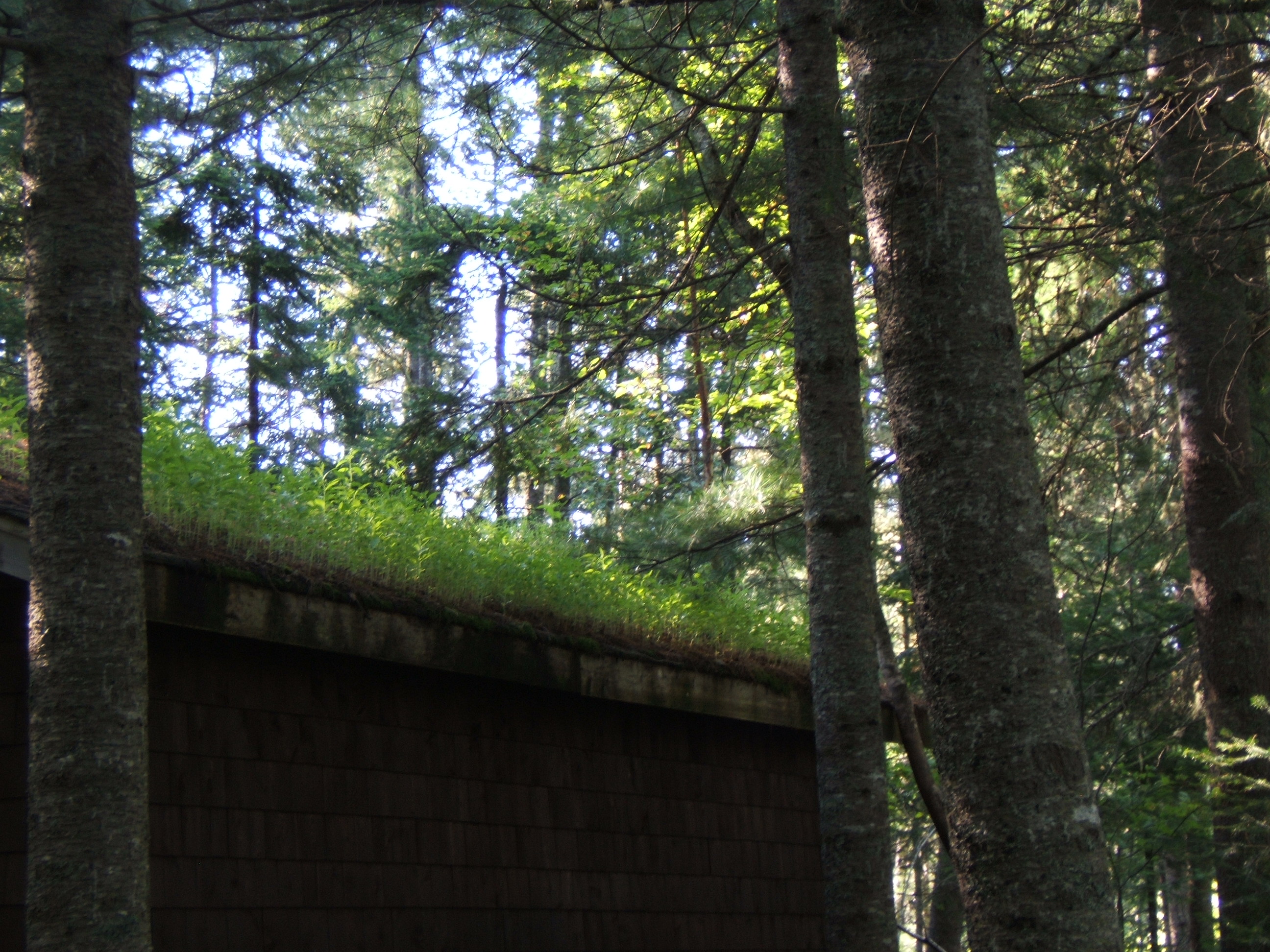
the right amount of soil, the right amount of sun
Just above the wood shed is a white pine. Each year it sheds some of its needles and these land on the roof. Over the years, they have gradually built up, forming a kind of compost. This year, a dusting of seeds found hold, sprouted and are thriving! The roof is still keeping the contents of the wood shed dry, although we expect a vigorous root to break through any time.
Sometimes, we find a space to grow and thrive where it is least expected.

thriving on the wood shed roof
‘niche’ on a rock
In July, we went to the Saint Martins area for the day and spent some time exploring the caves and beach-combing. We also took the short drive to the lighthouse at Quaco Head. The lighthouse is perched on the cliff overlooking Quaco Bay.

the Quaco Head Lighthouse ....... “The present Quaco Head Lighthouse was constructed in 1966 and consists of a square tower rising from one corner of a concrete fog signal building. The light in its lantern room produces a white flash every ten seconds, while the fog signal emits a three-second blast every thirty seconds, when needed.” from http://www.lighthousefriends.com/
If you look out over the Bay, you can see some exposed rocks where sea birds make their home, and, to the north-east, Martin Head, about 30 kilometers away.

the view to the north-east ...... Martin Head is on the horizon, to the left
Wildflowers were everywhere, but what caught my eye was a lichen on a flat rock at the base of the lighthouse. It was bright orange, like a splash of paint.
There are two orange lichens that live on rocks in the coastal area of New Brunswick, Xanthoria and Caloplaca. The orange lichen I found at Quaco Head is likely one of two species: Xanthoria sorediata (Vain.) Poelt or Xanthoria elegans (Link) Th. Fr.
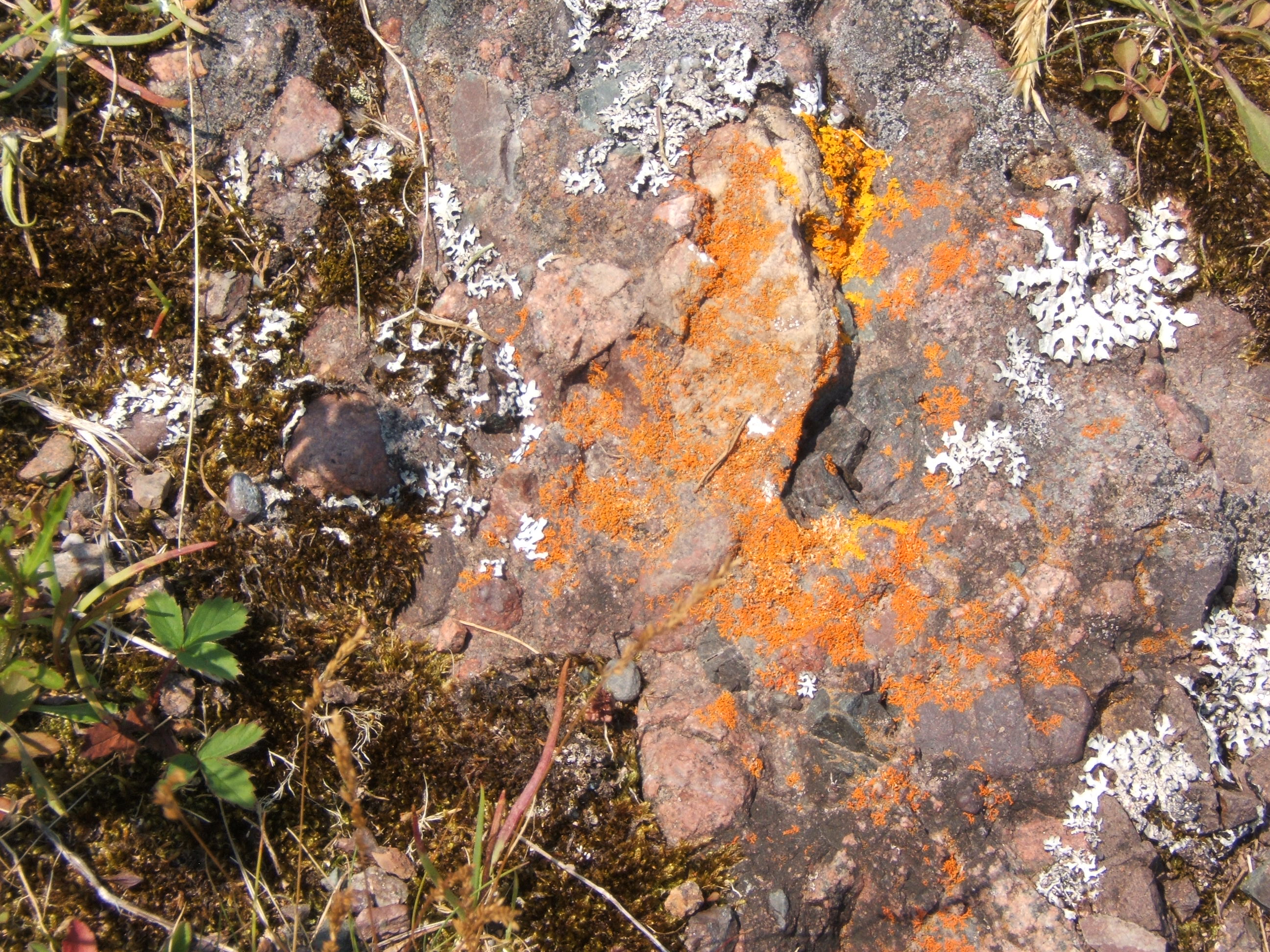
bright orange Xanthoria lichen on a rock .... there are also two or more other species of lichen present
A lichen is not a plant, but a composite organism, consisting of an algae and a fungus, living together in a symbiotic, mutually beneficial, relationship.
Ringing
Swallow Tail Lighthouse, Grand Manan
air saltfresh and balsam
walls lapped by a juniper sea
pale mimic of the salt sea
battering its foundations
its endurance
a mystery
until I found
an iron ring
anchored deep
in rock
almost lost
in lichen
Xanthoria orange
lifted and dropped
run round
its axis
clashing on stone
creak and clank of the metal door
echoes climbing the welded stair
ground glass grit of the light
fog washed clang of the channel bell
rock lashed to the lighthouse
salt breakers turned to stone
Published as: ‘Ringing’, Spring 1995, The Cormorant XI (2)
(revised)
© Jane Tims
exploring the intertidal zone
Every summer, we take a day to drive along the Bay of Fundy and explore some of the beaches and rocky shores. Last summer, we found a small cove where the fog was just lifting.
Through the mist we could see the ghostly form of a fishing weir and the distant rugged shore.

a cove along the Bay of Fundy coast
The beach was pebbles and sand, perfect for beach-combing. We wandered at random, watching for sea glass, shells and wave-smoothed rocks.
The intertidal area, between low and high tide, is an extraordinary space, not quite ocean, not quite land. The plants and animals who live in this area have very particular ‘niche-needs’. They need the rise and fall of the tide twice daily. Some plants have adaptations to help them cope with changing conditions. For example, the brown algae Ascophyllum nodosum has bladders to help it float at high tide and reach the sunlight.
When we explored the cove, it was low tide. Where the sea water was trapped among the rocks, there were tidal pools, small natural aquariums of sea life. One rock with a large hollow in its surface had its own population of bladder wrack (Fucus vesiculosis), green algae (Enteromorpha), barnacles, and a lone crab.
The barnacles are fun to watch. They are crustaceans, and live with their shells securely attatched to the substrate. An opening in the top of the shell is covered by a pair of ‘sliding doors’ called the operculum. Under water, the operculum opens and the barnacle reaches out with modified legs, designed to capture its food. The legs, known as cirri, look like feathery fingers, reaching out and pulling back, reaching out and pulling back.
The ‘niche’ of a particular plant or animal can be thought of as its ‘occupation’ in the space where it lives. For example, with respect to food gathering, the crab feeds on the larger prey in the pool, the barnacles filter out the smallest creatures, and the algae take in their nutrients from the water itself. Although they live in the same space, the crab, barnacles and algae each occupy a different ‘niche’.

one of the smallest tidal pools ever... in the hollow of a rock
Deep Cove detail
low tide
weirs and dories indistinct
pillars of fog
glide up the long beach
attention to
drifts of mica
periwinkle paths
breaking bands of wave
water kicked into rainbows
sunlight above the fog
plover tracks sprinkled on sand
cobbles, coloured glass
float ropes, plastic pink
rockweed
plaited by the sea
© Jane Tims