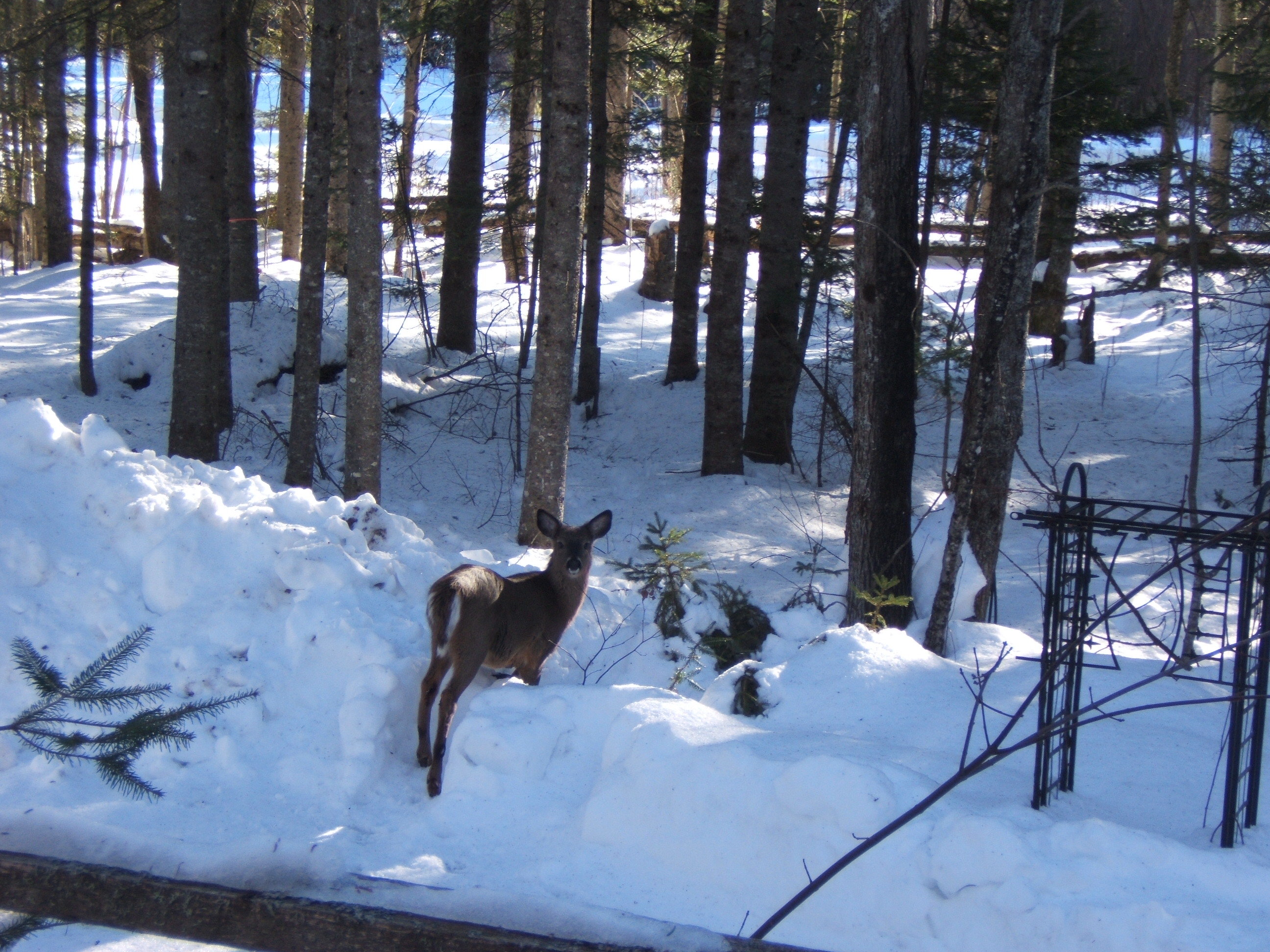
dear deer
This year, I moved our feeders to our front yard.
They are not so easy to see from the house, although I have a good view from the window of our library.

The deer have liked the new feeding station. We see them almost every day. They empty the feeder too quickly and also visit the compost pile. We don’t deliberately feed the deer, but they visit the feeders anyway.

~
deep and delicate, hoof print
evidence, this space is shared
~
deer, eat peelings by moonlight
one floor up, we sleep, unaware
~
lulled by winter carbs
carrots and potatoes in the supper stew
~
Copyright Jane Tims 2013
featuring a 1941 International truck
I have had a few poems accepted for publication recently. These include ‘abandoned resort hotel, Devil’s Head’; ‘Berries in Cellophane’; and ‘1941 International K-4’. They appear in Issue 10 (Spring, 2013) of The Lion’s Head Magazine (online). You can have a look at these three poems at http://lionsheadpress.blogspot.ca/
~
‘Berries in Cellophane’ is from my manuscript on growing and gathering local foods.
The poems ‘abandoned resort hotel, Devil’s Head’ and ‘ ‘1941 International K-4’ are both part of a series, not yet completed, on abandonment. This series began my interest in abandoned churches, and lead to the novel I am now working on – ‘Saving the Landing Church’.
~
The poem ‘1941 International K-4’ was inspired by an old International truck, seen in a wood lot in southern New Brunswick in the fall of 2011. It was set up on steel drums and looked like it was no longer used. Rusted and out-of-commission, she was still elegant to behold. The poem came easily, written in the ‘voice’ of the truck, recalling its various adventures.
Have a look at the poem in Lion’s Head Magazine and let me know what you think.

~

Copyright Jane Tims 2013
editing to remove the passive voice
I am still editing my novel, aiming for the third draft. Today is about finding and eradicating the passive voice. When I find an instant of the passive voice, I try to find a better, more active way to present the idea.
The passive voice occurs when the object of an action is expressed as the subject. ‘The book was read by Jane’ (passive voice) … instead of … ‘Jane read the book’ (active voice).
The passive voice is often accompanied by a form of the verb ‘to be’. A simple example: ‘The text had been edited by the teacher’ (passive voice) … ‘The teacher had edited the text’ (active voice).
The active voice is usually preferred because it’s direct, energetic and less wordy. Sometimes the passive voice is Ok to use – for example, if the agent of an action is unknown or unimportant: ‘The letters were misdirected to Toronto.’
~
Here are examples of some of the changes I have made:
~
Passive : The louvers of the belfry were splintered where they had been damaged by the move.
Active: The move had damaged the louvers of the belfry, splintering the wood.
~

louvers in a belfry, the wood not splintered!!!
~
Passive: Our taste buds were teased by names like the Pickle in the Barrel Pub, Heavenly Hash, and Bob’s Country Diner.
Active: Names like the Pickle in the Barrel Pub, Heavenly Hash, and Bob’s Country Diner teased our taste buds.
~

if there were such a place as ‘Heavenly Hash’, they might serve a salad like this!!!!
~
Passive: The deconsecration has been approved by the Diocese
Active: The Diocese has approved the deconsecration.
~
~
I treat my edits of dialogue a little differently with respect to the passive voice. People often speak in the passive and so I am careful to edit for what sounds natural rather than what is grammatically correct!
~
Copyright Jane Tims 2013
the case of the missing…
My Mom always loved her belongings and kept excellent care of them. She also tried to keep track of them, but with four children (especially me), occasionally items went missing.
Once she called me in great distress. She had been all over her property and could not locate the second wheel from a pair of wagon wheels she knew she had.
I said she didn’t have to worry. I had taken the wheel as a decoration for my yard.
Today, I can look out at my winter garden, and see Mom’s missing wagon wheel.
 ~
~
Copyright Jane Tims 2013
writing a novel – the first reads
So, I have completed the second draft of my novel. This stage follows the pages of edits I had after reading my book on my e-reader. It took two long days to make the changes. I emerged from the experience feeling that I needed a few other eyes on my work before I start another draft.
I am lucky to have two people in my family who have volunteered to look at the draft, my son and my niece. I am also fortunate to belong to a couple of writer’s groups and some of these brave folk have agreed to give the draft a critical read. I don’t know what to expect, but it will be so helpful to see their comments, both good and bad. I am so grateful to them all.
My husband is also listening to the draft. Just before we watch Coronation Street each evening, I read a chapter from my novel to him. He is no book-worm, but he listens carefully and gives me his impressions. He is especially helpful on some of the technical issues. For example, my main character’s husband, Tom, is a welder, and my husband explained to me that you can’t weld copper to steel. Also, I find errors as I read. So, I make a few changes each evening.
~

Tom, my main character’s husband, is a welder… in the novel, he makes a series of wind sculptures for the writers’ retreat… this wind sculpture is one we have at our real property by the lake
~
I am rapidly coming to a time when I will leave the draft untouched for about three weeks. This is Stephen King’s advice (On Writing, 2000). It will give me a chance to return to my poetry and meet some upcoming deadlines. Then I will pick up the draft of my novel, to read it as if brand new! Who knows what idiosyncrasies I will find!!!
~
For you to read, here is an excerpt from the book, about Tom’s wind sculpture:
~
‘You shouldn’t be welding, you know,’ I said. ‘The doctor said you might improve if you stayed away.’
‘The doctor said I’d already done all the damage I could do,’ said Tom.
I was silent. It was an old argument. Tom didn’t want to hear about possibilities. He believed in the frozen-cold facts.
‘Hey, girl, have a look.’
He lifted part of his project from the bench. The main element was a long cylinder of steel. In a coil around the cylinder, he had welded a thick, inflexible steel wire. To the flat end of this wire, Tom had screwed a broad triangle of copper sheeting. The triangle was shaped like an oak leaf, cupped and angled to catch the wind. Tom stood the cylinder on its end and it became a tree with a single clinging leaf. He reached for another piece of formed metal and threaded the two together. With his hands, he moved the unit, giving me a glimpse of the way it would move in the wind.
‘It’s wonderful,’ I said, always awed by the mellow gleam of the copper and his ingenious designs. ‘How many leaves will there be?’
‘Nine, in three layers,’ he said. ‘It’ll be taller and quicker than the others.’ He had already finished the first three in a series of these wind mobiles. Eventually, they would be part of a sort of garden he had planned for the property. ‘Writers,’ he said, ‘will visit the wind garden and be inspired.’
The whisper of the wind and the mobile joinery of the sculpture, the exchange of light between the burnished metal and the shimmering lake, together these would create a magical, rhythmic experience of light, movement and sound, perfect for meditation and contemplation.
~
Copyright Jane Tims 2013
a moment of beautiful – icicles
the space: drip line of a house on a winter day
the beautiful: icicles
~
On the day after an increase in temperature, when the snow from the roof is melting, the front of our house, on the south side and in full sun, is always dripping and making icicles.
They glitter and sparkle, sculptural wonders of frozen water.
~

~
~
ice storm
~
for three days
freezing rain and willow
have hung uncertain magic
along the river
~
ice in layers
laid on the bones
of the tree tops, branches break
candy-coats crack in the sun
~
I refuse the sparkle
resist the awe
worry
the bones will not recover
~
~
© Jane Tims 2009
writing a novel – words, words, words
I have kept close track of my progress during the writing of my novel.
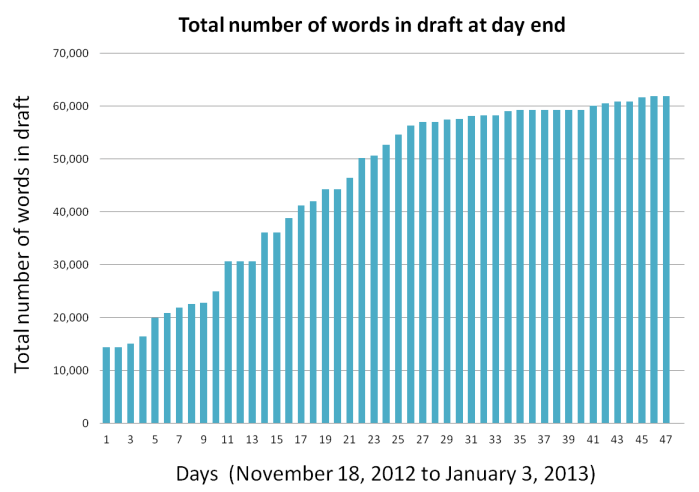
I began writing my novel ‘Saving the Landing Church’ on November 1, 2012. By November 18, I had a short story of 14,432 words. After November 18, each day, before I saved the document, I took a word count. This helped me feel productive and let me decide when it was time to start editing the first draft. In the graph below, you can see the number of words I had on each day after November 18 (Day 1).
During the writing, I decided 60,000 words would be a good goal. At first, I was worried I wouldn’t be able to reach this many words. By December 9 (Day 22), I had reached 50,000 words, the story was almost told, and I knew I would reach my goal. Around Day 26, at a little less than 60,000 words, I was beginning to edit.
~
I also made a graph to show how many words I wrote per day. My daily goal was 2000 words, as Stephen King recommends in his book On Writing (Schribner, 2000). Until my editing phase (beginning Day 26), my production was highly variable. However, I usually wrote more than 1000 words per day. I had four very productive days when I wrote more than 3000 words.

I hope this might help you to be aware of your productivity when writing.
I know that quantity does not equal quality. I also know that, during editing, my word count could begin to be in the negative. But, during the phase of producing the first draft, I do think the number of words is a useful indicator for a writer who wants to make progress on a particular project.
~
Copyright Jane Tims 2013
writing a novel – e-reader editing
So the poet is writing a novel…
~
Title: unknown
Working Title: Saving the Landing Church
Setting: a writers’ retreat, including an abandoned church
Characters: main character a writer; her husband Tom; people from the embedded community including next door neighbors Emma and Mark; people from the commuter community; the aberrant community
Plot: the story of how a woman tries to preserve an abandoned church with unexpected consequences for herself and for the community
~
~
I have finished my first draft!
This week, I am working on edits.
The writer’s discipline of producing something each day suits me most of the time. I characteristically accomplish enough in three or four hours of work to push back from the computer with a feeling of satisfaction.
Some days, it’s harder to focus. I find editing particularly hard. Perhaps because of the recent holidays, perhaps because it is so cold outside, this week I have been having trouble concentrating.
Yesterday, I discovered a way to make the editing easier!
Lately, I’ve been using my e-reader more and more for general reading. I thought, why not use it to read my own (draft) book?
I didn’t do any fancy work. I merely took my Word draft and saved it as a .pdf file. The first time I did this, the font was so tiny, I’d have to use a magnifier to read. So I experimented a little, and finally settled on the font Times New Roman, size 22, double-spaced. Once I made the font change in Word, I saved it as a .pdf file and copied it directly into my Kobo e-reader. There were a couple of glitches which I didn’t bother to fix. Some words transposed as bold (as you can see in the photo) and none of my italics made it through. But the book was very readable.
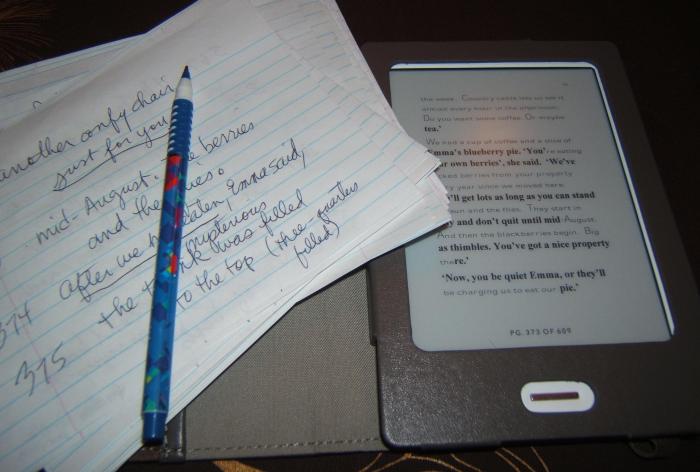
Today and yesterday, I have been editing in luxury. I have been sitting in my comfy chair, with a warm throw, a cup of tea and my Kobo. By having my draft in book format, I can see it as a book, read it with more ‘distance’ and more easily find the places I need to re-write or edit. I keep track of edits, page by page, in pen, on note paper. Of course, I’ll have to do the final edits at the computer, but that pain is somewhere in the future, made easier by the ‘Find’ feature in Word.
One step closer to completion!!!
~
Copyright Jane Tims 2013

blackberries as big as thimbles
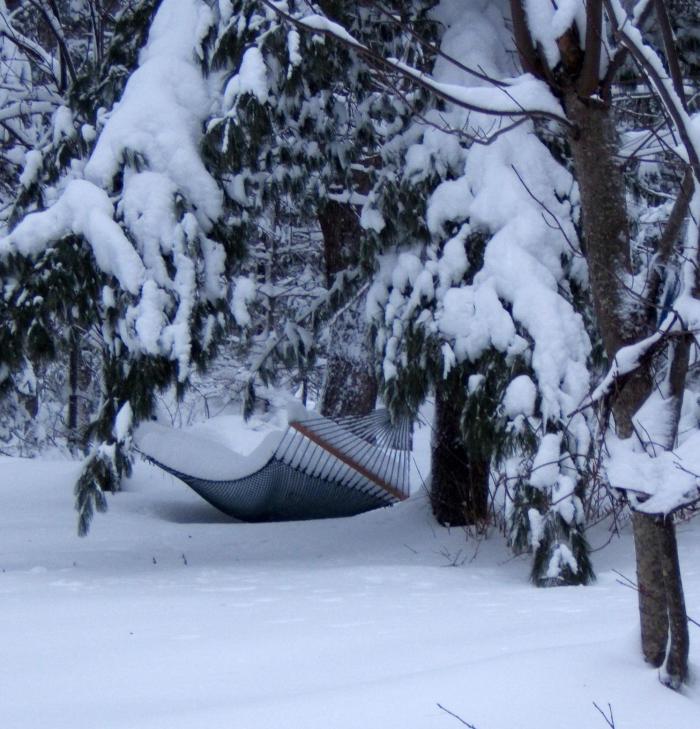
snowfall and summer
~
envy
~
in the hammock
the snow rocks
gently, enthralled by
whispers
of fireflies
owl calls
~
wind harasses
the pines
mutters them miserable
snow fall ceases
stars punctuate
indigo sky
~
snow dwindles
shrinks and sublimates
the hammock cradles
a frail cadaver, swings
in obedience to
winter storm
~
~
Copyright Jane Tims 2013
Happy New Year from the 1910s
Happy New Year!
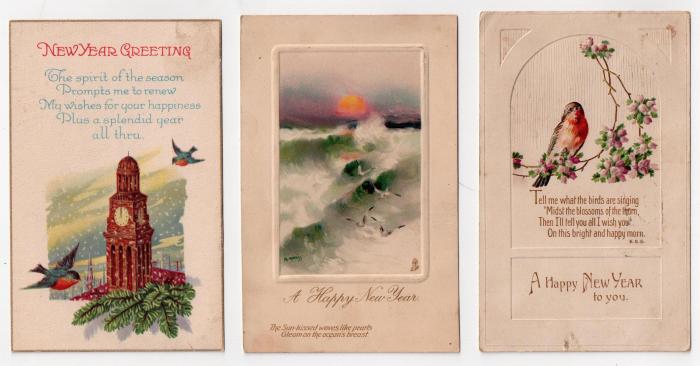
Once, in the 1910s, special wishes were sent on New Year’s Day via post card.
Today, I want to put these old post cards to good use again, using them to wish you the best possible in the coming year!!!!
 ~
~
 ~
~
 ~
~
 ~
~
 ~
~
Copyright Jane Tims 2012