Archive for the ‘writing’ Category
in the shelter of the covered bridge – final manuscript
In the last weeks, I have been working towards completion of the book-length manuscript for ‘in the shelter of the covered bridge’. It includes poems and drawings about the plants and animals living in and around some of the covered bridges in New Brunswick.
~
Earlier this summer I was lucky enough to win a mentoring package from the Writers’ Federation of New Brunswick. I chose a talented, award-winning local poet to work with me on the manuscript and during the early part of the summer, with her expert guidance, I made revisions to the poems. She focused my attention on word choice, clarity and ‘showing not telling’. She also helped me with a handful of poems I thought were not salvageable and now some of these will make it into the manuscript!
~
In the last few weeks, I have worked on revisions, ordering of the poems, and, hardest of all, my footnotes. Since the poems are about the remaining covered bridges in the St. John River watershed, I want to include some basic information in the footnotes as well as notes I made during my visits to each bridge. I have also worked on the drawings I will include in the manuscript.
~

~
The process of preparing a manuscript is long and certainly goes beyond the fist few lines written on the page way back when this manuscript was just an idea. But if the way is about the journey, this has been such a memorable experience. Best of all, I have been lucky to make the acquaintance of many of New Brunswick’s covered bridges. Last Thursday, as we returned home from a visit, we saw a double rainbow in the sky and I was able to snap a shot as we waited to take our turn crossing the covered bridge across the Rusagonis River (the Patrick Owens Bridge):
~
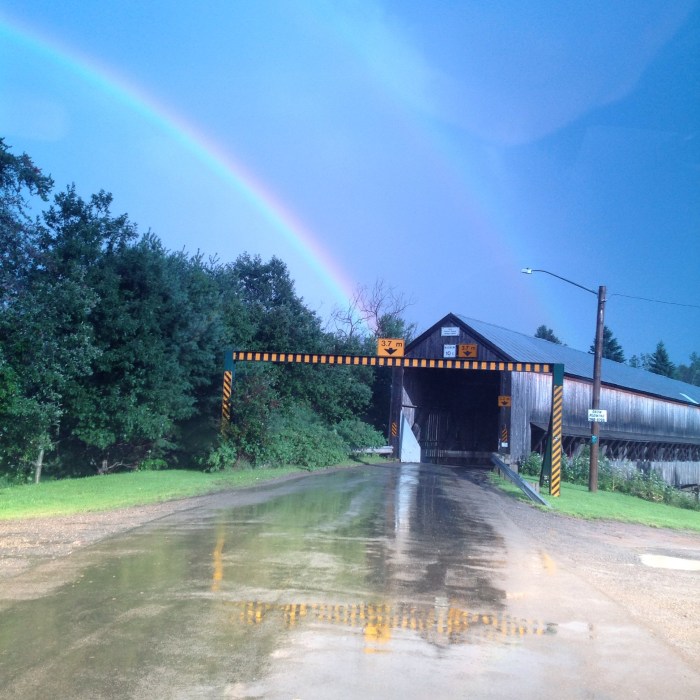
double rainbow over the Rusagonis #2 Covered Bridge in Rusagonis, New Brunswick – August 19, 2016
~
Copyright Jane Tims 2016
playing alleys
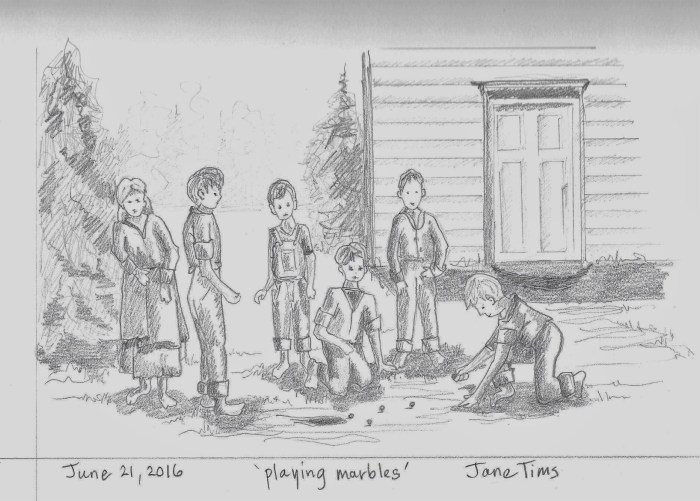
Kids in the school yard have played marbles since the late 1800s, when glass marbles were first produced for the mass market.
~
When my mom talked about marbles, she always referred to them as alleys, no matter what material was used in their construction. According to Wikipedia, alleys were a specific type of marble. Almost every kind of marble has a specific name. When my son played and collected marbles in the 1980s, some of these terms were regularly heard in our home.
aggie – made of agate
alley – a marble made of alabaster
bumblebee – a yellow and black glass marble
cat’s eye – a marble with a eye-like inclusion
crystal – a clear glass marble of various colours
galaxy – opaque marble with coloured dots
oily – an opaque marble with a sheen or oily finish
onionskin – a marble with surface streaks of colour
ox blood – a marble with a streak of dark red
pearl – opaque marble of single colour and a mother of pearl finish
plainsie – a clear glass marble with inclusion of two or more swirled ribbons of colour
swirly – glass marble with a ribbon inclusion of a single colour
tiger – a clear marble with orange and yellow stripes
~
There are lots of other marble types and names.
~
The language of marbles extends to the various moves in the game:
knuckle down – put hand in position to shoot
keepsies – to play for keeps
quitsies – stop playing without consequences
firing – to shoot a marble
~
Such interesting possibilities for the language of a poem!
~
Writing about a game of marbles will include all the senses (I think my poem will be from the point of view of a boy playing marbles):
sound – clinking of dishes in the sink; grinding of marbles together in the marble bag
taste – grit of sand stirred by wind across the playground; grit of raspberry seeds
feel – the cold smooth feel of a marble; a chunk of icicle from the roof in December
smell – stirred dust; girls watching the games, smelling of Ivory soap and well water
sight – bubble rising through the glass of the marble; bubbles with rainbows sliding; dew drops on Lady’s Mantle in the garden
~
I can hardly wait to write a poem about playing marbles in the school yard!
~
~
Copyright 2016 Jane Tims
Hermit thrush
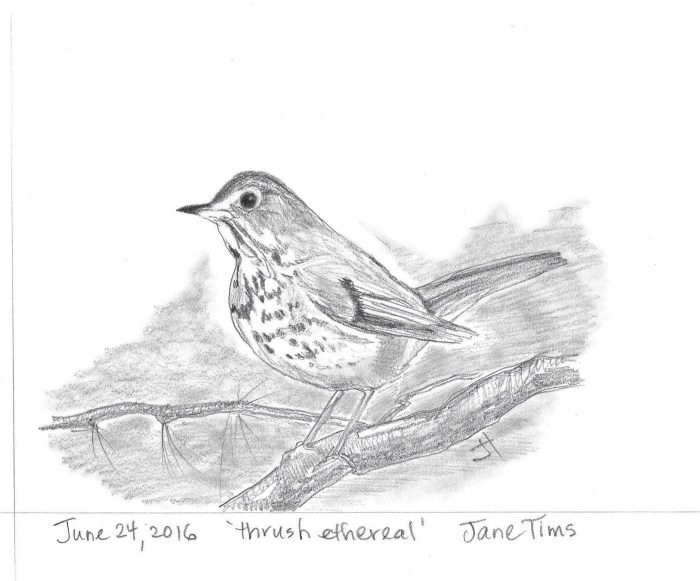
Another surprise in the morning bird chorus — a Hermit thrush. I have been listening for it all spring and at last, this morning, the ethereal notes.
~
~
How to describe the song of the Hermit thrush? T.S. Eliot described it in The Waste Land, in V: What the Thunder Said :
… sound of water over a rock
Where the hermit-thrush sings in the pine trees
Drip drop drip drop drop drop drop …
and
… who is the third who walks always beside you …
and
… In the faint moonlight, the grass is singing
Over the tumbled graves …
~
A technical description of the Hermit thrush song is ‘a beginning note, then several descending musical phrases in a minor key, repeated at different pitches.’
~
The song is clear, flute-like. To me the essential characteristics are the change in pitch at the beginning of the new phrase and the hint of water within. If you watch the Hermit thrush while she is singing, she stands tall, tilts her head back, looks into the distance with her bright black eye, lifts her feathers ever so slightly and opens her beak. Her throat swells a little but otherwise you are left to wonder, where do those notes begin?
~
If her song was another sound, it would be a flute in the forest.
If it was a smell, it would be the sweet scent of mayflowers, as you part the leaves with the back of your hand.
If it was a touch, it would be lifted hairs at the back of your neck.
If it was a taste, it would be syrup drizzled over iced milk.
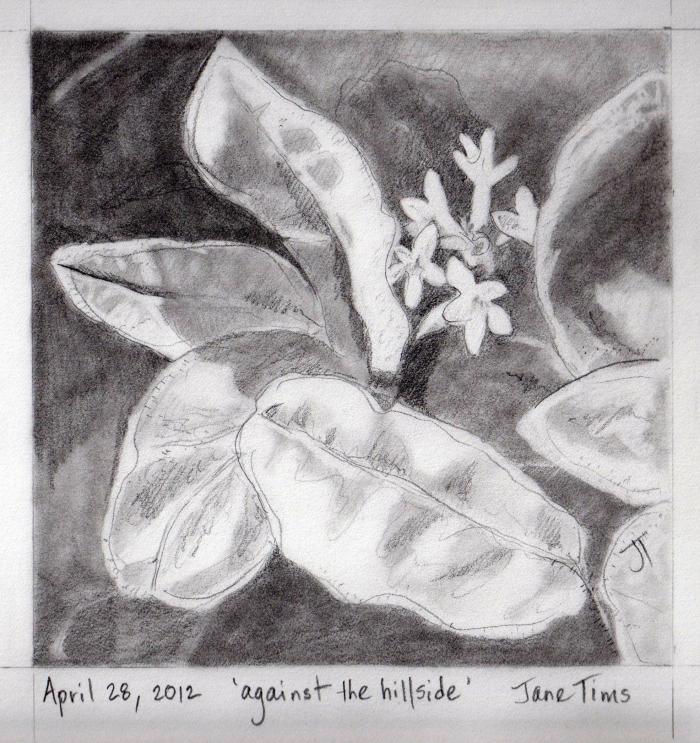
If it was an image, it would be guttation drops on strawberries.
~
~
What other words describe the song of the Hermit thrush?
clear
precise
covert
alone
sweet
tremolo
pure
hidden
pensive
thoughtful
thicket
froth on a dancing wave
raindrops trembling on the tips of leaves
the step from rung to rung on a ladder
~
If it was a vowel, it would be every vowel
If it was a consonant, it would be ‘c’, ‘l’, ‘r’, or ‘v’
~
~
Hermit thrush
~
Catharus guttatus
~
neither visceral nor guttural, ethereal
tip-toe in tree tops
air pulled into taffy thread
a flute in the forest
froth on a wave
~
rain trembles on leaf tips
guttation drops on strawberry
a lifted curtain of mayflower
~
I saw you there
hidden in the thicket
and I followed
~
climb the ladder and sing
then step to the rung below
heads up, thoughts of the new day
parting of the beak
pulse at the throat
hairs lift
at the nape
of the neck, fingers
warble the keys
between middle and ring
catharsis
~
~
Copyright 2016 Jane Tims
‘within easy reach’ – the history of a writing project
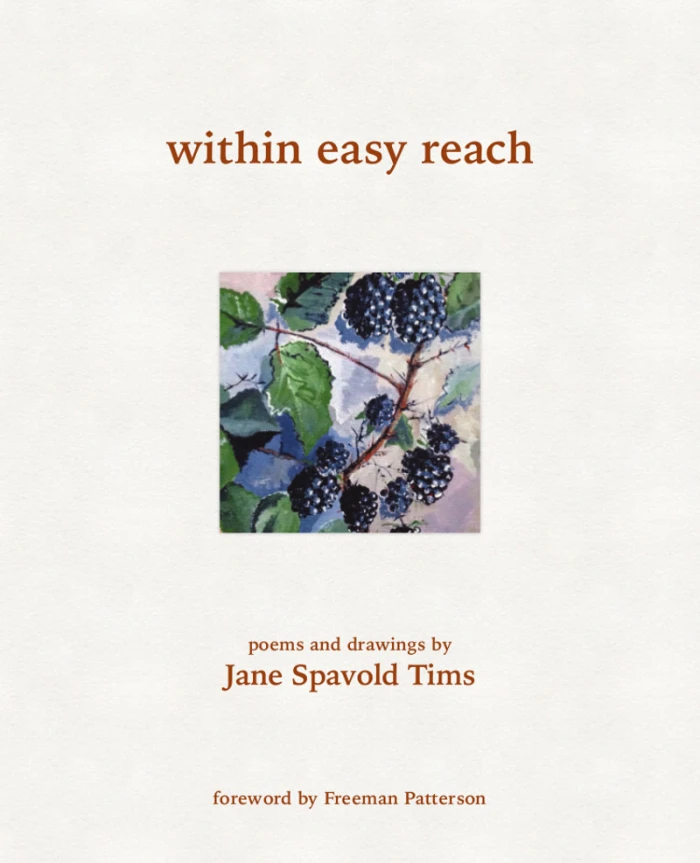
As I prepare for the publication and launch of my poetry book within easy reach, I am thinking about how long it takes to see a writing project through from beginning to end.
~
Of course, the time depends on the writer, the project and many circumstances beyond the writer’s control. But the way to a book of poems can be long … for me it has not been days or months, but years.
~
2010
For my book, the first idea came in 2010 when my husband and I were exploring our new lake property. We knew so little about the property and were delighted to find blackberries, growing in profusion along the ridge above the lake. I can still taste those plump indigo berries and remember how quickly we filled my husband’s hat (the only container we had for picking). I wrote the first poem for the project (‘berries in brambles’) at the end of the summer. By then I was thinking about combining my interests in local food and botany to write a manuscript of poems about ‘growing and gathering’.
~

blackberries at our lake property
~
2011
The second step in the project came with an application to artsnb for a Creation Grant. Not every writer seeks funding, but I knew, after 35 years of work, that I would produce my best work with a clear purpose and deadlines. I applied to artsnb in March 2011, in time for their April 1st deadline. When I was not successful, I tried again for the October 1st deadline and in December, a few weeks before my retirement, I received the letter saying my project had been approved. I would be able to transition from work into an endeavor I knew I would love!
~
2012
The writing of ‘growing and gathering’ continued through the spring and summer of 2012. I was determined to base my poems on experience, so I spent lots of time hiking and driving to locate and pick the various plants I wanted to write about. That spring we tapped twelve of our red maple trees and planted a small garden. Many of the plants I harvested grow on our properties at home and at the lake, but for some of the plants, we drove the countryside, poking about in the right habitat to find the plants I sought. My best memory is of a spring day along the Dunbar Stream north of Fredericton, discovering mounds of trout lily leaves growing on the floodplains along the brook.
~
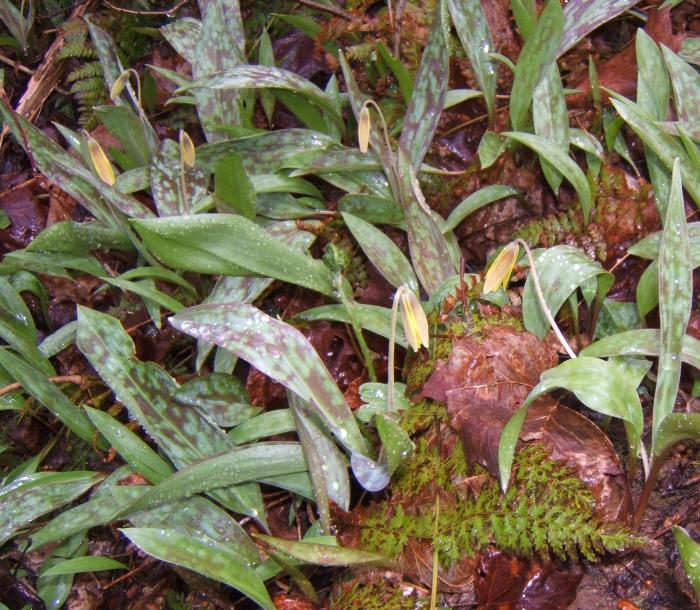
Trout Lily, also known as Dog’s Tooth Violet or Yellow Adder’s-tongue
~
For the next months, I harvested leaves and roots and nuts and berries. I chopped greens. I boiled, simmered and sautéed. I competed, unsuccessfully, with squirrels for hazelnuts. I scraped gum from spruce trees and peeled wild sarsaparilla roots. And, of course, I ate my fill of raspberries, blueberries, dandelion greens, fiddleheads, samphire greens, orach leaves and apples. From my own garden, I harvested rhubarb and herbs, onions and tomatoes. I visited Farmers Markets and roadside stands, sampling the best local produce in the world. I stirred memories from my own family history, recalling days when my dad kept bee hives and when my mom and I went blueberry picking. Really doesn’t sound like work, right?
~

salad ingredients from the garden and market
~
And then I wrote. And did research about the edibility of plants. And wrote some more. And did lots of pencil drawings. As I wrote, I consulted my Floras of New Brunswick and Nova Scotia. I completed my project with a manuscript of 135 poems and 29 pencil drawings. I submitted my manuscript to artsnb in October 2012.
~
2013
For me, the writing is only part of the process. I try to read my poems as often as possible, and I submit regularly for publication. For the ‘growing and gathering’ project, I read poems at eleven events and submitted poems to 12 literary journals. I had some success and, of the poems in the book, twelve have been previously published in seven literary journals. I also submitted the manuscript to the New Brunswick Writers’ Federation writing contest in 2013, winning Honorable Mention. Now that all sounds like work!
~

Orach growing among the rocks at the upper end of the Minister’s Island causeway
~
2014
From the beginning, I knew I wanted a published book of the ‘growing and gathering’ poems. So in 2014, after revisions and paring the poems to a reasonable book length, I began to submit to publishers. I submitted to three publishers and received three kind rejections. Then, in the fall of 2014, at the New Brunswick Writers’ Federation WordsFall, I met Keith Helmuth and Brendan Helmuth of Chapel Street Editions in Woodstock. They were interested in publishing books about the natural and human history of the Saint John River and I wondered if they might be interested in my book. I sent them my manuscript and soon began one of the best partnerships of my life.
~
2015 – 2016
During the last months, Keith and Brendan have worked to prepare my manuscript for publication. I have read every poem 20 times, revisited sources, squinted at Latin names to make certain they are spelled correctly and considered every comma and every line break.
~
Within a few weeks, my poetry book, within easy reach, will be a reality. When I first hold the finished book in my hands, I know I will be experiencing a milestone in my life. I will probably melt into a puddle. And the work will not yet be done! Ahead of me are readings and marketing and signing copies. I hope the rooms where I present my book are crowded with people eager to buy and read, but I know there may be places where I will be hoping a lone bystander will purchase a copy.
~
From beginning to end, my book has taken almost six years to complete. This may sound a bit daunting for a new writer reading this, but it is also encouraging. Your goal, like mine, may be publication. But it may also be to create a body of work representative of your life as a writer. My experience shows that every line, every paragraph, every poem you write, is part of a path towards your goal, whatever it may be. ‘A writer writes.’
~
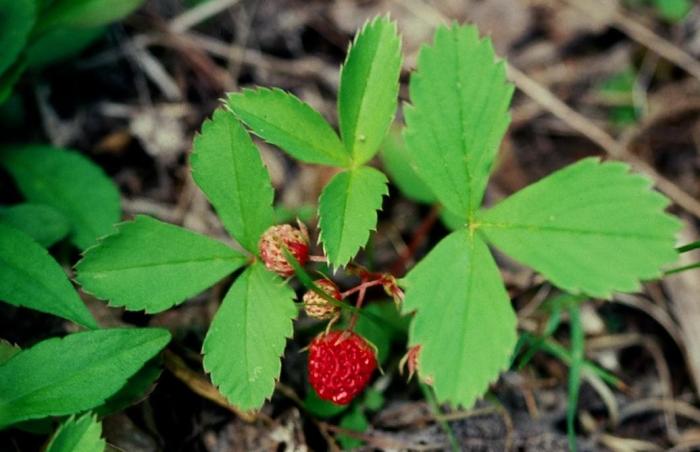
wild strawberries at our lake property
~
Copyright 2016 Jane Tims
‘within easy reach’ – why did I write these poems?
Later this spring I will have a book of poems and drawings in publication – ‘within easy reach’. The poems and art in the book are about gathering local, mostly wild, foods. I have been fortunate to work with a wonderful publisher, Chapel Street Editions, interested in books about the natural history, human history, and cultural life of the St. John River Region of New Brunswick, Canada. http://www.chapelstreeteditions.com/about_chapel_street_editions.html
~
As a botanist, I loved making this book. Identifying plants is a skill learned in university and during years of enjoying the out-of-doors. Many of the plants are found on my own property, but my husband and I travelled throughout the region to find some species. We found edible trout lily along the banks of the Dunbar Stream, salty orach on the beaches of Saint Andrews, and dangerous-to-eat water dragon in a wetland on the Renous highway. On our own property we tried to out-smart the squirrels for hazelnuts, tapped twelve trees for maple syrup and discovered partridge berries growing in the woods behind our house. As you can see, part of my enthusiasm for the subject is about spending time with my husband!
~

~
I also did a little time-travelling to write these poems. Although most of the plants I write about are found in the St. John River Region, I looked into my own past to remember some edible plants in other parts of Canada. This included eating cactus berries on the Alberta prairie, buying cloud berries from children along the Trans-Canada in Newfoundland, and picking blueberries with my Mom and Dad in Nova Scotia. I also looked to the diaries of my Great-Aunt to get a glimpse of the growing and gathering habits of an earlier generation.
~
I am sure many of my poems will echo memories of your own experiences with local foods.
~
Eating near to home has so many benefits – these foods are often free and have not travelled far to your table. Many wild foods go unharvested although they are ‘within easy reach’. Just think of those apples in the abandoned orchard at the edge of town, the dandelion greens on your brother’s lawn, or the choke-cherries growing along the fence down the road. Although you should use care when eating wild foods, many are easy to harvest and can add variety and taste to your meals.
~

~
In my next post, I’ll say more about why you might enjoy reading my book. And very soon, I’ll be starting a count-down on my blog to let you know how many days you have to wait until publication. I’ll have a contest and a give-away. Shameless self-promotion!
~
Copyright Jane Tims 2016
‘within easy reach’
This spring, I will celebrate the publication of my first book of poetry!
~
‘within easy reach’ is a result of my 2012 project ‘growing and gathering’ supported by artsnb (the New Brunswick Arts Board). The poems focus on harvesting and eating local foods, especially wild foods. My book will be published by Chapel Street Editions, Woodstock, New Brunswick.
~
The book will include about sixty poems as well as some of my black and white pencil drawings. These are poems about picking blackberries and blueberries, eating coastal favorites like goose tongue greens and samphire, buying smelts from a truck at the roadside and fishing for landlocked salmon. Every poem is based on a personal experience of harvesting and using local foods.
~
During the next few posts, I will tell you more about my book and its poems and drawings. I can’t wait to show it to you!
~

‘fiddleheads’ – a wild food eaten every spring in New Brunswick
~
Copyright 2016 Jane Tims
loving hockey
I think that I will never be as proud of a magazine publication as I am of my two poems and two drawings in a hockey magazine!
Between the Lines – A Journal of Hockey Literature is a publication of the University of Saskatchewan, now in its third volume. The editors are Dwayne Brenna and Sara-Jane Gloutnez.
~
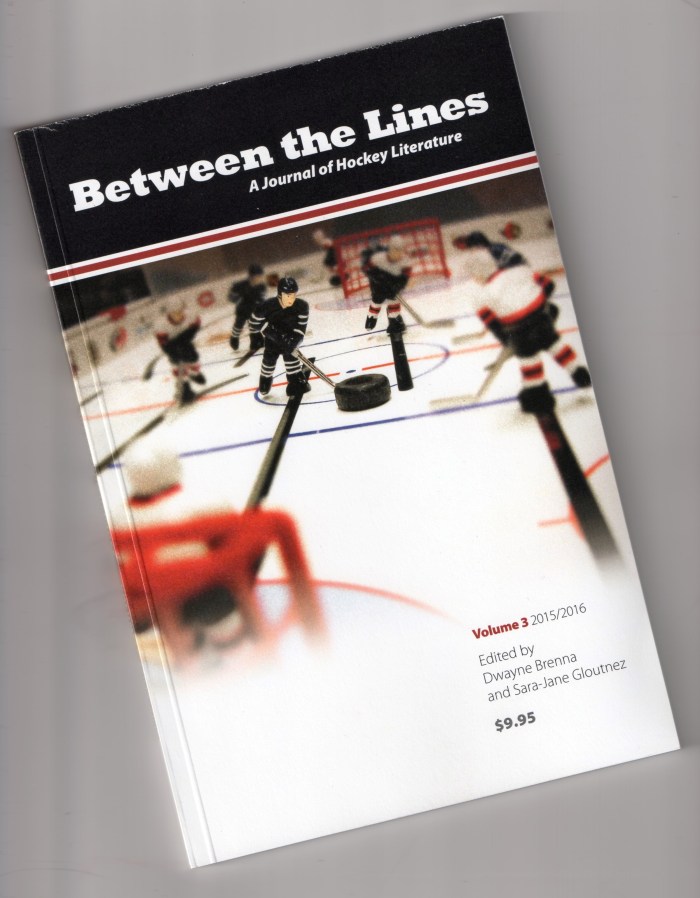
Between the Lines: A Journal of Hockey Literature
~
So, why am I so proud of this accomplishment? Is it because I am a lover of hockey? Just the opposite. I never pay it any attention! I have been known to ask if the Blue Jays won the Stanley Cup last year! However, one of my brothers is a devoted hockey fan. His love for the sport when he was young has always impressed me … I think people need should be passionate about their interests!
~
Hockey is a great theme for poetry. The game itself is naturally rhythmic (the movement of the skater, the varying pace of the game). The names of players and announcers, the terms for various plays, the enthusiasm of the fans … interesting words to work with! And metaphors abound.
~
I like to learn new things, to discover new themes for my writing and art. I also consider the game of hockey to be quintessentially Canadian. I can’t name a single hockey player after Mickey Mantle, but I love having my poems and art in a hockey magazine.
~
Between the Lines is a well-presented publication that includes stories about hockey and hockey players in both poetry and prose. The writing inside captures the scratch of blades on ice, the excitement of the announcer’s voice, the clouds of breath above the outside hockey rink, and the scurry of kids to move the net from the way of subdivision traffic.
~
~
loving hockey
~
at eight, my brother
was tall for his age
narrow-boned, jointed
as a skater bug
on the big farm pond
but compact, center
of gravity low
~
he learned to skate
on a strip of ice
by the driveway
practiced on the pond
a family myth
that he was pale
and our dad saw no value
in rising early
for ice time
~
my brother’s rink
a screen, rabbit-eared
Hockey Night in Canada
a pad of blue-lined
paper, hockey stick
a yellow pencil, skate
marks neat columns
of statistics, goals
and assists, Howe hat tricks
Mahovlich, Rocket
Richard, numbers
from the breathless
crescendo, Foster Hewitt –
‘He shoots, he scores.’
~
today my brother
is a fit man
an accountant, skates
on the boardroom table
on the frozen pond
a water strider
on the meniscus
attends games
at the coliseum
can still do a pivot
from standing
~
~

~
poem published as ‘loving hockey’ in Between the Lines, Volume 3, 2015/2016
drawing published in Between the Lines, Volume 1, 2014
~
Copyright 2015 Jane Tims
writing a novel – professional editing
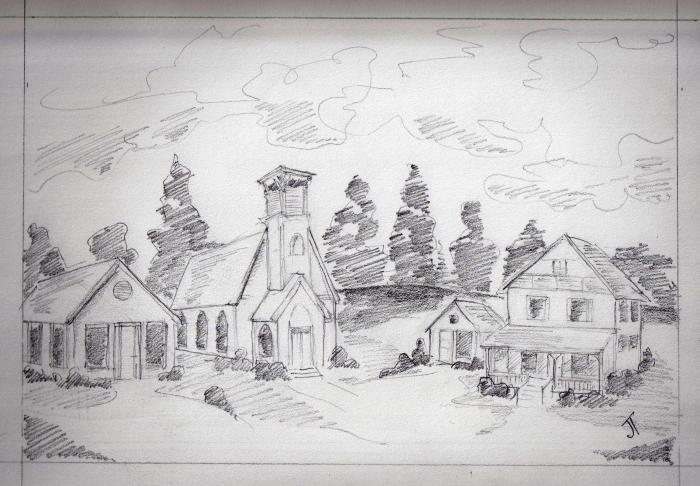
‘a writers’ retreat’
Jane Tims, November 29, 2012
~
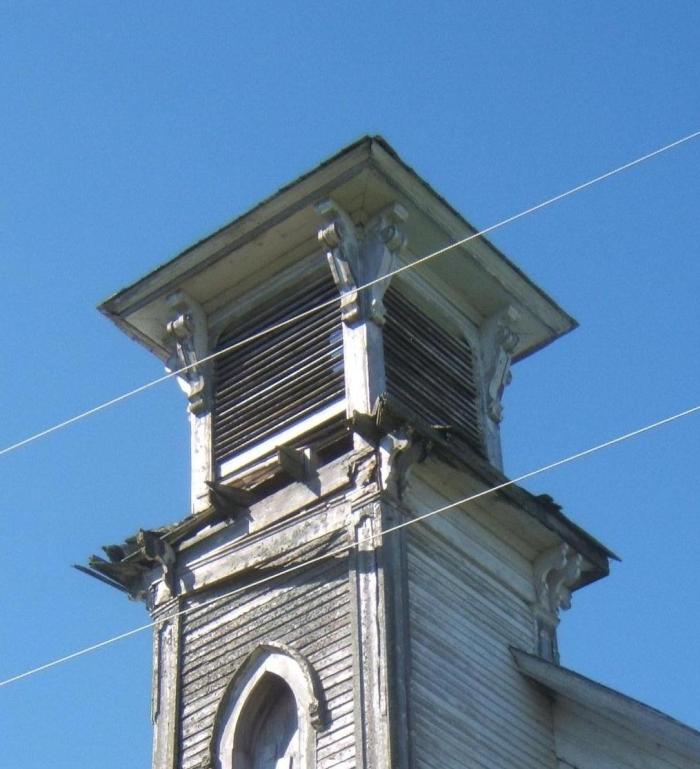
Remember my first novel? – ‘Saving the Landing Church’ aka ‘Open to the Skies’. The book is the story of how a woman tries to preserve an abandoned church with unexpected consequences for herself and for the community. The setting of the novel is a writers’ retreat in rural New Brunswick.
~
I began the book three years ago and worked on it, on and off, for a year. Since then, I have been working on two more novels in the series: ‘Crossing at a Walk’ and ‘Shore to Shore’.
~
In the last year, I sent ‘Open to the Skies’ to three publishers. Eventually I heard back from each one: ‘interesting but does not meet our publishing needs’. Disappointing but expected. However I intend to accomplish my goal of getting my novel published!
~
~
I decided to take another step and ask a professional editor to look at my novel and offer comments. I hired Lee Thompson of ‘Lee Thompson Editing +’ ( http://leethompsonediting.com/ ) to read my book and comment. I knew Lee from his role as Executive Director with the New Brunswick Writers’ Federation and took him up on one of the editing specials he occasionally offers. Lee read my novel and provided me with chapter-by-chapter notes about dialogue, plot pace and voice. He helped me most by pointing out areas where he felt characters were not contributing enough to the story.
~
The following is my commentary on Lee’s editing services:
One of the hardest aspects of writing is overcoming subjectivity. Hiring Lee to read and assess my novel helped to overcome this problem since Lee is not only a skilled editor, but is able to provide his comments in a way that encourages a writer’s objectivity. Lee provided a chapter-by-chapter analysis of my novel, including his assessment of what worked, what didn’t and suggestions for improvements. First, I knew by his synopsis that he had read the novel thoroughly and understood what I was trying to achieve. His comments on dialogue, plot pace and voice were specific and not only improved this book but helped me to look at my writing in a new way. Most important, his insightful thoughts on gaps in the story led me to discover story areas and directions that had previously eluded me but waited just below the surface to be discovered. Thanks to Lee I am now in the last stages of a final draft and almost ready to submit the novel to some of the publishers he suggested. I have realized that obtaining the services of a professional editor is one of the most important steps a writer can take – Lee’s confidence and skill made this part of the process painless and productive!
~
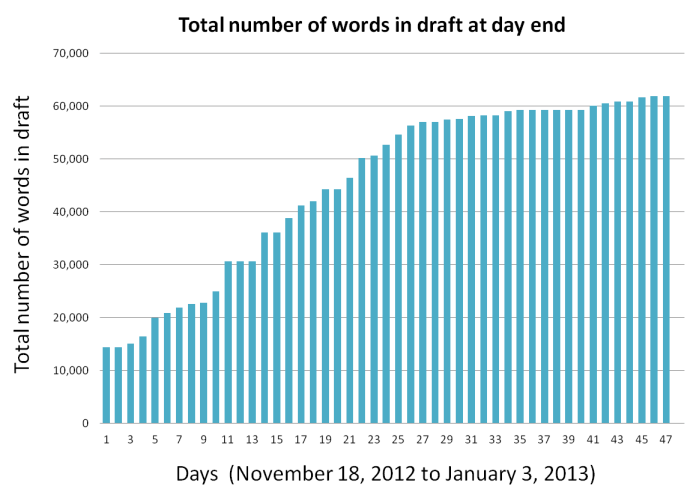
I am realising that writing a novel is a story of its own, consisting of many parts, each with its own consequences:
~
- First ideas about story and plot – a place to begin
- First Draft – the novel takes shape
- Second Draft – revision
- Third Draft and so on – more revision
- Beta Reader – someone to cast a reader’s eye on the draft and provide feedback
- Professional Editor – someone to cast an editor’s eye on the draft and provide feedback
- Publisher – someone to read and reject the novel
- Publisher – someone to read and accept the novel for publication
- Readers – someone to read the words and discover the story
~
~
Copyright 2015 Jane Tims
places for writers … writing desks
‘writer’ and ‘desk’ … a likely pairing of words … a writer may have many desks, but does the desk have a writer?
~
In our home are five desks, four for me.
~

the writing desk in my guest room
The desk in my guest room is the neatest, used only for addressing Christmas cards in December. A little desk, it has a lamp, a box of stamps for personalizing cards and envelopes, a ceramic dog that once sat on my desk at work, a tiny gecko bought for me in Milan by my oldest brother, a cloisonné sea-shell from my sister, and a hand-blown glass purchased with my husband in Ontario. Quite by accident, these items are all orange and green. I sit at this desk every morning, to look at the eastern sky and plan my day. I never write fiction or poetry at this desk.
~
my desk in the loft
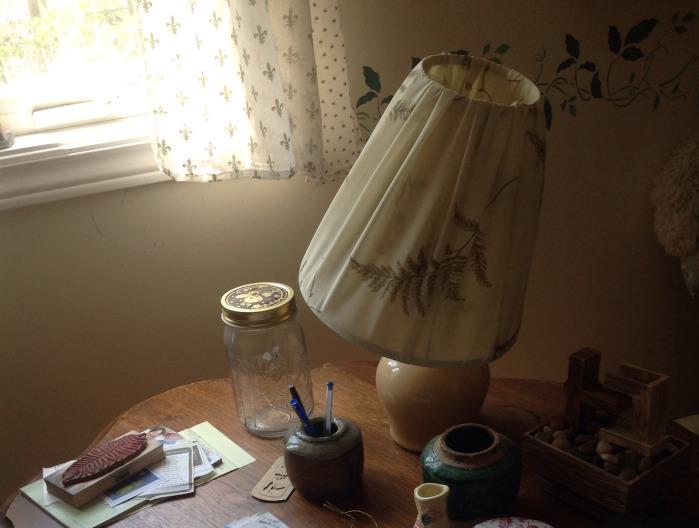
The desk in the loft is my official desk. This desk is oval and was given to me by my youngest brother – it originally belonged to my aunt. It has a lamp, a small fountain and a jar of simulated fireflies from my son. I keep a few ongoing projects here, including a stack of pages where I store tidbits of information remembered from my life. If I come across a vacation memento or a scrap of paper kept from some event, I record it here. One page per year … 61 so far. This desk is equipped for writing. Nearby is a dictionary, a thesaurus and a keyboard for my iPad. No poems or fiction, however, are written at this desk. This is the desk I clean when I haven’t written for a while.
~
my messy desk in the library
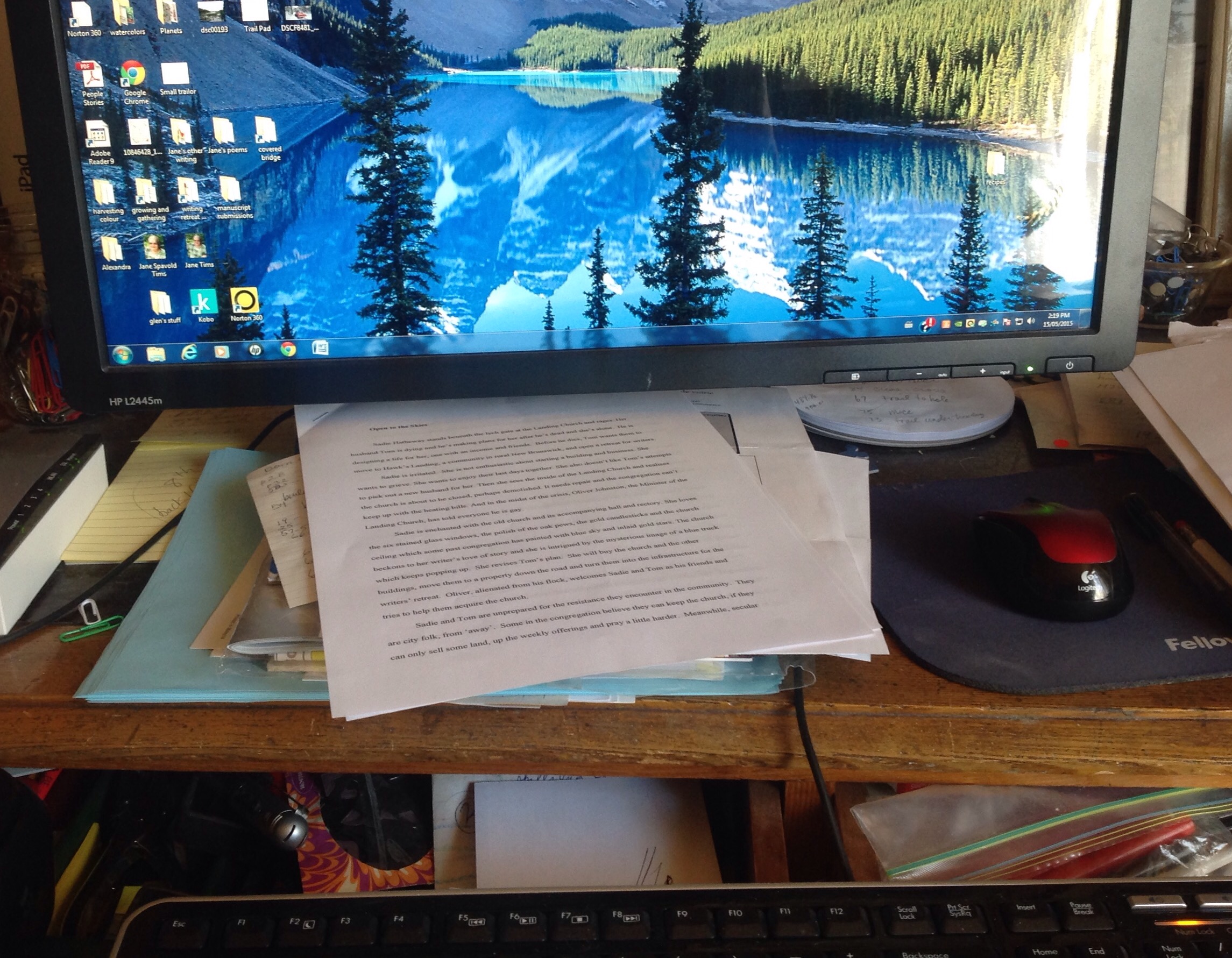
My third writing desk is oak, very old, and has a leather top. This desk holds a lamp, my computer and printer, the modem, and a USB dock for e-books, iPad, camera, Bamboo drawing surface, and a small USB-driven fan for warm days. Add a wonky stack of paperwork, sorted at tax time, and a mouse with 2 square inches of space to manoeuvre. This desk is always a mess, has no space for pen and paper, and somewhere in the desk drawer is a Tamagotchi that hasn’t been shaken in fifteen years! Lots of poems and thousands of words of fiction are written at this desk … not so much written as pecked out, in three finger combinations.
~

my lap desk
My fourth desk wouldn’t get a mention in a furniture inventory. It is a beaten-up plastic lap desk, scavenged from my son and re-covered (it used to have a dinosaur pattern) in a fern-patterned fabric. This is where my pen and paper writing gets done, usually in my living room chair, sometimes at our camp and occasionally outside in our yard. It has room for my rough book and a small ledge to hold a pen. It never needs tidying and slips neatly into my writing bag. It has supported the writing of poems, books, blog posts and letters. I love my lap desk.
~
Do you have a writing desk or desks? Where do you prefer to write?
~
Copyright 2015 Jane Tims
places for writers … writing workshops – part two
Sometimes the ‘place’ experienced at a writing workshop is the local area, the community where the workshop is held. I wrote this poem in 2014 after a writing workshop at WordSpring in Saint Andrews (New Brunswick) …
~

‘oak leaves and acorns’
~
encounters
~
on a windy night
in Saint Andrews, a toad
out of place, hop-toddies across
the street
~
also, on Prince of Wales, a deer
pauses on the sidewalk, stares
up the hill, and I hesitate
before driving on
~
in the Algonquin, a light
switches on, in the room I know is mine
and a couple huddles on the hotel porch
their attitude more suited to summer
than a night when leaves skip
mottled across the street
~
~
Previously published in ‘writing weekend’, June, 2014, http://www.nichepoetryandprose.wordpress.com
Copyright 2015 Jane Tims




 nichepoetryandprose