Archive for the ‘writing’ Category
organizing writing files – ordering a manuscript of poems
Last month I started a big project – to find and organize all the poems I have written during the last forty years. For a glimpse of my approach see here.
~
After four weeks of effort, I now have a file of poems I would like to assemble into a book. The title will be ‘niche’ and the book will include poems about the ecological spaces plants and animals (including humans) occupy.
~
niche \ ‘nich\ n (F, fr. MF, fr. nicher to nest, fr. (assumed) VL nidicare, from L nidus nest) 1 a : a recess in a wall, especially for a statue. b : something that resembles a niche. 2 a : a place, employment, or activity for which a person is best fitted. b : a habitat supplying the factors necessary for the existence of an organism or species. c : the ecological role of an organism in a community especially in regard to food consumption.
– Webster’s New Collegiate Dictionary, 1979
~
I have identified 66 poems for ‘niche,’ taking up about 110 pages. Although I could just toss the poems into the book in random order, I like to think about how I want the reader to encounter the poems. I organize the poems in the book following these steps.
~
1. List the ideas in the poems:
After I find all the poems to fit the ‘niche’ category, I arrange them roughly into a manuscript. Then I print the Table of Contents and write a list of ideas associated with each poem. Examples for ‘niche’ include: needs, predation, reproduction, invasion of other spaces, seasons, nutrition, competition, and so on. I also start to get a feel for poems that do not fit.
~

~
2. Develop a progression of ideas:
Once I have identified these ideas, I decide how I want to group them and how I want them to progress for the reader. In the case of ‘niche,’ I want the poems to first define niche, then consider the strategies plants and animals use to stay in their niche, then explore the discomfort or danger created when a niche is occupied, consider the spaces I have occupied in my own life, consider the problems you have to overcome to occupy your own niche, and conclude with an idea of the ideal space. Then, I reorder the poems so they fit the progression of ideas.
~
3. Sort the poems roughly into groups:
Once I have decided on a progression of ideas, I put poems into sections to portray those ideas. I choose the title for the section from a poem in the section. It is at this point that I decide which poems do not belong in the collection and remove them. For ‘niche’ the following are the sections (for now):
occupation of space – needs of an organism for food, water, air, physical space, and so on.
strategy – ways plants and animals protect their niche and solidify their position
praying for rain – dangers and discomforts of occupying a niche
mapping the labyrinth – places I have occupied, a bit of memoir
not touching the land – ways a niche is changed when it is occupied
forgetting to move – getting comfortable in your own niche
~
4. Order and fine tune:
Now the fine-tuning. To create a readable book of poetry, I think poems should not only be consistent in theme, but also segue from one to the other. This may be as simple as grouping poems of one season together, or grouping poems about plant species. It also means allowing the language and rhythm to flow from one poem to another.
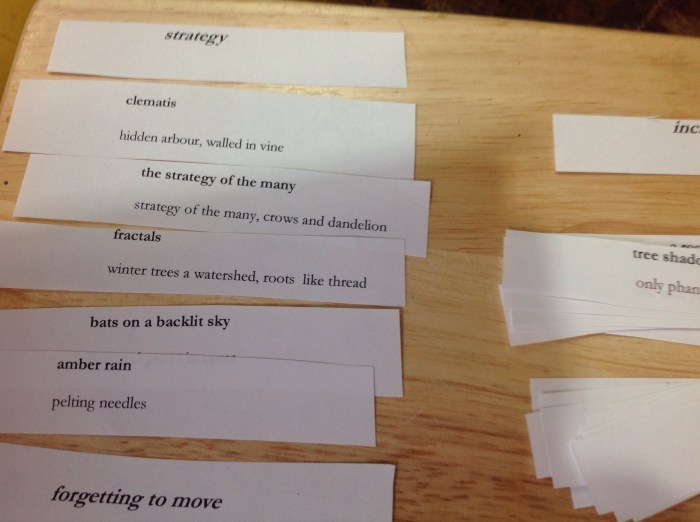
The intensive way to do this is to print all the poems and lay them out on a surface, ordering and reordering until they feel ‘right.’
I hate to waste the paper, and I like to have all materials within one view, so I use an abbreviated method. I prepare pages showing just the section titles, the poem titles and a line about the poem. I cut these out so they can easily be moved around on a table. If I want to check detailed poem content structure, I have my i-pad near at hand.
~

~
The process is sometimes tedious. Taking a break helps since after a while the poems you know so well begin to blur in meaning and the relationships between poems become nebulous. However, like many editorial-type tasks, the end product is worth the effort.
~
All my best,
staying at home,
Jane
organizing writing files – what to do with scores of poems
Lately I have been doing a lot of thinking about the poetry I have written over the years. I have two traditionally published books of poetry and will publish, independently, a small volume later this month. But scattered in the memory of my computer are hundreds of other poems, written over the course of forty years. Quality varies, but they are all mine, an expression of what it is like to be ‘me.’ Someday, when I am dust on the wind, someone is going to scan my computer and push delete. My son would not do this, but if I leave them in this state, they will become part of the clutter of his life.
~
So, if I have had success at publishing my own work, and have the skills, why shouldn’t I ‘save’ the poems it took four decades to write.
~
My approach has been to find the poems and assign them to one of five files. Each of the files will be the contents of a book of poetry, independently published and produced in a few copies. I have no intention of marketing these books. I may give them to family or friends, perhaps submit them to a few contests and just enjoy them myself.
~
The five files will be:
1. ‘niche’ – poems about the spaces occupied by plants and animals
2. ‘myth and mystery’ – poems about strange occurrences in life
3. ‘lakes’ – poems about lakes and rivers in New Brunswick
4. ‘my grandfather’s farm’ – poems about my memories of the farm
5. ‘journal poems’ – poems about specific times in my life
~
This is a slow process. First, there are multiple copies of some poems. Second, I have not been consistent with the naming of files. One outcome of this project will be a tidier computer.
~
When I have the files in folders, then I will work to organize the poems, revise them, format the manuscript and produce a book. A huge task, but as with all things, I will see the project through in stages, working on one part at a time.
~

~
UPDATE: I now have the files organized! It has taken about a month of work, off and on. I am now working on the poems for ‘niche.’ There are 66 poems, taking about 110 pages. Next post, I will write about organizing the poems into a readable manuscript.
~
All my best,
and staying home,
Jane
crystal ball
During these incredible days of isolation, our writing group has begun a series of prompts to help stimulate writing. One of our members suggested ‘weird phrases’ as the prompt category. So far we have had ‘ear hair,’ ‘under the fridge,’ ‘spider web’ and ‘crystal ball.’
~
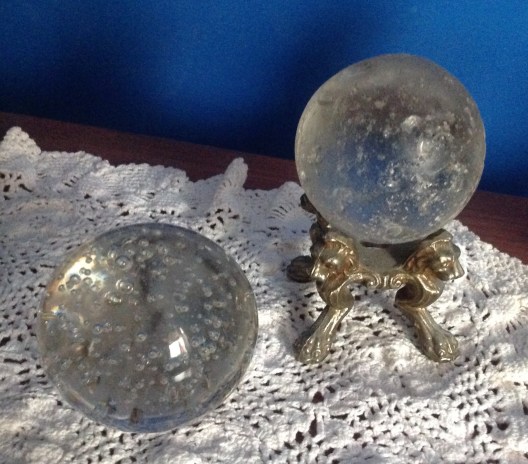
I have two ‘crystal balls,’ both small and both more properly called ‘glass spheres.’ But they are as close to a crystal ball as I will ever have. I am certain neither sees the ‘future’ but both show an interesting ‘present’ and both remind me of the ‘past.’
~

~

~
clairvoyance
~
my crystal ball
is a glass sphere
from a claw-footed
piano stool I sat on
to practice my scales
~
chipped, it never
snags the sun
will not scry or clarify
occludes
forecasting fog
~
it has a past
Chopin’s Butterfly Étude
in half-time
and a furry
Für Elise
~
but gaze
though I may
it never resonates
with a note
about tomorrow
~
although it has
guessed, after
damaging percussion,
I will never play
Carnegie Hall
~
~
All my best,
Jane
pantoum on morning
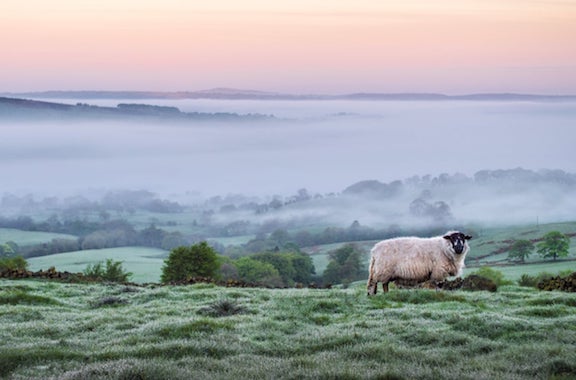
A couple of months ago, a friend from my Fictional Friends writing group suggested the image below as a writing prompt. The image reminded me of my once-daily morning commute where I would often see the settling of the morning mists in the low valley of the Saint John River.
~
~
morning mist
~
wake in morning, wool-headed
reluctant to start the day
fog settles as droplets of dew
webs woven over pasture
~
reluctant to start the day
fleece teased over hollows of hill
webs woven over pasture
hesitation of a solitary ewe
~
fleece teased over hollows of hill
disperse as sun stretches arms
hesitation of a solitary ewe
drowsy as dreams feather into deed
~
disperse as sun stretches arms
push back pillows and duvet
drowsy as dreams feather into deed
woolen blanket of valley mist
~
push back pillows and duvet
wake in morning wool-headed
woolen blanket of valley mist
fog settles as droplets of dew
~
~
I have been thinking about prompts for writing: images, collage, words, phrases, sentences, and so on. Just google ‘writing prompts’ for a barrage of ideas. Writing prompts can be used to combat ‘writer’s block’, to suggest new pathways for writing or to find new metaphors.
~
For a poet, I think another type of prompt is ‘form’. Form suggests new patterns of expressing an idea. For the poem ‘morning mist‘, I used a photo as a visual writing prompt and the pantoum form (with modifications) to explore new ways to pattern ideas about morning.
pantoum – a poetic form written in any number of quatrains with an abab rhyme scheme and repeating lines: the first and third lines of any stanza are the same as the second and fourth lines of the preceding stanza; the first and third lines of the opening stanza are used as the second or fourth lines of the last stanza. The last line of the poem may be the same as its first line.
I like the interweaving of ideas and emerging images as the pantoum proceeds. The repetition slows the poem and establishes echoes within.
~
All my best,
Jane Tims
rural to urban
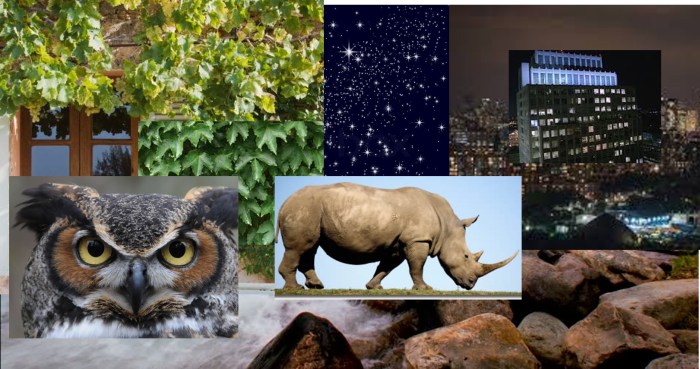
In one of my recent posts, here, I wrote about a course I took using collage-making as a writing prompt. To help us visualize the method, the teacher (Lynn Davies) gave us examples of collages she had built and asked us to do some response writing. Here is a facsimile of Lynn’s collage and the poem I wrote in response.
~
~
Relocating the Rhino
~
We move,
rural to urban.
Exchange night song
for traffic noise.
Swap canopied trees
for storied buildings,
~
night stars and Jupiter
for wall switches
and tic-tac-toe
of energy leak
from offices
in skyscrapers.
~
Beneath our feet,
rocks become fluid,
magma, electric blue.
Footing uncertain
on rocks
that wobble.
~
We armor ourselves,
chose tenement addresses.
Turn off lights
to save our silver,
wish for stars
in the night sky.
~
See only
tired workers,
keeping
the lights on
way past
quitting time.
~
~
Since I am a community planner and environmentalist, the interpretation of the collage comes as no surprise. The surprises (for me) are the rhino as metaphor for humans moving into the urban setting and the comparison of the twinkle of office buildings to the twinkle of rural stars. Implied is the irony of rural workers, seeking a better life, working even longer hours when they migrate to an urban life.
~
All my best,
Jane Tims
out of place
One of the advantages of belonging to a regional writing group — regular opportunities to refresh the writing mind and put new tools in the writer’s kit.
~
This past month at WordsFall, an annual event of the New Brunswick Writers’ Federation, I took a course from well-known poet Lynn Davies (author of how the gods pour tea, 2013, Goose Lane Editions, The Bridge That Carries the Road, 1999, Brick Books, and others). Lynn’s course Paper Moon, Paper Shoe: Writing and Collage introduced me to an new idea, using paper collage to inspire and renew.
~
In a couple of very enjoyable hours, Lynn showed us how to build a collage from magazine images and other paper scraps. She showed us examples of collages she had made and set us to work on our own collage. Her instructions were to select images that appealed to us at the moment and not overthink the choice of images. After the images were glued to a card, we took some time to write about the collage and the ideas it suggested.
~
Here is the collage I produced and the resulting poem.
~

~
out of place
~
An orange tree
in temperate soil,
among caraway
and dill.
One red tile
in a zigzag
of black and white.
~
Shoes take me
for a walk
in barley grass
and caraway.
Melon rinds
on size five feet.
Too slippery, too wide.
~
Garlic and dill
by lantern-light.
Ten after ten
on the hall clock.
Pickles and port
and a splash
of blackberry wine.
~
Floor-plan,
when the lights go out,
makes no sense at all.
Dormer rooms
too tight
and me too tall.
Caraway among the dill.
~
Salt on wounds.
Seeds in pickle jars.
Willow trees scratch
at window glass.
Garlic to banish
grinning skulls,
creep beneath tiles.
~
~
Next time you struggle for inspiration, consider generating some new ideas with collage.
~
All my best,
Jane Tims
after a poetry reading
Why do you go to poetry readings? Is it because you are supporting a writing friend? Because you love poetry? Or because you search for the perfect poetic experience — the memorable reading of an unforgettable poem, expressive words you know you will always be able to summon. Have you ever left a poetry reading feeling renewed, animated, believing in the impossible?
~
I attend a lot of readings. I go to support my writing friends. I go because I love words and poetry. I also go because I long for the memorable. Occasionally, I will hear words, phrases, poems to thrill me for the rest of my life.
~
I have had many such experiences. I have been privileged to hear Roo Borson read her poem Grey Glove. I have heard Roger Moore read poems from his book Monkey Temple with his stirring Welsh accent. Years ago I heard a young Irish poet read her poem about a kettle boiling on the stove, and I have never forgotten her words even though I have forgotten her name.
~

~
after the poetry reading
~
Bailey Drive is a steep incline
for an out-of-shape heart
a pause returns the thud in ears
to chest where it needs to be, a moment
to see maples on the Aitken House lawn
animated by wind, as metaphor for adrenaline rush
of words
~
as trees send Tesla coil sparks into blue sky
from trunks constrained by building
and sidewalks, to branches and twigs
unfettered, plasma filaments bloom
on fractal paths
~
another pulse, trunk to bud-tips
and another, signals up and outward
heart slows and holds in place
lightning throb in continuum of space
~
~
All my best,
Jane
tweeting about writing
Every day, I write. Today I worked on the story for Book Six in the Meniscus Series — Meniscus:Encounter with the Emenpod. I also did some editing of an upcoming mystery novel I refer to as HHGG. Tomorrow I will be writing poetry for a series about abandoned communities and what happens to plants in abandoned gardens.
~

~
Working back and forth like this between projects at various stages of completion is a great strategy for me. I never get bored, I never get writers’ block and I think shifting projects keeps my writing brain refreshed.
~

~
Besides blogging, I participate in Twitter, sending a tweet almost every day to #amwriting … if you’d like to find out what my writing life is like, follow me at @TimsJane … I report on what I am doing and share a bit of writing wisdom. I’d love it if you would follow along!
~
A little about the mystery novel since I tweet most often about it. HHGG is one I wrote in 1997. I have learned a lot since then, so editing makes me laugh. HHGG is about a woman and her two kids who seek summer solace at her old family home. She never dreams she is walking into a village rife with mysteries, some of them stretching back more than a century. I have a few human antagonists, but one who is anything but human!
~
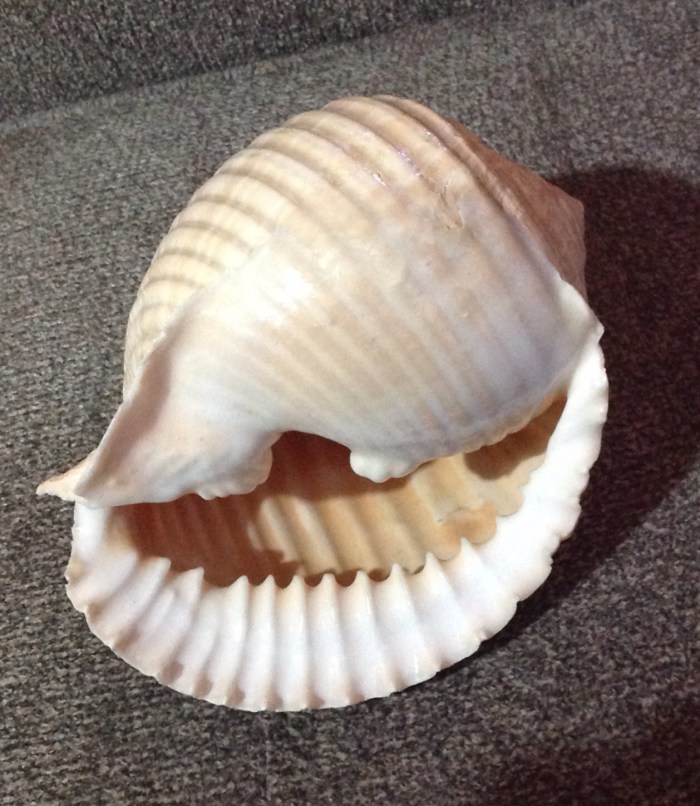

~
Hope you are enjoying your summer and your own writing life!
~
All the best,
Jane.
Guest Post – Liza O’Connor: when stories write themselves
Welcome to author Liza O’Connor, a writer with some seriously wild adventures in her life!
Liza O’Connor lives in Denville, NJ with her dog Jess. They hike in fabulous woods every day, rain or shine, sleet or snow. Having an adventurous nature, she learned to fly small Cessnas in NJ, hang-glide in New Zealand, kayak in Pennsylvania, ski in New York, scuba dive with great white sharks in Australia, dig up dinosaur bones in Montana, sky dive in Indiana, and raft a class four river in Tasmania. She’s an avid gardener, amateur photographer, and dabbler in watercolors and graphic arts. Yet through her entire life, her first love has and always will be writing novels.
~~~~~
When stories write themselves…
By Liza O’Connor
I have two stories coming up soon that fall under the category of writing themselves.
~

In the first book, Lessons from Wabbaseka, coming Mar 8, the story comes from my personal life. As will happen during a career, I was let go when my company downsized. When my great aunt and uncle heard I was unemployed, they wrote me a letter inviting me to come to Wabbaseka Arkansas (population 300) and live with them. While I remained in NJ and located a new job, I couldn’t get the ‘what if I had gone to Wabbaseka’ out of my head.
I loved my great aunt, but I was pretty certain I’d go crazy in such a tiny town. Also, to get a job, I would have had to drive an hour to Pine Bluff to find a crappy underpaid job. (And I hate Pine Bluff, it was where I grew up.) So, I wrote them back, reminding them I had a house in NJ, and I would find another well-paying job, which I quickly did.
But I couldn’t get them out of my mind, I kept thinking about what if I had really gone to Wabbaseka. The only way I could stop wondering was to play the scenario out on paper. Not surprisingly, it starts out funny as I’m driven insane by the people so very different than me, but then it gets serious. Turns out there are a handful of single men in the town of 300, and I fall in love with one and then someone tries to kill me. (That has actually happened many times in my life. Fortunately, I don’t die easily.) In the story, I did change everyone’s names except the first names of my aunt and uncle. I changed their last name, but they are the reason the story exist, and they had to be Aunt Peck and Uncle Lee.
https://www.amazon.com/dp/B078WS1TDW
~

The second story that wrote itself is Arrival: Titan coming May 7th.
It came to be due to Cassini and NASA discoveries in the last year.
Seriously, the second book of this series was dead in the water until Cassini and NASA discovered some mind-boggling stuff in this last year. Stuff so astounding that the world isn’t ready for it. Nor have they gone out of their way to clearly state what they know. Even when they shared the information, it was done in an obscure way, so most people will never realize what their discoveries meant.
Fortunately, the truth is right there for anyone to see. That truth enabled a vibrant story to come alive all by itself. While I made up the sentients that my people have to learn to live with on Titan, the truly crazy stuff is all compliments from NASA and Cassini. With the revelations from Cassini and NASA, this book became the easiest book I’ve ever written. And while most will think I’m one imaginative author, and this is a crazy story, the astounding truth is that the impossible to believe stuff is almost certainly true, only NASA does not want to admit it. But the pictures from Cassini and NASA reveal the truth to anyone who wants to see the truth. And in this case, reality is stranger than most fiction.
But there is no need to turn your world upside down with uncomfortable probable realities. You can safely read the story as a highly imaginative Sci-Fi and be no worse for it. That’s how I’m dealing with it.
I have a blog on the main extraordinary events, with Cassini and NASA pics to help prove my points. I should warn you in advance: no one has declared me spot on. Although, I have gotten many compliments for my creative imagination.
Honestly, I don’t need anyone to actually see what I see. I just need you to have a grand time enjoying the book that NASA and Cassini made possible.
Arrival: Titan coming May 7
~~~~
Thanks to Liza for her post. You can learn more about Liza’s books here:
free book … Meniscus Science Fiction Series
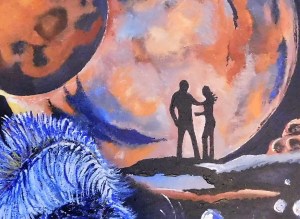
Do you like to read? Would you like to start a new series, one with adventure and a good love story? The Meniscus Series follows the adventures of two Humans trying to build a life together on a rather nasty alien planet. The first book in the Meniscus Series, “Meniscus: Crossing The Churn” will be free on Amazon Kindle today until October 8, 2017. A good chance to give it a try. To order, just click here.
~



~
2017 has been a productive year for me. I completed three of the Science Fiction Series “Meniscus”. By the end of the year, I will add a forth book to the Series … “Meniscus: One Point Five”. This is a short book, intended to tell the story of the six months between the first and second books. The writing is almost done and I am about to begin the illustrations. In January, I will be publishing number four in the Series … “Meniscus: The Village at Themble Hill”.
~
I am biased, of course, but I think the books tell a great story. On Meniscus, Humans have lost all the progress they have made and are slaves to the ruling Dock-winders. My books tell the tale of one Human’s search for freedom and relationship. Against all odds, Odymn finds a partner and builds a new life in the dangerous Meniscus landscape. The books are full of romance and adventure, and the Meniscus world is packed with interesting plants and animals. Some are good to eat; some want to eat you!
~
If you haven’t read “Meniscus: Crossing The Churn”, try it out. It tells the story of how Odymn meets the Slain. He is a trader and his motives are not at all consistent with his kindness. But Odymn is beautiful and capable. In the end, love is sure to win out over the Slain’s desire to keep his good reputation as a trader.
~
To help introduce you to the story of Odymn and the Slain (eight books are planned for the Series), I am running a Free Book Promotion on Amazon Kindle from October 4, 2017 to October 8, 2017. You can get a Kindle version of “Meniscus: Crossing The Churn” for free. Discover what Odymn finds hidden away in the Slain’s backpack!
To order “Meniscus: Crossing The Churn”, just click here!
~




 nichepoetryandprose