Archive for the ‘writing a novel’ Category
writing a novel – sub-plots
In every story, sub-plots help with the story telling and contribute their own dynamic to the action, characters, and the relationships between characters.
sub-plot : a smaller, separate story strand that provides support for and adds complexity to the main plot
The courses I have taken have taught me that often subplots contain a minimum of three re-occurrences or ‘beats’ in a story. A sub-plot is introduced, more is learned and the sub-plot is resolved.
~
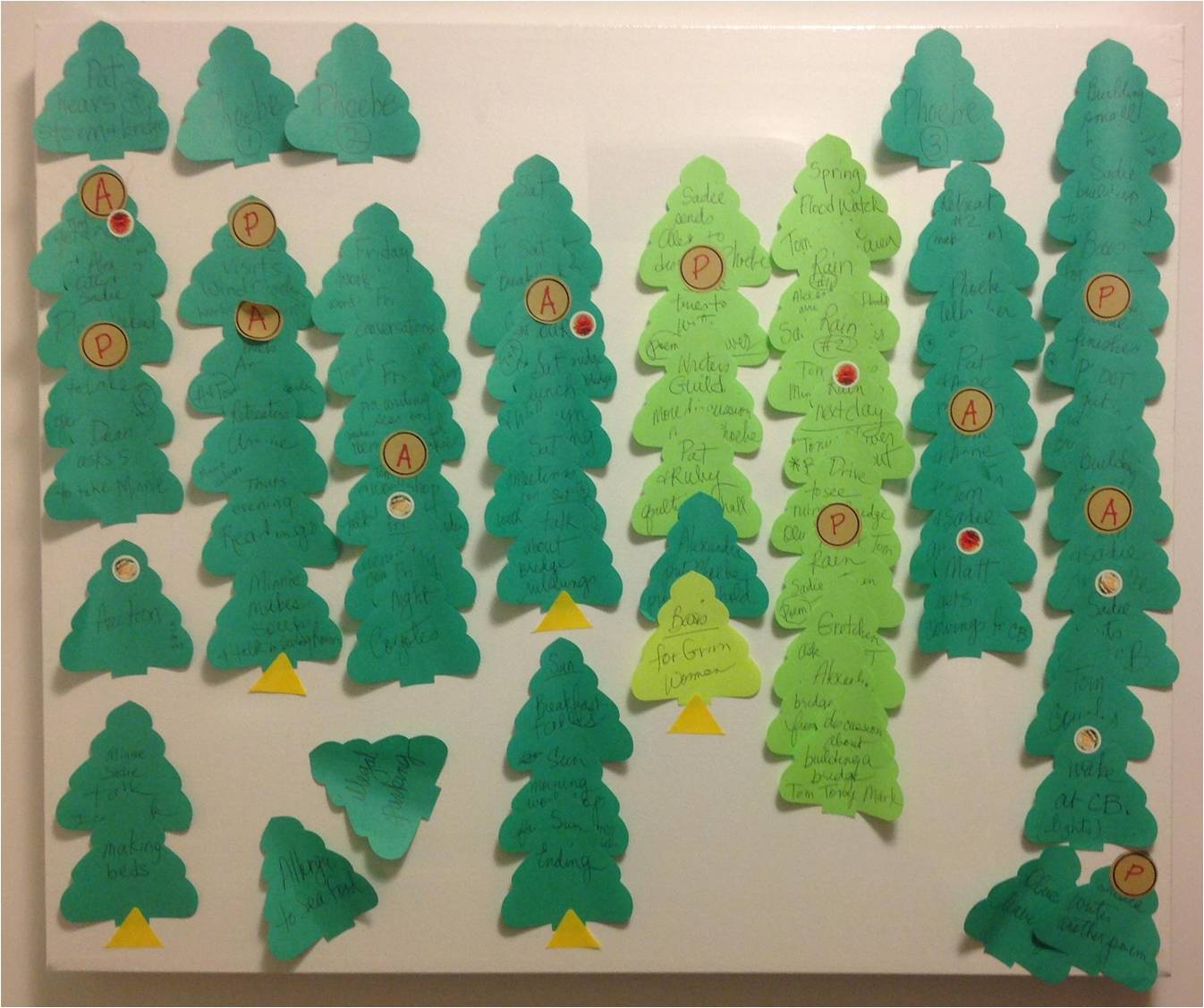
To help me identify the subplots, I have used my ‘story board.’ I identified some key subplots and put stickers on the scenes on my ‘story board’. Here you can see the subplots ‘A’ and ‘P’.
~
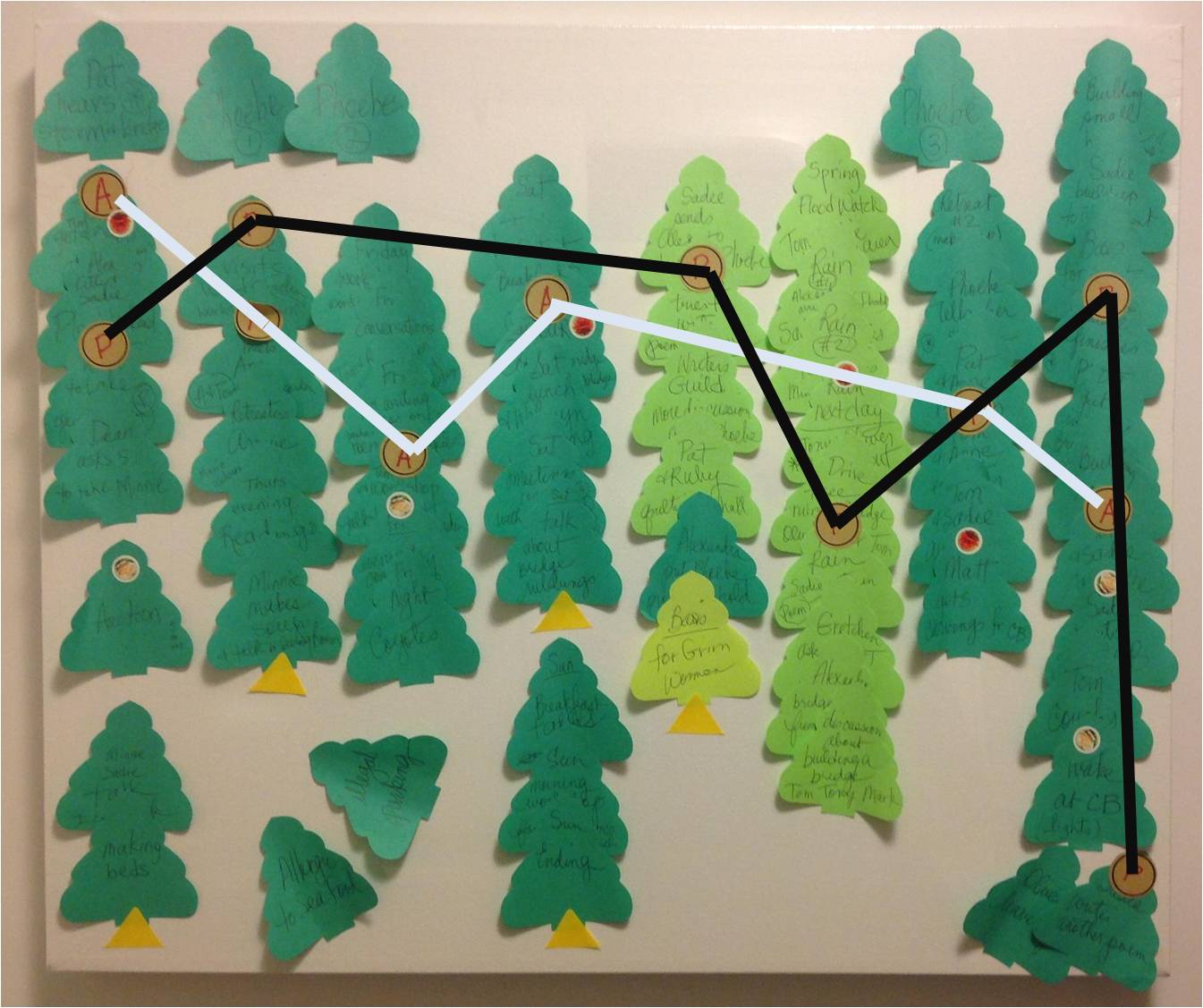
This mapping of subplots can help me decide if some of the story is missing. In the ‘story board’ below, sub-plot ‘P’ could be improved by a mention on Day 3 and 4 (the vertical rows of green trees indicate a day in the action). Major inclusions of the subplot P on Days 1, 5, and 8 will be my three subplot ‘beats’.
~
~
Copyright 2015 Jane Tims
writing a novel – character arcs
Title: unknown
Working Title: ‘Crossing at a Walk’
Setting: a writers’ retreat – the renovated Landing Church, the hall and the rectory now used as a Learning Center, a Sleeping Hall and a home/base of operations for Sadie and Tom
Characters: main character Sadie, a writer; her husband Tom, a retired welder; people from the community; writers participating in the first weekend of the writers’ retreat
Plot: Sadie wants the first writers’ retreat to go smoothly, but the history of an old covered bridge keeps getting in the way
~
I have finished the first draft of my novel. Still lots of holes to fill and editing to do. But I am now certain of the basic story-line.
~
For the next while I will be spending some time with each of my characters. I know a bit about them, because I have a character sketch and a drawing for each character. Now I want to make sure each person has their own story arc. I would like each character to grow in some way during the novel.
~

some of the characters in my novel
~
My first step is to print a copy of the draft ‘Table of Contents’ for my book.
On a separate page, I also list the events (or scenes) in each chapter and the characters involved in each event.
Then I use the initial of the character’s first name to show on the ‘Table of Contents’ where the character occurs in the story. For example, my characters include Patricia and her brother Rob … marked P/R on the extreme right hand side of the ‘Table of Contents’.
Right away, I can see if a character falls off the radar. I can also make certain the characters are distributed through the action so my reader doesn’t forget they exist. For example, one of my main characters, Alexandra (marked A) doesn’t occur in four chapters … this may be OK but I want to think it through.
~

~
Once I have completed this step, I have a list of additions to make to the manuscript (written up and down along the bottom of the page).
~
I also write, in a simple sentence, the story arc of each character. I write the arc in the format of: what the character wants, the obstacles he or she encounters, and the resolution.
Patricia (the rather sour-looking woman on the far left of my drawing above) wants to feel connected with her brother who left home and died years before – she reconnects with him by learning some of the details of his story.
Tom (below) retired from his career as a welder due to ill health. He is surrounded by writers attending the writer’s retreat. He is at loose ends and tries to find his purpose, discovering it embedded in his daily routine.
Matt (third from the left in the drawing above) is a theatre student who wants to attract a fellow writer. In spite of repeated rebuffs, they find a common interest, the basis of a friendship.
~

Tom, Sadie’s husband, doesn’t always feel comfortable around writers.
~
I have learned from various courses that story arcs are often expressed as sub-plots. The story arcs often occur in three ‘bumps’ in the action. Although most of my characters occur several times in the book, this is a good minimum guide to follow for the significant events in their stories.
~
Back to work …
~
Copyright 2015 Jane Tims
writing a novel – writing and plotting
I often see questions from writers about plotting the story in a novel. Some advocate just writing, letting the plot write itself. Others say the best approach is to carefully plot the action beginning with an outline.
~
My approach is a mix of these two. I began to write some of my novel early last year – just jotting down ideas and doing sections of writing. Now, I have reached about 32,000 words, and I have a very good idea about my plot and where the action takes the reader. It is time to make sure I am going in a particular direction.
~
I have always wanted to use a plot board in the writing of my book, but I don’t have the wall space to use a proper ‘story board’ or one of those ‘white boards’ you see in detective shows on TV. I do have an empty canvas or two, so I am using one (20 X 24) as a story board to arrange the elements of my book. The canvas is a good size to store easily, or work with on my knee!
~
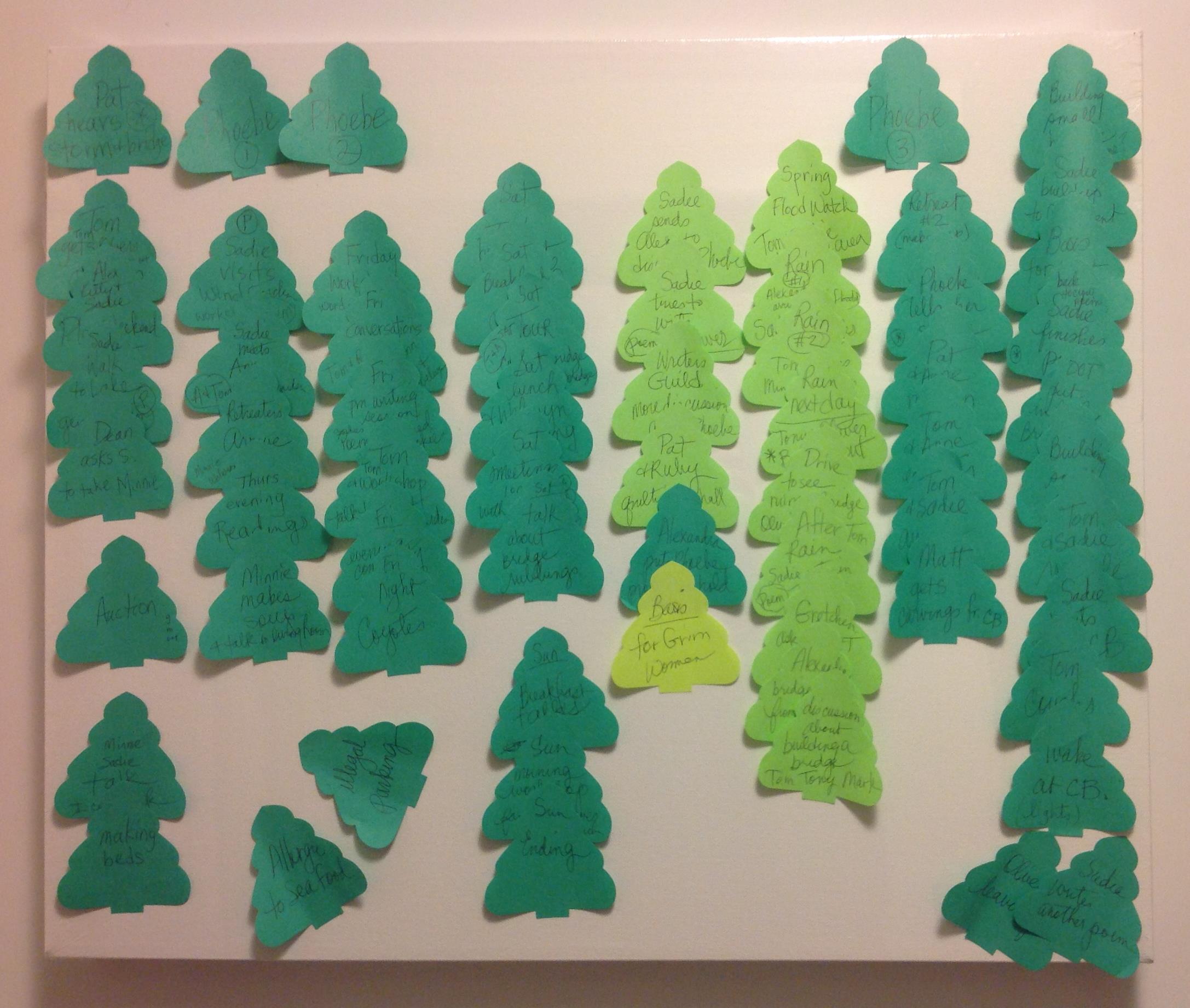
First I used a block of post-it notes (mine look like evergreen trees) to jot down the various scenes I have written to date (looks like a forest).
Scene – a sequence of related actions and conversation occurring in a particular place. For example: Sadie and Tom sit at their kitchen table and discuss where to take the writers for a tour of the community.
~
I put these scenes in order and posted them on the canvas in vertical lines, each line representing roughly a day (or a group of related days) in the action. Below is my canvas story board with scenes arranged in eight ‘days’ worth of action.
~
~
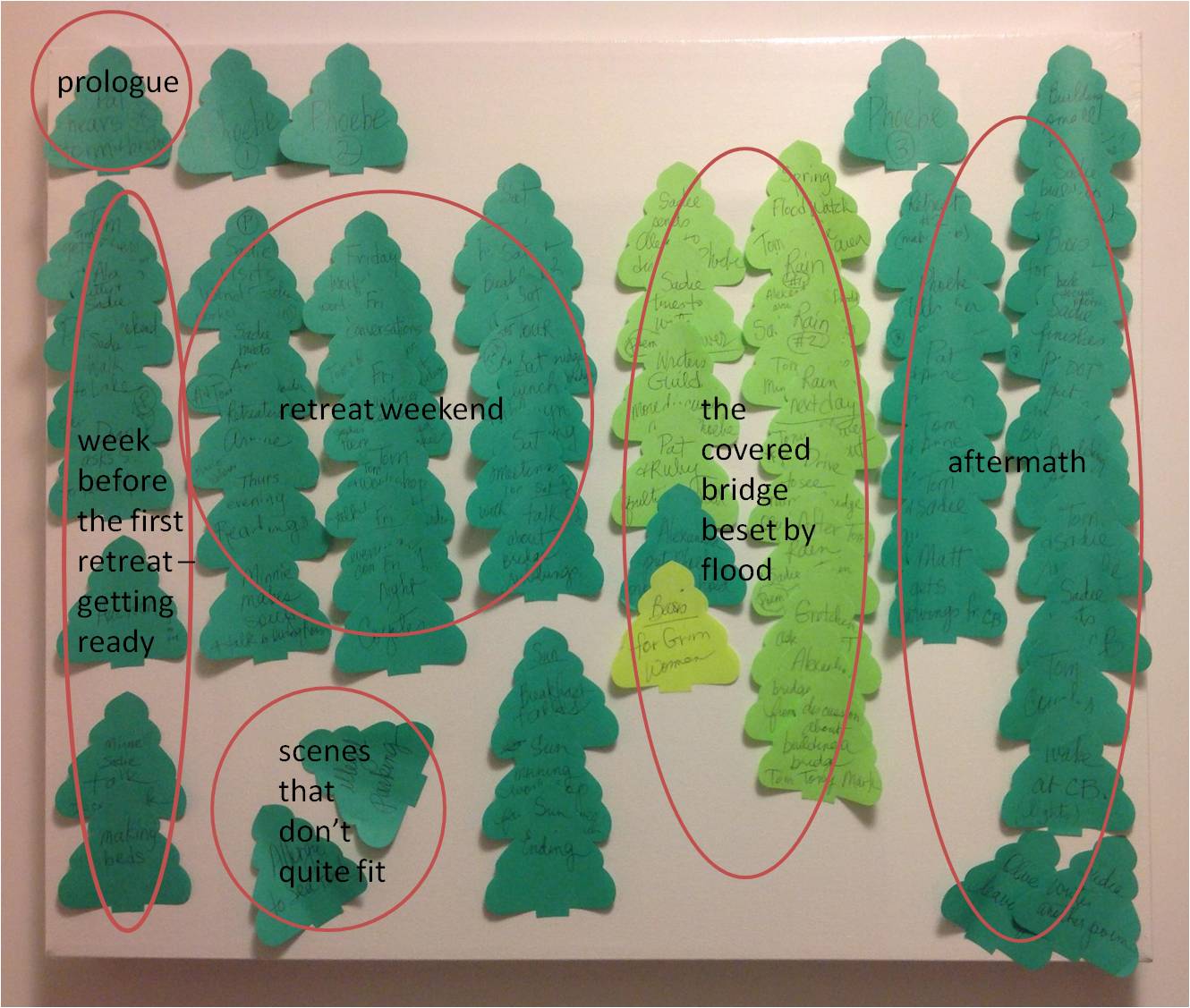
To show a little more of the arrangement, I have drawn some circles to show you where I put different scenes. Some (lower left) don’t seem to fit anywhere – perhaps they will just become bits of orphan writing. The ‘aftermath’ will include a return to the writing retreat by the first group of ‘retreaters’ – the weekend went so badly, Sadie offered them a free weekend at the retreat!!!
~
~
Now, I can continue to write and fill in parts of the plot I have not completed. I can move the post-it notes around and rearrange the action. I can add new scenes. And I can look at where ideas, sub-plots, symbols and people occur and reoccur. And I can add any information if needed.
~
Lots of work to do!
~
Copyright 2015 Jane Tims
writing a novel – next in the series !
Having sent my first novel ‘Open to the Skies’ (aka ‘Saving the Landing Church’) out to three publishers, I have begun my next novel in the series. I intend for the series to focus on the adventures of running a writers’ retreat. Same characters, same setting, same struggle to be a part of the community.
~
Title: unknown
Working Title: ‘Crossing at a Walk’
Setting: a writers’ retreat – the renovated Landing Church, the hall and the rectory now used as a Learning Center, a Sleeping Hall and a home and base of operations for Sadie and Tom
Characters: main character Sadie, a writer; her husband Tom, a retired welder; people from the community; writers participating in the first weekend of the writers’ retreat
Plot: Sadie wants the first writers’ retreat to go smoothly, but the history of an old covered bridge keeps getting in the way
~
My first novel was about an abandoned church. The subject of this book will be yet another feature of our built landscape, one also having a difficult time … the covered bridge. In the 1940s there were 340 covered bridges in New Brunswick. Today there are only 60.
~
I chuckle all the time about my ‘Saving The …’ series. Lots of buildings to save out there! However, I have no intention of sinking into the formulaic (Sadie falls in love with the … and takes steps to save the …). Instead, each story will take a unique approach to honoring the bit of built landscape it portrays!
~

~
As I have said, in New Brunswick, we have 60 remaining covered bridges. Their numbers are dwindling, the losses due to flooding, fire and vandalism. For a look at the covered bridges in New Brunswick, see the map and photos at http://www2.gnb.ca/content/gnb/en/departments/dti/bridges_ferries/content/covered_bridges.html
~
So how does a covered bridge get in the way of a well planned writers’ retreat?
- Sadie includes a local tour during the retreat, to introduce the writers to the community and give them new experiences to write about. The covered bridge is outside the tour loop, but a couple of the writers would love to go there.
- the covered bridge is part of the community’s history. Inside the bridge are the carved initials of some of the many people who have lingered there. The writers want to know ‘who was Phoebe?’ a girl whose name is carved in the bridge and imprinted on the memories of some of the members of the community.
- after the retreat is over, heavy rains and flooding threaten the bridge to its very foundations. Can the bridge be saved and will Sadie be willing to take on the cause of another community icon?
~

Sadie … my main character … a writer and weaver … she wants the first weekend of the writers’ retreat to go smoothly … I still think she needs an afternoon at the hairdressers
Sadie’s husband Tom … a welder with a fatal case of welder’s lung … a likeable fellow, he refused to die in the first novel … I wonder what will happen to him in ‘Crossing at a Walk’?
~
Copyright 2015 Jane Tims
writing a novel … next (brave) step
For the past two years, I have been working on a novel. The working title of the book is ‘Saving the Landing Church’ – the actual title is ‘Open to the Skies’. For more information about the process of writing ‘Open to the Skies’, have a look at the category ‘writing a novel’. https://nichepoetryandprose.wordpress.com/2012/12/03/writing-a-novel-telling-a-story/
~
The book is about a woman who falls in love with an old church and decides to save it from demolition, in spite of active resistance from members of the community.
~
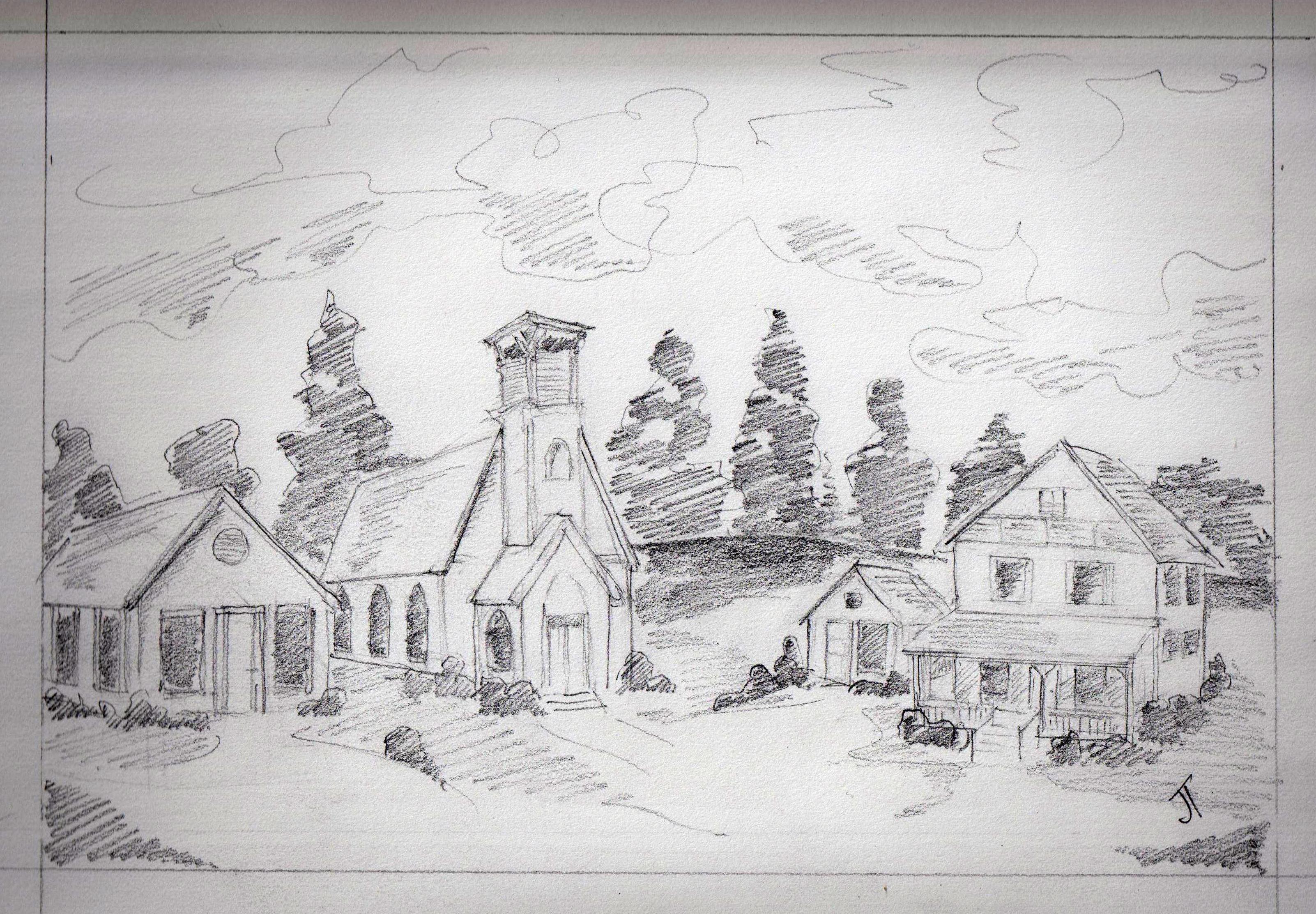
the setting for my novel … an old church and its hall and rectory are moved to a new location along the St. John River to create a writers’ retreat …
~
After taking my book through nine drafts, numerous readings of bits with my writing groups, and a third-party edit, I have taken the next (brave) step. I am sending my novel to three publishing companies. I chose the publishers based on their dedication to Canadian authors and subjects, their willingness to read unsolicited manuscripts, and their current book lists.
~
It will be a long wait. I know from past experience that I may not hear from them for six to eight months, and then it will likely be ‘no’. This is not lack of confidence or uncertainty about my skill. It is reality – most book publishers get up to a thousand submissions per year and, of course, can only choose a few of these to publish. However, on my side is the characteristic of doggedness.
~
I will be sure and let you know what happens next with ‘Open to the Skies’. Meanwhile, I’ll be busy working on a sequel to the first book and, of course, on my poetry.
~
Copyright 2015 Jane Tims
The Light Never Lies – A Guest Post from Francis Guenette
I am so pleased to welcome a guest in this post. Francis Guenette is a Canadian writer, the author of two books, ‘Disappearing in Plain Sight’ ( FriesenPress, 2013) and ‘The Light Never Lies’ (Huckleberry Haven Publishing, 2014). When I read ‘Disappearing in Plain Sight’, I was drawn to the setting – Crater Lake, the cabins and the garden. In this post, Frances writes about the setting, its origins and how the setting influences the story. Welcome Frances! And thank you so much for your Crater Lake Series of books!
~
 To begin – a synopsis of The Light Never Lies:
As circumstances spiral out of control, Lisa-Marie is desperate to return to Crater Lake. The young girl’s resolve is strengthened when she learns that Justin Roberts is headed there for a summer job at the local sawmill. Her sudden appearance causes turmoil. The mere sight of Lisa-Marie upsets the relationship Liam Collins has with trauma counsellor, Izzy Montgomery. All he wants to do is love Izzy, putter in the garden and mind the chickens. Bethany struggles with her own issues as Beulah hits a brick wall in her efforts to keep the organic bakery and her own life running smoothly. A native elder and a young boy who possesses a rare gift show up seeking family. A mystery writer arrives to rent the guest cabin and a former client returns looking for Izzy’s help. Life is never dull for those who live on the secluded shores of Crater Lake. Set against the backdrop of Northern Vancouver Island, The Light Never Lies is a story of heartbreaking need and desperate measures. People grapple with the loss of cherished ideals to discover that love comes through the unique family ties they create as they go.
~
My first order of business is to extend many thanks to Jane for inviting me over to her blog. Jane thought it would be interesting to hear how architectural and garden elements of the setting for Disappearing in Plain Sight and The Light Never Lies contributed to the story.
~
Write what you know. It’s a common sense piece of advice. After all, fiction writers have enough work in the making-things-up department. When I first envisioned writing a novel, it was because a group of characters had made a sudden appearance in my imagination. I always knew they would live in a rural setting, on the shores of a lake, some in elaborate cabins with expansive gardens and some in more rustic dwellings. Fiction mirroring reality – where I live is somewhere in the grandiose middle.

I thought about my own home and a few cabins in the vicinity and from there I embellished, stretched and massaged the reality of these settings into a small community on the shores of a fictional place called Crater Lake.
I have lived on the shores of a lake, in a cabin, with a garden in the wilderness for over twenty years. I’ve walked the trails around this place so many times my feet have worn smooth my route. In many ways, it’s hard for me to separate my own environment from that of the books – except to stress that Crater Lake is fictional, Micah Camp is a product of my imagination, the characters likewise. The cabins and gardens described are all altered, sometimes to a grander scale, sometimes to include elements not present anywhere but in my imagination. I suspect many writers have gone through a similar process.

Living in a particular place shapes people. A rural, semi-isolated setting, homes that reflect local materials open to multiple views of lake, mountains and trees, gardens and small businesses carved out of wild landscapes – all of these factors make the characters in my books the people they are and dictate (to a degree) the situations they find themselves in.
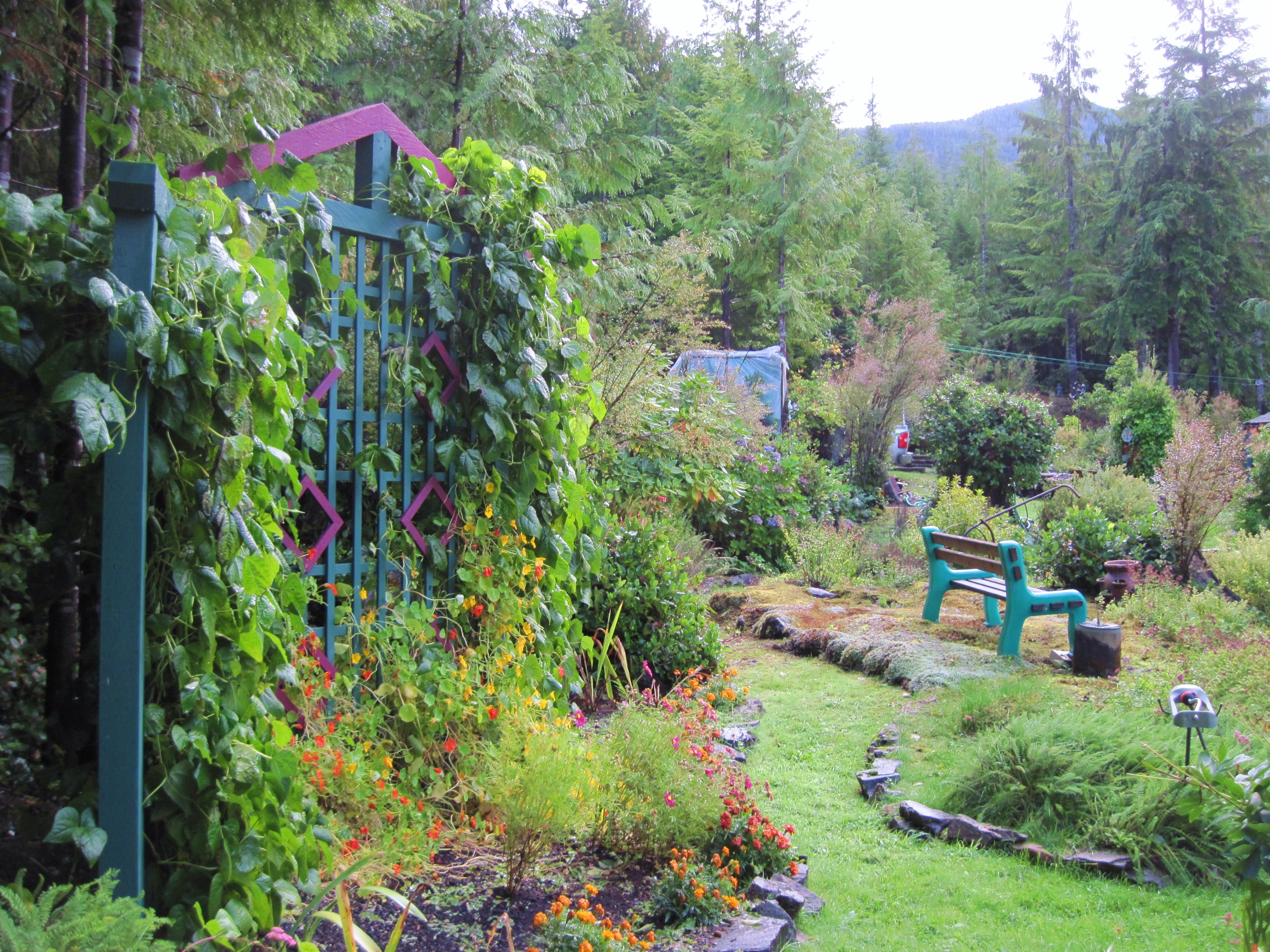
I have a couple of anecdotes that illustrate well a juxtaposition of fiction and reality. A close friend who has never visited our lakeside home, read Disappearing in Plain Sight and she loved it. When her husband managed a quick visit last summer, he told me he would tell his wife that our cabin and the view were just like walking into the book. The view perhaps – the cabin not so close, but close enough to resonate.
I recently ran into a woman who borrowed one of my books from her daughter. She and her husband had bought some land out in the wild and were getting ready to build. She asked me it the architect Caleb used to design his cabin in Disappearing in Plain Sight was based on a real person. She shrugged and said, “Oh, I suppose that would be too much to ask, but I want a place like the one you described in that book.”

Here is a dichotomy, for sure. If you come and visit me, at first glance you will recognize, in broad brush strokes, the setting of Disappearing in Plain Sight and The Light Never Lies. But don’t go looking for more. You’ll only end up disappointed. It is in the fine details that fiction has taken off to soar away from the landing strip of reality.
~

~

Francis Guenette has spent most of her life on the west coast of British Columbia. She lives with her husband and finds inspiration for writing in the beauty and drama of their lakeshore cabin and garden. She has a graduate degree in Counselling Psychology from the University of Victoria, British Columbia, Canada. She has worked as an educator, trauma counsellor and researcher. The Light Never Lies is her second novel. Francis blogs over at http://disappearinginplainsight.com and maintains a Facebook author page. Please stop by and say hello.

http://www.amazon.com/dp/B00I8XKIDK
writing a novel – still editing
~
Title: unknown
Working Title: Saving the Landing Church
Setting: a writers’ retreat, including an abandoned church
Characters: main character Sadie, a writer; her husband Tom; people from the community
Plot: the story of how Sadie tries to win over a community in order to preserve an abandoned church
~
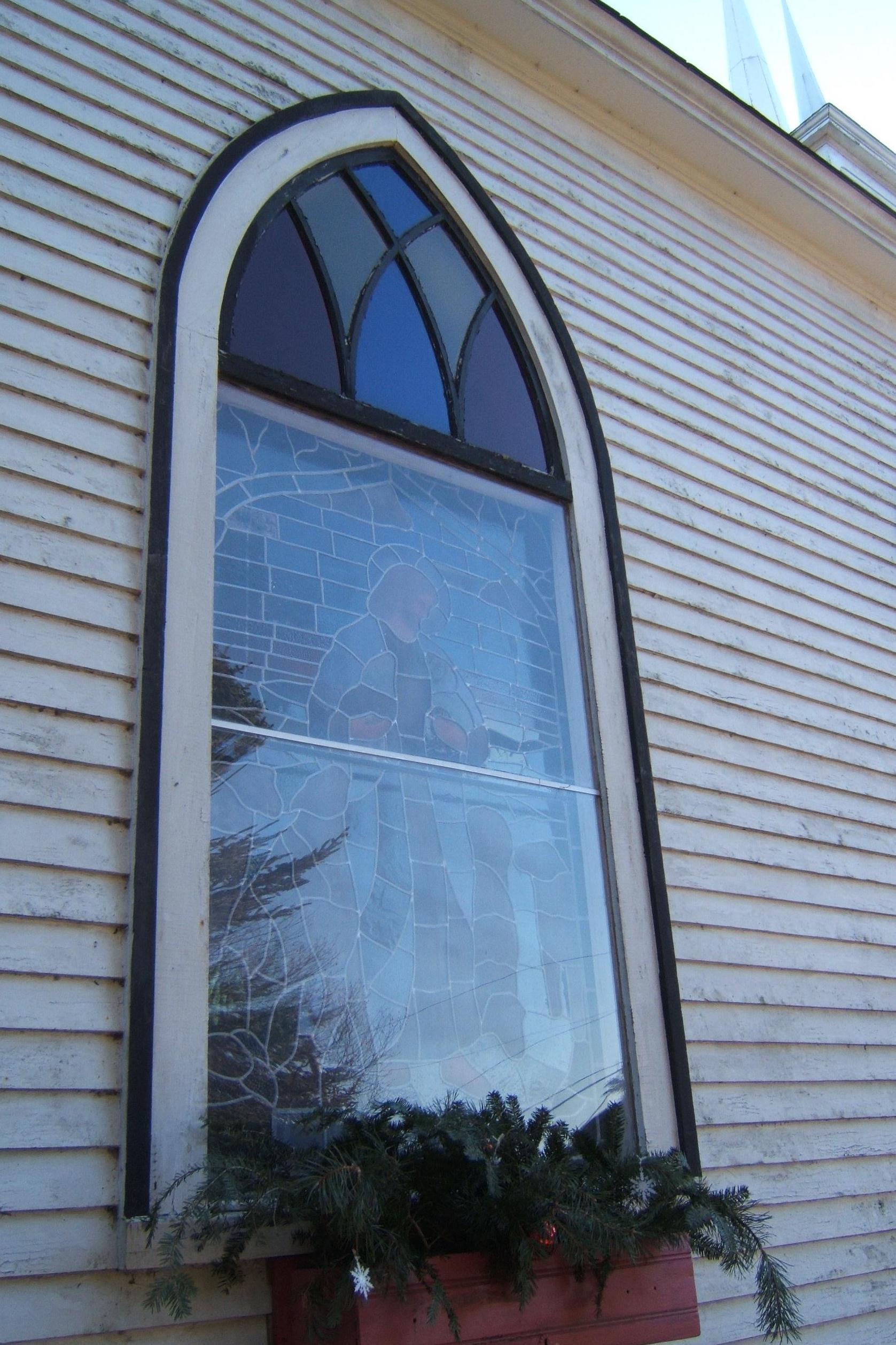
~
Still editing.
~
I am on Draft #7 of my novel. In this draft I am going chapter by chapter through the whole novel to look for opportunities for improvement:
- I need to make sure I am showing, not telling. Instead of telling the reader that Sadie is afraid, I try to show the reader her fear, by writing about her accelerated heart rate, her dry throat, how her shoes seem stuck to the floor, and so on.
- I need to be sure I not only describe how the scene looks, but also include the smells, the sounds and the tactile experiences.
- I am still looking for words I repeat in consecutive lines, a hard-to-break habit of mine …
One of the tools I have constructed to help me with fine edits is a chart about the characters. I have character sketches (in both words and drawings) for each person in my novel, but it is tedious to refer to these over and over. So, I constructed a table with the important details – how old the person is, what they look like, and so on.
~

~
Especially helpful is a list of the words he or she uses. For example, Sadie says ‘dinner’ for the six o’clock meal. Her husband says ‘supper’. Sadie uses the word ‘graveyard’, while most of the local people say ‘cemetery’.
~
I have 44 characters in my book, including both major, minor and dead characters. This is probably too many, but it is a book about a community. Here is my table for a few of my characters:
~
| Character | Occupation | Nickname | Characteristics | Age in 2005 | Words they use |
| Sarah Hatheway | writer | Sadie | Plain, thin, oval face, short brown hair | 42 | Bed and Breakfast; silly; retreaters; dinner; graveyard |
| Tom Hatheway | welder | Sadie’s husband; strong, short grey hair, pale | 48 | B & B; hey girl; clients; supper; graveyard | |
| Oliver Johnston | minister | 42 | graveyard; supper | ||
| Emma Southkind | homemaker | Keeps a journal; solid; yellow purse; curly grey hair, gentle | 59 | cemetery; supper | |
| Mark Southkind | retired train conductor | 60 | cemetery | ||
| Katherine Birch | writing coach | Kitty | Language a bit coarse | 62 | graveyard; dinner |
| Alexandra Connelly | student | Tall; long brown hair | 16 | supper | |
| Joe Connelly | accountant | Alexandra’s dad; widowed; tall | 45 | graveyard |
writing a novel – plotting the change
~
Title: unknown
Working Title: Saving the Landing Church
Setting: a writers’ retreat, including an abandoned church
Characters: main character Sadie, a writer; her husband Tom; people from the community
Plot: the story of how Sadie tries to win over a community in order to preserve an abandoned church
~

~
In writing and editing my novel, I have had to turn my attention to the plot, again and again.
~
Last November, when I started to write my novel, I learned quickly – stories usually are built on the concept of change.
- the main character wants something (a need)
- The character sets about trying to fill the need and is thwarted at every turn
- In the end, they either fill the need or they don’t
~
During the story, the main character must be altered in some way.
~
this is my main character, Sadie … how will she be changed during the novel? She does look like she could use a hair salon …
~
As my novel has progressed, I have realised that Sadie not only wants the church, she wants the church with the blessing of the community
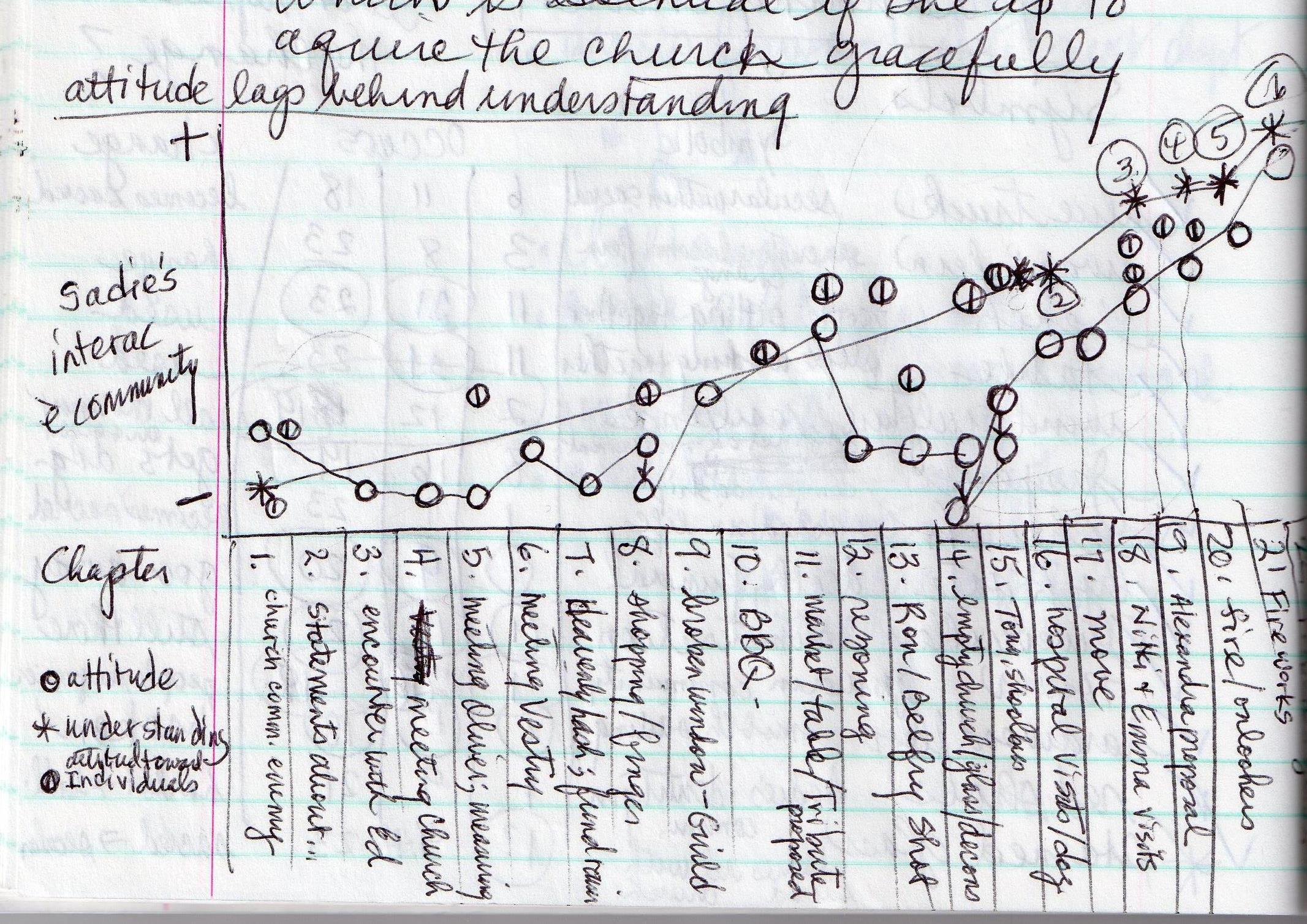
How does Sadie change? Her understanding of the community and her attitude towards the community changes. She realises that ‘community’ is a necessary component of the church she wants so badly … without the community, the church is just a hollow building …
~
To make certain my main character is changing and growing in the right direction, I’ve plotted out her understanding, her attitude and her progress with respect to the community …
~
~
This excerpt from my writing journal will make no sense to you, but it shows that I write to make the novel and the characters progress towards an end. If I encounter something in the plot (or the subplots) that does not fit, I look at it again and rewrite or reorder events …
~
If you write short or long fiction, how do you make sure the plot is always moving in the direction you intend?
~
Copyright 2013 Jane Tims
writing a novel – objects and symbols
~
Title: unknown
Working Title: Saving the Landing Church
Setting: a writers’ retreat, including an abandoned church
Characters: main character Sadie, a writer; her husband Tom; people from the community
Plot: the story of how Sadie tries to win over a community in order to preserve an abandoned church
~
If you are new to following my Blog, you may not know I have been writing a novel since last November. If you have followed my Blog for some time, you may be wondering if I have abandoned my novel for the world of watercolor painting – not so.
~
~
I am on Draft Six. I have taken the comments of my readers and members of my writing groups to heart, considered them carefully and made many revisions in the Fifth and Sixth Drafts. I have also paid careful attention to three workshops I attended on writing fiction.
~
One of these workshops was exceptionally thought provoking, teaching me to look at elements of my book in a new way.
~
Our instructor at this course suggested we pay particular attention to the objects mentioned in our writing. Mentioned once, an object, such as a table, is just a table. Mentioned twice, it becomes a symbol, and the reader remembers the first mention of the object and draws understanding from the symbolism. So a table may be remembered for the people siting at it and the subject of their conversation. Perhaps it becomes a symbol for family, for example. If, in the second mention, someone breaks the table by putting too much weight on it, this may make a comment on the idea of family in the story. By breaking the table, the family may be damaged or broken. The use of symbols deepens meanings and helps the plot reverberate throughout the writing.
~
The instructor also said that symbols operate like mini sub-plots throughout the story. These mini-plots echo the main plot, and the objects change in a way that illuminates the main plot. The mini-plots also tend to occur in three ‘beats’, providing a beginning, middle and end. For example, the table is bought at an auction, broken and finally mended.
~
In this round of edits, I have tried to examine the use of symbols in my novel. To do this, I built a list of the objects I have used as symbols. Then I looked for their occurrence in the novel to see if I could identify three ‘beats’ and a mini sub-plot. In some cases, I identified gaps – fixing these has helped me to solidify my overall plot and improve the understanding of my readers.
~

a lych gate is one of the objects I use as a symbol in my novel
~
This is a short version of my list of some of the objects/symbols in my book. When I assembled the list, the items in red were missing and I had to fill out the story accordingly. Perhaps you can use this method to help strengthen the narrative in your own fiction.
~
| Object | Symbolism | Occurrence (Chapter Numbers) | Mini-plot | ||
| long bench | togetherness | 11 | 21 | 23 | bench moves from private to communal space; people start working together |
| stained glass | relationship between sacred and secular | 1 | 9 | 23 | stained glass window breaks and is repurposed; the sacred becomes the secular |
| lych gate | death | 1 | 9 | 20 | lych gate falls into decay; fear of death is no longer the driving factor in a family |
| red shoes | respect | 1 | 9 | 21 | community’s view of main character is altered |
| minister’s collar | mentorship | 1 | 15 | 21 | although he leaves the church, a minister grows as mentor to a family and the community |
| blue plastic truck | secular within the sacred | 3 | 11 | 21 | a plastic toy becomes an object worthy of protection; the secular becomes the sacred |
| Jasper the dog | companionship | 8 | 16 | 19 | a new dog helps build a family |
| air fern in a swan vase | ability to change (a sea-creature poses as a fern) | 3 | 8 | 23 | something unwanted becomes valuable |
~
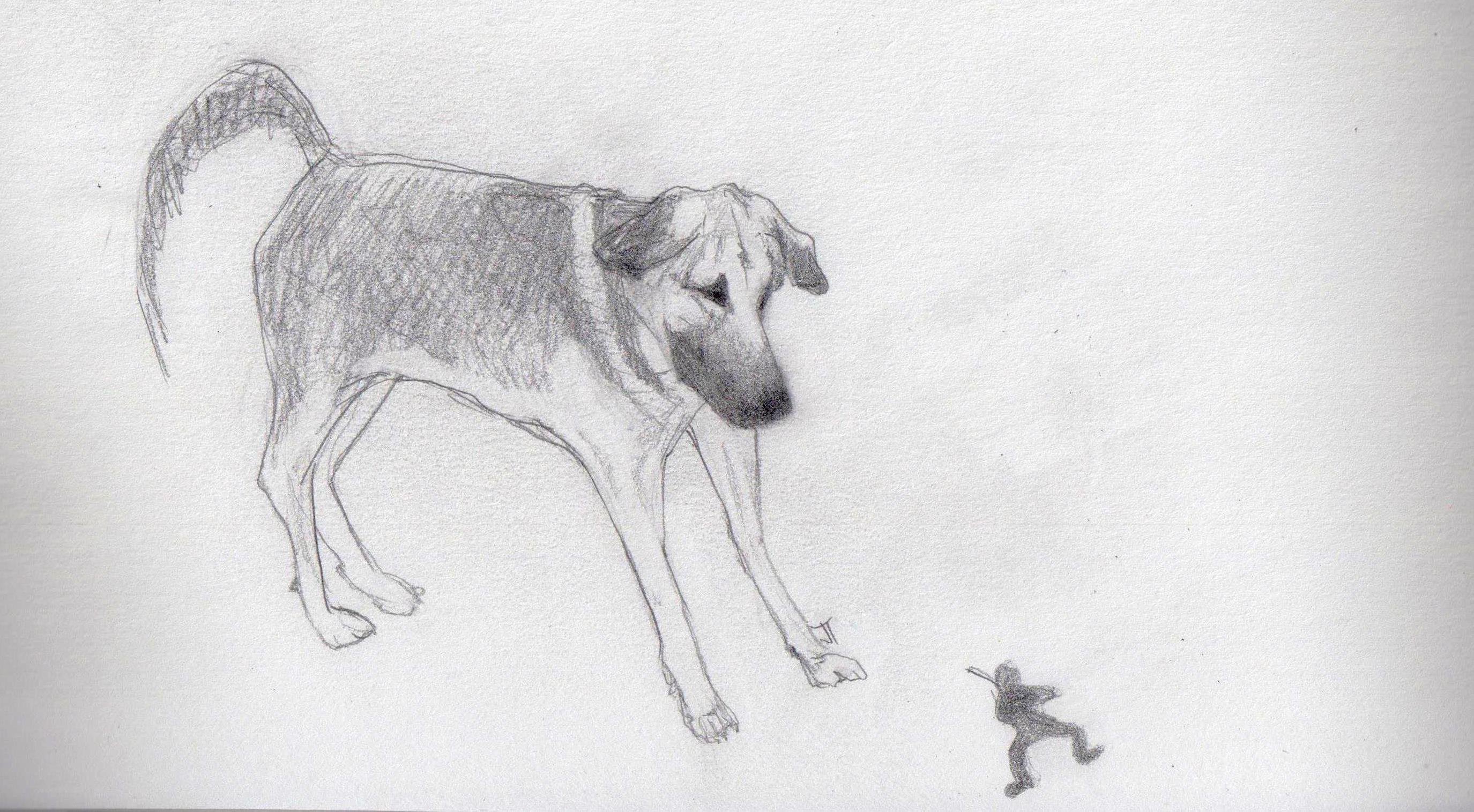
Jasper the dog was a late addition to my novel, but he opened up so many story possibilities, I’m glad he came to be one of the characters
~
Each time I add something new to the narrative, I have to make other edits in consequence. However, I find these changes are worth the effort since they contribute to building the story.
~
Have you considered the use of objects as symbols in your writing?
~
Copyright 2013 Jane Tims
writing a novel – characters with a point of view
As some of you will know, I have been working on a novel since November of last year. Although I have been quiet about it in my Blog, I work on my manuscript almost every day and the plot is getting tighter with every edit. I now have 83,000 words, 23 chapters and 273 pages.
~
The novel has the working title ‘Saving the Landing Church’ and is about a woman, Sadie, who decides to buy an abandoned church as a learning center for her new writers’ retreat. People in the community where Sadie lives have mixed opinions about her undertaking and Sadie meets a lot of opposition as she sets about acquiring and moving the church to its new location.
~
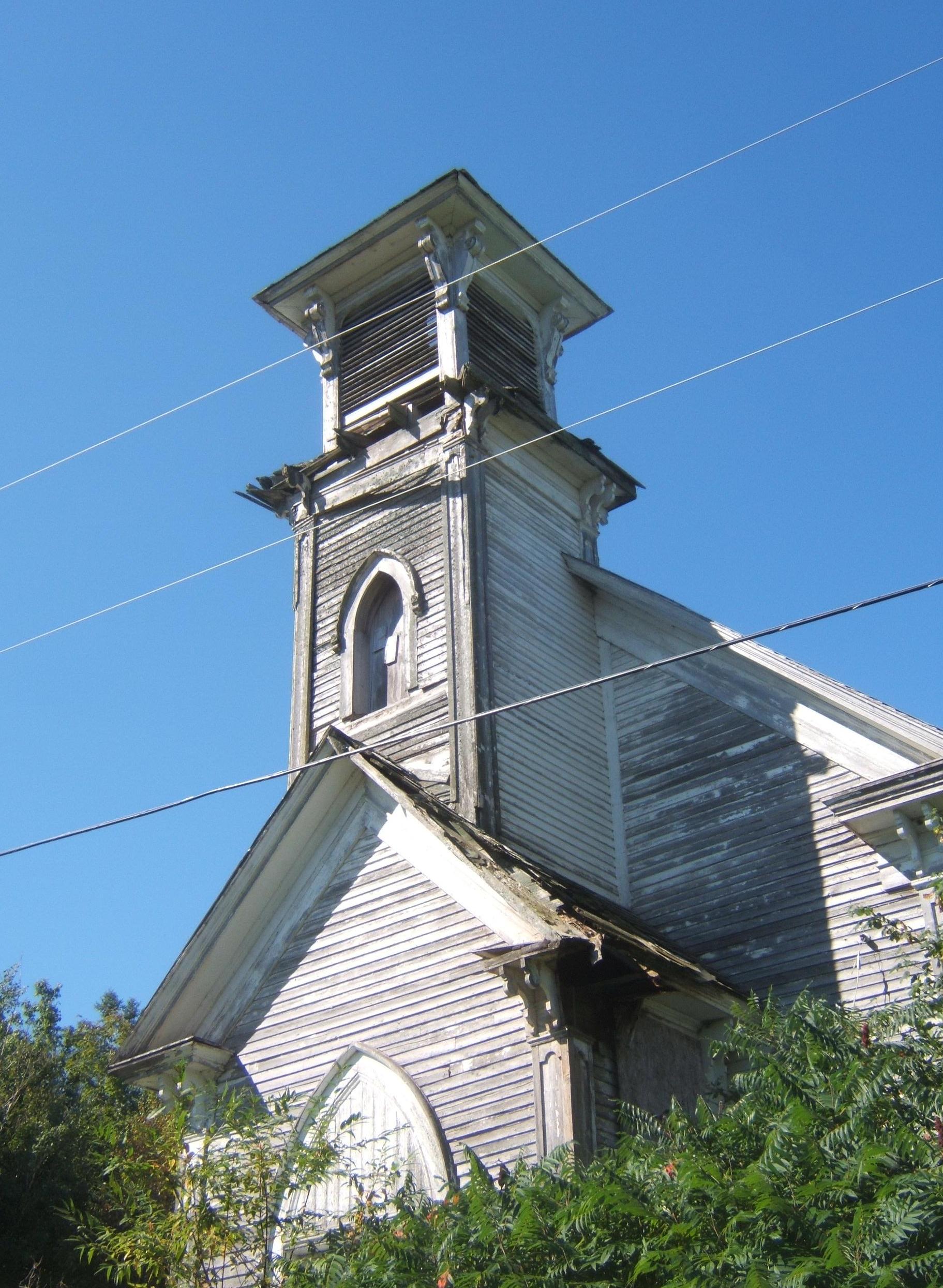
abandoned church near Knowlesville, New Brunswick
~
The book is written in the first person, past, from Sadie’s point of view.
~
Sadie … she looks a little timid, but she is determined to own the abandoned church
~
When I completed the second draft of the novel in January, I asked a few people in my family and my writing group to read it and tell me what they thought. I also workshoped Chapter Twenty at the Maritime Writers’ Workshop Winter Retreat in February and received many helpful comments from the workshop participants. I have obtained useful analyses from several people, most especially my niece who has read the draft carefully and given me many useful insights and edits. Various members of my two writers’ groups have also listened to parts of the novel and provided ideas for improving the writing.
~
One of the most consistent comments I have received is about one of my main characters, Sadie’s husband, Tom. Tom is not well. He has an advanced condition called Welder’s Lung and his doctors have given him less than a year to live. This situation is one of the main drivers behind setting up the writers’ retreat – it will give Sadie a livelihood after Tom is gone.
~
The criticism about Tom has been that his only role in the book seems to be to die. Readers have consistently told me they want to find out more about him. One of my writing group friends suggested I try writing the book from Tom’s point of view. She said she knew I would resist this idea, and, sure enough, my first response was ‘No way!!!’ … my book was almost done, my book was perfect! And write from a man’s point of view? … squiggle!
~
Tom, Sadie’s husband … he is looking a bit battered by his illness, but he is willing to do anything to help his wife
~
However, I thought about the possibilities and decided it might be interesting to write a small part of the book in Tom’s voice. I looked at each chapter and extracted a bit of the conversation or action that I thought might be better seen from Tom’s point of view. In some cases, Tom’s viewpoint immediately solved the problem of segments where there was no action, only Sadie’s thoughts about where she was in her quest for ownership of the church.
~
The new parts of each chapter were surprisingly easy to write and it took me less than three weeks to develop Tom’s ‘words’. As Tom’s voice began to emerge, I realised that Sadie has some things wrong … an example is her analysis of Tom’s response to his illness. To her, he has given up all hope. Tom sees his response not as despondent, but resolute. Also, Sadie has a consistently passive response to some quite violent behavior in the community. Tom takes nothing passively. Confronted by opposition, he responds in kind. And he has a couple of pals from his days on the construction site who will help him in any endeavor.
~
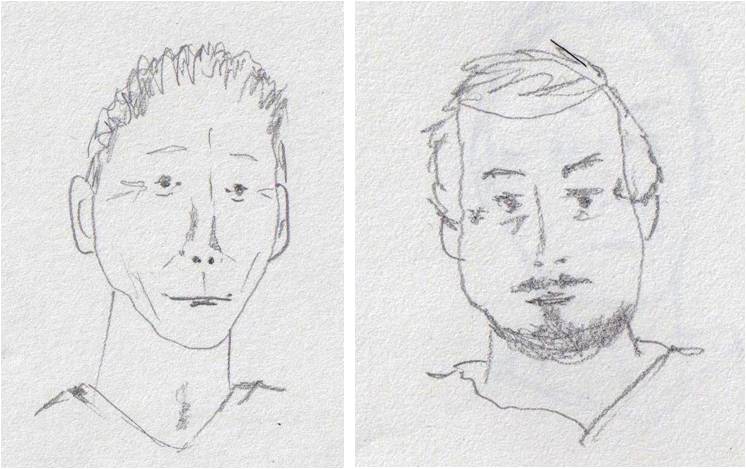
Tom’s friends Paul (left) and Rigger (right)
~
Tom also wants a dog and the introduction of Jasper, a German Shepherd mix puppy, to the action has been so much fun to write. Try adding a dog to your own novel or plan for a novel. At the height of the action, who is taking care of the puppy???
~
Jasper responds to a crawling military toy
~
Responding to people’s editorial comments is difficult. First, your ego has to be tamed. Then, you have to decide if the edit will really improve the draft. I try to look at every comment objectively but this is so hard. I give extra weight to a comment made by more than one person since this suggests the reading public may have a similar response. I know, however, that when all is said and done, it is my book and I have to make the decision to edit or not to edit.
~
My experience with the ‘Tom re-writes’ shows me that sometimes a seemingly radical comment can lead to an improved draft. Writing from another character’s point of view can suggest new ways of working out plot problems, add dimension to the story and background, and take the narrative in new and interesting directions. I strongly suggest looking carefully at each character in your story, writing a good character sketch for each and considering every bit of action from their point of view. As your characters find their way through the story, they will reveal unique ways of responding to the action.
~
As for my squirming about writing as if from a man’s point of view, this was easier to do than I first thought. Tom’s character was embedded in my head, so I had a good idea of how he would respond to a given circumstance. His ‘voice’ and reactions are unlike Sadie’s, so there is a significant difference in the words they use and the way they express their ideas. Tom also speaks in the present or immediate past tense, so his ideas are more visceral and lack the reflection brought by time. As for thinking like a man, I think Tom is likely from Saturn, rather than either Mars or Venus! And he likes quiche.
~
Lots of fun …
~
~
Copyright Jane Tims 2013




 nichepoetryandprose