Archive for the ‘wild life’ Category
jane 9 squirrels 1
Again, I am in competition with the squirrels (see ‘competing with the squirrels #1 and #2’, in the Category ‘competing for niche space’).
Christmas is coming and this year, I am decorating with natural elements. One of these is a ceramic bowl of large pine cones.
We have several large White Pine (Pinus Strobus L.) on our property and from time to time, they produce masses of beautiful pine cones, perfect for my decorations. White Pine are easy to remember in this area, since they have their needles in bundles of five. The cones are between 10 and 15 cm long and are a favourite food for squirrels.
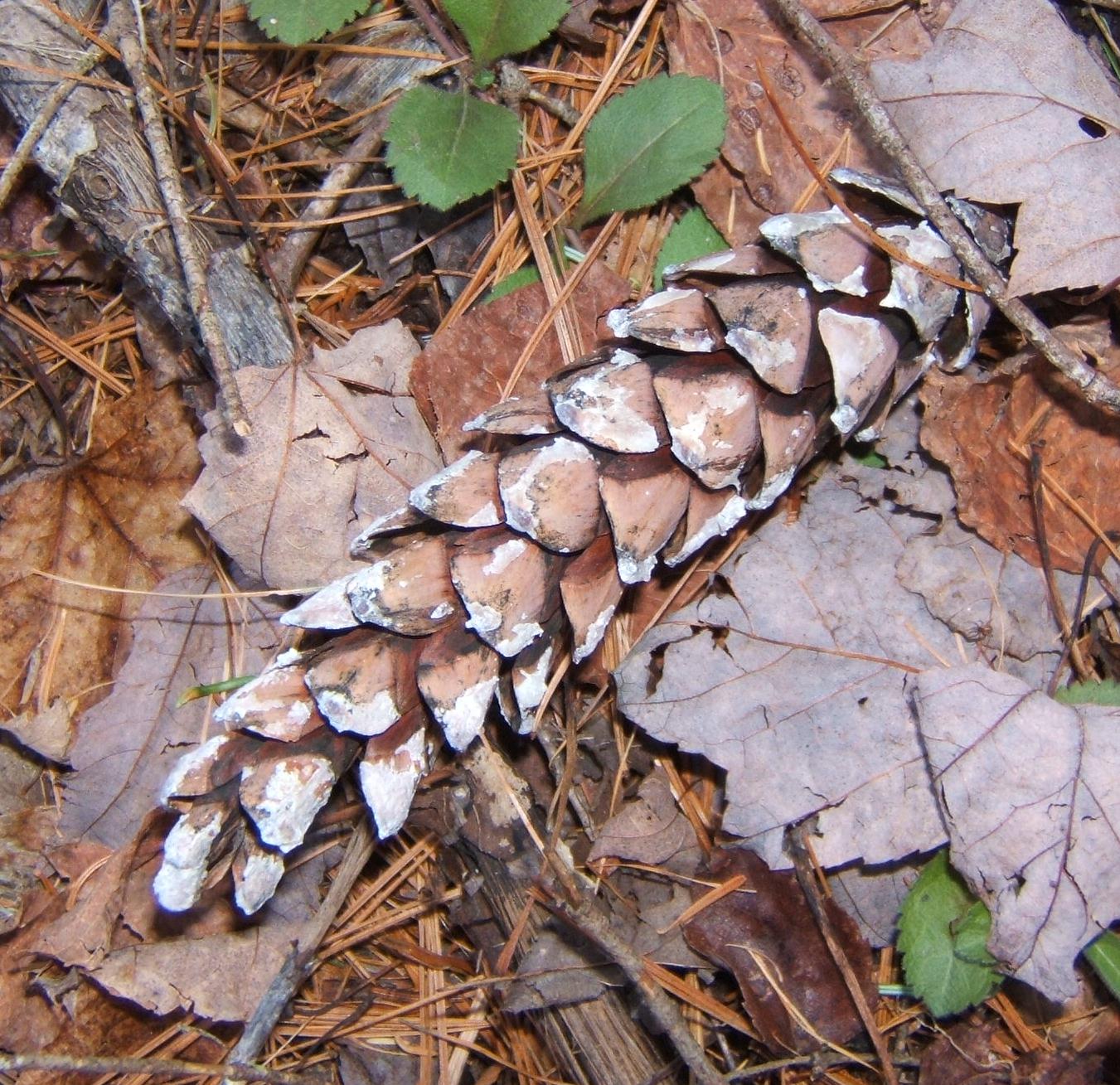
My husband came in last weekend and announced there were lots of the big cones in the pine tree next to our lawn. “Watch for them to fall, and then you should hurry to collect them,” said my savvy husband (he remembers the sad tale of the ripening hazelnuts).
I waited a couple of days and then went scavenging. And now, I am supreme. I have gathered enough cones for our Christmas. I saw a few cones with the lower scales and seeds nibbled away, but I found plenty for me. My hands were sticky, true, but I was so happy. All I can say is, with an emphasis approaching smug, “CH-CH-Ch-chchchchch-ch.”

- just to show that the squirrels do have lots of pine nuts… these cones are about half eaten

in November
~
we gather pine cones
snakes of lion’s paw
hawthorn
cedar boughs
and holly
~
we walk the wild ways
pruners and scissors
baskets and stout cord
bind bunches
of branches
~
balsam and cedar
blood berries
and evergreen
garlands of fir
rosehips and acorns, gilded
needles
and prickles
and thorns
~
© Jane Tims 2011
crows in trees

Of all the birds, I like the American crow (Corvus brachyrynchos) the best.
For one thing, they seem to me to be full of personality. I also know that crows are intelligent – research shows they can distinguish humans from one another by facial features. Crows also stay in family groups (parents and fledged offspring) for a few seasons. I feel sorry for crows; they seem to have a bad reputation and are treated poorly as a result.
If you want to learn more about crows and their habits, have a look at Michael Westerfield’s new book “The Language of Crows: The crows.net Book of the American Crow,” available at www.crows.net/crowbook.html .
A group of crows is known as a ‘murder’ of crows. The term ‘murder’ refers to the ‘observation’ that a group of crows will kill a dying cow. Some people are advocating for an alternative, since the term ‘murder’ perpetuates the notion of crows being malicious. Alternative names for a group of crows are presented in http://www.crows.net/mjw.html Michael Westerfield’s Crow Log: The Crows.net Project. I think this is an opportunity for a Poll!
~
~
Morning Song
~
in the morning
dew soaks the grass
and Canada
belongs to the crows
~
the croaking of ravens
the cawing of crows
familiar, unheard
backdrop to Canadian dawn
~
(theme music
in Canadian film)
~
in a conversational rattle
discussing gold and letters
~
a two syllable scream
haunting the fields
~
solitary sorrow
throned at the top
of a tamarack
~
black wings bruise the air
he calls an alarm
screams to his mate
the love of his life
with only the fall of the dew
for an answer
~
silent is the shroud of black feathers
strung by the feet from a pole
beside a garden
where she braved the flapping man
and dared to pull new corn
~
in the morning
Canada belongs to the crows
~
Published as: ‘Morning Song’, Spring 1995, The Cormorant XI (2)
© Jane Tims 1995
mood of the lake
One of the very enjoyable experiences of having a property near the lake is listening to the loons. There is a least one pair of loons on our lake and we see them often. Usually they call a few times at mid-day or in the evening. Their cries are varied, ranging from a laughing tremolo to distinctive and melancholy wails, hoots, and yodels.
We have always been interested in loons and the protection of their habitat. Loons are especially vulnerable to quickly changing water levels and wave action because they build their nests just at water level. `Watch Your Wake` programs help boaters protect loon habitat.
In 1994, we participated briefly in the North American Loon Project. Today there is a similar program, the Canadian Lakes Loon Survey, sponsored by Bird Studies Canada. This is a long term study, using data from volunteers, to assess the health of Canada’s loon population.
We had little time in those days to participate fully, but we did visit Peltoma Lake in southern New Brunswick, to look at the loons living there. My journal entry for our visit to Peltoma Lake reads:
May 1, 1994 Sunday
Trip to Peltoma Lake to see if there are any loons. We are preparing to canoe the lake
about three times this year to make observations. Disappointed at first
as the lake is lined with cottages and we could see no loons.
Then we stopped near a small bay and there they were
– nine black and white beauties! They left the cove as soon as they saw us.

I also wrote a poem about the lake – the mood of the poem suggests it must have been a damp and miserable day.
Last Sunday, we drove out to Peltoma Lake to take some photographs. The loons and most of the people are gone this time of year. Although it was cold, the lake sparkled in the sunlight and was anything but dreary.
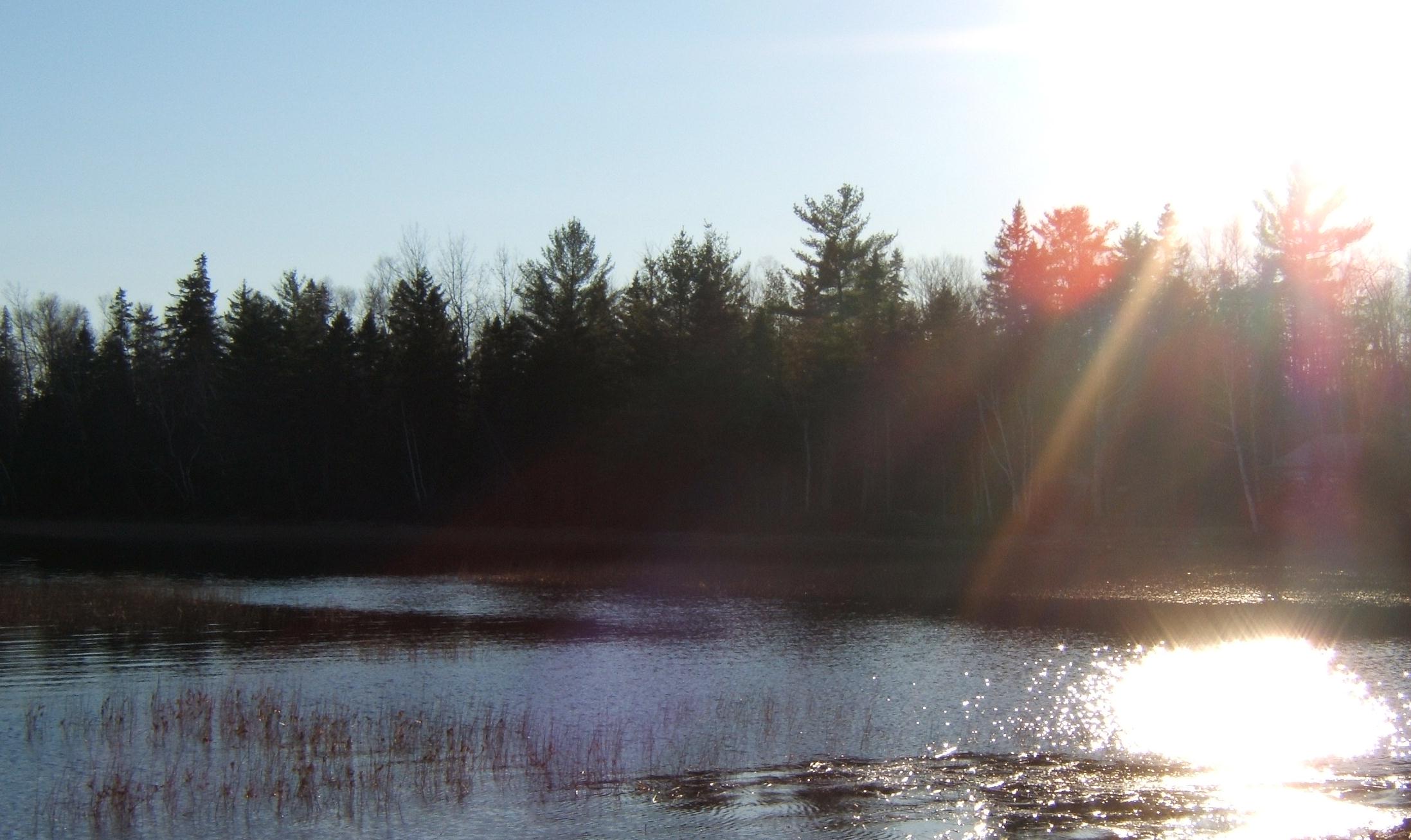
Peltoma Lake– Sunbury County
~
Peltoma in rain
is a faded black and white photo
layers of misery, thick and still
the lake, the shore, the mist
the thin chill drizzle
~
in the coves
the cedar and birch swoon above the water
moved to tears at reflection
the lake broods
over her loons
and the cell-thick pall of algae
smoothed to the shore
~
cottages hug the lake
like campers huddle a fire
cheerless and smoky
pines on the esker reach
blank windows keep watch
for sparkle on waves
back flips from the dock
paddles flashing sun
the day is bleak without answer
~
a muskrat tows a line on the shallows
loons quit the cove
diminish to mist
~
Peltoma is scowling
~
© Jane Tims 1994

air to breathe
As I approach retirement, I find I am thinking a lot about my past work. My first job was as a botanist in the field of air quality.
Some plants are very sensitive to air pollutants and develop ‘herring bone’ patterns on the leaves when the levels of pollutants like sulphur dioxide get too high. Other plants can be used as monitors since they absorb pollutants from the air.
I worked to diagnose air pollution injury to sensitive plants and designed ways of using plants to assess air quality problems. We grew tobacco to measure ozone pollution, set out ‘tea bags’ of sphagnum moss to monitor levels of trace metals in the air, and collected reindeer lichens to determine their pollutant exposure. I had wonderful days identifying plants, collecting lichens and being a botanist.
My favourite air pollution monitors were the reindeer lichens. These are like all lichens, a symbiotic organism consisting of an algae and a fungus. They have no roots, so they absorb all their nutrients from the air, making them an excellent monitoring system for air pollutants. They were a challenge to identify and the habitats where they grew took me to some very interesting places in New Brunswick. These included peat bogs where the lichens grew beside pitcher plants and sundews, mountain-tops dominated by ericaceous species like sheep laurel (Kalmia angustifolia L.) and blueberry, and high flung rock outcrops where I could see all the world below me as I picked my specimens.
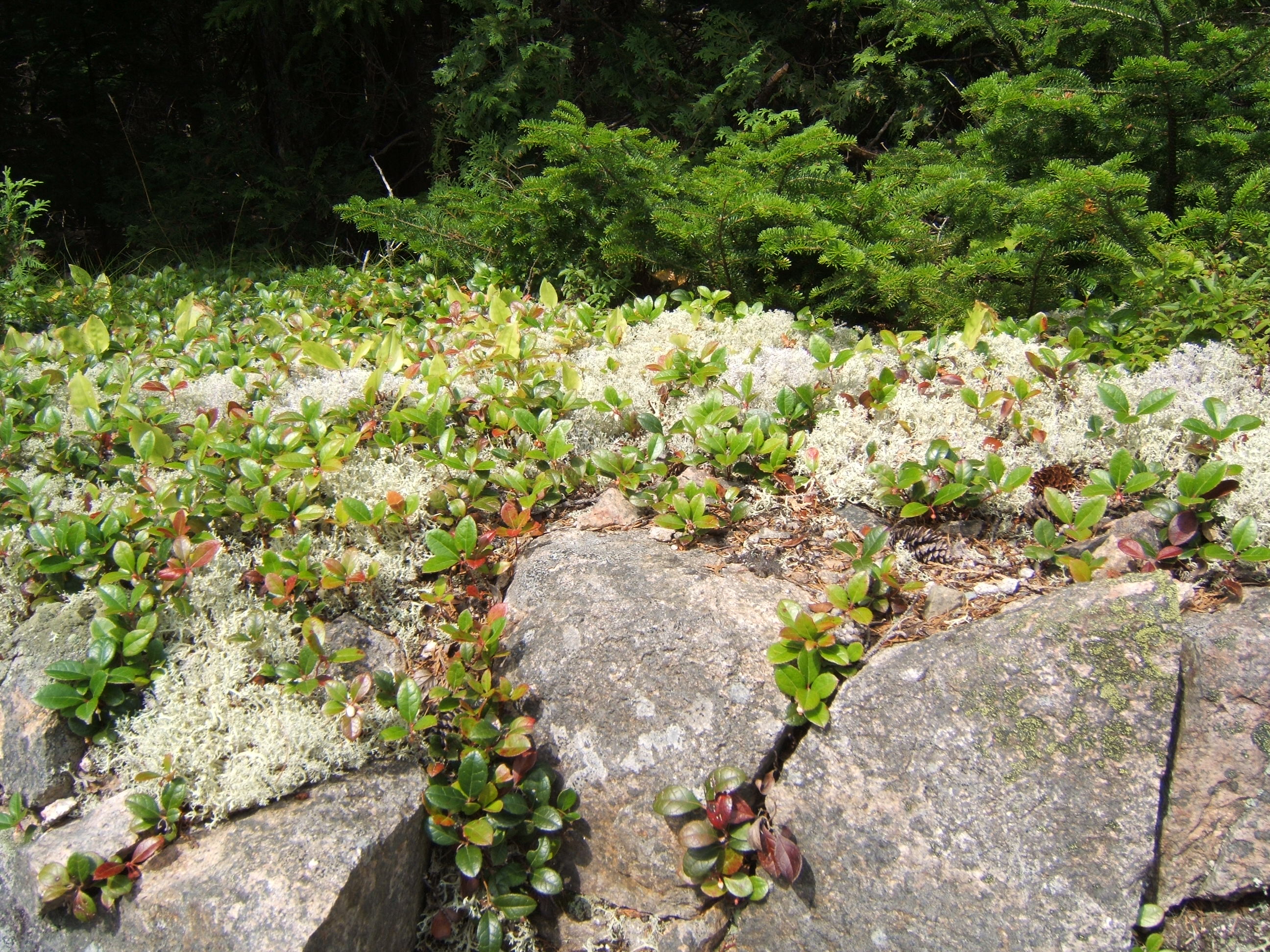
Although we collected many species, the three reindeer lichens most useful for our studies were Cladina arbuscula, Cladina rangiferina, and Cladina stellaris. These are all ‘fruticose’ lichens, species with a ‘shrubby’ appearance, consisting of a main branch with many side-branches. A single ‘plant’ fits nicely in your hand. The Cladinas all have hollow branches and could be (and are) used as little trees in HO scale train models.

- Cladina arbuscula (left) and Cladina rangiferina (right) growing on a rock by the roadside in Maine. You can tell the difference by the greenish color of the arbuscula and the bluish-grey color of the rangiferina.

Cladina arbuscula (Wallr.) Hale & Culb. grows in extensive colonies, and is yellowish-green. The tips of the branches all point in one direction, a distinguishing characteristic of the species. Cladina rangiferina (L.) Harm. is often found growing with Cladina arbuscula and can be distinguished from arbuscula by its very blue-grey appearance.
Cladina stellaris (Opiz) Brodo is yellowish-grey, and grows in distinct clumps which resemble small ‘poofy’ trees.

Cladina lichens and moss on the rock at Moss Glen Falls in New Brunswick. The clump of lichen towards the center, looking like the ice cream in a cone, is Cladina stellaris.
On our travels this summer, I reacquainted myself with the Cladinas. And I remembered all the remote places I have been as a result of my work. One of these was Turtle Mountain in southern New Brunswick, now protected as part of the Loch Alva Protected Natural Area (PNA). It is a very old mountain, worn to a granite hill. At the top of the hill, is an ericaceous meadow where Cladina lichens flourish.
Turtle Mountain, 1979
~
afternoon air at the base
of the food chain
rewards obligation to breathe
~
grazing tickles the nose
and grey-blue lichens know
laurel and balsam
~
flume of curtain billows
across the daybed
into the room
~
into the space between
Kalmia and wintergreen
meadow heat rising from stone
~
marbled weave of oxygen
hydrogen nitrogen
bilberry and salt ocean
~
© Jane Tims 2011

black and amber signs
When people and animals try to occupy the same space, sometimes misfortune or even tragedy occurs. In New Brunswick, drivers constantly scan for deer and friends include a warning to ‘watch for moose’ in their goodbyes.
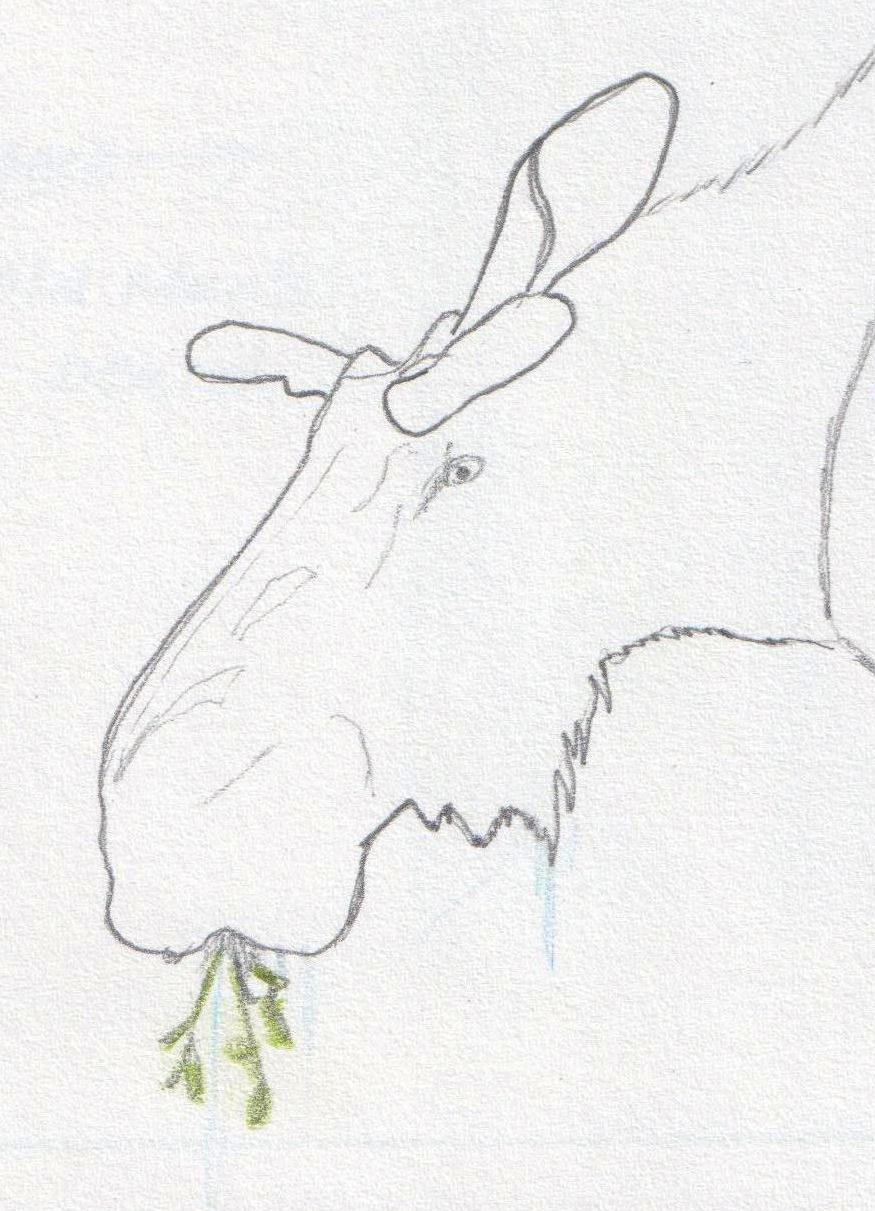
The tragedy works both ways. A moose is a big animal – a collision will mangle a car and destroy a young life in an instant. At the same time, a turtle killed on the highway is a loss for our ecology and our biodiversity.
The first step in preventing tragic encounters of vehicles with deer and moose and other wild life is the black and amber sign. It warns us when we travel through the spaces animals consider home.

In New Brunswick the fatalities involving moose have been so high, the Department of Transportation works constantly on a program of fencing and tunnels to keep cars and people separate and to provide safe passage for animals.
Often in our travels, my husband and I stop to rescue turtles from becoming road kill, carefully moving them off the road in the direction of their destination. In Ontario, we were delighted to encounter Turtle Crossing signs. These signs serve to warn and also to make people aware that the wetlands are home to many species.
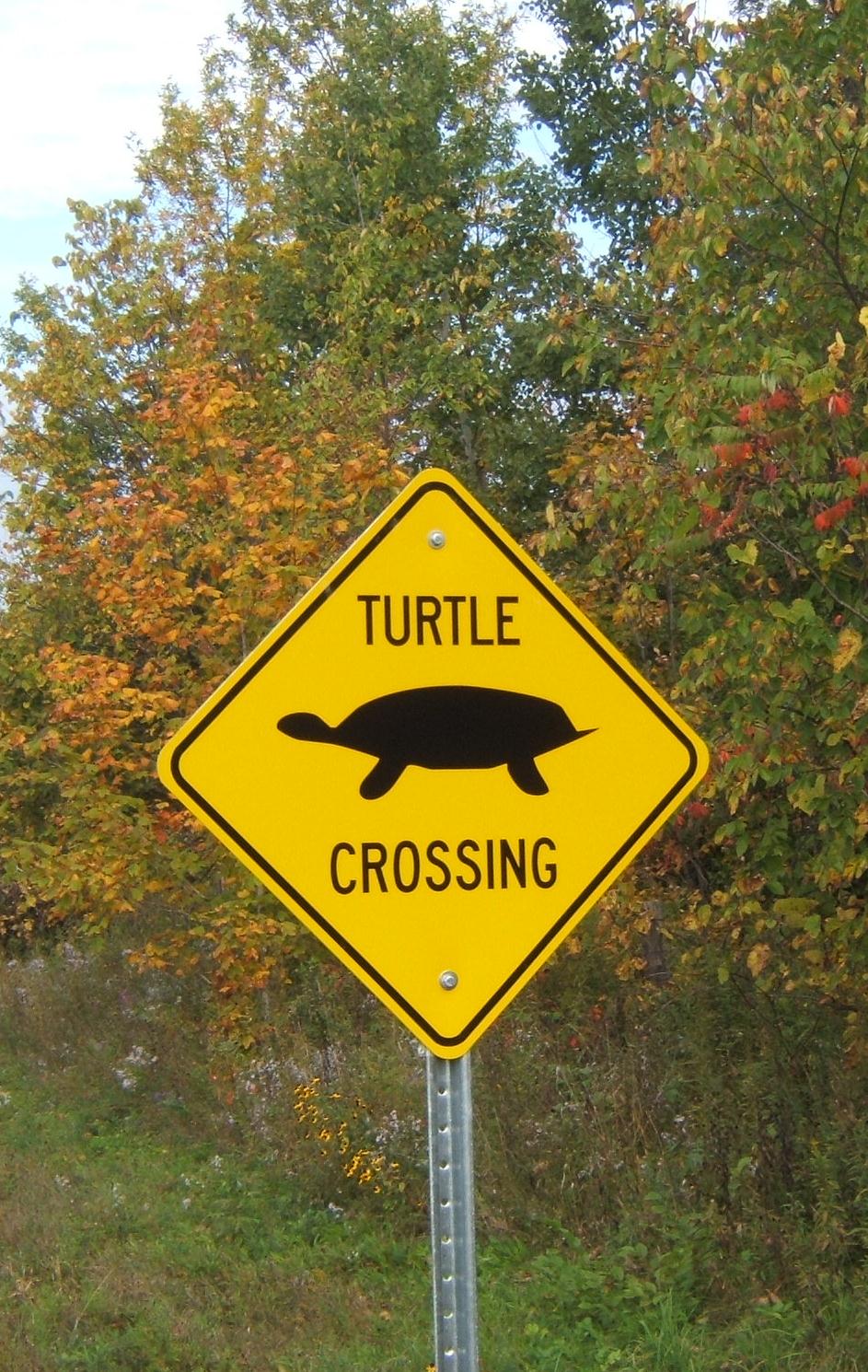
black and amber
~
take these as warning
black on amber
time presses forward
no back-spin in the gyre
lost is lost
bubbles make no progress
against the river’s flow
~
five things to do
before evening
the least of these
to notice the shadow
climbs the wall
her hair tangles
on the pillow as she sleeps
immobile
~
remember the deer
how it fits itself to the hollow
of the hood of the car
and the moose matches pace
with the bike
prolonging collision
~
remember how the turtle withdraws its feet
refuses to move
just another
stone on the highway
~
© Jane Tims 2011
drive at dusk
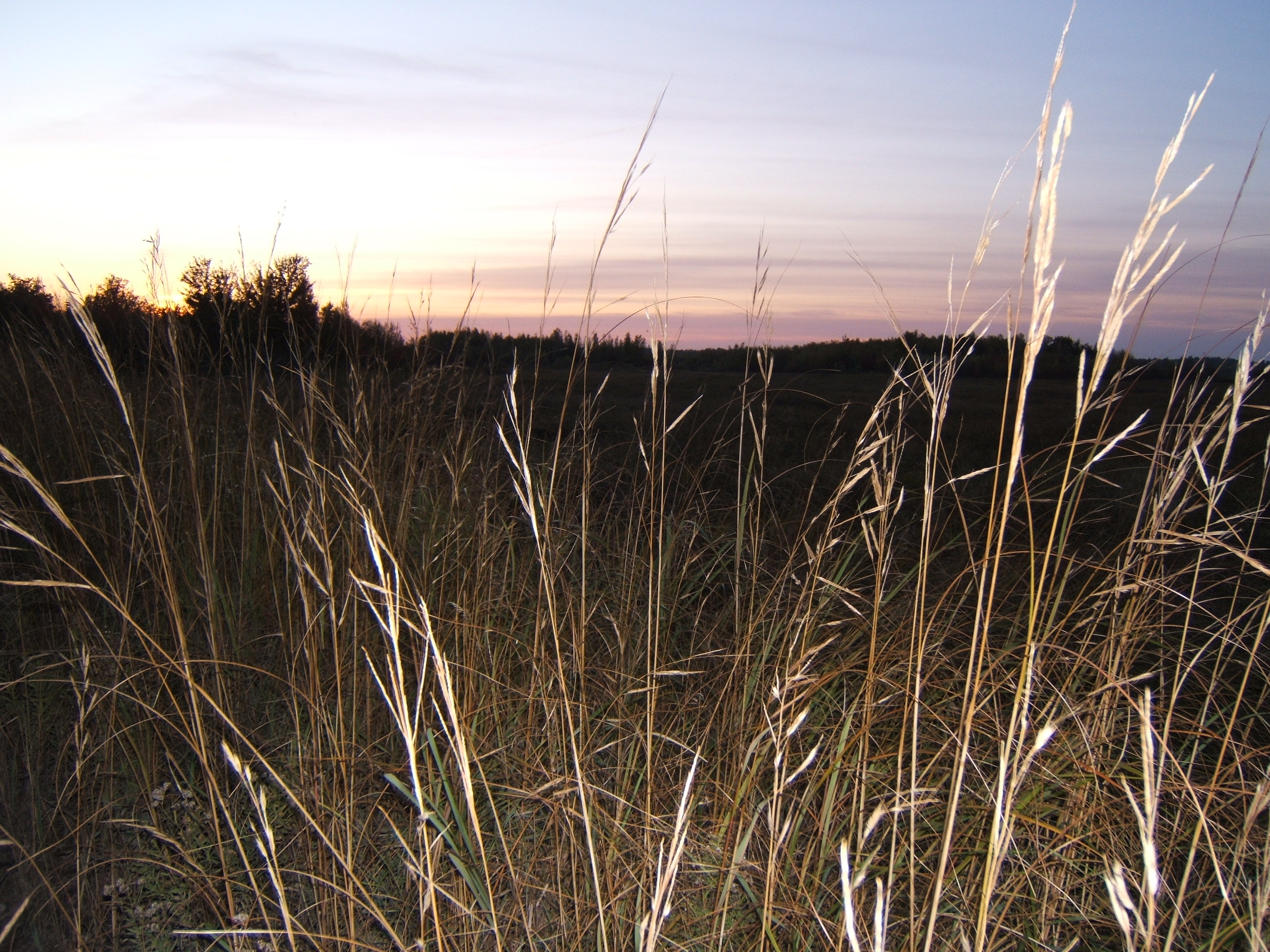
Saturday evening we took a drive along Sunpoke Lake, a low part of the landscape where you can see, simultaneously, the marsh of Sunpoke Lake, the Lake itself, and the Oromocto River.
Along the road were tracks of moose and bear, and the very smelly carcass of a bear. In each of the tracks, there was a fair sprinkling of seeds, so we surmised the bear tracks were those of the dead bear.

notice the seeds in the tracks... the bear travelled by quite a while ago
The tracks gave us a hint at the drama that must have played out along the road, probably on a night earlier in the week.
The moose tracks were also full of seeds. I like to think of it, ambling along the road.

At the turn of the road where it runs along the Oromocto River, we stopped to take some photos of the moon and its reflection.

And on the opposite side of the road, I caught the sunset at its peak, and the silhouette of a very spooky tree.

Fears
~
I saw a light in the woods tonight
low, through tangled branches of spruce
and crowded stems of fir
~
white in the dark
a gleam where only black should stir
~
like the lamp of a stranger
lost
~
but the glow was steady and still
and in less than the catch of a breath I knew
all I saw was the rising moon
beyond the hill
~
I heard a cry in the woods tonight
soft and low through the tangle of spruce
and the thicket of fir
~
a moan in the dark
a sob where only wind should stir
~
like frightened tears of a child
alone
~
but the cries held no human word
and in less than the catch of a breath I knew
the wail of a wildcat on the prowl
was all that I heard
~
© Jane Tims 1992

more butterfly spaces
On our trip to Ontario, I did a little chasing of butterflies. I was trying for a photo so I could identifyanother butterfly for my ‘life list’. So far I have collected two: ‘Monarch’ and ‘Viceroy’!
The field I focussed on had a lively population of yellow butterflies, and I thought it would be easy to catch one in a photograph. I was wrong!
If I stood still and waited for them to come to me, they would eventually flutter nearby but be gone by the time I had the camera in focus. If I chased after them… well that was just silly.
Eventually I did capture an image as one butterfly settled for a second on the purple head of a Red Clover (Trifolium pratense L.).
Once I had my photo, I could identify the new member of my ‘collection’ – a Clouded Sulphur (Colias philodice). Its distinguishing characteristics are a double spot on the underside of the hindwing and a submarginal row of dark spots. According to my source, the Clouded Sulphur is similar to the Pink-edged Sulphur (Colias interior) but the Pink-edged Sulphurhas a single spot on the underwing and no row of dark spots.

The experience of chasing this butterfly reminded me of a study I used to play on the piano when I was younger. The piece was by Chopin, the well-named ‘Butterfly Etude’. It was a hard piece (although I was playing an ‘easy’ version), made up of sets of of detached and un-detached octaves, played in rapid staccato. At the time I thought of it as just another study in agony, but now I realise how aptly it represents the inelegant, bouncy flight of the butterfly!
étude opus 25, no. 9 – Chopin
~
wrist staccato
octave stretches
disarticulated
sprite
~
wings a-flutter
closed and open
cloud to clover
bouncy bright
~
flirt and quiver
tip and stumble
clouded sulphur
butterflight
~
© Jane Tims 2011

butterfly spaces

Viceroy butterfly on the rail of a little-used track

- ‘Viceroy butterfly on a rail’

butterfly
~
scrap of paper
plucked from my hand
wind a tease
always one wing beat
beyond the finger tip
attempts to read
delicate code
of dots
and dashes
~
a yellow Post-it note
folded on the tower
of a blue sky flaxflower
a tatter
a musical note
set to the panic
of butterfly flight
~
a curtsy and away
across the field
~
pursued by a butterfly net
~
and a killing jar
~
© Jane Tims 2007
pitfalls
If the space you occupy, your niche, has benefits to nourish, lift and sustain you, it also has its pitfalls, its dangers. Animals know this and their adaptations to their habitat are as much about avoiding danger as they are about obtaining food or shelter.
Think about the Groundhog family in the grey woods behind our house (see post ‘the location of our picnic table‘ August 20,2011, category ‘wild life’). The Groundhog’s tunnels are designed to provide shelter and food storage, but they are also designed for checking out the enemy and for quick escape.
Like the Groundhog, I try to prepare for the pitfalls. I have an emergency kit, including water and a flashlight, ready for severe storms, unexpected floods, and power outages. In spite of this, when our basement was flooded last December, I found I was poorly prepared and all I could do was concentrate on the small steps toward return to normalcy.
The path through the grey woods has its own pitfalls. When I go for walks I have to beware of fallen trees…

roots ready to grab an ankle…
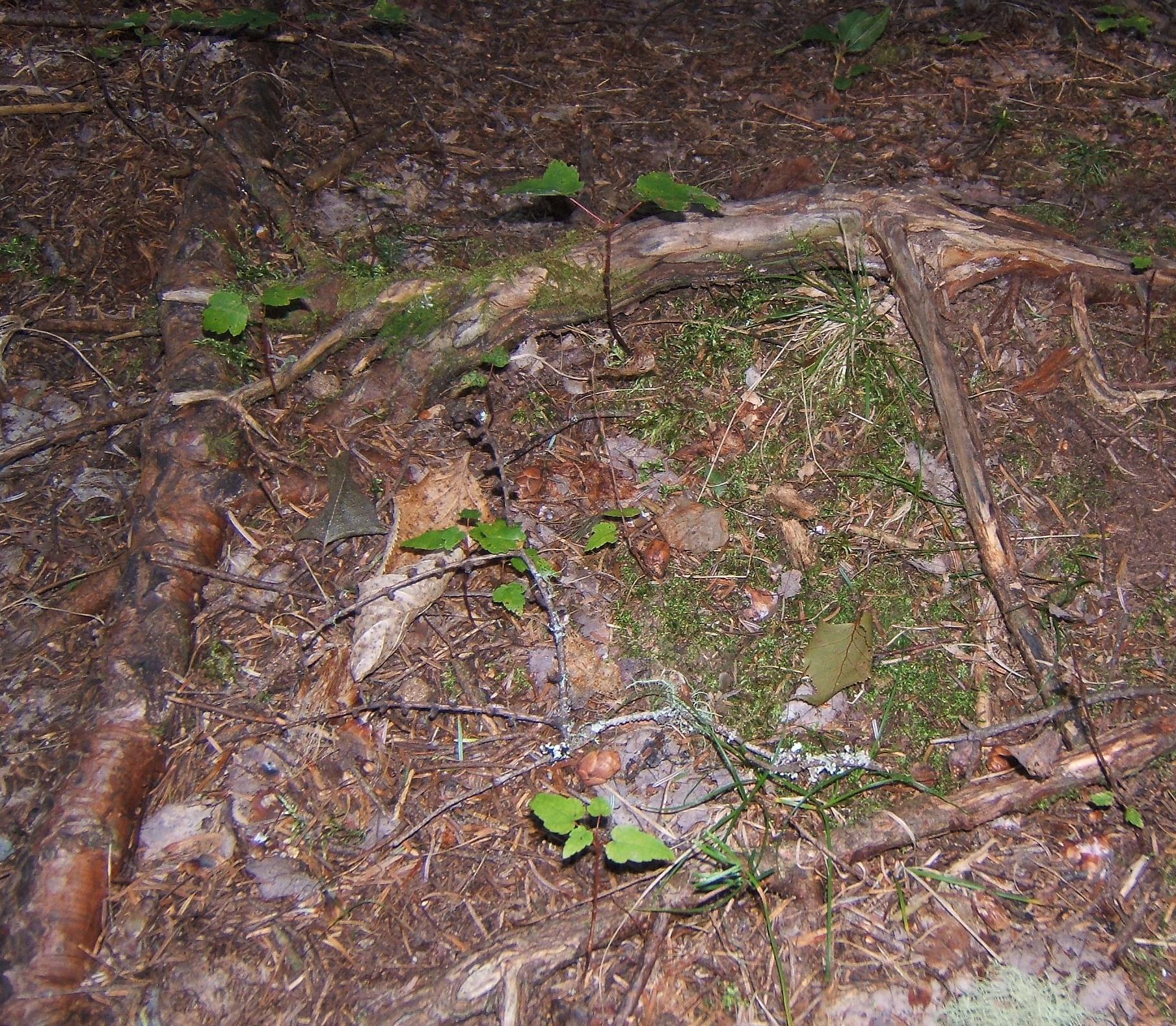
branches reaching to poke an eye…
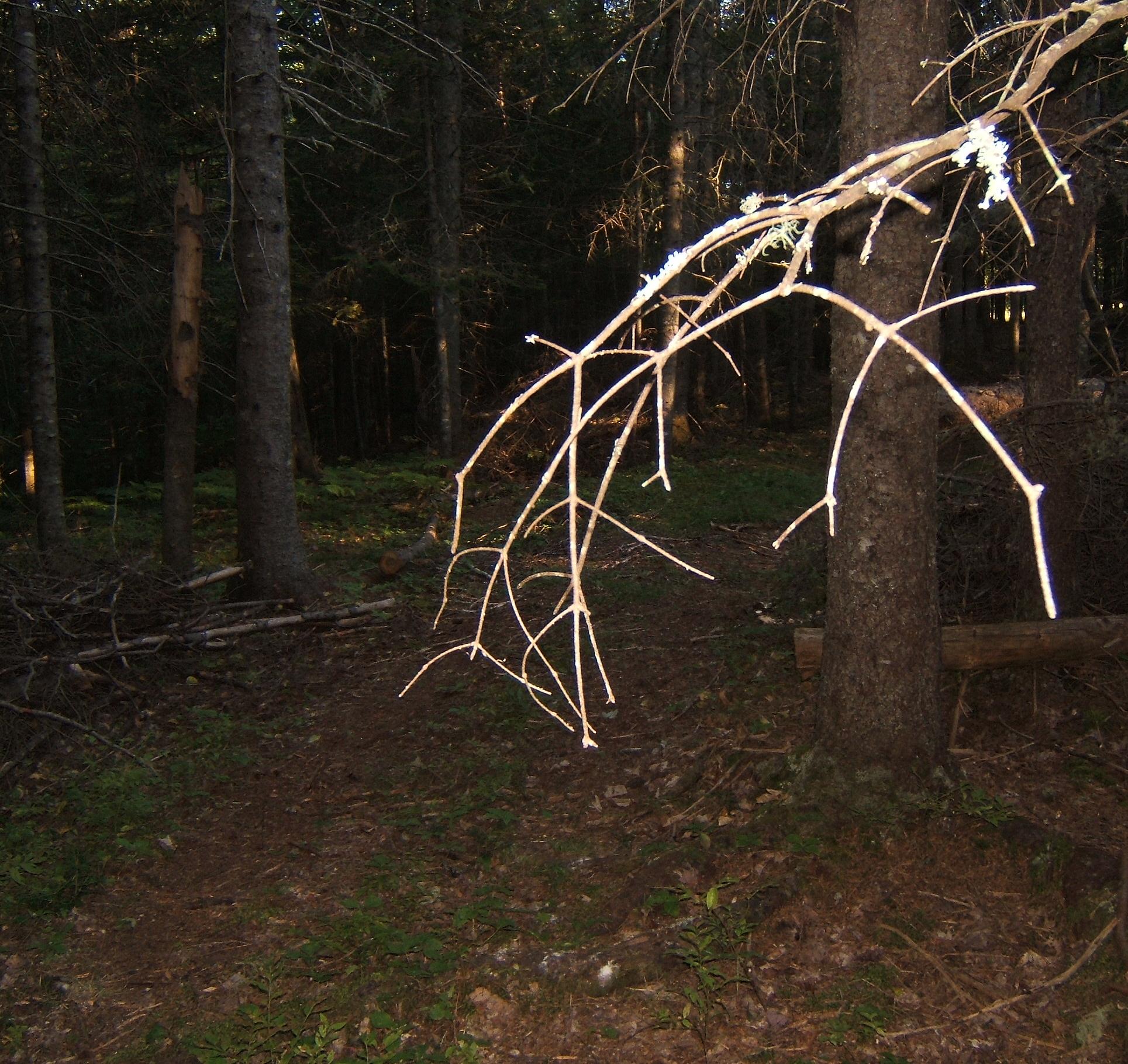
and the risks of not looking around, and missing something special and ephemeral…

pitfalls
~
soft places in the earth
hollows in the leaf layer
deadfalls to snag the surest ankle
roots that reach for the body
and chasms to claim it
~
gaps in the greyness of pine
spaces to spill sunlight
admit the riot of leaves
and the keys of the maple
~
holes in the layer of cloud
snags in the curtain
knots in floorboards
eyes in the blackness of night
~
flaws in the fabric
seams to part and peer through
paths we have crossed before
in other ways
~
© Jane Tims 2005
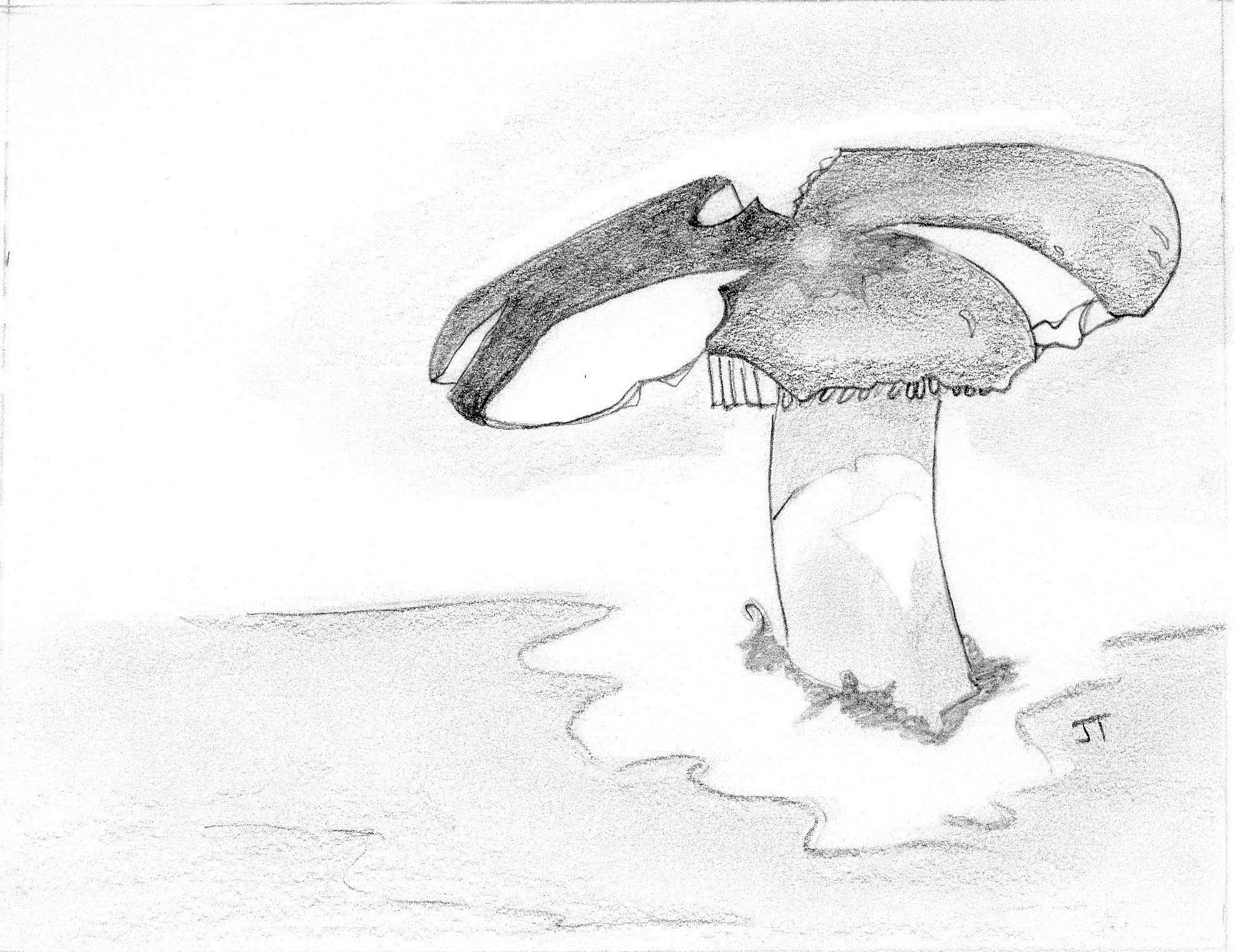
'red mushroom'
the color of niche
What are the color characteristics of niche? Are humans the only species to prefer certain colors for their spaces?
Other species also have color preferences. The best example I know is the preference of insects for color in their interactions with plants. Some insect pollinators, for example, prefer certain colors over others. Bumble bees have been shown to prefer the color purple. Also, flowers appearing monochromatic to us may be perceived quite differently by insects since they also see in the ultraviolet range of the spectrum. Some flowers, such as the yellow Evening-Primrose (Oenothera biennis L.), have ‘runway markers’ on their petals, to help insect pollinators to find their way to the nectar-producing parts of the plant.
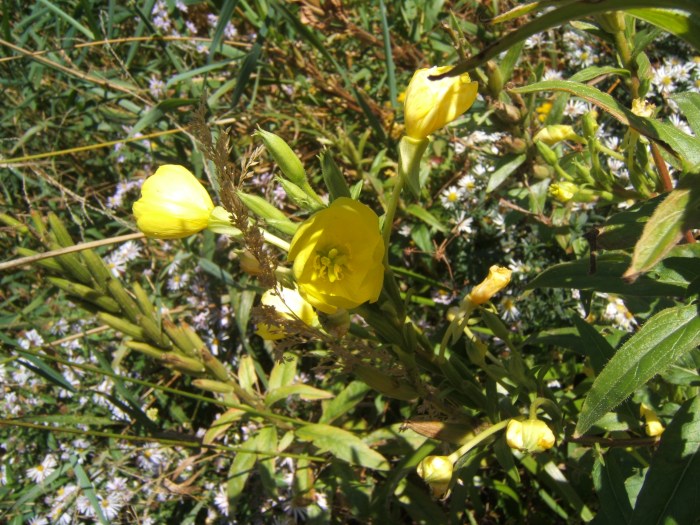
- Evening- Primrose (Oenothera biennis L.) Under uptra-violet light, the central area of the inner petals shows dark ‘runway markers’… if you look closely, you can see some vein-like variation in the yellow of the inner petals

Knowing about color-preference in insects can help us to spend more time in the out-of-doors. Science has shown us that mosquitoes prefer black or other dark colors over lighter colors. Greens, yellows and white are the colors to wear to reduce your attractiveness to mosquitoes.
An early paper on color preference of insects is A.S. Packard, 1903, ‘Color Preference in Insects’, Journal of the New York Entomological Society 11: 132-137. This paper is over one hundred years old but has charming anecdotes of the color preferences of houseflies, butterflies, moths and other insects. It is available on-line at:
http://www.jstor.org/stable/25003044
In the article, Packard reports mosquitoes are attracted to navy-blue, dark red and reddish brown.
My favorite color is definitely green, followed closely by orange. I also find I associate these colors strongly with the seasons: autumn with orange, summer with green. Although I would not select red as a favorite color, I notice my house, not at all color-coordinated, has definite red accents in almost every room.
What is the preferred color of your niche?
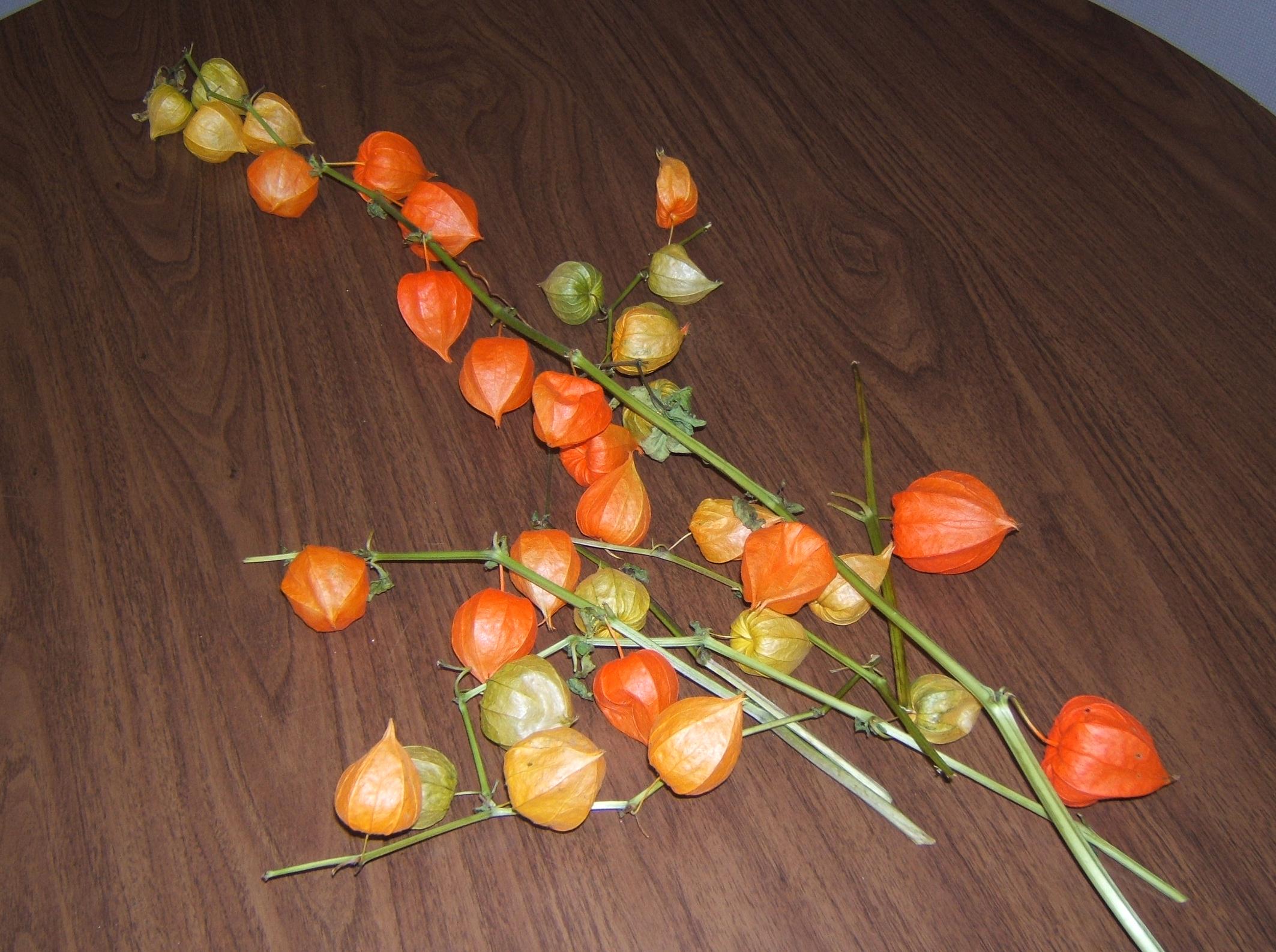
Chinese lanterns (Physalis alkekengi L.) from a friend's garden... also called Bladder cherry or Japanese lantern
orange peel
~
orchard bees
wings of monarch or viceroy
citrus oil, flames spurted in dark
weightlessness of Chinese lanterns, evolution of green
~
jack-o-lantern grin on the compost heap
taste and root-thread trace of carrot
pumpkins on the vine
~
furniture polish stain
on an empty page
~
nothing rhymes
with orange
~
© Jane Tims 2011




 nichepoetryandprose