Archive for the ‘wild life’ Category
something orange
I love the colour orange. It must be so – it is one of the most used ‘tag’ words in my blog postings.
~
This is a rather whimsical ‘side-view’ watercolour of an orange mushroom I saw recently in our cottage woods. I published the ‘top-view’ in an earlier post.
~

November 22, 2015 ‘side-view of an orange mushroom’ Jane Tims
~

November 5, 2015 ‘woodland floor’ Jane Tims
~
Copyright 2105 Jane Tims
colour on the woodland floor
Today, we went for a walk along the trails at our camp. My favorite path runs along the boundary, next to our zig-zag cedar fence and among young white pine, grey birch, red maple and balsam fir.
~
The weather has been very damp, so I expected to find fungi along the way. But I was surprised to see a beautiful patch of bright orange toadstools, each with a distinct orange-red center. They stood out among the red-brown leaves and green mosses.
~
I am not good at the identification of fungi, but I think this is Caesar’s mushroom (Amanita caesarea). It is easily confused with the poisonous Amanita muscaria, so no one should use my painting as an identification guide. Just a celebration of orange and red on a fall day.
~

November 5, 2015 ‘woodland floor’ Jane Tims
~
Copyright Jane Tims 2015
art auction – new painting

September 17, 2015 ‘Outside-In #3 – Far from the Sea’ Jane Tims
~
I have submitted another painting to Isaac’s Way Restaurant, for their 25th Art Auction and Sale. This event will run from September 27, 2015 to late January, 2016. The proceeds from the auction go to sponsor kids-in-need. My latest painting is titled ‘Outside-In #3 – Far from the Sea’.
~
The painting is the third in a series of still life paintings I have done about the many elements of nature we bring into our homes. This includes items collected on walks, motifs on fabrics and metals, small statuary and so on. My first painting in the series was ‘Outside-In’, a Chinese dragon hiding behind a glass cloche. The second painting was ‘Outside-In #2’ , a still life of a potpourri jar.
~
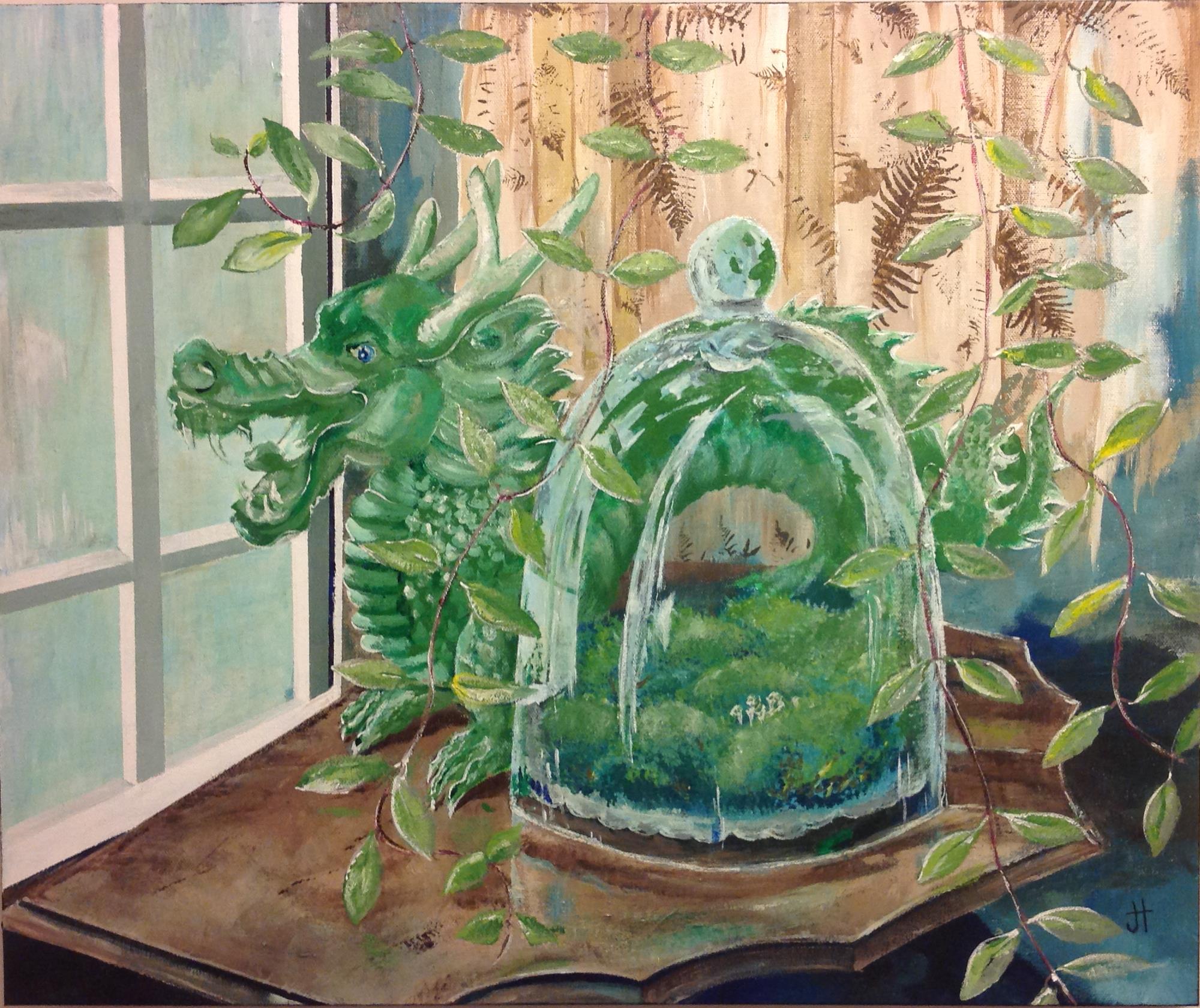
February 12, 2015 ‘Outside-In’ Jane Tims
~

May 2015 ‘Outside-In #2’ Jane Tims
~
For the new painting, I used Chromium Oxide Green, Burnt Umber, Titanium White, Phthalo Blue, Cadmium Yellow, Quinacridone Magenta and Cadmium Red.
~
If you are in the Fredericton area, please drop in to Isaac’s Way. Their food is delicious and over fifty artists have their paintings on display. Bid and you could take home a piece of original art!
~
Copyright Jane Tims 2015
stinkhorns – what’s not to love?
This morning I was trimming the vines at our front door and resting occasionally in my yellow lawn chair. Every time I sat down, I smelled a very disgusting smell. It didn’t take me long to find the source. Something I have never seen before – an Elegant Stinkhorn fungus (Mutinus elegans).
~
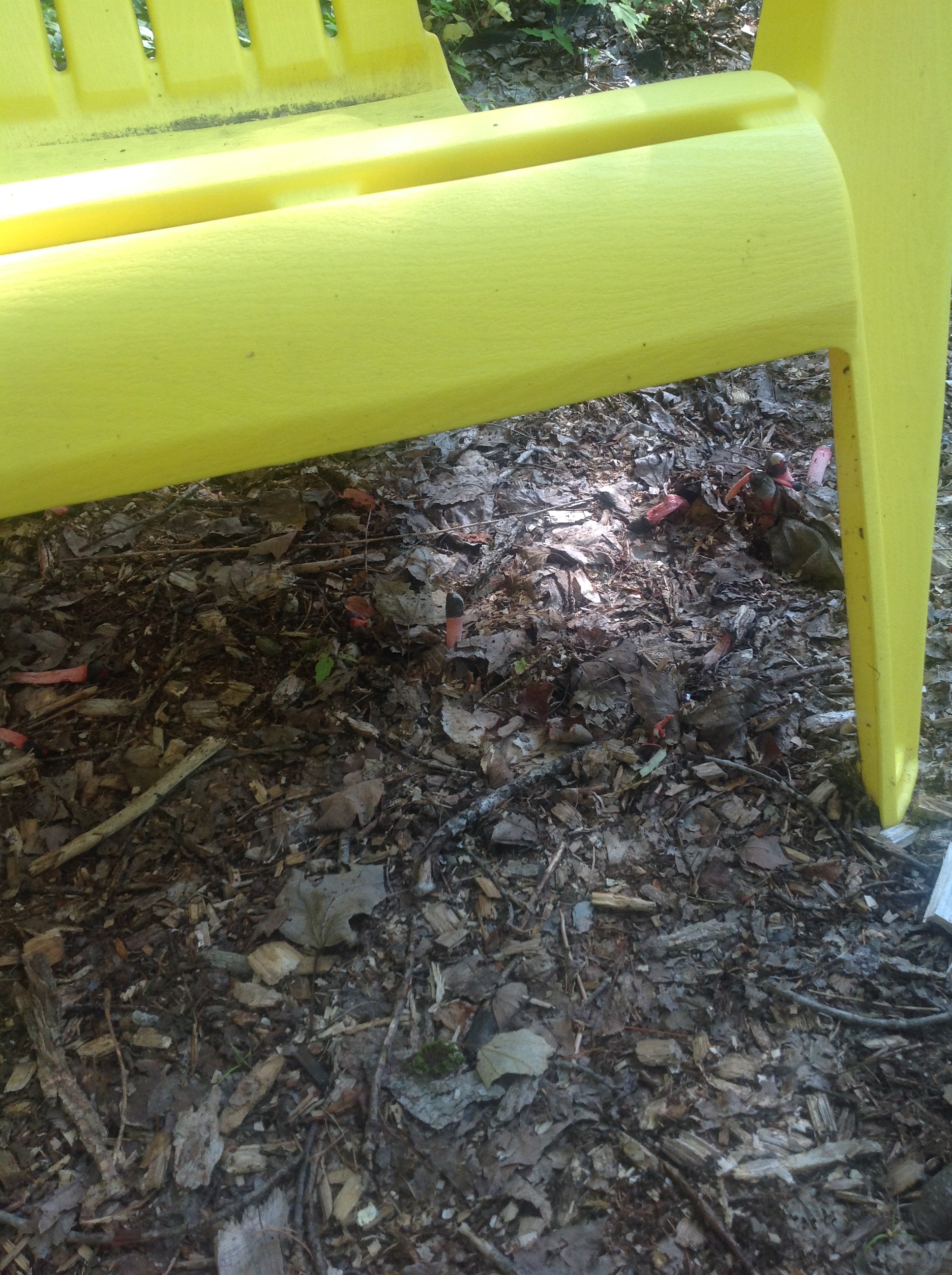
under the yellow chair is a pink stinkhorn fungus
~
Elegant is not an apt word for this fungus in my opinion. Its fruiting body consists of long pink cylinders covered with a dark brown mucilage at the tip. They belong to the family ‘Phallaceae’ (I understand the source of this name). The cylinder emerges from a whitish ‘egg’, a puffball-like body. Flies were buzzing about, attracted to the putrid smell.
~

~
My thought when I first saw the fungus was that Aliens had invaded. Actually, the fungus has found an ideal location to grow. Recently it has been very wet, after a long spell of dry weather. The area where I keep my lawn chairs is mulched with wood chips, providing a source of food for the Stinkhorns. I think the space had been made more habitable by the lawn chair which has kept air movement down and humidity high.
~

~
Sorry. I am a botanist and I understand that I am the invader on our property. But these look disgusting, smell disgusting and, if people have to come to my front door, no one will ever visit me again.
~
Copyright Jane Tims 2015
a strange place to grow
Who knows where life will flourish? Yesterday morning, I found a crowd of tiny toadstools beneath our truck. Although I looked around, I couldn’t find them anywhere else in the yard. But under the truck the microclimate was just right for this faerie land to grow.
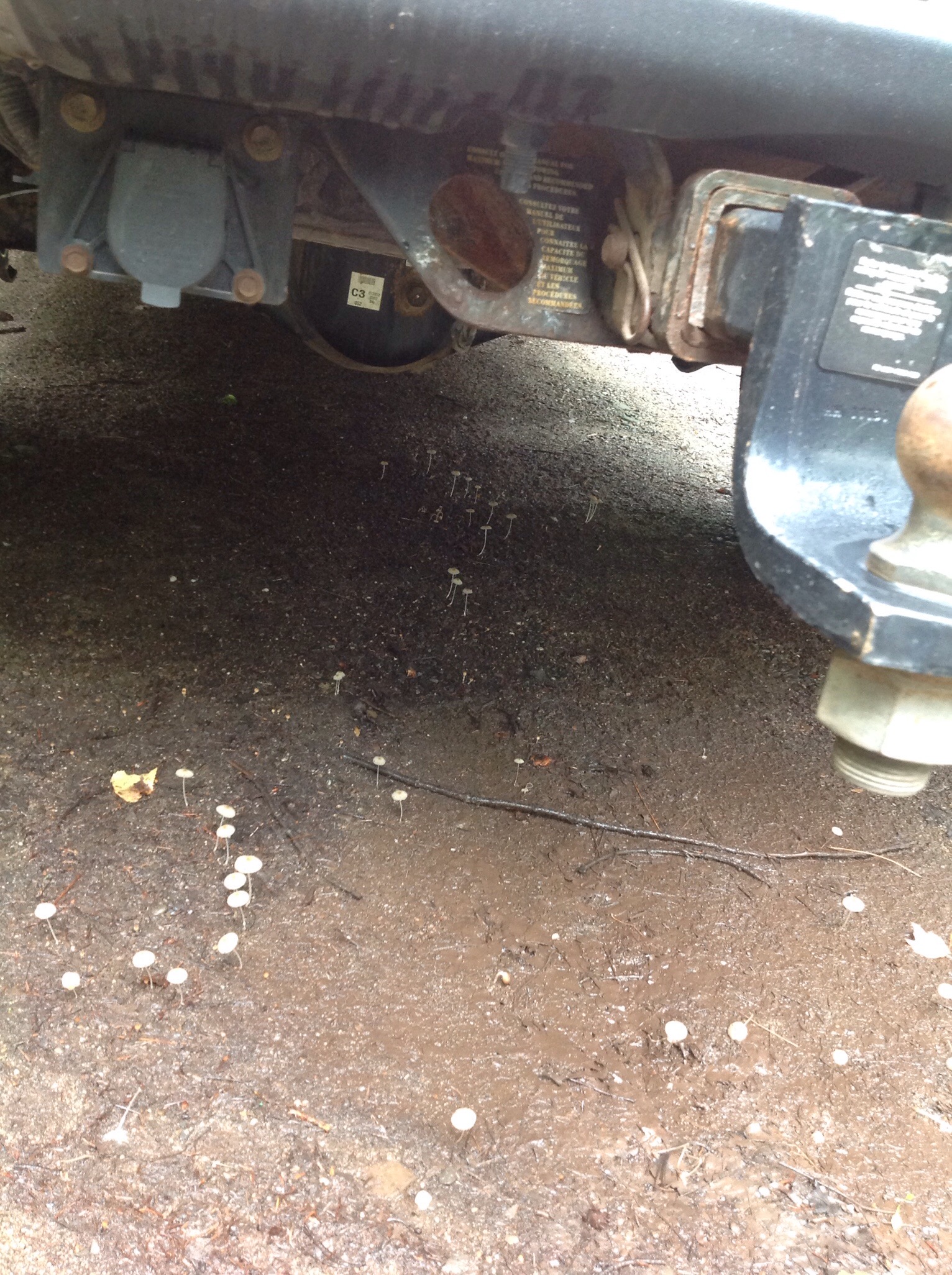
Copyright 2015 Jane Tims
beaver slap – Bloomfield Creek Covered Bridge
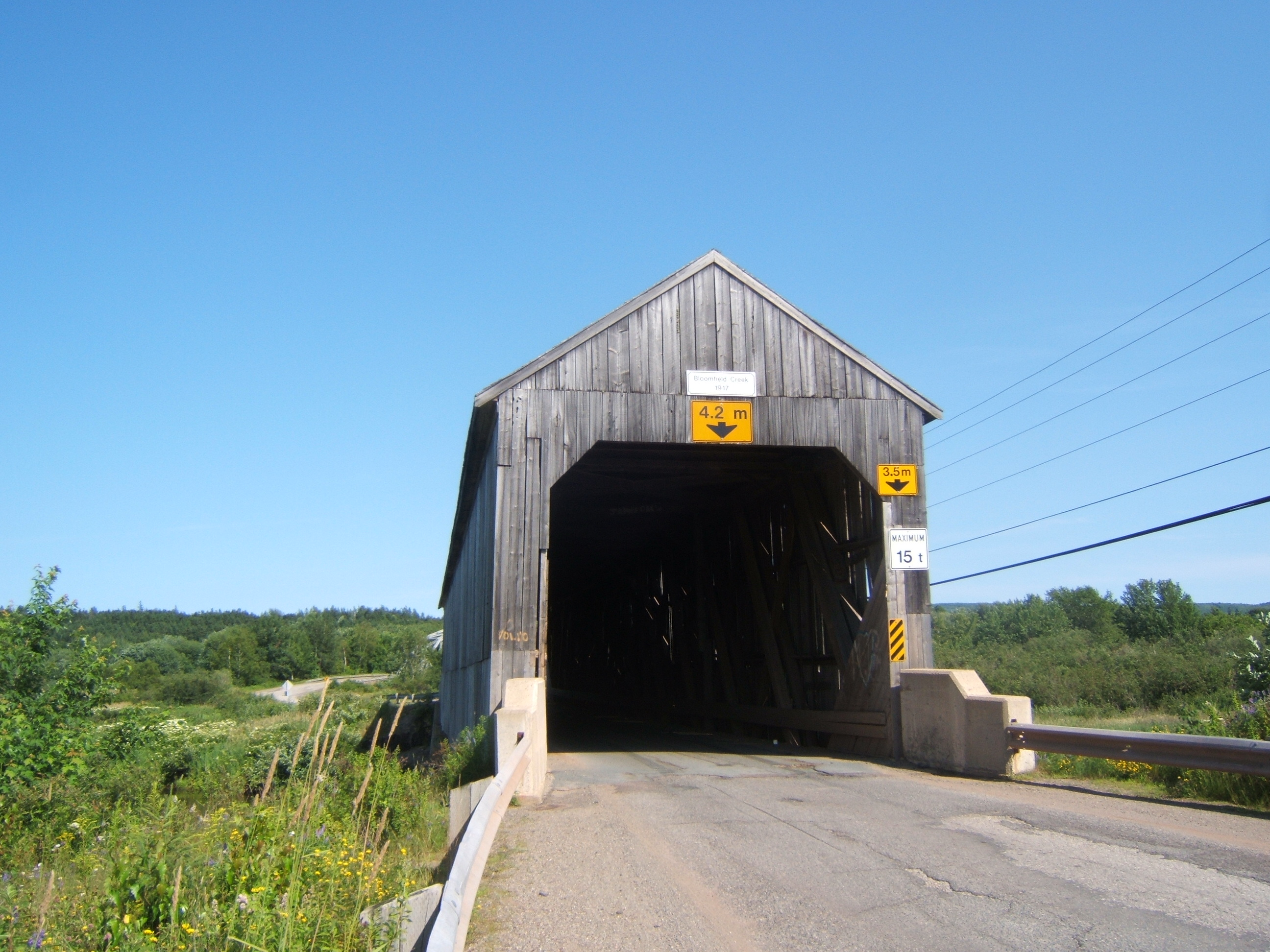
On a recent weekend tour of four covered bridges in southern Kings County in New Brunswick, we stopped at Bloomfield Creek. Built in 1917, this bridge is busy and well-used. It crosses a broad creek, very pond-like with its growth of lily pads (the yellow pond-lily Nuphar) and pickerel weed (Pontederia).

~
Along the grassy banks of the creek is a beaver lodge.
~
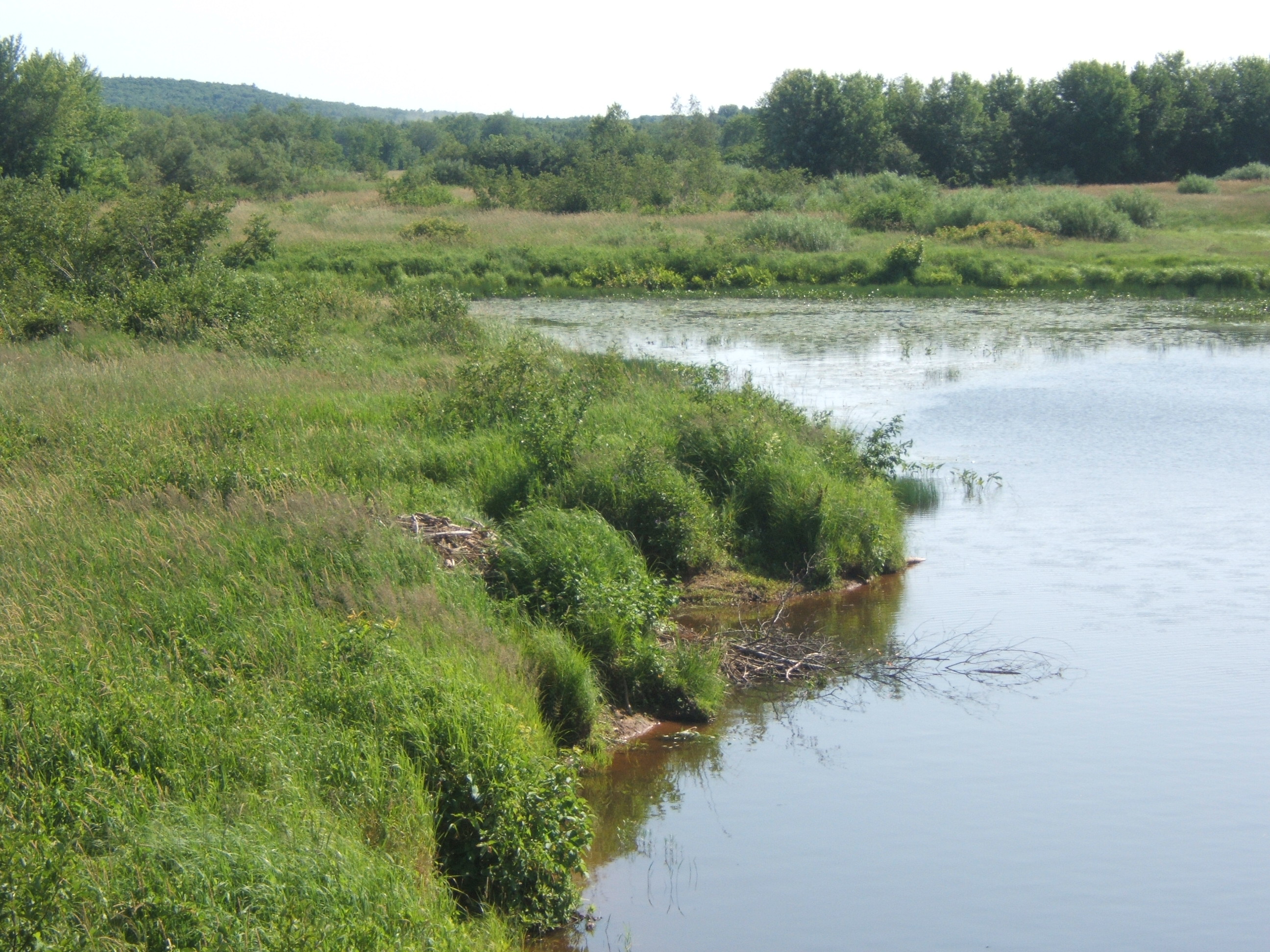
beaver lodge on the bank of the creek – the beaver has dragged lots of extra branches to keep near the underwater opening of his home
~
A large beaver kept us company while we visited the bridge. He swam back and forth along the river, in a course we were certain was designed to confuse and hide the location of his lodge. Most of the time he stayed on the surface – so soothing to watch his smooth brown body ‘towing’ a ‘V’ across the water. Every few minutes he would pause in his swim, arch his body, scissor his tail and lift it perpendicular to the water surface. Then he would slap the water and produce a loud ‘k-thud’ before he dove beneath the surface. In a minute or so, he would reappear to swim as calmly as before.
~
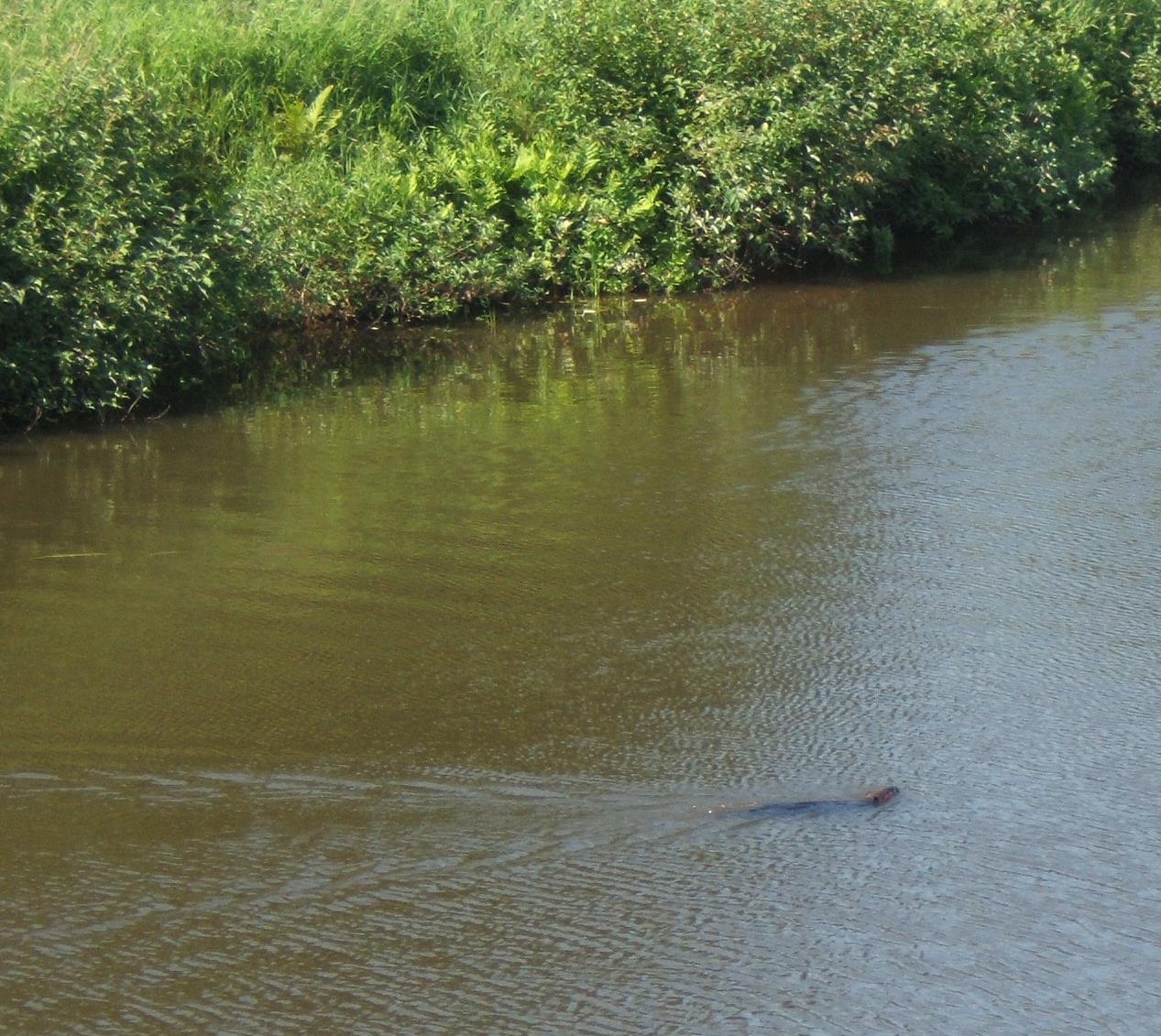
close-up of the beaver towing the ‘V’

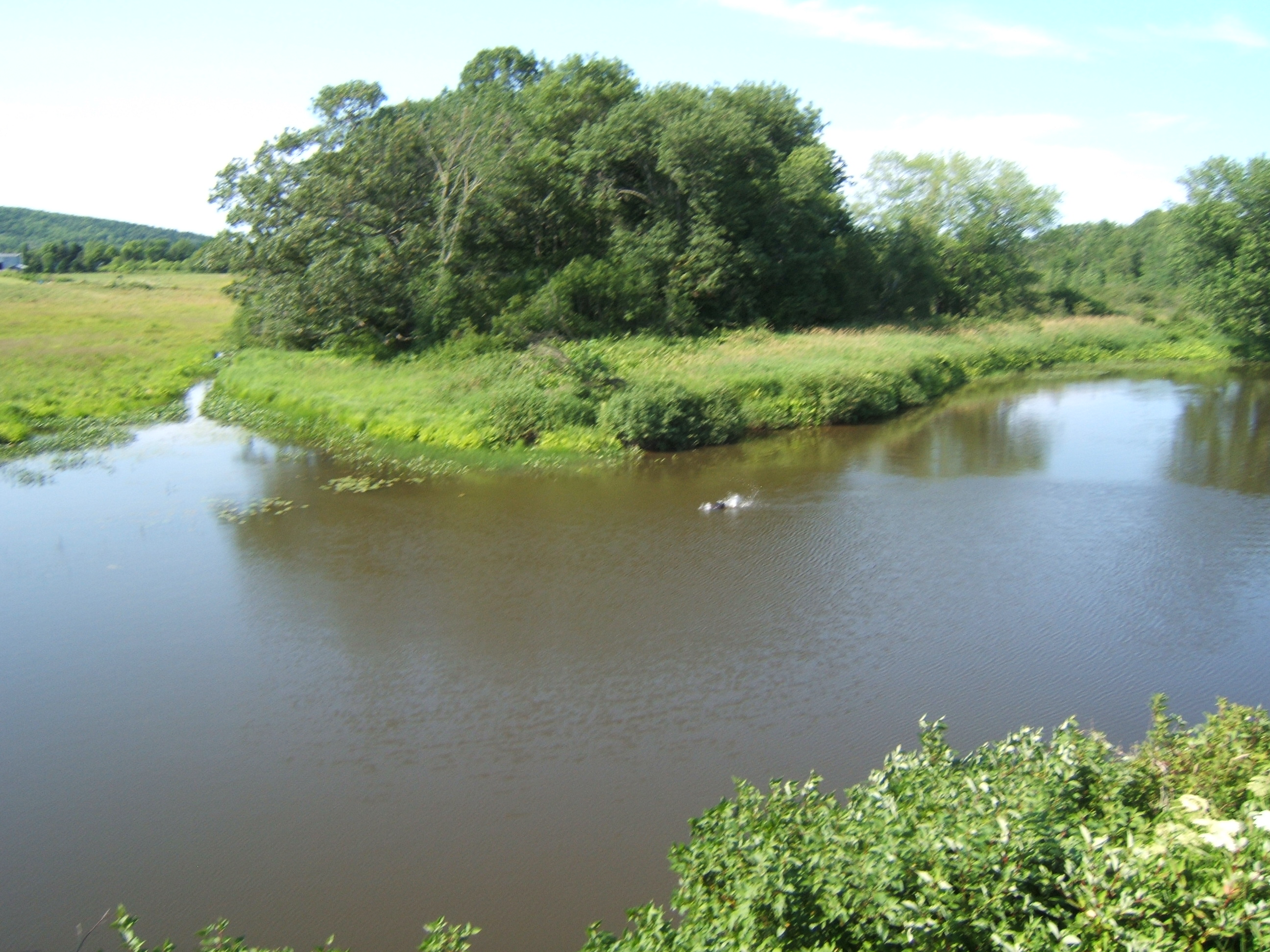
big splash as the beaver slaps its tail on the water
~
Copyright 2015 Jane Tims
morning chorus
Each morning I have a short quiet time after rising. I spend this time in my guest bedroom. I do some stretching. I watch the sun rise among the trees. And I try to sort out the morning bird chorus.
~

~
The morning bird chorus is known to be a complex social interaction among birds of various species – a communication we humans can listen to with wonder, but little understanding.
~
We have lots of birds in our area and the woods are thick with birdsong. Although ours is a residential area, we have many hundred acres of woodland behind us and no houses between us and the river. Our back woods are mixed conifer and hardwood, mostly balsalm fir, spruce, red maple and white birch. We have nearby wetlands and, of course, the river.
~

~
I now regret not learning to identify the birds from their songs earlier in my life. Although I can name many birds by sight, I have a feeling I know many more by their sounds. This summer I have tuned up my ears and spent lots of hours trying to learn to recognise the birds by their songs. Perhaps because of their variety and complexity, learning the songs is more difficult than just listening and comparing. Once I have heard a few birds, my memory becomes jumbled trying to distinguish between them.
~
I use three main tools to help me identify and remember bird sounds.
- mnemonics – short phrases to describe and remember various bird songs. These phrases help narrow down the possibilities when I hear a bird sing. Many lists of bird song mnemonics exist, but I like the simple listing from the Fernbank Science Center in Georgia http://www.fernbank.edu/Birding/mnemonics.htm
- recorded songs – although there are many sites with bird song recordings, the one I like the best is Dendroica- NatureInstruct http://www.natureinstruct.org/dendroica/spec.php/Dendroica+Canada#sp_select . Once you select a bird, you can hear calls recorded by birders in various parts of the range.
- a list of the calls I know and new songs I hear, described in my own words and with a diagram of the way the song progresses, in a shorthand of my own. I use words like: trill, flute, scratch, liquid, repetitive, bored, delirious …
~
The Cornell Lab of Ornithology has some excellent tips for those who would like to learn the songs of local birds.
http://www.allaboutbirds.org/Page.aspx?pid=1189#_ga=1.202457239.768663648.1437046200
They suggest listening for rhythm, tone, pitch and repetition of a bird song. By listening for these qualities, one at a time, you can start to make sense of the variability and help your memory.
~
Here is a list of the participants in this morning’s bird chorus outside my window:
- odd high-pitched sound at the first grey light of morning, probably not a bird
- immediately, an American Robin – ‘chirrup, cheerup, cheery cheer-up’ – we have a nest of robins at the start of our woods road
- a Mourning Dove, intermittent – ‘oo-oo-hoooo’ – very sad sound – a pair perches on the wires along our main road
- a White-throated Sparrow – ‘I love dear Canada-Canada-Canada’
- a Hermit Thrush – an ethereal, flute-like phrase, repeated over and over, each time at a new pitch – close at first and then gradually moving further away
- an Eastern Phoebe – a nasal ‘fee-bee’, repeated – a nest in the eaves of our shed
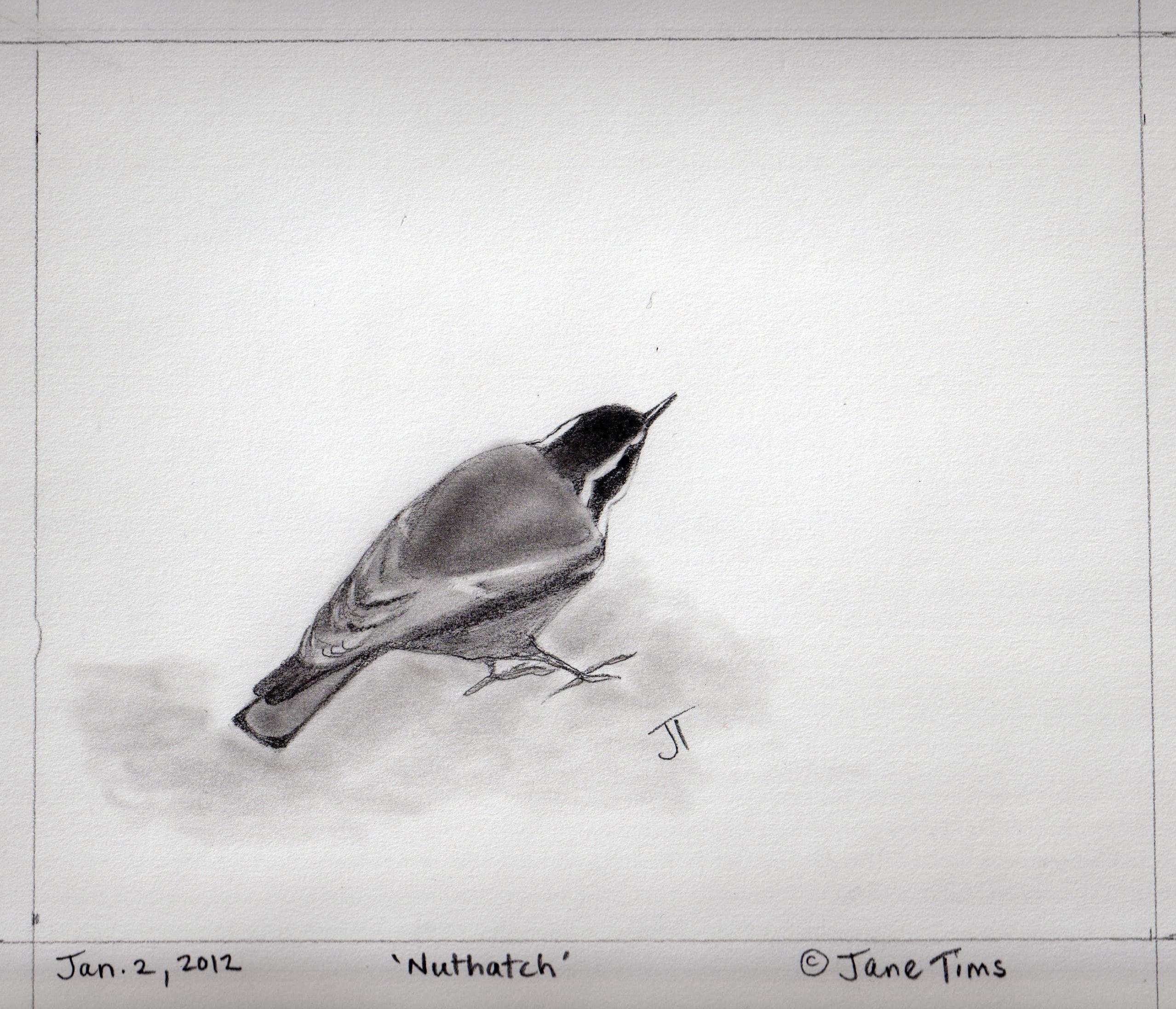
- a Red-breasted Nuthatch – a monotonous low-key ‘yank yank yank yank’, like a cross between a bored duck and a bullfrog
- the ‘caw caw caw’ of a Crow
~
I wonder if you ever listen to the morning bird chorus. What birds do you hear?
~
~
Copyright 2015 Jane Tims
summer on the river
~
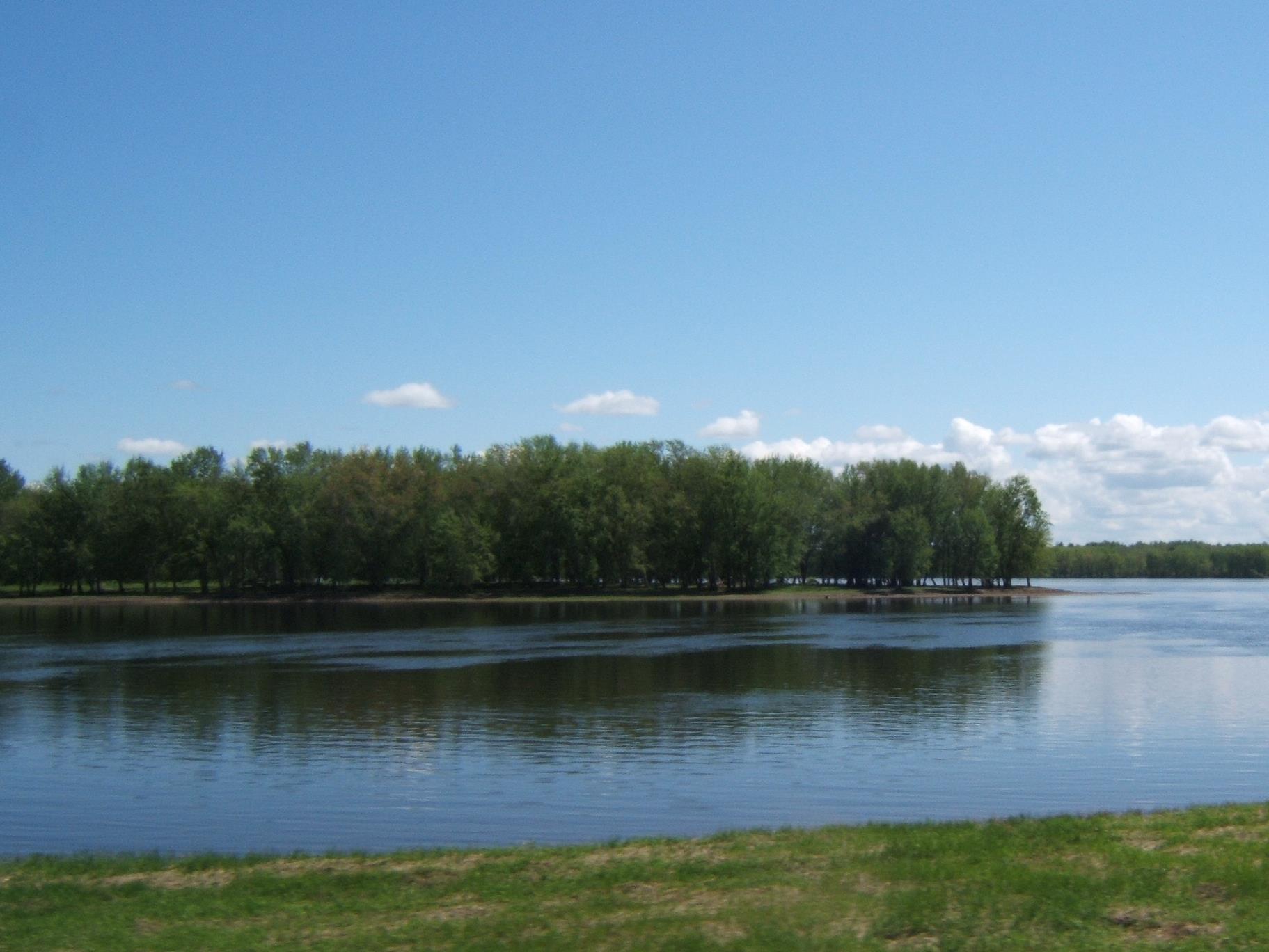
St. John River, south of Fredericton
~
drinks on the patio
~
the setting spins
on the river
golden while the mayflies dance
with gilded wings
~
this is conversation!
a cold glass
singing ice
white wicker
umbrella shade
the hills
wistful beyond the gauze
of mayfly dancing
~
you are dazzled by the play of sun
and words on water
your voice
your smile
who cares what you are saying
as long as the lines are long
and the tone is light
and the mayflies stir
the air above the river
~
I listen
with a nod of my head
a flutter of my hand
the corners of my mouth lift
to smile
~
my ears and eyes
have better things to do
~
the sunlight slides on cobwebs
spun across the river
our voices slur
while the mayflies dance
the rise and fall
of their glass bodies
and your laughter
~
liquid on water
~
~

St. John River, south of Fredericton
~
Published as ‘drinks on the patio’, Pottersfield Portfolio 17 (3), Spring 1997.
Copyright 2015 Jane Tims
in the shelter of the covered bridge – hummingbird hawkmoths
At one end of the Benton Covered Bridge (Eel River #3) is a large Lilac bush.
~

Lilac by the Benton Bridge
~
Since I was looking for wild life in the vicinity of the bridge, I was delighted to see what appeared to be bumblebees or hummingbirds busy gathering nectar from the Lilac blossoms.
~

moth getting nectar from the flowers – you can see his orangy body and dark antennae
~
As we approached, we realised these were not bumblebees or hummingbirds, but a type of ‘hummingbird hawkmoth’. They behaved like hummingbirds, darting among the flowers, backing up and slipping sideways. Their transparent wings were a blur, they moved so fast. Their bodies were striped in gold and black and their bodies were very hairy.
~

hummingbird hawkmoth, his wings a blur, gathering nectar
~
Although my photographs are not very clear, with help from the New Brunswick Museum staff, I now know these are Hummingbird Clearwing moths (Hemaris thysbe). Although I listened carefully, I could not hear the sound their wings made, since the rippling of the water in the river was so loud!
~
There were hundreds of moths in the Lilac bush. The hummingbird hawkmoths shared their feast with a group of very nervous Canadian Tiger Swallowtail butterflies (Papilio canadensis).
~
The Lilac scent was overwhelming, thick and sweet. If that scent was a room, it would be a Victorian parlour. If it was a textile it would be deep-purple satin. If it was weather, it would be a sultry August evening. If it was a light, it would be a Moroccan lantern … and so on.
~

~
Copyright 2015 Jane Tims
in the shelter of the covered bridge – Stonefly nymphs
These days, I am having a great time visiting some of the covered bridges in New Brunswick. I have visited many of the bridges before, but mostly to learn about their history. Now I am planning a project to look at the plants and animals living in or around covered bridges, so I am trying to get a feel for the subject to see what species I am likely to meet.
~
Benton Covered Bridge (Eel River #3)
~
This weekend, we visited the Benton Covered Bridge (Eel River #3) in west-central New Brunswick. Benton is a small community on the Eel River. The bridge, 31.9 meters long, was built in 1927.
~
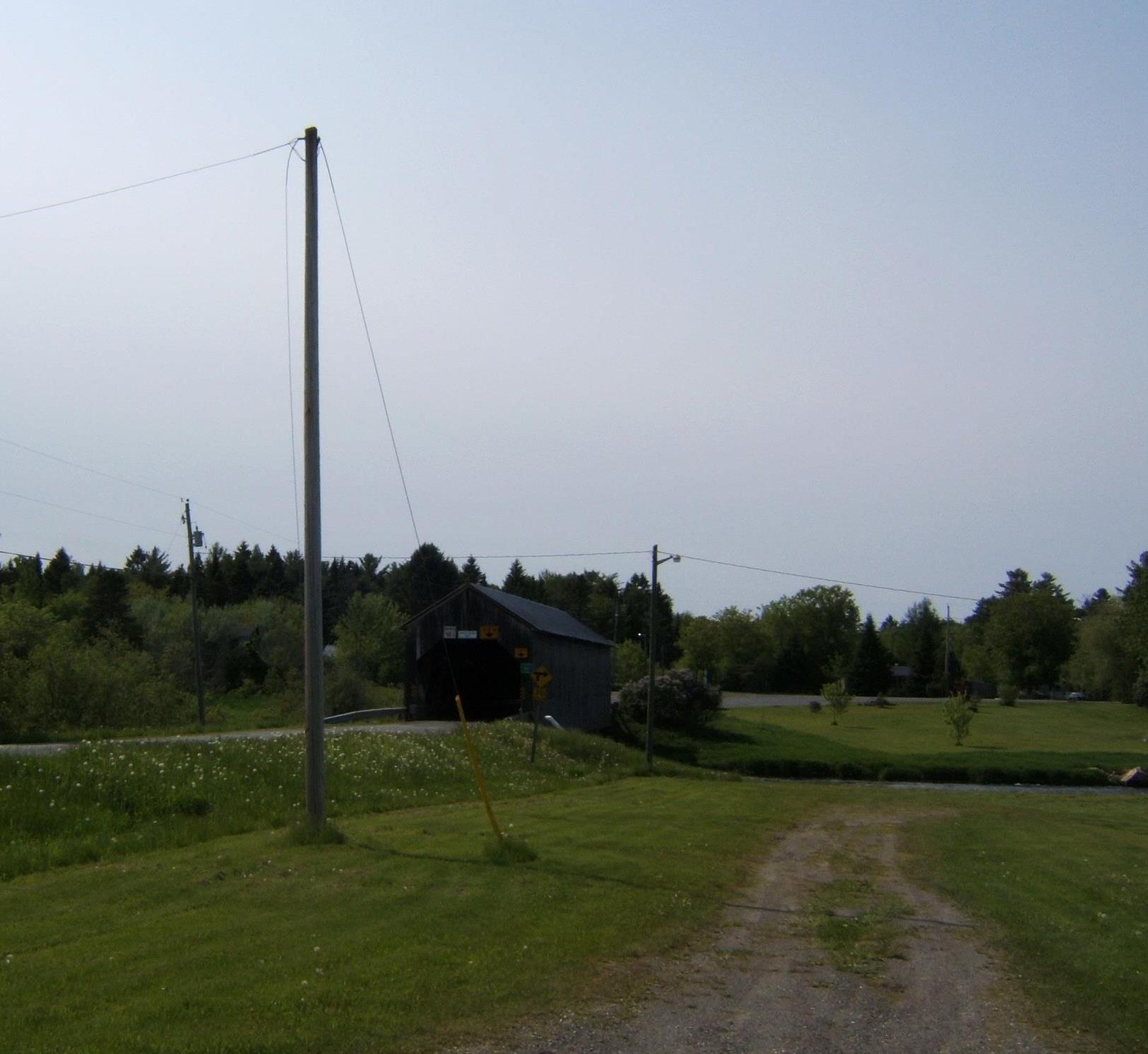
Benton Bridge on Eel River showing part of the community park on one side
~
The Eel River is a pleasant shallow river. When we were there, people were fishing with rod and reel. We noticed a digger log had been installed in the river, often done as a way of encouraging the river to dig deeper pools and improve fish habitat.
~

Eel River – a digger log has been installed in the river, the long line of flowing water above the center of the photo, running from 8:00 to 2:00 – the log causes the water downstream to dig a deeper pool and simulates the action of fallen trees in a natural river
~
My search for wild life in and around the bridge was rewarded by the discovery of Stonefly nymphs clinging to the wooden walls of the bridge.
~

Two Stonefly nymphs on the wall at the end of the bridge – the cerci are hard to see – they are a pair of extensions at the end of the abdomen, pointing upward in the photo, between the hind pair of legs – the cerci are almost as long as the insect itself
~
Not particularly beautiful to me, the nymph is a life-stage on the way to the adult form. Stoneflies (Order Plecoptera) are identified by their narrow bodies and the long pair of cerci at the end of the abdomen (cerci are long appendages on the rear abdomen of many insects). I was never any good at insect identification when I worked in the field of water quality, so I am not certain which Family of the Order Plecoptera they belong to.
~
There were Stonefly nymphs all over the bridge walls, inside and out. I was happy to see these insects because they are an indicator of good to excellent water quality. Anglers love to see these insects in a stream or river because it usually means good fishing.
~
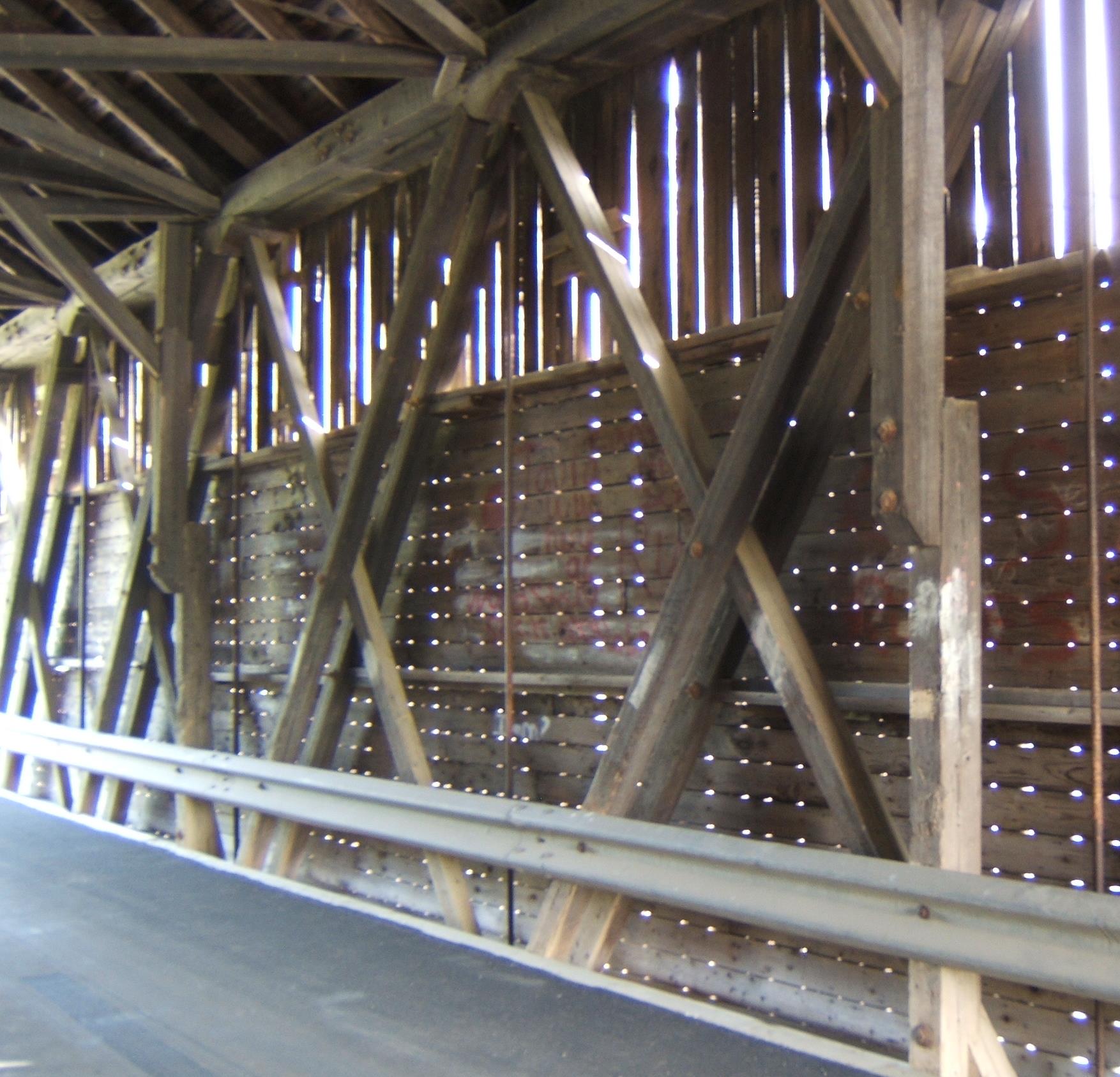
inside the Benton Bridge
~
I nudged one of the nymphs with a pen and he did not budge a millimeter. In spite of his inaction, I am certain he will be the hero of a future poem about life in the shelter of the covered bridge!
~
Copyright 2015 Jane Tims




 nichepoetryandprose