Archive for the ‘the rock project’ Category
Rock Project: update
News about my ‘rock project.’ We have been building a side road to our driveway, to serve as a turn-about and also a walking trail. I have been working on embellishments for the last few years. For more about the ‘rock project’ click here.
~
~
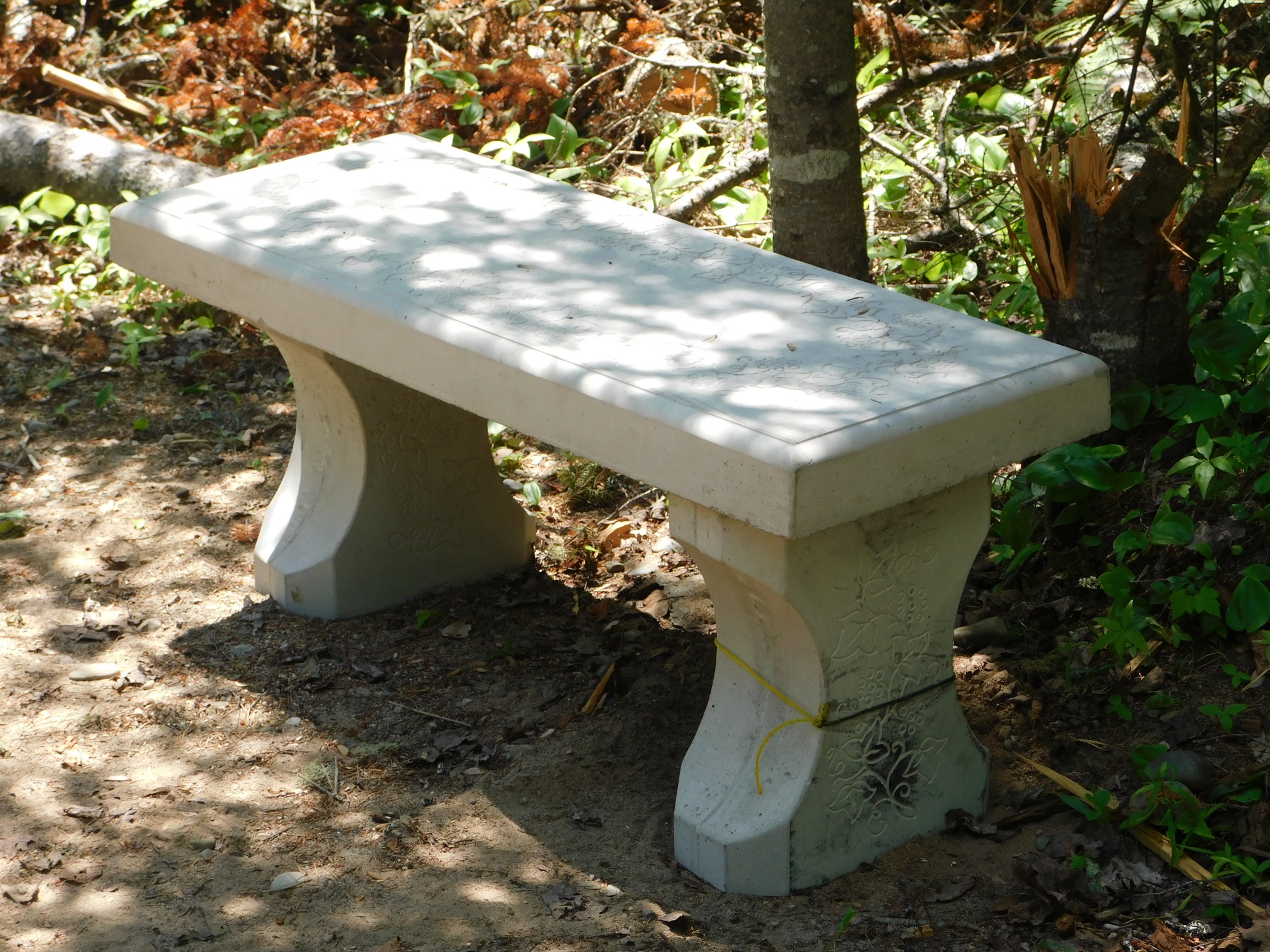
I bought a cement bench for our side road! I had put my name in for one at Scott’s Nursery and when I went to get seeds this week, it had arrived. The fine staff at Scott’s put it into the truck for me (it is very heavy). At home, my husband lifted the two pedestals and placed them in the chosen spot. Then he rigged two straps around the flat seat and lifted it into place with the tractor. We had prepared a bench platform, but after the wind storm, it is still filled with downed trees!
~
~

~
I had my first sit on the bench after it was stable. On a hot day, it was so cool to sit on! Now I have more incentive to go for walks around the ‘loop.’
~
~
All my best!
Jane
the rock project: plans for 2024
As I have said in past posts, one of our long term projects on our property has been to develop a woods side road to be a turning loop for the driveway and an easy walking trail for me.
~

~
This year, I have three things to do to move the ‘rock project’ a little more towards completion.
~
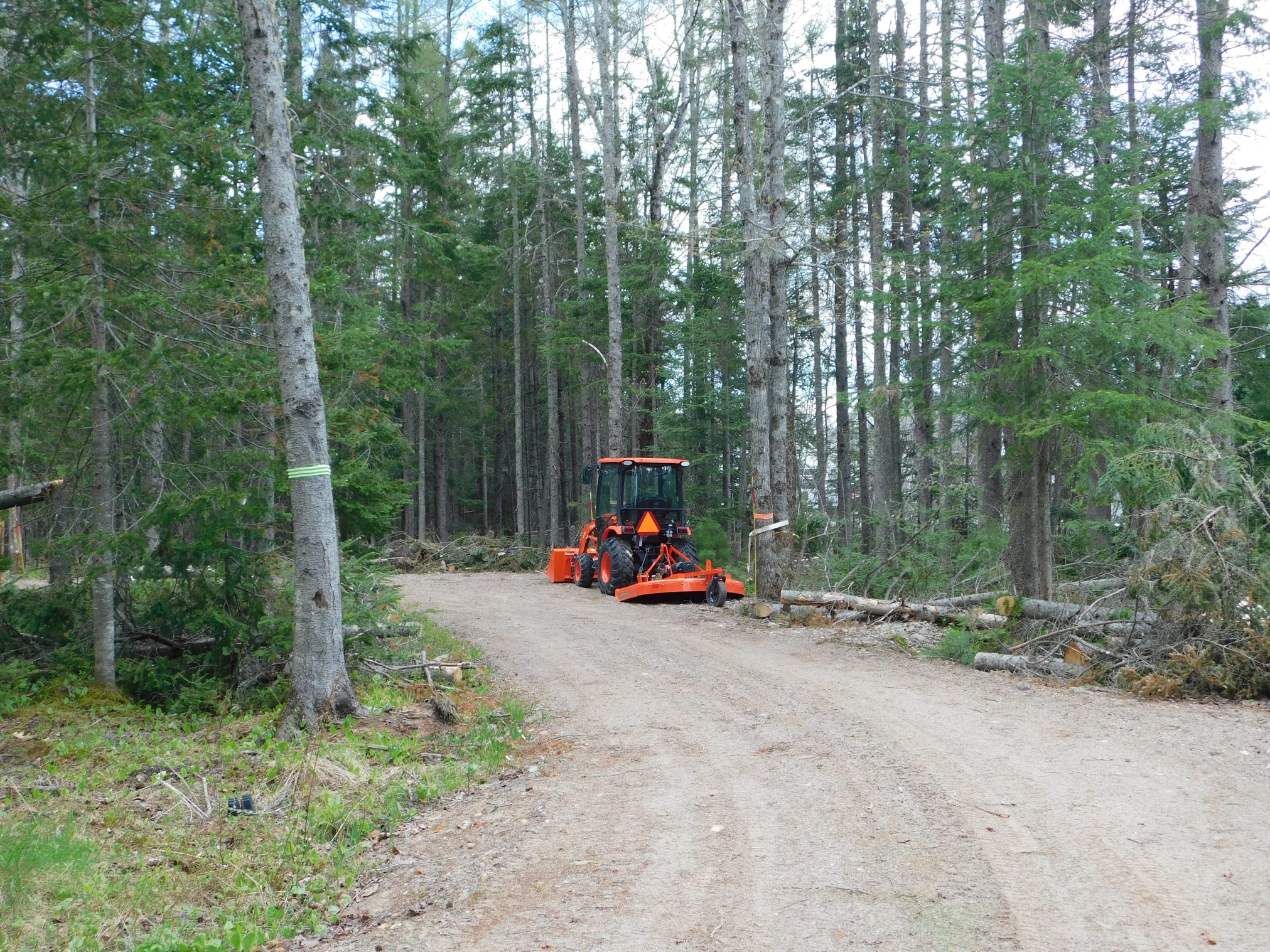
1. Clean-up of wind storm debris:
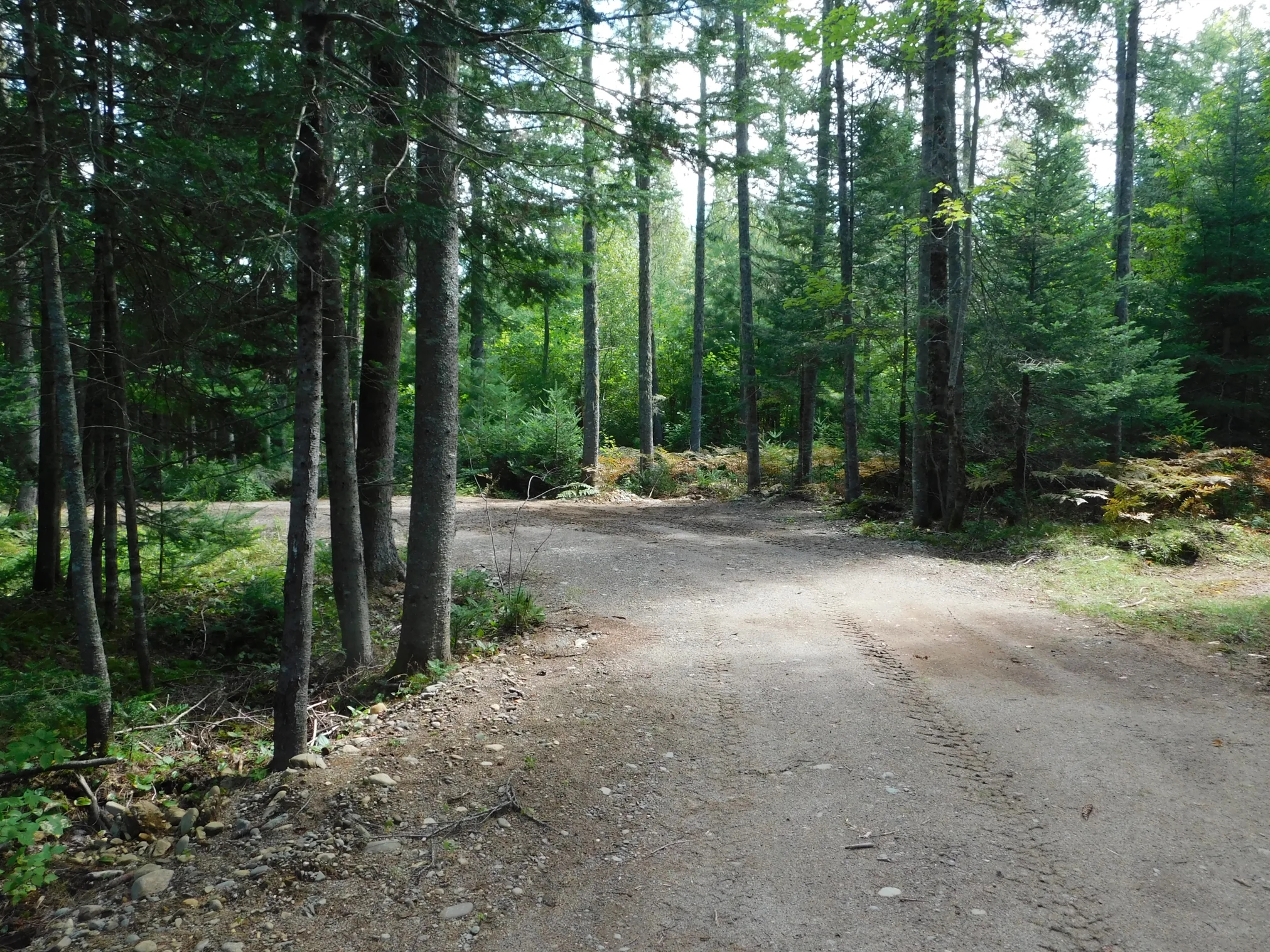
- Over the past winter, we have had a couple of storms that made a shambles of our ‘walking loop.’ After the wind storm on December 18 and 19th, 2023, we had 18 softwood trees fall across the roadway! After a little chain saw work, the roadway is clear again, but it may never return to the tidy woods we once had. I am a biologist and I realize that trees are always falling in the forest, but I think we will do some clean-up. Just putting branches and bigger tree chunks into brush piles in the woods will suit me well, because I know animals will use a decaying pile for shelter and habitat. My plan is to gather stray branches and sticks when I go for my walks around the ‘loop.’ I will deliver them to a convenient brush pile and get my exercise at the same time.
~
~
and to the right
~
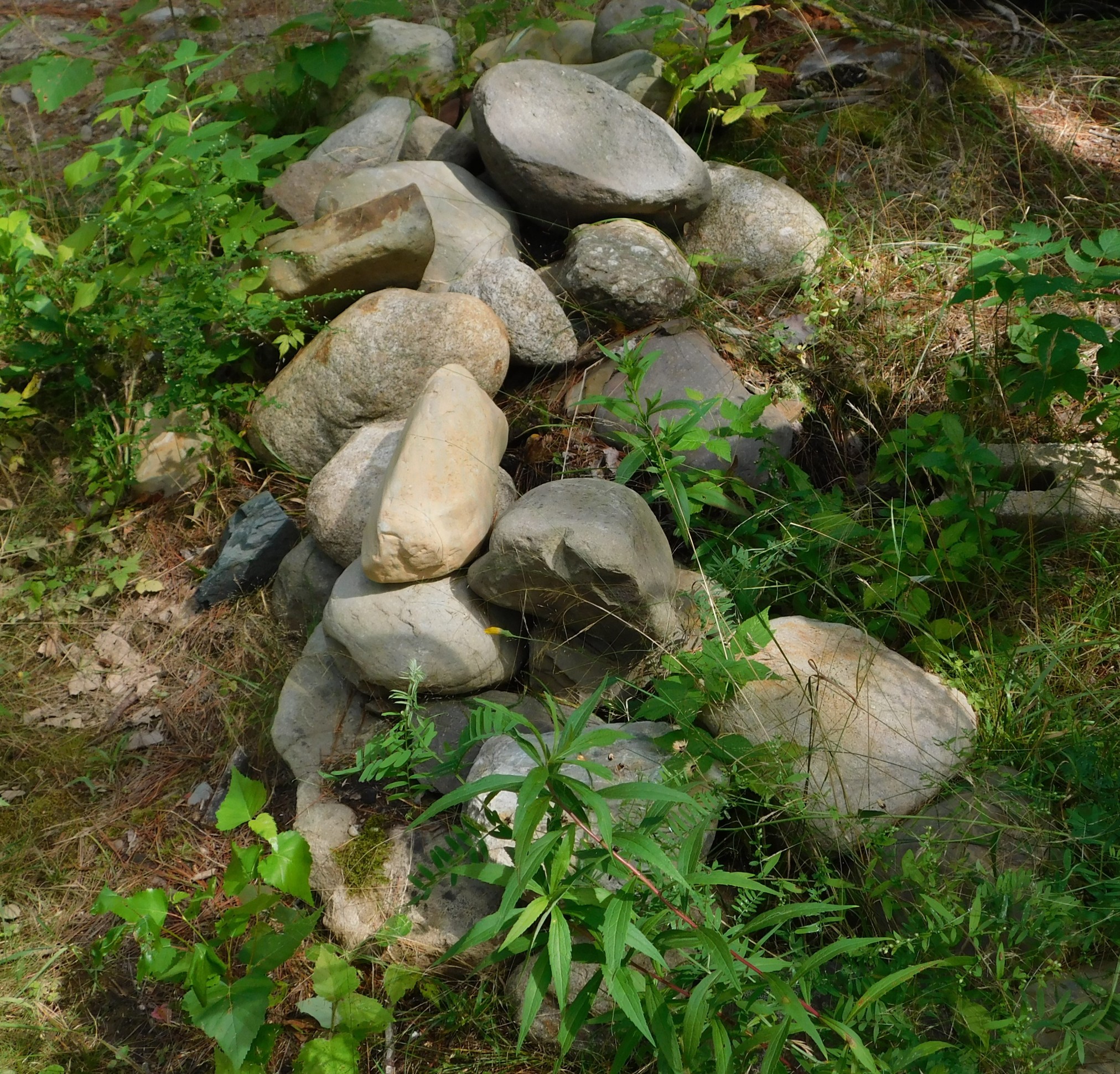
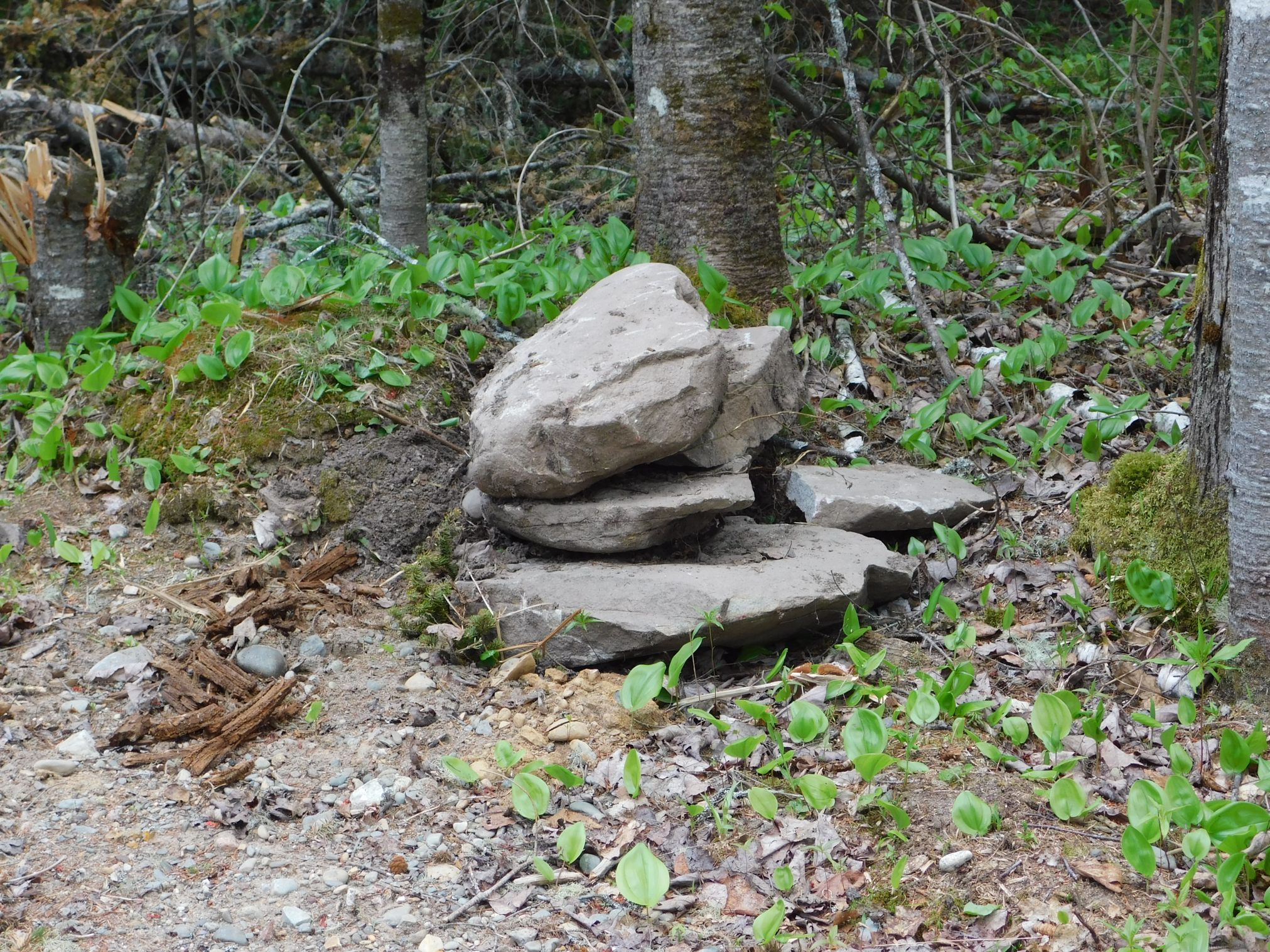
2. Collection of a few more rocks for the rock wall:
- On every drive we take, I bring back a souvenir rock from a ditch, a bit of landscape to contribute to our ‘rock project.’ I have always loved aspects of geology. I understand the role of landscape, and geomorphology in our lives. When we go on drives, we think about the terrain we move within. Since New Brunswick has a glacial history, I know that elements of landscape have glacial origins … small hills are parts of eskers, the sediments once deposited by rivers and streams flowing within a melting glacier. Some elements of landscape display a sedimentary history … as we drive, we see cuts through bedrock, exposed when the highway was built. The rocks we collect remind me of our many drives through the New Brunswick landscape.
~
~
~
3. Continue creating interesting stops along the walk:
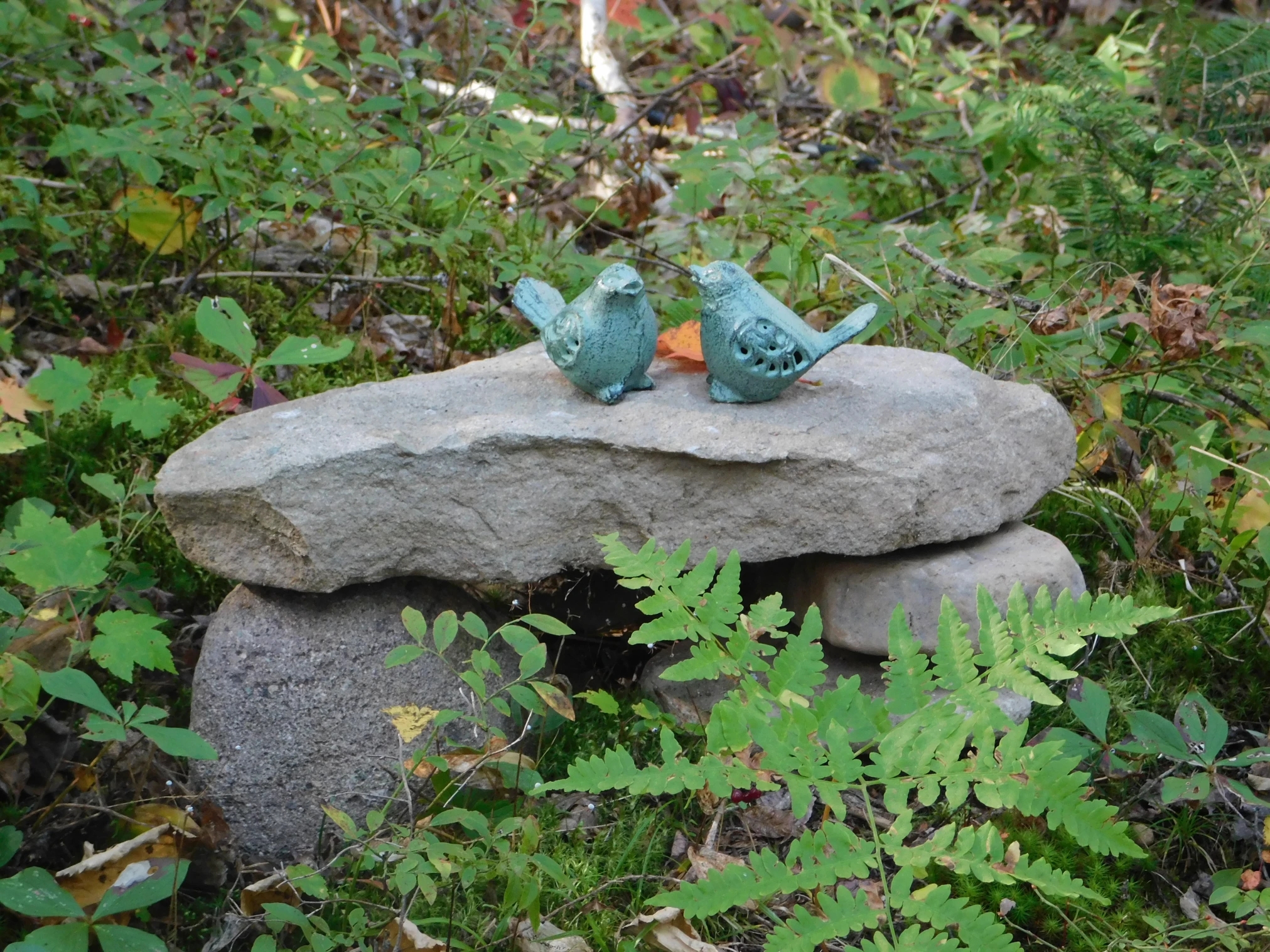
- this year we want to purchase a concrete bench for the loop, at the half-way mark. I have my name for one at Scotts Nursery, to arrive in a week or so. I also want to improve the small stone pile where my iron lantern sits to make it more like the stone platform I made last year for two small meal birds.
~
~
If you would like to see more about the history of our ‘rock project’ have a look here.
~
All my best!
Jane (a.k.a. Alexandra)
the rock project continues
My ‘rock project’ has an important personal implication: keeping me physically fit and active. Every day, I try to walk the loop, at least twice. Not a long distance, but it gets me outside, in nature, for some time each day and keeps me ahead of being crippled by my arthritis.
~
The ‘rock project’ includes anything that encourages me to walk the loop. Today provides a great example. Today, I walked the loop twice, once to collect some rocks to create a small table-like structure in the woods beside the loop. I used three piles of rock to create the legs of the table and a larger, flat stone to create the table top.
~

~
I have used this table to display two small iron birds.
~

~
Now, when I walk the loop, I will watch for these little metal birds, a small tribute to the real birds I often see on the path or near the bird feeder.
~
Small projects like this keep me active and encourage me to walk the loop. Other projects include:
- clearing unwanted vegetation from the small iron faerie beside the path
- continuing to work on the rock wall at the start of the loop
- planting mosses and periwinkle on the platform of ‘rockhenge’
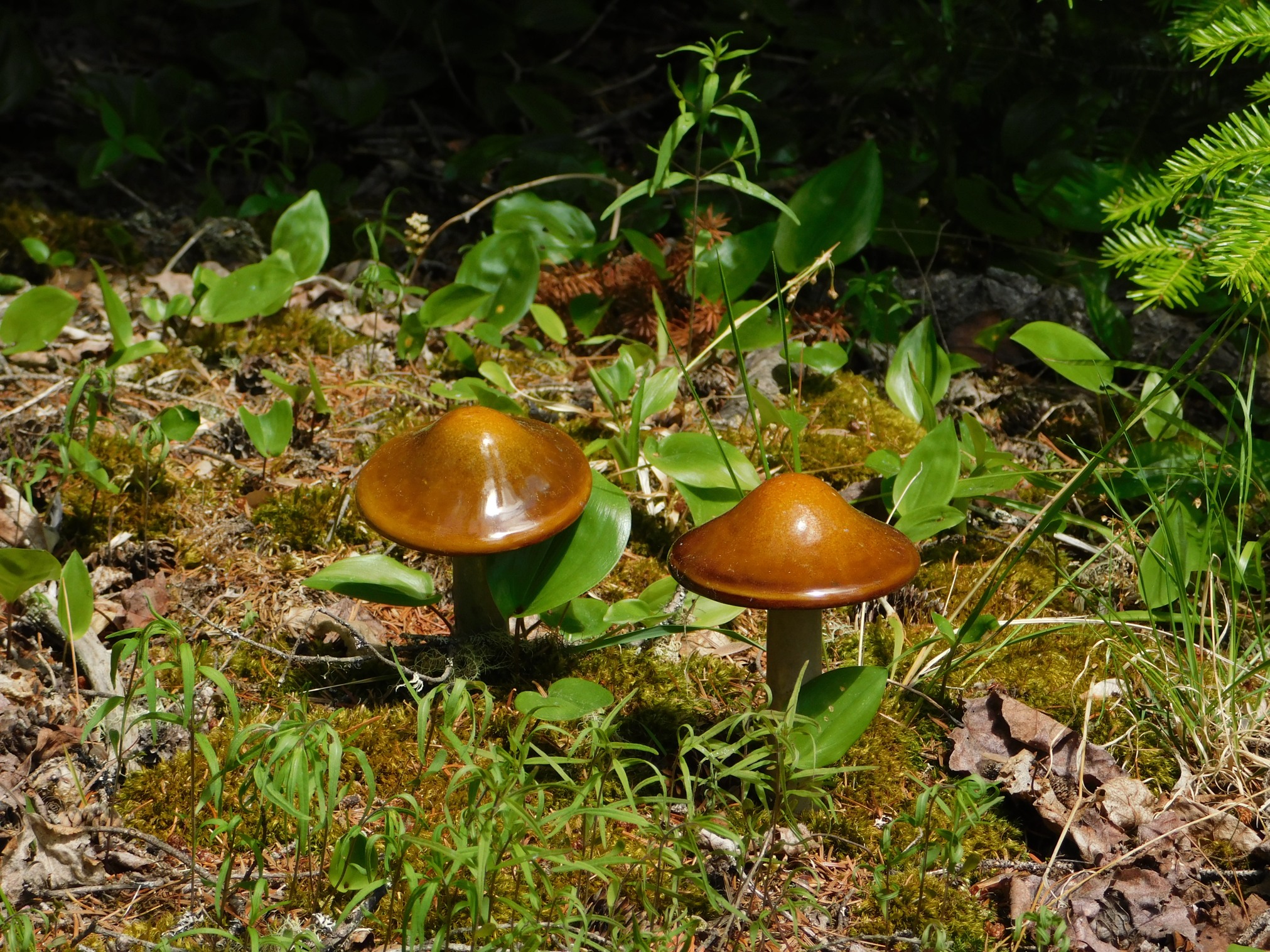
- finding two ceramic ‘mushrooms’ I put into the woods years ago and giving them a new home by the edge of the loop
~
Keep walking!
Best regards!
Jane (a.k.a. Alexandra)
the rock project – update
It sometimes takes years to make progress on a project. That has certainly been the case with ‘the rock project,’ begun November 2011 and reported here https://janetims.com/2011/11/13/plans-for-a-rocky-road/
~
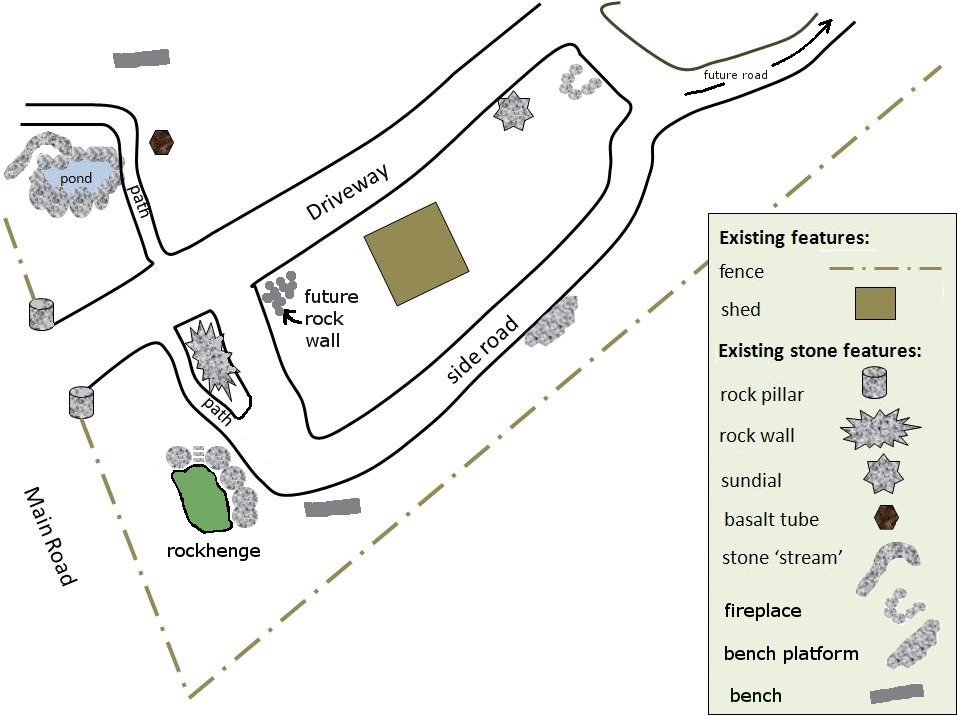
The original project was to add a circular component to the driveway and to install a few rock features along the way. In part, this was to allow us to avoid backing out to the road in front of our house. It was also meant to give us an interesting walking ‘trail’ as we get older. This was the feature map as it existed in 2011.
~

~
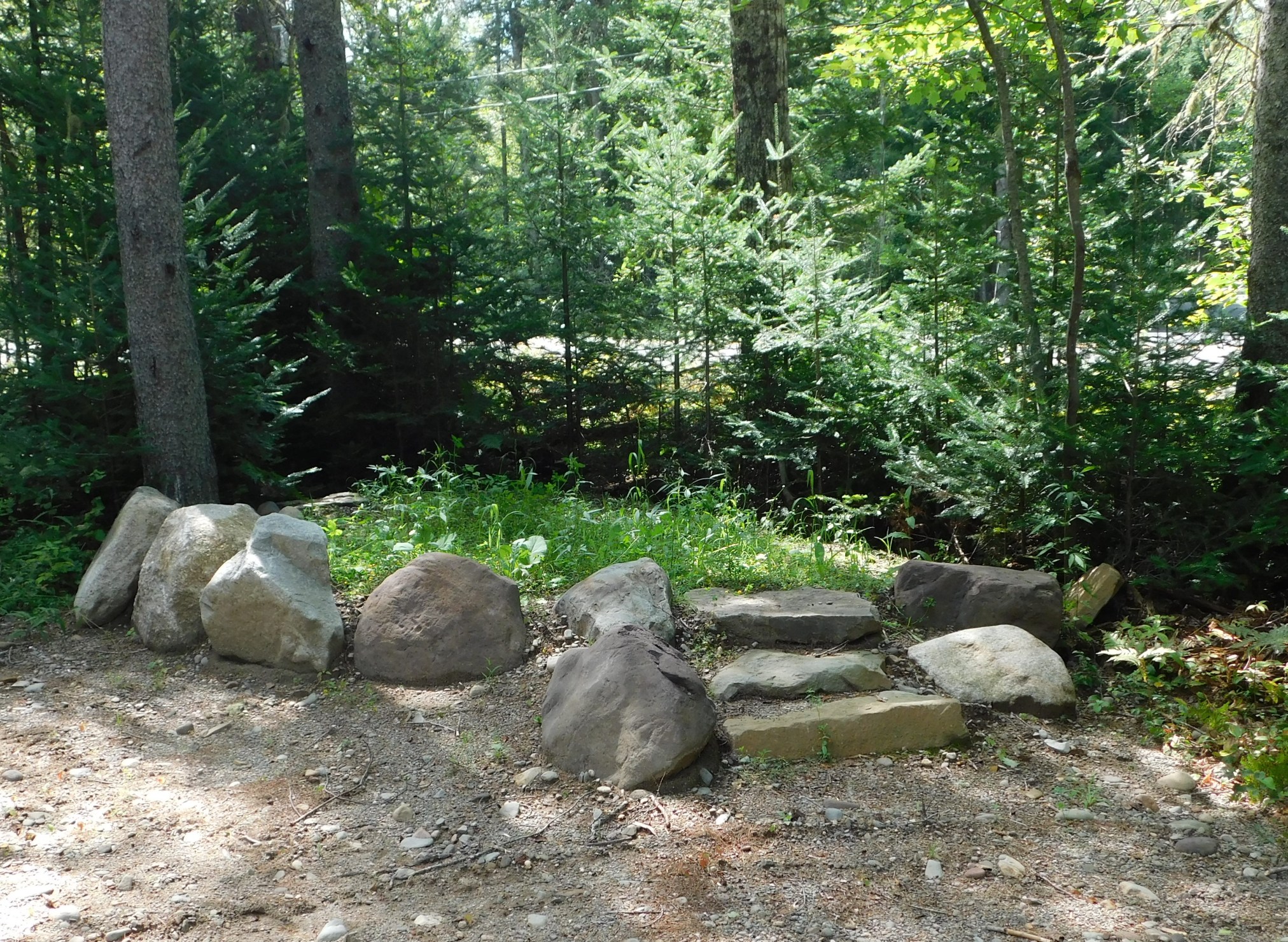
Over the years, we built a rock fireplace and added a concrete bench. And, last summer, we brought in gravel and rock to finish the circular roadway and a rock feature I refer to as ‘rockhenge.’
~

~
‘Rockhenge’ consists of a platform, fronted by six very large rocks and accessed by a stone stair. Eventually it will be planted in periwinkle and moss.
~
The roadway allows a pleasant walk in the grey woods.
~

~

~
Now that the road is done, we have more plans for the rock project.
~
~
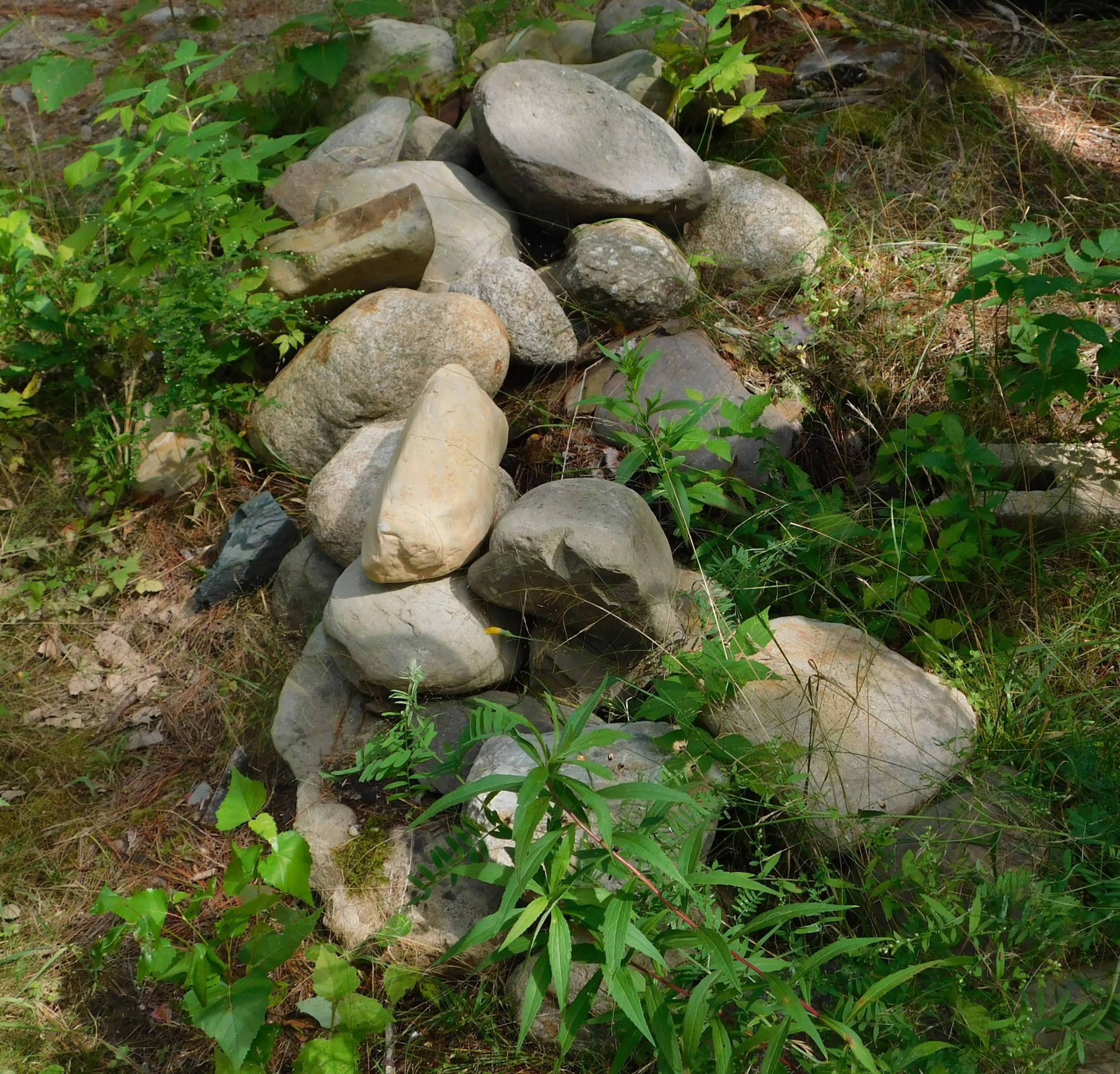
This summer, every time we go for a drive, I bring back one or two rocks towards the building of a stone wall along the front of the area where I feed the birds. I also added two small solar-powered lanterns; they shine every night and make the woods less dark.
~
The next step in our project has begun, with the creation of a small platform, a flat surface to put another concrete bench. It will be a place to sit and watch the woods and occasional wildlife.
~

~
A future part of the plan will be to build a narrow roadway through the grey woods, to the back of our property.
~

~
Not having to back out of our driveway has made life better and safer for us. The circular drive is also an exercise opportunity — every day I try to find the time to walk the loop. Every evening I watch the little lanterns flicker and shine. I love this place where we have lived now for 43 years. And with the ‘rock project’ ongoing, I love it even more.
~
All my best,
Jane
(a.k.a. Alexandra)
yard work – sundial
Although I have no trouble spending endless hours at the computer writing, writing, writing, even editing, editing, editing, more physical types of work have always been hard for me to enthuse over!
~
And although I am a botanist, and interested in the environment, spending time out-of-doors has become harder with the years. I hate mosquitoes and black flies. Heat and humidity are no friend of mine. And, of course, there are the arthritic knees. I do go out, on endless drives to find bridges, schools and various plants. We spend lots of time at our cabin, watching birds. And I sit on our deck each day to listen for bird songs and enjoy the evening breeze. But notice that most of this is sitting.
~
Last month I put myself on a reward system (like a child earning stickers) and have spent a little active time outside each day. Usually only about an hour. I have helped my husband cut wood, piled said wood, helped him cut down our dead apple tree, broken the dead branches of said apple tree into sticks for a future fire, picked up all the fallen tree branches in our back driveway, cut the bracken fern from my back garden in two sessions, and so on. I’m sure no one else would even notice the resulting yard improvements, but I do! And going outside each day is now a habit.
~
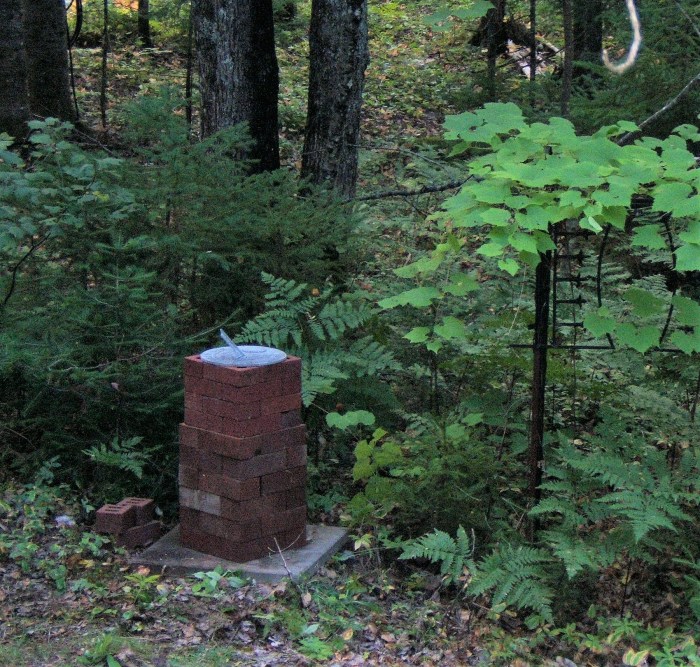
Today I tackled a long-planned project – the rebuilding of our sundial. I built the original sundial base with chunks of stone, but frost heaves and snowbanks have done their work and the old sundial base is now a pile of rubble. I had saved the brick from the dismantling of our inside hearth this spring and had lots of material to work with. On Wednesday morning, I rolled a cement paving stone into place and used the brick to rebuild a base. Now the sundial is no longer a tumbled mess of rock.
~
~
No work of engineering but much neater than before. And if the clocks ever stop working, my sundial will still record the passing of time!
~
Copyright 2016 Jane Tims
firepit
Our firepit has a roaming spirit. It began its days in front of the house and we had many wonderful evening fires. Then, as the years passed, the maple tree overhead grew until it was dangerous to have a fire under such a thick canopy.
To improve the safety of the firepit, I moved it, stone by stone to the back of the house, reassembling it exactly as it was. We had a few fires and then, one day, our lives became busy. We kept taking wood for the next fire and the next fire never happened. Gradually the pile became so large, you could not see the firepit!
Last month, my husband put our tractor to use to move the firepit one more time. I clawed my way into the pile of scrap wood and uncovered the stones. Then we pushed them into the bucket of the tractor and away they went, to their new home across the yard.

Now they are in the driveway, waiting for their new home (see the plan in ‘plans for a rocky road’ November 13, 2011 under the category ‘the rock project’).
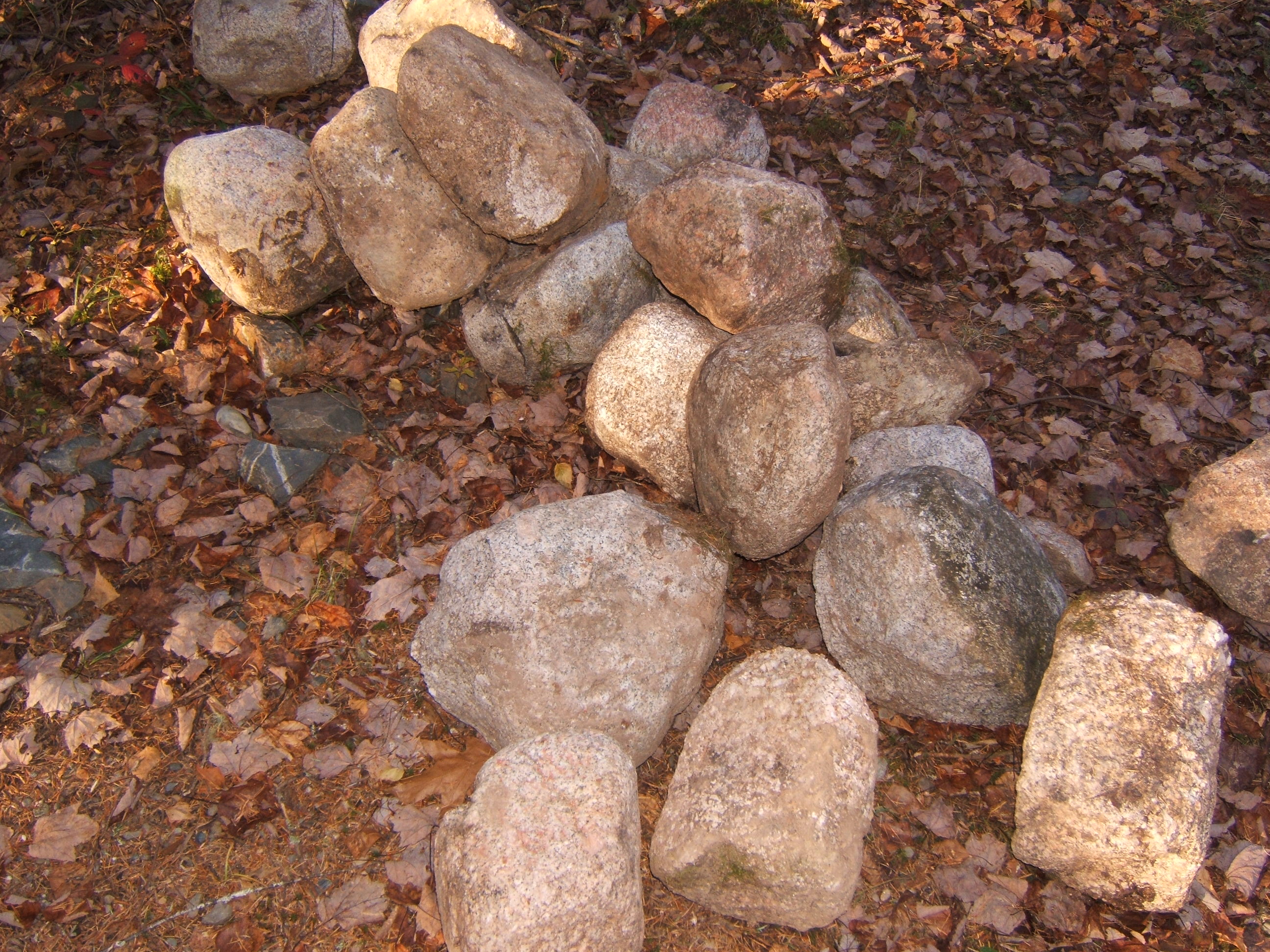
The next step will be to fell four spruce trees in the area of the firepit, to make sure we can have our fires safely. This next step may have to wait until spring since the stones are now in the frozen throes of winter!
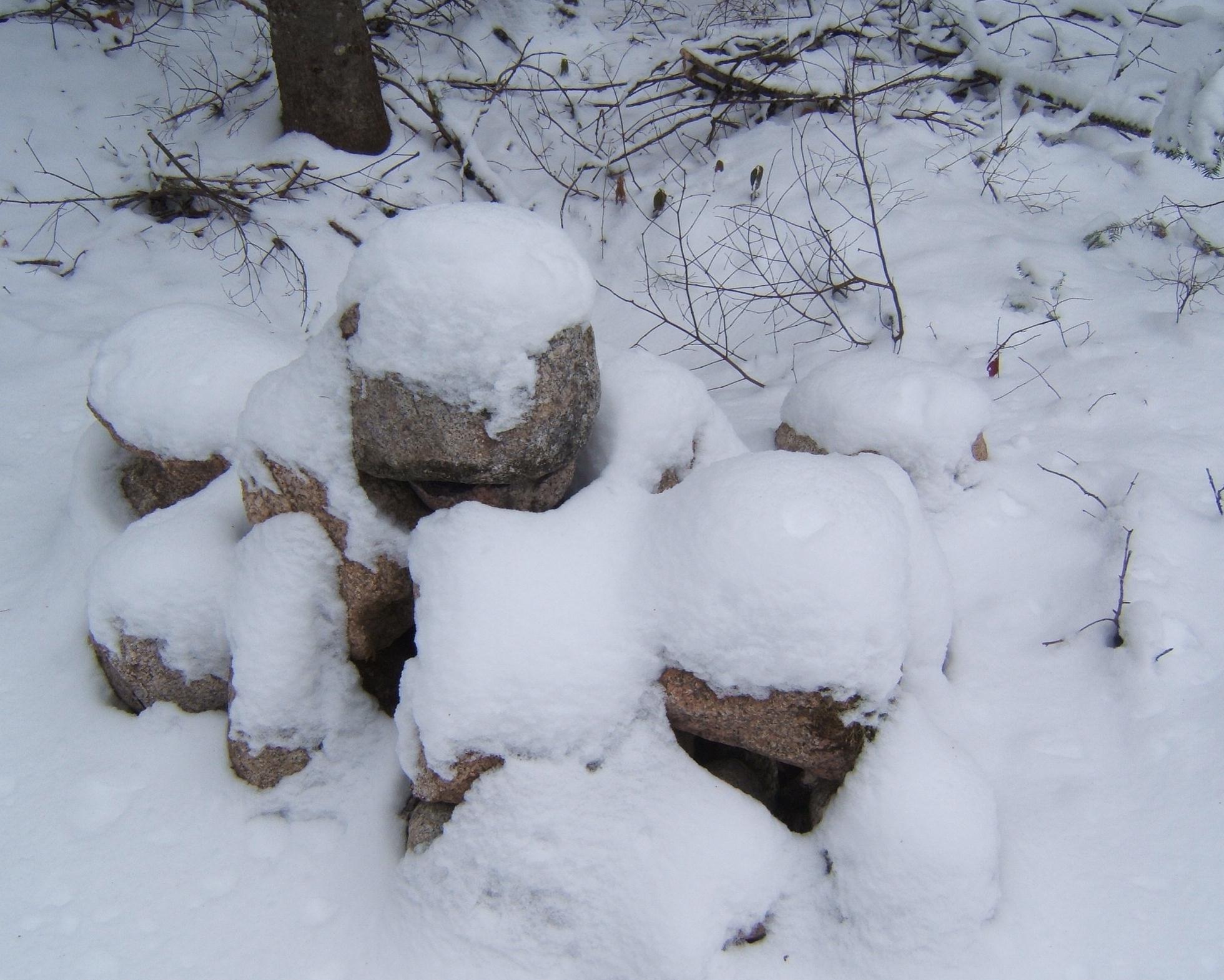
fire
~
rattle of leaves
bark, twigs
and paper
as the air warms
finds its chimney
surges red life
into the tunnel of maple
the moment when breath
turned cloudy on cold air
becomes smoke
and lungs draw ash and fire
~
the summer night
when lightning strikes
when thunder
bold in its dreaming
turns beneath the earth
ions leap
and pine sap explodes
in a fistful of sparks
~
the warming by smiles
and clasping of hands
striking of sparks in the tinder
the flame leaps
from candle to candle
~
the sharp ache
at the corner of an eye
where cinders and smoke
have gathered
lungs drawing fire and ash
an effort to breathe
and fingers
warm with tremble
~
© Jane Tims 1995

Briar Island Rock #4

~
~
jointed ruler
(Wreck of the Trafalgar, 1817)
~
the ship is broken on rocks
and we leave in fog
I hold my brother’s hand
we stumble up the shore
in a yellow room of fog
it stumbles with us
they set the baggage down
together, folded
we wait
~
my step-father
pats my mother’s hand
leaves to talk with the Captain
the ship is lost
I look up at my mother
she watches him go, her lips move
she says we will lie in green pastures
~
I look for grass but only see
black rock and grinning fog
lanterns and men calling
my brother sniffs a little
in my pocket I clutch my father’s jointed ruler
he was a carpenter, would have fixed the hole
the mate says
there’s no going back to her now
we stay where we are
folded in a yellow room
luggage at our feet
~
the walls move
the ruler opens
I see the ship
black hull held high
on dark and pointed rock
against the early morning sky
white waves beyond
the ruler closes
~
pink and yellow mix, and the room
is the color of pumpkin
the ruler opens and I know
the black shore has bristles
I heard the mate call it
Briar Island
~
the rock I stand on tips a bit
I step down
the rock is wet and grey
five sides
a funny-looking stone
fits with other stones
strange puzzle
~
I take my ruler
help it to unfold
I measure the rock
I make it jiggle and my brother smiles
a little smile
the ruler folds, unfolds, the room expands
I see my step-father’s uneven walk
across uneven stones
~
~
Copyright 2011, Jane Tims
Briar Island Rock #3
In my garden there is a black pentagonal rock set into the ground. The rock is black basalt, and future people may wonder how such a rock ended up in a setting of glacial moraines, far from other volcanic surface formations.
The rock comes from the rocky shore of Briar Island in Nova Scotia. On this shore, in July, 1817, my great-great grandfather came to Canada by way of the wreck of the ship Trafalgar.
In August 1993, my Dad led our family on a pilgrimage to Briar Island, to see Gull Rock where the ship went aground. Our troupe included my Mom and Dad, my two brothers, my sister and me, with our respective families. There we could see the rugged rocks where William first set foot in Canada. Among those on the shore were four Williams of other generations, my Dad, my older brother, my younger brother (whose name, my Dad pointed out is the French version of William) and my nephew.
The pilgrimage had an amusing side. We all gazed out to sea and retold the story of the shipwreck. We all turned and had our photograph taken in the dazzling sun. And when we later talked about our trip, no one could agree on what we had seen. Some saw a black rock in the distance. Some saw a small island. Some saw a low rocky shoal of rocks extending into the sea. In any case, I know we saw more than seven year old William did in 1817 as he stumbled onto the shore in thick fog and in the small hours of the morning.
The shore there is a pavement of columnar basaltic rock, emerging from the earth in slim five-sided columns. This pattern develops when thick lava cools, resulting in a fracture network and the creation of perpendicular columns.
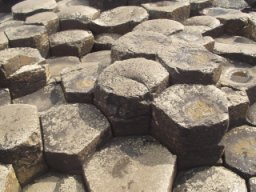
example of columnar basalt (from Wikipedia)
One of those rocks I pried loose and it now sits, embedded in my garden, a memorial to young William.
My next post will be a poem and drawing about the shipwreck.
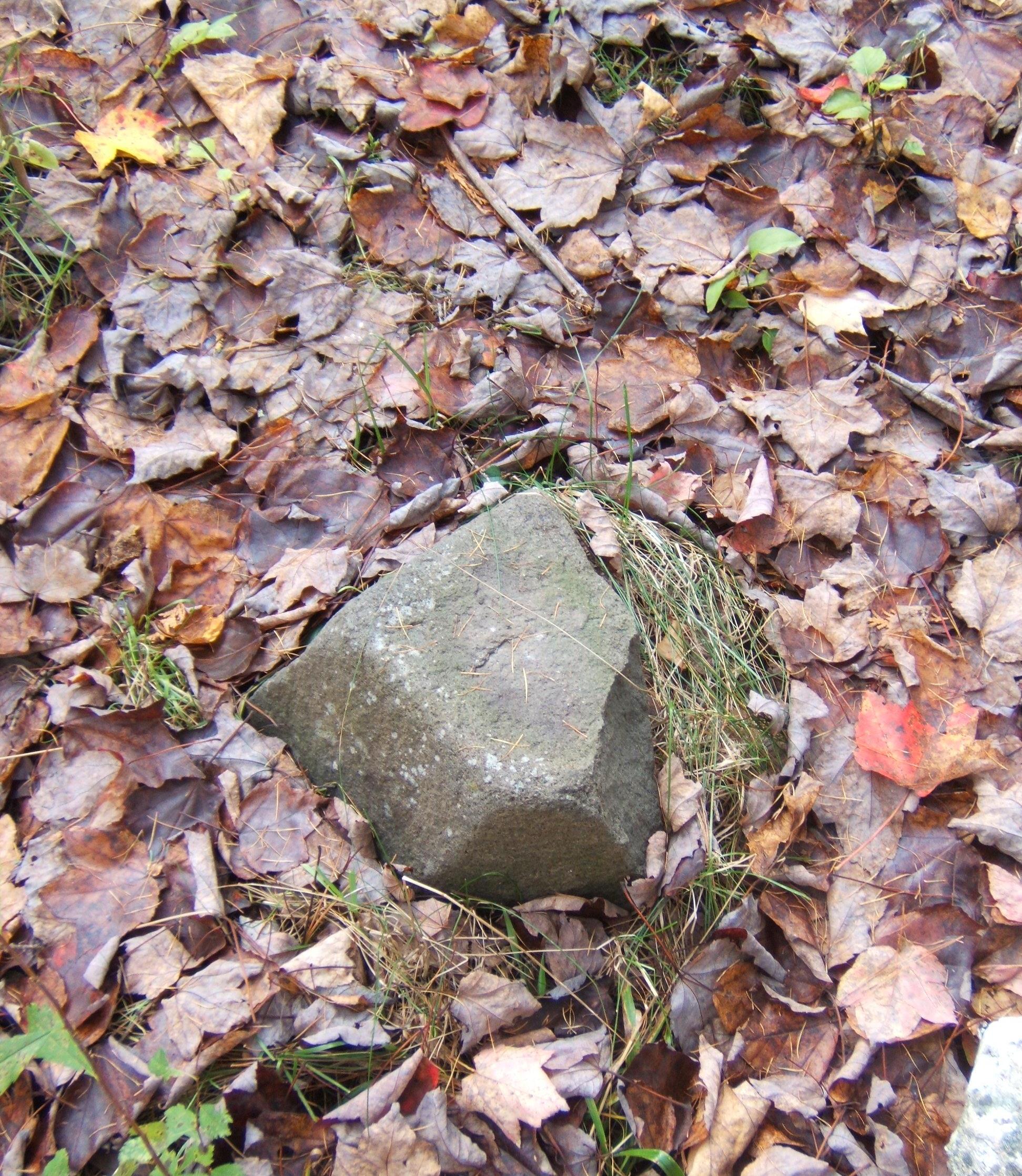
this rock has endured the decades since the shipwreck of the Trafalgar... it was there when the ship was stranded on the rocks...there when William and his brother came ashore... a witness to my family history
© Jane Tims 2011
Briar Island Rock #2 ‘the shipwreck’
How did your family first come to the country where you now live?
In my last post, I introduced the story of my great-great grandfather, William, who arrived in Canada, when he was about seven years old, by shipwreck.
William and his mother, brother and step-father took the schooner Trafalger. It was a 3-masted square-sterned ship with two decks, 96 feet long and 25 feet wide. The family embarked from Hull, England for Canada on May 31, 1817.
The ship was headed for Saint John in New Brunswick, but became lost in thick fog and was shipwrecked off Brier Island, on the Nova Scotia side of the Bay of Fundy. In a letter reported in the Hull Advertiser, the Captain of the Trafalgar gave a detailed account of what happened:
I am sorry to inform you of the loss of the Trafalgar, on the 25 July, about half-past eight o’clock in the evening, upon Brier’ s Island, in the Bay of Fundy, about 60 miles below St. John’ s [Saint John, New Brunswick]. I had been running up all the day, it being very thick could not see anything; at seven p.m. I hove the ship to, with her head to the Westward, thinking we were well over to the Westward, sounding in 40 fathoms; the tide running very strong, and before we could see the land, we heard the surf against the rocks; got sail upon the ship, but being too close the strong tide set us upon the rocks; it being high water when we got on, run out a kedge to heave her off, but all to no use. At low water, the ship was dry all round, amongst the rugged rocks, which went through her in different parts; the ship having as much water in the inside as there was on the outside at high water. The passengers were all safe landed that were brought out, and got all their baggage on shore. We are saving all the stores that we can, but they must be taken up to St John’ s to be sold, as there are no people on Briers Island to purchase anything.
– ‘Letter from Captain J. Welburn to H. Cochrane, July 30, 1817. Saint John, New Brunswick’, Hull Advertiser, September 27, 1817.
The shipwreck was also reported in the New Brunswick Courier:
Shipwreck! – On Friday evening last, about half-past eight o’clock, the ship Trafalgar, Capt. Welburn, went ashore on Briar Island in a very thick fog – the ship will be a total wreck; chief part of the materials saved – The Trafalgar was from Hull bound to this port, and from hence to Quebec, and had 159 passengers, which together with the crew were all saved.
– ‘Shipwreck’, Marine Journal, New Brunswick Courier, Volume 7, No. 325, Saint John, New Brunswick, August 2,1817.
The ship’s passenger list is available at The Ships List (http://www.theshipslist.com/ships/passengerlists/trafalgar1817.htm). It lists the heads of the various families on board.
One of the saved passengers was my great-great grandfather, William, a child of about seven years. William’s father, also named William, had been a carpenter and was killed by lightning while working on a building. His mother married for a second time, and sold her first husband’s tools to get her second husband out of the army.
It would have been hard for them after the shipwreck, but there was a small community of people living on Briar Island – it had been inhabited by fishermen since 1769, and by Loyalists after 1783. After the shipwreck, William’s family eventually settled in Digby County, Nova Scotia.
Tomorrow, I will tell the story of my own family’s pilgrimage to Briar Island in 1993.

'luggage, landed on the shore' (detail of a larger drawing by Jane Tims, 2011)
© Jane Tims 2011
Briar Island Rock #1
One of the rock features already along the path in our front yard is a pentagonal chunk of black basalt. Over the next three posts, I will tell you the story of what it represents and how it came to be in our yard.
The story begins with my study of our family history and genealogy. Of course, being interested in genealogy means you will always have something to do.
As you go back in time, more and more people become part of your life story. By the time you go back only three generations (your great-grandparents), you have 8 grandparents to research. If you include your great-great grandparents, you have 16, and so on. By the time you get to eight generations, you’ll have 256 people to call your own. At 14 generations you have 16,384 grandparents! Think of how many people had to meet and procreate just to make you!
The sad thing is, you will never know most of these people by name, let alone by their many stories.
One of my great-great grandparents would have quite a story to tell. My great-great grandfather, William, came to Canada from England when he was about seven years old, with his mother, step-father, and brother. The ship they travelled on, the Trafalgar, was shipwrecked off Briar Island, Nova Scotia on July 25, 1817.
In my next post, I will tell the story of the shipwreck.

© Jane Tims 2011




 nichepoetryandprose