Archive for the ‘old school houses’ Category
early schools – the autograph book
A tradition in schools before the 1960s was the autograph book. I had one of these books in the 1960s, but although I collected some autographs, it was considered a quaint activity.
~
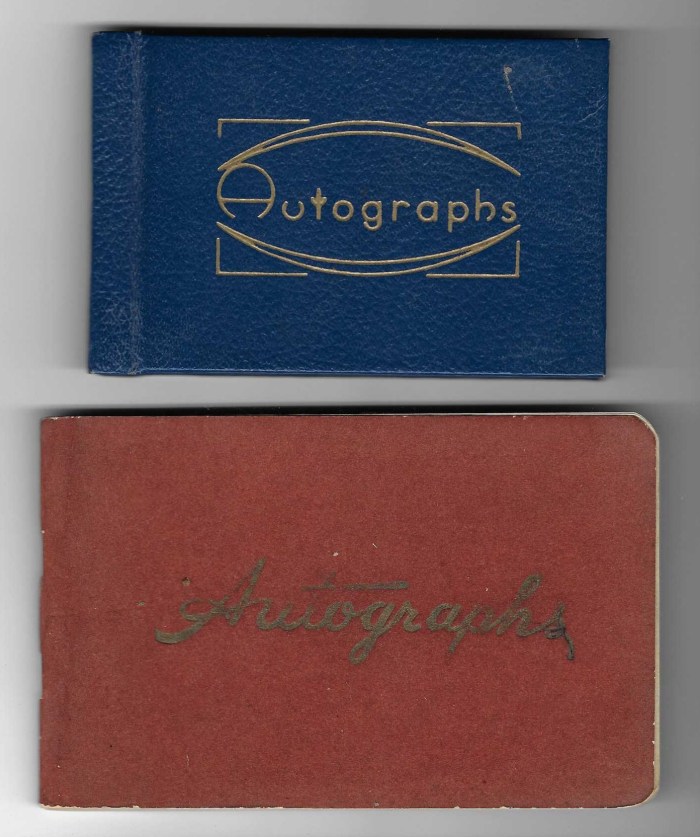
two of Jane Margaret Norman’s autograph albums
~
Both my mother and my aunt had autograph books in the 1940s and 1950s. One of my aunt’s albums was from her students when she taught in a one room school.
I also have my great-grandmother’s autograph album with messages from 1885 to 1914. Her name was Mary Jane (Johnson) Clarke. Her daughters (including my grand-mother) wrote in the album in the later years.
~

Mary Jane Johnson Clarke’s autograph album from the 1880s
~
These books are small, rectangular in shape. The covers are heavy stock paper, sometimes flocked. The older albums have embossed leather covers. The albums range in size from about 3″ by 5″ to 7 3/4″ by 4 3/4″ (the oldest books are the largest). Each page of the book held one autograph: the date, a message, saying or poem, perhaps an address and a signature. Males as well as females wrote in the albums. The albums from the 1940s and 1950s have variously coloured pages in now-faded pink, yellow and blue. The pages in my great-grandmother’s album are beige and white.
~
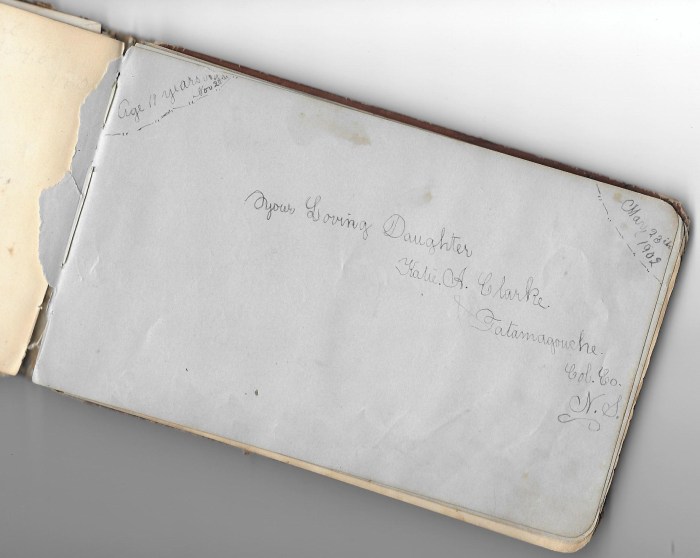
my grandmother’s autograph in my great-grandmother’s autograph album
~
Some of the messages offer serious advice for a good life:
Life is like a mirror
Reflecting what you do
And when you face it smiling
It smiles right back at you
~
Some messages are amusing or even politically incorrect. One from 1947 shows a disturbing flippancy about marital violence:
~
When your husband at you flings
Knives and forks and other things
Seek revenge and seek it soon
In the handle of a broom
~
Some messages are just funny, and seem almost modern:

Great-Aunt Laura Clarke’s autograph in my Great-Grandmother’s autograph album in 1909
~
Since my focus in my ‘old schools’ project will be on the school in the context of the landscape, I was pleased to find one or two messages about landscape!
~
When hills and dales divide us
And distance is our lot
Just cultivate the little flower
That is called forget-me-not
~
And:
~
I’m glad the sky is painted blue
And the earth is painted green
And such a lot of nice fresh air
Is sandwiched in between
~

June 8 2016 ‘the autograph’ Jane Tims (Is she writing the autograph for her friend or her doll?)
~
Did you ever have an autograph album? Do you remember any of the verses people wrote?
~
Copyright 2016 JaneTims
early schools – Arbour Day
Trees in the school yard, especially big trees suitable for climbing and swinging, would have been an appreciated feature of the school landscape. On a hot June day, students would have enjoyed the shade under a big tree.
~
In the 1940s and 50s, some of these trees may have been planted sixty years before by students learning about abouriculture. By the early 1900s, there were Arbour Day celebrations in Canada when students planted trees at school and elsewhere in the community. The first official Arbour Day in Canada was established in 1906 by Don Clark of Schomberg, Ontario to remember his wife Margaret.
~
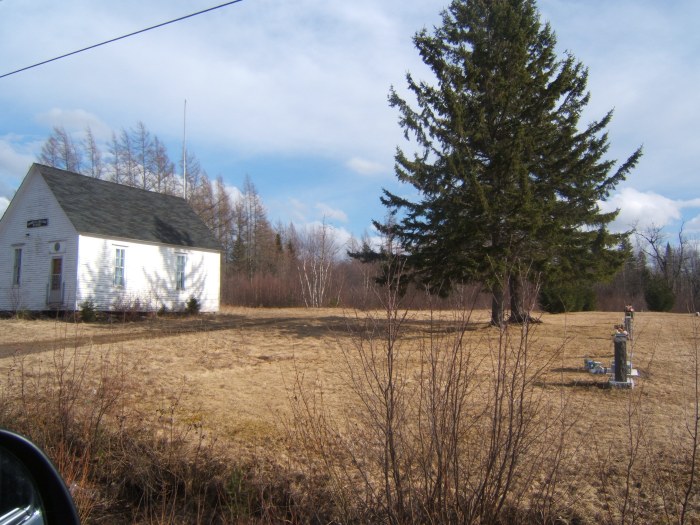
big spruce trees in the yard of the Cumberland Bay School, New Brunswick
~
In Nova Scotia, schools celebrated Arbour Day by 1929 and perhaps before. In May and June that year, officials organized the planting of trees and shrubs in the school yard and involved community members and local dignitaries in the events to encourage their interest in the school system. In 1928, the newspaper Halifax Harald offered, province-wide, a $700 prize for school beautification, which would have included the planting of trees (Jane Norman, Loran Arthur DeWolfe and The Reform of Education in Nova Scotia 1891-1959. Truro, Nova Scotia: Atlantic Early Learning Productions, 1989).
~
The idea of planting trees in school yards continues to this day. Trees are important because they:
- clean our air of pollutants
- remove carbon dioxide, to reduce the contribution to global warming
- prevent soil erosion
- trap water pollutants by directing flow downward
- provide habitat for birds, bees and squirrels
- raise property values
- provide the oxygen we breathe
- provide shade
- make great places for climbing and swinging
~

~
~
Copyright Jane Tims 2016
early schools – the rope swing
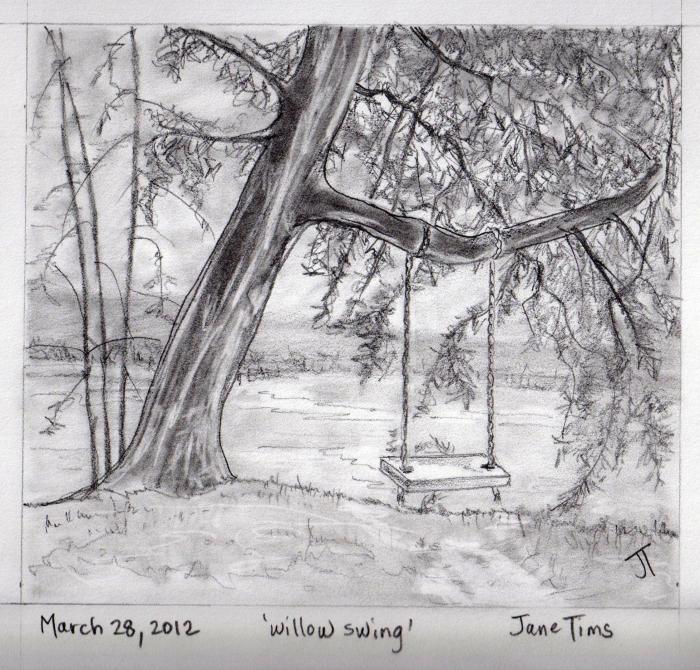
Students in the one room school may have appreciated apple trees growing in the school yard. But there would have been other trees too. A hefty old red maple would have been a good place for a swing. Perhaps a simple rope swing, with a loop over a horizontal tree branch and a big old knot at the end for sitting.
~
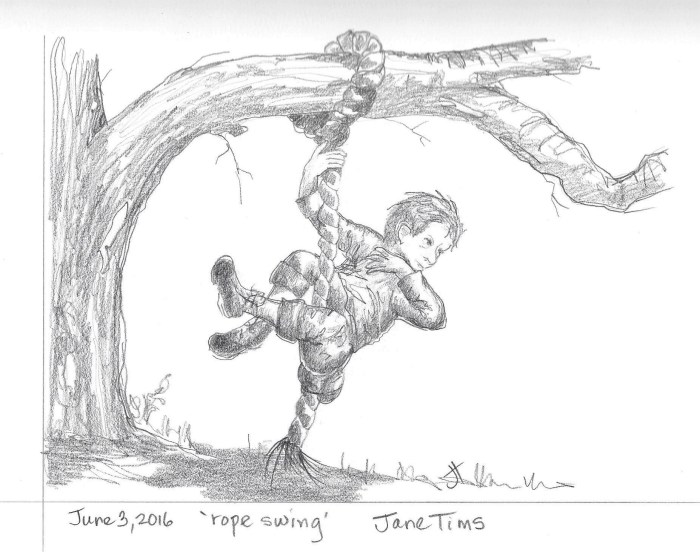
~
rope swing
~
lunch hour
best spent
upside down
~
legs wrapped
tight as twist
of hemp
~
splayed ends
of the big knot
trail on the ground
follow hair and
dragging fingers
~
world tipsy-turned
maple branch – a bridge across the sky
other kids stand on their heads
school house and outhouse
hang from the hill
~
~
Copyright 2016 Jane Tims
early schools – school gardens
It’s gardening time in New Brunswick. While I tend my little tomato plants, I wonder if one room schools in the early 1900s kept school gardens.
~

Was there once a school garden in the yard of this one room school near Gagetown, New Brunswick?
~
In the province of Nova Scotia, some schools had gardens. My aunt, Dr. Jane Norman, in her history of Nova Scotia’s schools, tells about the Travelling Teachers program and the ‘Garden Score Card’ (Jane Norman, Loran Arthur DeWolfe and The Reform of Education in Nova Scotia 1891-1959. Truro, Nova Scotia: Atlantic Early Learning Productions, 1989). The Travelling Teachers operated from 1918-1920, bringing knowledge and help to schools in their districts about rural science, including home-making, healthy living and gardening.
~
In 1918-19, to encourage gardening as part of the school program, the Rural Science Department of the Nova Scotia Normal College (where teachers were trained) donated $10.00 to each Travelling Teachers’ school district. School children and schools who obtained the highest scores on the ‘Garden Score Card’ shared the money as follows:
- three school children with the highest scores won prizes of $2.50, $1.50 and $1.00
- three schools with the highest scores won prizes of $2.50, $1.50 and $1.00
~
The ‘Garden Score Card’ rated the school gardens and the efforts of the children with the following criteria:
- Condition of Garden:
- Planting and arrangement of plants (5)
- Thinning, training, regularity in row (5)
- Cultivation and freedom from weeds (10)
- Freedom from diseases and insect pests (10)
- General neatness of paths, labels, stakes, etc. (5)
- Consideration of adverse conditions, if any (5)
- Range of variety in flowers and vegetables (10)
- Amount and quality of bloom (flowers) and crop (vegetables) (15)
- Amount and value of canning or sales (20)
- Showing made at exhibition (15) Total Points (100)
~
The school children in my drawing are working hard, but based on the ‘Garden Score Card’, they would not have received a prize for their gardening! No stakes, no labels, no regularity in the row.
~

~
How would your gardening efforts be scored??? I would not make good marks on any criterion!
~
Copyright Jane Tims 2016
early schooling – apple trees for climbing

~
When I find an old one room school still standing, there are often apple trees in the yard. I realise these trees may not have existed a century ago, but it makes me think how important trees are to kids. I can imagine, if there was an apple tree or an orchard near the school yard, it would have been a favorite place for the students to play at recess and lunch-time.
~
Apple trees were made for climbing. And for hanging swings. Perhaps for carving initials. Or shaking loose blossom petals on friends standing beneath the tree.
~
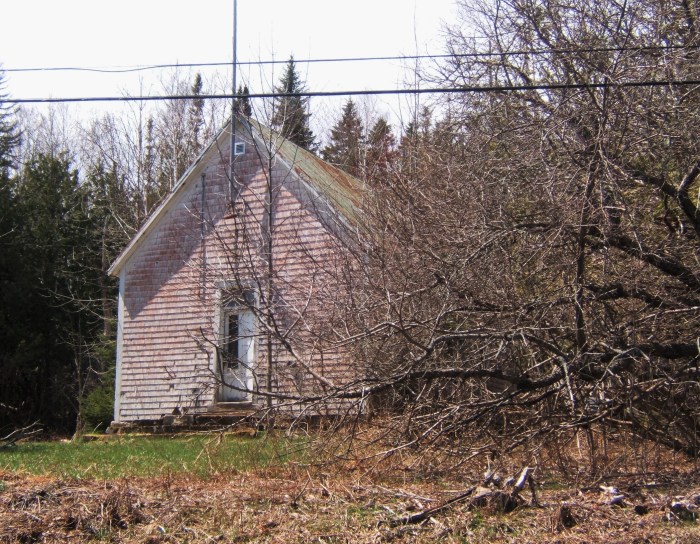
Lower Queensbury School, York County, New Brunswick
~
I grew up in a city in the 1960s when authorities considered concrete the best play surface for a school yard. Run and risk a skinned knee. There were monkey bars for climbing, but I find myself wishing my school yard memories included an apple tree with a big horizontal limb.
~

~
Did you have trees to play on where you went to school?
~
Copyright Jane Tims 2016
early schooling – finding the one room schools
I am continuing to find interesting information in the Annual Report of the Schools of New Brunswick 1888 (Fredericton, 1889). This report includes information on the number of one room school houses in the late 1800s. Although the numbers are for all schools, you can see, by comparing the numbers of teachers to the numbers of schools, most schools had only one room.
~
Statistics on Schools in Four Counties of New Brunswick as of December 31, 1887
| County | Number of Schools | Number of Teachers | Number of Students | Number of Boys | Number of Girls |
| York | 167 | 178 | 5558 | 2811 | 2746 |
| Sunbury | 46 | 48 | 1050 | 553 | 497 |
| Queens | 85 | 87 | 2196 | 1088 | 1108 |
| Kings | 155 | 161 | 4552 | 2303 | 2249 |
| All Counties | 1542 | 1613 | 55492 | 27888 | 27604 |
~
One of the things I want to do in my new project is visit a number of the schools still standing in four counties in the lower Saint John River watershed (Kings, Queens, Sunbury and York Counties). I’ll also visit some locations where schools once stood but are now gone.
~
Finding these schools by driving the roads is a rather inefficient approach. So how do I find the whereabouts of over 400 one room schools? To start, the location of every school in Kings County in 1862 is known from the Walling Map. For more information on this map, see http://www.rubycusack.com/issue34.html
~
I have also found a valuable resource in a book I found for sale at Amazon.com : Diana Moore and Andrea Schwenke. New Brunswick Schools: A Guide to Archival Sources. Acadiensis Press: Fredericton, 1992. The Guide provides information on where to find various sources for early schooling in New Brunswick. I will be consulting some of these:
- a scrapbook by Marion Johnston Dunphy who photographed 150 schools from 1974 to 1984 (The One Room Schools of New Brunswick and What Became of Them).
- a list of one room schools in Kings County in 1983 prepared by The Kings County Retired Teachers Association
- old school records in the Provincial Archives and the Archives of the Saint John Museum
- diaries of people who taught school, for example C. Gordon Lawrence (Tracy School, Sunbury County, 1903 – 1962)
- various exercise books, workbooks and school registers from the 1800s
~
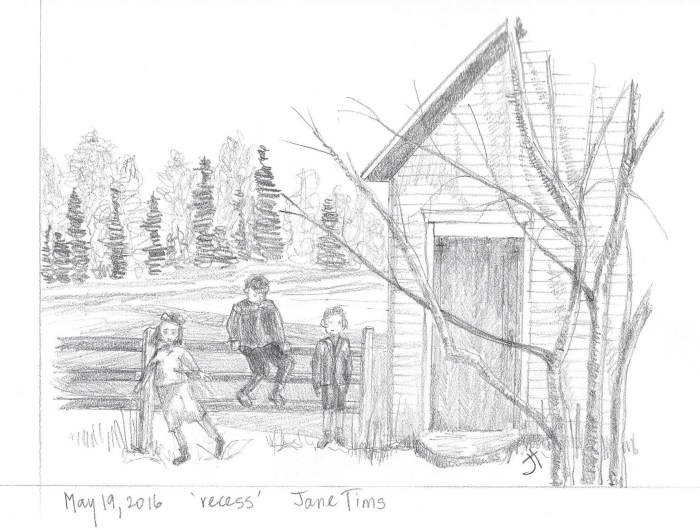
~
The first of many drawings about days at the one room school. I think I should take a course on drawing people. They look a little bored.
~
Copyright Jane Tims 2016
songs in the grey woods – ovenbird
He can be a bit monotonous. A bit of a scold. He reminds me of a rusty hinge. He says teacher-teacher-teacher, repeating his song through the woodland. He is the Ovenbird.
~
His scientific name is Seiurus aurocapilla. Seiurus (which I remember as ‘serious’) is from the Greek meaning ‘tail shake’, a reference to the characteristic upward flip of his tail. The name aurocapilla means golden-haired referring to his crest of orangy feathers. The Ovenbird is olive-brown, with a streaked white breast. He has a white ring around his eye, a white throat and a dark line below his cheek. He looks a bit like a thrush, but is a large warbler.
~
His serious nature and his call of ‘teacher, teacher, teacher’ make me think I’ll include a poem about his ways in my project about one room school houses in New Brunswick. This is how my poems usually begin, with a whisper from nature.
~

~
Copyright 2016 Jane Tims
old schools in the landscape
In my last few posts, I have focussed on my research toward a new poetry project I will be beginning. I know there are interesting stories to be told about the ‘inside’ of the one room school. Because of my interests in botany and community history, I would like to reflect on the ‘outside’ of the one room school – its surroundings and geographic location.
~
I still have to do some thinking about this project. I know that people who attended one room schools will have stories to tell about how the local terrain and landscape influenced their schooling.
~
A school’s surroundings would have impacted learning in many ways. For example, the view of a lake from the school window may have caused many a pupil to settle into daydreams. Interesting fields, hills, and watercourses would provide the teacher with opportunities for nature study.
~
The location of the school would also influence recess and lunch-time activities. My Dad wrote about damming a local stream so they could skate in the winter months. The same stream meant fishing in May and June. A nearby hillside would be great for sledding in January and February. Trees in the school yard? – A place to climb or to hang a swing.
~
~
Students walked to school before the 1950s. The study I made of schools in Upham Parish, New Brunswick suggests that students walked as many as three miles to school in the late 1800s. Hills made the long walk to school more difficult. The winds by a lake or other shore land would be bitter on a winter day. Rivers, lakes and wetlands meant a place to hunt tadpoles. A spring by the road? – A cool drink. My Uncle, forced to wear a hat/scarf he hated, used the bridge on the way to school as a place to hide his headgear!
~
One room schools were located near clusters of houses and various community activities. The walk to school may have passed a church, a post office or a community store. Hardwood forests meant lumber mills and, in spring, maple syrup and the sugar shack. Good land meant farms; grazing land meant cows to outstare.
~
On a drive last weekend, we found an older building along the Saint John River that may have been a school. The Upper Queensbury Community Hall has all the characteristics of a one room school – the steep roof, rectangular footprint, and tall side windows.
~
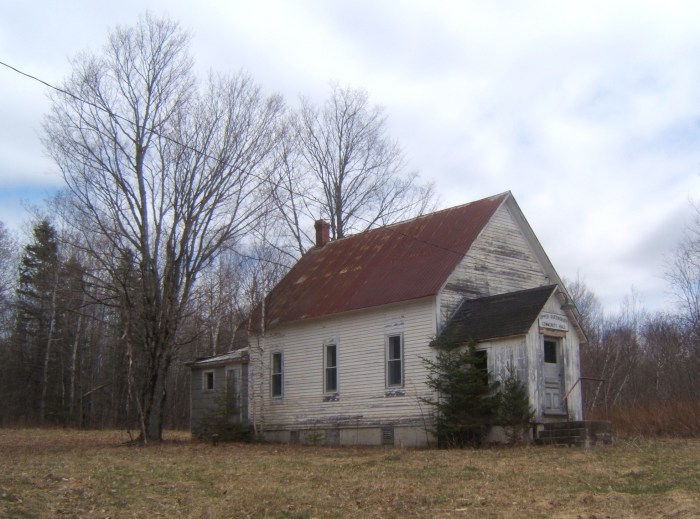
Upper Queensbury Community Hall near Nackawic, New Brunswick. I will have to make some inquiries to find out if it was a school house at one time.
~
A look at a map shows some of the landscape features in the area.
~

Map showing landscape features of part of Queensbury Parish, near Nackawic, New Brunswick. The yellow dot is the location of the Upper Queensbury Community Hall which may have been a one room school.
~
The Saint John River was nearby, although further than it is today since the Mactaquac Dam (built in 1968) has raised the level of the water. The river’s possibilities for fishing, skating and boating were only a downhill trek away. The terrain is gently undulating, as the names of nearby communities (Day Hill and Granite Hill) suggest. Local geographic points the community children may have known include the many-tiered Coac Falls and Coac Lake (an old road runs past the community hall back through the woods to the lake, about a mile away). The aerial photo (taken near the end of September) shows the red of the cranberry bog – picking cranberries may have been a well-known activity. Sugar maples are common in the area, as are old ‘sugar shacks’. When I interview people who went to the one room school I will have to remember to ask them about their memories of these places.
~
Writing poetry about these ideas will be so much fun!
~
~
Copyright 2016 Jane Tims
early schooling – the fate of older buildings
Since our first drive to the Grand Lake area to find old schools in the landscape, we have kept an eye out for others. I am realising these buildings have met one of three fates:
- demolition – lost forever to the landscape
- deterioration – left to decay and eventual collapse
- re-purposing – restoration and maintenance for use as camps, sheds or community use
~
For example, the Bunker Hill School in Rusagonis, New Brunswick has been well maintained and is used as a meeting place in the community. The old school has been recently painted and has a wheel-chair ramp.
~
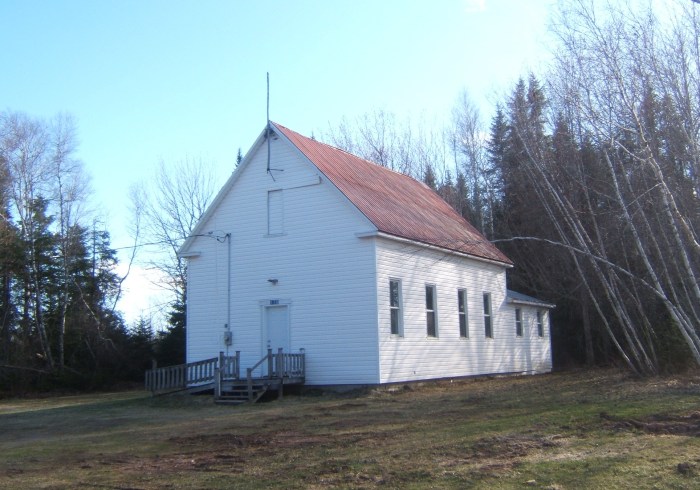
Bunker Hill School, Rusagonis Station, Sunbury County, New Brunswick
~
The conservation of older buildings in the landscape is problematic. They have historical value, create community character, and serve as a reminder of the past. On the other hand, for derelict buildings without purpose, liability soon exceeds value. We are at a time in our history when the buildings associated with growth in the late 19th and early 20th centuries are succumbing to the vagaries of time. Older designs, although often sturdy, are not energy-efficient and don’t always fit our modern ideas of efficiency and convenience, or our 21st century need for parking areas, central heating, and convenient washrooms. As a result many older buildings, including churches, schools, halls and stores are lost from the landscape.
~
old school at Mill Road, near Gagetown, Queens County, New Brunswick (Verified as Lawfield School, Gagetown #1)
~
Do you have older school buildings in your community and what has been/will be their fate?
~
Copyright 2016 Jane Tims
early schooling – what to do at recess
When I was young, recess was a big deal. You had to take a treat to eat and something for play. In Grade Three, tops were all the rage. My Dad made me a top from a wooden spool and we painted it in a rainbow of colours. I can still see it spinning on the concrete step. We also played hop-scotch, ball games like Ordinary Secretary, marbles, skipping and tag.
~

April 30, 2016 ‘top made from a wooden spool’ Jane Tims
~
I am lucky to have some of my Dad’s writing about his early years and his experiences in a one room school. He went to the Weaver Settlement School in Digby County in Nova Scotia in the late 1920s and early 1930s. He tells about some of the activities at the school, especially at recess. Fishing was popular, as well as playing ball and trading jack knives.
~
… There was a well out beside the school and it was a good appointment to take care of the water-cooler for a day of a week … Gave a student time off from books…
~
… There was a brook nearby … In fall we usually built a dam so the brook became a pond for winter … A place to skate or just play on the ice …every moment of recess and noon was spent there …
~
… The big contest was ‘who comes to school first in bare feet ’ … Our parents had control, not full control as there were hiding places for shoes and stockings along the way to school …
~
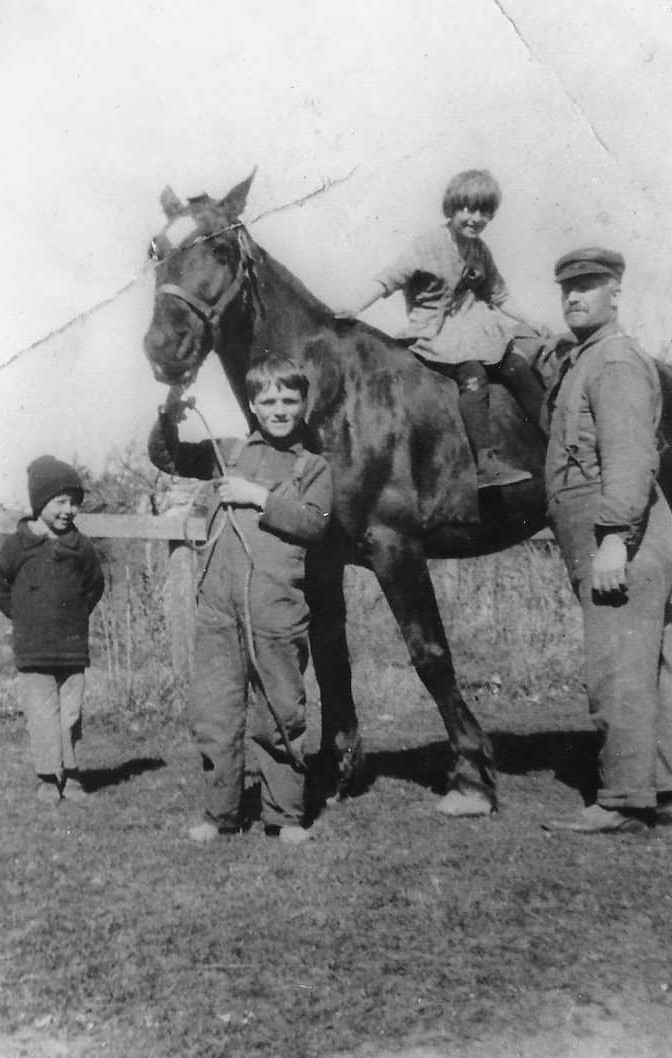
Dad with the family horse Goldie in about 1930
~
I am certain recess is still a favorite time for school kids – time to talk with friends, play games and get a little break from the classroom. I think we could all build a little ‘recess’ into our busy lives!
~
Copyright 2016 Jane Tims




 nichepoetryandprose