Archive for the ‘exploring New Brunswick’ Category
Pileated Woodpecker excavations
The Pileated Woodpecker (Dryocopus pileatus) is a common visitor in our yard. The size of the woodpecker and its triangular red crest are impossible to miss. The male also has a red stripe on the side of its face.
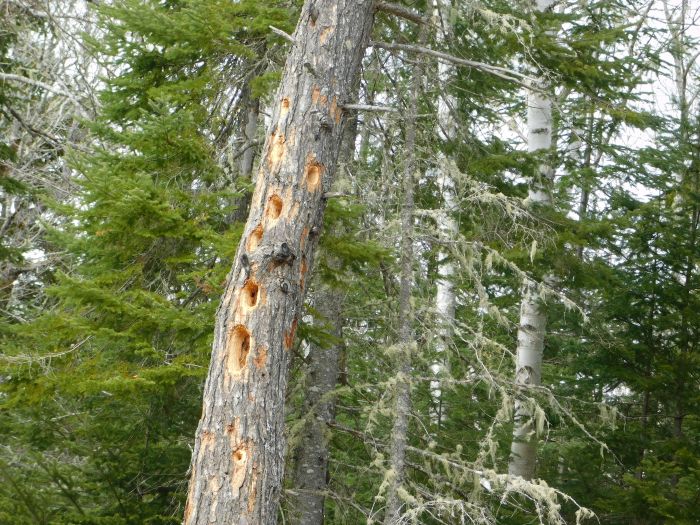
There is a big spruce tree in our grey woods where the Pileated Woodpecker loves to visit. The hole in the tree and the pile of woodchips below the hole say this woodpecker has been very busy. The woodpeckers drill these holes to get insects.
On a drive to see the Smyth Covered Bridge near Hoyt, New Brunswick, we found a roadside tree with evidence of the Pileated Woodpecker’s industry. The holes are almost a foot in length and deep enough to hide a hand.
~
~

~
To humans, the best forests may seem to be woods with healthy trees. To provide good habitat for the Pileated Woodpecker, a forest should have lots of dead and fallen trees, to provide food and nesting sites.
~

~
Copyright Jane Tims 2018
ice-falls in New Brunswick
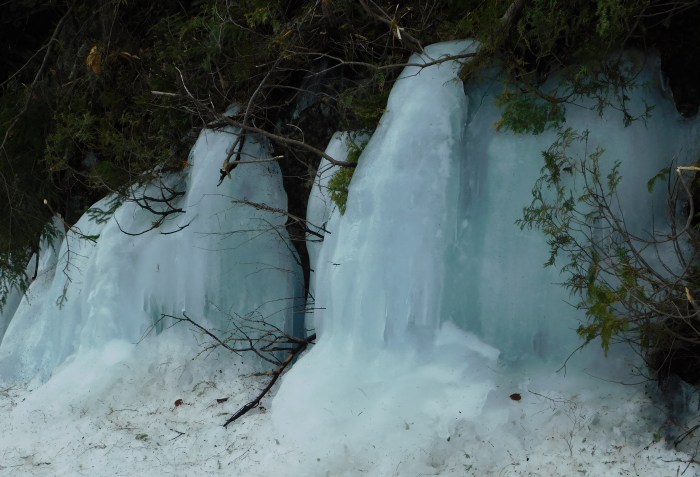
An ice-fall along highway #102 in New Brunswick
~
One of the sad things about the end of winter is the demise of our ice-falls in New Brunswick. Along the roads, where there are streams intersected by road-cuts, we often have a build-up of ice as it drips from the top of the cut. Some of the ice-falls are spectacular and all are dazzlers in the sun. For more about ice-falls in my blog see here.
~
From my reading, I know that ice-falls begin as ‘frazil ice’, a suspension of small ice crystals adhering to soil, rock or vegetation. As meltwater flows over the surface of the frozen ice-fall, new layers are built and a cross-section of the ice will show bands of ice.
~
In New Brunswick, some ice-falls are climbable, and some create caves under the curtain of ice. A famous New Brunswick ice-fall is the Midland Ice Caves near Norton. https://www.explorenb.ca/blog/icecaves
~
~
one warm hand
~
icicles seep between
layers of rock frozen
curtains separate
inner room from winter storm
glass barrier between blue
light and sheltered eyes
memory of water flows
along the face of the rock
one warm hand melts ice
consolation, condensation
on the inward glass
~
~
(published as ‘one warm hand’, http://www.janetims.com, March 10, 2012)
Copyright Jane Tims 2018
signs of spring
Here are few of the signs of spring we saw on our drive last weekend:
~
a skunk running through the apple orchard …
 ~
~

~
pussy willows …

~
muddy roads …

~
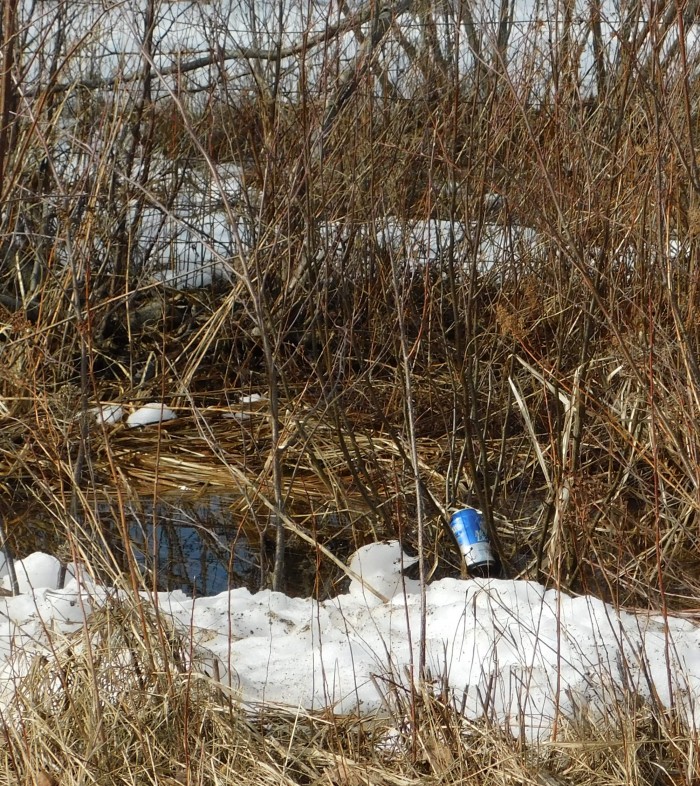
beer cans and other returnables, released from their cover of snow …
~
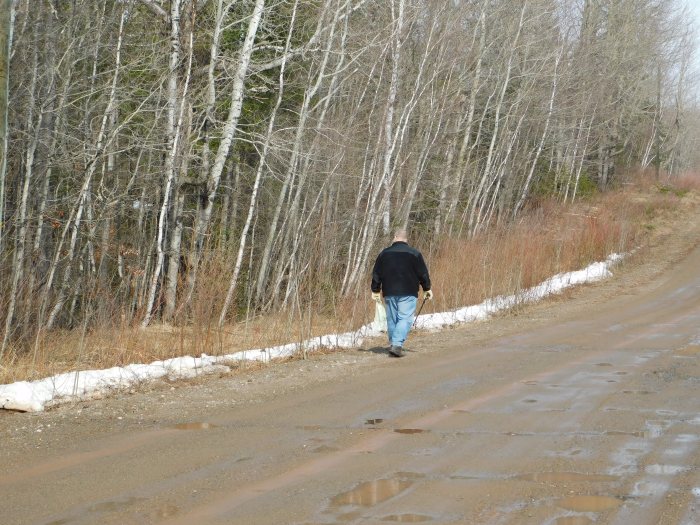
and a New Brunswick can-and-bottle collector out for walk …
~
Happy Spring!
~
Copyright Jane Tims 2018
Pokiok Falls

Pokiok Stream, about 2011
~
On one of our family summer excursions across Canada, my parents stopped along the highway in New Brunswick to see the Pokiok Falls near Nackawick. I remember the white churn of water below me, so steep it looked like the water was falling into a pipe. In 1967 the Mactaquac Dam submerged the falls and now they are only a memory, visible on old post cards and in photo albums.
~
For a fictionalized account of the changes resulting from the building of the Mactaquac Dam, read Riel Nason’s excellent coming-of-age book ‘The Town That Drowned‘ (Goose Land Editions, 2011).
~
Pokiok Falls
~
my mother held me at the railing
to see the Pokiok
plunge
from highway
to river
granite pipe
roiling water
~
later, when the dam went in
they moved the churches
to higher ground
so the church bells
wouldn’t gurgle
when they rang
~
now the river slips sideways a notch
to fill the round drowning of the falls
~
water cannot fall within water
~
I cried when I left
I hadn’t seen the pokioks
I said
~
~
Copyright Jane Tims 2018
wildflowers – Bladder campion
One of my favorite roadside flowers is the Bladder campion, Silene vulgaris (Moench) Garcke. The flowers are white, with five deeply lobed petals. The flowers protrude from an inflated, papery calyx, greenish, purple-veined and bladder-like. This time of year, the flowers are almost past.
~

~
I love the scientific generic name Silene, derived from the name of a Greek woodland deity. Another common name for Bladder campion is maidenstears.
~

~
The leaves of Bladder campion are edible, used raw in a salad or cooked in a stew.
~

~
Copyright 2017 Jane Tims
wildflowers – Canada lily
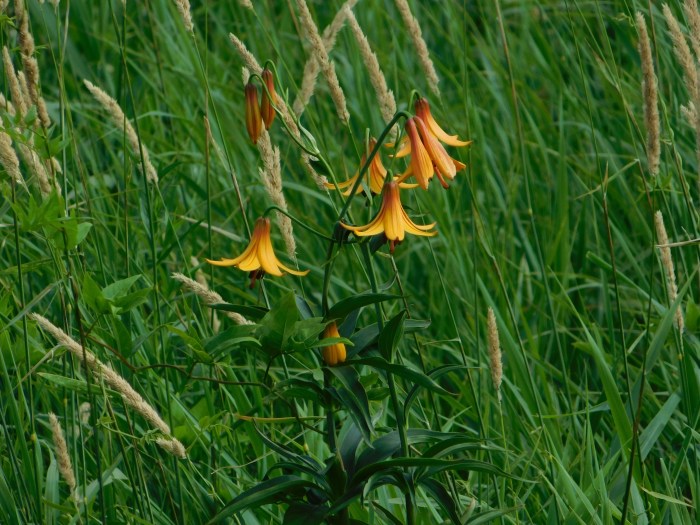
A drive this time of year through Grand Lake Meadows, along the old Trans-Canada Highway, will show you one of our prettiest wild flowers — Lilium canadense L., the Canada lily.
~

~
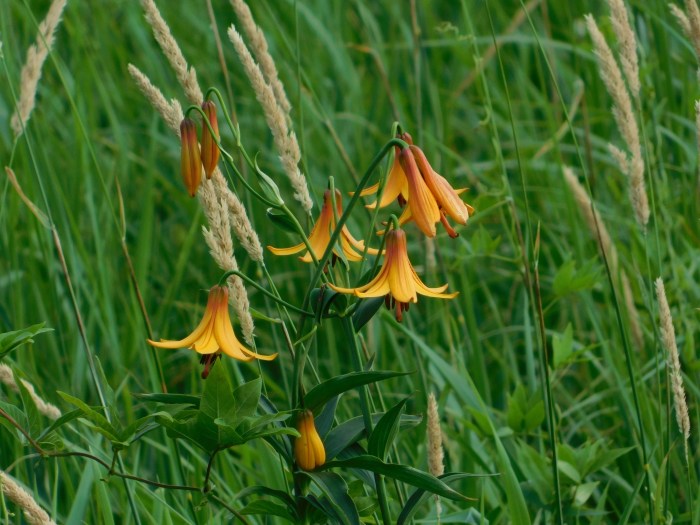
The flowers are a glimpse of orange in vast fields of greenery. The flowers are down-ward pointing, reminding me of a chandelier of light. They bloom from June through August in the moist wetlands of this part of central New Brunswick.
~
~
~
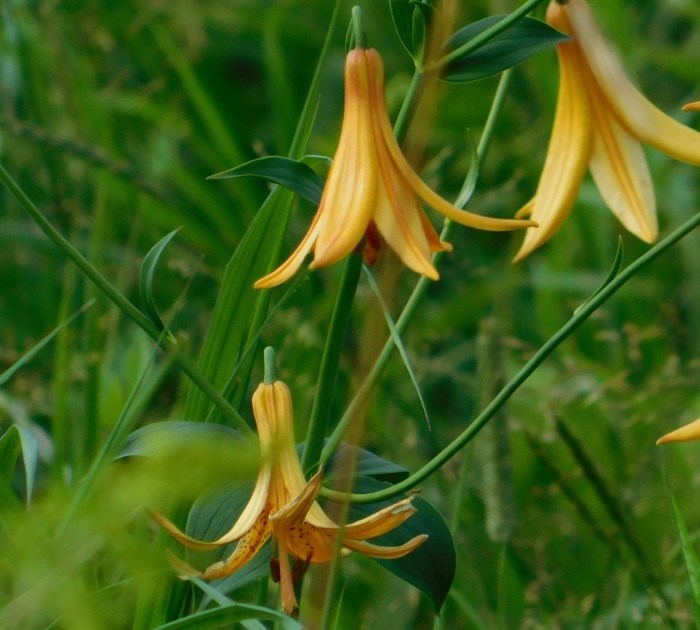
As the meadow winds flip the flowers upward, you can catch a glimpse of the dark red anthers and the spotted interior of the petals.
~
~
Copyright 2017 Jane Tims
those don’t look like French fries!
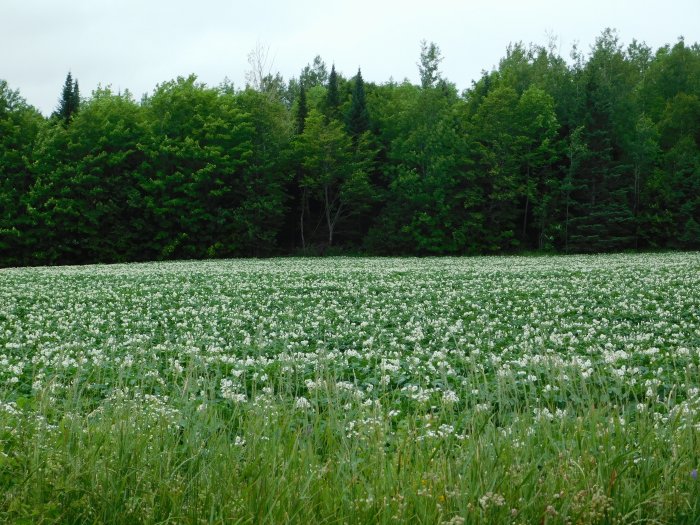
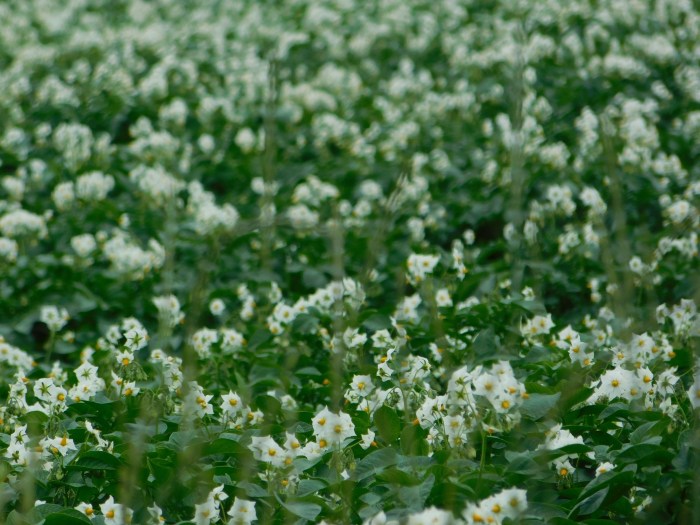
This time of year in eastern New Brunswick and elsewhere, the potato fields are flourishing and many are in bloom.
~
~
I am so grateful for those potato fields. I love French fries, so much so that I limit my intake by making promises to myself and my son (something like: I promise to eat French fries only once per week for the next three months. I usually stick to these promises because I make them for a specific time.
~
~
I love other potato products. I make great potato salad (potatoes, Miracle Whip, onions, bacon bits, mustard, green relish, pepper and basil). We also eat potato and leek soup regularly (a great hot-day supper). And, of course, potatoes are an ingredient in every stew I make through the winter.
~

~
But although we love potatoes, do we ever appreciate their very pretty flowers? Like so many things, we fail to see their beauty unless we look.
~

~
Copyright Jane Tims 2017
a touch of Monet
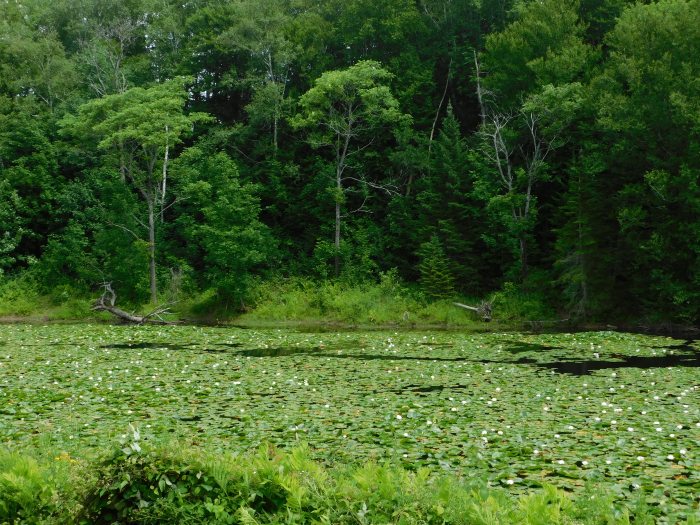
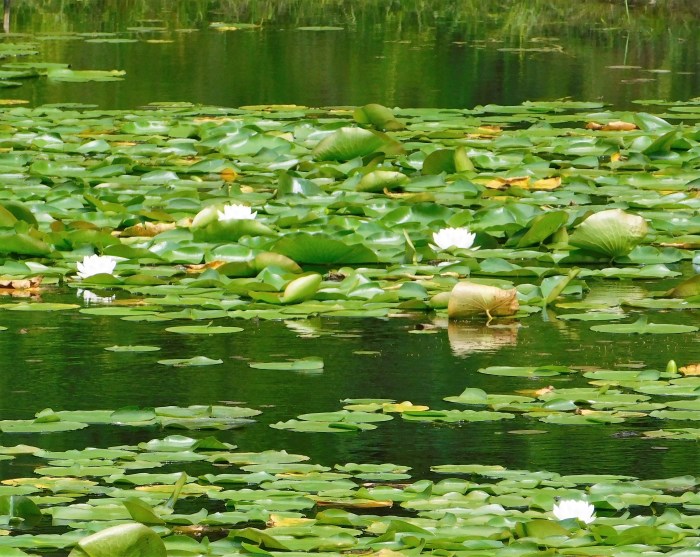
Last week, on a drive to Plaster Rock, we passed a pond along the Saint John River filled with water lilies (Nymphaea sp.).
~
 ~
~
Lovely. Calming. And reminiscent, in the way they lay on expanses of open water, of Monet’s water lilies at Giverny.
~
~
When I think of water lilies, I also remember Edgar Allan Poe’s short story Silence – “And the water lilies sighed unto one another….”
~
~
So to add to these greats, I have my own snippet from my poem ‘Bear Creek Meadow by Canoe’ (published in Canadian Stories 14 (82 ), Dec 2011 ):
~
dignity quiets our paddles
hushed voices heed
the diminishing echo
~
pliant as stems of pickerel weed
we honour the whisper
of wild rice
the edgewise touching
of nymphaea and nuphar
amphibian eyes
in the harbour-notch of lily pads
~
we are threaded by dragonflies
drawn by water striders
gathered in a cloak of water shield
~

~
Copyright Jane Tims 2017
in search of Thornton W. Burgess
Last weekend we took a drive to the western part of the province. Our goal was to see Bolton Lake.
~
I have heard that there was once a cabin on an island on Bolton Lake used by Thornton W. Burgess during his summer visits to New Brunswick. Thornton W. Burgess (1874 to 1965) was a conservationist and children’s author who wrote adventure stories featuring all the denizens of the wild wood – he wrote more than 170 books and many stories including The Adventures of Jerry Muskrat (1914), The Adventures of Sammy Jay (1915), The Adventures of Danny Meadow Mouse (1915), The Adventures of Grandfather Frog (1915) and so on. I particularly remember Mother West Wind’s Neighbors (1913) because it brought lots of the characters together.
~
Our drive took us along East Brook Road, off highway #630 in western New Brunswick, in the area of Palfrey and Spednic Lakes.
~

Bolton Lake is at 8 o’clock on the map … we followed the East Brook Road (upper road marked in red from right to left) and then the Parker Lake Ridge Road (marked in black along the left edge of the map)
~
The road is well-used but rough and I had a few ‘moments’ as my husband navigated the potholed and sometimes inundated road.
~

the road is the northern boundary of one of New Brunswick’s protected areas
~
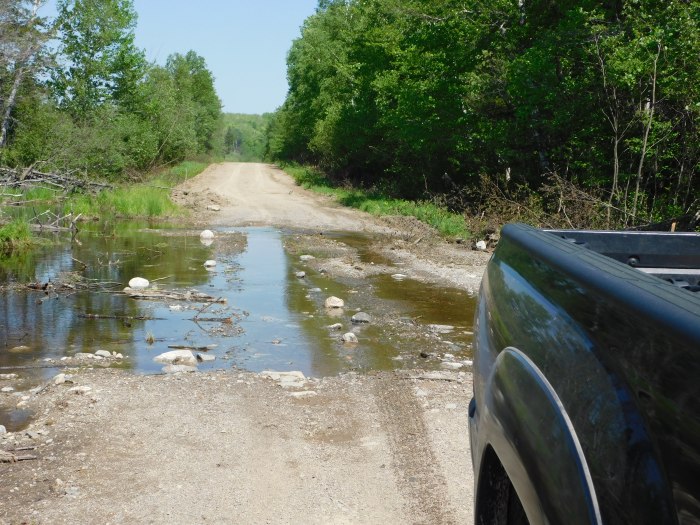
it always looks worse than it is …. a beaver dam blocking a culvert caused this flooding on the road
~
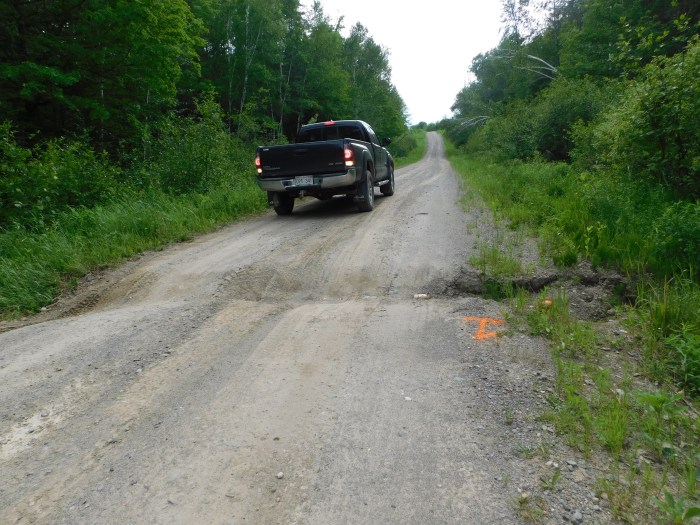
our conversation as we drive is augmented by my warnings … “bump!”, “big rock!”, “really big rock!” as if my husband couldn’t see these himself! … there was lots of road maintenance going on – culverts replaced and washouts resolved
~
We were surprised but wildlife sightings were scarce on our trek. We saw moose, deer and coyote tracks, bear and coyote droppings, and lots of beaver lodges but no one was out and about on such a hot and windy day.
~
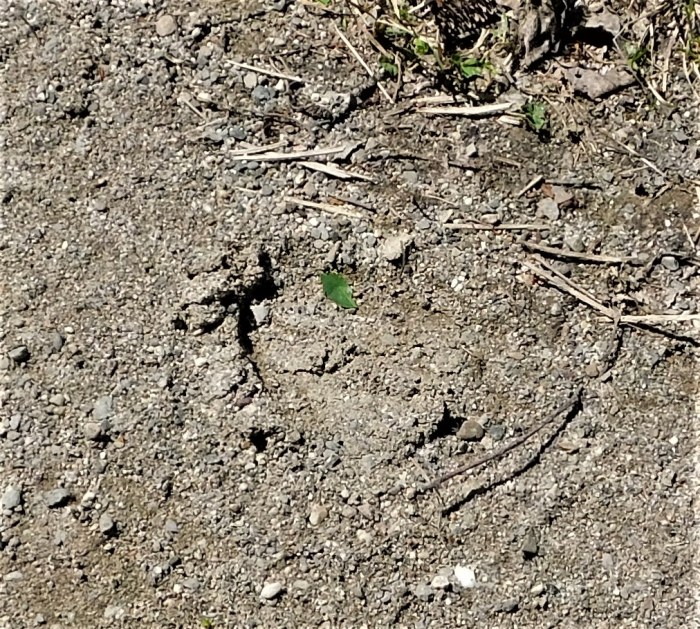
a moose track in the sand of the road
~
We had been to Bolton Lake in 1990 and were amazed to find that almost thirty years has made a huge change. The road from Parker Lake Ridge Road to Bolton Lake has completely grown over. So Bolton Lake will keep its secrets and its history for now. We will have to content ourselves with a vista from Pemberton Ridge along the Forest City Road … the lake in the distance is one of the many waters comprising the Spednic Lake – St. Croix River system along the US/Canada boarder. Bolton Lake is hidden in the trees and valleys on the right hand side of the photo.
~

~
Copyright Jane Tims 2017
waterfalls of New Brunswick – a reading by Nicholas Guitard
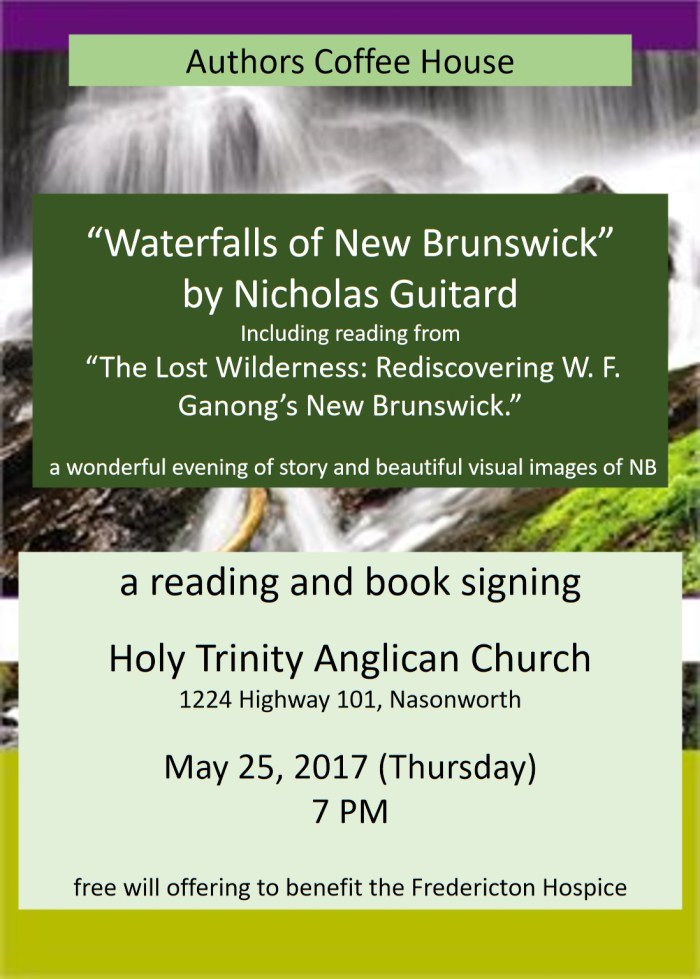
On Thursday evening this week, Nicholas Guitard will be reading during our church’s Authors Coffee House. Nicholas Guitard is the author of Waterfalls of New Brunswick (Gooselane, 2009). He is also author of The Lost Wilderness: Rediscovering W.F. Ganong’s New Brunswick (Gooselane, 2015). Ganong was a famous 19th and 20th century naturalist and geographer who is responsible for much of the understanding of natural history, place names and geography of New Brunswick. You can get copies of these books here and here.
~
If you are in the Fredericton area, you would certainly enjoy this reading. There will be photos of some of New Brunswick’s best waterfalls, as well as refreshments and a chance to talk to Nick about his work. Hope to see you there!
~
~
Copyright Jane Tims 2017




 nichepoetryandprose