Archive for the ‘along the roadside’ Category
not naming any names (along the country road # 7)
What do you do if you are stranded beside a highway and have to wait for a long while? I name the plants I see growing in the ditches.
Part of my fascination with plant taxonomy is the interesting origin of the plant names. This includes both the Latin ‘scientific’ names and the common names. Many scientific names for plants can be traced to their physical characteristics. However, with references to mythology and local lore, and the modern unfamiliarity with Latin and Greek, the origin of many names may seem quite obscure.
For example, the Latin species name for Buttercup is Ranunculus, from the Latin name for ‘little frog’; Pliny gave this name to the plant because it grew where frogs lived. Some plants were named because they resembled parts of common animals; Larkspur has the specific name Delphinium since the flower resembles the shape of a dolphin. Other plants were given names because they reminded botanists of everyday objects – the species name of Meadowsweet is Spirea, from the Greek speira, wreath.

Meadowsweet (Spirea latifolia (Ait.) Borkh.)
Common names may vary with location. One of the reasons for using scientific names is the variety of common names assigned to a single plant by people of different localities. Botanists needed a way to make sure they were talking about the same plant. So Virgin’s Bower, or Devil’s-darning-needle, or Devil’s Hair, or Lovejoy, or Traveller’s Joy, or Love Vine are known by one scientific name, Clematis virginiana L.
Many common names also include references to mythology or religion. Coltsfoot (Tussilago farfara L.), the dandelion-like flower blooming in our ditches almost before the snow has disappeared, is also called Son-before-the-Father, which refers to the appearance of flowers before the leaves.
Since New Brunswick is a bilingual province, I like to know the French common names for plants as well as the English. Some examples of French names for common flowers include pas-d’âne (literally donkey-steps) for Coltsfoot, immortelle (meaning immortal) for Pearly Everlasting (Anaphalis margaritacea (L.) C.B. Clarke), and herbe aux gueux (meaning beggar or tramp) for Virgin’s bower.
So, what is this plant, discovered beside a stretch of highway while we waited for our friends to arrive?

what is my name?
~
common name unknown
~
1.
stranded beside the highway
entirely industrial
chain-link fence, ditches sandy dry
we passed the time
naming the familiar
giving names to unknown
road-side
vegetation
~
2.
three-leaflets
definitely clover
but what species
what common names might suit
a crowded cloud
of soft and purple
flower?
~
3.
we tried ‘common’
clover cloud
clover crowd
muffin-mound
rabbit’s whiskers
pussy-toes
pillow-fill
billow hill
lavender clover
Purple Pleiades Pleione
please!
~
3.
we tried Latin
Trifolium
lavandula
purpura
porphyrophobia
fluffense
~
we mixed Latin with Italian
musical notation
Trifolium pianissimo
very soft
~
4.
our drive arrived
our wait was over
botanical field-guide
verified Trifolium arvense
Rabbit-foot, ‘of-the-field’, Hare’s-foot, Stone Clover
~
a footnote: sometime the botanical description is no help at all…
Trifolium arvense L.
“…long-villous 10-nerved sessile campanulate calyces crowded, spreading, their setiform teeth much longer that the tube and the marcescent corolla…”
Fernald, Gray’s Manual of Botany, 1950.
© Jane Tims 2011
along the country road #6
How are the giant statue of a Canada goose at WAWA, Ontario, and the roadside plant White Clover associated? Read on…

the giant statue of a Canada goose at Wawa, Ontario
White Clover is a common perennial herb of fields, lawns and roadsides. The plant is also called White Clover or, in French, trèfle blanc. Flowers are borne in globular heads, pure white or tinged with pink. The name Trifolium is from tres meaning three and folium meaning leaf. Repens means creeping, a reference to the long, prostrate stems.
The leaves of clover are in threes, palmately compound, and are occasionally found in fours. According to superstition, finding a four-leaved clover gives good luck to the finder. In the 1960’s, my Dad found a five-leaved clover in the grassy field in front of the giant statue of the Canada goose at WAWA, Ontario.
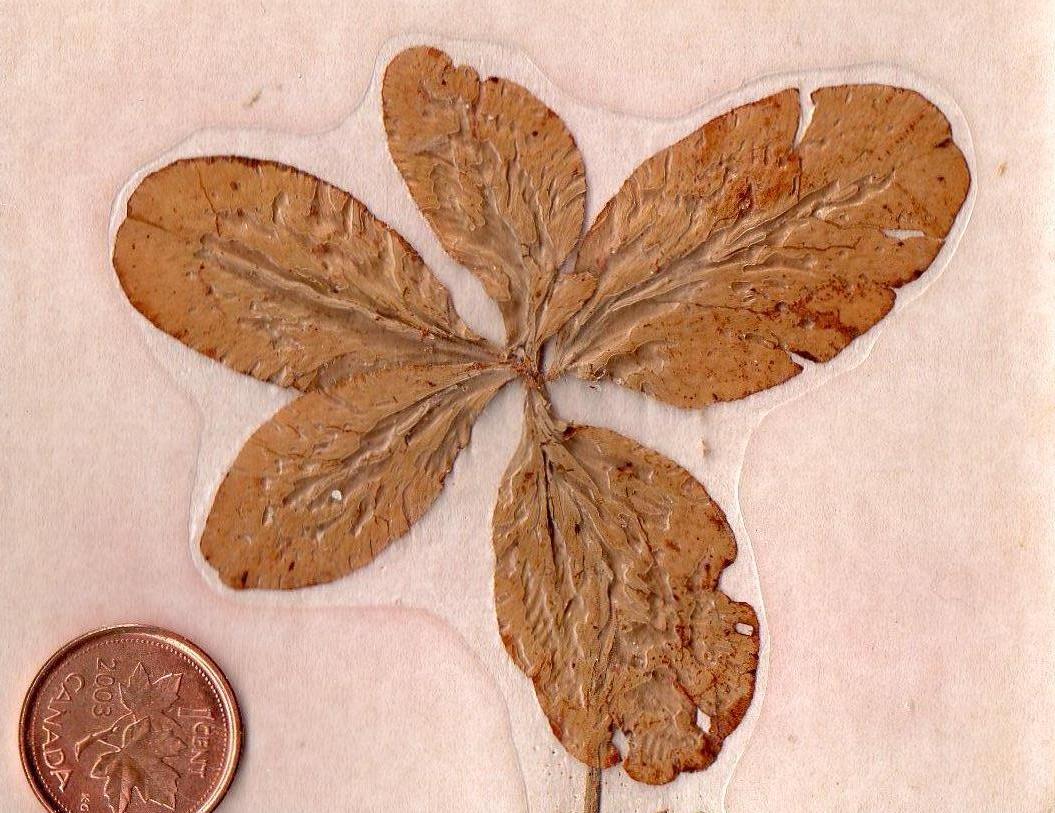
the five-leaved clover my Dad found on the lawn in front of the Canada goose at Wawa almost 45 years ago
Dad pressed the leaves and covered them in a laminating film. The pressed plant is still among my treasures.
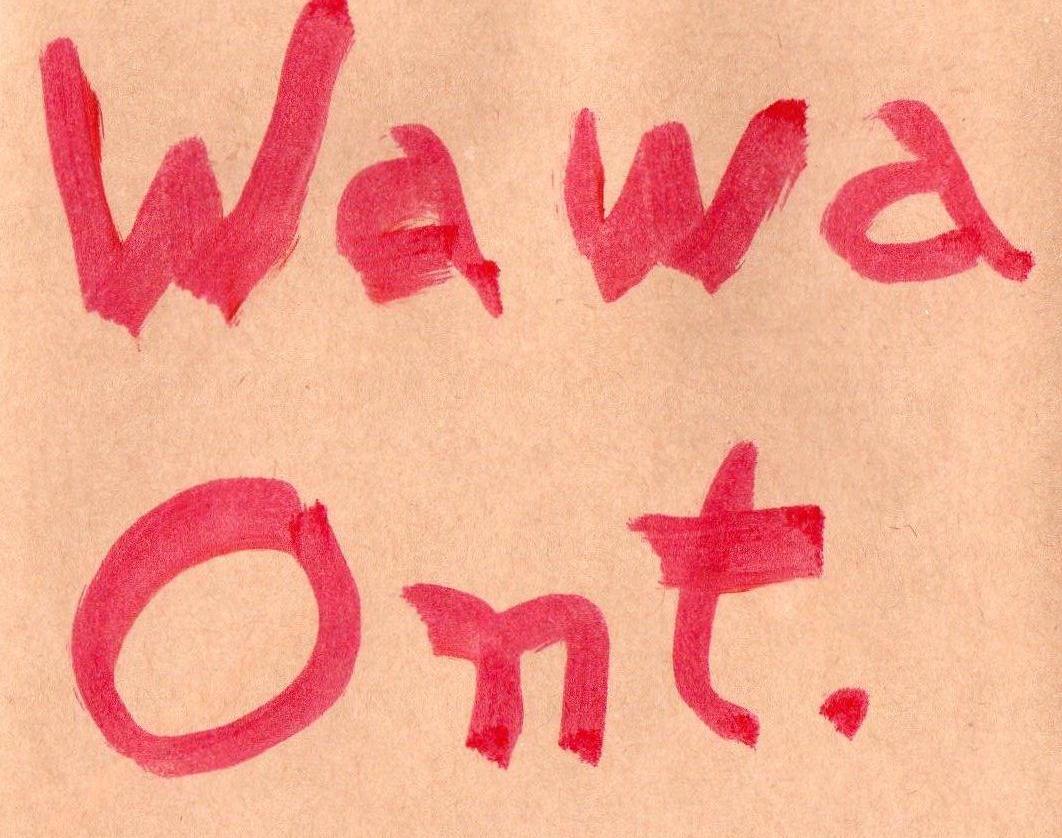
the reverse side of the specimen of five-leaved clover, with my Dad’s printing
We returned in 2002 and searched, but the three-leaved variety was all we found.

we searched in 2002, but I think the lawn had been replaced
Clover is a useful plant. It ‘fixes nitrogen’, meaning it takes nitrogen from the atmosphere and introduces it into the soil as it grows. The flowers are a source of honey for bees, and I’ve tasted honey made from an infusion of clover flowers. Dried leaves can be used for making tea.
Have you ever found a clover leaf with more than three leaflets? Did it bring you luck?
White Clover
Trifolium repens L.
(Three Leaves and Wishes)
~
only to lie
sweet dreaming in the clover
to pull blossoms
from long stems
toss soft snowballs
at blue-bottle flies
~
bees to visit me
florets for nectar
hair splashed on the clover
scented sweet honey
~
to search three leaves for four
creeping across the lawn
to the roadside
to roll in the fields
of white clover
trèfle blanc
blushing
~
Warning: 1. never eat any plant if you are not absolutely certain of the identification; 2. never eat any plant if you have personal sensitivities, including allergies, to certain plants or their derivatives; 3. never eat any plant unless you have checked several sources to verify the edibility of the plant.
© Jane Tims 2005
along the country road #5
Not far from where I live is a new road, built a few years ago along the edge of a field. When it was first built, it was a scar on the land, its ditches unlovely smears of muck.
This year, the weeds of the roadside have moved in to fill the empty spaces with green. At one place, where the new road joins the old, it is particularly wet and the ditches have been overwhelmed with a green and orange explosion of Jewel Weed.
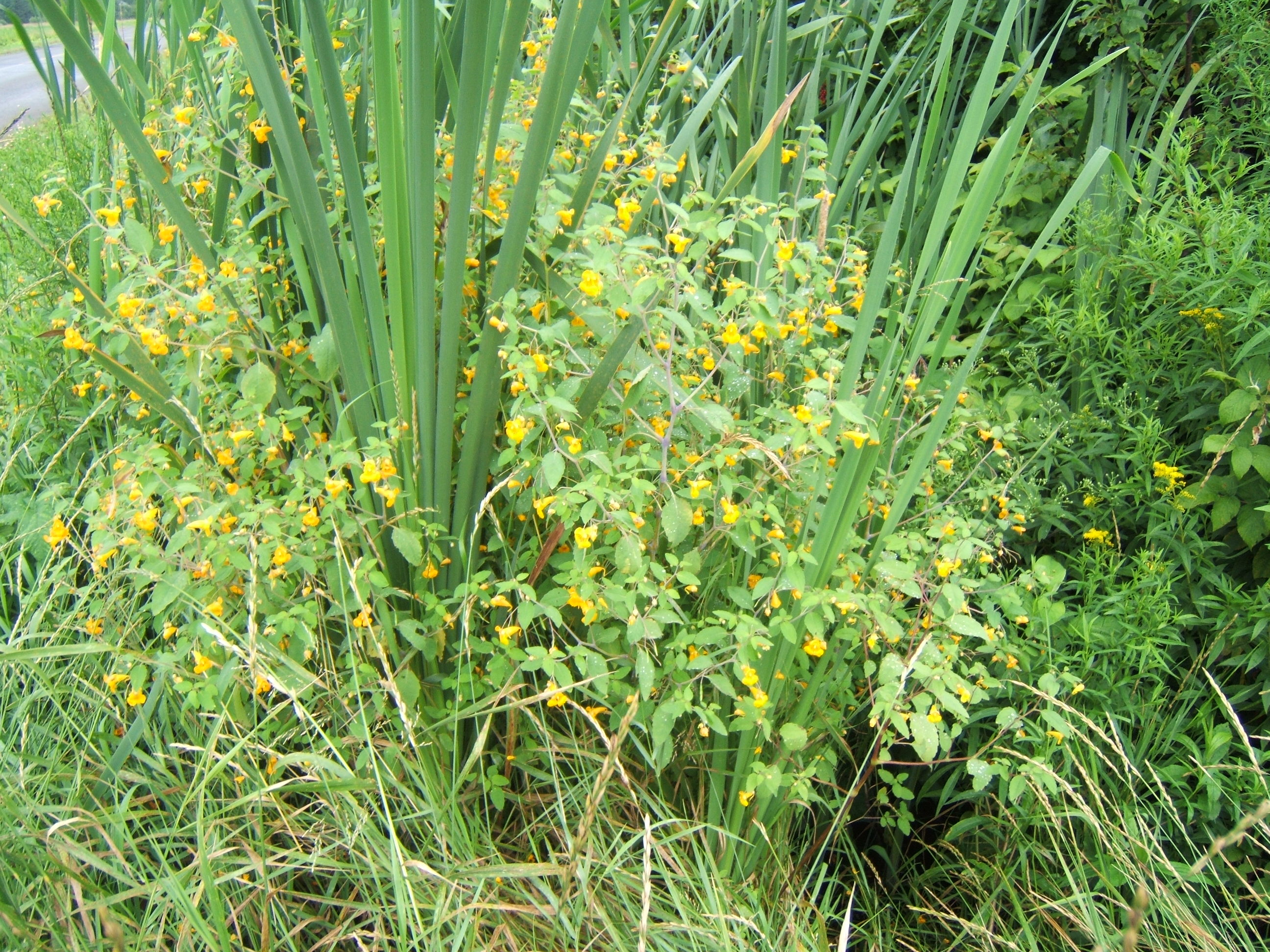
Jewel Weed growing with cattails in a wet ditch

a profusion of Jewel Weed
The botanist, Nicolaas Meerburgh, who first named the plant, called it capensis, meaning “of the cape” since he wrongly thought it had been introduced from the Cape of Good Hope into European gardens.

Jewel Weed (Impatiens capensis Meerb.)
Jewel Weed
Impatiens capensis Meerb.
~
Jewel Weed
orange and green
tangled in the gully
spotted spurred
impatiente
for a visit
from a hummingbird
~
Jewel Weed
not used as gems
for lady’s ears
not (after all)
from the Cape
of Good Hope-
Celandine tends
to mope
~
Jewel Weed
pendulant
petulant
“Touch-me-not!
or I fling
seeds from my pods
into the spring”
~
© Jane Tims
along the country road #4
My Mom was a great gardener. She could grow vegetables on the smallest corner of land and coax flowers where I was certain none would grow. When I was a little girl, and we lived in Alberta, she kept vibrant flower gardens. I remember the hollyhocks towered above my head, nasturtiums made pools of fire beside our door, and alyssum spilled over the edge of the cement walkway. One year, Mom planted sweet peas and I helped her put up a little string, unbelieving when the shoots pushed up through the soil and the papery leaves used curly tendrils to climb the string.
Another flower I remember fondly is the snapdragon, with its inflated lower lip. Its mouth yawned and looked like it could spurt dragon-fire if you pressed the petals between your thumb and forefinger.
I was never able to grow snapdragons, although I’ve tried. But one of the plants growing wild along our road has the charm of the garden snapdragon and is in the same family of plants. This little plant is called Toadflax. Its other common name is Butter-and-eggs.
Butter-and-eggs (Linaria vulgaris Hill.) is a weed of roadsides and waste places, blooming in large patches, late in summer. The flowers are spurred and bright yellow, with a lower orange lip. The inflated lower lip acts as a landing platform for insects and is hinged, to allow the right pollinators access to the nectar and pollen.
Butter-and-eggs is not a very big dragon, but it does have a mouth that yawns if you press the petals between your thumb and forefinger. Perhaps this is the reason Butter-and-eggs is known in French as guele de lion. Its other French name is linaire. This name, and the scientific name Linaria, are derived from the Latin linum meaning ‘flax’.

Butter-and-eggs (Linaria vulgaris Hill.)
along the country road #3
A few years ago, I became interested in pressing flowers as a craft. I discovered a secret – one of the best flowers to press is Queen Anne’s Lace. Laid out on the page, it has the look of intricate crochet.
Queen Anne’s Lace, also called wild carrot, devil’s-plague, and carotte sauvage, is a tall weed with an umbrella-like cluster of lacy white flowers. The flowers are an umbel, meaning that the individual flowers all radiate from the same point on the stem to form a head. The flower is commonly seen in hayfields and waste places, and along roadsides.

Queen Anne's Lace (Daucus carota L.)
Daucus is the ancient Greek name for carrot; carota is the old generic name for carrot.
Don’t let the name ‘carrot’ fool you, as the roots are said to be somewhat poisonous. Also, beware of look-alikes. There are many flowers that can be described as a ‘white umbel’, some of them poisonous to the touch. Use an identification guide before you investigate too closely!
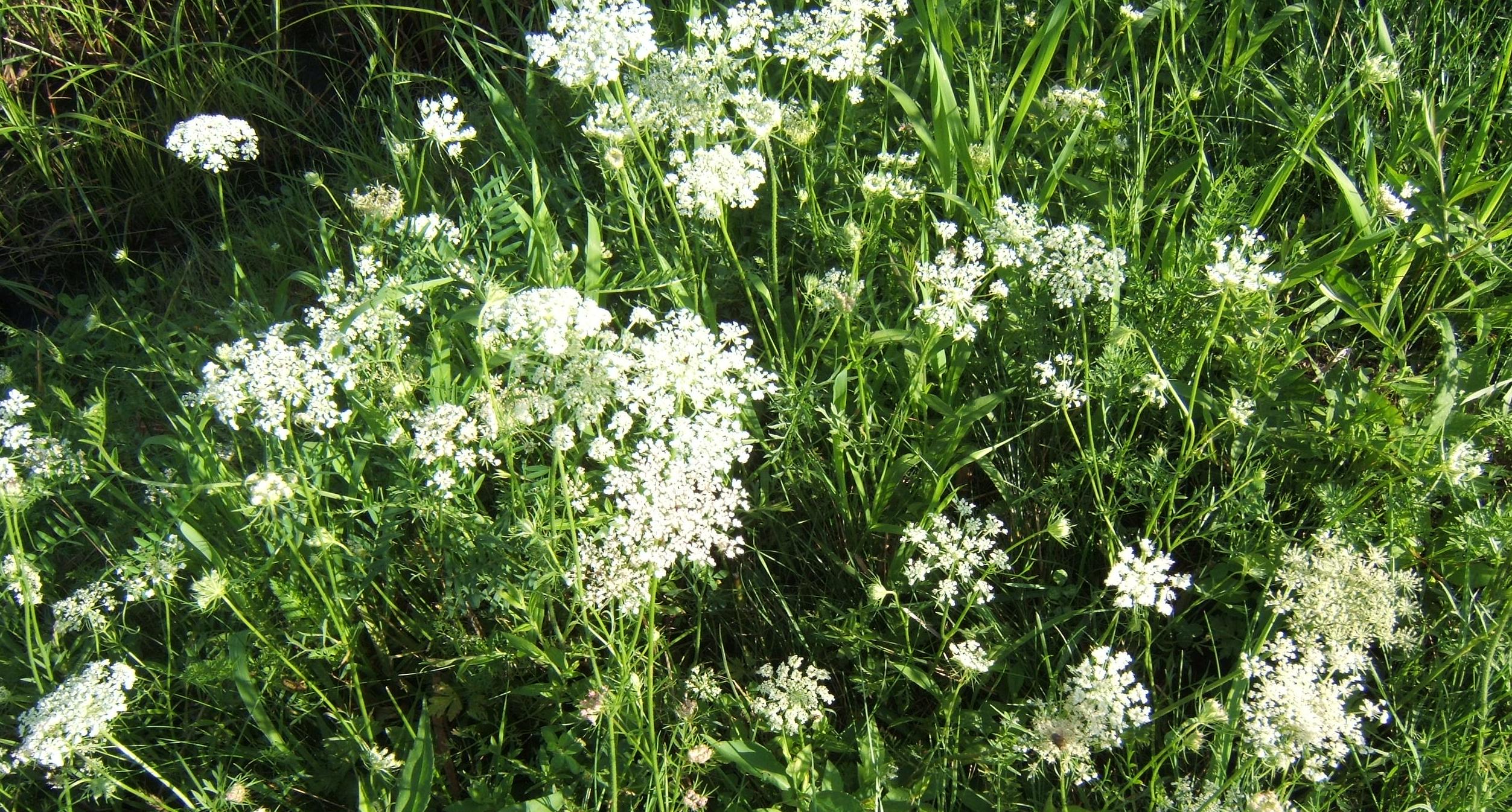
like snowflakes in summer
Queen Anne’s Lace
Daucus carota L.
wild carrot
inedible
no colour
unsuitable
as a vegetable
(poison probable)
white lace
three dimensional
tatted for Anne
‘Not Suitable’
for a Queen
(too usual)
umbrella
non-functional
(leaky)
unsuitable
for the rain
(or even drizzle)
in moonlight
unforgettable
common words
unsuitable
devil’s-plague?
ethereal!
Published as: ‘Queen Anne’s Lace’, Winter 1993, The Antigonish Review 92:80-81.
(revised)
© Jane Tims
along the country road #2
Here in New Brunswick, although it is only August, the flowers along the roadside are changing. The daisies and buttercups of summer are giving way to the flowers we associate with autumn – the goldenrods, the asters, and Pearly Everlasting.
Pearly everlasting (Anaphalis margaritacea (L.) C.B. Clarke), called immortelle in French, is a weed of roadsides, fields, open woods, and clearings. Its flowers are borne in clusters on an upright, leafy stem. They are easy to dry in bouquets since most of the so-called flower consists of a small yellow floral head surrounded by pearly-white dry bracts.
The generic name is an anagram of Gnaphalium, the name of another genus of everlasting flowers. This, in turn, is an ancient Greek name for a downy plant, derived from the word gnaphallon, lock of wool. Margaritacea means pearly.
What flowers mark the change of seasons in your area?
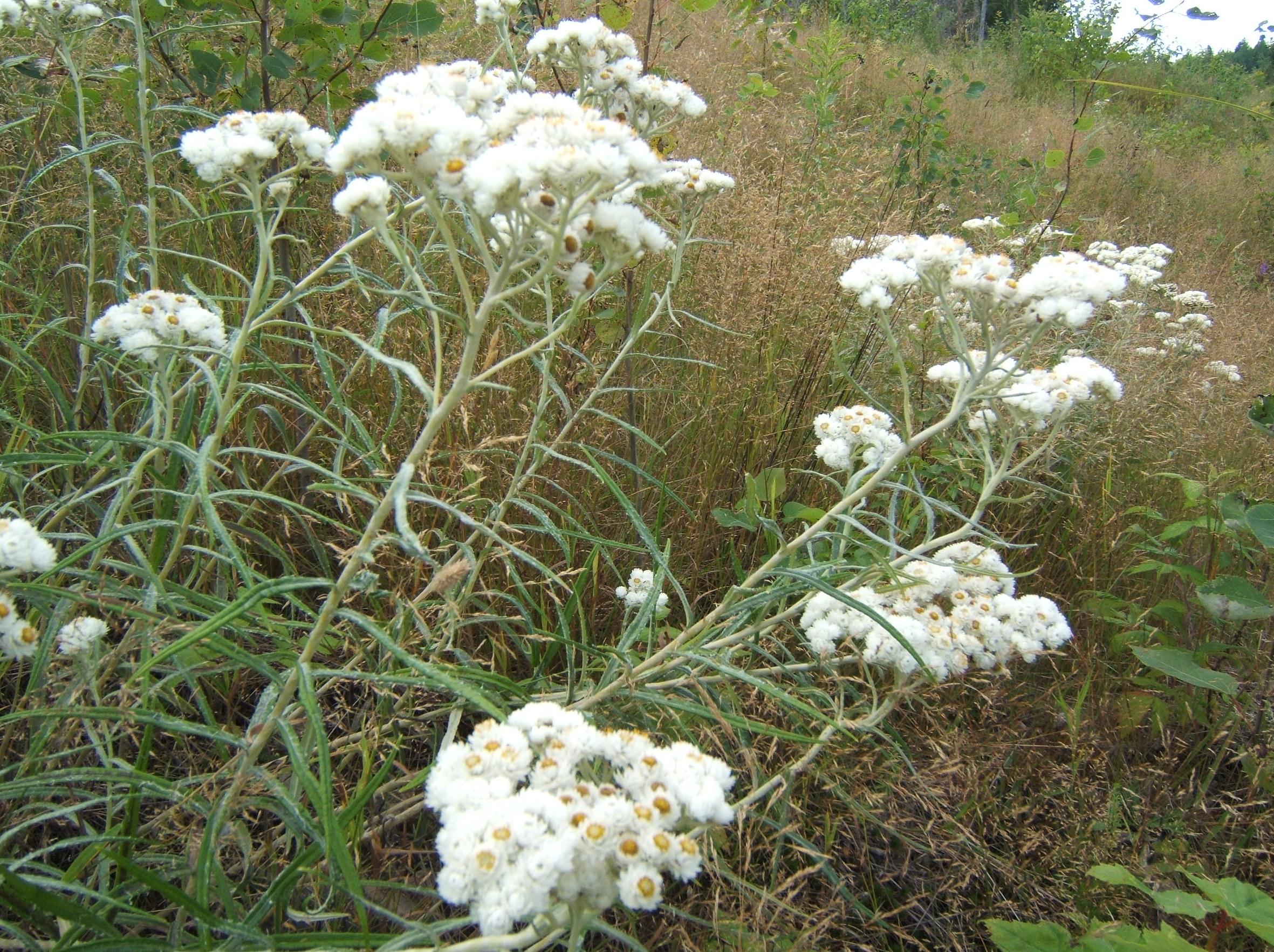
Pearly Everlasting (Anaphalis margaritacea (L.) C.B. Clarke)
Pearly Everlasting
Anaphalis margaritacea L.
Pearly Everlasting
sign of summer’s passing
yet- immortelle
picked by the road
by the armload
hung from rafters
children’s laughter
runs beneath
downy leaf, woolly stem
white diadem
perfectly matched flowers
thatched in gold
dry and old
Linnaeus-named
for Marguarite
memory sweet
paper petals keep
pale perfume
summer
grace
in a winter room
Published as: ‘Pearly Everlasting’, Winter 1993, The Antigonish Review 92.
(revised)
© Jane Tims
along the country road #1
When I was taking botany in university, a requirement of my taxonomy course was to make a ‘collection’ of plants, so I could learn how to identify them. Since I lived at home, and spent lots of time on the road, the easiest collection for me to make was of plants living along the roadside.
I made the collection, identified, pressed and dried each plant, glued them to the herbarium sheets, prepared their labels, and got a good mark in the course. The real legacy of the collection was that I developed the habit of botanizing along the road, at the edges and in the ditches. Gradually, I learned the names of the plants of the roadside better than any other group.
One of my favorite roadside plants is Common Yellow Rattle (Rhinanthus minor). In early summer, it’s a small herbaceous plant, with wiry stems and opposite leaves. In the axil of each leaf is a yellow, two-lipped flower with an inflated green calyx.
The charm of Yellow Rattle is also the reason for its common name. After flowering, when the calyx dries and turns brown, it becomes a natural rattle. If you pick the dry plant and give it a shake, you can hear the seeds clattering inside the pod.
Rhinanthus minor L. is also known as Rhinanthus Crista-galli L. The old generic name crista-galli means cock’s-comb, from the deeply toothed flower parts. The present generic name is from rhis meaning snout, referring to the shape of the flowers. In French, the plant is called claquette (tap dance), or sonnette (door chime).
Do you have a favorite roadside plant? Next time you take a walk along the road, what plants do you see and do you know their names?
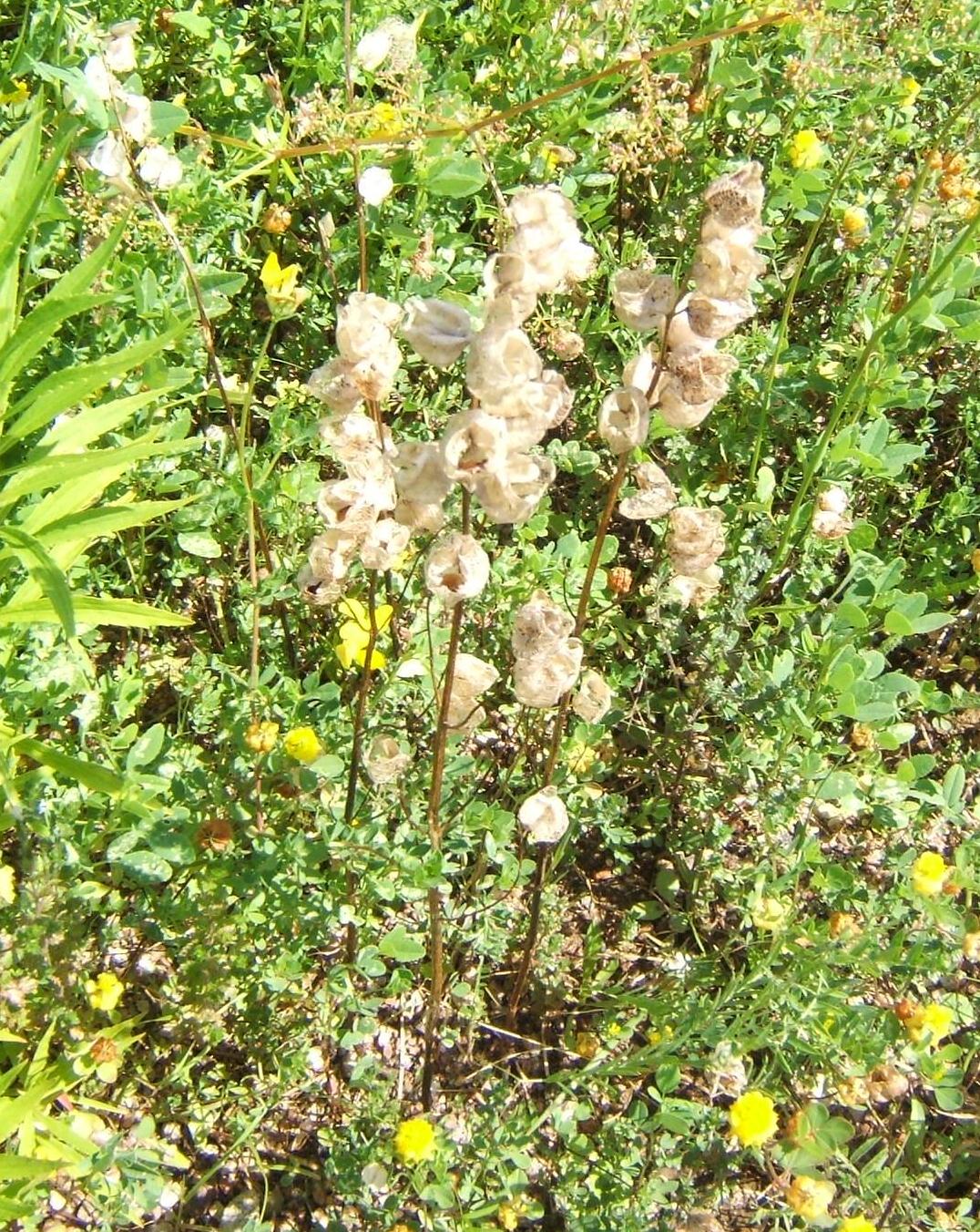
The dry brown plants are the rattling seed-pods of Yellow Rattle. Photo was taken in early August, so no flowers are present. The yellow flowers you see in the photo are two other plant species.
Yellow Rattle
Rhinanthus minor L.
weeds at the roadside
tickle my ankles
parchment whispers
like Alberta prairie
rattler whirr
I freeze
as I do when mouse feet rustle
in a house I thought empty
shake
loose seeds
in paper packets
yellow rattle snouts
test the air
crista-galli flowers
toothed as a cock’s comb
chatter at the north wind
claquette
tap dance on the chilly breeze
sonnette
quick scratching at summer’s door
Published as: ‘Yellow Rattle’, Summer 1994, the Fiddlehead 180
© Jane Tims




 nichepoetryandprose