Posts Tagged ‘writing’
places for writers … writing desks
‘writer’ and ‘desk’ … a likely pairing of words … a writer may have many desks, but does the desk have a writer?
~
In our home are five desks, four for me.
~

the writing desk in my guest room
The desk in my guest room is the neatest, used only for addressing Christmas cards in December. A little desk, it has a lamp, a box of stamps for personalizing cards and envelopes, a ceramic dog that once sat on my desk at work, a tiny gecko bought for me in Milan by my oldest brother, a cloisonné sea-shell from my sister, and a hand-blown glass purchased with my husband in Ontario. Quite by accident, these items are all orange and green. I sit at this desk every morning, to look at the eastern sky and plan my day. I never write fiction or poetry at this desk.
~
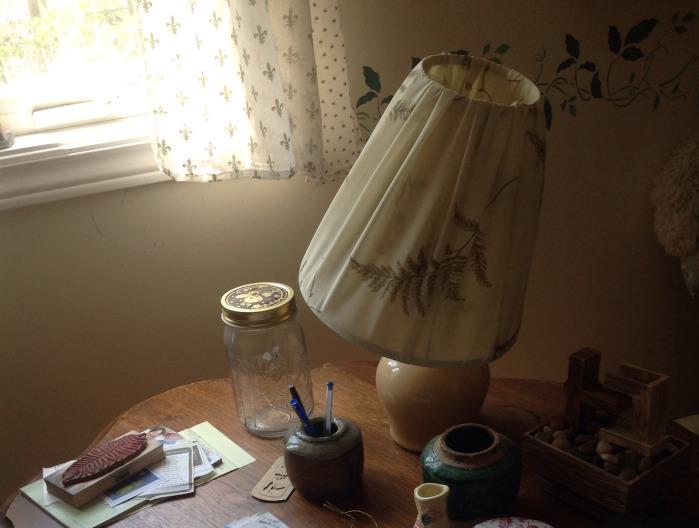
my desk in the loft
The desk in the loft is my official desk. This desk is oval and was given to me by my youngest brother – it originally belonged to my aunt. It has a lamp, a small fountain and a jar of simulated fireflies from my son. I keep a few ongoing projects here, including a stack of pages where I store tidbits of information remembered from my life. If I come across a vacation memento or a scrap of paper kept from some event, I record it here. One page per year … 61 so far. This desk is equipped for writing. Nearby is a dictionary, a thesaurus and a keyboard for my iPad. No poems or fiction, however, are written at this desk. This is the desk I clean when I haven’t written for a while.
~
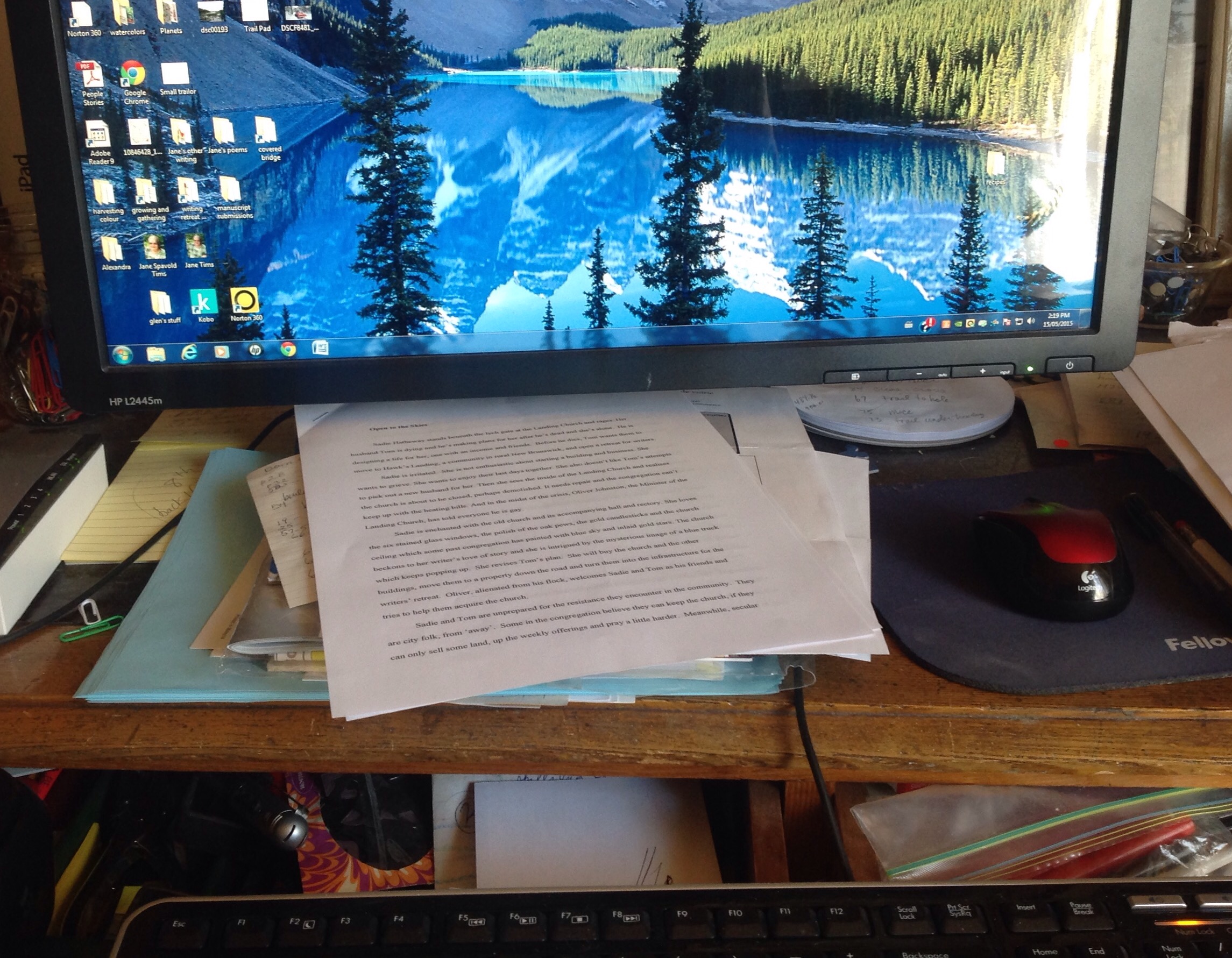
my messy desk in the library
My third writing desk is oak, very old, and has a leather top. This desk holds a lamp, my computer and printer, the modem, and a USB dock for e-books, iPad, camera, Bamboo drawing surface, and a small USB-driven fan for warm days. Add a wonky stack of paperwork, sorted at tax time, and a mouse with 2 square inches of space to manoeuvre. This desk is always a mess, has no space for pen and paper, and somewhere in the desk drawer is a Tamagotchi that hasn’t been shaken in fifteen years! Lots of poems and thousands of words of fiction are written at this desk … not so much written as pecked out, in three finger combinations.
~

my lap desk
My fourth desk wouldn’t get a mention in a furniture inventory. It is a beaten-up plastic lap desk, scavenged from my son and re-covered (it used to have a dinosaur pattern) in a fern-patterned fabric. This is where my pen and paper writing gets done, usually in my living room chair, sometimes at our camp and occasionally outside in our yard. It has room for my rough book and a small ledge to hold a pen. It never needs tidying and slips neatly into my writing bag. It has supported the writing of poems, books, blog posts and letters. I love my lap desk.
~
Do you have a writing desk or desks? Where do you prefer to write?
~
Copyright 2015 Jane Tims
writing a novel – being the reader
At some point during the writing of a novel, the writer must become reader.
~
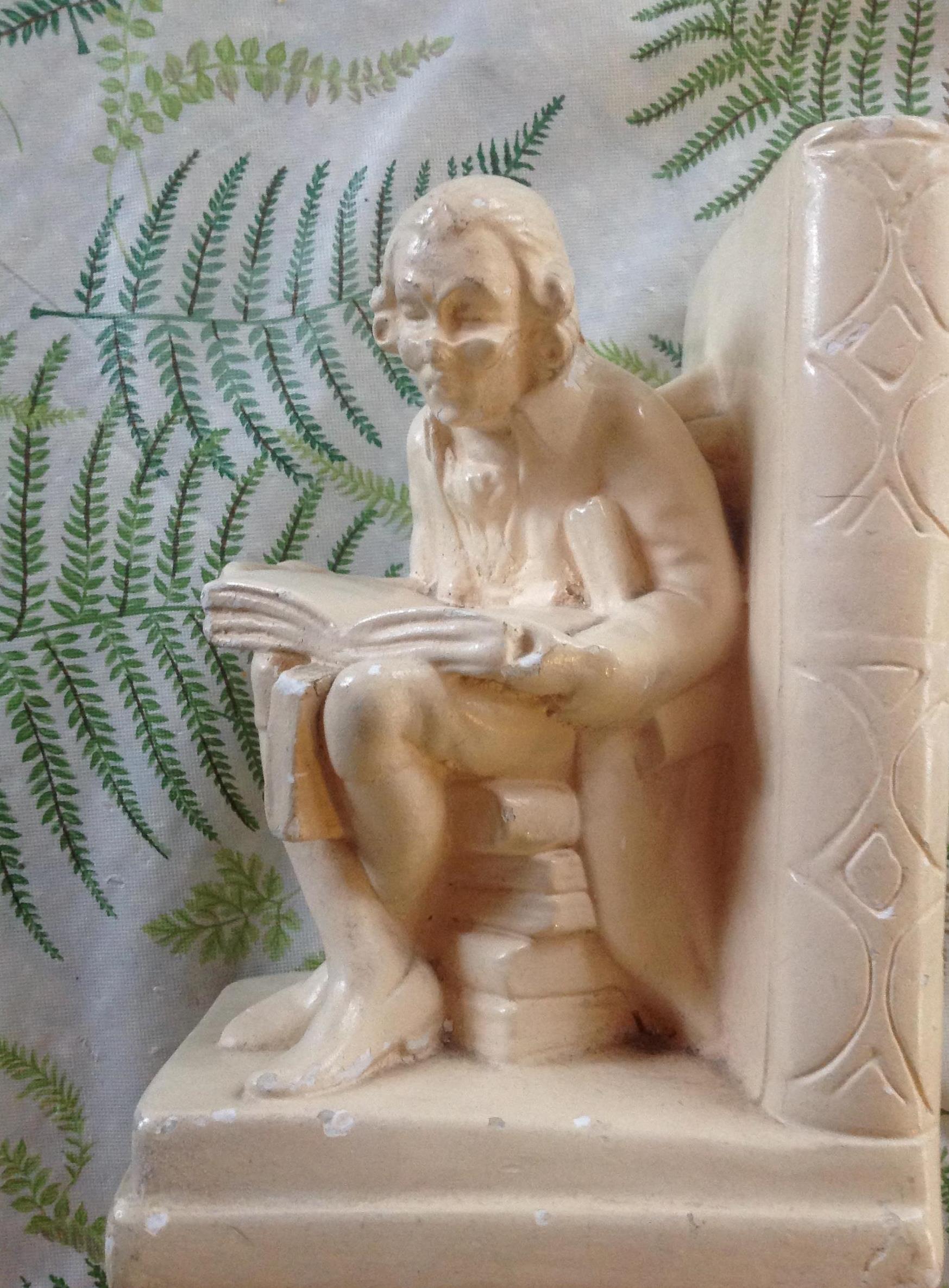
a ‘reader’ in my library – one of a very old set of bookends I call the ‘Two Muses’
~
The writer reads their work, over and over and over. Eventually, the sentences and paragraphs, the story itself, become so familiar, the writer can’t ‘see’ them properly any more.
~
The writer has two disadvantages.
First is familiarity. The writer knows every detail of the story, even details not written down. The writer’s mind fills in the gaps and the poor reader is, perhaps, left wondering. But the reader has experience as well. The writer has to know how much detail to include and how much to leave to the imagination. Sometimes the details the reader fills in make the better story. Have you ever read a book, having a perfect idea of what the protagonist looks like, only to be told, mid-way through the story, he has a twitch in one eye?
Second is love. Writers tend to become enamoured of their characters, their stories and their own writing. A description or sub-plot or character may take root and grow within the novel, even though it has little to do with the larger story. Once written, it is difficult to rip those paragraphs from the whole. Keeping track of word number will help, since it is an objective measure of progress towards a goal. In my novel ‘Crossing at a Walk’ I often write bits that I later remove. Too allay the fear that they will be lost forever, I have a file for a bone-yard – I can always return to this pile in future. I rarely do. ‘Murder your darlings‘ (Arthur Quiller-Couch, 1914).
~

This young lady never reads … she just sits among the potted plants and dreams.
~
The writer must also consider the questions the reader is asking as he or she reads the book. If the book hints at a problem or something that needs resolution, the reader will watch for an answer. For example, if a character mentions she has heard a cousin is coming to visit, the reader will wait for the cousin to arrive. If the cousin never shows up, the result may be a disgruntled reader.
~
I read my book, cover to cover, at every draft. I also think it’s important to read it aloud at some point, once the story is complete. Reading aloud to another person will give the writer some feedback. The act of hearing the word spoken will also suggest problems with rhythm, word choice or continuity. I read aloud to my husband and to the members of the two writing groups where I am a member.
~
In the end, the writer cannot be an objective reader. Every writer must find a test reader, someone who will provide honest feedback on characters, plot and story, as well as editorial advice.
~

I use my Kobo to read drafts of my book …
~
Copyright 2015 Jane Tims
writing a novel – words, day by day
I have reached Draft Four of my novel ‘Crossing at a Walk’ and the story is all told. I want to see how I reached my current word count of 78,598 words, so I have created some graphs showing my progress. I began in 2013 with 8 days of writing. I did a little more on one day in 2014. And this year I have worked steadily since early March.
~

~
My daily writing goal was 2000 words, as Stephen King recommends in his book On Writing (Scribner, 2000). I was quite variable in the number of words written each day. Early in the writing, in 2013, I had three very productive days when I wrote more than 3000 words.
~

~
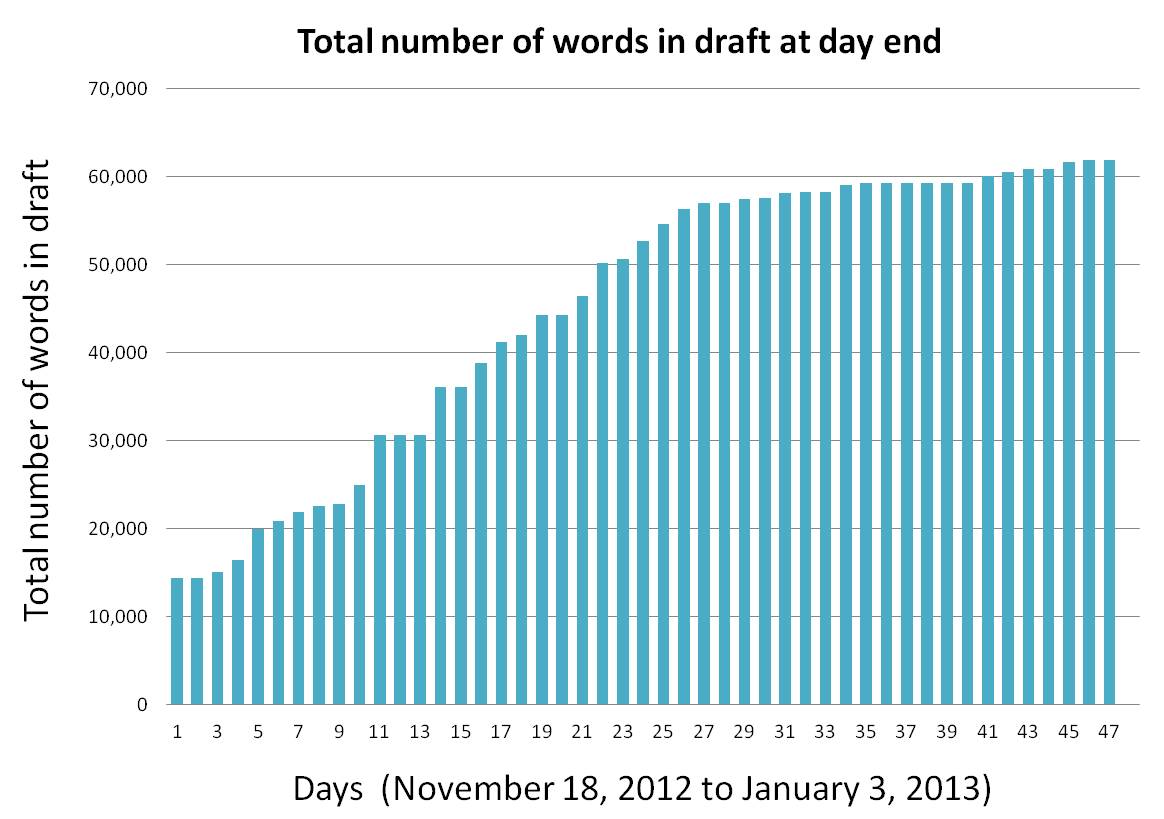
A graph of the cumulative number of words shows I was steady in my progress. Now, with editing, the total number of words should stay steady, or decrease.
If I compare this to my progress during the writing of ‘Open to the Skies’ (‘Saving the Landing Church’), my progress was similar. You can see below where I began editing, at about 25 days. For this book, it took 27 days to reach this point.
~
~
Keeping track of the number of words I write has three purposes:
- the daily number of words is a tangible record of progress and for me, a reward at the end of the writing day.
- the cumulative number of words shows me how long the book is getting; may aim is for less than 90,000 words, usual for books of the type I am writing.
- I report the number of words I have written to my husband, keeping him ‘involved’ and making him extra joyous as the day comes when I will read my book to him.
~
For your writing, do you have an aim for your daily number of words?
~
Copyright 2015 Jane Tims
writing a novel – pulling out the weeds
I have completed Draft Three of my novel ‘Crossing at a Walk’. The entire story is there. If I add more ‘story’ now, I will only confuse my plot and my readers. Next I have to concentrate on honing every sentence, including dealing with the oddities I allow to creep into my writing. As if I am growing a garden, I have to find and pull out the weeds.
~

~
I think these are different for every writer and writers have to learn these for themselves. For me, the culprits are:
writing in the passive voice.
using the word ‘that’. I never use ‘which’.
using adverbs, although I (quickly) drilled this one out of my system.
repeating the same word in adjacent lines or adjacent paragraphs.
using phrases like ‘she stood and … ‘, ‘I opened the door and …’ , ‘I looked at her and …’ – I sometimes tend to breathe for my characters!
using colorless words like ‘felt’, ‘drove’, ‘went’, ‘wondered’, ‘just’ and so on.
putting two spaces after every period – I learned to type on a typewriter!
~
I also have to do careful editing with respect to tense and person. I tell Sadie’s story in the third person and past tense. Tom speaks in the first person and present tense. I also have an angler who likes to fish just below the covered bridge and always speaks in the second person (something new I am trying).
~

my husband when he was a boy, fishing on the North Branch of the Rusagonis River, under the covered bridge … this covered bridge is now gone from our community
~
My husband is not looking forward to the completion of Draft Four. It ends with me reading him the entire novel, chapter by chapter, every evening, an hour before ‘Coronation Street’ on TV. Until we finish. Poor fellow.
~
Copyright 2015 Jane Tims
in the shelter of the covered bridge – drip line

clear and amber water of the South Oromocto River
~
~
Drip line
~
slices river into upstream
and down, opaque and transparent,
dead calm and riffle, dark and light.
As water and air are cut
by meniscus, erratic in rain,
as her voice slips past present tense,
concentric rings expand. Three trout
~
and gravels, perpendicular
rocks, embedded in amber. Rain
disconnects today from yesterday,
slips from the roof of the covered
bridge, slides from edge, corrugated
steel, sheet of rain, crosses river
linear, liminal, shore to shore.
~
~
Copyright 2015 Jane Tims
~
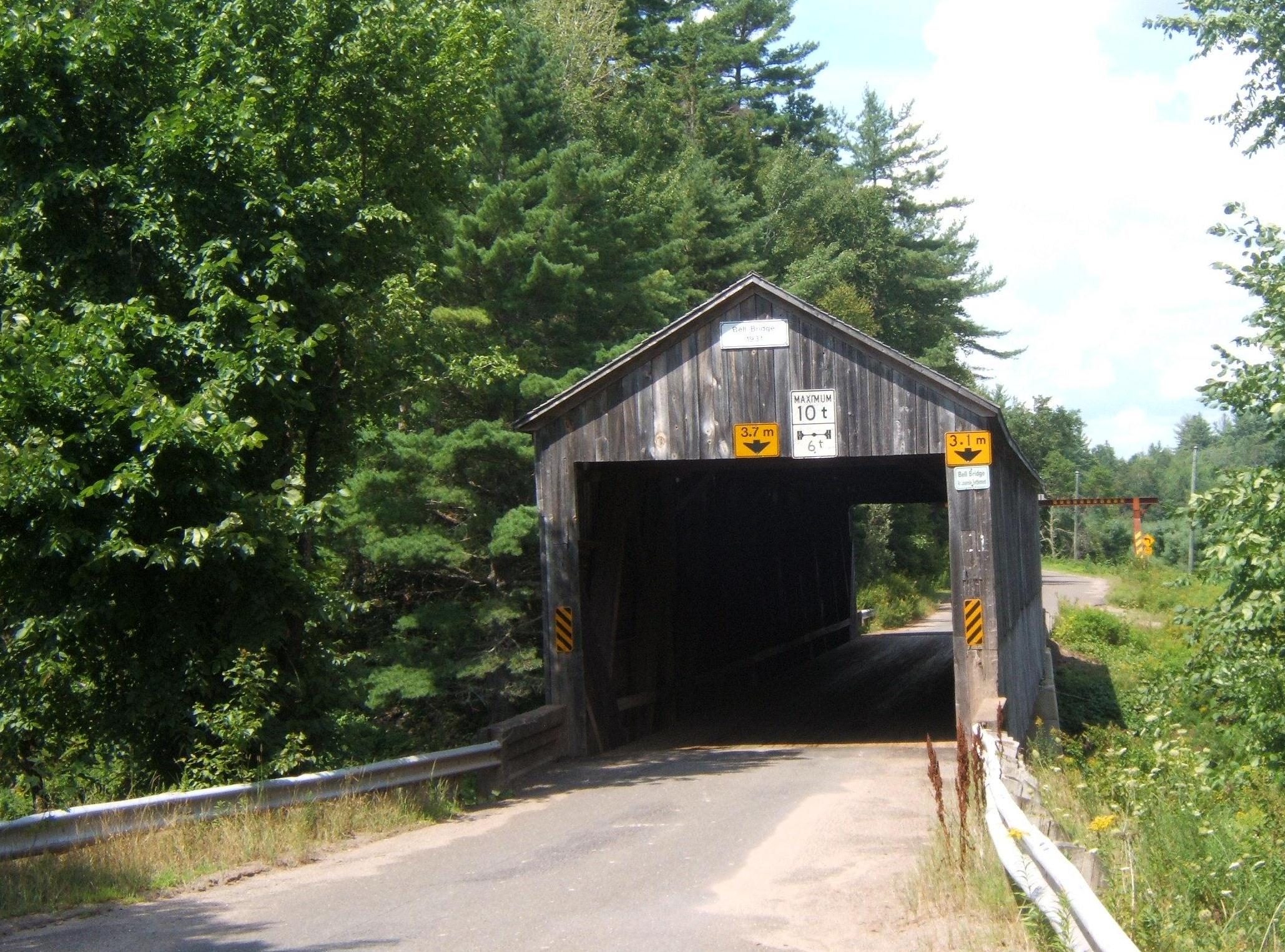
Bell Bridge, South Branch Oromocto River
writing a novel – getting to know your characters
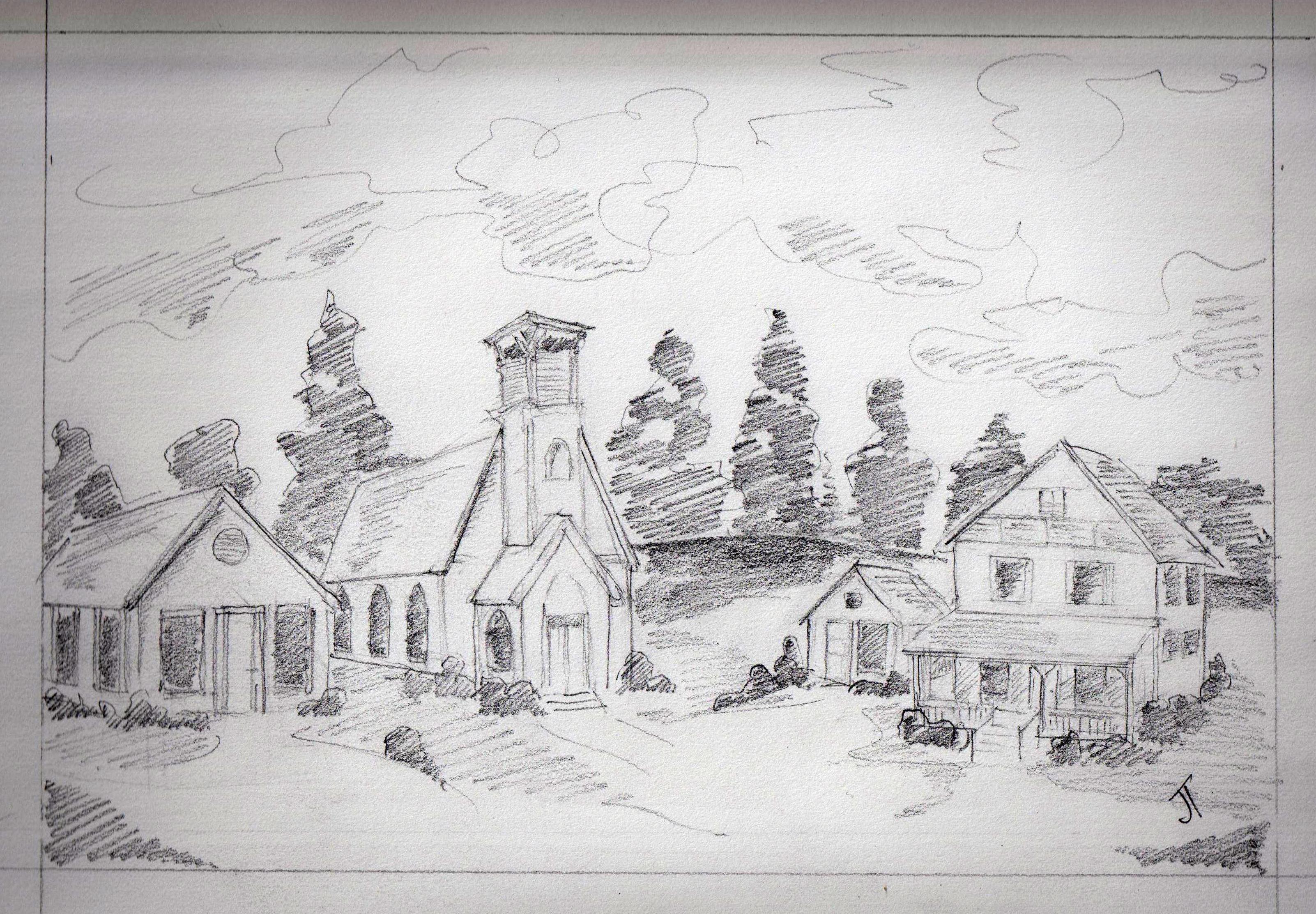
The Whisper Wind Writers’ Retreat – the setting for my novel
~
Working on the drafts of a novel is like combing hair. You start at the top/beginning and comb through the words and sentences, paragraphs and chapters, over and over. Eventually the tangles comb out and the hair becomes smooth and shiny.
~
I find the best way to do the ‘combing’ is to work at specific components of the story. Developing symbols within the story is one. Developing characters in the story is another.
~
I have a lot of characters in my books. In ‘Open to the Skies’ there are 44 characters, major, minor and dead. This is probably too many, but it is a book about a community.
So far, in ‘Crossing at a Walk’, I have 33 characters. These include Sadie and Tom, members of the community, and the six ‘retreaters’ (the writers enjoying a weekend at the Writers’ Retreat).
~
A difficulty with writing a sequel, I feel responsible for all these characters. Leaving one of them out of book #2 seems wrong to me. But by book # 25 (!) I’ll have a whole planet to contend with. So I have to make choices.
~

~
Each of my characters has a character sketch, a background story and a story arc. As I’ve said before, I try to include three ‘bumps’ in each story line.
One of the ‘combings’ I do is to look at each character as he or she appears in the book. I want to make sure the character is consistent with respect to appearance, back story, way of speaking, relationships, and so on.
~
1. Character sketch and background
As an example, let me introduce you to Ruby Milton. She is the fourth character from the left in the sketches above. She is a minor character, a constant companion to one of the major characters. Ruby is 64 and married (she was a Brunelle before she was married). She is a retired librarian and now runs a U-Pick with her husband Lars. Ruby, as a result of her name, loves all things red. She wears red and she bids on a lamp at an auction because it has a red glass finial. A quilter, she works a red patch into every quilt she makes. She was also one of the characters who opposed the sale and relocation of the Landing Church in ‘Open to the Skies’. Ruby snubs Sadie at every opportunity.
~
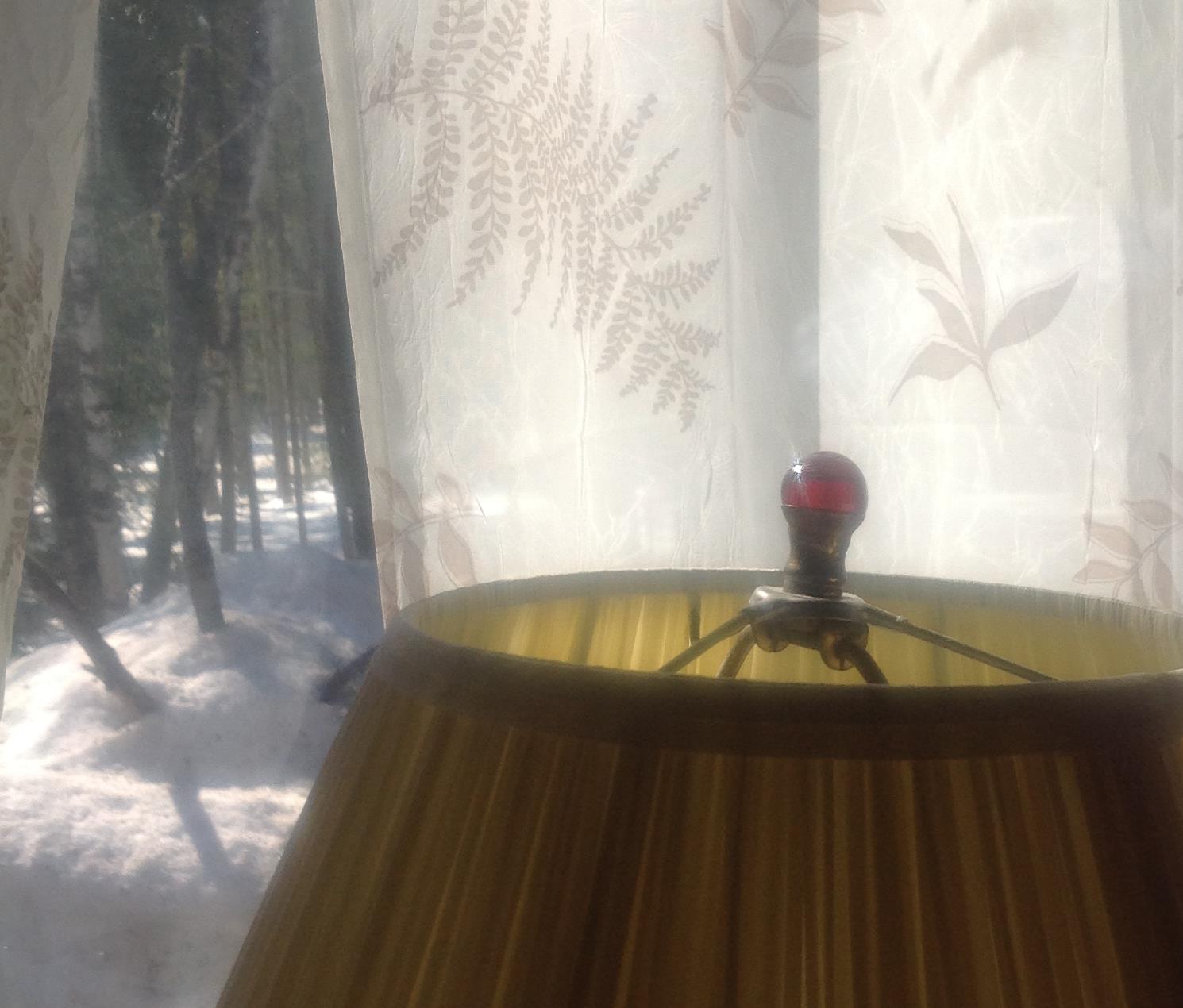
Ruby would love my lamp with the red finial – it once belonged to my mother-in-law Mary
~
It’s hard to have to keep checking on a character sketch as I write, so I prepare a chart of my characters. I keep the chart file open so I can check on it as often as I want.
~
| Name | Occupation | Characteristics | Age | Vocabulary |
| Ruby Milton | Librarian; runs a U-Pick | Wears red; thin; a quilter; maiden name Brunelle; lived in community all her life | 62 | Cemetery; uses lots of contractions |
| Lars Milton | Retired Teacher; runs a U-Pick | Tall; Full head of snowy hair | 65 | Graveyard |
| Marjory Alworth | Shop owner | Nicknamed Margie; Ruby Milton’s daughter | 41 | |
| Betsy Alworth | Waitress | Ruby Milton’s grand-daughter | 24 |
~
2. Story arc
Ruby occurs three times in ‘Crossing at a Walk’. She occurs because she is a friend to Pat, a major character; she runs a local U-Pick and food from the U-Pick is used at the Retreat; she represents the community’s continued interest in its landmarks. She wants to continue to use the Landing Church for her quilting group and she participates in celebrations of the history of the covered bridge. Ruby also represents the part of the community that Sadie hasn’t quite won over in her efforts to fit in.
~
As I read my draft so far, I realise Ruby needs to change in some small way during the book. So, in keeping with her importance as a representative of community, I add some elements to Ruby’s story. At the auction, she won’t even acknowledge Sadie. But during the book, Sadie allows Ruby’s quilters to use the church and treats Ruby as knowledgeable about community history. By the end of the book, Ruby greets Sadie as a friend and contributes a story about her memories of the covered bridge.
~

inside a covered bridge
~
I keep a table of story arcs for each of my characters, to help me build the story, be consistent and make sure that I find the story for each character.
~
| Name | First occurrence | Second occurrence | Third occurrence | Story |
| Ruby Milton | Ignores Sadie at auction (page 35) | Asks to use hall for quilting group (page 146) | Greets Sadie as a friend at a community gathering; tells a story about bridge (page 232) | Pat’s friend; represents community; changes her attitude about Sadie |
~
Ruby is a relatively minor character in the book. However, I treat her with the same respect I give my major characters. And she gives back to me. She suggests turnings for the story. And she helps make the community I have created for these characters more realistic.
~

Ruby puts a bit of red in every quilt she makes
~
Copyright 2015 Jane Tims
writing a novel – searching out the symbols
When I wrote ‘Open to the Skies’, I used various ways to examine and tighten the plot. One of these was to list the various objects in the book and consider them as symbols.
~
For my book ‘Crossing at a Walk’, I will use this process to help my eventual readers understand the progress of the story.
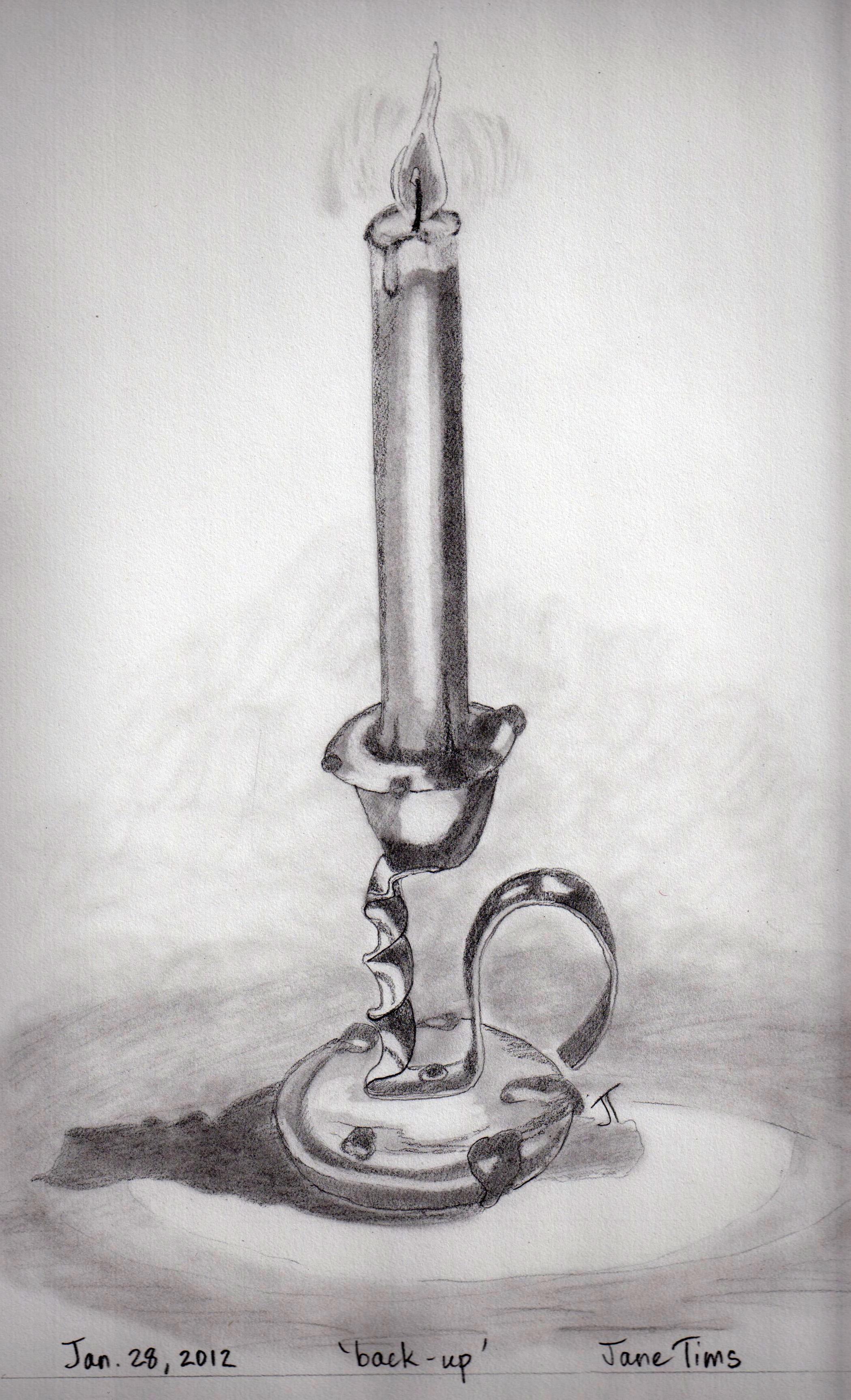
Mentioned once, an object, such as a candle, is just a candle. Mentioned twice, it becomes a symbol, and the reader remembers the first mention of the object and draws understanding from the symbolism. So a candle may be remembered for its light. If, in a subsequent mention, someone blows out the candle, this may make a comment on the idea of communication. Passing a candle from person to person suggests the passing of stories between people. The use of symbols deepens meanings and helps the plot reverberate throughout the writing.
~
~
Symbols operate like mini sub-plots throughout the story. These mini-plots echo the main plot, and the objects change in a way that illuminates the main plot. The mini-plots also tend to occur in three ‘beats’, providing a beginning, middle and end. For example, an unlit candle becomes a useful source of light and is passed between people at a wake.
~
In this round of edits, I have tried to examine the use of symbols in my novel. To do this, I built a list of the objects I have used as symbols. Then I looked for their occurrence in the novel to see if I could identify three ‘beats’ and a mini sub-plot. In some cases, I identified gaps – fixing these has helped me to solidify my overall plot.
~
This is a short version of my list of some of the objects/symbols in my book. When I assembled the list, the items in red were missing and I had to fill out the story accordingly. Perhaps you can use this method to help strengthen the narrative in your own fiction.
~
| Object | Symbol | Occurrence (page numbers) | Mini-plot | ||
| coyote | fear | 87 | 104 | 120 | coyotes howl in woods; they rattle some of the retreaters; Sadie considers it a failing of the retreat |
| church tower | refuge | 15 | 104 | 181 | tower is off-limits to retreaters; becomes a place to sleep in safety; a place to write a poem |
| paper maché ball and chain | servitude | 39 | 58 | 180 | Sadie is asked to provide a community service placement for Minnie, a trouble-maker; Minnie stores the ball and chain, a theatrical prop, on a library shelf during her stay; when the time is up, she destroys the ball and chain |
| rain | a barrier | 6 | 133 | 186 | rain interferes with the retreat at every turn and ends up being the source of the flood that threatens the covered bridge |
| scale model of a covered bridge | remembering | 35 | 132 | 150 | a scale model of the covered bridge is purchased at an auction; helps tell the story of a character in the novel; could become the only memento of the bridge |
| burning candles | passing stories from person to person | 58 | 140 | 188 | candles are not allowed in the old church but later become a practical source of light during a storm and a way of passing stories about the covered bridge from person to person |
| loon | communication | 21 | 169 | 182 | loon calls at retreat encourage people to talk to one another |
| stars, shooting stars | hope | 12 | 109 | 185 | stars become inspiration for an artist, encouragement for a love-interest, and an inspirational setting for a wake |

Copyright 2015 Jane Tims
writing a novel – sub-plots
In every story, sub-plots help with the story telling and contribute their own dynamic to the action, characters, and the relationships between characters.
sub-plot : a smaller, separate story strand that provides support for and adds complexity to the main plot
The courses I have taken have taught me that often subplots contain a minimum of three re-occurrences or ‘beats’ in a story. A sub-plot is introduced, more is learned and the sub-plot is resolved.
~
To help me identify the subplots, I have used my ‘story board.’ I identified some key subplots and put stickers on the scenes on my ‘story board’. Here you can see the subplots ‘A’ and ‘P’.
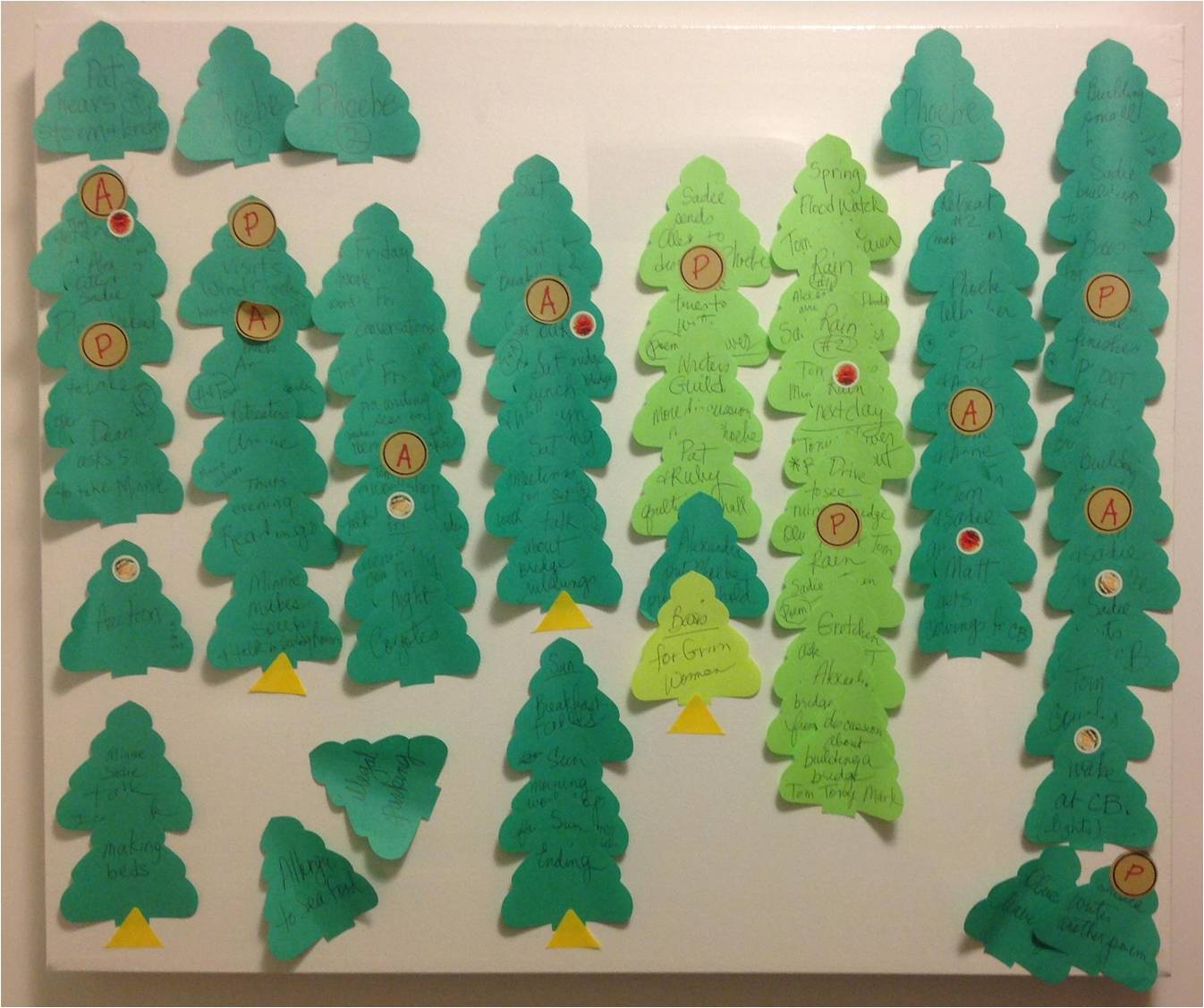
~
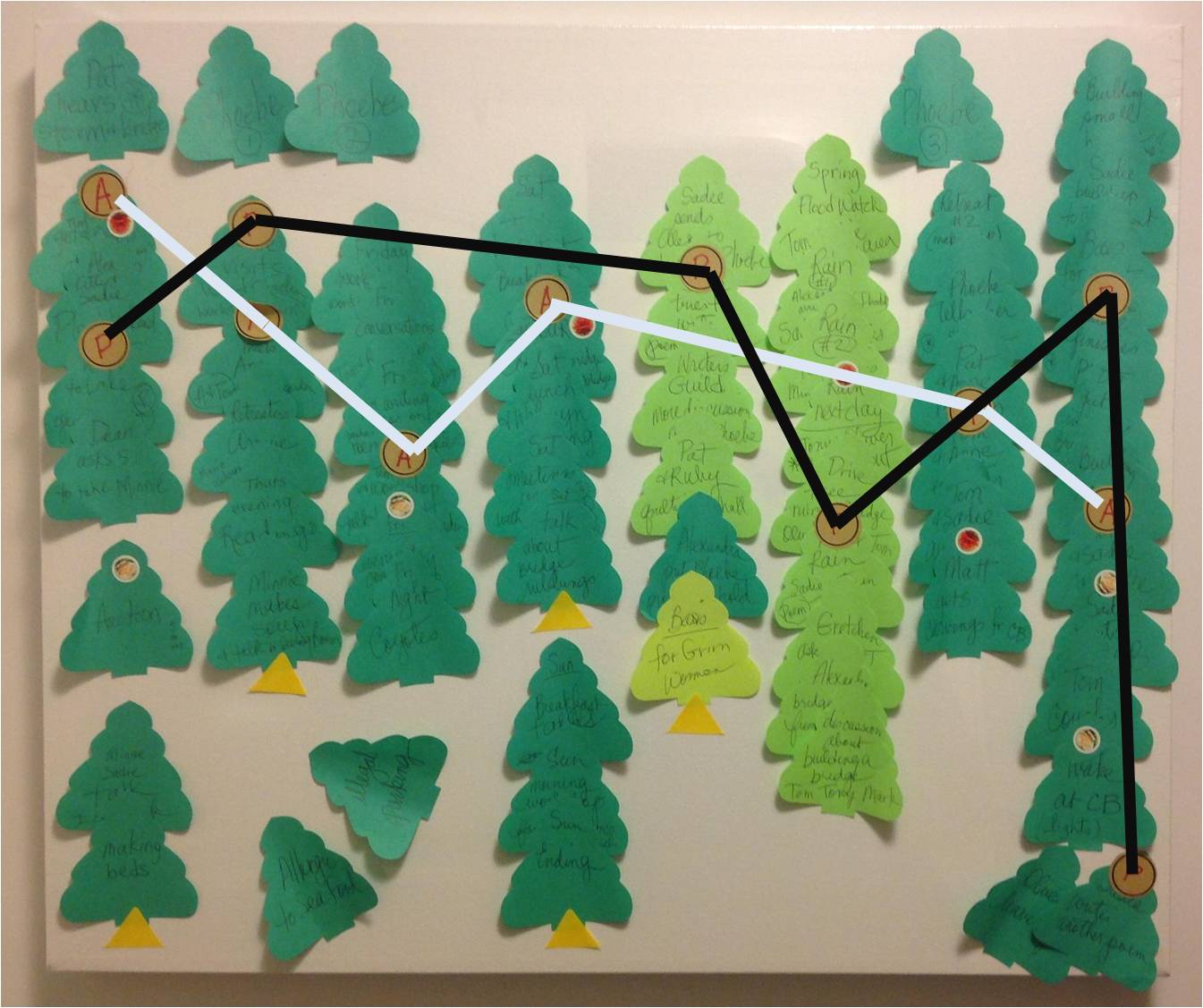
This mapping of subplots can help me decide if some of the story is missing. In the ‘story board’ below, sub-plot ‘P’ could be improved by a mention on Day 3 and 4 (the vertical rows of green trees indicate a day in the action). Major inclusions of the subplot P on Days 1, 5, and 8 will be my three subplot ‘beats’.
~
~
Copyright 2015 Jane Tims
writing a novel – character arcs
Title: unknown
Working Title: ‘Crossing at a Walk’
Setting: a writers’ retreat – the renovated Landing Church, the hall and the rectory now used as a Learning Center, a Sleeping Hall and a home/base of operations for Sadie and Tom
Characters: main character Sadie, a writer; her husband Tom, a retired welder; people from the community; writers participating in the first weekend of the writers’ retreat
Plot: Sadie wants the first writers’ retreat to go smoothly, but the history of an old covered bridge keeps getting in the way
~
I have finished the first draft of my novel. Still lots of holes to fill and editing to do. But I am now certain of the basic story-line.
~
For the next while I will be spending some time with each of my characters. I know a bit about them, because I have a character sketch and a drawing for each character. Now I want to make sure each person has their own story arc. I would like each character to grow in some way during the novel.
~
some of the characters in my novel
~
My first step is to print a copy of the draft ‘Table of Contents’ for my book.
On a separate page, I also list the events (or scenes) in each chapter and the characters involved in each event.
Then I use the initial of the character’s first name to show on the ‘Table of Contents’ where the character occurs in the story. For example, my characters include Patricia and her brother Rob … marked P/R on the extreme right hand side of the ‘Table of Contents’.
Right away, I can see if a character falls off the radar. I can also make certain the characters are distributed through the action so my reader doesn’t forget they exist. For example, one of my main characters, Alexandra (marked A) doesn’t occur in four chapters … this may be OK but I want to think it through.
~

~
Once I have completed this step, I have a list of additions to make to the manuscript (written up and down along the bottom of the page).
~
I also write, in a simple sentence, the story arc of each character. I write the arc in the format of: what the character wants, the obstacles he or she encounters, and the resolution.
Patricia (the rather sour-looking woman on the far left of my drawing above) wants to feel connected with her brother who left home and died years before – she reconnects with him by learning some of the details of his story.
Tom (below) retired from his career as a welder due to ill health. He is surrounded by writers attending the writer’s retreat. He is at loose ends and tries to find his purpose, discovering it embedded in his daily routine.
Matt (third from the left in the drawing above) is a theatre student who wants to attract a fellow writer. In spite of repeated rebuffs, they find a common interest, the basis of a friendship.
~

Tom, Sadie’s husband, doesn’t always feel comfortable around writers.
~
I have learned from various courses that story arcs are often expressed as sub-plots. The story arcs often occur in three ‘bumps’ in the action. Although most of my characters occur several times in the book, this is a good minimum guide to follow for the significant events in their stories.
~
Back to work …
~
Copyright 2015 Jane Tims
writing a novel – next in the series !
Having sent my first novel ‘Open to the Skies’ (aka ‘Saving the Landing Church’) out to three publishers, I have begun my next novel in the series. I intend for the series to focus on the adventures of running a writers’ retreat. Same characters, same setting, same struggle to be a part of the community.
~
Title: unknown
Working Title: ‘Crossing at a Walk’
Setting: a writers’ retreat – the renovated Landing Church, the hall and the rectory now used as a Learning Center, a Sleeping Hall and a home and base of operations for Sadie and Tom
Characters: main character Sadie, a writer; her husband Tom, a retired welder; people from the community; writers participating in the first weekend of the writers’ retreat
Plot: Sadie wants the first writers’ retreat to go smoothly, but the history of an old covered bridge keeps getting in the way
~
My first novel was about an abandoned church. The subject of this book will be yet another feature of our built landscape, one also having a difficult time … the covered bridge. In the 1940s there were 340 covered bridges in New Brunswick. Today there are only 60.
~
I chuckle all the time about my ‘Saving The …’ series. Lots of buildings to save out there! However, I have no intention of sinking into the formulaic (Sadie falls in love with the … and takes steps to save the …). Instead, each story will take a unique approach to honoring the bit of built landscape it portrays!
~

~
As I have said, in New Brunswick, we have 60 remaining covered bridges. Their numbers are dwindling, the losses due to flooding, fire and vandalism. For a look at the covered bridges in New Brunswick, see the map and photos at http://www2.gnb.ca/content/gnb/en/departments/dti/bridges_ferries/content/covered_bridges.html
~
So how does a covered bridge get in the way of a well planned writers’ retreat?
- Sadie includes a local tour during the retreat, to introduce the writers to the community and give them new experiences to write about. The covered bridge is outside the tour loop, but a couple of the writers would love to go there.
- the covered bridge is part of the community’s history. Inside the bridge are the carved initials of some of the many people who have lingered there. The writers want to know ‘who was Phoebe?’ a girl whose name is carved in the bridge and imprinted on the memories of some of the members of the community.
- after the retreat is over, heavy rains and flooding threaten the bridge to its very foundations. Can the bridge be saved and will Sadie be willing to take on the cause of another community icon?
~

Sadie … my main character … a writer and weaver … she wants the first weekend of the writers’ retreat to go smoothly … I still think she needs an afternoon at the hairdressers
Sadie’s husband Tom … a welder with a fatal case of welder’s lung … a likeable fellow, he refused to die in the first novel … I wonder what will happen to him in ‘Crossing at a Walk’?
~
Copyright 2015 Jane Tims




 nichepoetryandprose