Posts Tagged ‘pencil drawing’
playing alleys
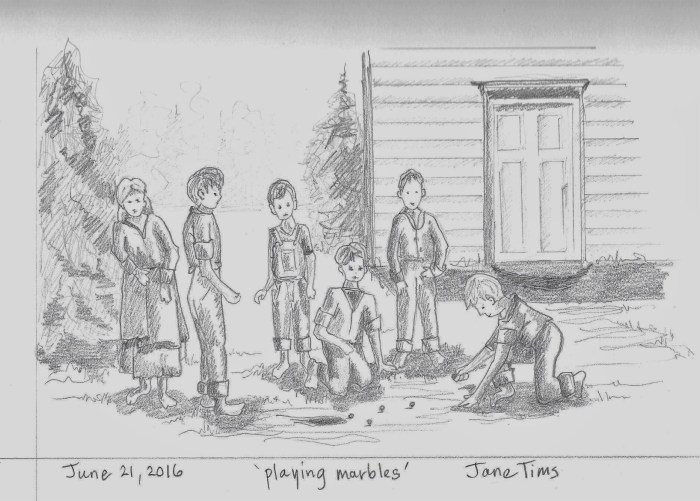
Kids in the school yard have played marbles since the late 1800s, when glass marbles were first produced for the mass market.
~
When my mom talked about marbles, she always referred to them as alleys, no matter what material was used in their construction. According to Wikipedia, alleys were a specific type of marble. Almost every kind of marble has a specific name. When my son played and collected marbles in the 1980s, some of these terms were regularly heard in our home.
aggie – made of agate
alley – a marble made of alabaster
bumblebee – a yellow and black glass marble
cat’s eye – a marble with a eye-like inclusion
crystal – a clear glass marble of various colours
galaxy – opaque marble with coloured dots
oily – an opaque marble with a sheen or oily finish
onionskin – a marble with surface streaks of colour
ox blood – a marble with a streak of dark red
pearl – opaque marble of single colour and a mother of pearl finish
plainsie – a clear glass marble with inclusion of two or more swirled ribbons of colour
swirly – glass marble with a ribbon inclusion of a single colour
tiger – a clear marble with orange and yellow stripes
~
There are lots of other marble types and names.
~
The language of marbles extends to the various moves in the game:
knuckle down – put hand in position to shoot
keepsies – to play for keeps
quitsies – stop playing without consequences
firing – to shoot a marble
~
Such interesting possibilities for the language of a poem!
~
Writing about a game of marbles will include all the senses (I think my poem will be from the point of view of a boy playing marbles):
sound – clinking of dishes in the sink; grinding of marbles together in the marble bag
taste – grit of sand stirred by wind across the playground; grit of raspberry seeds
feel – the cold smooth feel of a marble; a chunk of icicle from the roof in December
smell – stirred dust; girls watching the games, smelling of Ivory soap and well water
sight – bubble rising through the glass of the marble; bubbles with rainbows sliding; dew drops on Lady’s Mantle in the garden
~
I can hardly wait to write a poem about playing marbles in the school yard!
~
~
Copyright 2016 Jane Tims
dancing around the daisy pole
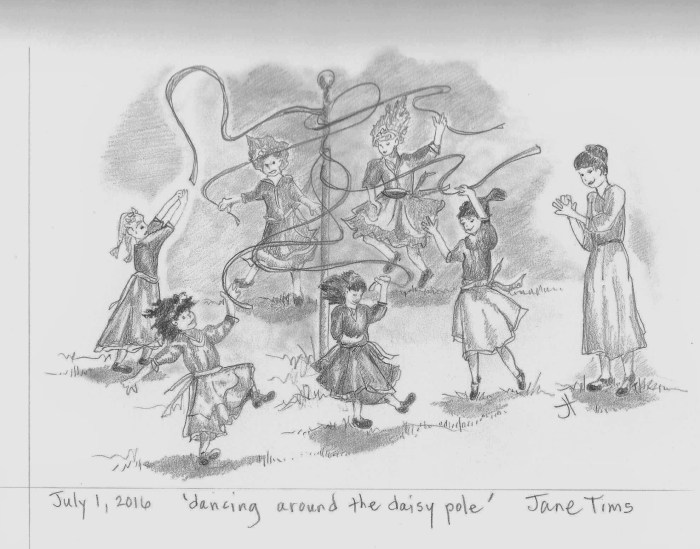
Perhaps strange to talk about a Maypole in July but Maypoles have been used for summer celebrations throughout the years. In the old stereoscope photo below, published by a company in Meadville Pennsylvania and St. Louis Missouri, the Maypole is referred to as a Daisy Pole.
~
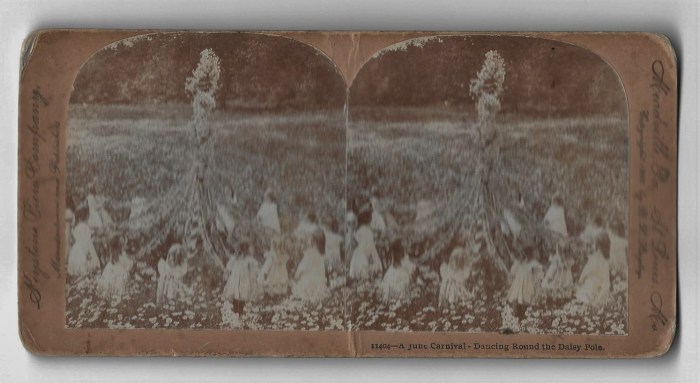
A rather blurry scan of a stereoscopic photo, blurry because it is curved for the viewer. The title of the photo is ‘A June Carnival – Dancing Round the Daisy Pole’ 1900
~
When my Aunt Jane was young, attending a small school in Nova Scotia, field days were held in June. In her book, she recalls participating in a field day:
… I was in grade 1 … we had a “field day”. My dress was made of blue and white crepe paper and, holding on to the end of a white paper streamer, I danced around a May pole. I remember my great embarrassment as a gust of wind took the streamer out of my hand and sent it high in the air to flutter in the breeze …
~

The decorative Maypole we made years ago to celebrate May 1 every year. Through the years, when I needed ribbon, I occasionally snipped a length from the pole, so there are a few short ribbons!
~
~
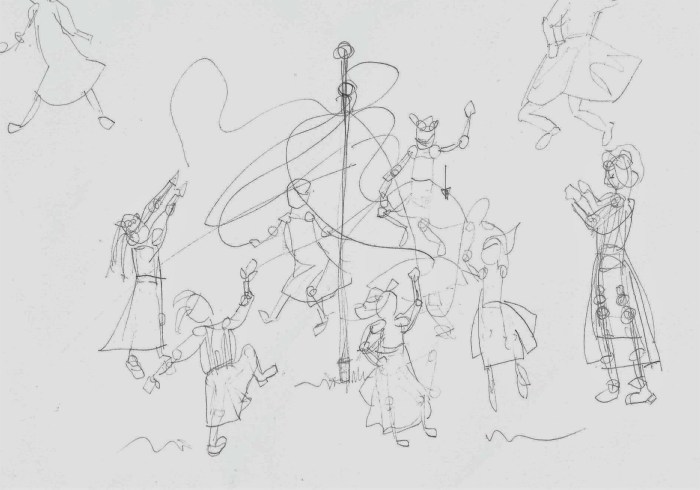
sketch for ‘dancing around the daisy pole’ … in some ways more lively than the final drawing
~
~
Copyright Jane Tims 2016
Hermit thrush
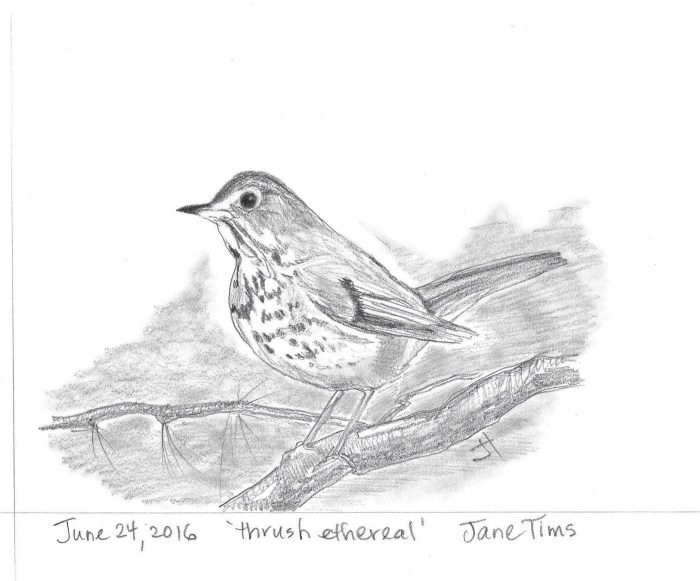
Another surprise in the morning bird chorus — a Hermit thrush. I have been listening for it all spring and at last, this morning, the ethereal notes.
~
~
How to describe the song of the Hermit thrush? T.S. Eliot described it in The Waste Land, in V: What the Thunder Said :
… sound of water over a rock
Where the hermit-thrush sings in the pine trees
Drip drop drip drop drop drop drop …
and
… who is the third who walks always beside you …
and
… In the faint moonlight, the grass is singing
Over the tumbled graves …
~
A technical description of the Hermit thrush song is ‘a beginning note, then several descending musical phrases in a minor key, repeated at different pitches.’
~
The song is clear, flute-like. To me the essential characteristics are the change in pitch at the beginning of the new phrase and the hint of water within. If you watch the Hermit thrush while she is singing, she stands tall, tilts her head back, looks into the distance with her bright black eye, lifts her feathers ever so slightly and opens her beak. Her throat swells a little but otherwise you are left to wonder, where do those notes begin?
~
If her song was another sound, it would be a flute in the forest.
If it was a smell, it would be the sweet scent of mayflowers, as you part the leaves with the back of your hand.
If it was a touch, it would be lifted hairs at the back of your neck.
If it was a taste, it would be syrup drizzled over iced milk.
If it was an image, it would be guttation drops on strawberries.
~
~
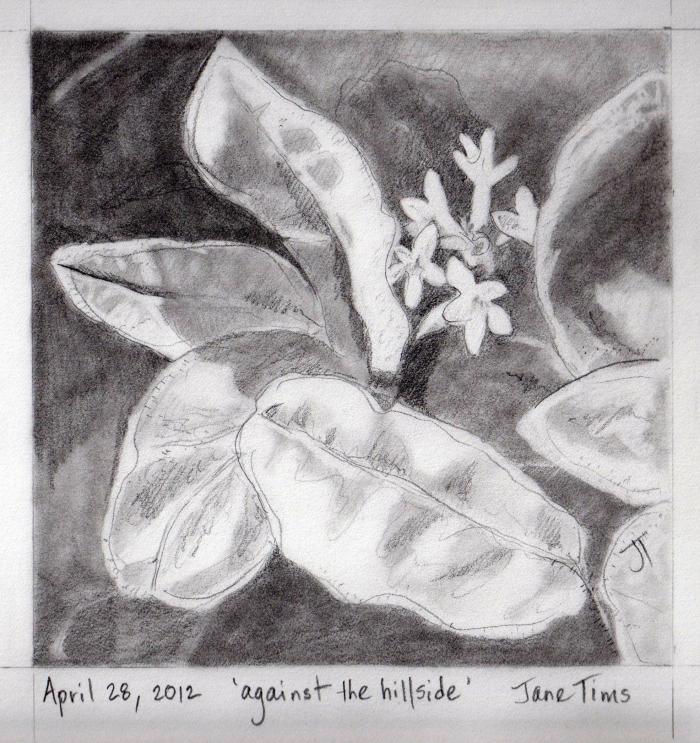
What other words describe the song of the Hermit thrush?
clear
precise
covert
alone
sweet
tremolo
pure
hidden
pensive
thoughtful
thicket
froth on a dancing wave
raindrops trembling on the tips of leaves
the step from rung to rung on a ladder
~
If it was a vowel, it would be every vowel
If it was a consonant, it would be ‘c’, ‘l’, ‘r’, or ‘v’
~
~
Hermit thrush
~
Catharus guttatus
~
neither visceral nor guttural, ethereal
tip-toe in tree tops
air pulled into taffy thread
a flute in the forest
froth on a wave
~
rain trembles on leaf tips
guttation drops on strawberry
a lifted curtain of mayflower
~
I saw you there
hidden in the thicket
and I followed
~
climb the ladder and sing
then step to the rung below
heads up, thoughts of the new day
parting of the beak
pulse at the throat
hairs lift
at the nape
of the neck, fingers
warble the keys
between middle and ring
catharsis
~
~
Copyright 2016 Jane Tims
Mourning dove
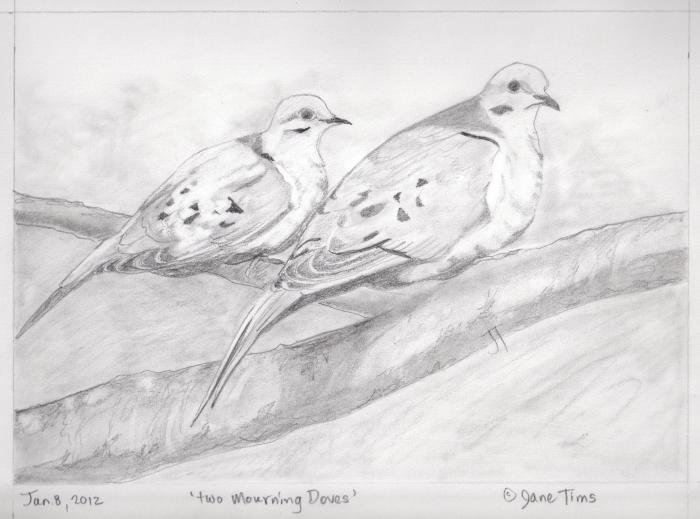
I woke this morning to another new bird in the mix of the morning bird chorus — a Mourning dove. In this area, the Mourning dove is a common bird, seen pecking at seeds beneath feeders or hanging out on the telephone lines. But I haven’t heard one in our grey woods for a while.
~
~
The call of the Mourning dove gives it its name. It begins with a low question and continues in a descending series of coos.
Oh no, no, no, no, no
Dear me, me, me, me, me, me
I decided to try and capture this sound in words.
~
Mourning
Melancholy
Monotonous
Sad
Solemn
Hollow, mellow
A reed, the inside walls of a bottle
An emerald bottle, buried to its neck in the sand
Breath across the mouth of a bottle
A child’s feeble attempt at a whistle
Light and shadow inside a vessel of glass
~
If the call of a mourning dove were a colour it would be amethyst
If the call of a mourning dove were a sound it would be wind blowing down the stairway of a tower
If the call of a mourning dove were a taste it would be chowder, thick and left too long on the fire
If the call of a mourning dove were a touch it would be a wooden shawl, wrapped round and round until it was no longer warm but strangling
If the call of a mourning dove were a song it would be hesitant, riff-driven, repeated over and over
If the call of a mourning dove were a smell it would be the cloying perfume of lilac
~
If it was a vowel, it would be ‘o’ or ‘u’ and sometimes ‘y’
If it was a consonant, it would be ‘m’, ‘n’, ‘r’, or ‘w’
~
Heavy or light
Loud or soft
Tall or short
Sad or happy
Bright or dull
Sharp or dull
Nearby or distant
Solemn or joyous
Spacious or confined
~
So, from all this, a poem. This is the second draft of a poem about the mourning dove which never mentions the bird except in the title.
~
Mourning dove
~
Zenaida macroura
~
wind wakens, descends the stair
notices shadow, gaps in cladding
the hollow of the tower, breath
across the mouth of a bottle
amethyst, buried in sand
~
the reed widened, a solemn song
the riff, the echo, a distant train
expands across the valley
and a child hollows her hand
shapes her lips for a kiss
~
tries to whistle, her breath
a sigh, a puff to cool
the chowder, still simmers
on the fire, thick
and needing stirring
~
potatoes, corn and onions
curdled cream, a woollen shawl wrapped
round and round, warmth tightened
to struggle, viscous as lilac
unable to breathe
~
~
For other posts and poems about the Mourning dove, see https://janetims.com/2012/01/16/keeping-warm/ and https://janetims.com/2015/01/30/for-the-birds/
~
Copyright 2016 Jane Tims
early schools – the exotic and the common
In my Aunt’s book about early schooling in Nova Scotia, she tells an amusing story about field days at school:
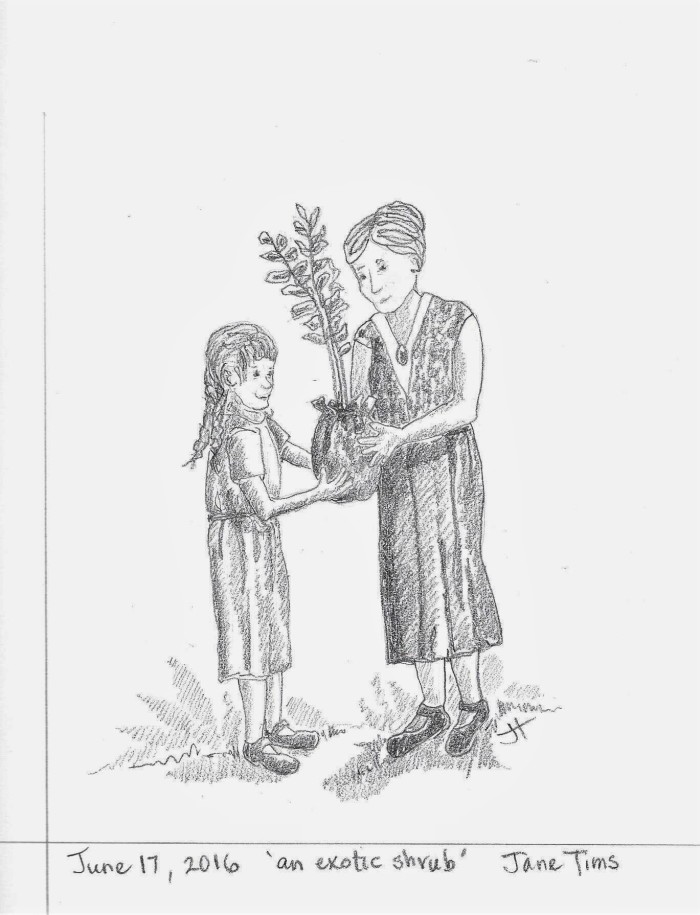
… I recall another field day when Dr. DeWolfe, Miss Harris, and Miss Baker came with shrubs to our school. The shrubs were ten cents each. My mother had always longed for a weigela and a snowball and we were delighted that at last she could have her wish, for both these varieties were among Dr. DeWolf’s collection. They were duly planted at my home on the bank of the French River. One turned out to be a high bush cranberry and the other a spiraea, but today we still refer to them as the “snowball” and “weigela” and, I may mention, they have many an offspring throughout our province.
~
I must have seen the high bush cranberry and spiraea many times at my mother’s old home, but I don’t remember them in particular. I do remember the gardens, lush with rose bushes, tiger lilies, and grape vines.
~
~
Copyright 2016 Jane Tims
Arbour Day in New Brunswick – 1888
In a previous post, I wrote about the importance of trees in the school yard and the celebration of Arbour Day in schools in Nova Scotia during the early 1900s. One room schools in New Brunswick also celebrated Arbour Day.
~
The 1888 Annual Report of the Schools of New Brunswick, by the Chief Superintendent of Education, reports on 1888 Arbour Day celebrations in New Brunswick, years before the first official Arbour Day in Ontario, Canada (1906). The purpose of Arbour Day celebrations in the school was:
~
to encourage the improvement and ornamentation of school grounds and thereby of cultivating on the part of pupils habits of neatness and order, and a taste for the beautiful in nature …
~
In 1888 New Brunswick schools celebrated Arbour Day on May 18. In the whole province, students planted 6,571 trees, 650 shrubs and 393 flower beds!
~
~
Copyright Jane Tims 2016
early schools – the autograph book
A tradition in schools before the 1960s was the autograph book. I had one of these books in the 1960s, but although I collected some autographs, it was considered a quaint activity.
~

two of Jane Margaret Norman’s autograph albums
~
Both my mother and my aunt had autograph books in the 1940s and 1950s. One of my aunt’s albums was from her students when she taught in a one room school.
I also have my great-grandmother’s autograph album with messages from 1885 to 1914. Her name was Mary Jane (Johnson) Clarke. Her daughters (including my grand-mother) wrote in the album in the later years.
~

Mary Jane Johnson Clarke’s autograph album from the 1880s
~
These books are small, rectangular in shape. The covers are heavy stock paper, sometimes flocked. The older albums have embossed leather covers. The albums range in size from about 3″ by 5″ to 7 3/4″ by 4 3/4″ (the oldest books are the largest). Each page of the book held one autograph: the date, a message, saying or poem, perhaps an address and a signature. Males as well as females wrote in the albums. The albums from the 1940s and 1950s have variously coloured pages in now-faded pink, yellow and blue. The pages in my great-grandmother’s album are beige and white.
~
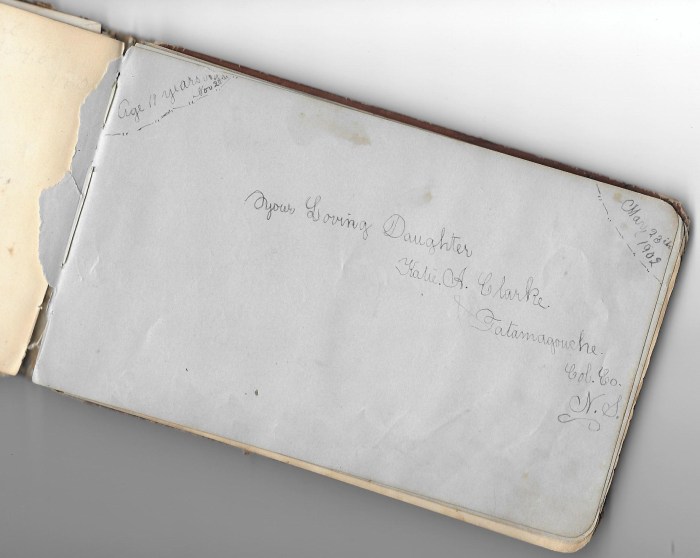
my grandmother’s autograph in my great-grandmother’s autograph album
~
Some of the messages offer serious advice for a good life:
Life is like a mirror
Reflecting what you do
And when you face it smiling
It smiles right back at you
~
Some messages are amusing or even politically incorrect. One from 1947 shows a disturbing flippancy about marital violence:
~
When your husband at you flings
Knives and forks and other things
Seek revenge and seek it soon
In the handle of a broom
~
Some messages are just funny, and seem almost modern:

Great-Aunt Laura Clarke’s autograph in my Great-Grandmother’s autograph album in 1909
~
Since my focus in my ‘old schools’ project will be on the school in the context of the landscape, I was pleased to find one or two messages about landscape!
~
When hills and dales divide us
And distance is our lot
Just cultivate the little flower
That is called forget-me-not
~
And:
~
I’m glad the sky is painted blue
And the earth is painted green
And such a lot of nice fresh air
Is sandwiched in between
~

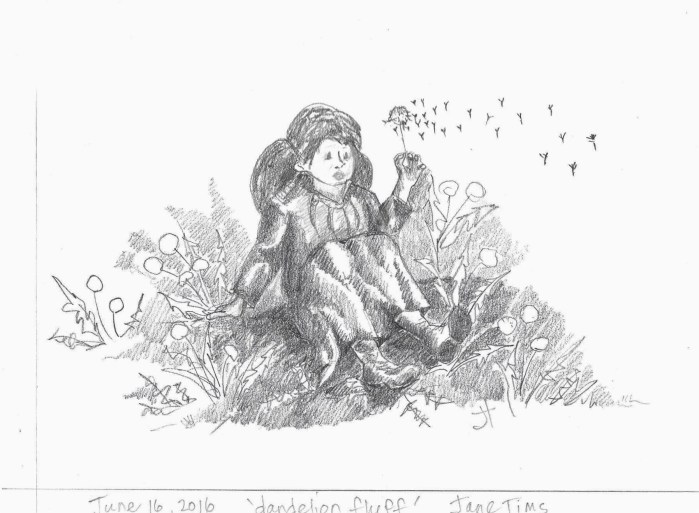
June 8 2016 ‘the autograph’ Jane Tims (Is she writing the autograph for her friend or her doll?)
~
Did you ever have an autograph album? Do you remember any of the verses people wrote?
~
Copyright 2016 JaneTims
early schools – Arbour Day
Trees in the school yard, especially big trees suitable for climbing and swinging, would have been an appreciated feature of the school landscape. On a hot June day, students would have enjoyed the shade under a big tree.
~
In the 1940s and 50s, some of these trees may have been planted sixty years before by students learning about abouriculture. By the early 1900s, there were Arbour Day celebrations in Canada when students planted trees at school and elsewhere in the community. The first official Arbour Day in Canada was established in 1906 by Don Clark of Schomberg, Ontario to remember his wife Margaret.
~
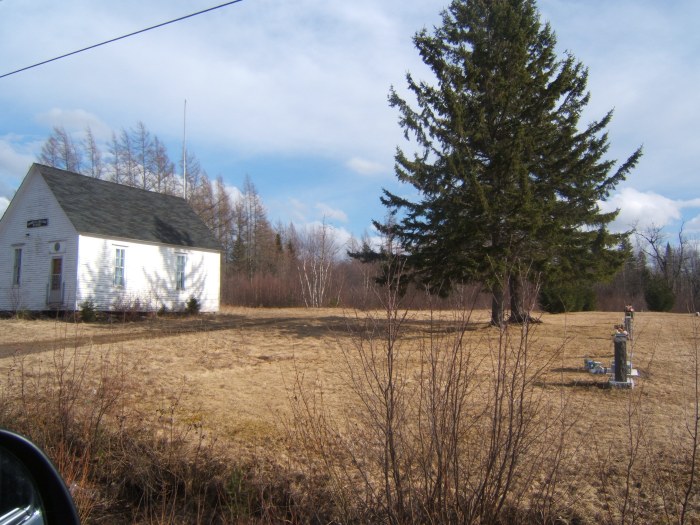
big spruce trees in the yard of the Cumberland Bay School, New Brunswick
~
In Nova Scotia, schools celebrated Arbour Day by 1929 and perhaps before. In May and June that year, officials organized the planting of trees and shrubs in the school yard and involved community members and local dignitaries in the events to encourage their interest in the school system. In 1928, the newspaper Halifax Harald offered, province-wide, a $700 prize for school beautification, which would have included the planting of trees (Jane Norman, Loran Arthur DeWolfe and The Reform of Education in Nova Scotia 1891-1959. Truro, Nova Scotia: Atlantic Early Learning Productions, 1989).
~
The idea of planting trees in school yards continues to this day. Trees are important because they:
- clean our air of pollutants
- remove carbon dioxide, to reduce the contribution to global warming
- prevent soil erosion
- trap water pollutants by directing flow downward
- provide habitat for birds, bees and squirrels
- raise property values
- provide the oxygen we breathe
- provide shade
- make great places for climbing and swinging
~

~
~
Copyright Jane Tims 2016
songs in the grey woods – ovenbird, over and over
This week we had a meeting of our writing group Fictional Friends. We are trying something new – dedicating our whole meeting to one person’s writing. The writer ‘in the spotlight’ talks about writing goals and the problems they encounter. Then they describe their current project, giving a synopsis. They read and the group provides constructive comments. We found this first session helpful for everyone present and we plan another session, with a focus on another writer’s work. I think each member of the group learned something applicable to his or her own writing.
~
This session was held at my house. I left the back screen open, to let in some air. More than air comes in – at a meeting last month, the sound of our next door neighbour’s rooster crowing provided a backdrop to some reading about rural themes. At this week’s meeting, an Ovenbird decided to start singing in the woods behind our house. ‘Teacher, teacher, teacher’ he said, over and over. Perhaps he was making a commentary on our particular way of learning.
~
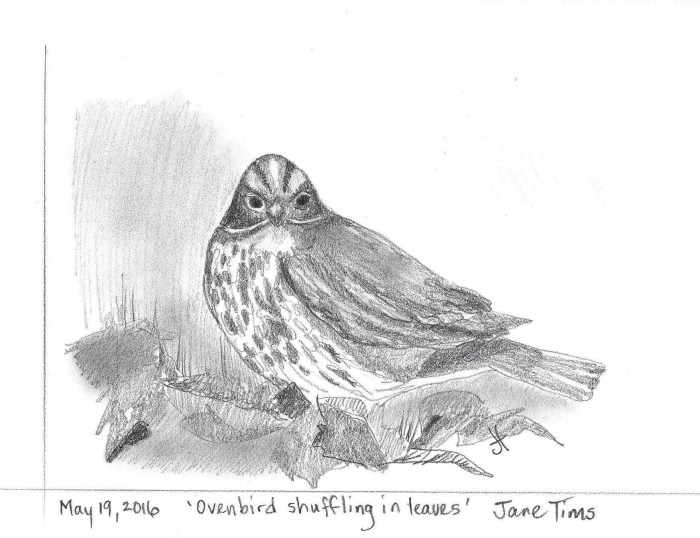
The Ovenbird is a large warbler, olive-brown. He reminds me of a thrust because of his streaked white breast. He has an orange crest, a white ring around each eye, a white throat and a dark line below his cheek. My drawing is from a photo by Ann Gardner, used with permission. http://www.anngardnerphotography.com/
~
~
Do you belong to a writing group? What methods does your group use to help one another?
~
Copyright 2016 Jane Tims
early schools – the rope swing
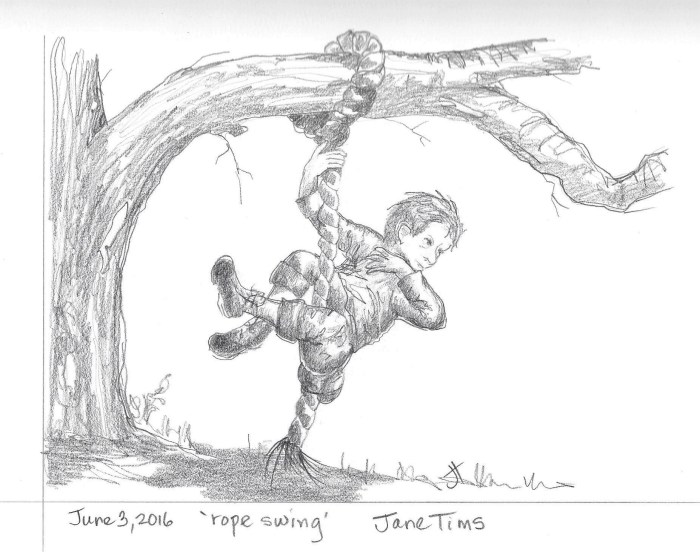
Students in the one room school may have appreciated apple trees growing in the school yard. But there would have been other trees too. A hefty old red maple would have been a good place for a swing. Perhaps a simple rope swing, with a loop over a horizontal tree branch and a big old knot at the end for sitting.
~
~
rope swing
~
lunch hour
best spent
upside down
~
legs wrapped
tight as twist
of hemp
~
splayed ends
of the big knot
trail on the ground
follow hair and
dragging fingers
~
world tipsy-turned
maple branch – a bridge across the sky
other kids stand on their heads
school house and outhouse
hang from the hill
~
~
Copyright 2016 Jane Tims




 nichepoetryandprose